

- Market Size (2026)
- USD 540.4 Mn
- Forecast (2036)
- USD 1315.0 Mn
- CAGR (2026 to 2036)
- 9.3%
How big is Dinner Rolls Market in 2026?
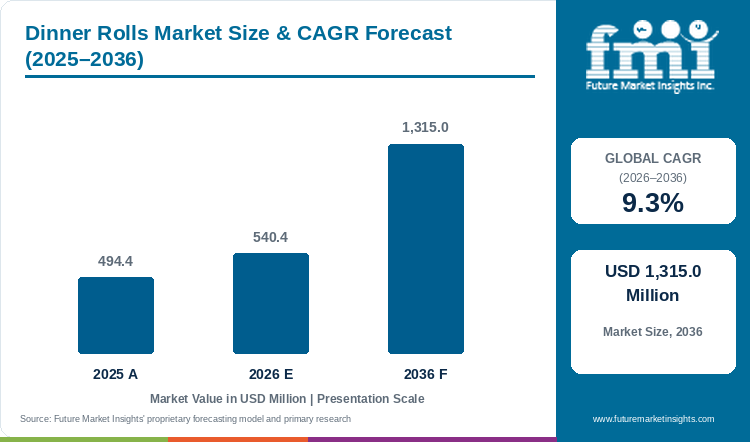
With a valuation of USD 494.4 million in 2025 and moving to USD 540.4 million in 2026, the global dinner rolls market is positioned to attain USD 1,315.0 million by 2036, exhibiting a CAGR of 9.3%.
Household meal habits are moving from seasonal holiday roasts toward weeknight slider sandwiches and quick-bake table bread, which turns commercial dinner roll demand into a year-round grocery and hospitality staple. Wholesale pan-roll bakeries and frozen foodservice commissaries expand global dinner rolls market value beyond USD 494.4 million in 2025 to reach USD 540.4 million in 2026 and a projected 2036 figure of USD 1,315.0 million at a 9.3% compound annual growth rate. To maintain crumb structure across these high-volume lines, October 2026 federal bakery regulation 21 CFR 136.110 requires yeast-leavened rolls and buns to contain at least 62% total solids and meet statutory enrichment levels for B vitamins and iron [1]. Because soft pull-apart clusters serve both family dinner tables and slider occasions, classic / original rolls represent 39.0% of 2026 revenue while bakers broaden assortments in tandem with potato bread and rolls, even as starch retrogradation during ambient shelf display challenges unsaleable return rates.
Key Market Trends & Insights
- By product type: Classic / original rolls secure 39.0% of 2026 category value because interconnected cluster panning preserves crumb softness for family dinners and sliders.
- By claim / nature: Conventional formulations generate 57.0% of 2026 claim / nature revenue through cost-effective enriched wheat flour and dairy-solid dough systems.
- By format: Frozen dinner rolls lead format segmentation with 29.0% of 2026 demand as steakhouses and supermarket bake-off counters eliminate scratch dough mixing.
- By packaging format: Multipack trays and twin-packs account for 27.0% of 2026 packaging turnover by letting families open one sealed cluster tray while keeping the second fresh.
- By sales channel: Supermarkets & hypermarkets generate 35.0% of 2026 grocery and foodservice turnover via high-traffic perimeter bakery tables and rotisserie cross-merchandising.
Regional Highlights
- Top national expansion: The UAE leads country growth at a 10.7% yearly pace over the forecast decade on surging hotel banquet service and aviation flight-kitchen procurement.
- Broader country progression: Saudi Arabia advances at a 10.3% annual pace while the USA records 10.0% and South Korea posts 9.7% due to quick-service slider and par-baked roll adoption.
Market Size & Forecast
Table 1: Market Size and Forecast for the Dinner Rolls Market (USD million and CAGR percentage), 2025 to 2036
| Metric | Value |
|---|---|
| 2025 Market Size | USD 494.4 million |
| Estimated Market Size in 2026 | USD 540.4 million |
| Projected Market Size by 2036 | USD 1,315.0 million |
| CAGR, 2026 to 2036 | 9.3% |
| Added Revenue, 2026 to 2036 | USD 774.6 million |
Year-round positioning of dinner rolls as everyday barbecue and party carriers requires major capital investment in automated pan-cluster capacity and clean-label flavor extensions. Branded bakery leaders are building dedicated high-speed lines to prevent perimeter grocery out-of-stocks during peak summer and autumn entertaining windows. For instance, July 2025 announcements from Governor Brian Kemp's office confirmed that King's Hawaiian is investing USD 54 million to expand its Oakwood, Georgia bakery facility in Hall County and add more than 135 jobs [2]. Expansion of these pull-apart pan lines in concert with golden brioche rolls creates USD 774.6 million in incremental category sales from 2026 to 2036. In April 2026, King's Hawaiian also broadened flavor innovation by releasing limited-edition 12-count Ube Coconut Rolls formulated with no artificial dyes [3].
Commercial Bakery Output and Foodservice Tray Sizing
Table 2: Commercial Output and Pan-Cluster Volume Sizing for the Dinner Rolls Market (kilotonnes and billion units), 2025 to 2036
| Metric | 2025 | 2026 | 2036 |
|---|---|---|---|
| Market size (USD million) | 494.4 | 540.4 | 1,315.0 |
| Commercial dinner roll volume (kilotonnes) | 152.0 to 164.0 | 165.0 to 178.5 | 382.0 to 412.0 |
| Portioned dinner roll units baked (billion rolls) | 3.8 to 4.1 | 4.1 to 4.5 | 9.5 to 10.3 |
| Average wholesale realization per 12-roll tray equivalent (USD) | 1.45 to 1.56 | 1.46 to 1.57 | 1.53 to 1.66 |
Operational note: Unit figures reflect 28-gram to 56-gram portioned table rolls across retail 12-pack trays and bulk foodservice cases.
Health-conscious shoppers who previously avoided white bread baskets are returning to the roll aisle as wholesale bakers introduce organic whole-grain and protein-fortified roll recipes. Higher protein and lower net carbohydrates per roll allow brands to capture stronger wholesale realizations per 12-roll tray while lifting unit volumes from 4.1–4.5 billion rolls in 2026 to 9.5–10.3 billion by 2036. For example, in April 2025, Flowers Foods expanded its branded roll portfolio by introducing organic Sandwich Rolls under the Dave's Killer Bread banner with 8 grams of protein per roll plus Nature's Own Keto buns [4]. On the hospitality side, institutional caterers and steakhouses pair these functional retail offerings with frozen unbaked dough and frozen par-baked rolls to serve warm bread baskets without hiring skilled night-shift bakers.
Per Capita & Institutional Catering Indicators
Table 3: Per Capita and Catering Spending Indicators for the Dinner Rolls Market (USD), 2025 to 2036
| Metric | 2025 | 2026 | 2036 |
|---|---|---|---|
| Global population reference (billion) | 8.2 | 8.3 | 9.0 |
| Spend per 1,000 people (USD) | 60.3 | 65.1 | 146.1 |
| Full-service restaurants, hotels & institutional caterers (million) | 1.6 | 1.7 | 2.6 |
| Annual dinner roll procurement per active dining facility (USD) | 309.0 | 317.9 | 505.8 |
Table 4: Dough Rheology & Thermal Processing Benchmarks for the Dinner Rolls Market (regulatory and technical parameters), 2026
| Metric | Value | Institutional Reference Basis |
|---|---|---|
| Market size, 2026 | USD 540.4 million | 2026 global factory-gate revenue baseline |
| Minimum finished total solids | >= 62.0% w/w | 21 CFR 136.110 statutory identity threshold for rolls |
| Dietary fiber fortification benchmark | 6.0 g fiber per roll (4.0 g per 50 g) | Warburtons January 2026 Fibre Fix roll specification |
| Discrete unit serving weight window | 67% to 200% of federal RACC | 21 CFR 101.9 single-unit roll nutrition declaration |
Moderate retail price inflation in commercial bakery goods compared with meat and dairy proteins is reinforcing the role of dinner rolls as an affordable family meal extender. When household grocery budgets come under pressure, shoppers pair 12-count trays of soft dinner rolls or par-baked bread formats with soups and rotisserie chicken to feed larger groups economically. Specifically, June 2026 USDA Economic Research Service food expenditure data showed that cereal and bakery product retail prices rose just 1.0% in 2025 compared with 2.4% across all food at home [5]. This favorable price stability supports an increase in annual roll procurement per active dining facility from USD 317.9 in 2026 to USD 505.8 by 2036.
Analyst Perspective
"Winning share in the dinner rolls category requires solving two operational challenges simultaneously: giving foodservice operators frozen and par-baked rolls that finish in five minutes without skilled night bakers, and giving grocery shoppers soft pull-apart multipacks that resist crumb firming past day ten using fermented wheat starch and maltogenic amylase rather than synthetic additives."
- Nandini Roy Choudhury, Principal Consultant, Future Market Insights.
How is the dinner rolls market segmented?
Commercial dinner rolls segmentation covers product type; claim / nature; format; packaging format; sales channel; and region.
By product type: Classic / original; whole grain & seeded; flavored & filled; mini & snacking formats; and premium / artisan.
By claim / nature: Conventional; clean label; organic; gluten-free; and high-protein / fortified.
By format: Frozen; fresh; ambient packaged; chilled; and par-baked / thaw-and-serve.
By packaging format: Multipack; single-serve; family / loaf pack; and bulk foodservice.
By sales channel: Supermarkets & hypermarkets; artisan & specialty bakeries; convenience & forecourt; online & DTC; and foodservice distributors.
Why does Classic / original lead the product type category?
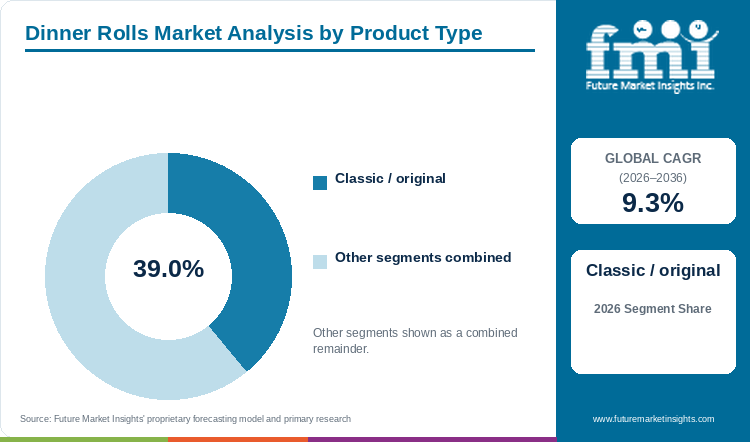
Classic / original dinner rolls generate 39.0% of 2026 product type revenue because soft interconnected pan clusters lock in crumb moisture and transition seamlessly from holiday dinner tables to everyday slider buns.
Table 5: Product Type Share for the Dinner Rolls Market (percentage share), 2026
| Product Type | Share (2026) |
|---|---|
| Classic / original | 39.0% |
| Other Segments Combined | 61.0%* |
| Total | 100.0% |
*Calculated as the balance remaining after deducting the leading segment's reported share from 100.0%.
Table 6: Product Type Leadership and Market Growth for the Dinner Rolls Market (segment and CAGR percentage), 2026 to 2036
| Metric | Value |
|---|---|
| Global CAGR (2026 to 2036) | 9.3% |
| Leading Segment | Classic / original |
Close cluster arrangement of 12 or 24 enriched dough balls inside a baking tray lets adjacent rolls kiss during proofing and oven spring, eliminating side-wall crust dehydration across commercial bakery products. This interconnected cluster structure keeps internal crumb soft for up to two weeks on ambient grocery tables without requiring heavy lipid coatings. Households and catering kitchens therefore purchase classic / original white and sweet pan rolls year-round for mini sandwiches and dinner sides, whereas crusty individual rolls lose moisture within 24 hours if left unpackaged.
- Classic / original pan clusters hold 39.0% of 2026 product type volume through kiss-pan moisture retention and dual usage as table rolls and slider carriers.
- In October 2026, updated federal nutrition labeling rules in 21 CFR 101.9 mandated single-unit serving declarations for discrete bakery rolls weighing between 67% and 200% of the reference amount [6].
Why does Conventional define the largest claim / nature segment?
Conventional dinner rolls account for 57.0% of 2026 claim / nature revenue since high-speed plant bakeries rely on conventional enriched wheat flour and vegetable oil contracts to keep retail tray pricing affordable.
High-throughput pan-roll lines serving mainstream supermarkets and institutional cafeterias depend on conventional wheat grists and enzymatic crumb softeners to hit tight wholesale price targets. Certified organic wheat and organic dairy solids carry steep farm-gate price premiums that push retail 12-pack roll trays above everyday family budgets. While clean-label and organic rolls are expanding in parallel with crusty artisan loaves, conventional recipes retain the majority volume base across retail and catering accounts.
- Conventional roll lines contribute 57.0% of 2026 claim / nature sales due to enriched flour economics and broad institutional catering adoption.
- In July 2025, Grupo Bimbo confirmed in its wellness update that 99% of its everyday bread and bun and roll SKUs exclude artificial flavors and colorants, representing over 70% of net sales in the USA [7].
What keeps Frozen ahead by format?
Frozen dinner rolls hold 29.0% of 2026 format turnover because blast-frozen dough pieces and frozen baked rolls allow restaurant kitchens and supermarket in-store bakeries to eliminate staling waste and night-shift mixing.
Ambient fresh rolls begin firming within 72 hours via amylopectin retrogradation, which creates costly unsaleable stales for grocers and restaurants when dining traffic fluctuates. Blast freezing locks starch structure in place for up to twelve months at minus 18 degrees Celsius so hotel banquet kitchens and grocery bake-off counters can pull exact tray counts to match daily orders. Formulators incorporate functional bakery ingredients to protect yeast viability and crumb volume during freeze-thaw cycles, although cold-storage warehousing and reefer freight add logistics overhead.
- Frozen formats represent 29.0% of 2026 format volume as hospitality and in-store bakery operators replace scratch mixing with zero-waste freezer inventory.
- For instance, in February 2025, Vandemoortele expanded its Italian and European frozen bakery platform by acquiring frozen bakery specialist Lizzi to strengthen its foodservice roll and pastry network [8].
Why does Multipack lead the packaging format category?
Multipack formats capture 27.0% of 2026 packaging revenue by bundling twin 12-count trays or divided freshness pouches that protect unused rolls from air exposure and top-crust crushing.
Soft yeast dinner rolls and laminated butter croissants lose crumb tenderness rapidly once a single large bag is unsealed in a household kitchen. Twin paperboard baking trays sealed inside divided barrier overwraps let families open one 6-roll or 12-roll tray for a weeknight meal while keeping the second tray factory-sealed. Rigid paperboard trays also prevent top-crust crushing when route drivers stack multipacks on perimeter display tables.
- Multipack units claim 27.0% of 2026 packaging turnover through crush-resistant tray geometry and split-pack freshness protection.
- In March 2026, Warburtons rolled out a modernized packaging identity across more than 70 bakery SKUs to improve on-shelf visibility for multipack rolls and loaves [9].
What gives Supermarkets & hypermarkets the leading position in sales channel?
Supermarkets & hypermarkets generate 35.0% of 2026 channel sales by positioning dinner roll display tables directly beside hot rotisserie chickens and holiday promotional end-caps.
Grocery perimeter merchandising pairs 12-count and 24-count roll trays in protective bread bags with hot prepared proteins, driving high-frequency impulse attachment on weeknights as well as fourth-quarter holiday peaks. In-store bake-off ovens further reinforce supermarket leadership by supplying warm crusty rolls throughout afternoon shopping hours. Independent bakeries lack the national direct-store-delivery route density required to match supermarket promotional volumes.
- Supermarkets & hypermarkets secure 35.0% of 2026 sales channel revenue through perimeter deli cross-displays and in-store bake-off stations.
- To illustrate, in February 2025, Flowers Foods strengthened its grocery bakery presence by completing the acquisition of Simple Mills across more than 30,000 retail doors [10].
What are the drivers, restraints, and opportunities in the dinner rolls market?
In the dinner rolls market, year-round slider entertaining and clean-label fermented shelf-life extenders propel growth, whereas starch retrogradation staling and bakery labor shortages challenge plant margins.
- Driver: De-seasonalization of sweet and brioche dinner rolls into everyday slider and barbecue carriers lifts weekly grocery turnover.
- Restraint: Rapid amylopectin retrogradation and mold growth in preservative-free rolls increase supermarket unsaleable returns.
- Opportunity: Replacing synthetic calcium propionate with fermented wheat starch and sourdough cultures unlocks clean-label retail and foodservice tenders.
Growth Analysis and Future Potential: Qualitative Demand Catalysts
Retailers demanding clean-label ingredient lists are pushing wholesale roll bakers to eliminate synthetic calcium propionate (E 282) without sacrificing 14-day ambient shelf life across dinner rolls and packaged sweet muffins. Elimination of chemical mold inhibitors previously caused rapid spoilage in soft high-moisture rolls, creating a need for natural fermented preservation systems. For instance, in July 2025 Manildra Group launched GemMate, a 100% fermented wheat starch ingredient that naturally inhibits mold and replaces synthetic calcium propionate in white breads and wholemeal rolls [11]. Bakers are also using spontaneous sourdough fermentation to improve crumb softness and nutrition. In October 2025, *Journal of Food Science* experiments confirmed that incorporating 20% whole-wheat or intermediate-wheatgrass sourdough maintained bread volume and crumb softness while elevating dietary fiber [12].
Risk Assessment of the Dinner Rolls Market: Operational and Formulation Friction
Weather-driven swings in domestic milling wheat harvests and acute shortages of skilled bakery technicians create ongoing margin friction for commercial roll manufacturers. When domestic wheat quality drops due to heavy rainfall, millers and bakers must import higher-priced high-protein milling wheat to prevent dough slackening on high-speed pan dividers. In fact, July 2025 UK DEFRA agricultural statistics documented that the 2024 UK wheat harvest fell 20% to 11.1 million tonnes due to wet autumn planting weather, forcing milling wheat imports up 81% to 3.0 million tonnes [13]. To insulate operations against raw-material and labor bottlenecks, multinational bakery groups are investing in automated high-throughput bun and roll plants, as demonstrated in January 2026 when ARYZTA commissioned a EUR 40 million bakery facility in Portugal [14].
Commercial Opportunity Analysis: Formulation Differentiation and Value-Add Formats
Public-health campaigns targeting national dietary fiber deficits have created a lucrative opportunity for bakers to fortify soft dinner rolls with soluble and insoluble cereal fibers. Shoppers frequently reject dense wholemeal loaves for children's meals but readily accept soft pull-apart rolls that conceal added dietary fiber inside a tender crumb. In January 2026, Warburtons demonstrated commercial execution with its Fibre Fix roll and loaf launch providing 6.0 grams of dietary fiber per roll, supported by a corporate pledge that 60% of its bakery range will be fiber-enriched by 2030 [15].
Dinner Rolls Market by Country (2026 to 2036)
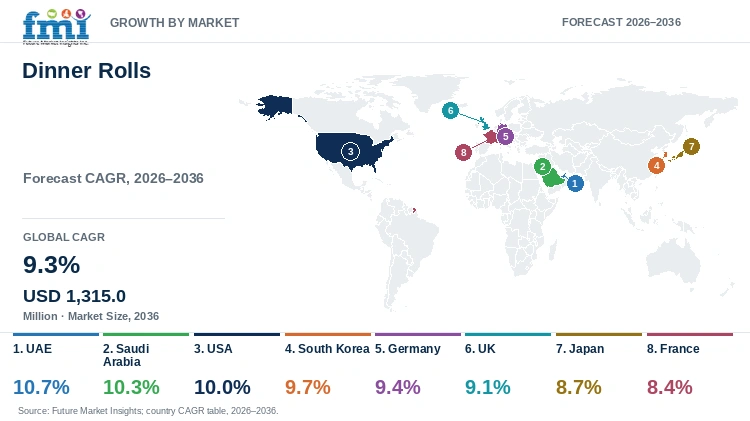
National growth is paced by a 10.7% CAGR in the UAE and 10.3% in Saudi Arabia through 2036, while the USA records 10.0% and South Korea reaches 9.7%.
Table 7: Country CAGR and Primary Growth Levers for the Dinner Rolls Market (CAGR percentage and operational drivers), 2026 to 2036
| Country | CAGR (2026 to 2036) | Primary Growth Lever |
|---|---|---|
| UAE | 10.7% | Aviation flight-kitchen trays, luxury hotel banquet catering, and over 570 local food processors |
| Saudi Arabia | 10.3% | USD 57 billion retail grocery expansion, quick-service slider chains, and hospitality catering |
| USA | 10.0% | Year-round sweet Hawaiian and organic slider rolls, USD 54M bakery capacity expansion, and steakhouse service |
| South Korea | 9.7% | Home air-fryer frozen roll bake-off, KRW 111.9 trillion food processing base, and convenience slider packs |
| Germany | 9.4% | Supermarket in-store Brötchen bake-off stations, USD 323.8B retail food market, and seeded whole-grain rolls |
| UK | 9.1% | USD 133B foodservice sandwich/bakery demand, fiber-fortified soft rolls, and brioche slider upgrades |
| Japan | 8.7% | USD 286B retail food market, ultra-soft butter table rolls, and convenience store chilled slider packs |
| France | 8.4% | Institutional catering petit pain contracts, supermarket brioche slider packs, and sourdough fermentation |
Source: Future Market Insights analysis
UAE Dinner Rolls Market Outlook (2026 to 2036)
Aviation flight kitchens in Dubai and Abu Dhabi and luxury hotel banquet halls require millions of portion-calibrated 35-gram Kaiser and brioche dinner rolls engineered to stay soft in high-altitude warming ovens. In August 2026, the USDA Foreign Agricultural Service reported that more than 570 food and beverage manufacturers now operate in the UAE under the National Food Security Strategy 2051 and the UAE Food Cluster [16]. Propelled by this expanding domestic commissary base and international catering demand, dinner roll sales in the UAE climb at a 10.7% annual clip through 2036. However, summer ambient temperatures exceeding 42 degrees Celsius accelerate starch staling and lipid oxidation, forcing distributors to rely on chilled delivery vans.
Key takeaway: In the UAE, aviation flight-kitchen demand and domestic food-processing expansion generate a leading 10.7% CAGR through 2036.
Saudi Arabia Dinner Rolls Market Outlook (2026 to 2036)
Homegrown quick-service burger and slider concepts coupled with modern hypermarket bakeries in Riyadh and Jeddah are driving rapid adoption of soft potato and milk cluster rolls across Saudi Arabia. Supported by these dining and retail shifts, Saudi Arabia dinner roll turnover pushes upward at a 10.3% annual rate from 2026 to 2036. Specifically, in August 2026, Saudi Arabia Retail Foods Annual reports from the USDA Foreign Agricultural Service documented that the Kingdom's food retail sector totaled USD 57 billion in 2025 while imported retail food shipments rose 22% in the first half of 2026 [17]. Even so, commercial bakers must formulate exclusively with Halal-certified microbial enzymes and zero-trans vegetable shortenings to pass Saudi customs and retail audits.
Key takeaway: In Saudi Arabia, USD 57 billion retail grocery scale and quick-service slider expansion sustain a 10.3% CAGR through 2036.
USA Dinner Rolls Market Outlook (2026 to 2036)
Year-round household consumption of sweet Hawaiian and organic pull-apart rolls for sliders and backyard barbecues propels the USA dinner rolls market at a 10.0% CAGR through 2036. Unlike European markets where crusty bake-off rolls dominate, grocery shoppers in the USA favor pillowy kiss-panned clusters merchandised on perimeter tables beside rotisserie chicken. Major domestic investments—including King's Hawaiian's USD 54 million Georgia line expansion and Flowers Foods' organic Sandwich Rolls under Dave's Killer Bread—directly expand perimeter supply across the USA. Yet acute shortages of night-shift restaurant bakers and state-level bans on synthetic dyes force suppliers to reformulate glazes and scale frozen par-baked banquet cases.
Key takeaway: In the USA, year-round slider consumption and major domestic roll-line investments generate a 10.0% CAGR through 2036.
South Korea Dinner Rolls Market Outlook (2026 to 2036)
High penetration of countertop air fryers in urban apartments has transformed how households in South Korea prepare frozen par-baked milk and butter dinner rolls (`moning-ppang`) at home. E-commerce cold-chain platforms and bakery cafes across Seoul package soft tangzhong dinner rolls in resealable multipack pouches for five-minute home warming. In May 2026, food-processing statistics from the USDA Foreign Agricultural Service documented that South Korea's food and beverage manufacturing sector generated KRW 111.9 trillion (USD 82.1 billion) in annual sales while relying on imported milling wheat and specialty dairy ingredients [18]. Anchored by this cold-chain retail infrastructure and home bake-off convenience, South Korea dinner roll revenue achieves a 9.7% annual growth rate between 2026 and 2036, though imported wheat and butter duties pressure manufacturer margins.
Key takeaway: In South Korea, air-fryer frozen roll adoption and cold-chain e-commerce delivery support a 9.7% CAGR through 2036.
Germany Dinner Rolls Market Outlook (2026 to 2036)
Daily consumption of crusty wheat and seeded table rolls (`Brötchen`) dispensed from automated supermarket self-service bake-off stations distinguishes Germany from soft-pan-roll markets. Powered by these in-store bake-off counters, the dinner rolls market in Germany records a 9.4% yearly expansion over the 10-year forecast period. In September 2026, USDA Foreign Agricultural Service Germany Retail Foods data valued Germany's retail food sector at USD 323.8 billion, marked by intense private-label competition and strong demand for organic and clean-label baked goods [19]. Industrial frozen-dough suppliers deliver pre-proofed spelt and wheat dinner rolls directly to supermarket ovens, although high industrial electricity tariffs in Germany weigh on proofing and blast-freezing costs.
Key takeaway: In Germany, automated supermarket bake-off stations across a USD 323.8 billion grocery market sustain a 9.4% CAGR through 2036.
UK Dinner Rolls Market Outlook (2026 to 2036)
Supermarkets and gastro-pub chains in the UK have upgraded standard burger and dinner occasions with glazed French-style brioche slider rolls and fiber-fortified soft batch rolls. In December 2025, USDA Foreign Agricultural Service UK foodservice reporting confirmed that the UK hotel and restaurant sector reached USD 133 billion in 2025 led by coffee shops and bakery-cafe chains [20]. Supported by this out-of-home dining recovery and supermarket perimeter premiumization, UK dinner roll revenues advance at a 9.1% CAGR over the 2026 to 2036 forecast period. However, domestic wheat harvest volatility and strict retail sodium targets compel UK plant bakers to blend imported high-protein wheat with fermented wheat starch.
Key takeaway: In the UK, USD 133 billion foodservice demand and fiber-enriched retail roll launches deliver a 9.1% CAGR through 2036.
Japan Dinner Rolls Market Outlook (2026 to 2036)
Single-person and dual-income households in Japan prioritize ultra-soft butter table rolls (`bataa rooru`) and chilled convenience-store slider packs that require zero kitchen preparation. This convenience-driven demand supports an 8.7% yearly expansion across Japan from 2026 through 2036. For instance, in September 2026, USDA Foreign Agricultural Service Japan Retail Foods Annual figures confirmed that retail food and beverage turnover in Japan totaled USD 286 billion in 2025 on rising demand for convenient meal items [21]. Yamazaki Baking consolidated financial disclosures through June 2026 further verify steady domestic sales of soft table rolls [22], even though Japan's aging population and strict day-code freshness rules require frequent small-lot store deliveries.
Key takeaway: In Japan, convenience-driven grocery spending and ultra-soft sponge-and-dough table rolls drive an 8.7% CAGR through 2036.
France Dinner Rolls Market Outlook (2026 to 2036)
While neighborhood *boulangeries* in France capture daily baguette traffic, institutional catering kitchens and hypermarket aisles generate strong demand for individual *petit pain* table rolls and packaged brioche slider rolls. French industrial bakers increasingly utilize sourdough pre-ferments (`pâte fermentée`) and reduced-sodium formulas across school and hospital canteen contracts. In July 2025, USDA Foreign Agricultural Service exporter guidance noted that France imported USD 1.05 billion in specialty agricultural goods in 2024 while expanding clean-label and organic bakery assortments [23]. Driven by these institutional catering contracts and weekend entertaining multipacks, the market in France achieves an 8.4% CAGR between 2026 and 2036, despite strict national salt-reduction pledges.
Key takeaway: In France, institutional petit pain catering and clean-label brioche multipacks support an 8.4% CAGR through 2036.
Full report country CAGRs cover: North America; Latin America; Western Europe; Eastern Europe; East Asia; South Asia and Pacific; Middle East and Africa.
Who are the notable companies in the dinner rolls market?
Grupo Bimbo, Flowers Foods, Aryzta, Lantmannen Unibake, Vandemoortele, Yamazaki Baking, Warburtons, King's Hawaiian, Europastry, and St Pierre Groupe lead commercial dinner roll production across retail and foodservice channels.
Market leadership in the dinner rolls sector connects sweet pull-apart and brioche perimeter brand captains with national wholesale direct-store-delivery bakers and international frozen foodservice manufacturers.
- Sweet Pull-Apart & Brioche Brand Captains: Branded sweet Hawaiian rolls from King's Hawaiian and French brioche clusters from St Pierre Groupe command premium supermarket perimeter tables.
- Wholesale Plant Bakery & Direct-Store-Delivery Leaders: High-speed pan-roll lines operated by Yamazaki Baking and Grupo Bimbo and Warburtons and Flowers Foods supply national grocery chains.
- Frozen & Par-Baked Foodservice Specialists: Aryzta and Lantmannen Unibake along with Vandemoortele and Europastry supply blast-frozen dough balls and five-minute bake-off rolls to hospitality kitchens.
Competitive Benchmarking: Dinner Rolls Market
Table 8: Competitive Benchmarking for the Dinner Rolls Market (qualitative capability ratings), 2026
| Company | Classic, Whole-Grain & Brioche Breadth | Frozen & Par-Baked Capability | Supermarket & Foodservice Reach | Geographic Reach |
|---|---|---|---|---|
| Grupo Bimbo | High | High | High | High |
| Flowers Foods | High | Medium | High | Medium |
| Aryzta | High | High | High | High |
| Lantmannen Unibake | High | High | High | High |
| Vandemoortele | High | High | High | High |
| Yamazaki Baking | High | Medium | High | Medium |
| Warburtons | High | Medium | High | Medium |
| King's Hawaiian | High | Medium | High | Medium |
| Europastry | High | High | High | High |
| St Pierre Groupe | High | Medium | High | High |
Evaluation framework: Benchmarks reflect commercial pan-roll and brioche assortment depth plus blast-frozen par-baked engineering and grocery perimeter distribution.
Key Developments in the Dinner Rolls Market
- In July 2025, King's Hawaiian committed USD 54 million to expand its Oakwood, Georgia bakery with a new production line in Q2 2026 and launched dye-free Ube Coconut Rolls in April 2026.
- In April 2025, Flowers Foods rolled out organic Sandwich Rolls under Dave's Killer Bread and Nature's Own Keto buns following its February 2025 acquisition of Simple Mills.
- In October 2026, Vandemoortele completed its Délifrance merger after acquiring Italian frozen bakery specialist Lizzi in February 2025, creating a 41-plant frozen and par-baked bakery leader.
Key Players in the Dinner Rolls Market
Branded Sweet & Brioche Perimeter Roll Leaders
- King's Hawaiian
- St Pierre Groupe
Wholesale Plant Bakery & Direct-Store-Delivery Leaders
- Grupo Bimbo
- Flowers Foods
- Yamazaki Baking
- Warburtons
Frozen & Par-Baked Foodservice Bakery Platforms
- Aryzta
- Lantmannen Unibake
- Vandemoortele
- Europastry
Dinner Rolls Market - Report Scope
Table 9: Report Scope for the Dinner Rolls Market (coverage fields and definitions), 2026 to 2036
| Coverage field | Report scope |
|---|---|
| Market breakdown | Product Type; Claim / Nature; Format; Packaging Format; Sales Channel; Region |
| Quantitative Units | USD Million |
| Market Definition | Commercial factory-gate and in-store bakery sales of portion-baked classic/original, whole grain & seeded, flavored & filled, mini & snacking, and premium/artisan dinner rolls across frozen, fresh, ambient packaged, chilled, and par-baked formats (>=62% total solids). |
| Regions Covered | North America; Latin America; Western Europe; Eastern Europe; East Asia; South Asia and Pacific; Middle East and Africa |
| Countries Covered | UAE, Saudi Arabia, USA, South Korea, Germany, UK, Japan, France, and 35+ additional countries |
| Key Companies Covered | Grupo Bimbo, Flowers Foods, Aryzta, Lantmannen Unibake, Vandemoortele, Yamazaki Baking, Warburtons, King's Hawaiian, Europastry, St Pierre Groupe |
| Forecast Period | 2026 to 2036 (Base Year: 2025) |
| Approach | Bottom-up commercial pan-line and frozen bake-off volume aggregation cross-validated against USDA ERS/FAS retail and foodservice audits and corporate financial filings |
Dinner Rolls Market - Research Methodology
Table 10: Research Methodology for the Dinner Rolls Market (research methods and approach), 2026 edition
| Method | Approach |
|---|---|
| Primary Research | Structured interviews with wholesale bakery plant managers, in-store bakery category directors, frozen par-baked foodservice distributors, and enzyme formulation specialists across North America, Europe, the Middle East, and Asia. |
| Secondary Research | Direct verification of 21 CFR 136.110 bread/roll standards, 21 CFR 101.9 discrete-unit nutrition rules, USDA ERS and FAS retail/foodservice reports, PubMed sourdough studies, and official company press releases. |
| Market Sizing and Forecasting | Bottom-up aggregation of frozen, fresh, ambient packaged, chilled, and par-baked dinner roll tray and case realizations from 2025 through 2036. |
| Country Forecasting Model | Country-level demand modeling weighted by quick-service slider adoption, hotel/aviation catering volume, supermarket perimeter bakery space, and household air-fryer penetration. |
| Operational Benchmark Traceability | Verification of >=62% total solids compliance, single-unit serving weight windows, and dietary fiber fortification benchmarks against statutory and corporate technical disclosures. |
| Data Triangulation and Validation | Reconciliation of retail grocery bakery turnover with public financial and press disclosures from King's Hawaiian, Flowers Foods, Grupo Bimbo, Aryzta, Vandemoortele, Warburtons, and Yamazaki Baking. |
Dinner Rolls Market by Segments
Dinner Rolls Market segmented by Product Type:
- Classic / original
- Whole grain & seeded
- Flavored & filled
- Mini & snacking formats
- Premium / artisan
Dinner Rolls Market segmented by Claim / Nature:
- Conventional
- Clean label
- Organic
- Gluten-free
- High-protein / fortified
Dinner Rolls Market segmented by Format:
- Frozen
- Fresh
- Ambient packaged
- Chilled
- Par-baked / thaw-and-serve
Dinner Rolls Market segmented by Packaging Format:
- Multipack
- Single-serve
- Family / loaf pack
- Bulk foodservice
Dinner Rolls Market segmented by Sales Channel:
- Supermarkets & hypermarkets
- Artisan & specialty bakeries
- Convenience & forecourt
- Online & DTC
- Foodservice distributors
Dinner Rolls Market by Region
- North America
- USA
- Canada
- Latin America
- Brazil
- Mexico
- Argentina
- Chile
- Western Europe
- Germany
- France
- UK
- Italy
- Spain
- Benelux
- Nordics
- Eastern Europe
- Poland
- Czech Republic
- Romania
- Hungary
- East Asia
- China
- Japan
- South Korea
- South Asia and Pacific
- India
- ASEAN
- Australia and New Zealand
- Middle East and Africa
- GCC Countries (UAE, Saudi Arabia)
- South Africa
- Türkiye
- Israel
Research Sources and Bibliography
- [1] National Archives and Records Administration. (2026, October 15). 21 CFR 136.110 -- Bread, rolls, and buns. - eCFR. Electronic Code of Federal Regulations, Title 21 Part 136.
- [2] Office of the Governor of Georgia. (2025, July 17). Gov. Kemp: King's Hawaiian to Invest $54 Million in Hall County Expansion | Governor Brian P. Kemp Office of the Governor. State of Georgia Official Press Releases.
- [3] King's Hawaiian Holding Co., Inc. (2026, April 29). Ube Coconut Rolls | King's Hawaiian. King's Hawaiian Official Product Releases.
- [4] Flowers Foods, Inc. (2025, April 16). Flowers Foods Launches New Products and Line Expansions to Meet Consumer Needs - Flowers Foods. Flowers Foods Official News Releases.
- [5] U.S. Department of Agriculture, Economic Research Service. (2026, June 1). Ag and Food Statistics: Charting the Essentials - Food Prices and Spending | Economic Research Service. USDA Economic Research Service.
- [6] National Archives and Records Administration. (2026, October 20). 21 CFR 101.9 -- Nutrition labeling of food. - eCFR. Electronic Code of Federal Regulations, Title 21 Part 101.
- [7] Grupo Bimbo, S.A.B. de C.V. (2025, July 29). We are committed to removing artificial colorants from all our products by the end of 2026 | Grupo Bimbo. Grupo Bimbo Official Press Releases.
- [8] Vandemoortele NV. (2025, February 14). Corporate | Vandemoortele. Vandemoortele Official Corporate Newsroom.
- [9] Warburtons Ltd. (2026, March 30). Packaging Redesign Unveiled | News | Warburtons. Warburtons Official Corporate Newsroom.
- [10] Flowers Foods, Inc. (2025, February 21). FLOWERS FOODS, INC. COMPLETES ACQUISITION OF SIMPLE MILLS - Flowers Foods. Flowers Foods Official News Releases.
- [11] Manildra Group. (2025, July 9). Natural Ingredient Reduces Food Waste - Manildra Group. Manildra Group Official Newsroom.
- [12] Iorga, B., Trinetta, V., Boyacioglu, M. H., & Karkle, E. (2025, October 15). Functionality of Intermediate Wheatgrass (Thinopyrum intermedium) in Spontaneous Sourdough Fermentation and Bread Quality. Journal of Food Science, 90(10), e70607 (PubMed NCBI).
- [13] Department for Environment, Food & Rural Affairs. (2025, July 10). Chapter 7: Crops - GOV.UK. Agriculture in the United Kingdom Official Statistics.
- [14] ARYZTA AG. (2026, January 22). News – ARYZTA. ARYZTA AG Official Corporate Newsroom.
- [15] Warburtons Ltd. (2026, January 22). Fibre Black Holes | News | Warburtons. Warburtons Official Corporate Newsroom.
- [16] U.S. Department of Agriculture, Foreign Agricultural Service. (2026, August 4). United Arab Emirates: Food Processing Ingredients Annual | USDA Foreign Agricultural Service. USDA Foreign Agricultural Service GAIN Report.
- [17] U.S. Department of Agriculture, Foreign Agricultural Service. (2026, August 31). Saudi Arabia: Retail Foods Annual | USDA Foreign Agricultural Service. USDA Foreign Agricultural Service GAIN Report.
- [18] U.S. Department of Agriculture, Foreign Agricultural Service. (2026, May 27). South Korea: Food Processing Ingredients Annual | USDA Foreign Agricultural Service. USDA Foreign Agricultural Service GAIN Report.
- [19] U.S. Department of Agriculture, Foreign Agricultural Service. (2026, September 25). Germany: Retail Foods Annual | USDA Foreign Agricultural Service. USDA Foreign Agricultural Service GAIN Report.
- [20] U.S. Department of Agriculture, Foreign Agricultural Service. (2025, December 31). United Kingdom: Food Service - Hotel Restaurant Institutional Annual. USDA Foreign Agricultural Service GAIN Report.
- [21] U.S. Department of Agriculture, Foreign Agricultural Service. (2026, September 28). Japan: Retail Foods Annual | USDA Foreign Agricultural Service. USDA Foreign Agricultural Service GAIN Report.
- [22] Yamazaki Baking Co., Ltd. (2026, June 30). YAMAZAKI BAKING Co., Ltd. Yamazaki Baking Investor Relations Financial Results.
- [23] U.S. Department of Agriculture, Foreign Agricultural Service. (2025, July 3). France: Exporter Guide Annual | USDA Foreign Agricultural Service. USDA Foreign Agricultural Service GAIN Report.
This bibliography is provided for reader reference and is not exhaustive. The full report contains the complete reference list and primary research documentation.
This Report Answers
- What is the 2026 revenue baseline for dinner rolls and how much will sales grow by 2036?
- How are year-round slider occasions and frozen bake-off lines reshaping dinner roll demand?
- Why do Classic / original pan clusters retain the top spot in product type?
- What keeps conventional enriched doughs ahead in the claim / nature breakdown?
- How does dinner roll expansion compare between Gulf aviation hubs and Western European grocers?
- Which wholesale and frozen bakery companies lead commercial dinner roll production?
- How do amylopectin staling and baker shortages affect commercial dinner roll margins?
- What shelf-life and frozen recovery benchmarks matter most to grocery and restaurant buyers?
Frequently Asked Questions
How big is the dinner rolls market in 2026, and what is forecast for 2036?
Global dinner rolls turnover stands at USD 540.4 million in 2026 above the USD 494.4 million recorded in 2025 and will reach USD 1,315.0 million by 2036.
What is the CAGR for the dinner rolls market from 2026 to 2036?
Category sales progress at a 9.3% compound annual growth rate from 2026 to 2036, creating USD 774.6 million in net expansion.
Which product type segment leads the dinner rolls market?
Classic / original rolls command 39.0% of 2026 product type volume because soft cluster-panned rolls retain internal moisture and serve both dinner table and slider occasions.
Which claim / nature segment leads the dinner rolls market?
Conventional recipes represent 57.0% of 2026 claim / nature revenue through cost-efficient enriched wheat flour and dairy-solid formulations across mainstream grocery trays.
Which country has a notable growth outlook during the assessment period?
The UAE tops country growth with a 10.7% annual expansion through 2036 on the strength of airline flight-kitchen trays and luxury hotel banquet demand.
Who are the key players in the market?
Key producers include Grupo Bimbo; Flowers Foods; Aryzta; Lantmannen Unibake; Vandemoortele; Yamazaki Baking; Warburtons; King's Hawaiian; Europastry; and St Pierre Groupe.
Preview the report firsthand - request a free sample
Get SampleGet the brochure for pricing and purchase details.
Get PDFTable of Content
- Key Takeaways
- Market Size and CAGR
- Top Growth Driver
- Fastest Growing Segment
- Leading Region
- Key Companies
- Emerging Opportunities
- Executive Summary
- Global Market Outlook
- Demand-side Trends
- Supply-side Trends
- Technology Roadmap Analysis
- Analysis and Recommendations
- Analyst Perspective (What is happening? Why now? What should investors know?)
- Key Questions Answered
- How large is the market?
- What is the CAGR?
- What are key trends?
- Which region dominates?
- Who are the leaders?
- Market Overview
- Market Coverage / Taxonomy
- Market Definition / Scope / Limitations
- Research Methodology
- Chapter Orientation
- Analytical Lens and Working Hypotheses
- Market Structure, Signals, and Trend Drivers
- Benchmarking and Cross-market Comparability
- Market Sizing, Forecasting, and Opportunity Mapping
- Research Design and Evidence Framework
- Desk Research Programme (Secondary Evidence)
- Expert Input and Fieldwork (Primary Evidence)
- Tooling, Models, and Reference Databases
- Data Engineering and Model Build
- Quality Assurance and Audit Trail
- Market Background
- Market Dynamics (Drivers, Restraints, Opportunity, Trends)
- Scenario Forecast (Optimistic, Likely, Conservative)
- Impact Analysis
- AI Impact
- Sustainability Impact
- Regulatory Impact
- Technology Impact
- Consumer / Buyer Analysis
- Purchase Drivers
- Adoption Barriers
- Buyer Journey
- Opportunity Map Analysis
- Product Life Cycle Analysis
- Supply Chain Analysis
- Investment Feasibility Matrix
- Value Chain Analysis
- PESTLE and Porter's Analysis
- Regulatory Landscape
- Regional Parent Market Outlook
- Production and Consumption Statistics
- Import and Export Statistics
- Global Market Analysis and Forecast, 2021 to 2036
- Historical Market Size Value (USD Million) Analysis, 2021 to 2025
- Current and Future Market Size Value (USD Million) Projections, 2026 to 2036
- Y-o-Y Growth Trend Analysis
- Absolute $ Opportunity Analysis
- Global Market Pricing Analysis, 2021 to 2036
- Global Market Analysis and Forecast, By Product Type, 2021 to 2036
- Introduction / Key Findings
- Historical Market Size Value (USD Million) Analysis By Product Type, 2021 to 2025
- Current and Future Market Size Value (USD Million) Analysis and Forecast By Product Type, 2026 to 2036
- Classic / original
- Whole grain & seeded
- Flavored & filled
- Mini & snacking formats
- Premium / artisan
- Y-o-Y Growth Trend Analysis By Product Type, 2021 to 2025
- Absolute $ Opportunity Analysis By Product Type, 2026 to 2036
- Global Market Analysis and Forecast, By Claim / Nature, 2021 to 2036
- Introduction / Key Findings
- Historical Market Size Value (USD Million) Analysis By Claim / Nature, 2021 to 2025
- Current and Future Market Size Value (USD Million) Analysis and Forecast By Claim / Nature, 2026 to 2036
- Conventional
- Clean label
- Organic
- Gluten-free
- High-protein / fortified
- Y-o-Y Growth Trend Analysis By Claim / Nature, 2021 to 2025
- Absolute $ Opportunity Analysis By Claim / Nature, 2026 to 2036
- Global Market Analysis and Forecast, By Format, 2021 to 2036
- Introduction / Key Findings
- Historical Market Size Value (USD Million) Analysis By Format, 2021 to 2025
- Current and Future Market Size Value (USD Million) Analysis and Forecast By Format, 2026 to 2036
- Frozen
- Fresh
- Ambient packaged
- Chilled
- Par-baked / thaw-and-serve
- Y-o-Y Growth Trend Analysis By Format, 2021 to 2025
- Absolute $ Opportunity Analysis By Format, 2026 to 2036
- Global Market Analysis and Forecast, By Packaging Format, 2021 to 2036
- Introduction / Key Findings
- Historical Market Size Value (USD Million) Analysis By Packaging Format, 2021 to 2025
- Current and Future Market Size Value (USD Million) Analysis and Forecast By Packaging Format, 2026 to 2036
- Multipack
- Single-serve
- Family / loaf pack
- Bulk foodservice
- Y-o-Y Growth Trend Analysis By Packaging Format, 2021 to 2025
- Absolute $ Opportunity Analysis By Packaging Format, 2026 to 2036
- Global Market Analysis and Forecast, By Sales Channel, 2021 to 2036
- Introduction / Key Findings
- Historical Market Size Value (USD Million) Analysis By Sales Channel, 2021 to 2025
- Current and Future Market Size Value (USD Million) Analysis and Forecast By Sales Channel, 2026 to 2036
- Supermarkets & hypermarkets
- Artisan & specialty bakeries
- Convenience & forecourt
- Online & DTC
- Foodservice distributors
- Y-o-Y Growth Trend Analysis By Sales Channel, 2021 to 2025
- Absolute $ Opportunity Analysis By Sales Channel, 2026 to 2036
- Global Market Analysis and Forecast, By Region, 2021 to 2036
- Introduction
- Historical Market Size Value (USD Million) Analysis By Region, 2021 to 2025
- Current Market Size Value (USD Million) Analysis and Forecast By Region, 2026 to 2036
- North America
- Latin America
- Western Europe
- Eastern Europe
- East Asia
- South Asia and Pacific
- Middle East and Africa
- Market Attractiveness Analysis By Region
- North America Market Analysis and Forecast, By Country, 2021 to 2036
- Historical Market Size Value (USD Million) Trend Analysis By Market Taxonomy, 2021 to 2025
- Market Size Value (USD Million) Forecast By Market Taxonomy, 2026 to 2036
- By Country
- USA
- Canada
- By Product Type
- By Claim / Nature
- By Format
- By Packaging Format
- By Sales Channel
- By Country
- Market Attractiveness Analysis
- By Country
- By Product Type
- By Claim / Nature
- By Format
- By Packaging Format
- By Sales Channel
- Key Takeaways
- Latin America Market Analysis and Forecast, By Country
- Historical Market Size Value (USD Million) Trend Analysis By Market Taxonomy, 2021 to 2025
- Market Size Value (USD Million) Forecast By Market Taxonomy, 2026 to 2036
- By Country
- Brazil
- Mexico
- Argentina
- Chile
- By Product Type
- By Claim / Nature
- By Format
- By Packaging Format
- By Sales Channel
- By Country
- Market Attractiveness Analysis
- By Country
- By Product Type
- By Claim / Nature
- By Format
- By Packaging Format
- By Sales Channel
- Key Takeaways
- Western Europe Market Analysis and Forecast, By Country
- Historical Market Size Value (USD Million) Trend Analysis By Market Taxonomy, 2021 to 2025
- Market Size Value (USD Million) Forecast By Market Taxonomy, 2026 to 2036
- By Country
- Germany
- France
- UK
- Italy
- Spain
- Benelux
- Nordics
- By Product Type
- By Claim / Nature
- By Format
- By Packaging Format
- By Sales Channel
- By Country
- Market Attractiveness Analysis
- By Country
- By Product Type
- By Claim / Nature
- By Format
- By Packaging Format
- By Sales Channel
- Key Takeaways
- Eastern Europe Market Analysis and Forecast, By Country
- Historical Market Size Value (USD Million) Trend Analysis By Market Taxonomy, 2021 to 2025
- Market Size Value (USD Million) Forecast By Market Taxonomy, 2026 to 2036
- By Country
- Poland
- Czech Republic
- Romania
- Hungary
- By Product Type
- By Claim / Nature
- By Format
- By Packaging Format
- By Sales Channel
- By Country
- Market Attractiveness Analysis
- By Country
- By Product Type
- By Claim / Nature
- By Format
- By Packaging Format
- By Sales Channel
- Key Takeaways
- East Asia Market Analysis and Forecast, By Country
- Historical Market Size Value (USD Million) Trend Analysis By Market Taxonomy, 2021 to 2025
- Market Size Value (USD Million) Forecast By Market Taxonomy, 2026 to 2036
- By Country
- China
- Japan
- South Korea
- By Product Type
- By Claim / Nature
- By Format
- By Packaging Format
- By Sales Channel
- By Country
- Market Attractiveness Analysis
- By Country
- By Product Type
- By Claim / Nature
- By Format
- By Packaging Format
- By Sales Channel
- Key Takeaways
- South Asia and Pacific Market Analysis and Forecast, By Country
- Historical Market Size Value (USD Million) Trend Analysis By Market Taxonomy, 2021 to 2025
- Market Size Value (USD Million) Forecast By Market Taxonomy, 2026 to 2036
- By Country
- India
- ASEAN
- Australia and New Zealand
- By Product Type
- By Claim / Nature
- By Format
- By Packaging Format
- By Sales Channel
- By Country
- Market Attractiveness Analysis
- By Country
- By Product Type
- By Claim / Nature
- By Format
- By Packaging Format
- By Sales Channel
- Key Takeaways
- Middle East and Africa Market Analysis and Forecast, By Country
- Historical Market Size Value (USD Million) Trend Analysis By Market Taxonomy, 2021 to 2025
- Market Size Value (USD Million) Forecast By Market Taxonomy, 2026 to 2036
- By Country
- GCC Countries (UAE, Saudi Arabia)
- South Africa
- Türkiye
- Israel
- By Product Type
- By Claim / Nature
- By Format
- By Packaging Format
- By Sales Channel
- By Country
- Market Attractiveness Analysis
- By Country
- By Product Type
- By Claim / Nature
- By Format
- By Packaging Format
- By Sales Channel
- Key Takeaways
- Key Countries Market Analysis
- USA
- Pricing Analysis
- Market Share Analysis, 2025
- By Product Type
- By Claim / Nature
- By Format
- By Packaging Format
- By Sales Channel
- Canada
- Pricing Analysis
- Market Share Analysis, 2025
- By Product Type
- By Claim / Nature
- By Format
- By Packaging Format
- By Sales Channel
- Mexico
- Pricing Analysis
- Market Share Analysis, 2025
- By Product Type
- By Claim / Nature
- By Format
- By Packaging Format
- By Sales Channel
- Brazil
- Pricing Analysis
- Market Share Analysis, 2025
- By Product Type
- By Claim / Nature
- By Format
- By Packaging Format
- By Sales Channel
- Chile
- Pricing Analysis
- Market Share Analysis, 2025
- By Product Type
- By Claim / Nature
- By Format
- By Packaging Format
- By Sales Channel
- Germany
- Pricing Analysis
- Market Share Analysis, 2025
- By Product Type
- By Claim / Nature
- By Format
- By Packaging Format
- By Sales Channel
- UK
- Pricing Analysis
- Market Share Analysis, 2025
- By Product Type
- By Claim / Nature
- By Format
- By Packaging Format
- By Sales Channel
- Italy
- Pricing Analysis
- Market Share Analysis, 2025
- By Product Type
- By Claim / Nature
- By Format
- By Packaging Format
- By Sales Channel
- Spain
- Pricing Analysis
- Market Share Analysis, 2025
- By Product Type
- By Claim / Nature
- By Format
- By Packaging Format
- By Sales Channel
- France
- Pricing Analysis
- Market Share Analysis, 2025
- By Product Type
- By Claim / Nature
- By Format
- By Packaging Format
- By Sales Channel
- India
- Pricing Analysis
- Market Share Analysis, 2025
- By Product Type
- By Claim / Nature
- By Format
- By Packaging Format
- By Sales Channel
- ASEAN
- Pricing Analysis
- Market Share Analysis, 2025
- By Product Type
- By Claim / Nature
- By Format
- By Packaging Format
- By Sales Channel
- Australia and New Zealand
- Pricing Analysis
- Market Share Analysis, 2025
- By Product Type
- By Claim / Nature
- By Format
- By Packaging Format
- By Sales Channel
- China
- Pricing Analysis
- Market Share Analysis, 2025
- By Product Type
- By Claim / Nature
- By Format
- By Packaging Format
- By Sales Channel
- Japan
- Pricing Analysis
- Market Share Analysis, 2025
- By Product Type
- By Claim / Nature
- By Format
- By Packaging Format
- By Sales Channel
- South Korea
- Pricing Analysis
- Market Share Analysis, 2025
- By Product Type
- By Claim / Nature
- By Format
- By Packaging Format
- By Sales Channel
- Poland
- Pricing Analysis
- Market Share Analysis, 2025
- By Product Type
- By Claim / Nature
- By Format
- By Packaging Format
- By Sales Channel
- Hungary
- Pricing Analysis
- Market Share Analysis, 2025
- By Product Type
- By Claim / Nature
- By Format
- By Packaging Format
- By Sales Channel
- Türkiye
- Pricing Analysis
- Market Share Analysis, 2025
- By Product Type
- By Claim / Nature
- By Format
- By Packaging Format
- By Sales Channel
- South Africa
- Pricing Analysis
- Market Share Analysis, 2025
- By Product Type
- By Claim / Nature
- By Format
- By Packaging Format
- By Sales Channel
- UAE
- Pricing Analysis
- Market Share Analysis, 2025
- By Product Type
- By Claim / Nature
- By Format
- By Packaging Format
- By Sales Channel
- Saudi Arabia
- Pricing Analysis
- Market Share Analysis, 2025
- By Product Type
- By Claim / Nature
- By Format
- By Packaging Format
- By Sales Channel
- USA
- Market Structure Analysis
- Competition Dashboard
- Competition Benchmarking
- Market Share Analysis of Top Players
- By Regional
- By Product Type
- By Claim / Nature
- By Format
- By Packaging Format
- By Sales Channel
- Emerging Startups
- Innovation Benchmarking
- Competition Analysis
- Competition Deep Dive
- Grupo Bimbo
- Overview
- Product Portfolio
- Profitability by Market Segments
- Sales Footprint
- Strategy Overview
- Marketing Strategy
- Product Strategy
- Channel Strategy
- Flowers Foods
- Aryzta
- Lantmannen Unibake
- Vandemoortele
- Yamazaki Baking
- Warburtons
- King's Hawaiian
- Europastry
- St Pierre Groupe
- Grupo Bimbo
- Case Studies
- Success Stories
- Recent Developments
- Competition Deep Dive
- Assumptions & Acronyms Used


