

- Market Size (2026)
- USD 394.0 Mn
- Forecast (2036)
- USD 666.7 Mn
- CAGR (2026 to 2036)
- 5.4%
How Big is the Dissolvable Unit-Dose Pods Market in 2026?
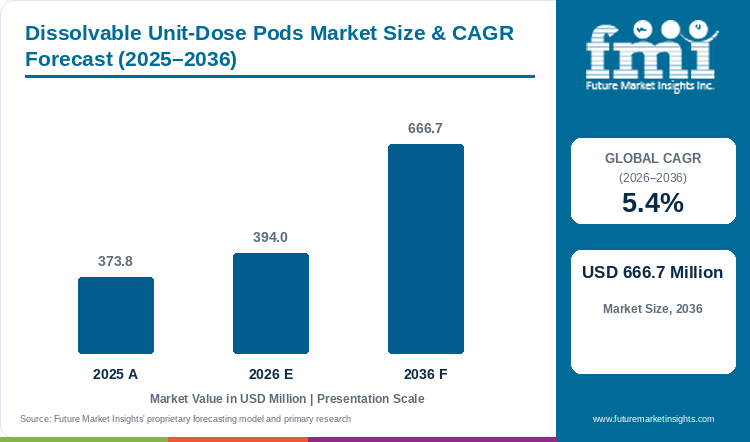
The dissolvable unit-dose pods market is worth USD 394.0 Million in 2026, up from USD 373.8 Million in 2025, and is projected to reach USD 666.7 Million by 2036 at a 5.4% CAGR.
The dissolvable unit-dose pods market is worth USD 394.0 Million in 2026, and according to FMI, sales are projected to reach USD 666.7 Million by 2036 at a 5.4% CAGR. On the market size chart, the 2025 actual of USD 373.8 Million stands against the 2036 forecast, with USD 272.7 Million added after 2026.
Demand for dissolvable unit-dose pods in Europe is now set by Regulation (EU) 2026/405, which entered into force on 22 March 2026 and replaced the 2004 detergents rules [1]. The revised rules require the films around 70% of detergent tablets and capsules to become biodegradable within six years [2]. Laundry pods film, with 37% of demand by product type in 2026, faces the largest switch. Brands are expected to move European laundry and dish volumes to tested biodegradable grades within that window, so compliant film gains orders and untested grades lose EU listings. Germany and France are projected at 5.6% and 4.9% CAGR through 2036 as the switch runs inside existing retail programs. Sales of dissolvable PVOH detergent pods are projected to rise from USD 13.2 Billion in 2026 to USD 23.9 Billion by 2036, widening the filled-pod base covered by these rules.
Key Takeaways
- Key players operating in the dissolvable unit-dose pods market include Huhtamaki, Mondi Group, Sonoco, Graphic Packaging, Stora Enso, Smurfit Westrock and International Paper.
- Laundry pods film carries 37% of demand by product type in 2026. EU film biodegradability rules will shape the next round of laundry film orders.
- Stiff, print-ready virgin kraft & SBS board holds 37% of demand by material in 2026, protecting moisture-sensitive pods on retail shelves.
- The UAE is projected to post the fastest growth at 6.8% CAGR through 2036. Saudi Arabia follows at 6.5% as Gulf plastic-reduction policy and new recycling capacity favor fiber outer packs.
Analyst Perspective
“Brand owners selling pods in Europe should prepare film test files now, since Regulation (EU) 2026/405 gives detergent capsules six years to move to biodegradable film. Laundry pods film holds 37% of demand by product type in 2026, and brands requalifying laundry film first will protect shelf space through 2036.”
- Nikhil Kaitwade, Principal Consultant, Future Market Insights
How is the Dissolvable Unit-Dose Pods Market Segmented?
The dissolvable unit-dose pods market is divided into product type, material, format size, end use, sales channel and region.
As per FMI, product types in the study are divided into laundry pods film, dish pods film, personal care pods, and agricultural and industrial pods. Materials are split into virgin kraft and SBS, recycled fiber, molded pulp and barrier-coated fiber. Format sizes cover standard retail, small unit packs, and bulk and transit packs. End use spans food and foodservice, beverage, e-commerce and retail, personal care and pharma, and industrial buyers. Sales are tracked across direct brand contracts, packaging distributors and online B2B channels. Country estimates reach beyond the eight profiled markets to more than 30 countries in seven world regions.
Why Does Laundry Pods Film Lead the Dissolvable Unit-Dose Pods Market by Product Type?
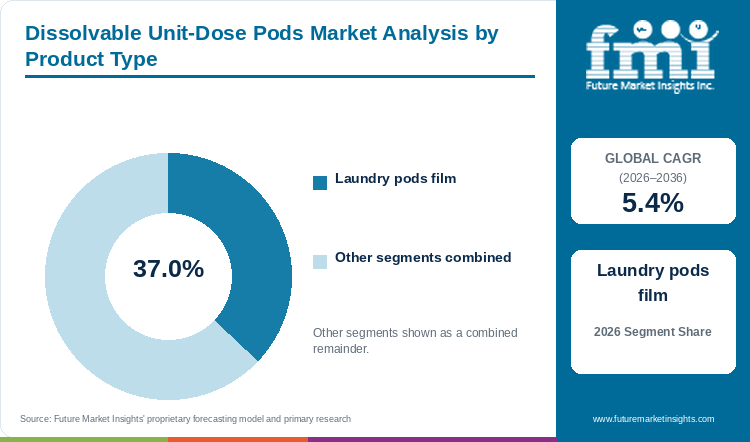
Laundry pods film takes the largest product type share in 2026, at 37%.
Laundry pods film leads the product type category with 37% of demand in 2026, as detergent brands buy one film grade for large retail laundry programs. The revised EU detergent rules give the films around most tablets and capsules six years to become biodegradable, so laundry brands face the largest requalification volume [2]. Dish pods film follows the same dosing habit on a smaller household base, and personal care and agricultural pods need separate film approvals for each product.
- Laundry brands are expected to place the first large biodegradable film orders, as one approved grade can cover many pack counts.
- In April 2026, an American Cleaning Institute survey found 38% of U.S. households using packets, pods or sheets [3].
Why Does Virgin Kraft & SBS Lead the Dissolvable Unit-Dose Pods Market by Material?
Virgin kraft & SBS covers 37% of demand by material in 2026.
Virgin kraft & SBS accounts for 37% of demand by material in 2026, as pod brands choose stiff, print-ready board for cartons and sleeves. Recycled fiber follows in second place, but brands buying recycled board often pay for extra surface or strength treatment to match virgin stiffness on high-speed lines. Molded pulp stays with trays and inserts, and barrier-coated fiber needs a recyclability check in each destination market before brands switch.
- Board mills selling both virgin and recycled grades are expected to gain as packaging fee schedules push brands to compare the two on cost per tonne.
- In September 2025, Stora Enso introduced Ensovelvet, a premium uncoated solid bleached sulfate paperboard for consumer packaging [4].
Why Does Standard Retail Lead the Dissolvable Unit-Dose Pods Market by Format Size?
Standard retail packs account for 42% of demand by format size in 2026.
Standard retail packs take 42% of demand by format size in 2026, because supermarket shoppers buy laundry and dishwasher pods in tubs and pouches holding several weeks of doses. Small unit packs carry fewer doses per sale, and bulk and transit formats serve a smaller base of foodservice and industrial buyers.
- Child-resistant closure tests on retail tubs and pouches are expected to set the supplier shortlist for new laundry listings through 2036.
- Regulation (EU) 2026/405 on detergents and surfactants entered into force on 22 March 2026, replacing the 2004 detergents rules [1].
Why Does Food & Foodservice Lead the Dissolvable Unit-Dose Pods Market by End Use?
Food & foodservice buyers form the largest end-use group in 2026, at 35% of demand.
Food & foodservice is the largest end-use buyer group at 35% of demand in 2026, as kitchens buy pre-portioned ingredients and measured cleaning doses to cut preparation steps. In August 2025, Mondi listed instant coffee sticks, pod overwraps and tea sachets among the uses for FunctionalBarrier Paper Ultimate [5]. Beverage doses need stronger aroma and moisture barriers, and personal care and pharma buyers face stricter product checks, so both groups add volume at a slower pace.
- Kitchen operators are expected to favour suppliers with complete food-contact files, cutting approval time for each new account.
- Mondi tied the August 2025 ramp-up to a EUR 16 million investment at the Solec plant in Poland [5].
Why Do Direct Brand Contracts Lead the Dissolvable Unit-Dose Pods Market by Sales Channel?
Direct brand contracts control 46% of sales by channel in 2026.
Because brand owners qualify film, board and packing-line settings in one joint program, direct brand contracts hold 46% of demand by sales channel in 2026. Packaging engineers agree film gauge, seal behavior and print with the supplier before the first order, so repeat orders stay with the qualified converter. Packaging distributors serve mainly smaller accounts and replenishment orders, and online B2B carries standard items needing no custom testing.
- Converters able to run trials on the brand's own line are expected to gain most new direct contracts through 2036.
- In July 2026, Graphic Packaging launched PaceSetter Ridgeline uncoated recycled paperboard for folding cartons and laminations [6].
What are the Drivers, Restraints, and Opportunities in the Dissolvable Unit-Dose Pods Market?
According to FMI, pre-measured dosing and the EU film biodegradability deadline are supporting sales of dissolvable unit-dose pods through 2036. Film and pack qualification is slowing conversion, and biodegradable film in recyclable fiber packs offers the largest new revenue pool.
- Driver: Brand owners are moving household dosing to unit doses, so repeat orders for film and outer packs are increasing.
- Restraint: Each new film needs humidity, seal and dissolution tests on the brand's line, so supplier changes move slowly.
- Opportunity: The EU six-year deadline for biodegradable capsule film opens new supply contracts for tested film grades in recyclable fiber packs.
Producer fees in the UK are pushing brands to review the outer packs around unit-dose pods. PackUK set 2025 to 2026 base fees at £196 per tonne for paper and card, £423 for plastic and £461 for fiber-based composite packaging [7]. Composite outer packs face the highest charge, so mono-material paper and board formats are gaining preference in pod cartons. Paper suppliers in the barrier coated papers market are projected to grow from USD 4.0 Billion in 2026 to USD 7.4 Billion by 2036. The folding carton and paperboard packaging market is projected to rise at 5.3% CAGR through 2036 on the same move to board. Film makers are scaling grades covered in the water-soluble films market, set to grow from USD 0.6 Billion in 2026 to USD 1.1 Billion by 2036.
Qualification slows every change of film or pack, as a film needs to resist humidity during filling and storage and still dissolve fully in the wash. Brands repeat these tests for each new film and pack, and the EU biodegradability deadline adds a fresh round of trials for laundry grades [2]. Suppliers offering dissolution data, seal tests and closure trials together are expected to shorten the route to repeat orders, a pattern also seen across the water-soluble packaging market. Retail volumes in the water soluble detergent pods market, projected to reach USD 228.4 Million by 2035, will follow the pace of these approvals.
Which Country CAGRs are Profiled in the Dissolvable Unit-Dose Pods Market?
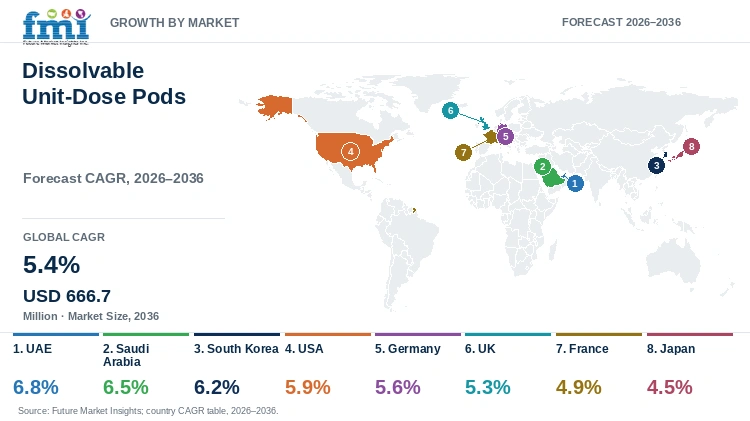
| Country | CAGR, 2026 to 2036 |
|---|---|
| UAE | 6.8% |
| Saudi Arabia | 6.5% |
| South Korea | 6.2% |
| USA | 5.9% |
| Germany | 5.6% |
| UK | 5.3% |
| France | 4.9% |
| Japan | 4.5% |
How do Country-level CAGRs Compare in the Dissolvable Unit-Dose Pods Market?
FMI's country CAGR chart runs from the UAE at 6.8% down to Japan at 4.5% through 2036. The UAE, Saudi Arabia and South Korea form the fast group, projected to grow at 6.2% or above by 2036 on plastic-reduction policy and new recycling routes. Gulf growth starts from a smaller revenue base, so a faster rate does not mean larger country revenue. Germany, the UK and France are expected to grow between 4.9% and 5.6% during the forecast period, as EU film rules and UK packaging fees reshape existing laundry programs. The USA is projected at 5.9% CAGR through 2036, and fiber pack adoption across the water soluble pods and capsules packaging market is projected at 8.1% CAGR through 2035.
- The UAE is projected to grow at 6.8% CAGR through 2036. Single-use plastic bans are raising the need for fiber outer packs.
- New recycling capacity will support fiber-based pod formats in Saudi Arabia, at 6.5% CAGR by 2036.
- South Korea is expected to post 6.2% CAGR during the forecast period as packaging EPR adds recyclability evaluation to each pack.
- Packet safety and closure checks will shape growth in the USA, projected at 5.9% CAGR through 2036.
- Demand in Germany will rise at 5.6% CAGR by 2036. PPWR design rules and the EU capsule film deadline will reshape German laundry programs.
- The UK is projected to expand at 5.3% CAGR during the forecast period under material-based producer-responsibility fees.
- France is forecast to grow at 4.9% CAGR through 2036, guided by national plastic reduction and recycling targets.
- Japan is set for the slowest rate at 4.5% CAGR by 2036. Brands in Japan prefer careful, step-by-step material changes for pod packs.
Beyond these eight profiles, the full report sizes more than 30 countries grouped into seven regions.
Country Outlook
- Local action on single-use plastics in Dubai is moving pod brands toward fiber outer packs with barrier and food-contact data. As a result, the UAE is projected at 6.8% CAGR through 2036, the fastest rate among the profiled countries.
- The Vision 2030 Annual Report 2025 recorded 145 recycling facilities and 18% waste diversion from landfills in Saudi Arabia in 2025 [8]. Wider collection gives buyers a recovery route for fiber-based pod packs, and Saudi Arabia is projected at 6.5% CAGR by 2036.
- South Korea is projected at 6.2% CAGR through 2036. Packaging EPR and recyclability evaluation call for clear material declarations before a pod pack moves from pilot to full listing, so suppliers with complete declarations reach repeat contracts faster.
- Adoption of tested child-resistant outer packs is the first supplier check in the large retail laundry programs of the USA. Closure-tested converters are expected to gain the larger programs, with demand projected at 5.9% CAGR by 2036.
- Around 5.5 million tonnes of packaging waste from dual systems were recycled in Germany in 2024, and plastic material recycling reached 70% [9]. A mature collection system tests each pod pack against existing sorting streams, keeping growth at 5.6% CAGR during the forecast period.
- Paper and card carry a £196 per tonne base fee in the UK, compared with £461 for fiber-based composite packaging [7]. Brands are reviewing composite outer packs against simpler paper formats, and demand is projected at 5.3% CAGR through 2036.
- France is forecast to post 4.9% CAGR by 2036 under national plastic reduction targets. A June 2025 government review found that 25.2% of plastic packaging was recycled in France in 2022 [10]. As a result, brand owners treat plastic reduction as a design obligation for each new pod pack.
- Sales of pods in Japan move with small, tested format changes, and suppliers offering controlled dissolution and compact retail packs receive trial orders first. Japan is projected at 4.5% CAGR through 2036, the slowest in the group.
Who are the Notable Companies in the Dissolvable Unit-Dose Pods Market?
Huhtamaki, Mondi Group, Sonoco, Graphic Packaging, Stora Enso and Smurfit Westrock are among the leading companies profiled by FMI across converted packs, board and transit packaging.
Detergent brands control the purchase, and each new pack goes through dissolution, seal and storage trials on the brand's own line before a supplier is named. Mondi ramped up FunctionalBarrier Paper Ultimate at the Solec plant in August 2025 after a EUR 16 million investment [5]. Stora Enso widened premium board choice with Ensovelvet in September 2025, and Graphic Packaging entered uncoated recycled paperboard in July 2026 [4] [6]. Suppliers span consumer pack converters, board producers and transit packaging groups, and brands change sources slowly once a structure is approved. FMI expects approved barrier structures paired with biodegradable film to separate leading suppliers through 2036.
- Converted Barrier and Consumer Formats: Huhtamaki, Mondi Group, Sonoco and Graphic Packaging make paperboard, flexible and rigid fiber formats and barrier-enabled consumer packs for brand pack programs.
- Fiber and Board Material Platforms: Mayr-Melnhof, Metsa Group and Stora Enso produce kraft, SBS, recycled-fiber, folding-carton and barrier board for converters and brand programs.
- Transit, Corrugated and Automation Integration: International Paper, Smurfit Westrock and Ranpak provide e-commerce protection, corrugated formats, industrial shipping and automated packing.
Competitive Benchmarking
| Company | Barrier-Ready Fiber / Film | Retail-Format Fiber Breadth | Secondary-Pack Automation Integration | Geographic Reach |
|---|---|---|---|---|
| Huhtamaki | High | High | Medium | Europe, North America, Asia, Oceania and selected emerging markets |
| Mayr-Melnhof | Medium | High | Low | Europe with selected global customer supply |
| Metsa Group | High | Medium | Low | Europe, Americas and Asia through paperboard sales |
| International Paper | Medium | Medium | High | North America and EMEA packaging network |
| Mondi Group | High | High | Medium | Europe, Middle East, Africa and selected Americas markets |
| Smurfit Westrock | High | High | High | North America, Europe, Latin America and selected Asia-Pacific markets |
| Sonoco | High | High | Medium | North America, Europe, Latin America and Asia-Pacific |
| Ranpak | Low | Medium | High | North America, Europe and Asia-Pacific |
| Graphic Packaging | Medium | High | Medium | North America, Europe, Asia-Pacific and selected Latin America |
| Stora Enso | High | High | High | Europe with broad global paperboard and selected corrugated reach |
Scoring basis: Barrier-Ready Fiber / Film rates documented moisture, oxygen, grease or flexible-barrier capability relevant to unit-dose protection. Retail-Format Fiber Breadth rates documented paperboard, carton, rigid-paper and molded-fiber coverage for consumer packs. Secondary-Pack Automation Integration rates documented corrugated, protective-packaging and packing-line capability. High reflects broad documented capability, Medium a narrower proven range, and Low limited public documentation or an adjacent role.
Key Developments
- Mondi Group ramped up FunctionalBarrier Paper Ultimate in August 2025 after a EUR 16 million investment at the Solec plant in Poland, listing pod overwraps among the uses [5].
- Stora Enso introduced Ensovelvet in September 2025, a premium uncoated solid bleached sulfate paperboard for consumer packaging [4].
- Graphic Packaging launched PaceSetter Ridgeline uncoated recycled paperboard in July 2026 for folding cartons, laminations, tubes, cores and specialty uses [6].
Key Players
Converted Barrier and Consumer Formats
- Huhtamaki
- Mondi Group
- Sonoco
- Graphic Packaging
Fiber and Board Material Platforms
- Mayr-Melnhof
- Metsa Group
- Stora Enso
Transit, Corrugated and Automation Integration
- International Paper
- Smurfit Westrock
- Ranpak
Report Scope and Methodology
| Coverage field | Report scope |
|---|---|
| Market breakdown | 5 categories plus region: Product Type (Laundry pods film, Dish pods film, Personal care pods, Ag & industrial pods), Material (Virgin kraft & SBS, Recycled fiber, Molded pulp, Barrier-coated fiber), Format Size (Standard retail, Small unit packs, Bulk & transit), End Use (Food & foodservice, Beverage, E-commerce & retail, Personal care & pharma, Industrial), Sales Channel (Direct brand contracts, Packaging distributors, Online B2B), and Region |
| Quantitative units | USD Million |
| Market definition | Revenue from packaging value attributable to dissolvable unit-dose pod systems, covering the water-soluble pod-film format and purpose-built fiber-based retail, foodservice, e-commerce and transit packaging sold for the pod system. The definition excludes the filled downstream formulation and unrelated substitute packaging. |
| Regions covered | North America, Latin America, Western Europe, Eastern Europe, East Asia, South Asia and Pacific, Middle East and Africa |
| Countries covered | More than 30 countries and country groups, including the USA, Germany, France, the UK, Japan, South Korea, Saudi Arabia and the UAE |
| Key companies profiled | A few of the leading companies out of many players covered in the study: Huhtamaki, Mayr-Melnhof, Metsa Group, International Paper, Mondi Group, Smurfit Westrock, Sonoco, Ranpak, Graphic Packaging and Stora Enso |
| Forecast period | 2026 to 2036 |
| Approach | A hybrid bottom-up and top-down model built by FMI reconciles supplier revenue, converted packaging volume, application demand and channel economics within the defined revenue boundary. |
Research Methodology
| Method | Approach |
|---|---|
| Primary research | Consultations with packaging manufacturers, film and board suppliers, converters, distributors, brand procurement teams and operations managers test use cases, qualification criteria, purchase frictions and channel structures. |
| Desk research | The analysis reviews official regulations, national statistics, packaging-waste programs, standards, company filings, product documentation and dated company announcements inside the defined revenue boundary. |
| Market sizing and forecasting | The sizing framework reconciles base-year supplier revenue, shipment and conversion indicators, segment demand, material economics, application mix, channel structure and country conditions. Forecasts consider qualification cycles, regulatory change, material substitution and production-line compatibility. |
| Data validation | Inputs are cross-checked across independent source types and buyer-side operating logic. Double counting, downstream finished-product revenue, unsupported share claims and packaging not sold for the pod system are excluded. |
Dissolvable Unit-Dose Pods Market by Segments
Dissolvable Unit-Dose Pods Market Segmented by Product Type
- Laundry pods film
- Dish pods film
- Personal care pods
- Ag & industrial pods
Dissolvable Unit-Dose Pods Market Segmented by Material
- Virgin kraft & SBS
- Recycled fiber
- Molded pulp
- Barrier-coated fiber
Dissolvable Unit-Dose Pods Market Segmented by Format Size
- Standard retail
- Small unit packs
- Bulk & transit
Dissolvable Unit-Dose Pods Market Segmented by End Use
- Food & foodservice
- Beverage
- E-commerce & retail
- Personal care & pharma
- Industrial
Dissolvable Unit-Dose Pods Market Segmented by Sales Channel
- Direct brand contracts
- Packaging distributors
- Online B2B
Dissolvable Unit-Dose Pods Market Segmented by Region
- North America
- Latin America
- Western Europe
- Eastern Europe
- East Asia
- South Asia and Pacific
- Middle East and Africa
Research Sources and Bibliography
- [1] Official Journal of the European Union (2026, March 2). Regulation (EU) 2026/405 of the European Parliament and of the Council on detergents and surfactants, repealing Regulation (EC) No 648/2004.
- [2] European Parliament (2026, January). Detergents: MEPs revise rules to improve environmental and health protection.
- [3] American Cleaning Institute (2026, April 8). National Laundry Day: America's Laundry Habits Revealed.
- [4] Stora Enso (2025, September 25). Stora Enso introduces Ensovelvet, a new premium uncoated paperboard for luxury packaging.
- [5] Mondi Group (2025, August 14). Mondi ramps up FunctionalBarrier Paper Ultimate to meet growing demand for sustainable high-barrier paper-based packaging.
- [6] Graphic Packaging (2026, July 13). Graphic Packaging Enters Uncoated Recycled Paperboard Market with Launch of PaceSetter Ridgeline.
- [7] Department for Environment, Food & Rural Affairs (2025, June 30). Extended Producer Responsibility for Packaging: 2025 base fees.
- [8] Saudi Vision 2030 (2026). Vision 2030 Annual Report 2025.
- [9] German Environment Agency and Central Agency Packaging Register (2026, January 27). Facts against myths: Packaging waste recycling in Germany is working.
- [10] French Ministry for Ecological Transition (2025, June). National Strategy for the Reduction, Reuse and Recycling of Single-Use Plastic Packaging: Interim Review.
This bibliography is provided for reader reference and is not exhaustive. The full report contains the complete reference list and detailed citations.
This Report Answers
- What will the Dissolvable Unit-Dose Pods Market size be in 2026, and what value will the market reach by 2036?
- What effect will the revised EU detergent rules on film biodegradability have on pod film sales?
- Why will laundry pods film hold the leading position within the Product Type category in 2026?
- Which fiber materials will protect pods in retail, foodservice and transit packs through 2036?
- Why will standard retail packs, food & foodservice and direct brand contracts lead the other categories?
- Which growth rates will the UAE, Saudi Arabia, South Korea, the USA, Germany, the UK, France and Japan post till 2036?
- Which dissolution, seal, closure and recyclability checks will slow new pod formats?
- What will brand procurement teams need to verify before approving a new pod packaging supplier?
Frequently Asked Questions
How Big Is the Dissolvable Unit-Dose Pods Market Expected to Be in 2026?
Sales of dissolvable unit-dose pods will reach USD 394.0 Million in 2026, up from USD 373.8 Million in 2025, as FMI estimates show. Revenue will rise to USD 666.7 Million by 2036 as brands move to biodegradable film grades and recyclable fiber outer packs.
What Is the CAGR of the Dissolvable Unit-Dose Pods Market from 2026 to 2036?
The market will grow at a 5.4% CAGR from 2026 to 2036. Repeat household dosing will keep film volumes rising, and outer packs will gain value from barrier and recyclability upgrades.
Which Product Type Holds the Largest Share of the Dissolvable Unit-Dose Pods Market?
Laundry pods film will lead with 37% of market share by product type in 2026. Large retail laundry programs running one stable film specification will support the position.
Which Material Leads the Dissolvable Unit-Dose Pods Market?
Virgin kraft & SBS will account for 37% of market share by material in 2026. Stiffness, clean converting and print quality around moisture-sensitive pods will support the lead.
Which Country Is Expected to Grow Fastest in the Dissolvable Unit-Dose Pods Market?
The UAE will grow fastest at a 6.8% CAGR till 2036, followed by Saudi Arabia at 6.5% and South Korea at 6.2%. Japan will post the slowest rate of the eight profiled countries at 4.5%.
What Notable Restraint Affects the Dissolvable Unit-Dose Pods Market?
Key challenges will come from qualification, since a film will need to resist moisture during filling and storage and still dissolve on time. Closure, barrier and packing-line tests on the outer pack will add further time before repeat orders.
Which Are the Key Companies in the Dissolvable Unit-Dose Pods Market?
Huhtamaki, Mayr-Melnhof, Metsa Group, International Paper, Mondi Group, Smurfit Westrock, Sonoco, Ranpak, Graphic Packaging and Stora Enso rank among the leading companies covered by FMI. The report places each company in one of three supplier groups.
Preview the report firsthand - request a free sample
Get SampleGet the brochure for pricing and purchase details.
Get PDFTable of Content
- Key Takeaways
- Market Size and CAGR
- Top Growth Driver
- Fastest Growing Segment
- Leading Region
- Key Companies
- Emerging Opportunities
- Executive Summary
- Global Market Outlook
- Demand-side Trends
- Supply-side Trends
- Technology Roadmap Analysis
- Analysis and Recommendations
- Analyst Perspective (What is happening? Why now? What should investors know?)
- Key Questions Answered
- How large is the market?
- What is the CAGR?
- What are key trends?
- Which region dominates?
- Who are the leaders?
- Market Overview
- Market Coverage / Taxonomy
- Market Definition / Scope / Limitations
- Research Methodology
- Chapter Orientation
- Analytical Lens and Working Hypotheses
- Market Structure, Signals, and Trend Drivers
- Benchmarking and Cross-market Comparability
- Market Sizing, Forecasting, and Opportunity Mapping
- Research Design and Evidence Framework
- Desk Research Programme (Secondary Evidence)
- Expert Input and Fieldwork (Primary Evidence)
- Tooling, Models, and Reference Databases
- Data Engineering and Model Build
- Quality Assurance and Audit Trail
- Market Background
- Market Dynamics (Drivers, Restraints, Opportunity, Trends)
- Scenario Forecast (Optimistic, Likely, Conservative)
- Impact Analysis
- AI Impact
- Sustainability Impact
- Regulatory Impact
- Technology Impact
- Consumer / Buyer Analysis
- Purchase Drivers
- Adoption Barriers
- Buyer Journey
- Opportunity Map Analysis
- Product Life Cycle Analysis
- Supply Chain Analysis
- Investment Feasibility Matrix
- Value Chain Analysis
- PESTLE and Porter's Analysis
- Regulatory Landscape
- Regional Parent Market Outlook
- Production and Consumption Statistics
- Import and Export Statistics
- Global Market Analysis and Forecast, 2021 to 2036
- Historical Market Size Value (USD Million) Analysis, 2021 to 2025
- Current and Future Market Size Value (USD Million) Projections, 2026 to 2036
- Y-o-Y Growth Trend Analysis
- Absolute $ Opportunity Analysis
- Global Market Pricing Analysis, 2021 to 2036
- Global Market Analysis and Forecast, By Product Type, 2021 to 2036
- Introduction / Key Findings
- Historical Market Size Value (USD Million) Analysis By Product Type, 2021 to 2025
- Current and Future Market Size Value (USD Million) Analysis and Forecast By Product Type, 2026 to 2036
- Laundry pods film
- Dish pods film
- Personal care pods
- Ag & industrial pods
- Y-o-Y Growth Trend Analysis By Product Type, 2021 to 2025
- Absolute $ Opportunity Analysis By Product Type, 2026 to 2036
- Global Market Analysis and Forecast, By Material, 2021 to 2036
- Introduction / Key Findings
- Historical Market Size Value (USD Million) Analysis By Material, 2021 to 2025
- Current and Future Market Size Value (USD Million) Analysis and Forecast By Material, 2026 to 2036
- Virgin kraft & SBS
- Recycled fiber
- Molded pulp
- Barrier-coated fiber
- Y-o-Y Growth Trend Analysis By Material, 2021 to 2025
- Absolute $ Opportunity Analysis By Material, 2026 to 2036
- Global Market Analysis and Forecast, By Format Size, 2021 to 2036
- Introduction / Key Findings
- Historical Market Size Value (USD Million) Analysis By Format Size, 2021 to 2025
- Current and Future Market Size Value (USD Million) Analysis and Forecast By Format Size, 2026 to 2036
- Standard retail
- Small unit packs
- Bulk & transit
- Y-o-Y Growth Trend Analysis By Format Size, 2021 to 2025
- Absolute $ Opportunity Analysis By Format Size, 2026 to 2036
- Global Market Analysis and Forecast, By End Use, 2021 to 2036
- Introduction / Key Findings
- Historical Market Size Value (USD Million) Analysis By End Use, 2021 to 2025
- Current and Future Market Size Value (USD Million) Analysis and Forecast By End Use, 2026 to 2036
- Food & foodservice
- Beverage
- E-commerce & retail
- Personal care & pharma
- Industrial
- Y-o-Y Growth Trend Analysis By End Use, 2021 to 2025
- Absolute $ Opportunity Analysis By End Use, 2026 to 2036
- Global Market Analysis and Forecast, By Sales Channel, 2021 to 2036
- Introduction / Key Findings
- Historical Market Size Value (USD Million) Analysis By Sales Channel, 2021 to 2025
- Current and Future Market Size Value (USD Million) Analysis and Forecast By Sales Channel, 2026 to 2036
- Direct brand contracts
- Packaging distributors
- Online B2B
- Y-o-Y Growth Trend Analysis By Sales Channel, 2021 to 2025
- Absolute $ Opportunity Analysis By Sales Channel, 2026 to 2036
- Global Market Analysis and Forecast, By Region, 2021 to 2036
- Introduction
- Historical Market Size Value (USD Million) Analysis By Region, 2021 to 2025
- Current Market Size Value (USD Million) Analysis and Forecast By Region, 2026 to 2036
- North America
- Latin America
- Western Europe
- Eastern Europe
- East Asia
- South Asia and Pacific
- Middle East and Africa
- Market Attractiveness Analysis By Region
- North America Market Analysis and Forecast, By Country, 2021 to 2036
- Historical Market Size Value (USD Million) Trend Analysis By Market Taxonomy, 2021 to 2025
- Market Size Value (USD Million) Forecast By Market Taxonomy, 2026 to 2036
- By Country
- By Product Type
- By Material
- By Format Size
- By End Use
- By Sales Channel
- Market Attractiveness Analysis
- By Country
- By Product Type
- By Material
- By Format Size
- By End Use
- By Sales Channel
- Key Takeaways
- Latin America Market Analysis and Forecast, By Country
- Historical Market Size Value (USD Million) Trend Analysis By Market Taxonomy, 2021 to 2025
- Market Size Value (USD Million) Forecast By Market Taxonomy, 2026 to 2036
- By Country
- By Product Type
- By Material
- By Format Size
- By End Use
- By Sales Channel
- Market Attractiveness Analysis
- By Country
- By Product Type
- By Material
- By Format Size
- By End Use
- By Sales Channel
- Key Takeaways
- Western Europe Market Analysis and Forecast, By Country
- Historical Market Size Value (USD Million) Trend Analysis By Market Taxonomy, 2021 to 2025
- Market Size Value (USD Million) Forecast By Market Taxonomy, 2026 to 2036
- By Country
- By Product Type
- By Material
- By Format Size
- By End Use
- By Sales Channel
- Market Attractiveness Analysis
- By Country
- By Product Type
- By Material
- By Format Size
- By End Use
- By Sales Channel
- Key Takeaways
- Eastern Europe Market Analysis and Forecast, By Country
- Historical Market Size Value (USD Million) Trend Analysis By Market Taxonomy, 2021 to 2025
- Market Size Value (USD Million) Forecast By Market Taxonomy, 2026 to 2036
- By Country
- By Product Type
- By Material
- By Format Size
- By End Use
- By Sales Channel
- Market Attractiveness Analysis
- By Country
- By Product Type
- By Material
- By Format Size
- By End Use
- By Sales Channel
- Key Takeaways
- East Asia Market Analysis and Forecast, By Country
- Historical Market Size Value (USD Million) Trend Analysis By Market Taxonomy, 2021 to 2025
- Market Size Value (USD Million) Forecast By Market Taxonomy, 2026 to 2036
- By Country
- By Product Type
- By Material
- By Format Size
- By End Use
- By Sales Channel
- Market Attractiveness Analysis
- By Country
- By Product Type
- By Material
- By Format Size
- By End Use
- By Sales Channel
- Key Takeaways
- South Asia and Pacific Market Analysis and Forecast, By Country
- Historical Market Size Value (USD Million) Trend Analysis By Market Taxonomy, 2021 to 2025
- Market Size Value (USD Million) Forecast By Market Taxonomy, 2026 to 2036
- By Country
- By Product Type
- By Material
- By Format Size
- By End Use
- By Sales Channel
- Market Attractiveness Analysis
- By Country
- By Product Type
- By Material
- By Format Size
- By End Use
- By Sales Channel
- Key Takeaways
- Middle East and Africa Market Analysis and Forecast, By Country
- Historical Market Size Value (USD Million) Trend Analysis By Market Taxonomy, 2021 to 2025
- Market Size Value (USD Million) Forecast By Market Taxonomy, 2026 to 2036
- By Country
- By Product Type
- By Material
- By Format Size
- By End Use
- By Sales Channel
- Market Attractiveness Analysis
- By Country
- By Product Type
- By Material
- By Format Size
- By End Use
- By Sales Channel
- Key Takeaways
- Key Countries Market Analysis
- UAE
- Pricing Analysis
- Market Share Analysis, 2025
- By Product Type
- By Material
- By Format Size
- By End Use
- By Sales Channel
- Saudi Arabia
- Pricing Analysis
- Market Share Analysis, 2025
- By Product Type
- By Material
- By Format Size
- By End Use
- By Sales Channel
- South Korea
- Pricing Analysis
- Market Share Analysis, 2025
- By Product Type
- By Material
- By Format Size
- By End Use
- By Sales Channel
- USA
- Pricing Analysis
- Market Share Analysis, 2025
- By Product Type
- By Material
- By Format Size
- By End Use
- By Sales Channel
- Germany
- Pricing Analysis
- Market Share Analysis, 2025
- By Product Type
- By Material
- By Format Size
- By End Use
- By Sales Channel
- UK
- Pricing Analysis
- Market Share Analysis, 2025
- By Product Type
- By Material
- By Format Size
- By End Use
- By Sales Channel
- France
- Pricing Analysis
- Market Share Analysis, 2025
- By Product Type
- By Material
- By Format Size
- By End Use
- By Sales Channel
- Japan
- Pricing Analysis
- Market Share Analysis, 2025
- By Product Type
- By Material
- By Format Size
- By End Use
- By Sales Channel
- UAE
- Market Structure Analysis
- Competition Dashboard
- Competition Benchmarking
- Market Share Analysis of Top Players
- By Regional
- By Product Type
- By Material
- By Format Size
- By End Use
- By Sales Channel
- Emerging Startups
- Innovation Benchmarking
- Competition Analysis
- Competition Deep Dive
- Huhtamaki
- Overview
- Product Portfolio
- Profitability by Market Segments
- Sales Footprint
- Strategy Overview
- Marketing Strategy
- Product Strategy
- Channel Strategy
- Mayr-Melnhof
- Metsa Group
- International Paper
- Mondi Group
- Smurfit Westrock
- Sonoco
- Ranpak
- Graphic Packaging
- Stora Enso
- Huhtamaki
- Case Studies
- Success Stories
- Recent Developments
- Competition Deep Dive
- Assumptions & Acronyms Used


