

- Market Size (2026)
- USD 1.2 Bn
- Forecast (2036)
- USD 2.1 Bn
- CAGR (2026 to 2036)
- 5.8%
How big is Dry Stack Boat Storage Market in 2026?
USD 1.2 billion in 2026 and USD 2.1 billion by 2036 at a 5.8% CAGR.
Demand for dry stack boat storage is projected to expand at 5.8% CAGR between 2026 and 2036, increasing valuation from USD 1.2 billion in 2026 to USD 2.1 billion by 2036. Rising recreational boating activity is increasing the need for secure, high-density storage facilities in key marina markets. The United States Coast Guard reported in June 2025 that 11,674,073 recreational vessels were registered during 2024. The registered fleet creates a broad customer base for recreational boating services, but practical conversion depends on local rack capacity and vessel size. Facility economics improve through occupied rack months and dependable crane cycles rather than nominal building capacity. Operators need storage pricing that covers launch labor and maintenance without weakening the convenience promised to boat owners.
Coastal facilities face different investment conditions across mature boating regions, so national ownership totals cannot determine storage conversion by themselves. United Kingdom government rating guidance stated in May 2026 that dry-stack tariffs normally include on-demand launch and recovery. The guidance assigns greater value to standalone dry-stack facilities than open storage, reflecting the commercial contribution of launch and recovery services. The valuation distinction connects leisure boat ownership with facility service capability rather than available land alone. American operators can access larger private vessel clusters, whereas European facilities often face tighter coastal planning and fewer expansion sites. Investment should follow verified occupancy and launch performance alongside a local approval route that supports practical building expansion.
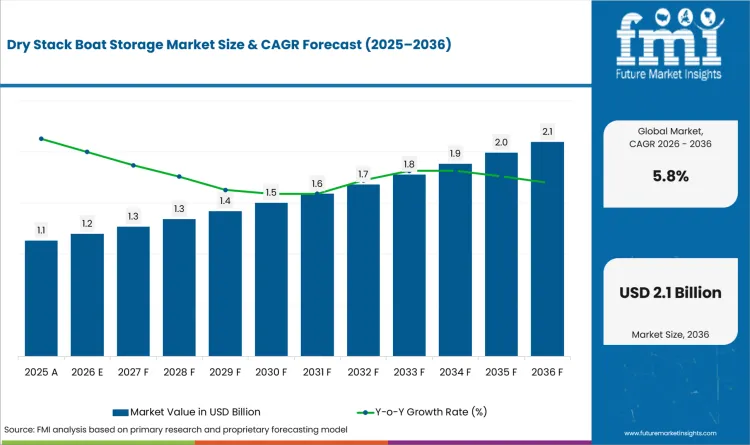
Key Takeaways
- Limited wet-slip capacity supports dry-stack demand by increasing vessel storage without requiring every marina to expand its water basin.
- Private facilities are expected to hold 68.0% share in 2026, supported by direct control over pricing and capital improvements.
- Recreational boat owners are projected to represent 62.0% share in 2026, reflecting demand for protected storage and scheduled launch convenience.
- Marina-based dry stack is estimated to capture 57.0% share in 2026, underpinned by direct water access and attached marine services.
- Planning approvals and high building costs can delay new capacity across waterfront locations with otherwise attractive boat ownership.
- Safe Harbor Marinas, Suntex Marinas, and Premier Marinas compete through verified dry-stack portfolios and integrated launch services across several boating regions.
Analyst Perspective
“Dry-stack facilities create commercial value through reliable launch service rather than nominal rack count alone. Owners renew annual contracts for protected vessels and dependable launch windows during concentrated boating seasons. Marina operators should base capacity expansion on verified local boat sizes and measured peak retrieval demand. Equipment support and planning approval must also protect occupancy economics throughout the building’s operating life.”
- Anurag Sharma, Principal Analyst, Future Market Insights
How is the Dry Stack Boat Storage Market segmented?
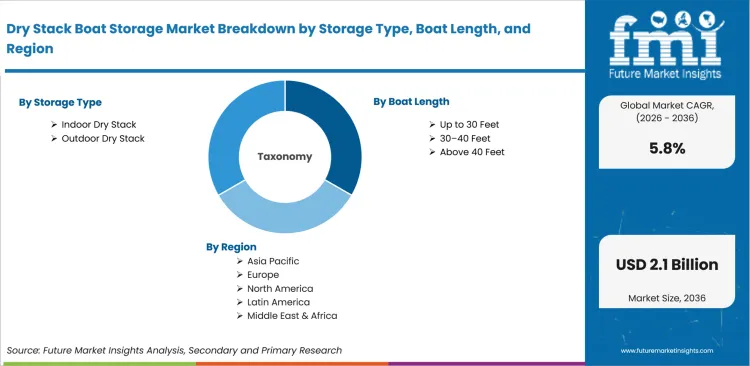
The dry stack boat storage market is segmented by Storage Type, Boat Length, Facility Type, End Use, Ownership Model, and Region.
The market is assessed by storage type, boat length, facility type, end use, ownership model, and region. Storage type separates indoor racks from outdoor, covered, automated, and trailer-based formats that offer different protection and handling requirements. Boat length identifies safe rack and lifting requirements for each vessel size, and facility type separates marina-based sites from independent facilities and dealership storage. End use separates recreational owners from commercial operators, institutions, clubs, and seasonal users with different service expectations. Ownership model shows whether private operators, public authorities, or partnership structures control investment and operating standards. Regional analysis compares boat density, waterfront access, weather exposure, and planning conditions across major operating territories. The combined framework shows why small boats and larger cruisers require different rack designs, launch routines, and service economics.
Why does indoor dry Stack lead the storage type category?
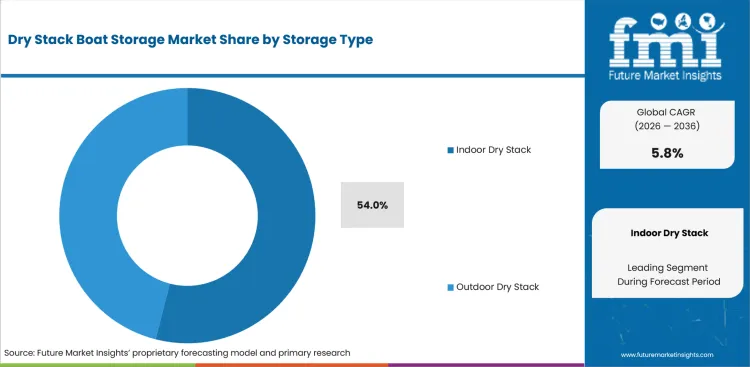
Indoor racks protect hull finishes and onboard equipment through a controlled storage environment that supports organized launch preparation. Suntex Marinas announced in April 2026 that Legendary Marina in Nassau would provide a CAT 5-rated enclosed dry stack with more than 300 spaces for vessels reaching 55 feet. The facility shows how enclosed capacity can combine storm protection with marine outboard engines service. Operators need reliable lifting equipment and fire protection systems that can sustain frequent retrieval cycles throughout concentrated launch periods.
- Indoor dry stack is projected to hold 54.0% share in 2026 owing to stronger weather protection and more controlled retrieval operations. Enclosed buildings can support premium annual pricing across storm-exposed locations, but reliable lift capacity must protect customer launch times. Delays during peak periods can quickly weaken the convenience advantage that supports higher annual storage fees.
- Marina operators adopt enclosed racks at storm-exposed sites with limited waterfront land and enough year-round demand to support higher fixed costs. The enclosed format protects electronics and upholstery and gives marina crews a consistent preparation area throughout the year. Adoption weakens in short-season locations that cannot generate sufficient occupied rack months or dependable service revenue.
How does up to 30 feet shape demand in the boat length category?
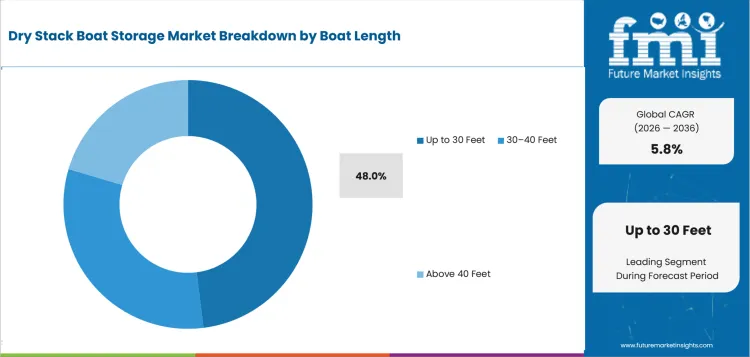
Shorter vessels fit standard rack bays and common forklifts without specialized structural changes across most storage buildings. The United States Coast Guard reported in June 2025 that 3,731,822 registered vessels measured below 16 feet. The same report counted 6,480,886 vessels between 16 and 26 feet during 2024. The vessel mix supports compact storage layouts beside routine yacht maintenance work and other recurring marina services. Marina-based contracts also reduce repeated boat trailer handling for owners who prefer scheduled launch service.
- By boat length, up to 30 feet is forecast to represent 48.0% share in 2026 driven by efficient rack use and compatibility with common lifting equipment. Standard bays hold more vessels without wider aisles or reinforced structures that remove revenue-producing positions. The segment therefore benefits from practical building economics and a large installed base of smaller recreational boats.
- Facilities adopt shorter-boat racks through repeatable forklift procedures that support high storage density and predictable retrieval times. Standardized bunks reduce equipment changeovers across mixed runabouts and fishing boats during concentrated weekend demand. Larger-cruiser fleets require stronger racks and wider circulation areas, reducing the number of revenue-producing spaces within each building.
What keeps marina-based dry stack ahead within facility type?
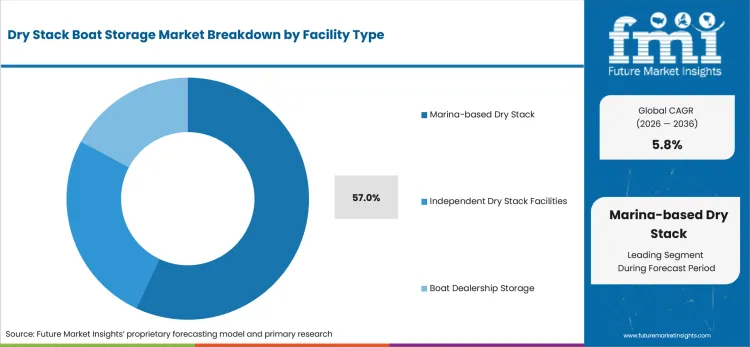
Marina-based dry stacks connect storage with immediate water access and spending through fuel and service departments. Suntex Marinas acquired Saguaro Lake Marina in May 2025 with dry storage beside fuel and an on-site service center. Reliable marine cranes and forklifts support a continuous storage-to-launch workflow across each scheduled customer retrieval. Standalone facilities can offer lower land costs, but each retrieval requires dependable transport to a suitable launch point.
- The marina-based dry stack segment is likely to capture 57.0% share in 2026 attributable to direct water access and attached marine services. Fuel and maintenance departments can earn additional revenue from each stored vessel during a scheduled marina visit. The segment loses appeal at sites whose peak retrieval capacity cannot match concentrated weekend or holiday demand.
- Boat owners adopt marina-based storage to combine launching and routine service through one established annual account. The integrated format reduces repeated towing and simplifies fueling or maintenance across the same scheduled marina visit. Coordinated staffing across forklifts and docks must protect both retrieval speed and launch access during concentrated weekend demand.
Which buying mechanism supports recreational boat owners in the end use category?
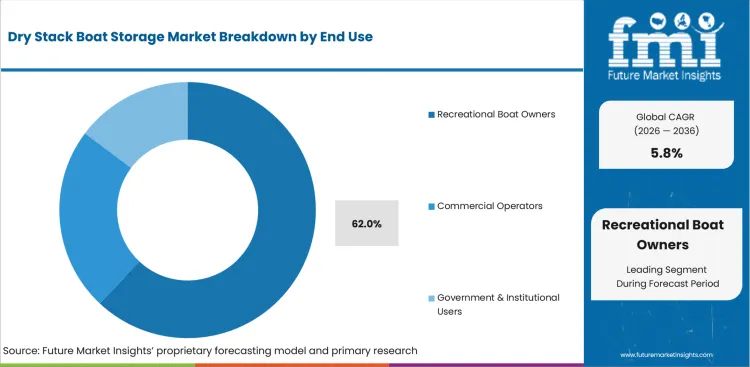
Recreational owners purchase predictable access and vessel protection rather than operating capacity for a commercial fleet. Bain Capital and BlueWater Marinas announced in April 2025 that they acquired Boathouse Marine Center as a dry-stack marina serving a year-round boating market. Shared launch infrastructure can serve private owners and boat rental services through separate scheduling windows. Household retention depends on dependable retrieval times and transparent pricing across each annual storage agreement.
- By end use, recreational boat owners are estimated to hold 62.0% share in 2026 owing to recurring household demand for protected storage and scheduled launch convenience. Annual members avoid repeated trailering and reduce hull exposure between outings through one service contract. Long waits or unclear fees can push dissatisfied customers toward trailer storage or competing marina arrangements.
- Recreational owners adopt dry-stack contracts to reduce hull fouling and shorten preparation for planned outings during concentrated boating seasons. Enclosed storage protects electronics and upholstery as marina crews coordinate routine launch tasks for each scheduled outing. Missed retrieval commitments directly weaken the convenience promised by an annual household contract, making dependable launch windows essential for customer retention.
What supports the position of private facilities within the ownership model category?
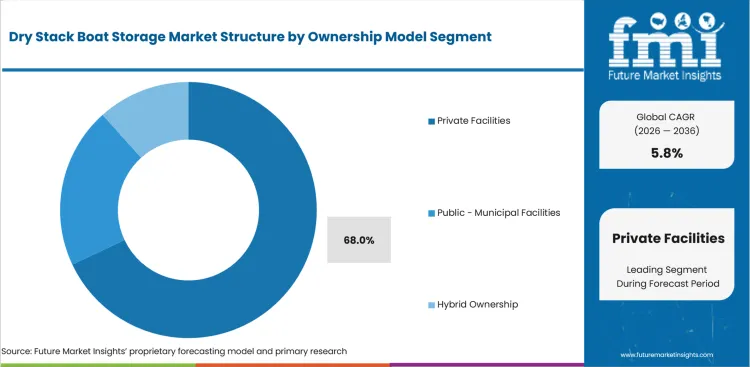
Private facilities can coordinate real estate decisions and operating standards across a controlled marina portfolio. Bain Capital and BlueWater Marinas announced in August 2025 that their joint venture acquired Glyn’s Marine as a dry-slip marina and service center on Nantucket Island. The completed transaction shows how private capital can combine storage revenue with maintenance capability at a supply-constrained destination. Tourism-heavy portfolios can offer separate service packages for private owners and yacht charter operators throughout concentrated seasons.
- The ownership model category is forecast to be led by private facilities at 68.0% share in 2026 due to direct control over capital planning and service pricing. Operators can adjust rack layouts or maintenance packages around measured local demand without coordinating several public agencies. Financing costs and zoning limits can delay construction across waterfront sites with otherwise attractive boating demand.
- Private operators adopt dry-stack capacity through phased investments that align new racks with measured occupancy and launch demand. Portfolio ownership can spread equipment expertise across several properties and standardize maintenance procedures through shared operating teams. One crane failure or planning delay creates greater risk at smaller sites, and nearby service alternatives may not protect customer access.
What are the drivers, restraints, and opportunities in the Dry Stack Boat Storage Market?
Limited wet-slip capacity supports dry-stack investment, although planning approvals and construction costs determine which projects convert demand into operating revenue.
- Driver: High wet-slip occupancy supports dry-stack conversion by adding vessel capacity without expanding every marina basin.
- Restraint: Planning approval and construction expense can postpone capacity additions across coastal locations with otherwise attractive boat ownership.
- Opportunity: Integrated storage packages can combine launch scheduling with fuel and maintenance to increase annual revenue from each stored vessel.
Restricted coastal berthing is driving demand pressure for dry-stack facilities and marina operators across mature boating regions. United Kingdom government rating guidance reported in May 2026 that average berth occupancy remained near 90%. The guidance also documented limited permission for new coastal marina development across established waterfront locations. Rack storage can therefore increase vessel capacity without extending the water basin or reducing wet-slip access. Operators convert that pressure into revenue through reliable launch service and annual customer retention at high-occupancy locations.
Planning approval and construction expense is one of the main restraint on large dry-stack projects across urban waterfront sites. PORT 32 Marinas reported in June 2025 that its Palm Beach Gardens redevelopment required seven years of approvals. The USD 80 million project shows how permitting and heavy structures can postpone storage revenue. Developers need a site-specific approval route and equipment plan that confirms viable rack capacity ahead of capital commitment. Extended review periods weaken returns through land and design spending that produces no customer revenue.
Integrated services create a credible opening for operators that already control launch access and maintenance capability. Shellharbour City Council announced in April 2026 that its new marine hub would combine dry-stack storage with maintenance and workshop space. The project connects rack capacity with maintenance support through one integrated waterfront facility and service workflow. Operators can increase annual revenue through launch scheduling and routine service rather than relying entirely on higher rack counts. Coordinated staffing must protect promised retrieval times as onsite workshops handle scheduled maintenance demand from stored vessels.
Which country CAGRs are profiled in the Dry Stack Boat Storage Market?
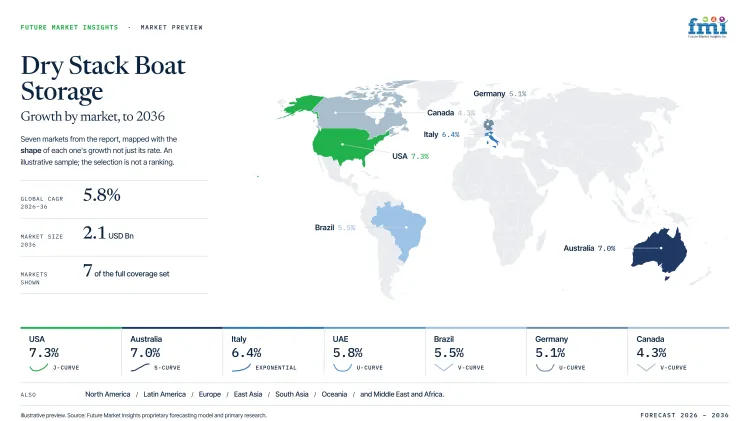
| Country | CAGR |
|---|---|
| USA | 7.3% |
| Australia | 7.0% |
| Italy | 6.4% |
| UAE | 5.8% |
| Brazil | 5.5% |
| Germany | 5.1% |
| Canada | 4.3% |
How do country-level CAGRs compare in the Dry Stack Boat Storage Market?
The profiled forecasts form a gradual 3.0-point spread from the USA to Canada rather than separate growth tiers. Private marina investment and launch infrastructure explain much of the spacing across the seven profiled markets. Operating season and service distance create further differences between countries with otherwise comparable recreational boating demand.
- The USA benefits from concentrated private marina ownership and a large registered vessel base across year-round coastal markets. Local zoning and hurricane-ready construction remain decisive conditions for converting that ownership base into durable rack occupancy.
- Australia relies on public launch infrastructure spread across long coastal corridors and widely dispersed recreational boating communities. Facility economics improve near major population centers with dependable technical support and sufficiently concentrated launch demand.
- Italy combines mature marina demand with dense seasonal boating destinations and limited waterfront expansion space. Digital vessel records support recurring storage contracts, but local approvals and winter utilization vary across coastal communities.
- The UAE supports premium enclosed storage through integrated waterfront destinations and concentrated spending on hospitality-linked marine services. Imported lifting equipment raises operating costs and increases dependence on specialist maintenance teams with reliable regional coverage.
- Brazil offers concentrated storage demand near major tourism hubs and established coastal boating communities with marina services. Long equipment service routes and uneven facility standards limit expansion outside the largest boating centers.
- Germany can support dry-stack storage across coastal areas and inland boating corridors with established launch access. Formal planning requirements and weather-driven seasonality limit annual rack utilization across many regional operating facilities.
- Canada benefits from winter vessel protection needs across freshwater boating regions with long seasonal storage periods. Short operating seasons and dispersed service coverage constrain occupancy economics outside the country’s larger boating communities.
Comparable CAGRs can produce different market entry conditions across countries with similar recreational boat demand. Local permitting and service coverage determine whether forecast momentum converts into occupied racks and dependable customer retention. The full report provides country-level CAGR analysis across North America, Latin America, Europe, East Asia, South Asia, Oceania and the Middle East and Africa.
Country-wise Analysis
- United States facilities benefit from concentrated private marina ownership and a large registered vessel base across year-round coastal markets. Dry stack boat storage sales in the USA are forecast to expand at 7.3% CAGR by 2036, supported by private marina investment and dense recreational ownership. The United States Coast Guard reported in June 2025 that Florida registered 1,171,432 recreational vessels during 2024. The registered fleet creates a strong addressable base for rack-compatible boats across major coastal counties. Integrated facilities can add fuel and maintenance revenue through annual customer relationships at the same property. Hurricane building standards and local zoning remain material frictions that require resilient structures and practical evacuation procedures.
- Australia’s dry-stack facilities rely on public launch infrastructure across long coastal corridors and dispersed boating communities. Adoption of dry stack boat storage in Australia is estimated to expand at 7.0% CAGR through 2036, aided by coastal recreation and public infrastructure upgrades. The NSW Government announced in August 2025 that forty-six maritime projects received funding through its infrastructure program. The program included longer ramps and improved access at Ulladulla for safer launch and retrieval. Upgraded ramps strengthen the operating case for nearby storage facilities that serve concentrated recreational boating activity. Long service distances and planning controls remain material frictions outside major population centers with dependable technical support.
- Italy’s mature marina network serves dense seasonal destinations with limited waterfront expansion space and demanding service expectations. Italy’s dry stack boat storage outlook is anticipated to advance at 6.4% CAGR over the assessment period, shaped by specialized marinas and established leisure demand. The Ministry of Infrastructure and Transport stated in May 2025 that recreational vessel procedures operate through the central SISTE system and authorized telematic offices. The digital framework gives marina operators a formal ownership record for recurring commercial storage agreements. Private facilities can attach maintenance and launch services to annual rack contracts across mature boating destinations. Seasonal utilization and fragmented local approvals remain material frictions for capacity planning across smaller coastal communities.
- The UAE concentrates recreational boating around integrated waterfront destinations that combine marinas with hospitality and premium services. In the UAE, dry stack boat storage demand is predicted to advance at 5.8% CAGR through 2036, underpinned by coordinated marina destinations and digital berth management. Dubai’s maritime authorities announced in September 2025 that the Dock and Dine initiative standardized visitor access across twenty participating marinas and stations. The participating network represented more than 4,000 berths across Dubai and created coordinated access for visiting vessels. Concentrated premium activity supports enclosed storage and concierge launch services through established year-round waterfront destinations. Imported lifting equipment and limited inland alternatives remain material frictions for specialized local dry-stack facilities.
- Brazil requires national registration for recreational vessels through maritime authorities as a condition of formal operation. Dry stack boat storage demand in Brazil is forecast to rise at 5.5% CAGR over the forecast period, influenced by coastal recreation and formal vessel ownership. The federal government updated its vessel registration service in December 2025 under NORMAM-211 rules covering recreational craft. The registration framework gives marina operators consistent ownership information for recurring storage and launch records. Coastal tourism hubs support rack-compatible boats near established waterfront communities and specialized marine service clusters. Uneven marina quality and long equipment service routes remain material frictions outside major boating centers.
- Germany’s recreational boating base operates across coastal areas and an extensive network of federal waterways. The Federal Ministry of Transport stated in October 2025 that recreational navigation covers approximately 10,000 kilometers of federal waterways. The German dry stack boat storage sector is projected to record 5.1% CAGR during the assessment period, reinforced by established boating services and formal operating systems. The network spreads potential demand across coastal and inland launch points without proving conversion at every site. Operators need dependable transport and launch routes for facilities located away from direct water access. Formal planning requirements and weather-driven seasonality remain material frictions for annual rack utilization across regional facilities.
- Canada’s boating demand is distributed across freshwater regions with long travel distances between storage sites and service technicians. By 2036, Canada’s dry stack boat storage market is projected to grow at 4.3% CAGR, linked to recurring storage needs across regional boating communities. Transport Canada stated in May 2026 that pleasure craft with engines of at least ten horsepower require a license valid for five years. The licensing system gives operators consistent vessel identification across recurring storage agreements and account records. Winter vessel protection supports enclosed storage across colder provinces with strongly concentrated seasonal boating activity. Short operating seasons and dispersed fleets remain material frictions for occupancy economics and technician coverage.
Who are the notable companies in the Dry Stack Boat Storage Market?
Safe Harbor Marinas, Suntex Marinas, MarineMax, PORT 32 Marinas, BlueWater Marinas, Premier Marinas, Bain Capital Real Estate, and Blackstone Infrastructure are the notable companies shaping this market.
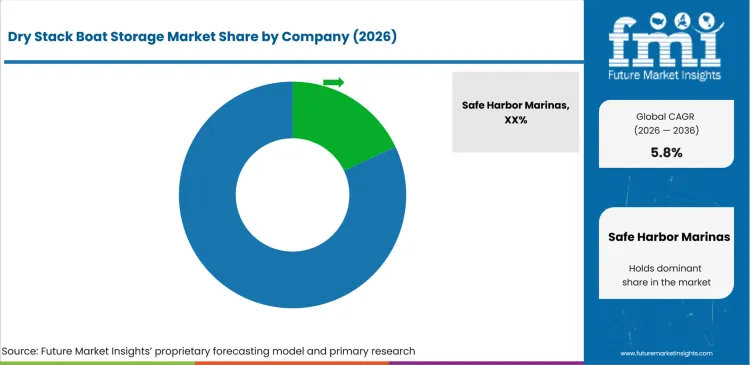
Marina operators compete with investment platforms that control verified dry-stack assets across several boating regions. Blackstone completed its USD 5.65 billion acquisition of Safe Harbor Marinas in April 2025. The completed transaction gives infrastructure capital direct exposure to recurring storage income and attached service revenue. Portfolio scale does not establish operating quality without site evidence on retrieval speed and customer retention. Marine service departments can deepen storage relationships through marine electronics work, but service activity cannot prove rack demand by itself. Competitive positioning therefore depends on exact-market capacity and current ownership rather than corporate size alone.
- Safe Harbor Marinas operates a multi-country network with documented dry storage across several current marina locations. Suntex Marinas combines dry-storage properties with fuel and maintenance services through an expanding United States portfolio. Premier Marinas provides multiple United Kingdom dry-stack locations with app-based launch and recovery service for annual customers.
- MarineMax connects boat sales with dry storage and repair services across documented marina properties in the United States. PORT 32 Marinas operates valet dry-stack facilities with launch and fuel support across several Florida locations. BlueWater Marinas manages storage-focused East Coast assets through a formal operating platform backed by Bain Capital Real Estate.
- Bain Capital Real Estate participates through a BlueWater joint venture that owns storage-centric marinas along the United States East Coast. Blackstone Infrastructure controls Safe Harbor Marinas through a completed acquisition that closed in April 2025. Local operating teams remain responsible for launch performance and equipment service across both investment platforms.
Competitive Benchmarking: Dry Stack Boat Storage Market
| Company | Dry Stack Portfolio | Launch and Marine Services | Development Activity | Geographic Reach |
|---|---|---|---|---|
| Safe Harbor Marinas | Low | Medium | High | Multi-country |
| Suntex Marinas | Medium | High | High | United States with Bahamas partnership |
| MarineMax | Low | High | High | United States |
| PORT 32 Marinas | Low | High | Medium | Southeastern United States |
| BlueWater Marinas | Medium | Medium | High | United States East Coast |
| Premier Marinas | Medium | High | High | United Kingdom |
| Bain Capital Real Estate | Medium | Medium | High | United States East Coast |
| Blackstone Infrastructure | Low | Medium | High | Multi-country |
Key Developments in the Dry Stack Boat Storage Market
- In July 2025, Safe Harbor Marinas acquired Los Sueños Marina in Costa Rica with 166 dry slips and 200 wet slips. The transaction expanded its international operating network and added fuel and hospitality services around a mixed storage base. The dry-storage component gives the company a measurable platform for scheduled launch services and annual customer contracts. International expansion also increases the need for consistent operating standards across local staffing and equipment support.
- In January 2026, Suntex Marinas acquired Two Georges Marina and renamed the property Shalimar Harbor Marina. The Florida facility includes 190 dry-rack spaces and 134 wet slips alongside fuel and marine services. The acquisition expands North Florida capacity through one property that combines storage and routine vessel support. The integrated offer can improve retention beyond the initial annual rack agreement without requiring another customer service location.
- In March 2025, MarineMax completed the acquisition of Shelter Bay Marina in Marathon and added a storage-focused Florida property. The property offers dry storage with fuel and repair services beside the company’s boat sales operations. MarineMax stated that further infrastructure investment would improve the location and expand retail and brokerage services. The transaction links vessel purchase relationships with recurring storage and maintenance revenue across a year-round Florida boating market.
- In September 2025, Premier Marinas completed its acquisition of Boatfolk and created a combined portfolio of twenty-two United Kingdom locations. Premier reported that its established network includes dry-stack berthing and full-service boatyards across multiple South Coast locations. The transaction broadens customer access across the South Coast and preserves local marina operations during integration. The larger network can share launch procedures and maintenance support without treating every property as an identical storage site.
Key Players in the Dry Stack Boat Storage Market
National Portfolio Operators
- Safe Harbor Marinas
- Suntex Marinas
- Premier Marinas
Integrated Marina and Retail Operators
- MarineMax
- PORT 32 Marinas
- BlueWater Marinas
Storage-Centric Operating and Investment Platforms
- Bain Capital Real Estate
- Blackstone Infrastructure
Dry Stack Boat Storage Market - Report Scope
| Coverage field | Report scope |
|---|---|
| Market breakdown | Storage Type, Boat Length, Facility Type, End Use, Ownership Model, and Region. |
| Market Definition | Indoor and outdoor rack facilities that lift, store, launch, and retrieve recreational boats through marina-based or standalone operations. |
| Regions Covered | North America, Latin America, Europe, East Asia, South Asia, Oceania, and Middle East and Africa. |
| Countries Covered | USA, Australia, Italy, UAE, Brazil, Germany, and Canada. |
| Key Companies Profiled | Safe Harbor Marinas, Suntex Marinas, MarineMax, PORT 32 Marinas, BlueWater Marinas, Premier Marinas, Bain Capital Real Estate, and Blackstone Infrastructure. |
| Forecast Period | 2026 to 2036. |
| Approach | Market estimates combine the 2026 baseline with segment shares, country growth, facility utilization, and current company activity. Operating evidence covers launch capacity and recurring storage economics across the defined market boundary. |
Dry Stack Boat Storage Market - Research Methodology
| Method | Approach |
|---|---|
| Primary Research | FMI analysts gathered input from manufacturers, service providers, technology developers, distributors, end users, procurement teams, and subject-matter experts. Interviews examined purchasing decisions, product or service evaluation, adoption barriers, approval requirements, pricing considerations, and expectations for technical or commercial support. Respondents were also asked what evidence is required before a trial, pilot, or initial order develops into regular purchasing. |
| Desk Research | Desk research covered government statistics, regulatory publications, trade data, industry associations, technical literature, standards, company filings, product information, and official corporate announcements. Sources were reviewed for relevance, publication date, geographic coverage, and consistency with the defined market scope. Claims relating to performance, applications, approvals, capacity, investment, and commercial activity were retained only when supported by credible public evidence. |
| Market Sizing and Forecasting | The market model combined the baseline value with historical performance, segment structure, pricing and volume indicators, adoption levels, company participation, and country-level demand conditions. Forecast assumptions considered economic activity, investment trends, regulatory developments, technology adoption, purchasing cycles, supply availability, and barriers to wider market use. Segment and regional estimates were reconciled before the final market total was calculated. |
| Data Validation | Estimates were checked against multiple independent indicators, including public data, company activity, trade patterns, industry developments, and findings from primary interviews. Validation also tested whether products, services, applications, and company revenues fell within the defined market boundaries. Adjacent categories, unsupported claims, overlapping revenues, and activities without direct market relevance were excluded to reduce double counting and maintain consistency across segments and countries. |
Dry Stack Boat Storage Market by Segments
Dry Stack Boat Storage Market segmented by Storage Type:
- Indoor Dry Stack
- Outdoor Dry Stack
- Automated Rack Storage
- Covered Outdoor Storage
- Trailer-based Storage
Dry Stack Boat Storage Market segmented by Boat Length:
- Up to 30 Feet
- 30-40 Feet
- Above 40 Feet
- Runabouts and Bowriders
- Motor Yachts and Catamarans
Dry Stack Boat Storage Market segmented by Facility Type:
- Marina-based Dry Stack
- Independent Dry Stack Facilities
- Boat Dealership Storage
Dry Stack Boat Storage Market segmented by End Use:
- Recreational Boat Owners
- Commercial Operators
- Government and Institutional Users
- Boating Clubs
- Seasonal Users
Dry Stack Boat Storage Market segmented by Ownership Model:
- Private Facilities
- Public or Municipal Facilities
- Hybrid Ownership
- Corporate Marina Chains
- Public-Private Partnership Facilities
Dry Stack Boat Storage Market by Region:
- North America
- USA
- Canada
- Latin America
- Brazil
- Mexico
- Argentina
- Chile
- Western Europe
- Germany
- France
- UK
- Italy
- Spain
- Benelux
- Nordics
- Eastern Europe
- Poland
- Czech Republic
- Romania
- Hungary
- East Asia
- China
- Japan
- South Korea
- South Asia and Pacific
- India
- ASEAN
- Australia and New Zealand
- Middle East and Africa
- GCC Countries
- South Africa
- Türkiye
- Israel
Research Sources and Bibliography
- USA Coast Guard. (2025, June 24).
- HM Revenue & Customs. (2026, May 11).
- Shellharbour City Council. (2026, April 30).
- Bain Capital. (2025, April 21).
- NSW Government. (2025, August 14).
- Ministero delle Infrastrutture e dei Trasporti. (2025, May 23).
- Government of Dubai Media Office. (2025, September 1).
- Governo Federal do Brasil. (2025, December 15).
- Bundesministerium für Verkehr. (2025, October 17).
- Transport Canada. (2026, May 14)
- Blackstone. (2025, April 30).
- Safe Harbor Marinas. (2025, July 22).
- Suntex Marinas. (2026, January 21).
- Suntex Marinas. (2025, May 1).
- Suntex Marinas. (2026, April 8).
- MarineMax. (2025, March 10).
- Suntex Marinas. (2026, June 16).
- Washburn, M. (2025, June 10).
- Bain Capital. (2025, August 11).
- Premier Marinas. (2025, September 17).
- Bain Capital. (2026, January 9).
This bibliography is provided for reader reference and is not exhaustive. The full report contains the complete reference list and detailed citations
This Report Answers
- How large is the dry stack boat storage market in 2026 and 2036?
- Which operating pressures support investment in dry-stack storage capacity?
- Why does indoor dry stack hold the largest storage type share in 2026?
- How does the up to 30 feet category support rack utilization?
- Why do marina-based dry stack facilities capture the largest facility type share?
- How do country growth rates differ across the USA, Australia, Europe, Brazil, and Canada?
- Which companies operate established dry-stack marina portfolios and storage-focused investment platforms?
- What planning and construction conditions limit new dry-stack capacity?
- How can integrated launch and marine services improve revenue per stored vessel?
Frequently Asked Questions
How big is the Dry Stack Boat Storage Market in 2026?
The dry stack boat storage market is valued at USD 1.2 billion in 2026 and is forecast to reach USD 2.1 billion by 2036, reflecting rising recreational boating activity and growing demand for secure high-density storage facilities across key marina markets with limited wet-slip capacity.
What is the CAGR of the Dry Stack Boat Storage Market from 2026 to 2036?
The dry stack boat storage market is projected to grow at a CAGR of 5.8% between 2026 and 2036, supported by high wet-slip occupancy that drives dry-stack conversion and integrated launch and maintenance services that increase annual revenue from each stored vessel.
Which facility type leads the Dry Stack Boat Storage Market?
Marina-based dry stack accounts for 57.0% of the dry stack boat storage market by facility type in 2026, driven by direct water access and attached marine services that allow fuel and maintenance departments to earn additional revenue from each stored vessel during scheduled marina visits.
Which country is growing fastest in the Dry Stack Boat Storage Market?
The dry stack boat storage market in the USA is projected to expand at a CAGR of 7.3% through 2036, ahead of Australia at 7.0%, Italy at 6.4%, the UAE at 5.8%, Brazil at 5.5%, Germany at 5.1%, and Canada at 4.3%, reflecting concentrated private marina ownership and a large registered recreational vessel base across year-round coastal markets.
Who are the leading companies in the Dry Stack Boat Storage Market?
Leading companies in the dry stack boat storage market include Safe Harbor Marinas, Suntex Marinas, MarineMax, PORT 32 Marinas, BlueWater Marinas, Premier Marinas, Bain Capital Real Estate, and Blackstone Infrastructure, spanning national portfolio operators, integrated marina and retail services, and storage-centric investment platforms across major boating regions.
Preview the report firsthand - request a free sample
Get SampleGet the brochure for pricing and purchase details.
Get PDFTable of Content
- Key Takeaways
- Market Size and CAGR
- Top Growth Driver
- Fastest Growing Segment
- Leading Region
- Key Companies
- Emerging Opportunities
- Executive Summary
- Global Market Outlook
- Demand-side Trends
- Supply-side Trends
- Technology Roadmap Analysis
- Analysis and Recommendations
- Analyst Perspective (What is happening? Why now? What should investors know?)
- Key Questions Answered
- How large is the market?
- What is the CAGR?
- What are key trends?
- Which region dominates?
- Who are the leaders?
- Market Overview
- Market Coverage / Taxonomy
- Market Definition / Scope / Limitations
- Research Methodology
- Chapter Orientation
- Analytical Lens and Working Hypotheses
- Market Structure, Signals, and Trend Drivers
- Benchmarking and Cross-market Comparability
- Market Sizing, Forecasting, and Opportunity Mapping
- Research Design and Evidence Framework
- Desk Research Programme (Secondary Evidence)
- Expert Input and Fieldwork (Primary Evidence)
- Tooling, Models, and Reference Databases
- Data Engineering and Model Build
- Quality Assurance and Audit Trail
- Market Background
- Market Dynamics (Drivers, Restraints, Opportunity, Trends)
- Scenario Forecast (Optimistic, Likely, Conservative)
- Impact Analysis
- AI Impact
- Sustainability Impact
- Regulatory Impact
- Technology Impact
- Consumer / Buyer Analysis
- Purchase Drivers
- Adoption Barriers
- Buyer Journey
- Opportunity Map Analysis
- Product Life Cycle Analysis
- Supply Chain Analysis
- Investment Feasibility Matrix
- Value Chain Analysis
- PESTLE and Porter's Analysis
- Regulatory Landscape
- Regional Parent Market Outlook
- Production and Consumption Statistics
- Import and Export Statistics
- Global Market Analysis and Forecast, 2021 to 2036
- Historical Market Size Value (USD Billion) Analysis, 2021 to 2025
- Current and Future Market Size Value (USD Billion) Projections, 2026 to 2036
- Y-o-Y Growth Trend Analysis
- Absolute $ Opportunity Analysis
- Global Market Pricing Analysis, 2021 to 2036
- Global Market Analysis and Forecast, By Storage Type, 2021 to 2036
- Introduction / Key Findings
- Historical Market Size Value (USD Billion) Analysis By Storage Type, 2021 to 2025
- Current and Future Market Size Value (USD Billion) Analysis and Forecast By Storage Type, 2026 to 2036
- Indoor Dry Stack
- Automated Rack Storage
- Manual Rack Storage
- Multi-level Rack Storage
- Outdoor Dry Stack
- Open Rack Storage
- Covered Outdoor Storage
- Trailer-based Storage
- Indoor Dry Stack
- Y-o-Y Growth Trend Analysis By Storage Type, 2021 to 2025
- Absolute $ Opportunity Analysis By Storage Type, 2026 to 2036
- Global Market Analysis and Forecast, By Boat Length, 2021 to 2036
- Introduction / Key Findings
- Historical Market Size Value (USD Billion) Analysis By Boat Length, 2021 to 2025
- Current and Future Market Size Value (USD Billion) Analysis and Forecast By Boat Length, 2026 to 2036
- Up to 30 Feet
- Runabouts
- Bowriders
- Center Console Boats
- 30–40 Feet
- Cruisers
- Deck Boats
- Fishing Boats
- Above 40 Feet
- Sportfishing Boats
- Motor Yachts
- Catamarans
- Up to 30 Feet
- Y-o-Y Growth Trend Analysis By Boat Length, 2021 to 2025
- Absolute $ Opportunity Analysis By Boat Length, 2026 to 2036
- Global Market Analysis and Forecast, By Facility Type, 2021 to 2036
- Introduction / Key Findings
- Historical Market Size Value (USD Billion) Analysis By Facility Type, 2021 to 2025
- Current and Future Market Size Value (USD Billion) Analysis and Forecast By Facility Type, 2026 to 2036
- Marina-based Dry Stack
- Full-service Marinas
- Resort Marinas
- Private Club Marinas
- Independent Dry Stack Facilities
- Standalone Storage Centers
- Commercial Storage Parks
- Municipal Storage Facilities
- Boat Dealership Storage
- New Boat Inventory Storage
- Pre-owned Boat Storage
- Manufacturer Holding Yards
- Marina-based Dry Stack
- Y-o-Y Growth Trend Analysis By Facility Type, 2021 to 2025
- Absolute $ Opportunity Analysis By Facility Type, 2026 to 2036
- Global Market Analysis and Forecast, By End Use, 2021 to 2036
- Introduction / Key Findings
- Historical Market Size Value (USD Billion) Analysis By End Use, 2021 to 2025
- Current and Future Market Size Value (USD Billion) Analysis and Forecast By End Use, 2026 to 2036
- Recreational Boat Owners
- Private Boat Owners
- Boating Clubs
- Seasonal Users
- Commercial Operators
- Charter Operators
- Boat Rental Companies
- Tourism Operators
- Government & Institutional Users
- Coast Guard
- Marine Police
- Research Organizations
- Recreational Boat Owners
- Y-o-Y Growth Trend Analysis By End Use, 2021 to 2025
- Absolute $ Opportunity Analysis By End Use, 2026 to 2036
- Global Market Analysis and Forecast, By Ownership Model, 2021 to 2036
- Introduction / Key Findings
- Historical Market Size Value (USD Billion) Analysis By Ownership Model, 2021 to 2025
- Current and Future Market Size Value (USD Billion) Analysis and Forecast By Ownership Model, 2026 to 2036
- Private Facilities
- Corporate Marina Chains
- Family-owned Marinas
- Private Investors
- Public - Municipal Facilities
- City-owned Marinas
- Port Authority Facilities
- Government-operated Facilities
- Hybrid Ownership
- Public-Private Partnership Facilities
- Leased Marina Operations
- Joint Venture Facilities
- Private Facilities
- Y-o-Y Growth Trend Analysis By Ownership Model, 2021 to 2025
- Absolute $ Opportunity Analysis By Ownership Model, 2026 to 2036
- Global Market Analysis and Forecast, By Region, 2021 to 2036
- Introduction
- Historical Market Size Value (USD Billion) Analysis By Region, 2021 to 2025
- Current Market Size Value (USD Billion) Analysis and Forecast By Region, 2026 to 2036
- North America
- Latin America
- Western Europe
- Eastern Europe
- East Asia
- South Asia and Pacific
- Middle East & Africa
- Market Attractiveness Analysis By Region
- North America Market Analysis and Forecast, By Country, 2021 to 2036
- Historical Market Size Value (USD Billion) Trend Analysis By Market Taxonomy, 2021 to 2025
- Market Size Value (USD Billion) Forecast By Market Taxonomy, 2026 to 2036
- By Country
- USA
- Canada
- By Storage Type
- By Boat Length
- By Facility Type
- By End Use
- By Ownership Model
- By Country
- Market Attractiveness Analysis
- By Country
- By Storage Type
- By Boat Length
- By Facility Type
- By End Use
- By Ownership Model
- Key Takeaways
- Latin America Market Analysis and Forecast, By Country
- Historical Market Size Value (USD Billion) Trend Analysis By Market Taxonomy, 2021 to 2025
- Market Size Value (USD Billion) Forecast By Market Taxonomy, 2026 to 2036
- By Country
- Brazil
- Mexico
- Chile
- Rest of Latin America
- By Storage Type
- By Boat Length
- By Facility Type
- By End Use
- By Ownership Model
- By Country
- Market Attractiveness Analysis
- By Country
- By Storage Type
- By Boat Length
- By Facility Type
- By End Use
- By Ownership Model
- Key Takeaways
- Western Europe Market Analysis and Forecast, By Country
- Historical Market Size Value (USD Billion) Trend Analysis By Market Taxonomy, 2021 to 2025
- Market Size Value (USD Billion) Forecast By Market Taxonomy, 2026 to 2036
- By Country
- Germany
- UK
- Italy
- Spain
- France
- Nordic
- BENELUX
- Rest of Western Europe
- By Storage Type
- By Boat Length
- By Facility Type
- By End Use
- By Ownership Model
- By Country
- Market Attractiveness Analysis
- By Country
- By Storage Type
- By Boat Length
- By Facility Type
- By End Use
- By Ownership Model
- Key Takeaways
- Eastern Europe Market Analysis and Forecast, By Country
- Historical Market Size Value (USD Billion) Trend Analysis By Market Taxonomy, 2021 to 2025
- Market Size Value (USD Billion) Forecast By Market Taxonomy, 2026 to 2036
- By Country
- Russia
- Poland
- Hungary
- Balkan & Baltic
- Rest of Eastern Europe
- By Storage Type
- By Boat Length
- By Facility Type
- By End Use
- By Ownership Model
- By Country
- Market Attractiveness Analysis
- By Country
- By Storage Type
- By Boat Length
- By Facility Type
- By End Use
- By Ownership Model
- Key Takeaways
- East Asia Market Analysis and Forecast, By Country
- Historical Market Size Value (USD Billion) Trend Analysis By Market Taxonomy, 2021 to 2025
- Market Size Value (USD Billion) Forecast By Market Taxonomy, 2026 to 2036
- By Country
- China
- Japan
- South Korea
- By Storage Type
- By Boat Length
- By Facility Type
- By End Use
- By Ownership Model
- By Country
- Market Attractiveness Analysis
- By Country
- By Storage Type
- By Boat Length
- By Facility Type
- By End Use
- By Ownership Model
- Key Takeaways
- South Asia and Pacific Market Analysis and Forecast, By Country
- Historical Market Size Value (USD Billion) Trend Analysis By Market Taxonomy, 2021 to 2025
- Market Size Value (USD Billion) Forecast By Market Taxonomy, 2026 to 2036
- By Country
- India
- ASEAN
- Australia & New Zealand
- Rest of South Asia and Pacific
- By Storage Type
- By Boat Length
- By Facility Type
- By End Use
- By Ownership Model
- By Country
- Market Attractiveness Analysis
- By Country
- By Storage Type
- By Boat Length
- By Facility Type
- By End Use
- By Ownership Model
- Key Takeaways
- Middle East & Africa Market Analysis and Forecast, By Country
- Historical Market Size Value (USD Billion) Trend Analysis By Market Taxonomy, 2021 to 2025
- Market Size Value (USD Billion) Forecast By Market Taxonomy, 2026 to 2036
- By Country
- Kingdom of Saudi Arabia
- Other GCC Countries
- Türkiye
- South Africa
- Other African Union
- Rest of Middle East & Africa
- By Storage Type
- By Boat Length
- By Facility Type
- By End Use
- By Ownership Model
- By Country
- Market Attractiveness Analysis
- By Country
- By Storage Type
- By Boat Length
- By Facility Type
- By End Use
- By Ownership Model
- Key Takeaways
- Key Countries Market Analysis
- USA
- Pricing Analysis
- Market Share Analysis, 2025
- By Storage Type
- By Boat Length
- By Facility Type
- By End Use
- By Ownership Model
- Canada
- Pricing Analysis
- Market Share Analysis, 2025
- By Storage Type
- By Boat Length
- By Facility Type
- By End Use
- By Ownership Model
- Mexico
- Pricing Analysis
- Market Share Analysis, 2025
- By Storage Type
- By Boat Length
- By Facility Type
- By End Use
- By Ownership Model
- Brazil
- Pricing Analysis
- Market Share Analysis, 2025
- By Storage Type
- By Boat Length
- By Facility Type
- By End Use
- By Ownership Model
- Chile
- Pricing Analysis
- Market Share Analysis, 2025
- By Storage Type
- By Boat Length
- By Facility Type
- By End Use
- By Ownership Model
- Germany
- Pricing Analysis
- Market Share Analysis, 2025
- By Storage Type
- By Boat Length
- By Facility Type
- By End Use
- By Ownership Model
- UK
- Pricing Analysis
- Market Share Analysis, 2025
- By Storage Type
- By Boat Length
- By Facility Type
- By End Use
- By Ownership Model
- Italy
- Pricing Analysis
- Market Share Analysis, 2025
- By Storage Type
- By Boat Length
- By Facility Type
- By End Use
- By Ownership Model
- Spain
- Pricing Analysis
- Market Share Analysis, 2025
- By Storage Type
- By Boat Length
- By Facility Type
- By End Use
- By Ownership Model
- France
- Pricing Analysis
- Market Share Analysis, 2025
- By Storage Type
- By Boat Length
- By Facility Type
- By End Use
- By Ownership Model
- India
- Pricing Analysis
- Market Share Analysis, 2025
- By Storage Type
- By Boat Length
- By Facility Type
- By End Use
- By Ownership Model
- ASEAN
- Pricing Analysis
- Market Share Analysis, 2025
- By Storage Type
- By Boat Length
- By Facility Type
- By End Use
- By Ownership Model
- Australia & New Zealand
- Pricing Analysis
- Market Share Analysis, 2025
- By Storage Type
- By Boat Length
- By Facility Type
- By End Use
- By Ownership Model
- China
- Pricing Analysis
- Market Share Analysis, 2025
- By Storage Type
- By Boat Length
- By Facility Type
- By End Use
- By Ownership Model
- Japan
- Pricing Analysis
- Market Share Analysis, 2025
- By Storage Type
- By Boat Length
- By Facility Type
- By End Use
- By Ownership Model
- South Korea
- Pricing Analysis
- Market Share Analysis, 2025
- By Storage Type
- By Boat Length
- By Facility Type
- By End Use
- By Ownership Model
- Russia
- Pricing Analysis
- Market Share Analysis, 2025
- By Storage Type
- By Boat Length
- By Facility Type
- By End Use
- By Ownership Model
- Poland
- Pricing Analysis
- Market Share Analysis, 2025
- By Storage Type
- By Boat Length
- By Facility Type
- By End Use
- By Ownership Model
- Hungary
- Pricing Analysis
- Market Share Analysis, 2025
- By Storage Type
- By Boat Length
- By Facility Type
- By End Use
- By Ownership Model
- Kingdom of Saudi Arabia
- Pricing Analysis
- Market Share Analysis, 2025
- By Storage Type
- By Boat Length
- By Facility Type
- By End Use
- By Ownership Model
- Türkiye
- Pricing Analysis
- Market Share Analysis, 2025
- By Storage Type
- By Boat Length
- By Facility Type
- By End Use
- By Ownership Model
- South Africa
- Pricing Analysis
- Market Share Analysis, 2025
- By Storage Type
- By Boat Length
- By Facility Type
- By End Use
- By Ownership Model
- USA
- Market Structure Analysis
- Competition Dashboard
- Competition Benchmarking
- Market Share Analysis of Top Players
- By Regional
- By Storage Type
- By Boat Length
- By Facility Type
- By End Use
- By Ownership Model
- Emerging Startups
- Innovation Benchmarking
- Competition Analysis
- Competition Deep Dive
- Safe Harbor Marinas
- Overview
- Product Portfolio
- Profitability by Market Segments
- Sales Footprint
- Strategy Overview
- Marketing Strategy
- Product Strategy
- Channel Strategy
- Suntex Marinas
- IGY Marinas
- Marina Development Corporation
- Dry Stack Boat Storage Systems
- Westrec Marinas
- Brunswick Corporation
- Safe Harbor Marinas
- Case Studies
- Success Stories
- Recent Developments
- Competition Deep Dive
- Assumptions & Acronyms Used


