

- Market Size (2026)
- USD 1200.0 Mn
- Forecast (2036)
- USD 2300.0 Mn
- CAGR (2026 to 2036)
- 6.2%
How Big is the Dust Control Polymers Market in 2026?
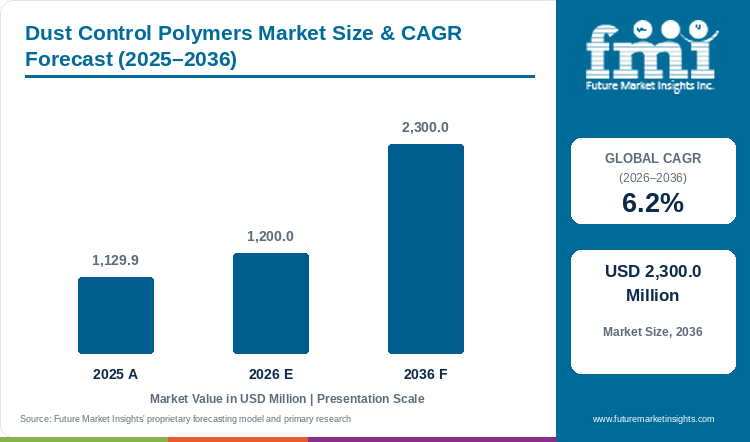
Dust control polymer value stands at an estimated USD 1,200.0 Million in 2026, a rise from USD 1,129.9 Million in 2025. Silica rules and water savings on haul roads will push the market, on a 6.2% CAGR, to USD 2,300.0 Million by 2036.
Demand for dust control polymers is projected to rise at 6.2% CAGR between 2026 and 2036, as per FMI. Market valuation increases from USD 1,129.9 Million in 2025 to USD 1,200.0 Million in 2026 and is expected to reach USD 2,300.0 Million by 2036, adding USD 1.1 Billion over the forecast decade. Rising cost of hauling water to mine roads and unpaved county networks is supporting the demand for polymer binders. Global Road Technology calculated that one pass at 1.5 litres per square metre on a 10 km haul road uses 375,000 litres, with arid operations needing 6 to 12 passes per shift [1]. Polymer-dosed programs cut water use by 50% to 90% in the same comparison [1]. Due to this, each polymer contract is replacing water trucks, drivers and diesel hours already carried in mine operating budgets.
Mining is expected to hold 34% of demand by end use in 2026, and direct industrial supply is estimated at 37% by sales channel, as mine operators sign supply contracts for entire haul networks. Road maintenance agencies and construction contractors form the next group of buyers, with county budgets setting order size each season. Demand for dust control polymers is rising fastest in South Africa at 7% CAGR, as per FMI's analysis, and Japan is projected at 4.7% on construction sites and industrial yards. In the USA, the MSHA silica rule set a permissible exposure limit of 50 µg/m³ over an eight-hour shift with an action level of 25 µg/m³ [2]. US mines are therefore adding haul-road and handling-point treatment to silica compliance budgets.
Neighbouring treatment categories sold at mines and on rural roads are also widening the opportunity for polymer suppliers. Sales in the dust-control and surface-stabilization additives for unpaved roads market are projected to rise from USD 545.0 Million in 2026 to USD 948.7 Million by 2036 at 5.7% CAGR, an opportunity of USD 403.7 Million. Demand for tailings flocculants is estimated to increase from USD 2.1 Billion toward USD 3.6 Billion at 5.5% a year. Erosion-control work is also expected to raise hydroseeding tackifiers revenue from USD 420.6 Million to USD 711.7 Million at 5.4%. Key challenges in the dust control polymers market include price competition from water and salts on county and construction work, along with freight cost to remote open-pit operations. Repeat application also adds cost for buyers, as truck traffic loosens settled fines on busy haul roads. However, site trial data and a water-and-fuel payback case will decide when trial volumes turn into standing orders, and this proof will lengthen the sales cycle for new suppliers.
Key Takeaways
- Dust control polymer revenue will rise from USD 1,200.0 Million in 2026 to USD 2,300.0 Million by 2036 on a 6.2% CAGR.
- Based on polymer type, acrylic polymers are projected to account for 31% in 2026, owing to longer control life on haul roads, and liquid emulsion is estimated at 48% by form.
- By application, unpaved roads are expected to hold 31% in 2026 on recurring seasonal treatment, and mining is projected at 34% by end use as one mine carries several treatment budgets.
- Notable companies in the dust control polymers market include Midwest Industrial Supply, Solenis, SNF Group, Ecolab / Nalco Water, GRT, Benetech, Cypher Environmental, Soilworks, Quaker Houghton and Veolia Water Technologies.
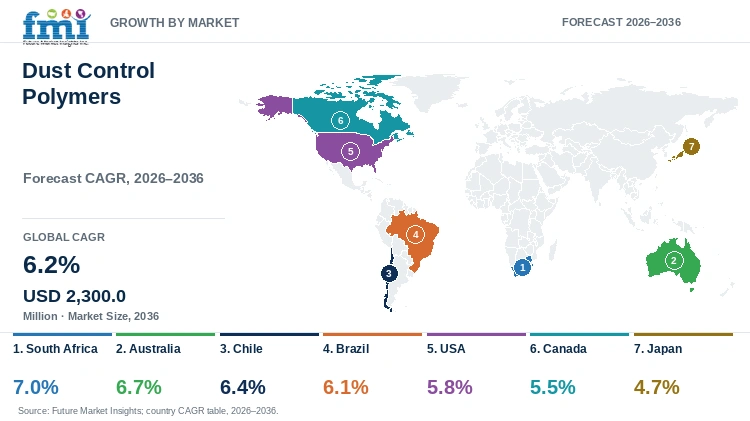
- South Africa is projected at 7% CAGR through 2036, followed by Australia at 6.7%, as large mine bases keep haul roads under treatment, and Japan is forecast at 4.7% on construction and yard work.
Analyst Perspective
“Polymer programs replacing water trucks on long haul networks in dry mining regions will receive the larger share of new mine contracts through 2036. Suppliers selling polymer together with dosing units and site trial data will gain repeat orders from operators in South Africa, Australia and Chile.”
- Nikhil Kaitwade, Principal Consultant, Future Market Insights
How is the Dust Control Polymers Market Segmented?
The dust control polymers market is segmented into polymer type, form, application, end use, sales channel and region.
As per FMI, the market is segmented by polymer type into acrylic polymers, vinyl acetate polymers, polyacrylamide blends, latex-based polymers and bio-polymer binders. By form, the market is segmented into liquid emulsion, concentrate, dry powder and ready-to-use solution. By application, the market is segmented into unpaved roads, mine haul roads, construction sites, stockpiles and rail and port terminals. By end use, the market is segmented into mining, road maintenance, construction, agriculture and industrial yards. By sales channel, the market is segmented into direct industrial supply, chemical distributors, dust-control service firms and government and municipal tenders. The regional analysis covers seven regions and more than 25 countries.
Why Do Acrylic Polymers Lead the Dust Control Polymers Market by Polymer Type?
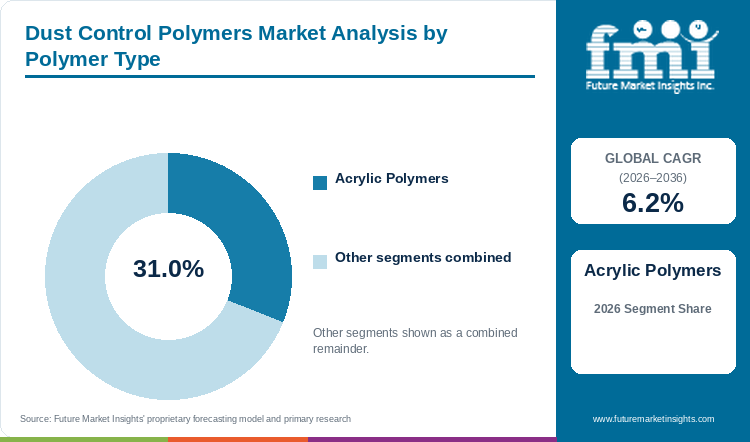
Based on polymer type, acrylic polymers will account for 31% of market share in 2026.
Heavier truck traffic on mine and rural roads is supporting the demand for dust control polymers based on acrylic chemistry. Operators need a binder that keeps the surface bonded after rain and drying spells, due to which spending is moving to acrylic grades that need fewer reapplications per season. Vinyl acetate grades cost less by volume, though demand for these grades is growing at a slower pace, as the crust cracks sooner under fully laden mine trucks. Polyacrylamide blends are priced lower per dose and are used in soluble spray programs linked to the polyacrylamide market, though crews have to retreat these surfaces more often. Latex-based grades go mostly to building contractors and bulk material yards. Bio-polymer binders are appearing in public tenders that specify plant-based chemistry, though few field trials exist on heavy mine routes. However, the treatment interval each customer records on site will decide repeat orders for acrylic programs.
- Acrylic polymers are projected to account for 31% of demand by polymer type in 2026, owing to longer control life between applications on haul roads.
- In June 2025, Midwest Industrial Supply published a technical feature on polymer soil stabilization centered on Soil-Sement Engineered Formula and the surface-binding mechanism behind the product [3].
Why Does Liquid Emulsion Lead the Dust Control Polymers Market by Form?
In 2026, liquid emulsion will account for 48% of market share by form.
Liquid emulsion is widely used in mine and county dust programs, as the product goes straight into the water truck fleets and spray bars that sites already operate. Crews avoid a separate blending stage, owing to which buyers can add polymer to routine watering with little new equipment or training. Concentrates reduce shipping cost for each unit of active polymer, though demand for concentrates is growing at a slower pace, as users need dosing pumps and skilled mixing staff. Isolated sites order dry powders to avoid trucking heavy liquid loads over long distances, a freight trade-off also seen in the soil stabilization materials market. Ready-to-use solutions carry the top price per area treated, so buyers order these products for compact yards and patch jobs only. However, trucking distance from the supplier will decide the mix of emulsion and concentrate bought at remote mines.
- Liquid emulsion is estimated to hold 48% of demand by form in 2026, supported by dosing through installed water-truck fleets.
- In July 2026, Midwest Industrial Supply described an enhanced watering program that adds DustPro Super Dilution Technology to existing water trucks, with water savings of roughly 75% [4].
Why Do Unpaved Roads Lead the Dust Control Polymers Market by Application?
By application, unpaved roads will account for 31% of market share in 2026.
Rural road networks are widely treated by public agencies on a set seasonal schedule, and this repeat work is supporting the demand for dust control polymers on unpaved roads. Traffic breaks up the treated surface over time, due to which agencies come back to the same kilometres every year and form a steady base of orders also counted within the wider dust suppressant market. Canadian data points the same way, with Environment and Climate Change Canada recording 16 Mt of total particulate emissions in 2024, 16% above the 1990 level, and attributing most of the increase to dust from construction operations and unpaved roads [5]. Mine haul roads cover fewer kilometres, though heavier loads push spending per kilometre higher. Building contractors order only for the duration of each project. Demand for crusting agents at stockpiles and rail and port terminals is steady but small, as only a few fixed surfaces need cover. However, the money counties set aside for roads and the prices offered in public bids will decide the treated distance in a season.
- Unpaved roads are expected to account for 31% of demand by application in 2026, owing to recurring reapplication as traffic loosens settled fines.
Why Does Mining Lead the Dust Control Polymers Market by End Use?
Based on end use, mining will account for 34% of market share in 2026.
Mining is the largest buyer of dust control polymers, as one mine pays for dust treatment across haul roads, crushers, transfer points and stockpiles from distinct budgets. Site managers face silica exposure limits and high water bills across every one of these areas, due to which orders from mines are larger and repeat more often than orders from other users. Treated haul roads also cut diesel use, and Cypher Environmental recorded a 17.4% fuel saving on a 10 km stabilized route at Shenhua, valued at about USD 3.6 million each year [6]. Highway and county maintenance bodies order through public bids at lower prices per unit. Construction firms apply product only during an active build, and farms and industrial yards add only small, irregular purchases. Static misting systems from the dry fog dust suppression equipment market also compete with polymers for crusher and conveyor spending at mines. However, proof of fuel and water savings on each haul network will decide annual polymer spending by mine operators.
- Mining is projected to hold 34% of demand by end use in 2026, supported by fuel and water savings on long haul networks.
What are the Drivers, Restraints, and Opportunities in the Dust Control Polymers Market?
As per FMI's analysis, silica exposure limits and water cost will drive polymer adoption, site-by-site performance variation will slow conversion, and chemistry bundled with dosing hardware will open the largest new pool till 2036.
- Driver: Increasing water cost and tighter silica exposure limits are moving mines, contractors and road agencies toward binding chemistry, due to which longer control life is becoming a purchase requirement.
- Restraint: Polymer performance varies with soil, traffic, weather, dosage and application discipline, and each site needs a field trial before annual volumes are released.
- Opportunity: Large mines can offer recurring contracts to suppliers selling polymer programs with metering units and documented water savings.
Engineering controls now come first under the MSHA silica rule, and personal protective equipment is treated as a secondary measure, according to Midwest Industrial Supply [2]. In a six-week independent trial across underground mine locations, the MineKleen Plus system cut silica dust by an average of 69%, with individual reductions from 61% to 88% [2]. Key challenges in the dust control polymers market come from the field, as control life changes with aggregate, traffic, rainfall and dilution, and buyers are testing dosage before committing budgets. GRT reported one operation reducing spray-truck use by 77% and another taking 57% of the water cart fleet off hire, and suppliers are expected to sell against these purchasing metrics during the forecast period [1].
Which Country CAGRs are Profiled in the Dust Control Polymers Market?
| Country | CAGR, 2026 to 2036 |
|---|---|
| South Africa | 7% |
| Australia | 6.7% |
| Chile | 6.4% |
| Brazil | 6.1% |
| USA | 5.8% |
| Canada | 5.5% |
| Japan | 4.7% |
How do Country-level CAGRs Compare in the Dust Control Polymers Market?
Haul-road intensity is creating three growth groups among the seven profiled countries, as per FMI's analysis. South Africa, Australia and Chile are projected at 6.4% or above, Brazil and the USA are expected to grow at a middle pace, and Canada and Japan are forecast at the slower end. Growth pace and revenue size will differ through 2036, as the USA is expected to keep a larger revenue base than the faster-growing mining countries.
- South Africa leads at 7%, with haul-road and exposed-surface trials across a large installed mine base.
- Australia follows at 6.7% as water-saving treatments gain weight on iron ore and coal haul roads.
- Chile at 6.4% will draw on large open-pit copper operations in dry climates.
- Brazil is projected at 6.1% on orders from mines, road programs and construction sites, with the USA close behind at 5.8%.
- Canada is forecast at 5.5% and Japan at 4.7%, with both countries weighted toward roads, construction and industrial yards.
Growth rates for the remaining markets across seven regions and over 25 countries and country groups appear in the full report beside these seven profiles.
Country Outlook
- South Africa is projected at 7% CAGR, the quickest among the seven profiled countries, owing to occupational health obligations at mines. Haul roads and exposed surfaces across a large installed mine base are expected to stay under active treatment.
- Haul roads in arid Australian mining regions consume large water volumes, due to which polymer suppliers documenting fewer truck passes without loss of traction are expected to receive repeat contracts. Polymer sales in Australia are projected at 6.7% CAGR through 2036.
- Codelco produced 1,332,000 tonnes of copper in 2025, slightly above 1,328,000 tonnes in 2024, even after the El Teniente accident cost about 45,000 tonnes of output [7]. Copper volumes of that scale move across dry open-pit haul roads, so treatment life will carry the most weight in supplier selection. A 6.4% CAGR is expected for Chile, and field trials there will test compatibility with local road material and mine water.
- Demand for dust control polymers in Brazil is spread across many open-pit operations in several states. As a result, distributor and service coverage outside the main mining centres is becoming more valuable. Brazil is forecast at 6.1% CAGR through 2036, and local logistics will decide whether polymers can match the cost of water and salts at remote operations.
- For US buyers, the MSHA silica rule effective from April 8, 2026 adds a regulated reason to treat haul roads and handling points [2]. A 5.8% CAGR is projected for US polymer revenue, with county road programs, construction sites and industrial yards forming separate buying channels.
- Dust from unpaved roads and construction drove the rise in Canadian particulate emissions, and PM10 reached 5.6 Mt in 2024, up 13% since 1990 [5]. Demand for dust control polymers in Canada is set to expand at 5.5% CAGR, and freeze-thaw performance and environmental acceptability will be the main tests for suppliers.
- Japan is projected at 4.7%, the slowest in the group, as buying is centred on construction sites, industrial yards and port or terminal handling with little exposure to large domestic mine-haul networks. Buyers in these settings prefer predictable application, cleanliness and material compatibility, owing to which specification-led suppliers are expected to receive steady volume.
Who are the Notable Companies in the Dust Control Polymers Market?
Fragmented supply splits across surface-road specialists, mining chemistry platforms and transfer-point engineers, and FMI profiles Midwest Industrial Supply, Solenis, SNF Group, Ecolab / Nalco Water, GRT and Benetech among the leading names.
No single company covers haul-road, county-road and transfer-point budgets together, due to which supply of dust control polymers remains moderately fragmented. Surface-road specialists such as Midwest Industrial Supply, GRT, Cypher Environmental and Soilworks are competing on control life and water reduction, and GRT reported polymer-dosed water savings of 50% to 90% [1]. Mining chemistry platforms, including Solenis, SNF Group, Ecolab / Nalco Water, Quaker Houghton and Veolia Water Technologies, are selling dust suppressants inside flocculant and water-treatment programs already qualified at the mine. New suppliers need site trial data, dosing hardware and trained application crews, and buyers rerun field trials before moving a road network to a new chemistry. Owing to this, suppliers documenting fewer water-truck passes on the customer's own roads are expected to hold better pricing. However, platforms are pushing into haul roads and specialists are adding mining coverage through bundled chemistry-and-service offers, and competition is projected to increase through 2036.
- Surface-Road Polymer Specialists: Midwest Industrial Supply, GRT, Cypher Environmental and Soilworks treat roads and exposed surfaces, and Cypher Environmental positions ROAD//STABILIZR against haul-road fuel loss [6].
- Mining and Material-Handling Chemistry Platforms: Solenis, SNF Group, Ecolab / Nalco Water, Quaker Houghton and Veolia Water Technologies sell dust control within wider mining and bulk-material chemistry portfolios.
- Integrated Dust-Control Engineering: Benetech combines containment, filtration and suppression systems at bulk-material transfer points.
Competitive Benchmarking
| Company | Polymer Surface-Binding Chemistry | Mining and Bulk-Material Coverage | Application and Dosing Support | Geographic Reach |
|---|---|---|---|---|
| Midwest Industrial Supply | High | Medium | High | United States and international project markets |
| Solenis | High | High | High | Global mining and mineral-processing customers |
| SNF Group | High | High | High | Global mining markets |
| Ecolab / Nalco Water | Medium | High | High | Global, with regional mining teams |
| GRT | High | High | High | Australia and international mining and civil markets |
| Benetech | Low | High | High | North America and international bulk-material projects |
| Cypher Environmental | Medium | Medium | Medium | Canada and international project markets |
| Soilworks | High | Medium | High | United States and international project markets |
| Quaker Houghton | Medium | High | High | Operations in more than 25 countries |
| Veolia Water Technologies | Medium | High | High | Global industrial and material-handling markets |
Scoring basis: Polymer Surface-Binding Chemistry rates documented polymer or binding products for roads and exposed surfaces. Mining and Bulk-Material Coverage rates documented mine-site and handling applications, and Application and Dosing Support rates documented site trials, dosing equipment or technical optimization. A High score signals wide documented capability across these areas, a Medium score a narrower documented range, and a Low score thin public documentation. Geographic Reach covers operations and projects evidenced in the sources reviewed in October 2026.
Key Developments
- In September 2025, Midwest Industrial Supply promoted the MineKleen Plus system for MSHA silica compliance and reported an average 69% silica dust reduction in a six-week underground trial [2].
- In October 2025, Cypher Environmental linked haul-road stabilization to fuel cost, citing a 10 km stabilized road at Shenhua that cut fuel consumption by 17.4% [6].
- In March 2026, GRT compared polymer and water programs for mine haul roads and reported polymer-dosed water savings of 50% to 90% across operations [1].
- In July 2026, Midwest Industrial Supply set out managed service, guided self-apply and enhanced watering programs for road dust control, including DustPro Super Dilution Technology for existing water trucks [4].
Key Players
Surface-Road Polymer Specialists
- Midwest Industrial Supply
- GRT
- Cypher Environmental
- Soilworks
Mining and Material-Handling Chemistry Platforms
- Solenis
- SNF Group
- Ecolab / Nalco Water
- Quaker Houghton
- Veolia Water Technologies
Integrated Dust-Control Engineering
- Benetech
Report Scope and Methodology
| Coverage field | Report scope |
|---|---|
| Market breakdown | 5 categories plus region: Polymer Type (Acrylic Polymers, Vinyl Acetate Polymers, Polyacrylamide Blends, Latex-based Polymers, Bio-polymer Binders), Form (Liquid Emulsion, Concentrate, Dry Powder, Ready-to-use Solution), Application (Unpaved Roads, Mine Haul Roads, Construction Sites, Stockpiles, Rail / Port Terminals), End Use (Mining, Road Maintenance, Construction, Agriculture, Industrial Yards), Sales Channel (Direct Industrial Supply, Chemical Distributors, Dust-control Service Firms, Government / Municipal Tenders), and Region |
| Quantitative units | USD Million |
| Market definition | Revenue from polymer-based dust-control products sold into the stated applications and end uses. Polymer value inside bundled treatment programs counts only to the extent attributable to the polymer. The definition excludes downstream finished-product revenue, substitute dust-control products, mechanical dust-collection equipment and unrelated service labor. |
| Regions covered | North America, Latin America, Western Europe, Eastern Europe, East Asia, South Asia and Pacific, Middle East and Africa |
| Countries covered | South Africa, Australia, Chile, Brazil, the USA, Canada, and Japan in detail, within a wider set of over 25 countries and country groups |
| Key companies profiled | Midwest Industrial Supply, Solenis, SNF Group, Ecolab / Nalco Water, GRT, Benetech, Cypher Environmental, Soilworks, Quaker Houghton, and Veolia Water Technologies, profiled from a wider pool of haul-road, mine chemistry and dust-engineering suppliers |
| Forecast period | 2026 to 2036 |
| Approach | The sizing model used by FMI triangulates primary interviews and secondary research with segment structure, pricing and volume indicators, and country-level mining, road and construction activity. |
Research Methodology
| Method | Approach |
|---|---|
| Primary research | Mine operators, road agencies, procurement teams, distributors, polymer manufacturers, dust-control service providers and dosing-equipment developers were interviewed on purchase drivers, trial requirements and pricing, and on the haul-road and silica-compliance proof a site needs before trial volumes turn into standing orders. |
| Desk research | The analysis reviews government emissions and mining statistics, occupational exposure rules, technical literature, company announcements and product documentation. The study keeps sources that describe demand for polymers, application performance or supplier activity inside the market boundary. |
| Market sizing and forecasting | Forecasts start from the baseline value and layer on segment structure, price and volume signals, the adoption rate on haul roads and stockpiles, supplier participation and demand conditions in each country. Mining activity, road and construction investment, silica exposure regulation and water cost shape the forward path. |
| Data validation | Every estimate is cross-checked with public statistics, supplier announcements and what interviewees reported from the field. Before the final reconciliation, the model removes substitute products, dust-collection equipment, double-counted revenue and any claim lacking support. |
Dust Control Polymers Market by Segments
Dust Control Polymers Market Segmented by Polymer Type
- Acrylic Polymers
- Vinyl Acetate Polymers
- Polyacrylamide Blends
- Latex-based Polymers
- Bio-polymer Binders
Dust Control Polymers Market Segmented by Form
- Liquid Emulsion
- Concentrate
- Dry Powder
- Ready-to-use Solution
Dust Control Polymers Market Segmented by Application
- Unpaved Roads
- Mine Haul Roads
- Construction Sites
- Stockpiles
- Rail / Port Terminals
Dust Control Polymers Market Segmented by End Use
- Mining
- Road Maintenance
- Construction
- Agriculture
- Industrial Yards
Dust Control Polymers Market Segmented by Sales Channel
- Direct Industrial Supply
- Chemical Distributors
- Dust-control Service Firms
- Government / Municipal Tenders
Dust Control Polymers Market Segmented by Region
- North America
- Latin America
- Western Europe
- Eastern Europe
- East Asia
- South Asia and Pacific
- Middle East and Africa
Research Sources and Bibliography
- [1] Global Road Technology (2026, March 2). Polymer vs Water: Mining Haul Road Dust Control.
- [2] Midwest Industrial Supply (2025, September 9). New MSHA Silica Rule - Compliance with MineKleen Plus System.
- [3] Midwest Industrial Supply (2025, June 11). Proving the Power of Midwest's Polymer Soil Stabilization.
- [4] Midwest Industrial Supply (2026, July 27). Dust Control for Roads: Three Programs, One Goal.
- [5] Environment and Climate Change Canada (2026, March 13). Canada's Air Pollutant Emissions Inventory Report 2026.
- [6] Cypher Environmental (2025, October 30). How Rolling Resistance is Quietly Burning Fuel at Your Mine (And What to Do About It).
- [7] La Tercera (2026, January 5). Codelco cerró 2025 con ligero aumento productivo: alcanzó las 1.332.000 toneladas de cobre.
This bibliography is provided for reader reference and is not exhaustive. The full report contains the complete reference list and detailed citations.
This Report Answers
- What will dust control polymer spending on haul roads and exposed surfaces total in 2026, and what revenue will the market reach by 2036?
- Which silica exposure rules and water-cost pressures will keep mines and road agencies buying dust control polymers?
- Why will acrylic polymers take the largest polymer type share in 2026, and in what ways will haul-road traffic shape that lead?
- Why will liquid emulsion remain the main delivery format for dust control polymers?
- Which of South Africa, Australia, Chile, Brazil, the USA, Canada, and Japan will post the fastest dust control polymer growth till 2036?
- In what ways will bundled dosing equipment and documented water savings raise the value of polymer programs?
- Which field trial and site variability factors will slow supplier switching through 2036?
- What field evidence will mine operators and road agencies ask for before approving a new polymer supplier?
Frequently Asked Questions
How Big Is the Dust Control Polymers Market Expected to Be in 2026?
Across mine haul roads, unpaved roads and other treated sites, dust control polymer sales will total USD 1.2 Billion in 2026, compared with USD 1,129.9 Million a year earlier in 2025, according to FMI. Water-truck programs giving way to binding chemistry will take revenue to USD 2.3 Billion by 2036.
What Is the CAGR of the Dust Control Polymers Market from 2026 to 2036?
On each haul road or county network, a field trial gates new volume, so dust control polymer sales will compound at a 6.2% CAGR between 2026 and 2036. Buyers will commit annual volumes only after a polymer holds control under local traffic and weather.
Which Polymer Type Holds the Largest Share of the Dust Control Polymers Market?
Acrylic polymers will lead with 31% of market share by polymer type in 2026. Flexible surface films will keep control intervals longer than short-lived wetting treatments.
Which Form Leads the Dust Control Polymers Market?
Liquid emulsion will account for 48% of market share by form in 2026. Dilution and dosing through existing water trucks will keep the format ahead of powders and concentrates.
Which Country Is Expected to Grow Fastest in the Dust Control Polymers Market?
South African mine sites will drive the fastest growth, a 7% CAGR till 2036, with Australia next at 6.7% and Chile at 6.4%. Construction yards and port terminals in Japan will keep that country at the bottom of the seven profiled markets, growing at 4.7%.
What Notable Restraint Affects the Dust Control Polymers Market?
Key challenges in the dust control polymers market will include site-by-site qualification. Control life will shift with soil gradation, traffic, rainfall and dilution, so buyers will run field trials before committing annual budgets.
Which Are the Key Companies in the Dust Control Polymers Market?
For haul roads, mine chemistry and transfer-point engineering, the notable companies FMI covers are Midwest Industrial Supply, Solenis, SNF Group, Ecolab / Nalco Water, GRT, Benetech, Cypher Environmental, Soilworks, Quaker Houghton, and Veolia Water Technologies. Road specialists, mining chemistry platforms and dust-control engineering form the three supplier groups used for these companies.
Preview the report firsthand - request a free sample
Get SampleGet the brochure for pricing and purchase details.
Get PDFTable of Content
- Key Takeaways
- Market Size and CAGR
- Top Growth Driver
- Fastest Growing Segment
- Leading Region
- Key Companies
- Emerging Opportunities
- Executive Summary
- Global Market Outlook
- Demand-side Trends
- Supply-side Trends
- Technology Roadmap Analysis
- Analysis and Recommendations
- Analyst Perspective (What is happening? Why now? What should investors know?)
- Key Questions Answered
- How large is the market?
- What is the CAGR?
- What are key trends?
- Which region dominates?
- Who are the leaders?
- Market Overview
- Market Coverage / Taxonomy
- Market Definition / Scope / Limitations
- Research Methodology
- Chapter Orientation
- Analytical Lens and Working Hypotheses
- Market Structure, Signals, and Trend Drivers
- Benchmarking and Cross-market Comparability
- Market Sizing, Forecasting, and Opportunity Mapping
- Research Design and Evidence Framework
- Desk Research Programme (Secondary Evidence)
- Expert Input and Fieldwork (Primary Evidence)
- Tooling, Models, and Reference Databases
- Data Engineering and Model Build
- Quality Assurance and Audit Trail
- Market Background
- Market Dynamics (Drivers, Restraints, Opportunity, Trends)
- Scenario Forecast (Optimistic, Likely, Conservative)
- Impact Analysis
- AI Impact
- Sustainability Impact
- Regulatory Impact
- Technology Impact
- Consumer / Buyer Analysis
- Purchase Drivers
- Adoption Barriers
- Buyer Journey
- Opportunity Map Analysis
- Product Life Cycle Analysis
- Supply Chain Analysis
- Investment Feasibility Matrix
- Value Chain Analysis
- PESTLE and Porter's Analysis
- Regulatory Landscape
- Regional Parent Market Outlook
- Production and Consumption Statistics
- Import and Export Statistics
- Global Market Analysis and Forecast, 2021 to 2036
- Historical Market Size Value (USD Million) Analysis, 2021 to 2025
- Current and Future Market Size Value (USD Million) Projections, 2026 to 2036
- Y-o-Y Growth Trend Analysis
- Absolute $ Opportunity Analysis
- Global Market Pricing Analysis, 2021 to 2036
- Global Market Analysis and Forecast, By Polymer Type, 2021 to 2036
- Introduction / Key Findings
- Historical Market Size Value (USD Million) Analysis By Polymer Type, 2021 to 2025
- Current and Future Market Size Value (USD Million) Analysis and Forecast By Polymer Type, 2026 to 2036
- Acrylic Polymers
- Vinyl Acetate Polymers
- Polyacrylamide Blends
- Latex-based Polymers
- Bio-polymer Binders
- Y-o-Y Growth Trend Analysis By Polymer Type, 2021 to 2025
- Absolute $ Opportunity Analysis By Polymer Type, 2026 to 2036
- Global Market Analysis and Forecast, By Form, 2021 to 2036
- Introduction / Key Findings
- Historical Market Size Value (USD Million) Analysis By Form, 2021 to 2025
- Current and Future Market Size Value (USD Million) Analysis and Forecast By Form, 2026 to 2036
- Liquid Emulsion
- Concentrate
- Dry Powder
- Ready-to-use Solution
- Y-o-Y Growth Trend Analysis By Form, 2021 to 2025
- Absolute $ Opportunity Analysis By Form, 2026 to 2036
- Global Market Analysis and Forecast, By Application, 2021 to 2036
- Introduction / Key Findings
- Historical Market Size Value (USD Million) Analysis By Application, 2021 to 2025
- Current and Future Market Size Value (USD Million) Analysis and Forecast By Application, 2026 to 2036
- Unpaved Roads
- Mine Haul Roads
- Construction Sites
- Stockpiles
- Rail / Port Terminals
- Y-o-Y Growth Trend Analysis By Application, 2021 to 2025
- Absolute $ Opportunity Analysis By Application, 2026 to 2036
- Global Market Analysis and Forecast, By End Use, 2021 to 2036
- Introduction / Key Findings
- Historical Market Size Value (USD Million) Analysis By End Use, 2021 to 2025
- Current and Future Market Size Value (USD Million) Analysis and Forecast By End Use, 2026 to 2036
- Mining
- Road Maintenance
- Construction
- Agriculture
- Industrial Yards
- Y-o-Y Growth Trend Analysis By End Use, 2021 to 2025
- Absolute $ Opportunity Analysis By End Use, 2026 to 2036
- Global Market Analysis and Forecast, By Sales Channel, 2021 to 2036
- Introduction / Key Findings
- Historical Market Size Value (USD Million) Analysis By Sales Channel, 2021 to 2025
- Current and Future Market Size Value (USD Million) Analysis and Forecast By Sales Channel, 2026 to 2036
- Direct Industrial Supply
- Chemical Distributors
- Dust-control Service Firms
- Government / Municipal Tenders
- Y-o-Y Growth Trend Analysis By Sales Channel, 2021 to 2025
- Absolute $ Opportunity Analysis By Sales Channel, 2026 to 2036
- Global Market Analysis and Forecast, By Region, 2021 to 2036
- Introduction
- Historical Market Size Value (USD Million) Analysis By Region, 2021 to 2025
- Current Market Size Value (USD Million) Analysis and Forecast By Region, 2026 to 2036
- North America
- Latin America
- Western Europe
- Eastern Europe
- East Asia
- South Asia and Pacific
- Middle East and Africa
- Market Attractiveness Analysis By Region
- North America Market Analysis and Forecast, By Country, 2021 to 2036
- Historical Market Size Value (USD Million) Trend Analysis By Market Taxonomy, 2021 to 2025
- Market Size Value (USD Million) Forecast By Market Taxonomy, 2026 to 2036
- By Country
- By Polymer Type
- By Form
- By Application
- By End Use
- By Sales Channel
- Market Attractiveness Analysis
- By Country
- By Polymer Type
- By Form
- By Application
- By End Use
- By Sales Channel
- Key Takeaways
- Latin America Market Analysis and Forecast, By Country
- Historical Market Size Value (USD Million) Trend Analysis By Market Taxonomy, 2021 to 2025
- Market Size Value (USD Million) Forecast By Market Taxonomy, 2026 to 2036
- By Country
- By Polymer Type
- By Form
- By Application
- By End Use
- By Sales Channel
- Market Attractiveness Analysis
- By Country
- By Polymer Type
- By Form
- By Application
- By End Use
- By Sales Channel
- Key Takeaways
- Western Europe Market Analysis and Forecast, By Country
- Historical Market Size Value (USD Million) Trend Analysis By Market Taxonomy, 2021 to 2025
- Market Size Value (USD Million) Forecast By Market Taxonomy, 2026 to 2036
- By Country
- By Polymer Type
- By Form
- By Application
- By End Use
- By Sales Channel
- Market Attractiveness Analysis
- By Country
- By Polymer Type
- By Form
- By Application
- By End Use
- By Sales Channel
- Key Takeaways
- Eastern Europe Market Analysis and Forecast, By Country
- Historical Market Size Value (USD Million) Trend Analysis By Market Taxonomy, 2021 to 2025
- Market Size Value (USD Million) Forecast By Market Taxonomy, 2026 to 2036
- By Country
- By Polymer Type
- By Form
- By Application
- By End Use
- By Sales Channel
- Market Attractiveness Analysis
- By Country
- By Polymer Type
- By Form
- By Application
- By End Use
- By Sales Channel
- Key Takeaways
- East Asia Market Analysis and Forecast, By Country
- Historical Market Size Value (USD Million) Trend Analysis By Market Taxonomy, 2021 to 2025
- Market Size Value (USD Million) Forecast By Market Taxonomy, 2026 to 2036
- By Country
- By Polymer Type
- By Form
- By Application
- By End Use
- By Sales Channel
- Market Attractiveness Analysis
- By Country
- By Polymer Type
- By Form
- By Application
- By End Use
- By Sales Channel
- Key Takeaways
- South Asia and Pacific Market Analysis and Forecast, By Country
- Historical Market Size Value (USD Million) Trend Analysis By Market Taxonomy, 2021 to 2025
- Market Size Value (USD Million) Forecast By Market Taxonomy, 2026 to 2036
- By Country
- By Polymer Type
- By Form
- By Application
- By End Use
- By Sales Channel
- Market Attractiveness Analysis
- By Country
- By Polymer Type
- By Form
- By Application
- By End Use
- By Sales Channel
- Key Takeaways
- Middle East and Africa Market Analysis and Forecast, By Country
- Historical Market Size Value (USD Million) Trend Analysis By Market Taxonomy, 2021 to 2025
- Market Size Value (USD Million) Forecast By Market Taxonomy, 2026 to 2036
- By Country
- By Polymer Type
- By Form
- By Application
- By End Use
- By Sales Channel
- Market Attractiveness Analysis
- By Country
- By Polymer Type
- By Form
- By Application
- By End Use
- By Sales Channel
- Key Takeaways
- Key Countries Market Analysis
- South Africa
- Pricing Analysis
- Market Share Analysis, 2025
- By Polymer Type
- By Form
- By Application
- By End Use
- By Sales Channel
- Australia
- Pricing Analysis
- Market Share Analysis, 2025
- By Polymer Type
- By Form
- By Application
- By End Use
- By Sales Channel
- Chile
- Pricing Analysis
- Market Share Analysis, 2025
- By Polymer Type
- By Form
- By Application
- By End Use
- By Sales Channel
- Brazil
- Pricing Analysis
- Market Share Analysis, 2025
- By Polymer Type
- By Form
- By Application
- By End Use
- By Sales Channel
- USA
- Pricing Analysis
- Market Share Analysis, 2025
- By Polymer Type
- By Form
- By Application
- By End Use
- By Sales Channel
- Canada
- Pricing Analysis
- Market Share Analysis, 2025
- By Polymer Type
- By Form
- By Application
- By End Use
- By Sales Channel
- Japan
- Pricing Analysis
- Market Share Analysis, 2025
- By Polymer Type
- By Form
- By Application
- By End Use
- By Sales Channel
- South Africa
- Market Structure Analysis
- Competition Dashboard
- Competition Benchmarking
- Market Share Analysis of Top Players
- By Regional
- By Polymer Type
- By Form
- By Application
- By End Use
- By Sales Channel
- Emerging Startups
- Innovation Benchmarking
- Competition Analysis
- Competition Deep Dive
- Midwest Industrial Supply
- Overview
- Product Portfolio
- Profitability by Market Segments
- Sales Footprint
- Strategy Overview
- Marketing Strategy
- Product Strategy
- Channel Strategy
- Solenis
- SNF Group
- Ecolab / Nalco Water
- GRT
- Benetech
- Cypher Environmental
- Soilworks
- Quaker Houghton
- Veolia Water Technologies
- Midwest Industrial Supply
- Case Studies
- Success Stories
- Recent Developments
- Competition Deep Dive
- Assumptions & Acronyms Used


