

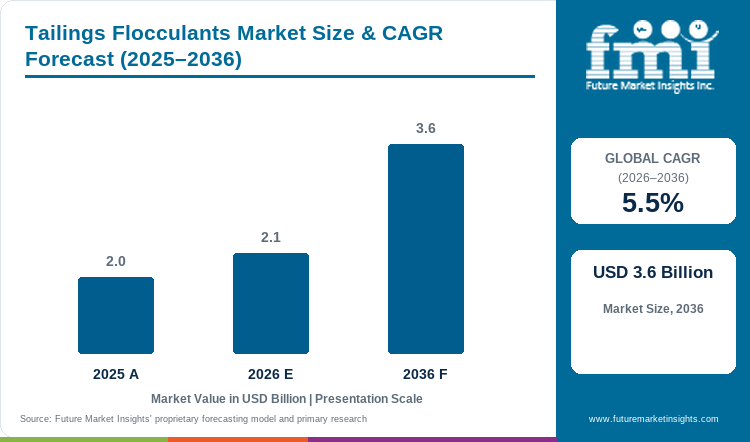
- Market Size (2026)
- USD 2.1 Bn
- Forecast (2036)
- USD 3.6 Bn
- CAGR (2026 to 2036)
- 5.5%
How big is Tailings Flocculants Market in 2026?
USD 2.1 billion in 2026 and USD 3.6 billion by 2036, expanding at 5.5% CAGR.
Sales of tailings flocculants are set to grow at 5.5% CAGR through 2036. The value rises from USD 2.0 billion in 2025 to USD 2.1 billion in 2026. It is set to reach USD 3.6 billion by 2036. Mines use flocculants to split solids from water faster. This helps when water recovery or thickener stability limits mine output. Kemira documents a seven-month trial at a Brazilian bauxite mine. The trial used Superfloc RH4821 and cut polymer use by more than 35%. More solids in the underflow also improved water recovery and tailings-handling capacity.
Site needs change which product grade works. The basic separation job stays the same. Chile's copper mines use more seawater. Sites in Australia handle large tailings volumes in remote areas. COCHILCO projects Chilean copper-mine water demand to rise from 18.5 cubic meters per second in 2024 to 20.6 cubic meters per second in 2034. Salt water makes brine tolerance and fit with recovered water more important. At remote Australian sites reagent plans face the same delivery limits as surface mining equipment support. A late reagent delivery can stop tailings treatment even when the approved chemistry has not changed.
Key Takeaways
- Mine teams set tighter goals for water recovery. Dense underflow can send more process water back and cut stored slurry.
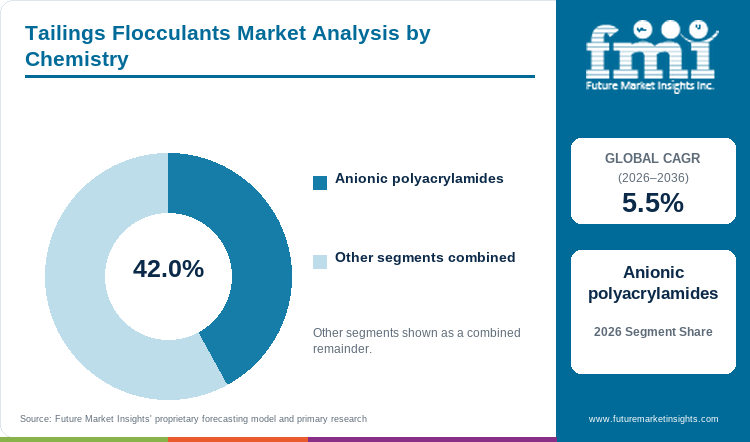
- Anionic polyacrylamides are set to make up 42.0% of chemistry demand in 2026. Their polymer chains help many mineral particles stick together.
- Copper tailings are set to make up 29.0% of tailings-type demand in 2026. Copper plants run steadily and face pressure to reuse water.
- Thickening is set to hold 31.0% of application demand in 2026. Mines add flocculants before storage or dewatering.
- Salty water and changes in ore makeup (mineralogy) make plant trials important. Feed chemistry can change the dose range that works.
- Key companies include SNF, Kemira, Solenis, Ecolab / Nalco Water, Clariant, and Syensqo.
Analyst Perspective
"Tailings flocculant economics depend on whether a formulation keeps settling and water recovery stable as ore mineralogy or recycled-water chemistry changes. Plant-scale qualification therefore rewards products that hold a workable dose window and arrive with application support."
- Nikhil Kaitwade, Principal Consultant, Future Market Insights.
How is the tailings flocculants market segmented?
The tailings flocculants market is segmented by Chemistry, Tailings Type, Application, End Use, Sales Channel and Region.
For 2026 to 2036 the market is split by chemistry, tailings type, application, end use, sales channel and region. Chemistry groups products by polymer charge and blend type. Tailings type groups them by mineral and slurry. Application shows where solids are split from water. End use shows who controls repeat treatment. Sales channel separates direct contracts from service and sales routes. Region covers mine locations and local site needs.
Why do anionic polyacrylamides lead the chemistry category?
Anionic polyacrylamides link fine mineral particles into larger groups and help them settle. SNF offers FLOMIN TFA for mine thickening and dewatering. Syensqo offers anionic CYFLOC grades for red-mud clarification. Sites must match charge density to local needs. Clay and dissolved salts can change how the polymer sticks to particles. The same chemistry also links tailings use with polyacrylamide demand.
- Anionic polyacrylamides are set to make up 42.0% of chemistry demand in 2026. Mines use them to settle many types of mineral slurry.
- Blended treatment can lower the charge on particles. It can also use polymer chains to link particles when one flocculant cannot form stable groups.
Why do copper tailings lead the tailings type category?
Copper plants make tailings every day. Many send recovered water back to flotation. COCHILCO projects seawater to supply 67.6% of Chilean copper-mining water by 2034. Salt can narrow the dose range that works. It can also change the water left after treatment. Site tests therefore link flocculants with mining flotation chemicals used earlier in the same copper plant.
- Copper tailings are set to hold 29.0% of tailings-type demand in 2026. Large copper plants make recovered process water more valuable.
- Salt water puts more focus on brine tolerance during product trials. Teams also check the quality of water left after treatment.
How does thickening anchor the application category?
Mines add flocculants during thickening. The step packs more solids into the slurry before storage or dewatering. Teams check clear overflow water and dense underflow as feed changes. Kemira reports lower polymer use and more underflow solids in a Brazilian bauxite trial. Stable mineral processing equipment also keeps mixing and solids handling steady.
- Thickening is set to hold 31.0% of application demand in 2026. Mines use it before storage and water return.
- Denser underflow can send less water to storage. It can also prepare tailings for filtration or dry stacking.
What keeps mining operators central to the end-use category?
Mine teams face production and water-use problems when a flocculant works poorly. Metallurgy teams test how each dose works. Tailings teams check flow (rheology) and where solids settle. Buyers weigh reagent cost against water recovery and steady supply. Direct control of the process also links repeat dosing to wider industrial water treatment choices at sites with limited water.
- Mine teams are likely to hold 50.0% share in 2026. They control repeat dosing budgets and process risk.
- Site teams keep approved grades when a formulation stays stable through ore changes and recycled plant water.
Why do mining chemical suppliers lead the sales channel category?
Mining chemical suppliers sell reagents and help with plant trials. They can screen products and change doses as ore conditions shift. SNF and Solenis document field support for mining flocculants. Field help matters when flocculant and coagulant demand must match the slurry at each site.
- Mining chemical suppliers are set to hold 44.0% share in 2026. They combine reagent access with field support.
- Direct mine contracts still matter at high-volume sites. These sites can support dedicated stock and field help.
What are the drivers, restraints and opportunities in the Tailings Flocculants Market?
Higher tailings volumes and water recovery sustain repeat dosing, variable slurry chemistry slows qualification, and difficult dewatering duties open room for tailored flocculant programs.
- Driver: Mines use flocculants each day. Dense underflow sends more process water back and keeps thickeners steady.
- Restraint: Ore makeup (mineralogy) and recycled water can change how a dose works. Mines may need new plant trials before approval.
- Opportunity: Salt water and dense tailings create a need for new grades. Those grades must handle tight flow (rheology) limits and still recover water.
Water recovery keeps flocculant dosing tied to daily tailings throughput
Mine teams handle large tailings volumes and try to send more water back to the plant. CSIRO estimates that Australia makes about 620 million tonnes of mining waste each year. CSIRO says much of this waste is stored in tailings dams. Flocculants can make solids settle faster and raise underflow density. They must still keep the overflow water clear. Kemira reports water savings of 3,500 cubic meters per day at a Brazilian bauxite mine. The full-scale program also cut polymer use by 35%. These results tie dosing to mine costs and water recovery rather than waste treatment alone. Tailings chemistry also works with water and wastewater treatment chemicals that help manage industrial water quality.
Feed variability lengthens site testing when dose response changes at plant scale
A flocculant may work differently when ore makeup (mineralogy) or particle size moves beyond lab tests. Recycled water adds another factor. Dissolved salts can change surface charge and polymer action. Solenis describes a nickel plant that struggled with hard-to-process laterite ore. A Praestol program then made thickener operation steady. The treatment cut flocculant use by 20%. It also raised average underflow density from 36.8% to 38.1% on one thickener. The plant reached these gains through site tests rather than one standard recipe. A grade change still brings test cost and process risk. A mine may keep its current grade until another product proves stable through feed changes and normal make-down conditions.
Saline circuits and high-density disposal create a wider formulation opportunity
Dewatering jobs in hard water create room for products that work better than standard anionic treatment. Solenis says Rheomax flocculants can recover more water in very salty and high-iron settings. Clariant sells filter aids for tailings filtration. It also sells flow (rheology) modifiers for dense solids. These products matter more as sites move toward paste or filtered tailings. Such sites send less water to storage. A wider product range can shorten tests when ore or water chemistry changes. Automated dose control can change the feed rate as slurry properties shift. The same need reaches industrial wastewater treatment chemicals when recovered water needs more treatment before reuse or discharge.
Which country CAGRs are profiled in the Tailings Flocculants Market?
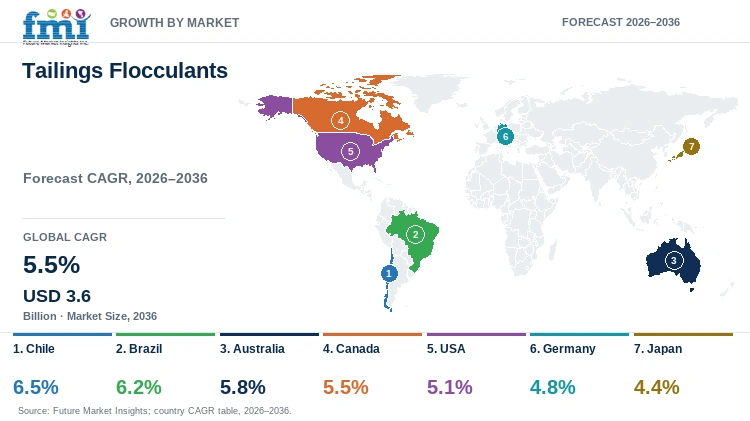
| Country | CAGR |
|---|---|
| Chile | 6.5% |
| Brazil | 6.2% |
| Australia | 5.8% |
| Canada | 5.5% |
| USA | 5.1% |
| Germany | 4.8% |
| Japan | 4.4% |
How do country-level CAGRs compare in the Tailings Flocculants Market?
The displayed CAGRs put Chile and Brazil in a faster-growth group. Australia and Canada form a middle group. Germany and Japan grow more slowly in the forecast. The USA stays close to the title-market pace. These differences come from mine-water pressure and site testing conditions. They do not describe current market size or supplier position.
- Chile: Salt water makes product tests more important.
- Brazil: Dam changes make clear treatment records more important.
- Australia: Remote sites raise the cost of a reagent supply break.
- Canada: Tailings rules require more records.
- USA: Different mine-waste streams need different product tests.
- Germany: Mine cleanup needs solids separation for each project.
- Japan: Closed mines need products for specific engineering jobs.
Similar CAGRs can still create different product-entry and service needs. The full report gives country CAGR data for North America and Latin America. It also covers Europe, East Asia, South Asia, Oceania, and the Middle East and Africa.
Country-wise Analysis
- Chile is set to grow at 6.5% CAGR through 2036 as copper mines face water limits and use more seawater. COCHILCO projects water demand to rise from 18.5 cubic meters per second in 2024 to 20.6 cubic meters per second in 2034. COCHILCO also expects seawater to supply 67.6% of copper-mine water by 2034. Salt water changes how flocculants work. It can also affect recycled water sent back to flotation. Mines test each grade before full-scale use. Local stock helps remote high-altitude mines avoid delivery breaks. Suppliers can pair brine-tolerant products with field help. This can protect water recovery and steady supply during seasonal production changes.
- Brazil is set to post 6.2% CAGR over the forecast period as dam decharacterization work and inspections stay active. The National Mining Agency reported 137 field inspections during 2025. The agency also recorded seven upstream dams decharacterized during the year. It recorded 45 structures still remaining. These programs keep tailings work and records under close review. Brazil also has direct plant proof for better flocculant use. Kemira reports a bauxite mine where a seven-month full-scale trial cut polymer use by 35%. The trial also saved about 3,500 cubic meters of water per day. Suppliers can use plant-scale proof and local service to compete. They also need products that handle fine bauxite or iron-rich feed without making the dose range too narrow.
- Australia is set to grow at 5.8% CAGR through 2036 as mines manage large tailings volumes at remote sites. In November 2025 CSIRO reported that Australia makes about 620 million tonnes of mining waste each year. CSIRO placed this waste across about 250 active tailings dams. It also said about 96% of mining waste is stored in tailings dams. Large volumes favor products that keep underflow density steady as feed changes. Remote sites make stockouts or poor make-down more costly. Cold-weather preparation can add another handling limit. Suppliers need regional stock and field teams that can respond fast. Dense slurry pumping also links treatment chemistry with industrial pumps used to move the slurry.
- Sales of these products in Canada are set to grow at 5.5% CAGR by 2036. Site-specific tailings systems and formal reporting shape this outlook. The Mining Association of Canada says sites report against the 2023 Tailings Management Protocol in 2026 and 2027. Environment and Climate Change Canada also asked for public views on a plan to expand tailings capacity at Scully Mine. The review ran from December 2025 through February 2026. These rules link storage design and operating records with treatment choices. Mines still need chemistry that works through seasonal and ore changes. Suppliers can make approval easier with clear trial steps and cold-weather preparation guidance. Service matters when sites rely on long transport routes and strict operating plans.
- Demand for these products in the USA is set to rise at 5.1% CAGR over the forecast period. Mine-waste mapping and water work support this outlook. In January 2026 the U.S. Geological Survey released the first phase of its National Mine Waste Inventory. The database lists tailings and waste-rock piles across eleven states. Mine teams still test flocculants at each site because ore type and water chemistry vary. Local field support can shorten jar tests and plant trials. Suppliers also need good make-down support when water reuse changes later process steps. Accounts with repeat thickener dosing and clear operating control can provide steadier demand than one-time cleanup work.
- Demand for these products in Germany is set to rise at 4.8% CAGR over the forecast period. Federal mine-plan rules and cleanup of old sites shape this outlook. Germany's Federal Mining Act requires approved plans for mining and processing work. Section 54 says firms must submit plan changes before work starts. In August 2026 Wismut reported work at the Culmitzsch tailings site. The work added a new seepage collection system. It also included major water-routing construction. These projects need solids separation for each work stage. Treatment chemistry must stay reliable as the solids change. Flexible delivery and clear water-cleaning results matter as cleanup moves between construction phases and site transitions.
- Tailings flocculant use in Japan is set to grow at 4.4% CAGR through 2036. Mine-water treatment and cleanup programs shape this outlook. METI opened a 2026 test program for advanced wastewater treatment at closed and abandoned mines. The program targets long-term mine water that contains heavy metals. It also tests lower-energy tools at working sites. This creates a narrow need for chemicals that split solids from water. Japan does not have the same large tailings-volume base as some mining countries. Flocculant suppliers need portable tests and clear dose-response records. Teams must also check recovered water when treatment uses metal precipitation and other cleanup steps. Project-by-project field help matters more than broad stock at each mine site.
Who are the notable companies in the Tailings Flocculants Market?
SNF, Kemira, Solenis, Ecolab / Nalco Water, Clariant and Syensqo are active within the defined tailings flocculants supply boundary.
Firms compete on the range of products and the help they give mine sites. Company size alone matters less. SNF sells FLOMIN TFA for thickening and dewatering. Kemira shows Superfloc in full-scale tailings work. Solenis sells Praestol and Rheomax with mine-processing help. Ecolab / Nalco Water pairs liquid flocculants with mixing tools. Clariant works on filtration and flow (rheology). Syensqo supplies CYFLOC for red-mud separation. These products also link with water treatment chemicals when mines clean reused water.
- SNF, Kemira and Solenis sell a broad set of mine flocculants. They also provide field help for several processing jobs.
- Ecolab / Nalco Water and Clariant link tailings work with water treatment. Their programs cover dewatering and flow (rheology).
- Syensqo sells CYFLOC for red-mud clarification. The same grades help in counter-current decantation at alumina plants.
Competitive Benchmarking: Tailings Flocculants Market
| Company | Tailings Flocculant Breadth | Mine-Site Application Support | Tailings / Water Evidence | Geographic Reach |
|---|---|---|---|---|
| SNF | High | High | High | Global |
| Kemira | Medium | High | High | Global |
| Solenis | High | High | High | Global |
| Ecolab / Nalco Water | Medium | High | High | Global |
| Clariant | Medium | High | High | Global |
| Syensqo | Medium | Medium | Medium | Global |
Scoring basis: High breadth means a firm shows many flocculant or related product families for mine work. Medium breadth means the range is smaller or covers fewer minerals. High field support means the firm shows mine-site tests or field programs. Medium field support means less support. High evidence means an official tailings case or a detailed field program. Medium evidence means exact-market product proof with fewer case details. Geographic reach uses public statements on where the firm supplies or supports mines.
Key Developments in the Tailings Flocculants Market
- In July 2026 Clariant showed tools for tailings filtration and flow (rheology) at Procemin-Geomet in Santiago. The program linked them with dewatering and water recovery. It also covered handling dense solids.
- In March 2026 SNF opened a Mining Technical Center at the Gorceix Foundation campus in Ouro Preto. The center runs field tests. SNF's current FLOMIN TFA range covers mine thickening and filtration. It also covers dewatering.
- In February 2026 Syensqo showed its mining reagent program at SME MINEXCHANGE. The event covered chemicals for set mine-processing tasks. Syensqo's current CYFLOC range helps red mud settle and clear in alumina circuits.
Key Players in the Tailings Flocculants Market
Broad mining-flocculant platforms
- SNF
- Kemira
- Solenis
Integrated tailings and water-treatment programs
- Ecolab / Nalco Water
- Clariant
Specialized mineral-processing flocculants
- Syensqo
Tailings Flocculants Market - Report Scope
| Coverage field | Report scope |
|---|---|
| Market breakdown | By chemistry, tailings type, application, end use, sales channel and region. |
| Quantitative Units | USD billion. |
| Market Definition | Commercial flocculants and coagulant blends sold for mining tailings solid-liquid separation are included. Finished dewatering equipment and unrelated mining reagents are excluded. |
| Regions Covered | North America, Latin America, Western Europe, Eastern Europe, East Asia, South Asia and Pacific, and Middle East and Africa. |
| Countries Covered | Chile, Brazil, Australia, Canada, USA, Germany, Japan, and 25+ additional countries in the full report. |
| Key Companies Profiled | SNF, Kemira, Solenis, Ecolab / Nalco Water, Clariant and Syensqo. |
| Forecast Period | 2026 to 2036. |
| Approach | Primary and secondary research with market triangulation. |
Tailings Flocculants Market - Research Methodology
| Method | Approach |
|---|---|
| Primary Research | FMI analysts gathered input from manufacturers, service providers, technology developers, distributors, end users, procurement teams, and subject-matter experts. Interviews examined purchasing decisions, product or service evaluation, adoption barriers, approval requirements, pricing considerations, and expectations for technical or commercial support. Respondents were also asked what evidence is required before a trial, pilot, or initial order develops into regular purchasing. |
| Desk Research | Desk research covered government statistics, regulatory publications, trade data, industry associations, technical literature, standards, company filings, product information, and official corporate announcements. Sources were reviewed for relevance, publication date, geographic coverage, and consistency with the defined market scope. Claims relating to performance, applications, approvals, capacity, investment, and commercial activity were retained only when supported by credible public evidence. |
| Market Sizing and Forecasting | The market model combined the baseline value with historical performance, segment structure, pricing and volume indicators, adoption levels, company participation, and country-level demand conditions. Forecast assumptions considered economic activity, investment trends, regulatory developments, technology adoption, purchasing cycles, supply availability, and barriers to wider market use. Segment and regional estimates were reconciled before the final market total was calculated. |
| Data Validation | Estimates were checked against multiple independent indicators, including public data, company activity, trade patterns, industry developments, and findings from primary interviews. Validation also tested whether products, services, applications, and company revenues fell within the defined market boundaries. Adjacent categories, unsupported claims, overlapping revenues, and activities without direct market relevance were excluded to reduce double counting and maintain consistency across segments and countries. |
Tailings Flocculants Market by Segments
Tailings Flocculants Market segmented by Chemistry:
- Anionic polyacrylamides
- Cationic polyacrylamides
- Nonionic flocculants
- Natural polymer flocculants
- Coagulant blends
Tailings Flocculants Market segmented by Tailings Type:
- Copper tailings
- Iron ore tailings
- Gold tailings
- Coal tailings
- Mineral sands tailings
Tailings Flocculants Market segmented by Application:
- Thickening
- Clarification
- Paste tailings
- Dry stack tailings
- Water recovery
Tailings Flocculants Market segmented by End Use:
- Mining operators
- Mineral processors
- Tailings facilities
- Water treatment contractors
Tailings Flocculants Market segmented by Sales Channel:
- Mining chemical suppliers
- Direct mine contracts
- Service programs
- Distributors
Tailings Flocculants Market by Region:
- North America
- United States
- Canada
- Latin America
- Brazil
- Mexico
- Argentina
- Chile
- Rest of Latin America
- Western Europe
- Germany
- United Kingdom
- France
- Italy
- Spain
- Benelux
- Nordics
- Rest of Western Europe
- Eastern Europe
- Poland
- Czech Republic
- Romania
- Hungary
- Rest of Eastern Europe
- East Asia
- China
- Japan
- South Korea
- South Asia and Pacific
- India
- ASEAN
- Australia and New Zealand
- Rest of South Asia and Pacific
- Middle East and Africa
- GCC Countries
- South Africa
- Türkiye
- Israel
- Other African Union Countries
- Rest of Middle East and Africa
Research Sources and Bibliography
- U.S. Geological Survey. (2026, January 20). National Mine Waste Inventory.
- Federal Ministry of Justice and Consumer Protection & Federal Office of Justice. (n.d.). Federal Mining Act (Bundesberggesetz), §§ 51 and 54. Retrieved September 20, 2026.
- Wismut GmbH. (2026, August 31). Construction work on the south-southeast dam of the Culmitzsch tailings facility.
- Ministry of Economy, Trade and Industry, Japan. (2026, February 20). Survey on the feasibility of bidding for the FY2026 demonstration project for introducing advanced mine-wastewater treatment technologies at closed and abandoned mines.
- Commonwealth Scientific and Industrial Research Organisation. (2025, November 5). From pottery clay to moon bricks: How mining waste could solve two global crises.
- National Mining Agency, Brazil. (2026, March 10). Report highlights improvement in mining dam safety in 2025.
- The Mining Association of Canada. (2026). TSM Protocol Reporting Schedule.
- Environment and Climate Change Canada. (n.d.). Share your ideas: Amendments to the Metal and Diamond Mining Effluent Regulations for the Scully Mine Tailings Expansion Project. Retrieved September 20, 2026.
- Chilean Copper Commission. (2026, March 18). Projection of water demand in Chilean copper mining: 2025-2034.
- Kemira. (n.d.). Sustainable mining operations through enhanced industrial water treatment. Retrieved September 20, 2026.
- SNF. (2026, March 5). SNF has established a Mining Technical Center in Brazil.
- SNF. (n.d.). Tailings management. Retrieved September 20, 2026.
- Solenis. (n.d.). Rheomax flocculants for mineral processing. Retrieved September 20, 2026.
- Solenis. (n.d.). Flocculant program provides significant benefits to a nickel processing plant dealing with difficult-to-process ores. Retrieved September 20, 2026.
- Nalco Water. (n.d.). Tailings management. Retrieved September 20, 2026.
- Clariant. (2026, July 7). Procemin 2026.
- Clariant. (n.d.). Water management: Tailings management and GISTM solutions. Retrieved September 20, 2026.
- Syensqo. (2026, February 25). SME MINEXCHANGE 2026 Annual Conference and Expo.
- Syensqo. (n.d.). CYFLOC flocculants. Retrieved September 20, 2026.
This bibliography gives readers a reference list but does not include every source. The full report contains the complete reference list and detailed citations.
This Report Answers
- How large is the tailings flocculants market in 2026 and 2036?
- Which chemistry leads demand during the 2026 base year?
- Why do copper tailings hold a larger profiled share than other tailings types?
- How does thickening create recurring flocculant use and water-recovery value?
- Which country conditions change formulation and service requirements?
- Which companies operate tailings-flocculant or closely matched mineral-processing platforms?
- How do ore variability and recycled-water chemistry affect product site testing?
- How do sales channels combine reagent access with field application support?
- What should mine teams verify before approving a tailings flocculant for recurring use?
Frequently Asked Questions
How big is the tailings flocculants market in 2026?
The market is valued at USD 2.1 billion in 2026. Mine sites use these products to recover water and split solids from water during regular work.
What is the CAGR of the tailings flocculants market from 2026 to 2036?
The market is set to grow at 5.5% CAGR between 2026 and 2036. Mines use flocculants during regular thickener work. More focus on tailings management also supports the outlook.
Which chemistry leads the tailings flocculants market?
Anionic polyacrylamides are set to hold 42.0% of chemistry demand in 2026. Their polymer chains link fine particles. The larger groups then settle faster.
Which tailings type leads the tailings flocculants market?
Copper tailings are set to make up 29.0% of tailings-type demand in 2026. Large copper plants make high volumes of tailings. These volumes support repeat flocculant use.
Which application leads the tailings flocculants market?
Thickening is set to hold 31.0% of application demand in 2026. Mines dose flocculants during thickening to speed settling and recover more process water.
Which profiled country is expected to grow faster than the others in the tailings flocculants market?
Chile is set to grow at 6.5% CAGR through 2036 within the profiled country set. Mines are using more seawater and face tighter water rules. These needs support products made for local water chemistry.
Which companies are active in the tailings flocculants market?
Key companies include SNF, Kemira, Solenis, Ecolab / Nalco Water, Clariant, and Syensqo. Each firm serves mine customers in a different way. Product performance and application know-how shape competition. Field service also supports market position.
Preview the report firsthand - request a free sample
Get SampleGet the brochure for pricing and purchase details.
Get PDFTable of Content
- Key Takeaways
- Market Size and CAGR
- Top Growth Driver
- Fastest Growing Segment
- Leading Region
- Key Companies
- Emerging Opportunities
- Executive Summary
- Global Market Outlook
- Demand-side Trends
- Supply-side Trends
- Technology Roadmap Analysis
- Analysis and Recommendations
- Analyst Perspective (What is happening? Why now? What should investors know?)
- Key Questions Answered
- How large is the market?
- What is the CAGR?
- What are key trends?
- Which region dominates?
- Who are the leaders?
- Market Overview
- Market Coverage / Taxonomy
- Market Definition / Scope / Limitations
- Research Methodology
- Chapter Orientation
- Analytical Lens and Working Hypotheses
- Market Structure, Signals, and Trend Drivers
- Benchmarking and Cross-market Comparability
- Market Sizing, Forecasting, and Opportunity Mapping
- Research Design and Evidence Framework
- Desk Research Programme (Secondary Evidence)
- Expert Input and Fieldwork (Primary Evidence)
- Tooling, Models, and Reference Databases
- Data Engineering and Model Build
- Quality Assurance and Audit Trail
- Market Background
- Market Dynamics (Drivers, Restraints, Opportunity, Trends)
- Scenario Forecast (Optimistic, Likely, Conservative)
- Impact Analysis
- AI Impact
- Sustainability Impact
- Regulatory Impact
- Technology Impact
- Consumer / Buyer Analysis
- Purchase Drivers
- Adoption Barriers
- Buyer Journey
- Opportunity Map Analysis
- Product Life Cycle Analysis
- Supply Chain Analysis
- Investment Feasibility Matrix
- Value Chain Analysis
- PESTLE and Porter's Analysis
- Regulatory Landscape
- Regional Parent Market Outlook
- Production and Consumption Statistics
- Import and Export Statistics
- Global Market Analysis and Forecast, 2021 to 2036
- Historical Market Size Value (USD Billion) Analysis, 2021 to 2025
- Current and Future Market Size Value (USD Billion) Projections, 2026 to 2036
- Y-o-Y Growth Trend Analysis
- Absolute $ Opportunity Analysis
- Global Market Pricing Analysis, 2021 to 2036
- Global Market Analysis and Forecast, By Chemistry, 2021 to 2036
- Introduction / Key Findings
- Historical Market Size Value (USD Billion) Analysis By Chemistry, 2021 to 2025
- Current and Future Market Size Value (USD Billion) Analysis and Forecast By Chemistry, 2026 to 2036
- Anionic polyacrylamides
- Cationic polyacrylamides
- Nonionic flocculants
- Natural polymer flocculants
- Coagulant blends
- Y-o-Y Growth Trend Analysis By Chemistry, 2021 to 2025
- Absolute $ Opportunity Analysis By Chemistry, 2026 to 2036
- Global Market Analysis and Forecast, By Tailings Type, 2021 to 2036
- Introduction / Key Findings
- Historical Market Size Value (USD Billion) Analysis By Tailings Type, 2021 to 2025
- Current and Future Market Size Value (USD Billion) Analysis and Forecast By Tailings Type, 2026 to 2036
- Copper tailings
- Iron ore tailings
- Gold tailings
- Coal tailings
- Mineral sands tailings
- Y-o-Y Growth Trend Analysis By Tailings Type, 2021 to 2025
- Absolute $ Opportunity Analysis By Tailings Type, 2026 to 2036
- Global Market Analysis and Forecast, By Application, 2021 to 2036
- Introduction / Key Findings
- Historical Market Size Value (USD Billion) Analysis By Application, 2021 to 2025
- Current and Future Market Size Value (USD Billion) Analysis and Forecast By Application, 2026 to 2036
- Thickening
- Clarification
- Paste tailings
- Dry stack tailings
- Water recovery
- Y-o-Y Growth Trend Analysis By Application, 2021 to 2025
- Absolute $ Opportunity Analysis By Application, 2026 to 2036
- Global Market Analysis and Forecast, By End Use, 2021 to 2036
- Introduction / Key Findings
- Historical Market Size Value (USD Billion) Analysis By End Use, 2021 to 2025
- Current and Future Market Size Value (USD Billion) Analysis and Forecast By End Use, 2026 to 2036
- Mining operators
- Mineral processors
- Tailings facilities
- Water treatment contractors
- Y-o-Y Growth Trend Analysis By End Use, 2021 to 2025
- Absolute $ Opportunity Analysis By End Use, 2026 to 2036
- Global Market Analysis and Forecast, By Sales Channel, 2021 to 2036
- Introduction / Key Findings
- Historical Market Size Value (USD Billion) Analysis By Sales Channel, 2021 to 2025
- Current and Future Market Size Value (USD Billion) Analysis and Forecast By Sales Channel, 2026 to 2036
- Mining chemical suppliers
- Direct mine contracts
- Service programs
- Distributors
- Y-o-Y Growth Trend Analysis By Sales Channel, 2021 to 2025
- Absolute $ Opportunity Analysis By Sales Channel, 2026 to 2036
- Global Market Analysis and Forecast, By Region, 2021 to 2036
- Introduction
- Historical Market Size Value (USD Billion) Analysis By Region, 2021 to 2025
- Current Market Size Value (USD Billion) Analysis and Forecast By Region, 2026 to 2036
- North America
- Latin America
- Western Europe
- Eastern Europe
- East Asia
- South Asia and Pacific
- Middle East and Africa
- Market Attractiveness Analysis By Region
- North America Market Analysis and Forecast, By Country, 2021 to 2036
- Historical Market Size Value (USD Billion) Trend Analysis By Market Taxonomy, 2021 to 2025
- Market Size Value (USD Billion) Forecast By Market Taxonomy, 2026 to 2036
- By Country
- United States
- Canada
- By Chemistry
- By Tailings Type
- By Application
- By End Use
- By Sales Channel
- By Country
- Market Attractiveness Analysis
- By Country
- By Chemistry
- By Tailings Type
- By Application
- By End Use
- By Sales Channel
- Key Takeaways
- Latin America Market Analysis and Forecast, By Country
- Historical Market Size Value (USD Billion) Trend Analysis By Market Taxonomy, 2021 to 2025
- Market Size Value (USD Billion) Forecast By Market Taxonomy, 2026 to 2036
- By Country
- Brazil
- Mexico
- Argentina
- Chile
- Rest of Latin America
- By Chemistry
- By Tailings Type
- By Application
- By End Use
- By Sales Channel
- By Country
- Market Attractiveness Analysis
- By Country
- By Chemistry
- By Tailings Type
- By Application
- By End Use
- By Sales Channel
- Key Takeaways
- Western Europe Market Analysis and Forecast, By Country
- Historical Market Size Value (USD Billion) Trend Analysis By Market Taxonomy, 2021 to 2025
- Market Size Value (USD Billion) Forecast By Market Taxonomy, 2026 to 2036
- By Country
- Germany
- United Kingdom
- France
- Italy
- Spain
- Benelux
- Nordics
- Rest of Western Europe
- By Chemistry
- By Tailings Type
- By Application
- By End Use
- By Sales Channel
- By Country
- Market Attractiveness Analysis
- By Country
- By Chemistry
- By Tailings Type
- By Application
- By End Use
- By Sales Channel
- Key Takeaways
- Eastern Europe Market Analysis and Forecast, By Country
- Historical Market Size Value (USD Billion) Trend Analysis By Market Taxonomy, 2021 to 2025
- Market Size Value (USD Billion) Forecast By Market Taxonomy, 2026 to 2036
- By Country
- Poland
- Czech Republic
- Romania
- Hungary
- Rest of Eastern Europe
- By Chemistry
- By Tailings Type
- By Application
- By End Use
- By Sales Channel
- By Country
- Market Attractiveness Analysis
- By Country
- By Chemistry
- By Tailings Type
- By Application
- By End Use
- By Sales Channel
- Key Takeaways
- East Asia Market Analysis and Forecast, By Country
- Historical Market Size Value (USD Billion) Trend Analysis By Market Taxonomy, 2021 to 2025
- Market Size Value (USD Billion) Forecast By Market Taxonomy, 2026 to 2036
- By Country
- China
- Japan
- South Korea
- By Chemistry
- By Tailings Type
- By Application
- By End Use
- By Sales Channel
- By Country
- Market Attractiveness Analysis
- By Country
- By Chemistry
- By Tailings Type
- By Application
- By End Use
- By Sales Channel
- Key Takeaways
- South Asia and Pacific Market Analysis and Forecast, By Country
- Historical Market Size Value (USD Billion) Trend Analysis By Market Taxonomy, 2021 to 2025
- Market Size Value (USD Billion) Forecast By Market Taxonomy, 2026 to 2036
- By Country
- India
- ASEAN
- Australia and New Zealand
- Rest of South Asia and Pacific
- By Chemistry
- By Tailings Type
- By Application
- By End Use
- By Sales Channel
- By Country
- Market Attractiveness Analysis
- By Country
- By Chemistry
- By Tailings Type
- By Application
- By End Use
- By Sales Channel
- Key Takeaways
- Middle East and Africa Market Analysis and Forecast, By Country
- Historical Market Size Value (USD Billion) Trend Analysis By Market Taxonomy, 2021 to 2025
- Market Size Value (USD Billion) Forecast By Market Taxonomy, 2026 to 2036
- By Country
- GCC Countries
- South Africa
- Türkiye
- Israel
- Other African Union Countries
- Rest of Middle East and Africa
- By Chemistry
- By Tailings Type
- By Application
- By End Use
- By Sales Channel
- By Country
- Market Attractiveness Analysis
- By Country
- By Chemistry
- By Tailings Type
- By Application
- By End Use
- By Sales Channel
- Key Takeaways
- Key Countries Market Analysis
- United States
- Pricing Analysis
- Market Share Analysis, 2025
- By Chemistry
- By Tailings Type
- By Application
- By End Use
- By Sales Channel
- Canada
- Pricing Analysis
- Market Share Analysis, 2025
- By Chemistry
- By Tailings Type
- By Application
- By End Use
- By Sales Channel
- Mexico
- Pricing Analysis
- Market Share Analysis, 2025
- By Chemistry
- By Tailings Type
- By Application
- By End Use
- By Sales Channel
- Brazil
- Pricing Analysis
- Market Share Analysis, 2025
- By Chemistry
- By Tailings Type
- By Application
- By End Use
- By Sales Channel
- Chile
- Pricing Analysis
- Market Share Analysis, 2025
- By Chemistry
- By Tailings Type
- By Application
- By End Use
- By Sales Channel
- Germany
- Pricing Analysis
- Market Share Analysis, 2025
- By Chemistry
- By Tailings Type
- By Application
- By End Use
- By Sales Channel
- United Kingdom
- Pricing Analysis
- Market Share Analysis, 2025
- By Chemistry
- By Tailings Type
- By Application
- By End Use
- By Sales Channel
- Italy
- Pricing Analysis
- Market Share Analysis, 2025
- By Chemistry
- By Tailings Type
- By Application
- By End Use
- By Sales Channel
- Spain
- Pricing Analysis
- Market Share Analysis, 2025
- By Chemistry
- By Tailings Type
- By Application
- By End Use
- By Sales Channel
- France
- Pricing Analysis
- Market Share Analysis, 2025
- By Chemistry
- By Tailings Type
- By Application
- By End Use
- By Sales Channel
- India
- Pricing Analysis
- Market Share Analysis, 2025
- By Chemistry
- By Tailings Type
- By Application
- By End Use
- By Sales Channel
- ASEAN
- Pricing Analysis
- Market Share Analysis, 2025
- By Chemistry
- By Tailings Type
- By Application
- By End Use
- By Sales Channel
- Australia and New Zealand
- Pricing Analysis
- Market Share Analysis, 2025
- By Chemistry
- By Tailings Type
- By Application
- By End Use
- By Sales Channel
- China
- Pricing Analysis
- Market Share Analysis, 2025
- By Chemistry
- By Tailings Type
- By Application
- By End Use
- By Sales Channel
- Japan
- Pricing Analysis
- Market Share Analysis, 2025
- By Chemistry
- By Tailings Type
- By Application
- By End Use
- By Sales Channel
- South Korea
- Pricing Analysis
- Market Share Analysis, 2025
- By Chemistry
- By Tailings Type
- By Application
- By End Use
- By Sales Channel
- Poland
- Pricing Analysis
- Market Share Analysis, 2025
- By Chemistry
- By Tailings Type
- By Application
- By End Use
- By Sales Channel
- Hungary
- Pricing Analysis
- Market Share Analysis, 2025
- By Chemistry
- By Tailings Type
- By Application
- By End Use
- By Sales Channel
- Türkiye
- Pricing Analysis
- Market Share Analysis, 2025
- By Chemistry
- By Tailings Type
- By Application
- By End Use
- By Sales Channel
- South Africa
- Pricing Analysis
- Market Share Analysis, 2025
- By Chemistry
- By Tailings Type
- By Application
- By End Use
- By Sales Channel
- Australia
- Pricing Analysis
- Market Share Analysis, 2025
- By Chemistry
- By Tailings Type
- By Application
- By End Use
- By Sales Channel
- United States
- Market Structure Analysis
- Competition Dashboard
- Competition Benchmarking
- Market Share Analysis of Top Players
- By Regional
- By Chemistry
- By Tailings Type
- By Application
- By End Use
- By Sales Channel
- Emerging Startups
- Innovation Benchmarking
- Competition Analysis
- Competition Deep Dive
- SNF
- Overview
- Product Portfolio
- Profitability by Market Segments
- Sales Footprint
- Strategy Overview
- Marketing Strategy
- Product Strategy
- Channel Strategy
- Kemira
- Solenis
- Ecolab / Nalco Water
- Clariant
- Syensqo
- SNF
- Case Studies
- Success Stories
- Recent Developments
- Competition Deep Dive
- Assumptions & Acronyms Used


