

- Market Size (2026)
- USD 545.0 Mn
- Forecast (2036)
- USD 948.7 Mn
- CAGR (2026 to 2036)
- 5.7%
Dust-Control and Surface-Stabilization Additives for Unpaved Roads Market Size, Market Forecast and Outlook By FMI
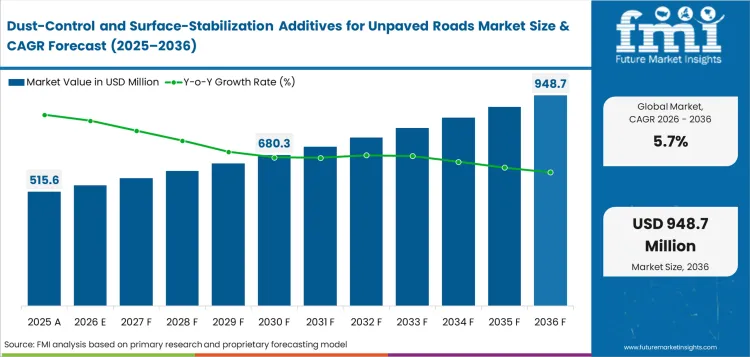
The dust-control and surface-stabilization additives for unpaved roads market size was valued at USD 515.6 million in 2025. Industry revenue is anticipated to cross USD 545.0 million in 2026 and rise to USD 948.7 million by 2036 at 5.7% CAGR. Liquid concentrates are expected to hold 48.5% share in 2026. By sales channel, direct tender is projected to account for 50.5% share in 2026.
Summary of the Dust-Control and Surface-Stabilization Additives for Unpaved Roads Market
- Demand and Growth Drivers
- Public agencies are expected to use suppressants to cut watering frequency and keep fines bound to gravel road surfaces.
- Mining operators need surface treatments that reduce dust plumes without slowing haul truck cycles.
- Construction access roads create seasonal demand as temporary haul routes need quick stabilization during dry months.
- Product and Segment View
- Liquid concentrates are expected to secure 48.5% share in 2026 as applicators prefer tank-based dilution.
- Public roads are anticipated to account for 45.0% share in 2026 due to wide rural network coverage.
- Direct tender is projected to lead with 50.5% share in 2026 since large contracts need trials and service records.
- Geography and Competitive Outlook
- India is projected at 7.1% CAGR by 2036, led by rural road programs widening treatment opportunities.
- China is expected to expand at 6.8% CAGR by 2036, driven by rural road investment sustaining broad maintenance demand.
- Soilworks and Midwest Industrial Supply compete on field service as Cypher Environmental and Global Road Technology compete on performance proof.
- Analyst Opinion
- Nikhil Kaitwade, Principal Analyst for Chemicals and Materials at FMI, observes, “Dust control is moving from a seasonal nuisance fix into a road maintenance input. Buyers now compare watering reduction and surface loss before approving a product. Permit risk is part of the same approval check. Suppliers with field crews and clear dosage records should gain better access to county roads and mine haul networks. Demand is expected to follow maintenance teams measuring cost per treated mile by 2036.”
- Dust-Control and Surface-Stabilization Additives for Unpaved Roads Market Value Analysis
- Surface treatments are moving from occasional palliatives into planned maintenance inputs for gravel roads and haul roads.
- Road agencies are expected to increase additive use as watering and regrading costs strain rural maintenance budgets.
- Liquid concentrates are preferred because of tank mixing speed and simpler field adjustment during spray cycles.
- Demand is supported by dust exposure control and aggregate retention on roads carrying regular heavy vehicle traffic.
Key Takeaways
- The dust-control and surface-stabilization additives for unpaved roads market was valued at USD 515.6 million in 2025.
- Industry is projected to reach USD 948.7 million by 2036 as road owners treat gravel loss as a recurring maintenance cost.
- The sector is expected to expand at 5.7% CAGR from 2026 to 2036 across public roads and haul road networks.
- The industry is projected to create an incremental opportunity of USD 403.7 million between 2026 and 2036.
- Direct tender is projected to account for 50.5% share in 2026, led by large buyers asking for trials and application records.
- Liquid concentrates are expected to hold 48.5% share in 2026 as spray trucks need fast dilution and steady field coverage.
- India at 7.1% CAGR and China at 6.8% CAGR are expected to record a significant expansion pace by 2036.
Unpaved roads create dust loss and permit exposure when traffic moves across dry aggregate surfaces. The United States Environmental Protection Agency’s September 2025 permit language treats chemical soil stabilizers and chemical dust suppressants as accepted control practices for unpaved roads and log yards. Industrial site operators therefore need products that can be documented during inspections. Public road and timber contracts are also becoming more specific. The United States Forest Service listed water, bituminous products, lignin sulfonates and chloride products as dust-abatement options in May 2025. That supports additive selection by road condition rather than a single product habit. Concentration is now part of the commercial decision because Forest Service contract language lists lignosulfonate at 50%, magnesium chloride at 33% and calcium chloride brine at 38%. Suppliers that show dosage, active content and runoff fit are better placed for agency and industrial road work.
Dust-Control and Surface-Stabilization Additives for Unpaved Roads Market Definition
Sector scope covers chemical and bio-based additives used to suppress dust and stabilize the surface layer of unpaved roads. Included products cover chloride salts and lignosulfonates. Polymer binders and enzyme blends complete the core additive scope. Materials are sold to road agencies and mine operators treating gravel roads. Contractors and farms use the same products on temporary access routes. Finished paving materials and mechanical road graders remain outside the study.
Dust-Control and Surface-Stabilization Additives for Unpaved Roads Market Inclusions
Market scope covers all commercially traded dust-control and surface-stabilization additives for unpaved roads categorized by additive type such as chloride salts and polymer binders. Scope covers product form such as liquid concentrates and granular blends. Application scope includes public roads and mine haul roads. End user scope includes road agencies and mining operators. Revenue scope covers 2026 to 2036. Stakeholders include additive manufacturers and road maintenance agencies. Mining firms and applicator contractors shape field use. Distributors and environmental regulators support compliance. Testing laboratories and rural infrastructure bodies complete the buyer ecosystem.
Dust-Control and Surface-Stabilization Additives for Unpaved Roads Market Exclusions
Study scope excludes asphalt paving and concrete road construction materials. Mechanical compaction services are excluded unless billed with additive supply. Finished road aggregates are treated as adjacent inputs. Water trucks and spraying equipment sold without additive supply are outside revenue scope. Permanent pavement sealers and asphalt emulsions used as full wearing courses are excluded unless sold as unpaved road stabilizers.
Dust-Control and Surface-Stabilization Additives for Unpaved Roads Market Research Methodology
- Primary Research: FMI analysts reviewed additive producers and road maintenance contractors using chloride salts and polymer systems. Interviews focused on dosage control and watering reduction.
- Desk Research: Desk review used public road length data and rural infrastructure program updates. Official company actions after January 2024 were checked separately.
- Market Sizing and Forecasting: Forecast work combined unpaved road length exposure with treatment frequency and additive price bands. Country demand was adjusted for road agency budgets.
- Data Validation: Segment shares were checked against application method and supplier portfolios before the country-level demand review was completed.
Why is the Dust-Control and Surface-Stabilization Additives for Unpaved Roads Market Growing?
- Road agencies are treating dust control as a maintenance-cost issue as fine loss raises grading frequency on gravel roads.
- Mining operators are shifting toward additive-treated haul roads to reduce airborne dust and improve surface firmness during dry cycles.
- Supplier selection is focusing on firms able to support application rates and weather limits before contract approval.
Public road maintenance teams are prioritizing additives that hold surface fines between grading cycles. FHWA’s 2024 public road data recorded 1,207,692 miles of unpaved public roads in the United States. Large unpaved road exposure raises the maintenance case for dust control for agencies trying to reduce water-truck use and aggregate loss. Chloride salts and polymer binders gain attention as road owners compare treatment cost with repeated grading work.
Rural road expansion is creating a clearer role for surface-stabilization additives in high-maintenance corridors. China’s rural road network reached 4.64 million km by the end of 2024. India’s rural road program completed 787,520 km under PMGSY by December 2025. Wider rural road networks create more sections exposed to dust lift and surface raveling. Suppliers with field application guidance should gain preference over firms selling standard dust suppressant products without site-use support.
Market Segmentation Analysis
- Chloride salts are anticipated to account for 36.0% share in 2026 since buyers understand moisture retention and seasonal reapplication needs.
- With a projected 48.5% share in 2026, liquid concentrates are expected to lead as spray crews value field mixing speed.
- Public roads are estimated to hold 45.0% share in 2026 with county and rural networks needing regular dust control.
- Road agencies are expected to secure 41.5% share in 2026 as public maintenance teams manage the widest road exposure.
- Direct tender is projected to represent 50.5% share in 2026, led by large contracts requiring trials and service records.
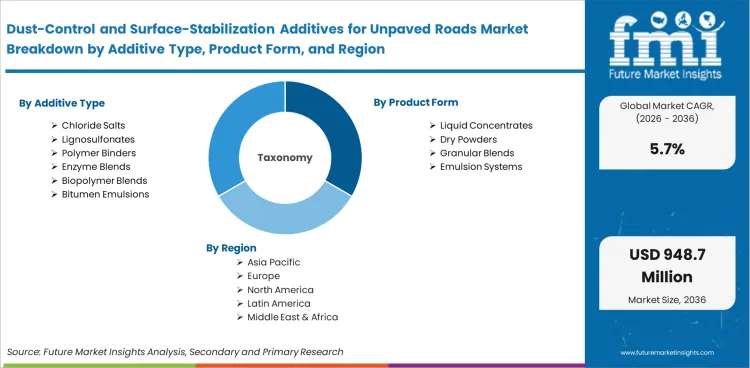
The market is segmented by additive type, product form and application. End user and sales channel complete the structure. Additive type segmentation includes chloride salts, lignosulfonates and polymer binders with chloride salts leading due to broad use on gravel roads. Product form covers liquid concentrates, dry powders and granular blends with liquid concentrates favored for field dilution and spray application. Application scope includes public roads, mine haul roads and construction access roads with public roads leading through rural network exposure. End user includes road agencies, mining operators and construction contractors with road agencies holding a strong use case. Sales channel segmentation covers direct tender, distributors and contractor supply with direct tender leading as buyers need application guidance and dosage support.
Insights into the Chloride Salts Additive Type Segment
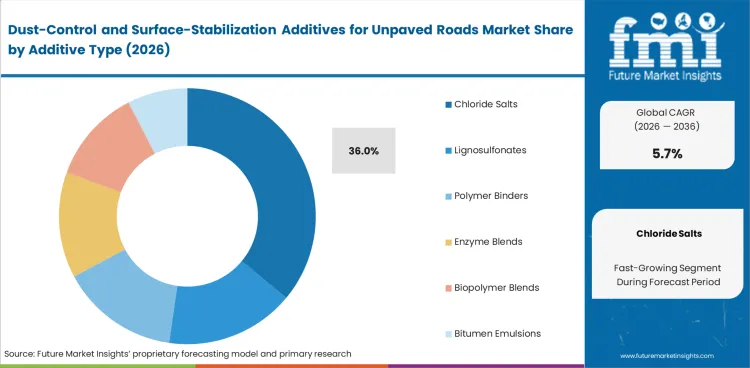
- Chloride salts are projected to account for 36.0% share in 2026 since calcium chloride and magnesium chloride keep surfaces damp for longer periods, reducing dust formation between grading cycles and decreasing water-truck passes over dry road sections.
- Polymer binders gain specialty use on mine haul roads and high-traffic public roads as buyers seek stronger crust formation.
Insights into the Liquid Concentrates Product Form Segment
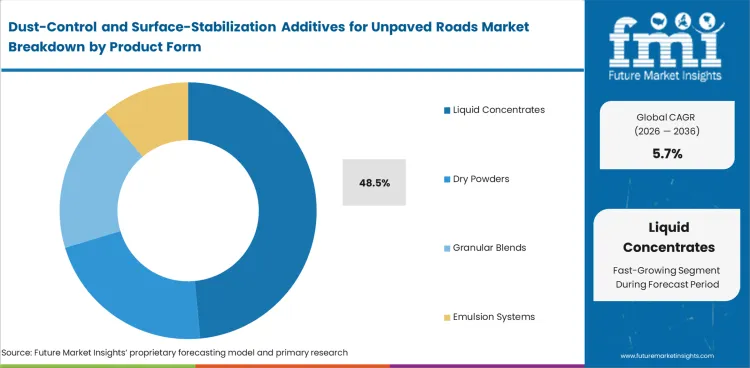
- Liquid concentrates are expected to represent 48.5% share in 2026, led by road crews diluting product in tanker trucks and adjusting dosage by road condition.
- Granular blends contribute in cold storage areas and small municipal yards as product handling is simpler. uneven spreading can reduce treatment consistency on corrugated gravel surfaces.
Insights into the Public Roads Application Segment
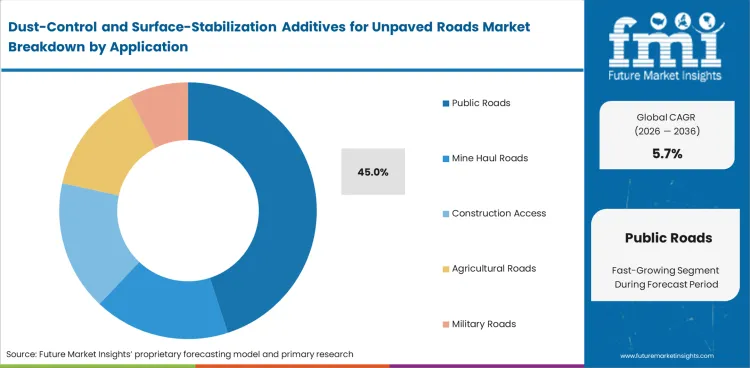
- Public roads are anticipated to account for 45.0% share in 2026, driven by rural roads carrying school access and farm transport.
- Mine haul roads spend more per treated kilometer because truck loads are heavier. Public road networks cover wider mileage.
Insights into the Road Agencies End User Segment
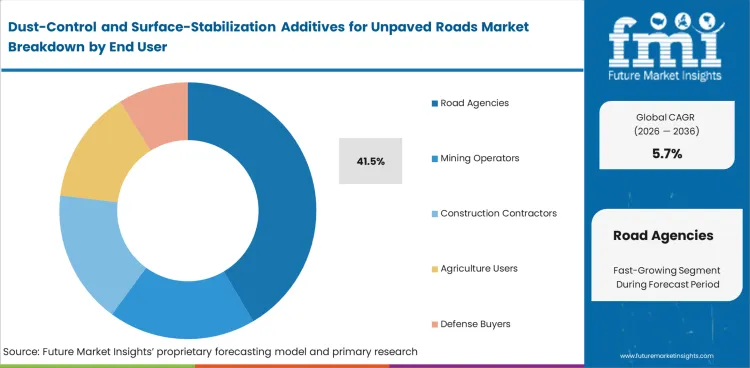
- Road agencies are projected to hold 41.5% share in 2026 as public works teams run scheduled grading and approve dust programs.
- Mining operators buy more technical products for haul ramps and crusher approaches as downtime has a direct output cost, so supplier proof often focuses on watering cuts and tire safety.
Insights into the Direct Tender Sales Channel Segment
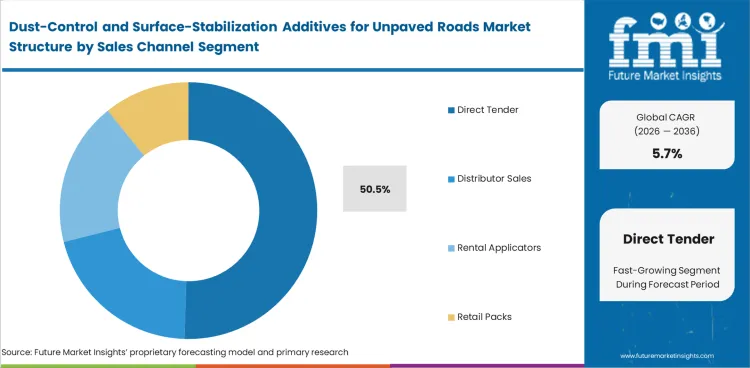
- Direct tender is anticipated to account for 50.5% share in 2026 as large buyers want site trials and safety data.
- Distributor sales remain useful for smaller townships and farms buying spot volumes. Large public and mine accounts prefer documented service packages over product-only transactions.
Dust-Control and Surface-Stabilization Additives for Unpaved Roads Market Drivers, Restraints and Opportunities
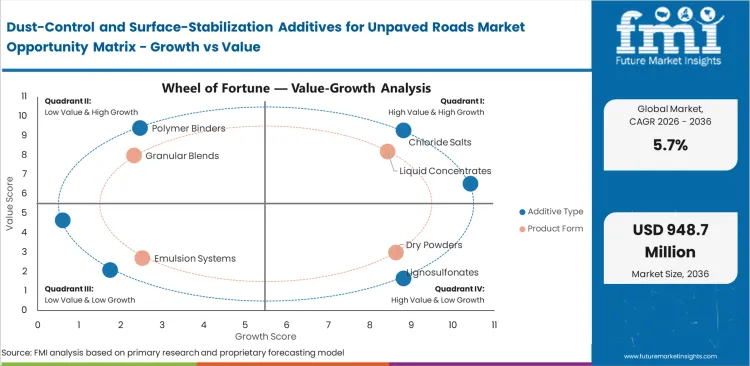
- Gravel fines loss is expected to increase additive adoption as road owners seek lower aggregate replacement and fewer regrading cycles.
- Salt runoff concerns are anticipated to slow chloride switching in sensitive watersheds and near agricultural drainage zones.
- Rural asset management planning is expected to create prospects as agencies compare treatment cost against repeated watering and gravel haulage.
Maintenance budgets are expected to push road owners toward treating gravel surfaces as managed assets. Fine particles hold the road surface together and FHWA guidance says keeping fines in the road can extend gravel replacement intervals. Products tied to soil hardening agents should receive more attention as agencies compare cost per treated mile with watering and imported gravel. Chloride salts will continue to serve roads needing moisture retention. EPA guidance reports chloride impact concerns can raise scrutiny near vulnerable waterways. Buyer checks are expected to move toward leaching data and application records before supplier approval. Supplier opportunity should favor suppliers offering chloride and polymer choices with field support. Buyers facing tighter residue limits may compare bio-based suppressants with green anti-static and anti-dust additives. Road owners considering longer-life upgrades may benchmark suppressants against bitumen emulsifiers used in road maintenance.
Technology Adoption and Automation Penetration Analysis
Technology use is expected to center on dosage planning, moisture monitoring, and application records for unpaved-road programs. GPS-enabled spray trucks help contractors document treated mileage and product concentration. Simple road-condition logs can connect regrading intervals with suppressant performance. Buyers are expected to prefer suppliers that provide field records, weather limits, and reapplication guidance.
Application-wise Equipment Deployment Analysis
Equipment deployment is expected to remain concentrated in spray trucks, graders, compactors, and storage tanks. Liquid concentrates suit tank-based dilution and route-level application. Granular blends fit smaller municipal yards that lack dosing equipment. Mine haul roads need higher-capacity spraying and road-condition monitoring because heavy trucks disturb treated surfaces faster.
Regional Analysis
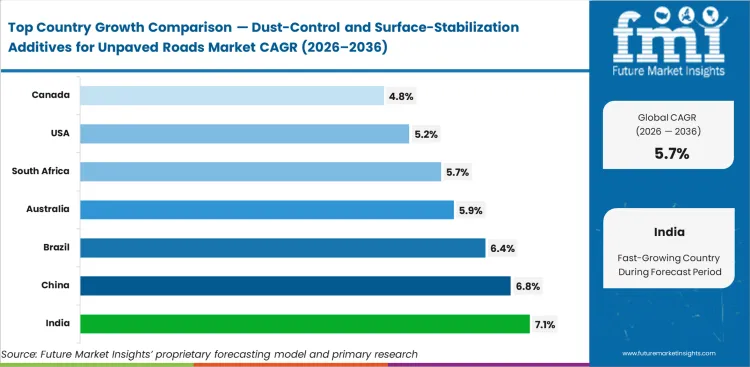
.webp "Top Country Growth Comparison Dust Control And Surface Stabilization Additives For Unpaved Roads Market Cagr (2026 2036)")
| Country | CAGR 2026 to 2036 |
|---|---|
| India | 7.1% |
| China | 6.8% |
| Brazil | 6.4% |
| Australia | 5.9% |
| South Africa | 5.7% |
| United States | 5.2% |
| Canada | 4.8% |
Source: Future Market Insights analysis based on unpaved road exposure and additive adoption review in 2026.
Analysis of Dust-Control and Surface-Stabilization Additives for Unpaved Roads Market by Key Countries
- India is expected to expand at 7.1% CAGR by 2036, led by rural road programs raising the need for lower dust and fewer regrading cycles.
- China is projected to record 6.8% CAGR by 2036 as rural road length and mining movement support wider additive use.
- Brazil is forecast to grow at 6.4% CAGR by 2036 due to gravel-road exposure across agriculture and resource transport corridors.
- Australia is expected to advance at 5.9% CAGR by 2036 with mining haul roads supporting polymer and chloride suppressant demand.
- South Africa is forecast at 5.7% CAGR by 2036. The United States and Canada are expected to expand at 5.2% and 4.8%, respectively, through rural road maintenance and dust-control rules.
Country performance differs by unpaved road exposure, mining haul routes and rural maintenance budgets. India leads due to wider rural road programs and stronger pressure to reduce aggregate loss. China follows through large rural road length and steady mining traffic in inland regions. Brazil advances as agricultural logistics routes need lower dust and firmer gravel surfaces. Australia benefits from mining haul road treatment needs across dry operating areas. United States and Canada progress through public road maintenance and environmental review. South Africa maintains steady uptake as mine operators and municipalities focus on dust control.
Demand Outlook for Dust-Control and Surface-Stabilization Additives for Unpaved Roads in India
Industry in India is projected to record 7.1% CAGR by 2036, led by rural roads creating a large addressable surface for dust control and stabilization. Rural road program records show 825.1 thousand km sanctioned and 787.5 thousand km completed by December 2025. Longer rural links create recurring maintenance points on shoulders and unsealed approaches. Suppliers with low-dosage field trials and district-level applicator partners should gain faster approval.
- Madhya Pradesh and Rajasthan’s road teams value stabilizers reducing gravel loss across long dry stretches with limited water availability.
- Northeast hill districts need products able to hold surface fines during wet months without forcing frequent regrading.
- National Rural Infrastructure Development Agency quality reviews create a testing route for suppliers with clear dosage and curing records.
Sales Analysis for Dust-Control and Surface-Stabilization Additives for Unpaved Roads in China
China is expected to expand at 6.8% CAGR by 2036 as rural road maintenance remains aligned to local transport access. Official state media reported 75,000 km of rural roads built during the first three quarters of 2025. New links add future maintenance needs, once surfaces face wind and farm vehicle load. Domestic chemical supply and county-level road programs support wider product availability.
- Western province road bureaus favor chloride and polymer programs for dry corridors exposed to tire abrasion and wind lift.
- County maintenance depots in Inner Mongolia need treatments able to work across cold spring and hot summer dust periods.
- Rural logistics routes near grain and livestock areas create repeat demand for products protecting visibility and surface fines.
Opportunity Analysis of Dust-Control and Surface-Stabilization Additives for Unpaved Roads in Brazil
Brazil demand is forecast to grow at 6.4% CAGR by 2036 as rural freight corridors and municipal roads keep dust control commercially important. Federal infrastructure records referenced 8,000 km of unpaved federal roads in late 2025. Much larger local networks carry farm output and quarry materials. Suppliers should focus on tropical rainfall recovery and low-cost reapplication plans.
- Minas Gerais road managers face long gravel corridors, so products reducing corrugation and fines loss can protect road budgets.
- Mato Grosso agricultural routes favor stabilizers limiting dust near grain loading points during dry harvest months.
- Amazon-region access roads require treatments with clear runoff guidance as rain events can shorten untreated surface life.
In-Depth Analysis of Dust-Control and Surface-Stabilization Additives for Unpaved Roads in Australia
Australian demand is expected to advance at 5.9% CAGR by 2036, driven by councils and resource operators managing long unsealed networks. Local government asset work in 2024 valued sealed and unsealed local roads at about AUD 250 billion. Asset cost visibility makes gravel preservation easier to justify. Suppliers with spray contractor coverage across remote regions should hold stronger positions.
- Queensland councils value liquid treatments able to reduce dust and corrugation across cattle and mining service routes.
- Western Australia resource roads favor binders holding surfaces under heavy vehicle traffic and long dry intervals.
- Northern Territory communities need products capable of preserving access during dry seasons without relying on frequent water trucking.
Sales Analysis of Dust-Control and Surface-Stabilization Additives for Unpaved Roads in South Africa
Industry sales in South Africa are projected to rise at 5.7% CAGR by 2036 as gravel road serviceability remains a rural access issue. National transport information identifies a 750,000 km road network with large unpaved shares under provincial and municipal care. Budget limits make full paving unrealistic across many corridors. Chemical stabilization gains attention as a lower-cost bridge between grading and paving.
- Eastern Cape gravel programs value surface binders that lower washboarding near schools and clinic access roads.
- Limpopo mining supply routes need treatments reducing dust exposure around haul movements and stockpile approaches.
- KwaZulu-Natal rural links require stabilizers able to recover after intense rainfall without complete surface rebuilding.
Demand Outlook for Dust-Control and Surface-Stabilization Additives for Unpaved Roads in United States
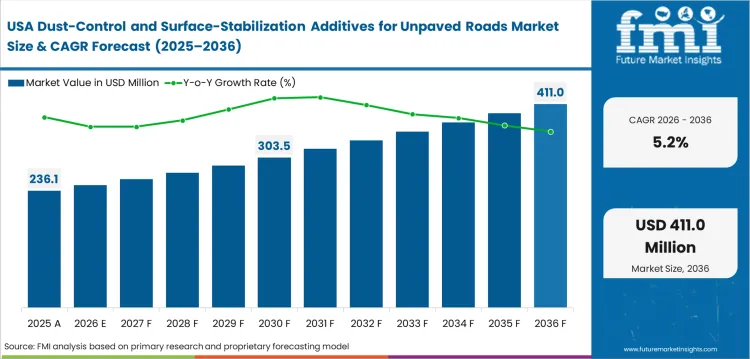
USA demand is forecast at 5.2% CAGR by 2036 since county road teams manage dust complaints and aggregate loss. Federal transport data tracks public road mileage by surface type and keeps unpaved road estimates visible for maintenance planning. County budgets often compare chloride treatment against water trucking and gravel replacement. Road aggregate use points to the wider material context behind gravel preservation. Product approval depends on state rules and local environmental review.
- Arizona and New Mexico county teams favor tested suppressants as dry climate and resident complaints shape treatment priorities.
- Midwestern gravel roads need spring maintenance programs that limit fines loss after thaw and farm equipment traffic.
- Maricopa County contract activity shows how local buyers use direct awards for dust and soil stabilization services.
Opportunity Analysis of Dust-Control and Surface-Stabilization Additives for Unpaved Roads in Canada
Industry in Canada is expected to post 4.8% CAGR by 2036 as municipalities balance dust control with runoff reporting. Federal environmental guidance from January 2024 provides road dust calculation methods for vehicles on unpaved roads. Reporting discipline pushes buyers toward measurable treatment plans. Mature chloride use keeps growth steadier compared with high-build rural road economies.
- Prairie municipalities favor chloride products for gravel concessions and farm access roads facing short summer dust windows.
- British Columbia resource roads need treatments considering runoff near streams and forestry access corridors.
- Ontario townships use local applicators when residents raise visibility and property dust complaints near gravel roads.
Competitive Positioning and Strategic Supplier Strength
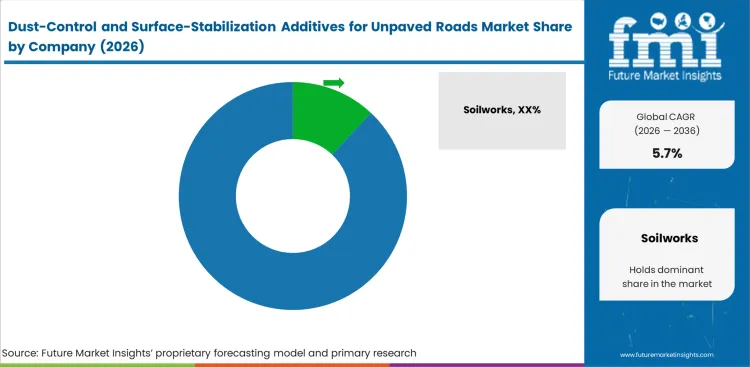
- Soilworks can gain public agency and mining accounts by combining dust control products with field guidance and contract experience.
- Midwest Industrial Supply is expected to protect large road projects through a long service record and application support.
- Cypher Environmental stands out with polymer and enzyme-based products for buyers seeking lower chloride exposure.
- Global Road Technology holds contractor attention based on haul road and industrial dust programs tied to site safety.
Competition in the dust-control and surface-stabilization additives sector is moving from product pricing toward field proof. Suppliers compete on application support alongside treated-road performance and past contract delivery. Soilworks won a Maricopa County dust control and soil stabilization contract in October 2024, showing how public agencies value proven field execution. Cypher Environmental received Boeing certification for DUST/BLOKR in June 2024, giving its binder a stronger proof point for industrial sites. Buyer screening is expected to become tighter as dust programs connect with permit risk and resident complaints.
Larger suppliers are likely to protect accounts through applicator networks and repeat maintenance programs. Additives become harder to replace after dosage rates and regrading intervals are written into tender documents. Regional suppliers can still win smaller accounts through quick delivery and local service. Competitive pressure is expected to center on application support and verified performance records. Suppliers with proven road results and field support should be best placed to win.
Key Companies in Dust-Control and Surface-Stabilization Additives for Unpaved Roads Market
Competition spans chemical producers and branded road treatment suppliers. Applicator service firms round out the supplier base. Chloride suppliers remain in scope because calcium and magnesium brines support seasonal road treatment. Specialty firms compete through polymer and enzyme packages aimed at longer surface hold. Environmental screening shows how road chemicals face stricter review.
- Road treatment specialists: Soilworks and Midwest Industrial Supply compete through dust control chemistry and field service. Cypher Environmental and Global Road Technology compete through specialized stabilizer portfolios.
- Chemical suppliers: Compass Minerals and K+S compete through chloride chemistry and brine logistics. Cargill competes through bulk salt and deicing channels that overlap with road treatment buyers.
- Construction chemistry platforms: Sika and BASF connect polymer know-how with low-carbon concrete shrinkage-reduction additives and related infrastructure chemistry.
Competitive Benchmarking: Dust-Control and Surface-Stabilization Additives for Unpaved Roads Market
| Company | Dust Binding Chemistry Depth | Field Application Support | Public Tender References | Footprint |
|---|---|---|---|---|
| Soilworks | High | High | High | Global |
| Midwest Industrial Supply | High | High | High | North America |
| Cypher Environmental | Large | High | Large | Global |
| Global Road Technology | Large | High | Large | Global |
| Compass Minerals | High | Moderate | Large | North America |
| K+S | High | Moderate | Large | Global |
| Cargill | Large | Moderate | Large | North America |
| BASF | Large | Moderate | Moderate | Global |
Source: Future Market Insights competitive analysis based on public product portfolios and company activity in 2026.
Key Developments in the Dust-Control and Surface-Stabilization Additives for Unpaved Roads Market
- In January 2025, Cypher Environmental reported that DUST/BLOKR remained in use at B2Gold’s Mali operations, with related Green Roads work covering community road sections.
- In February 2025, Dust-A-Side released its 2025 company overview, covering dust and road management services for mines and construction sites.
- In March 2026, Global Road Technology positioned engineered dust control for autonomous haul road operations, connecting dust suppression with sensor visibility and haul-road uptime.
Key Players in the Dust-Control and Surface-Stabilization Additives for Unpaved Roads Market
Road treatment specialists
- Soilworks
- Midwest Industrial Supply
- Cypher Environmental
- Global Road Technology
- Zydex Industries
Chemical and brine suppliers
- Compass Minerals
- K+S
- Cargill
- TETRA Technologies
- Occidental Chemical
Construction chemistry and binder suppliers
- BASF
- Sika
- Arkema
- Dow
- Wacker Chemie
Report Scope and Coverage
| Item | Value |
|---|---|
| Market value in 2025 | USD 515.6 million |
| Market value in 2026 | USD 545.0 million |
| Market value in 2036 | USD 948.7 million |
| CAGR from 2026 to 2036 | 5.7% |
| Quantitative units | USD million |
| Market definition | Additives used to suppress dust and stabilize unpaved road surfaces |
| By additive type | Chloride Salts, Lignosulfonates, Polymer Binders, Enzyme Blends, Biopolymer Blends, Bitumen Emulsions |
| By product form | Liquid Concentrates, Dry Powders, Granular Blends, Emulsion Systems |
| By application | Public Roads, Mine Haul Roads, Construction Access, Agricultural Roads, Military Roads |
| By end user | Road Agencies, Mining Operators, Construction Contractors, Agriculture Users, Defense Buyers |
| By sales channel | Direct Tender, Distributor Sales, Rental Applicators, Retail Packs |
| Regions covered | North America, Latin America, Western Europe, Eastern Europe, East Asia, South Asia and Pacific, Middle East and Africa |
| Countries covered | United States, Canada, Brazil, China, India, Australia, South Africa |
| Key companies profiled | Soilworks, Midwest Industrial Supply, Cypher Environmental, Global Road Technology, Compass Minerals, K+S, Cargill |
| Forecast period | 2026 to 2036 |
| Approach | Bottom-up unpaved road treatment modeling with country and segment cross-checks |
Source: Future Market Insights analysis, 2026.
Dust-Control and Surface-Stabilization Additives for Unpaved Roads Market Breakdown by Additive Type, Product, Form, Application, End User, Sales Channel and Region
Dust-Control and Surface-Stabilization Additives for Unpaved Roads Market Segmented by Additive Type
- Chloride Salts
- Lignosulfonates
- Polymer Binders
- Enzyme Blends
- Biopolymer Blends
- Bitumen Emulsions
Dust-Control and Surface-Stabilization Additives for Unpaved Roads Market Segmented by Product Form
- Liquid Concentrates
- Dry Powders
- Granular Blends
- Emulsion Systems
Dust-Control and Surface-Stabilization Additives for Unpaved Roads Market Segmented by Application
- Public Roads
- Mine Haul Roads
- Construction Access
- Agricultural Roads
- Military Roads
Dust-Control and Surface-Stabilization Additives for Unpaved Roads Market Segmented by End User
- Road Agencies
- Mining Operators
- Construction Contractors
- Agriculture Users
- Defense Buyers
Dust-Control and Surface-Stabilization Additives for Unpaved Roads Market Segmented by Sales Channel
- Direct Tender
- Distributor Sales
- Rental Applicators
- Retail Packs
Dust-Control and Surface-Stabilization Additives for Unpaved Roads Market by Region
- North America
- United States
- Canada
- Mexico
- Latin America
- Brazil
- Chile
- Rest of Latin America
- Western Europe
- Germany
- United Kingdom
- France
- Italy
- Spain
- Rest of Western Europe
- Eastern Europe
- Poland
- Hungary
- Rest of Eastern Europe
- East Asia
- China
- Japan
- South Korea
- South Asia and Pacific
- India
- ASEAN
- Australia and New Zealand
- Rest of South Asia and Pacific
- Middle East and Africa
- Kingdom of Saudi Arabia
- Other GCC Countries
- Turkiye
- South Africa
- Rest of Middle East and Africa
Research Sources and Bibliography
- Australian Local Government Association. (2024, July 2). 2024 National State of the Assets report.
- Bureau of Transportation Statistics. (2026, January 30). BTS updates National Transportation Statistics 1/30/2026. USA Department of Transportation.
- Cypher Environmental. (2024, June 26). DUST/BLOKR® receives Boeing certification following stringent testing.
- Cypher Environmental. (2025, January 15). B2Gold and Cypher Environmental: Building better roads and communities in Mali.
- Departamento Nacional de Infraestrutura de Transportes. (2025, March 20). Relatório de Gestão de 2024.
- Dust-A-Side. (2025, February). Company overview 2025.
- Environment and Climate Change Canada. (2024, January 15). Road dust emissions from unpaved surfaces. Government of Canada.
- Global Road Technology. (2024, June 19). GRT DC Binder: Essential dust control for mining operations.
- Global Road Technology. (2026, March 3). Dust control for AHS: Haul road performance.
- Government of India, Press Information Bureau. (2025, December 25). Pradhan Mantri Gram Sadak Yojana (PMGSY).
- Minnesota Local Technical Assistance Program. (2025, April 1). New report released on dust control for gravel roads. University of Minnesota.
- Soilworks. (2024, October 7). Soilworks awarded Maricopa County dust control and soil stabilization contract.
- South African National Roads Agency SOC Limited, & National Department of Transport. (2024, October). TRH 24: Upgrading of unpaved roads: Draft standard.
- State Council of the People’s Republic of China. (2025, October 28). China builds 75,000 km of rural roads in first three quarters.
- Yang, D., Zhang, X., Li, Y., Wang, H., & Chen, J. (2025). Natural polymer composites for sustainable dust suppression. Frontiers in Chemistry, 13, Article 1589969.
- Yellavajjala, R. K., & Hesami, M. (2025, July 1). An economical and sustainable dust suppressant for gravel roads. Iowa Highway Research Board.
Bibliography uses public infrastructure sources and official company publications.
Report Questions Addressed
- What is the value outlook for dust-control and surface-stabilization additives for unpaved roads from 2026 to 2036?
- Which additive type is expected to hold the leading share in 2026?
- Which product form is expected to lead buyer use in 2026?
- Which country is projected to record the fastest CAGR during the forecast period?
- How do road agencies and mining operators differ in product selection?
- Which supplier capabilities shape competitive position in public tenders?
- How do chloride products and polymer binders differ in field use?
- What role do direct tender contracts play in supplier selection?
Frequently Asked Questions
What is the projected value of the dust-control and surface-stabilization additives for unpaved roads market by 2036?
The dust-control and surface-stabilization additives for unpaved roads market is projected to reach USD 948.7 million by 2036 at 5.7% CAGR.
What was the dust-control and surface-stabilization additives for unpaved roads market value in 2025?
Industry value stood at USD 515.6 million in 2025 and is projected to cross USD 545.0 million in 2026.
Which additive type is expected to lead the dust-control and surface-stabilization additives for unpaved roads market?
Chloride salts are anticipated to account for 36.0% share in 2026 due to known pricing and simple field dosing.
Which product form is expected to lead the dust-control and surface-stabilization additives for unpaved roads market?
Liquid concentrates are expected to hold 48.5% share in 2026 as spray crews value dilution control and faster route coverage.
Which country is expected to grow fastest in the dust-control and surface-stabilization additives for unpaved roads market?
India is projected to record the fastest pace at 7.1% CAGR by 2036 due to wider rural road maintenance needs.
How do dust-control additives work on unpaved roads?
Chloride products retain moisture and polymers bind fine particles, so treated gravel roads lose less dust under vehicle traffic.
Do polymer binders cost more than chloride salts for unpaved road treatment?
Polymer binders usually cost more upfront, but they can reduce rework on high-traffic roads that lose fines quickly.
How long can a dust-control treatment last on an unpaved road?
Treatment life changes with traffic and rainfall. Grading frequency also affects supplier comparison by cost per treated mile.
Preview the report firsthand - request a free sample
Get SampleGet the brochure for pricing and purchase details.
Get PDFTable of Content
- Key Takeaways
- Market Size and CAGR
- Top Growth Driver
- Fastest Growing Segment
- Leading Region
- Key Companies
- Emerging Opportunities
- Executive Summary
- Global Market Outlook
- Demand-side Trends
- Supply-side Trends
- Technology Roadmap Analysis
- Analysis and Recommendations
- Analyst Perspective (What is happening? Why now? What should investors know?)
- Key Questions Answered
- How large is the market?
- What is the CAGR?
- What are key trends?
- Which region dominates?
- Who are the leaders?
- Market Overview
- Market Coverage / Taxonomy
- Market Definition / Scope / Limitations
- Research Methodology
- Chapter Orientation
- Analytical Lens and Working Hypotheses
- Market Structure, Signals, and Trend Drivers
- Benchmarking and Cross-market Comparability
- Market Sizing, Forecasting, and Opportunity Mapping
- Research Design and Evidence Framework
- Desk Research Programme (Secondary Evidence)
- Expert Input and Fieldwork (Primary Evidence)
- Tooling, Models, and Reference Databases
- Data Engineering and Model Build
- Quality Assurance and Audit Trail
- Market Background
- Market Dynamics (Drivers, Restraints, Opportunity, Trends)
- Scenario Forecast (Optimistic, Likely, Conservative)
- Impact Analysis
- AI Impact
- Sustainability Impact
- Regulatory Impact
- Technology Impact
- Consumer / Buyer Analysis
- Purchase Drivers
- Adoption Barriers
- Buyer Journey
- Opportunity Map Analysis
- Product Life Cycle Analysis
- Supply Chain Analysis
- Investment Feasibility Matrix
- Value Chain Analysis
- PESTLE and Porter's Analysis
- Regulatory Landscape
- Regional Parent Market Outlook
- Production and Consumption Statistics
- Import and Export Statistics
- Global Market Analysis and Forecast, 2021 to 2036
- Historical Market Size Value (USD Million) & Volume (Unit) Analysis, 2021 to 2025
- Current and Future Market Size Value (USD Million) & Volume (Unit) Projections, 2026 to 2036
- Y-o-Y Growth Trend Analysis
- Absolute $ Opportunity Analysis
- Global Market Pricing Analysis, 2021 to 2036
- Global Market Analysis and Forecast, By Additive Type, 2021 to 2036
- Introduction / Key Findings
- Historical Market Size Value (USD Million) & Volume (Unit) Analysis By Additive Type, 2021 to 2025
- Current and Future Market Size Value (USD Million) & Volume (Unit) Analysis and Forecast By Additive Type, 2026 to 2036
- Chloride Salts
- Lignosulfonates
- Polymer Binders
- Enzyme Blends
- Biopolymer Blends
- Bitumen Emulsions
- Chloride Salts
- Y-o-Y Growth Trend Analysis By Additive Type, 2021 to 2025
- Absolute $ Opportunity Analysis By Additive Type, 2026 to 2036
- Global Market Analysis and Forecast, By Product Form, 2021 to 2036
- Introduction / Key Findings
- Historical Market Size Value (USD Million) & Volume (Unit) Analysis By Product Form, 2021 to 2025
- Current and Future Market Size Value (USD Million) & Volume (Unit) Analysis and Forecast By Product Form, 2026 to 2036
- Liquid Concentrates
- Dry Powders
- Granular Blends
- Emulsion Systems
- Liquid Concentrates
- Y-o-Y Growth Trend Analysis By Product Form, 2021 to 2025
- Absolute $ Opportunity Analysis By Product Form, 2026 to 2036
- Global Market Analysis and Forecast, By Application, 2021 to 2036
- Introduction / Key Findings
- Historical Market Size Value (USD Million) & Volume (Unit) Analysis By Application, 2021 to 2025
- Current and Future Market Size Value (USD Million) & Volume (Unit) Analysis and Forecast By Application, 2026 to 2036
- Public Roads
- Mine Haul Roads
- Construction Access
- Agricultural Roads
- Military Roads
- Public Roads
- Y-o-Y Growth Trend Analysis By Application, 2021 to 2025
- Absolute $ Opportunity Analysis By Application, 2026 to 2036
- Global Market Analysis and Forecast, By End User, 2021 to 2036
- Introduction / Key Findings
- Historical Market Size Value (USD Million) & Volume (Unit) Analysis By End User, 2021 to 2025
- Current and Future Market Size Value (USD Million) & Volume (Unit) Analysis and Forecast By End User, 2026 to 2036
- Road Agencies
- Mining Operators
- Construction Contractors
- Agriculture Users
- Defense Buyers
- Road Agencies
- Y-o-Y Growth Trend Analysis By End User, 2021 to 2025
- Absolute $ Opportunity Analysis By End User, 2026 to 2036
- Global Market Analysis and Forecast, By Sales Channel, 2021 to 2036
- Introduction / Key Findings
- Historical Market Size Value (USD Million) & Volume (Unit) Analysis By Sales Channel, 2021 to 2025
- Current and Future Market Size Value (USD Million) & Volume (Unit) Analysis and Forecast By Sales Channel, 2026 to 2036
- Direct Tender
- Distributor Sales
- Rental Applicators
- Retail Packs
- Direct Tender
- Y-o-Y Growth Trend Analysis By Sales Channel, 2021 to 2025
- Absolute $ Opportunity Analysis By Sales Channel, 2026 to 2036
- Global Market Analysis and Forecast, By Region, 2021 to 2036
- Introduction
- Historical Market Size Value (USD Million) & Volume (Unit) Analysis By Region, 2021 to 2025
- Current Market Size Value (USD Million) & Volume (Unit) Analysis and Forecast By Region, 2026 to 2036
- North America
- Latin America
- Western Europe
- Eastern Europe
- East Asia
- South Asia and Pacific
- Middle East & Africa
- Market Attractiveness Analysis By Region
- North America Market Analysis and Forecast, By Country, 2021 to 2036
- Historical Market Size Value (USD Million) & Volume (Unit) Trend Analysis By Market Taxonomy, 2021 to 2025
- Market Size Value (USD Million) & Volume (Unit) Forecast By Market Taxonomy, 2026 to 2036
- By Country
- USA
- Canada
- Mexico
- By Additive Type
- By Product Form
- By Application
- By End User
- By Sales Channel
- By Country
- Market Attractiveness Analysis
- By Country
- By Additive Type
- By Product Form
- By Application
- By End User
- By Sales Channel
- Key Takeaways
- Latin America Market Analysis and Forecast, By Country
- Historical Market Size Value (USD Million) & Volume (Unit) Trend Analysis By Market Taxonomy, 2021 to 2025
- Market Size Value (USD Million) & Volume (Unit) Forecast By Market Taxonomy, 2026 to 2036
- By Country
- Brazil
- Chile
- Rest of Latin America
- By Additive Type
- By Product Form
- By Application
- By End User
- By Sales Channel
- By Country
- Market Attractiveness Analysis
- By Country
- By Additive Type
- By Product Form
- By Application
- By End User
- By Sales Channel
- Key Takeaways
- Western Europe Market Analysis and Forecast, By Country
- Historical Market Size Value (USD Million) & Volume (Unit) Trend Analysis By Market Taxonomy, 2021 to 2025
- Market Size Value (USD Million) & Volume (Unit) Forecast By Market Taxonomy, 2026 to 2036
- By Country
- Germany
- UK
- Italy
- Spain
- France
- Nordic
- BENELUX
- Rest of Western Europe
- By Additive Type
- By Product Form
- By Application
- By End User
- By Sales Channel
- By Country
- Market Attractiveness Analysis
- By Country
- By Additive Type
- By Product Form
- By Application
- By End User
- By Sales Channel
- Key Takeaways
- Eastern Europe Market Analysis and Forecast, By Country
- Historical Market Size Value (USD Million) & Volume (Unit) Trend Analysis By Market Taxonomy, 2021 to 2025
- Market Size Value (USD Million) & Volume (Unit) Forecast By Market Taxonomy, 2026 to 2036
- By Country
- Russia
- Poland
- Hungary
- Balkan & Baltic
- Rest of Eastern Europe
- By Additive Type
- By Product Form
- By Application
- By End User
- By Sales Channel
- By Country
- Market Attractiveness Analysis
- By Country
- By Additive Type
- By Product Form
- By Application
- By End User
- By Sales Channel
- Key Takeaways
- East Asia Market Analysis and Forecast, By Country
- Historical Market Size Value (USD Million) & Volume (Unit) Trend Analysis By Market Taxonomy, 2021 to 2025
- Market Size Value (USD Million) & Volume (Unit) Forecast By Market Taxonomy, 2026 to 2036
- By Country
- China
- Japan
- South Korea
- By Additive Type
- By Product Form
- By Application
- By End User
- By Sales Channel
- By Country
- Market Attractiveness Analysis
- By Country
- By Additive Type
- By Product Form
- By Application
- By End User
- By Sales Channel
- Key Takeaways
- South Asia and Pacific Market Analysis and Forecast, By Country
- Historical Market Size Value (USD Million) & Volume (Unit) Trend Analysis By Market Taxonomy, 2021 to 2025
- Market Size Value (USD Million) & Volume (Unit) Forecast By Market Taxonomy, 2026 to 2036
- By Country
- India
- ASEAN
- Australia & New Zealand
- Rest of South Asia and Pacific
- By Additive Type
- By Product Form
- By Application
- By End User
- By Sales Channel
- By Country
- Market Attractiveness Analysis
- By Country
- By Additive Type
- By Product Form
- By Application
- By End User
- By Sales Channel
- Key Takeaways
- Middle East & Africa Market Analysis and Forecast, By Country
- Historical Market Size Value (USD Million) & Volume (Unit) Trend Analysis By Market Taxonomy, 2021 to 2025
- Market Size Value (USD Million) & Volume (Unit) Forecast By Market Taxonomy, 2026 to 2036
- By Country
- Kingdom of Saudi Arabia
- Other GCC Countries
- Türkiye
- South Africa
- Other African Union
- Rest of Middle East & Africa
- By Additive Type
- By Product Form
- By Application
- By End User
- By Sales Channel
- By Country
- Market Attractiveness Analysis
- By Country
- By Additive Type
- By Product Form
- By Application
- By End User
- By Sales Channel
- Key Takeaways
- Key Countries Market Analysis
- USA
- Pricing Analysis
- Market Share Analysis, 2025
- By Additive Type
- By Product Form
- By Application
- By End User
- By Sales Channel
- Canada
- Pricing Analysis
- Market Share Analysis, 2025
- By Additive Type
- By Product Form
- By Application
- By End User
- By Sales Channel
- Mexico
- Pricing Analysis
- Market Share Analysis, 2025
- By Additive Type
- By Product Form
- By Application
- By End User
- By Sales Channel
- Brazil
- Pricing Analysis
- Market Share Analysis, 2025
- By Additive Type
- By Product Form
- By Application
- By End User
- By Sales Channel
- Chile
- Pricing Analysis
- Market Share Analysis, 2025
- By Additive Type
- By Product Form
- By Application
- By End User
- By Sales Channel
- Germany
- Pricing Analysis
- Market Share Analysis, 2025
- By Additive Type
- By Product Form
- By Application
- By End User
- By Sales Channel
- UK
- Pricing Analysis
- Market Share Analysis, 2025
- By Additive Type
- By Product Form
- By Application
- By End User
- By Sales Channel
- Italy
- Pricing Analysis
- Market Share Analysis, 2025
- By Additive Type
- By Product Form
- By Application
- By End User
- By Sales Channel
- Spain
- Pricing Analysis
- Market Share Analysis, 2025
- By Additive Type
- By Product Form
- By Application
- By End User
- By Sales Channel
- France
- Pricing Analysis
- Market Share Analysis, 2025
- By Additive Type
- By Product Form
- By Application
- By End User
- By Sales Channel
- India
- Pricing Analysis
- Market Share Analysis, 2025
- By Additive Type
- By Product Form
- By Application
- By End User
- By Sales Channel
- ASEAN
- Pricing Analysis
- Market Share Analysis, 2025
- By Additive Type
- By Product Form
- By Application
- By End User
- By Sales Channel
- Australia & New Zealand
- Pricing Analysis
- Market Share Analysis, 2025
- By Additive Type
- By Product Form
- By Application
- By End User
- By Sales Channel
- China
- Pricing Analysis
- Market Share Analysis, 2025
- By Additive Type
- By Product Form
- By Application
- By End User
- By Sales Channel
- Japan
- Pricing Analysis
- Market Share Analysis, 2025
- By Additive Type
- By Product Form
- By Application
- By End User
- By Sales Channel
- South Korea
- Pricing Analysis
- Market Share Analysis, 2025
- By Additive Type
- By Product Form
- By Application
- By End User
- By Sales Channel
- Russia
- Pricing Analysis
- Market Share Analysis, 2025
- By Additive Type
- By Product Form
- By Application
- By End User
- By Sales Channel
- Poland
- Pricing Analysis
- Market Share Analysis, 2025
- By Additive Type
- By Product Form
- By Application
- By End User
- By Sales Channel
- Hungary
- Pricing Analysis
- Market Share Analysis, 2025
- By Additive Type
- By Product Form
- By Application
- By End User
- By Sales Channel
- Kingdom of Saudi Arabia
- Pricing Analysis
- Market Share Analysis, 2025
- By Additive Type
- By Product Form
- By Application
- By End User
- By Sales Channel
- Türkiye
- Pricing Analysis
- Market Share Analysis, 2025
- By Additive Type
- By Product Form
- By Application
- By End User
- By Sales Channel
- South Africa
- Pricing Analysis
- Market Share Analysis, 2025
- By Additive Type
- By Product Form
- By Application
- By End User
- By Sales Channel
- USA
- Market Structure Analysis
- Competition Dashboard
- Competition Benchmarking
- Market Share Analysis of Top Players
- By Regional
- By Additive Type
- By Product Form
- By Application
- By End User
- By Sales Channel
- Emerging Startups
- Innovation Benchmarking
- Competition Analysis
- Competition Deep Dive
- Soilworks
- Overview
- Product Portfolio
- Profitability by Market Segments (Product/Region/Sales Channel)
- Sales Footprint
- Strategy Overview
- Marketing Strategy
- Product Strategy
- Channel Strategy
- Midwest Industrial Supply
- Cypher Environmental
- Global Road Technology
- Compass Minerals
- K+S
- Cargill
- BASF
- Soilworks
- Case Studies
- Success Stories
- Recent Developments
- Competition Deep Dive
- Assumptions & Acronyms Used


