

- Market Size (2026)
- USD 41.9 Bn
- Forecast (2036)
- USD 100.1 Bn
- CAGR (2026 to 2036)
- 9.1%
How big is Electric Scooters Market in 2026?
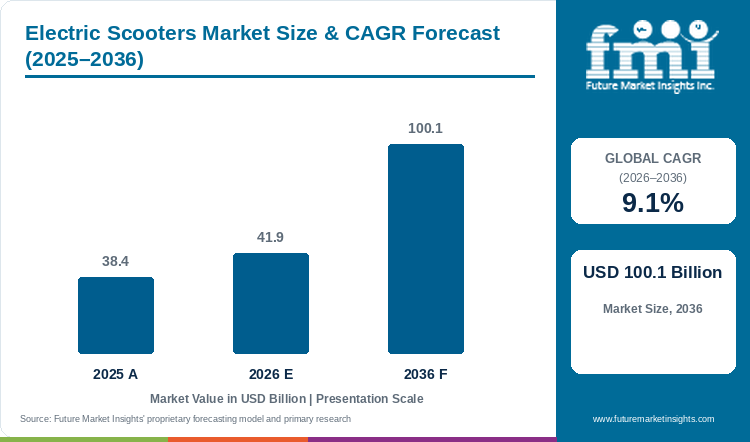
The electric scooters market is estimated at USD 38.4 billion in 2025 and USD 41.9 billion in 2026, and is forecast to reach USD 100.1 billion by 2036 at a 9.1% CAGR.
Global electric scooter sales are estimated at USD 38.4 billion in 2025 and are projected to reach USD 41.9 billion in 2026. Sales will grow at a 9.1% CAGR and are likely to reach USD 100.1 billion by 2036. Rental fleets in large cities are putting first-time riders on electric scooters before any purchase. Lime ran an average operational fleet of 407,707 vehicles over the three months to June 2026, up 22%, with revenue up 24% to USD 304 million.[1] Each rented ride works as a test ride, and operators renew vehicles on fixed cycles, so sharing and delivery fleets, near 18.5% of 2026 application sales, add steady replacement volume and future private buyers.
ASEAN is projected to grow at an 11.2% CAGR through 2036, against 8.7% for the United Kingdom. In July 2025, Vietnam's Prime Minister directed a ban on fossil fuel motorbikes and mopeds inside Hanoi's inner Ring Road 1 from 1 July 2026, and electric models still held under 10% of motorbike sales in Vietnam.[2] A fixed switch date on a low electric base turns petrol commuter bikes into scheduled replacement orders, led by mid-range models priced at VND 20 million to 35 million. The United Kingdom still has no law for private e-scooters after the King's Speech in May 2026 left out legislation, and the rental trial now runs until May 2028.[3] UK growth therefore comes mostly from rental fleets until a law passes.
Key Market Trends & Insights
- Lithium-ion batteries should lead battery type sales with 76.5% share in 2026, with lead-acid packs on about 23.5%.
- Motor power sales are led by light machines rated below 1 kW, at 41.0% share in 2026, just ahead of the 1 to 2.5 kW band at an estimated 38.5%. TVS Motor Company specifies a 4.6 kW peak power rating for both iQube variants launched in Kenya in August 2026.[4]
- Demand for electric scooters comes mainly from private riders, who will lead application sales with 68.0% share in 2026, and sharing and delivery fleets hold near 18.5%. Lime ran an average operational fleet of 407,707 vehicles in the second quarter of 2026, up 22%.[1]
- Showroom and dealer sales are forecast to lead channel sales with 71.0% share in 2026, and online orders are estimated at 29.0%.
Regional Highlights
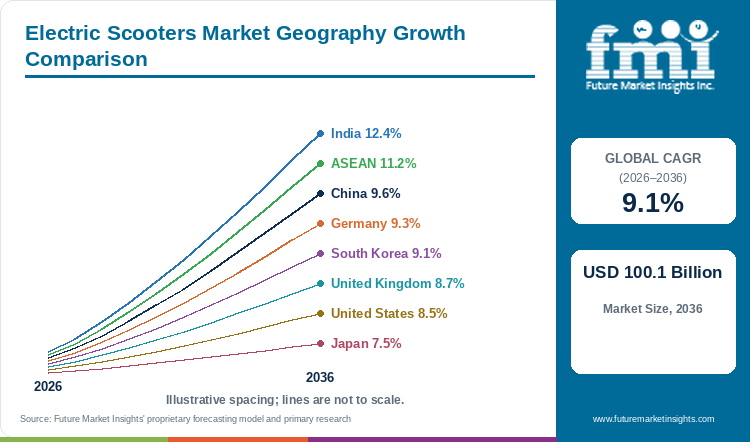
- FMI projects India to grow at the highest profiled CAGR, 12.4% from 2026 to 2036, ahead of ASEAN at 11.2% and China at 9.6%.
- Below the three fastest Asian entries, Germany grows at 9.3%, South Korea is expected to grow at the 9.1% global rate, the United Kingdom is likely to grow at 8.7% and the United States at 8.5%, and Japan is the lowest of the eight at 7.5%.
- Vietnam's Prime Minister directed a ban on fossil fuel motorbikes and mopeds inside Hanoi's inner Ring Road 1 from 1 July 2026.[2]
Market Size & Forecast
Table 1: Market Size and Forecast for the Electric Scooters Market (USD billion and percentage), 2025 to 2036
| Metric | Value |
|---|---|
| 2025 Market Size | USD 38.4 billion |
| Estimated Market Size in 2026 | USD 41.9 billion |
| Projected Market Size by 2036 | USD 100.1 billion |
| CAGR, 2026 to 2036 | 9.1% |
| Added Revenue, 2026 to 2036 | USD 58.2 billion |
| Market Expansion Multiple | 2.4x |
Subsidy calendars decide the month in which Indian riders buy a scooter, FMI finds. India's Ministry of Heavy Industries extended PM E-DRIVE support for electric two-wheelers to 31 March 2028 and raised the allocation to Rs 2,767 crore from Rs 1,772 crore.[5] The incentive now pays Rs 2,500 per kWh, capped at Rs 5,000 per vehicle, against Rs 5,000 per kWh and a Rs 10,000 cap in FY2024-25.[5] Indian buyers will pull purchases forward before each step-down, so dealer orders will bunch ahead of March 2028. Independent repair shops keep older scooters running, and the two-wheeler aftermarket components market is forecast to grow at a 7.4% CAGR from 2026 to 2036. As a result, used scooters will hold resale value, and owners will trade up to a new model with more cash in hand. FMI projects the market to add USD 58.2 billion between 2026 and 2036, a 2.4x expansion of the 2026 base. Falling used-scooter prices would cut trade-in values and slow the USD 58.2 billion expansion.
Subsidy Step-Downs and Factory Ramps in India
Ather Energy delivered 83,173 units in the quarter ended June 2026, up 80.5%, and pre-orders rose 158% to 150,000 units.[6] Phase 1 of Factory 3.0 at AURIC in Chhatrapati Sambhaji Nagar adds 500,000 units of annual capacity from the third quarter of FY2026-27.[6] Ola Electric Mobility delivered 39,192 units in Q1 FY27 and raised India share from 5.1% to 8.4% against the previous quarter.[7] Indian makers are adding capacity in the same window as the subsidy cut, so dealer stock will build faster than in FY26.
E-2W sales in India reached 1.46 million units in FY26 against 252,787 in FY22, according to Vahan data cited with the PM E-DRIVE extension.[5] Ola Electric Mobility reports that the commercially deployed 4680 Bharat Cell is performing in the field and that a 46100 LFP cell is vehicle-ready.[7] TVS Motor Company brought the iQube to Kenya in August 2026 as the brand's first entry into Africa, backed by the Car & General service network.[4] Indian producers with in-house cells and export routes will hold margin as the per-vehicle cap falls from Rs 10,000 to Rs 5,000.
Table 2: Subsidy, Capacity and Volume Indicators for the Electric Scooters Market (units, rupees and percentage), 2025 to 2028
| Indicator | Data Point | Relevance | Source |
|---|---|---|---|
| PM E-DRIVE end date for e-2Ws | 31 March 2028 | Sets the last month of incentive-backed bookings. | [5] |
| PM E-DRIVE incentive rate | Rs 2,500 per kWh, cap Rs 5,000 | Below the FY2024-25 rate of Rs 5,000 per kWh, so entry prices rise. | [5] |
| E-2W sales in India, FY26 | 1.46 million units | Shows the base the subsidy now supports. | [5] |
| Ather Energy deliveries, Q1 FY27 | 83,173 units, up 80.5% | Demand ahead of plant capacity. | [6] |
| Ather Energy Factory 3.0 Phase 1 | 500,000 units of annual capacity | New supply from Q3 FY2026-27. | [6] |
| Ola Electric Mobility India share | 5.1% to 8.4%, Q4 FY26 to Q1 FY27 | Share is moving between Indian brands. | [7] |
| Yadea Group Holdings electric scooter volume, H1 2026 | 3,484.2 thousand units, up 63.7% | China volume moved from e-bicycles to scooters. | [8] |
| NIU Technologies gross margin, Q2 2026 | 16.0% against 20.1% | Price pressure on Chinese brands. | [9] |
Analyst Perspective
“Backing demand for scooters in India through 2030 is my regional call, because Ather Energy, Ola Electric Mobility and TVS Motor Company are adding plants and cell lines just as the PM E-DRIVE cap falls to Rs 5,000 per vehicle. Ather Energy received 150,000 pre-orders in one quarter, and that queue tells me Indian riders want the product even with a smaller subsidy. I expect Indian brands to ship far larger volumes to Africa and Southeast Asia from those new lines.”
- Nikhil Kaitwade, Principal Consultant, Future Market Insights.
How is the electric scooters market segmented?
Battery type, motor power, application and sales channel define the market alongside region. Lithium-ion packs are anticipated to lead battery type with 76.5% share in 2026, with sub-1 kW machines leading motor power at 41.0%, private riders leading application at 68.0% and offline stores leading channel at 71.0%.
By battery type: lithium-ion, and lead acid.
By motor power: below 1 kW, 1 to 2.5 kW, and above 2.5 kW.
By application: personal, commercial, and sharing/delivery services.
By sales channel: online, and offline.
By region: Seven regions are covered, namely North America, Latin America, Western Europe, Eastern Europe, East Asia, South Asia and Pacific, and Middle East and Africa.
Why do lithium-ion batteries lead electric scooter battery type sales?
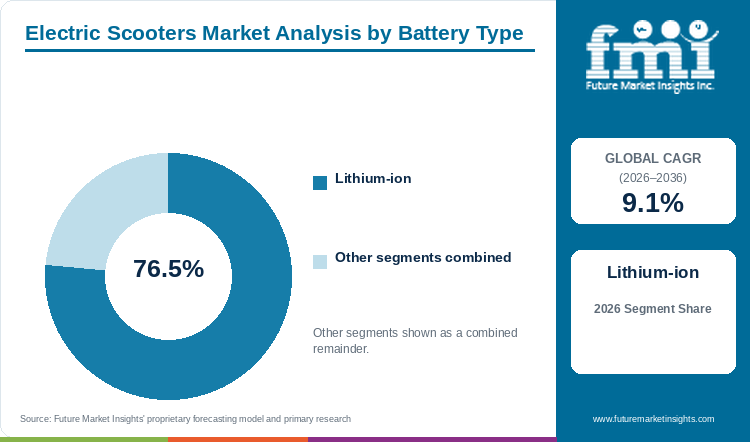
Lithium-ion packs are expected to lead with 76.5% share in 2026, and lead-acid packs are likely to hold about 23.5%.
Table 3: Battery Type Share for the Electric Scooters Market (percentage share), 2026
| Battery Type | Estimated Share (2026) |
|---|---|
| Lithium-ion | 76.5% |
| Lead Acid | 23.5% |
| Total | 100.0% |
Table 4: Battery Type Leadership and Market Growth for the Electric Scooters Market (segment and CAGR percentage), 2026 to 2036
| Metric | Value |
|---|---|
| Global CAGR (2026 to 2036) | 9.1% |
| Leading Segment | Lithium-ion |
Lithium-ion packs are expected to lead with 76.5% share in 2026, because range and weight decide battery choice and a lithium-ion pack gives a scooter the 75 km to 115 km of rated range that Indian and European commuters now expect. TVS Motor Company rates the 2.2 kWh iQube at 75 km and the 3.5 kWh version at 115 km, both on lithium-ion packs.[4] Lead-acid packs, at about 23.5% by estimate, hold on in Chinese entry models because the battery costs less at the counter and the shop that sold the scooter swaps the pack. A lead-acid scooter carries a far heavier battery for the same stored energy, so the format loses buyers each time a commuter needs a longer daily trip. Cheap replacement packs keep older lead-acid scooters running in Chinese towns, and the two-wheeler lead acid batteries market is anticipated to grow at an 8.0% CAGR from 2026 to 2036, below the 9.1% scooter CAGR. India's PM E-DRIVE incentive pays Rs 2,500 per kWh of battery capacity.[5] Two-wheelers are one of the uses for sodium-ion packs, and the sodium ion EV battery market should grow at a 10.3% CAGR from 2026 to 2036. Due to this, lead-acid entry models will face a second low-cost chemistry by the early 2030s, and lithium-ion will gain share as cell prices fall.
- NMC and LFP cells form the two main lithium-ion chemistries in the segment.
- Ola Electric Mobility's August 2026 results describe a commercially deployed 4680 NMC cell and a 46100 LFP cell ready for vehicles.[7]
Why do sub-1 kW models lead electric scooter motor power sales?
Scooters rated below 1 kW will lead with 41.0% share in 2026, ahead of the 1 to 2.5 kW band at an estimated 38.5%.
Table 5: Motor Power Share for the Electric Scooters Market (percentage share), 2026
| Motor Power | Estimated Share (2026) |
|---|---|
| Below 1 kW | 41.0% |
| 1 to 2.5 kW | 38.5% |
| Above 2.5 kW | 20.5% |
| Total | 100.0% |
Scooters rated below 1 kW will lead with 41.0% share in 2026. The band covers kick scooters, rental fleets and Chinese city models, all built around motors under 1 kW. The 1 to 2.5 kW band, near 38.5% by estimate, covers seated Chinese and European mopeds that carry two riders at 45 km/h, a speed that rental kick scooters never reach. Above 2.5 kW, the estimated 20.5% share belongs mostly to Indian and Taiwanese performance scooters built to replace a 110 cc petrol model. Price separates the three bands, because motor size sets battery size and battery size sets the bill. NIU Technologies reported lower kick-scooter margins in overseas markets in the second quarter of 2026, a sign of price pressure on the smallest machines.[9]
- Kick scooters, rental fleet models and Chinese city scooters fill the sub-1 kW band.
- NIU Technologies' August 2026 filing showed a second-quarter gross margin of 16.0%, down from 20.1% a year earlier.[9]
Why do personal riders lead electric scooter application sales?
Private riders are projected to lead with 68.0% share in 2026, ahead of sharing and delivery fleets at about 18.5% and commercial users at around 13.5%.
Table 6: Application Share for the Electric Scooters Market (percentage share), 2026
| Application | Estimated Share (2026) |
|---|---|
| Personal | 68.0% |
| Sharing/Delivery Services | 18.5% |
| Commercial | 13.5% |
| Total | 100.0% |
Private riders are projected to lead with 68.0% share in 2026, mostly households in China and India. A family scooter there replaces a bus pass or a petrol two-wheeler and stays in use for years. Sharing and delivery operators, near 18.5% (estimated), buy in fleet lots but replace vehicles on a schedule, and Lime guided full-year 2026 capital expenditure at about $180 million to $185 million.[1] Commercial users such as campus security teams and couriers working for themselves hold about 13.5% by estimate, because many still pick petrol models for payload and refuelling time. Fleet renewals will add volume in Europe with each replacement cycle, and private buyers across Asia will keep the larger base.
- Daily commuters, students and households replacing a petrol two-wheeler form the personal group.
- Ather Energy's deliveries reached 83,173 units in the quarter to June 2026.[6]
Why do offline stores lead electric scooter sales channels?
Offline stores are estimated to lead with 71.0% share in 2026, and online orders are likely to hold about 29.0%.
Table 7: Sales Channel Share for the Electric Scooters Market (percentage share), 2026
| Sales Channel | Estimated Share (2026) |
|---|---|
| Offline | 71.0% |
| Online | 29.0% |
| Total | 100.0% |
Offline stores are estimated to lead with 71.0% share in 2026, as seated scooters need registration, a test ride and a local service bay inside a dealer showroom. Online sales, at an estimated 29.0%, are mostly kick scooters and light Chinese models that ship in a box and need no plates. Indian brands accept bookings online but deliver through dealers, and Ather Energy counted 707,000 customer enquiries in the June 2026 quarter, up 95%.[6] Dealer floors will stay the main channel through 2036, and web bookings will grow as a lead source for those floors.
- Dealer showrooms with test rides, registration help and service bays form the offline channel.
- Customer enquiries at Ather Energy rose 95% to 707,000 in the June 2026 quarter.[6]
What are the drivers, restraints, and opportunities in the electric scooters market?
Riders moving from electric bicycles to scooters under tighter vehicle standards, and buyers booking ahead of supply, drive demand for electric scooters. Factory capacity and thinner margins hold back delivery, and battery leasing and export models open new buyers.
- Driver: Tighter safety and speed standards for electric bicycles push riders toward registered scooters, and brands answer with low-priced models that turn former bicycle buyers into scooter buyers.
- Restraint: Brands short of assembly capacity cannot deliver placed orders on time, so waiting buyers drift to rivals with stock on the floor and margins thin as makers chase volume.
- Opportunity: Battery leasing removes the pack from the purchase price and locally built export models avoid import duties, opening first-time buyers in cities with low upfront budgets.
New Chinese Standards Move Buyers from E-Bicycles to Scooters
Chinese riders are buying more electric scooters as the full switch to the new national standards pushes riders away from electric bicycles. Yadea Group Holdings sold 4,148.1 thousand electric bicycles in the first half of 2026, down about 37.8%, and 3,484.2 thousand electric scooters, up about 63.7%.[8] NIU Technologies sold 402,202 e-scooters in China in the second quarter of 2026, a 26.2% rise.[9] Chinese brands will keep adding scooter models priced near former e-bicycle levels, so unit growth will run ahead of value growth in 2026 and 2027.
Factory Capacity Holds Back Indian Deliveries
Placed orders turn into revenue only once a plant can build the scooter, so assembly capacity sets the pace of sales growth for young brands. A factory capacity constraint is slowing deliveries at Ather Energy, so riders who ordered in the June 2026 quarter face longer waits. Ather Energy delivered 83,173 units in the quarter against 150,000 pre-orders and is expanding at AURIC to address production constraints.[6] Installed capacity reaches 1.42 million units per year once Phases 1 and 2 of the new plant are complete.[6] Ola Electric Mobility also cited a challenging commodity environment and inflationary pressure in the same quarter.[7] Indian brands will lose some waiting buyers to rivals with stock on the floor until the new lines run at full rate.
Exports and Battery Leasing Open New Buyers
Outside China and India, electric scooter growth will come from African and Southeast Asian riders reached through export models and leased batteries. TVS Motor Company says the iQube has over 1 million customers globally and now sells in Kenya through Car & General.[4] Yadea Group Holdings reported higher demand across several overseas markets, particularly in Southeast Asia, and a new manufacturing base in Vietnam.[8] Plants in India and Vietnam will let brands undercut Chinese imports on duty, and battery rental removes the pack from the purchase bill. The battery leasing service market is projected to expand at a 17.4% CAGR from 2026 to 2036, so riders in Nairobi or Ho Chi Minh City will make a smaller first payment on a leased-pack scooter.
Which country CAGRs are profiled in the electric scooters market?
Table 8: Country CAGR Comparison for the Electric Scooters Market (CAGR percentage), 2026 to 2036
| Country | CAGR (2026 to 2036) |
|---|---|
| India | 12.4% |
| ASEAN | 11.2% |
| China | 9.6% |
| Germany | 9.3% |
| South Korea | 9.1% |
| United Kingdom | 8.7% |
| United States | 8.5% |
| Japan | 7.5% |
How do country-level CAGRs compare in the electric scooters market?
India extended PM E-DRIVE support for electric two-wheelers to 31 March 2028 and raised the allocation to Rs 2,767 crore.[5] According to FMI's analysis, India has a 12.4% CAGR from 2026 to 2036, ASEAN 11.2%, China 9.6%, Germany 9.3%, South Korea 9.1%, the United Kingdom 8.7%, the United States 8.5% and Japan 7.5%. The global CAGR is 9.1%. India, ASEAN and China grow above the global rate because millions of petrol two-wheeler owners there are replacing a daily commuter bike with an electric model. The United Kingdom, the United States and Japan grow below the global figure, as kick scooters and rental fleets carry most demand and private e-scooters remain illegal on British public roads.[3]
- Indian riders order ahead of each PM E-DRIVE step-down, and the per-vehicle cap is now Rs 5,000.[5]
- Hanoi's petrol motorbike ban inside Ring Road 1 from July 2026 moves Vietnamese commuters to electric models.[2]
- New national standards are moving Chinese riders from electric bicycles to scooters.[8]
- European cities license rental operators and cap fleet numbers, so fleet tenders in Berlin, Munich and Hamburg decide much of the volume in Germany.
- Delivery riders in Seoul and Busan will convert from petrol scooters as delivery apps add electric fleets.
- Volume in the United Kingdom waits on a rule for private e-scooters after the King's Speech left out legislation.[3]
- Lime averaged 407,707 vehicles globally in the June 2026 quarter, and rental rides give American riders a first trial before purchase.[1]
- Rental operators near Tokyo and Osaka rail stations will add most of Japan's new units.
Full report country CAGRs cover: ASEAN and India within South Asia and Pacific, China, Japan and South Korea within East Asia, Germany and the United Kingdom within Western Europe, the United States within North America, and regional tables for Latin America, Eastern Europe, and Middle East and Africa.
Country-wise Analysis
India Electric Scooters Market Outlook (2026 to 2036)
Sales of electric two-wheelers in India reached 1.46 million units in FY26, against 252,787 in FY22, according to Vahan data cited with the PM E-DRIVE extension.[5] Ather Energy delivered 83,173 units in the June 2026 quarter, up 80.5%, and Ola Electric Mobility raised India share from 5.1% to 8.4% in one quarter.[6][7] TVS Motor Company brought the iQube to Kenya in August 2026, turning Indian plants into export bases for Africa.[4] Demand in India is projected to expand at a 12.4% CAGR from 2026 to 2036, the highest of the eight profiled rates. Riders will keep booking ahead of each subsidy step-down until support ends on 31 March 2028.[5]
Key takeaway: New factory lines at Ather Energy, Ola Electric Mobility and TVS Motor Company, timed against the subsidy calendar, set the growth rate in India.
ASEAN Electric Scooters Market Outlook (2026 to 2036)
Hanoi will bar all fossil fuel motorbikes and mopeds from the inner Ring Road 1 from 1 July 2026 under a directive from the Prime Minister.[2] Electric models still account for less than 10% of motorbike sales in Vietnam, and mid-range models priced at VND 20 million to 35 million lead demand.[2] Yadea Group Holdings reported a new manufacturing base in Vietnam alongside higher demand in Southeast Asia.[8] ASEAN follows with an 11.2% CAGR from 2026 to 2036, as commuters inside the Hanoi zone and in other Southeast Asian cities replace petrol bikes.
Key takeaway: The Hanoi ban turns a sub-10% electric share in Vietnam into the main source of growth across ASEAN.
China Electric Scooters Market Outlook (2026 to 2036)
NIU Technologies' e-scooter sales in China rose 26.2% to 402,202 units in the second quarter of 2026.[9] NIU Technologies' revenue per e-scooter fell 8.6% to RMB 3,029 across all markets in the same quarter, and Yadea Group Holdings' gross profit margin fell to about 17.7% in the first half.[9][8] Sales in China will grow at a 9.6% CAGR from 2026 to 2036, a little above the global rate, because the extra units from the e-bicycle switch sell at lower prices per vehicle. Pedal-assist riders move up to seated scooters as daily trips lengthen, and growth of the electric bike market keeps that pool of upgrade buyers expanding at bicycle dealers.
Key takeaway: Brands pricing scooters near e-bicycle levels will push volume in China ahead of value.
Germany Electric Scooters Market Outlook (2026 to 2036)
City licences cap rental fleets in Germany, and operators such as Lime and Voi renew vehicles on fixed cycles. Lime grew second-quarter 2026 revenue 24% to $304 million and expects capital expenditure of about $180 million to $185 million in 2026.[1] Demand for electric scooters in Germany will grow at a 9.3% CAGR from 2026 to 2036, just above the global rate. Private buyers of seated 45 km/h scooters will add volume on top of the rental base.
Key takeaway: Germany is expected to grow above the global CAGR because fleet renewals and private moped sales grow together.
South Korea Electric Scooters Market Outlook (2026 to 2036)
Sales in South Korea are forecast to grow at the 9.1% global CAGR from 2026 to 2036, analysts at FMI see. Food delivery riders form the core buyer group, and delivery scooters run long daily distances in dense cities. Korean delivery riders will convert from petrol as swap kiosks open near delivery hubs in Seoul and Busan.
Key takeaway: Delivery fleets will decide volume in South Korea.
United Kingdom Electric Scooters Market Outlook (2026 to 2036)
Voi, Lime and CoMoUK all criticised the absence of e-scooter legislation from the King's Speech, and the national trial that began in July 2020 now runs until May 2028.[3] Simon Lightwood, minister for roads and buses, said the government will consult on detailed e-scooter regulation over the next year.[3] Sales in the United Kingdom are projected by FMI to grow at an 8.7% CAGR from 2026 to 2036. Retail sales of private e-scooters will jump in the first full year after a law passes.
Key takeaway: Legal status is the single switch for private sales in Britain.
United States Electric Scooters Market Outlook (2026 to 2036)
Rental rides and online kick-scooter orders shape scooter sales in the United States, which grow at an 8.5% CAGR from 2026 to 2036 in FMI estimates, below the global rate. Lime has powered one billion rides across five continents.[1] American campuses and city centres will keep rental rides as the first contact for many future buyers. Campus riders and city commuters buy kick scooters online, and seated mopeds stay a small niche outside a few coastal cities.
Key takeaway: Rental fleets and online kick-scooter sales carry demand in the United States.
Japan Electric Scooters Market Outlook (2026 to 2036)
Sales in Japan are the slowest profiled, and FMI predicts a 7.5% CAGR from 2026 to 2036. Japanese commuters cycle or take trains for short trips, so scooter ownership stays low outside Tokyo and Osaka. Kick scooters for the last kilometre from a station will be the main growth format.
Key takeaway: Station-area rental fleets set the Japanese ceiling.
Who are the notable companies in the electric scooters market?
Yadea Group Holdings, NIU Technologies, Ather Energy, Ola Electric Mobility, TVS Motor Company, Bajaj Auto, Gogoro, Segway-Ninebot, Horwin Global, Silence Urban Ecomobility, Pure EV, Revolt Motors and Simple Energy are among the profiled companies.
Volume makers from China, Indian scooter brands and a group of European and Taiwanese specialists form the profiled field of electric scooter suppliers. Yadea Group Holdings reported H1 2026 revenue of RMB18,236.1 million, down about 5.0%.[8] Lower e-bicycle volume outweighed higher scooter sales across the group. NIU Technologies sold 434,687 e-scooters in the second quarter of 2026, up 24.2%, and revenue per e-scooter fell 8.6% to RMB 3,029.[9] Ather Energy turned EBITDA positive at Rs 9 crore in the June 2026 quarter against a Rs 106 crore loss in the June 2025 quarter.[6]
- Chinese volume makers: Yadea Group Holdings, NIU Technologies, and Segway-Ninebot.
- Indian scooter brands: Ather Energy, Ola Electric Mobility, TVS Motor Company, Bajaj Auto, Pure EV, Revolt Motors, and Simple Energy.
- Taiwanese and European specialists: Gogoro, Horwin Global, and Silence Urban Ecomobility.
Competitive Benchmarking: Electric Scooters Market
Table 9: Competitive Benchmarking for the Electric Scooters Market (qualitative documentation ratings), 2026
| Company | Volume Scale | Cell and Battery Control | Export Reach | Recency |
|---|---|---|---|---|
| Yadea Group Holdings | High | Medium | High | High |
| NIU Technologies | Medium | Low | Medium | High |
| Ather Energy | Medium | Medium | Low | High |
| Ola Electric Mobility | Medium | High | Low | High |
| TVS Motor Company | Medium | Medium | High | High |
Ratings track the volume of dated company disclosures for each column, and a High score carries no market-share meaning.
Key Developments in the Electric Scooters Market
- In August 2026, Yadea Group Holdings reported 3,484.2 thousand electric scooter sales for the first half of 2026.[8]
- In August 2026, India's Ministry of Heavy Industries extended PM E-DRIVE support for electric two-wheelers to March 2028.[5]
- In August 2026, NIU Technologies reported a 16.0% gross margin for the second quarter of 2026.[9]
- In August 2026, Ola Electric Mobility reported 39,192 deliveries for Q1 FY27.[7]
- In August 2026, TVS Motor Company launched the iQube in Kenya.[4]
- In August 2026, Lime reported second-quarter revenue of $304 million.[1]
- In August 2026, Ather Energy reported 83,173 deliveries for the June 2026 quarter.[6]
- In May 2026, the United Kingdom extended the rental e-scooter trial to May 2028.[3]
Key Players in the Electric Scooters Market
Chinese Volume Makers
- Yadea Group Holdings
- NIU Technologies
- Segway-Ninebot
Indian Scooter Brands
- Ather Energy
- Ola Electric Mobility
- TVS Motor Company
- Bajaj Auto
- Pure EV
- Revolt Motors
- Simple Energy
Taiwanese and European Specialists
- Gogoro
- Horwin Global
- Silence Urban Ecomobility
Electric Scooters Market - Report Scope
Table 10: Report Scope for the Electric Scooters Market (coverage fields and definitions), 2026 to 2036
| Coverage field | Report scope |
|---|---|
| Market breakdown | Battery type; motor power; application; sales channel; region |
| Quantitative units | USD billion |
| Market definition | Battery-powered two-wheeled scooters, including seated electric scooters, mopeds and standing kick scooters, sold to private, commercial and fleet buyers. |
| Regions covered | North America; Latin America; Western Europe; Eastern Europe; East Asia; South Asia and Pacific; Middle East and Africa |
| Countries covered | United States; Canada; Brazil; Mexico; Argentina; Chile; Germany; France; United Kingdom; Italy; Spain; Benelux; Nordics; Poland; Czech Republic; Romania; Hungary; China; Japan; South Korea; India; ASEAN; Australia and New Zealand; GCC Countries; South Africa; Türkiye; Israel |
| Key companies profiled | Yadea Group Holdings, NIU Technologies, Ather Energy, Ola Electric Mobility, TVS Motor Company, Bajaj Auto, Gogoro, Segway-Ninebot, Horwin Global, Silence Urban Ecomobility, Pure EV, Revolt Motors, Simple Energy |
| Forecast period | 2026 to 2036 |
Electric Scooters Market - Research Methodology
Table 11: Research Methodology for the Electric Scooters Market (research methods and approach), 2026 edition
| Method | Approach |
|---|---|
| Data Sources | Stock exchange filings, ministry notifications, operator results and mobility trade press dated May 2025 or later. |
| Desk Research | Desk research covers unit sales, subsidy rules, plant capacity, rental fleets and national e-scooter rules. |
| Market Sizing and Forecasting | Sizing starts from the 2025 base of USD 38.4 billion and the 9.1% CAGR from 2026 to 2036. |
| Data Validation | Unit, margin and subsidy figures follow company filings and the ministry notification. |
Electric Scooters Market by Segments
Electric Scooters Market segmented by Battery Type:
- Lithium-ion
- Lead Acid
Electric Scooters Market segmented by Motor Power:
- Below 1 kW
- 1 to 2.5 kW
- Above 2.5 kW
Electric Scooters Market segmented by Application:
- Personal
- Commercial
- Sharing/Delivery Services
Electric Scooters Market segmented by Sales Channel:
- Online
- Offline
Electric Scooters Market by Region
- North America
- United States
- Canada
- Latin America
- Brazil
- Mexico
- Argentina
- Chile
- Western Europe
- Germany
- France
- United Kingdom
- Italy
- Spain
- Benelux
- Nordics
- Eastern Europe
- Poland
- Czech Republic
- Romania
- Hungary
- East Asia
- China
- Japan
- South Korea
- South Asia and Pacific
- India
- ASEAN
- Australia and New Zealand
- Middle East and Africa
- GCC Countries
- South Africa
- Türkiye
- Israel
Research Sources and Bibliography
- [1] Lime. (2026, August 4). Lime Announces Second Quarter 2026 Financial Results. https://investors.li.me/news-releases/news-release-details/lime-announces-second-quarter-2026-financial-results
- [2] Viet Nam News. (2025, July 18). Petrol-powered bike ban accelerates electric motorbike surge in Viet Nam. https://bizhub.vietnamnews.vn/petrol-powered-bike-ban-accelerates-electric-motorbike-surge-in-viet-nam-post380597.html
- [3] Road Safety GB. (2026, May 18). King's Speech 'leaves UK e-scooter industry in limbo once again'. https://roadsafetygb.org.uk/?p=23692
- [4] TVS Motor Company. (2026, August 6). TVS Motor Accelerates Global EV Expansion with iQube Launch in Kenya. https://nsearchives.nseindia.com/corporate/TVSMOTOR_06082026182701_NSEBSEIqubeinkenya_sd.pdf
- [5] Autocar Professional. (2026, August 11). Govt Extends PM E-Drive Subsidy For e2Ws Till FY28, Increases Allocation. https://www.autocarpro.in/news/govt-extends-pm-e-drive-subsidy-for-e2ws-till-fy28-increases-allocation-134036?amp=1
- [6] Autocar Professional. (2026, August 3). Ather Energy Q1 Revenue Grows by 87%, Turns EBITDA Positive. https://www.autocarpro.in/news/ather-energy-q1-revenue-grows-by-87-percent-turns-ebitda-positive-133893?amp=1
- [7] Ola Electric Mobility Ltd. (2026, August 7). Ola Electric Announces Q1 FY27 Results. https://nsearchives.nseindia.com/corporate/OLAELECTRIC_07082026165801_Press_Release_OEM.pdf
- [8] Yadea Group Holdings Ltd. (2026, August 25). Announcement of Interim Results for the Six Months Ended 30 June 2026. https://www1.hkexnews.hk/listedco/listconews/sehk/2026/0825/2026082500215.pdf
- [9] Niu Technologies. (2026, August 10). Niu Technologies Announces Unaudited Second Quarter 2026 Financial Results (Form 6-K, Exhibit 99.1). https://www.sec.gov/Archives/edgar/data/0001744781/000110465926092992/tm2622687d1_ex99-1.htm
This bibliography is provided for reader reference. The full report contains the complete reference list and detailed citations.
This Report Answers
- How big is the electric scooters market during 2026?
- What market size is projected by 2036?
- Which battery type holds notable share?
- Which motor power band holds notable share?
- Which countries have notable growth?
- Which companies are notable in the market?
Frequently Asked Questions
How large is the electric scooters market expected in 2026?
Electric scooter sales are expected to reach USD 41.9 billion in 2026 and USD 100.1 billion by 2036. The 2025 base was USD 38.4 billion.
What CAGR is projected for the electric scooters market through 2036?
Scooter sales will grow at a 9.1% CAGR from 2026 to 2036, as per FMI. Longer-range lithium-ion models and India's PM E-DRIVE support drive that pace.
Which battery type holds a notable market share in 2026?
Lithium-ion batteries are anticipated to lead with 76.5% share in 2026. Lead-acid packs are likely to hold about 23.5%, mostly in Chinese entry models.
Which motor power band holds a notable market share in 2026?
Models rated below 1 kW will lead with 41.0% share in 2026. The 1 to 2.5 kW band follows at an estimated 38.5%.
Which country has a notable expansion outlook through 2036?
At 12.4% from 2026 to 2036, India is forecast to grow at the top profiled CAGR, according to FMI. ASEAN follows at 11.2%.
Who are the key companies in the electric scooters market?
Yadea Group Holdings, NIU Technologies and Segway-Ninebot are the main Chinese brands in the profiled group. Ather Energy, Ola Electric Mobility, TVS Motor Company and Bajaj Auto lead the Indian brands profiled.
Preview the report firsthand - request a free sample
Get SampleGet the brochure for pricing and purchase details.
Get PDFTable of Content
- Key Takeaways
- Market Size and CAGR
- Top Growth Driver
- Fastest Growing Segment
- Leading Region
- Key Companies
- Emerging Opportunities
- Executive Summary
- Global Market Outlook
- Demand-side Trends
- Supply-side Trends
- Technology Roadmap Analysis
- Analysis and Recommendations
- Analyst Perspective (What is happening? Why now? What should investors know?)
- Key Questions Answered
- How large is the market?
- What is the CAGR?
- What are key trends?
- Which region dominates?
- Who are the leaders?
- Market Overview
- Market Coverage / Taxonomy
- Market Definition / Scope / Limitations
- Research Methodology
- Chapter Orientation
- Analytical Lens and Working Hypotheses
- Market Structure, Signals, and Trend Drivers
- Benchmarking and Cross-market Comparability
- Market Sizing, Forecasting, and Opportunity Mapping
- Research Design and Evidence Framework
- Desk Research Programme (Secondary Evidence)
- Expert Input and Fieldwork (Primary Evidence)
- Tooling, Models, and Reference Databases
- Data Engineering and Model Build
- Quality Assurance and Audit Trail
- Market Background
- Market Dynamics (Drivers, Restraints, Opportunity, Trends)
- Scenario Forecast (Optimistic, Likely, Conservative)
- Impact Analysis
- AI Impact
- Sustainability Impact
- Regulatory Impact
- Technology Impact
- Consumer / Buyer Analysis
- Purchase Drivers
- Adoption Barriers
- Buyer Journey
- Opportunity Map Analysis
- Product Life Cycle Analysis
- Supply Chain Analysis
- Investment Feasibility Matrix
- Value Chain Analysis
- PESTLE and Porter's Analysis
- Regulatory Landscape
- Regional Parent Market Outlook
- Production and Consumption Statistics
- Import and Export Statistics
- Global Market Analysis and Forecast, 2021 to 2036
- Historical Market Size Value (USD Billion) Analysis, 2021 to 2025
- Current and Future Market Size Value (USD Billion) Projections, 2026 to 2036
- Y-o-Y Growth Trend Analysis
- Absolute $ Opportunity Analysis
- Global Market Pricing Analysis, 2021 to 2036
- Global Market Analysis and Forecast, By Battery Type, 2021 to 2036
- Introduction / Key Findings
- Historical Market Size Value (USD Billion) Analysis By Battery Type, 2021 to 2025
- Current and Future Market Size Value (USD Billion) Analysis and Forecast By Battery Type, 2026 to 2036
- Lithium-ion
- Lead Acid
- Y-o-Y Growth Trend Analysis By Battery Type, 2021 to 2025
- Absolute $ Opportunity Analysis By Battery Type, 2026 to 2036
- Global Market Analysis and Forecast, By Motor Power, 2021 to 2036
- Introduction / Key Findings
- Historical Market Size Value (USD Billion) Analysis By Motor Power, 2021 to 2025
- Current and Future Market Size Value (USD Billion) Analysis and Forecast By Motor Power, 2026 to 2036
- Below 1 kW
- 1 to 2.5 kW
- Above 2.5 kW
- Y-o-Y Growth Trend Analysis By Motor Power, 2021 to 2025
- Absolute $ Opportunity Analysis By Motor Power, 2026 to 2036
- Global Market Analysis and Forecast, By Application, 2021 to 2036
- Introduction / Key Findings
- Historical Market Size Value (USD Billion) Analysis By Application, 2021 to 2025
- Current and Future Market Size Value (USD Billion) Analysis and Forecast By Application, 2026 to 2036
- Personal
- Commercial
- Sharing/Delivery Services
- Y-o-Y Growth Trend Analysis By Application, 2021 to 2025
- Absolute $ Opportunity Analysis By Application, 2026 to 2036
- Global Market Analysis and Forecast, By Sales Channel, 2021 to 2036
- Introduction / Key Findings
- Historical Market Size Value (USD Billion) Analysis By Sales Channel, 2021 to 2025
- Current and Future Market Size Value (USD Billion) Analysis and Forecast By Sales Channel, 2026 to 2036
- Online
- Offline
- Y-o-Y Growth Trend Analysis By Sales Channel, 2021 to 2025
- Absolute $ Opportunity Analysis By Sales Channel, 2026 to 2036
- Global Market Analysis and Forecast, By Region, 2021 to 2036
- Introduction
- Historical Market Size Value (USD Billion) Analysis By Region, 2021 to 2025
- Current Market Size Value (USD Billion) Analysis and Forecast By Region, 2026 to 2036
- North America
- Latin America
- Western Europe
- Eastern Europe
- East Asia
- South Asia and Pacific
- Middle East and Africa
- Market Attractiveness Analysis By Region
- North America Market Analysis and Forecast, By Country, 2021 to 2036
- Historical Market Size Value (USD Billion) Trend Analysis By Market Taxonomy, 2021 to 2025
- Market Size Value (USD Billion) Forecast By Market Taxonomy, 2026 to 2036
- By Country
- United States
- Canada
- By Battery Type
- By Motor Power
- By Application
- By Sales Channel
- By Country
- Market Attractiveness Analysis
- By Country
- By Battery Type
- By Motor Power
- By Application
- By Sales Channel
- Key Takeaways
- Latin America Market Analysis and Forecast, By Country
- Historical Market Size Value (USD Billion) Trend Analysis By Market Taxonomy, 2021 to 2025
- Market Size Value (USD Billion) Forecast By Market Taxonomy, 2026 to 2036
- By Country
- Brazil
- Mexico
- Argentina
- Chile
- By Battery Type
- By Motor Power
- By Application
- By Sales Channel
- By Country
- Market Attractiveness Analysis
- By Country
- By Battery Type
- By Motor Power
- By Application
- By Sales Channel
- Key Takeaways
- Western Europe Market Analysis and Forecast, By Country
- Historical Market Size Value (USD Billion) Trend Analysis By Market Taxonomy, 2021 to 2025
- Market Size Value (USD Billion) Forecast By Market Taxonomy, 2026 to 2036
- By Country
- Germany
- France
- United Kingdom
- Italy
- Spain
- Benelux
- Nordics
- By Battery Type
- By Motor Power
- By Application
- By Sales Channel
- By Country
- Market Attractiveness Analysis
- By Country
- By Battery Type
- By Motor Power
- By Application
- By Sales Channel
- Key Takeaways
- Eastern Europe Market Analysis and Forecast, By Country
- Historical Market Size Value (USD Billion) Trend Analysis By Market Taxonomy, 2021 to 2025
- Market Size Value (USD Billion) Forecast By Market Taxonomy, 2026 to 2036
- By Country
- Poland
- Czech Republic
- Romania
- Hungary
- By Battery Type
- By Motor Power
- By Application
- By Sales Channel
- By Country
- Market Attractiveness Analysis
- By Country
- By Battery Type
- By Motor Power
- By Application
- By Sales Channel
- Key Takeaways
- East Asia Market Analysis and Forecast, By Country
- Historical Market Size Value (USD Billion) Trend Analysis By Market Taxonomy, 2021 to 2025
- Market Size Value (USD Billion) Forecast By Market Taxonomy, 2026 to 2036
- By Country
- China
- Japan
- South Korea
- By Battery Type
- By Motor Power
- By Application
- By Sales Channel
- By Country
- Market Attractiveness Analysis
- By Country
- By Battery Type
- By Motor Power
- By Application
- By Sales Channel
- Key Takeaways
- South Asia and Pacific Market Analysis and Forecast, By Country
- Historical Market Size Value (USD Billion) Trend Analysis By Market Taxonomy, 2021 to 2025
- Market Size Value (USD Billion) Forecast By Market Taxonomy, 2026 to 2036
- By Country
- India
- ASEAN
- Australia and New Zealand
- By Battery Type
- By Motor Power
- By Application
- By Sales Channel
- By Country
- Market Attractiveness Analysis
- By Country
- By Battery Type
- By Motor Power
- By Application
- By Sales Channel
- Key Takeaways
- Middle East and Africa Market Analysis and Forecast, By Country
- Historical Market Size Value (USD Billion) Trend Analysis By Market Taxonomy, 2021 to 2025
- Market Size Value (USD Billion) Forecast By Market Taxonomy, 2026 to 2036
- By Country
- GCC Countries
- South Africa
- Türkiye
- Israel
- By Battery Type
- By Motor Power
- By Application
- By Sales Channel
- By Country
- Market Attractiveness Analysis
- By Country
- By Battery Type
- By Motor Power
- By Application
- By Sales Channel
- Key Takeaways
- Key Countries Market Analysis
- United States
- Pricing Analysis
- Market Share Analysis, 2025
- By Battery Type
- By Motor Power
- By Application
- By Sales Channel
- Canada
- Pricing Analysis
- Market Share Analysis, 2025
- By Battery Type
- By Motor Power
- By Application
- By Sales Channel
- Mexico
- Pricing Analysis
- Market Share Analysis, 2025
- By Battery Type
- By Motor Power
- By Application
- By Sales Channel
- Brazil
- Pricing Analysis
- Market Share Analysis, 2025
- By Battery Type
- By Motor Power
- By Application
- By Sales Channel
- Chile
- Pricing Analysis
- Market Share Analysis, 2025
- By Battery Type
- By Motor Power
- By Application
- By Sales Channel
- Germany
- Pricing Analysis
- Market Share Analysis, 2025
- By Battery Type
- By Motor Power
- By Application
- By Sales Channel
- United Kingdom
- Pricing Analysis
- Market Share Analysis, 2025
- By Battery Type
- By Motor Power
- By Application
- By Sales Channel
- Italy
- Pricing Analysis
- Market Share Analysis, 2025
- By Battery Type
- By Motor Power
- By Application
- By Sales Channel
- Spain
- Pricing Analysis
- Market Share Analysis, 2025
- By Battery Type
- By Motor Power
- By Application
- By Sales Channel
- France
- Pricing Analysis
- Market Share Analysis, 2025
- By Battery Type
- By Motor Power
- By Application
- By Sales Channel
- India
- Pricing Analysis
- Market Share Analysis, 2025
- By Battery Type
- By Motor Power
- By Application
- By Sales Channel
- ASEAN
- Pricing Analysis
- Market Share Analysis, 2025
- By Battery Type
- By Motor Power
- By Application
- By Sales Channel
- Australia and New Zealand
- Pricing Analysis
- Market Share Analysis, 2025
- By Battery Type
- By Motor Power
- By Application
- By Sales Channel
- China
- Pricing Analysis
- Market Share Analysis, 2025
- By Battery Type
- By Motor Power
- By Application
- By Sales Channel
- Japan
- Pricing Analysis
- Market Share Analysis, 2025
- By Battery Type
- By Motor Power
- By Application
- By Sales Channel
- South Korea
- Pricing Analysis
- Market Share Analysis, 2025
- By Battery Type
- By Motor Power
- By Application
- By Sales Channel
- Poland
- Pricing Analysis
- Market Share Analysis, 2025
- By Battery Type
- By Motor Power
- By Application
- By Sales Channel
- Hungary
- Pricing Analysis
- Market Share Analysis, 2025
- By Battery Type
- By Motor Power
- By Application
- By Sales Channel
- Türkiye
- Pricing Analysis
- Market Share Analysis, 2025
- By Battery Type
- By Motor Power
- By Application
- By Sales Channel
- South Africa
- Pricing Analysis
- Market Share Analysis, 2025
- By Battery Type
- By Motor Power
- By Application
- By Sales Channel
- United States
- Market Structure Analysis
- Competition Dashboard
- Competition Benchmarking
- Market Share Analysis of Top Players
- By Regional
- By Battery Type
- By Motor Power
- By Application
- By Sales Channel
- Emerging Startups
- Innovation Benchmarking
- Competition Analysis
- Competition Deep Dive
- Yadea Group Holdings
- Overview
- Product Portfolio
- Profitability by Market Segments
- Sales Footprint
- Strategy Overview
- Marketing Strategy
- Product Strategy
- Channel Strategy
- NIU Technologies
- Ather Energy
- Ola Electric Mobility
- TVS Motor Company
- Segway-Ninebot
- Bajaj Auto
- Pure EV
- Revolt Motors
- Simple Energy
- Gogoro
- Horwin Global
- Silence Urban Ecomobility
- Yadea Group Holdings
- Case Studies
- Success Stories
- Recent Developments
- Competition Deep Dive
- Assumptions & Acronyms Used


