

- Market Size (2026)
- USD 1.9 Bn
- Forecast (2036)
- USD 3.6 Bn
- CAGR (2026 to 2036)
- 6.6%
How big is Electric Vehicle Battery Chillers Market in 2026?
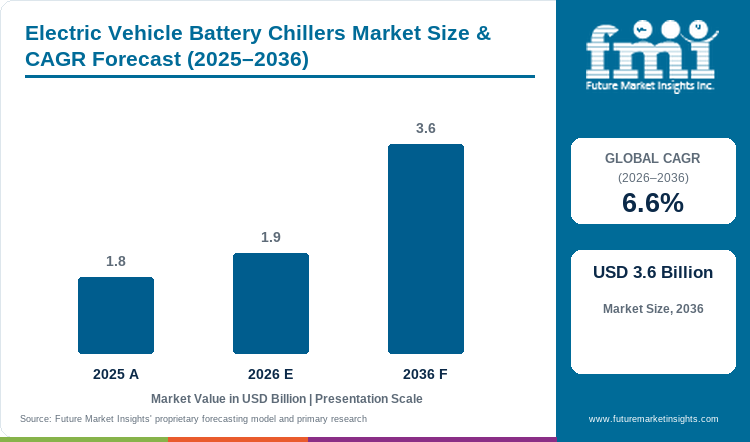
USD 1.9 billion in 2026 and USD 3.6 billion by 2036, expanding at 6.6% CAGR.
Sales of electric vehicle battery chillers are estimated to rise at 6.6% CAGR through 2036, increasing valuation from USD 1.8 billion in 2025 to USD 1.9 billion in 2026, and reaching USD 3.6 billion by 2036. IEA recorded 1.2 TWh of EV battery use in 2025. That was almost 30% more than in 2024. Bigger battery use creates more heat during charging. The chiller moves that heat into the refrigerant circuit. This cooling helps the car keep its planned charging speed under a heavy heat load.
Electric vehicle sales and charging use differ by country. VDA counted 545,100 new battery electric cars in Germany during 2025. Germany is projected at 4.4% CAGR as vehicle plants balance output with strict cost and energy goals. The Netherlands reaches 6.1% as plug-in cars form a larger part of its fleet. Japan reaches 4.0% as charging access grows from a smaller battery electric base. Each country therefore gives chiller suppliers a different mix of heat load, vehicle volume and local test work.
Key Takeaways
- More battery use and faster charging create extra heat that active cooling systems must remove during normal vehicle use.
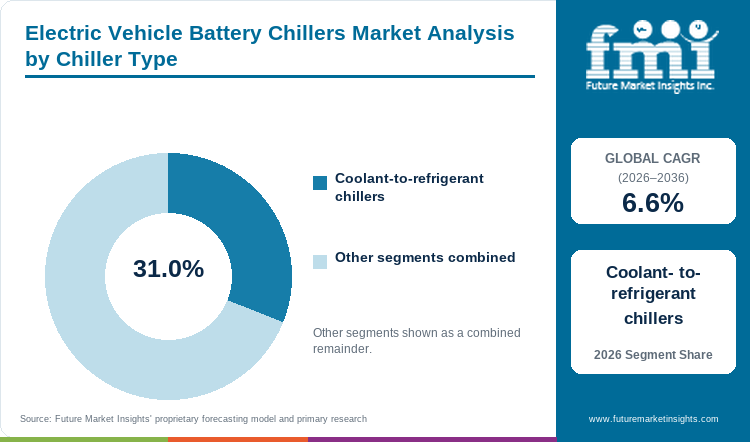
- Based on chiller type, coolant-to-refrigerant chillers are projected to account for 31.0% in 2026. Direct heat transfer into the refrigerant circuit supports this share.
- By vehicle type, battery electric cars are estimated to hold 39.0% in 2026. Large packs and high production volumes support this share.
- In 2026, the battery loop is expected to lead cooling loop revenue with 48.0% share. Its direct role in cell cooling supports the position.
- Vehicle tests slow supplier changes because each new chiller must pass leak, control and platform checks before vehicle production begins.
- Key players include Sanhua Automotive, DENSO, Valeo and MAHLE. Hanon Systems and Modine are also active. Dana TM4 and Eaton add to the list. Schaeffler and Eberspächer complete it. These firms make chillers and battery cooling parts. They also make thermal modules and wider electric vehicle cooling systems.
Analyst Perspective
"Chiller suppliers win vehicle work by proving that they can control battery heat. Integrated modules can add more content per vehicle. The same supplier then carries more test work and more interface risk."
- Nikhil Kaitwade, Principal Consultant, Future Market Insights
How is the electric vehicle battery chillers market segmented?
The electric vehicle battery chillers market is segmented by Chiller Type, Vehicle Type, Cooling Loop, Sales Channel, Material, and Region.
The market is segmented by chiller type, vehicle type, cooling loop, sales channel, material and region. Chiller type covers five main formats. Vehicle type covers five supplied groups. The other axes describe loop position, sales route and material choice. Each axis divides the same battery chiller market from a different operating or buying view.
What makes coolant-to-refrigerant chillers central to the chiller type category?
Air alone cannot always cool a battery pack enough. Coolant-to-refrigerant chillers move battery heat into the refrigerant circuit. They work with wider EV thermal systems and controls. In March 2026 Hanon Systems announced one unit with a chiller, eCompressor and valve block. The combined design cuts the number of separate thermal parts that a vehicle team must package and test.
- Coolant-to-refrigerant chillers are set to lead the chiller type category with 31.0% share in 2026. Their design moves heat between coolant and refrigerant circuits.
- Vehicle teams choose integrated modules to save space and reduce fluid links. The battery can still stay within its set temperature range.
How do battery electric cars shape demand within the vehicle type category?
Battery electric cars use large packs and often charge at high power. IEA found that light-duty vehicles supplied more than 85% of EV battery use in 2025. The high vehicle volume keeps electric vehicle batteries at the center of road cooling design. Large runs spread tooling and test costs across more vehicles. Proven cooling layouts can then move across high-volume electric car programs with less redesign work.
- In 2026, battery electric cars are expected to lead vehicle type with 39.0% share. Large packs and high sales volumes support this position.
- Fast charging raises cooling needs in battery electric cars. High-power public chargers can add more heat during long trips.
What role does the battery loop play within the cooling loop category?
The battery loop carries heat away from cells during driving and charging. Coolant distribution manifolds move fluid between the pack and refrigerant exchanger. IEA counted about 160 battery electric car models that could charge above 150 kW in 2025. High pack heat can force a car to cut charging speed. A strong battery loop helps keep cell temperature within the range set for fast charging.
- For cooling loop, the battery loop is predicted to reach 48.0% share in 2026. Cell heat and charging needs support this position.
- Cabin and electronics loops can share parts. The battery still carries the main cooling load during fast charging events.
What supports OEM direct leadership in the sales channel category?
Vehicle makers set chiller needs early in each platform plan. The fluid layout and refrigerant choice affect the full cooling system. Engineers set pressure and control limits before release. Service teams support the system later in the car's life. Chillers need fewer routine replacements than pumps or coolant. Early platform choices keep most new chiller sales with the vehicle maker and its approved thermal suppliers.
- OEM direct is set to lead the sales channel with 56.0% share in 2026. Platform tests fix connection and control needs before production.
- Tier-1 supply stays useful when a vehicle maker buys one thermal module. One module can replace a separate heat exchanger and control package.
Why does aluminum lead the material category?
Aluminum keeps chiller cores light and moves heat through thin plates. Engineers also check corrosion control and joint cleanliness. The same checks apply to EV coolants that flow through the battery loop. Stainless steel can support higher strength needs in some designs. The supplied model also includes brazed plate assemblies and composite housings. Material choice balances weight, pressure strength, cost and long-term fluid contact.
- Aluminum is projected to hold 54.0% share of the material category in 2026. Low weight and simple plate brazing support its lead.
- Clean joints matter because a chiller keeps refrigerant and coolant apart. The refrigerant side also works at high pressure.
What are the drivers, restraints and opportunities in the Electric Vehicle Battery Chillers Market?
Higher charging power increases active cooling demand, vehicle validation slows supplier changes, and integrated thermal modules can raise content per platform.
- Driver: More battery use and faster charging add heat to each pack. Vehicle cooling systems must remove that heat during normal use.
- Restraint: New chillers must match the refrigerant, pass leak tests and clear vehicle approval before suppliers can switch parts.
- Opportunity: One module can hold the chiller, compressor, valves and controls. Fewer separate parts can save space and cut assembly work.
Fast charging raises short-duration battery heat loads
Fast charging adds a large heat load to the battery during high-power charging sessions on road trips. IEA counted about 160 battery electric car models able to charge above 150 kW in 2025. High cell heat can force cars to slow charging. Coolant moves heat from the cells to the refrigerant circuit and gives the chiller a direct role at peak load. Battery thermal upgrades matter more as older vehicles face harder use and radiators reach their cooling limit. Platform teams compare chiller output with pack size and charging power before hot-weather tests start on each platform. Frequent high-power charging gives vehicle makers a clear reason to add cooling margin that protects charge speed.
Vehicle testing makes supplier switching slow
Every chiller must match two fluid circuits and the controls used across a vehicle platform. DENSO published a vehicle heat-management patent in March 2026 for a heat-pump cycle with linked heat paths. A part change can reopen several tests at once. The filing places battery cooling inside one wider refrigerant and coolant system and links the chiller with other parts. Platform teams test pressure limits, fluid choice and connection shape before final release to keep the full package safe. A later part change can reopen heat, leak and durability tests while new software settings may need fresh checks. Repeated testing slows supplier changes after platform approval because vehicle makers avoid extra work once production dates are fixed.
Integrated modules can increase thermal content per vehicle
Integrated systems let suppliers sell more than one stand-alone chiller by placing several cooling jobs in one unit. Hanon Systems combined a chiller with an eCompressor and valve block for EVs in March 2026. Fewer fluid links can save space and assembly work. The unit also puts condenser functions and sensors in one package and links them with the refrigerant loop. Automotive heat-pump refrigerant components follow the same pressure-control path and must work with the full system. The supplier tests hardware and controls together while keeping output steady at vehicle scale in production. Better integration can remove brackets and lines while helping one supplier win more thermal content on an approved platform.
Which country CAGRs are profiled in the Electric Vehicle Battery Chillers Market?
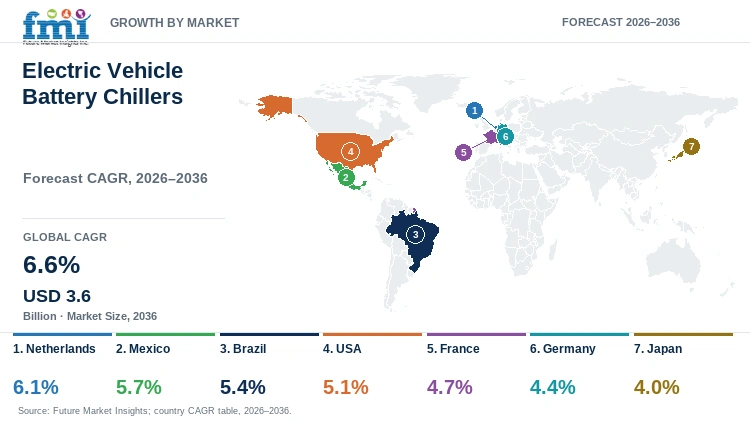
| Country | CAGR |
|---|---|
| Netherlands | 6.1% |
| Mexico | 5.7% |
| Brazil | 5.4% |
| USA | 5.1% |
| France | 4.7% |
| Germany | 4.4% |
| Japan | 4.0% |
How do country-level CAGRs compare in the Electric Vehicle Battery Chillers Market?
The CAGRs span 2.1 points from the Netherlands at 6.1% to Japan at 4.0%. Mexico and Brazil form the next growth group. USA and France sit in the middle range. Germany and Japan grow more slowly even though both have strong vehicle engineering bases. Vehicle use, charging access and local production plans give each country a different growth path.
- The Netherlands has dense charging and a large plug-in fleet that keeps battery cooling active during daily electric driving.
- Mexico pairs export plants with new electric programs that give local thermal firms more work in regional vehicle production.
- Brazil faces warm-weather cooling and strong cost pressure while local rules support shared thermal parts across several electric vehicle types.
- USA programs face hot and cold climates plus mixed charging conditions, so vehicle tests can outweigh the national growth rate.
- France supports new electric vans and trucks while suppliers face tight cost limits and rules for European production.
- Germany has high electric car output and strict energy goals that keep package size and winter range under review.
- Japan is adding charging capacity while compact cars and mixed powertrains shape each vehicle platform's thermal design.
Similar CAGRs can still create different supplier conditions. Vehicle mix, charging use and local rules change by country. The full report compares North America and Latin America. It also covers Western and Eastern Europe. East Asia and South Asia and Pacific form two more groups. The last group covers the Middle East and Africa. Each regional view keeps the country rate separate from the reason behind it.
Country-wise Analysis
- USA vehicle programs test battery cooling in hot weather and cold weather before platform approval. By 2036 the USA is projected to grow at 5.1% CAGR, shaped by its large charging base. Fast charging makes heat control a national design issue. The Alternative Fuels Data Center counted 168,388 public charging ports in 2023 across the country. Vehicle plans can change after suppliers reserve plant space and local teams must handle those shifts. Hot-weather tests call for extra cooling margin before release when charging power stays high. Suppliers that can move output between programs face less launch risk and can support testing, launch and production.
- Germany has high vehicle output and rising battery electric car sales across its large auto base. Chiller demand in Germany is forecast to rise at 4.4% CAGR through 2036, linked to tight cost and energy goals. Winter range keeps heat-pump use under close review. VDA counted 545,100 new battery electric registrations in 2025 after a 43% annual rise. Domestic car output reached 4.15 million units that year and kept local vehicle plants busy. Automotive heat exchangers share the cooling system while vehicle makers compare pressure loss and package size. Local test teams can speed approval and help suppliers meet tight launch dates at large German plants.
- Japanese car makers place strong weight on small parts and low energy use across compact vehicle programs. Adoption of battery chillers in Japan is estimated to expand at 4.0% CAGR through 2036, supported by wider charging access. Japan's energy agency reported about 68,000 charging ports in March 2025. About 12,000 of those ports were fast chargers nationwide. Energy-efficient EV cabin HVAC also draws power from the pack in hot and cold weather. Hybrid and battery electric cars need different pipe layouts while heat-pump routes must fit small vehicle designs. Local test teams can shorten approval work as suppliers fit more cooling jobs into limited space.
- Brazil car programs face high heat in warm weather and strong price pressure across many vehicle types. Brazil is estimated to post 5.4% CAGR over the forecast period, influenced by local industry policy and more electric vehicles. Common parts can help keep added cost under control. MOVER sets R&D spend for eligible firms at 0.30% to 1.80% of related gross revenue. The rate changes by product type and tax credits also support new plant technology. Shared cooling cores can spread tooling cost across more vehicle types and help local plants win new programs. Suppliers still need parts for battery electric and plug-in hybrid models, while low vehicle prices limit extra cooling hardware.
- French car programs tie battery cooling to support for new electric vehicles and local plants. Battery chiller sales in France are forecast to expand at 4.7% CAGR by 2036, reinforced by incentives for electric vans and trucks. Local support can reduce risk during a tight launch. The French government says bonuses for new electric vans and trucks run from June 2026 to June 2029. Plants must be in the European Economic Area to qualify, giving suppliers a clear sourcing test. Light chillers must cool packs without costly hardware while car makers watch energy use and driving range. Suppliers near European plants can respond faster during approval and support later changes with less shipping delay.
- Mexico has export car plants and new work on local electric car production lines. In Mexico battery chiller demand is predicted to advance at 5.7% CAGR through 2036, enabled by new platform and charging plans. Local test teams can shorten fixes during vehicle launch. Mexico announced a 2026 Kia investment for an EV3 production line and a national charging network. The plan adds local electric cars that need tested battery cooling parts before release. Electric commercial vehicle thermal systems also need cooling under hard duty and tight launch schedules. Export plants use tight quality checks because one failed cooling part can delay vehicle output far beyond its cost.
- The Netherlands has a large plug-in car base and dense public charging use. Battery chiller demand in the Netherlands is forecast to rise at 6.1% CAGR through 2036, tied to high electric driving use. City driving adds heat through repeated stop-and-charge cycles. Statistics Netherlands counted more than one million plug-in cars in early 2025, including 594,000 fully electric cars. Electric coolant pumps work with chillers in the same liquid loop and support pack cooling. Mature electric car use adds service needs while dense charging adds heat during daily driving. Suppliers still need compact parts because European platforms leave little spare space for added thermal hardware.
Who are the notable companies in the Electric Vehicle Battery Chillers Market?
Sanhua Automotive, DENSO, Valeo, MAHLE, Hanon Systems, Modine, Dana TM4, Eaton, Schaeffler, and Eberspächer.
Chiller makers compete with larger thermal firms. Vehicle approval still limits new entry. Schaeffler absorbed Vitesco Technologies in October 2024. Eaton completed its purchase of Boyd Thermal in March 2026. The deals add more firms with battery and liquid cooling skills. Vehicle makers can compare direct chiller makers with larger cooling groups before they choose a platform supplier.
- Sanhua Automotive and DENSO work close to chiller hardware and refrigerant flow. Valeo and Hanon Systems also supply cooling parts and controls for the same system. Their product work places these four firms close to direct chiller supply on electric vehicle programs.
- MAHLE and Modine make battery cooling parts. Eberspächer adds cabin heat and power-electronics cooling for electric vehicles. The three firms cover more than one cooling job. Their roles support wider vehicle cooling systems and give vehicle makers more options during platform sourcing.
- Dana TM4 and Eaton work in wider electric vehicle and liquid cooling systems. Schaeffler also serves broad electric vehicle system needs. The three firms have less public proof of direct stand-alone battery chiller work. Their role in this list comes from nearby electric and cooling systems rather than deep direct chiller supply.
Competitive Benchmarking: Electric Vehicle Battery Chillers Market
| Company | Direct Chiller Depth | Integrated Thermal Architecture | EV Platform Thermal Integration | Geographic Reach |
|---|---|---|---|---|
| Sanhua Automotive | High | High | High | Global |
| DENSO | High | High | High | Global |
| Valeo | High | High | High | Global |
| MAHLE | Medium | High | High | Global |
| Hanon Systems | High | High | High | Global |
| Modine | Medium | High | High | Global |
| Dana TM4 | Low | Medium | High | Global |
| Eaton | Low | Medium | Medium | Global |
| Schaeffler | Medium | High | High | Global |
| Eberspächer | Low | High | Medium | Global |
Scoring basis: High direct chiller depth needs public proof that a product moves heat between refrigerant and coolant. Medium means related battery cooling parts with less direct chiller proof. Low means little direct chiller proof. High thermal integration means one system links several cooling jobs. Medium means some jobs link. Low means a narrow role in the thermal system. These rules keep the table tied to product proof rather than company size.
Key Developments in the Electric Vehicle Battery Chillers Market
- In July 2026, MAHLE began series production of EV battery cooling plates at its Montblanc plant in Tarragona. The plant now makes those cooling plates at series scale. The action gives current production evidence for battery cooling hardware used on electric vehicle programs.
- In April 2026, Valeo said its five-in-one thermal module had entered series production. It also showed immersive cooling for ultra-fast charging. The design puts several cooling jobs in one package. Higher charging heat can make that compact setup useful on new electric vehicle platforms.
- In March 2026, Hanon Systems announced an integrated cooling unit with a chiller, eCompressor, valve block, condenser functions and sensors. The unit combines several thermal tasks in one package. Vehicle teams can use one integrated unit instead of packaging several separate cooling parts.
Key Players in the Electric Vehicle Battery Chillers Market
Refrigerant-circuit and chiller specialists
- Sanhua Automotive
- DENSO
- Valeo
- Hanon Systems
Integrated thermal-system suppliers
- MAHLE
- Modine
- Eberspächer
Electrified-platform and liquid-cooling integrators
- Dana TM4
- Eaton
- Schaeffler
Electric Vehicle Battery Chillers Market - Report Scope
| Coverage field | Report scope |
|---|---|
| Market breakdown | By chiller type, vehicle type, cooling loop, sales channel, material and region. |
| Quantitative Units | USD billion. |
| Market Definition | Commercial electric vehicle battery chillers that transfer heat from a battery coolant circuit into a refrigerant circuit. Integrated thermal modules are included only when chiller content is part of the defined supply boundary. |
| Regions Covered | North America, Latin America, Western Europe, Eastern Europe, East Asia, South Asia and Pacific, and Middle East and Africa. |
| Countries Covered | Netherlands, Mexico, Brazil, USA, France, Germany, Japan, and 20+ countries included in the full report. |
| Key Companies Profiled | Sanhua Automotive, DENSO, Valeo, MAHLE, Hanon Systems, Modine, Dana TM4, Eaton, Schaeffler, and Eberspächer. |
| Forecast Period | 2026 to 2036. |
| Approach | Primary and secondary research with market triangulation. |
Electric Vehicle Battery Chillers Market - Research Methodology
| Method | Approach |
|---|---|
| Primary Research | FMI analysts gathered input from manufacturers, service providers, technology developers, distributors, end users, procurement teams, and subject-matter experts. Interviews examined purchasing decisions, product or service evaluation, adoption barriers, approval requirements, pricing considerations, and expectations for technical or commercial support. Respondents were also asked what evidence is required before a trial, pilot, or initial order develops into regular purchasing. |
| Desk Research | Desk research covered government statistics, regulatory publications, trade data, industry associations, technical literature, standards, company filings, product information, and official corporate announcements. Sources were reviewed for relevance, publication date, geographic coverage, and consistency with the defined market scope. Claims relating to performance, applications, approvals, capacity, investment, and commercial activity were retained only when supported by credible public evidence. |
| Market Sizing and Forecasting | The market model combined the baseline value with historical performance, segment structure, pricing and volume indicators, adoption levels, company participation, and country-level demand conditions. Forecast assumptions considered economic activity, investment trends, regulatory developments, technology adoption, purchasing cycles, supply availability, and barriers to wider market use. Segment and regional estimates were reconciled before the final market total was calculated. |
| Data Validation | Estimates were checked against multiple independent indicators, including public data, company activity, trade patterns, industry developments, and findings from primary interviews. Validation also tested whether products, services, applications, and company revenues fell within the defined market boundaries. Adjacent categories, unsupported claims, overlapping revenues, and activities without direct market relevance were excluded to reduce double counting and maintain consistency across segments and countries. |
Electric Vehicle Battery Chillers Market by Segments
Electric Vehicle Battery Chillers Market segmented by Chiller Type:
- Coolant-to-refrigerant chillers
- Refrigerant-cooled chillers
- Plate chillers
- Integrated thermal modules
- Heat pump-compatible chillers
Electric Vehicle Battery Chillers Market segmented by Vehicle Type:
- Battery electric cars
- Electric SUVs
- Electric commercial vehicles
- Plug-in hybrids
- Performance EVs
Electric Vehicle Battery Chillers Market segmented by Cooling Loop:
- Battery loop
- Power electronics loop
- Integrated cabin/battery loop
- Fast-charge thermal loop
Electric Vehicle Battery Chillers Market segmented by Sales Channel:
- OEM direct
- Thermal management Tier-1s
- EV platform suppliers
- Aftermarket/service
Electric Vehicle Battery Chillers Market segmented by Material:
- Aluminum
- Stainless steel
- Brazed plate assemblies
- Composite housings
Electric Vehicle Battery Chillers Market by Region:
- North America
- United States
- Canada
- Latin America
- Brazil
- Mexico
- Chile
- Rest of Latin America
- Western Europe
- Germany
- United Kingdom
- Italy
- Spain
- France
- Nordics
- Benelux
- Rest of Western Europe
- Eastern Europe
- Russia
- Poland
- Hungary
- Balkan and Baltic States
- Rest of Eastern Europe
- East Asia
- China
- Japan
- South Korea
- South Asia and Pacific
- India
- ASEAN
- Australia and New Zealand
- Rest of South Asia and Pacific
- Middle East and Africa
- Kingdom of Saudi Arabia
- Other GCC Countries
- Türkiye
- South Africa
- Other African Union Countries
- Rest of Middle East and Africa
Research Sources and Bibliography
- International Energy Agency. (2026, May 20). Electric vehicle batteries.
- International Energy Agency. (2026, May 20). Electric vehicle charging.
- German Association of the Automotive Industry. (2026, January 5). Passenger car production in 2025 slightly above previous year's level.
- U.S. Department of Energy, Alternative Fuels Data Center. (n.d.). U.S. public electric vehicle charging infrastructure.
- Agency for Natural Resources and Energy, Japan. (2026).
- Ministry of Development, Industry, Trade and Services, Brazil. (2026, July 6 update). Programa MOVER.
- Ministry for Ecological Transition, France. (2026, September 17 update). Bonifications Véhicules Electriques.
- Presidency of the Republic, Mexico. (2026, July 29). Plan México: presidenta destaca inversión de Kia de 649 mdd para producción de vehículo eléctrico; muestra la confianza en el país.
- Statistics Netherlands. (2025, May 28). More than 1 million plug-in cars in the Netherlands.
- Hanon Systems. (2026, March 31). Hanon Systems Supplies Highly Integrated Cooling Entity for Electric Vehicles.
- MAHLE. (2026, July 29). MAHLE Starts Series Production of Battery Cooling Plates at the Montblanc Plant, Tarragona.
- Valeo. (2026, April 22). Valeo at Auto China 2026: Leading the Era of Technology Expansion with High-Tech Solutions.
- Schaeffler AG. (2024, October 1). Merger of Vitesco Technologies Group AG into Schaeffler AG successfully completed.
- Schaeffler AG. (2026, June 8). Performance and efficiency under all conditions: Schaeffler showcases portfolio for integrated energy management.
- Eberspächer. (2026, July 17). In use right at our doorstep: Eberspaecher air-conditioning systems for Esslingen’s public transport.
- Modine Manufacturing Company. (2026, January 29). Gentherm and Modine’s Performance Technologies Business to Combine, Establishing a Scaled Leader in Thermal Management Solutions.
- Dana Incorporated. (2026, June 11). Dana Incorporated Announces Agreement to Combine with Eaton's Mobility Business, Strengthens Dana's Position as a Leading Global Powertrain Systems Provider.
- Hanon Systems. (2026, September 4). Hanon Systems Strengthens Global Aftermarket Business.
- MAHLE. (2026, August 27). MAHLE Starts E-Compressor Production in India.
- Valeo. (2026, June 9). Valeo and Calyos Revolutionize Thermal Management of Chips Used for Data Centers and Mobility with Advanced Passive Two-Phase Cooling Solutions.
- Eaton. (2026, March 12). Eaton completes acquisition of leading liquid-cooling solutions provider Boyd Thermal.
- Google Patents. (2026, April 17). CN115200241B: A fluid control device and a vehicle thermal management system having the device.
- Google Patents. (2026, March 5). WO2026048186A1: Heat management system.
This bibliography gives readers the main public sources used in the article. It is not the full reference list. The complete report keeps the wider set of source records and detailed citations.
This Report Answers
- What are the 2026 and 2036 market values?
- Why does fast charging raise active cooling demand?
- Which chiller type holds the largest 2026 share?
- Which vehicle type and cooling loop lead in 2026?
- Why do vehicle tests slow supplier switching?
- Why do country CAGRs differ among profiled countries?
- Which companies compete closest to direct chiller supply?
- Which company actions in 2026 changed battery cooling?
Frequently Asked Questions
How big is the Electric Vehicle Battery Chillers Market in 2026?
The Electric Vehicle Battery Chillers Market is valued at USD 1.9 billion in 2026 and is projected to reach USD 3.6 billion by 2036. Growing battery capacity and increased electric vehicle adoption are raising thermal-management requirements, supporting demand for advanced battery cooling solutions.
What is the CAGR of the Electric Vehicle Battery Chillers Market from 2026 to 2036?
The Electric Vehicle Battery Chillers Market is expected to grow at 6.6% CAGR between 2026 and 2036. Growth is driven by larger battery packs, faster charging systems, and the need to maintain battery performance, safety, and service life through effective thermal management.
Which chiller type leads the Electric Vehicle Battery Chillers Market?
Coolant-to-refrigerant chillers are expected to hold 31.0% of chiller type revenue in the Electric Vehicle Battery Chillers Market in 2026. These systems transfer battery heat from the coolant loop to the refrigerant circuit, providing effective cooling during high-load operation and fast charging.
Which cooling loop leads the Electric Vehicle Battery Chillers Market?
The battery loop is expected to account for 48.0% of cooling loop revenue in the Electric Vehicle Battery Chillers Market in 2026. Battery temperature directly influences charging speed, performance, and battery life, making it the primary focus of thermal-management systems.
Which sales channel leads the Electric Vehicle Battery Chillers Market?
OEM direct is expected to hold 56.0% of sales channel revenue in the Electric Vehicle Battery Chillers Market in 2026. Vehicle manufacturers typically integrate battery chillers during platform development, with performance and connectivity requirements defined before production begins.
Which country is expected to record the highest growth in the Electric Vehicle Battery Chillers Market?
The Netherlands is expected to grow at 6.1% CAGR through 2036 among the profiled countries. Expanding electric vehicle adoption, charging infrastructure development, and evolving production strategies support market growth, while Mexico and Brazil follow at 5.7% and 5.4% CAGR, respectively.
How much value will the Electric Vehicle Battery Chillers Market add by 2036?
The Electric Vehicle Battery Chillers Market is expected to add USD 1.7 billion in value between 2026 and 2036. Increased battery capacity and higher charging power levels are creating greater demand for efficient thermal-management systems across new electric vehicle platforms.
Which companies are active in the Electric Vehicle Battery Chillers Market?
Key companies include Sanhua Automotive, DENSO, Valeo, MAHLE, Hanon Systems, Modine, Dana TM4, Eaton, Schaeffler, and Eberspächer. These companies provide battery chillers, thermal modules, liquid-cooling technologies, and broader vehicle thermal-management solutions.
Preview the report firsthand - request a free sample
Get SampleGet the brochure for pricing and purchase details.
Get PDFTable of Content
- Key Takeaways
- Market Size and CAGR
- Top Growth Driver
- Fastest Growing Segment
- Leading Region
- Key Companies
- Emerging Opportunities
- Executive Summary
- Global Market Outlook
- Demand-side Trends
- Supply-side Trends
- Technology Roadmap Analysis
- Analysis and Recommendations
- Analyst Perspective (What is happening? Why now? What should investors know?)
- Key Questions Answered
- How large is the market?
- What is the CAGR?
- What are key trends?
- Which region dominates?
- Who are the leaders?
- Market Overview
- Market Coverage / Taxonomy
- Market Definition / Scope / Limitations
- Research Methodology
- Chapter Orientation
- Analytical Lens and Working Hypotheses
- Market Structure, Signals, and Trend Drivers
- Benchmarking and Cross-market Comparability
- Market Sizing, Forecasting, and Opportunity Mapping
- Research Design and Evidence Framework
- Desk Research Programme (Secondary Evidence)
- Expert Input and Fieldwork (Primary Evidence)
- Tooling, Models, and Reference Databases
- Data Engineering and Model Build
- Quality Assurance and Audit Trail
- Market Background
- Market Dynamics (Drivers, Restraints, Opportunity, Trends)
- Scenario Forecast (Optimistic, Likely, Conservative)
- Impact Analysis
- AI Impact
- Sustainability Impact
- Regulatory Impact
- Technology Impact
- Consumer / Buyer Analysis
- Purchase Drivers
- Adoption Barriers
- Buyer Journey
- Opportunity Map Analysis
- Product Life Cycle Analysis
- Supply Chain Analysis
- Investment Feasibility Matrix
- Value Chain Analysis
- PESTLE and Porter's Analysis
- Regulatory Landscape
- Regional Parent Market Outlook
- Production and Consumption Statistics
- Import and Export Statistics
- Global Market Analysis and Forecast, 2021 to 2036
- Historical Market Size Value (USD Billion) Analysis, 2021 to 2025
- Current and Future Market Size Value (USD Billion) Projections, 2026 to 2036
- Y-o-Y Growth Trend Analysis
- Absolute $ Opportunity Analysis
- Global Market Pricing Analysis, 2021 to 2036
- Global Market Analysis and Forecast, By Chiller Type, 2021 to 2036
- Introduction / Key Findings
- Historical Market Size Value (USD Billion) Analysis By Chiller Type, 2021 to 2025
- Current and Future Market Size Value (USD Billion) Analysis and Forecast By Chiller Type, 2026 to 2036
- Coolant-to-refrigerant chillers
- Refrigerant-cooled chillers
- Plate chillers
- Integrated thermal modules
- Heat pump-compatible chillers
- Y-o-Y Growth Trend Analysis By Chiller Type, 2021 to 2025
- Absolute $ Opportunity Analysis By Chiller Type, 2026 to 2036
- Global Market Analysis and Forecast, By Vehicle Type, 2021 to 2036
- Introduction / Key Findings
- Historical Market Size Value (USD Billion) Analysis By Vehicle Type, 2021 to 2025
- Current and Future Market Size Value (USD Billion) Analysis and Forecast By Vehicle Type, 2026 to 2036
- Battery electric cars
- Electric SUVs
- Electric commercial vehicles
- Plug-in hybrids
- Performance EVs
- Y-o-Y Growth Trend Analysis By Vehicle Type, 2021 to 2025
- Absolute $ Opportunity Analysis By Vehicle Type, 2026 to 2036
- Global Market Analysis and Forecast, By Cooling Loop, 2021 to 2036
- Introduction / Key Findings
- Historical Market Size Value (USD Billion) Analysis By Cooling Loop, 2021 to 2025
- Current and Future Market Size Value (USD Billion) Analysis and Forecast By Cooling Loop, 2026 to 2036
- Battery loop
- Power electronics loop
- Integrated cabin/battery loop
- Fast-charge thermal loop
- Y-o-Y Growth Trend Analysis By Cooling Loop, 2021 to 2025
- Absolute $ Opportunity Analysis By Cooling Loop, 2026 to 2036
- Global Market Analysis and Forecast, By Sales Channel, 2021 to 2036
- Introduction / Key Findings
- Historical Market Size Value (USD Billion) Analysis By Sales Channel, 2021 to 2025
- Current and Future Market Size Value (USD Billion) Analysis and Forecast By Sales Channel, 2026 to 2036
- OEM direct
- Thermal management Tier-1s
- EV platform suppliers
- Aftermarket/service
- Y-o-Y Growth Trend Analysis By Sales Channel, 2021 to 2025
- Absolute $ Opportunity Analysis By Sales Channel, 2026 to 2036
- Global Market Analysis and Forecast, By Material, 2021 to 2036
- Introduction / Key Findings
- Historical Market Size Value (USD Billion) Analysis By Material, 2021 to 2025
- Current and Future Market Size Value (USD Billion) Analysis and Forecast By Material, 2026 to 2036
- Aluminum
- Stainless steel
- Brazed plate assemblies
- Composite housings
- Y-o-Y Growth Trend Analysis By Material, 2021 to 2025
- Absolute $ Opportunity Analysis By Material, 2026 to 2036
- Global Market Analysis and Forecast, By Region, 2021 to 2036
- Introduction
- Historical Market Size Value (USD Billion) Analysis By Region, 2021 to 2025
- Current Market Size Value (USD Billion) Analysis and Forecast By Region, 2026 to 2036
- North America
- Latin America
- Western Europe
- Eastern Europe
- East Asia
- South Asia and Pacific
- Middle East and Africa
- Market Attractiveness Analysis By Region
- North America Market Analysis and Forecast, By Country, 2021 to 2036
- Historical Market Size Value (USD Billion) Trend Analysis By Market Taxonomy, 2021 to 2025
- Market Size Value (USD Billion) Forecast By Market Taxonomy, 2026 to 2036
- By Country
- United States
- Canada
- By Chiller Type
- By Vehicle Type
- By Cooling Loop
- By Sales Channel
- By Material
- By Country
- Market Attractiveness Analysis
- By Country
- By Chiller Type
- By Vehicle Type
- By Cooling Loop
- By Sales Channel
- By Material
- Key Takeaways
- Latin America Market Analysis and Forecast, By Country
- Historical Market Size Value (USD Billion) Trend Analysis By Market Taxonomy, 2021 to 2025
- Market Size Value (USD Billion) Forecast By Market Taxonomy, 2026 to 2036
- By Country
- Brazil
- Mexico
- Chile
- Rest of Latin America
- By Chiller Type
- By Vehicle Type
- By Cooling Loop
- By Sales Channel
- By Material
- By Country
- Market Attractiveness Analysis
- By Country
- By Chiller Type
- By Vehicle Type
- By Cooling Loop
- By Sales Channel
- By Material
- Key Takeaways
- Western Europe Market Analysis and Forecast, By Country
- Historical Market Size Value (USD Billion) Trend Analysis By Market Taxonomy, 2021 to 2025
- Market Size Value (USD Billion) Forecast By Market Taxonomy, 2026 to 2036
- By Country
- Germany
- United Kingdom
- Italy
- Spain
- France
- Nordics
- Benelux
- Rest of Western Europe
- By Chiller Type
- By Vehicle Type
- By Cooling Loop
- By Sales Channel
- By Material
- By Country
- Market Attractiveness Analysis
- By Country
- By Chiller Type
- By Vehicle Type
- By Cooling Loop
- By Sales Channel
- By Material
- Key Takeaways
- Eastern Europe Market Analysis and Forecast, By Country
- Historical Market Size Value (USD Billion) Trend Analysis By Market Taxonomy, 2021 to 2025
- Market Size Value (USD Billion) Forecast By Market Taxonomy, 2026 to 2036
- By Country
- Russia
- Poland
- Hungary
- Balkan and Baltic States
- Rest of Eastern Europe
- By Chiller Type
- By Vehicle Type
- By Cooling Loop
- By Sales Channel
- By Material
- By Country
- Market Attractiveness Analysis
- By Country
- By Chiller Type
- By Vehicle Type
- By Cooling Loop
- By Sales Channel
- By Material
- Key Takeaways
- East Asia Market Analysis and Forecast, By Country
- Historical Market Size Value (USD Billion) Trend Analysis By Market Taxonomy, 2021 to 2025
- Market Size Value (USD Billion) Forecast By Market Taxonomy, 2026 to 2036
- By Country
- China
- Japan
- South Korea
- By Chiller Type
- By Vehicle Type
- By Cooling Loop
- By Sales Channel
- By Material
- By Country
- Market Attractiveness Analysis
- By Country
- By Chiller Type
- By Vehicle Type
- By Cooling Loop
- By Sales Channel
- By Material
- Key Takeaways
- South Asia and Pacific Market Analysis and Forecast, By Country
- Historical Market Size Value (USD Billion) Trend Analysis By Market Taxonomy, 2021 to 2025
- Market Size Value (USD Billion) Forecast By Market Taxonomy, 2026 to 2036
- By Country
- India
- ASEAN
- Australia and New Zealand
- Rest of South Asia and Pacific
- By Chiller Type
- By Vehicle Type
- By Cooling Loop
- By Sales Channel
- By Material
- By Country
- Market Attractiveness Analysis
- By Country
- By Chiller Type
- By Vehicle Type
- By Cooling Loop
- By Sales Channel
- By Material
- Key Takeaways
- Middle East and Africa Market Analysis and Forecast, By Country
- Historical Market Size Value (USD Billion) Trend Analysis By Market Taxonomy, 2021 to 2025
- Market Size Value (USD Billion) Forecast By Market Taxonomy, 2026 to 2036
- By Country
- Kingdom of Saudi Arabia
- Other GCC Countries
- Türkiye
- South Africa
- Other African Union Countries
- Rest of Middle East and Africa
- By Chiller Type
- By Vehicle Type
- By Cooling Loop
- By Sales Channel
- By Material
- By Country
- Market Attractiveness Analysis
- By Country
- By Chiller Type
- By Vehicle Type
- By Cooling Loop
- By Sales Channel
- By Material
- Key Takeaways
- Key Countries Market Analysis
- United States
- Pricing Analysis
- Market Share Analysis, 2025
- By Chiller Type
- By Vehicle Type
- By Cooling Loop
- By Sales Channel
- By Material
- Canada
- Pricing Analysis
- Market Share Analysis, 2025
- By Chiller Type
- By Vehicle Type
- By Cooling Loop
- By Sales Channel
- By Material
- Mexico
- Pricing Analysis
- Market Share Analysis, 2025
- By Chiller Type
- By Vehicle Type
- By Cooling Loop
- By Sales Channel
- By Material
- Brazil
- Pricing Analysis
- Market Share Analysis, 2025
- By Chiller Type
- By Vehicle Type
- By Cooling Loop
- By Sales Channel
- By Material
- Chile
- Pricing Analysis
- Market Share Analysis, 2025
- By Chiller Type
- By Vehicle Type
- By Cooling Loop
- By Sales Channel
- By Material
- Germany
- Pricing Analysis
- Market Share Analysis, 2025
- By Chiller Type
- By Vehicle Type
- By Cooling Loop
- By Sales Channel
- By Material
- United Kingdom
- Pricing Analysis
- Market Share Analysis, 2025
- By Chiller Type
- By Vehicle Type
- By Cooling Loop
- By Sales Channel
- By Material
- Italy
- Pricing Analysis
- Market Share Analysis, 2025
- By Chiller Type
- By Vehicle Type
- By Cooling Loop
- By Sales Channel
- By Material
- Spain
- Pricing Analysis
- Market Share Analysis, 2025
- By Chiller Type
- By Vehicle Type
- By Cooling Loop
- By Sales Channel
- By Material
- France
- Pricing Analysis
- Market Share Analysis, 2025
- By Chiller Type
- By Vehicle Type
- By Cooling Loop
- By Sales Channel
- By Material
- India
- Pricing Analysis
- Market Share Analysis, 2025
- By Chiller Type
- By Vehicle Type
- By Cooling Loop
- By Sales Channel
- By Material
- ASEAN
- Pricing Analysis
- Market Share Analysis, 2025
- By Chiller Type
- By Vehicle Type
- By Cooling Loop
- By Sales Channel
- By Material
- Australia and New Zealand
- Pricing Analysis
- Market Share Analysis, 2025
- By Chiller Type
- By Vehicle Type
- By Cooling Loop
- By Sales Channel
- By Material
- China
- Pricing Analysis
- Market Share Analysis, 2025
- By Chiller Type
- By Vehicle Type
- By Cooling Loop
- By Sales Channel
- By Material
- Japan
- Pricing Analysis
- Market Share Analysis, 2025
- By Chiller Type
- By Vehicle Type
- By Cooling Loop
- By Sales Channel
- By Material
- South Korea
- Pricing Analysis
- Market Share Analysis, 2025
- By Chiller Type
- By Vehicle Type
- By Cooling Loop
- By Sales Channel
- By Material
- Russia
- Pricing Analysis
- Market Share Analysis, 2025
- By Chiller Type
- By Vehicle Type
- By Cooling Loop
- By Sales Channel
- By Material
- Poland
- Pricing Analysis
- Market Share Analysis, 2025
- By Chiller Type
- By Vehicle Type
- By Cooling Loop
- By Sales Channel
- By Material
- Hungary
- Pricing Analysis
- Market Share Analysis, 2025
- By Chiller Type
- By Vehicle Type
- By Cooling Loop
- By Sales Channel
- By Material
- Kingdom of Saudi Arabia
- Pricing Analysis
- Market Share Analysis, 2025
- By Chiller Type
- By Vehicle Type
- By Cooling Loop
- By Sales Channel
- By Material
- Türkiye
- Pricing Analysis
- Market Share Analysis, 2025
- By Chiller Type
- By Vehicle Type
- By Cooling Loop
- By Sales Channel
- By Material
- South Africa
- Pricing Analysis
- Market Share Analysis, 2025
- By Chiller Type
- By Vehicle Type
- By Cooling Loop
- By Sales Channel
- By Material
- Netherlands
- Pricing Analysis
- Market Share Analysis, 2025
- By Chiller Type
- By Vehicle Type
- By Cooling Loop
- By Sales Channel
- By Material
- United States
- Market Structure Analysis
- Competition Dashboard
- Competition Benchmarking
- Market Share Analysis of Top Players
- By Regional
- By Chiller Type
- By Vehicle Type
- By Cooling Loop
- By Sales Channel
- By Material
- Emerging Startups
- Innovation Benchmarking
- Competition Analysis
- Competition Deep Dive
- Sanhua Automotive
- Overview
- Product Portfolio
- Profitability by Market Segments
- Sales Footprint
- Strategy Overview
- Marketing Strategy
- Product Strategy
- Channel Strategy
- DENSO
- Valeo
- MAHLE
- Hanon Systems
- Modine
- Dana TM4
- Eaton
- Schaeffler
- Eberspächer
- Sanhua Automotive
- Case Studies
- Success Stories
- Recent Developments
- Competition Deep Dive
- Assumptions & Acronyms Used


