

- Market Size (2026)
- USD 646.6 Mn
- Forecast (2036)
- USD 1213.8 Mn
- CAGR (2026 to 2036)
- 6.5%
How big is Electrolyte Diffusion and Degassing Chamber Market in 2026?
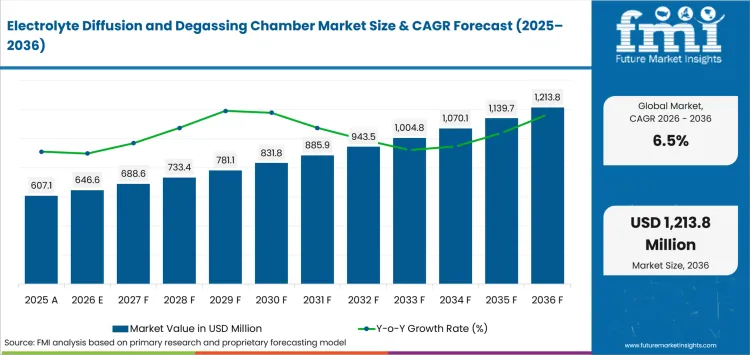
USD 646.6 million in 2026 and USD 1,213.8 million by 2036 at a 6.5% CAGR.
Demand for electrolyte diffusion and degassing chambers is projected to expand at 6.5% CAGR between 2026 and 2036. Market value rises from USD 646.6 million in 2026 to USD 1,213.8 million by 2036. Cell makers buy this equipment as electrolyte filling and formation move into production lines with fixed takt and yield targets. Wuxi Lead Intelligent Equipment signed an April 2025 contract with FAAM for an 8 GWh end-of-line system covering electrolyte filling, formation and final inspection. The contract places filling and finishing equipment inside the same factory release decision.
Country demand depends on whether cell manufacturing is local or limited to vehicle and pack assembly. Mexico illustrates that distinction. In May 2026 the Mexican Presidency confirmed planned battery manufacturing in Puebla and said initial supply would rely partly on imports because a complete domestic production chain was absent. Chamber orders become addressable once localization reaches cell-line equipment rather than pack assembly alone.
Key Takeaways
- New battery-cell investment requires filling and finishing lines to control wetting time and residual gas before final sealing.
- By chamber type, vacuum degassing chambers are estimated to hold 27.0% in 2026 owing to their direct role in gas removal before release.
- In 2026, lithium-ion pouch cells are expected to lead battery type with 34.0% share due to flexible packaging that makes gas control more consequential.
- By process step, electrolyte filling is forecast to represent 26.0% in 2026 driven by pressure-assisted liquid entry into porous electrode structures.
- Pressure recipes must remain stable with the intended cell geometry and dry-room conditions, which can extend equipment qualification.
- Some of the key players in this market include Wuxi Lead Intelligent Equipment, Dürr, and ANDRITZ Sovema.
Analyst Perspective
"Equipment should be evaluated on how quickly a validated pressure recipe transfers into stable production instead of chamber price alone. Commercial value is earned where filling accuracy, wetting time and formation data reduce commissioning work without moving defects downstream."
- Nikhil Kaitwade, Principal Consultant, Future Market Insights
How is the electrolyte diffusion and degassing chamber market segmented?
The electrolyte diffusion and degassing chamber market is segmented by chamber type, battery type, process step, end use, sales channel and region.
Chamber type covers vacuum degassing chambers, electrolyte diffusion chambers, formation process chambers, battery wetting chambers and integrated degas-diffusion units. Battery type includes lithium-ion pouch cells, prismatic cells, cylindrical cells, solid-state pilot cells and sodium-ion cells. Process step covers electrolyte filling, cell wetting, vacuum degassing, formation aging and quality inspection. End use includes EV battery manufacturing, consumer battery plants, energy storage cells and R&D - pilot lines. Sales channels include battery equipment OEMs, turnkey gigafactory integrators, direct cell makers and aftermarket - service.
What makes vacuum degassing chambers central to the chamber type category?
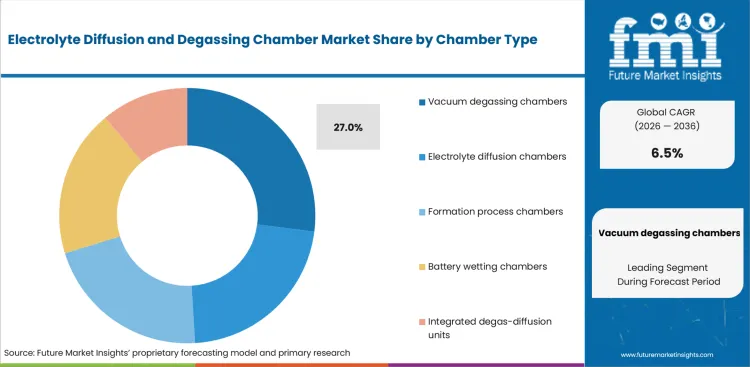
Trapped gas can distort the package or delay final sealing after filling and early formation. Dürr demonstrated single-step electrolyte filling at The Battery Show India in October 2025. The process uses pressure up to 30 bar and removes residual gas before wetting. Dedicated chambers retain a clear role where filling and formation are purchased as separate equipment packages.
- By chamber type, vacuum degassing chambers are estimated to hold 27.0% in 2026 owing to their direct role before final sealing.
- Cell makers evaluate battery manufacturing machines as one system so degassing preserves validated pressure recipes and transfer timing.
Why do lithium-ion pouch cells lead the battery type category?
Pouch cells expose the finishing step to package deformation because an aluminum-laminate enclosure lacks the rigidity of a metal can. Oak Ridge National Laboratory listed pouch-cell capability up to 7 Ah in its December 2025 Battery Manufacturing Facility profile. Process teams can use that pilot capability to test pouch handling and filling changes before high-volume equipment is fixed.
- Lithium-ion pouch cells are set to lead the battery type category with 34.0% share in 2026 attributable to flexible packaging that requires controlled gas removal.
- Production teams qualify lithium-ion batteries with fixtures that hold pouch geometry steady during vacuum and sealing steps under the approved recipe.
How does electrolyte filling anchor the process step category?
Electrolyte filling determines how quickly liquid enters the electrode pore structure before formation starts. At Battery Show Europe in June 2025 Dürr demonstrated X.Cellify PF with direct high-pressure filling that shortens subsequent wetting. Cell makers therefore evaluate dosing accuracy and wetting time as one equipment decision.
- By process step, electrolyte filling is projected to hold 26.0% share in 2026 driven by its direct control over the start of cell wetting.
- Electrolyte viscosity and gas content set the pressure window available to the chamber, so plants select battery electrolytes and filling recipes together.
What supports EV battery manufacturing in the end use category?
EV cell plants make small filling losses expensive because the same delay repeats at high line volume. Panasonic Energy began mass production at its Kansas EV battery factory in July 2025 with planned annual capacity of about 32 GWh. A cell plant at that scale turns electrolyte filling time and downstream wetting control into repeated line-level costs.
- EV battery manufacturing is likely to capture 48.0% share in 2026 supported by high-volume cell programs that make wetting time and yield financially material.
- An electric vehicle battery line usually requires chamber controls to fit automated handling and traceability instead of operating as a stand-alone pressure station.
Why do battery equipment OEMs lead the sales channel category?
Chamber purchases become integration projects once pressure control must exchange recipes and cell identity with adjacent machines. Wuxi Lead Intelligent Equipment presented a full battery-manufacturing portfolio at The Battery Show North America in October 2025. Its exhibit covered cell production through formation and inspection under one automation architecture.
- In 2026, battery equipment OEMs are expected to lead sales channel with 41.0% share owing to their control of interfaces inside wider cell-production lines.
- Integrated sourcing also reduces handoffs between chamber controls and battery cell dry-room systems during commissioning of moisture-sensitive production areas.
What are the drivers, restraints and opportunities in the electrolyte diffusion and degassing chamber market?
New cell capacity raises chamber demand, qualification and staffing slow release into production, and integrated process control can shorten the path from trial to stable output.
- Driver: New and retooled cell lines require controlled electrolyte filling and finishing before mass production can reach target throughput.
- Restraint: Qualification slows adoption if validated pressure recipes require trained process staff and stable interfaces with adjacent equipment.
- Opportunity: Integrated formation and process-data functions can reduce commissioning work by tying chamber results to cell quality records.
New cell capacity requires filling and finishing stations before commercial output can begin. The USA Department of Energy reported in May 2025 that Ultium Cells had used USD 1.8 billion to finance lithium-ion cell facilities in Ohio and Tennessee. Those factory programs place battery testing equipment and chamber systems inside the same capital-equipment release cycle.
Qualification slows if plant teams cannot reproduce pressure recipes under clean-production conditions. Japan established the BATON battery talent network in October 2025 to extend battery manufacturing education from regional technical schools to universities nationwide. Battery testing and certification support becomes more useful once trained staff can reproduce the same test conditions during line approval.
Chamber data earns more commercial value by isolating formation losses instead of recording pressure alone. Wuxi Lead Intelligent Equipment launched a formation and grading system in July 2025 with automated leak detection plus real-time electrolyte exhaust handling. Separator uptake and filling records can then be read beside lithium-ion separators performance to shorten root-cause work during production ramp-up.
Which country CAGRs are profiled in the electrolyte diffusion and degassing chamber market?
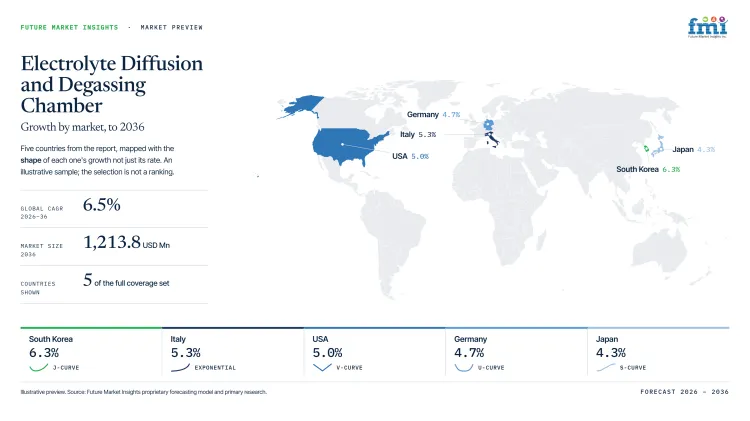
| Country | CAGR |
|---|---|
| South Korea | 6.3% |
| Mexico | 6.0% |
| Brazil | 5.7% |
| Italy | 5.3% |
| USA | 5.0% |
| Germany | 4.7% |
| Japan | 4.3% |
How do country-level CAGRs compare in the electrolyte diffusion and degassing chamber market?
The 2.0-percentage-point spread separates South Korea and Mexico from a slower group where cell manufacturing is newer or concentrated in fewer projects. Brazil and Italy form the middle, USA and Germany follow before Japan at 4.3%. The gap reflects how quickly cell investments become chamber orders instead of current battery revenue alone.
- South Korea converts incumbent cell capacity into repeat equipment orders.
- Mexico has vehicle scale but limited local cell production for chamber demand.
- Brazil is localising cell manufacturing as strategic-mineral projects attract battery investment.
- Italy depends on a small number of gigafactory projects for equipment demand.
- USA demand spans greenfield battery plants and retrofits with different equipment needs.
- Germany is moving pilot recipes into commercial lines that require process validation.
- Japan pairs capacity targets with long qualification cycles before capital equipment orders.
Installed cell capacity and project concentration can produce different order timing despite similar CAGRs. The full report provides country-level CAGR analysis across North America, Latin America, Western Europe, Eastern Europe, East Asia, South Asia and Pacific, and the Middle East and Africa.
Country-wise Analysis
- South Korean cell makers source equipment inside a dense domestic battery cluster with short access to local application engineers. The South Korean electrolyte diffusion and degassing chamber sector is projected to expand at 6.3% CAGR during the assessment period driven by continued equipment localization. MOTIR reported in March 2026 that InterBattery hosted 667 companies and procurement consultations with purchasing managers from Korea's three major battery makers. Slower EV demand can delay new capital releases even with that local supply depth. Chamber companies with Korean recipe support can respond faster to cell-format changes and commissioning problems than teams serving the line remotely.
- With a large vehicle-manufacturing base already in place, Mexico still concentrates battery activity closer to packs than cell production. Electrolyte diffusion and degassing chamber demand in Mexico is forecast to rise at 6.0% CAGR over the forecast period attributable to planned battery localization. The Mexican Presidency confirmed in June 2026 that Olinia battery-pack assembly would be located in Puebla. Imported inputs and incomplete cell supply chains limit near-term chamber orders. Equipment companies have a stronger entry case on projects that specify local electrolyte filling and formation instead of battery electric vehicle programs or pack assembly alone in the first project phase.
- Brazil has automotive and battery energy storage systems demand but domestic cell manufacturing is less developed than downstream assembly. BNDES and Finep stated in January 2025 that their strategic-minerals program would include industrial chains for battery-cell manufacturing. By 2036 Brazil is predicted to grow at 5.7% CAGR supported by policy attention to local battery-cell production. Materials projects do not automatically translate into chamber orders, so equipment companies should separate cell-line investments from pack projects before assigning service capacity. Local commissioning also needs fixtures and process support that can reach new production sites without long import delays during factory ramp-up at scale.
- In Italy, a limited installed gigafactory base concentrates chamber demand in a small number of industrial cell projects. Italy is anticipated to record 5.3% CAGR over the assessment period driven by planned stationary-storage cell capacity. MIMIT confirmed in April 2026 that the Seri Industrial battery gigafactory investment in Brindisi was proceeding on schedule. A delayed gigafactory removes a meaningful share of the equipment pipeline and makes project concentration a material timing risk. Flexible commissioning teams and project-specific spares are more practical than a large fixed service footprint until the country develops a broader cell-production base beyond the Brindisi investment cluster.
- USA chamber purchases are spread among large cell plants and a growing domestic component supply chain. In the USA chamber demand is expected to advance at 5.0% CAGR through 2036 supported by continued manufacturing investment. The Department of Energy selected seven projects in August 2026 to expand critical-material processing plus battery manufacturing and recycling capacity. Policy changes can alter factory release dates, and retrofit work can arrive on a different budget cycle during later plant upgrades. North American service coverage therefore needs to support both greenfield lines and later retrofits without forcing a complete recipe requalification for routine equipment changes.
- Before equipment reaches a German commercial line, recipes are often tested in advanced domestic pilot facilities built for industrial transfer. The Federal Government described Fraunhofer FFB in September 2025 as one of Germany's largest research construction projects and a bridge into industrial manufacturing. Germany is projected to record 4.7% CAGR over the forecast period owing to its engineering base and cell-production research infrastructure. Project financing can still delay factory equipment releases even after technical qualification is complete. Documented recipe transfer gives companies a clearer route into German programs by letting buyers test the handoff before line commissioning under actual production dry-room conditions used by the plant.
- Japanese cell programs put process repeatability ahead of rapid equipment substitution and normally require long qualification cycles. Adoption of electrolyte diffusion and degassing chambers in Japan is forecast to expand at 4.3% CAGR through 2036 reinforced by a large domestic manufacturing objective. METI revised its battery strategy in June 2026 with a target of 150 GWh per year of domestic manufacturing capacity from 2030 into the mid-2030s. Structural oversupply and supply-chain risk temper near-term expansion despite Japan’s long-term manufacturing objectives. Local programs therefore favor chamber equipment that can reproduce validated pressure recipes through format changes without forcing the plant to restart a lengthy qualification sequence.
Who are the notable companies in the electrolyte diffusion and degassing chamber market?
Wuxi Lead Intelligent Equipment, Dürr, and ANDRITZ Sovema are the notable companies profiled in this market.
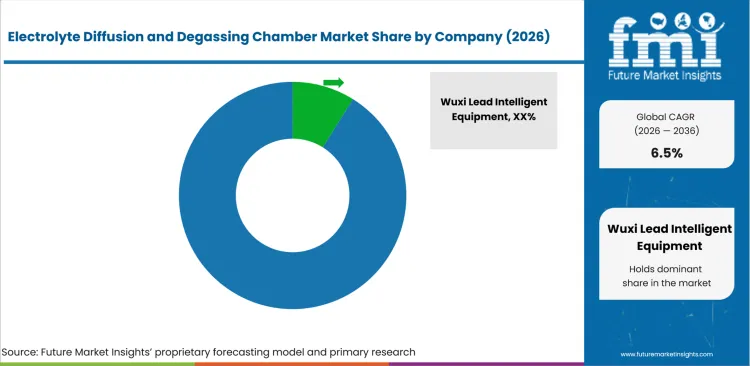
Competition is concentrated among battery-line specialists with direct electrolyte handling or cell-finishing references. Wuxi Lead Intelligent Equipment and Dürr compete in electrolyte filling. ANDRITZ Sovema concentrates on formation chambers and automated finishing. A chamber fault can stop cell release for the wider line, so entry depends on proven process references and local service ownership.
- Electrolyte filling and integrated assembly: Wuxi Lead Intelligent Equipment and Dürr.
- Formation and cell-finishing chambers: ANDRITZ Sovema.
- System-level integration: all three companies publish current evidence of automated battery-production equipment or line integration.
Competitive Benchmarking: Electrolyte Diffusion and Degassing Chamber Market
| Company | Electrolyte Handling Breadth | Cell-Finishing Coverage | Line Integration | Geographic Reach |
|---|---|---|---|---|
| Wuxi Lead Intelligent Equipment | Medium | Medium | High | China, North America and international battery programs |
| Dürr | High | Medium | High | Europe and North America with wider global service reach |
| ANDRITZ Sovema | Low | High | High | Europe with global ANDRITZ engineering and service reach |
Scoring basis: High electrolyte handling requires filling plus a second verified pressure or gas-management function. Medium requires one direct filling or wetting function. Low marks an in-scope company documented only in another finishing step. High cell-finishing coverage requires several verified post-fill functions and Medium identifies one. High line integration requires coordinated multistep automation. Medium covers a narrower integrated module and Low a stand-alone device.
Key Developments in the Electrolyte Diffusion and Degassing Chamber Market
- In March 2026, Wuxi Lead Intelligent Equipment delivered a prismatic energy-storage cell line covering hot-press shaping through electrolyte filling with a designed output of 17 PPM.
- In January 2026, ANDRITZ Sovema technology entered operation in a 1.5-gigawatt formation line with 200 formation chambers for a battery producer in southern Germany.
- In October 2025, Dürr and GROB presented a North American concept factory that included single-step electrolyte filling at pressures up to 30 bar.
Key Players in the Electrolyte Diffusion and Degassing Chamber Market
Electrolyte Filling and Integrated Cell-Production Platforms
- Wuxi Lead Intelligent Equipment
- Dürr
Formation and Cell-Finishing Platforms
- ANDRITZ Sovema
Electrolyte Diffusion and Degassing Chamber Market - Report Scope
| Coverage field | Report scope |
|---|---|
| Market breakdown | By chamber type, battery type, process step, end use, sales channel and region. |
| Quantitative Units | USD million. |
| Market Definition | Commercial revenue from dedicated electrolyte diffusion and degassing chambers plus in-scope filling, wetting and formation-chamber systems whose revenue is attributable to the chamber function. |
| Regions Covered | North America, Latin America, Western Europe, Eastern Europe, East Asia, South Asia and Pacific, and Middle East and Africa. |
| Countries Covered | South Korea, Mexico, Brazil, Italy, USA, Germany, Japan, and 20+ countries included in the full report. |
| Key Companies Profiled | Wuxi Lead Intelligent Equipment, Dürr, ANDRITZ Sovema. |
| Forecast Period | 2026 to 2036. |
| Approach | Primary and secondary research with market triangulation. |
Electrolyte Diffusion and Degassing Chamber Market - Research Methodology
| Method | Approach |
|---|---|
| Primary Research | FMI analysts gathered input from manufacturers, service providers, technology developers, distributors, end users, procurement teams, and subject-matter experts. Interviews examined purchasing decisions, product or service evaluation, adoption barriers, approval requirements, pricing considerations, and expectations for technical or commercial support. Respondents were also asked what evidence is required before a trial, pilot, or initial order develops into regular purchasing. |
| Desk Research | Desk research covered government statistics, regulatory publications, trade data, industry associations, technical literature, standards, company filings, product information, and official corporate announcements. Sources were reviewed for relevance, publication date, geographic coverage, and consistency with the defined market scope. Claims relating to performance, applications, approvals, capacity, investment, and commercial activity were retained only when supported by credible public evidence. |
| Market Sizing and Forecasting | The market model combined the baseline value with historical performance, segment structure, pricing and volume indicators, adoption levels, company participation, and country-level demand conditions. Forecast assumptions considered economic activity, investment trends, regulatory developments, technology adoption, purchasing cycles, supply availability, and barriers to wider market use. Segment and regional estimates were reconciled before the final market total was calculated. |
| Data Validation | Estimates were checked against multiple independent indicators, including public data, company activity, trade patterns, industry developments, and findings from primary interviews. Validation also tested whether products, services, applications, and company revenues fell within the defined market boundaries. Adjacent categories, unsupported claims, overlapping revenues, and activities without direct market relevance were excluded to reduce double counting and maintain consistency across segments and countries. |
Electrolyte Diffusion and Degassing Chamber Market by Segments
Electrolyte Diffusion and Degassing Chamber Market segmented by Chamber Type:
- Vacuum degassing chambers
- Electrolyte diffusion chambers
- Formation process chambers
- Battery wetting chambers
- Integrated degas-diffusion units
Electrolyte Diffusion and Degassing Chamber Market segmented by Battery Type:
- Lithium-ion pouch cells
- Prismatic cells
- Cylindrical cells
- Solid-state pilot cells
- Sodium-ion cells
Electrolyte Diffusion and Degassing Chamber Market segmented by Process Step:
- Electrolyte filling
- Cell wetting
- Vacuum degassing
- Formation aging
- Quality inspection
Electrolyte Diffusion and Degassing Chamber Market segmented by End Use:
- EV battery manufacturing
- Consumer battery plants
- Energy storage cells
- R&D - pilot lines
Electrolyte Diffusion and Degassing Chamber Market segmented by Sales Channel:
- Battery equipment OEMs
- Turnkey gigafactory integrators
- Direct cell makers
- Aftermarket - service
Electrolyte Diffusion and Degassing Chamber Market by Region:
- North America
- United States
- Canada
- Latin America
- Brazil
- Mexico
- Argentina
- Chile
- Western Europe
- Germany
- France
- United Kingdom
- Italy
- Spain
- Benelux
- Nordics
- Eastern Europe
- Poland
- Czech Republic
- Romania
- Hungary
- East Asia
- China
- Japan
- South Korea
- South Asia and Pacific
- India
- ASEAN
- Australia and New Zealand
- Middle East and Africa
- GCC Countries
- South Africa
- Türkiye
- Israel
Research Sources and Bibliography
- Wuxi Lead Intelligent Equipment. (2025, April 28). Lead Intelligent Equipment Signs Major Contract with FAAM to Deliver Advanced End-of-Line Lithium Battery Production Solution for 8 GWh Facility in Italy.
- Presidencia de la República, Mexico. (2026, May 13). Versión estenográfica. Conferencia de prensa de la presidenta Claudia Sheinbaum Pardo del 13 de mayo de 2026.
- Dürr. (2025, October 30). The Battery Show India 2025 | India Expo Centre, Greater Noida.
- Oak Ridge National Laboratory. (2025, December 19). Battery Manufacturing Facility.
- Dürr. (2025, June 23). Bundled power: Dürr at the Battery Show Europe 2025.
- Panasonic Energy Co., Ltd. (2025, July 14). Panasonic Energy Begins Mass Production at New Automotive Lithium-ion Battery Factory in Kansas, Aiming for Annual Capacity of 32 GWh to Accelerate USA Local Production.
- Wuxi Lead Intelligent Equipment. (2025, October 17). LEAD Showcases Full-Value-Chain Smart Manufacturing Solutions at The Battery Show North America 2025.
- USA Department of Energy. (2025, May 13). DOE Receives Early, Voluntary Repayment in Full of Ultium Cells Loan.
- Ministry of Economy, Trade and Industry, Japan. (2025, October 16). 蓄電池の製造能力確保に必要な蓄電池に係る人材の育成・確保のために、バッテリー先進人材普及ネットワーク(BATON)を設立しました.
- Wuxi Lead Intelligent Equipment. (2025, July 11). LEAD Launches Advanced Solution for Battery Formation and Grading, Setting New Standards in Energy Efficiency and Cost Optimization.
- Ministry of Trade, Industry and Resources, Republic of Korea. (2026, March 11). InterBattery 2026 Opens in Seoul, Showcasing the Future of the Global Battery Industry.
- Presidencia de la República, Mexico. (2026, June 9). Versión estenográfica. Conferencia de prensa de la presidenta Claudia Sheinbaum Pardo del 09 de junio de 2026.
- Banco Nacional de Desenvolvimento Econômico e Social. (2025, January 7). Com R$ 5 bi, BNDES e Finep apoiarão projetos para transformação de minerais estratégicos.
- Ministry of Enterprises and Made in Italy. (2026, April 28). Versalis: Urso incontra assessore Di Sciascio (Regione Puglia).
- USA Department of Energy. (2026, August 20). Energy Department Announces $500 Million To Secure America's Critical Mineral and Battery Supply Chains.
- Press and Information Office of the Federal Government, Germany. (2025, September 1). Schnittstelle zwischen Forschung und Umsetzung.
- Ministry of Economy, Trade and Industry, Japan. (2026, June 2). “Battery Industry Strategy” Revised as the “Battery and Power Industry Strategy”.
- Wuxi Lead Intelligent Equipment. (2026, March 27). LEAD Delivers High-Compatibility Prismatic Large-Scale Energy Storage Benchmark Production Line to a Leading Global Customer.
- ANDRITZ. (2026, January 14). Battery cell mass formation line for electric cars supplied by ANDRITZ goes into operation.
- Dürr. (2025, October 7). More innovation with 70 percent less energy consumption.
- Dürr. (2025, March 20). Production technology for battery cells: Dürr and GROB deepen strategic partnership.
- ANDRITZ. (n.d.). Funded Projects and Associations.
- Wuxi Lead Intelligent Equipment. (2025, January 9). LEAD Collaborates with a Renowned European Automotive Brand to Create an Ultra-Efficient and Streamlined Formation and Capacity Grading Solution.
- Wuxi Lead Intelligent Equipment. (2025, May 7). LEAD Introduces Integrated Production Solution for 46-Series Large Cylindrical Batteries, Enhancing Efficiency and Manufacturing Standards.
- Dürr. (2025, October 6). X.Cellify DC enables dry coating with free-standing film.
- Dürr. (2026, February 19). From automotive production to battery cells.
- Wuxi Lead Intelligent Equipment. (2025, June 19). LEAD Strengthens Global Position by Delivering Core Equipment for Next-Gen Solid-State Battery Manufacturing.
This bibliography is provided for reader reference and is not exhaustive. The full report contains the complete reference list and detailed citations.
This Report Answers
- How large is the electrolyte diffusion and degassing chamber market in 2026 and 2036?
- Why does electrolyte filling sustain chamber demand inside battery cell production?
- Why do vacuum degassing chambers account for 27.0% of chamber type demand in 2026?
- How does lithium-ion pouch packaging change degassing and sealing requirements?
- Why does electrolyte filling account for 26.0% of process step demand in 2026?
- How do country growth rates differ among the seven profiled countries?
- Which companies provide direct electrolyte handling or formation-chamber capability?
- What qualification conditions can slow chamber adoption on new and retooled cell lines?
- What should a cell manufacturer test before moving a chamber recipe from pilot work into mass production?
Frequently Asked Questions
How big is the Electrolyte Diffusion and Degassing Chamber Market in 2026?
The electrolyte diffusion and degassing chamber market is valued at USD 646.6 million in 2026 and is projected to reach USD 1,213.8 million by 2036. Growth is tied to controlled filling and gas removal on new and retooled cell lines.
What is the CAGR of the Electrolyte Diffusion and Degassing Chamber Market from 2026 to 2036?
The electrolyte diffusion and degassing chamber market is projected to grow at a CAGR of 6.5% between 2026 and 2036. Expansion is supported by battery-cell capacity additions plus tighter control of filling and finishing operations.
Which chamber type leads the Electrolyte Diffusion and Degassing Chamber Market?
The vacuum degassing chambers segment is expected to hold 27.0% of the electrolyte diffusion and degassing chamber market in 2026, attributable to residual-gas removal before final cell sealing. The function stays relevant even with separately sourced filling equipment.
Which battery type holds the largest current share in the Electrolyte Diffusion and Degassing Chamber Market?
The lithium-ion pouch cells segment is projected to hold 34.0% share in 2026 driven by flexible packaging that makes swelling and gas control more consequential. Chamber fixtures must also protect package geometry during pressure changes and resealing.
Which companies are active in the Electrolyte Diffusion and Degassing Chamber Market?
Key companies operating in the market include Wuxi Lead Intelligent Equipment, Dürr and ANDRITZ Sovema. Their verified roles cover electrolyte filling, integrated cell-production equipment and formation-chamber systems.
Preview the report firsthand - request a free sample
Get SampleGet the brochure for pricing and purchase details.
Get PDFTable of Content
- Key Takeaways
- Market Size and CAGR
- Top Growth Driver
- Fastest Growing Segment
- Leading Region
- Key Companies
- Emerging Opportunities
- Executive Summary
- Global Market Outlook
- Demand-side Trends
- Supply-side Trends
- Technology Roadmap Analysis
- Analysis and Recommendations
- Analyst Perspective (What is happening? Why now? What should investors know?)
- Key Questions Answered
- How large is the market?
- What is the CAGR?
- What are key trends?
- Which region dominates?
- Who are the leaders?
- Market Overview
- Market Coverage / Taxonomy
- Market Definition / Scope / Limitations
- Research Methodology
- Chapter Orientation
- Analytical Lens and Working Hypotheses
- Market Structure, Signals, and Trend Drivers
- Benchmarking and Cross-market Comparability
- Market Sizing, Forecasting, and Opportunity Mapping
- Research Design and Evidence Framework
- Desk Research Programme (Secondary Evidence)
- Expert Input and Fieldwork (Primary Evidence)
- Tooling, Models, and Reference Databases
- Data Engineering and Model Build
- Quality Assurance and Audit Trail
- Market Background
- Market Dynamics (Drivers, Restraints, Opportunity, Trends)
- Scenario Forecast (Optimistic, Likely, Conservative)
- Impact Analysis
- AI Impact
- Sustainability Impact
- Regulatory Impact
- Technology Impact
- Consumer / Buyer Analysis
- Purchase Drivers
- Adoption Barriers
- Buyer Journey
- Opportunity Map Analysis
- Product Life Cycle Analysis
- Supply Chain Analysis
- Investment Feasibility Matrix
- Value Chain Analysis
- PESTLE and Porter's Analysis
- Regulatory Landscape
- Regional Parent Market Outlook
- Production and Consumption Statistics
- Import and Export Statistics
- Global Market Analysis and Forecast, 2021 to 2036
- Historical Market Size Value (USD Million) Analysis, 2021 to 2025
- Current and Future Market Size Value (USD Million) Projections, 2026 to 2036
- Y-o-Y Growth Trend Analysis
- Absolute $ Opportunity Analysis
- Global Market Pricing Analysis, 2021 to 2036
- Global Market Analysis and Forecast, By Chamber Type, 2021 to 2036
- Introduction / Key Findings
- Historical Market Size Value (USD Million) Analysis By Chamber Type, 2021 to 2025
- Current and Future Market Size Value (USD Million) Analysis and Forecast By Chamber Type, 2026 to 2036
- Vacuum degassing chambers
- Electrolyte diffusion chambers
- Formation process chambers
- Battery wetting chambers
- Integrated degas-diffusion units
- Vacuum degassing chambers
- Y-o-Y Growth Trend Analysis By Chamber Type, 2021 to 2025
- Absolute $ Opportunity Analysis By Chamber Type, 2026 to 2036
- Global Market Analysis and Forecast, By Battery Type, 2021 to 2036
- Introduction / Key Findings
- Historical Market Size Value (USD Million) Analysis By Battery Type, 2021 to 2025
- Current and Future Market Size Value (USD Million) Analysis and Forecast By Battery Type, 2026 to 2036
- Lithium-ion pouch cells
- Prismatic cells
- Cylindrical cells
- Solid-state pilot cells
- Sodium-ion cells
- Lithium-ion pouch cells
- Y-o-Y Growth Trend Analysis By Battery Type, 2021 to 2025
- Absolute $ Opportunity Analysis By Battery Type, 2026 to 2036
- Global Market Analysis and Forecast, By Process Step, 2021 to 2036
- Introduction / Key Findings
- Historical Market Size Value (USD Million) Analysis By Process Step, 2021 to 2025
- Current and Future Market Size Value (USD Million) Analysis and Forecast By Process Step, 2026 to 2036
- Electrolyte filling
- Cell wetting
- Vacuum degassing
- Formation aging
- Quality inspection
- Electrolyte filling
- Y-o-Y Growth Trend Analysis By Process Step, 2021 to 2025
- Absolute $ Opportunity Analysis By Process Step, 2026 to 2036
- Global Market Analysis and Forecast, By End Use, 2021 to 2036
- Introduction / Key Findings
- Historical Market Size Value (USD Million) Analysis By End Use, 2021 to 2025
- Current and Future Market Size Value (USD Million) Analysis and Forecast By End Use, 2026 to 2036
- EV battery manufacturing
- Consumer battery plants
- Energy storage cells
- R&D/pilot lines
- EV battery manufacturing
- Y-o-Y Growth Trend Analysis By End Use, 2021 to 2025
- Absolute $ Opportunity Analysis By End Use, 2026 to 2036
- Global Market Analysis and Forecast, By Sales Channel, 2021 to 2036
- Introduction / Key Findings
- Historical Market Size Value (USD Million) Analysis By Sales Channel, 2021 to 2025
- Current and Future Market Size Value (USD Million) Analysis and Forecast By Sales Channel, 2026 to 2036
- Battery equipment OEMs
- Turnkey gigafactory integrators
- Direct cell makers
- Aftermarket/service
- Battery equipment OEMs
- Y-o-Y Growth Trend Analysis By Sales Channel, 2021 to 2025
- Absolute $ Opportunity Analysis By Sales Channel, 2026 to 2036
- Global Market Analysis and Forecast, By Region, 2021 to 2036
- Introduction
- Historical Market Size Value (USD Million) Analysis By Region, 2021 to 2025
- Current Market Size Value (USD Million) Analysis and Forecast By Region, 2026 to 2036
- North America
- Latin America
- Western Europe
- Eastern Europe
- East Asia
- South Asia and Pacific
- Middle East & Africa
- Market Attractiveness Analysis By Region
- North America Market Analysis and Forecast, By Country, 2021 to 2036
- Historical Market Size Value (USD Million) Trend Analysis By Market Taxonomy, 2021 to 2025
- Market Size Value (USD Million) Forecast By Market Taxonomy, 2026 to 2036
- By Country
- USA
- Canada
- By Chamber Type
- By Battery Type
- By Process Step
- By End Use
- By Sales Channel
- By Country
- Market Attractiveness Analysis
- By Country
- By Chamber Type
- By Battery Type
- By Process Step
- By End Use
- By Sales Channel
- Key Takeaways
- Latin America Market Analysis and Forecast, By Country
- Historical Market Size Value (USD Million) Trend Analysis By Market Taxonomy, 2021 to 2025
- Market Size Value (USD Million) Forecast By Market Taxonomy, 2026 to 2036
- By Country
- Brazil
- Mexico
- Chile
- Rest of Latin America
- By Chamber Type
- By Battery Type
- By Process Step
- By End Use
- By Sales Channel
- By Country
- Market Attractiveness Analysis
- By Country
- By Chamber Type
- By Battery Type
- By Process Step
- By End Use
- By Sales Channel
- Key Takeaways
- Western Europe Market Analysis and Forecast, By Country
- Historical Market Size Value (USD Million) Trend Analysis By Market Taxonomy, 2021 to 2025
- Market Size Value (USD Million) Forecast By Market Taxonomy, 2026 to 2036
- By Country
- Germany
- UK
- Italy
- Spain
- France
- Nordic
- BENELUX
- Rest of Western Europe
- By Chamber Type
- By Battery Type
- By Process Step
- By End Use
- By Sales Channel
- By Country
- Market Attractiveness Analysis
- By Country
- By Chamber Type
- By Battery Type
- By Process Step
- By End Use
- By Sales Channel
- Key Takeaways
- Eastern Europe Market Analysis and Forecast, By Country
- Historical Market Size Value (USD Million) Trend Analysis By Market Taxonomy, 2021 to 2025
- Market Size Value (USD Million) Forecast By Market Taxonomy, 2026 to 2036
- By Country
- Russia
- Poland
- Hungary
- Balkan & Baltic
- Rest of Eastern Europe
- By Chamber Type
- By Battery Type
- By Process Step
- By End Use
- By Sales Channel
- By Country
- Market Attractiveness Analysis
- By Country
- By Chamber Type
- By Battery Type
- By Process Step
- By End Use
- By Sales Channel
- Key Takeaways
- East Asia Market Analysis and Forecast, By Country
- Historical Market Size Value (USD Million) Trend Analysis By Market Taxonomy, 2021 to 2025
- Market Size Value (USD Million) Forecast By Market Taxonomy, 2026 to 2036
- By Country
- China
- Japan
- South Korea
- By Chamber Type
- By Battery Type
- By Process Step
- By End Use
- By Sales Channel
- By Country
- Market Attractiveness Analysis
- By Country
- By Chamber Type
- By Battery Type
- By Process Step
- By End Use
- By Sales Channel
- Key Takeaways
- South Asia and Pacific Market Analysis and Forecast, By Country
- Historical Market Size Value (USD Million) Trend Analysis By Market Taxonomy, 2021 to 2025
- Market Size Value (USD Million) Forecast By Market Taxonomy, 2026 to 2036
- By Country
- India
- ASEAN
- Australia & New Zealand
- Rest of South Asia and Pacific
- By Chamber Type
- By Battery Type
- By Process Step
- By End Use
- By Sales Channel
- By Country
- Market Attractiveness Analysis
- By Country
- By Chamber Type
- By Battery Type
- By Process Step
- By End Use
- By Sales Channel
- Key Takeaways
- Middle East & Africa Market Analysis and Forecast, By Country
- Historical Market Size Value (USD Million) Trend Analysis By Market Taxonomy, 2021 to 2025
- Market Size Value (USD Million) Forecast By Market Taxonomy, 2026 to 2036
- By Country
- Kingdom of Saudi Arabia
- Other GCC Countries
- Türkiye
- South Africa
- Other African Union
- Rest of Middle East & Africa
- By Chamber Type
- By Battery Type
- By Process Step
- By End Use
- By Sales Channel
- By Country
- Market Attractiveness Analysis
- By Country
- By Chamber Type
- By Battery Type
- By Process Step
- By End Use
- By Sales Channel
- Key Takeaways
- Key Countries Market Analysis
- USA
- Pricing Analysis
- Market Share Analysis, 2025
- By Chamber Type
- By Battery Type
- By Process Step
- By End Use
- By Sales Channel
- Canada
- Pricing Analysis
- Market Share Analysis, 2025
- By Chamber Type
- By Battery Type
- By Process Step
- By End Use
- By Sales Channel
- Mexico
- Pricing Analysis
- Market Share Analysis, 2025
- By Chamber Type
- By Battery Type
- By Process Step
- By End Use
- By Sales Channel
- Brazil
- Pricing Analysis
- Market Share Analysis, 2025
- By Chamber Type
- By Battery Type
- By Process Step
- By End Use
- By Sales Channel
- Chile
- Pricing Analysis
- Market Share Analysis, 2025
- By Chamber Type
- By Battery Type
- By Process Step
- By End Use
- By Sales Channel
- Germany
- Pricing Analysis
- Market Share Analysis, 2025
- By Chamber Type
- By Battery Type
- By Process Step
- By End Use
- By Sales Channel
- UK
- Pricing Analysis
- Market Share Analysis, 2025
- By Chamber Type
- By Battery Type
- By Process Step
- By End Use
- By Sales Channel
- Italy
- Pricing Analysis
- Market Share Analysis, 2025
- By Chamber Type
- By Battery Type
- By Process Step
- By End Use
- By Sales Channel
- Spain
- Pricing Analysis
- Market Share Analysis, 2025
- By Chamber Type
- By Battery Type
- By Process Step
- By End Use
- By Sales Channel
- France
- Pricing Analysis
- Market Share Analysis, 2025
- By Chamber Type
- By Battery Type
- By Process Step
- By End Use
- By Sales Channel
- India
- Pricing Analysis
- Market Share Analysis, 2025
- By Chamber Type
- By Battery Type
- By Process Step
- By End Use
- By Sales Channel
- ASEAN
- Pricing Analysis
- Market Share Analysis, 2025
- By Chamber Type
- By Battery Type
- By Process Step
- By End Use
- By Sales Channel
- Australia & New Zealand
- Pricing Analysis
- Market Share Analysis, 2025
- By Chamber Type
- By Battery Type
- By Process Step
- By End Use
- By Sales Channel
- China
- Pricing Analysis
- Market Share Analysis, 2025
- By Chamber Type
- By Battery Type
- By Process Step
- By End Use
- By Sales Channel
- Japan
- Pricing Analysis
- Market Share Analysis, 2025
- By Chamber Type
- By Battery Type
- By Process Step
- By End Use
- By Sales Channel
- South Korea
- Pricing Analysis
- Market Share Analysis, 2025
- By Chamber Type
- By Battery Type
- By Process Step
- By End Use
- By Sales Channel
- Russia
- Pricing Analysis
- Market Share Analysis, 2025
- By Chamber Type
- By Battery Type
- By Process Step
- By End Use
- By Sales Channel
- Poland
- Pricing Analysis
- Market Share Analysis, 2025
- By Chamber Type
- By Battery Type
- By Process Step
- By End Use
- By Sales Channel
- Hungary
- Pricing Analysis
- Market Share Analysis, 2025
- By Chamber Type
- By Battery Type
- By Process Step
- By End Use
- By Sales Channel
- Kingdom of Saudi Arabia
- Pricing Analysis
- Market Share Analysis, 2025
- By Chamber Type
- By Battery Type
- By Process Step
- By End Use
- By Sales Channel
- Türkiye
- Pricing Analysis
- Market Share Analysis, 2025
- By Chamber Type
- By Battery Type
- By Process Step
- By End Use
- By Sales Channel
- South Africa
- Pricing Analysis
- Market Share Analysis, 2025
- By Chamber Type
- By Battery Type
- By Process Step
- By End Use
- By Sales Channel
- USA
- Market Structure Analysis
- Competition Dashboard
- Competition Benchmarking
- Market Share Analysis of Top Players
- By Regional
- By Chamber Type
- By Battery Type
- By Process Step
- By End Use
- By Sales Channel
- Emerging Startups
- Innovation Benchmarking
- Competition Analysis
- Competition Deep Dive
- Wuxi Lead Intelligent Equipment
- Overview
- Product Portfolio
- Profitability by Market Segments
- Sales Footprint
- Strategy Overview
- Marketing Strategy
- Product Strategy
- Channel Strategy
- Manz AG
- Dürr
- Koem
- PNT
- Toray Engineering
- CKD Corporation
- Hirano Tecseed
- Hitachi High-Tech
- Sovema Group
- Wuxi Lead Intelligent Equipment
- Case Studies
- Success Stories
- Recent Developments
- Competition Deep Dive
- Assumptions & Acronyms Used


