

- Market Size (2026)
- USD 6.9 Bn
- Forecast (2036)
- USD 16.6 Bn
- CAGR (2026 to 2036)
- 9.2%
How big is Electron Beam Evaporation Systems Market in 2026?
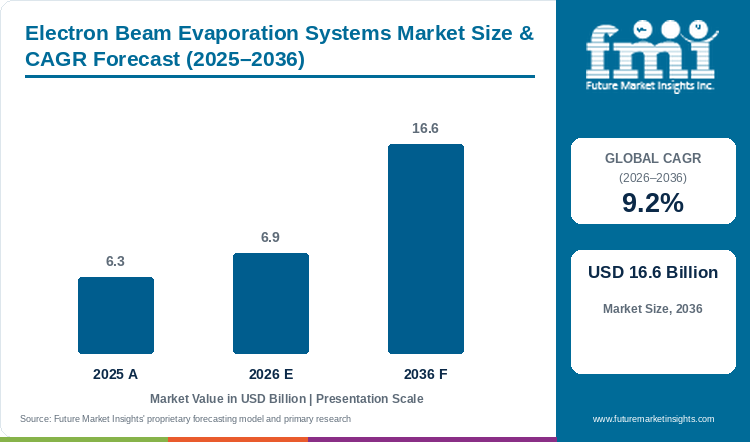
Demand for electron beam evaporation systems is projected to expand at 9.2% CAGR between 2026 and 2036. Industry value grows from USD 6.3 billion in 2025 to USD 6.9 billion in 2026 and is projected to reach USD 16.6 billion by 2036.
Electron beam evaporation systems market is valued at USD 6.3 billion in 2025 and is set to reach USD 6.9 billion in 2026. As per FMI, sales are projected at USD 16.6 billion by 2036, expanding at 9.2% CAGR from 2026 to 2036. Multi-pocket systems carries 40.2% of system configuration revenue in 2026, as one source can deposit several materials without opening the chamber, expanding adoption across high-precision thin film coatings. ULVAC offers a 5 kW laboratory source with 2.6 cc crucible capacity.[1] Temescal UEFC-5700 holds 42 wafers of 150 mm or 21 wafers of 200 mm.[2] HHV sources ranges from 3 kW to over 20 kW and accommodates four to eight crucibles.[3] While individual equipment specifications illustrate laboratory and batch capabilities, broader global market revenue is driven by commercial fab multi-pocket tool procurements across power electronics and compound semiconductor manufacturing.
Key Market Trends & Insights
- By system configuration, multi-pocket systems led with 40.2% share in 2026, owing to sequential deposition of several materials without chamber venting.
- By automation level, fully automated production systems accounted for 41.1% in 2026, supported by stored recipes and production data logging.
- By deposition application, semiconductor metallization represented 38.6% in 2026, attributed to high-purity electrodes and contact layers used in device fabrication.
- By end use industry, semiconductor and electronics held 40.2% share in 2026, driven by controlled metal films and multilayer device structures.
Regional Highlights
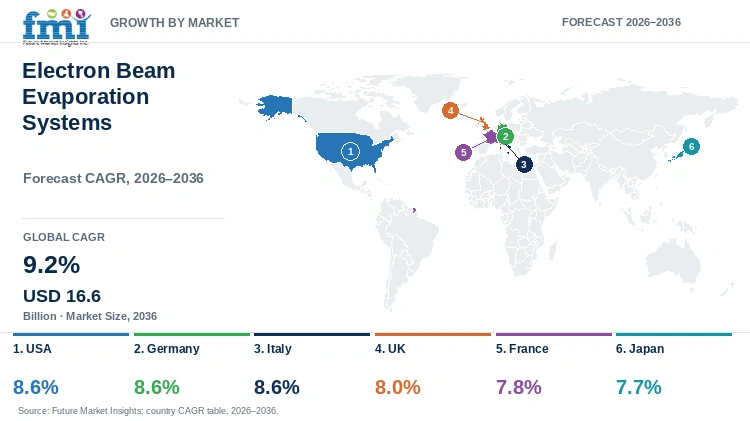
- Fastest-growing profiled countries: USA, Germany and Italy, each at 8.6% CAGR from 2026 to 2036.
- By country: UK and France are projected at 8.0% and 7.8%, respectively, while Japan records the lowest profiled CAGR at 7.7%.
Market Size & Forecast
Table 1: Market Size and Forecast for the Electron Beam Evaporation Systems Market (USD billion and percentage), 2025 to 2036
| Metric | Value |
|---|---|
| 2025 Market Size | USD 6.3 billion |
| Estimated Market Size in 2026 | USD 6.9 billion |
| Projected Market Size by 2036 | USD 16.6 billion |
| CAGR, 2026 to 2036 | 9.2% |
| Added Revenue, 2026 to 2036 | USD 9.7 billion |
| Market Expansion Multiple | 2.4x |
Production demand for electron beam evaporation systems depends on coating material, wafer size and output required from every vacuum cycle, where chambers operate with high-throughput dry vacuum pumps to maintain baseline vacuum levels. Temescal systems covers university research and pilot production along with 150 mm and 200 mm high-throughput wafer coating. UEFC-5700 uses two six-pocket 25 cc sources and power supplies of 6 kW, 12 kW or 15 kW. Material collected around the source may create pocket jams during indexing, which can contaminate a film or damage the source. Film stress and chemical incompatibility also affects adhesion when the surrounding process is not controlled. Buyers are therefore expected to select a system on the basis of material capacity, film control and technical service available for repeated production.
Production Scale and Process Readiness Indicators
Laboratory and production users does not require the same electron beam evaporation system. Laboratory systems uses smaller crucibles and lower source power for material trials, whereas production systems requires faster pump-down and higher wafer handling. Pocket indexing, vacuum throughput and film-assistance controls also changes according to the coating program. The indicators below connects these equipment values with their practical use in research, pilot and production facilities.
Table 2: Production Scale and Process Readiness Indicators for the Electron Beam Evaporation Systems Market (kW, crucibles, wafers, minutes, and vacuum throughput), mixed reporting years from 2025 to 2026
| Indicator | Data Point | Why It Matters | Source |
|---|---|---|---|
| Laboratory source capacity | 5 kW; 2.6 cc crucible | Supports experiments and small-scale metal film production. | [1] |
| Multi-material source range | 4 to 8 crucibles; 3 kW to over 20 kW | Shows the source range available for multilayer optical and production tools. | [3] |
| UEFC-5700 wafer handling | 42 x 150 mm; 21 x 200 mm | Connects one coating cycle with high-volume wafer output. | [2] |
| UEFC-5700 pump-down | Below 10 minutes to 1E-06 | Shorter vacuum preparation supports repeated production cycles. | [2] |
| UEFC-5700 cryopump throughput | 44,000 litres per second for water | Supports rapid removal of water load in a production chamber. | [2] |
| Pocket management | Torque-sensing pocket-jam detection | Reduces contamination and source damage during material indexing. | [4] |
| Film adhesion controls | Heating, ion assistance or plasma assistance | Adds energy at the substrate to reduce tensile stress. | [5] |
Analyst Perspective
“I expect automated multi-pocket systems to gain orders as semiconductor manufacturers add more contact layers in every device. Film stability and faster technical service will decide which research platforms moves into repeated production.”
- Nikhil Kaitwade, Principal Consultant, Future Market Insights.
How is the electron beam evaporation systems market segmented?
Electron beam evaporation systems market is segmented by four primary commercial axes and region: system configuration, automation level, deposition application, end use industry, and region. In 2026, multi-pocket systems are projected at 40.2%, fully automated production systems at 41.1%, semiconductor metallization at 38.6%, and semiconductor and electronics at 40.2%.
By system configuration: multi-pocket systems, single-pocket systems, multi-source and co-deposition systems.
By automation level: fully automated production systems, semi-automated systems, manual and research systems.
By deposition application: semiconductor metallization, optical coatings, compound semiconductor devices, research thin films.
By end use industry: semiconductor and electronics, optics and photonics, academic and research institutes, solar and energy devices, medical and specialty coatings.
By region: North America, Latin America, Western Europe, Eastern Europe, East Asia, South Asia and Pacific, and Middle East and Africa.
Why do multi-pocket systems retain a notable configuration share?
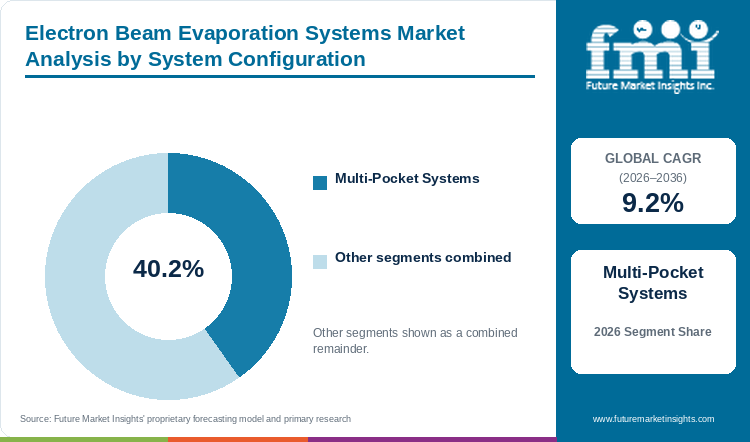
Based on system configuration, multi-pocket systems is projected to account for 40.2% in 2026, driven by sequential deposition of several materials without breaking vacuum.
Table 3: System Configuration Share for the Electron Beam Evaporation Systems Market (percentage share), 2026
| System Configuration | Share (2026) |
|---|---|
| Multi-Pocket Systems | 40.2% |
| Other Segments Combined | 59.8%* |
| Total | 100.0% |
*Calculated as the balance remaining after deducting the leading segment's reported share from 100.0%.
Table 4: System Configuration Leadership and Market Growth for the Electron Beam Evaporation Systems Market (segment and CAGR percentage), 2026 to 2036
| Metric | Value |
|---|---|
| Global CAGR (2026 to 2036) | 9.2% |
| Leading Segment | Multi-Pocket Systems |
Multi-pocket systems are increasingly preferred where more than one metal or dielectric layer is required in the same coating cycle. Pocket indexing changes the material position without venting the chamber, due to which the vacuum condition remains available for the next layer. Angstrom Engineering states that motorized indexing lets one source deposit several materials from one position.[4] This arrangement reduces process interruption and creates wider use of multi-pocket systems in semiconductor contacts, optical stacks and specialized optical materials.
- Multi-pocket systems account for 40.2% of system configuration revenue in 2026, reinforced by sequential deposition of several materials without breaking vacuum.
- Angstrom Engineering states that motorized pocket indexing lets one source deposit several materials from one position without venting the chamber.
What supports fully automated systems as the preferred automation choice?
By automation level, fully automated production systems is estimated to hold 41.1% in 2026, supported by recipe control, data logging, and repeatable pump-to-vent cycles.
Automated production systems controls pumping, source conditioning, deposition and venting through stored recipes. Production facilities requires similar film thickness in every batch, due to which automated tools operate alongside specialized semiconductor manufacturing equipment across front-end fabrication lines.
- Fully automated production systems account for 41.1% of automation level revenue in 2026, linked to recipe control, data logging, and repeatable pump-to-vent cycles.
- Temescal control systems integrate vacuum control, recipe processing, data logging, and automated regeneration cycles for production coaters.
How is semiconductor metallization gaining use in deposition applications?
In 2026, semiconductor metallization is expected to lead deposition application with 38.6% share, owing to high-purity contact layers for compound semiconductors and power devices.
Semiconductor metallization requires thin metal contacts having controlled thickness and lower contamination. Electron beam evaporation provides higher source temperature than resistance heating and can process refractory metals used in compound semiconductor materials and power devices. Ferrotec lists Ti, Pt, Au, Pd, Ag, Ni, Al, Cr, Cu, Mo and Sn among materials deposited through its systems.[6]
- Semiconductor metallization accounts for 38.6% of deposition application revenue in 2026, reflecting high-purity contact layers for compound semiconductors and power devices.
- Wider availability of contact materials along with high-purity deposition is expected to support semiconductor metallization segment growth.
Why does semiconductor and electronics anchor end-use demand?
The end use industry category is forecast to be led by semiconductor and electronics at 40.2% share in 2026, enabled by repeatable metal contacts and multilayer coatings used in device fabrication.
Semiconductor and electronics manufacturers uses electron beam evaporation for electrodes, contact layers and multilayer device structures. These applications requires material purity and controlled thickness because one unsuitable layer can affect the device performance.
- Semiconductor and electronics account for 40.2% of end use industry revenue in 2026, underpinned by repeatable metal contacts and multilayer coatings used in device fabrication.
- Expansion of power electronics and compound semiconductor production is likely to propel this end use segment over the forecast period.
What are the drivers, restraints, and opportunities in the electron beam evaporation systems market?
In the electron beam evaporation systems market, high-purity refractory deposition is the key driver, process instability is the restraint, and automated multilayer production is the opportunity.
- Driver: Electron beam sources deposit high-melting-point metals and ceramics while limiting contamination from surrounding heater components.
- Restraint: Film stress, substrate contamination, source spitting, and pocket-management faults can reduce yield and increase maintenance.
- Opportunity: Automated multi-pocket tools can combine recipe control, load locks, ion assistance, and data logging for repeatable production.
High-temperature Materials Expand Use
High-melting-point metals and ceramics cannot be easily deposited through conventional resistance heating. Electron beam sources concentrates heat on the coating material and allows refractory contacts, oxides and optical layers to be deposited under vacuum for next-generation SiC and GaN power semiconductors. HHV states that these sources processes materials above 1,800 degree Celsius and are used in optical and ophthalmic coating tools. Wider material handling is considered to be one of the primary factors driving electron beam evaporation systems market.
Film Stability Constrains Yield
Film stress, contamination and chemical incompatibility are some of the primary challenges associated with electron beam evaporation. These process conditions may reduce adhesion and can result in damaged substrates or rejected coating batches. Angstrom Engineering states that substrate heating, ion assistance and plasma assistance can densify films and reduce tensile stress.[5] However, the additional controls raises system setting and qualification requirement before production starts. Longer process development and maintenance may hamper adoption, requiring inline semiconductor metrology to detect defects before full-scale manufacturing.
Automation Broadens Production Routes
Automated multilayer coating is creating growth opportunities for complete electron beam evaporation systems. FMI data suggests that production buyers are moving beyond the source gun and selecting recipe control, load locks and deposition records with the chamber. ULVAC Ei-5 combines automated vacuum and deposition control with electron beam or mixed-source layouts.[7] Similar controls allows research laboratories to move a coating process towards pilot and low-volume production, including specialized multilayer fabrication for solid-state thin film battery cells.
Which country CAGRs are profiled in the electron beam evaporation systems market?
Table 5: Country CAGR Comparison for the Electron Beam Evaporation Systems Market (CAGR percentage), 2026 to 2036
| Country | CAGR |
|---|---|
| USA | 8.6% |
| Germany | 8.6% |
| Italy | 8.6% |
| UK | 8.0% |
| France | 7.8% |
| Japan | 7.7% |
How do country-level CAGRs compare in the electron beam evaporation systems market?
Commercial conditions differ across the profiled countries owing to semiconductor capacity, photonics research and availability of trained thin-film operators. As per the analysis from FMI, the USA, Germany and Italy are each projected at 8.6% CAGR through 2036. The USA has a wider semiconductor sales base, Germany is supported by automotive and power devices, whereas Italy is adding advanced packaging activity.
The UK is expected to grow at 8.0% CAGR as compound semiconductor and university programs moves closer to pilot production. France follows at 7.8% through industrial research funding, while Japan records 7.7% as established manufacturers replace sources and production controls. These country differences are expected to keep equipment requirement divided between new production coaters, flexible research tools and replacement modules.
- A broad semiconductor sales base and federal manufacturing programs support both production and research equipment purchases.
- Automotive, power semiconductor, and industrial electronics clusters create demand for production-grade thin-film tools.
- Microelectronics programs and industrial packaging investment widen the domestic equipment and process-development base.
- Compound semiconductor, photonics, and university R&D programs support flexible research and pilot systems.
- France 2030 funding connects semiconductor research with industrialization and new European technology programs.
- Device makers and vacuum-equipment suppliers sustain demand for high-purity deposition and production automation.
Full report country CAGRs cover: North America; Latin America; Western Europe; Eastern Europe; East Asia; South Asia and Pacific; Middle East and Africa.
Country-wise Analysis
- Electron beam evaporation systems demand in the USA is forecast to rise at 8.6% CAGR over the forecast period. The 2025 Semiconductor Industry Association factbook states that US-headquartered companies accounts for nearly half of global semiconductor sales.[8] Semiconductor fabs, compound-semiconductor plants and university cleanrooms uses thin-film systems for metal contacts and optical layers. Domestic chip investment along with replacement of older vacuum equipment is anticipated to support the USA market growth.
- Germany is estimated to post 8.6% CAGR over the forecast period, owing to automotive and power semiconductor production. Germany Trade & Invest reported more than USD 17 billion semiconductor revenue during 2025 and over one-third of European chip production.[9] Contact metallization and specialty coatings requires electron beam systems where refractory material is being deposited. Presence of industrial manufacturers and applied research institutes is expected to support Germany market revenue growth.
- By 2036, Italy is projected to grow at 8.6% CAGR, supported by advanced packaging and microelectronics investment. In March 2026, the Ministry of Enterprises and Made in Italy signed an agreement for a semiconductor packaging and testing site in Novara.[10] The planned 3.2 billion project focuses on chiplet integration, packaging and testing. These stages requires thin metal contacts and controlled coating equipment, which is expected to propel electron beam evaporation systems demand in Italy.
- Adoption of electron beam evaporation systems in the UK is estimated to expand at 8.0% CAGR through 2036. In September 2025, the UK government announced a 10 million semiconductor fund expected to support up to 40 British businesses.[11] The funding moves chip technology from laboratory development towards commercial use. Compound-semiconductor, photonic integrated circuits and university facilities requires flexible systems for metal and dielectric films, which is likely to support the UK market growth.
- The French electron beam evaporation systems sector is projected to record 7.8% CAGR during the assessment period. In May 2026, the Government of France announced a 550 million call for advanced semiconductor technology and industrial projects through 2035.[12] Semiconductor, photonics and aerospace electronics facilities requires deposition tools for material evaluation and pilot production. Public funding and industrial research activity is expected to create growth opportunities for system suppliers in France.
- Sales of electron beam evaporation systems in Japan are forecast to expand at 7.7% CAGR through 2036. In March 2026, JETRO and RISE-A signed a cooperation memorandum for semiconductor and microelectronics collaboration.[13] JETRO operates more than 70 overseas offices and around 50 domestic offices which supports company and research links. Established vacuum-equipment suppliers along with demand for electrode and optical films is anticipated to support Japan market growth.
Who are the notable companies in the electron beam evaporation systems market?
Ferrotec Temescal Systems, ULVAC, Inc., Angstrom Engineering Inc., Kurt J. Lesker Company, HHV Ltd., Semicore Equipment, Inc., Polyteknik AS, Moorfield Nanotechnology Ltd., Intlvac Thin Film Corporation, and Scientific Vacuum Systems Ltd. are notable companies profiled in this market.
Electron beam evaporation systems market is moderately fragmented between complete-system manufacturers, configurable research-platform suppliers and electron beam component companies. In the FMI report, Ferrotec Temescal and ULVAC are positioned around production coating, whereas Angstrom Engineering and Kurt J. Lesker addresses research and pilot systems. HHV, Semicore, Polyteknik, Moorfield, Intlvac and Scientific Vacuum Systems competes through chamber design, source integration and application support. Film uniformity, substrate handling, automation and service availability are expected to remain the main basis of competition.
- Production evaporation platforms: Ferrotec Temescal Systems and ULVAC, Inc. serve fab and high-throughput coating requirements.
- Configurable research and pilot systems: Angstrom Engineering, Kurt J. Lesker Company, Moorfield Nanotechnology, and Scientific Vacuum Systems.
- Specialty vacuum and coating integrators: HHV, Semicore Equipment, Polyteknik, and Intlvac Thin Film Corporation.
Competitive Benchmarking: Electron Beam Evaporation Systems Market
Table 6: Competitive Benchmarking for the Electron Beam Evaporation Systems Market (qualitative capability ratings), 2026
| Company | System breadth | Automation | Current activity | Reach |
|---|---|---|---|---|
| Ferrotec Temescal Systems | High | High | High | High |
| ULVAC, Inc. | High | High | High | High |
| Angstrom Engineering Inc. | High | High | Medium | High |
| Kurt J. Lesker Company | High | High | Medium | High |
| HHV Ltd. | Medium | Medium | Medium | High |
| Semicore Equipment, Inc. | Medium | Medium | Medium | Medium |
| Polyteknik AS | Medium | Medium | Medium | Medium |
| Moorfield Nanotechnology Ltd. | Medium | Medium | Medium | Medium |
| Intlvac Thin Film Corporation | Medium | Medium | Medium | Medium |
| Scientific Vacuum Systems Ltd. | Medium | Medium | Medium | Medium |
High indicates broad public evidence across full systems, controls, applications, or geographic service. Medium indicates a narrower documented portfolio or reach. Ratings do not indicate product quality, market share, or company rank.
Key Developments in the Electron Beam Evaporation Systems Market
- In October 2026, Kurt J. Lesker Company scheduled an electron beam evaporation course covering source behavior, thermal conductivity, and process consistency.[14]
- In April 2026, ULVAC announced that the USA-Japan Semiconductor Packaging Consortium began operations in Silicon Valley.[15]
- In September 2026, Kurt J. Lesker Company and Penn State partnered to advance atomic-scale processing through the ASPIRE centre.[16]
- In July 2026, Blue Ridge Optics selected Angstrom Engineering Reticle 300 as the foundation for future coating expansion.[17]
Key Players in the Electron Beam Evaporation Systems Market
Production Coating Systems
- Ferrotec Temescal Systems
- ULVAC, Inc.
Research and Pilot Deposition Platforms
- Angstrom Engineering Inc.
- Kurt J. Lesker Company
- HHV Ltd.
- Moorfield Nanotechnology Ltd.
- Intlvac Thin Film Corporation
- Scientific Vacuum Systems Ltd.
Specialty System Integrators and Components
- Semicore Equipment, Inc.
- Polyteknik AS
Electron Beam Evaporation Systems Market - Report Scope
Table 7: Report Scope for the Electron Beam Evaporation Systems Market (coverage fields and definitions), 2026 to 2036
| Coverage field | Report scope |
|---|---|
| Market breakdown | System configuration; automation level; deposition application; end use industry; region |
| Quantitative units | USD billion |
| Market definition | Revenue from complete electron beam evaporation systems, integrated sources, controls, and factory-installed options. Consumables, contract coating revenue, and unrelated inspection systems are excluded. |
| Regions covered | North America; Latin America; Western Europe; Eastern Europe; East Asia; South Asia and Pacific; Middle East and Africa |
| Countries covered | USA; Germany; Italy; UK; France; Japan |
| Key companies profiled | Ferrotec Temescal Systems, ULVAC, Inc., Angstrom Engineering Inc., Kurt J. Lesker Company, HHV Ltd., Semicore Equipment, Inc., Polyteknik AS, Moorfield Nanotechnology Ltd., Intlvac Thin Film Corporation, Scientific Vacuum Systems Ltd. |
| Forecast period | 2026 to 2036 |
| Approach | Hybrid bottom-up and top-down sizing reconciles system shipments, configuration mix, application demand, company participation, and country investment conditions. |
Electron Beam Evaporation Systems Market - Research Methodology
Table 8: Research Methodology for the Electron Beam Evaporation Systems Market (research methods and approach), 2026 edition
| Method | Approach |
|---|---|
| Primary Research | The research study includes interviews with manufacturers, system integrators, distributors, end users and industry experts. Interviews covers equipment purchase, pricing, operating issues and technical support requirement. |
| Desk Research | Desk research covers government publications, industry associations, technical literature, company filings, product pages and official announcements. Sources are checked for date and direct relevance to electron beam evaporation systems. |
| Market Sizing and Forecasting | Market sizing combines the 2025 value with system shipment, configuration mix, application demand and country investment condition. Segment and regional estimates are reconciled with the total market value. |
| Data Validation | Market estimates are checked with company activity, public statistics, trade pattern and primary research findings. Consumables, contract coating revenue and unrelated inspection equipment are excluded from the market. |
Electron Beam Evaporation Systems Market by Segments
Electron Beam Evaporation Systems Market Segmented By System Configuration:
- Multi-Pocket Systems
- Single-Pocket Systems
- Multi-Source and Co-Deposition Systems
Electron Beam Evaporation Systems Market Segmented By Automation Level:
- Fully Automated Production Systems
- Semi-Automated Systems
- Manual And Research Systems
Electron Beam Evaporation Systems Market Segmented By Deposition Application:
- Semiconductor Metallization
- Optical Coatings
- Compound Semiconductor Devices
- Research Thin Films
Electron Beam Evaporation Systems Market Segmented By End Use Industry:
- Semiconductor And Electronics
- Optics And Photonics
- Academic And Research Institutes
- Solar And Energy Devices
- Medical And Specialty Coatings
Electron Beam Evaporation Systems Market by Region
- North America
- United States
- Canada
- Latin America
- Brazil
- Mexico
- Argentina
- Chile
- Western Europe
- Germany
- France
- United Kingdom
- Italy
- Spain
- Benelux
- Nordics
- Eastern Europe
- Poland
- Czech Republic
- Romania
- Hungary
- East Asia
- Japan
- South Korea
- South Asia and Pacific
- ASEAN
- Australia and New Zealand
- Middle East and Africa
- GCC Countries
- South Africa
- Türkiye
- Israel
Research Sources and Bibliography
- [1] ULVAC, Inc.. (2026). Vacuum-deposition electron beam source. https://showcase.ulvac.co.jp/en/products/eb-gan-and-power-generator/
- [2] Ferrotec Temescal Systems. (2026). Systems. https://temescal.ferrotec.com/systems/
- [3] HHV Ltd.. (2026). Thermal evaporation and electron beam technology. https://hhvltd.com/technology
- [4] Angstrom Engineering Inc.. (2026). Source management for electron beam evaporation. https://angstromengineering.com/tech/electron-beam-evaporation/source-management/
- [5] Angstrom Engineering Inc.. (2026). Troubleshooting electron beam evaporation processes. https://angstromengineering.com/troubleshooting-electron-beam-evaporation-processes/
- [6] Ferrotec Temescal Systems. (2026). Temescal systems: Precision coating platforms. https://temescal.ferrotec.com/
- [7] ULVAC Technologies, Inc.. (2026). Ei-5 evaporation system. https://www.ulvac.com/markets/Evaporation/evaporationR-D/evaporationei5
- [8] Semiconductor Industry Association. (2025). 2025 SIA factbook. https://www.semiconductors.org/wp-content/uploads/2025/05/2025-SIA-Factbook-FINAL-1.pdf
- [9] Germany Trade & Invest. (2026). Semiconductor industry in Germany. https://www.gtai.de/en/invest/industries/industrial-production/semiconductors
- [10] Ministry of Enterprises and Made in Italy. (2026, March 31). Silicon Box: Development agreement signed for the Novara site. https://www.mimit.gov.it/it/notizie-stampa/silicon-box-firmato-laccordo-di-sviluppo-per-il-sito-di-novara
- [11] Department for Science, Innovation and Technology. (2025, September 24). New 10 million fund to support UK businesses to deliver next generation of semiconductors. https://www.gov.uk/government/news/new-10-million-fund-to-support-uk-businesses-to-deliver-next-generation-of-semiconductors
- [12] Government of France. (2026, May 22). European sovereignty: France invests 550 million in semiconductors. https://www.info.gouv.fr/actualite/souverainete-europeenne-la-france-investit-550m-dans-les-semi-conducteurs
- [13] Japan External Trade Organization. (2026, March 19). JETRO and RISE-A conclude memorandum of cooperation. https://www.jetro.go.jp/en/invest/newsroom/2026/7c2d465203ef1d5a.html
- [14] Kurt J. Lesker Company. (2026, October). Scheduled educational session: Introduction to thermal and electron beam evaporation. https://www.lesker.com/lesker-u-live/introduction-thermal-electron-beam-evaporation-2026-10-15
- [15] ULVAC, Inc. (2026, April 21). USA-Japan Semiconductor Packaging Consortium begins operations in Silicon Valley. https://www.ulvac.co.jp/en/news/2026/index.html
- [16] Kurt J. Lesker Company. (2026, September 10). Kurt J. Lesker Company and Penn State partner to advance atomic-scale processing. https://www.lesker.com/blog/archives/category/deposition-techniques/
- [17] Angstrom Engineering. (2026, July 16). Blue Ridge Optics selects Angstrom Engineering Reticle 300 as foundation for future coating expansion. https://angstromengineering.com/resources/company-news/
This bibliography is provided for reader reference. The full report contains the complete reference list and detailed citations.
This Report Answers
- How big is the electron beam evaporation systems market during 2026?
- What value is projected for electron beam evaporation systems by 2036?
- Which system configuration holds a notable market share during 2026?
- Which automation level accounts for a notable revenue share during 2026?
- Which countries have notable electron beam evaporation system growth outlooks?
- Which companies are notable in the electron beam evaporation systems market?
Frequently Asked Questions
How large is the electron beam evaporation systems market in 2026?
Future Market Insights estimates that the electron beam evaporation systems market will reach USD 6.9 billion in 2026. Demand is supported by high-purity films used across semiconductor and optical production.
What CAGR is projected for the market through 2036?
As per FMI, the electron beam evaporation systems market is projected to expand at 9.2% CAGR from 2026 to 2036. Wider use of multilayer deposition and high-melting-point materials is expected to support sales.
Which system configuration holds a notable 2026 share?
Multi-pocket systems are projected to represent 40.2% of system configuration revenue in 2026. Several coating materials can be deposited without opening the chamber, which supports repeated multilayer use.
Which automation level holds a notable market share?
Fully automated production systems are estimated to hold 41.1% of automation-level revenue in 2026. Recipe control and production records reduces operator variation between coating batches.
Which country has a notable expansion outlook through 2036?
The USA is projected to register 8.6% CAGR from 2026 to 2036. Semiconductor fabs, compound-semiconductor plants and university cleanrooms are expected to support equipment demand.
Who are the notable companies in this market?
Key participants include Ferrotec Temescal Systems, ULVAC, Inc., Angstrom Engineering Inc., Kurt J. Lesker Company and HHV Ltd. These companies supplies production coaters, configurable research systems, electron beam sources and process controls.
Preview the report firsthand - request a free sample
Get SampleGet the brochure for pricing and purchase details.
Get PDFTable of Content
- Key Takeaways
- Market Size and CAGR
- Top Growth Driver
- Fastest Growing Segment
- Leading Region
- Key Companies
- Emerging Opportunities
- Executive Summary
- Global Market Outlook
- Demand-side Trends
- Supply-side Trends
- Technology Roadmap Analysis
- Analysis and Recommendations
- Analyst Perspective (What is happening? Why now? What should investors know?)
- Key Questions Answered
- How large is the market?
- What is the CAGR?
- What are key trends?
- Which region dominates?
- Who are the leaders?
- Market Overview
- Market Coverage / Taxonomy
- Market Definition / Scope / Limitations
- Research Methodology
- Chapter Orientation
- Analytical Lens and Working Hypotheses
- Market Structure, Signals, and Trend Drivers
- Benchmarking and Cross-market Comparability
- Market Sizing, Forecasting, and Opportunity Mapping
- Research Design and Evidence Framework
- Desk Research Programme (Secondary Evidence)
- Expert Input and Fieldwork (Primary Evidence)
- Tooling, Models, and Reference Databases
- Data Engineering and Model Build
- Quality Assurance and Audit Trail
- Market Background
- Market Dynamics (Drivers, Restraints, Opportunity, Trends)
- Scenario Forecast (Optimistic, Likely, Conservative)
- Impact Analysis
- AI Impact
- Sustainability Impact
- Regulatory Impact
- Technology Impact
- Consumer / Buyer Analysis
- Purchase Drivers
- Adoption Barriers
- Buyer Journey
- Opportunity Map Analysis
- Product Life Cycle Analysis
- Supply Chain Analysis
- Investment Feasibility Matrix
- Value Chain Analysis
- PESTLE and Porter's Analysis
- Regulatory Landscape
- Regional Parent Market Outlook
- Production and Consumption Statistics
- Import and Export Statistics
- Global Market Analysis and Forecast, 2021 to 2036
- Historical Market Size Value (USD Billion) Analysis, 2021 to 2025
- Current and Future Market Size Value (USD Billion) Projections, 2026 to 2036
- Y-o-Y Growth Trend Analysis
- Absolute $ Opportunity Analysis
- Global Market Pricing Analysis, 2021 to 2036
- Global Market Analysis and Forecast, By System Configuration, 2021 to 2036
- Introduction / Key Findings
- Historical Market Size Value (USD Billion) Analysis By System Configuration, 2021 to 2025
- Current and Future Market Size Value (USD Billion) Analysis and Forecast By System Configuration, 2026 to 2036
- Multi-Pocket Systems
- Single-Pocket Systems
- Multi-Source and Co-Deposition Systems
- Y-o-Y Growth Trend Analysis By System Configuration, 2021 to 2025
- Absolute $ Opportunity Analysis By System Configuration, 2026 to 2036
- Global Market Analysis and Forecast, By Automation Level, 2021 to 2036
- Introduction / Key Findings
- Historical Market Size Value (USD Billion) Analysis By Automation Level, 2021 to 2025
- Current and Future Market Size Value (USD Billion) Analysis and Forecast By Automation Level, 2026 to 2036
- Fully Automated Production Systems
- Semi-Automated Systems
- Manual And Research Systems
- Y-o-Y Growth Trend Analysis By Automation Level, 2021 to 2025
- Absolute $ Opportunity Analysis By Automation Level, 2026 to 2036
- Global Market Analysis and Forecast, By Deposition Application, 2021 to 2036
- Introduction / Key Findings
- Historical Market Size Value (USD Billion) Analysis By Deposition Application, 2021 to 2025
- Current and Future Market Size Value (USD Billion) Analysis and Forecast By Deposition Application, 2026 to 2036
- Semiconductor Metallization
- Optical Coatings
- Compound Semiconductor Devices
- Research Thin Films
- Y-o-Y Growth Trend Analysis By Deposition Application, 2021 to 2025
- Absolute $ Opportunity Analysis By Deposition Application, 2026 to 2036
- Global Market Analysis and Forecast, By End Use Industry, 2021 to 2036
- Introduction / Key Findings
- Historical Market Size Value (USD Billion) Analysis By End Use Industry, 2021 to 2025
- Current and Future Market Size Value (USD Billion) Analysis and Forecast By End Use Industry, 2026 to 2036
- Semiconductor And Electronics
- Optics And Photonics
- Academic And Research Institutes
- Solar And Energy Devices
- Medical And Specialty Coatings
- Y-o-Y Growth Trend Analysis By End Use Industry, 2021 to 2025
- Absolute $ Opportunity Analysis By End Use Industry, 2026 to 2036
- Global Market Analysis and Forecast, By Region, 2021 to 2036
- Introduction
- Historical Market Size Value (USD Billion) Analysis By Region, 2021 to 2025
- Current Market Size Value (USD Billion) Analysis and Forecast By Region, 2026 to 2036
- North America
- Latin America
- Western Europe
- Eastern Europe
- East Asia
- South Asia and Pacific
- Middle East and Africa
- Market Attractiveness Analysis By Region
- North America Market Analysis and Forecast, By Country, 2021 to 2036
- Historical Market Size Value (USD Billion) Trend Analysis By Market Taxonomy, 2021 to 2025
- Market Size Value (USD Billion) Forecast By Market Taxonomy, 2026 to 2036
- By Country
- United States
- Canada
- By System Configuration
- By Automation Level
- By Deposition Application
- By End Use Industry
- By Country
- Market Attractiveness Analysis
- By Country
- By System Configuration
- By Automation Level
- By Deposition Application
- By End Use Industry
- Key Takeaways
- Latin America Market Analysis and Forecast, By Country
- Historical Market Size Value (USD Billion) Trend Analysis By Market Taxonomy, 2021 to 2025
- Market Size Value (USD Billion) Forecast By Market Taxonomy, 2026 to 2036
- By Country
- Brazil
- Mexico
- Argentina
- Chile
- By System Configuration
- By Automation Level
- By Deposition Application
- By End Use Industry
- By Country
- Market Attractiveness Analysis
- By Country
- By System Configuration
- By Automation Level
- By Deposition Application
- By End Use Industry
- Key Takeaways
- Western Europe Market Analysis and Forecast, By Country
- Historical Market Size Value (USD Billion) Trend Analysis By Market Taxonomy, 2021 to 2025
- Market Size Value (USD Billion) Forecast By Market Taxonomy, 2026 to 2036
- By Country
- Germany
- France
- United Kingdom
- Italy
- Spain
- Benelux
- Nordics
- By System Configuration
- By Automation Level
- By Deposition Application
- By End Use Industry
- By Country
- Market Attractiveness Analysis
- By Country
- By System Configuration
- By Automation Level
- By Deposition Application
- By End Use Industry
- Key Takeaways
- Eastern Europe Market Analysis and Forecast, By Country
- Historical Market Size Value (USD Billion) Trend Analysis By Market Taxonomy, 2021 to 2025
- Market Size Value (USD Billion) Forecast By Market Taxonomy, 2026 to 2036
- By Country
- Poland
- Czech Republic
- Romania
- Hungary
- By System Configuration
- By Automation Level
- By Deposition Application
- By End Use Industry
- By Country
- Market Attractiveness Analysis
- By Country
- By System Configuration
- By Automation Level
- By Deposition Application
- By End Use Industry
- Key Takeaways
- East Asia Market Analysis and Forecast, By Country
- Historical Market Size Value (USD Billion) Trend Analysis By Market Taxonomy, 2021 to 2025
- Market Size Value (USD Billion) Forecast By Market Taxonomy, 2026 to 2036
- By Country
- Japan
- South Korea
- By System Configuration
- By Automation Level
- By Deposition Application
- By End Use Industry
- By Country
- Market Attractiveness Analysis
- By Country
- By System Configuration
- By Automation Level
- By Deposition Application
- By End Use Industry
- Key Takeaways
- South Asia and Pacific Market Analysis and Forecast, By Country
- Historical Market Size Value (USD Billion) Trend Analysis By Market Taxonomy, 2021 to 2025
- Market Size Value (USD Billion) Forecast By Market Taxonomy, 2026 to 2036
- By Country
- ASEAN
- Australia and New Zealand
- By System Configuration
- By Automation Level
- By Deposition Application
- By End Use Industry
- By Country
- Market Attractiveness Analysis
- By Country
- By System Configuration
- By Automation Level
- By Deposition Application
- By End Use Industry
- Key Takeaways
- Middle East and Africa Market Analysis and Forecast, By Country
- Historical Market Size Value (USD Billion) Trend Analysis By Market Taxonomy, 2021 to 2025
- Market Size Value (USD Billion) Forecast By Market Taxonomy, 2026 to 2036
- By Country
- GCC Countries
- South Africa
- Türkiye
- Israel
- By System Configuration
- By Automation Level
- By Deposition Application
- By End Use Industry
- By Country
- Market Attractiveness Analysis
- By Country
- By System Configuration
- By Automation Level
- By Deposition Application
- By End Use Industry
- Key Takeaways
- Key Countries Market Analysis
- United States
- Pricing Analysis
- Market Share Analysis, 2025
- By System Configuration
- By Automation Level
- By Deposition Application
- By End Use Industry
- Canada
- Pricing Analysis
- Market Share Analysis, 2025
- By System Configuration
- By Automation Level
- By Deposition Application
- By End Use Industry
- Mexico
- Pricing Analysis
- Market Share Analysis, 2025
- By System Configuration
- By Automation Level
- By Deposition Application
- By End Use Industry
- Brazil
- Pricing Analysis
- Market Share Analysis, 2025
- By System Configuration
- By Automation Level
- By Deposition Application
- By End Use Industry
- Chile
- Pricing Analysis
- Market Share Analysis, 2025
- By System Configuration
- By Automation Level
- By Deposition Application
- By End Use Industry
- Germany
- Pricing Analysis
- Market Share Analysis, 2025
- By System Configuration
- By Automation Level
- By Deposition Application
- By End Use Industry
- United Kingdom
- Pricing Analysis
- Market Share Analysis, 2025
- By System Configuration
- By Automation Level
- By Deposition Application
- By End Use Industry
- Italy
- Pricing Analysis
- Market Share Analysis, 2025
- By System Configuration
- By Automation Level
- By Deposition Application
- By End Use Industry
- Spain
- Pricing Analysis
- Market Share Analysis, 2025
- By System Configuration
- By Automation Level
- By Deposition Application
- By End Use Industry
- France
- Pricing Analysis
- Market Share Analysis, 2025
- By System Configuration
- By Automation Level
- By Deposition Application
- By End Use Industry
- ASEAN
- Pricing Analysis
- Market Share Analysis, 2025
- By System Configuration
- By Automation Level
- By Deposition Application
- By End Use Industry
- Australia and New Zealand
- Pricing Analysis
- Market Share Analysis, 2025
- By System Configuration
- By Automation Level
- By Deposition Application
- By End Use Industry
- Japan
- Pricing Analysis
- Market Share Analysis, 2025
- By System Configuration
- By Automation Level
- By Deposition Application
- By End Use Industry
- South Korea
- Pricing Analysis
- Market Share Analysis, 2025
- By System Configuration
- By Automation Level
- By Deposition Application
- By End Use Industry
- Poland
- Pricing Analysis
- Market Share Analysis, 2025
- By System Configuration
- By Automation Level
- By Deposition Application
- By End Use Industry
- Hungary
- Pricing Analysis
- Market Share Analysis, 2025
- By System Configuration
- By Automation Level
- By Deposition Application
- By End Use Industry
- Türkiye
- Pricing Analysis
- Market Share Analysis, 2025
- By System Configuration
- By Automation Level
- By Deposition Application
- By End Use Industry
- South Africa
- Pricing Analysis
- Market Share Analysis, 2025
- By System Configuration
- By Automation Level
- By Deposition Application
- By End Use Industry
- United States
- Market Structure Analysis
- Competition Dashboard
- Competition Benchmarking
- Market Share Analysis of Top Players
- By Regional
- By System Configuration
- By Automation Level
- By Deposition Application
- By End Use Industry
- Emerging Startups
- Innovation Benchmarking
- Competition Analysis
- Competition Deep Dive
- Ferrotec Temescal Systems
- Overview
- Product Portfolio
- Profitability by Market Segments
- Sales Footprint
- Strategy Overview
- Marketing Strategy
- Product Strategy
- Channel Strategy
- ULVAC, Inc.
- Angstrom Engineering Inc.
- Kurt J. Lesker Company
- HHV Ltd.
- Semicore Equipment, Inc.
- Polyteknik AS
- Moorfield Nanotechnology Ltd.
- Intlvac Thin Film Corporation
- Scientific Vacuum Systems Ltd.
- Ferrotec Temescal Systems
- Case Studies
- Success Stories
- Recent Developments
- Competition Deep Dive
- Assumptions & Acronyms Used


