

- Market Size (2026)
- USD 6.6 Bn
- Forecast (2036)
- USD 17.1 Bn
- CAGR (2026 to 2036)
- 10.0%
How big is the Electronics & Semiconductor Assembly Robotics Market in 2026?
USD 6.6 billion in 2026 and USD 17.1 billion by 2036 at 10.0% CAGR.
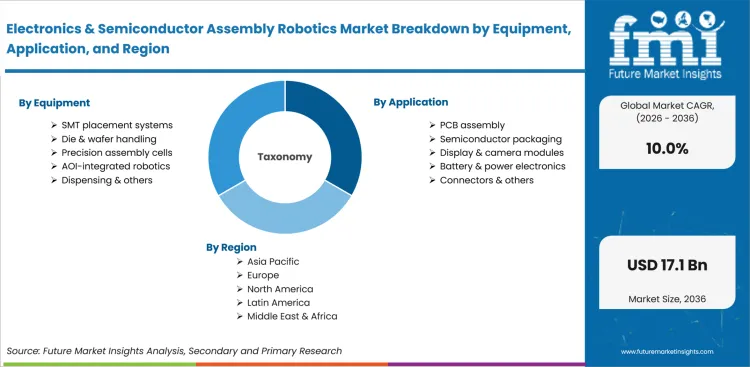
Demand for electronics & semiconductor assembly robotics is projected to expand at 10.0% CAGR between 2026 and 2036, increasing valuation from USD 6.6 billion in 2026 to USD 17.1 billion by 2036. Placing small and densely packed computer chips onto circuit boards requires steady robotic precision over long production runs. The need for dependable automated assembly continues to increase as chip manufacturers scale up their output. In February 2026, the Semiconductor Industry Association reported global semiconductor sales increasing 25.6% during 2025. This significant surge in chip production is forcing device and packaging plants everywhere to urgently re-evaluate their robotic assembly capacity.
Regional producers focus on different operational goals on upgrading such factories. Companies in China and South Korean prioritize fast packaging throughput alongside ultra-precise die handling. Plants across Japan and Europe favor selective upgrades designed to extend the working lifespan of existing platforms. Setting up advanced machinery across brand-new locations is becoming a major priority. In January 2025, SEMI published data identifying 18 semiconductor fabs scheduled for construction starts during 2025. Equipping these upcoming facilities ensures assembly robotics are likely to remain critical as global manufacturing expands.
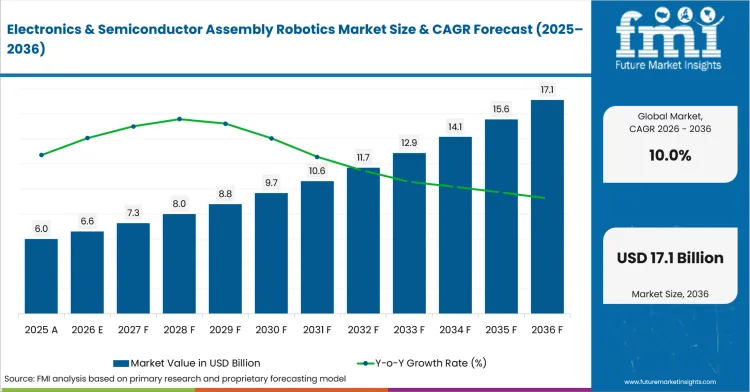
Key Takeaways of Electronics & Semiconductor Assembly Robotics Market
- Demand for electronics and semiconductor assembly robotics is driven by component density and repeatable placement quality, with equipment reviews considering feeder stability and inspection coordination across production cycles.
- By component, hardware is expected to lead with 66.0% share in 2026, reflecting physical equipment needs across feeders and motion platforms.
- Direct-OEM is the dominant sales channel segment, projected to hold 54.0% share in 2026, helped by detailed line planning and installation coordination.
- SMT placement systems are estimated to lead the product category with 38.0% share in 2026, guided by repeated component mounting across board production.
- Changeover time and sustained line output remain critical to adoption, as inspection teams favor linked movement that supports earlier defect separation.
- China, South Korea, and Japan are expected to form the higher-growth country tier, advancing at 13.0%, 11.0%, and 9.0% CAGR respectively through 2036, supported by electronics output, advanced packaging, and selective plant modernization.
- Competition centers on ASMPT, FUJI CORPORATION, Yamaha Robotics, and Hanwha Semitech, with vendors differentiating through semiconductor assembly and SMT process depth, modular placement capabilities, and integrated chip-mounting equipment.
Analyst Perspective
"The electronics & semiconductor assembly robotics market is increasingly defined by manufacturing yield rather than automation levels alone. As component miniaturization and product diversity continue to rise, manufacturers are prioritizing robotic platforms that maintain placement precision, support rapid product changeovers, and preserve process stability across high-mix production environments. The competitive landscape will increasingly favor suppliers that reduce engineering effort during new product introduction, enable seamless integration with inspection and feeder systems, and sustain production performance throughout the manufacturing lifecycle."
- Nikhil Kaitwade, Principal Consultant for Technology at Future Market Insights
Source: Future Market Insights analysis, 2026.
How is Electronics & Semiconductor Assembly Robotics Market segmented?
The electronics & semiconductor assembly robotics industry is segmented by equipment, application, component, end-use industry, sales channel and region.
The electronics & semiconductor assembly robotics scetor is segmented by equipment, application, component, end-use industry, sales channel and region. Equipment coverage includes SMT placement systems alongside die & wafer handling equipment, precision assembly cells, AOI-integrated robotics and dispensing & others. Application coverage includes PCB assembly, semiconductor packaging, display & camera modules, battery & power electronics and connectors & others.
Component coverage includes hardware, software and services. End-use industry coverage includes consumer electronics, automotive electronics, industrial electronics, telecom - 5G and medical & others. Sales channel coverage includes Direct - OEM, system integrators, distributors and aftermarket. Regional coverage includes North America and Latin America. Coverage also includes Western Europe, Eastern Europe, East Asia, South Asia and Pacific, Middle East and Africa.
How do SMT placement systems shape equipment selection?
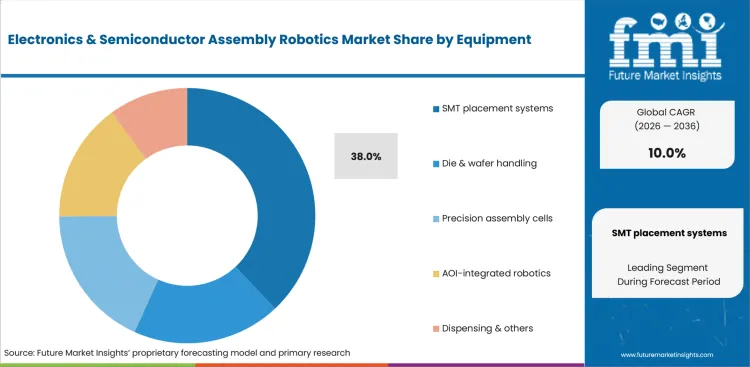
Yamaha Motor reported in February 2025 specifying a 6-second core tact time for YRP10e solder paste printing, illustrating cycle-time pressure surrounding surface mount technology lines. Equipment reviews often examine feeder stability and vision checks across repeated component placement. SMT placement systems dominate equipment selection since board producers require consistent mounting across compact layouts.
- SMT placement systems are expected to hold 38.0% share in 2026, driven by repeated mounting tasks and synchronized material feeding. Production engineers assess platform stability and changeover control during extended assembly schedules.
- Die & wafer handling equipment and precision assembly cells address specialized package needs. pick and place machines retain selection interest across board lines requiring repeatable position control.
How does PCB assembly guide application activity?
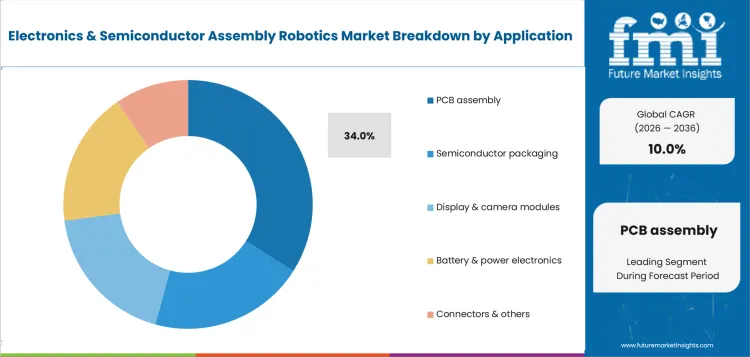
PCB assembly guide application activity as every board requires repeated placement and verification steps. Production planning also connects placement speed with reflow oven capacity and inspection timing. IPC reported in January 2025 recording North American PCB shipments rising 4.7% during November 2024, supporting line utilization across diversified board programs.
- In 2026, PCB assembly is projected to capture 34.0% share since it is helped by production volume across consumer and industrial devices. Board makers examine material loading and placement consistency across model changes.
- Printed circuit board (PCB) assembly supports recurring use across several end-use groups. Semiconductor packaging requires finer handling across dies and substrates.
How does Hardware guide component spending?
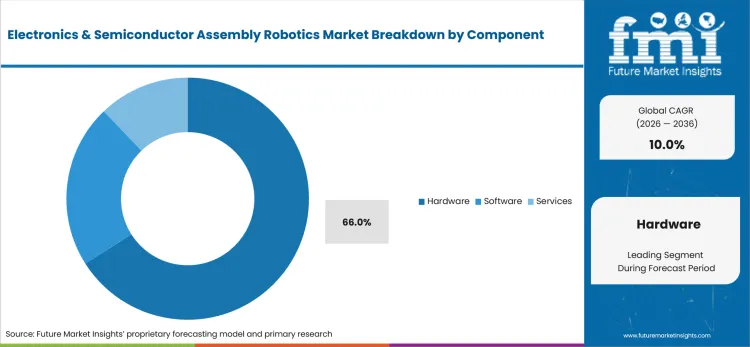
International Federation of Robotics reported in September 2025 recording 542,000 industrial robots installed during 2024, reflecting continued investment in physical automation platforms. Hardware leads component spending as feeders and motion stages perform core production work. Cameras and safety controllers also support factory automation and industrial controls across connected assembly cells.
- By component, hardware is anticipated to represent 66.0% share in 2026 by reflecting equipment value across robot bodies and material presentation systems. Plant teams compare vibration control and component-range compatibility during platform review.
- Software and services support recipe management and installed-equipment performance. Robotic vision strengthens position verification across varied electronic parts.
How does Consumer electronics shape end-use industry activity?
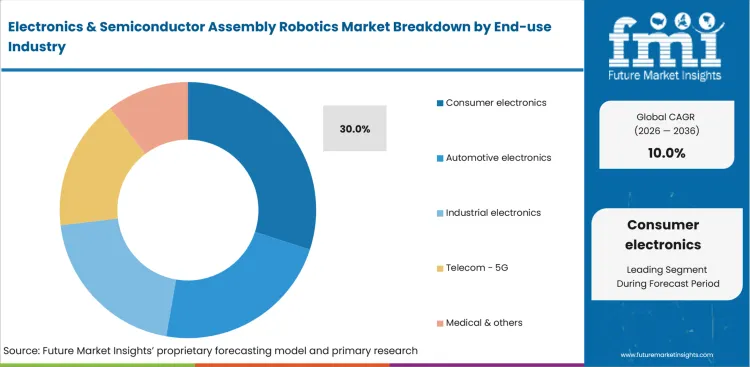
International Telecommunication Union reported in November 2025 estimating 6 billion people used internet services during 2025, reinforcing device-production requirements across connected electronics. Consumer electronics shapes end-use activity depending on high placement volume and frequent design refreshes. Line planners evaluate flexible feeders and inspection coverage across short product cycles.
- Consumer electronics is estimated to secure 30.0% share of end-use industry in 2026, driven by phones and computing devices requiring dense board assembly. Manufacturers favor platforms handling varied component sizes across repeated model launches.
- Automotive electronics and telecom - 5G support additional equipment use across modules and radio systems. Medical & others emphasize traceable assembly records and controlled material handling.
How does Direct - OEM retain sales channel preference?
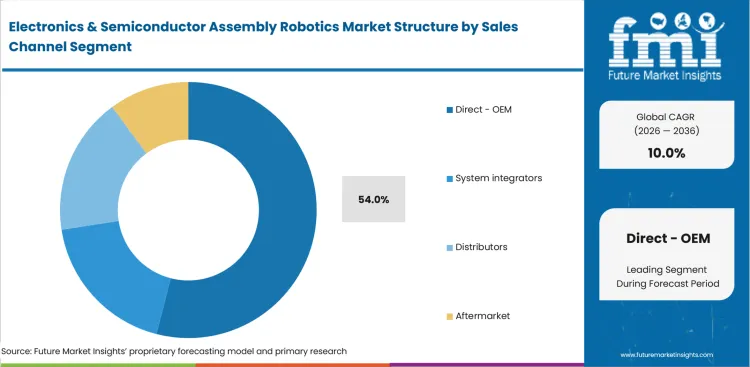
Direct - OEM helps retain channel preference due to large installations require line design and acceptance support. Engineering responsibility often spans feeders and software integration across complete production cells. Yamaha Motor announced in June 2025 combining 4 corporate entities under Yamaha Robotics Co., Ltd., strengthening direct coordination across semiconductor back-end and electronic assembly equipment.
- Based on sales channel, Direct - OEM is projected to account for 54.0% share in 2026 as it is aided by application engineering and installation coordination. Factory groups use direct support for platform configuration and production ramp planning.
- System integrators and distributors support multi-brand cells and smaller equipment programs. Electronic manufacturing services providers often combine direct supplier contact with local integration support.
What are drivers, restraints, and opportunities in electronics & semiconductor assembly robotics market?
Assembly equipment selection progresses through compact component handling and repeatable placement control. Integration cost and production interruption may delay line replacement.
- Driver: Dense boards and advanced packages encourage precise automated handling across sustained production schedules.
- Restraint: Integration complexity may slow equipment decisions across plants using mixed-generation line assets.
- Opportunity: Flexible cells may support product variation through faster recipes and inspection-linked movement.
Expanding semiconductor capacity and denser device designs increase assembly robotics requirements. SEMI reported in June 2024 projecting global fab capacity to reach 33.7 million wafers per month during 2025, increasing future workloads for die handling and package assembly equipment.
Restraints center on capital timing and utilization confidence across cyclical electronics production. SEMI reported in October 2024 projecting silicon wafer shipments to decline 2.0% during 2024, illustrating how inventory corrections may delay assembly-equipment commitments and line expansions.
Complex packaging and inspection-linked cells support technically demanding product assembly. SEMI reported in March 2024 forecasting global 300 mm fab equipment investment to increase 20.0% during 2025, indicating greater requirements for wafer handling and inspection-linked assembly equipment.
What country CAGRs are profiled in Electronics & Semiconductor Assembly Robotics Market?
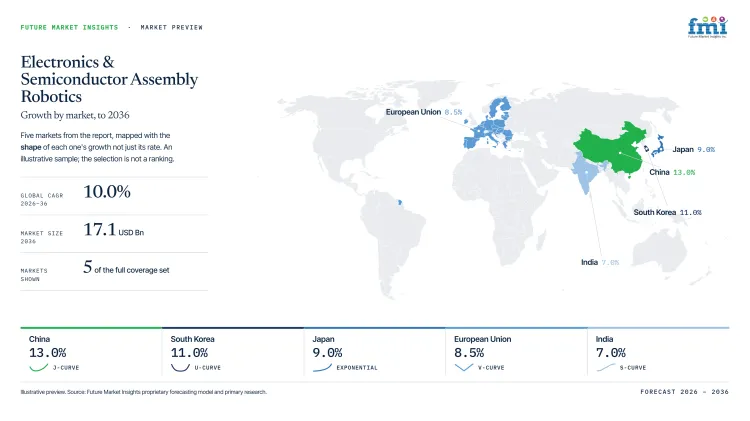
| Country or Market | CAGR |
|---|---|
| China | 13.0% |
| South Korea | 11.0% |
| Japan | 9.0% |
| European Union | 8.5% |
| India | 7.0% |
Source: Future Market Insights analysis, 2026.
How do country-level CAGRs compare in the Electronics & Semiconductor Assembly Robotics Market?
The country comparison spans 6.0 percentage points across the electronics & semiconductor assembly robotics market. China records the highest CAGR at 13.0%, followed by South Korea at 11.0%. Japan reaches 9.0%, while the European Union and India post 8.5% and 7.0%, respectively. The ranking reflects differences in semiconductor manufacturing capacity, electronics production and investment in automated assembly technologies.
- China leads with a CAGR of 13.0%. Electronics manufacturers are expanding robotic assembly lines to improve production precision, increase throughput and support high-volume fabrication of semiconductor devices and electronic components.
- South Korea follows at 11.0%, 2.0 percentage points below China. Assembly robotics continues to be integrated into semiconductor and electronics production, where manufacturers are optimizing wafer handling, component placement and inspection processes.
- Japan records a CAGR of 9.0%, placing it 2.0 percentage points behind South Korea. Demand reflects continued investment in robotic assembly systems that improve manufacturing accuracy and maintain consistent production quality across advanced electronics facilities.
- The European Union reaches 8.5%, only 0.5 percentage points below Japan. Industrial automation programs increasingly include robotic assembly solutions for electronics manufacturing, although adoption differs among member states because production capacity, investment priorities and industrial specialization vary across the region.
- India posts a CAGR of 7.0%, 1.5 percentage points behind the European Union. Electronics manufacturing facilities are gradually incorporating robotic assembly technologies as production capabilities expand and manufacturers seek greater consistency in assembly operations.
Comparable CAGRs do not indicate identical market conditions. Manufacturing scale, semiconductor investment, factory automation strategies and production requirements influence deployment decisions and long-term commercial opportunities. The full report provides country-level CAGR analysis across North America, Latin America, Europe, East Asia, South Asia, Oceania and the Middle East and Africa.
Country-wise Analysis
- Electronics & semiconductor assembly robotics activity in China is projected to scale at 13.0% CAGR between 2026 and 2036, driven by device output and assembly-capacity investment. High production volumes create recurring requirements for stable placement and package-handling equipment. National Bureau of Statistics of China reported in February 2026 recording 484.28 billion integrated circuits produced during 2025, increasing placement and package-handling workloads across local factories.
- Ministry of Science and ICT reported in January 2024 outlining 16 new semiconductor fabs for South Korea, encouraging equipment planning across packaging and material-handling stages. Planned production sites increase equipment requirements across precision handling and package assembly operations. Precision-focused production is anticipated to place South Korea at an estimated 11.0% CAGR from 2026 to 2036, led by complex packaging and memory assembly requirements.
- Selective modernization place Japan as expected to rise at 9.0% CAGR during the assessment period, guided by established equipment knowledge and varied electronics programs. Regional collaboration supports selective equipment upgrades across established production environments. Japan External Trade Organization reported in December 2024 detailing 5 regional semiconductor initiatives, strengthening collaboration around equipment skills and production support.
- European Commission reported in November 2024 selecting 27 Chips Competence Centers across participating European countries, expanding technical support for semiconductor design and manufacturing. Expanded technical capabilities support robotics evaluation across specialized electronics production programs. Automotive and industrial electronics adoption is likely to support European Union expansion at an anticipated 8.5% CAGR between 2026 and 2036.
- The market in India is estimated to record 7.0% CAGR during 2026-2036, backed by growing board assembly and semiconductor back-end programs. New manufacturing programs increase equipment requirements across placement, inspection, and material-handling stages. Press Information Bureau reported in September 2025 identifying 10 approved semiconductor projects, increasing equipment review across local assembly and packaging sites.
Who are notable companies in Electronics & Semiconductor Assembly Robotics Market?
ASMPT Limited and FUJI CORPORATION are expected to shape account comparisons across semiconductor assembly and SMT equipment. Yamaha Robotics Co., Ltd. and Hanwha Semitech Co., Ltd. add placement and back-end equipment coverage. Portfolio review is likely to center on accuracy and uptime alongside line integration and service access.
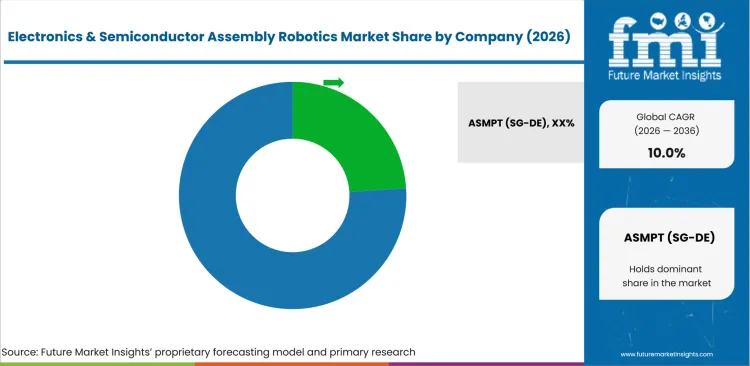
Competition is anticipated to focus on package range and changeover control across varied production environments. ASMPT Limited is projected to receive attention due to combined semiconductor and SMT equipment exposure. FUJI CORPORATION is estimated to support high-mix line programs led by modular placement platforms. Yamaha Robotics Co., Ltd. is likely to compete based on integrated electronics and semiconductor assembly offerings. Hanwha Semitech Co., Ltd. is forecast to support chip mounting and semiconductor back-end equipment programs.
- ASMPT Limited gains account attention across advanced packaging and SMT placement. Supplied analysis assigns ASMPT Limited 24.0% share in 2026.
- FUJI CORPORATION competes depending on modular placement and semiconductor assembly equipment. Factory groups review platform flexibility and feeder control.
- Yamaha Robotics Co., Ltd. supports direct programs spanning printing and placement alongside inspection coordination. Integrated equipment responsibility simplifies line acceptance planning.
- Hanwha Semitech Co., Ltd. competes across chip mounters and back-end semiconductor systems. Regional manufacturing support improves equipment review across Asian production sites.
Competitive Benchmarking: Electronics & Semiconductor Assembly Robotics Market
| Company | Portfolio Depth | Assembly Match | Service Support | Service Reach |
|---|---|---|---|---|
| ASMPT Limited | High | High | High | Asia and global |
| FUJI CORPORATION | High | High | High | Japan and global |
| Yamaha Robotics Co., Ltd. | High | High | High | Japan and global |
| Hanwha Semitech Co., Ltd. | High | High | Medium | South Korea and Asia |
Source: Future Market Insights competitive analysis, 2026.
Key Developments in Electronics & Semiconductor Assembly Robotics Market
- In August 2025, ASMPT announced SEMICON Taiwan exhibits covering ALSI LASER and AERO PRO alongside SIPLACE CA2. ASMPT stated SIPLACE CA2 combined SMT placement with die-attach and flip-chip assembly, improving production flexibility across advanced package lines.
- In September 2025, ASMPT introduced ALSI LASER1206 for automated wafer handling and separation under Class 1000 cleanroom conditions. ASMPT indicated integrated coating and cleaning functions reduced process transfers across advanced packaging production.
- In January 2026, ASMPT announced cooperation with Shinwa Co., Ltd. covering placement solutions across Japan. ASMPT expected local sales and support access to improve advanced packaging line evaluations and technical response.
Key Players in Electronics & Semiconductor Assembly Robotics Market
Semiconductor assembly and SMT platform suppliers
- ASMPT Limited
- Yamaha Robotics Co., Ltd.
Modular placement and line automation suppliers
- FUJI CORPORATION
- Hanwha Semitech Co., Ltd.
Electronics & Semiconductor Assembly Robotics Market - Report Scope
Source: Future Market Insights analysis, 2026.
Electronics & Semiconductor Assembly Robotics Market - Research Methodology
| Method | Approach |
|---|---|
| Primary Research | FMI analysts gathered input from manufacturers, service providers, technology developers, distributors, end users, procurement teams, and subject-matter experts. Interviews examined purchasing decisions, product or service evaluation, adoption barriers, approval requirements, pricing considerations, and expectations for technical or commercial support. Respondents were also asked what evidence is required before a trial, pilot, or initial order develops into regular purchasing. |
| Desk Research | Desk research covered government statistics, regulatory publications, trade data, industry associations, technical literature, standards, company filings, product information, and official corporate announcements. Sources were reviewed for relevance, publication date, geographic coverage, and consistency with the defined market scope. Claims relating to performance, applications, approvals, capacity, investment, and commercial activity were retained only when supported by credible public evidence. |
| Market Sizing and Forecasting | The market model combined the baseline value with historical performance, segment structure, pricing and volume indicators, adoption levels, company participation, and country-level demand conditions. Forecast assumptions considered economic activity, investment trends, regulatory developments, technology adoption, purchasing cycles, supply availability, and barriers to wider market use. Segment and regional estimates were reconciled before the final market total was calculated. |
| Data Validation | Estimates were checked against multiple independent indicators, including public data, company activity, trade patterns, industry developments, and findings from primary interviews. Validation also tested whether products, services, applications, and company revenues fell within the defined market boundaries. Adjacent categories, unsupported claims, overlapping revenues, and activities without direct market relevance were excluded to reduce double counting and maintain consistency across segments and countries. |
Source: Future Market Insights analysis, 2026.
Electronics & Semiconductor Assembly Robotics Market by Segments
Electronics & Semiconductor Assembly Robotics Market segmented by Equipment:
- SMT placement systems
- Die & wafer handling equipment
- Precision assembly cells
- AOI-integrated robotics
- Dispensing & others
Electronics & Semiconductor Assembly Robotics Market segmented by Application:
- PCB assembly
- Semiconductor packaging
- Display & camera modules
- Battery & power electronics
- Connectors & others
Electronics & Semiconductor Assembly Robotics Market segmented by Component:
- Hardware
- Software
- Services
Electronics & Semiconductor Assembly Robotics Market segmented by End-use Industry:
- Consumer electronics
- Automotive electronics
- Industrial electronics
- Telecom - 5G
- Medical & others
Electronics & Semiconductor Assembly Robotics Market segmented by Sales Channel:
- Direct - OEM
- System integrators
- Distributors
- Aftermarket
Electronics & Semiconductor Assembly Robotics Market by Region:
- North America
- United States
- Canada
- Latin America
- Brazil
- Mexico
- Argentina
- Western Europe
- Germany
- United Kingdom
- France
- Italy
- Spain
- Eastern Europe
- Poland
- Czech Republic
- Romania
- East Asia
- China
- Japan
- South Korea
- South Asia and Pacific
- India
- ASEAN
- Australia and New Zealand
- Middle East and Africa
- GCC countries
- South Africa
- Türkiye
Research Sources and Bibliography
- ASMPT. (2025, August 26). ASMPT exhibits at SEMICON Taiwan 2025 - Enabling chips for AI.
- ASMPT. (2025, September 10). ASMPT introduces ALSI LASER1206 - Fully automatic laser dicing and grooving.
- ASMPT. (2026, January 13). Strong partnership for innovative advanced packaging technologies.
- European Commission. (2024, November 8). Chips competence centres to strengthen semiconductor expertise across Europe about to kick-off.
- International Federation of Robotics. (2025, September 25). World Robotics 2025 report - Industrial robots - released by IFR.
- International Telecommunication Union. (2025, November 17). ITU’s Facts and Figures 2025 shows steady progress in connectivity, while highlighting gaps in quality and affordability.
- IPC. (2025, January 2). North American PCB industry sales up 4.7 percent in November.
- Japan External Trade Organization. (2024, December 9). JETRO and NY CREATES, USA semiconductor R&D organization, signed a memorandum of understanding on the strategic partnership in the semiconductor industry: Strengthening efforts to form semiconductor ecosystems around Japan through multifaceted international collaboration.
- Ministry of Science and ICT. (2024, January 15). Government to establish the world’s largest and most advanced mega semiconductor cluster.
- National Bureau of Statistics of China. (2026, February 28). Statistical communiqué of the People’s Republic of China on the 2025 national economic and social development.
- Press Information Bureau. (2025, September 2). Prime Minister Shri Narendra Modi presented with first set of Made-in-India chips; Union Minister Ashwini Vaishnaw calls it a moment of pride thanking PM for his farsighted vision, strong will and decisive action.
- Semiconductor Industry Association. (2026, February 6). Global annual semiconductor sales increase 25.6% to USD 791.7 billion in 2025.
- SEMI. (2024, March 19). 300mm fab equipment spending forecast to reach record USD 137 billion in 2027, SEMI reports.
- SEMI. (2024, June 18). Global semiconductor fab capacity projected to expand 6% in 2024 and 7% in 2025, SEMI reports.
- SEMI. (2024, October 21). Global silicon wafer shipments to remain soft in 2024 before strong expected rebound in 2025, SEMI reports.
- SEMI. (2025, January 7). Eighteen new semiconductor fabs to start construction in 2025, SEMI reports.
- Yamaha Motor Co., Ltd. (2025, February 17). Yamaha Motor to launch new YRP10e entry-level solder paste printer: Inherits the high speed and precision of the YRP10 premium model while prioritizing ease of use.
- Yamaha Motor Co., Ltd. (2025, June 19). Formulation of medium- to long-term management plan for Yamaha Robotics Co., Ltd.: Aiming for 100 billion yen in revenue in the semiconductor back-end equipment business by the early 2030s.
This bibliography is provided for reader reference and is not exhaustive. The full report contains the complete reference list and detailed citations.
This Report Answers
- What segments shape activity across equipment, application, component, end-use industry and sales channel?
- How do electronics manufacturers evaluate assembly robotics during line modernization?
- How do country CAGRs differ across profiled markets?
- What companies compete through placement depth and semiconductor assembly exposure?
- How are forecasts validated through bottom-up and top-down methods?
- What factors affect account progress during production-line integration?
- How do feeder stability and vision accuracy affect equipment selection?
- What limits investment returns across mixed-generation assembly lines?
- How do changeover records and application support influence account approval?
- What supplier capabilities improve long-term operating confidence?
Frequently Asked Questions
What supports activity in electronics & semiconductor assembly robotics market?
Activity is likely to be supported by denser boards and advanced packages requiring repeatable handling. Production teams are expected to favor platforms combining stable motion and inspection coordination.
Who are key players in electronics & semiconductor assembly robotics market?
Key companies are anticipated to include ASMPT Limited and FUJI CORPORATION among other active suppliers. Yamaha Robotics Co., Ltd. and Hanwha Semitech Co., Ltd. are also expected to shape account comparisons.
What restraint affects electronics & semiconductor assembly robotics market?
A central restraint is integration complexity across plants using mixed-generation equipment and factory software. Equipment decisions may slow if production interruption and operator training remain difficult to control.
Why do executives track electronics & semiconductor assembly robotics market?
Executives are projected to track assembly robotics as line accuracy affects yield and capacity planning. Equipment flexibility and technical support are likely to influence capital timing.
What business problem does electronics & semiconductor assembly robotics market address?
Electronics & semiconductor assembly robotics address production gaps created by fragile parts and dense layouts requiring repeatable movement. Manufacturers need equipment supporting precise handling and stable production across varied designs.
What do account teams evaluate during supplier selection?
Account teams are likely to evaluate placement accuracy and feeder compatibility alongside service response. Package range and inspection integration are expected to guide final supplier review.
What limits return on investment for manufacturing teams?
Return on investment weakens if utilization and product-change requirements are not proven during line planning. Extended setup and recurring stoppages reduce expected throughput gains.
How do suppliers build long-term account confidence?
Suppliers build account confidence through consistent equipment performance and application-specific support. Installation records and responsive troubleshooting are anticipated to influence repeat orders.
Preview the report firsthand - request a free sample
Get SampleGet the brochure for pricing and purchase details.
Get PDFTable of Content
- Key Takeaways
- Market Size and CAGR
- Top Growth Driver
- Fastest Growing Segment
- Leading Region
- Key Companies
- Emerging Opportunities
- Executive Summary
- Global Market Outlook
- Demand-side Trends
- Supply-side Trends
- Technology Roadmap Analysis
- Analysis and Recommendations
- Analyst Perspective (What is happening? Why now? What should investors know?)
- Key Questions Answered
- How large is the market?
- What is the CAGR?
- What are key trends?
- Which region dominates?
- Who are the leaders?
- Market Overview
- Market Coverage / Taxonomy
- Market Definition / Scope / Limitations
- Research Methodology
- Chapter Orientation
- Analytical Lens and Working Hypotheses
- Market Structure, Signals, and Trend Drivers
- Benchmarking and Cross-market Comparability
- Market Sizing, Forecasting, and Opportunity Mapping
- Research Design and Evidence Framework
- Desk Research Programme (Secondary Evidence)
- Expert Input and Fieldwork (Primary Evidence)
- Tooling, Models, and Reference Databases
- Data Engineering and Model Build
- Quality Assurance and Audit Trail
- Market Background
- Market Dynamics (Drivers, Restraints, Opportunity, Trends)
- Scenario Forecast (Optimistic, Likely, Conservative)
- Impact Analysis
- AI Impact
- Sustainability Impact
- Regulatory Impact
- Technology Impact
- Consumer / Buyer Analysis
- Purchase Drivers
- Adoption Barriers
- Buyer Journey
- Opportunity Map Analysis
- Product Life Cycle Analysis
- Supply Chain Analysis
- Investment Feasibility Matrix
- Value Chain Analysis
- PESTLE and Porter's Analysis
- Regulatory Landscape
- Regional Parent Market Outlook
- Production and Consumption Statistics
- Import and Export Statistics
- Global Market Analysis and Forecast, 2021 to 2036
- Historical Market Size Value (USD Bn) Analysis, 2021 to 2025
- Current and Future Market Size Value (USD Bn) Projections, 2026 to 2036
- Y-o-Y Growth Trend Analysis
- Absolute $ Opportunity Analysis
- Global Market Pricing Analysis, 2021 to 2036
- Global Market Analysis and Forecast, By Equipment, 2021 to 2036
- Introduction / Key Findings
- Historical Market Size Value (USD Bn) Analysis By Equipment, 2021 to 2025
- Current and Future Market Size Value (USD Bn) Analysis and Forecast By Equipment, 2026 to 2036
- SMT placement systems
- Die & wafer handling
- Precision assembly cells
- AOI-integrated robotics
- Dispensing & others
- SMT placement systems
- Y-o-Y Growth Trend Analysis By Equipment, 2021 to 2025
- Absolute $ Opportunity Analysis By Equipment, 2026 to 2036
- Global Market Analysis and Forecast, By Application, 2021 to 2036
- Introduction / Key Findings
- Historical Market Size Value (USD Bn) Analysis By Application, 2021 to 2025
- Current and Future Market Size Value (USD Bn) Analysis and Forecast By Application, 2026 to 2036
- PCB assembly
- Semiconductor packaging
- Display & camera modules
- Battery & power electronics
- Connectors & others
- PCB assembly
- Y-o-Y Growth Trend Analysis By Application, 2021 to 2025
- Absolute $ Opportunity Analysis By Application, 2026 to 2036
- Global Market Analysis and Forecast, By Component, 2021 to 2036
- Introduction / Key Findings
- Historical Market Size Value (USD Bn) Analysis By Component, 2021 to 2025
- Current and Future Market Size Value (USD Bn) Analysis and Forecast By Component, 2026 to 2036
- Hardware
- Software
- Services
- Hardware
- Y-o-Y Growth Trend Analysis By Component, 2021 to 2025
- Absolute $ Opportunity Analysis By Component, 2026 to 2036
- Global Market Analysis and Forecast, By End-use Industry, 2021 to 2036
- Introduction / Key Findings
- Historical Market Size Value (USD Bn) Analysis By End-use Industry, 2021 to 2025
- Current and Future Market Size Value (USD Bn) Analysis and Forecast By End-use Industry, 2026 to 2036
- Consumer electronics
- Automotive electronics
- Industrial electronics
- Telecom - 5G
- Medical & others
- Consumer electronics
- Y-o-Y Growth Trend Analysis By End-use Industry, 2021 to 2025
- Absolute $ Opportunity Analysis By End-use Industry, 2026 to 2036
- Global Market Analysis and Forecast, By Sales Channel, 2021 to 2036
- Introduction / Key Findings
- Historical Market Size Value (USD Bn) Analysis By Sales Channel, 2021 to 2025
- Current and Future Market Size Value (USD Bn) Analysis and Forecast By Sales Channel, 2026 to 2036
- Direct - OEM
- System integrators
- Distributors
- Aftermarket
- Direct - OEM
- Y-o-Y Growth Trend Analysis By Sales Channel, 2021 to 2025
- Absolute $ Opportunity Analysis By Sales Channel, 2026 to 2036
- Global Market Analysis and Forecast, By Region, 2021 to 2036
- Introduction
- Historical Market Size Value (USD Bn) Analysis By Region, 2021 to 2025
- Current Market Size Value (USD Bn) Analysis and Forecast By Region, 2026 to 2036
- North America
- Latin America
- Western Europe
- Eastern Europe
- East Asia
- South Asia and Pacific
- Middle East & Africa
- Market Attractiveness Analysis By Region
- North America Market Analysis and Forecast, By Country, 2021 to 2036
- Historical Market Size Value (USD Bn) Trend Analysis By Market Taxonomy, 2021 to 2025
- Market Size Value (USD Bn) Forecast By Market Taxonomy, 2026 to 2036
- By Country
- USA
- Canada
- By Equipment
- By Application
- By Component
- By End-use Industry
- By Sales Channel
- By Country
- Market Attractiveness Analysis
- By Country
- By Equipment
- By Application
- By Component
- By End-use Industry
- By Sales Channel
- Key Takeaways
- Latin America Market Analysis and Forecast, By Country
- Historical Market Size Value (USD Bn) Trend Analysis By Market Taxonomy, 2021 to 2025
- Market Size Value (USD Bn) Forecast By Market Taxonomy, 2026 to 2036
- By Country
- Brazil
- Mexico
- Chile
- Rest of Latin America
- By Equipment
- By Application
- By Component
- By End-use Industry
- By Sales Channel
- By Country
- Market Attractiveness Analysis
- By Country
- By Equipment
- By Application
- By Component
- By End-use Industry
- By Sales Channel
- Key Takeaways
- Western Europe Market Analysis and Forecast, By Country
- Historical Market Size Value (USD Bn) Trend Analysis By Market Taxonomy, 2021 to 2025
- Market Size Value (USD Bn) Forecast By Market Taxonomy, 2026 to 2036
- By Country
- Germany
- UK
- Italy
- Spain
- France
- Nordic
- BENELUX
- Rest of Western Europe
- By Equipment
- By Application
- By Component
- By End-use Industry
- By Sales Channel
- By Country
- Market Attractiveness Analysis
- By Country
- By Equipment
- By Application
- By Component
- By End-use Industry
- By Sales Channel
- Key Takeaways
- Eastern Europe Market Analysis and Forecast, By Country
- Historical Market Size Value (USD Bn) Trend Analysis By Market Taxonomy, 2021 to 2025
- Market Size Value (USD Bn) Forecast By Market Taxonomy, 2026 to 2036
- By Country
- Russia
- Poland
- Hungary
- Balkan & Baltic
- Rest of Eastern Europe
- By Equipment
- By Application
- By Component
- By End-use Industry
- By Sales Channel
- By Country
- Market Attractiveness Analysis
- By Country
- By Equipment
- By Application
- By Component
- By End-use Industry
- By Sales Channel
- Key Takeaways
- East Asia Market Analysis and Forecast, By Country
- Historical Market Size Value (USD Bn) Trend Analysis By Market Taxonomy, 2021 to 2025
- Market Size Value (USD Bn) Forecast By Market Taxonomy, 2026 to 2036
- By Country
- China
- Japan
- South Korea
- By Equipment
- By Application
- By Component
- By End-use Industry
- By Sales Channel
- By Country
- Market Attractiveness Analysis
- By Country
- By Equipment
- By Application
- By Component
- By End-use Industry
- By Sales Channel
- Key Takeaways
- South Asia and Pacific Market Analysis and Forecast, By Country
- Historical Market Size Value (USD Bn) Trend Analysis By Market Taxonomy, 2021 to 2025
- Market Size Value (USD Bn) Forecast By Market Taxonomy, 2026 to 2036
- By Country
- India
- ASEAN
- Australia & New Zealand
- Rest of South Asia and Pacific
- By Equipment
- By Application
- By Component
- By End-use Industry
- By Sales Channel
- By Country
- Market Attractiveness Analysis
- By Country
- By Equipment
- By Application
- By Component
- By End-use Industry
- By Sales Channel
- Key Takeaways
- Middle East & Africa Market Analysis and Forecast, By Country
- Historical Market Size Value (USD Bn) Trend Analysis By Market Taxonomy, 2021 to 2025
- Market Size Value (USD Bn) Forecast By Market Taxonomy, 2026 to 2036
- By Country
- Kingdom of Saudi Arabia
- Other GCC Countries
- Türkiye
- South Africa
- Other African Union
- Rest of Middle East & Africa
- By Equipment
- By Application
- By Component
- By End-use Industry
- By Sales Channel
- By Country
- Market Attractiveness Analysis
- By Country
- By Equipment
- By Application
- By Component
- By End-use Industry
- By Sales Channel
- Key Takeaways
- Key Countries Market Analysis
- USA
- Pricing Analysis
- Market Share Analysis, 2025
- By Equipment
- By Application
- By Component
- By End-use Industry
- By Sales Channel
- Canada
- Pricing Analysis
- Market Share Analysis, 2025
- By Equipment
- By Application
- By Component
- By End-use Industry
- By Sales Channel
- Mexico
- Pricing Analysis
- Market Share Analysis, 2025
- By Equipment
- By Application
- By Component
- By End-use Industry
- By Sales Channel
- Brazil
- Pricing Analysis
- Market Share Analysis, 2025
- By Equipment
- By Application
- By Component
- By End-use Industry
- By Sales Channel
- Chile
- Pricing Analysis
- Market Share Analysis, 2025
- By Equipment
- By Application
- By Component
- By End-use Industry
- By Sales Channel
- Germany
- Pricing Analysis
- Market Share Analysis, 2025
- By Equipment
- By Application
- By Component
- By End-use Industry
- By Sales Channel
- UK
- Pricing Analysis
- Market Share Analysis, 2025
- By Equipment
- By Application
- By Component
- By End-use Industry
- By Sales Channel
- Italy
- Pricing Analysis
- Market Share Analysis, 2025
- By Equipment
- By Application
- By Component
- By End-use Industry
- By Sales Channel
- Spain
- Pricing Analysis
- Market Share Analysis, 2025
- By Equipment
- By Application
- By Component
- By End-use Industry
- By Sales Channel
- France
- Pricing Analysis
- Market Share Analysis, 2025
- By Equipment
- By Application
- By Component
- By End-use Industry
- By Sales Channel
- India
- Pricing Analysis
- Market Share Analysis, 2025
- By Equipment
- By Application
- By Component
- By End-use Industry
- By Sales Channel
- ASEAN
- Pricing Analysis
- Market Share Analysis, 2025
- By Equipment
- By Application
- By Component
- By End-use Industry
- By Sales Channel
- Australia & New Zealand
- Pricing Analysis
- Market Share Analysis, 2025
- By Equipment
- By Application
- By Component
- By End-use Industry
- By Sales Channel
- China
- Pricing Analysis
- Market Share Analysis, 2025
- By Equipment
- By Application
- By Component
- By End-use Industry
- By Sales Channel
- Japan
- Pricing Analysis
- Market Share Analysis, 2025
- By Equipment
- By Application
- By Component
- By End-use Industry
- By Sales Channel
- South Korea
- Pricing Analysis
- Market Share Analysis, 2025
- By Equipment
- By Application
- By Component
- By End-use Industry
- By Sales Channel
- Russia
- Pricing Analysis
- Market Share Analysis, 2025
- By Equipment
- By Application
- By Component
- By End-use Industry
- By Sales Channel
- Poland
- Pricing Analysis
- Market Share Analysis, 2025
- By Equipment
- By Application
- By Component
- By End-use Industry
- By Sales Channel
- Hungary
- Pricing Analysis
- Market Share Analysis, 2025
- By Equipment
- By Application
- By Component
- By End-use Industry
- By Sales Channel
- Kingdom of Saudi Arabia
- Pricing Analysis
- Market Share Analysis, 2025
- By Equipment
- By Application
- By Component
- By End-use Industry
- By Sales Channel
- Türkiye
- Pricing Analysis
- Market Share Analysis, 2025
- By Equipment
- By Application
- By Component
- By End-use Industry
- By Sales Channel
- South Africa
- Pricing Analysis
- Market Share Analysis, 2025
- By Equipment
- By Application
- By Component
- By End-use Industry
- By Sales Channel
- USA
- Market Structure Analysis
- Competition Dashboard
- Competition Benchmarking
- Market Share Analysis of Top Players
- By Regional
- By Equipment
- By Application
- By Component
- By End-use Industry
- By Sales Channel
- Emerging Startups
- Innovation Benchmarking
- Competition Analysis
- Competition Deep Dive
- ASMPT (SG-DE)
- Overview
- Product Portfolio
- Profitability by Market Segments
- Sales Footprint
- Strategy Overview
- Marketing Strategy
- Product Strategy
- Channel Strategy
- Fuji (JP)
- Yamaha Robotics (JP)
- Hanwha Precision (KR)
- ASMPT (SG-DE)
- Case Studies
- Success Stories
- Recent Developments
- Competition Deep Dive
- Assumptions & Acronyms Used


