

- Industry Size (2026)
- USD 591.02 Mn
- Forecast (2036)
- USD 1.21 Bn
- CAGR (2026 to 2036)
- 7.4%
Endoscopy Fluid Management Systems Market Size, Market Forecast and Outlook By FMI
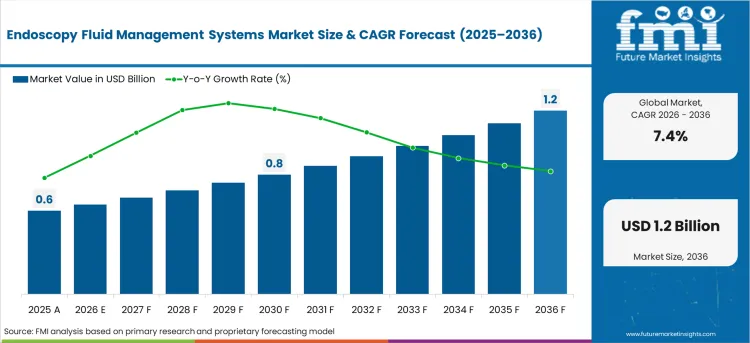
The endoscopy fluid management systems market was valued at USD 550.30 million in 2025, projected to reach USD 591.02 million in 2026, and is forecast to expand to USD 1.21 billion by 2036 at a 7.4% CAGR. As per FMI, rising minimally invasive surgical procedure volumes in gynaecology and general surgery, combined with tightening fluid deficit monitoring mandates during endoscopic procedures, are sustaining demand for automated fluid management platforms that track irrigation inflow, aspiration outflow, and real-time fluid balance. Fluid overload complications during hysteroscopy and laparoscopy remain a preventable patient safety risk that automated management systems directly address.
Summary of Endoscopy Fluid Management Systems Market
- Market snapshot
- The endoscopy fluid management systems market is valued at USD 550.30 million in 2025 and is projected to reach USD 1.21 billion by 2036.
- The industry is expected to grow at a 7.4% CAGR from 2026 to 2036, creating an incremental opportunity of USD 615.81 million.
- The market is a surgical capital equipment category where patient safety fluid deficit monitoring, minimally invasive procedure volume growth, and theatre modernisation define procurement patterns.
- Demand and growth drivers
- Demand is rising as minimally invasive surgical volumes increase across laparoscopy and hysteroscopy, each requiring real-time irrigation fluid balance monitoring.
- Fluid overload prevention mandates under surgical accreditation standards compel hospitals to adopt automated deficit tracking systems.
- Operating theatre modernisation programmes are upgrading legacy manual irrigation to integrated floor-standing platforms with warming, pressure control, and multi-channel monitoring.
- Among key countries, China leads at 10.0% CAGR, followed by India at 9.3%, Germany at 8.5%, Brazil at 7.8%, the USA at 7.0%, and the UK at 6.3%.
- Product and segment view
- Endoscopy fluid management systems are automated platforms that control irrigation fluid inflow, aspiration, and real-time deficit monitoring during minimally invasive endoscopic procedures.
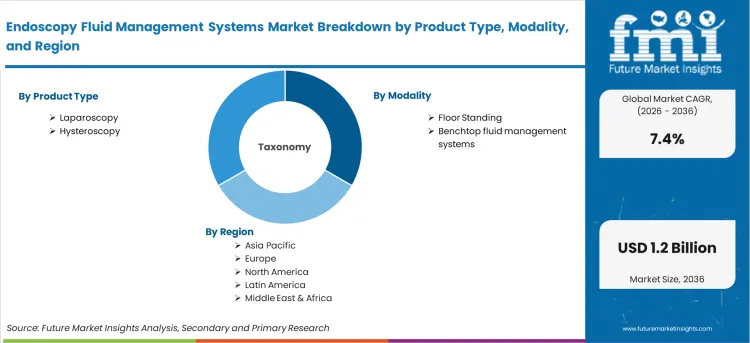
- Product types cover laparoscopy and hysteroscopy applications; modalities include floor-standing and benchtop configurations.
- Laparoscopy leads by Product Type with 54.0% share in 2026 as cholecystectomy, hernia repair, and bariatric surgery volumes exceed hysteroscopy procedure counts.
- Floor Standing leads by Modality with 61.0% share in 2026 as integrated high-flow pump, warming, and pressure monitoring platforms serve hospital operating theatres.
- Scope includes fluid management pumps, warming modules, and deficit monitoring systems; excludes irrigation fluids, suction canisters, and general operating theatre equipment.
- Geography and competitive outlook
- China and India are the fastest-growing markets due to MIS adoption expansion and hospital construction. The USA and Germany anchor mature theatre modernisation demand.
- Competition is shaped by flow rate accuracy, deficit calculation precision, and integration with existing operating theatre equipment ecosystems.
- Key players include Karl Storz GmbH & Co KG, Olympus Corporation, Richard Wolf GmbH, Smith & Nephew, Stryker Corporation, DePuy Synthes (Johnson & Johnson), Cantel Medical, Medtronic Plc., B. Braun Medical Inc., and Hologic Inc.
- Analyst opinion at FMI
- Sabyasachi Ghosh, Principal Consultant for Surgical Equipment, opines: 'FMI is of the opinion that fluid management system procurement is transitioning from optional theatre accessory to mandatory patient safety equipment. Hospitals performing hysteroscopy or laparoscopy without automated fluid deficit monitoring face accreditation audit risk and preventable complication liability. Equipment suppliers without integrated warming and pressure control modules will be excluded from next-generation theatre equipment procurement packages where bundled functionality reduces inter-device compatibility risk.'
- Strategic implications / Executive takeaways
- Perioperative directors must mandate automated fluid deficit monitoring for all hysteroscopy and laparoscopy procedures to meet surgical accreditation patient safety requirements.
- Capital equipment procurement teams should evaluate floor-standing fluid management systems on integrated warming, pressure control, and multi-procedure configurability to maximise per-unit utilisation.
- ASC operators must assess benchtop fluid management systems for lower-acuity laparoscopic procedures where floor-standing capital investment exceeds procedural volume justification.
Endoscopy Fluid Management Systems Market key takeaways
| Metric | Details |
|---|---|
| Industry Size (2026) | USD 591.02 million |
| Industry Value (2036) | USD 1.21 billion |
| CAGR (2026 to 2036) | 7.4% |
Source: Future Market Insights, 2026
FMI analysts observe that laparoscopy dominates the product type segment because the procedure volume base across cholecystectomy, appendectomy, hernia repair, and bariatric surgery far exceeds hysteroscopy volumes. Floor-standing systems command the modality share as these units integrate high-flow pumps, warming modules, and multi-channel pressure monitoring into a single platform positioned within the operating theatre equipment stack. Hospitals anchor end-user demand because inpatient operating theatres handle the highest-acuity endoscopic procedures where continuous fluid deficit monitoring is a patient safety mandate under surgical accreditation standards.
China leads with a 10.0% CAGR through 2036 as minimally invasive surgical training programmes expand and hospital operating theatre construction accelerates. India follows at 9.3%, driven by growing laparoscopic surgical adoption and hospital accreditation compliance. Germany registers an 8.5% pace as perioperative fluid management protocols tighten under surgical quality assurance frameworks. Brazil expands at 7.8% on the back of ambulatory surgical centre growth and gynaecological endoscopy adoption. The United States tracks at 7.0%, reflecting mature procedural volumes with incremental growth from fluid warming and pressure monitoring upgrades. The United Kingdom maintains a 6.3% trajectory driven by NHS theatre modernisation.
Endoscopy Fluid Management Systems Market definition
Endoscopy fluid management systems are automated surgical platforms that control the inflow, outflow, and real-time balance monitoring of irrigation fluids during minimally invasive endoscopic procedures including laparoscopy and hysteroscopy. The category covers floor-standing and benchtop configurations integrating irrigation pumps, fluid warming modules, aspiration control, and deficit calculation displays.
Endoscopy Fluid Management Systems Market inclusions
Market scope includes fluid management pump systems, warming modules, and deficit monitoring platforms for laparoscopy and hysteroscopy. The report covers global and regional market sizes for 2026 to 2036 with breakdowns by product type, modality, and end user.
Endoscopy Fluid Management Systems Market exclusions
The scope excludes irrigation fluid consumables, suction canisters, general operating theatre lighting and tables, and arthroscopy fluid management systems classified under orthopaedic surgical equipment.
Endoscopy Fluid Management Systems Market research methodology
- Primary research: Analysts engaged with perioperative directors, MIS surgeons, and biomedical engineering managers to map fluid management system selection criteria and theatre modernisation procurement triggers.
- Desk research: Data collection aggregated surgical accreditation fluid monitoring standards, MIS procedure volume statistics, and published operating theatre capital expenditure benchmarks.
- Market sizing and forecasting: Baseline values derive from a bottom-up aggregation of fluid management system installations by care setting, applying MIS procedure growth curves and theatre renovation schedules.
- Data validation and update cycle: Projections are cross-validated against published surgical equipment company revenue disclosures and hospital capital equipment procurement survey data.
Revenue Analysis of Endoscopy Fluid Management Systems (2020 to 2034) Vs Market Estimates (2025 to 2035)
The growth of the market is backed by a higher inclination towards minimally-invasive procedures. Coupled with this, the rising incidence of chronic ailments and cases of accidents has been creating growth prospects for the market. The market registered a 5.9% CAGR between 2020 to 2024.
Advancements witnessed in the last couple of years in conducting minimally-invasive procedures are indicative of impressive developments in surgical equipment. In addition to this, R&D activities are leading to technological advancements in fluid management systems. Government funds and grants are driving the market at a global level for nonsurgical procedures and leading to an increase in ESRD patient base.
Overall, the demand for endoscopy fluid management systems is anticipated to rise at a CAGR of around 7.4% through 2035, accounting for 4% share in the global fluid management systems market.
How is Rising Prevalence of Chronic Diseases Spurring Endoscopy Fluid Management Systems Adoption?
For diagnosing and treating chronic and acute diseases, doctors, at times, prescribe surgeries. Minimally invasive surgeries are done with the help of endoscopes along with endoscope procedure kits. During such procedures, endoscopy fluid management systems are used as irrigation pumps.
According to the Centers for Disease Control and Prevention (CDC), six in ten Americans live with at least one chronic disease. Globally, endoscopic systems have been witnessing high demand, owing to the rising prevalence of chronic diseases. North America has been registering high demand for endoscopic fluid management systems, owing to the large number of expert surgeons practicing in the region.
Endoscopic fluid management systems help reduce bleeding in internal cavities during endoscopic surgeries. They are integrated with endoscopy visualization systems & other endoscopic instruments. According to Cancer Research UK, there were 385.1 million new cases of cancer worldwide in 2020.
The four most common cancers occurring worldwide are lung, female breast, bowel, and prostate cancer. These four accounts for more than four in ten of all cancers diagnosed worldwide. Worldwide there will be 27.5 million new cases of cancer each year by 2040. Hence, endoscopic surgeries to cure such cancers will enhance deployment of endoscopic fluid management systems.
How are Emerging Markets Providing Growth Opportunities for Endoscopic Fluid Management Systems?
As healthcare infrastructure expands across developing countries, governments are attempting to reduce financial barriers to facilitate extensive R&D across various domains.
This trend has boded well for endoscopy fluid management systems. Countries such as China, India, Brazil and Mexico, for instance, are preferred destinations for healthcare tourism.
Moreover, countries across the Asia Pacific, including China and India, possess the world’s largest population base, collectively comprising over 60% of the total number of people across the globe. Also, they also constitute a large patient base for renal, gastrointestinal and respiratory ailments, areas which extensively require endoscopic surgery.
Also, as patients in emerging economic experience elevated living standards, they are in a position to afford cost-intensive treatments and surgeries. This is encouraging several small, medium and large-scale manufacturers to establish base across these regions.
Endoscopy Fluid Management Systems Market - Country-wise Analysis
.webp "Top Country Growth Comparison Endoscopy Fluid Management Systems Market Cagr (2026 2036)")
Will Asia Pacific Emerge as an Opportunistic Endoscopy Fluid Management Systems Landscape?
As per FMIs analysis, in the coming years, Asia Pacific is projected to be highly lucrative for the overall endoscopy fluid management systems market growth.
Rising awareness regarding minimally invasive endoscopic surgeries and irrigation pumps and affinity towards the products manufactured by local companies in India have collectively increased revenue opportunities.
Furthermore, the rising prevalence of chronic diseases in India is adding to the market expansion. According to the first Longitudinal Ageing Study in India (LASI) released by the Union Ministry of Family and Health Welfare in India on January 6, 2024, two in every three senior citizens in India suffer from some chronic disease.
Overall, the APAC region is projected to accumulate a market share of 7.4% in 2026.
Why Should Manufacturers of Endoscopy Fluid Management Systems Focus on North America?
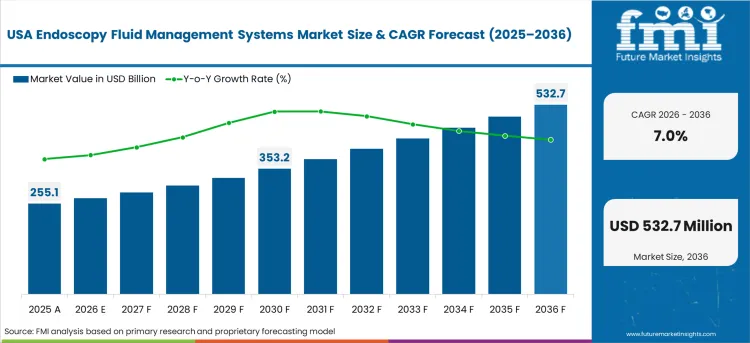
The North American Endoscopy fluid management systems industry is poised to capture a market share of 7.7% in 2026. The systems are helpful in maintaining precise pressure so as to reduce bleeding in internal cavities during endoscopic procedures.
From a market point of view, using high-tech devices improves treatment compliance, which could drive higher unit sales and subsequently, revenue.
The high share is due to the presence of skilled medical professionals, outstanding healthcare infrastructure, advancements in technology, and the presence of prominent market players in the country. In addition to this, healthcare reimbursement policies are also augmenting market growth.
For instance, President Joe Biden’s healthcare plan will insure more than 97% of Americans owing to the introduction of a Medicare-like public option for Individuals and Families. His plan also includes strengthening the Affordable Care Act (ACA) by increasing marketplace subsidies.
Endoscopy Fluid Management Systems Market - Category-wise Analysis
Why are Endoscopic Fluid Management Systems Most Sought After?
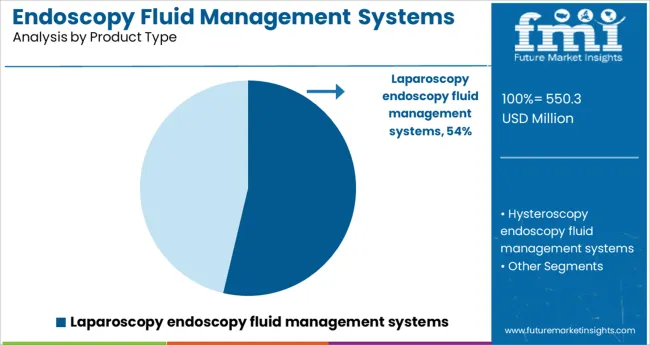
By product, endoscopic fluid management systems are expected to capture the dominant market share in 2025 and beyond. Increased demand for precision based surgeries to ensure minimal trauma during intensive surgical procedures is driving adoption.
As the incidence of various renal, gastrointestinal, respiratory and cardiac disorders increase, patients are opting for highly precise yet minimally invasive surgeries has led hospitals and clinics to deploy advanced endoscopic fluid management systems.
Which End User is expected to Make Extensive Usage of Endoscopy Fluid Management Systems?
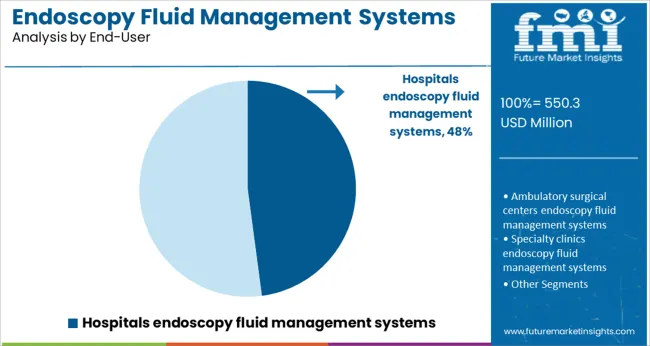
Hospitals are expected to make maximum usage of endoscopy fluid management systems, given the ever increasing volume of patient admissions for various laparoscopic and other internal surgeries.
Moreover, hospitals also partner with various laboratories and research institutions to conduct studies on surgical procedures, requiring them to use endoscopy fluid management systems.
Endoscopy Fluid Management Systems Market - Competitive Landscape
The global endoscopy fluid management systems market is on a rise owing to the manufacturers who are investing in the research & development of new valves as per changing industry standards across multiple industry verticals.
- In January 2024, Olympus Corporation announced that it has entered into an agreement to acquire Quest Photonic Devices B.V. for up to EUR50 million including milestone payments to strengthen its surgical endoscopy capabilities.
- In September 2024, Stryker announced the acquisition of Gauss Surgical, a medical device company that has developed Triton™, an artificial intelligence-enabled platform for real-time monitoring of blood loss during surgery. Triton has demonstrated improvements in maternal and surgical care through earlier recognition of hemorrhage leading to earlier intervention.
Scope of the report
| Metric | Value |
|---|---|
| Quantitative Units | USD 591.02 million to USD 1.21 billion, at a CAGR of 7.4% |
| Market Definition | Endoscopy fluid management systems control irrigation fluid inflow, aspiration, and real-time deficit monitoring during laparoscopy and hysteroscopy. |
| Product Type Segmentation | Laparoscopy, Hysteroscopy |
| Modality Segmentation | Floor Standing, Benchtop Fluid Management Systems |
| End-User Segmentation | Hospitals, Ambulatory Surgical Centers, Specialty Clinics, Diagnostic Centers |
| Regions Covered | North America, Latin America, Europe, East Asia, South Asia, Oceania, Middle East & Africa |
| Countries Covered | China, India, Germany, Brazil, USA, UK, and 40 plus countries |
| Key Companies Profiled | Karl Storz, Olympus, Richard Wolf, Smith & Nephew, Stryker, DePuy Synthes (J&J), Cantel Medical, Medtronic, B. Braun, Hologic |
| Forecast Period | 2026 to 2036 |
| Approach | Bottom-up methodology from system installations by care setting, projecting MIS growth and theatre renovation schedules. |
Key Segments Covered in Endoscopy Fluid Management Systems Industry Survey
By Product Type:
- Laparoscopy
- Hysteroscopy
By Modality:
- Floor Standing
- Benchtop fluid management systems
By End-User:
- Hospitals
- Ambulatory surgical centers
- Specialty clinics
- Diagnostic centers
By Region:
- North America Market
- Latin America Market
- Europe Market
- East Asia Market
- South Asia & Pacific Market
- Middle East & Africa (MEA) Market
Bibliography
- 1. American College of Surgeons. (2024). ACS quality standards: Perioperative fluid management during endoscopic surgery. ACS.
- 2. European Association for Endoscopic Surgery. (2024). EAES guidelines on fluid management during laparoscopy. EAES.
- 3. World Health Organization. (2024). Global guidelines on safe surgery: Perioperative standards. WHO.
- 4. Royal College of Obstetricians and Gynaecologists. (2024). RCOG guideline: Fluid management during hysteroscopy. RCOG.
- 5. Organisation for Economic Co-operation and Development. (2024). Health at a Glance 2024: Minimally invasive surgical procedure trends. OECD.
- 6. International Federation of Gynecology and Obstetrics. (2024). FIGO recommendations: Hysteroscopic fluid deficit monitoring. FIGO.
This bibliography is provided for reader reference. The full Future Market Insights report contains the complete reference list with primary research documentation.
Frequently Asked Questions
How large is the demand for endoscopy fluid management systems in 2026?
Demand in the global market is estimated to be valued at USD 591.02 million in 2026.
What will be the market size by 2036?
Market size is projected to reach USD 1.21 billion by 2036.
What is the expected demand growth between 2026 and 2036?
Demand is expected to grow at a CAGR of 7.4% between 2026 and 2036.
Which Product Type leads in 2026?
Laparoscopy accounts for 54.0% in 2026 as procedure volumes across cholecystectomy, hernia repair, and bariatric surgery exceed hysteroscopy counts.
Which Modality leads in 2026?
Floor Standing accounts for 61.0% in 2026 as integrated platforms serve hospital operating theatres.
What is driving demand in China?
MIS training programme expansion and hospital operating theatre construction are accelerating fluid management system procurement.
What is included in the scope?
The scope covers fluid management pumps, warming modules, and deficit monitoring systems; excludes irrigation fluids and general theatre equipment.
Preview the report firsthand - request a free sample
Get SampleGet the brochure for pricing and purchase details.
Get PDFTable of Content
- Executive Summary
- Global Market Outlook
- Demand-side Trends
- Supply-side Trends
- Technology Roadmap Analysis
- Analysis and Recommendations
- Market Overview
- Market Coverage / Taxonomy
- Market Definition / Scope / Limitations
- Research Methodology
- Chapter Orientation
- Analytical Lens and Working Hypotheses
- Market Structure, Signals, and Trend Drivers
- Benchmarking and Cross-market Comparability
- Market Sizing, Forecasting, and Opportunity Mapping
- Research Design and Evidence Framework
- Desk Research Programme (Secondary Evidence)
- Company Annual and Sustainability Reports
- Peer-reviewed Journals and Academic Literature
- Corporate Websites, Product Literature, and Technical Notes
- Earnings Decks and Investor Briefings
- Statutory Filings and Regulatory Disclosures
- Technical White Papers and Standards Notes
- Trade Journals, Industry Magazines, and Analyst Briefs
- Conference Proceedings, Webinars, and Seminar Materials
- Government Statistics Portals and Public Data Releases
- Press Releases and Reputable Media Coverage
- Specialist Newsletters and Curated Briefings
- Sector Databases and Reference Repositories
- FMI Internal Proprietary Databases and Historical Market Datasets
- Subscription Datasets and Paid Sources
- Social Channels, Communities, and Digital Listening Inputs
- Additional Desk Sources
- Expert Input and Fieldwork (Primary Evidence)
- Primary Modes
- Qualitative Interviews and Expert Elicitation
- Quantitative Surveys and Structured Data Capture
- Blended Approach
- Why Primary Evidence is Used
- Field Techniques
- Interviews
- Surveys
- Focus Groups
- Observational and In-context Research
- Social and Community Interactions
- Stakeholder Universe Engaged
- C-suite Leaders
- Board Members
- Presidents and Vice Presidents
- R&D and Innovation Heads
- Technical Specialists
- Domain Subject-matter Experts
- Scientists
- Physicians and Other Healthcare Professionals
- Governance, Ethics, and Data Stewardship
- Research Ethics
- Data Integrity and Handling
- Primary Modes
- Tooling, Models, and Reference Databases
- Desk Research Programme (Secondary Evidence)
- Data Engineering and Model Build
- Data Acquisition and Ingestion
- Cleaning, Normalisation, and Verification
- Synthesis, Triangulation, and Analysis
- Quality Assurance and Audit Trail
- Market Background
- Market Dynamics
- Drivers
- Restraints
- Opportunity
- Trends
- Scenario Forecast
- Demand in Optimistic Scenario
- Demand in Likely Scenario
- Demand in Conservative Scenario
- Opportunity Map Analysis
- Product Life Cycle Analysis
- Supply Chain Analysis
- Investment Feasibility Matrix
- Value Chain Analysis
- PESTLE and Porter’s Analysis
- Regulatory Landscape
- Regional Parent Market Outlook
- Production and Consumption Statistics
- Import and Export Statistics
- Market Dynamics
- Global Market Analysis 2021 to 2025 and Forecast, 2026 to 2036
- Historical Market Size Value (USD Million) Analysis, 2021 to 2025
- Current and Future Market Size Value (USD Million) Projections, 2026 to 2036
- Y-o-Y Growth Trend Analysis
- Absolute $ Opportunity Analysis
- Global Market Pricing Analysis 2021 to 2025 and Forecast 2026 to 2036
- Global Market Analysis 2021 to 2025 and Forecast 2026 to 2036, By Product Type
- Introduction / Key Findings
- Historical Market Size Value (USD Million) Analysis By Product Type , 2021 to 2025
- Current and Future Market Size Value (USD Million) Analysis and Forecast By Product Type , 2026 to 2036
- Laparoscopy
- Hysteroscopy
- Laparoscopy
- Y-o-Y Growth Trend Analysis By Product Type , 2021 to 2025
- Absolute $ Opportunity Analysis By Product Type , 2026 to 2036
- Global Market Analysis 2021 to 2025 and Forecast 2026 to 2036, By Modality
- Introduction / Key Findings
- Historical Market Size Value (USD Million) Analysis By Modality, 2021 to 2025
- Current and Future Market Size Value (USD Million) Analysis and Forecast By Modality, 2026 to 2036
- Floor Standing
- Benchtop fluid management systems
- Floor Standing
- Y-o-Y Growth Trend Analysis By Modality, 2021 to 2025
- Absolute $ Opportunity Analysis By Modality, 2026 to 2036
- Global Market Analysis 2021 to 2025 and Forecast 2026 to 2036, By End-User
- Introduction / Key Findings
- Historical Market Size Value (USD Million) Analysis By End-User, 2021 to 2025
- Current and Future Market Size Value (USD Million) Analysis and Forecast By End-User, 2026 to 2036
- Hospitals
- Ambulatory surgical centers
- Specialty clinics
- Diagnostic centers
- Hospitals
- Y-o-Y Growth Trend Analysis By End-User, 2021 to 2025
- Absolute $ Opportunity Analysis By End-User, 2026 to 2036
- Global Market Analysis 2021 to 2025 and Forecast 2026 to 2036, By Region
- Introduction
- Historical Market Size Value (USD Million) Analysis By Region, 2021 to 2025
- Current Market Size Value (USD Million) Analysis and Forecast By Region, 2026 to 2036
- North America
- Latin America
- Western Europe
- Eastern Europe
- East Asia
- South Asia and Pacific
- Middle East & Africa
- Market Attractiveness Analysis By Region
- North America Market Analysis 2021 to 2025 and Forecast 2026 to 2036, By Country
- Historical Market Size Value (USD Million) Trend Analysis By Market Taxonomy, 2021 to 2025
- Market Size Value (USD Million) Forecast By Market Taxonomy, 2026 to 2036
- By Country
- USA
- Canada
- Mexico
- By Product Type
- By Modality
- By End-User
- By Country
- Market Attractiveness Analysis
- By Country
- By Product Type
- By Modality
- By End-User
- Key Takeaways
- Latin America Market Analysis 2021 to 2025 and Forecast 2026 to 2036, By Country
- Historical Market Size Value (USD Million) Trend Analysis By Market Taxonomy, 2021 to 2025
- Market Size Value (USD Million) Forecast By Market Taxonomy, 2026 to 2036
- By Country
- Brazil
- Chile
- Rest of Latin America
- By Product Type
- By Modality
- By End-User
- By Country
- Market Attractiveness Analysis
- By Country
- By Product Type
- By Modality
- By End-User
- Key Takeaways
- Western Europe Market Analysis 2021 to 2025 and Forecast 2026 to 2036, By Country
- Historical Market Size Value (USD Million) Trend Analysis By Market Taxonomy, 2021 to 2025
- Market Size Value (USD Million) Forecast By Market Taxonomy, 2026 to 2036
- By Country
- Germany
- UK
- Italy
- Spain
- France
- Nordic
- BENELUX
- Rest of Western Europe
- By Product Type
- By Modality
- By End-User
- By Country
- Market Attractiveness Analysis
- By Country
- By Product Type
- By Modality
- By End-User
- Key Takeaways
- Eastern Europe Market Analysis 2021 to 2025 and Forecast 2026 to 2036, By Country
- Historical Market Size Value (USD Million) Trend Analysis By Market Taxonomy, 2021 to 2025
- Market Size Value (USD Million) Forecast By Market Taxonomy, 2026 to 2036
- By Country
- Russia
- Poland
- Hungary
- Balkan & Baltic
- Rest of Eastern Europe
- By Product Type
- By Modality
- By End-User
- By Country
- Market Attractiveness Analysis
- By Country
- By Product Type
- By Modality
- By End-User
- Key Takeaways
- East Asia Market Analysis 2021 to 2025 and Forecast 2026 to 2036, By Country
- Historical Market Size Value (USD Million) Trend Analysis By Market Taxonomy, 2021 to 2025
- Market Size Value (USD Million) Forecast By Market Taxonomy, 2026 to 2036
- By Country
- China
- Japan
- South Korea
- By Product Type
- By Modality
- By End-User
- By Country
- Market Attractiveness Analysis
- By Country
- By Product Type
- By Modality
- By End-User
- Key Takeaways
- South Asia and Pacific Market Analysis 2021 to 2025 and Forecast 2026 to 2036, By Country
- Historical Market Size Value (USD Million) Trend Analysis By Market Taxonomy, 2021 to 2025
- Market Size Value (USD Million) Forecast By Market Taxonomy, 2026 to 2036
- By Country
- India
- ASEAN
- Australia & New Zealand
- Rest of South Asia and Pacific
- By Product Type
- By Modality
- By End-User
- By Country
- Market Attractiveness Analysis
- By Country
- By Product Type
- By Modality
- By End-User
- Key Takeaways
- Middle East & Africa Market Analysis 2021 to 2025 and Forecast 2026 to 2036, By Country
- Historical Market Size Value (USD Million) Trend Analysis By Market Taxonomy, 2021 to 2025
- Market Size Value (USD Million) Forecast By Market Taxonomy, 2026 to 2036
- By Country
- Kingdom of Saudi Arabia
- Other GCC Countries
- Turkiye
- South Africa
- Other African Union
- Rest of Middle East & Africa
- By Product Type
- By Modality
- By End-User
- By Country
- Market Attractiveness Analysis
- By Country
- By Product Type
- By Modality
- By End-User
- Key Takeaways
- Key Countries Market Analysis
- USA
- Pricing Analysis
- Market Share Analysis, 2025
- By Product Type
- By Modality
- By End-User
- Canada
- Pricing Analysis
- Market Share Analysis, 2025
- By Product Type
- By Modality
- By End-User
- Mexico
- Pricing Analysis
- Market Share Analysis, 2025
- By Product Type
- By Modality
- By End-User
- Brazil
- Pricing Analysis
- Market Share Analysis, 2025
- By Product Type
- By Modality
- By End-User
- Chile
- Pricing Analysis
- Market Share Analysis, 2025
- By Product Type
- By Modality
- By End-User
- Germany
- Pricing Analysis
- Market Share Analysis, 2025
- By Product Type
- By Modality
- By End-User
- UK
- Pricing Analysis
- Market Share Analysis, 2025
- By Product Type
- By Modality
- By End-User
- Italy
- Pricing Analysis
- Market Share Analysis, 2025
- By Product Type
- By Modality
- By End-User
- Spain
- Pricing Analysis
- Market Share Analysis, 2025
- By Product Type
- By Modality
- By End-User
- France
- Pricing Analysis
- Market Share Analysis, 2025
- By Product Type
- By Modality
- By End-User
- India
- Pricing Analysis
- Market Share Analysis, 2025
- By Product Type
- By Modality
- By End-User
- ASEAN
- Pricing Analysis
- Market Share Analysis, 2025
- By Product Type
- By Modality
- By End-User
- Australia & New Zealand
- Pricing Analysis
- Market Share Analysis, 2025
- By Product Type
- By Modality
- By End-User
- China
- Pricing Analysis
- Market Share Analysis, 2025
- By Product Type
- By Modality
- By End-User
- Japan
- Pricing Analysis
- Market Share Analysis, 2025
- By Product Type
- By Modality
- By End-User
- South Korea
- Pricing Analysis
- Market Share Analysis, 2025
- By Product Type
- By Modality
- By End-User
- Russia
- Pricing Analysis
- Market Share Analysis, 2025
- By Product Type
- By Modality
- By End-User
- Poland
- Pricing Analysis
- Market Share Analysis, 2025
- By Product Type
- By Modality
- By End-User
- Hungary
- Pricing Analysis
- Market Share Analysis, 2025
- By Product Type
- By Modality
- By End-User
- Kingdom of Saudi Arabia
- Pricing Analysis
- Market Share Analysis, 2025
- By Product Type
- By Modality
- By End-User
- Turkiye
- Pricing Analysis
- Market Share Analysis, 2025
- By Product Type
- By Modality
- By End-User
- South Africa
- Pricing Analysis
- Market Share Analysis, 2025
- By Product Type
- By Modality
- By End-User
- USA
- Market Structure Analysis
- Competition Dashboard
- Competition Benchmarking
- Market Share Analysis of Top Players
- By Regional
- By Product Type
- By Modality
- By End-User
- Competition Analysis
- Competition Deep Dive
- Karl Storz GmbH & Co KG
- Overview
- Product Portfolio
- Profitability by Market Segments (Product/Age /Sales Channel/Region)
- Sales Footprint
- Strategy Overview
- Marketing Strategy
- Product Strategy
- Channel Strategy
- Olympus Corporation
- Richard Wolf GmbH
- Smith & Nephew
- Stryker Corporation
- DePuy Synthes (Johnson & Johnson Services Inc.)
- Cantel Medical Corporation
- Medtronics Plc.
- B. Braun Medical Inc.
- Hologic Inc.
- Karl Storz GmbH & Co KG
- Competition Deep Dive
- Assumptions & Acronyms Used


