

- Market Size (2026)
- USD 1260.6 Mn
- Forecast (2036)
- USD 2215.3 Mn
- CAGR (2026 to 2036)
- 5.8%
How big is Erosion Protection Coatings Market in 2026?
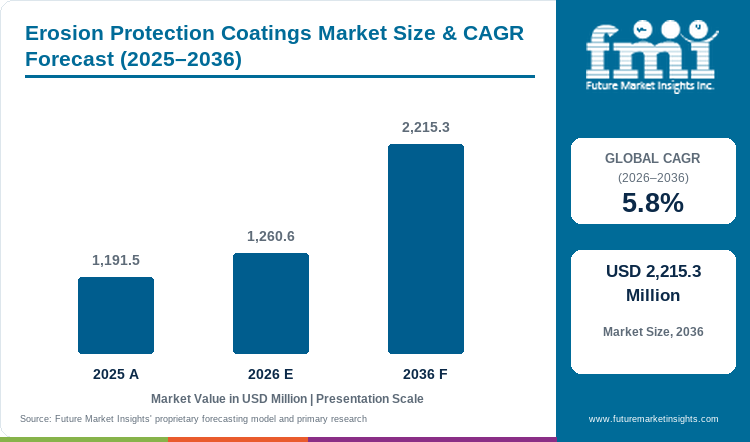
USD 1,260.6 million in 2026 and USD 2,215.3 million by 2036, expanding at 5.8% CAGR.
Sales of erosion protection coatings are estimated to rise at 5.8% CAGR through 2036. Valuation rises from USD 1,191.5 million in 2025 to USD 1,260.6 million in 2026 and reaches USD 2,215.3 million by 2036. Wind turbine blades are creating recurring coating demand as leading edges face frequent rain and grit. In April 2026, the World Wind Energy Association reported 169,014 MW of new wind capacity installed during 2025. Each new blade adds exposed surface that needs protection before regular operation begins. Aircraft and plant equipment also face rain and grit during regular service. Slurry and cavitation create different wear patterns on pumps and other exposed surfaces. Operators compare erosion tests with surface type and repair time before choosing a coating system.
Canada is projected to grow at 5.8% CAGR through 2036 compared with 4.5% for Japan. In February 2026, CanREA reported 347 MW of new Canadian wind capacity that entered service during 2025. New Canadian capacity adds factory blade demand beside an installed fleet that requires regular repair. Japan follows a slower project path as marine planning and approvals extend development schedules. Project timing determines when coating orders can move into production. Suppliers also need product approval before systems enter planned construction or repair programs.
Key Takeaways
- Wind and aerospace operators use erosion protection coatings to reduce surface damage and recurring repair requirements.
- By Coating Type, polyurethane coatings are estimated at 34.0% in 2026, supported by flexible films that absorb repeated impact on exposed surfaces.
- Wind turbine blades are expected to hold 31.0% of End Use in 2026, owing to recurring erosion along exposed leading edges.
- Spray coating is forecast at 32.0% of Application Method demand in 2026, with controlled film thickness supporting consistent coverage.
- Surface cleaning, cure limits, and changing weather can delay field use by shrinking available repair windows.
- Some of the key players in this market include 3M, AkzoNobel, Hempel, PPG, Mankiewicz, Sika, Teknos, Sherwin-Williams, Belzona, and Gurit.
Analyst Perspective
"The commercial opportunity improves when coating systems extend repair intervals without slowing application during narrow service windows. Adoption depends on proving bond strength and erosion resistance for each surface before operators accept systems for regular maintenance."
- Nikhil Kaitwade, Principal Consultant, Future Market Insights
How is the erosion protection coatings market segmented?
The erosion protection coatings market is segmented by Coating Type, End Use, Application Method, Environment, Sales Channel, and Region.
Five market axes and Region define the segmentation used in this analysis. Coating Type covers polyurethane coatings, epoxy coatings, ceramic-filled coatings, elastomeric coatings, and fluoropolymer coatings. End Use covers wind turbine blades, aircraft leading edges, industrial pumps and valves, marine structures, and oil and gas equipment. Application Method includes spray coating, brush or roller, film or tape applied, factory-applied, and field repair kits. Environment includes rain erosion, sand or particle erosion, marine erosion, chemical erosion, and high-speed airflow. Sales Channel covers OEM direct, maintenance contractors, coating distributors, and field service kits.
How do polyurethane coatings support impact resistance within the coating type category?
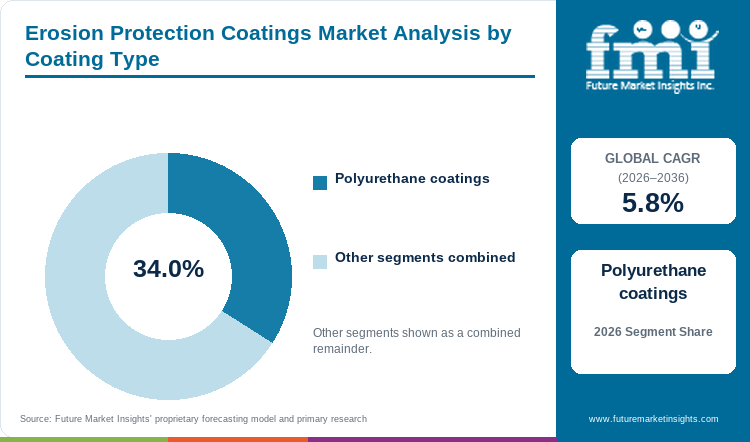
Polyurethane films bend with moving surfaces and absorb repeated impact without becoming brittle. Flexible polyurethane coatings protect fast surfaces exposed to rain, grit, and leading-edge wear. Crews need a smooth finish and controlled cure to keep protective films bonded during service. In April 2025, 3M issued a regulatory data sheet for Wind Blade Protection Tape 3.0. The regulatory sheet documents an approval route for wind blade protection systems. Approval requires verified bond strength and careful application on the selected surface. Crews also check cure conditions before systems enter regular repair work. Bond and cure checks connect film flexibility with practical approval requirements.
- Based on Coating Type, polyurethane coatings are projected at 34.0% in 2026, reinforced by flexible films that absorb repeated impact.
- Wind systems require bond testing and controlled cure before OEM approval or repair use.
What keeps wind turbine blades central to the end use category?
Wind blades face repeated rain impact and remain difficult to reach during offshore service. Small leading-edge defects reduce airflow and can expand before crews reach damaged areas. Wind power coatings must resist rain while remaining flexible on composite blade surfaces. South Korea published an offshore wind infrastructure plan in December 2025. The plan supports future blade projects that require factory protection before service. Offshore projects increase the value of longer repair intervals as access can be costly. Operators compare erosion tests with cure time and repair access during approval. A smooth leading edge supports planned service and limits deeper blade wear.
- By End Use, wind turbine blades are forecast at 31.0% in 2026, attributable to recurring erosion along exposed leading edges.
- Operators favor coating systems that keep blade edges smooth and match planned service work.
How does spray coating affect application-method selection?
Spray coating covers large surfaces while crews control flow and film thickness. Crews use coating additives to reduce sag and keep wet films stable on curved surfaces. Factory teams can repeat the same spray settings across planned production runs. In January 2026, Teknos updated safety data for TEKNOBLADE REPAIR 9000-20. Its dispenser controls coating flow during blade repair and helps crews apply an even film. Clean surfaces and steady flow protect final film quality during spray application. Poor spray control can create uneven thickness and reduce the benefit of faster coverage. Spray selection therefore depends on coverage speed and control of the finished repair.
- Spray coating is forecast at 32.0% of Application Method demand in 2026, enabled by controlled application across large exposed surfaces.
- Crews need clean surfaces and steady flow to protect film quality during spray application.
Why does rain erosion lead the environment category?
Rain erosion combines frequent droplet impact with high surface speed on blades and aircraft edges. Blade and aircraft edges need coatings that resist airflow wear and maintain strong adhesion. Marine coatings face water and salt under a different service environment. Sika's current SikaForce-860 LEP system protects wind blade edges against rain wear. Blade operators compare erosion tests with cure time before approving a repair system. Flexible surfaces also require films that remain bonded as the base moves. Repair crews balance erosion resistance with application time during short service windows. Rain-exposed assets favor systems that protect edges without making field repairs harder.
- Rain erosion is forecast to lead the Environment category at 30.0% in 2026, influenced by repeated droplet impact on fast surfaces.
- Rain-exposed assets need protective films that remain bonded as surfaces flex during regular service.
Why does OEM direct hold the sales channel position?
OEM direct sales begin with factory approval as manufacturers test coatings on each surface. Blade and aircraft manufacturers check bond strength and cure before adding coatings to production specifications. High performance epoxy coatings follow similar approval steps on some plant equipment. Mankiewicz states that wind turbine makers have qualified its rotor-blade coatings for blade use. Approved systems give turbine makers a documented coating route before production begins. Sales increase once approved systems enter factory specifications and routine production work. The same specification can guide later repair work on installed equipment. Direct supply depends on proven performance and clear repair steps across the asset life.
- OEM direct is set to lead Sales Channel at 39.0% in 2026, tied to factory approval and recurring production orders.
- Maintenance contractors handle recurring service work as field repairs follow installed coating systems and approved repair steps.
What are the drivers, restraints and opportunities in the Erosion Protection Coatings Market?
Installed high-speed assets sustain repair demand, application qualification limits eligible systems, and faster field workflows expand service-day economics.
- Driver: Wind and aerospace operators protect exposed surfaces to limit output losses and avoid shorter service intervals.
- Restraint: Field coating choices are constrained by surface cleaning, cure conditions, and approval steps during site repairs.
- Opportunity: Faster application expands workable service windows without removing required adhesion and erosion testing.
Installed assets turn surface damage into scheduled coating work
Blade damage is driving recurring coating work as worn edges can reduce turbine output. Planned repairs also limit operating losses during scheduled service periods. Offshore wind raises access costs and increases the value of longer repair intervals. In February 2026, CanREA reported more than 350 people at its operators summit on maintaining Canada's renewable assets. Aircraft and plant equipment also need protection from wear that affects output or inspection cycles. Coating firms secure recurring work by matching erosion tests with approved repair methods. Maintenance crews use those test results to plan coating work around each service window. Clear repair plans protect exposed surfaces without extending scheduled maintenance periods.
Qualification and surface preparation narrow the usable product set
Surface cleaning and site conditions narrow the coating choices available for field work. Contractors keep film thickness inside approved ranges to protect repair quality. Crews use abrasive blasting nozzles when approved methods permit abrasive preparation. In March 2026, Sika issued first-edition safety data for SikaForce-860 L02 LEP. Weather and site access can restrict field work even with approved products available. Mixing errors create another potential failure point during coating application. Teams compare repair steps with erosion tests and allow enough time for surface drying and cure. Clear repair instructions reduce rework but cannot remove weather or access limits.
Faster field application can expand the number of workable service days
Repair systems shorten field work by reducing steps inside limited access windows. Teknos maintains January 2026 data for a dispenser-applied blade repair coating. The Teknos system combines filling and erosion protection within one repair layer. Plant teams choose epoxy paint systems that reduce steps during planned maintenance work. Simple mixing and dispensing can save field time without replacing bond or erosion tests. Crews gain more usable hours for planned protection during each site visit. Contractors can complete scheduled repairs inside the same access window while following approved methods. Shorter procedures increase usable service time without changing required performance tests.
Which country CAGRs are profiled in the Erosion Protection Coatings Market?
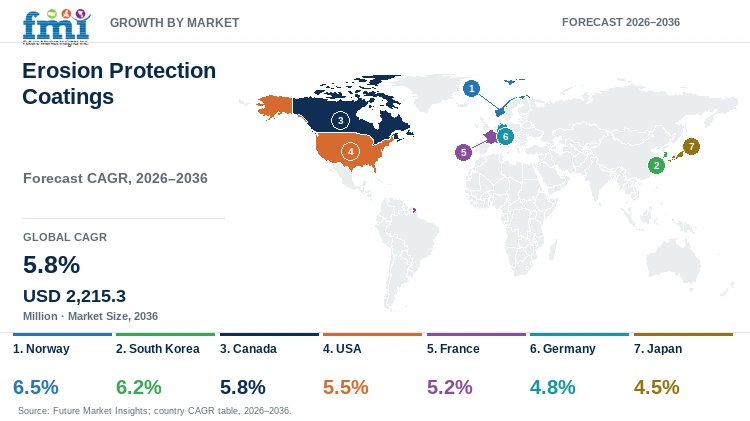
| Country | CAGR |
|---|---|
| Norway | 6.5% |
| South Korea | 6.2% |
| Canada | 5.8% |
| USA | 5.5% |
| France | 5.2% |
| Germany | 4.8% |
| Japan | 4.5% |
How do country-level CAGRs compare in the Erosion Protection Coatings Market?
The countries span a 2.0-point CAGR range from Norway at 6.5% to Japan at 4.5%. Norway and South Korea record the upper rates as offshore projects add exposed assets. Canada and the USA combine installed fleets with new project work. France and Germany depend more on mature asset bases and planned service networks. Japan's longer marine planning and approval steps postpone coating orders until projects move into production.
- Floating offshore wind exposes hard-to-reach assets, and high marine service costs increase the value of longer coating life.
- Offshore bidding expands future blade demand in South Korea, with local qualification and service support shaping which coating systems reach projects.
- Canada's broad land-based wind fleet creates recurring blade maintenance, and distant new projects add factory coating work across wide service areas.
- The large U.S. operating fleet keeps blade repair active, and selected projects add factory coating demand for new blades.
- France combines onshore and offshore wind demand, but grid timing and marine permits can delay approval work for new projects.
- Germany's mature offshore fleet sustains planned blade maintenance, with established service networks supporting approved systems across operating sites.
- Japan's marine planning and project rules lengthen construction timelines, so coating orders start later in the confirmed build cycle.
Similar country CAGRs can result from very different national buying conditions. Installed assets and project schedules determine when coating work begins.
The report covers country CAGRs across North America, Latin America, Europe, East Asia, South Asia, Oceania and the Middle East and Africa.
Country-wise Analysis
- U.S. erosion protection coating demand is predicted to advance at 5.5% CAGR through 2036, supported by repair needs across its installed wind fleet. In May 2026, EIA reported 158,646.6 MW of onshore wind summer capacity at the end of March. The installed fleet keeps blade inspections and coating repairs active across operating sites. Selected new projects also create factory coating demand for blades entering service. Aircraft and plant equipment follow separate approval paths for their coating systems. Local service teams need systems that match short outage windows and planned maintenance schedules. Fast technical support moves damaged surfaces from inspection to repair before wear becomes more severe.
- Germany's erosion protection coating demand is forecast to rise at 4.8% CAGR through 2036, reinforced by recurring service work across its offshore fleet. German wind sites use North Sea service networks for scheduled blade maintenance. In January 2026, Bundesnetzagentur reported 9.5 GW of offshore wind capacity at the end of 2025. Existing turbines need regular coating checks as exposed surfaces wear during service. New turbines require factory coating before operators place them into service. Grid work can delay new projects and postpone related coating orders. Offshore weather narrows sea access and increases the value of clear repair guides. Coating systems must match plant controls before local teams approve field use.
- Japan is estimated to post 4.5% CAGR through 2036, shaped by marine planning and project rules that lengthen the route to construction. Japanese offshore projects need longer planning before blade orders move into production. In June 2026, METI revised offshore wind bidding rules after project cancellations across three sea areas. The revised bidding rules place more weight on project delivery and schedule control. The new rules can delay coating volume until projects reach the construction stage. Coating suppliers need local support during product approval and later service work. Repair methods must satisfy documented quality checks before teams approve regular use. Marine access limits field-work days, making clear records important during the move from trials to service.
- South Korean erosion protection coating demand is estimated to expand at 6.2% CAGR through 2036, influenced by offshore bidding that supports new blade projects. Current bidding rules place greater weight on project delivery and local support. In June 2026, the climate ministry released a roadmap with at least 4 GW of annual offshore wind bidding. The roadmap targets 10.5 GW installed or under construction by 2030. New projects require blade protection before service and reliable repair support during operation. Local service capability affects repair speed across remote offshore sites. Vendors need steady supply routes and service partners near project areas. Local partners shorten the path from damage checks to repair without changing qualification requirements.
- Canada's erosion protection coatings outlook is anticipated to advance at 5.8% CAGR through 2036, tied to service needs across remote wind fleets. In April 2026, CanREA projected a need for 54 to 88 GW of new wind plus solar and storage capacity. Project timing varies across provinces and distant wind service areas. Remote locations lengthen travel and increase service costs for repair crews. Coating suppliers need contractor coverage near major wind sites and planned work windows. Local stock reduces the risk of lost visits for crews serving distant assets. Simple repair systems help crews use limited site time without reducing required performance checks.
- France's erosion protection coating sales are forecast to expand at 5.2% CAGR through 2036, linked to installed assets and new projects entering service. French wind demand combines a large onshore base with offshore projects entering service. In September 2026, the national statistics service reported 26.7 GW of wind capacity at the end of June. The agency also recorded 0.8 GW of additions during the first half of 2026. Marine permits and grid timing can delay coating decisions for new offshore projects. New blades need factory protection before service, while existing assets require planned repair systems. Coating suppliers support factory application and field maintenance across both asset groups. Technical support keeps approval work aligned with project and service schedules.
- Norway is projected to grow at 6.5% CAGR through 2036, driven by floating wind projects and high service costs that favor longer coating life. Norwegian offshore wind faces high access costs in deep water. In February 2026, the Ministry of Energy confirmed 1,500 MW of planned Utsira Nord capacity. Two groups received project areas in the December 2025 award. License work and state-aid rules shape schedules before construction begins. Floating sites need marine service crews that can work within short weather windows. Longer coating life reduces the number of difficult repair visits at sea. Cold and wet conditions make cure control more important during field application.
Who are the notable companies in the Erosion Protection Coatings Market?
3M, AkzoNobel, Hempel, PPG, Mankiewicz, Sika, Teknos, Sherwin-Williams, Belzona, Gurit are active within the defined erosion protection coatings supply boundary.
Coating firms compete by surface type as each application follows a separate approval path. Wind blade suppliers focus on rain damage and repair work along exposed leading edges. Aircraft coating firms follow formal qualification rules before production or maintenance programs begin. Plant repair specialists treat cavitation and slurry wear on pumps and other equipment. Some high-wear plant surfaces use ceramic coatings, whereas wind systems follow separate approval and service requirements.
- Wind blade protection and repair includes 3M, AkzoNobel, Hempel, Mankiewicz, Sika, Teknos, and Gurit.
- Aerospace exterior systems include PPG, Mankiewicz, and Sherwin-Williams for aircraft production and MRO programs.
- Industrial erosion repair includes Belzona, AkzoNobel, and PPG for plant and marine equipment exposed to severe wear.
Competitive Benchmarking: Erosion Protection Coatings Market
| Company | Wind Blade Protection | Aerospace Qualification | Industrial Erosion Repair | Geographic Reach |
|---|---|---|---|---|
| 3M | High | Medium | Medium | Global |
| AkzoNobel | High | Medium | High | Global |
| Hempel | High | Low | Medium | Global |
| PPG | Medium | High | High | Global |
| Mankiewicz | High | High | Medium | Global |
| Sika | High | Low | Medium | Global |
| Teknos | High | Low | Medium | Europe and international wind markets |
| Sherwin-Williams | Low | High | Medium | Global |
| Belzona | Low | Low | High | Global distributor network |
| Gurit | Medium | Low | Medium | Global wind markets |
A High rating requires direct current proof for the capability being assessed. A Medium rating means public evidence covers a narrower product or use case. A Low rating means public evidence remains limited for the assessed capability. Geographic reach describes where a company operates and does not change its capability rating.
Key Developments in the Erosion Protection Coatings Market
- In July 2026, Gurit secured a two-year formulated-products supply agreement placed by a global wind turbine manufacturer. The contract covered specialized formulated products used within the buyer's wind supply program.
- In June 2026, Belzona reported repair work on a hydroelectric turbine with erosion and cavitation damage across exposed surfaces. Its coated repair systems restored the damaged turbine areas during the completed project.
- In August 2025, Sherwin-Williams Aerospace Coatings received four additional AMS 3095B qualifications for commercial-aircraft exterior coating systems. The approvals expanded its documented list of qualified aircraft coatings.
Key Players in the Erosion Protection Coatings Market
Wind Blade Leading-Edge Protection and Rotor-Blade Coatings
- 3M
- AkzoNobel
- Hempel
- Mankiewicz
- Sika
- Teknos
Aerospace Exterior and High-Speed Coating Systems
- PPG
- Sherwin-Williams
Industrial Erosion Repair Materials
- Belzona
Composite and Blade-Life Support Materials
- Gurit
Erosion Protection Coatings Market - Report Scope
| Coverage field | Report scope |
|---|---|
| Market breakdown | By coating type, end use, application method, environment, sales channel, and region. |
| Quantitative Units | USD million. |
| Market Definition | Commercial erosion protection coatings and coating kits sold for wind, aerospace, industrial, marine, and oil and gas applications are included. Downstream equipment revenue, application labor, inspection services, unrelated structural repair, corrosion-only coatings, and decorative coatings are excluded. |
| Regions Covered | North America, Latin America, Western Europe, Eastern Europe, East Asia, South Asia and Pacific, and Middle East and Africa. |
| Countries Covered | Norway, South Korea, Canada, USA, France, Germany, Japan, and 20+ countries included in the full report. |
| Key Companies Profiled | 3M, AkzoNobel, Hempel, PPG, Mankiewicz, Sika, Teknos, Sherwin-Williams, Belzona, Gurit. |
| Forecast Period | 2026 to 2036. |
| Approach | Primary and secondary research with market triangulation. |
Erosion Protection Coatings Market - Research Methodology
| Method | Approach |
|---|---|
| Primary Research | FMI analysts gathered input from manufacturers, service providers, technology developers, distributors, end users, procurement teams, and subject-matter experts. Interviews examined purchasing decisions, product or service evaluation, adoption barriers, approval requirements, pricing considerations, and expectations for technical or commercial support. Respondents were also asked what evidence is required before a trial, pilot, or initial order develops into regular purchasing. |
| Desk Research | Desk research covered government statistics, regulatory publications, trade data, industry associations, technical literature, standards, company filings, product information, and official corporate announcements. Sources were reviewed for relevance, publication date, geographic coverage, and consistency with the defined market scope. Claims relating to performance, applications, approvals, capacity, investment, and commercial activity were retained only when supported by credible public evidence. |
| Market Sizing and Forecasting | The market model combined the baseline value with historical performance, segment structure, pricing and volume indicators, adoption levels, company participation, and country-level demand conditions. Forecast assumptions considered economic activity, investment trends, regulatory developments, technology adoption, purchasing cycles, supply availability, and barriers to wider market use. Segment and regional estimates were reconciled before the final market total was calculated. |
| Data Validation | Estimates were checked against multiple independent indicators, including public data, company activity, trade patterns, industry developments, and findings from primary interviews. Validation also tested whether products, services, applications, and company revenues fell within the defined market boundaries. Adjacent categories, unsupported claims, overlapping revenues, and activities without direct market relevance were excluded to reduce double counting and maintain consistency across segments and countries. |
Erosion Protection Coatings Market by Segments
Erosion Protection Coatings Market segmented by Coating Type:
- Polyurethane coatings
- Epoxy coatings
- Ceramic-filled coatings
- Elastomeric coatings
- Fluoropolymer coatings
Erosion Protection Coatings Market segmented by End Use:
- Wind turbine blades
- Aircraft leading edges
- Industrial pumps/valves
- Marine structures
- Oil and gas equipment
Erosion Protection Coatings Market segmented by Application Method:
- Spray coating
- Brush/roller
- Film/tape applied
- Factory-applied
- Field repair kits
Erosion Protection Coatings Market segmented by Environment:
- Rain erosion
- Sand/particle erosion
- Marine erosion
- Chemical erosion
- High-speed airflow
Erosion Protection Coatings Market segmented by Sales Channel:
- OEM direct
- Maintenance contractors
- Coating distributors
- Field service kits
Erosion Protection Coatings Market by Region:
- North America
- United States
- Canada
- Latin America
- Brazil
- Mexico
- Chile
- Rest of Latin America
- Western Europe
- Germany
- United Kingdom
- Italy
- Spain
- France
- Nordics
- Benelux
- Rest of Western Europe
- Eastern Europe
- Russia
- Poland
- Hungary
- Balkan and Baltic States
- Rest of Eastern Europe
- East Asia
- China
- Japan
- South Korea
- South Asia and Pacific
- India
- ASEAN
- Australia and New Zealand
- Rest of South Asia and Pacific
- Middle East and Africa
- Kingdom of Saudi Arabia
- Other GCC Countries
- Türkiye
- South Africa
- Other African Union Countries
- Rest of Middle East and Africa
Research Sources and Bibliography
- World Wind Energy Association. (2026, April 2). WWEA Annual Report 2025: Record Growth and Emerging Challenges.
- Canadian Renewable Energy Association. (2026, February 3). Canada added 347 MW of wind capacity in 2025 and approached 19 GW of installed wind capacity.
- 3M Company. (2025, April 25). 3M Wind Blade Protection Tape 3.0 W8851 regulatory data sheet.
- Ministry of Climate, Energy and Environment, Republic of Korea. (2025, December). Offshore wind infrastructure expansion and deployment plan.
- Teknos Group. (2026, January 12). TEKNOBLADE REPAIR 9000-20 safety data sheet.
- Sika. (n.d.). Rapid application. Lasting protection. Retrieved September 22, 2026.
- Mankiewicz Coating Solutions. (n.d.). Wind energy coating solutions. Retrieved September 22, 2026.
- Canadian Renewable Energy Association. (2026, February 12). Operations Summit brings together renewable energy operators and service teams.
- Sika. (2026, March 4). SikaForce-860 L02 LEP safety data sheet.
- Teknos Group. (n.d.). Wind turbine maintenance. Retrieved September 22, 2026.
- U.S. Energy Information Administration. (2026, May 19). Electric Power Monthly with data for March 2026.
- Bundesnetzagentur. (2026, January 8). Growth in renewable energy in 2025.
- Ministry of Economy, Trade and Industry, Japan. (2026, June 5). Operational guidelines for the general-sea-area offshore wind public bidding system revised.
- Ministry of Climate, Energy and Environment, Republic of Korea. (2026, June 30). Offshore wind mid- to long-term bidding roadmap released.
- Canadian Renewable Energy Association. (2026, April 30). Canada could require 54 to 88 GW of new wind, solar and storage capacity over the next decade.
- Statistical Data and Studies Department, France. (2026, September 4). Wind power dashboard - Second quarter 2026.
- Ministry of Energy, Norway. (2026, February 12). Utsira Nord.
- Gurit Holding AG. (2026, July 31). Gurit expands partnership with a global wind OEM through a new formulated-products supply contract.
- Belzona. (2026). Turbine components repaired with Belzona. Application completed June 2026.
- Sherwin-Williams Aerospace Coatings. (2025, August 1). Sherwin-Williams Aerospace Coatings receives four additional AMS 3095B qualifications.
- 3M Company. (n.d.). Wind turbine manufacturing and maintenance. Retrieved September 22, 2026.
- Hempel A/S. (n.d.). Wind blade coating and protection solutions. Retrieved September 22, 2026.
- PPG. (n.d.). Aerospace erosion-resistant polyurethane coating systems. Retrieved September 22, 2026.
- AkzoNobel. (n.d.). Marine and protective coatings for wind and industrial assets. Retrieved September 22, 2026.
- Belzona. (n.d.). Erosion and cavitation repair systems. Retrieved September 22, 2026.
- Gurit Holding AG. (n.d.). Wind energy materials and engineered solutions. Retrieved September 22, 2026.
- AkzoNobel. (2026, August 19). AkzoNobel lightens the load for TAP Air Portugal with more efficient aerospace coating.
- Hempel A/S. (2025, November 4). East Anglia 3 project: Haizea and Hempel.
- PPG. (2025, October 7). PPG launches PMC City, a digital hub for coatings selection.
- AkzoNobel. (2026, May). AkzoNobel supplies protective power for flagship energy project in China.
- Hempel A/S. (2026, September 14). Hempel secures 3-year global hull coatings agreement with Maersk for fleet dry dockings.
- PPG. (2025, May 8). PPG announces a new aerospace coatings and sealants manufacturing facility in Shelby, North Carolina.
- Belzona. (2025, August). Belzona protection against erosion-corrosion in new heat exchangers.
- Sherwin-Williams Aerospace Coatings. (2025, March 20). Sherwin-Williams announces four new aircraft model types for its Aircraft Color Visualizer.
- Gurit Holding AG. (2026, March 9). Gurit secures two-year contract for glass pultruded blade root reinforcements.
This bibliography is provided for reader reference and is not exhaustive. The full report contains the complete reference list and detailed citations.
This Report Answers
- How large is the erosion protection coatings market in 2026 and 2036?
- Which coating type accounts for 34.0% of revenue in 2026?
- Which end-use segment accounts for 31.0% of demand in 2026?
- Why is spray coating projected at 32.0% of application-method demand in 2026?
- How do surface preparation and weather limits restrict coating use during field repair?
- How do country CAGRs differ across the seven profiled countries?
- Which companies serve wind, aerospace, and industrial erosion protection applications?
- What should technical teams compare before approving an erosion protection coating?
Frequently Asked Questions
How big is the erosion protection coatings market in 2026?
The erosion protection coatings market is valued at USD 1,260.6 million in 2026. It is projected to reach USD 2,215.3 million by 2036 as exposed assets require recurring surface protection.
What is the CAGR of the erosion protection coatings market from 2026 to 2036?
The erosion protection coatings market is projected to grow at 5.8% CAGR from 2026 to 2036. Ongoing surface wear keeps demand connected to regular protection and repair programs.
Which coating type leads the erosion protection coatings market in 2026?
Polyurethane coatings are estimated to hold 34.0% of coating type revenue in 2026 for the erosion protection coatings market. Their flexible films absorb repeated impact and remain useful on moving surfaces.
Which end-use segment holds a major current share in the erosion protection coatings market?
Wind turbine blades are projected to account for 31.0% of end-use demand in 2026 for the erosion protection coatings market. Leading-edge wear connects coating selection with output protection and planned repair work.
Which companies are active in the erosion protection coatings market?
Key companies include 3M, AkzoNobel, Hempel, PPG, Mankiewicz, Sika, Teknos, Sherwin-Williams, Belzona, and Gurit. Their documented roles cover wind blades, aircraft exteriors, plant repair, and composite support systems.
Preview the report firsthand - request a free sample
Get SampleGet the brochure for pricing and purchase details.
Get PDFTable of Content
- Key Takeaways
- Market Size and CAGR
- Top Growth Driver
- Fastest Growing Segment
- Leading Region
- Key Companies
- Emerging Opportunities
- Executive Summary
- Global Market Outlook
- Demand-side Trends
- Supply-side Trends
- Technology Roadmap Analysis
- Analysis and Recommendations
- Analyst Perspective (What is happening? Why now? What should investors know?)
- Key Questions Answered
- How large is the market?
- What is the CAGR?
- What are key trends?
- Which region dominates?
- Who are the leaders?
- Market Overview
- Market Coverage / Taxonomy
- Market Definition / Scope / Limitations
- Research Methodology
- Chapter Orientation
- Analytical Lens and Working Hypotheses
- Market Structure, Signals, and Trend Drivers
- Benchmarking and Cross-market Comparability
- Market Sizing, Forecasting, and Opportunity Mapping
- Research Design and Evidence Framework
- Desk Research Programme (Secondary Evidence)
- Expert Input and Fieldwork (Primary Evidence)
- Tooling, Models, and Reference Databases
- Data Engineering and Model Build
- Quality Assurance and Audit Trail
- Market Background
- Market Dynamics (Drivers, Restraints, Opportunity, Trends)
- Scenario Forecast (Optimistic, Likely, Conservative)
- Impact Analysis
- AI Impact
- Sustainability Impact
- Regulatory Impact
- Technology Impact
- Consumer / Buyer Analysis
- Purchase Drivers
- Adoption Barriers
- Buyer Journey
- Opportunity Map Analysis
- Product Life Cycle Analysis
- Supply Chain Analysis
- Investment Feasibility Matrix
- Value Chain Analysis
- PESTLE and Porter's Analysis
- Regulatory Landscape
- Regional Parent Market Outlook
- Production and Consumption Statistics
- Import and Export Statistics
- Global Market Analysis and Forecast, 2021 to 2036
- Historical Market Size Value (USD Million) Analysis, 2021 to 2025
- Current and Future Market Size Value (USD Million) Projections, 2026 to 2036
- Y-o-Y Growth Trend Analysis
- Absolute $ Opportunity Analysis
- Global Market Pricing Analysis, 2021 to 2036
- Global Market Analysis and Forecast, By Coating Type, 2021 to 2036
- Introduction / Key Findings
- Historical Market Size Value (USD Million) Analysis By Coating Type, 2021 to 2025
- Current and Future Market Size Value (USD Million) Analysis and Forecast By Coating Type, 2026 to 2036
- Polyurethane coatings
- Epoxy coatings
- Ceramic-filled coatings
- Elastomeric coatings
- Fluoropolymer coatings
- Y-o-Y Growth Trend Analysis By Coating Type, 2021 to 2025
- Absolute $ Opportunity Analysis By Coating Type, 2026 to 2036
- Global Market Analysis and Forecast, By End Use, 2021 to 2036
- Introduction / Key Findings
- Historical Market Size Value (USD Million) Analysis By End Use, 2021 to 2025
- Current and Future Market Size Value (USD Million) Analysis and Forecast By End Use, 2026 to 2036
- Wind turbine blades
- Aircraft leading edges
- Industrial pumps/valves
- Marine structures
- Oil and gas equipment
- Y-o-Y Growth Trend Analysis By End Use, 2021 to 2025
- Absolute $ Opportunity Analysis By End Use, 2026 to 2036
- Global Market Analysis and Forecast, By Application Method, 2021 to 2036
- Introduction / Key Findings
- Historical Market Size Value (USD Million) Analysis By Application Method, 2021 to 2025
- Current and Future Market Size Value (USD Million) Analysis and Forecast By Application Method, 2026 to 2036
- Spray coating
- Brush/roller
- Film/tape applied
- Factory-applied
- Field repair kits
- Y-o-Y Growth Trend Analysis By Application Method, 2021 to 2025
- Absolute $ Opportunity Analysis By Application Method, 2026 to 2036
- Global Market Analysis and Forecast, By Environment, 2021 to 2036
- Introduction / Key Findings
- Historical Market Size Value (USD Million) Analysis By Environment, 2021 to 2025
- Current and Future Market Size Value (USD Million) Analysis and Forecast By Environment, 2026 to 2036
- Rain erosion
- Sand/particle erosion
- Marine erosion
- Chemical erosion
- High-speed airflow
- Y-o-Y Growth Trend Analysis By Environment, 2021 to 2025
- Absolute $ Opportunity Analysis By Environment, 2026 to 2036
- Global Market Analysis and Forecast, By Sales Channel, 2021 to 2036
- Introduction / Key Findings
- Historical Market Size Value (USD Million) Analysis By Sales Channel, 2021 to 2025
- Current and Future Market Size Value (USD Million) Analysis and Forecast By Sales Channel, 2026 to 2036
- OEM direct
- Maintenance contractors
- Coating distributors
- Field service kits
- Y-o-Y Growth Trend Analysis By Sales Channel, 2021 to 2025
- Absolute $ Opportunity Analysis By Sales Channel, 2026 to 2036
- Global Market Analysis and Forecast, By Region, 2021 to 2036
- Introduction
- Historical Market Size Value (USD Million) Analysis By Region, 2021 to 2025
- Current Market Size Value (USD Million) Analysis and Forecast By Region, 2026 to 2036
- North America
- Latin America
- Western Europe
- Eastern Europe
- East Asia
- South Asia and Pacific
- Middle East and Africa
- Market Attractiveness Analysis By Region
- North America Market Analysis and Forecast, By Country, 2021 to 2036
- Historical Market Size Value (USD Million) Trend Analysis By Market Taxonomy, 2021 to 2025
- Market Size Value (USD Million) Forecast By Market Taxonomy, 2026 to 2036
- By Country
- United States
- Canada
- By Coating Type
- By End Use
- By Application Method
- By Environment
- By Sales Channel
- By Country
- Market Attractiveness Analysis
- By Country
- By Coating Type
- By End Use
- By Application Method
- By Environment
- By Sales Channel
- Key Takeaways
- Latin America Market Analysis and Forecast, By Country
- Historical Market Size Value (USD Million) Trend Analysis By Market Taxonomy, 2021 to 2025
- Market Size Value (USD Million) Forecast By Market Taxonomy, 2026 to 2036
- By Country
- Brazil
- Mexico
- Chile
- Rest of Latin America
- By Coating Type
- By End Use
- By Application Method
- By Environment
- By Sales Channel
- By Country
- Market Attractiveness Analysis
- By Country
- By Coating Type
- By End Use
- By Application Method
- By Environment
- By Sales Channel
- Key Takeaways
- Western Europe Market Analysis and Forecast, By Country
- Historical Market Size Value (USD Million) Trend Analysis By Market Taxonomy, 2021 to 2025
- Market Size Value (USD Million) Forecast By Market Taxonomy, 2026 to 2036
- By Country
- Germany
- United Kingdom
- Italy
- Spain
- France
- Nordics
- Benelux
- Rest of Western Europe
- By Coating Type
- By End Use
- By Application Method
- By Environment
- By Sales Channel
- By Country
- Market Attractiveness Analysis
- By Country
- By Coating Type
- By End Use
- By Application Method
- By Environment
- By Sales Channel
- Key Takeaways
- Eastern Europe Market Analysis and Forecast, By Country
- Historical Market Size Value (USD Million) Trend Analysis By Market Taxonomy, 2021 to 2025
- Market Size Value (USD Million) Forecast By Market Taxonomy, 2026 to 2036
- By Country
- Russia
- Poland
- Hungary
- Balkan and Baltic States
- Rest of Eastern Europe
- By Coating Type
- By End Use
- By Application Method
- By Environment
- By Sales Channel
- By Country
- Market Attractiveness Analysis
- By Country
- By Coating Type
- By End Use
- By Application Method
- By Environment
- By Sales Channel
- Key Takeaways
- East Asia Market Analysis and Forecast, By Country
- Historical Market Size Value (USD Million) Trend Analysis By Market Taxonomy, 2021 to 2025
- Market Size Value (USD Million) Forecast By Market Taxonomy, 2026 to 2036
- By Country
- China
- Japan
- South Korea
- By Coating Type
- By End Use
- By Application Method
- By Environment
- By Sales Channel
- By Country
- Market Attractiveness Analysis
- By Country
- By Coating Type
- By End Use
- By Application Method
- By Environment
- By Sales Channel
- Key Takeaways
- South Asia and Pacific Market Analysis and Forecast, By Country
- Historical Market Size Value (USD Million) Trend Analysis By Market Taxonomy, 2021 to 2025
- Market Size Value (USD Million) Forecast By Market Taxonomy, 2026 to 2036
- By Country
- India
- ASEAN
- Australia and New Zealand
- Rest of South Asia and Pacific
- By Coating Type
- By End Use
- By Application Method
- By Environment
- By Sales Channel
- By Country
- Market Attractiveness Analysis
- By Country
- By Coating Type
- By End Use
- By Application Method
- By Environment
- By Sales Channel
- Key Takeaways
- Middle East and Africa Market Analysis and Forecast, By Country
- Historical Market Size Value (USD Million) Trend Analysis By Market Taxonomy, 2021 to 2025
- Market Size Value (USD Million) Forecast By Market Taxonomy, 2026 to 2036
- By Country
- Kingdom of Saudi Arabia
- Other GCC Countries
- Türkiye
- South Africa
- Other African Union Countries
- Rest of Middle East and Africa
- By Coating Type
- By End Use
- By Application Method
- By Environment
- By Sales Channel
- By Country
- Market Attractiveness Analysis
- By Country
- By Coating Type
- By End Use
- By Application Method
- By Environment
- By Sales Channel
- Key Takeaways
- Key Countries Market Analysis
- United States
- Pricing Analysis
- Market Share Analysis, 2025
- By Coating Type
- By End Use
- By Application Method
- By Environment
- By Sales Channel
- Canada
- Pricing Analysis
- Market Share Analysis, 2025
- By Coating Type
- By End Use
- By Application Method
- By Environment
- By Sales Channel
- Mexico
- Pricing Analysis
- Market Share Analysis, 2025
- By Coating Type
- By End Use
- By Application Method
- By Environment
- By Sales Channel
- Brazil
- Pricing Analysis
- Market Share Analysis, 2025
- By Coating Type
- By End Use
- By Application Method
- By Environment
- By Sales Channel
- Chile
- Pricing Analysis
- Market Share Analysis, 2025
- By Coating Type
- By End Use
- By Application Method
- By Environment
- By Sales Channel
- Germany
- Pricing Analysis
- Market Share Analysis, 2025
- By Coating Type
- By End Use
- By Application Method
- By Environment
- By Sales Channel
- United Kingdom
- Pricing Analysis
- Market Share Analysis, 2025
- By Coating Type
- By End Use
- By Application Method
- By Environment
- By Sales Channel
- Italy
- Pricing Analysis
- Market Share Analysis, 2025
- By Coating Type
- By End Use
- By Application Method
- By Environment
- By Sales Channel
- Spain
- Pricing Analysis
- Market Share Analysis, 2025
- By Coating Type
- By End Use
- By Application Method
- By Environment
- By Sales Channel
- France
- Pricing Analysis
- Market Share Analysis, 2025
- By Coating Type
- By End Use
- By Application Method
- By Environment
- By Sales Channel
- India
- Pricing Analysis
- Market Share Analysis, 2025
- By Coating Type
- By End Use
- By Application Method
- By Environment
- By Sales Channel
- ASEAN
- Pricing Analysis
- Market Share Analysis, 2025
- By Coating Type
- By End Use
- By Application Method
- By Environment
- By Sales Channel
- Australia and New Zealand
- Pricing Analysis
- Market Share Analysis, 2025
- By Coating Type
- By End Use
- By Application Method
- By Environment
- By Sales Channel
- China
- Pricing Analysis
- Market Share Analysis, 2025
- By Coating Type
- By End Use
- By Application Method
- By Environment
- By Sales Channel
- Japan
- Pricing Analysis
- Market Share Analysis, 2025
- By Coating Type
- By End Use
- By Application Method
- By Environment
- By Sales Channel
- South Korea
- Pricing Analysis
- Market Share Analysis, 2025
- By Coating Type
- By End Use
- By Application Method
- By Environment
- By Sales Channel
- Russia
- Pricing Analysis
- Market Share Analysis, 2025
- By Coating Type
- By End Use
- By Application Method
- By Environment
- By Sales Channel
- Poland
- Pricing Analysis
- Market Share Analysis, 2025
- By Coating Type
- By End Use
- By Application Method
- By Environment
- By Sales Channel
- Hungary
- Pricing Analysis
- Market Share Analysis, 2025
- By Coating Type
- By End Use
- By Application Method
- By Environment
- By Sales Channel
- Kingdom of Saudi Arabia
- Pricing Analysis
- Market Share Analysis, 2025
- By Coating Type
- By End Use
- By Application Method
- By Environment
- By Sales Channel
- Türkiye
- Pricing Analysis
- Market Share Analysis, 2025
- By Coating Type
- By End Use
- By Application Method
- By Environment
- By Sales Channel
- South Africa
- Pricing Analysis
- Market Share Analysis, 2025
- By Coating Type
- By End Use
- By Application Method
- By Environment
- By Sales Channel
- Norway
- Pricing Analysis
- Market Share Analysis, 2025
- By Coating Type
- By End Use
- By Application Method
- By Environment
- By Sales Channel
- United States
- Market Structure Analysis
- Competition Dashboard
- Competition Benchmarking
- Market Share Analysis of Top Players
- By Regional
- By Coating Type
- By End Use
- By Application Method
- By Environment
- By Sales Channel
- Emerging Startups
- Innovation Benchmarking
- Competition Analysis
- Competition Deep Dive
- 3M
- Overview
- Product Portfolio
- Profitability by Market Segments
- Sales Footprint
- Strategy Overview
- Marketing Strategy
- Product Strategy
- Channel Strategy
- AkzoNobel
- Hempel
- PPG
- Mankiewicz
- Sika
- Teknos
- Sherwin-Williams
- Belzona
- Gurit
- 3M
- Case Studies
- Success Stories
- Recent Developments
- Competition Deep Dive
- Assumptions & Acronyms Used


