

- Market Size (2026)
- USD 1.2 Bn
- Forecast (2036)
- USD 2.5 Bn
- CAGR (2026 to 2036)
- 7.6%
How big is External Urine Management Products Market size?
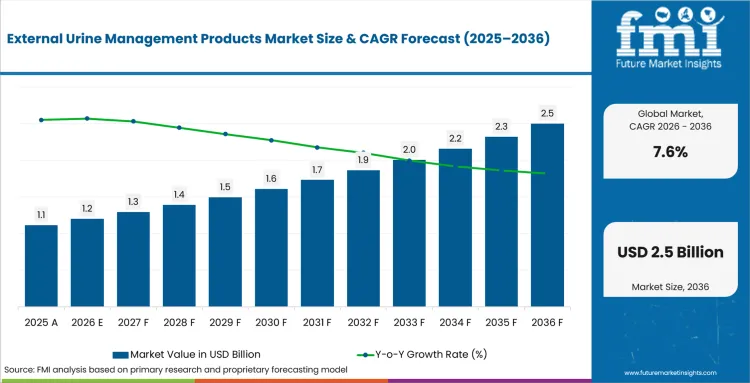
USD 1.2 billion in 2026 and USD 2.5 billion by 2036 at a 7.6% CAGR.
Demand for external urine management products is projected to expand at 7.6% CAGR between 2026 and 2036, increasing valuation from USD 1.2 billion in 2026 to USD 2.5 billion by 2036. The market encompasses non-invasive devices collecting and managing urine externally, offering comfortable alternatives to traditional catheters. Medical teams actively deploy male and female collection devices and suction-assisted accessories to handle drainage without inserting invasive tubes. Caregivers across various healthcare facilities readily adopt such solutions products delivering reliable urine capture for individuals experiencing incontinence or immobility. In June 2024, the International Wound Journal published clinical findings showing a 36.3% reduction in hospital-acquired incontinence-associated dermatitis among 1,897 monitored patients. Such documented improvements encourage clinical evaluators to combine dependable urine capture with recurring skin checks.
In the United States and Germany, purchasing teams prioritize documented skin-surveillance routines and demand an uninterrupted supply of accessories. Buying groups in China and India emphasize local service accessibility and seek concise training procedures for their medical staff. A systematic review from May 2024 highlighted a 14.0% decline in indwelling-catheter utilization after hospital staff implemented female external urine wicking devices. Such clinical findings reinforce the need for comprehensive staff training across participating care settings by demonstrating successful protocols centered on proper patient selection and consistent placement.
Key Takeaways for the External Urine Management Products Market
- Demand for external urine management products reflects hospital catheter-reduction programs and expanding long-term care as improved female external collection designs extend suitable use.
- Silicone is anticipated to garner 51.0% share of material in 2026, led by soft contact surfaces and established use across adhesive external catheters.
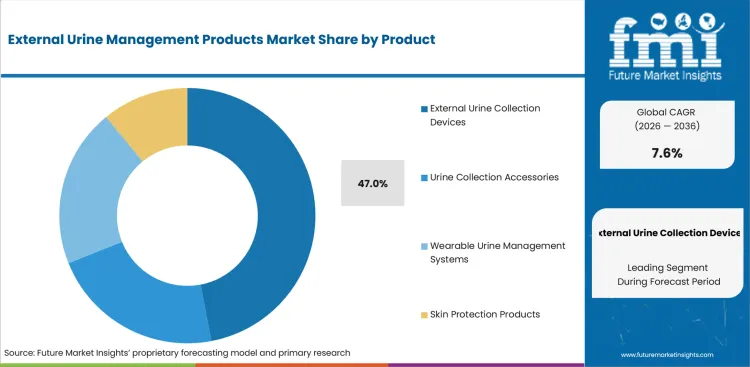
- External urine collection devices are likely to lead Product with 47.0% share in 2026, reflecting direct urine diversion across hospital and home-care settings.
- Skin injury and leakage combine with placement variation to limit repeat use across settings lacking staff training or suction availability.
- Competition focusses on Becton, Dickinson and Company, Stryker Corporation, Medline Industries, LP, Coloplast A/S, Hollister Incorporated, Teleflex Incorporated, and Consure Medical Pvt. Ltd., with providers differentiating based on urine-capture performance and clinical support.
Analyst Perspective
“External urine management products reward suppliers converting catheter-reduction protocols into repeatable capture performance across actual care settings. Clinical teams examine leakage control and skin surveillance throughout product review across participating inpatient units. Durable demand follows documented urine diversion and lower nursing rework across approved patient groups during recurring use.”
- Anurag Sharma, Principal Analyst for Healthcare at Future Market Insights
How is External Urine Management Products Market segmented?
The external urine management products sector is segmented by product, application, end user, material, distribution channel, and region.
The external urine management products industry is segmented by product, application, end user, material, distribution channel, and region. Product coverage includes external collection devices and accessories together with wearable systems and supporting skin protection products. Application coverage addresses urinary incontinence and critical care across neurological disorders and geriatric care settings. End-user coverage spans hospitals and long-term care facilities together with home healthcare and ambulatory surgical centers. Material coverage evaluates silicone and latex together with thermoplastic elastomers and hydrocolloid materials used across external devices. Distribution coverage includes hospital pharmacies and retail pharmacies together with online sales serving supported home-care use. Regional coverage includes North America, Latin America, Western Europe, Eastern Europe, East Asia, South Asia and Pacific, Middle East and Africa.
What supports external urine collection devices within product demand?
External urine collection devices lead product as hospitals and care providers purchase a complete urine-diversion function instead of isolated accessories. American Journal of Infection Control evaluated 50 paired urine specimens in March 2024, showing comparable chemistry results across control and externally wicked samples. Preserved test accuracy supports external collection during clinical monitoring without transurethral sample collection. Product acceptance rests on capture consistency during routine movement and predictable replacement practice across several shifts. Accessory compatibility supports bedside collection through accurate placement and recurring skin inspection.
- In 2026, external urine collection devices are set to account for 47.0% share since being helped by direct collection across male and female anatomy without urethral insertion. Clinical teams examine leakage frequency and nursing touches during trials since poor placement raises linen use and interrupts scheduled care.
- Wearable systems and urine collection accessories are anticipated to challenge established devices through mobility support and simpler discharge routines. Commercial progress requires secure tubing connections and dependable replacement access across urinary bags used in hospital and home settings.
Why does urinary incontinence lead application demand?
Stress and urge incontinence require different placement conditions from functional incontinence across varying patient assistance levels. Journal of Clinical Medicine reported a 90.9% mean urine-capture rate in December 2025, supporting overnight external collection for women managing nocturnal urinary incontinence at home. Recorded performance connects application demand with dependable capture during independent use. External products focus on urine capture and skin protection without correcting underlying continence mechanisms. Urinary incontinence contributes to application as recurring urine loss creates sustained need for non-invasive collection across acute and community care.
- Urinary incontinence is estimated to represent 44.0% share of application in 2026, reflecting recurring management needs across adult patients seeking alternatives to absorbent products or indwelling catheters. Product value grows through reliable overnight capture and fewer interruptions connected with linen changes or bedside repositioning.
- Critical care and neurological disorders are projected to support additional demand through immobility and limited toileting independence. Suppliers serving those applications require clear eligibility criteria as retention and stool exposure may alter suitability during agitation or prone positioning.
How do hospitals shape end user demand?
Hospitals influence demand through infection-prevention programs requiring frequent monitoring of catheter exposure across inpatient units. Nursing teams assess urine diversion together with skin condition and output measurement across changing mobility status during admission. Journal of Clinical Nursing reported 5.0% new or worsening skin breakdown among 381 women across 57 inpatient units in July 2024, supporting hospital use through daily skin assessment and documented placement. Clinical review links product approval with consistent skin surveillance across participating wards.
- Based on end user, hospitals are likely to hold 42.0% share in 2026 owing to formal review of catheter days and nursing workflows across inpatient units. Adoption advances through documented placement routines and clear escalation criteria for patients requiring internal drainage.
- Long-term care facilities and home-care providers are forecast to expand external-device use through overnight management and caregiver support. Purchase continuity relies on simple instructions and replacement availability across homecare medical devices supplied outside centralized hospital stores.
Why does silicone lead material demand?
Silicone combines soft contact properties and established use across self-adhering male external catheters. Cureus reported 1.8% urine leakage across 55 evaluations in September 2024, promoting silicone selection for stable drainage during patient movement. Study findings also support skin-tolerance review during recurring catheter placement. Transparent silicone products permit ongoing skin observation across routine wear and scheduled replacement. Material review connects comfort with securement strength across daily continence management.
- By material, silicone is projected to secure 51.0% share in 2026, led by transparent and latex-free options designed for skin observation during external catheter use. Buyers examine adhesive removal and moisture exposure since soft material performance may decline under poor sizing or preparation.
- Latex and thermoplastic elastomers are expected to retain defined roles across sheath products as hydrocolloid materials support adhesive pouches. Supplier selection reflects sensitivity history and wear duration across incontinence skincare products used with urine collection systems.
Why do hospital pharmacies lead distribution channel demand?
Pharmacy and central-store review connects device choice with required accessories and canisters across compatible suction tubing and skin products. Medline reported 99.6% accurate intake-and-output measurement for QiVi External Catheter in February 2026, propelling fluid monitoring across patients requiring external urine diversion. Closed collection and non-absorbing pouch construction help protect measured output from avoidable volume loss during bedside monitoring. Hospital pharmacies dominates distribution channel demand as external urine products often enter care pathways through approved inpatient supply lists.
- Hospital pharmacies are anticipated to account for 39.0% share in 2026, guided by institutional purchasing and coordinated replenishment across inpatient units. Clinical conversion proceeds more smoothly through aligned stocking for devices and required tubing instead of isolated unit-level ordering.
- Retail pharmacies and online sales are predicted to support home users seeking replacement devices and collection accessories. Recurring demand requires clear sizing support and dependable delivery across medical specialty bags used during daily continence management.
What are drivers, restraints, and opportunities in External Urine Management Products Market?
Hospital catheter-reduction programs support product demand across suitable patients as inconsistent placement slows conversion across participating units. Integrated product education creates expansion potential across hospital discharge pathways and supported home care involving trained caregivers.
- Driver: Clinical teams seek non-invasive urine diversion for suitable patients requiring continence management without urethral catheterization.
- Restraint: Leakage and skin irritation combine with anatomical variation to weaken confidence during inconsistent multi-unit product placement.
- Opportunity: Connected device portfolios combine external catheters with skin protection and output monitoring across education-led discharge support.
Hospital adoption reflects measurable external-device use across acute care. Geriatric Nursing reported 28.8% use among eligible patients in January 2024, connecting external-device demand with immobile patients requiring assisted urine management. Written eligibility criteria and standardized suction settings support consistent conversion across acute-care units.
Evidence variability restricts adoption across male external catheter programs. Cureus reported only 8 studies within its August 2025 meta-analysis, showing limited comparable evidence for infection claims and secondary outcomes. Suppliers need consistent definitions for leakage and skin events across future evaluations.
Hospital conversion programs create an opening for product bundles linked directly to catheter-avoidance decisions across inpatient workflows. Medline reported a 19.0% reduction in indwelling-catheter insertions during its May 2025 external male catheter review, reinforcing catheter-avoidance programs across clinically suitable patient groups. Commercial value improves through decision tools and clinical education linked to dependable device availability.
How are country CAGRs aligned in External Urine Management Products Market?
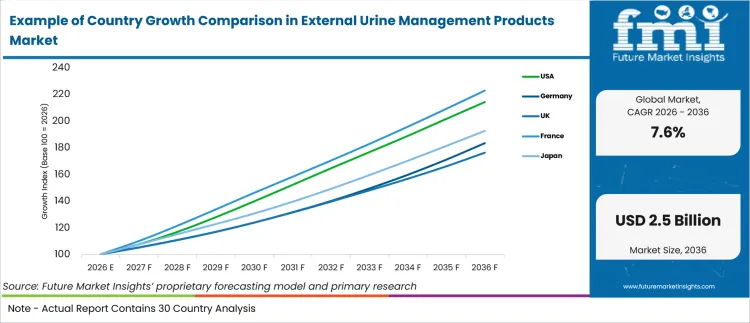
| Country or Market | CAGR |
|---|---|
| Italy | 9.0% |
| France | 8.3% |
| USA | 7.9% |
| Canada | 7.4% |
| Japan | 6.8% |
| Germany | 6.3% |
| UK | 5.8% |
Source: Future Market Insights analysis, 2026.
How do country-level CAGRs compare in External Urine Management Products Market?
Country comparison shows a measured step-down across disclosed national markets serving different care systems and patient populations. Italy occupies the upper forecast position as France follows within a limited distance under structured care-delivery systems. The United States and Canada form a central forecast band across hospital demand and continuing-care requirements within established purchasing systems. Japan follows under ageing-related care requirements and detailed product review involving local training and technical support expectations. Germany and United Kingdom complete the disclosed range through documentation-led purchasing and established continence-care pathways across institutional providers. A 3.2 percentage-point spread separates Italy from UK across the disclosed country forecast set through 2036.
- Italy establishes Southern Europe as the lead development cluster across disclosed national forecasts supported by ageing-related care requirements.
- France follows Italy and maintains a limited forecast difference through structured institutional care and expanding home-support requirements.
- USA and Canada form a central rate band through hospital purchasing systems and continuing-care product assessment across provinces and states.
- Japan follows North American rates through ageing-related demand and service-led product assessment involving detailed supplier documentation.
- Germany and UK complete the disclosed comparison under formal evidence requirements and established support expectations across care providers.
Markets carrying similar CAGRs are projected to present different entry conditions through device education and stocking practices linked to discharge support. Full report coverage extends across North America, Latin America, Western Europe, Eastern Europe, East Asia, South Asia and Pacific, Middle East and Africa.
Country-wise Analysis
- External urine management products market in Italy is forecast to expand at 9.0% CAGR between 2026 and 2036, guided by ageing-related care needs and home-care support. Structured product education supports use across hospitals and continuing-care providers. Italian National Institute of Statistics reported 25.1% of residents were aged 65 years and over in January 2026 in its March 2026 release, reinforcing demand for non-invasive collection across ageing care populations.
- National Institute of Statistics and Economic Studies projected France could have 2.8 million seniors living with loss of autonomy during the 2050s in its October 2025 analysis, increasing continence-support requirements across institutional and home settings. Rising support needs strengthen non-invasive urine management across public institutions and home-care services. Demand in France is estimated to rise at 8.3% CAGR during the assessment period, backed by structured care delivery and documented product support.
- Established infection-prevention reporting promotes external-device review across prominent United States hospitals. Sector in the United States is projected to record 7.9% CAGR from 2026 to 2036, backed by formal catheter-reduction programs and inpatient product trials. Centers for Disease Control and Prevention reported a 10.0% decline in acute-care hospital catheter-associated urinary tract infection ratios during 2024 in its January 2026 release, sustaining hospital attention on catheter alternatives.
- Sales in Canada are anticipated to scale at 7.4% CAGR during the forecast period, led by hospital and continuing-care demand. Statistics Canada reported 19.5% of residents were aged 65 years and over in July 2025 in its September 2025 release, expanding continence-support requirements across ageing populations. Provincial service coverage and concise caregiver instruction influence supplier approval across dispersed care organizations.
- Statistics Bureau of Japan reported residents aged 65 years and over represented 29.3% of the population in its April 2025 release, increasing continence-management needs across hospitals and elder-care facilities. Detailed quality review and local training support external-device selection across institutional providers. Adoption in Japan is predicted to expand at 6.8% CAGR during the study period due to ageing-related care requirements and service-led product assessment.
- German Federal Statistical Office reported 6.1 million residents were aged 80 years and over during 2024 in its December 2025 release, expanding demand for assisted continence management across care settings. Specification-led reviews guide product conversion across German hospitals and community-care providers. Industry in Germany is forecast to expand at 6.3% CAGR between 2026 and 2036, backed by documented quality controls and dependable technical support.
- Demand in the United Kingdom is likely to progress at 5.8% CAGR during the assessment period, helped by established hospital purchasing and home-care pathways. Office for National Statistics reported adults aged 65 years and over accounted for 49.6% of people living alone during 2025 in its April 2026 bulletin, strengthening demand for intuitive products across community care. Dependable caregiver guidance influences recurring use among households receiving limited daily assistance.
Who are notable companies in External Urine Management Products Market?
Becton, Dickinson and Company, Stryker Corporation, Medline Inc., Coloplast A/S, Hollister Incorporated, Teleflex Incorporated, and Consure Medical Pvt. Ltd. are notable companies shaping competition.
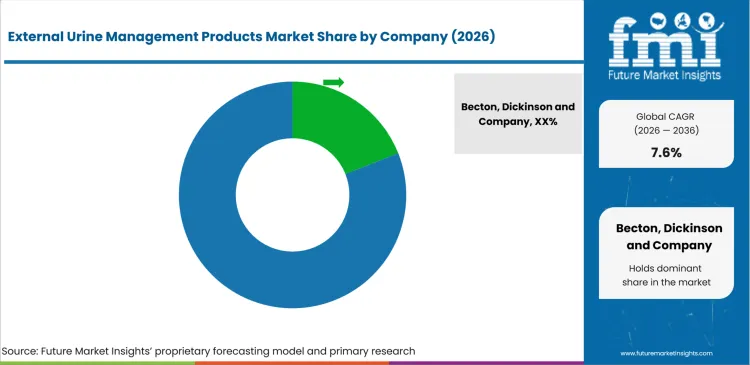
Competition centers on urine capture reliability and skin protection across hospital and community settings. BD and Stryker maintain suction-assisted systems serving male and female anatomy across hospital programs. Medline combines external products with distribution coverage and clinical education across participating care units. Coloplast and Hollister retain established male external catheter portfolios across silicone products. Teleflex supplies latex and non-latex configurations as Consure Medical develops suction-assisted urine management devices. Buyer review covers placement simplicity and product availability during implementation and renewal.
- Becton, Dickinson and Company and Stryker Corporation compete based on suction-assisted systems serving male and female anatomy. Hospital teams compare capture performance and placement simplicity during conversion programs involving standardized patient-selection procedures.
- Medline Inc. and Consure Medical Pvt. Ltd. compete depending on QiVi and Versette offerings supported by distribution and training. Product teams assess response quality across leakage reduction and clinical education during implementation.
- Coloplast A/S and Hollister Incorporated compete driven by sheath-style male external catheters serving daily continence management. Care providers examine silicone breathability and collection-bag connections across routine wear involving repeated movement.
- Teleflex Incorporated competes led by male external catheter configurations serving varied user requirements. Buyers assess size availability and connection compatibility across hospital and supported home-care systems.
Competitive Benchmarking: External Urine Management Products Market
| Company | Product Portfolio | Clinical Evidence | Support Capability | Service Reach |
|---|---|---|---|---|
| Becton, Dickinson and Company | High | High | High | Global |
| Stryker Corporation | High | High | High | Global |
| Medline Inc. | High | Medium | High | North America |
| Coloplast A/S | High | Medium | Medium | Global |
| Hollister Incorporated | Medium | Medium | Medium | Multi-country |
| Teleflex Incorporated | Medium | Medium | Medium | Multi-country |
| Consure Medical Pvt. Ltd. | Focused | Medium | Medium | Selected markets |
Source: Future Market Insights competitive analysis, 2026.
Key Developments in External Urine Management Products Market
- In May 2025, Medline expanded Versette training through four application steps covering cleaning and contouring followed by alignment confirmation and suction connection. Structured education supports consistent placement and limits avoidable leakage during hospital conversion.
- In November 2025, Becton, Dickinson and Company introduced the PureWick Portable Collection System for wheelchair users seeking urine management beyond fixed bedside equipment. Battery-powered collection extends external urine management into mobility-focused settings.
- In June 2026, Medline presented QiVi and Versette within one male and female external catheter portfolio. Combined coverage supports hospital programs seeking one supplier for varied anatomy and coordinated clinical education.
External Urine Management Products Market Report Scope
| Coverage field | Report scope |
|---|---|
| Market breakdown | External urine management products market breakdown includes product, application, end user, material, distribution channel, and region. |
| Quantitative Units | Revenue in USD Million, CAGR in %. |
| Market Definition | External urine management products include male and female collection devices, wicking systems, sheaths, suction-assisted products, accessories, skin protection products, and drainage components used without an indwelling catheter. Internal urinary catheters and absorbent products sold without an external collection function are excluded. |
| Regions Covered | North America, Latin America, Western Europe, Eastern Europe, East Asia, South Asia and Pacific, Middle East and Africa. |
| Countries Covered | Italy, France, USA, Canada, Japan, Germany, UK, and more than 25 additional countries complete full report coverage. |
| Key Companies Profiled | Becton, Dickinson and Company, Stryker Corporation, Medline Inc., Coloplast A/S, Hollister Incorporated, Teleflex Incorporated, and Consure Medical Pvt. Ltd. |
| Forecast Period | 2026 to 2036 |
| Approach | Hybrid bottom-up and top-down methodology uses segment shares and country CAGRs. Company activity and buyer adoption support final market reconciliation. |
Source: Future Market Insights analysis, 2026.
External Urine Management Products Market - Research Methodology
| Method | Approach |
|---|---|
| Primary Research | FMI analysts gathered input from manufacturers, service providers, technology developers, distributors, end users, procurement teams, and subject-matter experts. Interviews examined purchasing decisions, product or service evaluation, adoption barriers, approval requirements, pricing considerations, and expectations for technical or commercial support. Respondents were also asked what evidence is required before a trial, pilot, or initial order develops into regular purchasing. |
| Desk Research | Desk research covered government statistics, regulatory publications, trade data, industry associations, technical literature, standards, company filings, product information, and official corporate announcements. Sources were reviewed for relevance, publication date, geographic coverage, and consistency with the defined market scope. Claims relating to performance, applications, approvals, capacity, investment, and commercial activity were retained only when supported by credible public evidence. |
| Market Sizing and Forecasting | The market model combined the baseline value with historical performance, segment structure, pricing and volume indicators, adoption levels, company participation, and country-level demand conditions. Forecast assumptions considered economic activity, investment trends, regulatory developments, technology adoption, purchasing cycles, supply availability, and barriers to wider market use. Segment and regional estimates were reconciled before the final market total was calculated. |
| Data Validation | Estimates were checked against multiple independent indicators, including public data, company activity, trade patterns, industry developments, and findings from primary interviews. Validation also tested whether products, services, applications, and company revenues fell within the defined market boundaries. Adjacent categories, unsupported claims, overlapping revenues, and activities without direct market relevance were excluded to reduce double counting and maintain consistency across segments and countries. |
Source: Future Market Insights analysis, 2026.
External Urine Management Products Market by Segments
External Urine Management Products Market segmented by Product:
- External Urine Collection Devices
- Urine Collection Accessories
- Wearable Urine Management Systems
- Skin Protection Products
External Urine Management Products Market segmented by Application:
- Urinary Incontinence
- Critical Care
- Neurological Disorders
- Geriatric Care
External Urine Management Products Market segmented by End User:
- Hospitals
- Long-term Care Facilities
- Home Healthcare
- Ambulatory Surgical Centers
External Urine Management Products Market segmented by Material:
- Silicone
- Latex
- Thermoplastic Elastomers
- Hydrocolloid Materials
External Urine Management Products Market segmented by Distribution Channel:
- Hospital Pharmacies
- Retail Pharmacies
- Online Sales
External Urine Management Products Market segmented by Region:
- North America
- United States
- Canada
- Latin America
- Brazil
- Mexico
- Argentina
- Chile
- Western Europe
- Germany
- France
- United Kingdom
- Italy
- Spain
- Benelux
- Nordics
- Eastern Europe
- Poland
- Czech Republic
- Romania
- Hungary
- East Asia
- China
- Japan
- South Korea
- South Asia and Pacific
- India
- ASEAN
- Australia and New Zealand
- Middle East and Africa
- GCC Countries
- South Africa
- Türkiye
- Israel
Research Sources and Bibliography
- Barakat-Johnson, M., Stephenson, J., Lai, M., Basjarahil, S., Campbell, J., Cunich, M., Disher, G., Geering, S., Ko, N., Leahy, C., Leong, T., McClure, E., O'Grady, M., Walsh, J., White, K., & Coyer, F. (2024). Impact of an evidence-based bundle on incontinence-associated dermatitis prevalence in hospital patients: A quasi-experimental translational study. International Wound Journal, 21(6), Article e14936.
- Baxter, C. M., Matthews, C. L., Zamarripa, C., Johnston, J. R., Lane, R., Chung, A., Palladino, K., Kip, P. L., Zapf, R. L., Wagester, S., & Snyder, G. M. (2024, July 9). Implementation of an external female urinary catheter strategy on prevention of skin breakdown in acute care: A quality improvement study. Journal of Clinical Nursing.
- Becton, Dickinson and Company. (2025, November 12). BD expands PureWick portfolio with first-of-its-kind portable solution to confidently manage urinary incontinence on the go.
- Buddharaju, V., & Shelton, D. (2024, September 15). Acanthus condom catheter: A reusable and adjustable silicone male external catheter with pressure-sensitive silicone adhesive for urinary drainage. Cureus, 16(9), Article e69482.
- Cassone, M., Ameling, J., Mody, L., Patel, S., Muyanja, N. S., & Meddings, J. (2024, March 27). Impact of external female urinary catheter use on urine chemistry test results. American Journal of Infection Control, 52(8), 919-924.
- Centers for Disease Control and Prevention. (2026, January 29). 2024 National and State Healthcare-Associated Infections Progress Report.
- Dufeutrelle, J., Pucher, O., & Louvel, A. (2025, October 22). 700,000 more seniors living with loss of autonomy by 2050. National Institute of Statistics and Economic Studies.
- Fogli, A., Buhagiar, T. M., Salas, M. K., Pombo, K., Perryman, C., Sanga, S., Tuatagaloa, A., & Jappy, C. (2024, January 5). External urinary catheter devices: A multisite project involving point prevalence. Geriatric Nursing, 56, 14-17.
- German Federal Statistical Office. (2025, December 11). By 2035, one quarter of Germany's population projected to be aged 67 or over.
- Italian National Institute of Statistics. (2026, March 31). Demographic indicators - Year 2025.
- Medina, J. C., Fakih, M., Khalsa, S., Redmond, D., & Kennelly, M. J. (2025, December 9). Safety, efficacy, and patient-reported outcomes of the PureWick System versus comparator for nocturnal urinary incontinence in the home setting: Results of a randomized trial. Journal of Clinical Medicine, 14(24), Article 8699.
- Medline. (2025, May 14). Versette external catheter for women education and training.
- Medline. (2025, May 19). Try a system of products designed to minimize CAUTI risk.
- Medline. (2026, February 5). QiVi external catheter for men.
- Medline. (2026, June 25). Prevent CAUTI with male and female catheters.
- Mercado, F. S., Jr., Kop, M. M., Danko, A., Zimmerman, H., & Watase, C. (2025, August 17). Male external catheters and urinary tract infections: A systematic review and meta-analysis of current evidence and the need for standardized reporting. Cureus, 17(8), Article e90264.
- Office for National Statistics. (2026, April 17). Families and households in the UK: 2025.
- Pryor, N., Wang, J., Young, J., Townsend, W., Ameling, J., Henderson, J., & Meddings, J. (2024, May 6). Clinical outcomes of female external urine wicking devices as alternatives to indwelling catheters: A systematic review and meta-analysis. Infection Control & Hospital Epidemiology, 45(9), 1121-1129.
- Statistics Bureau of Japan. (2025, April 14). Current population estimates as of October 1, 2024.
- Statistics Canada. (2025, September 24). Canada's population estimates: Age and gender, July 1, 2025.
This bibliography is provided for reader reference and is not exhaustive. The full report contains the complete reference list and detailed citations.
This Report Answers
- How do product, application, end user, material, distribution channel, and region influence external urine management products demand?
- How do selection criteria guide clinical teams evaluating external urine collection devices for routine use?
- Why do country CAGRs differ across Italy, France, USA, Canada, Japan, Germany, and UK?
- How do companies compete through suction-assisted systems and sheath-style external catheters?
- How are forecasts validated through bottom-up and top-down analysis using independent indicators?
- How does clinical evidence support product review across hospital and community-care settings?
- Why do leakage and skin condition influence recurring external-device use?
- How does staff training affect product conversion across inpatient units?
- How do company capabilities improve confidence across placement support and replacement access?
- How do home-care needs influence product design and distribution-channel selection?
Frequently Asked Questions
How big is the External Urine Management Products Market in 2026?
The external urine management products market is valued at USD 1.2 billion in 2026 and is forecast to reach USD 2.5 billion by 2036. Growth is supported by expanding hospital catheter-reduction programs, with clinical findings published in the International Wound Journal reporting a 36.3% reduction in hospital-acquired incontinence-associated dermatitis among 1,897 monitored patients, reinforcing institutional demand for dependable external urine capture combined with structured skin surveillance routines.
What is the CAGR of the External Urine Management Products Market from 2026 to 2036?
The external urine management products market grows at a CAGR of 7.6% between 2026 and 2036, supported by hospital infection-prevention programs and ageing-related continence care requirements, as clinical teams adopt non-invasive collection devices once suppliers demonstrate consistent leakage control, anatomical compatibility, and staff training support across inpatient conversion programs and home-care discharge pathways.
Which product type leads the External Urine Management Products Market?
External urine collection devices account for 47.0% of the external urine management products market by product in 2026, driven by direct urine diversion across male and female anatomy without urethral insertion, where clinical teams assess leakage frequency and nursing workload during trials as placement reliability and accessory compatibility determine adoption across inpatient units and home-care settings.
How much will the External Urine Management Products Market add between 2026 and 2036?
The external urine management products market is set to add USD 1.3 billion between 2026 and 2036, growing from USD 1.2 billion to USD 2.5 billion as suction-assisted collection systems, mobility-oriented wearable devices, and integrated skin protection portfolios enter hospital catheter-avoidance programs and expanding community continence-care pathways across ageing populations in both established and developing national markets.
Who are the leading companies in the External Urine Management Products Market?
Seven companies lead the external urine management products market, including Becton Dickinson and Company, Stryker Corporation, Medline Inc., Coloplast A/S, Hollister Incorporated, Teleflex Incorporated, and Consure Medical Pvt. Ltd., competing through suction-assisted systems for male and female anatomy, silicone sheath portfolios, distribution-linked clinical education programs, and coordinated hospital conversion support across global, multi-country, and selected regional care settings.
Preview the report firsthand - request a free sample
Get SampleGet the brochure for pricing and purchase details.
Get PDFTable of Content
- Key Takeaways
- Market Size and CAGR
- Top Growth Driver
- Fastest Growing Segment
- Leading Region
- Key Companies
- Emerging Opportunities
- Executive Summary
- Global Market Outlook
- Demand-side Trends
- Supply-side Trends
- Technology Roadmap Analysis
- Analysis and Recommendations
- Analyst Perspective (What is happening? Why now? What should investors know?)
- Key Questions Answered
- How large is the market?
- What is the CAGR?
- What are key trends?
- Which region dominates?
- Who are the leaders?
- Market Overview
- Market Coverage / Taxonomy
- Market Definition / Scope / Limitations
- Research Methodology
- Chapter Orientation
- Analytical Lens and Working Hypotheses
- Market Structure, Signals, and Trend Drivers
- Benchmarking and Cross-market Comparability
- Market Sizing, Forecasting, and Opportunity Mapping
- Research Design and Evidence Framework
- Desk Research Programme (Secondary Evidence)
- Expert Input and Fieldwork (Primary Evidence)
- Tooling, Models, and Reference Databases
- Data Engineering and Model Build
- Quality Assurance and Audit Trail
- Market Background
- Market Dynamics (Drivers, Restraints, Opportunity, Trends)
- Scenario Forecast (Optimistic, Likely, Conservative)
- Impact Analysis
- AI Impact
- Sustainability Impact
- Regulatory Impact
- Technology Impact
- Consumer / Buyer Analysis
- Purchase Drivers
- Adoption Barriers
- Buyer Journey
- Opportunity Map Analysis
- Product Life Cycle Analysis
- Supply Chain Analysis
- Investment Feasibility Matrix
- Value Chain Analysis
- PESTLE and Porter's Analysis
- Regulatory Landscape
- Regional Parent Market Outlook
- Production and Consumption Statistics
- Import and Export Statistics
- Global Market Analysis and Forecast, 2021 to 2036
- Historical Market Size Value (USD Billion) Analysis, 2021 to 2025
- Current and Future Market Size Value (USD Billion) Projections, 2026 to 2036
- Y-o-Y Growth Trend Analysis
- Absolute $ Opportunity Analysis
- Global Market Pricing Analysis, 2021 to 2036
- Global Market Analysis and Forecast, By Product, 2021 to 2036
- Introduction / Key Findings
- Historical Market Size Value (USD Billion) Analysis By Product, 2021 to 2025
- Current and Future Market Size Value (USD Billion) Analysis and Forecast By Product, 2026 to 2036
- External Urine Collection Devices
- Male External Catheters
- Female External Urine Collection Devices
- Pediatric External Collection Devices
- Urine Collection Accessories
- Drainage Bags
- Connecting Tubes
- Securement Devices
- Wearable Urine Management Systems
- Smart Urine Collection Systems
- Portable Collection Devices
- Reusable Collection Systems
- Skin Protection Products
- Barrier Creams
- Adhesive Removers
- Skin Protection Films
- External Urine Collection Devices
- Y-o-Y Growth Trend Analysis By Product, 2021 to 2025
- Absolute $ Opportunity Analysis By Product, 2026 to 2036
- Global Market Analysis and Forecast, By Application, 2021 to 2036
- Introduction / Key Findings
- Historical Market Size Value (USD Billion) Analysis By Application, 2021 to 2025
- Current and Future Market Size Value (USD Billion) Analysis and Forecast By Application, 2026 to 2036
- Urinary Incontinence
- Stress Urinary Incontinence
- Urge Urinary Incontinence
- Functional Incontinence
- Critical Care
- Intensive Care Units
- Post-operative Care
- Long-term Hospitalization
- Neurological Disorders
- Spinal Cord Injury
- Multiple Sclerosis
- Parkinson's Disease
- Geriatric Care
- Elderly Home Care
- Nursing Homes
- Rehabilitation Centers
- Urinary Incontinence
- Y-o-Y Growth Trend Analysis By Application, 2021 to 2025
- Absolute $ Opportunity Analysis By Application, 2026 to 2036
- Global Market Analysis and Forecast, By End User, 2021 to 2036
- Introduction / Key Findings
- Historical Market Size Value (USD Billion) Analysis By End User, 2021 to 2025
- Current and Future Market Size Value (USD Billion) Analysis and Forecast By End User, 2026 to 2036
- Hospitals
- Public Hospitals
- Private Hospitals
- Specialty Hospitals
- Long-term Care Facilities
- Nursing Homes
- Assisted Living Facilities
- Rehabilitation Centers
- Home Healthcare
- Home Care Providers
- Self-care Users
- Palliative Care
- Ambulatory Surgical Centers
- Day Care Centers
- Outpatient Clinics
- Specialty Clinics
- Hospitals
- Y-o-Y Growth Trend Analysis By End User, 2021 to 2025
- Absolute $ Opportunity Analysis By End User, 2026 to 2036
- Global Market Analysis and Forecast, By Material, 2021 to 2036
- Introduction / Key Findings
- Historical Market Size Value (USD Billion) Analysis By Material, 2021 to 2025
- Current and Future Market Size Value (USD Billion) Analysis and Forecast By Material, 2026 to 2036
- Silicone
- Medical-grade Silicone
- Hypoallergenic Silicone
- Soft Silicone
- Latex
- Natural Latex
- Latex-free Blends
- Elastic Latex
- Thermoplastic Elastomers
- TPE Materials
- Flexible Polymers
- Bio-compatible Plastics
- Hydrocolloid Materials
- Adhesive Hydrocolloids
- Skin-friendly Hydrocolloids
- Moisture-resistant Materials
- Silicone
- Y-o-Y Growth Trend Analysis By Material, 2021 to 2025
- Absolute $ Opportunity Analysis By Material, 2026 to 2036
- Global Market Analysis and Forecast, By Distribution Channel, 2021 to 2036
- Introduction / Key Findings
- Historical Market Size Value (USD Billion) Analysis By Distribution Channel, 2021 to 2025
- Current and Future Market Size Value (USD Billion) Analysis and Forecast By Distribution Channel, 2026 to 2036
- Hospital Pharmacies
- Inpatient Pharmacies
- Outpatient Pharmacies
- Central Medical Stores
- Retail Pharmacies
- Chain Pharmacies
- Independent Pharmacies
- Medical Supply Stores
- Online Sales
- E-commerce Platforms
- Direct-to-Consumer Websites
- Home Healthcare Suppliers
- Hospital Pharmacies
- Y-o-Y Growth Trend Analysis By Distribution Channel, 2021 to 2025
- Absolute $ Opportunity Analysis By Distribution Channel, 2026 to 2036
- Global Market Analysis and Forecast, By Region, 2021 to 2036
- Introduction
- Historical Market Size Value (USD Billion) Analysis By Region, 2021 to 2025
- Current Market Size Value (USD Billion) Analysis and Forecast By Region, 2026 to 2036
- North America
- Latin America
- Western Europe
- Eastern Europe
- East Asia
- South Asia and Pacific
- Middle East & Africa
- Market Attractiveness Analysis By Region
- North America Market Analysis and Forecast, By Country, 2021 to 2036
- Historical Market Size Value (USD Billion) Trend Analysis By Market Taxonomy, 2021 to 2025
- Market Size Value (USD Billion) Forecast By Market Taxonomy, 2026 to 2036
- By Country
- USA
- Canada
- By Product
- By Application
- By End User
- By Material
- By Distribution Channel
- By Country
- Market Attractiveness Analysis
- By Country
- By Product
- By Application
- By End User
- By Material
- By Distribution Channel
- Key Takeaways
- Latin America Market Analysis and Forecast, By Country
- Historical Market Size Value (USD Billion) Trend Analysis By Market Taxonomy, 2021 to 2025
- Market Size Value (USD Billion) Forecast By Market Taxonomy, 2026 to 2036
- By Country
- Brazil
- Mexico
- Chile
- Rest of Latin America
- By Product
- By Application
- By End User
- By Material
- By Distribution Channel
- By Country
- Market Attractiveness Analysis
- By Country
- By Product
- By Application
- By End User
- By Material
- By Distribution Channel
- Key Takeaways
- Western Europe Market Analysis and Forecast, By Country
- Historical Market Size Value (USD Billion) Trend Analysis By Market Taxonomy, 2021 to 2025
- Market Size Value (USD Billion) Forecast By Market Taxonomy, 2026 to 2036
- By Country
- Germany
- UK
- Italy
- Spain
- France
- Nordic
- BENELUX
- Rest of Western Europe
- By Product
- By Application
- By End User
- By Material
- By Distribution Channel
- By Country
- Market Attractiveness Analysis
- By Country
- By Product
- By Application
- By End User
- By Material
- By Distribution Channel
- Key Takeaways
- Eastern Europe Market Analysis and Forecast, By Country
- Historical Market Size Value (USD Billion) Trend Analysis By Market Taxonomy, 2021 to 2025
- Market Size Value (USD Billion) Forecast By Market Taxonomy, 2026 to 2036
- By Country
- Russia
- Poland
- Hungary
- Balkan & Baltic
- Rest of Eastern Europe
- By Product
- By Application
- By End User
- By Material
- By Distribution Channel
- By Country
- Market Attractiveness Analysis
- By Country
- By Product
- By Application
- By End User
- By Material
- By Distribution Channel
- Key Takeaways
- East Asia Market Analysis and Forecast, By Country
- Historical Market Size Value (USD Billion) Trend Analysis By Market Taxonomy, 2021 to 2025
- Market Size Value (USD Billion) Forecast By Market Taxonomy, 2026 to 2036
- By Country
- China
- Japan
- South Korea
- By Product
- By Application
- By End User
- By Material
- By Distribution Channel
- By Country
- Market Attractiveness Analysis
- By Country
- By Product
- By Application
- By End User
- By Material
- By Distribution Channel
- Key Takeaways
- South Asia and Pacific Market Analysis and Forecast, By Country
- Historical Market Size Value (USD Billion) Trend Analysis By Market Taxonomy, 2021 to 2025
- Market Size Value (USD Billion) Forecast By Market Taxonomy, 2026 to 2036
- By Country
- India
- ASEAN
- Australia & New Zealand
- Rest of South Asia and Pacific
- By Product
- By Application
- By End User
- By Material
- By Distribution Channel
- By Country
- Market Attractiveness Analysis
- By Country
- By Product
- By Application
- By End User
- By Material
- By Distribution Channel
- Key Takeaways
- Middle East & Africa Market Analysis and Forecast, By Country
- Historical Market Size Value (USD Billion) Trend Analysis By Market Taxonomy, 2021 to 2025
- Market Size Value (USD Billion) Forecast By Market Taxonomy, 2026 to 2036
- By Country
- Kingdom of Saudi Arabia
- Other GCC Countries
- Türkiye
- South Africa
- Other African Union
- Rest of Middle East & Africa
- By Product
- By Application
- By End User
- By Material
- By Distribution Channel
- By Country
- Market Attractiveness Analysis
- By Country
- By Product
- By Application
- By End User
- By Material
- By Distribution Channel
- Key Takeaways
- Key Countries Market Analysis
- USA
- Pricing Analysis
- Market Share Analysis, 2025
- By Product
- By Application
- By End User
- By Material
- By Distribution Channel
- Canada
- Pricing Analysis
- Market Share Analysis, 2025
- By Product
- By Application
- By End User
- By Material
- By Distribution Channel
- Mexico
- Pricing Analysis
- Market Share Analysis, 2025
- By Product
- By Application
- By End User
- By Material
- By Distribution Channel
- Brazil
- Pricing Analysis
- Market Share Analysis, 2025
- By Product
- By Application
- By End User
- By Material
- By Distribution Channel
- Chile
- Pricing Analysis
- Market Share Analysis, 2025
- By Product
- By Application
- By End User
- By Material
- By Distribution Channel
- Germany
- Pricing Analysis
- Market Share Analysis, 2025
- By Product
- By Application
- By End User
- By Material
- By Distribution Channel
- UK
- Pricing Analysis
- Market Share Analysis, 2025
- By Product
- By Application
- By End User
- By Material
- By Distribution Channel
- Italy
- Pricing Analysis
- Market Share Analysis, 2025
- By Product
- By Application
- By End User
- By Material
- By Distribution Channel
- Spain
- Pricing Analysis
- Market Share Analysis, 2025
- By Product
- By Application
- By End User
- By Material
- By Distribution Channel
- France
- Pricing Analysis
- Market Share Analysis, 2025
- By Product
- By Application
- By End User
- By Material
- By Distribution Channel
- India
- Pricing Analysis
- Market Share Analysis, 2025
- By Product
- By Application
- By End User
- By Material
- By Distribution Channel
- ASEAN
- Pricing Analysis
- Market Share Analysis, 2025
- By Product
- By Application
- By End User
- By Material
- By Distribution Channel
- Australia & New Zealand
- Pricing Analysis
- Market Share Analysis, 2025
- By Product
- By Application
- By End User
- By Material
- By Distribution Channel
- China
- Pricing Analysis
- Market Share Analysis, 2025
- By Product
- By Application
- By End User
- By Material
- By Distribution Channel
- Japan
- Pricing Analysis
- Market Share Analysis, 2025
- By Product
- By Application
- By End User
- By Material
- By Distribution Channel
- South Korea
- Pricing Analysis
- Market Share Analysis, 2025
- By Product
- By Application
- By End User
- By Material
- By Distribution Channel
- Russia
- Pricing Analysis
- Market Share Analysis, 2025
- By Product
- By Application
- By End User
- By Material
- By Distribution Channel
- Poland
- Pricing Analysis
- Market Share Analysis, 2025
- By Product
- By Application
- By End User
- By Material
- By Distribution Channel
- Hungary
- Pricing Analysis
- Market Share Analysis, 2025
- By Product
- By Application
- By End User
- By Material
- By Distribution Channel
- Kingdom of Saudi Arabia
- Pricing Analysis
- Market Share Analysis, 2025
- By Product
- By Application
- By End User
- By Material
- By Distribution Channel
- Türkiye
- Pricing Analysis
- Market Share Analysis, 2025
- By Product
- By Application
- By End User
- By Material
- By Distribution Channel
- South Africa
- Pricing Analysis
- Market Share Analysis, 2025
- By Product
- By Application
- By End User
- By Material
- By Distribution Channel
- USA
- Market Structure Analysis
- Competition Dashboard
- Competition Benchmarking
- Market Share Analysis of Top Players
- By Regional
- By Product
- By Application
- By End User
- By Material
- By Distribution Channel
- Emerging Startups
- Innovation Benchmarking
- Competition Analysis
- Competition Deep Dive
- Becton, Dickinson and Company
- Overview
- Product Portfolio
- Profitability by Market Segments
- Sales Footprint
- Strategy Overview
- Marketing Strategy
- Product Strategy
- Channel Strategy
- Coloplast A/S
- Convatec Group plc
- Hollister Incorporated
- PureWick (BD)
- Medline Industries
- Cardinal Health
- Teleflex Incorporated
- HR Pharmaceuticals
- Sage Products LLC
- Becton, Dickinson and Company
- Case Studies
- Success Stories
- Recent Developments
- Competition Deep Dive
- Assumptions & Acronyms Used


