

- Market Size (2026)
- USD 6.8 Bn
- Forecast (2036)
- USD 24.8 Bn
- CAGR (2026 to 2036)
- 13.8%
How big is Face Swiping Payment Market in 2026?
USD 6.8 billion in 2026 and USD 24.8 billion by 2036 at a 13.8% CAGR.
Demand for face swiping payment is projected to increase valuation from USD 6.8 billion in 2026 to USD 24.8 billion by 2036 at a 13.8% CAGR. Merchants fund deployment when biometric authorization removes a physical checkout step without changing the underlying payment account. In June 2025 Verifone invested in PopID after partner deployments had processed millions of biometric loyalty and payment authentications. The investment extends biometric payment cards and other payment methods into payment terminals already installed at merchant locations.
The installed payment base governs how quickly facial authentication moves beyond pilots because merchants rarely replace acquiring and settlement systems solely for biometrics. Federal Reserve data published in July 2026 counted 236.6 billion United States noncash payments during 2024, with cards representing 79% of those transactions. Existing payment processing solutions give merchants a settlement base that biometric enrollment can extend without rebuilding the full payment stack.
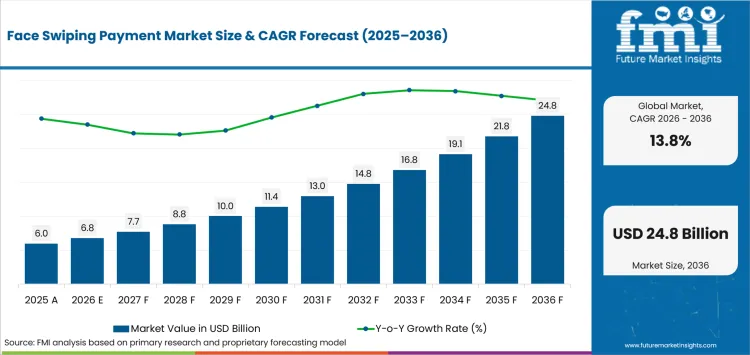
Key Takeaways of Face Swiping Payment Market
- Merchant demand centers on reducing physical checkout steps without replacing the acquiring and settlement infrastructure already used at each location.
- By payment solution, face recognition payment terminal is estimated to hold 46.0% in 2026 owing to one device controlling capture and customer interaction at checkout.
- In 2026, retail payments is expected to lead transaction application with 41.0% share because frequent purchases make checkout time measurable for merchants.
- The retail & e-commerce segment is likely to capture 38.0% share in 2026 attributable to reusable payment credentials and customer accounts.
- A failed biometric match must leave a workable payment alternative, so consent review and presentation-attack controls can extend deployment schedules.
- Some of the key players in this market include J.P. Morgan Payments, NEC Corporation, PopID, Inc., Verifone, Mastercard Incorporated, Ingenico, Stripe, Inc., and Aware, Inc.
Analyst Perspective
"Merchants gain the clearest signal from pilots that shorten authorization without changing the processor or removing a familiar fallback. A viable rollout also needs liveness and consent controls that store staff can manage on the same checkout estate."
- Sudip saha, Principal Consultant, Future Market Insights
How is the Face Swiping Payment Market segmented?
The market is segmented by payment solution, transaction application, end-use industry, deployment model, authentication technology, and region.
Payment solution covers face recognition payment terminal, mobile face payment solution, biometric payment gateway, and identity verification platform. Transaction application covers retail payments, public transportation payments, hospitality payments, and healthcare payments. End-use industry covers retail & e-commerce, transportation, hospitality, and healthcare. Deployment model includes on-premises deployment, cloud-based deployment, software as a service, and application programming interface integration. Authentication technology includes 3D facial recognition, artificial intelligence-powered facial recognition, cloud-based biometric authentication, and multimodal biometric authentication.
What supports On-premises Deployment in the Deployment Model category?
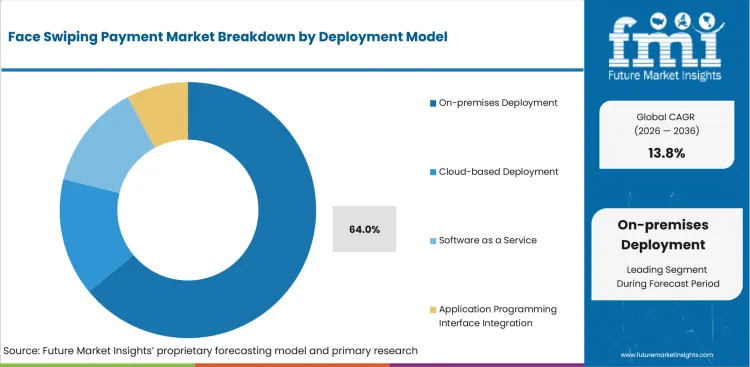
On-premises deployment keeps checkout cameras and local interfaces close to the transaction path. Merchants preserve predictable response times while assigning remote services to enrollment or identity verification functions. Local control also lets store technology teams test network failure without relying on remote matching for every payment.
- On-premises deployment is set to lead the deployment model with 64.0% share in 2026 due to direct control over installed payment hardware and local networks.
- Verifone introduced its Victa payment-device portfolio in January 2025 with biometric-capable hardware. The launch preserves existing payment applications, reducing the checkout software that must change during biometric trials.
What makes Face Recognition Payment Terminal central to the Payment Solution category?
Face recognition payment terminals place image capture and payment initiation at the same checkout point. Merchants test camera placement and failed-match handling on the POS terminal staff operate. A single device makes queue timing easier to compare ahead of wider biometric enrollment.
- By payment solution, face recognition payment terminal is estimated to hold 46.0% in 2026 owing to direct control over capture and customer interaction at checkout.
- J.P. Morgan Payments introduced Paypad and Pinpad in January 2025 with embedded facial or palm biometric recognition. Both devices accept conventional payment methods, letting merchants test biometrics without removing card fallback from the checkout lane.
Why does Retail Payments lead the Transaction Application category?
Retail gives merchants repeated payment events that reveal whether facial recognition removes enough checkout work to justify enrollment. Stores can compare transaction time and failed matches during a small registered-customer trial. High visit frequency also gives operators more observations than occasional service settings.
- In 2026, retail payments is expected to lead transaction application with 41.0% share because frequent store visits expose payment speed and fallback rates.
- Ingenico documented facial-recognition and palm-vein payment demonstrations at NRF in January 2025. The demonstration placed biometric authentication inside a merchant terminal workflow, giving retailers an operating proof point as they evaluate store integration budgets.
How does Retail & E-commerce anchor the End-use Industry category?
Retailers already manage customer accounts and payment credentials in physical stores and digital commerce. Face authentication becomes easier to justify if one identity layer supports mobile payment transaction flows and store checkout. Reusing one identity record reduces duplicate enrollment between online accounts and stores.
- The retail & e-commerce segment is likely to capture 38.0% share in 2026 attributable to reusable payment credentials and customer accounts.
- Mastercard announced an Australian biometric-checkout roadmap in April 2025 that replaces manual credentials with facial or fingerprint verification. The plan ties biometric authentication to existing card relationships, giving merchants a route to reuse credentials held by financial institutions.
What are the drivers, restraints and opportunities in the Face Swiping Payment Market?
Faster identity-linked checkout supports demand while consent and spoofing controls extend approvals. Configurable liveness and modular payment integration provide the clearest expansion route.
- Driver: Merchants invest where biometric authentication removes repeated checkout actions without forcing changes to the underlying payment account or settlement route.
- Restraint: Privacy review and presentation-attack testing lengthen approval when merchants cannot document lawful enrollment or a reliable non-biometric fallback.
- Opportunity: Configurable liveness and reusable interfaces let payment firms separate identity assurance from merchant acceptance while reducing custom checkout work.
Checkout Speed Converts Enrollment into Merchant Demand
Repeated purchases give merchants enough transaction volume to measure whether biometric checkout saves operating time. J.P. Morgan Payments demonstrated pay-by-face transactions completed in seconds using its Paypad terminal during Money20/20 USA in November 2025. Merchants therefore evaluate contactless biometric technology on completed transactions and repeat use instead of recognition speed alone.
Presentation-Attack Controls Extend Approval Cycles
Biometric payment changes authentication without removing the merchant's obligation to manage spoofing risk during enrollment and verification. NIST published SP 800-63A-4 in July 2025 with a remote-biometric requirement for presentation attack detection below 0.07 IAPAR. The identity-proofing threshold gives security teams a concrete test benchmark for biometric-as-a-service controls during pre-deployment security testing.
Modular Payment Integration Reduces Replacement Work
Payment firms can sell liveness as a separate authentication layer if existing checkout software accepts the service without new terminal hardware. Aware launched Intelligent Liveness in September 2025 with sub-second capture and rapidly retrainable machine-learning models for spoof detection. The release gives online payment gateway providers a standalone identity check while merchants retain existing processor and settlement relationships.
Which country CAGRs are profiled in the Face Swiping Payment Market?
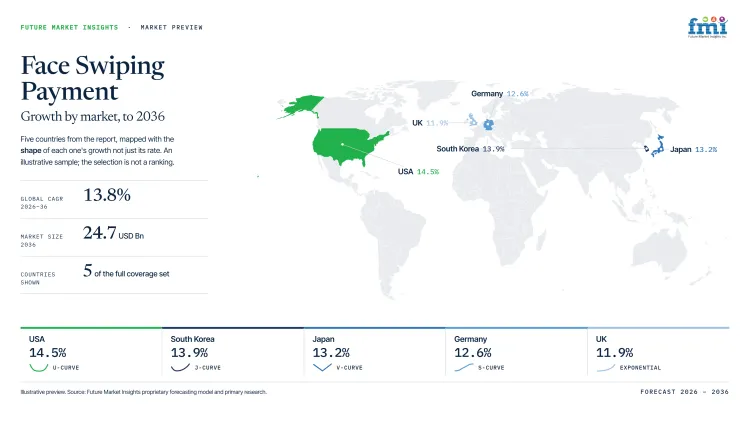
| Country | CAGR |
|---|---|
| USA | 14.5% |
| South Korea | 13.9% |
| Japan | 13.2% |
| Germany | 12.6% |
| UK | 11.9% |
How do country-level CAGRs compare in the Face Swiping Payment Market?
The profiled countries span 2.6 percentage points from USA at 14.5% CAGR to UK at 11.9%. USA and South Korea form the upper band while Japan occupies the middle. Germany and UK expand more slowly as biometric credentials must beat familiar cashless methods, while these CAGRs do not establish current national revenue.
- USA has multi-site chains that spread enrollment work over many checkout locations.
- South Korea concentrates merchant reach inside financial platforms that simplify pilot integration.
- Japan has Expo-scale reference experience, but routine retail still needs simple registration.
- Germany compares facial payment with contactless checkout, making incremental utility the hurdle.
- UK acquiring networks offer merchant access, but biometric enrollment adds communication work.
Similar CAGRs can mask different sales conditions shaped by payment habits and approval routes. The full report provides country-level CAGR analysis across North America, Latin America, Europe, East Asia, South Asia, Oceania and the Middle East and Africa.
Country-wise Analysis
- Large restaurant chains and event venues can add face payment to existing acquiring relationships without changing the customer funding source. Face swiping payment demand is forecast to rise at 14.5% CAGR through 2036 because biometric checkout can extend familiar card rails. Federal Reserve Governor Christopher Waller noted in August 2025 that more than three-quarters of United States consumers preferred credit or debit cards for in-person payments. Merchants can compare biometric convenience with a familiar settlement method during live pilots. Fragmented state privacy rules raise legal review costs, so multi-state providers gain an advantage from consistent consent records and fallback payments.
- Authorizing purchases through simplified bank and wallet credentials is already routine for users of mobile financial platforms. Bank of Korea data published in September 2025 show that daily simple-payment value increased 11.4% during the first half. The evidence confirms that merchants are not introducing biometric authentication into a cash-first checkout habit. South Korea is projected to record 13.9% CAGR through 2036 given dense mobile-payment usage. Korean-language service and regulated transaction controls concentrate viable deployments inside large financial and commerce platforms. National platforms control merchant reach and user credentials, leaving smaller standalone terminal programs with a harder integration path.
- At large public venues, registered facial payment has shown that users can accept face-based transactions under controlled enrollment. Face swiping payment sales are estimated to expand at 13.2% CAGR through 2036 aided by familiar digital-payment behavior during merchant trials. METI calculated a 58.0% cashless payment ratio for 2025 in March 2026. Retailers therefore do not need to explain cashless payment itself during face-authentication trials. Regional chains also need Japanese-language support for enrollment failures during ordinary service hours. Cards and wallets already complete ordinary purchases quickly, which limits conversion among optional biometric enrollees. Weekday retail must prove enough time savings to justify cameras and registration.
- Contactless cards and mobile wallets already satisfy most routine checkout needs, making incremental utility the purchase test for facial payment. Deutsche Bundesbank stated in June 2026 that cashless methods covered 55% of recorded purchases during 2025 and were available for 86% of physical-location purchases. Familiar digital payment lowers the integration barrier without proving that consumers will enroll for a facial credential. Germany is forecast to post 12.6% CAGR through 2036 tied to broad cashless acceptance. Local pilots also need clear deletion rules that store teams can explain during enrollment. Wider deployment will depend on providers showing local data handling and measurable checkout improvement as pilots move beyond selected sites.
- Under current data-protection expectations, payment providers must justify biometric collection for merchants to treat facial recognition as a routine checkout credential. The Information Commissioner's Office clarified in August 2025 that facial-recognition use must be lawful and fair with proportionate safeguards. Face swiping payment demand in the UK is anticipated to advance at 11.9% CAGR through 2036 attributable to regulated adoption beside mature digital-payment habits. Contactless payment gives merchants a reliable fallback while early face-payment pilots test enrollment. Companies that document necessity and impact assessments start from a stronger position than providers selling convenience without the privacy evidence needed for wider rollout.
Who are the notable companies in the Face Swiping Payment Market?
J.P. Morgan Payments, NEC Corporation, PopID, Inc., Verifone, Mastercard Incorporated, Ingenico, Stripe, Inc., and Aware, Inc. are the notable companies serving this market.
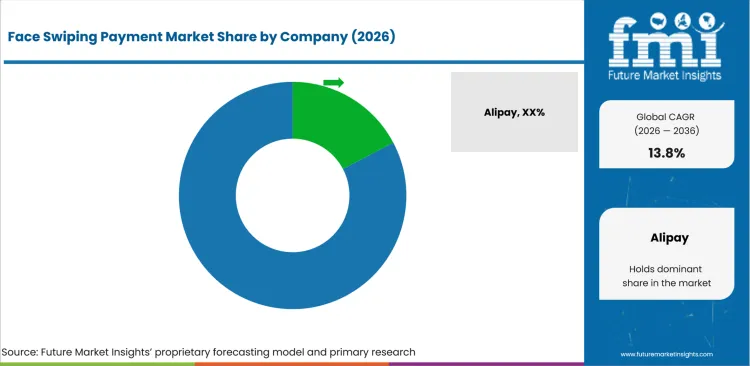
Competition separates merchant payment orchestration from face matching and identity assurance because each layer requires different control over checkout and authentication. J.P. Morgan Payments and Verifone control physical checkout routes, while NEC Corporation and PopID, Inc. specialize in biometric payment integration. Mastercard Incorporated and Stripe, Inc. provide network or acceptance infrastructure that biometric checkout services can reuse without controlling the biometric engine. Ingenico extends wireless POS terminal coverage while Aware, Inc. supplies verification technology upstream of payment authorization. Terminal access and tested biometric assurance shape entry more directly than corporate scale alone.
- J.P. Morgan Payments, Verifone, Mastercard Incorporated, and Stripe, Inc. compete closest to the payment-acceptance layer through terminals or processor integration.
- NEC Corporation and PopID, Inc. focus on face recognition linked directly to merchant payment or venue workflows.
- Ingenico supports merchant terminal deployment while Aware, Inc. provides biometric assurance upstream of merchant payment orchestration.
Competitive Benchmarking: Face Swiping Payment Market
| Company | Face-Payment Orchestration | Biometric Assurance Evidence | POS and Processor Integration Depth | Geographic Reach |
|---|---|---|---|---|
| J.P. Morgan Payments | High | Medium | High | North America with selected global merchant programs |
| NEC Corporation | High | High | High | Japan, Asia-Pacific, North America, and global enterprise deployments |
| PopID, Inc. | High | Medium | Medium | United States with partner-led international expansion |
| Verifone | High | Medium | High | Global payment-terminal and merchant network |
| Mastercard Incorporated | Medium | Medium | High | Global card-network and payment-partner footprint |
| Ingenico | Medium | Medium | High | Global merchant-acquiring and payment-terminal footprint |
| Stripe, Inc. | Medium | Low | High | Stripe Terminal availability in 25 countries documented in the NEC integration announcement |
| Aware, Inc. | Low | High | Medium | North America with international identity deployments |
Scoring basis: High face-payment orchestration requires documented deployment in two or more merchant or venue contexts. Medium face-payment orchestration requires one direct face-payment integration with a merchant or venue. Low face-payment orchestration identifies an upstream identity role without direct control over merchant acceptance. High biometric assurance requires independent certification or standards-based testing tied directly to the company's facial-authentication role. Medium biometric assurance requires company-controlled biometric authentication or documented spoof controls without independent certification. Low biometric assurance applies to payment providers that rely on a separately named partner's biometric engine. High integration depth requires at least three documented terminal, POS, processor, or API integration routes. Medium integration depth requires one or two documented merchant-acceptance routes tied to the payment service. Low integration depth identifies authentication technology without direct merchant acceptance integration in the documented offering.
Key Developments in the Face Swiping Payment Market
- In December 2025, NEC Corporation invested in PopID and began a collaboration aimed at expanding face-authentication payment services through payment-industry partners.
- In May 2025, J.P. Morgan Payments provided biometric payments at every official merchandise location during the Formula 1 Miami Grand Prix weekend.
- In February 2025, Verifone partnered with PopID to build face and palm modules for Verifone and third-party payment terminals worldwide.
Key Players in the Face Swiping Payment Market
Payment Orchestration and Merchant Acceptance
- J.P. Morgan Payments
- Verifone
- Mastercard Incorporated
- Stripe, Inc.
Facial Authentication and Checkout Platforms
- NEC Corporation
- PopID, Inc.
- Aware, Inc.
Payment Terminal Integration
- Ingenico
Face Swiping Payment Market - Report Scope
| Coverage field | Report scope |
|---|---|
| Market breakdown | By payment solution, transaction application, end-use industry, deployment model, authentication technology, and region. |
| Quantitative Units | USD Billion. |
| Market Definition | Revenue from facial biometric payment terminals, software, gateways, identity layers, deployment services, and integration directly used to authenticate or initiate payment transactions. |
| Regions Covered | North America, Latin America, Europe, East Asia, South Asia and Pacific, and Middle East and Africa. |
| Countries Covered | USA, South Korea, Japan, Germany, UK, and 20+ countries included in the full report. |
| Key Companies Profiled | J.P. Morgan Payments, NEC Corporation, PopID, Inc., Verifone, Mastercard Incorporated, Ingenico, Stripe, Inc., and Aware, Inc. |
| Forecast Period | 2026 to 2036. |
| Approach | Primary and secondary research with market triangulation. |
Face Swiping Payment Market - Research Methodology
| Method | Approach |
|---|---|
| Primary Research | FMI analysts gathered input from manufacturers, service providers, technology developers, distributors, end users, procurement teams, and subject-matter experts. Interviews examined purchasing decisions, product or service evaluation, adoption barriers, approval requirements, pricing considerations, and expectations for technical or commercial support. Respondents were also asked what evidence is required before a trial, pilot, or initial order develops into regular purchasing. |
| Desk Research | Desk research covered government statistics, regulatory publications, trade data, industry associations, technical literature, standards, company filings, product information, and official corporate announcements. Sources were reviewed for relevance, publication date, geographic coverage, and consistency with the defined market scope. Claims relating to performance, applications, approvals, capacity, investment, and commercial activity were retained only when supported by credible public evidence. |
| Market Sizing and Forecasting | The market model combined the baseline value with historical performance, segment structure, pricing and volume indicators, adoption levels, company participation, and country-level demand conditions. Forecast assumptions considered economic activity, investment trends, regulatory developments, technology adoption, purchasing cycles, supply availability, and barriers to wider market use. Segment and regional estimates were reconciled before the final market total was calculated. |
| Data Validation | Estimates were checked against multiple independent indicators, including public data, company activity, trade patterns, industry developments, and findings from primary interviews. Validation also tested whether products, services, applications, and company revenues fell within the defined market boundaries. Adjacent categories, unsupported claims, overlapping revenues, and activities without direct market relevance were excluded to reduce double counting and maintain consistency across segments and countries. |
Face Swiping Payment Market by Segments
Face Swiping Payment Market segmented by Payment Solution:
- Face Recognition Payment Terminal
- Standalone Payment Terminal
- Integrated POS Terminal
- Mobile Face Payment Solution
- Mobile Wallet Integration
- Facial Payment Application
- Biometric Payment Gateway
- Facial Authentication API
- SDK Integration
- Identity Verification Platform
- Patient Identity Verification
- Digital Identity Validation
Face Swiping Payment Market segmented by Transaction Application:
- Retail Payments
- In-store Purchases
- Self-checkout Payments
- Public Transportation Payments
- Metro Fare Collection
- Bus & Rail Ticketing
- Hospitality Payments
- Hotel Check-in Payments
- Restaurant Payments
- Healthcare Payments
- Hospital Billing
- Medical Service Payments
Face Swiping Payment Market segmented by End-use Industry:
- Retail & E-commerce
- Supermarkets & Hypermarkets
- Convenience Stores
- Transportation
- Public Transit Operators
- Smart Mobility Services
- Hospitality
- Hotels & Resorts
- Restaurant Chains
- Healthcare
- Hospitals & Clinics
- Diagnostic Centers
Face Swiping Payment Market segmented by Deployment Model:
- On-premises Deployment
- Store-installed Systems
- Branch Deployment
- Cloud-based Deployment
- Hybrid Deployment
- Edge-enabled Systems
- Software as a Service
- Managed Services
- Platform Integration
- Application Programming Interface Integration
- System Integration
- Enterprise Identity Platform
Face Swiping Payment Market segmented by Authentication Technology:
- 3D Facial Recognition
- Structured Light Recognition
- Infrared Facial Mapping
- Artificial Intelligence-powered Facial Recognition
- Deep Learning Recognition
- Liveness Detection Technology
- Cloud-based Biometric Authentication
- Real-time Face Matching
- Anti-spoofing Detection
- Multimodal Biometric Authentication
- Behavioral Biometrics
- Continuous Identity Verification
Face Swiping Payment Market by Region:
- North America
- United States
- Canada
- Latin America
- Brazil
- Mexico
- Chile
- Rest of Latin America
- Western Europe
- Germany
- United Kingdom
- Italy
- Spain
- France
- Nordics
- Benelux
- Rest of Western Europe
- Eastern Europe
- Russia
- Poland
- Hungary
- Balkan and Baltic States
- Rest of Eastern Europe
- East Asia
- China
- Japan
- South Korea
- South Asia and Pacific
- India
- ASEAN
- Australia and New Zealand
- Rest of South Asia and Pacific
- Middle East and Africa
- Kingdom of Saudi Arabia
- Other GCC Countries
- Türkiye
- South Africa
- Other African Union Countries
- Rest of Middle East and Africa
Research Sources and Bibliography
- Verifone. (2025, June 4). Verifone Invests in PopID to Accelerate Global Adoption of Biometric Authentication
- Board of Governors of the Federal Reserve System. (2026, July 1). National Payment Volumes, Top-Line Data (CY 2015-24)
- J.P. Morgan Payments. (2025, January 15). Introducing the Paypad and Pinpad from J.P. Morgan Payments
- Ingenico. (2025, January 27). Ingenico’s Biometric Payment Authentication Makes Impression at Retail Show
- Mastercard. (2025, April 7). Goodbye card numbers, hello smiles: Mastercard sets vision to help tackle Australia’s $1bn fraud problem by 2030
- Verifone. (2025, January 9). Verifone Unveils New Payment Device Portfolio and Innovations
- J.P. Morgan Payments. (2025, November 20). J.P. Morgan Payments showcases innovation and leadership at Money20/20 USA 2025
- National Institute of Standards and Technology. (2025, July 31). Digital Identity Guidelines: Identity Proofing and Enrollment
- Aware, Inc. (2025, September 10). Aware Launches New Intelligent Liveness Solution
- Mastercard. (2026, June 1). Mastercard Advances Europe’s Checkout Transformation on the Road to 2030
- Board of Governors of the Federal Reserve System. (2025, August 20). Technological Advancements in Payments
- Bank of Korea. (2025, September 29).
- Ministry of Economy, Trade and Industry. (2026, March 31). 2025 Ratio of Cashless Payment Among the Total Amount Paid by Consumers Calculated
- Deutsche Bundesbank. (2026, June 17). Payment behaviour in Germany in 2025
- Information Commissioner’s Office. (2025, August 13). ICO clarifies how data protection law applies to facial recognition technology
- NEC Corporation. (2025, December 4). NEC Orchestrating Future Fund Invests in PopID, Inc. to Accelerate Global Expansion of Biometric Payment Solutions and Launch a Strategic Collaboration
- J.P. Morgan Payments. (2025, July 9). J.P. Morgan Payments powers retail experience at Formula 1 Crypto.com Miami Grand Prix 2025
- Verifone. (2025, February 20). Verifone and PopID Partner to Drive Adoption of Biometric Payments and Loyalty
- FIDO Alliance. (2025, October 21). Biometric Update: BixeLab joins FIDO Face Verification program, certifies Aware
- Verifone. (2026, August 12). Pay with a smile: Verifone brings biometric-capable payment devices to Australia
- Visa. (2026, July 2). Visa Launches Payment Passkey in India, Reducing Friction in Digital Payments
- Facephi. (2026, February 25). Facephi Enters the Japanese Identity and Fraud-Prevention Market via Hancom
- NEC Corporation. (2025, July 17). A society advanced beyond our wildest imaginations: NEC’s facial recognition provides Japan’s famed “Expo Grandma” a glimpse into the future of society
- NEC Corporation. (2025, November 5). Stripe and NEC to Provide Face Recognition Payment Service via Stripe Terminal
- Mastercard. (2025, November 12). Mastercard Champions Password-Free, Number-Free Checkout Across Asia Pacific by 2030
- Visa. (2025, September 29). noon payments and Visa Announce Global First with the Launch of Visa Payment Passkey
- Razorpay. (2025, October 30). A New Era in Payment Security: Razorpay Unveils One of India’s First RBI-Compliant Biometric Authentication, in Partnership with YES BANK
- Mastercard. (2025, July 31).
- Razorpay. (2026, March 31). Say Goodbye to OTPs: Razorpay, along with Mastercard and Visa, Launches RBI-Compliant Biometric ‘Passkey’
- J.P. Morgan Payments. (2025, December 11). J.P. Morgan Payments earns Best in Class honors in Javelin’s 2025 Emerging Biometric Authentication at the Point of Sale Scorecard
This bibliography is provided for reader reference and is not exhaustive. The full report contains the complete reference list and detailed citations
This Report Answers
- How large is the face swiping payment market in 2026 and what value is forecast for 2036?
- Which checkout conditions turn facial authentication into a merchant payment investment?
- Why does face recognition payment terminal account for 46.0% of payment solution revenue in 2026?
- Why does retail payments account for 41.0% of transaction application revenue in 2026?
- How does retail & e-commerce shape integration priorities for face swiping payment providers?
- Which privacy and spoofing controls have the greatest effect on deployment timing?
- How do the five profiled country CAGRs differ through 2036?
- Which companies control merchant acceptance and which companies specialize in biometric assurance?
- Which competitive capabilities should merchants verify before scaling face-payment deployment?
Frequently Asked Questions
How big is the face swiping payment market in 2026?
The face swiping payment market is valued at USD 6.8 billion in 2026 and is projected to reach USD 24.8 billion by 2036. Merchant adoption rises once biometric authorization removes a checkout step without replacing existing payment rails.
What is the CAGR of the face swiping payment market from 2026 to 2036?
The face swiping payment market is projected to grow at a CAGR of 13.8% between 2026 and 2036. Expansion depends on payment-terminal integration and consumer enrollment that preserves a reliable fallback method.
Which payment solution leads the face swiping payment market?
The face recognition payment terminal segment is expected to hold 46.0% of the face swiping payment market in 2026, driven by one device handling capture and payment initiation. Installed hardware gives merchants one checkout point for testing failed matches during staged store rollout.
Which authentication technology holds an additional dominant share in the face swiping payment market?
The 3D facial recognition segment is expected to hold 53.0% of authentication technology revenue in 2026, supported by depth information that strengthens spoof resistance at unattended payment points. Higher hardware cost limits use at lower-risk locations that can accept simpler two-dimensional authentication methods.
Which countries are projected to record the highest growth in the face swiping payment market?
USA is projected to grow at 14.5% CAGR, followed by South Korea at 13.9% and Japan at 13.2% through 2036. Payment habits and merchant integration readiness separate these countries more clearly than current national market size.
Which companies are active in the face swiping payment market?
Key companies operating in the market include J.P. Morgan Payments, NEC Corporation, PopID, Inc., Verifone, Mastercard Incorporated, Ingenico, Stripe, Inc., and Aware, Inc. These companies differ in merchant acceptance depth, biometric assurance, and terminal integration.
Preview the report firsthand - request a free sample
Get SampleGet the brochure for pricing and purchase details.
Get PDFTable of Content
- Key Takeaways
- Market Size and CAGR
- Top Growth Driver
- Fastest Growing Segment
- Leading Region
- Key Companies
- Emerging Opportunities
- Executive Summary
- Global Market Outlook
- Demand-side Trends
- Supply-side Trends
- Technology Roadmap Analysis
- Analysis and Recommendations
- Analyst Perspective (What is happening? Why now? What should investors know?)
- Key Questions Answered
- How large is the market?
- What is the CAGR?
- What are key trends?
- Which region dominates?
- Who are the leaders?
- Market Overview
- Market Coverage / Taxonomy
- Market Definition / Scope / Limitations
- Research Methodology
- Chapter Orientation
- Analytical Lens and Working Hypotheses
- Market Structure, Signals, and Trend Drivers
- Benchmarking and Cross-market Comparability
- Market Sizing, Forecasting, and Opportunity Mapping
- Research Design and Evidence Framework
- Desk Research Programme (Secondary Evidence)
- Expert Input and Fieldwork (Primary Evidence)
- Tooling, Models, and Reference Databases
- Data Engineering and Model Build
- Quality Assurance and Audit Trail
- Market Background
- Market Dynamics (Drivers, Restraints, Opportunity, Trends)
- Scenario Forecast (Optimistic, Likely, Conservative)
- Impact Analysis
- AI Impact
- Sustainability Impact
- Regulatory Impact
- Technology Impact
- Consumer / Buyer Analysis
- Purchase Drivers
- Adoption Barriers
- Buyer Journey
- Opportunity Map Analysis
- Product Life Cycle Analysis
- Supply Chain Analysis
- Investment Feasibility Matrix
- Value Chain Analysis
- PESTLE and Porter's Analysis
- Regulatory Landscape
- Regional Parent Market Outlook
- Production and Consumption Statistics
- Import and Export Statistics
- Global Market Analysis and Forecast, 2021 to 2036
- Historical Market Size Value (USD Billion) Analysis, 2021 to 2025
- Current and Future Market Size Value (USD Billion) Projections, 2026 to 2036
- Y-o-Y Growth Trend Analysis
- Absolute $ Opportunity Analysis
- Global Market Pricing Analysis, 2021 to 2036
- Global Market Analysis and Forecast, By Payment Solution, 2021 to 2036
- Introduction / Key Findings
- Historical Market Size Value (USD Billion) Analysis By Payment Solution, 2021 to 2025
- Current and Future Market Size Value (USD Billion) Analysis and Forecast By Payment Solution, 2026 to 2036
- Face Recognition Payment Terminal
- Standalone Payment Terminal
- Integrated POS Terminal
- Mobile Face Payment Solution
- Mobile Wallet Integration
- Facial Payment Application
- Biometric Payment Gateway
- Facial Authentication API
- SDK Integration
- Identity Verification Platform
- Patient Identity Verification
- Digital Identity Validation
- Face Recognition Payment Terminal
- Y-o-Y Growth Trend Analysis By Payment Solution, 2021 to 2025
- Absolute $ Opportunity Analysis By Payment Solution, 2026 to 2036
- Global Market Analysis and Forecast, By Transaction Application, 2021 to 2036
- Introduction / Key Findings
- Historical Market Size Value (USD Billion) Analysis By Transaction Application, 2021 to 2025
- Current and Future Market Size Value (USD Billion) Analysis and Forecast By Transaction Application, 2026 to 2036
- Retail Payments
- In-store Purchases
- Self-checkout Payments
- Public Transportation Payments
- Metro Fare Collection
- Bus & Rail Ticketing
- Hospitality Payments
- Hotel Check-in Payments
- Restaurant Payments
- Healthcare Payments
- Hospital Billing
- Medical Service Payments
- Retail Payments
- Y-o-Y Growth Trend Analysis By Transaction Application, 2021 to 2025
- Absolute $ Opportunity Analysis By Transaction Application, 2026 to 2036
- Global Market Analysis and Forecast, By End-use Industry, 2021 to 2036
- Introduction / Key Findings
- Historical Market Size Value (USD Billion) Analysis By End-use Industry, 2021 to 2025
- Current and Future Market Size Value (USD Billion) Analysis and Forecast By End-use Industry, 2026 to 2036
- Retail & E-commerce
- Supermarkets & Hypermarkets
- Convenience Stores
- Transportation
- Public Transit Operators
- Smart Mobility Services
- Hospitality
- Hotels & Resorts
- Restaurant Chains
- Healthcare
- Hospitals & Clinics
- Diagnostic Centers
- Retail & E-commerce
- Y-o-Y Growth Trend Analysis By End-use Industry, 2021 to 2025
- Absolute $ Opportunity Analysis By End-use Industry, 2026 to 2036
- Global Market Analysis and Forecast, By Deployment Model, 2021 to 2036
- Introduction / Key Findings
- Historical Market Size Value (USD Billion) Analysis By Deployment Model, 2021 to 2025
- Current and Future Market Size Value (USD Billion) Analysis and Forecast By Deployment Model, 2026 to 2036
- On-premises Deployment
- Store-installed Systems
- Branch Deployment
- Cloud-based Deployment
- Hybrid Deployment
- Edge-enabled Systems
- Software as a Service
- Managed Services
- Platform Integration
- Application Programming Interface Integration
- System Integration
- Enterprise Identity Platform
- On-premises Deployment
- Y-o-Y Growth Trend Analysis By Deployment Model, 2021 to 2025
- Absolute $ Opportunity Analysis By Deployment Model, 2026 to 2036
- Global Market Analysis and Forecast, By Authentication Technology, 2021 to 2036
- Introduction / Key Findings
- Historical Market Size Value (USD Billion) Analysis By Authentication Technology, 2021 to 2025
- Current and Future Market Size Value (USD Billion) Analysis and Forecast By Authentication Technology, 2026 to 2036
- 3D Facial Recognition
- Structured Light Recognition
- Infrared Facial Mapping
- Artificial Intelligence-powered Facial Recognition
- Deep Learning Recognition
- Liveness Detection Technology
- Cloud-based Biometric Authentication
- Real-time Face Matching
- Anti-spoofing Detection
- Multimodal Biometric Authentication
- Behavioral Biometrics
- Continuous Identity Verification
- 3D Facial Recognition
- Y-o-Y Growth Trend Analysis By Authentication Technology, 2021 to 2025
- Absolute $ Opportunity Analysis By Authentication Technology, 2026 to 2036
- Global Market Analysis and Forecast, By Region, 2021 to 2036
- Introduction
- Historical Market Size Value (USD Billion) Analysis By Region, 2021 to 2025
- Current Market Size Value (USD Billion) Analysis and Forecast By Region, 2026 to 2036
- North America
- Latin America
- Western Europe
- Eastern Europe
- East Asia
- South Asia and Pacific
- Middle East & Africa
- Market Attractiveness Analysis By Region
- North America Market Analysis and Forecast, By Country, 2021 to 2036
- Historical Market Size Value (USD Billion) Trend Analysis By Market Taxonomy, 2021 to 2025
- Market Size Value (USD Billion) Forecast By Market Taxonomy, 2026 to 2036
- By Country
- USA
- Canada
- By Payment Solution
- By Transaction Application
- By End-use Industry
- By Deployment Model
- By Authentication Technology
- By Country
- Market Attractiveness Analysis
- By Country
- By Payment Solution
- By Transaction Application
- By End-use Industry
- By Deployment Model
- By Authentication Technology
- Key Takeaways
- Latin America Market Analysis and Forecast, By Country
- Historical Market Size Value (USD Billion) Trend Analysis By Market Taxonomy, 2021 to 2025
- Market Size Value (USD Billion) Forecast By Market Taxonomy, 2026 to 2036
- By Country
- Brazil
- Mexico
- Chile
- Rest of Latin America
- By Payment Solution
- By Transaction Application
- By End-use Industry
- By Deployment Model
- By Authentication Technology
- By Country
- Market Attractiveness Analysis
- By Country
- By Payment Solution
- By Transaction Application
- By End-use Industry
- By Deployment Model
- By Authentication Technology
- Key Takeaways
- Western Europe Market Analysis and Forecast, By Country
- Historical Market Size Value (USD Billion) Trend Analysis By Market Taxonomy, 2021 to 2025
- Market Size Value (USD Billion) Forecast By Market Taxonomy, 2026 to 2036
- By Country
- Germany
- UK
- Italy
- Spain
- France
- Nordic
- BENELUX
- Rest of Western Europe
- By Payment Solution
- By Transaction Application
- By End-use Industry
- By Deployment Model
- By Authentication Technology
- By Country
- Market Attractiveness Analysis
- By Country
- By Payment Solution
- By Transaction Application
- By End-use Industry
- By Deployment Model
- By Authentication Technology
- Key Takeaways
- Eastern Europe Market Analysis and Forecast, By Country
- Historical Market Size Value (USD Billion) Trend Analysis By Market Taxonomy, 2021 to 2025
- Market Size Value (USD Billion) Forecast By Market Taxonomy, 2026 to 2036
- By Country
- Russia
- Poland
- Hungary
- Balkan & Baltic
- Rest of Eastern Europe
- By Payment Solution
- By Transaction Application
- By End-use Industry
- By Deployment Model
- By Authentication Technology
- By Country
- Market Attractiveness Analysis
- By Country
- By Payment Solution
- By Transaction Application
- By End-use Industry
- By Deployment Model
- By Authentication Technology
- Key Takeaways
- East Asia Market Analysis and Forecast, By Country
- Historical Market Size Value (USD Billion) Trend Analysis By Market Taxonomy, 2021 to 2025
- Market Size Value (USD Billion) Forecast By Market Taxonomy, 2026 to 2036
- By Country
- China
- Japan
- South Korea
- By Payment Solution
- By Transaction Application
- By End-use Industry
- By Deployment Model
- By Authentication Technology
- By Country
- Market Attractiveness Analysis
- By Country
- By Payment Solution
- By Transaction Application
- By End-use Industry
- By Deployment Model
- By Authentication Technology
- Key Takeaways
- South Asia and Pacific Market Analysis and Forecast, By Country
- Historical Market Size Value (USD Billion) Trend Analysis By Market Taxonomy, 2021 to 2025
- Market Size Value (USD Billion) Forecast By Market Taxonomy, 2026 to 2036
- By Country
- India
- ASEAN
- Australia & New Zealand
- Rest of South Asia and Pacific
- By Payment Solution
- By Transaction Application
- By End-use Industry
- By Deployment Model
- By Authentication Technology
- By Country
- Market Attractiveness Analysis
- By Country
- By Payment Solution
- By Transaction Application
- By End-use Industry
- By Deployment Model
- By Authentication Technology
- Key Takeaways
- Middle East & Africa Market Analysis and Forecast, By Country
- Historical Market Size Value (USD Billion) Trend Analysis By Market Taxonomy, 2021 to 2025
- Market Size Value (USD Billion) Forecast By Market Taxonomy, 2026 to 2036
- By Country
- Kingdom of Saudi Arabia
- Other GCC Countries
- Türkiye
- South Africa
- Other African Union
- Rest of Middle East & Africa
- By Payment Solution
- By Transaction Application
- By End-use Industry
- By Deployment Model
- By Authentication Technology
- By Country
- Market Attractiveness Analysis
- By Country
- By Payment Solution
- By Transaction Application
- By End-use Industry
- By Deployment Model
- By Authentication Technology
- Key Takeaways
- Key Countries Market Analysis
- USA
- Pricing Analysis
- Market Share Analysis, 2025
- By Payment Solution
- By Transaction Application
- By End-use Industry
- By Deployment Model
- By Authentication Technology
- Canada
- Pricing Analysis
- Market Share Analysis, 2025
- By Payment Solution
- By Transaction Application
- By End-use Industry
- By Deployment Model
- By Authentication Technology
- Mexico
- Pricing Analysis
- Market Share Analysis, 2025
- By Payment Solution
- By Transaction Application
- By End-use Industry
- By Deployment Model
- By Authentication Technology
- Brazil
- Pricing Analysis
- Market Share Analysis, 2025
- By Payment Solution
- By Transaction Application
- By End-use Industry
- By Deployment Model
- By Authentication Technology
- Chile
- Pricing Analysis
- Market Share Analysis, 2025
- By Payment Solution
- By Transaction Application
- By End-use Industry
- By Deployment Model
- By Authentication Technology
- Germany
- Pricing Analysis
- Market Share Analysis, 2025
- By Payment Solution
- By Transaction Application
- By End-use Industry
- By Deployment Model
- By Authentication Technology
- UK
- Pricing Analysis
- Market Share Analysis, 2025
- By Payment Solution
- By Transaction Application
- By End-use Industry
- By Deployment Model
- By Authentication Technology
- Italy
- Pricing Analysis
- Market Share Analysis, 2025
- By Payment Solution
- By Transaction Application
- By End-use Industry
- By Deployment Model
- By Authentication Technology
- Spain
- Pricing Analysis
- Market Share Analysis, 2025
- By Payment Solution
- By Transaction Application
- By End-use Industry
- By Deployment Model
- By Authentication Technology
- France
- Pricing Analysis
- Market Share Analysis, 2025
- By Payment Solution
- By Transaction Application
- By End-use Industry
- By Deployment Model
- By Authentication Technology
- India
- Pricing Analysis
- Market Share Analysis, 2025
- By Payment Solution
- By Transaction Application
- By End-use Industry
- By Deployment Model
- By Authentication Technology
- ASEAN
- Pricing Analysis
- Market Share Analysis, 2025
- By Payment Solution
- By Transaction Application
- By End-use Industry
- By Deployment Model
- By Authentication Technology
- Australia & New Zealand
- Pricing Analysis
- Market Share Analysis, 2025
- By Payment Solution
- By Transaction Application
- By End-use Industry
- By Deployment Model
- By Authentication Technology
- China
- Pricing Analysis
- Market Share Analysis, 2025
- By Payment Solution
- By Transaction Application
- By End-use Industry
- By Deployment Model
- By Authentication Technology
- Japan
- Pricing Analysis
- Market Share Analysis, 2025
- By Payment Solution
- By Transaction Application
- By End-use Industry
- By Deployment Model
- By Authentication Technology
- South Korea
- Pricing Analysis
- Market Share Analysis, 2025
- By Payment Solution
- By Transaction Application
- By End-use Industry
- By Deployment Model
- By Authentication Technology
- Russia
- Pricing Analysis
- Market Share Analysis, 2025
- By Payment Solution
- By Transaction Application
- By End-use Industry
- By Deployment Model
- By Authentication Technology
- Poland
- Pricing Analysis
- Market Share Analysis, 2025
- By Payment Solution
- By Transaction Application
- By End-use Industry
- By Deployment Model
- By Authentication Technology
- Hungary
- Pricing Analysis
- Market Share Analysis, 2025
- By Payment Solution
- By Transaction Application
- By End-use Industry
- By Deployment Model
- By Authentication Technology
- Kingdom of Saudi Arabia
- Pricing Analysis
- Market Share Analysis, 2025
- By Payment Solution
- By Transaction Application
- By End-use Industry
- By Deployment Model
- By Authentication Technology
- Türkiye
- Pricing Analysis
- Market Share Analysis, 2025
- By Payment Solution
- By Transaction Application
- By End-use Industry
- By Deployment Model
- By Authentication Technology
- South Africa
- Pricing Analysis
- Market Share Analysis, 2025
- By Payment Solution
- By Transaction Application
- By End-use Industry
- By Deployment Model
- By Authentication Technology
- USA
- Market Structure Analysis
- Competition Dashboard
- Competition Benchmarking
- Market Share Analysis of Top Players
- By Regional
- By Payment Solution
- By Transaction Application
- By End-use Industry
- By Deployment Model
- By Authentication Technology
- Emerging Startups
- Innovation Benchmarking
- Competition Analysis
- Competition Deep Dive
- Alipay
- Overview
- Product Portfolio
- Profitability by Market Segments
- Sales Footprint
- Strategy Overview
- Marketing Strategy
- Product Strategy
- Channel Strategy
- Tencent Holdings Limited
- NEC Corporation
- Thales S.A.
- IDEMIA Group
- FacePhi Biometría, S.A.
- PopID, Inc.
- SenseTime Group Inc.
- Megvii Technology Limited
- Aware, Inc.
- Alipay
- Case Studies
- Success Stories
- Recent Developments
- Competition Deep Dive
- Assumptions & Acronyms Used


