

- Market Size (2026)
- USD 280.0 Mn
- Forecast (2036)
- USD 854.2 Mn
- CAGR (2026 to 2036)
- 11.8%
Factory Line Changeover Optimization Software Market Size, Market Forecast and Outlook By FMI
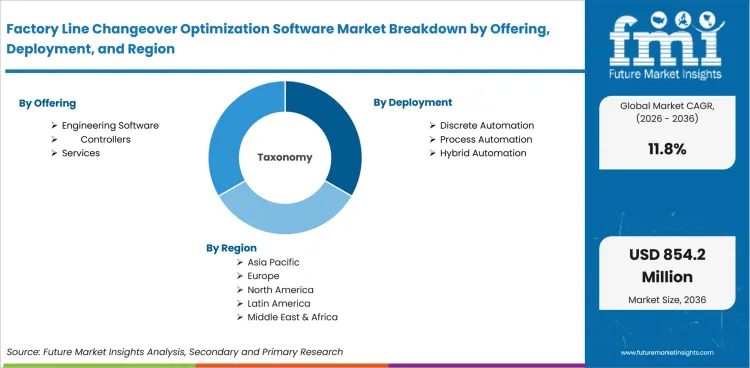
USD 280.0 million in 2026 and USD 854.2 million by 2036 at an 11.8% CAGR.
The factory line changeover optimization software industry value is forecast to rise from USD 250.4 million in 2025 to USD 854.2 million by 2036 at 11.8% CAGR. Demand is supported by high-mix manufacturing where recipes and operator prompts must be synchronized before each product run. Engineering Software is forecast to represent 42.0% share in 2026 because recipe libraries and setup validation carry the highest changeover value. Discrete Automation is set to hold 51.0% share in 2026 as automotive and electronics lines switch models more often than process plants.
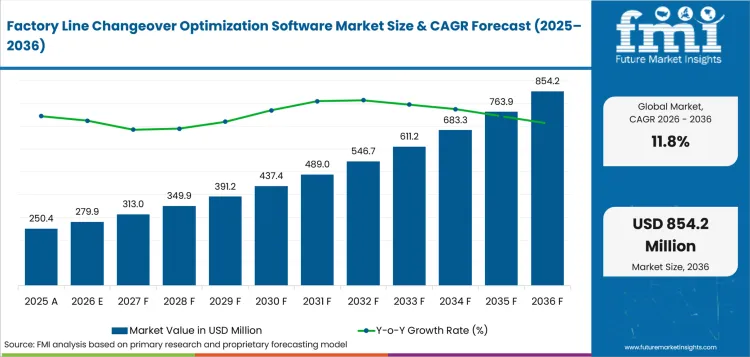
Factory Line Changeover Optimization Software Market Overview: Size and Forecast
- 2026 Market Size: USD 280.0 million
- 2036 Market Size: USD 854.2 million
- Forecast CAGR: 11.8% from 2026 to 2036
- Leading Offering: Engineering Software
- Engineering Software Share in 2026: 42.0%
- Leading Deployment: Discrete Automation
- Discrete Automation Share in 2026: 51.0%
- Fastest-growing Country: India
- India CAGR: 13.4% by 2036
Summary of the Factory Line Changeover Optimization Software Market
- Demand and Growth Drivers
- High-mix automotive and electronics plants are expected to increase demand for software that reduces setup loss after every model change.
- PLC and HMI reuse is set to support retrofit projects where buyers want changeover control without replacing working machines.
- Remote operations are forecast to gain share as multi-site manufacturers standardize setup support across plants.
- Product and Segment View
- Engineering Software is projected to lead the offering segment with 42.0% share in 2026.
- Discrete Automation is expected to lead the deployment segment with 51.0% share in 2026.
- Line Integration is anticipated to lead the application segment with 38.0% share in 2026.
- Geography and Competitive Outlook
- India is forecast to record the fastest country CAGR at 13.4% through 2036.
- China is projected to expand at 13.1% CAGR due to large robot deployment and electronics manufacturing scale.
- Siemens, Rockwell Automation, Schneider Electric, ABB, and Emerson compete through control platforms and plant software.
- Mitsubishi Electric, OMRON, Yokogawa, Honeywell, and Phoenix Contact add machine automation and OT data depth.
- Analyst Opinion
- Nikhil Kaitwade, Principal Consultant for industrial automation at Future Market Insights, observes, “This market is a changeover discipline problem before it is a software problem. Buyers should evaluate whether each platform connects PLC programs with HMI screens. MES records and work instructions must connect without forcing plants to rewrite control code.”
- Which factors support expansion in the factory line changeover optimization software market?
- Software license revenue and integration services support market value as factories reduce downtime between product runs.
- Market value is supported by engineering software licenses before service attachment adds implementation revenue.
- Supplier pricing reflects controller integration depth before operator-screen configuration affects rollout cost.
- Revenue improves when one validated changeover library can be reused across several lines.
- Buyer confidence rises when platforms document every recipe and parameter in one record.
Demand for factory automation and industrial controls stack is offering prospects for market growth. The USA Census Bureau reported April 2026 manufacturing new orders at USD 662.7 billion. It also estimated April 2026 construction spending at a USD 2,172.4 billion annual rate. These indicators point to plants and contractors managing larger operating loads where downtime and manual setup errors become more expensive. Rockwell Automation’s October 2025 Automation Fair release added controllers, I/O, edge gateways, and analytics software to support this shift. The development matters because buyers are prioritizing control stacks that connect machines with plant data and make upgrade spending easier to defend.
Why is the factory line changeover optimization software market growing?
High-mix production is expected to raise setup error risk when each line needs different recipes and safety checks.
The rising demand for smart factory supports this adoption because buyers want production context to move from planning into line execution. A delayed station can stop the full line, which makes manufacturing execution systems a natural integration layer for changeover records.
Safety review is expected to remain a buying gate because new routines can affect guards and interlocks. This creates natural adjacency with the machine safety market when buyers validate restart logic. The International Federation of Robotics reported 4.66 million industrial robots in global operational stock during 2024. This installed base creates more programmable equipment that needs coordinated product-switch procedures.
The OPC Foundation launched an OPC UA Cloud Initiative in April 2024 to improve interoperability across IT and cloud environments. This supports changeover software because multi-vendor lines need secure data exchange rather than fragile custom links.
How is the factory line changeover optimization software market segmented?
The factory line changeover optimization software industry is segmented by offering, deployment, application, end-use industry, and region.
- Engineering Software is projected to secure 42.0% share in 2026 because recipe comparison and validation screens carry most changeover value.
- Discrete Automation is expected to hold 51.0% share in 2026 due to repeated model and SKU switching.
- Line Integration is anticipated to represent 38.0% share in 2026 as buyers synchronize cells across one production line.
- Automotive is forecast to account for 32.0% share in 2026 due to mixed-model assembly and station readiness checks.
- East Asia is estimated to hold 34.0% share in 2026 because China and Japan operate dense automation clusters.
Sequence changes can affect conveyors and machine axes, which links this market to motion control centers in high-speed manufacturing environments.
Automated transport and pallet movement are relevant when product switches change line flow. This creates adjacency with automated material handling systems in plants that move between SKUs frequently.
Why does Engineering Software dominate the factory line changeover optimization software market?
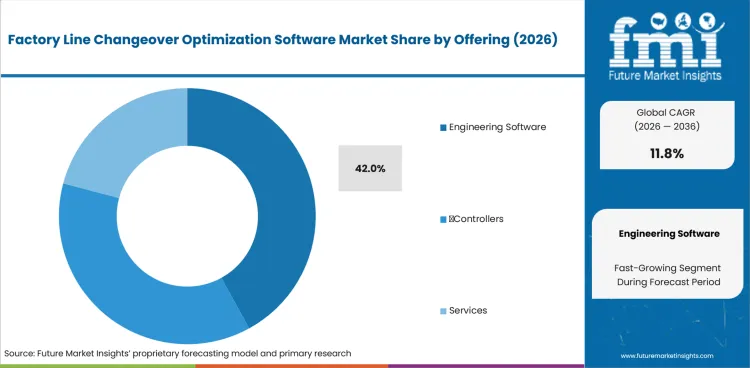
- Engineering Software is projected to account for 42.0% share in 2026, influenced by recipe libraries and setup audit trails.
- Controllers remain necessary because machine parameters must be accepted before each production restart.
Which deployment leads the factory line changeover optimization software market?
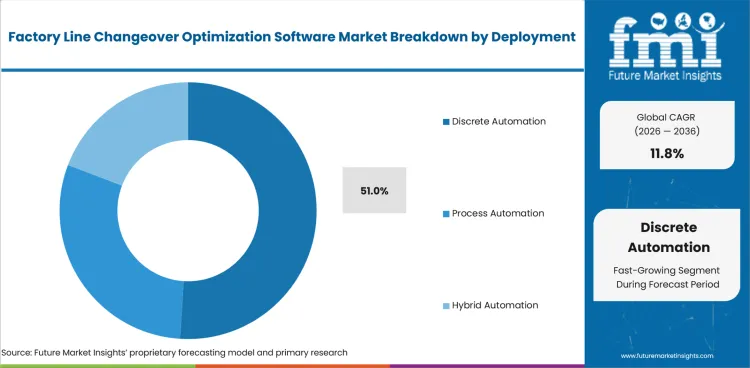
- Discrete Automation is expected to represent 51.0% share in 2026 through high-frequency model and SKU switching.
- Hybrid Automation gains relevance where batch records and discrete handling steps need one changeover record.
Which application leads the factory line changeover optimization software market?
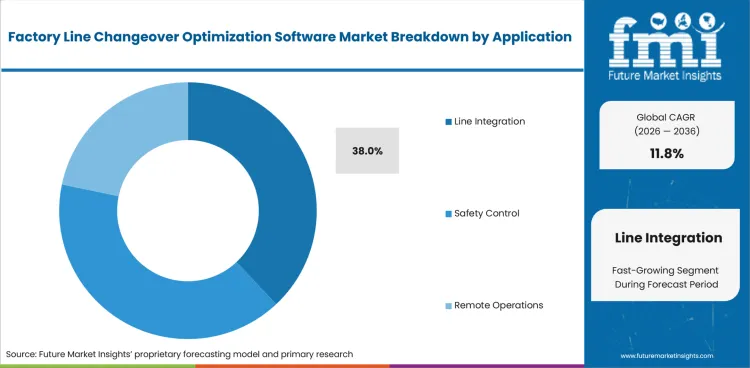
- Line Integration is anticipated to hold 38.0% share in 2026 as failures often occur between machines rather than inside one asset.
- Remote Operations gain use when multi-site manufacturers standardize setup support across plants.
Which end-use industry leads the factory line changeover optimization software market?
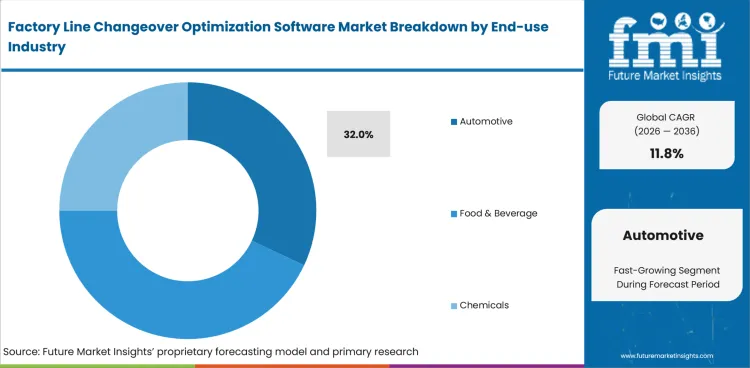
- Automotive is forecast to account for 32.0% share in 2026 as mixed-model assembly requires verified station readiness.
- Food and beverage plants add demand because packaging formats and recipes change frequently.
Which region leads the factory line changeover optimization software market?
- East Asia is estimated to hold 34.0% share in 2026 due to large automation clusters in China, Japan, and South Korea.
- North America remains important because brownfield retrofit work supports system-integrator led projects.
What are the driver, restraints, and opportunities in the factory line changeover optimization software market?
Recipe control and brownfield PLC reuse support adoption while OT security review slows some projects.
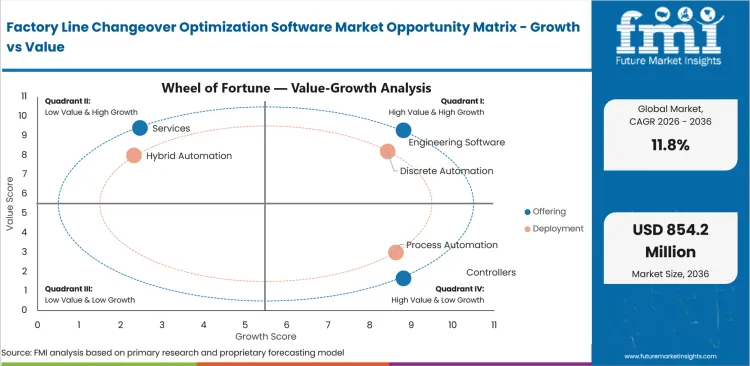
- Driver: Recipe drift control is expected to raise demand for verified settings before a line accepts a new SKU.
- Driver: Brownfield PLC reuse is expected to support retrofit projects where replacement cost is too high.
- Restraint: OT security review can slow projects when software touches production assets and safety systems.
- Opportunity: Remote changeover support can reduce engineering travel while keeping setup methods consistent.
Recipe-led Changeover Control
Demand is moving toward software that connects recipes and controller parameters with HMI prompts and production records. Yokogawa’s October 2024 OpreX Batch MES release emphasized low-code manufacturing procedure changes for batch plants. That matters because high-mix manufacturers need controlled recipe edits without manual setup drift across repeated line switches.
Consumer Segmentation and Purchase Behavior Analysis
Plant managers and controls engineers remain the core buyers because they own downtime losses during product switches. System integrators and machine builders influence adoption when software must connect new equipment with older controllers. Rockwell Automation’s October 2024 FactoryTalk Optix update supports this buyer path because DataReady functions help move organized machine data from equipment to enterprise systems.
Voice of Customer and Decision-driver Analysis
Buyers compare platforms on restart risk and integration burden before approving wider rollout. They look for operator prompts, recipe traceability, access control, and clear asset documentation. NIST’s September 2025 Manufacturing Profile supports this screening logic because manufacturers need risk-based cybersecurity controls for production systems before connecting plant data across OT and IT environments.
Who are the leading companies in the factory line changeover optimization software market?
Siemens, Rockwell Automation, Schneider Electric, ABB, Emerson, Mitsubishi Electric, OMRON, Yokogawa, Honeywell, and Phoenix Contact lead the supplier field.
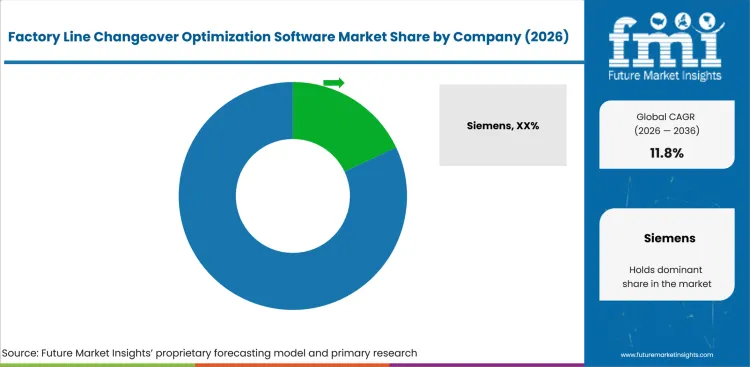
- Established automation vendors hold an advantage through controller libraries and installed PLC bases.
- MES and plant software suppliers gain relevance when changeover records must connect with production execution data.
- System integrators remain important because brownfield plants rarely use one controller family across every line.
- Cybersecurity documentation supports supplier selection when software touches OT assets.
Automation suppliers in this market compete by combining control-platform depth with plant software and service capability. Siemens and Rockwell Automation are well positioned because their engineering platforms already sit close to PLC programming and HMI configuration. Schneider Electric, ABB, and Emerson add software depth across process and hybrid automation sites.
Suppliers best positioned through 2036 are those that can prove repeatable changeover gains across brownfield plants. The strongest vendors will combine controller libraries with MES integration and cybersecurity documentation. Local service teams decide plant acceptance in markets where older assets remain in use.
How do top factory line changeover optimization software market companies compare?
| Company | Relevance to Market Title | Control Platform Depth | MES and Data Integration | Brownfield Service Reach | Geographic Footprint |
|---|---|---|---|---|---|
| Siemens | Very High | Very Strong | Very Strong | Very Strong | Global |
| Rockwell Automation | Very High | Very Strong | Strong | Very Strong | North America and global |
| Schneider Electric | Very High | Strong | Very Strong | Strong | Global |
| ABB | High | Strong | Strong | Strong | Global |
| Emerson | High | Strong | Strong | Strong | Global |
| Mitsubishi Electric | High | Very Strong | Moderate | Strong | East Asia and global |
| OMRON | High | Strong | Moderate | Strong | Japan and global |
| Yokogawa Electric | Moderate to High | Strong | Strong | Moderate | Japan and process markets |
| Honeywell | Moderate to High | Moderate | Strong | Strong | Global |
| Phoenix Contact | Moderate | Strong | Moderate | Strong | Europe and global |
Source: Future Market Insights competitive analysis, 2026.
Who are the key players in the factory line changeover optimization software market?
Siemens, Rockwell Automation, Schneider Electric, ABB, and Emerson are listed with Mitsubishi Electric and OMRON among other suppliers.
Key global companies leading the factory line changeover optimization software market include:
- Siemens
- Rockwell Automation
- Schneider Electric
- ABB
- Emerson
- Mitsubishi Electric
- OMRON
- Yokogawa Electric
- Honeywell
- Phoenix Contact
Key Developments in Factory Line Changeover Optimization Software Market
- In April 2024, Siemens connected Industrial Copilot to TIA Portal and added SCL code generation plus HMI visualization support for engineering teams.
- In October 2024, Rockwell Automation advanced FactoryTalk Optix with DataReady smart machine functions for contextualized machine data and edge-to-cloud analytics.
- In July 2024, Emerson released DeltaV Version 15 Feature Pack 2 with expanded Ethernet protocol connectivity and streamlined state-based control execution.
Key Players in the Factory Line Changeover Optimization Software Market
Global Automation Groups
- Siemens
- Rockwell Automation
- Schneider Electric
- ABB
- Emerson
Machine Automation Specialists
- Mitsubishi Electric
- OMRON
- Phoenix Contact
- Beckhoff Automation
- Bosch Rexroth
Process and OT Software Providers
- Yokogawa Electric
- Honeywell
- AVEVA
- PTC
- Inductive Automation
Which countries are growing fastest in the factory line changeover optimization software market?
India leads at 13.4% CAGR through 2036 while China follows at 13.1% CAGR. The United States and South Korea sit in the next tier. Japan and Germany form the next pair. France and the United Kingdom follow.
.webp "Top Country Growth Comparison Factory Line Changeover Optimization Software Market Cagr (2026 2036)")
| Country | CAGR |
|---|---|
| United States | 10.9% |
| United Kingdom | 9.2% |
| Germany | 10.4% |
| France | 9.8% |
| Japan | 10.6% |
| China | 13.1% |
| South Korea | 10.7% |
| India | 13.4% |
Source: Future Market Insights, 2026.
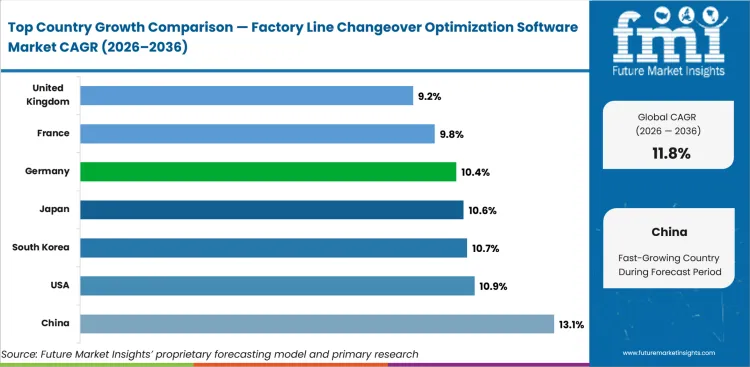
How do country-level CAGRs compare in the factory line changeover optimization software market?
India leads country growth while the United Kingdom records the most cautious expansion outlook among profiled markets.
- The United States is expected to expand at 10.9% CAGR from 2026 to 2036 through brownfield retrofit demand.
- The United Kingdom is estimated to rise at 9.2% CAGR by 2036 as adoption remains selective in mid-sized plants.
- Germany is forecast to grow at 10.4% CAGR through 2036 due to automation depth and machine-building capacity.
- France is projected to advance at 9.8% CAGR by 2036 as food and chemical sites digitize procedures.
- Japan is expected to grow at 10.6% CAGR over the forecast period due to robot density and local automation depth.
- China is projected to post 13.1% CAGR through 2036 due to electronics scale and robot fleet expansion.
- South Korea is forecast to rise at 10.7% CAGR through 2036 as electronics and battery lines need repeatable setup control.
- India is forecast to record 13.4% CAGR by 2036 as automation expands from a smaller installed base.
How fast is the factory line changeover optimization software market growing in the United States?
A 10.9% CAGR through 2036 reflects brownfield retrofit demand across automotive and electronics plants. Packaged-food plants add further demand.
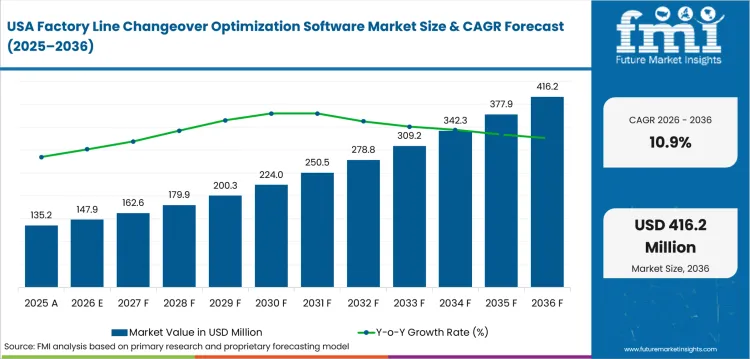
Country Market Snapshot Table
| Parameter | Value |
|---|---|
| Market Size in 2025 (Value) | USD 55.0 million |
| Market Size in 2026 (Value) | USD 61.0 million |
| Market Forecast in 2036 (Value) | USD 171.7 million |
| CAGR (2026 to 2036) | 10.9% |
| Years Considered | 2021 to 2036 |
| Base Year | 2025 |
| Forecast Period | 2026 to 2036 |
| Units Considered | Value (USD million) |
| Leading Sub-Region | Midwest and South Atlantic manufacturing corridors |
United States Factory Line Changeover Optimization Software Market Outlook
United States demand is influenced by brownfield automation scale and the need to extract more output from installed PLC and HMI estates.
System integrators are expected to convert changeover loss into software projects where recipe libraries and operator prompts reduce restart errors.
Key Growth Drivers
- The USA Census Bureau reported durable goods orders increased 7.9% in April 2026, supporting software demand in high-throughput factories.
- The USA Bureau of Labor Statistics placed manufacturing job openings at 474 thousand in April 2026. This lifts demand for guided setup workflows.
- Automotive and electronics plants are expected to use changeover tools to protect throughput during mixed-model scheduling.
- System integrators are expected to convert brownfield PLC estates into software-led changeover projects.
Key Restraints
- CISA released three industrial control systems advisories in August 2025, keeping OT security review central to connected changeover software.
- OT asset inventories can extend approval cycles when software touches PLCs and HMIs across segmented production networks.
- Brownfield plants can delay deployment when recipe libraries must be mapped across several legacy controller families.
What makes United States unique
The United States is unique because large brownfield plants and a deep system-integrator base can turn small pilots into multi-site rollouts.
Key Companies
- Rockwell Automation
- Emerson Electric
- Honeywell
- PTC
- GE Vernova
- Inductive Automation
- Plex Systems
Sales & Marketing Channels
- System integrators
- Automation distributors
- Machine builders
- Direct enterprise sales
- MES implementation partners
- Cloud and OT service partners
Country Segment Breakdown Table
| Segment | Sub-Segments |
|---|---|
| By Offering | Controllers · I/O Modules · Engineering Software · Services |
| By Deployment | Discrete Automation · Process Automation · Hybrid Automation |
| By Application | Machine Control · Line Integration · Safety Control · Remote Operations |
| By End-use Industry | Automotive · Food & Beverage · Chemicals · Pharmaceuticals · Electronics · Metals |
| By Region | North America · Latin America · Europe · East Asia · South Asia & Pacific · Middle East & Africa |
| Key Sub-Regions Covered, Manufacturing and automation corridors | Midwest and South Atlantic manufacturing corridors |
Frequently Asked Questions
How fast is United States factory line changeover optimization software market growing?
Sales in United States are forecast to grow at 10.9% CAGR from 2026 to 2036, supported by local automation and retrofit demand.
Who leads United States factory line changeover optimization software market?
Rockwell Automation and Emerson Electric compete through automation software. Honeywell and PTC add plant integration support.
What is driving adoption in United States factory line changeover optimization software market?
High-mix production and brownfield PLC reuse are moving factories toward verified restart routines after product switches.
How is the factory line changeover optimization software market performing in the United Kingdom?
A 9.2% CAGR through 2036 is supported by selective automation upgrades and food manufacturing changeover needs.
Country Market Snapshot Table
| Parameter | Value |
|---|---|
| Market Size in 2025 (Value) | USD 8.4 million |
| Market Size in 2026 (Value) | USD 9.2 million |
| Market Forecast in 2036 (Value) | USD 22.2 million |
| CAGR (2026 to 2036) | 9.2% |
| Years Considered | 2021 to 2036 |
| Base Year | 2025 |
| Forecast Period | 2026 to 2036 |
| Units Considered | Value (USD million) |
| Leading Sub-Region | Midlands and North West manufacturing corridors |
United Kingdom Factory Line Changeover Optimization Software Market Outlook
United Kingdom demand is concentrated in plants that need measurable setup reduction without large control-system replacement programs.
Food and beverage users are expected to prioritize short projects that protect uptime while machinery users reduce operator variation.
Key Growth Drivers
- ONS reported manufacturing output grew 0.9% in the three months to December 2025, supporting selective line-utilization upgrades.
- The UK Advanced Manufacturing Sector Plan allocated up to GBP 99.0 million for Made Smarter Adoption, supporting digital factory uptake.
- Food and beverage plants are expected to use software to reduce packaging-format change delays.
- SME manufacturers are expected to favor retrofit tools that avoid full line replacement.
Key Restraints
- The Bank of England expected business investment to fall 0.6% in early 2026, which can slow discretionary plant software projects.
- Lower robot installation volumes are expected to constrain large multi-site software pull compared with Germany and China.
- Payback scrutiny can keep projects limited to one pilot line before wider procurement.
What makes United Kingdom unique
The United Kingdom is unique because demand favors targeted changeover projects that fit mid-sized plants and supplier-led integration models.
Key Companies
- AVEVA
- Schneider Electric UK
- KUKA UK
- ATS Global
- Control Systems Integration
- Renishaw
- B&R Industrial Automation UK
Sales & Marketing Channels
- System integrators
- Automation distributors
- Machine builders
- Direct enterprise sales
- MES implementation partners
- Cloud and OT service partners
Country Segment Breakdown Table
| Segment | Sub-Segments |
|---|---|
| By Offering | Controllers · I/O Modules · Engineering Software · Services |
| By Deployment | Discrete Automation · Process Automation · Hybrid Automation |
| By Application | Machine Control · Line Integration · Safety Control · Remote Operations |
| By End-use Industry | Automotive · Food & Beverage · Chemicals · Pharmaceuticals · Electronics · Metals |
| By Region | North America · Latin America · Europe · East Asia · South Asia & Pacific · Middle East & Africa |
| Key Sub-Regions Covered, Manufacturing and automation corridors | Midlands and North West manufacturing corridors |
Frequently Asked Questions
How fast is United Kingdom factory line changeover optimization software market growing?
Sales in United Kingdom are forecast to grow at 9.2% CAGR from 2026 to 2036, supported by local automation and retrofit demand.
Who leads United Kingdom factory line changeover optimization software market?
AVEVA and Schneider Electric UK compete through automation software. KUKA UK and ATS Global add plant integration support.
What is driving adoption in United Kingdom factory line changeover optimization software market?
High-mix production and brownfield PLC reuse are moving factories toward verified restart routines after product switches.
How fast is the factory line changeover optimization software market growing in Germany?
A 10.4% CAGR through 2036 reflects deep automation capacity and strong machine-building influence.
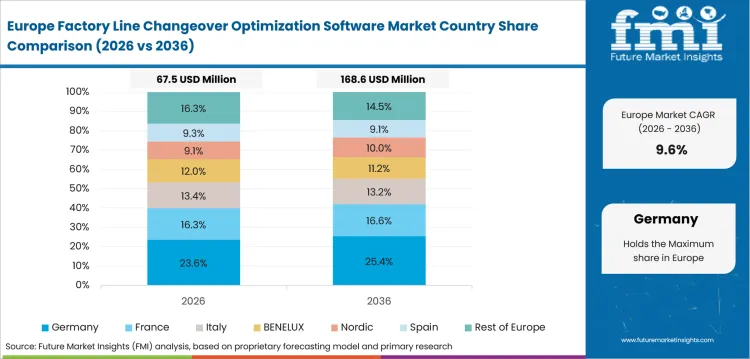
Country Market Snapshot Table
| Parameter | Value |
|---|---|
| Market Size in 2025 (Value) | USD 18.1 million |
| Market Size in 2026 (Value) | USD 20.0 million |
| Market Forecast in 2036 (Value) | USD 53.8 million |
| CAGR (2026 to 2036) | 10.4% |
| Years Considered | 2021 to 2036 |
| Base Year | 2025 |
| Forecast Period | 2026 to 2036 |
| Units Considered | Value (USD million) |
| Leading Sub-Region | Bavaria and Baden-Württemberg with North Rhine-Westphalia |
Germany Factory Line Changeover Optimization Software Market Outlook
Germany demand is shaped by automotive and machinery plants where short changeovers protect high-value production queues.
Local automation suppliers are expected to support adoption through controller libraries and plant engineering services.
Key Growth Drivers
- Destatis reported manufacturing order stock was up 8.4% year over year in April 2026, supporting software that protects production queues.
- Eurostat reported Germany held 26.0% of EU sold industrial production in 2024, giving changeover software a broad factory base.
- Machinery builders are expected to embed setup routines into equipment service packages.
- Automotive suppliers are expected to use changeover control across mixed drivetrain and component lines.
Key Restraints
- Destatis reported new manufacturing orders fell 3.8% month over month in April 2026, increasing scrutiny on payback timing.
- Long validation cycles can slow adoption in high-spec manufacturing environments.
- Cost pressure can shift software budgets toward projects with immediate line-output proof.
What makes Germany unique
Germany is unique because machine builders and control vendors can package changeover logic inside equipment programs and factory standards.
Key Companies
- Siemens
- Bosch Rexroth
- Phoenix Contact
- Festo
- Beckhoff Automation
- KUKA
- SAP Manufacturing
Sales & Marketing Channels
- System integrators
- Automation distributors
- Machine builders
- Direct enterprise sales
- MES implementation partners
- Cloud and OT service partners
Country Segment Breakdown Table
| Segment | Sub-Segments |
|---|---|
| By Offering | Controllers · I/O Modules · Engineering Software · Services |
| By Deployment | Discrete Automation · Process Automation · Hybrid Automation |
| By Application | Machine Control · Line Integration · Safety Control · Remote Operations |
| By End-use Industry | Automotive · Food & Beverage · Chemicals · Pharmaceuticals · Electronics · Metals |
| By Region | North America · Latin America · Europe · East Asia · South Asia & Pacific · Middle East & Africa |
| Key Sub-Regions Covered, Manufacturing and automation corridors | Bavaria and Baden-Württemberg with North Rhine-Westphalia |
Frequently Asked Questions
How fast is Germany factory line changeover optimization software market growing?
Sales in Germany are forecast to grow at 10.4% CAGR from 2026 to 2036, supported by local automation and retrofit demand.
Who leads Germany factory line changeover optimization software market?
Siemens and Bosch Rexroth compete through automation software. Phoenix Contact and Festo add plant integration support.
What is driving adoption in Germany factory line changeover optimization software market?
High-mix production and brownfield PLC reuse are moving factories toward verified restart routines after product switches.
What is the factory line changeover optimization software market outlook in France?
A 9.8% CAGR through 2036 is supported by procedure digitization across food and chemicals. Regulated packaging sites add demand.
Country Market Snapshot Table
| Parameter | Value |
|---|---|
| Market Size in 2025 (Value) | USD 9.5 million |
| Market Size in 2026 (Value) | USD 10.4 million |
| Market Forecast in 2036 (Value) | USD 26.5 million |
| CAGR (2026 to 2036) | 9.8% |
| Years Considered | 2021 to 2036 |
| Base Year | 2025 |
| Forecast Period | 2026 to 2036 |
| Units Considered | Value (USD million) |
| Leading Sub-Region | Auvergne-Rhône-Alpes and Île-de-France industrial corridors |
France Factory Line Changeover Optimization Software Market Outlook
France demand is linked to procedure control in batch and packaging environments where documentation affects buyer trust.
Large industrial software suppliers and engineering contractors are expected to connect MES records with line setup routines.
Key Growth Drivers
- INSEE reported manufacturing output increased 0.3% in November 2025, giving selective sites a reason to protect uptime.
- Eurostat reported France held 12.0% of EU sold industrial production in 2024, supporting a sizable installed manufacturing base.
- Food and pharmaceutical plants are expected to need tighter recipe and procedure control.
- Schneider Electric’s domestic software presence is expected to support enterprise plant standardization.
Key Restraints
- INSEE reported industrial producer prices rose 1.1% in January 2026, increasing near-term pressure on discretionary software budgets.
- Regulated environments need documentation before changeover software is trusted in batch and packaging operations.
- Smaller plants may postpone investment until downtime savings are proven on one line.
What makes France unique
France is unique because software adoption is often linked to documented procedures and regulated production workflows.
Key Companies
- Schneider Electric
- Dassault Systèmes
- Actemium
- SDEL Contrôle Commande
- Eiffage Énergie Systèmes
- Capgemini Engineering
- Astek
Sales & Marketing Channels
- System integrators
- Automation distributors
- Machine builders
- Direct enterprise sales
- MES implementation partners
- Cloud and OT service partners
Country Segment Breakdown Table
| Segment | Sub-Segments |
|---|---|
| By Offering | Controllers · I/O Modules · Engineering Software · Services |
| By Deployment | Discrete Automation · Process Automation · Hybrid Automation |
| By Application | Machine Control · Line Integration · Safety Control · Remote Operations |
| By End-use Industry | Automotive · Food & Beverage · Chemicals · Pharmaceuticals · Electronics · Metals |
| By Region | North America · Latin America · Europe · East Asia · South Asia & Pacific · Middle East & Africa |
| Key Sub-Regions Covered, Manufacturing and automation corridors | Auvergne-Rhône-Alpes and Île-de-France industrial corridors |
Frequently Asked Questions
How fast is France factory line changeover optimization software market growing?
Sales in France are forecast to grow at 9.8% CAGR from 2026 to 2036, supported by local automation and retrofit demand.
Who leads France factory line changeover optimization software market?
Schneider Electric and Dassault Systèmes compete through automation software. Actemium and SDEL Contrôle Commande add plant integration support.
What is driving adoption in France factory line changeover optimization software market?
High-mix production and brownfield PLC reuse are moving factories toward verified restart routines after product switches.
What is the factory line changeover optimization software market forecast for Japan?
A 10.6% CAGR through 2036 reflects robot density and local automation software depth.
Country Market Snapshot Table
| Parameter | Value |
|---|---|
| Market Size in 2025 (Value) | USD 25.3 million |
| Market Size in 2026 (Value) | USD 28.0 million |
| Market Forecast in 2036 (Value) | USD 76.7 million |
| CAGR (2026 to 2036) | 10.6% |
| Years Considered | 2021 to 2036 |
| Base Year | 2025 |
| Forecast Period | 2026 to 2036 |
| Units Considered | Value (USD million) |
| Leading Sub-Region | Kanto and Chubu with Kansai manufacturing corridors |
Japan Factory Line Changeover Optimization Software Market Outlook
Japan demand is shaped by high-quality manufacturing where changeover mistakes can affect yield and customer delivery schedules.
Automation vendors are expected to support adoption through controller software and digital twin validation before commissioning.
Key Growth Drivers
- METI reported industrial production rose 0.5% month over month in April 2026, supporting line-readiness investments.
- Japan’s Cabinet Office reported private-sector machinery orders increased 8.7% in April 2026, indicating automation investment appetite.
- Automotive and electronics plants are expected to use parameter control to protect yield during product variants.
- Local automation suppliers are expected to reduce implementation friction through controller-specific engineering tools.
Key Restraints
- IPA reported nearly 200 practitioners in the FY2025 industrial control systems cybersecurity week, showing that OT security remains a live approval issue.
- Conservative validation practices can lengthen pilot timelines before site-wide deployment.
- Legacy machine interfaces can slow software mapping when plants operate several generations of equipment.
What makes Japan unique
Japan is unique because factory software buyers often expect deep controller fit and low disruption during changeover improvements.
Key Companies
- Mitsubishi Electric
- OMRON
- Yokogawa Electric
- Fanuc
- Keyence
- Azbil
- Panasonic Industry
Sales & Marketing Channels
- System integrators
- Automation distributors
- Machine builders
- Direct enterprise sales
- MES implementation partners
- Cloud and OT service partners
Country Segment Breakdown Table
| Segment | Sub-Segments |
|---|---|
| By Offering | Controllers · I/O Modules · Engineering Software · Services |
| By Deployment | Discrete Automation · Process Automation · Hybrid Automation |
| By Application | Machine Control · Line Integration · Safety Control · Remote Operations |
| By End-use Industry | Automotive · Food & Beverage · Chemicals · Pharmaceuticals · Electronics · Metals |
| By Region | North America · Latin America · Europe · East Asia · South Asia & Pacific · Middle East & Africa |
| Key Sub-Regions Covered, Manufacturing and automation corridors | Kanto and Chubu with Kansai manufacturing corridors |
Frequently Asked Questions
How fast is Japan factory line changeover optimization software market growing?
Sales in Japan are forecast to grow at 10.6% CAGR from 2026 to 2036, supported by local automation and retrofit demand.
Who leads Japan factory line changeover optimization software market?
Mitsubishi Electric and OMRON compete through automation software. Yokogawa Electric and Fanuc add plant integration support.
What is driving adoption in Japan factory line changeover optimization software market?
High-mix production and brownfield PLC reuse are moving factories toward verified restart routines after product switches.
How is the factory line changeover optimization software market performing in China?
A 13.1% CAGR through 2036 is supported by robot scale and high-mix electronics manufacturing.
Country Market Snapshot Table
| Parameter | Value |
|---|---|
| Market Size in 2025 (Value) | USD 47.7 million |
| Market Size in 2026 (Value) | USD 54.0 million |
| Market Forecast in 2036 (Value) | USD 184.9 million |
| CAGR (2026 to 2036) | 13.1% |
| Years Considered | 2021 to 2036 |
| Base Year | 2025 |
| Forecast Period | 2026 to 2036 |
| Units Considered | Value (USD million) |
| Leading Sub-Region | Yangtze River Delta and Pearl River Delta with Guangdong electronics clusters |
China Factory Line Changeover Optimization Software Market Outlook
China demand is influenced by large robot fleets and manufacturing clusters that need standardized line-start routines across many plants.
Local automation suppliers are expected to lower adoption barriers through domestic controller support and regional service teams.
Key Growth Drivers
- NBS reported manufacturing value added increased 6.6% in January to February 2026, supporting manufacturing productivity software.
- NBS reported high-technology manufacturing value added increased 13.1% in January to February 2026, supporting changeover demand in precision plants.
- Electronics and EV supply chains are expected to require faster line balancing across product variants.
- Local automation suppliers are expected to lower the cost of software-enabled changeover deployment.
Key Restraints
- NBS reported the industrial product sales ratio was 95.4% in January to February 2026, signaling margin pressure on discretionary software budgets.
- Data localization and cybersecurity checks can complicate multinational software rollouts.
- Local supplier competition can push global vendors toward service-heavy proof of value.
What makes China unique
China is unique because automation scale and local supplier depth can turn changeover software into a standard layer across manufacturing groups.
Key Companies
- Inovance Technology
- Hollysys Automation
- SUPCON Technology
- Estun Automation
- Siasun Robot
- Midea KUKA China
- Shanghai Electric
Sales & Marketing Channels
- System integrators
- Automation distributors
- Machine builders
- Direct enterprise sales
- MES implementation partners
- Cloud and OT service partners
Country Segment Breakdown Table
| Segment | Sub-Segments |
|---|---|
| By Offering | Controllers · I/O Modules · Engineering Software · Services |
| By Deployment | Discrete Automation · Process Automation · Hybrid Automation |
| By Application | Machine Control · Line Integration · Safety Control · Remote Operations |
| By End-use Industry | Automotive · Food & Beverage · Chemicals · Pharmaceuticals · Electronics · Metals |
| By Region | North America · Latin America · Europe · East Asia · South Asia & Pacific · Middle East & Africa |
| Key Sub-Regions Covered, Manufacturing and automation corridors | Yangtze River Delta and Pearl River Delta with Guangdong electronics clusters |
Frequently Asked Questions
How fast is China factory line changeover optimization software market growing?
Sales in China are forecast to grow at 13.1% CAGR from 2026 to 2036, supported by local automation and retrofit demand.
Who leads China factory line changeover optimization software market?
Inovance Technology and Hollysys Automation compete through automation software. SUPCON Technology and Estun Automation add plant integration support.
What is driving adoption in China factory line changeover optimization software market?
High-mix production and brownfield PLC reuse are moving factories toward verified restart routines after product switches.
What is the factory line changeover optimization software market outlook in South Korea?
A 10.7% CAGR through 2036 is supported by electronics and battery line complexity.
Country Market Snapshot Table
| Parameter | Value |
|---|---|
| Market Size in 2025 (Value) | USD 10.8 million |
| Market Size in 2026 (Value) | USD 12.0 million |
| Market Forecast in 2036 (Value) | USD 33.2 million |
| CAGR (2026 to 2036) | 10.7% |
| Years Considered | 2021 to 2036 |
| Base Year | 2025 |
| Forecast Period | 2026 to 2036 |
| Units Considered | Value (USD million) |
| Leading Sub-Region | Seoul Capital Area and Gyeonggi with Ulsan industrial corridors |
South Korea Factory Line Changeover Optimization Software Market Outlook
South Korea demand is concentrated in precision manufacturing where line setup errors can affect throughput and quality.
Large OEMs and battery producers are expected to standardize approved changeover routines once suppliers prove technical fit.
Key Growth Drivers
- MOTIR reported semiconductor exports rose 151.4% in March 2026, supporting changeover tools for precision electronics lines.
- MOTIR reported secondary battery exports increased 36.0% in March 2026, supporting setup control across changing cell formats.
- Battery manufacturers are expected to need repeatable parameter control across changing cell formats.
- Large OEMs can scale approved software across several sites after technical validation.
Key Restraints
- MOTIR reported automobile exports rose only 2.2% in March 2026, keeping vehicle-platform software budgets selective.
- Supplier qualification is strict in high-yield electronics environments.
- A concentrated customer base can make sales cycles long and technical.
What makes South Korea unique
South Korea is unique because electronics and battery manufacturing creates strong need for precise setup control at high production speed.
Key Companies
- LS Electric
- Samsung SDS
- Hyundai Robotics
- Doosan Robotics
- LG CNS
- POSCO DX
- Hanwha Robotics
Sales & Marketing Channels
- System integrators
- Automation distributors
- Machine builders
- Direct enterprise sales
- MES implementation partners
- Cloud and OT service partners
Country Segment Breakdown Table
| Segment | Sub-Segments |
|---|---|
| By Offering | Controllers · I/O Modules · Engineering Software · Services |
| By Deployment | Discrete Automation · Process Automation · Hybrid Automation |
| By Application | Machine Control · Line Integration · Safety Control · Remote Operations |
| By End-use Industry | Automotive · Food & Beverage · Chemicals · Pharmaceuticals · Electronics · Metals |
| By Region | North America · Latin America · Europe · East Asia · South Asia & Pacific · Middle East & Africa |
| Key Sub-Regions Covered, Manufacturing and automation corridors | Seoul Capital Area and Gyeonggi with Ulsan industrial corridors |
Frequently Asked Questions
How fast is South Korea factory line changeover optimization software market growing?
Sales in South Korea are forecast to grow at 10.7% CAGR from 2026 to 2036, supported by local automation and retrofit demand.
Who leads South Korea factory line changeover optimization software market?
LS Electric and Samsung SDS compete through automation software. Hyundai Robotics and Doosan Robotics add plant integration support.
What is driving adoption in South Korea factory line changeover optimization software market?
High-mix production and brownfield PLC reuse are moving factories toward verified restart routines after product switches.
What is the factory line changeover optimization software market outlook in India?
A 13.4% CAGR through 2036 reflects fast automation growth from a smaller installed base.
Country Market Snapshot Table
| Parameter | Value |
|---|---|
| Market Size in 2025 (Value) | USD 7.4 million |
| Market Size in 2026 (Value) | USD 8.4 million |
| Market Forecast in 2036 (Value) | USD 29.5 million |
| CAGR (2026 to 2036) | 13.4% |
| Years Considered | 2021 to 2036 |
| Base Year | 2025 |
| Forecast Period | 2026 to 2036 |
| Units Considered | Value (USD million) |
| Leading Sub-Region | Western and southern automotive and electronics clusters |
India Factory Line Changeover Optimization Software Market Outlook
India demand is shaped by expanding automotive and electronics manufacturing where buyers need higher throughput without replacing every line.
Integrator-led projects are expected to support brownfield plants that need guided setup routines and lower restart risk.
Key Growth Drivers
- PIB reported manufacturing output grew 8.0% in November 2025, supporting software that lifts throughput without adding plants.
- MeitY reported electronics goods production reached INR 11.32 lakh crore in FY 2024 to 2025, supporting electronics-line changeover demand.
- Automotive suppliers are expected to need controlled station setup as model variety increases.
- Integrator-led projects are expected to support brownfield plants that cannot replace all controls.
Key Restraints
- CERT-In handled more than 29.44 lakh cyber incidents in 2025, raising scrutiny for connected software that touches plant systems.
- Cost sensitivity can keep software pilots small during early adoption.
- Controls engineering skill gaps can slow rollout beyond the first line.
What makes India unique
India is unique because automation growth and brownfield manufacturing expansion create a wide retrofit base for changeover tools.
Key Companies
- Tata Technologies
- Larsen & Toubro
- Tata Elxsi
- Bosch India
- Siemens India
- Rockwell Automation India
- Kaynes Technology
Sales & Marketing Channels
- System integrators
- Automation distributors
- Machine builders
- Direct enterprise sales
- MES implementation partners
- Cloud and OT service partners
Country Segment Breakdown Table
| Segment | Sub-Segments |
|---|---|
| By Offering | Controllers · I/O Modules · Engineering Software · Services |
| By Deployment | Discrete Automation · Process Automation · Hybrid Automation |
| By Application | Machine Control · Line Integration · Safety Control · Remote Operations |
| By End-use Industry | Automotive · Food & Beverage · Chemicals · Pharmaceuticals · Electronics · Metals |
| By Region | North America · Latin America · Europe · East Asia · South Asia & Pacific · Middle East & Africa |
| Key Sub-Regions Covered, Manufacturing and automation corridors | Western and southern automotive and electronics clusters |
Frequently Asked Questions
How fast is India factory line changeover optimization software market growing?
Sales in India are forecast to grow at 13.4% CAGR from 2026 to 2036, supported by local automation and retrofit demand.
Who leads India factory line changeover optimization software market?
Tata Technologies and Larsen & Toubro compete through automation software. Tata Elxsi and Bosch India add plant integration support.
What is driving adoption in India factory line changeover optimization software market?
High-mix production and brownfield PLC reuse are moving factories toward verified restart routines after product switches.
Factory Line Changeover Optimization Software Market - Report Scope
| Parameter | Details |
|---|---|
| Forecast period | 2026 to 2036 |
| Historical period | 2021 to 2025 |
| Quantitative unit | Revenue in USD million |
| By offering | Controllers, I/O modules, engineering software, services |
| By deployment | Discrete automation, process automation, hybrid automation |
| By application | Machine control, line integration, safety control, remote operations |
| By end-use industry | Automotive, food and beverage, chemicals, pharmaceuticals, electronics, metals |
| Regions covered | North America, Latin America, Europe, East Asia, South Asia and Pacific, Middle East and Africa |
| Countries covered | United States, United Kingdom, Germany, France, Japan, China, South Korea, India |
| Key companies profiled | Siemens, Rockwell Automation, Schneider Electric, ABB, Emerson, Mitsubishi Electric, OMRON, Yokogawa, Honeywell |
| Approach | Bottom-up software-boundary approach using license revenue, service attachment, controller integration value, and country automation maturity |
Factory Line Changeover Optimization Software Market - Scope & Definition
| Attribute | Detail |
| Market Definition | Software and related services that plan, guide, validate, and record product switches on manufacturing lines. |
| Functions Covered | Recipe management, controller parameter control, setup validation, operator guidance, restart sequencing, and changeover recordkeeping. |
| Applications Covered | Machine control, line integration, safety control, and remote operations for product switchovers. |
| End-Use Industries | Automotive, food and beverage, chemicals, pharmaceuticals, electronics, metals, and other high-mix manufacturing environments. |
| System Types Covered | Controllers, I/O modules, engineering software, and implementation services used for line changeover execution. |
| Inclusions | Software licenses, integration services, controller configuration work, recipe libraries, HMI prompts, and plant support tied to changeover optimization. |
| Exclusions | Standalone ERP scheduling, broad SCADA alarm management, generic maintenance software, and consulting work not tied to line changeover execution. |
Factory Line Changeover Optimization Software Market - Research Methodology
| Method | Description |
| Primary Research | FMI analyst interviews with plant managers, automation engineers, machine builders, system integrators, and software providers across key markets. |
| Desk Research | Review of industrial robot data, automation standards, OT cybersecurity guidance, company product information, and official manufacturing statistics. |
| Market Sizing & Forecasting | Bottom-up software-boundary approach using license revenue, service attachment, controller integration intensity, and country automation maturity. |
| Data Validation | Cross-verification using supplier portfolios, robot installation signals, end-use changeover frequency, public statistics, and company disclosures. |
Factory Line Changeover Optimization Software Market Breakdown by Offering, Deployment, Application, End-use Industry, and Region
Factory Line Changeover Optimization Software Market Segmented by Offering
- Controllers
- I/O Modules
- Engineering Software
- Services
Factory Line Changeover Optimization Software Market Segmented by Deployment
- Discrete Automation
- Process Automation
- Hybrid Automation
Factory Line Changeover Optimization Software Market Segmented by Application
- Machine Control
- Line Integration
- Safety Control
- Remote Operations
Factory Line Changeover Optimization Software Market Segmented by End-use Industry
- Automotive
- Food & Beverage
- Chemicals
- Pharmaceuticals
- Electronics
- Metals
Factory Line Changeover Optimization Software Market by Region
- North America
- Latin America
- Europe
- East Asia
- South Asia and Pacific
- Middle East and Africa
Research Sources and Bibliography
- ABB. (2024, June 4). ABB launches next-generation robotics control platform OmniCore.
- Bank of England. (2026, April 30). Monetary Policy Report - April 2026.
- Cabinet Office of Japan. (2026, June 18). Machinery orders in April 2026.
- China National Bureau of Statistics. (2026, March 17). Industrial production operation from January to February 2026.
- Cybersecurity and Infrastructure Security Agency. (2025, August 21). CISA releases three industrial control systems advisories.
- Emerson Electric Co. (2024, July 10). Emerson enhances control system software for seamless data integration and improved operational performance.
- Eurostat. (2026, June). Industrial production statistics.
- Federal Reserve Bank of St. Louis. (2026, June 2). Job openings: Manufacturing.
- Federal Statistical Office of Germany. (2026, June 18). Stock of orders in manufacturing in April 2026.
- Federal Statistical Office of Germany. (2026, June 8). New orders in manufacturing in April 2026.
- Honeywell. (2025, February 11). Honeywell unveils AI assistant for industrial operators in Honeywell Forge Production Intelligence.
- INSEE. (2026, January 9). In November 2025, manufacturing output was back on the rise.
- INSEE. (2026, February 28). In January 2026, industrial producer prices rose by 1.1%.
- Information-technology Promotion Agency, Japan. (2025, November 25). JP-US-EU Industrial Control Systems Cybersecurity Week for the Indo-Pacific Region was held in FY2025.
- International Federation of Robotics. (2025, September 25). Best-of World Robotics 2025.
- METI. (2026, June 12). Revised report for April 2026: Indices of industrial production.
- Ministry of Electronics and Information Technology. (2026, April). Annual report 2025-26.
- Ministry of Trade, Industry and Resources. (2026, April 1). March 2026 exports reach record USD 86.1 billion.
- Office for National Statistics. (2026, February 12). GDP monthly estimate, UK: December 2025.
- OPC Foundation. (2024, April 22). OPC Foundation launches OPC UA Cloud Initiative.
- Press Information Bureau. (2025, December 29). India’s Index of industrial production records growth of 6.7% in November 2025.
- Press Information Bureau. (2026, January 23). CERT-In: India’s frontline defender against cyber threats.
- Rockwell Automation. (2024, October 15). Rockwell Automation advances FactoryTalk Optix portfolio with DataReady smart machine application.
- Schneider Electric. (2024, February 26). Schneider Electric launches EcoStruxure Plant Lean Management.
- Siemens. (2024, April 22). Siemens Xcelerator: Scaling roll-out of generative AI with Siemens Industrial Copilot.
- USA Census Bureau. (2026, May 28). Monthly advance report on durable goods manufacturers’ shipments, inventories, and orders.
- Yokogawa Electric Corporation. (2024, October 28). Yokogawa releases OpreX Batch MES.
This bibliography is provided for reader reference and is not exhaustive. The full report contains the complete reference list and detailed citations.
This Report Answers
- Market size estimates for 2026 and forecasts through 2036 for the factory line changeover optimization software market.
- Insights across regional and country-level markets including the United States, China, Germany, Japan, India, and South Korea.
- Analysis of demand drivers, deployment models, changeover workflows, and plant integration requirements.
- Evaluation of leading offerings including engineering software, controllers, I/O modules, and services.
- Assessment of OT security, brownfield integration, and cybersecurity review impacts on market development.
- Identification of growth opportunities across application areas such as line integration and remote operations.
- Evaluation of supply chain dynamics, product development, and system-integrator roles.
- Country-level growth analysis covering eight profiled manufacturing markets.
- Assessment of the competitive landscape including automation suppliers, MES vendors, and machine automation specialists.
- Regional outlooks across North America, Europe, East Asia, South Asia and Pacific, Latin America, and Middle East and Africa.
- Delivery of market data, forecasts, and supporting analysis in PDF and Excel formats.
Frequently Asked Questions
What is the growth prospect for factory line changeover optimization software?
Demand is expected to rise as high-mix factories connect recipes, controller parameters, and guided operator workflows.
Which companies are expected to shape the factory line changeover optimization software market?
Siemens, Rockwell Automation, Schneider Electric, ABB, Emerson, Mitsubishi Electric, and OMRON are expected to shape competition.
Why are automation suppliers investing in changeover optimization software?
Automation suppliers are investing because changeover workflows can extend control-platform value across brownfield plants.
Why is brownfield integration important in the market?
Brownfield integration is important because many plants need software-led changeover control without replacing working PLCs and HMIs.
Which application is gaining attention in factory line changeover optimization software?
Line integration is gaining attention as plants try to reduce delays between machines during product switches.
How do regulations influence factory line changeover optimization software?
Regulations influence adoption when safety records, batch procedures, and OT cybersecurity controls must be documented.
Why is cybersecurity important for changeover optimization software?
Cybersecurity is important because changeover software can touch controllers, recipes, HMI prompts, and production restart rules.
What role do system integrators play in the market?
System integrators help map legacy machines, validate controller links, and deploy changeover workflows across mixed automation estates.
Preview the report firsthand - request a free sample
Get SampleGet the brochure for pricing and purchase details.
Get PDFTable of Content
- Key Takeaways
- Market Size and CAGR
- Top Growth Driver
- Fastest Growing Segment
- Leading Region
- Key Companies
- Emerging Opportunities
- Executive Summary
- Global Market Outlook
- Demand-side Trends
- Supply-side Trends
- Technology Roadmap Analysis
- Analysis and Recommendations
- Analyst Perspective (What is happening? Why now? What should investors know?)
- Key Questions Answered
- How large is the market?
- What is the CAGR?
- What are key trends?
- Which region dominates?
- Who are the leaders?
- Market Overview
- Market Coverage / Taxonomy
- Market Definition / Scope / Limitations
- Research Methodology
- Chapter Orientation
- Analytical Lens and Working Hypotheses
- Market Structure, Signals, and Trend Drivers
- Benchmarking and Cross-market Comparability
- Market Sizing, Forecasting, and Opportunity Mapping
- Research Design and Evidence Framework
- Desk Research Programme (Secondary Evidence)
- Expert Input and Fieldwork (Primary Evidence)
- Tooling, Models, and Reference Databases
- Data Engineering and Model Build
- Quality Assurance and Audit Trail
- Market Background
- Market Dynamics (Drivers, Restraints, Opportunity, Trends)
- Scenario Forecast (Optimistic, Likely, Conservative)
- Impact Analysis
- AI Impact
- Sustainability Impact
- Regulatory Impact
- Technology Impact
- Consumer / Buyer Analysis
- Purchase Drivers
- Adoption Barriers
- Buyer Journey
- Opportunity Map Analysis
- Product Life Cycle Analysis
- Supply Chain Analysis
- Investment Feasibility Matrix
- Value Chain Analysis
- PESTLE and Porter's Analysis
- Regulatory Landscape
- Regional Parent Market Outlook
- Production and Consumption Statistics
- Import and Export Statistics
- Global Market Analysis and Forecast, 2021 to 2036
- Historical Market Size Value (USD Million) & Volume (Unit) Analysis, 2021 to 2025
- Current and Future Market Size Value (USD Million) & Volume (Unit) Projections, 2026 to 2036
- Y-o-Y Growth Trend Analysis
- Absolute $ Opportunity Analysis
- Global Market Pricing Analysis, 2021 to 2036
- Global Market Analysis and Forecast, By Offering, 2021 to 2036
- Introduction / Key Findings
- Historical Market Size Value (USD Million) & Volume (Unit) Analysis By Offering, 2021 to 2025
- Current and Future Market Size Value (USD Million) & Volume (Unit) Analysis and Forecast By Offering, 2026 to 2036
- Engineering Software
- Services
- Controllers
- I/O Modules
- Engineering Software
- Y-o-Y Growth Trend Analysis By Offering, 2021 to 2025
- Absolute $ Opportunity Analysis By Offering, 2026 to 2036
- Global Market Analysis and Forecast, By Deployment, 2021 to 2036
- Introduction / Key Findings
- Historical Market Size Value (USD Million) & Volume (Unit) Analysis By Deployment, 2021 to 2025
- Current and Future Market Size Value (USD Million) & Volume (Unit) Analysis and Forecast By Deployment, 2026 to 2036
- Discrete Automation
- Process Automation
- Hybrid Automation
- Discrete Automation
- Y-o-Y Growth Trend Analysis By Deployment, 2021 to 2025
- Absolute $ Opportunity Analysis By Deployment, 2026 to 2036
- Global Market Analysis and Forecast, By Application, 2021 to 2036
- Introduction / Key Findings
- Historical Market Size Value (USD Million) & Volume (Unit) Analysis By Application, 2021 to 2025
- Current and Future Market Size Value (USD Million) & Volume (Unit) Analysis and Forecast By Application, 2026 to 2036
- Line Integration
- Machine Control
- Safety Control
- Remote Operations
- Line Integration
- Y-o-Y Growth Trend Analysis By Application, 2021 to 2025
- Absolute $ Opportunity Analysis By Application, 2026 to 2036
- Global Market Analysis and Forecast, By End-use Industry, 2021 to 2036
- Introduction / Key Findings
- Historical Market Size Value (USD Million) & Volume (Unit) Analysis By End-use Industry, 2021 to 2025
- Current and Future Market Size Value (USD Million) & Volume (Unit) Analysis and Forecast By End-use Industry, 2026 to 2036
- Automotive
- Food & Beverage
- Chemicals
- Pharmaceuticals
- Electronics
- Metals
- Automotive
- Y-o-Y Growth Trend Analysis By End-use Industry, 2021 to 2025
- Absolute $ Opportunity Analysis By End-use Industry, 2026 to 2036
- Global Market Analysis and Forecast, By Region, 2021 to 2036
- Introduction
- Historical Market Size Value (USD Million) & Volume (Unit) Analysis By Region, 2021 to 2025
- Current Market Size Value (USD Million) & Volume (Unit) Analysis and Forecast By Region, 2026 to 2036
- North America
- Latin America
- Western Europe
- Eastern Europe
- East Asia
- South Asia and Pacific
- Middle East & Africa
- Market Attractiveness Analysis By Region
- North America Market Analysis and Forecast, By Country, 2021 to 2036
- Historical Market Size Value (USD Million) & Volume (Unit) Trend Analysis By Market Taxonomy, 2021 to 2025
- Market Size Value (USD Million) & Volume (Unit) Forecast By Market Taxonomy, 2026 to 2036
- By Country
- USA
- Canada
- Mexico
- By Offering
- By Deployment
- By Application
- By End-use Industry
- By Country
- Market Attractiveness Analysis
- By Country
- By Offering
- By Deployment
- By Application
- By End-use Industry
- Key Takeaways
- Latin America Market Analysis and Forecast, By Country
- Historical Market Size Value (USD Million) & Volume (Unit) Trend Analysis By Market Taxonomy, 2021 to 2025
- Market Size Value (USD Million) & Volume (Unit) Forecast By Market Taxonomy, 2026 to 2036
- By Country
- Brazil
- Chile
- Rest of Latin America
- By Offering
- By Deployment
- By Application
- By End-use Industry
- By Country
- Market Attractiveness Analysis
- By Country
- By Offering
- By Deployment
- By Application
- By End-use Industry
- Key Takeaways
- Western Europe Market Analysis and Forecast, By Country
- Historical Market Size Value (USD Million) & Volume (Unit) Trend Analysis By Market Taxonomy, 2021 to 2025
- Market Size Value (USD Million) & Volume (Unit) Forecast By Market Taxonomy, 2026 to 2036
- By Country
- Germany
- UK
- Italy
- Spain
- France
- Nordic
- BENELUX
- Rest of Western Europe
- By Offering
- By Deployment
- By Application
- By End-use Industry
- By Country
- Market Attractiveness Analysis
- By Country
- By Offering
- By Deployment
- By Application
- By End-use Industry
- Key Takeaways
- Eastern Europe Market Analysis and Forecast, By Country
- Historical Market Size Value (USD Million) & Volume (Unit) Trend Analysis By Market Taxonomy, 2021 to 2025
- Market Size Value (USD Million) & Volume (Unit) Forecast By Market Taxonomy, 2026 to 2036
- By Country
- Russia
- Poland
- Hungary
- Balkan & Baltic
- Rest of Eastern Europe
- By Offering
- By Deployment
- By Application
- By End-use Industry
- By Country
- Market Attractiveness Analysis
- By Country
- By Offering
- By Deployment
- By Application
- By End-use Industry
- Key Takeaways
- East Asia Market Analysis and Forecast, By Country
- Historical Market Size Value (USD Million) & Volume (Unit) Trend Analysis By Market Taxonomy, 2021 to 2025
- Market Size Value (USD Million) & Volume (Unit) Forecast By Market Taxonomy, 2026 to 2036
- By Country
- China
- Japan
- South Korea
- By Offering
- By Deployment
- By Application
- By End-use Industry
- By Country
- Market Attractiveness Analysis
- By Country
- By Offering
- By Deployment
- By Application
- By End-use Industry
- Key Takeaways
- South Asia and Pacific Market Analysis and Forecast, By Country
- Historical Market Size Value (USD Million) & Volume (Unit) Trend Analysis By Market Taxonomy, 2021 to 2025
- Market Size Value (USD Million) & Volume (Unit) Forecast By Market Taxonomy, 2026 to 2036
- By Country
- India
- ASEAN
- Australia & New Zealand
- Rest of South Asia and Pacific
- By Offering
- By Deployment
- By Application
- By End-use Industry
- By Country
- Market Attractiveness Analysis
- By Country
- By Offering
- By Deployment
- By Application
- By End-use Industry
- Key Takeaways
- Middle East & Africa Market Analysis and Forecast, By Country
- Historical Market Size Value (USD Million) & Volume (Unit) Trend Analysis By Market Taxonomy, 2021 to 2025
- Market Size Value (USD Million) & Volume (Unit) Forecast By Market Taxonomy, 2026 to 2036
- By Country
- Kingdom of Saudi Arabia
- Other GCC Countries
- Türkiye
- South Africa
- Other African Union
- Rest of Middle East & Africa
- By Offering
- By Deployment
- By Application
- By End-use Industry
- By Country
- Market Attractiveness Analysis
- By Country
- By Offering
- By Deployment
- By Application
- By End-use Industry
- Key Takeaways
- Key Countries Market Analysis
- USA
- Pricing Analysis
- Market Share Analysis, 2025
- By Offering
- By Deployment
- By Application
- By End-use Industry
- Canada
- Pricing Analysis
- Market Share Analysis, 2025
- By Offering
- By Deployment
- By Application
- By End-use Industry
- Mexico
- Pricing Analysis
- Market Share Analysis, 2025
- By Offering
- By Deployment
- By Application
- By End-use Industry
- Brazil
- Pricing Analysis
- Market Share Analysis, 2025
- By Offering
- By Deployment
- By Application
- By End-use Industry
- Chile
- Pricing Analysis
- Market Share Analysis, 2025
- By Offering
- By Deployment
- By Application
- By End-use Industry
- Germany
- Pricing Analysis
- Market Share Analysis, 2025
- By Offering
- By Deployment
- By Application
- By End-use Industry
- UK
- Pricing Analysis
- Market Share Analysis, 2025
- By Offering
- By Deployment
- By Application
- By End-use Industry
- Italy
- Pricing Analysis
- Market Share Analysis, 2025
- By Offering
- By Deployment
- By Application
- By End-use Industry
- Spain
- Pricing Analysis
- Market Share Analysis, 2025
- By Offering
- By Deployment
- By Application
- By End-use Industry
- France
- Pricing Analysis
- Market Share Analysis, 2025
- By Offering
- By Deployment
- By Application
- By End-use Industry
- India
- Pricing Analysis
- Market Share Analysis, 2025
- By Offering
- By Deployment
- By Application
- By End-use Industry
- ASEAN
- Pricing Analysis
- Market Share Analysis, 2025
- By Offering
- By Deployment
- By Application
- By End-use Industry
- Australia & New Zealand
- Pricing Analysis
- Market Share Analysis, 2025
- By Offering
- By Deployment
- By Application
- By End-use Industry
- China
- Pricing Analysis
- Market Share Analysis, 2025
- By Offering
- By Deployment
- By Application
- By End-use Industry
- Japan
- Pricing Analysis
- Market Share Analysis, 2025
- By Offering
- By Deployment
- By Application
- By End-use Industry
- South Korea
- Pricing Analysis
- Market Share Analysis, 2025
- By Offering
- By Deployment
- By Application
- By End-use Industry
- Russia
- Pricing Analysis
- Market Share Analysis, 2025
- By Offering
- By Deployment
- By Application
- By End-use Industry
- Poland
- Pricing Analysis
- Market Share Analysis, 2025
- By Offering
- By Deployment
- By Application
- By End-use Industry
- Hungary
- Pricing Analysis
- Market Share Analysis, 2025
- By Offering
- By Deployment
- By Application
- By End-use Industry
- Kingdom of Saudi Arabia
- Pricing Analysis
- Market Share Analysis, 2025
- By Offering
- By Deployment
- By Application
- By End-use Industry
- Türkiye
- Pricing Analysis
- Market Share Analysis, 2025
- By Offering
- By Deployment
- By Application
- By End-use Industry
- South Africa
- Pricing Analysis
- Market Share Analysis, 2025
- By Offering
- By Deployment
- By Application
- By End-use Industry
- USA
- Market Structure Analysis
- Competition Dashboard
- Competition Benchmarking
- Market Share Analysis of Top Players
- By Regional
- By Offering
- By Deployment
- By Application
- By End-use Industry
- Emerging Startups
- Innovation Benchmarking
- Competition Analysis
- Competition Deep Dive
- Siemens
- Overview
- Product Portfolio
- Profitability by Market Segments (Product/Region/Sales Channel)
- Sales Footprint
- Strategy Overview
- Marketing Strategy
- Product Strategy
- Channel Strategy
- Rockwell Automation
- Schneider Electric
- ABB
- Emerson
- Mitsubishi Electric
- OMRON
- Yokogawa Electric
- Honeywell
- Phoenix Contact
- Siemens
- Case Studies
- Success Stories
- Recent Developments
- Competition Deep Dive
- Assumptions & Acronyms Used


