

- Market Size (2026)
- USD 780.6 Mn
- Forecast (2036)
- USD 2256.7 Mn
- CAGR (2026 to 2036)
- 11.2%
How big is Factory Line Changeover Software Market in 2026?
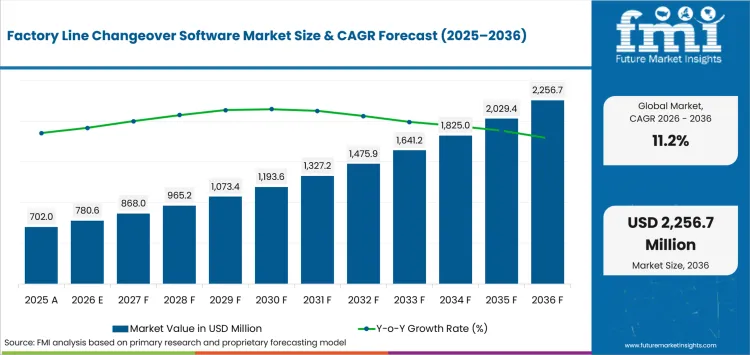
USD 780.6 million in 2026 and USD 2256.7 million by 2036 at an 11.2% CAGR.
Demand for factory line changeover software is projected to expand at 11.2% CAGR between 2026 and 2036, increasing valuation from USD 780.6 million in 2026 to USD 2256.7 million by 2036. Manufacturers fund these tools as repeated setup losses become visible against production schedules. In May 2026, Siemens connected flexible work orders with imported production orders in Opcenter X 2604 and added quality tasks. The Opcenter X release ties order context to shop-floor execution and makes restart checks easier to govern.
Automation density changes the integration work needed around established production controls. The International Federation of Robotics reported in April 2026 that the United States operated 307 robots per 10,000 manufacturing employees versus 62 in Mexico. The gap does not measure software demand, but it changes the starting point for deployment. USA plants face denser brownfield interfaces, whereas Mexican export factories need scalable workflows that fit mixed automation and local integration capacity.
Key Takeaways of Factory Line Changeover Software Market
- Manufacturing operations teams purchase changeover software to protect productive time as product variation increases the frequency and coordination burden of line setup.
- Based on software function, digital work instructions are projected to account for 24.0% in 2026 due to direct control over operator setup sequences.
- Cloud SaaS is set to lead the deployment category with 61.0% share in 2026 due to centrally managed workflow updates across production sites.
- The integration category is forecast to be led by MES-integrated architecture at 36.0% share in 2026 due to live production context governing recipes and restart authorization.
- Brownfield integration and weak master-data ownership can delay rollout because plants must preserve reliable production context across existing automation and software layers.
- Siemens, Rockwell Automation, SAP, Dassault Systèmes, Tulip, Critical Manufacturing, AVEVA and Poka are the eight companies covered across the competitive sections.
Analyst Perspective
“Plant teams should test whether changeover software keeps the active order, approved setup sequence and restart checks aligned during each product switch. Wider rollout depends on preserving that context across lines without forcing replacement of proven MES or automation controls.”
- Nikhil Kaitwade, Principal Consultant, Future Market Insights
How is the Factory Line Changeover Software Market segmented?
The factory line changeover software market is segmented by software function, deployment, integration, end use, revenue model and region.
Software function includes digital work instructions, changeover scheduling, tooling / recipe management, SMED analytics, operator guidance and validation & sign-off. Deployment covers cloud SaaS, on-premise and hybrid. Integration includes MES-integrated, ERP-integrated, PLC / SCADA-linked and standalone systems. End use covers automotive, food & beverage, pharma / medical devices, packaging and electronics. Revenue model separates subscription, enterprise license and implementation services.
Why does cloud SaaS lead the deployment category?
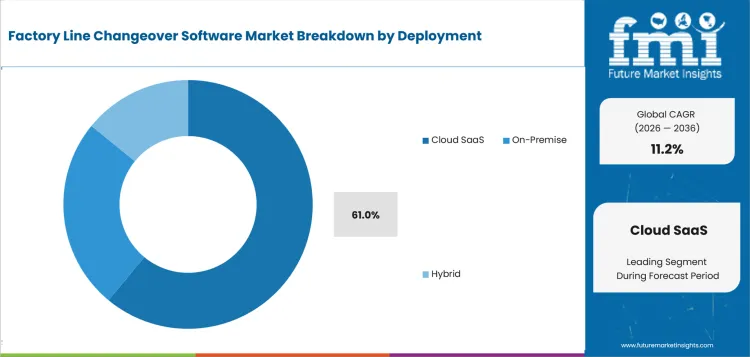
Cloud SaaS centralizes changeover content for manufacturers operating several lines or plants with frequent workflow revisions across product families and sites. Central configuration reduces routine local application maintenance, and resilient edge execution protects critical production work during local network interruptions.
- Cloud SaaS is projected to hold 61.0% share in 2026 owing to recurring workflow updates and phased expansion across multiple production sites.
- Smart factory programs need cloud administration paired with resilient plant execution for dependable multi-site rollout. Rockwell Automation announced elastic MES offerings in December 2025, combining cloud-native architecture with edge-to-cloud deployment choices for manufacturing operations.
Why do digital work instructions lead the software function category?
Digital work instructions place approved setup logic beside operators during product changes and reduce dependence on memory. Poka opened early access for AI Studio in June 2026 with a work-instruction comparison agent that flags procedural differences. The same workflow keeps revised setup knowledge directly visible at the point of work for operator training.
- By software function, digital work instructions are estimated to hold 24.0% in 2026 owing to consistent sequences and auditable completion across operator tasks.
- Frontline adoption strengthens as current instructions stay visible at workstations and supervisors review completion records for each completed setup.
Why does MES-integrated architecture lead the integration category?
SAP announced Manufacturing Assistant in May 2026 to connect shop-floor signals with operational context during disruptions. MES-integrated architecture connects each setup with the active production order and routing that triggered it. The order link keeps work aligned with the active revision and returns completion status to the execution record.
- By integration, MES-integrated architecture is forecast to represent 36.0% in 2026 driven by live production context governing recipes and restart authorization.
- Plants keep IoT in manufacturing data beside execution records to compare machine state with the dispatched order. The combined record keeps operator guidance tied to production context instead of leaving it as a standalone application.
Why does automotive lead the end use category?
Automotive plants combine model variation with synchronized stations that require matching fixtures and machine settings. Incomplete setup can spread quality loss across operations and make restart readiness a measurable daily production concern.
- In 2026, automotive is expected to lead end use with 27.0% share because synchronized production lines raise the cost of inconsistent setup execution.
- The International Federation of Robotics reported in June 2026 that USA automotive plants installed 13,500 industrial robots during 2025. The dense robot base raises demand for industrial robotics integration that synchronizes machine states and operator checks during product switches.
What are the drivers, restraints and opportunities in the Factory Line Changeover Software Market?
Manufacturers use changeover software to protect productive time as product variation increases, but brownfield integration slows deployment and replayable execution data expands improvement value.
- Driver: Higher product variation and digitally controlled production make repeatable changeover execution a direct uptime and quality requirement for plant operations.
- Restraint: Brownfield integration and weak master-data ownership extend deployment as changeover workflows depend on trustworthy production context across connected systems.
- Opportunity: Context-aware guidance and replayable execution records give manufacturers a practical route to compare planned setup logic with actual line behavior.
Product Variation Raises the Cost of Setup Variance
Frequent product changes expose small setup errors as lost production time because every restart depends on current instructions and system context. In September 2025, Rockwell Automation connected Plex guided work with Rockwell applications and third-party MES and ERP systems. The Plex integration lets plants compare standard work with industrial IoT context across recurring changeovers instead of treating operator instructions as a separate record.
Integration Complexity Slows Multi-Line Rollout
Multi-line rollout slows as changeover workflows cross legacy controls and enterprise applications that assign production data to different systems. AVEVA announced in May 2026 that Operations Control would connect HMI and SCADA with enterprise systems using CONNECT from June. Each interface to factory automation systems adds validation and service work before a plant can standardize one changeover workflow across more lines.
Replayable Operations Expand Improvement Value
Engineers need a reliable setup record to compare planned work with the actions that occurred on the line. In March 2026, Tulip announced Factory Playback to synchronize machine telemetry with operator workflows and quality events in one operational timeline. Industrial digital twins can use that history during investigation, but plants retain human approval for changes to validated production procedures.
Which country CAGRs are profiled in the Factory Line Changeover Software Market?
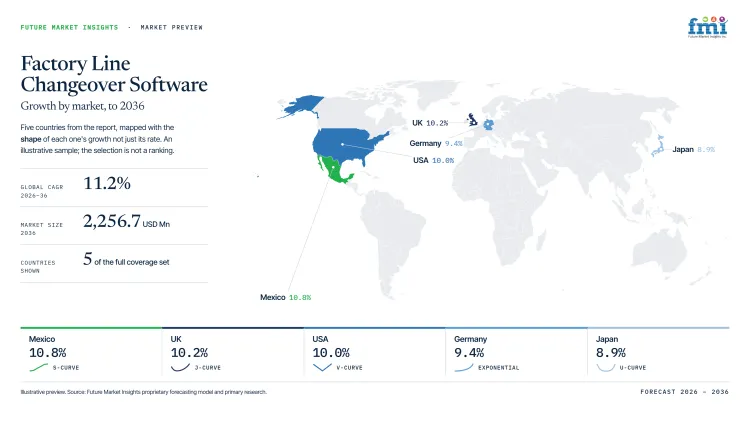
| Country | CAGR |
|---|---|
| Mexico | 10.8% |
| United Kingdom | 10.2% |
| United States | 10.0% |
| Germany | 9.4% |
| Japan | 8.9% |
How do country-level CAGRs compare in the Factory Line Changeover Software Market?
The country outlook span a 1.9 percentage-point CAGR range, but their operating conditions still divide into distinct groups. Mexico centers on export manufacturing. Germany and Japan carry heavier brownfield integration requirements. The United Kingdom and United States form a close middle cluster whose similar growth rates mask different deployment priorities.
- Mexico concentrates activity in export plants requiring model-change and restart coordination.
- United Kingdom programs lower barriers for smaller manufacturers testing production workflows.
- United States plants combine broad automation with stricter scrutiny of integration economics.
- Germany emphasizes compatibility with established engineering controls across long-lived production systems nationwide.
- Japan favors incremental deployment that reinforces standard work across mature automated assets.
Comparable CAGRs can produce different entry priorities because installed automation and service conditions vary by country. The full report provides country-level CAGR analysis across North America, Latin America, Europe, East Asia, South Asia, Oceania and the Middle East and Africa.
Country-wise Analysis
- Mexican automotive plants work to fixed export schedules, so model-change timing and restart stability affect assembly lines serving multinational vehicle programs with narrow outbound windows and recurring quality gates during each production switch. INEGI reported in June 2026 that Mexico produced 342,926 light vehicles during May 2026, a production base in which tightly scheduled model changes make restart timing and traceability measurable across high-volume vehicle programs. Factory line changeover software sales in Mexico are forecast to expand at 10.8% CAGR by 2036, driven by automotive integration needs despite uneven digital maturity among tier manufacturers that raises connector and local service requirements.
- United Kingdom manufacturers often test changeover software inside site-level digitalization programs that give smaller factories external implementation guidance and structured training for wider rollout across several production lines during plant modernization. In the United Kingdom, factory line changeover software demand is predicted to advance at 10.2% CAGR through 2036, aided by public training that lowers the first-line implementation burden for smaller manufacturers. The Department for Business and Trade reported in July 2026 that Made Smarter supports 5,500 SMEs, giving smaller manufacturers access to practical advice and training even as recurring fees and connector work still require measurable setup savings.
- United States manufacturers assess changeover software inside brownfield plants that combine several automation generations, so cybersecurity rules and production-data ownership shape each new connection to line controls across production sites with different local engineering resources. NIST reported in March 2025 that the MEP network assists more than 12,000 manufacturing clients each year, giving smaller plants local technology support during modernization projects that lack dedicated automation engineering teams. By 2036, the United States is projected to grow at 10.0% CAGR owing to modernization spending as brownfield connectors and security reviews extend validation between a successful pilot and wider production-line rollout.
- German manufacturers combine formal engineering change control with established MES and automation layers, so changeover software must preserve validated production states across long-lived factory systems and documented revisions during carefully phased workflow updates. Germany is estimated to post 9.4% CAGR over the forecast period, influenced by established digital production practices that favor controlled interface upgrades and staged validation across manufacturing environments with tightly governed system changes. Bitkom reported in March 2025 that 71% of German industrial companies used Industry 4.0 applications, so many plants already manage connected production workflows even as data-sharing complexity and specialized integration work remain material rollout frictions.
- Japanese factories rely on stable production routines and careful machine servicing across long-lived automated assets, so changeover software must fit formally governed product switches without disrupting established quality routines during repeated production cycles. The Japan Robot Association reported in June 2026 that domestic robot shipments totaled 37,816 units during 2025, indicating continued industrial robot deployment across factories that still require machine-specific integration and service for changeover software. Adoption of factory line changeover software in Japan is estimated to expand at 8.9% CAGR through 2036, aided by the installed automation base despite site-specific practices that favor incremental rollout and offline resilience across validated lines.
Who are the notable companies in the Factory Line Changeover Software Market?
Siemens, Rockwell Automation, SAP, Dassault Systèmes, Tulip, Critical Manufacturing, AVEVA and Poka serve this market.
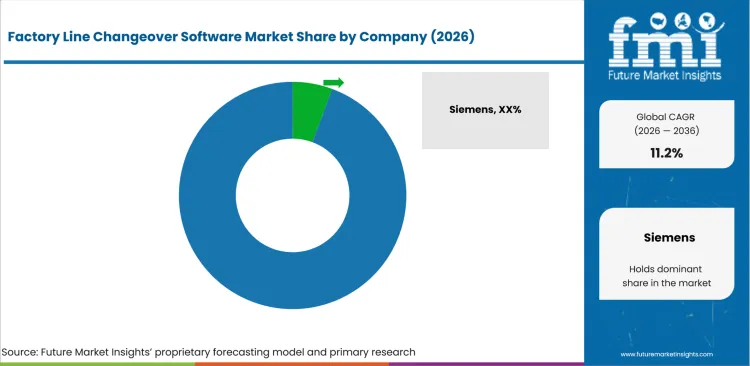
The field is fragmented between manufacturing-execution suites and frontline workflow platforms. MES depth, connector coverage and operator workflow control shape selection during multi-site rollout. Applications must preserve production context across existing controls, and digital twin technology gives engineering teams another route for linking line state with changeover records.
- Siemens, Rockwell Automation and AVEVA combine manufacturing execution with plant connectivity for changeover projects anchored in established industrial software.
- SAP, Dassault Systèmes and Critical Manufacturing connect production records with MES-centered execution for plants extending existing enterprise environments.
- Tulip and Poka emphasize configurable operator guidance for plants adding frontline workflows without replacing the complete production software stack.
Competitive Benchmarking: Factory Line Changeover Software Market
| Company | Changeover Workflow & Operator Guidance | MES / Production Context Integration | OT Connectivity & Deployment Flexibility | Geographic Reach |
|---|---|---|---|---|
| Siemens | High | High | High | Americas, Europe and Asia-Pacific |
| Rockwell Automation | High | High | High | Americas, Europe, Asia-Pacific and Latin America |
| SAP | Medium | High | Medium | Global enterprise manufacturing regions |
| Dassault Systèmes | Medium | High | Medium | Americas, Europe and Asia-Pacific |
| Tulip | High | Medium | High | North America, Europe and Asia-Pacific |
| Critical Manufacturing | Medium | High | High | Europe, North America and Asia-Pacific |
| AVEVA | Medium | High | High | Global industrial markets |
| Poka | High | Medium | Medium | North America and Europe with multinational deployments |
Key Developments in the Factory Line Changeover Software Market
- In June 2026, Rockwell Automation introduced FactoryTalk ResilientEdge combining Plex MES with resilient edge operations and cloud services for connected factories.
- In May 2026, Critical Manufacturing established a Taiwan entity to support MES deployments for semiconductor and electronics manufacturers.
- In May 2026, AVEVA and Amazon Web Services announced a multi-year collaboration expanding CONNECT on AWS with public and private SaaS options.
Key Players in the Factory Line Changeover Software Market
Integrated Industrial Execution and OT Platforms
- Siemens
- Rockwell Automation
- AVEVA
Enterprise and MES-Centered Manufacturing Platforms
- SAP
- Dassault Systèmes
- Critical Manufacturing
Frontline Workflow Platforms
- Tulip
- Poka
Factory Line Changeover Software Market - Report Scope
| Coverage field | Report scope |
|---|---|
| Market breakdown | By software function, deployment, integration, end use, revenue model and region. |
| Quantitative Units | Revenue in USD million and CAGR in %. |
| Market Definition | Software used to plan, guide, validate, analyze or integrate production-line changeovers across manufacturing operations. |
| Regions Covered | North America, Latin America, Europe, East Asia, South Asia and Pacific and Middle East and Africa. |
| Countries Covered | Mexico, United Kingdom, United States, Germany, Japan, and 20+ countries included in the full report. |
| Key Companies Profiled | Siemens, Rockwell Automation, SAP, Dassault Systèmes, Tulip, Critical Manufacturing, AVEVA and Poka. |
| Forecast Period | 2026 to 2036. |
| Approach | Primary and secondary research with market triangulation. |
Factory Line Changeover Software Market - Research Methodology
| Method | Approach |
|---|---|
| Primary Research | FMI analysts gathered input from manufacturers, service providers, technology developers, distributors, end users, procurement teams, and subject-matter experts. Interviews examined purchasing decisions, product or service evaluation, adoption barriers, approval requirements, pricing considerations, and expectations for technical or commercial support. Respondents were also asked what evidence is required before a trial, pilot, or initial order develops into regular purchasing. |
| Desk Research | Desk research covered government statistics, regulatory publications, trade data, industry associations, technical literature, standards, company filings, product information, and official corporate announcements. Sources were reviewed for relevance, publication date, geographic coverage, and consistency with the defined market scope. Claims relating to performance, applications, approvals, capacity, investment, and commercial activity were retained only when supported by credible public evidence. |
| Market Sizing and Forecasting | The market model combined the baseline value with historical performance, segment structure, pricing and volume indicators, adoption levels, company participation, and country-level demand conditions. Forecast assumptions considered economic activity, investment trends, regulatory developments, technology adoption, purchasing cycles, supply availability, and barriers to wider market use. Segment and regional estimates were reconciled before the final market total was calculated. |
| Data Validation | Estimates were checked against multiple independent indicators, including public data, company activity, trade patterns, industry developments, and findings from primary interviews. Validation also tested whether products, services, applications, and company revenues fell within the defined market boundaries. Adjacent categories, unsupported claims, overlapping revenues, and activities without direct market relevance were excluded to reduce double counting and maintain consistency across segments and countries. |
Factory Line Changeover Software Market by Segments
Factory Line Changeover Software Market segmented by Software Function:
- Digital Work Instructions
- Changeover Scheduling
- Tooling / Recipe Management
- SMED Analytics
- Operator Guidance
- Validation & Sign-off
Factory Line Changeover Software Market segmented by Deployment:
- Cloud SaaS
- On-premise
- Hybrid
Factory Line Changeover Software Market segmented by Integration:
- MES-integrated
- ERP-integrated
- PLC / SCADA-linked
- Standalone
Factory Line Changeover Software Market segmented by End Use:
- Automotive
- Food & Beverage
- Pharma / Medical Devices
- Packaging
- Electronics
Factory Line Changeover Software Market segmented by Revenue Model:
- Subscription
- Enterprise License
- Implementation Services
Factory Line Changeover Software Market by Region:
- North America
- United States
- Canada
- Latin America
- Brazil
- Mexico
- Chile
- Rest of Latin America
- Western Europe
- Germany
- United Kingdom
- Italy
- Spain
- France
- Nordics
- Benelux
- Rest of Western Europe
- Eastern Europe
- Russia
- Poland
- Hungary
- Balkan and Baltic States
- Rest of Eastern Europe
- East Asia
- China
- Japan
- South Korea
- South Asia and Pacific
- India
- ASEAN
- Australia and New Zealand
- Rest of South Asia and Pacific
- Middle East and Africa
- Kingdom of Saudi Arabia
- Other GCC Countries
- Türkiye
- South Africa
- Other African Union Countries
- Rest of Middle East and Africa
Research Sources and Bibliography
- Cereseto, A. (2026, May 21). What’s new in Opcenter X 2604
- International Federation of Robotics. (2026, April 8). Robot Density Surges in Europe, Asia, and Americas
- Poka. (2026, June 24). Poka Plants the Flag on Industrial AI for Connected Work
- Rockwell Automation. (2025, December 9). Rockwell Automation Leads New Era of Manufacturing With Elastic MES Offerings
- Metzger, D. (2026, May 14). Moving Toward a More Autonomous Supply Chain
- International Federation of Robotics. (2026, June 18). US Robot Industry Returns to Double Digit Growth
- Rockwell Automation. (2025, September 30). Connected Worker Solution from Plex, by Rockwell Automation, Now Integrates Across Applications
- AVEVA. (2026, May 20). AVEVA announces new AI capabilities at AVEVA World 2026
- Tulip Interfaces. (2026, March 17). Tulip Announces Factory Playback, Bringing Replayable Operations to AI-Driven Manufacturing Powered by NVIDIA
- Instituto Nacional de Estadística y Geografía. (2026, June 8). Registro administrativo de la industria automotriz de vehículos ligeros. Mayo de 2026
- Department for Business and Trade. (2026, July 15). Advanced Manufacturing
- Blum, M., & Thomas, N. (2025, March 25). Challenges, Solutions, and Success Stories Across the MEP National Network
- Bitkom e. V. (2025, March 27). Industrie 4.0 2025 – Wie digital ist Deutschlands Industrie?
- Japan Robot Association. (2026, June 1).
- Dassault Systèmes. (2025, March 12). Dassault Systèmes Partners with NTT e-MOI to Support Industrial Growth and Digital Transformation in Vietnam
- AVEVA. (2025, January 22). AVEVA is Recognised as a Leader in the 2024-2025 IDC MarketScape for worldwide manufacturing execution systems
- Critical Manufacturing. (2026, March 19). Critical Manufacturing to Demonstrate MES-Powered Industrial Operations Platform for AI-Driven Manufacturing at Hannover Messe 2026
- Rockwell Automation. (2026, June 18). Rockwell Automation Introduces FactoryTalk ResilientEdge to Enable Autonomous, Scalable Manufacturing Operations
- Critical Manufacturing. (2026, May 27). Critical Manufacturing Expands into Taiwan to Support MES-Driven Industrial Operations Platform
- AVEVA. (2026, May 19). AVEVA and AWS Partner to Accelerate Industrial Intelligence
- Dassault Systèmes. (2026, April 21). OMRON and Dassault Systèmes Partner to Revolutionize Manufacturing with Virtual and Real Integration
- Critical Manufacturing. (2025, December 17). Critical Manufacturing Partners with Canonical to Expand Cloud-Native Deployment Options for Manufacturers
- Tulip. (2026, February 25). Tulip Achieves FedRAMP Moderate Equivalency, Accelerating Secure Digital Manufacturing for Aerospace & Defense
- Siemens Digital Industries Software. (2025, January 23). IDC MarketScape names Siemens a Leader in Manufacturing Execution Systems
- Rockwell Automation. (2025, June 12). Rockwell Automation Named as a Representative Vendor in 2025 Gartner® Market Guide for Manufacturing Execution Systems
- Poka. (2025, June 17). How to Optimize Product Changeovers in Manufacturing
- Metzger, D. (2025, March 28). Unleashing Manufacturing’s Potential: SAP’s Vision for an Adaptive, AI-Driven Future
- AVEVA. (2025, July 30). AVEVA successfully validates its SCADA and MES software on AWS infrastructure
This bibliography is provided for reader reference and is not exhaustive. The full report contains the complete reference list and detailed citations
This Report Answers
- How large is the market in 2026 and 2036?
- Which operating conditions make changeover software budgetable for manufacturers?
- Why do digital work instructions lead software function demand?
- How does cloud SaaS support multi-site workflow governance?
- Why does MES integration anchor production-context execution?
- How do profiled country growth conditions differ commercially?
- Which capabilities distinguish the eight active software companies in this market?
- Which recent developments reshape deployment and regional support?
Frequently Asked Questions
How big is the Factory Line Changeover Software Market in 2026?
The factory line changeover software market is expected to be valued at USD 780.6 million in 2026. Manufacturers increasingly fund repeatable setup execution that protects productive time during frequent product and format changes.
What is the CAGR of the Factory Line Changeover Software Market from 2026 to 2036?
The factory line changeover software market is projected to expand at an 11.2% CAGR between 2026 and 2036. Continued spending on digital work guidance and production-system integration makes changeover performance measurable across repeated operating cycles.
Which deployment segment is projected to account for 61.0% of the Factory Line Changeover Software Market?
The factory line changeover software market is expected to have cloud SaaS represent 61.0% of deployment in 2026. Central workflow updates and multi-site administration make the model practical for manufacturers expanding successful line implementations across broader production networks.
Which revenue model leads the Factory Line Changeover Software Market in 2026?
The factory line changeover software market is estimated to have subscription represent 58.0% of revenue-model demand in 2026. Recurring pricing fits cloud delivery and phased line expansion once manufacturers establish a workable operating case for repeated changeovers.
Which companies are active in the Factory Line Changeover Software Market?
The factory line changeover software market includes Siemens, Rockwell Automation, SAP, Dassault Systèmes, Tulip, Critical Manufacturing, AVEVA and Poka. These companies compete across industrial execution suites and MES-centered platforms as well as configurable frontline workflow software.
Preview the report firsthand - request a free sample
Get SampleGet the brochure for pricing and purchase details.
Get PDFTable of Content
- Key Takeaways
- Market Size and CAGR
- Top Growth Driver
- Fastest Growing Segment
- Leading Region
- Key Companies
- Emerging Opportunities
- Executive Summary
- Global Market Outlook
- Demand-side Trends
- Supply-side Trends
- Technology Roadmap Analysis
- Analysis and Recommendations
- Analyst Perspective (What is happening? Why now? What should investors know?)
- Key Questions Answered
- How large is the market?
- What is the CAGR?
- What are key trends?
- Which region dominates?
- Who are the leaders?
- Market Overview
- Market Coverage / Taxonomy
- Market Definition / Scope / Limitations
- Research Methodology
- Chapter Orientation
- Analytical Lens and Working Hypotheses
- Market Structure, Signals, and Trend Drivers
- Benchmarking and Cross-market Comparability
- Market Sizing, Forecasting, and Opportunity Mapping
- Research Design and Evidence Framework
- Desk Research Programme (Secondary Evidence)
- Expert Input and Fieldwork (Primary Evidence)
- Tooling, Models, and Reference Databases
- Data Engineering and Model Build
- Quality Assurance and Audit Trail
- Market Background
- Market Dynamics (Drivers, Restraints, Opportunity, Trends)
- Scenario Forecast (Optimistic, Likely, Conservative)
- Impact Analysis
- AI Impact
- Sustainability Impact
- Regulatory Impact
- Technology Impact
- Consumer / Buyer Analysis
- Purchase Drivers
- Adoption Barriers
- Buyer Journey
- Opportunity Map Analysis
- Product Life Cycle Analysis
- Supply Chain Analysis
- Investment Feasibility Matrix
- Value Chain Analysis
- PESTLE and Porter's Analysis
- Regulatory Landscape
- Regional Parent Market Outlook
- Production and Consumption Statistics
- Import and Export Statistics
- Global Market Analysis and Forecast, 2021 to 2036
- Historical Market Size Value (USD Million) Analysis, 2021 to 2025
- Current and Future Market Size Value (USD Million) Projections, 2026 to 2036
- Y-o-Y Growth Trend Analysis
- Absolute $ Opportunity Analysis
- Global Market Pricing Analysis, 2021 to 2036
- Global Market Analysis and Forecast, By Software Function, 2021 to 2036
- Introduction / Key Findings
- Historical Market Size Value (USD Million) Analysis By Software Function, 2021 to 2025
- Current and Future Market Size Value (USD Million) Analysis and Forecast By Software Function, 2026 to 2036
- Digital Work Instructions
- Changeover Scheduling
- Tooling / Recipe Management
- SMED Analytics
- Operator Guidance
- Validation & Sign-Off
- Digital Work Instructions
- Y-o-Y Growth Trend Analysis By Software Function, 2021 to 2025
- Absolute $ Opportunity Analysis By Software Function, 2026 to 2036
- Global Market Analysis and Forecast, By Deployment, 2021 to 2036
- Introduction / Key Findings
- Historical Market Size Value (USD Million) Analysis By Deployment, 2021 to 2025
- Current and Future Market Size Value (USD Million) Analysis and Forecast By Deployment, 2026 to 2036
- Cloud SaaS
- On-Premise
- Hybrid
- Cloud SaaS
- Y-o-Y Growth Trend Analysis By Deployment, 2021 to 2025
- Absolute $ Opportunity Analysis By Deployment, 2026 to 2036
- Global Market Analysis and Forecast, By Integration, 2021 to 2036
- Introduction / Key Findings
- Historical Market Size Value (USD Million) Analysis By Integration, 2021 to 2025
- Current and Future Market Size Value (USD Million) Analysis and Forecast By Integration, 2026 to 2036
- MES-Integrated
- ERP-Integrated
- PLC / SCADA-Linked
- Standalone
- MES-Integrated
- Y-o-Y Growth Trend Analysis By Integration, 2021 to 2025
- Absolute $ Opportunity Analysis By Integration, 2026 to 2036
- Global Market Analysis and Forecast, By End Use, 2021 to 2036
- Introduction / Key Findings
- Historical Market Size Value (USD Million) Analysis By End Use, 2021 to 2025
- Current and Future Market Size Value (USD Million) Analysis and Forecast By End Use, 2026 to 2036
- Automotive
- Food & Beverage
- Pharma / Medical Devices
- Packaging
- Electronics
- Automotive
- Y-o-Y Growth Trend Analysis By End Use, 2021 to 2025
- Absolute $ Opportunity Analysis By End Use, 2026 to 2036
- Global Market Analysis and Forecast, By Revenue Model, 2021 to 2036
- Introduction / Key Findings
- Historical Market Size Value (USD Million) Analysis By Revenue Model, 2021 to 2025
- Current and Future Market Size Value (USD Million) Analysis and Forecast By Revenue Model, 2026 to 2036
- Subscription
- Enterprise License
- Implementation Services
- Subscription
- Y-o-Y Growth Trend Analysis By Revenue Model, 2021 to 2025
- Absolute $ Opportunity Analysis By Revenue Model, 2026 to 2036
- Global Market Analysis and Forecast, By Region, 2021 to 2036
- Introduction
- Historical Market Size Value (USD Million) Analysis By Region, 2021 to 2025
- Current Market Size Value (USD Million) Analysis and Forecast By Region, 2026 to 2036
- North America
- Latin America
- Western Europe
- Eastern Europe
- East Asia
- South Asia and Pacific
- Middle East & Africa
- Market Attractiveness Analysis By Region
- North America Market Analysis and Forecast, By Country, 2021 to 2036
- Historical Market Size Value (USD Million) Trend Analysis By Market Taxonomy, 2021 to 2025
- Market Size Value (USD Million) Forecast By Market Taxonomy, 2026 to 2036
- By Country
- USA
- Canada
- By Software Function
- By Deployment
- By Integration
- By End Use
- By Revenue Model
- By Country
- Market Attractiveness Analysis
- By Country
- By Software Function
- By Deployment
- By Integration
- By End Use
- By Revenue Model
- Key Takeaways
- Latin America Market Analysis and Forecast, By Country
- Historical Market Size Value (USD Million) Trend Analysis By Market Taxonomy, 2021 to 2025
- Market Size Value (USD Million) Forecast By Market Taxonomy, 2026 to 2036
- By Country
- Brazil
- Mexico
- Chile
- Rest of Latin America
- By Software Function
- By Deployment
- By Integration
- By End Use
- By Revenue Model
- By Country
- Market Attractiveness Analysis
- By Country
- By Software Function
- By Deployment
- By Integration
- By End Use
- By Revenue Model
- Key Takeaways
- Western Europe Market Analysis and Forecast, By Country
- Historical Market Size Value (USD Million) Trend Analysis By Market Taxonomy, 2021 to 2025
- Market Size Value (USD Million) Forecast By Market Taxonomy, 2026 to 2036
- By Country
- Germany
- UK
- Italy
- Spain
- France
- Nordic
- BENELUX
- Rest of Western Europe
- By Software Function
- By Deployment
- By Integration
- By End Use
- By Revenue Model
- By Country
- Market Attractiveness Analysis
- By Country
- By Software Function
- By Deployment
- By Integration
- By End Use
- By Revenue Model
- Key Takeaways
- Eastern Europe Market Analysis and Forecast, By Country
- Historical Market Size Value (USD Million) Trend Analysis By Market Taxonomy, 2021 to 2025
- Market Size Value (USD Million) Forecast By Market Taxonomy, 2026 to 2036
- By Country
- Russia
- Poland
- Hungary
- Balkan & Baltic
- Rest of Eastern Europe
- By Software Function
- By Deployment
- By Integration
- By End Use
- By Revenue Model
- By Country
- Market Attractiveness Analysis
- By Country
- By Software Function
- By Deployment
- By Integration
- By End Use
- By Revenue Model
- Key Takeaways
- East Asia Market Analysis and Forecast, By Country
- Historical Market Size Value (USD Million) Trend Analysis By Market Taxonomy, 2021 to 2025
- Market Size Value (USD Million) Forecast By Market Taxonomy, 2026 to 2036
- By Country
- China
- Japan
- South Korea
- By Software Function
- By Deployment
- By Integration
- By End Use
- By Revenue Model
- By Country
- Market Attractiveness Analysis
- By Country
- By Software Function
- By Deployment
- By Integration
- By End Use
- By Revenue Model
- Key Takeaways
- South Asia and Pacific Market Analysis and Forecast, By Country
- Historical Market Size Value (USD Million) Trend Analysis By Market Taxonomy, 2021 to 2025
- Market Size Value (USD Million) Forecast By Market Taxonomy, 2026 to 2036
- By Country
- India
- ASEAN
- Australia & New Zealand
- Rest of South Asia and Pacific
- By Software Function
- By Deployment
- By Integration
- By End Use
- By Revenue Model
- By Country
- Market Attractiveness Analysis
- By Country
- By Software Function
- By Deployment
- By Integration
- By End Use
- By Revenue Model
- Key Takeaways
- Middle East & Africa Market Analysis and Forecast, By Country
- Historical Market Size Value (USD Million) Trend Analysis By Market Taxonomy, 2021 to 2025
- Market Size Value (USD Million) Forecast By Market Taxonomy, 2026 to 2036
- By Country
- Kingdom of Saudi Arabia
- Other GCC Countries
- Türkiye
- South Africa
- Other African Union
- Rest of Middle East & Africa
- By Software Function
- By Deployment
- By Integration
- By End Use
- By Revenue Model
- By Country
- Market Attractiveness Analysis
- By Country
- By Software Function
- By Deployment
- By Integration
- By End Use
- By Revenue Model
- Key Takeaways
- Key Countries Market Analysis
- USA
- Pricing Analysis
- Market Share Analysis, 2025
- By Software Function
- By Deployment
- By Integration
- By End Use
- By Revenue Model
- Canada
- Pricing Analysis
- Market Share Analysis, 2025
- By Software Function
- By Deployment
- By Integration
- By End Use
- By Revenue Model
- Mexico
- Pricing Analysis
- Market Share Analysis, 2025
- By Software Function
- By Deployment
- By Integration
- By End Use
- By Revenue Model
- Brazil
- Pricing Analysis
- Market Share Analysis, 2025
- By Software Function
- By Deployment
- By Integration
- By End Use
- By Revenue Model
- Chile
- Pricing Analysis
- Market Share Analysis, 2025
- By Software Function
- By Deployment
- By Integration
- By End Use
- By Revenue Model
- Germany
- Pricing Analysis
- Market Share Analysis, 2025
- By Software Function
- By Deployment
- By Integration
- By End Use
- By Revenue Model
- UK
- Pricing Analysis
- Market Share Analysis, 2025
- By Software Function
- By Deployment
- By Integration
- By End Use
- By Revenue Model
- Italy
- Pricing Analysis
- Market Share Analysis, 2025
- By Software Function
- By Deployment
- By Integration
- By End Use
- By Revenue Model
- Spain
- Pricing Analysis
- Market Share Analysis, 2025
- By Software Function
- By Deployment
- By Integration
- By End Use
- By Revenue Model
- France
- Pricing Analysis
- Market Share Analysis, 2025
- By Software Function
- By Deployment
- By Integration
- By End Use
- By Revenue Model
- India
- Pricing Analysis
- Market Share Analysis, 2025
- By Software Function
- By Deployment
- By Integration
- By End Use
- By Revenue Model
- ASEAN
- Pricing Analysis
- Market Share Analysis, 2025
- By Software Function
- By Deployment
- By Integration
- By End Use
- By Revenue Model
- Australia & New Zealand
- Pricing Analysis
- Market Share Analysis, 2025
- By Software Function
- By Deployment
- By Integration
- By End Use
- By Revenue Model
- China
- Pricing Analysis
- Market Share Analysis, 2025
- By Software Function
- By Deployment
- By Integration
- By End Use
- By Revenue Model
- Japan
- Pricing Analysis
- Market Share Analysis, 2025
- By Software Function
- By Deployment
- By Integration
- By End Use
- By Revenue Model
- South Korea
- Pricing Analysis
- Market Share Analysis, 2025
- By Software Function
- By Deployment
- By Integration
- By End Use
- By Revenue Model
- Russia
- Pricing Analysis
- Market Share Analysis, 2025
- By Software Function
- By Deployment
- By Integration
- By End Use
- By Revenue Model
- Poland
- Pricing Analysis
- Market Share Analysis, 2025
- By Software Function
- By Deployment
- By Integration
- By End Use
- By Revenue Model
- Hungary
- Pricing Analysis
- Market Share Analysis, 2025
- By Software Function
- By Deployment
- By Integration
- By End Use
- By Revenue Model
- Kingdom of Saudi Arabia
- Pricing Analysis
- Market Share Analysis, 2025
- By Software Function
- By Deployment
- By Integration
- By End Use
- By Revenue Model
- Türkiye
- Pricing Analysis
- Market Share Analysis, 2025
- By Software Function
- By Deployment
- By Integration
- By End Use
- By Revenue Model
- South Africa
- Pricing Analysis
- Market Share Analysis, 2025
- By Software Function
- By Deployment
- By Integration
- By End Use
- By Revenue Model
- USA
- Market Structure Analysis
- Competition Dashboard
- Competition Benchmarking
- Market Share Analysis of Top Players
- By Regional
- By Software Function
- By Deployment
- By Integration
- By End Use
- By Revenue Model
- Emerging Startups
- Innovation Benchmarking
- Competition Analysis
- Competition Deep Dive
- Siemens
- Overview
- Product Portfolio
- Profitability by Market Segments
- Sales Footprint
- Strategy Overview
- Marketing Strategy
- Product Strategy
- Channel Strategy
- Rockwell Automation
- SAP
- Dassault Systemes
- Tulip
- Critical Manufacturing
- AVEVA
- Poka
- Siemens
- Case Studies
- Success Stories
- Recent Developments
- Competition Deep Dive
- Assumptions & Acronyms Used


