

- Market Size (2026)
- USD 188.0 Mn
- Forecast (2036)
- USD 474.5 Mn
- CAGR (2026 to 2036)
- 9.7%
Inline Surface Scratch Detection Software Market Size, Market Forecast and Outlook By FMI
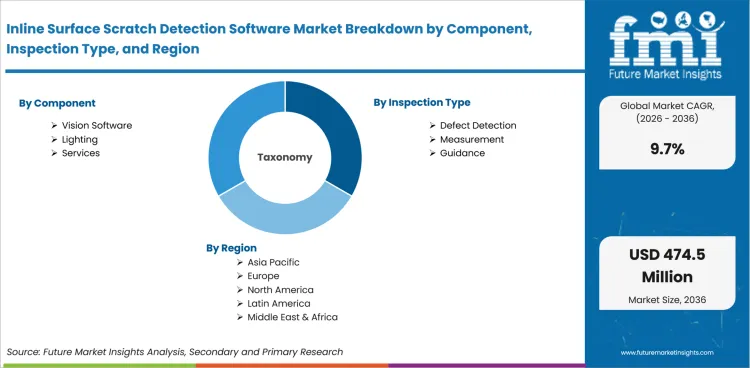
USD 188.0 million in 2026 and USD 474.5 million by 2036 at a 9.7% CAGR.
The inline surface scratch detection software industry value is forecast to grow from USD 171.4 million in 2025 to USD 474.5 million by 2036 at 9.7% CAGR. Vision Software is forecast to represent 37.5% share in 2026 because defect models and recipe tuning carry the main value. Defect Detection is expected to secure 52.0% share in 2026, led by scratch classification on reflective and coated surfaces.
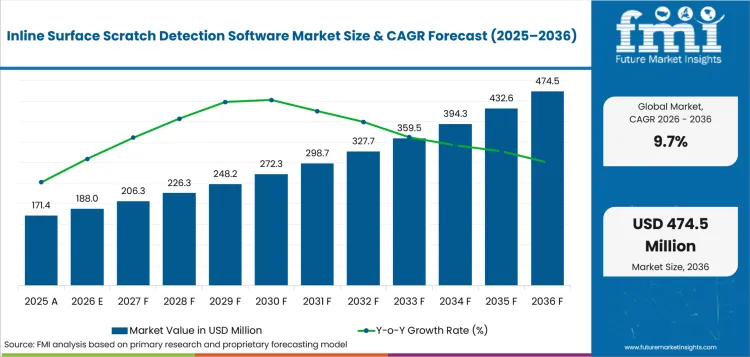
Inline Surface Scratch Detection Software Market Overview: Size and Forecast
- 2026 Market Size: USD 188.0 million
- 2036 Market Size: USD 474.5 million
- Forecast CAGR: 9.7% from 2026 to 2036
- Leading Component: Vision Software
- Vision Software Share in 2026: 37.5%
- Leading Inspection Type: Defect Detection
- Defect Detection Share in 2026: 52.0%
- Fastest-growing Country: China
- China CAGR: 10.9% by 2036
Summary of the Inline Surface Scratch Detection Software Market
- Demand and Growth Drivers
- Electronics and automotive plants are moving scratch checks closer to production because rework cost rises after the next process step.
- Line scan imaging is expanding demand in metals, films, foils, packaging webs, and battery materials.
- Edge inspection supports factories that cannot move production images to cloud systems.
- Product and Segment View
- Vision Software is projected to hold 37.5% share in 2026, led by model tuning and defect libraries.
- Defect Detection is forecast to secure 52.0% share in 2026 because scratch scoring is the core buying reason.
- Inline deployment is estimated to represent 61.0% share in 2026 due to live reject decisions.
- Electronics is projected to account for 31.0% share in 2026 due to strict surface acceptance limits.
- Geography and Competitive Outlook
- China is projected to record 10.9% CAGR through 2036, supported by electronics output and factory automation scale.
- India is expected to expand at 10.6% CAGR through 2036 as automation spreads into electronics and packaging lines.
- Cognex, Keyence, Teledyne DALSA, Basler, Omron, Zebra Technologies, SICK, Siemens, Balluff, Datalogic, and MVTec shape the supplier field.
- Software value is shifting toward training images, image preprocessing, and PLC-level reject integration.
- Analyst Opinion
- Nikhil Kaitwade, Principal Consultant at Future Market Insights for industrial domain, says, "Inline scratch detection software is becoming a line-control layer rather than a camera add-on. Buyers should test false reject rates, recipe change stability, and integration speed before approving plant-wide deployment."
- Which factors support expansion in the Inline Surface Scratch Detection Software Market?
- Live visual inspection, repeatable defect scoring, and plant-level data capture support market value across automated manufacturing lines.
- Market value is supported by software license revenue and service revenue tied to camera-linked inspection systems.
- Supplier pricing reflects model training, lighting setup, and reject integration before wider line deployment.
- Revenue improves where brands face warranty claims or rejected premium surface finishes.
- Buyer trust rises when software explains why a scratch is critical and why glare is ignored.
Quality-control budgets are shifting from sampling checks into inline decision layers. This market sits next to machine vision system and services and factory automation and industrial controls where image capture must connect to reject control. IFR reported 542,000 industrial robots installed in 2024 and 4,664,000 units in operational use. That automation base raises the need for scratch detection software that can score defects at production speed. Cognex documentation for Red Analyze confirms that trained tools can identify scratches on complex surfaces. Teledyne DALSA’s 2024 Linea Lite 8k release also supports high-speed line scan inspection with 25 kHz throughput at full resolution.
Why is the Inline Surface Scratch Detection Software Market growing?
Automated plants need inspection software that can read scratches without slowing line speed. This demand connects with robotic vision and vision guided robots when handling and inspection are joined on the same line.
Growth is supported by a clear production problem. Human review is hard to sustain where reflective surfaces, line speed, and product variants change in the same shift. IFR data shows the scale of global automation. Cognex and Teledyne DALSA documentation also show why trained software and high-throughput imaging must work together. Buyers now assess false rejects and model setup effort as closely as detection accuracy. This gives suppliers with lighting expertise and PLC integration a stronger position.
How is the Inline Surface Scratch Detection Software Market segmented?
The inline surface scratch detection software industry is segmented by component, inspection type, deployment, end-use industry, and region.
- Vision Software is projected to secure 37.5% share in 2026, led by defect model training and production recipe support.
- Defect Detection is expected to hold 52.0% share in 2026 since scratch classification is the primary use case.
- Inline deployment is forecast to account for 61.0% share in 2026, guided by the need for live pass-fail decisions.
- Electronics is estimated to represent 31.0% share in 2026 because screens, housings, connectors, and boards need tight cosmetic control.
- East Asia is forecast to lead regional demand with 34.0% share in 2026 as China, Japan, and South Korea anchor precision production.
Why does Vision Software dominate the inline surface scratch detection software market?
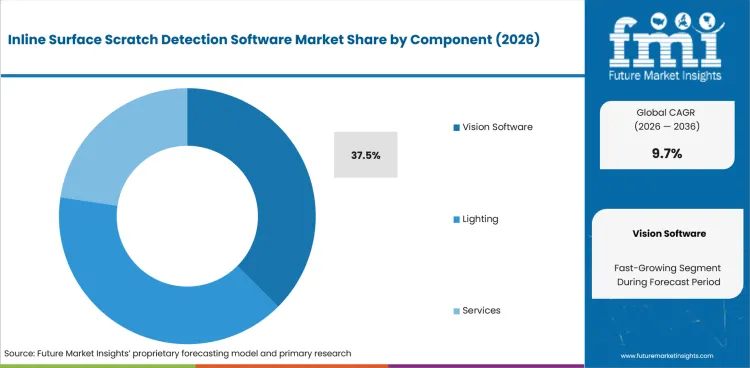
- Vision Software is projected to account for 37.5% share in 2026, supported by defect libraries and model tuning around glare and texture variation.
- Its dominance is further driven by the growing use of AI-based image analysis that improves scratch classification accuracy while reducing false rejects on high-speed production lines.
Which inspection type leads the inline surface scratch detection software market?
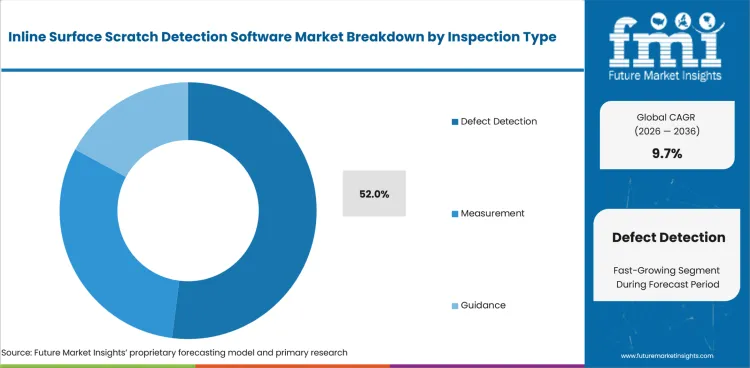
- Defect Detection is forecast to hold 52.0% share in 2026 because buyers mainly need scratch segmentation and severity scoring.
- Adoption is also supported by manufacturers’ focus on preventing defective products from reaching downstream assembly and end customers, reducing quality-related costs.
Which deployment type leads the inline surface scratch detection software market?
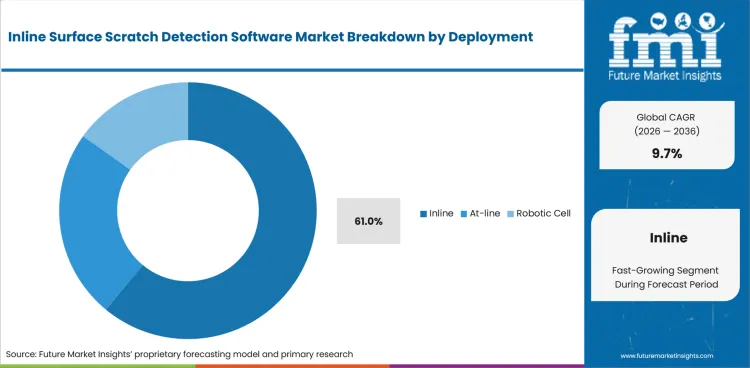
- Inline deployment is projected to represent 61.0% share in 2026 as factories prefer real-time reject control over delayed audit checks.
- Growth is driven by increasing automation investments that require continuous inspection without interrupting production throughput.
Which end-use industry leads the inline surface scratch detection software market?
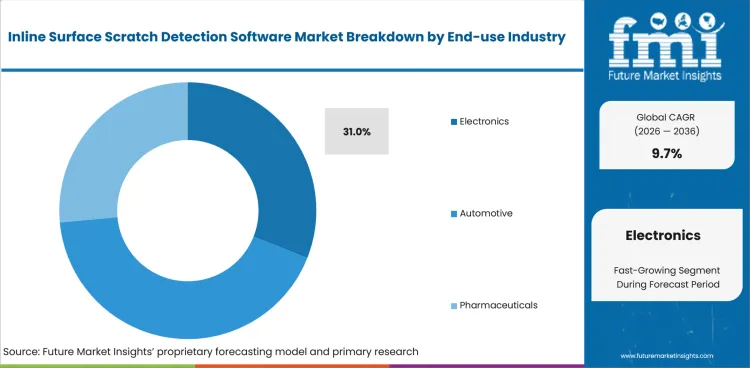
- Electronics is expected to secure 31.0% share in 2026 due to surface quality requirements on screens, housings, boards, and connectors.
- The segment also benefits from rising production of premium consumer electronics, where even minor cosmetic defects can affect product acceptance and brand reputation.
What are the driver, restraints, and opportunities in the Inline Surface Scratch Detection Software Market?
Defect segmentation and line scan throughput support growth while false rejects and integration cost limit wider deployment.
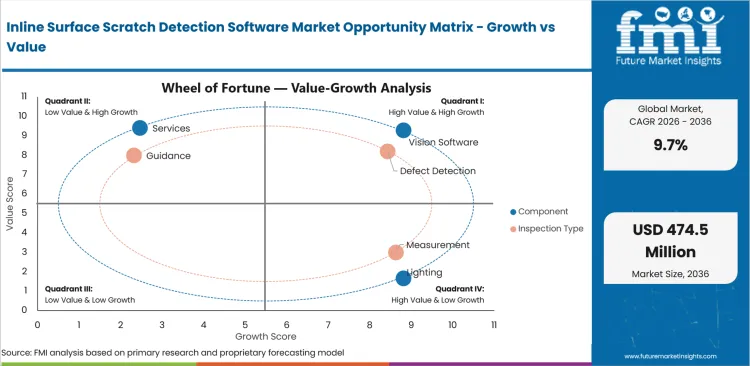
- Driver: AI defect segmentation is expected to increase demand where fixed thresholds cannot handle surface variation.
- Restraint: False reject risk can reduce buyer confidence when good parts are rejected because of glare or dust.
- Opportunity: Edge-based inspection is expected to support plants that keep production images inside the factory network.
Inline Surface Scratch Detection Software Market Demand Outlook
Demand outlook is moving toward trained surface inspection systems that can connect defect images with line decisions. Reflective plastics, brushed metals, coated glass, and printed films create inspection problems that fixed rules cannot consistently solve. Teledyne DALSA’s Linea Lite 8k camera shows how image throughput can support narrow scratch detection on moving surfaces. Buyers are expected to prioritize proof from difficult surfaces before scaling systems across plants.
Customer Decision-driver Analysis
Buyer decisions are shaped by false reject rate, lighting setup, recipe maintenance, and integration with controls. Adjacent spending is visible in machine vision and industrial vision gateways when inspection data is linked to wider plant performance. Production teams usually want one successful line trial before wider rollout. Quality teams want defect images, acceptance rules, and reject reasons that can be reviewed later. Procurement teams compare software cost with lighting changes and integrator services. This is why suppliers that sell a complete inspection workflow can defend better pricing than software-only entrants.
Who are the leading companies in the Inline Surface Scratch Detection Software Market?
The market is served by machine vision platform suppliers, camera specialists, automation companies, and software vendors. Competition is based on defect model accuracy, lighting support, line speed, PLC integration, service reach, and proof from difficult surfaces.
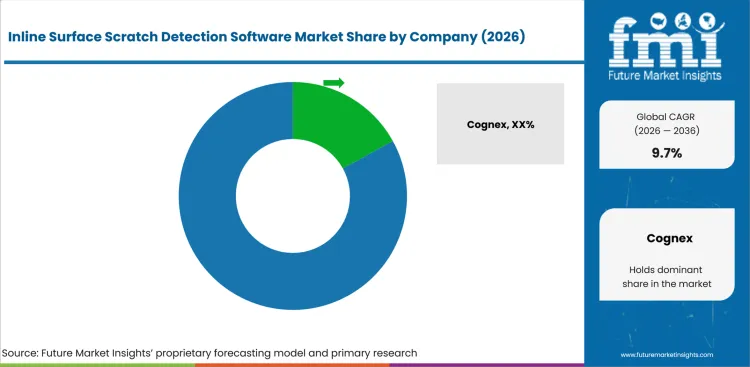
- Cognex and Keyence compete through broad machine vision portfolios and direct application support.
- Teledyne DALSA and Basler support high-resolution imaging and line scan use cases.
- Omron, Siemens, SICK, Balluff, and Datalogic compete through automation channels and factory integration.
- MVTec supports software-led inspection through HALCON, MERLIC, and anomaly detection capabilities.
How do top inline surface scratch detection software market companies compare?
| Company | Relevance to Market Title | Software Depth | Hardware Fit | Integration Support | Channel Reach | Geographic Footprint |
|---|---|---|---|---|---|---|
| Cognex | High | Deep learning and VisionPro | Smart cameras | Strong | Direct and integrator-led | Global |
| Keyence | High | Vision software tools | Cameras and controllers | Strong | Direct sales-led | Global |
| Teledyne DALSA | High | Imaging software | Line scan cameras | Moderate | Distributor and OEM-led | Global |
| Basler | High | Camera software | Industrial cameras | Moderate | Distributor and OEM-led | Global |
| Omron | Medium | Automation vision tools | Vision systems | Strong | Automation sales-led | Global |
| Zebra Technologies | Medium | Aurora software | 3D machine vision | Moderate | Partner-led | Global |
| MVTec | Medium | HALCON and MERLIC | Software-first | Moderate | Partner-led | Global |
| SICK | Medium | Vision sensors | Camera systems | Strong | Automation channel-led | Global |
| Balluff | Medium | Vision components | Industrial cameras | Moderate | Distributor and direct | Global |
| Datalogic | Medium | Vision software | Smart cameras | Moderate | Automation channel-led | Global |
Who are the key players in the Inline Surface Scratch Detection Software Market?
Integrated Vision Platform Suppliers
- Cognex
- Keyence
- Omron
- Zebra Technologies
- Siemens
Imaging and Component Specialists
- Basler
- Teledyne DALSA
- SICK
- Balluff
Software and Application Specialists
- MVTec
- Datalogic
- Landing AI
Key Developments in Inline Surface Scratch Detection Software Market
- In April 2024, Cognex launched the In-Sight L38 3D vision system with embedded AI for inspection, measurement, and guidance on factory lines.
- In June 2024, Basler acquired a 25.1% stake in Roboception to deepen its 3D vision position for factory automation and robotics.
- In September 2024, Teledyne DALSA introduced the Linea HS2 TDI line scan camera family for ultra-high-speed inspection work.
- In December 2024, Zebra Technologies announced plans to acquire Photoneo to expand its 3D machine vision portfolio.
- In May 2026, MVTec demonstrated Global Context Anomaly Detection in MERLIC for local scratches and broader assembly anomalies.
Which countries are growing fastest in the Inline Surface Scratch Detection Software Market?
China 10.9% CAGR, India 10.6% CAGR, South Korea 10.2% CAGR, Japan 9.5% CAGR, United States 9.3% CAGR, Germany 9.0% CAGR, France 8.7% CAGR, and United Kingdom 8.5% CAGR through 2036.
.webp "Top Country Growth Comparison Inline Surface Scratch Detection Software Market Cagr (2026 2036)")
| Country | CAGR |
|---|---|
| China | 10.9% |
| India | 10.6% |
| South Korea | 10.2% |
| Japan | 9.5% |
| United States | 9.3% |
| Germany | 9.0% |
| France | 8.7% |
| United Kingdom | 8.5% |
| Source | Future Market Insights, 2026. |
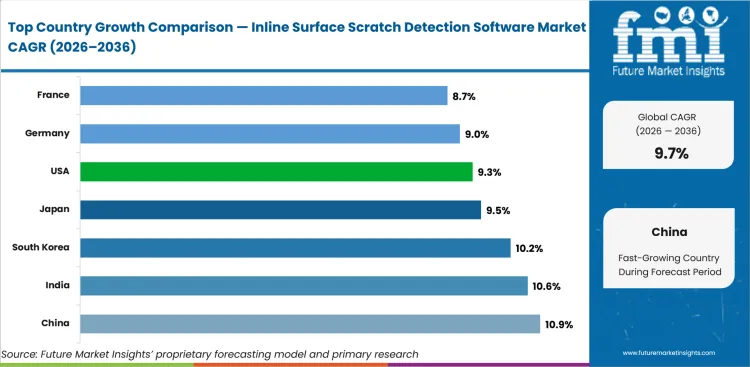
How do country-level CAGRs compare in the Inline Surface Scratch Detection Software Market?
China leads country growth while the United Kingdom records the most selective expansion outlook among profiled markets.
- China is forecast to record 10.9% CAGR by 2036, supported by country-specific automation and quality-control drivers.
- India is forecast to record 10.6% CAGR by 2036, supported by country-specific automation and quality-control drivers.
- South Korea is forecast to record 10.2% CAGR by 2036, supported by country-specific automation and quality-control drivers.
- Japan is forecast to record 9.5% CAGR by 2036, supported by country-specific automation and quality-control drivers.
- United States is forecast to record 9.3% CAGR by 2036, supported by country-specific automation and quality-control drivers.
- Germany is forecast to record 9.0% CAGR by 2036, supported by country-specific automation and quality-control drivers.
- France is forecast to record 8.7% CAGR by 2036, supported by country-specific automation and quality-control drivers.
- United Kingdom is forecast to record 8.5% CAGR by 2036, supported by country-specific automation and quality-control drivers.
How fast is the Inline Surface Scratch Detection Software Market growing in China?
A 10.9% CAGR through 2036 reflects electronics, EV, battery, and precision-metal inspection demand across automated factory clusters.
Country Market Snapshot Table
| Parameter | Value |
|---|---|
| Market Size in 2025 (Value) | USD 35.6 million |
| Market Size in 2026 (Value) | USD 39.5 million |
| Market Forecast in 2036 (Value) | USD 111.1 million |
| CAGR (2026 to 2036) | 10.9% |
| Years Considered | 2021 to 2036 |
| Base Year | 2025 |
| Forecast Period | 2026 to 2036 |
| Units Considered | Value (USD million) |
| Leading Sub-Region | Guangdong and Yangtze River Delta electronics corridors |
China Inline Surface Scratch Detection Software Market Outlook
China inline surface scratch detection software demand is forecast to record a 10.9% CAGR through 2036. Electronics, EV, battery, and precision-metal producers are expanding automated inspection across supplier tiers.
Key Growth Drivers
- China creates a large automation base for scratch detection pilots. NBS reported industrial robot output growth of 24.0% in July 2025.
- Electronics and EV lines widen the addressable inspection base. NBS reported new energy vehicle output growth of 17.1% in July 2025.
- Battery materials and metal sheet lines are expected to increase demand for line scan scratch scoring where defects move continuously.
- Local integrators are expected to support faster commissioning because buyers often require service in regional manufacturing clusters.
Key Restraints
- Budget approvals can stay selective where NBS reported a 95.5% industrial product sales rate in early 2025.
- Cloud inspection workflows can face buyer resistance when image storage policies are not clear across plant networks.
- Mid-market factories are expected to push prices lower when scratch detection is bundled with cameras and lighting.
What makes China unique
China is unique because premium OEM demand and cost-driven mid-market demand exist at scale in the same country.
Key Companies
- Hikrobot
- Daheng Imaging
- OPT Machine Vision
- Cognex China
- Keyence China
- Basler China
- SICK China
Sales & Marketing Channels
- Direct sales to large OEMs
- Local system integrators
- Machine-builder partnerships
- Distributor camera bundles
- Factory demonstration centers
- Industry fairs in Shenzhen and Shanghai
Country Segment Breakdown Table
| Segment | Sub-Segments |
|---|---|
| By Component | Cameras · Lenses · Lighting · Frame Grabbers · Vision Software · Services |
| By Inspection Type | Defect Detection · Measurement · OCR/OCV · Presence/Absence · Guidance |
| By Deployment | Inline · At-line · Robotic Cell · Portable |
| By End-use Industry | Electronics · Automotive · Packaging · Pharmaceuticals · Food & Beverage · Metals |
| By Region | North America · Latin America · Europe · East Asia · South Asia & Pacific · Middle East & Africa |
| Key Sub-Regions Covered, Manufacturing and automation corridors | Guangdong and Yangtze River Delta electronics corridors |
Frequently Asked Questions
How fast is China inline surface scratch detection software market growing?
Sales in China are forecast to scale at 10.9% CAGR from 2026 to 2036.
Who leads China inline surface scratch detection software market?
Hikrobot, Daheng Imaging, OPT Machine Vision, Cognex, Keyence, and Basler compete through local automation channels.
What is driving adoption in China inline surface scratch detection software market?
Electronics, EVs, batteries, and metal sheet lines are moving more defect decisions into inline inspection software.
What is driving the Inline Surface Scratch Detection Software Market in India?
A 10.6% CAGR through 2036 is supported by electronics production, manufacturing GVA growth, and integrator-led inspection pilots.
Country Market Snapshot Table
| Parameter | Value |
|---|---|
| Market Size in 2025 (Value) | USD 8.5 million |
| Market Size in 2026 (Value) | USD 9.4 million |
| Market Forecast in 2036 (Value) | USD 25.7 million |
| CAGR (2026 to 2036) | 10.6% |
| Years Considered | 2021 to 2036 |
| Base Year | 2025 |
| Forecast Period | 2026 to 2036 |
| Units Considered | Value (USD million) |
| Leading Sub-Region | Pune, Chennai, Bengaluru, Noida, Hyderabad, and Ahmedabad manufacturing clusters |
India Inline Surface Scratch Detection Software Market Outlook
India inline surface scratch detection software demand is projected to rise at a 10.6% CAGR through 2036. Automotive, electronics, pharmaceutical packaging, and component producers are adding low-friction inspection pilots.
Key Growth Drivers
- Electronics assembly creates a wider surface inspection base. PIB reported electronics goods production of Rs. 11.3 lakh crore in 2024-25.
- Manufacturing depth supports broader quality automation. PIB reported manufacturing GVA growth of 9.13% in Q2 FY 2025-26.
- Pharmaceutical packaging users are expected to add print and surface checks where batch release documentation matters.
- Integrator-led bundles are expected to reduce buyer friction by combining software with lighting and camera setup.
- bCapital approval can remain staged because larger component schemes need multi-year allocation. PIB reported ECMS outlay increased to Rs. 40,000 crore in Budget 2026.
- Service coverage gaps can weaken confidence where plants need repeated model tuning after installation.
- Small and mid-sized manufacturers are expected to delay projects when payback proof is unclear.
What makes India unique
India is unique because adoption depends on low-cost pilots that can expand through integrator networks.
Key Companies
- Lincode Labs
- Jekson Vision
- Qualitas Technologies
- Cognex India
- Keyence India
- Omron India
- SICK India
Sales & Marketing Channels
- Integrator-led sales to factories
- Distributor bundles for cameras and lighting
- Direct sales to automotive OEMs
- Packaging and pharmaceutical OEM channels
- Demonstration pilots with payback files
Country Segment Breakdown Table
| Segment | Sub-Segments |
|---|---|
| By Component | Cameras · Lenses · Lighting · Frame Grabbers · Vision Software · Services |
| By Inspection Type | Defect Detection · Measurement · OCR/OCV · Presence/Absence · Guidance |
| By Deployment | Inline · At-line · Robotic Cell · Portable |
| By End-use Industry | Electronics · Automotive · Packaging · Pharmaceuticals · Food & Beverage · Metals |
| By Region | North America · Latin America · Europe · East Asia · South Asia & Pacific · Middle East & Africa |
| Key Sub-Regions Covered, Industrial Manufacturing Clusters | Pune, Chennai, Bengaluru, Noida, Hyderabad, and Ahmedabad manufacturing clusters |
Frequently Asked Questions
How fast is India inline surface scratch detection software market growing?
Sales in India are forecast to expand at 10.6% CAGR from 2026 to 2036.
Who leads India inline surface scratch detection software market?
Lincode Labs, Jekson Vision, Qualitas Technologies, Cognex, Keyence, and Omron compete through local channels.
What is driving adoption in India inline surface scratch detection software market?
Automotive, electronics assembly, packaging, and pharmaceutical lines are shifting targeted defect checks into inline workflows.
How is the Inline Surface Scratch Detection Software Market performing in South Korea?
A 10.2% CAGR through 2036 reflects semiconductor, display, battery, and automotive plants that need low false-reject inspection.
Country Market Snapshot Table
| Parameter | Value |
|---|---|
| Market Size in 2025 (Value) | USD 11.1 million |
| Market Size in 2026 (Value) | USD 12.2 million |
| Market Forecast in 2036 (Value) | USD 32.3 million |
| CAGR (2026 to 2036) | 10.2% |
| Years Considered | 2021 to 2036 |
| Base Year | 2025 |
| Forecast Period | 2026 to 2036 |
| Units Considered | Value (USD million) |
| Leading Sub-Region | Seoul Capital Area, Gyeonggi, Chungcheong, Ulsan, and Gumi industrial corridors |
South Korea Inline Surface Scratch Detection Software Market Outlook
South Korea inline surface scratch detection software demand is estimated to post a 10.2% CAGR through 2036. Semiconductor, display, battery, and automotive plants are raising inspection depth on complex surfaces.
Key Growth Drivers
- Semiconductor equipment activity supports precision inspection demand. Invest Korea cited a 17.4% global equipment market share in 2024.
- Automotive export scale supports inspection on coated and molded components. MOTIE reported May 2026 automobile exports of USD 5.83 billion.
- Battery coating and display glass lines are expected to favor line scan tools that detect long or low-contrast scratches.
- Large electronics groups are expected to require defect image libraries before scaling models across plants.
Key Restraints
- Automation programs face tighter validation where MOEF reported overall industrial production fell 0.6% month on month in April 2026.
- Supplier qualification can remain slow when buyers require stable performance across multiple shifts.
- Custom integration needs can raise project cost on complex semiconductor and battery lines.
What makes South Korea unique
South Korea is unique because high robot density makes inspection software speed a direct production requirement.
Key Companies
- Koh Young Technology
- Vieworks
- ISRA Vision Korea
- Cognex Korea
- Keyence Korea
- Omron Korea
- SICK Korea
Sales & Marketing Channels
- Direct sales to electronics groups
- Battery line integrators
- Automotive tier supplier programs
- Local automation distributors
- OEM machine-builder partnerships
Country Segment Breakdown Table
| Segment | Sub-Segments |
|---|---|
| By Component | Cameras · Lenses · Lighting · Frame Grabbers · Vision Software · Services |
| By Inspection Type | Defect Detection · Measurement · OCR/OCV · Presence/Absence · Guidance |
| By Deployment | Inline · At-line · Robotic Cell · Portable |
| By End-use Industry | Electronics · Automotive · Packaging · Pharmaceuticals · Food & Beverage · Metals |
| By Region | North America · Latin America · Europe · East Asia · South Asia & Pacific · Middle East & Africa |
| Key Sub-Regions Covered, Industrial Manufacturing Clusters | Seoul Capital Area, Gyeonggi, Chungcheong, Ulsan, and Gumi industrial corridors |
Frequently Asked Questions
How fast is South Korea inline surface scratch detection software market growing?
Sales in South Korea are forecast to rise at 10.2% CAGR from 2026 to 2036.
Who leads South Korea inline surface scratch detection software market?
Koh Young Technology, Vieworks, Cognex, Keyence, Omron, and SICK compete through technical sales routes.
What is driving adoption in South Korea inline surface scratch detection software market?
Semiconductors, displays, batteries, and automotive parts require high-speed inspection with low false rejects.
What is the Inline Surface Scratch Detection Software Market forecast for Japan?
A 9.5% CAGR through 2036 reflects precision manufacturing upgrades and replacement of legacy inspection recipes.
Country Market Snapshot Table
| Parameter | Value |
|---|---|
| Market Size in 2025 (Value) | USD 16.3 million |
| Market Size in 2026 (Value) | USD 17.9 million |
| Market Forecast in 2036 (Value) | USD 44.3 million |
| CAGR (2026 to 2036) | 9.5% |
| Years Considered | 2021 to 2036 |
| Base Year | 2025 |
| Forecast Period | 2026 to 2036 |
| Units Considered | Value (USD million) |
| Leading Sub-Region | Kanto, Chubu, Kansai, Kyushu, and Tohoku precision manufacturing corridors |
Japan Inline Surface Scratch Detection Software Market Outlook
Japan inline surface scratch detection software demand is forecast to grow at a 9.5% CAGR through 2036. Mature factories are replacing legacy inspection recipes with trainable defect models.
Key Growth Drivers
- Production machinery supports new inspection projects. METI forecast production to rise 0.6% in March 2025.
- Electronics production supports surface inspection demand. JEITA cited industrial electronic equipment output of 278,946 million yen in July 2025.
- Automotive suppliers are expected to use scratch detection for trim, glass, molded parts, and coated metal surfaces.
- Local field engineering from Keyence and Omron is expected to reduce setup risk for precision factories.
Key Restraints
- Machine-tool investment caution can affect budgets where JMTBA cited 901.3 billion yen in 2024 production value.
- Legacy machine vision systems can slow replacement unless false rejects are already costly.
- Conservative qualification practices can delay AI model rollout across high-mix production lines.
What makes Japan unique
Japan is unique because local vision suppliers combine hardware, software, and field support for high-precision plants.
Key Companies
- Keyence
- Omron
- Cognex Japan
- SICK Japan
- Basler Japan
- Teledyne DALSA Japan
- MVTec Japan
Sales & Marketing Channels
- Direct technical sales
- OEM machine-builder partnerships
- Distributor routes for cameras and lenses
- Electronics factory trials
- Automotive tier supplier programs
Country Segment Breakdown Table
| Segment | Sub-Segments |
|---|---|
| By Component | Cameras · Lenses · Lighting · Frame Grabbers · Vision Software · Services |
| By Inspection Type | Defect Detection · Measurement · OCR/OCV · Presence/Absence · Guidance |
| By Deployment | Inline · At-line · Robotic Cell · Portable |
| By End-use Industry | Electronics · Automotive · Packaging · Pharmaceuticals · Food & Beverage · Metals |
| By Region | North America · Latin America · Europe · East Asia · South Asia & Pacific · Middle East & Africa |
| Key Sub-Regions Covered, Industrial Manufacturing Clusters | Kanto, Chubu, Kansai, Kyushu, and Tohoku precision manufacturing corridors |
Frequently Asked Questions
How fast is Japan inline surface scratch detection software market growing?
Sales in Japan are forecast to grow at 9.5% CAGR from 2026 to 2036.
Who leads Japan inline surface scratch detection software market?
Keyence, Omron, Cognex, SICK, Basler, and Teledyne DALSA compete through technical channels.
What is driving adoption in Japan inline surface scratch detection software market?
Electronics, automotive, precision components, and semiconductor supply chains require stable inspection on complex surfaces.
What is the Inline Surface Scratch Detection Software Market outlook in the United States?
A 9.3% CAGR through 2036 is supported by electronics output, manufacturing orders, and integrator-led automation projects.
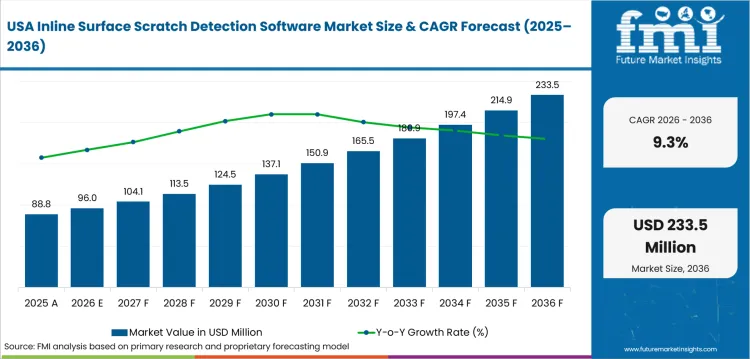
Country Market Snapshot Table
| Parameter | Value |
|---|---|
| Market Size in 2025 (Value) | USD 32.7 million |
| Market Size in 2026 (Value) | USD 35.7 million |
| Market Forecast in 2036 (Value) | USD 86.9 million |
| CAGR (2026 to 2036) | 9.3% |
| Years Considered | 2021 to 2036 |
| Base Year | 2025 |
| Forecast Period | 2026 to 2036 |
| Units Considered | Value (USD million) |
| Leading Sub-Region | Midwest automotive belt, Southeast EV corridor, California electronics, and Northeast medical device hubs |
United States Inline Surface Scratch Detection Software Market Outlook
United States inline surface scratch detection software demand is expected to register a 9.3% CAGR through 2036. Integrator-led plants are tying defect decisions to automation controls.
Key Growth Drivers
- Electronics output gives inspection software more addressable lines. Federal Reserve data showed a computer and electronic product index of 132.6 in Q1 2026.
- Manufacturing order activity supports factory automation spending. Census reported April 2026 new manufactured goods orders of USD 662.7 billion.
- Medical device and automotive trim plants are expected to require image records that support quality audits and customer dispute review.
- System integrator networks are expected to shorten trials where factories already use cameras and reject-bin controls.
Key Restraints
- Labor replacement is not automatic because BLS projected 69,900 annual quality-control inspector openings.
- False reject cost can block rollout when defect thresholds are not trained on real production variation.
- Plant IT teams can delay projects when image storage and network ownership are unclear.
What makes United States unique
The United States is unique because system integrators strongly influence supplier selection and pilot design.
Key Companies
- Cognex
- Zebra Technologies
- Teledyne DALSA
- Landing AI
- SICK USA
- Omron Automation Americas
- Datalogic USA
Sales & Marketing Channels
- Direct enterprise sales to multi-plant manufacturers
- Certified system integrator projects
- OEM machine-builder partnerships
- Distributor-led camera and lighting bundles
- Trade show demos and proof-of-concept pilots
Country Segment Breakdown Table
| Segment | Sub-Segments |
|---|---|
| By Component | Cameras · Lenses · Lighting · Frame Grabbers · Vision Software · Services |
| By Inspection Type | Defect Detection · Measurement · OCR/OCV · Presence/Absence · Guidance |
| By Deployment | Inline · At-line · Robotic Cell · Portable |
| By End-use Industry | Electronics · Automotive · Packaging · Pharmaceuticals · Food & Beverage · Metals |
| By Region | North America · Latin America · Europe · East Asia · South Asia & Pacific · Middle East & Africa |
| Key Sub-Regions Covered, Industrial Manufacturing Clusters | Midwest automotive belt, Southeast EV corridor, California electronics, and Northeast medical device hubs |
Frequently Asked Questions
How fast is United States inline surface scratch detection software market growing?
Sales in the United States are forecast to grow at 9.3% CAGR from 2026 to 2036.
Who leads United States inline surface scratch detection software market?
Cognex, Zebra Technologies, Teledyne DALSA, Keyence, SICK, Omron, and Datalogic compete through USA channels.
What is driving adoption in United States inline surface scratch detection software market?
Automotive, medical device, electronics, and packaging plants need repeatable defect scoring across shifts.
How is the Inline Surface Scratch Detection Software Market performing in Germany?
A 9.0% CAGR through 2036 reflects automotive, battery, machinery, and packaging lines that need validated inspection depth.
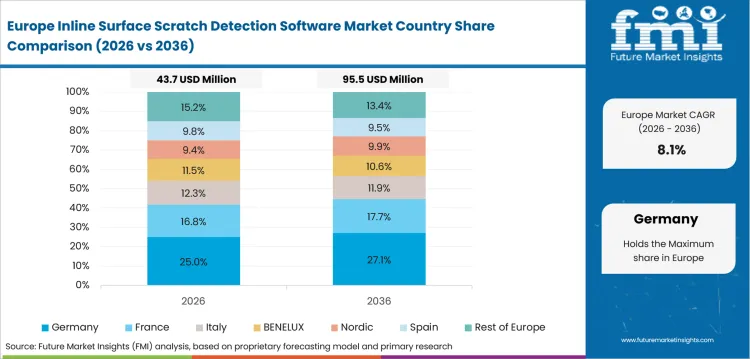
Country Market Snapshot Table
| Parameter | Value |
|---|---|
| Market Size in 2025 (Value) | USD 13.8 million |
| Market Size in 2026 (Value) | USD 15.0 million |
| Market Forecast in 2036 (Value) | USD 35.6 million |
| CAGR (2026 to 2036) | 9.0% |
| Years Considered | 2021 to 2036 |
| Base Year | 2025 |
| Forecast Period | 2026 to 2036 |
| Units Considered | Value (USD million) |
| Leading Sub-Region | Bavaria, Baden-Wuerttemberg, North Rhine-Westphalia, Saxony, and Lower Saxony |
Germany Inline Surface Scratch Detection Software Market Outlook
Germany inline surface scratch detection software demand is projected to rise at a 9.0% CAGR through 2036. Automotive, battery, machinery, and packaging lines are upgrading inspection depth.
Key Growth Drivers
- Machinery orders support camera and controls demand. Destatis reported a 11.5% monthly order increase in machinery and equipment in December 2025.
- Metal-product production can create line scan inspection opportunities. Destatis reported fabricated metal orders rising 30.2% in December 2025.
- Battery coating and metal web inspection are expected to favor line scan systems tied to edge software.
- Local suppliers such as Basler, SICK, Siemens, MVTec, and Balluff are expected to reduce integration risk for machine builders.
Key Restraints
- Project timing can remain cautious where Destatis reported industrial production down 4.3% month on month in August 2025.
- Labor councils and plant teams may resist poorly explained AI defect decisions during rollout.
- Qualification cycles can remain long where inspection rules affect customer acceptance criteria.
What makes Germany unique
Germany is unique because the supplier base spans cameras, software libraries, controls, and machine builders.
Key Companies
- Basler
- SICK
- Siemens
- MVTec
- Balluff
- ISRA Vision
- Cognex Germany
Sales & Marketing Channels
- Machine-builder partnerships
- Direct sales to automotive tier suppliers
- Automation integrator projects
- VISION Stuttgart and SPS trade channels
- Distributor bundles for cameras and lighting
Country Segment Breakdown Table
| Segment | Sub-Segments |
|---|---|
| By Component | Cameras · Lenses · Lighting · Frame Grabbers · Vision Software · Services |
| By Inspection Type | Defect Detection · Measurement · OCR/OCV · Presence/Absence · Guidance |
| By Deployment | Inline · At-line · Robotic Cell · Portable |
| By End-use Industry | Electronics · Automotive · Packaging · Pharmaceuticals · Food & Beverage · Metals |
| By Region | North America · Latin America · Europe · East Asia · South Asia & Pacific · Middle East & Africa |
| Key Sub-Regions Covered, Industrial Manufacturing Clusters | Bavaria, Baden-Wuerttemberg, North Rhine-Westphalia, Saxony, and Lower Saxony |
Frequently Asked Questions
How fast is Germany inline surface scratch detection software market growing?
Sales in Germany are forecast to rise at 9.0% CAGR from 2026 to 2036.
Who leads Germany inline surface scratch detection software market?
Basler, SICK, Siemens, MVTec, Balluff, Cognex, and Keyence compete through German automation routes.
What is driving adoption in Germany inline surface scratch detection software market?
Automotive, battery, machinery, metals, and packaging lines require inspection systems that prove repeatability.
What is the Inline Surface Scratch Detection Software Market outlook in France?
An 8.7% CAGR through 2036 reflects aerospace, cosmetics packaging, and pharmaceutical inspection demand.
Country Market Snapshot Table
| Parameter | Value |
|---|---|
| Market Size in 2025 (Value) | USD 6.9 million |
| Market Size in 2026 (Value) | USD 7.5 million |
| Market Forecast in 2036 (Value) | USD 17.3 million |
| CAGR (2026 to 2036) | 8.7% |
| Years Considered | 2021 to 2036 |
| Base Year | 2025 |
| Forecast Period | 2026 to 2036 |
| Units Considered | Value (USD million) |
| Leading Sub-Region | Ile-de-France, Auvergne-Rhone-Alpes, Occitanie, Grand Est, and Hauts-de-France |
France Inline Surface Scratch Detection Software Market Outlook
France inline surface scratch detection software demand is estimated to advance at an 8.7% CAGR through 2036. Aerospace, cosmetics packaging, and pharmaceutical plants are adding traceable inspection.
Key Growth Drivers
- Manufacturing activity supports targeted inspection upgrades. INSEE reported manufacturing output rose 0.3% in November 2025.
- Aerospace and precision producers can support inspection demand. INSEE reported March 2025 manufacturing output rose 0.6% month on month.
- Cosmetics packaging users are expected to need consistent checks for scratches, stains, and print defects.
- Aerospace suppliers are expected to use repeatable inspection records to reduce manual surface review.
Key Restraints
- Replacement timing may stay cautious where INSEE reported manufacturing output fell 0.8% in December 2025.
- Validation needs can lengthen sales cycles for software that changes final acceptance rules.
- Selective automation can slow full inline coverage when project budgets remain narrow.
What makes France unique
France is unique because premium packaging and aerospace create high-value use cases beyond standard automotive automation.
Key Companies
- Actemium
- Akeoplus
- Cognex France
- Keyence France
- SICK France
- Omron France
- Datalogic France
Sales & Marketing Channels
- Direct sales to regulated manufacturers
- Packaging machine OEM routes
- Aerospace quality integrators
- Distributor networks for vision components
- Pilot projects tied to validation files
Country Segment Breakdown Table
| Segment | Sub-Segments |
|---|---|
| By Component | Cameras · Lenses · Lighting · Frame Grabbers · Vision Software · Services |
| By Inspection Type | Defect Detection · Measurement · OCR/OCV · Presence/Absence · Guidance |
| By Deployment | Inline · At-line · Robotic Cell · Portable |
| By End-use Industry | Electronics · Automotive · Packaging · Pharmaceuticals · Food & Beverage · Metals |
| By Region | North America · Latin America · Europe · East Asia · South Asia & Pacific · Middle East & Africa |
| Key Sub-Regions Covered, Industrial Manufacturing Clusters | Ile-de-France, Auvergne-Rhone-Alpes, Occitanie, Grand Est, and Hauts-de-France |
Frequently Asked Questions
How fast is France inline surface scratch detection software market growing?
Sales in France are forecast to advance at 8.7% CAGR from 2026 to 2036.
Who leads France inline surface scratch detection software market?
Actemium, Akeoplus, Cognex, Keyence, SICK, Omron, and Datalogic serve French buyers.
What is driving adoption in France inline surface scratch detection software market?
Aerospace parts, cosmetics packaging, pharmaceuticals, and food packaging need traceable surface quality checks.
How is the Inline Surface Scratch Detection Software Market performing in the United Kingdom?
An 8.5% CAGR through 2036 reflects high-value inspection projects in aerospace, pharmaceuticals, and premium packaging.
Country Market Snapshot Table
| Parameter | Value |
|---|---|
| Market Size in 2025 (Value) | USD 7.8 million |
| Market Size in 2026 (Value) | USD 8.5 million |
| Market Forecast in 2036 (Value) | USD 19.1 million |
| CAGR (2026 to 2036) | 8.5% |
| Years Considered | 2021 to 2036 |
| Base Year | 2025 |
| Forecast Period | 2026 to 2036 |
| Units Considered | Value (USD million) |
| Leading Sub-Region | Midlands, North West, South East, Wales, and Scotland advanced manufacturing clusters |
United Kingdom Inline Surface Scratch Detection Software Market Outlook
United Kingdom inline surface scratch detection software demand is forecast to expand at an 8.5% CAGR through 2036. High-value plants are funding tightly scoped inspection upgrades.
Key Growth Drivers
- Short-term production recovery can support selective upgrades. ONS estimated manufacturing rose 1.2% in the three months to February 2026.
- Life sciences manufacturing gives inspection vendors a regulated route. GOV.UK committed up to GBP 520 million for life sciences manufacturing.
- Aerospace component plants are expected to require repeatable records for surface acceptance before shipment.
- Pharmaceutical and premium packaging lines are expected to add defect checks where visual quality affects release confidence.
Key Restraints
- Budget caution can persist where ONS reported production output fell 0.2% in March 2026.
- Short pilot budgets can limit the image set needed for durable scratch models.
- Mid-sized manufacturers may avoid projects that require heavy custom engineering and long trials.
What makes United Kingdom unique
The United Kingdom is unique because buyers usually need a tightly scoped payback case before line-wide automation.
Key Companies
-
Cognex UK
- Keyence UK
- SICK UK
- Omron UK
- Zebra Technologies UK
- Datalogic UK
- Industrial Vision Systems
Sales & Marketing Channels
- Application-led direct sales
- Packaging and pharmaceutical integrators
- OEM inspection machine suppliers
- Distributor networks for cameras and lighting
- Pilot projects with payback documentation
Country Segment Breakdown Table
| Segment | Sub-Segments |
|---|---|
| By Component | Cameras · Lenses · Lighting · Frame Grabbers · Vision Software · Services |
| By Inspection Type | Defect Detection · Measurement · OCR/OCV · Presence/Absence · Guidance |
| By Deployment | Inline · At-line · Robotic Cell · Portable |
| By End-use Industry | Electronics · Automotive · Packaging · Pharmaceuticals · Food & Beverage · Metals |
| By Region | North America · Latin America · Europe · East Asia · South Asia & Pacific · Middle East & Africa |
| Key Sub-Regions Covered, Industrial Manufacturing Clusters | Midlands, North West, South East, Wales, and Scotland advanced manufacturing clusters |
Frequently Asked Questions
How fast is United Kingdom inline surface scratch detection software market growing?
Sales in the United Kingdom are forecast to expand at 8.5% CAGR from 2026 to 2036.
Who leads United Kingdom inline surface scratch detection software market?
Cognex, Keyence, SICK, Omron, Zebra Technologies, Datalogic, and Industrial Vision Systems compete through UK channels.
What is driving adoption in United Kingdom inline surface scratch detection software market?
Aerospace, pharmaceuticals, premium packaging, and food lines require targeted inspection with proof before rollout.
Inline Surface Scratch Detection Software Market - Report Scope
| Parameter | Details |
|---|---|
| Forecast period | 2026 to 2036 |
| Historical period | 2021 to 2025 |
| Quantitative unit | Revenue in USD million |
| By component | Cameras, lenses, lighting, frame grabbers, vision software, services |
| By inspection type | Defect detection, measurement, OCR/OCV, presence/absence, guidance |
| By deployment | Inline, at-line, robotic cell, portable |
| By end-use industry | Electronics, automotive, packaging, pharmaceuticals, food and beverage, metals |
| Regions covered | North America, Latin America, Europe, East Asia, South Asia and Pacific, Middle East and Africa |
| Countries covered | China, India, South Korea, Japan, United States, Germany, France, United Kingdom |
| Key companies profiled | Cognex, Keyence, Basler, Teledyne DALSA, Omron, Zebra Technologies, SICK, Balluff, Siemens, Datalogic, MVTec |
| Approach | Bottom-up software-boundary approach using software revenue, attached inspection value, integrator services, country automation maturity, and end-use adoption |
Source: Future Market Insights, 2026.
Inline Surface Scratch Detection Software Market - Scope & Definition
| Attribute | Detail |
|---|---|
| Market Definition | Software used to detect, classify, segment, and score scratches on surfaces during production using cameras, lighting, frame grabbers, PLCs, and edge computers |
| Functions Covered | Defect detection, measurement, OCR/OCV, presence/absence checks, scratch scoring, reject signaling, and inspection data capture |
| Applications Covered | Inline inspection, at-line review, robotic cell inspection, portable inspection, line scan surface checks, and production-line image review |
| End-Use Industries | Electronics, automotive, packaging, pharmaceuticals, food and beverage, metals, battery materials, and precision components |
| Grades Covered | Rule-based inspection, trainable vision software, AI defect segmentation, edge-based inspection, and service-supported software deployments |
| Inclusions | Software licenses, attached software value, model training, lighting setup, camera-linked services, PLC reject integration, and production-line scratch detection workflows |
| Exclusions | Laboratory-only microscopes, manual visual inspection labor, generic surveillance video analytics, standalone barcode readers, and quality systems without production-line image processing |
Inline Surface Scratch Detection Software Market - Research Methodology
| Method | Description |
|---|---|
| Primary Research | FMI analyst interviews with quality managers, automation engineers, machine builders, system integrators, plant heads, and machine vision suppliers across key markets |
| Desk Research | Review of official robotics data, industrial production statistics, company product documentation, standards references, and machine vision technology sources |
| Market Sizing & Forecasting | Bottom-up software-boundary approach using software license value, camera-linked software use, integrator services, country automation maturity, and end-use adoption |
| Data Validation | Cross-verification using robot installation trends, supplier portfolios, line scan camera releases, end-use quality requirements, and country-level manufacturing activity checks |
Inline Surface Scratch Detection Software Market Breakdown by Component, Inspection Type, Deployment, End-use Industry, and Region
Inline Surface Scratch Detection Software Market Segmented by Component
- Cameras
- Lenses
- Lighting
- Frame Grabbers
- Vision Software
- Services
Inline Surface Scratch Detection Software Market Segmented by Inspection Type
- Defect Detection
- Measurement
- OCR/OCV
- Presence/Absence
- Guidance
Inline Surface Scratch Detection Software Market Segmented by Deployment
- Inline
- At-line
- Robotic Cell
- Portable
Inline Surface Scratch Detection Software Market Segmented by End-use Industry
- Electronics
- Automotive
- Packaging
- Pharmaceuticals
- Food & Beverage
- Metals
Inline Surface Scratch Detection Software Market by Region
- North America
- Latin America
- Europe
- East Asia
- South Asia & Pacific
- Middle East & Africa
Research Sources and Bibliography
- Basler AG. (2024, June 12). Basler AG acquires stake in Roboception GmbH.
- Balluff GmbH. (2024, November 6). Balluff at SPS trade show 2024.
- Bureau of Labor Statistics. (2025, September 4). Quality control inspectors: Occupational outlook handbook.
- Cognex Corporation. (2025, June 26). Red Analyze. Cognex Deep Learning Help.
- Destatis. (2025, October 8). Production in August 2025: -4.3% on the previous month.
- Destatis. (2026, February 5). New orders in manufacturing in December 2025.
- Federal Reserve Bank of St. Louis. (2026, May 15). Industrial production: Computer and electronic product.
- Federal Reserve Board. (2026, May 15). Industrial production and capacity utilization.
- GOV.UK. (2025, September 5). Life Sciences Innovative Manufacturing Fund.
- International Federation of Robotics. (2025, July 15). Japan’s car industry has highest robot installations in five years.
- International Federation of Robotics. (2025, September 25). World Robotics 2025 report: Industrial robots released by IFR.
- International Federation of Robotics. (2026, April 8). Robot density surges in Europe, Asia, and Americas.
- INSEE. (2025, May 6). In March 2025, manufacturing output increased for the second month in a row.
- INSEE. (2026, January 9). In November 2025, manufacturing output was back on the rise.
- INSEE. (2026, February 5). In December 2025, manufacturing output fell back sharply.
- Invest Korea. (2025, October 2). South Korea’s semiconductor industry and investment status.
- Japan Electronics and Information Technology Industries Association. (2025, July). Production by the Japanese electronics industry.
- Japan Machine Tool Builders’ Association. (2025, September). Size of the machine tool industry.
- Ministry of Economy, Trade and Industry. (2025, March 31). Indices of industrial production forecast.
- Ministry of Trade, Industry and Resources. (2026, June 17). May 2026 automobile exports total USD 5.83 billion
- MVTec Software GmbH. (2026, May 13). MVTec at Automate 2026.
- National Bureau of Statistics of China. (2025, March 18). Industrial production operation from January to February 2025.
- National Bureau of Statistics of China. (2025, August 15). National economy maintained a steady development momentum with progress in July.
- Office for National Statistics. (2026, April 16). Index of Production, UK: February 2026.
- Office for National Statistics. (2026, May 14). GDP monthly estimate, UK: March 2026.
- OMRON Corporation. (2025, March 18). OMRON automation software Sysmac Studio and NVIDIA Omniverse collaborate.
- Press Information Bureau. (2025, September 19). India’s manufacturing momentum: Performance and policy.
- Press Information Bureau. (2025, October 11). India’s electronics leap.
- Press Information Bureau. (2026, February 12). Manufacturing sector driving India’s next growth phase.
- Teledyne DALSA. (2024, June 18). Teledyne’s new 8k super resolution GigE Vision line scan camera is in production.
- Teledyne DALSA. (2024, September 17). Teledyne unveils the first 16k TDI line scan camera with a 1-Megahertz line rate.
- USA Census Bureau. (2026, June 3). Manufacturers’ shipments, inventories, and orders: April 2026.
- Zebra Technologies. (2024, December 30). Zebra Technologies to acquire Photoneo.
- Press Information Bureau. (2026, February 3). Electronics Components Manufacturing Scheme.
- Ministry of Economy and Finance. (2026, June 12). Current Economic Situation, June 2026.
This bibliography is provided for reader reference and is not exhaustive. The full report contains the complete reference list and detailed citations.
This Report Answers
-
Market size estimates for 2026 and forecasts through 2036 for the Inline Surface Scratch Detection Software Market.
- Insights across more than 30 regional and country-level markets.
- Analysis of demand drivers, manufacturing automation patterns, inspection software trends, and purchasing behavior.
- Evaluation of key component groups and deployment models including inline and at-line inspection dynamics.
- Assessment of factory automation, machine vision, line scan imaging, and edge inspection impacts on market development.
- Identification of growth opportunities across components, inspection types, deployment models, and end-use industries.
- Evaluation of supplier dynamics, product development trends, and integration channel structures.
- Country-level growth analysis covering China, India, South Korea, Japan, the United States, Germany, France, and the United Kingdom.
- Assessment of the competitive landscape including leading machine vision software suppliers and automation companies.
- Analysis of buyer preferences, false reject concerns, model training needs, and integration requirements.
- Regional outlooks across North America, Europe, East Asia, South Asia and Pacific, Latin America, and Middle East and Africa.
- Delivery of market data, forecasts, and supporting analysis in PDF and Excel formats.
Frequently Asked Questions
What is the global market demand for the Inline Surface Scratch Detection Software Market in 2026?
In 2026, the global inline surface scratch detection software market is expected to be supported by growing adoption of automated visual inspection technologies and increasing emphasis on real-time quality control in manufacturing environments.
What will the Inline Surface Scratch Detection Software Market be worth by 2036?
The market is forecast to be driven by broader deployment of AI-powered inspection software, rising production automation, and growing requirements for surface defect detection across precision manufacturing industries.
What is the CAGR for the Inline Surface Scratch Detection Software Market?
The market is projected to grow at a significant CAGR from 2026 to 2036, fueled by increasing demand for defect detection accuracy, advancements in machine vision algorithms, and the integration of automated quality assurance systems into production lines.
Which component leads the Inline Surface Scratch Detection Software Market?
Vision Software is projected to lead the Component segment with 37.5% share in 2026 as defect models carry the highest value.
Which inspection type leads the market?
Defect Detection is expected to lead with 52.0% share in 2026 because scratch classification is the core buying use case.
Which country is growing fastest in the Inline Surface Scratch Detection Software Market?
China is forecast to grow fastest at 10.9% CAGR, supported by electronics, EVs, and factory automation scale.
What does inline surface scratch detection software include?
It includes software that detects, segments, classifies, and scores scratches using cameras, lighting, frame grabbers, PLCs, and edge computers.
How is the market forecast built?
The forecast combines software revenue, camera-linked inspection use, country automation maturity, supplier portfolios, and end-use quality-control needs.
Which inline scratch detection setup is best for glossy surfaces?
Glossy surfaces usually need controlled lighting, high-resolution imaging, and defect segmentation that separates real scratches from glare and dust.
How much does inline scratch detection software cost?
Cost depends on line speed, camera count, lighting, software license type, and integration effort.
What is the difference between rule-based and AI scratch detection?
Rule-based systems use fixed thresholds and image rules. AI systems learn acceptable surface variation and handle scratches that vary by shape or background.
How does inline scratch detection software work?
The system captures production-line images, preprocesses them, compares patterns with trained defect models, and sends pass-fail decisions to operators or controls.
What are the main disadvantages of inline scratch detection software?
The main disadvantages are setup effort, lighting sensitivity, false rejects, and the need for good training images when product variants change.
Preview the report firsthand - request a free sample
Get SampleGet the brochure for pricing and purchase details.
Get PDFTable of Content
- Key Takeaways
- Market Size and CAGR
- Top Growth Driver
- Fastest Growing Segment
- Leading Region
- Key Companies
- Emerging Opportunities
- Executive Summary
- Global Market Outlook
- Demand-side Trends
- Supply-side Trends
- Technology Roadmap Analysis
- Analysis and Recommendations
- Analyst Perspective (What is happening? Why now? What should investors know?)
- Key Questions Answered
- How large is the market?
- What is the CAGR?
- What are key trends?
- Which region dominates?
- Who are the leaders?
- Market Overview
- Market Coverage / Taxonomy
- Market Definition / Scope / Limitations
- Research Methodology
- Chapter Orientation
- Analytical Lens and Working Hypotheses
- Market Structure, Signals, and Trend Drivers
- Benchmarking and Cross-market Comparability
- Market Sizing, Forecasting, and Opportunity Mapping
- Research Design and Evidence Framework
- Desk Research Programme (Secondary Evidence)
- Expert Input and Fieldwork (Primary Evidence)
- Tooling, Models, and Reference Databases
- Data Engineering and Model Build
- Quality Assurance and Audit Trail
- Market Background
- Market Dynamics (Drivers, Restraints, Opportunity, Trends)
- Scenario Forecast (Optimistic, Likely, Conservative)
- Impact Analysis
- AI Impact
- Sustainability Impact
- Regulatory Impact
- Technology Impact
- Consumer / Buyer Analysis
- Purchase Drivers
- Adoption Barriers
- Buyer Journey
- Opportunity Map Analysis
- Product Life Cycle Analysis
- Supply Chain Analysis
- Investment Feasibility Matrix
- Value Chain Analysis
- PESTLE and Porter's Analysis
- Regulatory Landscape
- Regional Parent Market Outlook
- Production and Consumption Statistics
- Import and Export Statistics
- Global Market Analysis and Forecast, 2021 to 2036
- Historical Market Size Value (USD Million) & Volume (Unit) Analysis, 2021 to 2025
- Current and Future Market Size Value (USD Million) & Volume (Unit) Projections, 2026 to 2036
- Y-o-Y Growth Trend Analysis
- Absolute $ Opportunity Analysis
- Global Market Pricing Analysis, 2021 to 2036
- Global Market Analysis and Forecast, By System Type, 2021 to 2036
- Introduction / Key Findings
- Historical Market Size Value (USD Million) & Volume (Unit) Analysis By System Type, 2021 to 2025
- Current and Future Market Size Value (USD Million) & Volume (Unit) Analysis and Forecast By System Type, 2026 to 2036
- Inline Spectrophotometers
- Machine Vision Color Systems
- Closed-loop Color Controls
- Portable-linked Systems
- Inline Spectrophotometers
- Y-o-Y Growth Trend Analysis By System Type, 2021 to 2025
- Absolute $ Opportunity Analysis By System Type, 2026 to 2036
- Global Market Analysis and Forecast, By Application, 2021 to 2036
- Introduction / Key Findings
- Historical Market Size Value (USD Million) & Volume (Unit) Analysis By Application, 2021 to 2025
- Current and Future Market Size Value (USD Million) & Volume (Unit) Analysis and Forecast By Application, 2026 to 2036
- Dyeing Lines
- Printing Lines
- Coating Lines
- Extrusion / Film Lines
- Dyeing Lines
- Y-o-Y Growth Trend Analysis By Application, 2021 to 2025
- Absolute $ Opportunity Analysis By Application, 2026 to 2036
- Global Market Analysis and Forecast, By End Use, 2021 to 2036
- Introduction / Key Findings
- Historical Market Size Value (USD Million) & Volume (Unit) Analysis By End Use, 2021 to 2025
- Current and Future Market Size Value (USD Million) & Volume (Unit) Analysis and Forecast By End Use, 2026 to 2036
- Textiles
- Packaging
- Coatings & Paints
- Plastics
- Textiles
- Y-o-Y Growth Trend Analysis By End Use, 2021 to 2025
- Absolute $ Opportunity Analysis By End Use, 2026 to 2036
- Global Market Analysis and Forecast, By Integration, 2021 to 2036
- Introduction / Key Findings
- Historical Market Size Value (USD Million) & Volume (Unit) Analysis By Integration, 2021 to 2025
- Current and Future Market Size Value (USD Million) & Volume (Unit) Analysis and Forecast By Integration, 2026 to 2036
- PLC / MES Integrated
- Standalone Monitoring
- Cloud Analytics
- PLC / MES Integrated
- Y-o-Y Growth Trend Analysis By Integration, 2021 to 2025
- Absolute $ Opportunity Analysis By Integration, 2026 to 2036
- Global Market Analysis and Forecast, By Sales Channel, 2021 to 2036
- Introduction / Key Findings
- Historical Market Size Value (USD Million) & Volume (Unit) Analysis By Sales Channel, 2021 to 2025
- Current and Future Market Size Value (USD Million) & Volume (Unit) Analysis and Forecast By Sales Channel, 2026 to 2036
- Direct OEM
- System Integrators
- Distributors
- Direct OEM
- Y-o-Y Growth Trend Analysis By Sales Channel, 2021 to 2025
- Absolute $ Opportunity Analysis By Sales Channel, 2026 to 2036
- Global Market Analysis and Forecast, By Region, 2021 to 2036
- Introduction
- Historical Market Size Value (USD Million) & Volume (Unit) Analysis By Region, 2021 to 2025
- Current Market Size Value (USD Million) & Volume (Unit) Analysis and Forecast By Region, 2026 to 2036
- North America
- Latin America
- Western Europe
- Eastern Europe
- East Asia
- South Asia and Pacific
- Middle East & Africa
- Market Attractiveness Analysis By Region
- North America Market Analysis and Forecast, By Country, 2021 to 2036
- Historical Market Size Value (USD Million) & Volume (Unit) Trend Analysis By Market Taxonomy, 2021 to 2025
- Market Size Value (USD Million) & Volume (Unit) Forecast By Market Taxonomy, 2026 to 2036
- By Country
- USA
- Canada
- Mexico
- By System Type
- By Application
- By End Use
- By Integration
- By Sales Channel
- By Country
- Market Attractiveness Analysis
- By Country
- By System Type
- By Application
- By End Use
- By Integration
- By Sales Channel
- Key Takeaways
- Latin America Market Analysis and Forecast, By Country
- Historical Market Size Value (USD Million) & Volume (Unit) Trend Analysis By Market Taxonomy, 2021 to 2025
- Market Size Value (USD Million) & Volume (Unit) Forecast By Market Taxonomy, 2026 to 2036
- By Country
- Brazil
- Chile
- Rest of Latin America
- By System Type
- By Application
- By End Use
- By Integration
- By Sales Channel
- By Country
- Market Attractiveness Analysis
- By Country
- By System Type
- By Application
- By End Use
- By Integration
- By Sales Channel
- Key Takeaways
- Western Europe Market Analysis and Forecast, By Country
- Historical Market Size Value (USD Million) & Volume (Unit) Trend Analysis By Market Taxonomy, 2021 to 2025
- Market Size Value (USD Million) & Volume (Unit) Forecast By Market Taxonomy, 2026 to 2036
- By Country
- Germany
- UK
- Italy
- Spain
- France
- Nordic
- BENELUX
- Rest of Western Europe
- By System Type
- By Application
- By End Use
- By Integration
- By Sales Channel
- By Country
- Market Attractiveness Analysis
- By Country
- By System Type
- By Application
- By End Use
- By Integration
- By Sales Channel
- Key Takeaways
- Eastern Europe Market Analysis and Forecast, By Country
- Historical Market Size Value (USD Million) & Volume (Unit) Trend Analysis By Market Taxonomy, 2021 to 2025
- Market Size Value (USD Million) & Volume (Unit) Forecast By Market Taxonomy, 2026 to 2036
- By Country
- Russia
- Poland
- Hungary
- Balkan & Baltic
- Rest of Eastern Europe
- By System Type
- By Application
- By End Use
- By Integration
- By Sales Channel
- By Country
- Market Attractiveness Analysis
- By Country
- By System Type
- By Application
- By End Use
- By Integration
- By Sales Channel
- Key Takeaways
- East Asia Market Analysis and Forecast, By Country
- Historical Market Size Value (USD Million) & Volume (Unit) Trend Analysis By Market Taxonomy, 2021 to 2025
- Market Size Value (USD Million) & Volume (Unit) Forecast By Market Taxonomy, 2026 to 2036
- By Country
- China
- Japan
- South Korea
- By System Type
- By Application
- By End Use
- By Integration
- By Sales Channel
- By Country
- Market Attractiveness Analysis
- By Country
- By System Type
- By Application
- By End Use
- By Integration
- By Sales Channel
- Key Takeaways
- South Asia and Pacific Market Analysis and Forecast, By Country
- Historical Market Size Value (USD Million) & Volume (Unit) Trend Analysis By Market Taxonomy, 2021 to 2025
- Market Size Value (USD Million) & Volume (Unit) Forecast By Market Taxonomy, 2026 to 2036
- By Country
- India
- ASEAN
- Australia & New Zealand
- Rest of South Asia and Pacific
- By System Type
- By Application
- By End Use
- By Integration
- By Sales Channel
- By Country
- Market Attractiveness Analysis
- By Country
- By System Type
- By Application
- By End Use
- By Integration
- By Sales Channel
- Key Takeaways
- Middle East & Africa Market Analysis and Forecast, By Country
- Historical Market Size Value (USD Million) & Volume (Unit) Trend Analysis By Market Taxonomy, 2021 to 2025
- Market Size Value (USD Million) & Volume (Unit) Forecast By Market Taxonomy, 2026 to 2036
- By Country
- Kingdom of Saudi Arabia
- Other GCC Countries
- Türkiye
- South Africa
- Other African Union
- Rest of Middle East & Africa
- By System Type
- By Application
- By End Use
- By Integration
- By Sales Channel
- By Country
- Market Attractiveness Analysis
- By Country
- By System Type
- By Application
- By End Use
- By Integration
- By Sales Channel
- Key Takeaways
- Key Countries Market Analysis
- USA
- Pricing Analysis
- Market Share Analysis, 2025
- By System Type
- By Application
- By End Use
- By Integration
- By Sales Channel
- Canada
- Pricing Analysis
- Market Share Analysis, 2025
- By System Type
- By Application
- By End Use
- By Integration
- By Sales Channel
- Mexico
- Pricing Analysis
- Market Share Analysis, 2025
- By System Type
- By Application
- By End Use
- By Integration
- By Sales Channel
- Brazil
- Pricing Analysis
- Market Share Analysis, 2025
- By System Type
- By Application
- By End Use
- By Integration
- By Sales Channel
- Chile
- Pricing Analysis
- Market Share Analysis, 2025
- By System Type
- By Application
- By End Use
- By Integration
- By Sales Channel
- Germany
- Pricing Analysis
- Market Share Analysis, 2025
- By System Type
- By Application
- By End Use
- By Integration
- By Sales Channel
- UK
- Pricing Analysis
- Market Share Analysis, 2025
- By System Type
- By Application
- By End Use
- By Integration
- By Sales Channel
- Italy
- Pricing Analysis
- Market Share Analysis, 2025
- By System Type
- By Application
- By End Use
- By Integration
- By Sales Channel
- Spain
- Pricing Analysis
- Market Share Analysis, 2025
- By System Type
- By Application
- By End Use
- By Integration
- By Sales Channel
- France
- Pricing Analysis
- Market Share Analysis, 2025
- By System Type
- By Application
- By End Use
- By Integration
- By Sales Channel
- India
- Pricing Analysis
- Market Share Analysis, 2025
- By System Type
- By Application
- By End Use
- By Integration
- By Sales Channel
- ASEAN
- Pricing Analysis
- Market Share Analysis, 2025
- By System Type
- By Application
- By End Use
- By Integration
- By Sales Channel
- Australia & New Zealand
- Pricing Analysis
- Market Share Analysis, 2025
- By System Type
- By Application
- By End Use
- By Integration
- By Sales Channel
- China
- Pricing Analysis
- Market Share Analysis, 2025
- By System Type
- By Application
- By End Use
- By Integration
- By Sales Channel
- Japan
- Pricing Analysis
- Market Share Analysis, 2025
- By System Type
- By Application
- By End Use
- By Integration
- By Sales Channel
- South Korea
- Pricing Analysis
- Market Share Analysis, 2025
- By System Type
- By Application
- By End Use
- By Integration
- By Sales Channel
- Russia
- Pricing Analysis
- Market Share Analysis, 2025
- By System Type
- By Application
- By End Use
- By Integration
- By Sales Channel
- Poland
- Pricing Analysis
- Market Share Analysis, 2025
- By System Type
- By Application
- By End Use
- By Integration
- By Sales Channel
- Hungary
- Pricing Analysis
- Market Share Analysis, 2025
- By System Type
- By Application
- By End Use
- By Integration
- By Sales Channel
- Kingdom of Saudi Arabia
- Pricing Analysis
- Market Share Analysis, 2025
- By System Type
- By Application
- By End Use
- By Integration
- By Sales Channel
- Türkiye
- Pricing Analysis
- Market Share Analysis, 2025
- By System Type
- By Application
- By End Use
- By Integration
- By Sales Channel
- South Africa
- Pricing Analysis
- Market Share Analysis, 2025
- By System Type
- By Application
- By End Use
- By Integration
- By Sales Channel
- USA
- Market Structure Analysis
- Competition Dashboard
- Competition Benchmarking
- Market Share Analysis of Top Players
- By Regional
- By System Type
- By Application
- By End Use
- By Integration
- By Sales Channel
- Emerging Startups
- Innovation Benchmarking
- Competition Analysis
- Competition Deep Dive
- X-Rite
- Overview
- Product Portfolio
- Profitability by Market Segments (Product/Region/Sales Channel)
- Sales Footprint
- Strategy Overview
- Marketing Strategy
- Product Strategy
- Channel Strategy
- Datacolor
- Konica Minolta
- HunterLab
- BYK-Gardner
- TECHKON
- BST
- AVT
- Valmet
- Nireco
- X-Rite
- Case Studies
- Success Stories
- Recent Developments
- Competition Deep Dive
- Assumptions & Acronyms Used


