

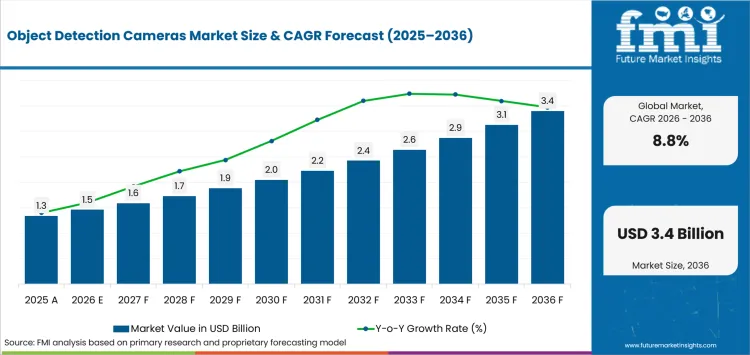
- Market Size (2026)
- USD 1.5 Bn
- Forecast (2036)
- USD 3.4 Bn
- CAGR (2026 to 2036)
- 8.8%
How big is Object Detection Cameras Market in 2026?
USD 1.5 billion in 2026 and USD 3.4 billion by 2036 at an 8.8% CAGR.
Demand for object detection cameras is projected to expand at an 8.8% CAGR between 2026 and 2036, increasing valuation from USD 1.5 billion to USD 3.4 billion. Shipowners are shifting spending from passive recording toward perception systems that classify hazards for supervised collision avoidance. The International Maritime Organization adopted the non-mandatory MASS Code in May 2026 with navigation requirements for autonomous cargo ships.
Japan has a formal inspection route for autonomous functions while Italy's mixed vessel base relies more on retrofit installation and service. In December 2025 Japan issued its first vessel inspection certificate for an autonomous ship after confirming system safety under national standards. The different routes change how manufacturers document interoperability and provide technical support for navigation-hazard cameras.
Key Takeaways of Object Detection Cameras Market
- Shipowners specify object detection cameras for supervised collision avoidance where outputs can enter existing navigation systems.
- By camera type, visible-light cameras are estimated to hold 28.0% in 2026 owing to familiar bridge watchkeeping.
- Floating objects are projected to hold 26.0% of detection-scope demand in 2026 owing to visual classification needs for unidentified surface hazards.
- In 2026, camera-only processing is expected to lead processing with 25.0% share because simpler interfaces suit retrofit installations.
- Glare and darkness can delay approval because false detections become costlier once cameras influence collision-avoidance decisions.
- Some of the key players in this market include Orca AI, Teledyne FLIR, Garmin Ltd., Furuno Electric Co., Ltd., Sea Machines Robotics, Avikus (HD Hyundai), Axis Communications, and Hangzhou Hikvision Digital Technology Co., Ltd.
Analyst Perspective
"Marine operators should compare object-classification performance inside the visibility limits stated for each vessel before comparing camera price. A camera earns repeat fleet orders after its alerts pass into installed bridge electronics without forcing a wider control-system redesign."
- Nikhil Kaitwade, Principal Consultant, Future Market Insights
How is the Object Detection Cameras Market segmented?
The object detection cameras market is evaluated by camera type, detection scope, processing, end use, sales channel, and region.
Camera type covers visible-light, thermal, stereo, AI edge, and low-light marine cameras while detection scope covers floating objects, vessels, people - MOB, dock obstacles, and navigation marks. Processing covers camera-only, edge AI, cloud-assisted detection, and sensor fusion while end use covers ADAS, autonomous vessels, security, docking assistance, and search and rescue. Sales channels include marine electronics OEMs, autonomy integrators, boat OEMs, and aftermarket specialists serving these applications.
What makes visible-light cameras central to the camera type category?
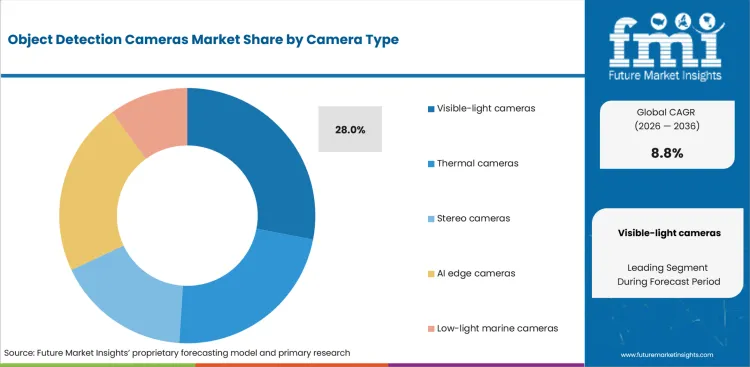
Visible-light cameras fit routine bridge watchkeeping because crews already interpret color and vessel shape during navigation. Marine electronics displays place camera video beside chart and radar information without requiring another dedicated bridge console.
- By camera type, the visible-light segment is estimated to hold 28.0% in 2026 owing to familiar daytime watchkeeping and helm-display integration.
- Garmin's April 2026 marine software update added a dedicated video category so operators can open individual onboard cameras directly from compatible displays.
Why do floating objects hold the stated share within the detection scope category?
Floating debris and small craft may lack reliable identity broadcasts even after radar detects a target. Smart camera systems let bridge crews classify the contact before navigation software escalates it as a hazard.
- The floating objects segment is likely to capture 26.0% share of detection scope in 2026 attributable to visual classification needs for non-cooperative surface hazards.
- Orca AI launched a 360-degree field-of-view configuration in March 2026 using three RGB and thermal SeaPod units for perimeter vessel detection.
How does camera-only processing retain a practical role within the processing category?
Camera-only processing reduces installation interfaces by keeping inference close to the imager during commercial retrofit work. Embedded edge AI reduces remote-processing dependence without requiring immediate sensor-fusion redesign for every vessel.
- Camera-only processing is projected to hold 25.0% share in 2026 owing to lower integration requirements in retrofit and assisted-navigation projects.
- Teledyne FLIR launched the M460 and M560 marine cameras in October 2025 with onboard AI target tracking and local multispectral processing.
What supports ADAS adoption within the end use category?
Assisted navigation keeps bridge crews responsible while perception software ranks hazards for routine collision-avoidance decisions. Marine radar and AIS stay active because cameras classify targets without replacing other navigation sensors.
- In 2026, ADAS is expected to lead end use with 28.0% share because supervised decision support retains crew responsibility on commercial vessels.
- Furuno stated in March 2026 that GENBU entered commercial service with level 4 autonomous navigation after Japanese inspection and certification.
Why do marine electronics OEMs hold the stated sales channel share?
Marine electronics OEMs control the displays and vessel-network interfaces used during many retrofit projects. Their service channels give machine vision cameras a supported path from installation to troubleshooting inside bridge systems.
- Marine electronics OEMs are set to lead the sales channel with 36.0% share in 2026 due to display integration and regional service relationships.
- Sea Machines appointed Shintoa Corporation as its authorized reseller in Japan in April 2026 to market and support autonomy products domestically.
What are the drivers, restraints and opportunities in the Object Detection Cameras Market?
Autonomous-vessel rules are broadening perception requirements, operating-envelope validation delays safety-critical approval, and open interfaces give retrofit integrators a practical route into existing bridge systems.
- Driver: Autonomous and remotely operated vessels require perception systems that can support navigation decisions within documented safety and oversight requirements.
- Restraint: Marine cameras must maintain useful detection performance under glare and low visibility plus motion and spray before safety-relevant use in vessel-specific control systems.
- Opportunity: Edge inference and open control interfaces can lower retrofit complexity for operators that need better perception without replacing the complete navigation stack.
Autonomous-ship rules broaden the perception requirement
South Korea's autonomous-ship law makes perception performance part of a formal demonstration and verification route instead of an optional bridge-video feature. The law took effect in January 2025 and gives shipbuilders a defined basis for testing object recognition under designated operating conditions. AI video surveillance tools can supply detection methods, but marine use requires vessel-specific safety evidence before commercial deployment.
Operating-envelope validation delays safety-critical approval
Camera output used for navigation must retain useful detection under changing visibility and after integration with bridge controls. In June 2026 the USA Coast Guard published national guidance for officers overseeing unmanned and remote maritime operations. The guidance makes operating limits and documented human control part of deployment planning, while maritime cybersecurity requirements add another check for networked perception systems.
Open interfaces reduce retrofit integration work
Retrofit economics improve when perception software exchanges data with control systems the operator already uses. Sea Machines released SMLink streaming and control APIs in September 2025 so approved third-party systems can use its SM300 autonomy platform. Open interfaces preserve existing mission software while machine vision systems give specialist marine integrators more edge-processing choices during retrofit upgrades without replacing vessel controls.
Which country CAGRs are profiled in the Object Detection Cameras Market?
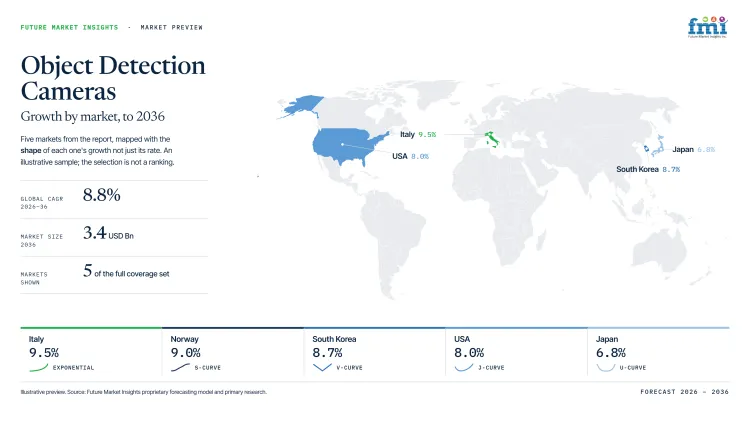
| Country | CAGR |
|---|---|
| Italy | 9.5% |
| Norway | 9.0% |
| South Korea | 8.7% |
| Canada | 8.2% |
| USA | 8.0% |
| Germany | 7.5% |
| Japan | 6.8% |
How do country-level CAGRs compare in the Object Detection Cameras Market?
The forecasts span 2.7 percentage points from Italy at 9.5% CAGR to Japan at 6.8% CAGR. Italy and Norway form the upper group while South Korea follows within the high-growth tier. Canada and the USA remain tightly grouped as Germany and Japan form a lower growth band.
- Italy's higher forecast places more weight on installer throughput because many retrofits enter through regional marine-equipment channels.
- Norway's dispersed coastline makes remote diagnostics valuable for operators working far from major marine-electronics service centers.
- South Korea's liner-fleet concentration gives camera vendors repeat-account access after one platform passes a fleet operator's technical review.
- Canada's long coastal service distances favor rugged camera hardware with remote maintenance for work far from specialist electronics centers.
- USA aftermarket breadth gives camera makers access to commercial workboats and recreational vessels outside government autonomy programs.
- Germany's dense inland-waterway traffic favors compact perception packages that can work with mixed radar and bridge installations.
- Japan's domestic marine-electronics base gives perception functions access to radar and bridge-display service channels familiar to vessel operators.
Similar growth rates still produce different entry conditions because service reach and approval routes vary by country. The full report uses North America, Latin America, Western Europe, Eastern Europe, East Asia, South Asia and Pacific and the Middle East and Africa.
Country-wise Analysis
- Italy's vessel-traffic services give installers a national monitoring base, but mixed recreational and professional fleets produce very different retrofit layouts. By 2036 Italy is projected to grow at 9.5% CAGR as operators modernize cameras without replacing complete bridge systems. The Ministry of Infrastructure and Transport set a 2025 target requiring VTS centers to maintain a minimum quarterly availability of 92%. Integrators can extend existing video surveillance systems with object classification, yet older vessel networks and uneven service coverage make interface support a decisive part of each retrofit. Specialist marine electronics dealers can shorten troubleshooting where legacy displays and network gateways require local support.
- Norwegian coastal operators plan voyages against route limits and weather windows that can alter visibility within hours. The Norwegian Coastal Administration published digital Pilot Guidelines in May 2025 so ship managers can review route restrictions and safety parameters before sailing. Norway is estimated to post 9.0% CAGR over the forecast period influenced by digital voyage planning and remote operations that raise the value of documented perception limits. Darkness and severe weather increase qualification demands for equipment used far from major service ports. Manufacturers with verified low-light performance and regional maintenance can reduce troubleshooting during narrow seasonal service windows for commercial coastal vessels.
- Large South Korean shipbuilders can standardize a qualified perception package on sister vessels and repeat the design with limited engineering change. Object detection camera sales in South Korea are forecast to expand at 8.7% CAGR by 2036 due to national policy for commercial autonomous shipping. Fleet contracts can scale quickly once the same interfaces and recognition limits pass vessel-class approval. The Ministry of Oceans and Fisheries launched the Autonomous Vessel Policy Committee in May 2025 to coordinate policy under the national act. Shipyard teams can then reuse approved interfaces on repeat builds without rebuilding the perception stack for every hull.
- Canadian operators must fit autonomous navigation functions inside existing inspections while protecting connected perception systems from cyber risk. Adoption of object detection cameras in Canada is estimated to expand at 8.2% CAGR through 2036, driven by national research and oversight work for marine autonomous surface ships. Transport Canada's 2025-2026 departmental plan commits the department to developing cybersecurity requirements for those vessels. Cold-weather operation and long service distances increase lifetime support costs for rugged thermal cameras. Integrators with remote diagnostics and regional maintenance capacity are better placed to serve public and commercial fleets working far from major service centers nationwide.
- USA shipowners face a fragmented approval route because autonomous functions pass through Coast Guard inspection and port-safety oversight instead of one commercial certificate. The Coast Guard established a Robotics and Autonomous Systems Program Executive Office in August 2025 to accelerate fielding of autonomous capabilities. Object detection camera demand in the USA is predicted to advance at 8.0% CAGR through 2036 due to maritime autonomy programs that need documented human oversight. Vessel-specific integration records are still required before perception output can directly influence safety-critical navigation. Camera makers with traceable test results can reuse more of the approval package on repeat vessel classes without assuming every port presents identical operating conditions.
- German autonomous-vessel applications use case-specific flag-state review for smaller craft and trials that operate before a binding national framework is complete. The German object detection cameras sector is projected to record 7.5% CAGR during the assessment period supported by formal coordination and validated collision-avoidance evidence. Germany joined the North Sea MASS memorandum in July 2025 and established a national coordination round for autonomous-shipping applications. The coordination route gives integrators a clearer administrative path for planned trials and commercial reviews. Cybersecurity and remote-operator requirements can still extend qualification work on coastal and inland routes where bridge electronics differ by vessel type.
- Japanese autonomous-shipping programs operate under national safety and inspection methods that define how perception functions enter nationally certified commercial vessel systems. MLIT finalized autonomous-ship safety standards and inspection methods on June 30 2025 after committee reviews. Object detection camera demand in Japan is forecast to rise at 6.8% CAGR over the forecast period reflecting a formal examination route for autonomous functions. The inspection framework gives camera manufacturers clearer test expectations before scheduled service and later periodic reviews. Suppliers still need recognition evidence for each approved operating condition and domestic service networks must support interface rework during commercial operation.
Who are the notable companies in the Object Detection Cameras Market?
Orca AI, Teledyne FLIR, Garmin Ltd., Furuno Electric Co., Ltd., Sea Machines Robotics, Avikus (HD Hyundai), Axis Communications, and Hangzhou Hikvision Digital Technology Co., Ltd..
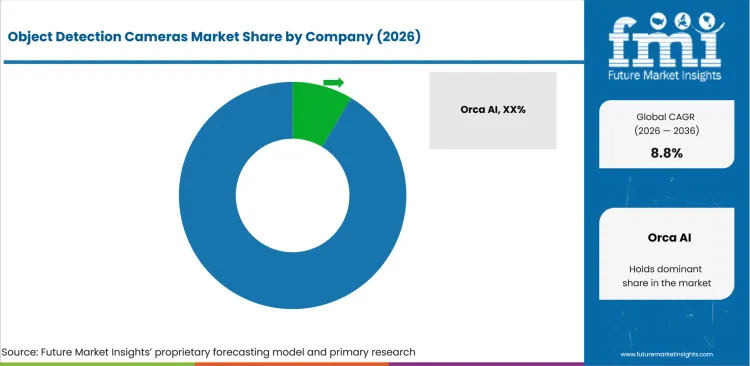
Maritime autonomy companies compete for vessel-scale perception programs while marine-electronics manufacturers control installed bridge interfaces. Orca AI and Sea Machines Robotics compete with Avikus in autonomy programs while Teledyne FLIR, Garmin and Furuno focus on marine imaging and bridge integration.
- Orca AI and Sea Machines Robotics join Avikus (HD Hyundai) in vessel-scale perception and autonomous-navigation control.
- Teledyne FLIR and Garmin Ltd. join Furuno Electric Co., Ltd. in marine imaging and bridge-electronics integration.
Competitive Benchmarking: Object Detection Cameras Market
| Company | Marine Detection | Low-Visibility | Integration | Geographic Reach |
|---|---|---|---|---|
| Orca AI | High | High | High | Global shipping |
| Teledyne FLIR | High | High | High | Global marine |
| Garmin Ltd. | Medium | Medium | High | Global marine |
| Furuno Electric Co., Ltd. | High | Medium | High | Global marine |
| Sea Machines Robotics | High | Low | High | North America, Europe, Asia-Pacific |
| Avikus (HD Hyundai) | High | Medium | High | Global shipping |
| Axis Communications | Medium | High | Medium | Global infrastructure |
| Hangzhou Hikvision Digital Technology Co., Ltd. | Low | High | Medium | Global video security |
Key Developments in the Object Detection Cameras Market
- In September 2026, Sea Machines Robotics announced a five-year IDIQ contract supplying deployable autonomy kits to USA Special Operations Forces.
- In April 2026, Orca AI signed a Samsung Heavy Industries memorandum covering perception integration with autonomous navigation plus berthing and speed control.
- In January 2026, Avikus signed with HMM to supply HiNAS Control autonomous-navigation systems for forty vessels.
Key Players in the Object Detection Cameras Market
Maritime perception platform
- Orca AI
Marine camera and electronics manufacturers
- Teledyne FLIR
- Garmin Ltd.
- Furuno Electric Co., Ltd.
Marine autonomy software and navigation
- Sea Machines Robotics
- Avikus (HD Hyundai)
Security and industrial vision suppliers
- Axis Communications
- Hangzhou Hikvision Digital Technology Co., Ltd.
Object Detection Cameras Market - Report Scope
| Coverage field | Report scope |
|---|---|
| Market breakdown | By camera type, detection scope, processing, end use, sales channel, and region. |
| Quantitative Units | Revenue in USD billion and CAGR in %. |
| Market Definition | Cameras and integrated vision systems used to detect, classify, or track objects for marine navigation, autonomy, docking, safety, and monitored-waterway applications. |
| Regions Covered | North America, Latin America, Western Europe, Eastern Europe, East Asia, South Asia and Pacific, and Middle East and Africa. |
| Countries Covered | Italy, Norway, South Korea, Canada, USA, Germany, Japan, and 30+ countries included in the full report. |
| Key Companies Profiled | Orca AI, Teledyne FLIR, Garmin Ltd., Furuno Electric Co., Ltd., Sea Machines Robotics, Avikus (HD Hyundai), Axis Communications, and Hangzhou Hikvision Digital Technology Co., Ltd.. |
| Forecast Period | 2026 to 2036. |
| Approach | Primary and secondary research with market triangulation. |
Object Detection Cameras Market - Research Methodology
| Method | Approach |
|---|---|
| Primary Research | FMI analysts gathered input from manufacturers, service providers, technology developers, distributors, end users, procurement teams, and subject-matter experts. Interviews examined purchasing decisions, product or service evaluation, adoption barriers, approval requirements, pricing considerations, and expectations for technical or commercial support. Respondents were also asked what evidence is required before a trial, pilot, or initial order develops into regular purchasing. |
| Desk Research | Desk research covered government statistics, regulatory publications, trade data, industry associations, technical literature, standards, company filings, product information, and official corporate announcements. Sources were reviewed for relevance, publication date, geographic coverage, and consistency with the defined market scope. Claims relating to performance, applications, approvals, capacity, investment, and commercial activity were retained only when supported by credible public evidence. |
| Market Sizing and Forecasting | The market model combined the baseline value with historical performance, segment structure, pricing and volume indicators, adoption levels, company participation, and country-level demand conditions. Forecast assumptions considered economic activity, investment trends, regulatory developments, technology adoption, purchasing cycles, supply availability, and barriers to wider market use. Segment and regional estimates were reconciled before the final market total was calculated. |
| Data Validation | Estimates were checked against multiple independent indicators, including public data, company activity, trade patterns, industry developments, and findings from primary interviews. Validation also tested whether products, services, applications, and company revenues fell within the defined market boundaries. Adjacent categories, unsupported claims, overlapping revenues, and activities without direct market relevance were excluded to reduce double counting and maintain consistency across segments and countries. |
Object Detection Cameras Market by Segments
Object Detection Cameras Market segmented by Camera Type:
- Visible-light cameras
- Thermal cameras
- Stereo cameras
- AI edge cameras
- Low-light marine cameras
Object Detection Cameras Market segmented by Detection Scope:
- Floating objects
- Vessels
- People - MOB
- Dock obstacles
- Navigation marks
Object Detection Cameras Market segmented by Processing:
- Camera-only
- Edge AI processing
- Cloud-assisted detection
- Sensor fusion
Object Detection Cameras Market segmented by End Use:
- ADAS
- Autonomous vessels
- Security
- Docking assistance
- Search and rescue
Object Detection Cameras Market segmented by Sales Channel:
- Marine electronics OEMs
- Autonomy integrators
- Boat OEMs
- Aftermarket retrofit specialists
Object Detection Cameras Market by Region:
- North America
- United States
- Canada
- Latin America
- Brazil
- Mexico
- Argentina
- Chile
- Western Europe
- Germany
- France
- United Kingdom
- Italy
- Spain
- Benelux
- Nordics
- Eastern Europe
- Poland
- Czech Republic
- Romania
- Hungary
- East Asia
- China
- Japan
- South Korea
- South Asia and Pacific
- India
- ASEAN
- Australia and New Zealand
- Middle East and Africa
- GCC Countries
- South Africa
- Türkiye
- Israel
Research Sources and Bibliography
- International Maritime Organization. (2026, May 22). IMO adopts first global Code for autonomous ships.
- Ministry of Land, Infrastructure, Transport and Tourism. (2025, December 10). 我が国で初めて「自動運航船」の船舶検査に合格!~船舶に搭載された自動運航システムについて安全性を確認し船舶検査証書を交付しました~.
- Garmin. (2026, April 1). April 2026 marine software update.
- Orca AI. (2026, March 4). Orca AI extends situational awareness to full 360° Field of View.
- Furuno Electric Co., Ltd. (2026, March 31). World’s first commercial operation of autonomous container ship with level 4 capability.
- Sea Machines Robotics. (2026, April 8). Sea Machines and Shintoa Corporation form trading agreement to serve the Japanese market, Expanding APAC Presence.
- Ministry of Oceans and Fisheries. (2025, January 10). Enactment of the Enforcement Decree of the Act on the Promotion of Development and Commercialization of Autonomous Ships.
- United States Coast Guard. (2026, June 5). Coast Guard Assistant Commandant for Prevention Policy (CG-5P) Publishes Guidance on Oversight of Unmanned, Autonomous and Remote-Control Operations.
- Sea Machines Robotics. (2025, September 16). Sea Machines Launches Marine Autonomy APIs for Third-Party C2 Systems.
- Ministero delle Infrastrutture e dei Trasporti. (2025, February). Programmazione strategica 2025: Scheda 1.D1.4.
- United States Coast Guard. (2025, August 19). Coast Guard establishes new Program Executive Office dedicated to robotics and autonomous systems.
- Ministry of Land, Infrastructure, Transport and Tourism. (2025, June 30). 自動運航船の安全基準・検査方法.
- Ministry of Oceans and Fisheries. (2025, May 28). Official Launch of the Autonomous Vessel Policy Committee.
- Norwegian Coastal Administration. (2025, May 9). Pilot Guidelines in a new digital solution - we want your feedback.
- German Flag State Administration. (2025, November 28). Maritime Innovationen: Deutschlands Einsatz für die Autonome Schifffahrt.
- Transport Canada. (2025). Transport Canada 2025-2026 Departmental Plan.
- Avikus. (2026, January 16). HD Hyundai’s Avikus Secures Industry-Record Contract to Supply Autonomous Navigation to 40 HMM Vessels.
- Orca AI. (2026, April 29). Orca AI joins forces with Samsung Heavy Industries to accelerate autonomous vessel technology.
- Sea Machines Robotics. (2026, September 8). Sea Machines secures IDIQ Contract with US Special Operations Forces (SOF) for Universal Autonomy Systems.
- Orca AI. (2025, May 6). Orca AI secures $72.5 million investment to scale autonomous shipping solutions.
- Teledyne FLIR Marine. (2026, August 26). Teledyne FLIR Marine Introduces FLIR M364C-USV Camera for Autonomous and Uncrewed Vessels.
- Orca AI. (2025, November 6). Orca AI releases Co-Captain, allowing vessels to share real-time data and optimize navigation.
- Axis Communications. (2026, January 9). Multi-layered solutions offer AI-powered classification across large areas.
- Orca AI. (2026, August 25). Eastern Pacific Shipping expands Orca AI platform rollout after successful pilot.
- Teledyne FLIR Marine. (2025, October 28). FLIR Launches AI-Powered M460 and M560 Cameras.
- Garmin. (2026, March 31). GC 245/255 software version 14.00.
- Furuno Electric Co., Ltd. (2025, November 28). Furuno to exhibit at Marintec China 2025.
- Sea Machines Robotics. (2025, May 7). Sea Machines Provides Autonomy for USA Marine Corps’ Autonomous Low-Profile Vessel (ALPV) Program.
- Avikus. (2026, July 6). KMTC Expands Deployment of Avikus’ AI-Powered HiNAS Control with Additional Three-Vessel Agreement.
- Axis Communications. (2025, January 20). Windsor Port Authority Strengthens USA-Canada Border Waterway Safety and Security.
- Hangzhou Hikvision Digital Technology Co., Ltd. (2026, April 27). Hikvision 2025 Annual Report.
- Family with New Helios2 Chroma Models.
- Avikus. (2026, April 6). HD Hyundai Avikus Spearheads Global Standards of Autonomous Navigation Support.
- Avikus. (2025, May 22). Eastern Pacific Shipping and Avikus Sign Retrofit Contract for AI-Based Autonomous Navigation Solution.
- Teledyne FLIR Marine. (2026, July 23). RNLI Announce Strategic Five Year Partnership with Teledyne FLIR Marine.
This bibliography is provided for reader reference and is not exhaustive. The full report contains the complete reference list and detailed citations
This Report Answers
- How large is the global hand & nail care sets market, and what value is projected through 2036?
- Why are at-home hand and nail care routines gaining popularity among consumers?
- Why do core/classic product lines account for 37.0% of the market share?
- Why do conventional formulations hold 50.0% of total market demand?
- Why do cream and balm formats represent 31.0% of the hand & nail care sets market?
- How do growth rates and market opportunities compare across the eight profiled countries?
- Which leading companies are competing in the global hand & nail care sets market?
Frequently Asked Questions
How big is the Object Detection Cameras Market in 2026?
The object detection cameras market is valued at USD 1.5 billion in 2026 and is projected at USD 3.4 billion by 2036. Camera-based hazard recognition now enters supervised navigation and collision-avoidance systems used on commercial vessels.
What is the CAGR of the Object Detection Cameras Market from 2026 to 2036?
The object detection cameras market is projected to grow at 8.8% CAGR between 2026 and 2036. Autonomous-vessel programs expand object classification beside established bridge sensors while crews retain navigation oversight.
Which camera type leads the Object Detection Cameras Market?
The visible-light cameras segment is expected to hold 28.0% of the object detection cameras market in 2026, attributable to familiar bridge watchkeeping. Marine displays also place video beside navigation data without requiring another dedicated bridge console.
Which detection scope segment has the stated share in the Object Detection Cameras Market?
The floating objects segment is expected to hold 26.0% of the object detection cameras market in 2026, driven by classification needs for non-cooperative hazards. Radar and AIS provide target cues while cameras let crews verify nearby surface contacts visually.
Which countries record the upper growth rates in the Object Detection Cameras Market?
Italy is projected to grow at 9.5% CAGR, followed by Norway at 9.0% and South Korea at 8.7% through 2036. Each country reaches that rate through a distinct mix of retrofit service and fleet programs.
Which companies are active in the Object Detection Cameras Market?
Key companies in the object detection cameras market include Orca AI, Teledyne FLIR, Garmin Ltd., Furuno Electric Co., Ltd., Sea Machines Robotics, Avikus (HD Hyundai), Axis Communications, Hangzhou Hikvision Digital Technology Co., Ltd., Cognex Corporation, and LUCID Vision Labs, Inc. These companies span maritime perception, marine electronics, monitored infrastructure and specialist machine-vision supply roles.
Preview the report firsthand - request a free sample
Get SampleGet the brochure for pricing and purchase details.
Get PDFTable of Content
- Key Takeaways
- Market Size and CAGR
- Top Growth Driver
- Fastest Growing Segment
- Leading Region
- Key Companies
- Emerging Opportunities
- Executive Summary
- Global Market Outlook
- Demand-side Trends
- Supply-side Trends
- Technology Roadmap Analysis
- Analysis and Recommendations
- Analyst Perspective (What is happening? Why now? What should investors know?)
- Key Questions Answered
- How large is the market?
- What is the CAGR?
- What are key trends?
- Which region dominates?
- Who are the leaders?
- Market Overview
- Market Coverage / Taxonomy
- Market Definition / Scope / Limitations
- Research Methodology
- Chapter Orientation
- Analytical Lens and Working Hypotheses
- Market Structure, Signals, and Trend Drivers
- Benchmarking and Cross-market Comparability
- Market Sizing, Forecasting, and Opportunity Mapping
- Research Design and Evidence Framework
- Desk Research Programme (Secondary Evidence)
- Expert Input and Fieldwork (Primary Evidence)
- Tooling, Models, and Reference Databases
- Data Engineering and Model Build
- Quality Assurance and Audit Trail
- Market Background
- Market Dynamics (Drivers, Restraints, Opportunity, Trends)
- Scenario Forecast (Optimistic, Likely, Conservative)
- Impact Analysis
- AI Impact
- Sustainability Impact
- Regulatory Impact
- Technology Impact
- Consumer / Buyer Analysis
- Purchase Drivers
- Adoption Barriers
- Buyer Journey
- Opportunity Map Analysis
- Product Life Cycle Analysis
- Supply Chain Analysis
- Investment Feasibility Matrix
- Value Chain Analysis
- PESTLE and Porter's Analysis
- Regulatory Landscape
- Regional Parent Market Outlook
- Production and Consumption Statistics
- Import and Export Statistics
- Global Market Analysis and Forecast, 2021 to 2036
- Historical Market Size Value (USD Billion) Analysis, 2021 to 2025
- Current and Future Market Size Value (USD Billion) Projections, 2026 to 2036
- Y-o-Y Growth Trend Analysis
- Absolute $ Opportunity Analysis
- Global Market Pricing Analysis, 2021 to 2036
- Global Market Analysis and Forecast, By Camera Type, 2021 to 2036
- Introduction / Key Findings
- Historical Market Size Value (USD Billion) Analysis By Camera Type, 2021 to 2025
- Current and Future Market Size Value (USD Billion) Analysis and Forecast By Camera Type, 2026 to 2036
- Visible-light cameras
- Thermal cameras
- Stereo cameras
- AI edge cameras
- Low-light marine cameras
- Visible-light cameras
- Y-o-Y Growth Trend Analysis By Camera Type, 2021 to 2025
- Absolute $ Opportunity Analysis By Camera Type, 2026 to 2036
- Global Market Analysis and Forecast, By Detection Scope, 2021 to 2036
- Introduction / Key Findings
- Historical Market Size Value (USD Billion) Analysis By Detection Scope, 2021 to 2025
- Current and Future Market Size Value (USD Billion) Analysis and Forecast By Detection Scope, 2026 to 2036
- Floating objects
- Vessels
- People / MOB
- Dock obstacles
- Navigation marks
- Floating objects
- Y-o-Y Growth Trend Analysis By Detection Scope, 2021 to 2025
- Absolute $ Opportunity Analysis By Detection Scope, 2026 to 2036
- Global Market Analysis and Forecast, By Processing, 2021 to 2036
- Introduction / Key Findings
- Historical Market Size Value (USD Billion) Analysis By Processing, 2021 to 2025
- Current and Future Market Size Value (USD Billion) Analysis and Forecast By Processing, 2026 to 2036
- Camera-only
- Edge AI processing
- Cloud-assisted detection
- Sensor fusion
- Camera-only
- Y-o-Y Growth Trend Analysis By Processing, 2021 to 2025
- Absolute $ Opportunity Analysis By Processing, 2026 to 2036
- Global Market Analysis and Forecast, By End Use, 2021 to 2036
- Introduction / Key Findings
- Historical Market Size Value (USD Billion) Analysis By End Use, 2021 to 2025
- Current and Future Market Size Value (USD Billion) Analysis and Forecast By End Use, 2026 to 2036
- ADAS
- Autonomous vessels
- Security
- Docking assistance
- Search and rescue
- ADAS
- Y-o-Y Growth Trend Analysis By End Use, 2021 to 2025
- Absolute $ Opportunity Analysis By End Use, 2026 to 2036
- Global Market Analysis and Forecast, By Sales Channel, 2021 to 2036
- Introduction / Key Findings
- Historical Market Size Value (USD Billion) Analysis By Sales Channel, 2021 to 2025
- Current and Future Market Size Value (USD Billion) Analysis and Forecast By Sales Channel, 2026 to 2036
- Marine electronics OEMs
- Autonomy integrators
- Boat OEMs
- Aftermarket retrofit
- Marine electronics OEMs
- Y-o-Y Growth Trend Analysis By Sales Channel, 2021 to 2025
- Absolute $ Opportunity Analysis By Sales Channel, 2026 to 2036
- Global Market Analysis and Forecast, By Region, 2021 to 2036
- Introduction
- Historical Market Size Value (USD Billion) Analysis By Region, 2021 to 2025
- Current Market Size Value (USD Billion) Analysis and Forecast By Region, 2026 to 2036
- North America
- Latin America
- Western Europe
- Eastern Europe
- East Asia
- South Asia and Pacific
- Middle East & Africa
- Market Attractiveness Analysis By Region
- North America Market Analysis and Forecast, By Country, 2021 to 2036
- Historical Market Size Value (USD Billion) Trend Analysis By Market Taxonomy, 2021 to 2025
- Market Size Value (USD Billion) Forecast By Market Taxonomy, 2026 to 2036
- By Country
- USA
- Canada
- By Camera Type
- By Detection Scope
- By Processing
- By End Use
- By Sales Channel
- By Country
- Market Attractiveness Analysis
- By Country
- By Camera Type
- By Detection Scope
- By Processing
- By End Use
- By Sales Channel
- Key Takeaways
- Latin America Market Analysis and Forecast, By Country
- Historical Market Size Value (USD Billion) Trend Analysis By Market Taxonomy, 2021 to 2025
- Market Size Value (USD Billion) Forecast By Market Taxonomy, 2026 to 2036
- By Country
- Brazil
- Mexico
- Chile
- Rest of Latin America
- By Camera Type
- By Detection Scope
- By Processing
- By End Use
- By Sales Channel
- By Country
- Market Attractiveness Analysis
- By Country
- By Camera Type
- By Detection Scope
- By Processing
- By End Use
- By Sales Channel
- Key Takeaways
- Western Europe Market Analysis and Forecast, By Country
- Historical Market Size Value (USD Billion) Trend Analysis By Market Taxonomy, 2021 to 2025
- Market Size Value (USD Billion) Forecast By Market Taxonomy, 2026 to 2036
- By Country
- Germany
- UK
- Italy
- Spain
- France
- Nordic
- BENELUX
- Rest of Western Europe
- By Camera Type
- By Detection Scope
- By Processing
- By End Use
- By Sales Channel
- By Country
- Market Attractiveness Analysis
- By Country
- By Camera Type
- By Detection Scope
- By Processing
- By End Use
- By Sales Channel
- Key Takeaways
- Eastern Europe Market Analysis and Forecast, By Country
- Historical Market Size Value (USD Billion) Trend Analysis By Market Taxonomy, 2021 to 2025
- Market Size Value (USD Billion) Forecast By Market Taxonomy, 2026 to 2036
- By Country
- Russia
- Poland
- Hungary
- Balkan & Baltic
- Rest of Eastern Europe
- By Camera Type
- By Detection Scope
- By Processing
- By End Use
- By Sales Channel
- By Country
- Market Attractiveness Analysis
- By Country
- By Camera Type
- By Detection Scope
- By Processing
- By End Use
- By Sales Channel
- Key Takeaways
- East Asia Market Analysis and Forecast, By Country
- Historical Market Size Value (USD Billion) Trend Analysis By Market Taxonomy, 2021 to 2025
- Market Size Value (USD Billion) Forecast By Market Taxonomy, 2026 to 2036
- By Country
- China
- Japan
- South Korea
- By Camera Type
- By Detection Scope
- By Processing
- By End Use
- By Sales Channel
- By Country
- Market Attractiveness Analysis
- By Country
- By Camera Type
- By Detection Scope
- By Processing
- By End Use
- By Sales Channel
- Key Takeaways
- South Asia and Pacific Market Analysis and Forecast, By Country
- Historical Market Size Value (USD Billion) Trend Analysis By Market Taxonomy, 2021 to 2025
- Market Size Value (USD Billion) Forecast By Market Taxonomy, 2026 to 2036
- By Country
- India
- ASEAN
- Australia & New Zealand
- Rest of South Asia and Pacific
- By Camera Type
- By Detection Scope
- By Processing
- By End Use
- By Sales Channel
- By Country
- Market Attractiveness Analysis
- By Country
- By Camera Type
- By Detection Scope
- By Processing
- By End Use
- By Sales Channel
- Key Takeaways
- Middle East & Africa Market Analysis and Forecast, By Country
- Historical Market Size Value (USD Billion) Trend Analysis By Market Taxonomy, 2021 to 2025
- Market Size Value (USD Billion) Forecast By Market Taxonomy, 2026 to 2036
- By Country
- Kingdom of Saudi Arabia
- Other GCC Countries
- Türkiye
- South Africa
- Other African Union
- Rest of Middle East & Africa
- By Camera Type
- By Detection Scope
- By Processing
- By End Use
- By Sales Channel
- By Country
- Market Attractiveness Analysis
- By Country
- By Camera Type
- By Detection Scope
- By Processing
- By End Use
- By Sales Channel
- Key Takeaways
- Key Countries Market Analysis
- USA
- Pricing Analysis
- Market Share Analysis, 2025
- By Camera Type
- By Detection Scope
- By Processing
- By End Use
- By Sales Channel
- Canada
- Pricing Analysis
- Market Share Analysis, 2025
- By Camera Type
- By Detection Scope
- By Processing
- By End Use
- By Sales Channel
- Mexico
- Pricing Analysis
- Market Share Analysis, 2025
- By Camera Type
- By Detection Scope
- By Processing
- By End Use
- By Sales Channel
- Brazil
- Pricing Analysis
- Market Share Analysis, 2025
- By Camera Type
- By Detection Scope
- By Processing
- By End Use
- By Sales Channel
- Chile
- Pricing Analysis
- Market Share Analysis, 2025
- By Camera Type
- By Detection Scope
- By Processing
- By End Use
- By Sales Channel
- Germany
- Pricing Analysis
- Market Share Analysis, 2025
- By Camera Type
- By Detection Scope
- By Processing
- By End Use
- By Sales Channel
- UK
- Pricing Analysis
- Market Share Analysis, 2025
- By Camera Type
- By Detection Scope
- By Processing
- By End Use
- By Sales Channel
- Italy
- Pricing Analysis
- Market Share Analysis, 2025
- By Camera Type
- By Detection Scope
- By Processing
- By End Use
- By Sales Channel
- Spain
- Pricing Analysis
- Market Share Analysis, 2025
- By Camera Type
- By Detection Scope
- By Processing
- By End Use
- By Sales Channel
- France
- Pricing Analysis
- Market Share Analysis, 2025
- By Camera Type
- By Detection Scope
- By Processing
- By End Use
- By Sales Channel
- India
- Pricing Analysis
- Market Share Analysis, 2025
- By Camera Type
- By Detection Scope
- By Processing
- By End Use
- By Sales Channel
- ASEAN
- Pricing Analysis
- Market Share Analysis, 2025
- By Camera Type
- By Detection Scope
- By Processing
- By End Use
- By Sales Channel
- Australia & New Zealand
- Pricing Analysis
- Market Share Analysis, 2025
- By Camera Type
- By Detection Scope
- By Processing
- By End Use
- By Sales Channel
- China
- Pricing Analysis
- Market Share Analysis, 2025
- By Camera Type
- By Detection Scope
- By Processing
- By End Use
- By Sales Channel
- Japan
- Pricing Analysis
- Market Share Analysis, 2025
- By Camera Type
- By Detection Scope
- By Processing
- By End Use
- By Sales Channel
- South Korea
- Pricing Analysis
- Market Share Analysis, 2025
- By Camera Type
- By Detection Scope
- By Processing
- By End Use
- By Sales Channel
- Russia
- Pricing Analysis
- Market Share Analysis, 2025
- By Camera Type
- By Detection Scope
- By Processing
- By End Use
- By Sales Channel
- Poland
- Pricing Analysis
- Market Share Analysis, 2025
- By Camera Type
- By Detection Scope
- By Processing
- By End Use
- By Sales Channel
- Hungary
- Pricing Analysis
- Market Share Analysis, 2025
- By Camera Type
- By Detection Scope
- By Processing
- By End Use
- By Sales Channel
- Kingdom of Saudi Arabia
- Pricing Analysis
- Market Share Analysis, 2025
- By Camera Type
- By Detection Scope
- By Processing
- By End Use
- By Sales Channel
- Türkiye
- Pricing Analysis
- Market Share Analysis, 2025
- By Camera Type
- By Detection Scope
- By Processing
- By End Use
- By Sales Channel
- South Africa
- Pricing Analysis
- Market Share Analysis, 2025
- By Camera Type
- By Detection Scope
- By Processing
- By End Use
- By Sales Channel
- USA
- Market Structure Analysis
- Competition Dashboard
- Competition Benchmarking
- Market Share Analysis of Top Players
- By Regional
- By Camera Type
- By Detection Scope
- By Processing
- By End Use
- By Sales Channel
- Emerging Startups
- Innovation Benchmarking
- Competition Analysis
- Competition Deep Dive
- Orca AI
- Overview
- Product Portfolio
- Profitability by Market Segments
- Sales Footprint
- Strategy Overview
- Marketing Strategy
- Product Strategy
- Channel Strategy
- Teledyne FLIR
- Garmin
- Furuno
- Sea Machines Robotics
- Avikus / HD Hyundai
- Axis Communications
- Hikvision
- Cognex
- LUCID Vision Labs
- Orca AI
- Case Studies
- Success Stories
- Recent Developments
- Competition Deep Dive
- Assumptions & Acronyms Used


