

- Market Size (2026)
- USD 846.4 Mn
- Forecast (2036)
- USD 1896.1 Mn
- CAGR (2026 to 2036)
- 8.4%
How big is Federated Learning Drug Discovery Market in 2026?
USD 846.4 million in 2026 and USD 1896.1 million by 2036 at an 8.4% CAGR
Demand for federated learning drug discovery is expected to increase valuation from USD 846.4 million in 2026 to USD 1896.1 million by 2036 at a CAGR of 8.4%, supported by research programs that need broader training data without surrendering proprietary records. Nature Machine Intelligence published a March 2025 study that validated FLuID in a real-world collaboration among eight pharmaceutical companies. The study shows that AI-enabled drug discovery programs can share predictive knowledge across corporate data silos without exposing the underlying records. Commercial demand depends on proving that federated models improve decisions across different chemistry domains and participating organizations.
The United Kingdom is building a national route into governed health data, whereas Japan directs public support toward medical digital transformation and pharmaceutical research. British programs emphasize consistent access across NHS-linked institutions and require controls that connect institutional approvals with auditable model execution. Japanese programs place greater weight on agency-funded consortia, so deployments need to fit public funding rules and proprietary company environments. The market is anticipated to add USD 1,049.7 million between 2026 and 2036, driven by repeatable orchestration rather than one research pilot. Reliable drug discovery informatics integration matters because model updates must connect with molecular records and validation results across every participating organization.
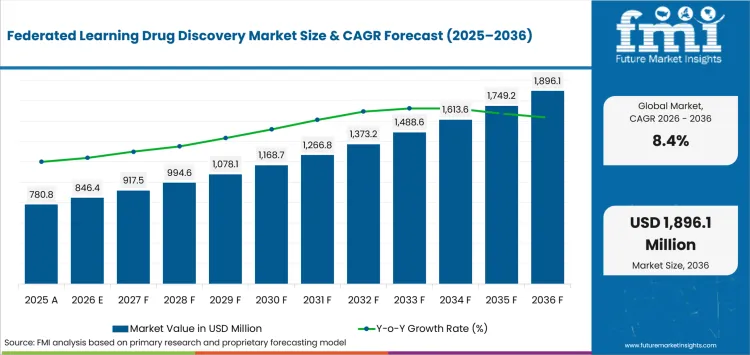
Key Takeaways of Federated Learning Drug Discovery Market
- Demand for federated learning in drug discovery is driven by pharmaceutical companies and research institutions seeking to improve shared models across proprietary chemistry, genomic, pathology, and patient records while each institution retains control over raw scientific data and local approval authority.
- By application, target identification holds the leading share at 31.1% in 2026, driven by the financial cost of weak early biological hypotheses on downstream assay design, medicinal chemistry, and later development priorities across portfolios.
- Cross-pharma federated networks lead the deployment model category at 33.2% share in 2026, attributable to discovery questions requiring greater chemical diversity than any single company can supply while protecting intellectual property across competing organizations.
- Oncology leads the therapeutic area category at 34.0% share in 2026, supported by the need to connect molecular signals with pathology and outcome data that remain fragmented across separate cancer centers, research networks, and pharmaceutical studies.
- Pharmaceutical companies account for 44.0% end-user share in 2026, owing to their control over proprietary discovery datasets and the enterprise budgets required for secure federated integration and local model validation.
- Japan, the United Kingdom, and the United States record CAGRs of 10.2%, 9.0%, and 8.2% respectively through 2036, shaped by public medical research programs, planned health-data investment, and pharmaceutical research scale alongside regulatory engagement with AI.
- Competition centers on Apheris, Owkin, and NVIDIA, with vendors differentiating through governed pharmaceutical network coordination, distributed patient-linked translational research workflows, and enterprise federated training infrastructure with local validation controls.
Analyst Perspective
"The long-term value of collaborative research networks is determined by data quality and scientific reproducibility rather than the number of participating institutions. Organizations are recognizing that standardized methodologies, comparable datasets, and consistent validation frameworks generate stronger development decisions than larger but fragmented collaborations. Companies that strengthen governance, data harmonization, and cross-institutional interoperability will establish a more durable competitive advantage."
- Anurag Sharma, Principal Analyst at Future Market Insights
How is the Federated Learning Drug Discovery Market segmented?
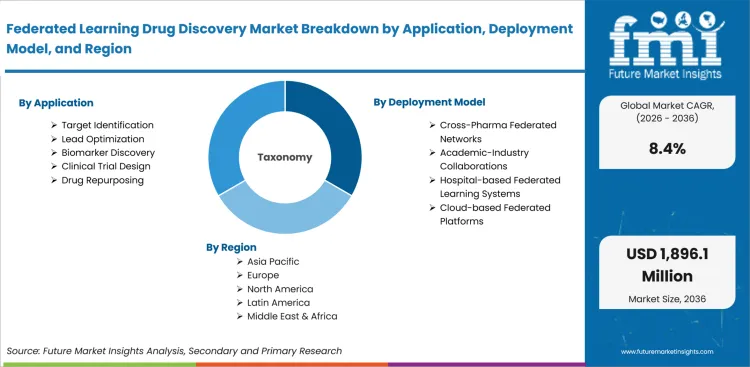
The market is segmented by Application, Deployment Model, Therapeutic Area, End User and Region.
The segmentation framework separates the scientific task from network design and the institution responsible for funding and governance. Application categories cover target identification, lead optimization, biomarker discovery, trial design and drug repurposing across the discovery cycle. Deployment models distinguish cross-pharma networks from academic partnerships, hospital systems and cloud platforms used for distributed research. Therapeutic-area categories identify research settings in which distributed evidence can support a specific development decision. End-user categories identify the budget owner and the organization accountable for local validation across each participating system. Regional analysis then tests how public data access and pharmaceutical research capacity affect network formation across countries. The framework connects with genomics research because federated models often need biological evidence that cannot move into one central repository.
How does target identification shape demand within the application category?
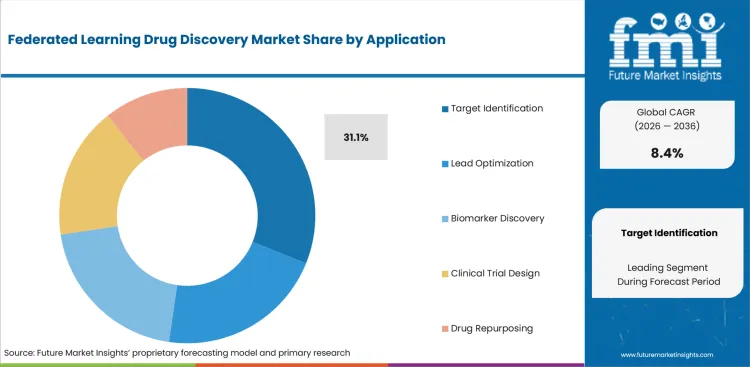
Target identification carries early portfolio risk because a weak biological hypothesis can direct years of chemistry toward the wrong mechanism. NVIDIA reported in October 2025 that federated training improved average protein-location prediction accuracy from 78.8% to 81.7%. The experiment examined subcellular localization, which links protein position with biological function and potential therapeutic targets. The result shows why distributed protein datasets can strengthen early biological decisions before medicinal chemistry expands.
- Based on Application, Target Identification is projected to account for 31.1% share in 2026, driven by the need to test biological hypotheses against evidence held by several research organizations. Its commercial position reflects the financial effect of early target choices on assay design, medicinal chemistry and later development priorities across portfolios.
- Pharmaceutical discovery teams use Target Identification networks to compare internal findings with complementary genomic, pathology and clinical evidence. The approach matters when a target appears credible in one dataset but remains uncertain across different populations or experimental systems. Related bioinformatics platforms provide the analytical layer needed to reconcile biological features before a shared model affects portfolio decisions.
What supports demand for cross-pharma federated networks within the deployment model category?
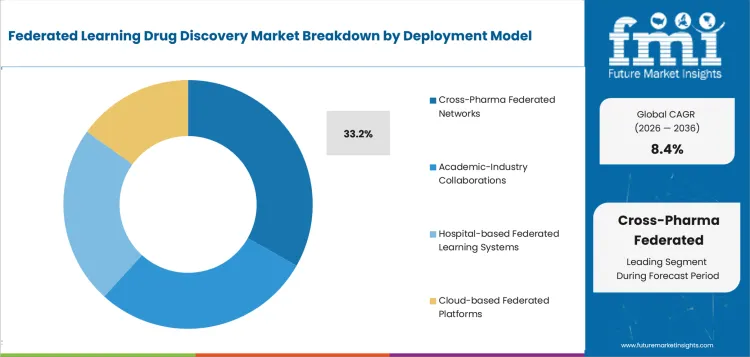
Cross-company networks address a clear data constraint because each pharmaceutical group owns structural or assay information that competitors cannot receive in raw form. Apheris announced in October 2025 that Astex Pharmaceuticals, Bristol Myers Squibb and Takeda joined AbbVie and Johnson & Johnson in the Federated OpenFold3 Initiative. Each participant contributes several thousand experimentally determined protein and small-molecule structures without transferring the underlying proprietary datasets.
- By Deployment Model, Cross-Pharma Federated Networks are estimated to hold 33.2% share in 2026, attributable to discovery questions that require more chemical diversity than one company can supply. The model protects intellectual property while creating a common training objective and a controlled process for evaluating shared model performance across multiple therapeutic programs.
- Medicinal chemistry and structural biology groups choose cross-pharma networks when public datasets fail to represent proprietary chemical space. Participation becomes easier to defend after model improvements are measured against local baselines and every company keeps final control over its own data. Complementary drug designing tools remain necessary because federated predictions still require experimental review and compound-level decision rules.
What makes oncology central to the therapeutic area category?
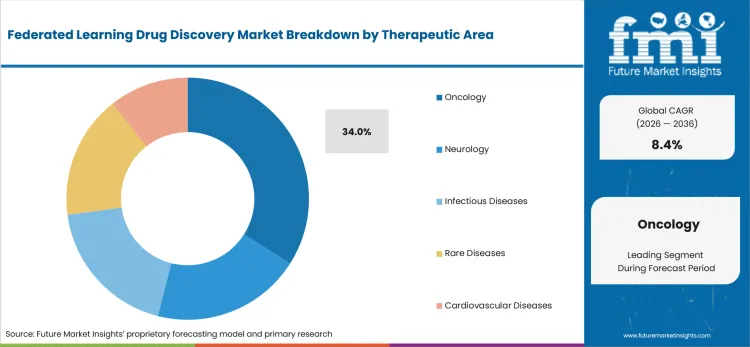
Oncology research combines pathology images with clinical variables that often remain inside separate cancer centers. Scientific Reports published a federated soft-tissue sarcoma study in October 2025 that trained on 611 patients across two centers and tested the model on 217 additional patients. The 828-patient design produced a five-year metastasis-free survival AUC of 0.797 during multicenter model cross-validation. The result shows how federated oncology models can use multicenter evidence when no single institution holds a sufficiently broad cohort.
- In 2026, Oncology is expected to lead the Therapeutic Area category with 34.0% share, supported by the need to connect molecular signals with pathology and outcome data across separate institutions. Oncology programs have enough evidence depth to support specialized models, but relevant records remain fragmented across hospitals, research networks and pharmaceutical studies.
- Cancer research groups use federated methods to test whether biomarkers remain informative across institutions serving different patient populations. Commercial value appears after distributed evidence reduces the risk of selecting a target or population that works in one cohort but fails elsewhere. The same requirement connects federated discovery with cancer diagnostics and later biomarker-guided development decisions across several clinical research sites.
How do pharmaceutical research organizations evaluate the pharmaceutical companies category?
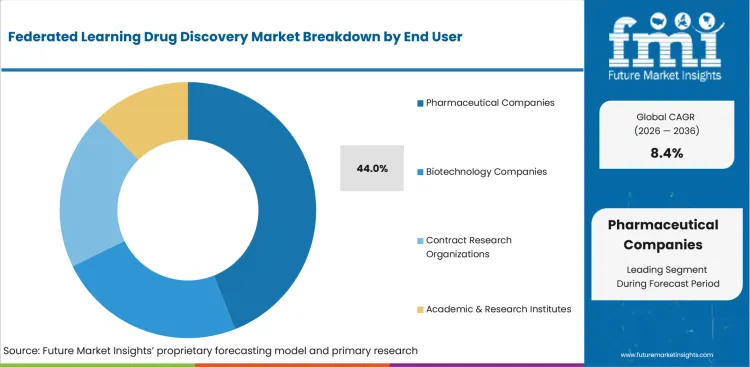
Pharmaceutical companies own assay histories, failed experiments and compound records that can make discovery models more useful in industrial research. Eli Lilly and Company reported in September 2025 that TuneLab gives biotechnology companies access to drug discovery models built through more than USD 1 billion in research investment. Federated learning lets participants use those models without directly exposing proprietary data, although every deployment still requires clear validation and ownership rules.
- By End User, Pharmaceutical Companies are forecast to represent 44.0% share in 2026, owing to their control over proprietary discovery datasets and the budgets needed for secure enterprise integration. Their participation determines whether a federated network receives enough data diversity to produce useful industrial models and repeatable research outcomes across programs.
- Research informatics leaders and therapeutic-area scientists compare federated platforms with internal security controls and established laboratory workflows. Purchase decisions depend on whether a system can document each model update and support local validation before results enter portfolio reviews. Demand overlaps with cloud-based drug discovery platforms but remains distinct because federated deployments preserve institutional boundaries across several data owners.
What are the drivers, restraints and opportunities in the Federated Learning Drug Discovery Market?
The market is projected to record an 8.4% CAGR from 2026 to 2036, supported by demand for usable proprietary data; governance and data incompatibility restrain network scale; repeatable cross-company models create a commercial opening for managed federated programs.
- Driver: Industrial drug discovery teams need model training data that reaches beyond public repositories without exposing confidential chemistry or patient records.
- Restraint: Cross-border data rules and inconsistent experimental methods can delay agreements even when the technical platform keeps raw records local.
- Opportunity: Managed networks can convert one-off collaborations into repeat programs for protein structure, ADMET, biomarkers and other discovery questions.
The transition of federated learning from experimental research frameworks to enterprise-ready pharmaceutical software is accelerating market expansion. Apheris launched ApherisFold in October 2025 for local deployment and federated customization of OpenFold3 and Boltz-2. The product lets research groups benchmark co-folding models against proprietary data without sending those records outside their systems. Commercial adoption improves after the platform fits existing validation and security procedures rather than creating a separate research environment.
Despite technological advances, the burden of navigating legal, governance, and operational requirements continues to constrain market growth. The European Health Data Space Regulation entered into force in March 2025 and began a staged transition toward common rules for health-data access and secondary use. Federated learning can reduce raw-data movement, but it does not remove requirements for lawful purpose, access control and accountable processing. Contracts take longer when participants lack aligned governance or cannot explain how local data influenced a shared model.
Demand for collaborative, privacy-preserving drug discovery initiatives is creating new opportunities for consortium-driven federated learning services. NVIDIA FLARE Day in September 2025 included a drug discovery session describing privacy-preserving data-diversity analysis across proprietary pharmaceutical datasets. Network operators can build recurring revenue by coordinating common benchmarks, security reviews and local validation across participating biopharma organizations. The opportunity extends into drug discovery services once scientific coordination becomes as important as software deployment.
Which country CAGRs are profiled in the Federated Learning Drug Discovery Market?
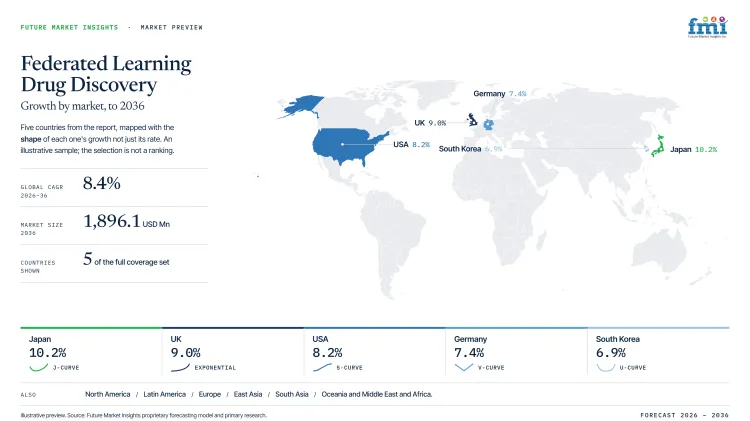
| Country | CAGR |
|---|---|
| USA | 8.2% |
| UK | 9.0% |
| Germany | 7.4% |
| Japan | 10.2% |
| South Korea | 6.9% |
How do country-level CAGRs compare in the Federated Learning Drug Discovery Market?
The country comparison spans 3.3 percentage points and shows a measured separation between adoption models. Japan and the UK form the upper group through public research programs and governed data access. The USA and Germany remain moderately aligned despite distinct pharmaceutical scale and national health-data environments. South Korea occupies a separate position owing to less commercially established multi-company governance arrangements.
- Japan directs agency funding toward AI discovery platforms that connect universities and domestic pharmaceutical research.
- UK programs emphasize consistent health-data access and auditable execution across NHS-linked research institutions and partner sites.
- The USA relies on pharmaceutical scale and regulatory engagement to validate models across proprietary datasets.
- Germany builds demand around secure health-data infrastructure and compliance with emerging European data rules.
- South Korea combines biotechnology capability with public AI investment but still needs clearer ownership arrangements.
Comparable CAGRs can mask different integration costs across chemistry systems and institutional approval processes. Vendors must match deployment timing with local governance maturity and clearly assigned model-validation responsibilities. The full report provides country-level CAGR analysis across North America, Latin America, Europe, East Asia, South Asia, Oceania and the Middle East and Africa.
- The United States combines substantial pharmaceutical research activity with an active regulatory discussion about AI evidence in drug development. By 2036, the country is projected to grow at 8.2% CAGR, shaped by the number of sponsors testing AI across discovery and development. The FDA reported in January 2025 that it had experience with more than 500 drug and biological product submissions containing AI components since 2016. The figure shows that regulatory reviewers already encounter AI-supported evidence, although experience does not guarantee acceptance of every model. Pharmaceutical research leaders therefore need systems that preserve model context, training records and local validation across each regulated use case. Platform selection depends on whether federated outputs can withstand scientific scrutiny and explain how each participating dataset affected model performance.
- The United Kingdom is building a national route for researchers to use health data under consistent access rules, and multi-institution AI programs give local partners a common direction for secure use. Federated learning drug discovery demand in the UK is forecast to rise at 9.0% CAGR between 2026 and 2036, reinforced by health-data and biomedical AI collaboration. Owkin’s ATLANTIS program spans 20 healthcare institutions across seven countries and 11 therapeutic areas, including UK hospital partners in a transatlantic network. Pharmaceutical companies and NHS-linked research centers can use that foundation to build governed discovery datasets across several institutions. Commercial progress depends on platforms that connect institutional approvals with reproducible model execution across separate environments.
- Germany is connecting national health-data infrastructure with research access and rules for secure AI testing. Adoption of federated learning drug discovery in Germany is estimated to expand at 7.4% CAGR through 2036, underpinned by the Health Data Lab and European data-space implementation. The Federal Ministry of Health stated in February 2026 that no fewer than 300 research projects would be conducted or initiated using Health Data Lab data by the end of 2026. German pharmaceutical and academic groups still need clear legal roles before distributed records support shared models. Investment decisions favor platforms that document data location, participant authority and each model update across the network.
- Japan is pairing public medical research funding with a policy direction that includes AI drug discovery. AMED reported in March 2025 that one project was selected from two applications for its industry-academia drug discovery AI platform program. The Japanese sector is projected to record 10.2% CAGR during the forecast period, led by agency programs that connect digital methods with biomedical research. The selected project focuses on a generative AI and simulation-based drug discovery platform led by Kyoto University. Japanese pharmaceutical companies need deployments that fit domestic governance requirements and public funding terms across participating research sites. The commercial opening is concentrated in networks that connect national programs with internal discovery systems without forcing raw-data transfer.
- South Korea has the computing ambition and biotechnology base needed for distributed research, although cross-company governance remains an early commercial test. In South Korea, demand is predicted to advance at 6.9% CAGR by 2036, aided by public investment and planned AI biotechnology models that include drug discovery. Federated drug discovery adoption is more likely where operators can show measurable model gains; NVIDIA reported that federated training improved average protein-location prediction accuracy from 78.8% to 81.7% while keeping raw data local. Biotechnology companies can use national AI capacity for secure multi-party modeling, but network operators must prove interoperability with local systems. Procurement decisions concentrate on deployments that limit integration work and define ownership of model outputs across every participating institution.
Who are the notable companies in the Federated Learning Drug Discovery Market?
Companies active in federated learning for drug discovery include Apheris, Owkin, NVIDIA, Eli Lilly and Company, AbbVie, Johnson & Johnson, Bristol Myers Squibb and Takeda.
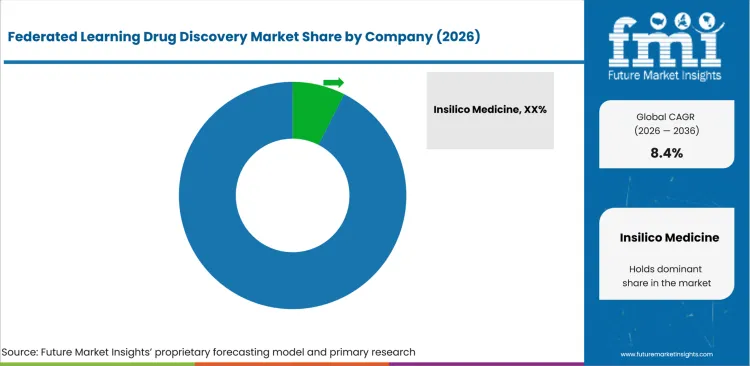
Competition does not follow a conventional software hierarchy because the organization operating the network may not own the data or the drug program. Apheris and NVIDIA focus on federated infrastructure, while Owkin connects distributed biomedical data with discovery and development workflows. Pharmaceutical companies contribute the proprietary evidence that determines whether a shared model has industrial relevance. Enterprise contracts depend on scientific governance, platform security and a clear division of model ownership across participants. The field overlaps with personalized medicine because patient variation can make multi-institution evidence necessary for target and biomarker decisions. Similar governance requirements extend into AI-based clinical trial solutions once distributed patient data enters development planning.
- Apheris focuses on network operation and local deployment controls that let pharmaceutical companies contribute data without transferring ownership. The company fits collaborations that require common model training, protected execution and company-specific validation across separate research environments and several discovery programs.
- Owkin competes through distributed patient-data partnerships and research workflows that connect biological evidence with target and biomarker decisions. Its position depends on maintaining institutional participation and showing that models remain useful across hospitals serving different patient populations and therapeutic programs.
- NVIDIA competes through FLARE orchestration and accelerated life-science model infrastructure that can operate inside enterprise computing environments. Each drug discovery program still requires domain validation and agreements covering data contribution, model ownership, permitted use and local review across regulated enterprise settings.
- Eli Lilly and Company, AbbVie, Johnson & Johnson, Bristol Myers Squibb and Takeda shape competition as pharmaceutical model or data contributors. Their participation increases network value and creates demanding requirements for security, integration, scientific benchmarking, local validation and evidence governance during repeated shared-model programs.
Competitive Benchmarking: Federated Learning Drug Discovery Market
| Company | Federated Orchestration | Proprietary Data Contribution | Workflow Integration | Enterprise Deployment | Geographic Reach |
|---|---|---|---|---|---|
| Apheris | High | Low | High | High | Europe and cross-border pharmaceutical networks |
| Owkin | High | Medium | High | High | Europe and North America |
| NVIDIA | High | Low | High | High | Global |
| Eli Lilly and Company | Medium | High | High | High | Global |
| AbbVie | Low | High | Medium | Medium | Global |
| Johnson & Johnson | Low | High | Medium | Medium | Global |
| Bristol Myers Squibb | Low | High | Medium | Medium | Global |
| Takeda | Low | High | Medium | Medium | Asia, North America and Europe |
Key Developments in the Federated Learning Drug Discovery Market
- In February 2025, Owkin launched ATLANTIS to map multimodal patient data across 20 healthcare institutions in seven countries and eleven therapeutic areas. The program prepares distributed hospital datasets for AI research by clarifying available records, harmonization needs and governance boundaries before model development begins. Its market relevance comes from creating a repeatable discovery layer that helps participating institutions understand usable evidence without moving every source into one repository.
- In March 2025, Apheris announced that OpenFold3 would be fine-tuned with proprietary structural data from AbbVie and Johnson & Johnson in a secure federated environment. The program examines protein-small molecule and antibody-antigen interactions across confidential pharmaceutical datasets contributed by the participating companies. It shows how data owners can improve a shared discovery model while records remain inside source systems and each participant retains control over access.
- In July 2025, Owkin and Newcastle upon Tyne Hospitals NHS Foundation Trust announced a five-year AI partnership covering medical discovery, development and diagnostics. Newcastle joined ATLANTIS, a program connecting 20 hospitals across seven countries for governed multimodal data discovery. The agreement extends Owkin’s distributed patient-data network and gives the hospital a structured route to support oncology research without treating institutional records as a conventional centralized dataset.
- In February 2026, Apheris launched the ADMET Network for pharmaceutical companies to train absorption, distribution, metabolism, excretion and toxicity models across proprietary datasets. The network began with several pharmaceutical and biotechnology members and focused first on small molecules for initial programs. Federated models train across the network and undergo local fine-tuning under participant-specific controls in each company environment. Each company retains authority over its data, intellectual property and private model outputs throughout the program.
Key Players in the Federated Learning Drug Discovery Market
Federated Infrastructure and Network Operators
- Apheris
- Owkin
- NVIDIA
Pharmaceutical Model and Data Contributors
- Eli Lilly and Company
- AbbVie
- Johnson & Johnson
- Bristol Myers Squibb
- Takeda
Federated Learning Drug Discovery Market - Report Scope
| Coverage field | Report scope |
|---|---|
| Market breakdown | Application, Deployment Model, Therapeutic Area, End User and Region. |
| Market Definition | Software and managed services that train, validate, or operate drug discovery models across separate data owners without centralizing raw proprietary data. |
| Regions Covered | North America, Latin America, Europe, East Asia, South Asia, Oceania and Middle East and Africa. |
| Countries Covered | USA, UK, Germany, Japan, South Korea and countries within the regional model. |
| Key Companies Profiled | Apheris, Owkin, NVIDIA, Eli Lilly and Company, AbbVie, Johnson & Johnson, Bristol Myers Squibb and Takeda. |
| Forecast Period | 2026 to 2036. |
| Approach | Hybrid bottom-up and top-down market sizing supported by primary interviews and official desk research. |
Federated Learning Drug Discovery Market - Research Methodology
| Method | Approach |
|---|---|
| Primary Research | FMI analysts gathered input from manufacturers, service providers, technology developers, distributors, end users, procurement teams and subject-matter experts. Interviews examined purchasing decisions, product or service evaluation, adoption barriers, approval requirements, pricing considerations and expectations for technical or commercial support. Respondents were also asked what evidence is required before a trial, pilot, or initial order develops into regular purchasing. |
| Desk Research | Desk research covered government statistics, regulatory publications, trade data, industry associations, technical literature, standards, company filings, product information and official corporate announcements. Sources were reviewed for relevance, publication date, geographic coverage and consistency with the defined market scope. Claims relating to performance, applications, approvals, capacity, investment and commercial activity were retained only when supported by credible public evidence. |
| Market Sizing and Forecasting | The market model combined the baseline value with historical performance, segment structure, pricing and volume indicators, adoption levels, company participation and country-level demand conditions. Forecast assumptions considered economic activity, investment trends, regulatory developments, technology adoption, purchasing cycles, supply availability and barriers to wider market use. Segment and regional estimates were reconciled before the final market total was calculated. |
| Data Validation | Estimates were checked against multiple independent indicators, including public data, company activity, trade patterns, industry developments and findings from primary interviews. Validation also tested whether products, services, applications and company revenues fell within the defined market boundaries. Adjacent categories, unsupported claims, overlapping revenues and activities without direct market relevance were excluded to reduce double counting and maintain consistency across segments and countries. |
Federated Learning Drug Discovery Market by Segments
Application:
- Target Identification
- Lead Optimization
- Biomarker Discovery
- Clinical Trial Design
- Drug Repurposing
Deployment Model:
- Cross-Pharma Federated Networks
- Academic-Industry Collaborations
- Hospital-based Federated Learning Systems
- Cloud-based Federated Platforms
Therapeutic Area:
- Oncology
- Neurology
- Infectious Diseases
- Rare Diseases
- Cardiovascular Diseases
End User:
- Pharmaceutical Companies
- Biotechnology Companies
- Contract Research Organizations
- Academic and Research Institutes
Federated Learning Drug Discovery Market by Region:
- North America
- USA
- Canada
- Latin America
- Brazil
- Mexico
- Argentina
- Europe
- UK
- Germany
- France
- Italy
- Spain
- Benelux
- Nordics
- East Asia
- Japan
- South Korea
- China
- South Asia
- India
- ASEAN
- Oceania
- Australia
- New Zealand
- Middle East and Africa
- GCC Countries
- South Africa
- Israel
- Rest of Middle East and Africa
Research Sources and Bibliography
- Hanser, T., et al. (March 5, 2025).
- NVIDIA. (October 8, 2025).
- Apheris. (October 1, 2025).
- Maussion, C., et al. (October 21, 2025).
- Eli Lilly and Company. (September 9, 2025).
- Apheris. (October 28, 2025).
- European Commission. (March 5, 2025).
- NVIDIA. (September 2025).
- USA Food and Drug Administration. (January 6, 2025).
- UK Government. (July 16, 2025).
- German Federal Ministry of Health. (February 2026).
- Japan Agency for Medical Research and Development. (March 21, 2025).
- Ministry of Science and ICT, Republic of Korea. (December 2025).
- Owkin. (February 27, 2025).
- Apheris. (March 27, 2025).
- Owkin. (July 3, 2025).
- Apheris. (February 25, 2026).
This bibliography is provided for reader reference and is not exhaustive. The full report contains the complete reference list and detailed citations.
This Report Answers
- How large is the federated learning drug discovery market in 2026 and 2036?
- Which discovery application accounts for the stated 2026 share?
- Why do cross-pharma networks hold the stated deployment share?
- How does oncology data fragmentation affect federated model design?
- What governance controls matter before proprietary data enters a collaborative workflow?
- How do the five profiled country CAGRs compare through 2036?
- Which companies operate networks or contribute proprietary discovery data?
- What separates federated orchestration from conventional cloud-based discovery software?
- Which company developments support commercial adoption after January 2025?
- What technical and legal factors can reduce return on a federated discovery program?
Frequently Asked Questions
How big is the Federated Learning Drug Discovery Market in 2026?
The federated learning drug discovery market is valued at USD 846.4 million in 2026 and is forecast to reach USD 1896.1 million by 2036. Growth reflects increasing adoption of privacy-preserving AI collaboration, broader pharmaceutical research networks, and demand for secure model training across distributed proprietary datasets.
What is the CAGR of the Federated Learning Drug Discovery Market from 2026 to 2036?
The federated learning drug discovery market is projected to grow at a CAGR of 8.4% between 2026 and 2036, supported by expanding cross-company AI research, governed data-sharing frameworks, and demand for collaborative drug discovery without transferring proprietary data.
Which application leads the Federated Learning Drug Discovery Market?
Target Identification accounts for 31.1% of the federated learning drug discovery market by application in 2026, reflecting the need to validate biological targets across distributed genomic, pathology, and clinical datasets before advancing drug discovery programs.
How much will the Federated Learning Drug Discovery Market add between 2026 and 2036?
The federated learning drug discovery market is set to add USD 1,049.7 million between 2026 and 2036, growing from USD 846.4 million to USD 1896.1 million as pharmaceutical companies and research institutions expand secure federated AI networks for collaborative drug discovery.
Who are the leading companies in the Federated Learning Drug Discovery Market?
Leading companies in the federated learning drug discovery market include Apheris, Owkin, NVIDIA, Eli Lilly and Company, AbbVie, Johnson & Johnson, Bristol Myers Squibb, and Takeda, competing through federated AI platforms, distributed research networks, enterprise infrastructure, and proprietary pharmaceutical data contributions.
Preview the report firsthand - request a free sample
Get SampleGet the brochure for pricing and purchase details.
Get PDFTable of Content
- Key Takeaways
- Market Size and CAGR
- Top Growth Driver
- Fastest Growing Segment
- Leading Region
- Key Companies
- Emerging Opportunities
- Executive Summary
- Global Market Outlook
- Demand-side Trends
- Supply-side Trends
- Technology Roadmap Analysis
- Analysis and Recommendations
- Analyst Perspective (What is happening? Why now? What should investors know?)
- Key Questions Answered
- How large is the market?
- What is the CAGR?
- What are key trends?
- Which region dominates?
- Who are the leaders?
- Market Overview
- Market Coverage / Taxonomy
- Market Definition / Scope / Limitations
- Research Methodology
- Chapter Orientation
- Analytical Lens and Working Hypotheses
- Market Structure, Signals, and Trend Drivers
- Benchmarking and Cross-market Comparability
- Market Sizing, Forecasting, and Opportunity Mapping
- Research Design and Evidence Framework
- Desk Research Programme (Secondary Evidence)
- Expert Input and Fieldwork (Primary Evidence)
- Tooling, Models, and Reference Databases
- Data Engineering and Model Build
- Quality Assurance and Audit Trail
- Market Background
- Market Dynamics (Drivers, Restraints, Opportunity, Trends)
- Scenario Forecast (Optimistic, Likely, Conservative)
- Impact Analysis
- AI Impact
- Sustainability Impact
- Regulatory Impact
- Technology Impact
- Consumer / Buyer Analysis
- Purchase Drivers
- Adoption Barriers
- Buyer Journey
- Opportunity Map Analysis
- Product Life Cycle Analysis
- Supply Chain Analysis
- Investment Feasibility Matrix
- Value Chain Analysis
- PESTLE and Porter's Analysis
- Regulatory Landscape
- Regional Parent Market Outlook
- Production and Consumption Statistics
- Import and Export Statistics
- Global Market Analysis and Forecast, 2021 to 2036
- Historical Market Size Value (USD Million) Analysis, 2021 to 2025
- Current and Future Market Size Value (USD Million) Projections, 2026 to 2036
- Y-o-Y Growth Trend Analysis
- Absolute $ Opportunity Analysis
- Global Market Pricing Analysis, 2021 to 2036
- Global Market Analysis and Forecast, By Application, 2021 to 2036
- Introduction / Key Findings
- Historical Market Size Value (USD Million) Analysis By Application, 2021 to 2025
- Current and Future Market Size Value (USD Million) Analysis and Forecast By Application, 2026 to 2036
- Target Identification
- Lead Optimization
- Biomarker Discovery
- Clinical Trial Design
- Drug Repurposing
- Target Identification
- Y-o-Y Growth Trend Analysis By Application, 2021 to 2025
- Absolute $ Opportunity Analysis By Application, 2026 to 2036
- Global Market Analysis and Forecast, By Deployment Model, 2021 to 2036
- Introduction / Key Findings
- Historical Market Size Value (USD Million) Analysis By Deployment Model, 2021 to 2025
- Current and Future Market Size Value (USD Million) Analysis and Forecast By Deployment Model, 2026 to 2036
- Cross-Pharma Federated Networks
- Academic-Industry Collaborations
- Hospital-based Federated Learning Systems
- Cloud-based Federated Platforms
- Cross-Pharma Federated Networks
- Y-o-Y Growth Trend Analysis By Deployment Model, 2021 to 2025
- Absolute $ Opportunity Analysis By Deployment Model, 2026 to 2036
- Global Market Analysis and Forecast, By Therapeutic Area, 2021 to 2036
- Introduction / Key Findings
- Historical Market Size Value (USD Million) Analysis By Therapeutic Area, 2021 to 2025
- Current and Future Market Size Value (USD Million) Analysis and Forecast By Therapeutic Area, 2026 to 2036
- Oncology
- Neurology
- Infectious Diseases
- Rare Diseases
- Cardiovascular Diseases
- Oncology
- Y-o-Y Growth Trend Analysis By Therapeutic Area, 2021 to 2025
- Absolute $ Opportunity Analysis By Therapeutic Area, 2026 to 2036
- Global Market Analysis and Forecast, By End User, 2021 to 2036
- Introduction / Key Findings
- Historical Market Size Value (USD Million) Analysis By End User, 2021 to 2025
- Current and Future Market Size Value (USD Million) Analysis and Forecast By End User, 2026 to 2036
- Pharmaceutical Companies
- Biotechnology Companies
- Contract Research Organizations
- Academic & Research Institutes
- Pharmaceutical Companies
- Y-o-Y Growth Trend Analysis By End User, 2021 to 2025
- Absolute $ Opportunity Analysis By End User, 2026 to 2036
- Global Market Analysis and Forecast, By Region, 2021 to 2036
- Introduction
- Historical Market Size Value (USD Million) Analysis By Region, 2021 to 2025
- Current Market Size Value (USD Million) Analysis and Forecast By Region, 2026 to 2036
- North America
- Latin America
- Western Europe
- Eastern Europe
- East Asia
- South Asia and Pacific
- Middle East & Africa
- Market Attractiveness Analysis By Region
- North America Market Analysis and Forecast, By Country, 2021 to 2036
- Historical Market Size Value (USD Million) Trend Analysis By Market Taxonomy, 2021 to 2025
- Market Size Value (USD Million) Forecast By Market Taxonomy, 2026 to 2036
- By Country
- USA
- Canada
- By Application
- By Deployment Model
- By Therapeutic Area
- By End User
- By Country
- Market Attractiveness Analysis
- By Country
- By Application
- By Deployment Model
- By Therapeutic Area
- By End User
- Key Takeaways
- Latin America Market Analysis and Forecast, By Country
- Historical Market Size Value (USD Million) Trend Analysis By Market Taxonomy, 2021 to 2025
- Market Size Value (USD Million) Forecast By Market Taxonomy, 2026 to 2036
- By Country
- Brazil
- Mexico
- Chile
- Rest of Latin America
- By Application
- By Deployment Model
- By Therapeutic Area
- By End User
- By Country
- Market Attractiveness Analysis
- By Country
- By Application
- By Deployment Model
- By Therapeutic Area
- By End User
- Key Takeaways
- Western Europe Market Analysis and Forecast, By Country
- Historical Market Size Value (USD Million) Trend Analysis By Market Taxonomy, 2021 to 2025
- Market Size Value (USD Million) Forecast By Market Taxonomy, 2026 to 2036
- By Country
- Germany
- UK
- Italy
- Spain
- France
- Nordic
- BENELUX
- Rest of Western Europe
- By Application
- By Deployment Model
- By Therapeutic Area
- By End User
- By Country
- Market Attractiveness Analysis
- By Country
- By Application
- By Deployment Model
- By Therapeutic Area
- By End User
- Key Takeaways
- Eastern Europe Market Analysis and Forecast, By Country
- Historical Market Size Value (USD Million) Trend Analysis By Market Taxonomy, 2021 to 2025
- Market Size Value (USD Million) Forecast By Market Taxonomy, 2026 to 2036
- By Country
- Russia
- Poland
- Hungary
- Balkan & Baltic
- Rest of Eastern Europe
- By Application
- By Deployment Model
- By Therapeutic Area
- By End User
- By Country
- Market Attractiveness Analysis
- By Country
- By Application
- By Deployment Model
- By Therapeutic Area
- By End User
- Key Takeaways
- East Asia Market Analysis and Forecast, By Country
- Historical Market Size Value (USD Million) Trend Analysis By Market Taxonomy, 2021 to 2025
- Market Size Value (USD Million) Forecast By Market Taxonomy, 2026 to 2036
- By Country
- China
- Japan
- South Korea
- By Application
- By Deployment Model
- By Therapeutic Area
- By End User
- By Country
- Market Attractiveness Analysis
- By Country
- By Application
- By Deployment Model
- By Therapeutic Area
- By End User
- Key Takeaways
- South Asia and Pacific Market Analysis and Forecast, By Country
- Historical Market Size Value (USD Million) Trend Analysis By Market Taxonomy, 2021 to 2025
- Market Size Value (USD Million) Forecast By Market Taxonomy, 2026 to 2036
- By Country
- India
- ASEAN
- Australia & New Zealand
- Rest of South Asia and Pacific
- By Application
- By Deployment Model
- By Therapeutic Area
- By End User
- By Country
- Market Attractiveness Analysis
- By Country
- By Application
- By Deployment Model
- By Therapeutic Area
- By End User
- Key Takeaways
- Middle East & Africa Market Analysis and Forecast, By Country
- Historical Market Size Value (USD Million) Trend Analysis By Market Taxonomy, 2021 to 2025
- Market Size Value (USD Million) Forecast By Market Taxonomy, 2026 to 2036
- By Country
- Kingdom of Saudi Arabia
- Other GCC Countries
- Türkiye
- South Africa
- Other African Union
- Rest of Middle East & Africa
- By Application
- By Deployment Model
- By Therapeutic Area
- By End User
- By Country
- Market Attractiveness Analysis
- By Country
- By Application
- By Deployment Model
- By Therapeutic Area
- By End User
- Key Takeaways
- Key Countries Market Analysis
- USA
- Pricing Analysis
- Market Share Analysis, 2025
- By Application
- By Deployment Model
- By Therapeutic Area
- By End User
- Canada
- Pricing Analysis
- Market Share Analysis, 2025
- By Application
- By Deployment Model
- By Therapeutic Area
- By End User
- Mexico
- Pricing Analysis
- Market Share Analysis, 2025
- By Application
- By Deployment Model
- By Therapeutic Area
- By End User
- Brazil
- Pricing Analysis
- Market Share Analysis, 2025
- By Application
- By Deployment Model
- By Therapeutic Area
- By End User
- Chile
- Pricing Analysis
- Market Share Analysis, 2025
- By Application
- By Deployment Model
- By Therapeutic Area
- By End User
- Germany
- Pricing Analysis
- Market Share Analysis, 2025
- By Application
- By Deployment Model
- By Therapeutic Area
- By End User
- UK
- Pricing Analysis
- Market Share Analysis, 2025
- By Application
- By Deployment Model
- By Therapeutic Area
- By End User
- Italy
- Pricing Analysis
- Market Share Analysis, 2025
- By Application
- By Deployment Model
- By Therapeutic Area
- By End User
- Spain
- Pricing Analysis
- Market Share Analysis, 2025
- By Application
- By Deployment Model
- By Therapeutic Area
- By End User
- France
- Pricing Analysis
- Market Share Analysis, 2025
- By Application
- By Deployment Model
- By Therapeutic Area
- By End User
- India
- Pricing Analysis
- Market Share Analysis, 2025
- By Application
- By Deployment Model
- By Therapeutic Area
- By End User
- ASEAN
- Pricing Analysis
- Market Share Analysis, 2025
- By Application
- By Deployment Model
- By Therapeutic Area
- By End User
- Australia & New Zealand
- Pricing Analysis
- Market Share Analysis, 2025
- By Application
- By Deployment Model
- By Therapeutic Area
- By End User
- China
- Pricing Analysis
- Market Share Analysis, 2025
- By Application
- By Deployment Model
- By Therapeutic Area
- By End User
- Japan
- Pricing Analysis
- Market Share Analysis, 2025
- By Application
- By Deployment Model
- By Therapeutic Area
- By End User
- South Korea
- Pricing Analysis
- Market Share Analysis, 2025
- By Application
- By Deployment Model
- By Therapeutic Area
- By End User
- Russia
- Pricing Analysis
- Market Share Analysis, 2025
- By Application
- By Deployment Model
- By Therapeutic Area
- By End User
- Poland
- Pricing Analysis
- Market Share Analysis, 2025
- By Application
- By Deployment Model
- By Therapeutic Area
- By End User
- Hungary
- Pricing Analysis
- Market Share Analysis, 2025
- By Application
- By Deployment Model
- By Therapeutic Area
- By End User
- Kingdom of Saudi Arabia
- Pricing Analysis
- Market Share Analysis, 2025
- By Application
- By Deployment Model
- By Therapeutic Area
- By End User
- Türkiye
- Pricing Analysis
- Market Share Analysis, 2025
- By Application
- By Deployment Model
- By Therapeutic Area
- By End User
- South Africa
- Pricing Analysis
- Market Share Analysis, 2025
- By Application
- By Deployment Model
- By Therapeutic Area
- By End User
- USA
- Market Structure Analysis
- Competition Dashboard
- Competition Benchmarking
- Market Share Analysis of Top Players
- By Regional
- By Application
- By Deployment Model
- By Therapeutic Area
- By End User
- Emerging Startups
- Innovation Benchmarking
- Competition Analysis
- Competition Deep Dive
- Insilico Medicine
- Overview
- Product Portfolio
- Profitability by Market Segments
- Sales Footprint
- Strategy Overview
- Marketing Strategy
- Product Strategy
- Channel Strategy
- Owkin
- NVIDIA
- BenevolentAI
- Exscientia
- Roche
- Atomwise
- Unlearn.AI
- Apheris
- Iktos
- Insilico Medicine
- Case Studies
- Success Stories
- Recent Developments
- Competition Deep Dive
- Assumptions & Acronyms Used


