

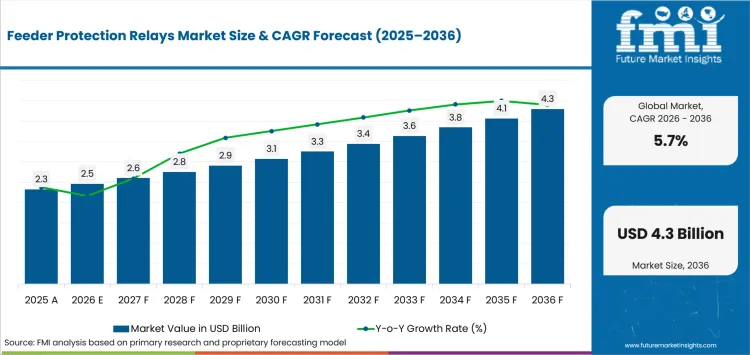
- Market Size (2026)
- USD 2.5 Bn
- Forecast (2036)
- USD 4.3 Bn
- CAGR (2026 to 2036)
- 5.7%
How big is Feeder Protection Relays Market in 2026?
USD 2.5 billion in 2026 and USD 4.3 billion by 2036 at a 5.7% CAGR.
Demand for feeder protection relays is projected to expand at 5.7% CAGR from 2026 to 2036, reaching USD 4.3 billion from USD 2.5 billion. Automated feeder switching repeatedly changes network configuration and forces engineers to revise protection settings. IEEE Power & Energy Society documented that relationship in May 2025 for distribution automation applications. Configurable numerical relays therefore gain specification value where utilities expect switching states to change during service.
New distribution substations create repeated relay specifications because every feeder position requires coordinated fault isolation and control. DEWA stated in May 2026 that it commissioned 1,994 new 11kV substations during 2025. Those additions enlarged Dubai's medium-voltage installed base and increased the feeders that will eventually require protection renewal.
Key Takeaways of Feeder Protection Relays Market
- Distribution automation increases feeder-protection spending because changing network configurations require settings that coordinate automated switching with fault isolation.
- By relay type, numerical feeder relays are estimated to hold 34.0% in 2026 owing to configurable functions that replace several fixed-purpose protection devices.
- In 2026, low voltage is expected to lead voltage class with 17.0% share because factories and data centers contain numerous protected outgoing circuits.
- IEC 61850 is set to lead communication with 31.0% share in 2026 due to standardized data models that reduce proprietary integration work.
- Brownfield replacement can slow because settings migration and interoperability testing require engineering review before utilities can approve another relay family.
- Some of the key players in this market include ABB, Siemens, Schneider Electric, GE Vernova, Eaton, SEL, Toshiba, Mitsubishi Electric, Hitachi Energy, and Littelfuse.
Analyst Perspective
"Feeder relay economics are determined during replacement engineering rather than at the device quotation stage. Platforms earn repeat fleet orders when settings transfer and IEC 61850 testing shorten planned outages without weakening protection selectivity."
- Nikhil Kaitwade, Principal Consultant, Future Market Insights
How is the Feeder Protection Relays Market segmented?
The feeder protection relays market is segmented by relay type, voltage class, communication, end use and sales channel.
Relay type separates numerical and dedicated protection designs, while voltage class distinguishes low-voltage circuits from utility distribution and substation applications. Communication options include IEC 61850, Modbus, DNP3, PROFINET/Ethernet, and standalone configurations for legacy or isolated feeder applications. End uses and sales channels separate utility, industrial, OEM, integrator, direct, and distributor routes.
Why do numerical feeder relays lead demand within the relay type category?
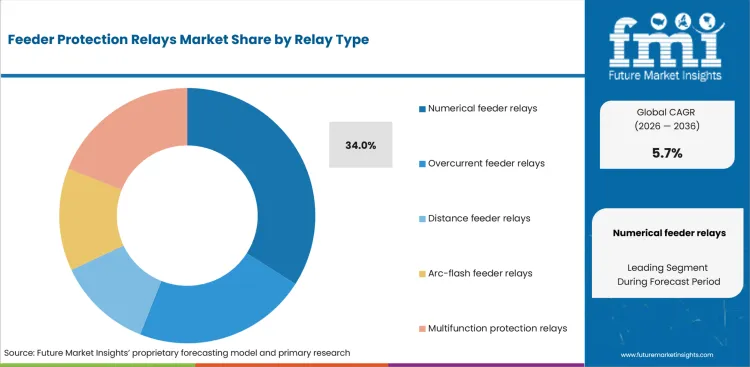
Changing feeder topology favors numerical relays that place several protection functions and event records inside one configurable device. ABB introduced Relion REC615 in May 2025 as one of its protective relay platforms for feeder protection and automated fault isolation.
- By relay type, numerical feeder relays are estimated to hold 34.0% in 2026 owing to configurable functions that consolidate several protection tasks inside one device.
- Protection engineers can revise numerical settings after topology changes without replacing relay hardware, which reduces equipment changes during later feeder reconfiguration.
Why does low voltage hold the stated position within the voltage class category?
Low-voltage switchboards can place many protected circuits inside one factory or data-center electrical room, making compact relays important beside existing switchgear assemblies.
- By voltage class, low voltage is forecast to represent 17.0% in 2026 driven by numerous protected feeder positions in industrial and commercial electrical systems.
- Panel density determines whether a relay family fits an OEM's repeatable switchboard design without enclosure changes. Eaton announced a Virginia manufacturing campus in December 2025 for critical power distribution technologies serving data-center customers. Compact feeder layouts reduce redesign inside assembled low-voltage equipment before factory acceptance testing begins there.
Why does IEC 61850 lead demand within the communication category?
IEC 61850 gives protection engineers a common data model for relay status and time-critical control messages in digital substation projects. Multi-vendor systems still require conformance testing because standardized naming does not guarantee correct application behavior.
- Within communication, IEC 61850 is projected to account for 31.0% in 2026 attributable to standardized engineering and interoperable protection-data exchange. IEC published Amendment 1 to IEC 61850-10 in July 2025 to update conformance testing for those interfaces.
- Project teams use structured device models and GOOSE messaging to reduce custom point mapping before application-specific acceptance testing begins.
What supports utilities as the principal end use for feeder protection relays?
Utilities coordinate feeder protection over large fleets where one settings error can disturb selectivity beyond a single panel. The Department of Energy documented an April 2025 Albany project replacing obsolete electromechanical relays at three substations and installing feeder automation through distribution automation systems.
- The utilities segment is likely to capture 36.0% share in 2026 attributable to repeated feeder-protection requirements over large distribution and substation fleets.
- Utility relay choices must coordinate fault selectivity with remote switching and event retrieval before engineers standardize devices for another feeder fleet.
Why do electrical OEMs hold the stated position within the sales channel category?
Electrical OEMs influence relay selection before assembled switchgear reaches site because factory engineering fixes terminal arrangements and circuit breaker coordination.
- Based on sales channel, electrical OEMs are projected to account for 37.0% in 2026 due to panel engineering that fixes relay interfaces before shipment.
- Factory integration gains value when relay settings and breakers must pass coordinated testing before shipment. A December 2025 Department of Energy project specifies relays and reclosers as coordinated fault-isolation equipment. That requirement keeps protection logic inside factory acceptance work instead of shifting unresolved coordination to the installation site.
What are the drivers, restraints and opportunities in the Feeder Protection Relays Market?
Distribution automation raises protection requirements, engineering validation can delay brownfield projects and retrofit-compatible relay platforms improve replacement economics.
- Driver: Automated switching and distributed energy alter feeder power flows, which raises demand for configurable directional protection and communications-assisted schemes.
- Restraint: Brownfield projects slow because settings migration and interoperability testing can exceed the engineering time available during planned outage windows.
- Opportunity: Retrofit-compatible relay platforms can turn aging protection fleets into planned replacement programs with less panel rewiring and repeated engineering work.
Distribution automation changes the protection job
Distributed resources can reverse feeder power direction and alter fault-current behavior during normal network switching. The Department of Energy stated in January 2025 that some DER interconnections require directional overcurrent elements and communications-assisted protection. Protection engineers therefore need relay settings that coordinate automated switching with changing power flows, which gives substation automation integration a direct role in feeder protection design.
Testing and settings migration extend brownfield schedules
Connected relays add conformance work to brownfield substation replacement programs that previously centered on settings and breaker timing. IEC published digital protection interface tests in August 2025 for sampled values and GOOSE messaging. Existing substations must verify communication behavior beside protection settings before operational acceptance, so testing effort can exceed a planned outage window without careful project staging during commissioning.
Retrofit-compatible designs improve replacement economics
Aging relay fleets favor designs that preserve panel interfaces because rewiring can dominate labor during short outage windows at utility-owned distribution substations. The Department of Energy documented an October 2025 project replacing three relay breakers at one substation. Retrofit-compatible hardware can reduce wiring changes before owners schedule similar feeder upgrades, making installed-base replacement more repeatable than emergency one-off replacement work.
Which country CAGRs are covered in the Feeder Protection Relays Market?
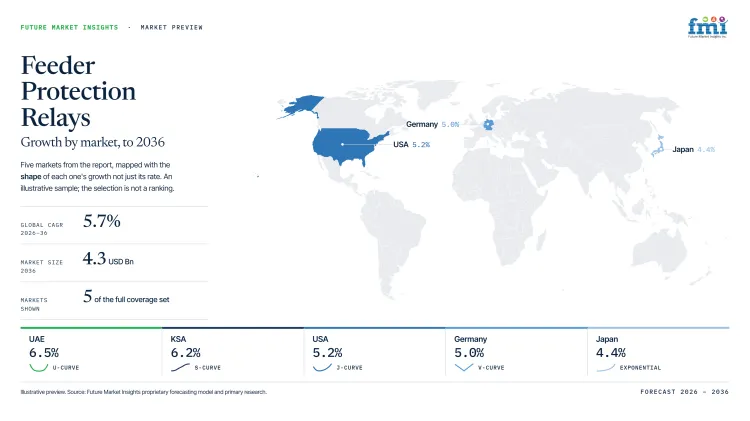
| Country | CAGR |
|---|---|
| UAE | 6.5% |
| KSA | 6.2% |
| Mexico | 5.8% |
| Brazil | 5.6% |
| USA | 5.2% |
| Germany | 5.0% |
| Japan | 4.4% |
How do country-level CAGRs compare in the Feeder Protection Relays Market?
The 2.1-point spread separates rapid Gulf distribution expansion from mature replacement-led markets in the comparison. UAE and KSA form the upper group because automated feeder positions enter service under active distribution expansion programs. Mexico and Brazil occupy the middle, while USA and Germany depend more on fleet renewal and Japan changes utility architectures deliberately.
- UAE interruption targets make protection coordination central to medium-voltage feeder expansion and commissioning schedules.
- KSA load-center expansion requires standardized protection packages that fit distribution construction under utility programs.
- Mexico's regional contractor network makes commissioning coverage important because project teams vary between distribution builds.
- Brazil's distributor structure makes local application coverage important because national settings packages cannot fit every deployment.
- USA utility fragmentation slows standardization despite a large installed base that supports relay replacement.
- Germany's long asset lives temper relay replacement even as renewable-grid reinforcement changes protection requirements.
- Japan's regional utility structure spreads relay-standardization decisions among separate service areas and slows fleet-wide architecture changes.
CAGR alone cannot rank revenue potential because fleet size and outage windows change replacement timing. The full report provides country-level CAGR analysis for North America, Latin America, Western Europe, Eastern Europe, East Asia, South Asia and Pacific, and Middle East and Africa.
Country-wise Analysis
- Dubai operates a dense automated distribution network where feeder protection must coordinate new substations with remote switching. UAE feeder protection relay demand is forecast to rise at 6.5% CAGR over the forecast period, driven by continuing medium-voltage substation additions. DEWA reported in April 2025 that Dubai had 45,317 medium-voltage distribution substations at the end of 2024. The installed base gives substation automation equipment a direct replacement route because new relays must match existing utility protection philosophies and tested communication interfaces. Local engineering teams need rapid field support because dense utility assets leave little room for commissioning errors during scheduled switching work.
- Saudi distribution operators are increasing remote supervision under utility specifications that govern protection interfaces and equipment approval for repeat medium-voltage projects. Saudi Energy (formerly Saudi Electricity Company) disclosed in its March 2025 full-year 2024 earnings release that distribution-grid automation reached 36.4% at the end of 2024. The KSA feeder protection relays sector is projected to record 6.2% CAGR during the assessment period, attributable to wider distribution automation. Local approval routes can extend product entry because relay settings and communication behavior must match existing distribution standards. Manufacturers with local engineering coverage can resolve settings migration during trials and convert accepted designs into repeat feeder specifications without delaying commissioning schedules.
- Mexico's distribution expansion program places feeder relays inside new panels and reinforcement projects under one national utility investment cycle. Feeder protection relay sales in Mexico are forecast to expand at 5.8% CAGR by 2036, supported by new distribution projects. Relay manufacturers must coordinate settings with construction schedules so protection testing does not delay energization at reinforced substations. CFE approved 18 distribution-network investment projects in March 2025 alongside transmission reinforcement and generation projects under the national expansion plan. The project mix gives relay manufacturers factory-integration work for new panels and field-support work for reinforcement at operating substations with existing protection schemes.
- Brazilian distribution feeders are absorbing more customer-sited generation, which changes directional fault behavior on circuits designed for radial power flow. EPE reported in September 2025 that its reference scenario reaches 9.5 million distributed-generation consumers by 2035. Adoption of feeder protection relays in Brazil is estimated to expand at 5.6% CAGR through 2036, driven by distributed-generation penetration. Different utility protection philosophies prevent one settings package from working uniformly and increase the value of adaptable directional elements. Relay manufacturers gain an advantage when field engineers can validate directional behavior without forcing utilities to redesign established protection schemes during scheduled local feeder upgrades.
- US utilities manage a large installed relay base while grid-hardening programs add automated switching and communications during planned substation work. The Department of Energy documented a December 2025 modernization project that installs sophisticated protection equipment and communications linked to SCADA. In the USA, feeder protection relay demand is predicted to advance at 5.2% CAGR through 2036 owing to planned protection renewal. Replacement work must fit medium-voltage circuit breakers already installed in feeder panels, which limits wiring changes during short outages. Domestic application support can shorten settings conversion and field troubleshooting enough to make scheduled replacement practical for dispersed utility fleets.
- German distribution operators are adding digital monitoring as renewable generation increases the operating states that protection teams must evaluate. Germany is estimated to post 5.0% CAGR over the forecast period owing to grid digitalization and replacement needs. Utility-specific topology keeps protection approval local even when high-voltage digital substations use standardized IEC 61850 engineering in multiple service territories. Bundesnetzagentur stated in December 2025 that future quality regulation will measure smart-grid functions and digital processes used by network operators. Detailed test records can shorten technical review by showing how another relay family will behave within renewable-heavy distribution networks during detailed technical approval reviews.
- Japanese transmission and distribution companies apply strict supply-quality standards that make protection changes deliberate before fleet-wide adoption. OCCTO published its FY2024 electricity-supply quality report in January 2026 using data from general transmission and distribution companies. Mature high-voltage substations provide a steady replacement base, but utilities expect proven interoperability and lifecycle support before standardizing another device family. By 2036, Japan is projected to grow at 4.4% CAGR attributable to planned replacement instead of rapid network expansion. Stable engineering relationships influence fleet standardization because protection teams prefer familiar test records during controlled replacement programs and outage planning for Japanese utility fleets nationwide.
Who are the notable companies in the Feeder Protection Relays Market?
ABB, Siemens, Schneider Electric, GE Vernova, Eaton, SEL, Toshiba, Mitsubishi Electric, Hitachi Energy and Littelfuse are the key companies serving this market.
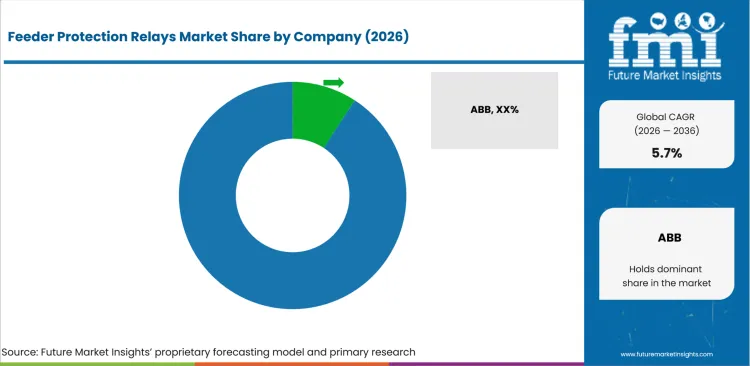
Competition divides between integrated grid-automation groups and specialist protection manufacturers with utility or industrial channels. Entry depends on documented protection breadth and IEC 61850 engineering because relay selection is tied to tested settings and service coverage.
- ABB and Siemens pair relay families with substation-control engineering alongside Schneider Electric as well as GE Vernova and Hitachi Energy.
- Eaton and SEL focus on protection applications alongside Toshiba and Mitsubishi Electric for utility and industrial control requirements.
- Littelfuse brings a focused electrical-protection position to industrial and utility relay requirements within the reconciled company set.
Competitive Benchmarking: Feeder Protection Relays Market
| Company | Feeder Protection Breadth | IEC 61850 / Digital Integration | Advanced Protection & Diagnostics | Geographic Reach |
|---|---|---|---|---|
| ABB | High | High | High | Global utility and industrial markets |
| Siemens | High | High | High | Global utility and industrial markets |
| Schneider Electric | High | High | High | Global utility and industrial markets |
| GE Vernova | High | High | High | Global utility and grid markets |
| Eaton | Medium | Medium | High | North America and international utility channels |
| SEL | High | High | High | Global utility and industrial protection markets |
| Toshiba | High | High | High | Asia and international utility markets |
| Mitsubishi Electric | Medium | Medium | High | Asia, North America and international utility markets |
| Hitachi Energy | High | High | High | Global utility and industrial markets |
| Littelfuse | Medium | Medium | High | North America, Europe and Asia protection channels |
Key Developments in the Feeder Protection Relays Market
- In February 2026, ABB launched REX600 for digital substations with compact protection and control functions supporting centralized virtualized processing and IEC 61850 integration.
- In February 2026, GE Vernova introduced GridBeats™ APS (Automation and Protection System), a software-defined platform enabling multiple protection and control functions to run on a single device, reducing hardware footprints in digital substations.
- In May 2025, Toshiba documented functional validation of IEC 61850 digital-substation protection and control equipment developed for multiple power-company requirements.
Key Players in the Feeder Protection Relays Market
Integrated grid automation and protection platforms
- ABB
- Siemens
- Schneider Electric
- GE Vernova
- Hitachi Energy
Protection and distribution control specialists
- Eaton
- SEL
- Toshiba
- Mitsubishi Electric
Focused electrical protection platform
- Littelfuse
Feeder Protection Relays Market - Report Scope
| Coverage field | Report scope |
|---|---|
| Market breakdown | By relay type, voltage class, communication, end use, sales channel and region. |
| Quantitative Units | Revenue in USD billion and CAGR in %. |
| Market Definition | Revenue from feeder protection relays sold within the stated segmentation universe. Downstream switchgear, circuit breakers, instrument transformers, SCADA platforms, engineering services and adjacent protection products are excluded. |
| Regions Covered | North America, Latin America, Western Europe, Eastern Europe, East Asia, South Asia and Pacific, and Middle East and Africa. |
| Countries Covered | UAE, KSA, Mexico, Brazil, USA, Germany, Japan, and more than twenty-five additional countries in the full report. |
| Key Companies | ABB, Siemens, Schneider Electric, GE Vernova, Eaton, SEL, Toshiba, Mitsubishi Electric, Hitachi Energy, Littelfuse. |
| Forecast Period | 2026 to 2036. |
| Approach | Hybrid bottom-up and top-down sizing reconciled against product revenue, replacement cycles, feeder applications and country-level grid investment indicators. |
Feeder Protection Relays Market - Research Methodology
| Method | Approach |
|---|---|
| Primary Research | FMI analysts gathered input from manufacturers, service providers, technology developers, distributors, end users, procurement teams, and subject-matter experts. Interviews examined purchasing decisions, product or service evaluation, adoption barriers, approval requirements, pricing considerations, and expectations for technical or commercial support. Respondents were also asked what evidence is required before a trial, pilot, or initial order develops into regular purchasing. |
| Desk Research | Desk research covered government statistics, regulatory publications, trade data, industry associations, technical literature, standards, company filings, product information, and official corporate announcements. Sources were reviewed for relevance, publication date, geographic coverage, and consistency with the defined market scope. Claims relating to performance, applications, approvals, capacity, investment, and commercial activity were retained only when supported by credible public evidence. |
| Market Sizing and Forecasting | The market model combined the baseline value with historical performance, segment structure, pricing and volume indicators, adoption levels, company participation, and country-level demand conditions. Forecast assumptions considered economic activity, investment trends, regulatory developments, technology adoption, purchasing cycles, supply availability, and barriers to wider market use. Segment and regional estimates were reconciled before the final market total was calculated. |
| Data Validation | Estimates were checked against multiple independent indicators, including public data, company activity, trade patterns, industry developments, and findings from primary interviews. Validation also tested whether products, services, applications, and company revenues fell within the defined market boundaries. Adjacent categories, unsupported claims, overlapping revenues, and activities without direct market relevance were excluded to reduce double counting and maintain consistency across segments and countries. |
Feeder Protection Relays Market by Segments
Feeder Protection Relays Market segmented by Relay Type:
- Numerical feeder relays
- Overcurrent feeder relays
- Distance feeder relays
- Arc-flash feeder relays
- Multifunction protection relays
Feeder Protection Relays Market segmented by Voltage Class:
- Low voltage
- Medium voltage
- High voltage substation
- Utility distribution
Feeder Protection Relays Market segmented by Communication:
- IEC 61850
- Modbus
- DNP3
- PROFINET/Ethernet
- Standalone
Feeder Protection Relays Market segmented by End Use:
- Utilities
- Industrial plants
- Oil & gas
- Data centers
- Commercial infrastructure
Feeder Protection Relays Market segmented by Sales Channel:
- Electrical OEMs
- System integrators
- Utilities direct
- Electrical distributors
Feeder Protection Relays Market by Region:
- North America
- United States
- Canada
- Latin America
- Brazil
- Mexico
- Argentina
- Chile
- Western Europe
- Germany
- France
- United Kingdom
- Italy
- Spain
- Benelux
- Nordics
- Eastern Europe
- Poland
- Czech Republic
- Romania
- Hungary
- East Asia
- China
- Japan
- South Korea
- South Asia and Pacific
- India
- ASEAN
- Australia and New Zealand
- Middle East and Africa
- GCC Countries
- South Africa
- Türkiye
- Israel
Research Sources and Bibliography
- IEEE Power & Energy Society. (2025, May 26). Effect of Distribution Automation on Protective Relaying
- Dubai Electricity and Water Authority. (2026, May 31). DEWA commissioned 1,994 11kV substations in 2025
- ABB. (2025, May 19). ABB introduces Relion REC615, a comprehensive relay solution for grid automation
- Eaton. (2025, December 10). Eaton invests $50M+ in new Virginia facility to advance grid-to-chip AI data center solutions
- International Electrotechnical Commission. (2025, July 30). IEC 61850-10:2012/AMD1:2025 - Amendment 1 - Communication networks and systems for power utility automation - Part 10: Conformance testing
- USA Department of Energy. (2025, April 2). CX-033701: City of Albany GA Substation Resiliency and Distribution Automation Project
- USA Department of Energy. (2025, December 12). CX-035146: Grid Sectionalization and Reliability Investments to Address Urgent Issues of Tree-Driven Power Outages
- USA Department of Energy. (2025, January 16). Distributed Energy Resource Interconnection Roadmap
- International Electrotechnical Commission. (2025, August 11). IEC TS 60255-216-1:2025 - Measuring relays and protection equipment - Part 216-1: Digital interface requirements and tests
- USA Department of Energy. (2025, October 24). CX-034844: Substation Break/Reclosers Replacement Project
- Dubai Electricity and Water Authority. (2025, April 7). DEWA expands electricity distribution network to meet growing demand.
- Saudi Electricity Company. (2025, March 6). FY 2024 Earnings Release
- Comisión Federal de Electricidad. (2025, March 4). La CFE aprueba proyectos estratégicos de generación, reforzamiento de la red de transmisión en Quintana Roo y 18 proyectos de inversión en redes de distribución
- Empresa de Pesquisa Energética. (2025, September 22). MME and EPE publish report on Distributed Generation and Behind-the-Meter Battery Energy Storage in the PDE 2035
- USA Department of Energy. (2025, December 12). CX-035150: HEC Grid Modernization
- Bundesnetzagentur. (2025, December 19). Bundesnetzagentur will Energiewendekompetenz und Digitalisierung der Netzbetreiber stärker in den Fokus rücken
- Organization for Cross-regional Coordination of Transmission Operators, Japan. (2026, January 14). Report on the Quality of the Electricity Supply - Data for FY2024
- ABB. (2026, February 19). ABB launches REX600, a compact protection and control device for digital substations
- GE Vernova. (2026, February 3). GE Vernova expands its Grid Automation portfolio with new Advanced Protection System
- Toshiba Corporation. (2025, May). TOSHIBA REVIEW Vol. 80, No. 3, May 2025
- Siemens. (2026, February 3). Siemens virtualized protection for power grids cuts costs and saves space in digital substations
- Schneider Electric. (2025, November 18). Schneider Electric debuts One Digital Grid Platform to help utilities modernize and address energy costs
- GE Vernova. (2025, May 14). GE Vernova to invest USD 16 million to expand manufacturing footprint in India to meet rising demand
- Eaton. (2025, March 24). Eaton announces breakthrough, AI-powered innovation to help utilities strengthen wildfire prevention efforts
- Schweitzer Engineering Laboratories. (2025, July 30). SEL enhances the performance and digital input capacity of the SEL-2240 Axion
- Toshiba Energy Systems & Solutions Corporation. (2026, March 16). Toshiba receives order for voltage-sourced converter HVDC system for renewal of Pole 1 of Hokkaido-Honshu HVDC Link
- Mitsubishi Electric Corporation. (2026, January 27). Mitsubishi Electric and Landis+Gyr accelerate grid edge innovation as Mitsubishi Electric takes part in Landis+Gyr’s Application Ecosystem
- Hitachi Energy. (2026, May 12). Türkiye’s first digital substation pilot
- Littelfuse. (2025, December 11). Littelfuse completes acquisition of Basler Electric
- Eaton. (2025, October 8). Eaton begins production at newly expanded Texas manufacturing facility
- Schneider Electric. (2025, March 25). Schneider Electric plans to invest over $700 million in the USA supporting energy, AI sectors and job growth
- Siemens. (2025, November 20). Siemens unveils flexibility software to increase electricity grid capacity
- Schweitzer Engineering Laboratories. (2026, January 29). SEL releases new transformer controller with LTC control
- Hitachi Energy. (2026, March 11). Hitachi Energy marks milestone with first mobile high-voltage digital substation in Chile
- ABB. (2026, January 12). ABB strengthens grid automation offerings with Netcontrol acquisition
This Report Answers
- How large is the feeder protection relays market through 2036?
- Which network changes raise feeder relay protection requirements?
- Why do numerical feeder relays lead relay type demand?
- Why does low voltage hold its stated voltage-class share?
- Why does IEC 61850 lead communication demand?
- How do the seven country CAGRs compare?
- Which engineering requirements delay brownfield relay replacement?
- What should engineers test before standardizing another relay family?
Frequently Asked Questions
How big is the Feeder Protection Relays Market in 2026?
The feeder protection relays market is valued at USD 2.5 billion in 2026 and is projected to reach USD 4.3 billion by 2036. Distribution automation and aging-device replacement increase spending on configurable feeder relays with communication functions.
What is the CAGR of the Feeder Protection Relays Market from 2026 to 2036?
The feeder protection relays market is projected to grow at a CAGR of 5.7% between 2026 and 2036. Expansion is supported by feeder automation and digital-substation programs that require configurable protection with communication and event records.
Which relay type leads the Feeder Protection Relays Market?
The numerical feeder relays segment is expected to hold 34.0% of the feeder protection relays market in 2026, driven by configurable protection and control functions. Numerical devices also give engineers fault records and settings flexibility without requiring several fixed-purpose relays.
Which communication segment leads the Feeder Protection Relays Market?
The IEC 61850 segment is expected to hold 31.0% of the feeder protection relays market in 2026, attributable to standardized substation communication and engineering. Interoperable data models reduce custom mapping while conformance testing gives utilities a defined acceptance route for multi-vendor projects.
Which companies are active in the Feeder Protection Relays Market?
Key companies operating in the market include ABB, Siemens, Schneider Electric, GE Vernova, Eaton, SEL, Toshiba, Mitsubishi Electric, Hitachi Energy and Littelfuse. Their relay breadth and digital integration differ, while engineering support influences standardization on utility and industrial feeder fleets.
Preview the report firsthand - request a free sample
Get SampleGet the brochure for pricing and purchase details.
Get PDFTable of Content
- Key Takeaways
- Market Size and CAGR
- Top Growth Driver
- Fastest Growing Segment
- Leading Region
- Key Companies
- Emerging Opportunities
- Executive Summary
- Global Market Outlook
- Demand-side Trends
- Supply-side Trends
- Technology Roadmap Analysis
- Analysis and Recommendations
- Analyst Perspective (What is happening? Why now? What should investors know?)
- Key Questions Answered
- How large is the market?
- What is the CAGR?
- What are key trends?
- Which region dominates?
- Who are the leaders?
- Market Overview
- Market Coverage / Taxonomy
- Market Definition / Scope / Limitations
- Research Methodology
- Chapter Orientation
- Analytical Lens and Working Hypotheses
- Market Structure, Signals, and Trend Drivers
- Benchmarking and Cross-market Comparability
- Market Sizing, Forecasting, and Opportunity Mapping
- Research Design and Evidence Framework
- Desk Research Programme (Secondary Evidence)
- Expert Input and Fieldwork (Primary Evidence)
- Tooling, Models, and Reference Databases
- Data Engineering and Model Build
- Quality Assurance and Audit Trail
- Market Background
- Market Dynamics (Drivers, Restraints, Opportunity, Trends)
- Scenario Forecast (Optimistic, Likely, Conservative)
- Impact Analysis
- AI Impact
- Sustainability Impact
- Regulatory Impact
- Technology Impact
- Consumer / Buyer Analysis
- Purchase Drivers
- Adoption Barriers
- Buyer Journey
- Opportunity Map Analysis
- Product Life Cycle Analysis
- Supply Chain Analysis
- Investment Feasibility Matrix
- Value Chain Analysis
- PESTLE and Porter's Analysis
- Regulatory Landscape
- Regional Parent Market Outlook
- Production and Consumption Statistics
- Import and Export Statistics
- Global Market Analysis and Forecast, 2021 to 2036
- Historical Market Size Value (USD Billion) Analysis, 2021 to 2025
- Current and Future Market Size Value (USD Billion) Projections, 2026 to 2036
- Y-o-Y Growth Trend Analysis
- Absolute $ Opportunity Analysis
- Global Market Pricing Analysis, 2021 to 2036
- Global Market Analysis and Forecast, By Relay Type, 2021 to 2036
- Introduction / Key Findings
- Historical Market Size Value (USD Billion) Analysis By Relay Type, 2021 to 2025
- Current and Future Market Size Value (USD Billion) Analysis and Forecast By Relay Type, 2026 to 2036
- Numerical feeder relays
- Overcurrent feeder relays
- Distance feeder relays
- Arc-flash feeder relays
- Multifunction protection relays
- Numerical feeder relays
- Y-o-Y Growth Trend Analysis By Relay Type, 2021 to 2025
- Absolute $ Opportunity Analysis By Relay Type, 2026 to 2036
- Global Market Analysis and Forecast, By Voltage Class, 2021 to 2036
- Introduction / Key Findings
- Historical Market Size Value (USD Billion) Analysis By Voltage Class, 2021 to 2025
- Current and Future Market Size Value (USD Billion) Analysis and Forecast By Voltage Class, 2026 to 2036
- Low voltage
- Medium voltage
- High voltage substation
- Utility distribution
- Low voltage
- Y-o-Y Growth Trend Analysis By Voltage Class, 2021 to 2025
- Absolute $ Opportunity Analysis By Voltage Class, 2026 to 2036
- Global Market Analysis and Forecast, By Communication, 2021 to 2036
- Introduction / Key Findings
- Historical Market Size Value (USD Billion) Analysis By Communication, 2021 to 2025
- Current and Future Market Size Value (USD Billion) Analysis and Forecast By Communication, 2026 to 2036
- IEC 61850
- Modbus
- DNP3
- PROFINET/Ethernet
- Standalone
- IEC 61850
- Y-o-Y Growth Trend Analysis By Communication, 2021 to 2025
- Absolute $ Opportunity Analysis By Communication, 2026 to 2036
- Global Market Analysis and Forecast, By End Use, 2021 to 2036
- Introduction / Key Findings
- Historical Market Size Value (USD Billion) Analysis By End Use, 2021 to 2025
- Current and Future Market Size Value (USD Billion) Analysis and Forecast By End Use, 2026 to 2036
- Utilities
- Industrial plants
- Oil & gas
- Data centers
- Commercial infrastructure
- Utilities
- Y-o-Y Growth Trend Analysis By End Use, 2021 to 2025
- Absolute $ Opportunity Analysis By End Use, 2026 to 2036
- Global Market Analysis and Forecast, By Sales Channel, 2021 to 2036
- Introduction / Key Findings
- Historical Market Size Value (USD Billion) Analysis By Sales Channel, 2021 to 2025
- Current and Future Market Size Value (USD Billion) Analysis and Forecast By Sales Channel, 2026 to 2036
- Electrical OEMs
- System integrators
- Utilities direct
- Electrical distributors
- Electrical OEMs
- Y-o-Y Growth Trend Analysis By Sales Channel, 2021 to 2025
- Absolute $ Opportunity Analysis By Sales Channel, 2026 to 2036
- Global Market Analysis and Forecast, By Region, 2021 to 2036
- Introduction
- Historical Market Size Value (USD Billion) Analysis By Region, 2021 to 2025
- Current Market Size Value (USD Billion) Analysis and Forecast By Region, 2026 to 2036
- North America
- Latin America
- Western Europe
- Eastern Europe
- East Asia
- South Asia and Pacific
- Middle East & Africa
- Market Attractiveness Analysis By Region
- North America Market Analysis and Forecast, By Country, 2021 to 2036
- Historical Market Size Value (USD Billion) Trend Analysis By Market Taxonomy, 2021 to 2025
- Market Size Value (USD Billion) Forecast By Market Taxonomy, 2026 to 2036
- By Country
- USA
- Canada
- By Relay Type
- By Voltage Class
- By Communication
- By End Use
- By Sales Channel
- By Country
- Market Attractiveness Analysis
- By Country
- By Relay Type
- By Voltage Class
- By Communication
- By End Use
- By Sales Channel
- Key Takeaways
- Latin America Market Analysis and Forecast, By Country
- Historical Market Size Value (USD Billion) Trend Analysis By Market Taxonomy, 2021 to 2025
- Market Size Value (USD Billion) Forecast By Market Taxonomy, 2026 to 2036
- By Country
- Brazil
- Mexico
- Chile
- Rest of Latin America
- By Relay Type
- By Voltage Class
- By Communication
- By End Use
- By Sales Channel
- By Country
- Market Attractiveness Analysis
- By Country
- By Relay Type
- By Voltage Class
- By Communication
- By End Use
- By Sales Channel
- Key Takeaways
- Western Europe Market Analysis and Forecast, By Country
- Historical Market Size Value (USD Billion) Trend Analysis By Market Taxonomy, 2021 to 2025
- Market Size Value (USD Billion) Forecast By Market Taxonomy, 2026 to 2036
- By Country
- Germany
- UK
- Italy
- Spain
- France
- Nordic
- BENELUX
- Rest of Western Europe
- By Relay Type
- By Voltage Class
- By Communication
- By End Use
- By Sales Channel
- By Country
- Market Attractiveness Analysis
- By Country
- By Relay Type
- By Voltage Class
- By Communication
- By End Use
- By Sales Channel
- Key Takeaways
- Eastern Europe Market Analysis and Forecast, By Country
- Historical Market Size Value (USD Billion) Trend Analysis By Market Taxonomy, 2021 to 2025
- Market Size Value (USD Billion) Forecast By Market Taxonomy, 2026 to 2036
- By Country
- Russia
- Poland
- Hungary
- Balkan & Baltic
- Rest of Eastern Europe
- By Relay Type
- By Voltage Class
- By Communication
- By End Use
- By Sales Channel
- By Country
- Market Attractiveness Analysis
- By Country
- By Relay Type
- By Voltage Class
- By Communication
- By End Use
- By Sales Channel
- Key Takeaways
- East Asia Market Analysis and Forecast, By Country
- Historical Market Size Value (USD Billion) Trend Analysis By Market Taxonomy, 2021 to 2025
- Market Size Value (USD Billion) Forecast By Market Taxonomy, 2026 to 2036
- By Country
- China
- Japan
- South Korea
- By Relay Type
- By Voltage Class
- By Communication
- By End Use
- By Sales Channel
- By Country
- Market Attractiveness Analysis
- By Country
- By Relay Type
- By Voltage Class
- By Communication
- By End Use
- By Sales Channel
- Key Takeaways
- South Asia and Pacific Market Analysis and Forecast, By Country
- Historical Market Size Value (USD Billion) Trend Analysis By Market Taxonomy, 2021 to 2025
- Market Size Value (USD Billion) Forecast By Market Taxonomy, 2026 to 2036
- By Country
- India
- ASEAN
- Australia & New Zealand
- Rest of South Asia and Pacific
- By Relay Type
- By Voltage Class
- By Communication
- By End Use
- By Sales Channel
- By Country
- Market Attractiveness Analysis
- By Country
- By Relay Type
- By Voltage Class
- By Communication
- By End Use
- By Sales Channel
- Key Takeaways
- Middle East & Africa Market Analysis and Forecast, By Country
- Historical Market Size Value (USD Billion) Trend Analysis By Market Taxonomy, 2021 to 2025
- Market Size Value (USD Billion) Forecast By Market Taxonomy, 2026 to 2036
- By Country
- Kingdom of Saudi Arabia
- Other GCC Countries
- Türkiye
- South Africa
- Other African Union
- Rest of Middle East & Africa
- By Relay Type
- By Voltage Class
- By Communication
- By End Use
- By Sales Channel
- By Country
- Market Attractiveness Analysis
- By Country
- By Relay Type
- By Voltage Class
- By Communication
- By End Use
- By Sales Channel
- Key Takeaways
- Key Countries Market Analysis
- USA
- Pricing Analysis
- Market Share Analysis, 2025
- By Relay Type
- By Voltage Class
- By Communication
- By End Use
- By Sales Channel
- Canada
- Pricing Analysis
- Market Share Analysis, 2025
- By Relay Type
- By Voltage Class
- By Communication
- By End Use
- By Sales Channel
- Mexico
- Pricing Analysis
- Market Share Analysis, 2025
- By Relay Type
- By Voltage Class
- By Communication
- By End Use
- By Sales Channel
- Brazil
- Pricing Analysis
- Market Share Analysis, 2025
- By Relay Type
- By Voltage Class
- By Communication
- By End Use
- By Sales Channel
- Chile
- Pricing Analysis
- Market Share Analysis, 2025
- By Relay Type
- By Voltage Class
- By Communication
- By End Use
- By Sales Channel
- Germany
- Pricing Analysis
- Market Share Analysis, 2025
- By Relay Type
- By Voltage Class
- By Communication
- By End Use
- By Sales Channel
- UK
- Pricing Analysis
- Market Share Analysis, 2025
- By Relay Type
- By Voltage Class
- By Communication
- By End Use
- By Sales Channel
- Italy
- Pricing Analysis
- Market Share Analysis, 2025
- By Relay Type
- By Voltage Class
- By Communication
- By End Use
- By Sales Channel
- Spain
- Pricing Analysis
- Market Share Analysis, 2025
- By Relay Type
- By Voltage Class
- By Communication
- By End Use
- By Sales Channel
- France
- Pricing Analysis
- Market Share Analysis, 2025
- By Relay Type
- By Voltage Class
- By Communication
- By End Use
- By Sales Channel
- India
- Pricing Analysis
- Market Share Analysis, 2025
- By Relay Type
- By Voltage Class
- By Communication
- By End Use
- By Sales Channel
- ASEAN
- Pricing Analysis
- Market Share Analysis, 2025
- By Relay Type
- By Voltage Class
- By Communication
- By End Use
- By Sales Channel
- Australia & New Zealand
- Pricing Analysis
- Market Share Analysis, 2025
- By Relay Type
- By Voltage Class
- By Communication
- By End Use
- By Sales Channel
- China
- Pricing Analysis
- Market Share Analysis, 2025
- By Relay Type
- By Voltage Class
- By Communication
- By End Use
- By Sales Channel
- Japan
- Pricing Analysis
- Market Share Analysis, 2025
- By Relay Type
- By Voltage Class
- By Communication
- By End Use
- By Sales Channel
- South Korea
- Pricing Analysis
- Market Share Analysis, 2025
- By Relay Type
- By Voltage Class
- By Communication
- By End Use
- By Sales Channel
- Russia
- Pricing Analysis
- Market Share Analysis, 2025
- By Relay Type
- By Voltage Class
- By Communication
- By End Use
- By Sales Channel
- Poland
- Pricing Analysis
- Market Share Analysis, 2025
- By Relay Type
- By Voltage Class
- By Communication
- By End Use
- By Sales Channel
- Hungary
- Pricing Analysis
- Market Share Analysis, 2025
- By Relay Type
- By Voltage Class
- By Communication
- By End Use
- By Sales Channel
- Kingdom of Saudi Arabia
- Pricing Analysis
- Market Share Analysis, 2025
- By Relay Type
- By Voltage Class
- By Communication
- By End Use
- By Sales Channel
- Türkiye
- Pricing Analysis
- Market Share Analysis, 2025
- By Relay Type
- By Voltage Class
- By Communication
- By End Use
- By Sales Channel
- South Africa
- Pricing Analysis
- Market Share Analysis, 2025
- By Relay Type
- By Voltage Class
- By Communication
- By End Use
- By Sales Channel
- USA
- Market Structure Analysis
- Competition Dashboard
- Competition Benchmarking
- Market Share Analysis of Top Players
- By Regional
- By Relay Type
- By Voltage Class
- By Communication
- By End Use
- By Sales Channel
- Emerging Startups
- Innovation Benchmarking
- Competition Analysis
- Competition Deep Dive
- ABB
- Overview
- Product Portfolio
- Profitability by Market Segments
- Sales Footprint
- Strategy Overview
- Marketing Strategy
- Product Strategy
- Channel Strategy
- Siemens
- Schneider Electric
- GE Vernova
- Eaton
- SEL
- Toshiba
- Mitsubishi Electric
- Hitachi Energy
- Littelfuse
- ABB
- Case Studies
- Success Stories
- Recent Developments
- Competition Deep Dive
- Assumptions & Acronyms Used


