

- Industry Size (2026)
- USD 195.0 Mn
- Forecast (2036)
- USD 468.0 Mn
- CAGR (2026 to 2036)
- 9.1%
Fill-Seal Die-Cut Lines Market Forecast and Outlook 2026 to 2036
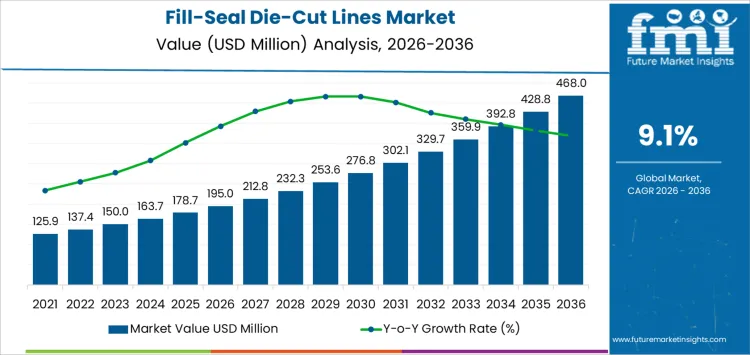
The fill-seal die-cut lines market is valued at USD 195 million in 2026 and is projected to reach USD 468 million by 2036, reflecting a CAGR of 9.1%. Analysis of annual data indicates recurring cyclical patterns, with moderate growth observed during early quarters of each year and accelerated uptake in the latter half, correlating with peak production schedules in food, pharmaceuticals, and personal care sectors. Seasonal demand aligns with higher packaging volumes during festive periods, promotional campaigns, and new product launches, driving temporary spikes in die-cut line deployments.
Over the longer term, from 2031 to 2036, the market demonstrates a sustained cyclical rhythm, where absolute gains fluctuate but the general upward trend remains intact. High-demand periods consistently correspond to inventory replenishment and batch production cycles, while slower periods reflect maintenance schedules and capital planning phases. This recurring pattern indicates that while year-over-year growth is strong, operational deployment of fill-seal die-cut lines is inherently seasonal, influenced by production planning, market promotions, and regulatory timelines, which should be factored into strategic investment and resource allocation decisions.
Quick Stats of the Fill-Seal Die-Cut Lines Market
- Fill-Seal Die-Cut Lines Market Value (2026): USD 195.0 million
- Fill-Seal Die-Cut Lines Market Forecast Value (2036): USD 468.0 million
- Fill-Seal Die-Cut Lines Market Forecast CAGR (2026-2036): 9.1%
- Leading Packaging Format: Die-cut fill-seal lines for cartons (40%)
- Key Growth Regions: North America, Asia Pacific, and Europe
- Top Players: Bobst / BOBST converters, WestRock machinery, BOBST China
What is the Growth Forecast for the Fill-Seal Die-Cut Lines Market through 2036?
From 2026 to 2031, the fill-seal die-cut lines market grows from USD 195 million to approximately USD 289 million, representing a recovery from an early trough toward an initial peak. Early demand is concentrated among food, beverage, and pharmaceutical manufacturers upgrading packaging efficiency while validating line performance and output quality. Growth in this period is incremental as companies integrate die-cut capabilities into selected production lines, and annual value additions reflect cautious scaling rather than full system deployment. The trough-to-peak phase is marked by gradual adoption, tool qualification, and capacity alignment with production requirements.
Between 2031 and 2036, the market expands from roughly USD 289 million to USD 468 million, marking the peak phase where broader commercial deployment drives accelerated value creation. Growth in this interval reflects portfolio-wide integration of die-cut lines, higher throughput utilization, and expansion across multiple sites and product SKUs. Annual additions increase substantially as adoption becomes standardized, repeat procurement grows, and manufacturers implement die-cut lines as a core component of high-speed fill-seal operations. Earlier growth relied on selective upgrades, while later expansion reflects structural scaling, higher line density per facility, and broader geographic penetration.
Fill Seal Die Cut Lines Market Key Takeaways
| Metric | Value |
|---|---|
| Sales Value (2026) | USD 195 million |
| Forecast Value (2036) | USD 468 million |
| Forecast CAGR (2026-2036) | 9.1% |
What Is Driving the Demand for Fill-Seal Die-Cut Lines?
Demand for fill-seal die-cut lines grew historically from the need to improve packaging efficiency and reduce material waste in consumer goods and food production. Traditional packaging methods relied on separate forming, filling, and sealing processes that required multiple machines and manual transfers, increasing cycle times and error rates. Early adopters in snack foods, pet treats, and small volume liquid products sought integrated die-cut systems that combined forming, filling, and sealing in a single line. Historical growth reflected expansion in packaged food production, rising retail availability of convenience formats, and emphasis on reducing per unit labor costs. Adoption correlated with capital investment cycles in small and mid-sized plants where output gains could be measured against manual bottlenecks and quality variances.
Future demand for fill-seal die-cut lines is expected to reflect structural shifts in production strategy and packaging innovation. Manufacturers are prioritising flexible automation that accommodates shorter runs, multiple format changes, and rapid product introductions. Die-cut line technologies are advancing to support adaptive tooling, real time quality monitoring, and integration with digital control systems. Growth in direct to consumer packaging and private label brands will increase demand for machines capable of handling varied materials and complex pouch formats. Unlike earlier expansion driven by throughput improvements in existing product lines, future adoption will be shaped by agility, changeover speed, and total cost of ownership assessments across food, pet care, and specialty consumer goods sectors.
What Factors Are Affecting the Demand for Fill Seal Die Cut Lines Market in Terms of End Use Application and Packaging Format and Type?
Demand for fill seal die cut lines is structured around end use application and packaging format and type across food and consumer goods packaging operations. Bakery and confectionery applications account for about 35% of total demand, driven by high volume carton packaging requirements. Ready meals and snacks, consumer electronics inserts, and personal care small runs represent additional applications with varying batch sizes and packaging complexity. Regional packaging operations contribute selective demand based on local production needs. Packaging format and type influence line configuration, tooling requirements, and changeover frequency. Die cut fill seal carton lines, pre formed die cut boxes, insert based systems, and small batch lines serve different production profiles. These segments explain demand patterns shaped by throughput needs, product protection, and packaging presentation requirements.
What Drives Demand by End Use Application in the Fill Seal Die Cut Lines Market?
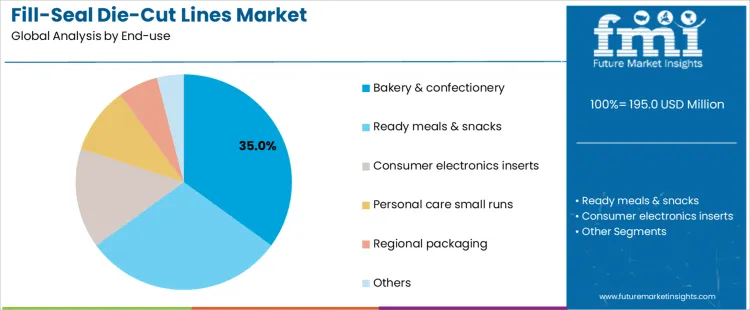
Bakery and confectionery applications lead demand due to consistent output volumes and standardized carton formats. These products require precise filling and sealing to maintain freshness and presentation quality. Ready meals and snack producers adopt die cut lines to support portion control and shelf ready packaging formats. Consumer electronics inserts use these systems for protective packaging of components within cartons. Personal care small runs rely on flexible lines suited for limited batch production. Adoption intensity varies by production scale and packaging uniformity. End use demand concentrates where repeatable packaging formats justify investment in dedicated lines. These applications value accuracy and efficiency over frequent format changes within daily production cycles.
Application driven demand remains stable because packaging requirements are embedded in product design. Bakery and confectionery producers operate continuous lines with predictable packaging needs. Ready meal producers balance volume with frequent SKU variation. Electronics insert packaging emphasizes consistency and component protection. Personal care brands favor adaptability to support promotional or seasonal runs. Regional packaging operations adopt selectively where local brands require short lead times. These usage patterns limit demand volatility. End use segmentation highlights reliance on packaging precision rather than discretionary automation. Demand therefore aligns with production planning and packaging standardization across food and consumer goods sectors.
How Does Packaging Format and Type Shape Demand for Fill Seal Die Cut Lines Market?
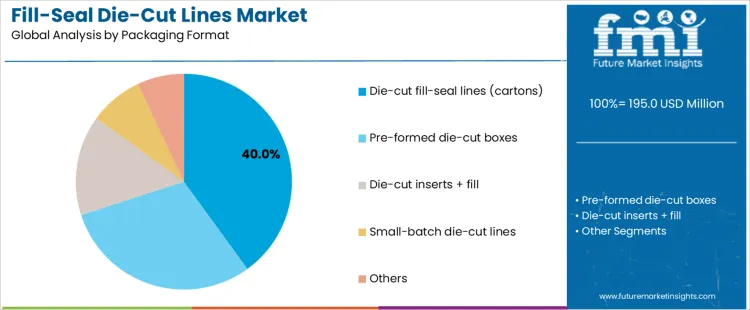
Die cut fill seal lines for cartons account for about 40% of total demand, making them the leading packaging format. Their adoption reflects suitability for high speed carton forming, filling, and sealing operations. Pre formed die cut boxes are used where carton shapes are complex or rigidity is required. Systems combining die cut inserts with fill functions serve electronics and specialty packaging needs. Small batch die cut lines support low volume and high mix production environments. Other formats address niche requirements. Packaging format selection depends on carton geometry, changeover frequency, and integration with upstream processes. Demand follows operational practicality rather than maximum automation capability.
Carton based die cut lines maintain leadership due to compatibility with established secondary packaging workflows. Pre formed boxes reduce forming complexity but increase material handling needs. Insert based systems prioritize placement accuracy over speed. Small batch lines enable flexibility without full scale investment. Producers favor formats that align with existing line layouts and staffing levels. Major format shifts are avoided due to tooling and validation costs. This constrains rapid adoption of alternative systems. Packaging format and type therefore stabilize demand by reinforcing proven configurations. These constraints explain why conventional die cut fill seal lines dominate adoption across food and consumer goods packaging operations.
How Are Fill Seal Die Cut Lines Being Applied Across Packaging and Production Operations?
Use appears in facilities that require precise forming, filling, and sealing of flexible packages with precut shapes. Snack producers adopt die cut lines to create consistent pouches for chips, nuts, or confectionery. Nutritional supplement manufacturers use them for single serve stick packs. Ready meal producers integrate die cut lines for shaped trays and laminated films. These applications reflect operational priorities tied to accuracy, speed, and package uniformity rather than decorative or promotional aspects, with adoption driven by process efficiency and product consistency.
What Operational Conditions Encourage Adoption of Fill Seal Die Cut Lines?
Selection aligns with facilities managing high volume, small footprint packaging operations. Packaging engineers favor lines that provide consistent pouch formation and reliable sealing under variable fill weights. Production teams require compatibility with laminated films, barrier materials, and preprinted graphics. Maintenance teams value modular designs for rapid changeovers and cleaning. Quality control relies on precise registration and consistent sealing performance. These conditions arise from the need for speed, repeatability, and material handling precision in structured packaging workflows.
Which Practical Considerations Limit Wider Use of Fill Seal Die Cut Lines?
Capital investment and maintenance complexity influence adoption in smaller facilities. Compatibility with certain film thicknesses or laminate structures may require specialized tooling. Operator training is necessary to maintain line speed and avoid misfeeds. Changeover time between different pouch shapes affects throughput efficiency. Material waste can increase if registration or die alignment is off. These factors lead to selective deployment where product variety, output speed, and packaging quality justify investment and operational control requirements.
What is the Demand for Fill Seal Die Cut Lines by Country?
| Country | CAGR (%) |
|---|---|
| Germany | 6.8% |
| USA | 8.2% |
| China | 10.5% |
| India | 11.8% |
| Brazil | 7.0% |
| Japan | 4.5% |
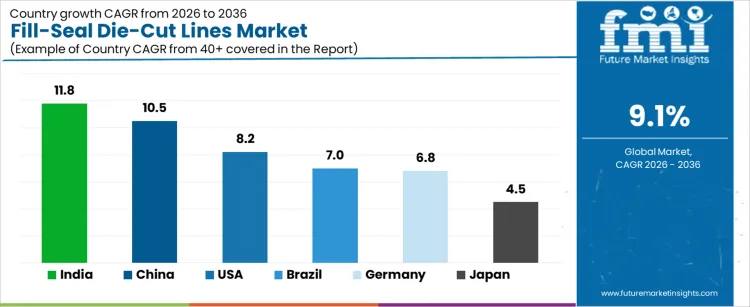
The demand for fill seal die cut lines varies across countries, driven by food and beverage packaging, processing automation, and production efficiency requirements. India leads with an 11.8% CAGR, supported by expanding packaged food production, growing adoption of high speed packaging lines, and demand for flexible format solutions. China follows at 10.5%, driven by large scale manufacturing, export oriented production, and modernization of packaging operations. The USA grows at 8.2%, reflecting adoption in snacks, bakery, and processed food sectors. Brazil records 7.0%, shaped by food packaging expansion. Germany posts 6.8%, supported by structured production standards, while Japan grows at 4.5%, reflecting mature operations and steady packaging line demand.
How Is Automated Packaging Driving Growth in Germany?
In Germany, revenue from the Fill-Seal Die-Cut Lines Market is expanding at a CAGR of 6.8% through 2036, driven by adoption of automated fill-seal systems for flexible packaging in food, beverage, and personal care products. Manufacturers are integrating die-cut lines to improve packaging speed, accuracy, and product integrity. Demand is concentrated in ready-to-eat meals, confectionery, and liquid products distributed through retail and industrial channels. Domestic machinery suppliers are providing automated lines compatible with various film types and pouch formats. Stable production volumes, regulated quality standards, and recurring packaging operations are sustaining predictable procurement across packaging facilities nationwide.
- Ready-to-eat meals, confectionery, and liquid products drive adoption of fill-seal die-cut lines
- Automated systems improve packaging speed, accuracy, and product integrity
- Domestic suppliers provide lines compatible with multiple film types and pouch formats
- Recurring packaging operations sustain predictable procurement volumes
How Is Packaging Automation Supporting Demand in the United States?
The United States is experiencing growth in the Fill-Seal Die-Cut Lines Market at a CAGR of 8.2% through 2036, supported by adoption of high-speed automated packaging systems in food, beverage, and personal care production. Brands are integrating die-cut lines to enhance throughput, reduce manual labor, and maintain consistent seal quality. Demand is concentrated in snack foods, powdered products, and liquid-filled pouches. Domestic equipment suppliers are scaling production of automated lines for integration with existing filling and sealing operations. Stable output volumes and recurring packaging cycles are sustaining predictable procurement nationwide.
- Snack foods, powdered products, and liquid pouches drive die-cut line adoption
- High-speed automation improves throughput and reduces labor dependency
- Domestic suppliers provide lines for seamless integration with filling and sealing operations
- Recurring packaging cycles sustain predictable procurement
How Is E-Commerce and Retail Expansion Accelerating Adoption in China?
In China, revenue from the Fill-Seal Die-Cut Lines Market is growing at a CAGR of 10.5% through 2036, driven by expansion of e-commerce fulfillment and packaged food manufacturing. Operators are adopting automated die-cut lines for ready meals, confectionery, and single-serve liquid products to improve production speed and reduce waste. Demand is strong across modern retail, online distribution, and industrial food processing centers. Domestic machinery suppliers are scaling fill-seal line production with advanced automation features. High throughput operations and structured procurement practices are sustaining rapid adoption nationwide.
- E-commerce and retail expansion support fill-seal die-cut line adoption
- Ready meals, confectionery, and single-serve liquids anchor demand
- Domestic suppliers scale production with advanced automation features
- High throughput operations sustain consistent procurement
How Is Organized Food Manufacturing Supporting Growth in India?
India is witnessing strong expansion in the Fill-Seal Die-Cut Lines Market at a CAGR of 11.8% through 2036, supported by growth in organized food production and retail packaging. Manufacturers are integrating automated die-cut lines for snacks, beverages, and ready-to-eat meals to improve efficiency, reduce material waste, and maintain product quality. Demand is rising across urban retail, e-commerce, and institutional food supply channels. Domestic equipment suppliers are offering cost-aligned fill-seal lines suitable for high-volume production. Expanding retail networks and modern food processing facilities are sustaining robust procurement nationwide.
- Organized food manufacturing increases demand for fill-seal die-cut lines
- Snacks, beverages, and ready-to-eat meals drive high-volume adoption
- Domestic suppliers provide cost-aligned automated lines
- Retail expansion and modern processing sustain predictable procurement
How Are Consumer Packaged Goods Shipments Supporting Adoption in Brazil?
Brazil is seeing steady growth in the Fill-Seal Die-Cut Lines Market at a CAGR of 7% through 2036, supported by rising packaged food and beverage shipments. Operators are using automated die-cut lines to maintain seal integrity, improve production speed, and optimize flexible packaging operations. Demand is concentrated in snacks, confectionery, and liquid-filled pouches. Imports supply some specialized machinery, while domestic suppliers expand line production and integration capacity. Growth in retail distribution and organized food shipments is sustaining recurring procurement across packaging operations nationwide.
- Snack foods, confectionery, and liquid pouches drive fill-seal die-cut line adoption
- Automation improves seal integrity and production efficiency
- Domestic suppliers expand line production and integration capacity
- Retail and food distribution growth sustains recurring procurement
How Does Mature Packaging Demand Influence Stability in Japan?
Japan is maintaining measured growth in the Fill-Seal Die-Cut Lines Market at a CAGR of 4.5% through 2036, supported by mature retail and industrial packaging markets and selective adoption of automated systems. Brands apply die-cut lines for ready meals, snacks, and liquid-filled pouches. Demand remains focused on precision, reliability, and compatibility with existing packaging equipment. Domestic suppliers emphasize process accuracy and consistent line performance. Stable consumption patterns and replacement-driven purchasing are sustaining predictable procurement across established packaging operations nationwide.
- Mature packaging markets favor selective adoption of automated die-cut lines
- Ready meals, snacks, and liquid pouches anchor baseline demand
- Domestic suppliers ensure precision operation and consistent performance
- Replacement-driven purchasing sustains procurement continuity
Which Companies Are Shaping Competition in The Fill Seal Die Cut Lines Market Across Packaging Converting Operations?
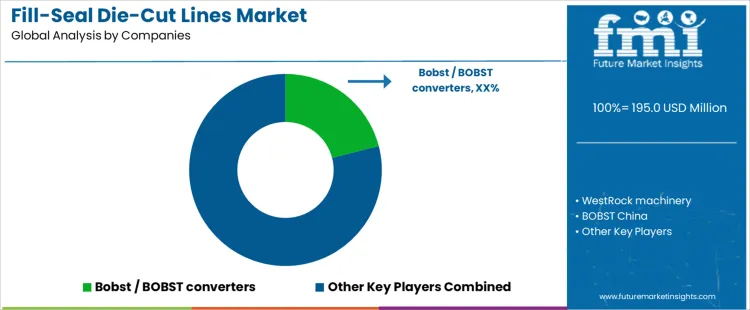
Competition in the Fill Seal Die Cut Lines Market is closely tied to high precision packaging machinery and converter aligned system supply. Bobst plays a central role through integrated die cut and forming lines used in fill seal packaging for food, beverage, and consumer goods. Its influence extends through direct equipment supply and through BOBST aligned converters that standardize production formats and tooling practices. WestRock machinery contributes from the packaging equipment side, supplying die cut and forming solutions designed to integrate with fill seal operations used by brand owners and contract packers. Competitive positioning at this level centers on mechanical accuracy, repeatability at high speeds, and compatibility with downstream sealing and filling processes.
Regional manufacturing and localization strategies shape secondary competitive dynamics. BOBST China supports demand through localized production, customization, and service support for Asia based converters and packaging plants. This presence enables shorter delivery cycles and adaptation to regional material specifications and operating standards. Competition is influenced by converter preferences, installed base continuity, and long term service agreements rather than frequent equipment replacement. Entry barriers remain high due to capital requirements, precision engineering needs, and customer reliance on proven line stability. Competitive differentiation reflects tooling flexibility, changeover efficiency, and the ability to support diverse packaging formats within a single production footprint.
Key Players in the Fill Seal Die Cut Lines Market
- Bobst / BOBST converters
- WestRock machinery
- BOBST China
Scope of the Report
| Items | Values |
|---|---|
| Quantitative Units (2026) | USD million |
| End-use / Application | Bakery & confectionery; Ready meals & snacks; Consumer electronics inserts; Personal care small runs; Regional packaging |
| Packaging Format / Type | Die-cut fill-seal lines (cartons); Pre-formed die-cut boxes; Die-cut inserts + fill; Small-batch die-cut lines |
| Material | Paperboard / Coated board; Coated folding carton board; Corrugated die-cut; Recycled board |
| Technology | Hot-glue / cold-seal + die-cutting; Automated fill-seal & die-cut; High-speed die-cutting; Semi-auto die-cut modules |
| Region | Asia Pacific; Europe; North America; Latin America; Middle East & Africa |
| Countries Covered | China; Japan; South Korea; India; Australia & New Zealand; ASEAN; Germany; United Kingdom; France; Italy; Spain; Nordic; BENELUX; United States; Canada; Mexico; Brazil; Chile; Kingdom of Saudi Arabia; Other GCC Countries; Turkey; South Africa; Other African Union; Rest of Asia Pacific; Rest of Europe; Rest of Latin America; Rest of Middle East & Africa |
| Key Companies Profiled | Bobst / BOBST converters; WestRock machinery; BOBST China |
| Additional Attributes | Dollar by sales across end-use applications, packaging formats, and technologies; Die-cut fill-seal lines for cartons lead demand due to high-speed forming, filling, and sealing efficiency; Pre-formed die-cut boxes support complex shapes; Small-batch lines facilitate flexible production; Adoption driven by food, beverage, personal care, and consumer electronics packaging; Integration with automated filling and sealing systems enhances throughput and consistency; Specification control includes line speed, tooling accuracy, material compatibility, and changeover efficiency; Recurring procurement aligned with production cycles, seasonal demand, and product launches; Adoption reflects operational efficiency, packaging precision, and process standardization rather than discretionary upgrades |
Fill Seal Die Cut Lines Market Segmentation
End-use / Application:
- Bakery & confectionery
- Ready meals & snacks
- Consumer electronics inserts
- Personal care small runs
- Regional packaging
Packaging Format / Type:
- Die-cut fill-seal lines (cartons)
- Pre-formed die-cut boxes
- Die-cut inserts + fill
- Small-batch die-cut lines
Material:
- Paperboard / Coated board
- Coated folding carton board
- Corrugated die-cut
- Recycled board
Technology:
- Hot-glue / cold-seal + die-cutting
- Automated fill-seal & die-cut
- High-speed die-cutting
- Semi-auto die-cut modules
Region:
- Asia Pacific
- China
- Japan
- South Korea
- India
- Australia & New Zealand
- ASEAN
- Rest of Asia Pacific
- Europe
- Germany
- United Kingdom
- France
- Italy
- Spain
- Nordic
- BENELUX
- Rest of Europe
- North America
- United States
- Canada
- Mexico
- Latin America
- Brazil
- Chile
- Rest of Latin America
- Middle East & Africa
- Kingdom of Saudi Arabia
- Other GCC Countries
- Turkey
- South Africa
- Other African Union
- Rest of Middle East & Africa
Frequently Asked Questions
How big is the fill-seal die-cut lines market in 2026?
The global fill-seal die-cut lines market is estimated to be valued at USD 195.0 million in 2026.
What will be the size of fill-seal die-cut lines market in 2036?
The market size for the fill-seal die-cut lines market is projected to reach USD 468.0 million by 2036.
How much will be the fill-seal die-cut lines market growth between 2026 and 2036?
The fill-seal die-cut lines market is expected to grow at a 9.1% CAGR between 2026 and 2036.
What are the key product types in the fill-seal die-cut lines market?
The key product types in fill-seal die-cut lines market are bakery & confectionery, ready meals & snacks, consumer electronics inserts, personal care small runs, regional packaging and others.
Which packaging format segment to contribute significant share in the fill-seal die-cut lines market in 2026?
In terms of packaging format, die-cut fill-seal lines (cartons) segment to command 40.0% share in the fill-seal die-cut lines market in 2026.
Preview the report firsthand - request a free sample
Get SampleGet the brochure for pricing and purchase details.
Get PDFTable of Content
- Executive Summary
- Global Market Outlook
- Demand-side Trends
- Supply-side Trends
- Technology Roadmap Analysis
- Analysis and Recommendations
- Market Overview
- Market Coverage / Taxonomy
- Market Definition / Scope / Limitations
- Market Background
- Market Dynamics
- Drivers
- Restraints
- Opportunity
- Trends
- Scenario Forecast
- Demand in Optimistic Scenario
- Demand in Likely Scenario
- Demand in Conservative Scenario
- Opportunity Map Analysis
- Product Life Cycle Analysis
- Supply Chain Analysis
- Investment Feasibility Matrix
- Value Chain Analysis
- PESTLE and Porter’s Analysis
- Regulatory Landscape
- Regional Parent Market Outlook
- Production and Consumption Statistics
- Import and Export Statistics
- Market Dynamics
- Global Market Analysis 2021 to 2025 and Forecast, 2026 to 2036
- Historical Market Size Value (USD Million) Analysis, 2021 to 2025
- Current and Future Market Size Value (USD Million) Projections, 2026 to 2036
- Y-o-Y Growth Trend Analysis
- Absolute $ Opportunity Analysis
- Global Market Pricing Analysis 2021 to 2025 and Forecast 2026 to 2036
- Global Market Analysis 2021 to 2025 and Forecast 2026 to 2036, By End-use
- Introduction / Key Findings
- Historical Market Size Value (USD Million) Analysis By End-use , 2021 to 2025
- Current and Future Market Size Value (USD Million) Analysis and Forecast By End-use , 2026 to 2036
- Bakery & confectionery
- Ready meals & snacks
- Consumer electronics inserts
- Personal care small runs
- Regional packaging
- Others
- Y-o-Y Growth Trend Analysis By End-use , 2021 to 2025
- Absolute $ Opportunity Analysis By End-use , 2026 to 2036
- Global Market Analysis 2021 to 2025 and Forecast 2026 to 2036, By Packaging Format
- Introduction / Key Findings
- Historical Market Size Value (USD Million) Analysis By Packaging Format, 2021 to 2025
- Current and Future Market Size Value (USD Million) Analysis and Forecast By Packaging Format, 2026 to 2036
- Die-cut fill-seal lines (cartons)
- Pre-formed die-cut boxes
- Die-cut inserts + fill
- Small-batch die-cut lines
- Others
- Y-o-Y Growth Trend Analysis By Packaging Format, 2021 to 2025
- Absolute $ Opportunity Analysis By Packaging Format, 2026 to 2036
- Global Market Analysis 2021 to 2025 and Forecast 2026 to 2036, By Material
- Introduction / Key Findings
- Historical Market Size Value (USD Million) Analysis By Material, 2021 to 2025
- Current and Future Market Size Value (USD Million) Analysis and Forecast By Material, 2026 to 2036
- Paperboard / Coated board
- Coated folding carton board
- Corrugated die-cut
- Recycled board
- Others
- Y-o-Y Growth Trend Analysis By Material, 2021 to 2025
- Absolute $ Opportunity Analysis By Material, 2026 to 2036
- Global Market Analysis 2021 to 2025 and Forecast 2026 to 2036, By Technology
- Introduction / Key Findings
- Historical Market Size Value (USD Million) Analysis By Technology, 2021 to 2025
- Current and Future Market Size Value (USD Million) Analysis and Forecast By Technology, 2026 to 2036
- Hot-glue / cold-seal + die-cutting
- Automated fill-seal & die-cut
- High-speed die-cutting
- Semi-auto die-cut modules
- —
- Others
- Y-o-Y Growth Trend Analysis By Technology, 2021 to 2025
- Absolute $ Opportunity Analysis By Technology, 2026 to 2036
- Global Market Analysis 2021 to 2025 and Forecast 2026 to 2036, By Region
- Introduction
- Historical Market Size Value (USD Million) Analysis By Region, 2021 to 2025
- Current Market Size Value (USD Million) Analysis and Forecast By Region, 2026 to 2036
- North America
- Latin America
- Western Europe
- Eastern Europe
- East Asia
- South Asia and Pacific
- Middle East & Africa
- Market Attractiveness Analysis By Region
- North America Market Analysis 2021 to 2025 and Forecast 2026 to 2036, By Country
- Historical Market Size Value (USD Million) Trend Analysis By Market Taxonomy, 2021 to 2025
- Market Size Value (USD Million) Forecast By Market Taxonomy, 2026 to 2036
- By Country
- USA
- Canada
- Mexico
- By End-use
- By Packaging Format
- By Material
- By Technology
- By Country
- Market Attractiveness Analysis
- By Country
- By End-use
- By Packaging Format
- By Material
- By Technology
- Key Takeaways
- Latin America Market Analysis 2021 to 2025 and Forecast 2026 to 2036, By Country
- Historical Market Size Value (USD Million) Trend Analysis By Market Taxonomy, 2021 to 2025
- Market Size Value (USD Million) Forecast By Market Taxonomy, 2026 to 2036
- By Country
- Brazil
- Chile
- Rest of Latin America
- By End-use
- By Packaging Format
- By Material
- By Technology
- By Country
- Market Attractiveness Analysis
- By Country
- By End-use
- By Packaging Format
- By Material
- By Technology
- Key Takeaways
- Western Europe Market Analysis 2021 to 2025 and Forecast 2026 to 2036, By Country
- Historical Market Size Value (USD Million) Trend Analysis By Market Taxonomy, 2021 to 2025
- Market Size Value (USD Million) Forecast By Market Taxonomy, 2026 to 2036
- By Country
- Germany
- UK
- Italy
- Spain
- France
- Nordic
- BENELUX
- Rest of Western Europe
- By End-use
- By Packaging Format
- By Material
- By Technology
- By Country
- Market Attractiveness Analysis
- By Country
- By End-use
- By Packaging Format
- By Material
- By Technology
- Key Takeaways
- Eastern Europe Market Analysis 2021 to 2025 and Forecast 2026 to 2036, By Country
- Historical Market Size Value (USD Million) Trend Analysis By Market Taxonomy, 2021 to 2025
- Market Size Value (USD Million) Forecast By Market Taxonomy, 2026 to 2036
- By Country
- Russia
- Poland
- Hungary
- Balkan & Baltic
- Rest of Eastern Europe
- By End-use
- By Packaging Format
- By Material
- By Technology
- By Country
- Market Attractiveness Analysis
- By Country
- By End-use
- By Packaging Format
- By Material
- By Technology
- Key Takeaways
- East Asia Market Analysis 2021 to 2025 and Forecast 2026 to 2036, By Country
- Historical Market Size Value (USD Million) Trend Analysis By Market Taxonomy, 2021 to 2025
- Market Size Value (USD Million) Forecast By Market Taxonomy, 2026 to 2036
- By Country
- China
- Japan
- South Korea
- By End-use
- By Packaging Format
- By Material
- By Technology
- By Country
- Market Attractiveness Analysis
- By Country
- By End-use
- By Packaging Format
- By Material
- By Technology
- Key Takeaways
- South Asia and Pacific Market Analysis 2021 to 2025 and Forecast 2026 to 2036, By Country
- Historical Market Size Value (USD Million) Trend Analysis By Market Taxonomy, 2021 to 2025
- Market Size Value (USD Million) Forecast By Market Taxonomy, 2026 to 2036
- By Country
- India
- ASEAN
- Australia & New Zealand
- Rest of South Asia and Pacific
- By End-use
- By Packaging Format
- By Material
- By Technology
- By Country
- Market Attractiveness Analysis
- By Country
- By End-use
- By Packaging Format
- By Material
- By Technology
- Key Takeaways
- Middle East & Africa Market Analysis 2021 to 2025 and Forecast 2026 to 2036, By Country
- Historical Market Size Value (USD Million) Trend Analysis By Market Taxonomy, 2021 to 2025
- Market Size Value (USD Million) Forecast By Market Taxonomy, 2026 to 2036
- By Country
- Kingdom of Saudi Arabia
- Other GCC Countries
- Turkiye
- South Africa
- Other African Union
- Rest of Middle East & Africa
- By End-use
- By Packaging Format
- By Material
- By Technology
- By Country
- Market Attractiveness Analysis
- By Country
- By End-use
- By Packaging Format
- By Material
- By Technology
- Key Takeaways
- Key Countries Market Analysis
- USA
- Pricing Analysis
- Market Share Analysis, 2025
- By End-use
- By Packaging Format
- By Material
- By Technology
- Canada
- Pricing Analysis
- Market Share Analysis, 2025
- By End-use
- By Packaging Format
- By Material
- By Technology
- Mexico
- Pricing Analysis
- Market Share Analysis, 2025
- By End-use
- By Packaging Format
- By Material
- By Technology
- Brazil
- Pricing Analysis
- Market Share Analysis, 2025
- By End-use
- By Packaging Format
- By Material
- By Technology
- Chile
- Pricing Analysis
- Market Share Analysis, 2025
- By End-use
- By Packaging Format
- By Material
- By Technology
- Germany
- Pricing Analysis
- Market Share Analysis, 2025
- By End-use
- By Packaging Format
- By Material
- By Technology
- UK
- Pricing Analysis
- Market Share Analysis, 2025
- By End-use
- By Packaging Format
- By Material
- By Technology
- Italy
- Pricing Analysis
- Market Share Analysis, 2025
- By End-use
- By Packaging Format
- By Material
- By Technology
- Spain
- Pricing Analysis
- Market Share Analysis, 2025
- By End-use
- By Packaging Format
- By Material
- By Technology
- France
- Pricing Analysis
- Market Share Analysis, 2025
- By End-use
- By Packaging Format
- By Material
- By Technology
- India
- Pricing Analysis
- Market Share Analysis, 2025
- By End-use
- By Packaging Format
- By Material
- By Technology
- ASEAN
- Pricing Analysis
- Market Share Analysis, 2025
- By End-use
- By Packaging Format
- By Material
- By Technology
- Australia & New Zealand
- Pricing Analysis
- Market Share Analysis, 2025
- By End-use
- By Packaging Format
- By Material
- By Technology
- China
- Pricing Analysis
- Market Share Analysis, 2025
- By End-use
- By Packaging Format
- By Material
- By Technology
- Japan
- Pricing Analysis
- Market Share Analysis, 2025
- By End-use
- By Packaging Format
- By Material
- By Technology
- South Korea
- Pricing Analysis
- Market Share Analysis, 2025
- By End-use
- By Packaging Format
- By Material
- By Technology
- Russia
- Pricing Analysis
- Market Share Analysis, 2025
- By End-use
- By Packaging Format
- By Material
- By Technology
- Poland
- Pricing Analysis
- Market Share Analysis, 2025
- By End-use
- By Packaging Format
- By Material
- By Technology
- Hungary
- Pricing Analysis
- Market Share Analysis, 2025
- By End-use
- By Packaging Format
- By Material
- By Technology
- Kingdom of Saudi Arabia
- Pricing Analysis
- Market Share Analysis, 2025
- By End-use
- By Packaging Format
- By Material
- By Technology
- Turkiye
- Pricing Analysis
- Market Share Analysis, 2025
- By End-use
- By Packaging Format
- By Material
- By Technology
- South Africa
- Pricing Analysis
- Market Share Analysis, 2025
- By End-use
- By Packaging Format
- By Material
- By Technology
- USA
- Market Structure Analysis
- Competition Dashboard
- Competition Benchmarking
- Market Share Analysis of Top Players
- By Regional
- By End-use
- By Packaging Format
- By Material
- By Technology
- Competition Analysis
- Competition Deep Dive
- Bobst / BOBST converters
- Overview
- Product Portfolio
- Profitability by Market Segments (Product/Age /Sales Channel/Region)
- Sales Footprint
- Strategy Overview
- Marketing Strategy
- Product Strategy
- Channel Strategy
- WestRock machinery
- BOBST China
- Bobst / BOBST converters
- Competition Deep Dive
- Assumptions & Acronyms Used
- Research Methodology


