

- Industry Size (2026)
- USD 281.0 Mn
- Forecast (2036)
- USD 647.0 Mn
- CAGR (2026 to 2036)
- 8.7%
Semi-Auto Flex Filling Lines Market Forecast and Outlook 2026 to 2036
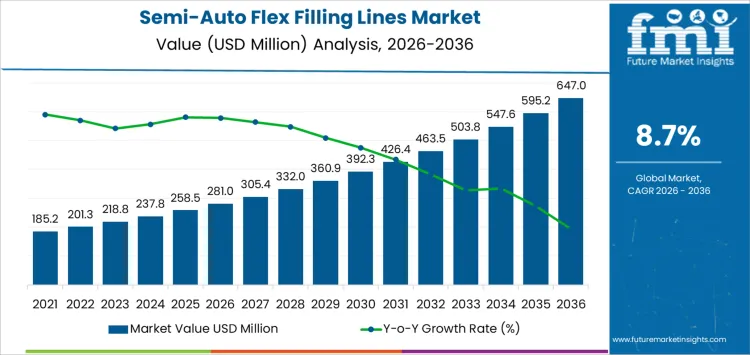
The semi-auto flex filling lines market is valued at USD 281 million in 2026 and is projected to reach USD 647 million by 2036, reflecting a CAGR of 8.7%. Analysis of annual growth trends reveals distinct cyclical behavior, with moderate increases during early-year quarters and accelerated adoption in the latter half, often aligned with peak production schedules in food, beverage, and personal care sectors. Seasonal spikes coincide with new product launches, promotional campaigns, and inventory replenishments, driving concentrated deployment of semi-automatic filling lines during these periods.
From 2031 to 2036, the market continues to follow a recognizable cyclical pattern, with absolute yearly gains fluctuating but maintaining an overall upward trajectory. High-demand periods are linked to seasonal production surges, regulatory compliance cycles, and capital investment planning, while slower periods correspond to maintenance downtime and operational recalibration. This cyclical behavior underscores the importance of aligning production capacity, workforce allocation, and investment decisions with expected seasonal demand patterns, ensuring optimal utilization of semi-auto flex filling line infrastructure across global manufacturing operations.
Quick Stats of the Semi-Auto Flex Filling Lines Market:
- Semi-Auto Flex Filling Lines Market Value (2026): USD 281.0 million
- Semi-Auto Flex Filling Lines Market Forecast Value (2036): USD 647.0 million
- Semi-Auto Flex Filling Lines Market Forecast CAGR (2026 to 2036): 8.7%
- Leading System Type: Semi-auto pouch & bag filling lines (50%)
- Key Growth Regions: India, China, USA, Brazil, Germany, Japan
- Top Players: MULTIVAC, GEA, Bosch Packaging, Hualian, UFlex Machinery, Toppan Automation, Local Integrators
What is the Growth Forecast for the Semi-Auto Flex Filling Lines Market through 2036?
From 2026 to 2031, the Semi-Auto Flex Filling Lines Market grows from USD 195 million to approximately USD 289 million, representing a recovery from an early trough toward an initial peak. Early demand is concentrated among food, beverage, and pharmaceutical manufacturers upgrading packaging efficiency while validating line performance and output quality. Growth in this period is incremental as companies integrate die-cut capabilities into selected production lines, and annual value additions reflect cautious scaling rather than full system deployment. The trough-to-peak phase is marked by gradual adoption, tool qualification, and capacity alignment with production requirements.
Between 2031 and 2036, the market expands from roughly USD 289 million to USD 468 million, marking the peak phase where broader commercial deployment drives accelerated value creation. Growth in this interval reflects portfolio-wide integration of die-cut lines, higher throughput utilization, and expansion across multiple sites and product SKUs. Annual additions increase substantially as adoption becomes standardized, repeat procurement grows, and manufacturers implement die-cut lines as a core component of high-speed fill-seal operations. Earlier growth relied on selective upgrades, while later expansion reflects structural scaling, higher line density per facility, and broader geographic penetration.
Semi Auto Flex Filling Lines Market Key Takeaways
| Metric | Value |
|---|---|
| Sales Value (2026) | USD 281 million |
| Forecast Value (2036) | USD 647 million |
| Forecast CAGR (2026 to 2036) | 8.7% |
How Is Demand Developing for Semi Auto Flex Filling Lines Across Packaging Operations?
Initial demand for semi auto flex filling lines arose from structural gaps between artisanal production and full scale industrial automation. Many manufacturers operated with skilled labor but faced limits in repeatability, hygiene control, and output predictability. Semi-automated filling lines offered a controlled step forward by introducing measured dosing, basic automation, and operator assisted workflows. Historical growth was strongest among regional food processors, specialty beverage producers, and contract packers managing diverse product portfolios. These systems supported compliance with basic quality standards while preserving manual oversight. Purchasing decisions emphasized simplicity, ease of maintenance, and operator training rather than system connectivity or speed, keeping adoption concentrated among firms balancing cost discipline with incremental capacity improvement.
Future demand for semi auto flex filling lines is expected to reflect changing production economics rather than incremental automation alone. Labor availability constraints and rising wage pressures are pushing manufacturers to stabilize output with fewer operators. Semi auto systems are increasingly deployed as flexible capacity buffers rather than permanent installations. Equipment designs now focus on rapid sanitation, interchangeable filling heads, and compatibility with varied viscosities and packaging formats. Growth will be supported by decentralized manufacturing models and short run production strategies. Unlike earlier adoption driven by productivity uplift, future expansion reflects resilience planning, workforce adaptation, and the need to maintain output consistency under variable demand conditions.
What Factors Are Affecting the Demand for Semi Auto Flex Filling Lines Market in Terms of End Use Application and Packaging and System Type?
Demand for semi auto flex filling lines is shaped by end use application and packaging or system type across small and mid-scale production environments. SME food and cosmetics producers account for about 45% of total demand, reflecting reliance on flexible, cost controlled filling operations. Pharma and nutraceutical producers, private label and retail brands, and small scale processors form additional application groups with varied batch requirements. Regional food processors contribute selective demand based on localized production needs. Packaging and system type determines line flexibility, footprint, and operator involvement. Semi auto pouch lines, vertical fillers, small batch systems, and entry level lines address different production constraints. These segments explain demand patterns driven by batch variability, capital limits, and operational control needs.
What Drives Demand by End Use Application in the Semi Auto Flex Filling Lines Market?
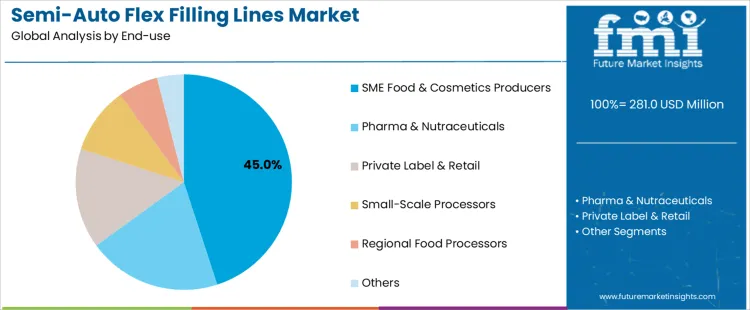
SME food and cosmetics producers lead demand due to frequent product variation and moderate output volumes. These producers require filling systems that balance manual control with repeatable accuracy. Pharma and nutraceutical applications adopt semi auto lines for small batch production and formulation changes. Private label and retail brands rely on flexible lines to support short production runs and packaging customization. Small scale processors favor systems with low setup complexity and limited training needs. Regional food processors adopt selectively to support seasonal or specialty products. Adoption intensity aligns with batch size variability and capital sensitivity. End use demand concentrates where flexibility and control outweigh the need for continuous high speed automation.
Application driven demand remains stable because production diversity persists across small and mid-sized manufacturers. SMEs embed semi auto filling into routine operations to manage frequent changeovers. Pharma users prioritize precision and validation over speed. Private label producers value adaptability to shifting retailer requirements. Small scale processors adopt entry level systems to formalize manual processes. Regional producers apply systems where scale does not justify full automation. These patterns limit demand volatility. End use segmentation highlights structural reliance on semi-automated workflows. Demand therefore follows production diversity and cost discipline rather than aggressive capacity expansion across processing sectors.
How Does Packaging and System Type Shape Demand for Semi Auto Flex Filling Lines Market?
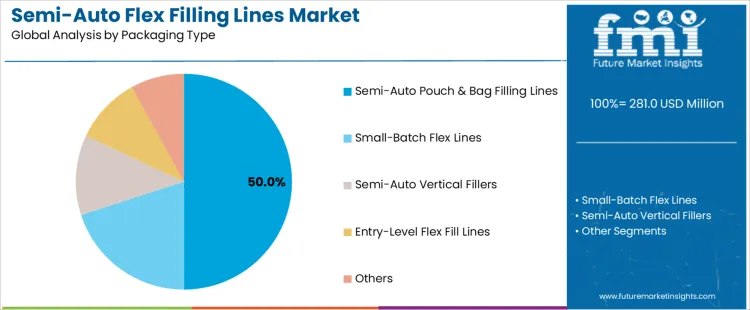
Semi auto pouch and bag filling lines account for about 50% of total demand, making them the leading system type. Their adoption reflects suitability for flexible packaging formats and moderate throughput. Small batch flex lines are used where frequent product changeovers are required. Semi auto vertical fillers support standardized packaging in private label and retail operations. Entry level flex fill lines serve first time adopters transitioning from manual filling. Other system types address niche applications. System selection depends on packaging format, operator involvement, and floor space. Demand follows practical deployment needs rather than maximum output capability across small and mid-scale producers.
Pouch and bag filling systems maintain leadership due to versatility and manageable investment requirements. Small batch lines reduce downtime during product transitions. Vertical fillers support consistency in standardized packs. Entry level systems lower adoption barriers for emerging producers. Organizations favor systems compatible with existing packaging materials and staffing levels. Major system changes are avoided due to retraining and validation costs. This constrains rapid shifts toward full automation. Packaging and system type therefore stabilize demand by aligning with operational realities. These constraints explain why semi auto configurations dominate adoption rather than fully automated flex filling solutions.
How Are Semi Auto Flex Filling Lines Being Applied Across Packaging and Production Operations?
Use appears in facilities that require flexible, medium volume filling without the full automation investment of high speed lines. Beverage and liquid food producers adopt semi auto flex lines for small batch runs or seasonal product variations. Personal care and cosmetic brands use them for lotions, shampoos, and oils in bottles of varying sizes. Pharmaceutical manufacturers apply semi auto filling for liquid medications in multi dose vials. These applications reflect operational priorities tied to flexibility, efficiency, and cost control rather than continuous high volume throughput.
What Operational Conditions Encourage Adoption of Semi Auto Flex Filling Lines?
Selection aligns with facilities managing variable product types, container formats, and batch sizes. Production teams value modular configurations that allow rapid changeovers between SKUs. Operators rely on equipment that maintains accurate fill levels while accommodating different viscosities. Maintenance teams benefit from compact design and simplified cleaning protocols. Quality control uses semi-automated monitoring to ensure consistent output. These conditions arise from the need for flexible, medium scale production with repeatable accuracy in structured manufacturing workflows.
Which Practical Considerations Limit Wider Use of Semi Auto Flex Filling Lines?
Throughput is lower compared with fully automated systems, affecting adoption in high volume operations. Operator skill is required to maintain consistent fill and line speed. Equipment cost can be high relative to very small batch manual filling. Cleaning and changeover procedures may still require downtime that impacts scheduling. Compatibility with existing capping or labeling systems may require adjustment. These factors result in selective use where flexibility, batch size variation, and moderate investment justify operational efficiency gains.
What is the Demand for Semi Auto Flex Filling Lines by Country?
| Country | CAGR (%) |
|---|---|
| USA | 7.5% |
| Germany | 6.9% |
| China | 10.8% |
| India | 11.5% |
| Brazil | 8.0% |
| Japan | 5.0% |
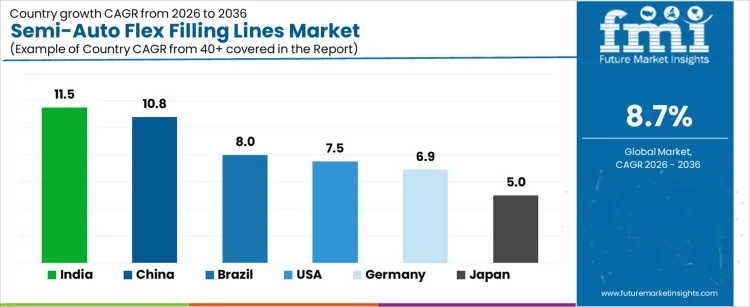
The demand for semi auto flex filling lines differs across countries, driven by flexible packaging adoption, production automation, and efficiency optimization. India leads with an 11.5% CAGR, supported by growth in packaged food, personal care, and pharmaceutical sectors, alongside rising adoption of semi-automated filling systems. China follows at 10.8%, driven by large scale manufacturing and modernization of packaging operations. The USA grows at 7.5%, reflecting adoption in snacks, beverages, and household products. Brazil records 8.0%, shaped by expanding production capacities. Germany posts 6.9%, supported by established manufacturing standards, while Japan grows at 5.0%, reflecting mature operations and stable demand for semi-automated filling technologies.
How Is Flexible Packaging Automation Driving Growth in the United States?
In the United States, revenue from the Semi-Auto Flex Filling Lines Market is expanding at a CAGR of 7.50% through 2035, driven by adoption of semi-automatic filling systems for flexible packaging in food, beverage, and personal care products. Manufacturers are integrating semi-auto lines to improve filling accuracy, reduce labor requirements, and maintain product consistency. Demand is concentrated in ready-to-eat meals, snack foods, and liquid pouches distributed through retail and industrial channels. Domestic equipment suppliers are providing semi-auto systems compatible with various pouch formats and film types. Stable production volumes and recurring packaging cycles are sustaining predictable procurement across packaging operations nationwide.
- Ready-to-eat meals, snack foods, and liquid pouches drive adoption of semi-auto flex filling lines
- Semi-automatic systems improve filling accuracy and reduce labor dependency
- Domestic suppliers provide systems compatible with multiple pouch formats and film types
- Recurring packaging cycles sustain predictable procurement volumes
How Do Quality Standards Shape Demand in Germany?
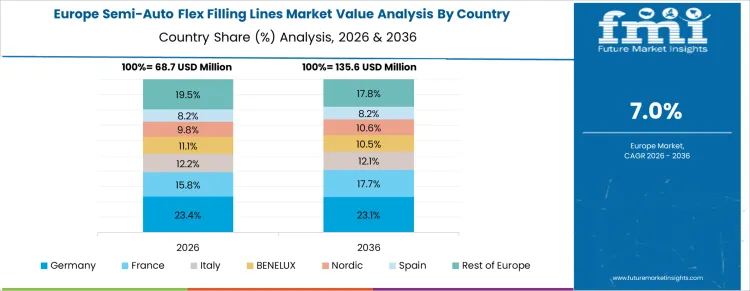
Germany continues to record steady growth in the Semi-Auto Flex Filling Lines Market at a CAGR of 6.90% through 2035, supported by structured quality standards and operational efficiency requirements. Manufacturers are integrating semi-auto flex lines for snacks, confectionery, and liquid products to maintain consistent fill weight and seal integrity. Demand is concentrated in industrial and retail packaging operations. Domestic suppliers are providing semi-auto systems designed for precision, reliability, and compatibility with existing production lines. Stable output volumes and compliance-driven procurement practices are sustaining measured adoption across packaging facilities nationwide.
- Quality standards encourage adoption of semi-auto flex filling lines for consistent filling and sealing
- Snacks, confectionery, and liquid products anchor demand
- Domestic suppliers provide reliable and compatible semi-auto systems
- Compliance-driven procurement sustains steady adoption levels
How Is Packaged Food Expansion Accelerating Adoption in China?
In China, revenue from the Semi-Auto Flex Filling Lines Market is growing at a CAGR of 10.80% through 2035, driven by rapid growth of packaged food manufacturing and modern retail distribution. Manufacturers are adopting semi-auto flex filling lines for liquid products, ready meals, and snack foods to improve efficiency and minimize material waste. Demand is strong across urban distribution hubs, e-commerce fulfillment, and retail networks. Domestic suppliers are scaling semi-auto line production with precision filling and sealing capabilities. High throughput operations and structured procurement practices are sustaining rapid adoption nationwide.
- Packaged food manufacturing drives demand for semi-auto flex filling lines
- Liquid products, ready meals, and snack foods are primary applications
- Domestic suppliers scale production with precision filling and sealing capabilities
- Urban retail and e-commerce distribution sustain consistent adoption
How Is Organized Manufacturing Supporting Growth in India?
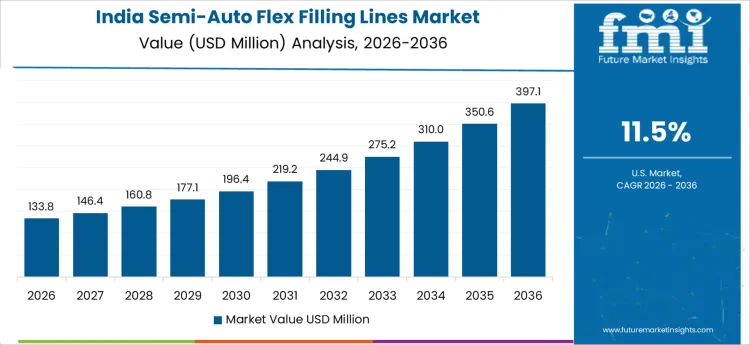
India is witnessing strong expansion in the Semi-Auto Flex Filling Lines Market at a CAGR of 11.50% through 2035, supported by growth in organized food and beverage production. Manufacturers are integrating semi-auto lines for snacks, beverages, and ready-to-eat products to improve fill accuracy, reduce labor, and enhance throughput. Demand is rising across urban retail, e-commerce, and institutional supply channels. Domestic suppliers are providing cost-aligned semi-auto systems suitable for high-volume production. Expanding retail penetration and organized manufacturing networks are sustaining robust procurement nationwide.
- Organized food and beverage manufacturing increases demand for semi-auto flex filling lines
- Snacks, beverages, and ready-to-eat meals drive high-volume adoption
- Domestic suppliers provide cost-aligned semi-auto systems
- Retail expansion and organized production sustain procurement growth
How Are Consumer Goods Shipments Supporting Adoption in Brazil?
Brazil is seeing steady growth in the Semi-Auto Flex Filling Lines Market at a CAGR of 8.00% through 2035, supported by expansion of packaged food and beverage distribution. Manufacturers are using semi-auto flex lines to maintain fill accuracy, improve throughput, and optimize flexible packaging operations. Demand is concentrated in snacks, confectionery, and liquid-filled pouches. Imports supply some specialized machinery, while domestic suppliers expand production and integration capacity. Growth in retail networks and packaged goods shipments is sustaining recurring procurement across packaging operations nationwide.
- Snack foods, confectionery, and liquid pouches drive semi-auto flex line adoption
- Semi-auto systems improve filling accuracy and production efficiency
- Domestic suppliers expand production and integration capacity
- Retail and distribution growth sustain recurring procurement
How Does Mature Packaging Demand Influence Stability in Japan?
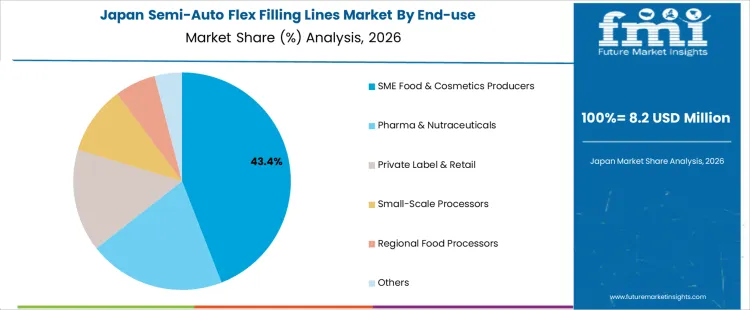
Japan is maintaining measured growth in the Semi-Auto Flex Filling Lines Market at a CAGR of 5.00% through 2035, supported by mature packaging markets and selective adoption of semi-auto systems. Manufacturers apply flex filling lines for snacks, beverages, and ready-to-eat meals. Demand remains focused on precision, reliability, and compatibility with existing packaging lines. Domestic suppliers emphasize process control and consistent performance. Stable consumption patterns and replacement-driven purchasing are sustaining predictable procurement across established packaging operations nationwide.
- Mature packaging markets favor selective adoption of semi-auto flex filling lines
- Snacks, beverages, and ready-to-eat meals anchor baseline demand
- Domestic suppliers ensure precise operation and consistent performance
- Replacement-driven purchasing sustains procurement continuity
Which Companies Are Shaping Competition in The Semi Auto Flex Filling Lines Market Across Food and Industrial Packaging Operations?
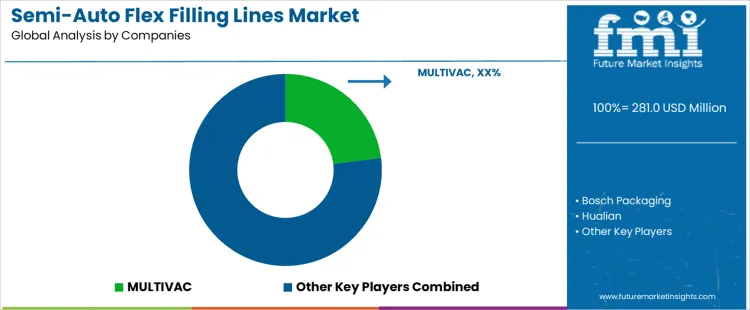
Competition in the Semi Auto Flex Filling Lines Market is driven by established packaging equipment manufacturers with strong application depth. MULTIVAC and GEA influence adoption through semi-automated filling systems used in food processing, dairy, and protein packaging environments where flexibility and hygiene standards matter. Bosch Packaging, now operating under restructured packaging technology operations, contributes legacy system expertise and installed base continuity in flexible filling applications. These companies compete on mechanical reliability, dosing accuracy, and ease of cleaning rather than full automation intensity. Customer preference often favors semi-automated lines where labor availability, batch variation, and moderate throughput requirements shape investment decisions. Equipment selection reflects proven performance, service access, and compatibility with existing flexible packaging formats.
Regional manufacturers and integrators add practical competitiveness to the market structure. Hualian supplies cost focused semi auto filling lines widely adopted by small and mid-scale processors, particularly in Asia and export oriented facilities. UFlex Machinery participates through flexible packaging equipment offerings aligned with pouch formats used by regional brand owners. Toppan Automation supports filling line integration within broader packaging workflows, especially where printing and converting interfaces are required. Local integrators play a decisive role by configuring systems to site specific requirements, handling installation, and providing ongoing service support. Competitive positioning is shaped by customization capability, responsiveness, and alignment with customer operating constraints rather than proprietary technology ownership alone.
Key Players in the Semi Auto Flex Filling Lines Market
- MULTIVAC
- GEA
- Bosch Packaging
- Hualian
- UFlex Machinery
- Local Integrators
- Toppan Automation
Scope of the Report
| Items | Values |
|---|---|
| Quantitative Units (2026) | USD million |
| End-use / Application | SME Food & Cosmetics Producers; Pharma & Nutraceuticals; Private Label & Retail; Small-Scale Processors; Regional Food Processors; Others |
| Packaging / System Type | Semi-Auto Pouch & Bag Filling Lines; Small-Batch Flex Lines; Semi-Auto Vertical Fillers; Entry-Level Flex Fill Lines; Others |
| Material | Flexible Film Laminates; High-Barrier Films; Cost-Optimized Laminates; Mono-PE Films; Others |
| Technology | Servo-Driven Fillers + FFS Interface; Cleanroom-Compatible Filling; PLC-Integrated Controls; Operator-Assist Filling Systems; Others |
| Region | Asia Pacific; Europe; North America; Latin America; Middle East & Africa |
| Countries Covered | China; Japan; South Korea; India; Australia & New Zealand; ASEAN; Germany; United Kingdom; France; Italy; Spain; Nordic; BENELUX; United States; Canada; Mexico; Brazil; Chile; Kingdom of Saudi Arabia; Other GCC Countries; Turkey; South Africa; Other African Union; Rest of Asia Pacific; Rest of Europe; Rest of Latin America; Rest of Middle East & Africa |
| Key Companies Profiled | MULTIVAC, GEA; Bosch Packaging; Hualian; UFlex Machinery; Local Integrators; Toppan Automation |
| Additional Attributes | Dollar by sales across end-use applications, system types, and technologies; Semi-auto pouch & bag filling lines lead demand due to flexibility and moderate throughput; Small batch and vertical filler lines enable adaptability to frequent SKU changes; Entry-level systems support first-time adopters and SMEs; Adoption driven by food, beverage, personal care, and pharmaceutical packaging; Integration with FFS and PLC systems enhances accuracy and operational efficiency; Specification control includes fill precision, sanitation compatibility, material handling, and changeover speed; Recurring procurement aligns with seasonal demand, promotional cycles, and product launches; Demand reflects operational flexibility, batch consistency, and capital-conscious investment strategies rather than full automation |
Semi Auto Flex Filling Lines Market Segmentation
End-use / Application:
- SME Food & Cosmetics Producers
- Pharma & Nutraceuticals
- Private Label & Retail
- Small-Scale Processors
- Regional Food Processors
- Others
Packaging / System Type:
- Semi-Auto Pouch & Bag Filling Lines
- Small-Batch Flex Lines
- Semi-Auto Vertical Fillers
- Entry-Level Flex Fill Lines
- Others
Material:
- Flexible Film Laminates
- High-Barrier Films
- Cost-Optimized Laminates
- Mono-PE Films
- Others
Technology:
- Servo-Driven Fillers + FFS Interface
- Cleanroom-Compatible Filling
- PLC-Integrated Controls
- Operator-Assist Filling Systems
- Others
Region
- Asia Pacific
- China
- Japan
- South Korea
- India
- Australia & New Zealand
- ASEAN
- Rest of Asia Pacific
- Europe
- Germany
- United Kingdom
- France
- Italy
- Spain
- Nordic
- BENELUX
- Rest of Europe
- North America
- United States
- Canada
- Mexico
- Latin America
- Brazil
- Chile
- Rest of Latin America
- Middle East & Africa
- Kingdom of Saudi Arabia
- Other GCC Countries
- Turkey
- South Africa
- Other African Union
- Rest of Middle East & Africa
Frequently Asked Questions
How big is the semi-auto flex filling lines market in 2026?
The global semi-auto flex filling lines market is estimated to be valued at USD 281.0 million in 2026.
What will be the size of semi-auto flex filling lines market in 2036?
The market size for the semi-auto flex filling lines market is projected to reach USD 647.0 million by 2036.
How much will be the semi-auto flex filling lines market growth between 2026 and 2036?
The semi-auto flex filling lines market is expected to grow at a 8.7% CAGR between 2026 and 2036.
What are the key product types in the semi-auto flex filling lines market?
The key product types in semi-auto flex filling lines market are sme food & cosmetics producers, pharma & nutraceuticals, private label & retail, small-scale processors, regional food processors and others.
Which packaging type segment to contribute significant share in the semi-auto flex filling lines market in 2026?
In terms of packaging type, semi-auto pouch & bag filling lines segment to command 50.0% share in the semi-auto flex filling lines market in 2026.
Preview the report firsthand - request a free sample
Get SampleGet the brochure for pricing and purchase details.
Get PDFTable of Content
- Executive Summary
- Global Market Outlook
- Demand-side Trends
- Supply-side Trends
- Technology Roadmap Analysis
- Analysis and Recommendations
- Market Overview
- Market Coverage / Taxonomy
- Market Definition / Scope / Limitations
- Market Background
- Market Dynamics
- Drivers
- Restraints
- Opportunity
- Trends
- Scenario Forecast
- Demand in Optimistic Scenario
- Demand in Likely Scenario
- Demand in Conservative Scenario
- Opportunity Map Analysis
- Product Life Cycle Analysis
- Supply Chain Analysis
- Investment Feasibility Matrix
- Value Chain Analysis
- PESTLE and Porter’s Analysis
- Regulatory Landscape
- Regional Parent Market Outlook
- Production and Consumption Statistics
- Import and Export Statistics
- Market Dynamics
- Global Market Analysis 2021 to 2025 and Forecast, 2026 to 2036
- Historical Market Size Value (USD Million) Analysis, 2021 to 2025
- Current and Future Market Size Value (USD Million) Projections, 2026 to 2036
- Y-o-Y Growth Trend Analysis
- Absolute $ Opportunity Analysis
- Global Market Pricing Analysis 2021 to 2025 and Forecast 2026 to 2036
- Global Market Analysis 2021 to 2025 and Forecast 2026 to 2036, By End-use
- Introduction / Key Findings
- Historical Market Size Value (USD Million) Analysis By End-use , 2021 to 2025
- Current and Future Market Size Value (USD Million) Analysis and Forecast By End-use , 2026 to 2036
- SME Food & Cosmetics Producers
- Pharma & Nutraceuticals
- Private Label & Retail
- Small-Scale Processors
- Regional Food Processors
- Others
- Y-o-Y Growth Trend Analysis By End-use , 2021 to 2025
- Absolute $ Opportunity Analysis By End-use , 2026 to 2036
- Global Market Analysis 2021 to 2025 and Forecast 2026 to 2036, By Packaging Type
- Introduction / Key Findings
- Historical Market Size Value (USD Million) Analysis By Packaging Type, 2021 to 2025
- Current and Future Market Size Value (USD Million) Analysis and Forecast By Packaging Type, 2026 to 2036
- Semi-Auto Pouch & Bag Filling Lines
- Small-Batch Flex Lines
- Semi-Auto Vertical Fillers
- Entry-Level Flex Fill Lines
- Others
- Y-o-Y Growth Trend Analysis By Packaging Type, 2021 to 2025
- Absolute $ Opportunity Analysis By Packaging Type, 2026 to 2036
- Global Market Analysis 2021 to 2025 and Forecast 2026 to 2036, By Material
- Introduction / Key Findings
- Historical Market Size Value (USD Million) Analysis By Material, 2021 to 2025
- Current and Future Market Size Value (USD Million) Analysis and Forecast By Material, 2026 to 2036
- Flexible Film Laminates
- High-Barrier Films
- Cost-Optimized Laminates
- Mono-PE Films
- Others
- Y-o-Y Growth Trend Analysis By Material, 2021 to 2025
- Absolute $ Opportunity Analysis By Material, 2026 to 2036
- Global Market Analysis 2021 to 2025 and Forecast 2026 to 2036, By Technology
- Introduction / Key Findings
- Historical Market Size Value (USD Million) Analysis By Technology, 2021 to 2025
- Current and Future Market Size Value (USD Million) Analysis and Forecast By Technology, 2026 to 2036
- Servo-Driven Fillers + FFS Interface
- Cleanroom-Compatible Filling
- PLC-Integrated Controls
- Operator-Assist Filling Systems
- Others
- Y-o-Y Growth Trend Analysis By Technology, 2021 to 2025
- Absolute $ Opportunity Analysis By Technology, 2026 to 2036
- Global Market Analysis 2021 to 2025 and Forecast 2026 to 2036, By Region
- Introduction
- Historical Market Size Value (USD Million) Analysis By Region, 2021 to 2025
- Current Market Size Value (USD Million) Analysis and Forecast By Region, 2026 to 2036
- North America
- Latin America
- Western Europe
- Eastern Europe
- East Asia
- South Asia and Pacific
- Middle East & Africa
- Market Attractiveness Analysis By Region
- North America Market Analysis 2021 to 2025 and Forecast 2026 to 2036, By Country
- Historical Market Size Value (USD Million) Trend Analysis By Market Taxonomy, 2021 to 2025
- Market Size Value (USD Million) Forecast By Market Taxonomy, 2026 to 2036
- By Country
- USA
- Canada
- Mexico
- By End-use
- By Packaging Type
- By Material
- By Technology
- By Country
- Market Attractiveness Analysis
- By Country
- By End-use
- By Packaging Type
- By Material
- By Technology
- Key Takeaways
- Latin America Market Analysis 2021 to 2025 and Forecast 2026 to 2036, By Country
- Historical Market Size Value (USD Million) Trend Analysis By Market Taxonomy, 2021 to 2025
- Market Size Value (USD Million) Forecast By Market Taxonomy, 2026 to 2036
- By Country
- Brazil
- Chile
- Rest of Latin America
- By End-use
- By Packaging Type
- By Material
- By Technology
- By Country
- Market Attractiveness Analysis
- By Country
- By End-use
- By Packaging Type
- By Material
- By Technology
- Key Takeaways
- Western Europe Market Analysis 2021 to 2025 and Forecast 2026 to 2036, By Country
- Historical Market Size Value (USD Million) Trend Analysis By Market Taxonomy, 2021 to 2025
- Market Size Value (USD Million) Forecast By Market Taxonomy, 2026 to 2036
- By Country
- Germany
- UK
- Italy
- Spain
- France
- Nordic
- BENELUX
- Rest of Western Europe
- By End-use
- By Packaging Type
- By Material
- By Technology
- By Country
- Market Attractiveness Analysis
- By Country
- By End-use
- By Packaging Type
- By Material
- By Technology
- Key Takeaways
- Eastern Europe Market Analysis 2021 to 2025 and Forecast 2026 to 2036, By Country
- Historical Market Size Value (USD Million) Trend Analysis By Market Taxonomy, 2021 to 2025
- Market Size Value (USD Million) Forecast By Market Taxonomy, 2026 to 2036
- By Country
- Russia
- Poland
- Hungary
- Balkan & Baltic
- Rest of Eastern Europe
- By End-use
- By Packaging Type
- By Material
- By Technology
- By Country
- Market Attractiveness Analysis
- By Country
- By End-use
- By Packaging Type
- By Material
- By Technology
- Key Takeaways
- East Asia Market Analysis 2021 to 2025 and Forecast 2026 to 2036, By Country
- Historical Market Size Value (USD Million) Trend Analysis By Market Taxonomy, 2021 to 2025
- Market Size Value (USD Million) Forecast By Market Taxonomy, 2026 to 2036
- By Country
- China
- Japan
- South Korea
- By End-use
- By Packaging Type
- By Material
- By Technology
- By Country
- Market Attractiveness Analysis
- By Country
- By End-use
- By Packaging Type
- By Material
- By Technology
- Key Takeaways
- South Asia and Pacific Market Analysis 2021 to 2025 and Forecast 2026 to 2036, By Country
- Historical Market Size Value (USD Million) Trend Analysis By Market Taxonomy, 2021 to 2025
- Market Size Value (USD Million) Forecast By Market Taxonomy, 2026 to 2036
- By Country
- India
- ASEAN
- Australia & New Zealand
- Rest of South Asia and Pacific
- By End-use
- By Packaging Type
- By Material
- By Technology
- By Country
- Market Attractiveness Analysis
- By Country
- By End-use
- By Packaging Type
- By Material
- By Technology
- Key Takeaways
- Middle East & Africa Market Analysis 2021 to 2025 and Forecast 2026 to 2036, By Country
- Historical Market Size Value (USD Million) Trend Analysis By Market Taxonomy, 2021 to 2025
- Market Size Value (USD Million) Forecast By Market Taxonomy, 2026 to 2036
- By Country
- Kingdom of Saudi Arabia
- Other GCC Countries
- Turkiye
- South Africa
- Other African Union
- Rest of Middle East & Africa
- By End-use
- By Packaging Type
- By Material
- By Technology
- By Country
- Market Attractiveness Analysis
- By Country
- By End-use
- By Packaging Type
- By Material
- By Technology
- Key Takeaways
- Key Countries Market Analysis
- USA
- Pricing Analysis
- Market Share Analysis, 2025
- By End-use
- By Packaging Type
- By Material
- By Technology
- Canada
- Pricing Analysis
- Market Share Analysis, 2025
- By End-use
- By Packaging Type
- By Material
- By Technology
- Mexico
- Pricing Analysis
- Market Share Analysis, 2025
- By End-use
- By Packaging Type
- By Material
- By Technology
- Brazil
- Pricing Analysis
- Market Share Analysis, 2025
- By End-use
- By Packaging Type
- By Material
- By Technology
- Chile
- Pricing Analysis
- Market Share Analysis, 2025
- By End-use
- By Packaging Type
- By Material
- By Technology
- Germany
- Pricing Analysis
- Market Share Analysis, 2025
- By End-use
- By Packaging Type
- By Material
- By Technology
- UK
- Pricing Analysis
- Market Share Analysis, 2025
- By End-use
- By Packaging Type
- By Material
- By Technology
- Italy
- Pricing Analysis
- Market Share Analysis, 2025
- By End-use
- By Packaging Type
- By Material
- By Technology
- Spain
- Pricing Analysis
- Market Share Analysis, 2025
- By End-use
- By Packaging Type
- By Material
- By Technology
- France
- Pricing Analysis
- Market Share Analysis, 2025
- By End-use
- By Packaging Type
- By Material
- By Technology
- India
- Pricing Analysis
- Market Share Analysis, 2025
- By End-use
- By Packaging Type
- By Material
- By Technology
- ASEAN
- Pricing Analysis
- Market Share Analysis, 2025
- By End-use
- By Packaging Type
- By Material
- By Technology
- Australia & New Zealand
- Pricing Analysis
- Market Share Analysis, 2025
- By End-use
- By Packaging Type
- By Material
- By Technology
- China
- Pricing Analysis
- Market Share Analysis, 2025
- By End-use
- By Packaging Type
- By Material
- By Technology
- Japan
- Pricing Analysis
- Market Share Analysis, 2025
- By End-use
- By Packaging Type
- By Material
- By Technology
- South Korea
- Pricing Analysis
- Market Share Analysis, 2025
- By End-use
- By Packaging Type
- By Material
- By Technology
- Russia
- Pricing Analysis
- Market Share Analysis, 2025
- By End-use
- By Packaging Type
- By Material
- By Technology
- Poland
- Pricing Analysis
- Market Share Analysis, 2025
- By End-use
- By Packaging Type
- By Material
- By Technology
- Hungary
- Pricing Analysis
- Market Share Analysis, 2025
- By End-use
- By Packaging Type
- By Material
- By Technology
- Kingdom of Saudi Arabia
- Pricing Analysis
- Market Share Analysis, 2025
- By End-use
- By Packaging Type
- By Material
- By Technology
- Turkiye
- Pricing Analysis
- Market Share Analysis, 2025
- By End-use
- By Packaging Type
- By Material
- By Technology
- South Africa
- Pricing Analysis
- Market Share Analysis, 2025
- By End-use
- By Packaging Type
- By Material
- By Technology
- USA
- Market Structure Analysis
- Competition Dashboard
- Competition Benchmarking
- Market Share Analysis of Top Players
- By Regional
- By End-use
- By Packaging Type
- By Material
- By Technology
- Competition Analysis
- Competition Deep Dive
- MULTIVAC
- Overview
- Product Portfolio
- Profitability by Market Segments (Product/Age /Sales Channel/Region)
- Sales Footprint
- Strategy Overview
- Marketing Strategy
- Product Strategy
- Channel Strategy
- Bosch Packaging
- Hualian
- UFlex Machinery
- Local Integrators
- Toppan Automation
- GEA
- MULTIVAC
- Competition Deep Dive
- Assumptions & Acronyms Used
- Research Methodology


