

- Market Size (2026)
- USD 860.7 Mn
- Forecast (2036)
- USD 1498.3 Mn
- CAGR (2026 to 2036)
- 5.7%
How big is Filter Cake Breakers Market in 2026?
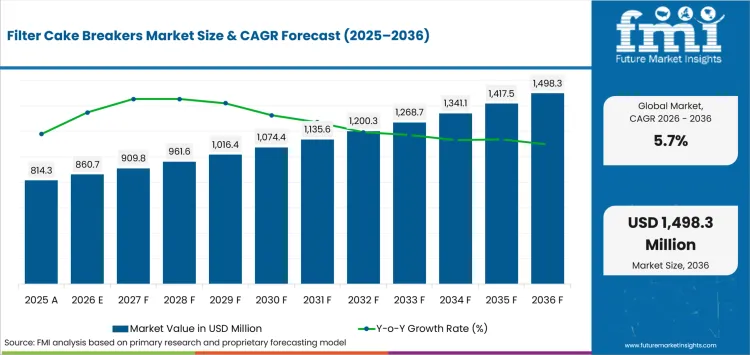
USD 860.7 million in 2026 and USD 1,498.3 million by 2036 at a 5.7% CAGR.
Filter cake breaker demand begins after drilling and completion fluids have finished controlling fluid loss and the interval must contribute flow. The market is projected to rise from USD 860.7 million in 2026 to USD 1,498.3 million by 2036 at a 5.7% CAGR. EIA’s July 2026 update recorded USA crude output at 13.6 million barrels per day in 2025. Higher output per completed well raises the penalty from residual cake, so completion teams test chemistry against the actual cake and planned brine.
Country demand depends on well design and service intensity more than national production volume. Oman shows the difference through offshore appraisal: the Ministry of Energy and Minerals signed a February 2026 Block 18 concession covering more than 21,000 square kilometers with a four-year initial exploration period. Deepwater appraisal increases the cost of poorly timed cleanup because the breaker must preserve fluid-loss control during placement and react inside a verified window. Local laboratories therefore become part of the commercial route for oilfield chemicals used with each completion design.
Key Takeaways
- Demand is tied to restoring near-wellbore permeability after reservoir drilling fluids have completed their temporary fluid-loss function.
- Based on breaker type, enzyme breakers are projected to account for 22.0% in 2026 due to selective polymer degradation and lower corrosion exposure than strong mineral-acid routes.
- In 2026, water-based mud cake is expected to lead filter cake with 31.0% share because several breaker routes can address its polymer and carbonate components.
- Open-hole completion is set to lead the application category with 27.0% share in 2026 due to direct contact between filter cake and exposed reservoir rock.
- Qualification remains the principal restraint because cake composition, brine chemistry, temperature, and planned activation time can change breaker performance materially.
- Key players in the filter cake breakers market include Halliburton, SLB, Baker Hughes, TETRA Technologies, Clariant, Innospec, CES Energy Solutions, and Italmatch Chemicals Group.
Analyst Perspective
"Filter cake breaker value depends on keeping the cake intact through screen placement and then clearing it inside the tested reaction window. Programs that change brine or reservoir-drilling-fluid design will keep laboratory evidence and field timing ahead of drum price."
- Nikhil Kaitwade, Principal Consultant, Future Market Insights
How is the filter cake breakers market segmented?
The filter cake breakers market is segmented by breaker type, filter cake, application, release profile, sales channel, and region.
Breaker type covers enzyme, oxidizing, acid, chelant, and delayed-release systems. Filter cake separates water-based, oil-based, polymer, carbonate, and starch residues. Applications cover open-hole completion, gravel pack cleanup, screen cleanup, wellbore cleanup, and production enhancement. Release profile and sales channel distinguish activation timing and route to customer.
Why do enzyme breakers lead the breaker type category?
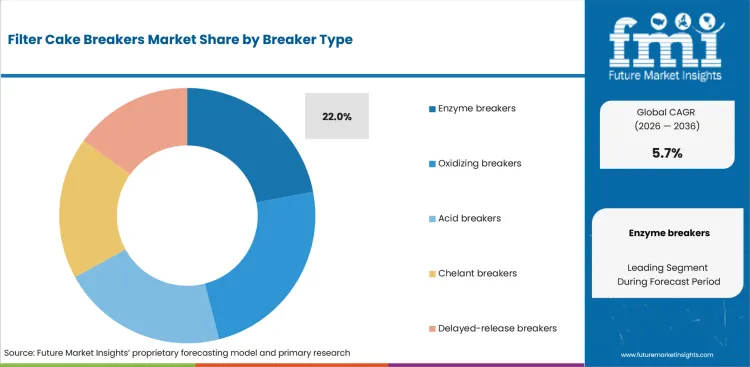
Enzyme breakers target starch and other susceptible polymers without requiring strongly acidic exposure to screens and tubulars. Selective cleanup fits onshore drilling fluids, though temperature, pH, salinity, and polymer chemistry narrow the usable window.
- By breaker type, enzyme breakers are estimated to hold 22.0% in 2026 owing to selective polymer degradation and lower corrosion exposure than strong mineral-acid routes.
- Saudi Aramco’s February 2025 sourcing specification lists a liquid enzyme filter cake breaker for water-based mud cake and requires batch documentation plus laboratory testing against representative samples. Routine purchasing therefore depends on proving enzyme activity against the fluid system actually used.
Why does water-based mud cake lead the filter cake category?
Water-based mud cake contains polymers and sized solids placed to control fluid loss over productive formations. A November 2025 Society of Petroleum Engineers case used synthetic polymer and sized calcium carbonate in a high-temperature reservoir drill-in fluid before applying a low-corrosive breaker treatment.
- By filter cake, water-based mud cake is estimated to hold 31.0% in 2026 owing to compatibility with enzyme, oxidizer, acid, and chelant cleanup routes.
- Several cleanup routes can attack different cake components, but the production chemicals selected for a job still need compatibility tests against the actual polymer and carbonate package during qualification.
Why does open-hole completion lead the application category?
Open-hole completion places filter cake directly against the reservoir interval and must coordinate chemical cleanup with oilwell completion tools. Breaker timing must preserve fluid-loss control until screens or gravel are positioned.
- The open-hole completion segment is likely to capture 27.0% share in 2026 attributable to direct contact between filter cake and exposed reservoir rock.
- At the 2025 SPE Annual Technical Conference, an offshore Angola study covering 12 wells reported planned productivity or skin targets in 90% of rapid-treatment wells versus 33% for slower breaker programs. The operator made the faster route its default practice in Blocks 17 and 32.
Why do completion service companies lead the sales channel category?
Completion service companies lead where breaker performance depends on laboratory matching and field execution. One accountable oil and gas field services route limits handoffs between reservoir-drilling fluid, completion brine, and screen-placement work.
- Completion service companies are set to lead the sales channel with 42.0% share in 2026 due to laboratory matching and field execution under one accountable provider.
- Baker Hughes received a September 2025 award to supply integrated subsea and completion systems for Turkish Petroleum’s Sakarya Gas Field Phase 3. The contract shows why operators can place several completion functions under one technical provider for execution.
What are the drivers, restraints and opportunities in the Filter Cake Breakers Market?
Well-productivity economics support demand, chemistry qualification limits interchangeability, and triggered release widens the operating window for complex completions.
- Driver: Operators need temporary filter cake during drilling but want that barrier removed before it restricts inflow or injectivity.
- Restraint: Breaker chemistry must match the actual cake, brine, temperature, metallurgy, and activation window before field approval.
- Opportunity: Triggered and delayed systems can separate placement from activation in long open-hole, deepwater, and high-temperature completions.
Well productivity keeps cleanup economics visible
Operators want reservoir-drilling fluids to control losses during drilling without carrying that barrier into production. EIA reported in March 2026 that USA crude output rose 3% in 2025 even as the active rig count averaged about 5% below 2024. More production from fewer rigs increases the cost of avoidable post-drilling skin within broader drilling waste management decisions.
Qualification limits chemistry interchangeability
Qualification slows adoption because filter cake can contain polymer, carbonate, weighting material, or oil-wet solids whose reaction rates change with temperature and pH. Halliburton’s December 2025 patent for a dual-acting delayed filtercake breaker describes controlling the delay before permeability is restored. Commercial approval depends on breakthrough tests that reproduce the actual mud, brine, and temperature.
Triggered release widens the usable completion window
Triggered release separates placement from reaction in long open-hole or high-temperature completions. Baker Hughes received USA Patent 12,448,561 in October 2025 for encapsulated oilfield chemicals designed for on-demand release. Chemistry earns commercial use once activation fits the planned completion window and the chosen brine, particularly in workflows that use intelligent completion systems.
Which country CAGRs are profiled in the Filter Cake Breakers Market?
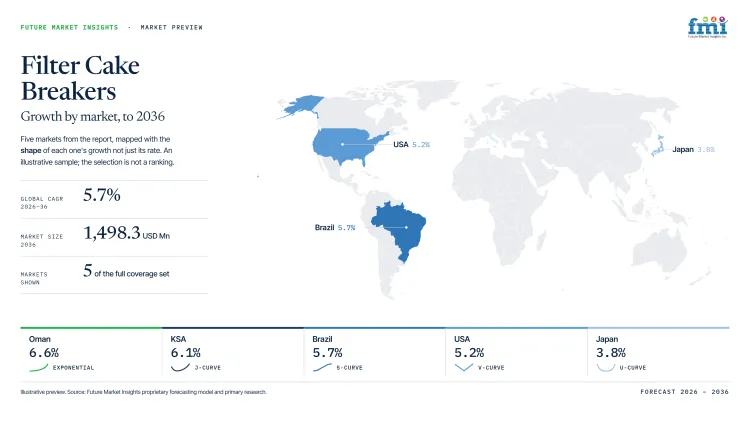
| Country | CAGR |
|---|---|
| Oman | 6.6% |
| KSA | 6.1% |
| UAE | 6.0% |
| Brazil | 5.7% |
| USA | 5.2% |
How do country-level CAGRs compare in the Filter Cake Breakers Market?
Country outlooks form a Gulf-led upper band, with Brazil as the transition market and USA below it. Oman, KSA, and UAE range from 6.0% to 6.6%. Brazil follows at 5.7%, and USA at 5.2%. The 1.4-point spread is narrow enough that well design and service structure can outweigh the headline CAGR in planning.
- Oman’s offshore acreage keeps appraisal work active.
- KSA’s concentrated operator base favors standardized completion work beside oilfield stimulation chemicals.
- UAE integrated drilling contracts reward field coverage under compressed delivery schedules.
- Brazil’s deepwater economics raise the cost of remedial cleanup after sand screen placement.
- USA service competition puts standalone chemistry under direct performance comparison.
Comparable growth rates therefore produce different approval costs and service requirements.
The full report provides country-level CAGR analysis across North America, Latin America, Western Europe, Eastern Europe, East Asia, South Asia and Pacific, and Middle East and Africa.
Country-wise Analysis
- Offshore appraisal in Oman places breaker design against carbonate intervals, elevated temperatures, and completion brines that can change reaction timing from one program to another. The Ministry of Energy and Minerals offered five new oil and gas concession areas in April 2026, widening the pipeline of projects that can require reservoir-drilling-fluid cleanup and related completion work. Oman is estimated to post 6.6% CAGR over the forecast period, helped by accessible regional laboratories and field support while formulation transfer remains the commercial limit because chemistry qualified on one cake still needs a verified reaction window before another fluid system can accept it.
- Large Saudi well programs reward repeatable chemistry because unconventional gas development concentrates many completions under common operating standards and local service schedules. Filter cake breaker demand in KSA is projected to grow at 6.1% CAGR through 2036, tied to program scale after Aramco confirmed in February 2026 that Jafurah had started production and retained its target for roughly 80% growth in sales-gas production capacity by 2030 versus 2021. Local inventory and repeatable batch testing improve execution speed, but high-temperature brines prevent a delayed-breaker recipe from moving between wells without laboratory confirmation of the planned activation window, cake composition, and completion brine.
- Integrated drilling contracts in the UAE compress the time available for fluid changes, laboratory review, and field mobilization during unconventional and offshore completion programs. ADNOC Drilling stated in May 2025 that Turnwell had reduced average well delivery to about 20 days, making prequalified chemistry and nearby technical support more useful to tightly sequenced operations. Filter cake breaker demand in the UAE is forecast to rise at 6.0% CAGR over the forecast period, supported by faster well execution provided that local laboratories can confirm brine compatibility quickly without weakening the testing needed for high-pressure, offshore, or short-cycle field service programs locally.
- Deepwater pre-salt completions in Brazil expose filter cake breaker programs to long open-hole intervals, costly vessel time, and limited tolerance for a second cleanup trip. ANP recorded 4.421 million barrels of oil equivalent per day from the pre-salt in March 2026, equal to 79.9% of national output from 184 wells. Brazil’s filter cake breaker outlook is anticipated to advance at 5.7% CAGR over the assessment period, attributable to deepwater project intensity and established offshore service capacity, though long residence times, remote logistics, and screen-placement sequences keep qualification demanding for chemistry entering high-cost commercial completion programs where remediation options are limited.
- USA completion programs with fewer active rigs place more weight on output per well and on chemistry that avoids extra intervention after the reservoir interval is drilled. Filter cake breaker sales in the USA are set to post 5.2% CAGR through 2036, driven by dense laboratory and field-service coverage that shortens testing and mobilization for well-specific recipes. EIA reported in November 2025 that active Lower 48 rigs had fallen to 517 from 750 in December 2022, so premium breaker chemistry faces direct comparison against other cleanup routes and must quantify recovered flow, lower skin, or avoided rig time for approval.
Who are the notable companies in the Filter Cake Breakers Market?
Halliburton, SLB, Baker Hughes, TETRA Technologies, Clariant, Innospec, CES Energy Solutions, and Italmatch Chemicals Group are the notable companies profiled in this market.
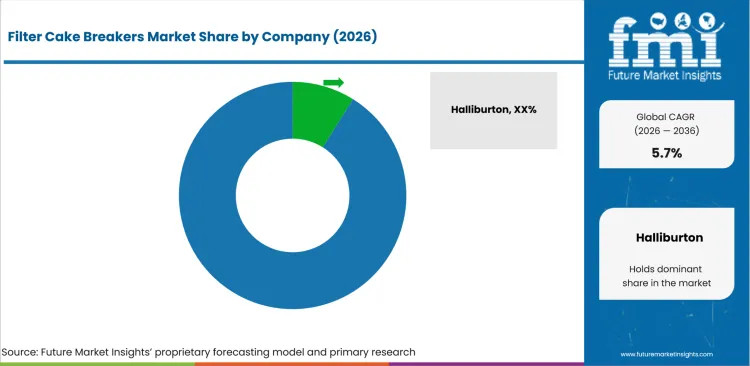
Competition separates by how much of the cleanup sequence each company can control. Halliburton, SLB, Baker Hughes, and TETRA Technologies pair completion-fluid delivery with laboratory and field execution. Clariant and Innospec provide specialty oilfield chemistry, while CES Energy Solutions and Italmatch Chemicals Group contribute regional drilling-fluid or well-service depth. Entry requires cake-specific test evidence, brine compatibility, and field support before an approved completion recipe changes.
- Integrated completion providers: Halliburton, SLB, Baker Hughes, and TETRA Technologies.
- Specialty oilfield formulators: Clariant and Innospec.
- Regional drilling-fluid and well-service chemistry providers: CES Energy Solutions and Italmatch Chemicals Group.
Competitive Benchmarking: Filter Cake Breakers Market
| Company | Filter Cake Chemistry Breadth | Open-Hole Cleanup Integration | High-Temperature / Brine Tolerance | Geographic Reach |
|---|---|---|---|---|
| Halliburton | High | High | High | Global |
| SLB | High | High | High | Global |
| Baker Hughes | High | High | High | Global |
| TETRA Technologies | High | High | High | Americas, Middle East, offshore markets |
| Clariant | Medium | Medium | Medium | Global |
| Innospec | Low | Medium | Medium | North America, Middle East, international oilfield markets |
| CES Energy Solutions | Medium | Medium | Medium | North America |
| Italmatch Chemicals Group | Medium | Medium | Medium | Europe, Middle East, Americas |
Scoring basis: High chemistry breadth requires at least three documented breaker or compatible cleanup routes, Medium requires two routes, and Low identifies one narrow route. High integration requires chemistry plus completion-fluid testing and field execution. Medium indicates application support without full execution control. High severe-service tolerance requires direct high-temperature or brine evidence. Medium reflects narrower documented exposure.
Key Developments in the Filter Cake Breakers Market
- In February 2026, Halliburton received USA Patent 12,559,666 for filter cake removal compositions using an ester-derived acid precursor and lactone. The patent gives completion teams another route for controlled acid generation after placement. Field use still requires breakthrough testing against the planned mud, brine, and temperature.
- In August 2025, SLB received USA Patent 12,391,863 for breaker fluids designed to break filtercake in a wellbore. The claims pair hydrolysable esters with an organic peroxide and include divalent brine. The chemistry targets high-temperature cleanup, but field use still depends on compatibility with the actual cake and completion sequence.
- In February 2025, Baker Hughes’ USA Patent Application Publication 2025/0059854 described an encapsulated internal filter cake breaker with on-demand release. The filing targets placement before activation by releasing breaker chemistry from a degradable shell. Commercial use still depends on proving release timing against the planned filter cake and brine.
Key Players in the Filter Cake Breakers Market
Integrated completion and breaker providers
- Halliburton
- SLB
- Baker Hughes
- TETRA Technologies
Specialty oilfield formulators
- Clariant
- Innospec
Regional drilling-fluid and well-service chemistry providers
- CES Energy Solutions
- Italmatch Chemicals Group
Filter Cake Breakers Market - Report Scope
| Coverage field | Report scope |
|---|---|
| Market breakdown | Breaker type, filter cake, application, release profile, sales channel, and region. |
| Quantitative Units | USD million. |
| Market Definition | Revenue includes filter cake breaker products sold to chemically degrade, dissolve, or weaken wellbore filter cake within the stated segmentation. It excludes adjacent drilling or completion chemistry not sold for filter cake removal. |
| Regions Covered | North America, Latin America, Western Europe, Eastern Europe, East Asia, South Asia and Pacific, and Middle East and Africa. |
| Countries Covered | Oman, KSA, UAE, Brazil, USA, and additional countries included in the full report. |
| Key Companies Profiled | Halliburton, SLB, Baker Hughes, TETRA Technologies, Clariant, Innospec, CES Energy Solutions, and Italmatch Chemicals Group. |
| Forecast Period | 2026 to 2036. |
| Approach | Primary and secondary research with market triangulation. |
Filter Cake Breakers Market - Research Methodology
| Method | Approach |
|---|---|
| Primary Research | FMI analysts gathered input from manufacturers, service providers, technology developers, distributors, end users, procurement teams, and subject-matter experts. Interviews examined purchasing decisions, product or service evaluation, adoption barriers, approval requirements, pricing considerations, and expectations for technical or commercial support. Respondents were also asked what evidence is required before a trial, pilot, or initial order develops into regular purchasing. |
| Desk Research | Desk research covered government statistics, regulatory publications, trade data, industry associations, technical literature, standards, company filings, product information, and official corporate announcements. Sources were reviewed for relevance, publication date, geographic coverage, and consistency with the defined market scope. Claims relating to performance, applications, approvals, capacity, investment, and commercial activity were retained only when supported by credible public evidence. |
| Market Sizing and Forecasting | The market model combined the baseline value with historical performance, segment structure, pricing and volume indicators, adoption levels, company participation, and country-level demand conditions. Forecast assumptions considered economic activity, investment trends, regulatory developments, technology adoption, purchasing cycles, supply availability, and barriers to wider market use. Segment and regional estimates were reconciled before the final market total was calculated. |
| Data Validation | Estimates were checked against multiple independent indicators, including public data, company activity, trade patterns, industry developments, and findings from primary interviews. Validation also tested whether products, services, applications, and company revenues fell within the defined market boundaries. Adjacent categories, unsupported claims, overlapping revenues, and activities without direct market relevance were excluded to reduce double counting and maintain consistency across segments and countries. |
Filter Cake Breakers Market by Segments
Filter Cake Breakers Market segmented by Breaker Type:
- Enzyme breakers
- Oxidizing breakers
- Acid breakers
- Chelant breakers
- Delayed-release breakers
Filter Cake Breakers Market segmented by Filter Cake:
- Water-based mud cake
- Oil-based mud cake
- Polymer filter cake
- Carbonate filter cake
- Starch-based cake
Filter Cake Breakers Market segmented by Application:
- Open-hole completion
- Gravel pack cleanup
- Standalone screen cleanup
- Wellbore cleanup
- Production enhancement
Filter Cake Breakers Market segmented by Release Profile:
- Immediate release
- Delayed release
- Temperature activated
- pH activated
Filter Cake Breakers Market segmented by Sales Channel:
- Completion service companies
- Specialty chemical suppliers
- Direct operator supply
- Regional distributors
Filter Cake Breakers Market by Region:
- North America
- United States
- Canada
- Latin America
- Brazil
- Mexico
- Argentina
- Chile
- Western Europe
- Germany
- France
- United Kingdom
- Italy
- Spain
- Benelux
- Nordics
- Eastern Europe
- Poland
- Czech Republic
- Romania
- Hungary
- East Asia
- China
- Japan
- South Korea
- South Asia and Pacific
- India
- ASEAN
- Australia and New Zealand
- Middle East and Africa
- GCC Countries
- South Africa
- Türkiye
- Israel
Research Sources and Bibliography
- USA Energy Information Administration. (2026, July 9). The United States produced more crude oil than any other country in 2025.
- Ministry of Energy and Minerals, Sultanate of Oman. (2026, February 12). Ministry of Energy and Minerals signs concession agreement for Offshore Block (18).
- Saudi Aramco. (2025, February 10). 2025 Sourcing List AA India.
- Society of Petroleum Engineers. (2025, November 1). Water-Based Reservoir Drill-In Fluid Withstands Extreme Thermal Boundaries.
- Asibor, J., et al. (2025, October 13). Challenging the Status Quo of Filter Cake Removal During New Well Completions.
- Baker Hughes. (2025, September 11). Baker Hughes to Supply Integrated Subsea, Completion Systems for Turkish Petroleum’s Sakarya Gas Field Phase 3.
- USA Energy Information Administration. (2026, March 31). USA crude oil production rose in 2025, setting new record.
- United States Patent and Trademark Office. (2025, December 23). USA Patent 12,503,930: Dual-acting delayed filtercake breaker fluid.
- United States Patent and Trademark Office. (2025, October 21). USA Patent 12,448,561: Encapsulation of oilfield chemicals for on-demand triggered release.
- Ministry of Energy and Minerals, Sultanate of Oman. (2026, April 12). Ministry of Energy and Minerals offers 5 new oil and gas concession areas to boost investment and support the national economy.
- Saudi Aramco. (2026, February 26). Aramco’s gas strategy builds momentum with major progress towards growth target.
- ADNOC Drilling. (2025, May 8). ADNOC Drilling’s exceptional first quarter performance sets the stage for a year of growth.
- Agência Nacional do Petróleo, Gás Natural e Biocombustíveis. (2026, April 4). Em março, o Brasil teve produção de 5,531 milhões de barris de óleo equivalente por dia de petróleo e gás natural.
- USA Energy Information Administration. (2025, November 17). USA rig counts remain low as production efficiencies improve.
- United States Patent and Trademark Office. (2026, February 24). USA Patent 12,559,666: Filter cake removal compositions and related wellbore methods.
- United States Patent and Trademark Office. (2025, August 19). USA Patent 12,391,863: Breaker fluids and methods of use thereof.
- TETRA Technologies. (2026, June 29). TETRA Technologies introduces TETRA Neptune Z-Lite deepwater completions fluid.
- Baker Hughes. (2025, February 3). Baker Hughes secures major chemicals award from ExxonMobil Guyana for FPSOs.
- SLB. (2025, July 16). SLB completes acquisition of ChampionX.
- Clariant. (2026, July 29). Clariant appoints Gapuma Group as Well Service Additives distributor across West Africa.
- Innospec. (2025, March 24). Innospec Announces LaZuli™ Product Line for Deepwater Subsea Production.
- CES Energy Solutions Corp. (2026, March 10). 2025 annual report.
- Halliburton. (2026, February 6). Annual report on Form 10-K for the year ended December 31, 2025.
- SLB N.V. (2026, January 23). Annual report on Form 10-K for the year ended December 31, 2025.
- Baker Hughes Company. (2026, February 5). Annual report on Form 10-K for the year ended December 31, 2025.
- TETRA Technologies. (2026, February 25). Annual report on Form 10-K for the year ended December 31, 2025.
- Clariant. (2025, September 2). Clariant Oil Services and Swire Energy Services open new supply base in Norway supporting European energy production.
- Innospec Inc. (2026, February 18). Annual report on Form 10-K for the year ended December 31, 2025.
- BSI Assurance UK Limited. (2025, February 26). Certificate of Registration: Italmatch Chemicals GB Ltd, ISO 45001:2018, Certificate No. OHS 804896.
- Clariant. (n.d.; accessed 2026, September 1). Principles and certifications.
- United States Patent and Trademark Office. (2025, February 20). USA Patent Application Publication 2025/0059854: Encapsulated internal filter cake breaker.
This bibliography is provided for reader reference and is not exhaustive. The full report contains the complete reference list and detailed citations.
This Report Answers
- What is the filter cake breakers market size in 2026 and what value is forecast for 2036?
- Which well-productivity conditions support demand for filter cake breakers?
- Why do enzyme breakers hold the leading position within breaker type?
- Why does water-based mud cake account for the largest filter cake share?
- How does open-hole completion influence breaker qualification and placement timing?
- Why do completion service companies hold the leading sales-channel position?
- How do country growth rates differ across Oman, KSA, UAE, Brazil, and USA?
- Which companies provide integrated completion services, specialty formulations, or regional well-service chemistry?
- How do brine compatibility and activation timing limit commercial approval?
Frequently Asked Questions
How big is the filter cake breakers market in 2026?
The filter cake breakers market is valued at USD 860.7 million in 2026 and is projected to reach USD 1,498.3 million by 2036. Growth follows operator efforts to restore reservoir connectivity without adding a separate remedial cleanup step.
What is the CAGR of the filter cake breakers market from 2026 to 2036?
The filter cake breakers market is projected to grow at a CAGR of 5.7% between 2026 and 2036. Expansion is supported by complex open-hole completions and tighter well-productivity economics that increase the cost of incomplete filter-cake removal.
Which breaker type leads the filter cake breakers market?
The enzyme breakers segment is expected to hold 22.0% of the filter cake breakers market in 2026, driven by selective degradation of susceptible polymer components. Use still depends on temperature, pH, salinity, and the actual polymer package.
Which filter cake category leads the filter cake breakers market?
The water-based mud cake segment is expected to hold 31.0% of the filter cake breakers market in 2026, supported by several cleanup routes. Enzymes, oxidizers, acids, and chelants address different polymer or carbonate components within this cake class.
Which application leads the filter cake breakers market?
The open-hole completion segment is expected to hold 27.0% of the filter cake breakers market in 2026, attributable to direct contact between the cake and exposed reservoir rock. Breaker timing must fit screen or gravel-pack placement before permeability is restored.
Which countries are projected to record the highest growth in the filter cake breakers market?
Oman is projected to grow at 6.6% CAGR, followed by KSA at 6.1% and UAE at 6.0% through 2036. Their outlooks are tied to active upstream programs that require local testing and repeatable completion-fluid execution.
Which companies are active in the filter cake breakers market?
Key companies operating in the filter cake breakers market include Halliburton, SLB, Baker Hughes, TETRA Technologies, Clariant, Innospec, CES Energy Solutions, and Italmatch Chemicals Group. They compete on chemistry breadth, completion integration, severe-service qualification, and regional technical coverage.
Preview the report firsthand - request a free sample
Get SampleGet the brochure for pricing and purchase details.
Get PDFTable of Content
- Key Takeaways
- Market Size and CAGR
- Top Growth Driver
- Fastest Growing Segment
- Leading Region
- Key Companies
- Emerging Opportunities
- Executive Summary
- Global Market Outlook
- Demand-side Trends
- Supply-side Trends
- Technology Roadmap Analysis
- Analysis and Recommendations
- Analyst Perspective (What is happening? Why now? What should investors know?)
- Key Questions Answered
- How large is the market?
- What is the CAGR?
- What are key trends?
- Which region dominates?
- Who are the leaders?
- Market Overview
- Market Coverage / Taxonomy
- Market Definition / Scope / Limitations
- Research Methodology
- Chapter Orientation
- Analytical Lens and Working Hypotheses
- Market Structure, Signals, and Trend Drivers
- Benchmarking and Cross-market Comparability
- Market Sizing, Forecasting, and Opportunity Mapping
- Research Design and Evidence Framework
- Desk Research Programme (Secondary Evidence)
- Expert Input and Fieldwork (Primary Evidence)
- Tooling, Models, and Reference Databases
- Data Engineering and Model Build
- Quality Assurance and Audit Trail
- Market Background
- Market Dynamics (Drivers, Restraints, Opportunity, Trends)
- Scenario Forecast (Optimistic, Likely, Conservative)
- Impact Analysis
- AI Impact
- Sustainability Impact
- Regulatory Impact
- Technology Impact
- Consumer / Buyer Analysis
- Purchase Drivers
- Adoption Barriers
- Buyer Journey
- Opportunity Map Analysis
- Product Life Cycle Analysis
- Supply Chain Analysis
- Investment Feasibility Matrix
- Value Chain Analysis
- PESTLE and Porter's Analysis
- Regulatory Landscape
- Regional Parent Market Outlook
- Production and Consumption Statistics
- Import and Export Statistics
- Global Market Analysis and Forecast, 2021 to 2036
- Historical Market Size Value (USD Million) Analysis, 2021 to 2025
- Current and Future Market Size Value (USD Million) Projections, 2026 to 2036
- Y-o-Y Growth Trend Analysis
- Absolute $ Opportunity Analysis
- Global Market Pricing Analysis, 2021 to 2036
- Global Market Analysis and Forecast, By Breaker Type, 2021 to 2036
- Introduction / Key Findings
- Historical Market Size Value (USD Million) Analysis By Breaker Type, 2021 to 2025
- Current and Future Market Size Value (USD Million) Analysis and Forecast By Breaker Type, 2026 to 2036
- Enzyme breakers
- Oxidizing breakers
- Acid breakers
- Chelant breakers
- Delayed-release breakers
- Enzyme breakers
- Y-o-Y Growth Trend Analysis By Breaker Type, 2021 to 2025
- Absolute $ Opportunity Analysis By Breaker Type, 2026 to 2036
- Global Market Analysis and Forecast, By Filter Cake, 2021 to 2036
- Introduction / Key Findings
- Historical Market Size Value (USD Million) Analysis By Filter Cake, 2021 to 2025
- Current and Future Market Size Value (USD Million) Analysis and Forecast By Filter Cake, 2026 to 2036
- Water-based mud cake
- Oil-based mud cake
- Polymer filter cake
- Carbonate filter cake
- Starch-based cake
- Water-based mud cake
- Y-o-Y Growth Trend Analysis By Filter Cake, 2021 to 2025
- Absolute $ Opportunity Analysis By Filter Cake, 2026 to 2036
- Global Market Analysis and Forecast, By Application, 2021 to 2036
- Introduction / Key Findings
- Historical Market Size Value (USD Million) Analysis By Application, 2021 to 2025
- Current and Future Market Size Value (USD Million) Analysis and Forecast By Application, 2026 to 2036
- Open-hole completion
- Gravel pack cleanup
- Standalone screen cleanup
- Wellbore cleanup
- Production enhancement
- Open-hole completion
- Y-o-Y Growth Trend Analysis By Application, 2021 to 2025
- Absolute $ Opportunity Analysis By Application, 2026 to 2036
- Global Market Analysis and Forecast, By Release Profile, 2021 to 2036
- Introduction / Key Findings
- Historical Market Size Value (USD Million) Analysis By Release Profile, 2021 to 2025
- Current and Future Market Size Value (USD Million) Analysis and Forecast By Release Profile, 2026 to 2036
- Immediate release
- Delayed release
- Temperature activated
- pH activated
- Immediate release
- Y-o-Y Growth Trend Analysis By Release Profile, 2021 to 2025
- Absolute $ Opportunity Analysis By Release Profile, 2026 to 2036
- Global Market Analysis and Forecast, By Sales Channel, 2021 to 2036
- Introduction / Key Findings
- Historical Market Size Value (USD Million) Analysis By Sales Channel, 2021 to 2025
- Current and Future Market Size Value (USD Million) Analysis and Forecast By Sales Channel, 2026 to 2036
- Completion service companies
- Specialty chemical suppliers
- Direct operator supply
- Regional distributors
- Completion service companies
- Y-o-Y Growth Trend Analysis By Sales Channel, 2021 to 2025
- Absolute $ Opportunity Analysis By Sales Channel, 2026 to 2036
- Global Market Analysis and Forecast, By Region, 2021 to 2036
- Introduction
- Historical Market Size Value (USD Million) Analysis By Region, 2021 to 2025
- Current Market Size Value (USD Million) Analysis and Forecast By Region, 2026 to 2036
- North America
- Latin America
- Western Europe
- Eastern Europe
- East Asia
- South Asia and Pacific
- Middle East & Africa
- Market Attractiveness Analysis By Region
- North America Market Analysis and Forecast, By Country, 2021 to 2036
- Historical Market Size Value (USD Million) Trend Analysis By Market Taxonomy, 2021 to 2025
- Market Size Value (USD Million) Forecast By Market Taxonomy, 2026 to 2036
- By Country
- USA
- Canada
- By Breaker Type
- By Filter Cake
- By Application
- By Release Profile
- By Sales Channel
- By Country
- Market Attractiveness Analysis
- By Country
- By Breaker Type
- By Filter Cake
- By Application
- By Release Profile
- By Sales Channel
- Key Takeaways
- Latin America Market Analysis and Forecast, By Country
- Historical Market Size Value (USD Million) Trend Analysis By Market Taxonomy, 2021 to 2025
- Market Size Value (USD Million) Forecast By Market Taxonomy, 2026 to 2036
- By Country
- Brazil
- Mexico
- Chile
- Rest of Latin America
- By Breaker Type
- By Filter Cake
- By Application
- By Release Profile
- By Sales Channel
- By Country
- Market Attractiveness Analysis
- By Country
- By Breaker Type
- By Filter Cake
- By Application
- By Release Profile
- By Sales Channel
- Key Takeaways
- Western Europe Market Analysis and Forecast, By Country
- Historical Market Size Value (USD Million) Trend Analysis By Market Taxonomy, 2021 to 2025
- Market Size Value (USD Million) Forecast By Market Taxonomy, 2026 to 2036
- By Country
- Germany
- UK
- Italy
- Spain
- France
- Nordic
- BENELUX
- Rest of Western Europe
- By Breaker Type
- By Filter Cake
- By Application
- By Release Profile
- By Sales Channel
- By Country
- Market Attractiveness Analysis
- By Country
- By Breaker Type
- By Filter Cake
- By Application
- By Release Profile
- By Sales Channel
- Key Takeaways
- Eastern Europe Market Analysis and Forecast, By Country
- Historical Market Size Value (USD Million) Trend Analysis By Market Taxonomy, 2021 to 2025
- Market Size Value (USD Million) Forecast By Market Taxonomy, 2026 to 2036
- By Country
- Russia
- Poland
- Hungary
- Balkan & Baltic
- Rest of Eastern Europe
- By Breaker Type
- By Filter Cake
- By Application
- By Release Profile
- By Sales Channel
- By Country
- Market Attractiveness Analysis
- By Country
- By Breaker Type
- By Filter Cake
- By Application
- By Release Profile
- By Sales Channel
- Key Takeaways
- East Asia Market Analysis and Forecast, By Country
- Historical Market Size Value (USD Million) Trend Analysis By Market Taxonomy, 2021 to 2025
- Market Size Value (USD Million) Forecast By Market Taxonomy, 2026 to 2036
- By Country
- China
- Japan
- South Korea
- By Breaker Type
- By Filter Cake
- By Application
- By Release Profile
- By Sales Channel
- By Country
- Market Attractiveness Analysis
- By Country
- By Breaker Type
- By Filter Cake
- By Application
- By Release Profile
- By Sales Channel
- Key Takeaways
- South Asia and Pacific Market Analysis and Forecast, By Country
- Historical Market Size Value (USD Million) Trend Analysis By Market Taxonomy, 2021 to 2025
- Market Size Value (USD Million) Forecast By Market Taxonomy, 2026 to 2036
- By Country
- India
- ASEAN
- Australia & New Zealand
- Rest of South Asia and Pacific
- By Breaker Type
- By Filter Cake
- By Application
- By Release Profile
- By Sales Channel
- By Country
- Market Attractiveness Analysis
- By Country
- By Breaker Type
- By Filter Cake
- By Application
- By Release Profile
- By Sales Channel
- Key Takeaways
- Middle East & Africa Market Analysis and Forecast, By Country
- Historical Market Size Value (USD Million) Trend Analysis By Market Taxonomy, 2021 to 2025
- Market Size Value (USD Million) Forecast By Market Taxonomy, 2026 to 2036
- By Country
- Kingdom of Saudi Arabia
- Other GCC Countries
- Türkiye
- South Africa
- Other African Union
- Rest of Middle East & Africa
- By Breaker Type
- By Filter Cake
- By Application
- By Release Profile
- By Sales Channel
- By Country
- Market Attractiveness Analysis
- By Country
- By Breaker Type
- By Filter Cake
- By Application
- By Release Profile
- By Sales Channel
- Key Takeaways
- Key Countries Market Analysis
- USA
- Pricing Analysis
- Market Share Analysis, 2025
- By Breaker Type
- By Filter Cake
- By Application
- By Release Profile
- By Sales Channel
- Canada
- Pricing Analysis
- Market Share Analysis, 2025
- By Breaker Type
- By Filter Cake
- By Application
- By Release Profile
- By Sales Channel
- Mexico
- Pricing Analysis
- Market Share Analysis, 2025
- By Breaker Type
- By Filter Cake
- By Application
- By Release Profile
- By Sales Channel
- Brazil
- Pricing Analysis
- Market Share Analysis, 2025
- By Breaker Type
- By Filter Cake
- By Application
- By Release Profile
- By Sales Channel
- Chile
- Pricing Analysis
- Market Share Analysis, 2025
- By Breaker Type
- By Filter Cake
- By Application
- By Release Profile
- By Sales Channel
- Germany
- Pricing Analysis
- Market Share Analysis, 2025
- By Breaker Type
- By Filter Cake
- By Application
- By Release Profile
- By Sales Channel
- UK
- Pricing Analysis
- Market Share Analysis, 2025
- By Breaker Type
- By Filter Cake
- By Application
- By Release Profile
- By Sales Channel
- Italy
- Pricing Analysis
- Market Share Analysis, 2025
- By Breaker Type
- By Filter Cake
- By Application
- By Release Profile
- By Sales Channel
- Spain
- Pricing Analysis
- Market Share Analysis, 2025
- By Breaker Type
- By Filter Cake
- By Application
- By Release Profile
- By Sales Channel
- France
- Pricing Analysis
- Market Share Analysis, 2025
- By Breaker Type
- By Filter Cake
- By Application
- By Release Profile
- By Sales Channel
- India
- Pricing Analysis
- Market Share Analysis, 2025
- By Breaker Type
- By Filter Cake
- By Application
- By Release Profile
- By Sales Channel
- ASEAN
- Pricing Analysis
- Market Share Analysis, 2025
- By Breaker Type
- By Filter Cake
- By Application
- By Release Profile
- By Sales Channel
- Australia & New Zealand
- Pricing Analysis
- Market Share Analysis, 2025
- By Breaker Type
- By Filter Cake
- By Application
- By Release Profile
- By Sales Channel
- China
- Pricing Analysis
- Market Share Analysis, 2025
- By Breaker Type
- By Filter Cake
- By Application
- By Release Profile
- By Sales Channel
- Japan
- Pricing Analysis
- Market Share Analysis, 2025
- By Breaker Type
- By Filter Cake
- By Application
- By Release Profile
- By Sales Channel
- South Korea
- Pricing Analysis
- Market Share Analysis, 2025
- By Breaker Type
- By Filter Cake
- By Application
- By Release Profile
- By Sales Channel
- Russia
- Pricing Analysis
- Market Share Analysis, 2025
- By Breaker Type
- By Filter Cake
- By Application
- By Release Profile
- By Sales Channel
- Poland
- Pricing Analysis
- Market Share Analysis, 2025
- By Breaker Type
- By Filter Cake
- By Application
- By Release Profile
- By Sales Channel
- Hungary
- Pricing Analysis
- Market Share Analysis, 2025
- By Breaker Type
- By Filter Cake
- By Application
- By Release Profile
- By Sales Channel
- Kingdom of Saudi Arabia
- Pricing Analysis
- Market Share Analysis, 2025
- By Breaker Type
- By Filter Cake
- By Application
- By Release Profile
- By Sales Channel
- Türkiye
- Pricing Analysis
- Market Share Analysis, 2025
- By Breaker Type
- By Filter Cake
- By Application
- By Release Profile
- By Sales Channel
- South Africa
- Pricing Analysis
- Market Share Analysis, 2025
- By Breaker Type
- By Filter Cake
- By Application
- By Release Profile
- By Sales Channel
- USA
- Market Structure Analysis
- Competition Dashboard
- Competition Benchmarking
- Market Share Analysis of Top Players
- By Regional
- By Breaker Type
- By Filter Cake
- By Application
- By Release Profile
- By Sales Channel
- Emerging Startups
- Innovation Benchmarking
- Competition Analysis
- Competition Deep Dive
- Halliburton
- Overview
- Product Portfolio
- Profitability by Market Segments
- Sales Footprint
- Strategy Overview
- Marketing Strategy
- Product Strategy
- Channel Strategy
- SLB
- Baker Hughes
- ChampionX
- Clariant
- Innospec
- Nouryon
- Solvay
- Aubin Group
- TETRA Technologies
- Halliburton
- Case Studies
- Success Stories
- Recent Developments
- Competition Deep Dive
- Assumptions & Acronyms Used


