

- Market Size (2026)
- USD 1.5 Bn
- Forecast (2036)
- USD 2.4 Bn
- CAGR (2026 to 2036)
- 5.3%
How Big is the Filtrate Reducer Additives Market in 2026?
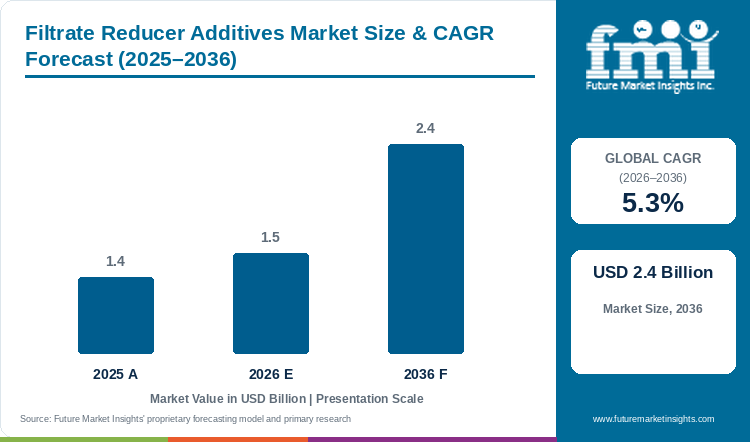
Filtrate reducer additive sales are projected at USD 1.5 Billion in 2026, up from USD 1.4 Billion in 2025, and will reach USD 2.4 Billion by 2036 at 5.3% CAGR.
FMI sizes the filtrate reducer additives market at USD 1.5 Billion in 2026, with sales projected to reach USD 2.4 Billion by 2036 at a 5.3% CAGR. On the market size chart, USD 0.9 Billion of added value separates the 2026 column from the 2036 column, with 2025 recorded at USD 1.4 Billion.
Input prices are pulling the two main chemistry groups apart. Suzano held pulp cash cost broadly stable year-on-year at R$843 per tonne in the second quarter of 2026, despite pressure on input costs from higher oil prices [1]. Stable pulp keeps PAC and CMC quotes predictable for cellulosic additives, the 22% chemistry leader in 2026. Acrylic polymers and synthetic copolymers come from oil-linked petrochemical feedstocks, so producer costs for these grades move with crude. Service companies have little room to pass higher costs to operators. The Dallas Fed input cost index for oilfield services firms stood at 60.4 in the third quarter of 2026, against 16.3 for prices received [2]. Margin-squeezed buyers are expected to treat routine water-based intervals with cellulosic grades through 2036 and reserve synthetic copolymers for HTHP sections.
Key Takeaways
- Leading companies in the filtrate reducer additives market include SLB, Halliburton, Baker Hughes, Nouryon, Ashland, Clariant, TETRA Technologies and Innospec.
- Water-based mud is projected to hold 53% of demand by mud system in 2026. Steady cellulose input costs keep PAC and CMC treatment affordable for these programs.
- Oilfield service companies take 44% of sales by channel in 2026, since operators buy polymer inside bundled drilling-fluid contracts.
- KSA is projected to post the fastest growth at 6.1% CAGR through 2036, with the UAE close behind at 5.8%. Gulf gas campaigns and integrated rig fleets keep mud treatment volumes high in both countries.
Analyst Perspective
“I expect filtrate reducer prices through 2036 to split by feedstock, with cellulose-based grades holding steadier quotes than oil-linked synthetic copolymers. That gap should protect the 22% share held by cellulosic additives in 2026, as service companies facing thin margins choose the lower-cost treatment for routine water-based intervals.”
- Nikhil Kaitwade, Principal Consultant, Future Market Insights
How is the Filtrate Reducer Additives Market Segmented?
The filtrate reducer additives market is divided into chemistry, mud system, well type, function, sales channel and region.
As per FMI, chemistry is divided into cellulosic additives, starch derivatives, PAC polymers, acrylic polymers, resin and lignite blends, and synthetic copolymers. Mud systems are split into water-based mud, oil-based mud, synthetic-based mud and high-performance mud systems. Well type coverage spans onshore, offshore, HPHT, unconventional and deepwater wells. Function is segregated into API fluid loss control, HTHP filtration control, cake quality improvement and shale stabilization support. Sales are tracked across oilfield service companies, mud chemical distributors, direct E&P contracts and regional blending plants. Seven regions and more than 30 countries complete the geographic coverage.
Why Do Cellulosic Additives Lead the Filtrate Reducer Additives Market by Chemistry?
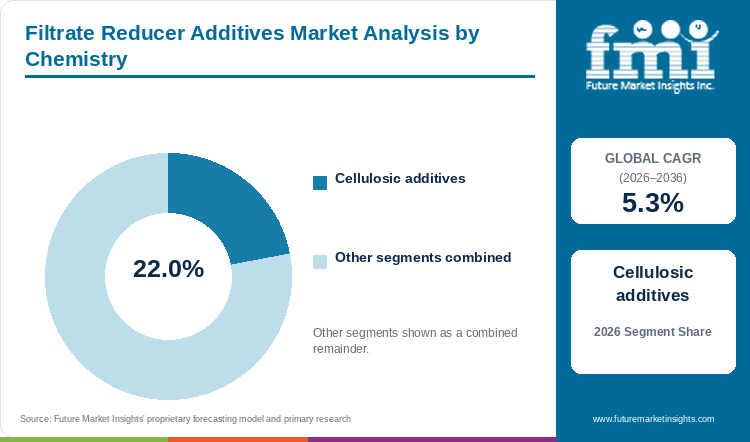
Cellulosic additives lead the chemistry split with 22% of market share in 2026.
Cellulosic additives hold 22% of demand by chemistry in 2026, the largest share of any chemistry group. Mud engineers choose PAC and CMC grades because one product controls fluid loss and viscosity in freshwater, seawater and brine. Starch derivatives, the closest low-cost alternative, lose performance as bottomhole temperature rises, so buyers limit starch to cooler and shallower wells.
- Mud plants are expected to stock cellulosic grades in larger lots through 2036, since one product covers several water types on the same rig.
- In July 2026, Clariant listed HOSTADRILL fluid loss additives for high temperature, pressure and salinity drilling environments [3].
Why Does Water-Based Mud Lead the Filtrate Reducer Additives Market by Mud System?
Water-based mud accounts for 53% of market share by mud system in 2026.
Water-based mud accounts for 53% of demand by mud system in 2026, as every water-based well consumes filtration chemistry from spud to total depth. Oil-based and synthetic-based muds need smaller doses because the organic phase already limits filtrate, and high-performance systems serve a smaller pool of reactive shale and offshore discharge wells.
- Offshore operators facing discharge limits are expected to move more intervals to high-performance water-based mud through 2036.
- Ashland reported in November 2025 that portfolio optimization across CMC, methylcellulose and other lines cut fourth-quarter sales by about USD 38 million [4].
Why Do Onshore Wells Lead the Filtrate Reducer Additives Market by Well Type?
Onshore wells make up 41% of market share by well type in 2026.
Onshore wells take 41% of demand by well type in 2026, since land basins drill the largest number of wells each year. Alberta alone recorded 9,592 wells and more than 26.7 million meters drilled in 2025 [5]. Offshore and deepwater wells use more chemistry per well, but operators drill far fewer of them. HPHT wells buy specialty polymer in small lots, which keeps volume in that segment low.
- Unconventional wells are expected to raise treatment per well through 2036, as long laterals cross reactive shale formations.
- ANP counted 19 exploratory wells started in Brazil in 2025 against 10 in 2024, with ten offshore and nine onshore [6].
Why Does API Fluid Loss Control Lead the Filtrate Reducer Additives Market by Function?
A 38% share of 2026 demand by function goes to API fluid loss control.
API fluid loss control holds 38% of demand by function in 2026. Routine mud checks follow the API standard filtration test, so buyers reorder fluid loss control after each test on every well. HTHP filtration control applies only to hot, high-pressure programs, and cake quality and shale stabilization products are bought for intervals with sticking or swelling risk.
- Deeper and hotter wells are expected to shift part of the function mix toward HTHP control by 2036.
- In August 2025, Halliburton reported the BaraDrilN X Generation III drill-in fluid with the new BaraFLC W-1096 polymer for reservoirs up to 344°F, holding zero downhole losses over a 69-hour wireline campaign in the US Gulf [7].
Why Do Oilfield Service Companies Lead the Filtrate Reducer Additives Market by Sales Channel?
Oilfield service companies are the largest sales channel, at 44% of market share in 2026.
Because operators buy drilling fluids inside complete well construction packages, oilfield service companies capture 44% of demand by sales channel in 2026. Service crews design the mud, source the additives and adjust treatment at the rig. Mud chemical distributors serve fragmented land basins from stock, and direct E&P contracts stay small, as only operators running standardized campaigns buy straight from producers.
- Polymer producers are expected to sell more volume through service company approval lists, as squeezed service margins push buyers toward fewer, larger supply agreements.
- In February 2026, ADNOC Drilling posted 2025 revenue of USD 4.9 Billion, up 22%, and set a target of about 70 integrated drilling services rigs by the end of 2026 [8].
What are the Drivers, Restraints, and Opportunities in the Filtrate Reducer Additives Market?
Gulf gas drilling is expanding the market, and squeezed service margins are slowing additive price increases. According to FMI, high-performance water-based mud will open the largest new revenue pool through 2036.
- Driver: Unconventional gas programs in KSA and the UAE add long wells through reactive shale, so operators buy more filtration control per program.
- Restraint: Oilfield service input costs are rising faster than service prices, so contractors push back on higher-priced additives.
- Opportunity: Discharge limits on offshore wells push operators toward high-performance water-based mud, raising spending on HTHP-capable polymers.
Gas programs in the Middle East and unconventional wells in the Americas supply most of the new volume. Aramco expects added gas volumes to generate USD 12 to 15 Billion in extra operating cash flow by 2030, funding long drilling at Jafurah and other fields [9]. Sales in the drilling mud chemicals market are projected to rise from USD 4.9 Billion in 2026 to USD 8.1 Billion by 2036. Spending on filtrate reducers moves with the wider oilfield chemicals market, valued at USD 31.17 Billion in 2025. Water-based fluids account for 42% of the onshore drilling fluids market, the largest outlet for cellulosic grades.
Cost pressure on service contractors is the sharper near-term risk for additive sales. Nouryon raised ketone peroxide prices by up to 30% from April 2026, citing Middle East pressure on oil markets and petrochemical feedstocks [10]. Synthetic copolymers come from the same petrochemical chain, which exposes HTHP chemistry to oil-linked cost swings. Polymer makers in the drilling polymers market and the cellulose derivative market face a second barrier in formulation sensitivity, as salt, hardness, temperature and solids change the result of the same additive in two wells. JAPEX completed an offshore Hokkaido well in 1,070 meters of water in June 2026 and judged the gas volume insufficient for immediate commercialization [11].
Which Country CAGRs are Profiled in the Filtrate Reducer Additives Market?
| Country | CAGR, 2026 to 2036 |
|---|---|
| KSA | 6.1% |
| UAE | 5.8% |
| Brazil | 5.3% |
| USA | 4.8% |
| Canada | 4.7% |
| Norway | 4.5% |
| Japan | 3.5% |
How do Country-level CAGRs Compare in the Filtrate Reducer Additives Market?
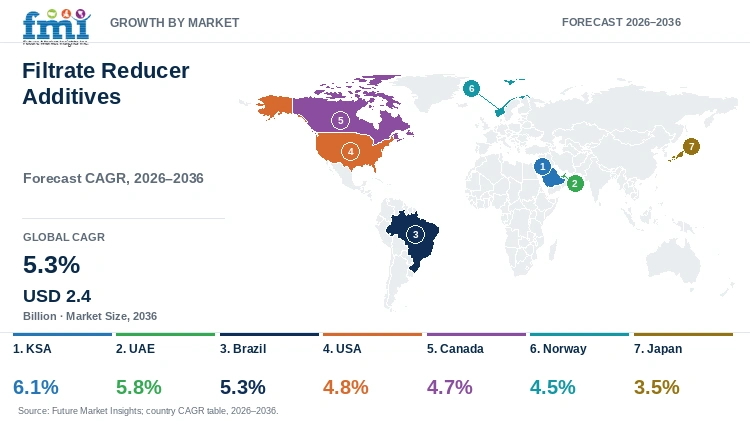
KSA and the UAE are projected to grow fastest at 6.1% and 5.8% through 2036, as per FMI's analysis, on Gulf gas campaigns and integrated rig fleets. The country CAGR chart puts the mature group well below, with the USA, Canada and Norway expected to grow between 4.5% and 4.8% and Japan at 3.5%. Brazil is expected to match the global 5.3% rate as exploration restarts offshore and onshore. Mature land basins in North America will still generate large additive revenue at mid-band growth, with long laterals also raising spending in the drilling lubricity enhancers market.
- KSA is set to lead at 6.1% CAGR through 2036. Jafurah gas wells keep adding treatment volume each year.
- Integrated rig fleets on land, island and offshore sites support UAE growth of 5.8% CAGR by 2036.
- Brazil is projected to grow at 5.3% CAGR during the forecast period, matching the global rate as exploratory drilling recovers.
- Long-lateral shale wells will carry the USA to 4.8% CAGR through 2036.
- Canada is expected to grow at 4.7% CAGR by 2036. Alberta development drilling keeps western basin mud plants restocking polymer.
- Demand for filtrate reducers in Norway will rise at 4.5% CAGR during the forecast period under strict offshore discharge controls.
- Japan is projected at 3.5% CAGR through 2036, the lowest of the seven, with domestic drilling run one project at a time.
The full report extends country CAGR estimates to more than 30 markets across seven regions.
Country Outlook
- Aramco started unconventional gas production at Jafurah in December 2025, in a field spanning about 17,000 square kilometers [9]. Repeated wells across one large field consume filtration chemistry in steady lots, and demand in KSA is projected at 6.1% CAGR through 2036.
- ADNOC Drilling is targeting about 70 integrated drilling services rigs in operation by the end of 2026 [8]. Integrated rigs buy mud chemistry inside service packages, so polymer makers approved by the national driller gain the steadiest volume as the UAE grows at 5.8% CAGR by 2036.
- ANP counted 19 exploratory wells started in Brazil in 2025, up from 10 in 2024 [6]. Pre-salt wells need HTHP filtration control and onshore wells add routine water-based volume, supporting 5.3% CAGR during the forecast period.
- The Dallas Fed business activity index for oil and gas firms eased to 38.8 in the third quarter of 2026 from 46.1 [2]. Activity still expanded, and operators drilling long laterals judge each additive on cost per well, putting the USA at 4.8% CAGR through 2036.
- Alberta recorded 9,592 wells and more than 26.7 million meters drilled in 2025 [5]. Development drilling at this pace keeps western basin mud plants restocking cellulosic polymer, and Canada is projected at 4.7% CAGR by 2036.
- Norwegian offshore drilling chemicals pass environmental review before use on the shelf. Each new product needs discharge documentation and HTHP filtration data, so approved suppliers keep North Sea programs for long periods, and demand is projected at 4.5% CAGR through 2036.
- JAPEX completed exploratory drilling off Hokkaido in June 2026 and found gas volumes too small for immediate commercialization [11]. Domestic programs proceed one project at a time with small orders, holding Japan to 3.5% CAGR during the forecast period.
Who are the Notable Companies in the Filtrate Reducer Additives Market?
Filtrate reducer suppliers profiled by FMI, including SLB, Halliburton, Baker Hughes, Nouryon and Clariant, compete on qualified chemistry, mud-system range and field formulation support.
Operators hand additive choice to the service company running the mud program, so SLB, Halliburton and Baker Hughes control most purchases. Halliburton added the BaraFLC W-1096 polymer to a high-temperature drill-in fluid in August 2025 [7], and Clariant listed HOSTADRILL fluid loss additives for hot, salty wells in July 2026 [3]. Ashland trimmed CMC and other cellulose lines in fiscal 2025, cutting fourth-quarter sales by about USD 38 million [4]. Each additive change needs laboratory and field testing in the operator's own mud, so a qualified product stays in a program for long periods. FMI expects producers able to hold polymer prices steady for Gulf and Brazilian campaigns to gain the largest supply agreements through 2036. Fluid loss chemistry for well cementing reaches the same buyers through the cement fluid loss additives market.
- Integrated Drilling-Fluid Service Platforms: SLB, Halliburton and Baker Hughes pair fluid chemistry with laboratory design, field monitoring and global service crews.
- Specialty Polymer Producers: Nouryon, Ashland and Clariant sell CMC, PAC, cellulose ethers and synthetic fluid loss additives to service companies and operators.
- Focused Oilfield Chemistry Providers: TETRA Technologies and Innospec supply completion fluids, oilfield chemicals and technical service across major oil and gas basins.
Competitive Benchmarking
| Company | Filtration-Control Chemistry | Mud-System Breadth | Field Formulation Support | Geographic Reach |
|---|---|---|---|---|
| SLB | High | High | High | Global drilling-fluid and well-construction presence |
| Halliburton | High | High | High | Global oilfield services and drilling-fluid support |
| Baker Hughes | High | High | High | Global well-construction and drilling-fluid support |
| Nouryon | High | Medium | Medium | Global specialty-chemical supply and oilfield application support |
| Ashland | High | Medium | Medium | Asia Pacific, Latin America, North America, Europe, Middle East and Africa |
| Clariant | High | Medium | Medium | Global oil services and specialty-chemical reach |
| TETRA Technologies | Medium | Medium | High | Americas, Europe, Middle East and selected Asia markets |
| Innospec | Medium | Medium | High | North America and other major oil and gas basins |
Scoring basis: Filtration-Control Chemistry rates documented products with fluid loss or filtration control as a stated drilling function. Mud-System Breadth rates documented use across water-based, oil-based, synthetic-based and high-performance systems. Field Formulation Support rates laboratory, technical and wellsite capability for adjusting treatment to well conditions. High reflects broad documented capability, Medium a narrower proven range, and Low limited public documentation.
Key Developments
- Halliburton reported the BaraDrilN X Generation III reservoir drill-in fluid in August 2025, using the new BaraFLC W-1096 polymer for HPHT reservoirs up to 344°F [7].
- Aramco began unconventional gas production at Jafurah in December 2025, in a field of about 17,000 square kilometers, under a plan to raise Saudi gas production by about 80% by 2030 against 2021 levels [9].
- ADNOC Drilling reported record 2025 revenue of USD 4.9 Billion in February 2026 and set a target of about 70 integrated drilling services rigs by the end of 2026 [8].
Key Players
Integrated Drilling-Fluid Service Platforms
- SLB
- Halliburton
- Baker Hughes
Specialty Polymer Producers
- Nouryon
- Ashland
- Clariant
Focused Oilfield Chemistry Providers
- TETRA Technologies
- Innospec
Report Scope and Methodology
| Coverage field | Report scope |
|---|---|
| Market breakdown | 5 categories plus region: Chemistry (Cellulosic additives, Starch derivatives, PAC polymers, Acrylic polymers, Resin / lignite blends, Synthetic copolymers), Mud System (Water-based mud, Oil-based mud, Synthetic-based mud, High-performance mud systems), Well Type (Onshore wells, Offshore wells, HPHT wells, Unconventional wells, Deepwater wells), Function (API fluid loss control, HTHP filtration control, Cake quality improvement, Shale stabilization support), Sales Channel (Oilfield service companies, Mud chemical distributors, Direct E&P contracts, Regional blending plants), and Region |
| Quantitative units | USD Billion |
| Market definition | Revenue from specialty filtrate reducer additives sold for drilling mud use, including cellulosic, starch, PAC, acrylic, resin and lignite, and synthetic copolymer products sold for filtration control. Complete drilling-fluid system revenue, field-service revenue, lost-circulation materials and completion-only or cementing additives are excluded. |
| Regions covered | North America, Latin America, Western Europe, Eastern Europe, East Asia, South Asia and Pacific, Middle East and Africa |
| Countries covered | More than 30 countries, with KSA, the USA, Japan, the UAE, Brazil, Canada and Norway profiled in detail |
| Key companies profiled | SLB, Halliburton, Baker Hughes, Nouryon, Ashland, Clariant, TETRA Technologies and Innospec, selected from a wider field of drilling-fluid service companies and specialty polymer suppliers |
| Forecast period | 2026 to 2036 |
| Approach | Product and channel revenue, well-activity indicators, company disclosures and qualification evidence triangulated by FMI at country level through a hybrid bottom-up and top-down model. |
Research Methodology
| Method | Approach |
|---|---|
| Primary research | Interviews with additive manufacturers, specialty polymer suppliers, oilfield service companies, distributors, mud-plant staff, E&P procurement teams and technical specialists test qualification criteria, treatment economics, channel roles and regional buying behavior. |
| Desk research | The analysis reviews regulator and government drilling statistics, company filings and news releases, standards, technical product literature and operator disclosures. Sources are kept for fit with the product boundary, a country trend, a company role or a dated development. |
| Market sizing and forecasting | Market sizing combines supplier and channel revenue with drilling activity, well complexity, mud-system mix, additive intensity and pricing direction. The forecast reflects new well programs, temperature and salinity trends, and qualification cycles for new chemistry. |
| Data validation | Findings are cross-checked across technical, commercial, company and country evidence. Complete drilling-fluid system revenue, field-service revenue and adjacent lost-circulation products are excluded so no revenue is counted twice. |
Filtrate Reducer Additives Market by Segments
Filtrate Reducer Additives Market Segmented by Chemistry
- Cellulosic additives
- Starch derivatives
- PAC polymers
- Acrylic polymers
- Resin / lignite blends
- Synthetic copolymers
Filtrate Reducer Additives Market Segmented by Mud System
- Water-based mud
- Oil-based mud
- Synthetic-based mud
- High-performance mud systems
Filtrate Reducer Additives Market Segmented by Well Type
- Onshore wells
- Offshore wells
- HPHT wells
- Unconventional wells
- Deepwater wells
Filtrate Reducer Additives Market Segmented by Function
- API fluid loss control
- HTHP filtration control
- Cake quality improvement
- Shale stabilization support
Filtrate Reducer Additives Market Segmented by Sales Channel
- Oilfield service companies
- Mud chemical distributors
- Direct E&P contracts
- Regional blending plants
Filtrate Reducer Additives Market Segmented by Region
- North America
- Latin America
- Western Europe
- Eastern Europe
- East Asia
- South Asia and Pacific
- Middle East and Africa
Research Sources and Bibliography
- [1] Suzano S.A. (2026, August 13). Suzano reports Adjusted EBITDA of R$4.7 billion in the second quarter of 2026.
- [2] Federal Reserve Bank of Dallas (2026, September 30). Dallas Fed Energy Survey, Third Quarter 2026.
- [3] Clariant (2026, July 7). HOSTADRILL - Fluid Loss Additives for Drilling.
- [4] Ashland Inc. (2025, November 4). Ashland reports fourth quarter fiscal 2025 results and issues outlook for full-year 2026.
- [5] Alberta Energy Regulator (2026). Statistical Series 59: Drilling Activity in Alberta, Year 2025.
- [6] Agência Nacional do Petróleo, Gás Natural e Biocombustíveis (2026, August 6). Seminário Panorama da Exploração 2025.
- [7] Drilling Contractor (2025, August 21). Drilling & Completion Tech Digest.
- [8] Gulf News (2026, February 12). ADNOC Drilling profit surges to $1.45 billion after record year.
- [9] World Oil (2026, February 26). Aramco starts up Jafurah, eyes 80% gas capacity growth by 2030.
- [10] PCI Magazine (2026, April 4). Nouryon Announces Global Price Increase.
- [11] Japan Petroleum Exploration Co., Ltd. (2026, June 12). Completion of Exploratory Drilling at Offshore Hidaka Area of Hokkaido.
This bibliography is provided for reader reference and is not exhaustive. The full report contains the complete reference list and detailed citations.
This Report Answers
- What revenue will filtrate reducer additives generate in 2026, and what value will the market reach by 2036?
- Which drilling trends in gas, unconventional and offshore wells will raise spending on filtration control?
- Why will cellulosic additives hold the largest chemistry share in 2026?
- Why will water-based mud remain the leading mud system for filtrate reducers?
- Which growth rates will KSA, the UAE, Brazil, the USA, Canada, Norway and Japan post through 2036?
- What role will oilfield service companies play in additive selection and pricing?
- Which temperature, salinity and hardness limits will slow switching between filtrate reducer products?
- Which test data will operators and mud engineers request before approving a new filtrate reducer?
Frequently Asked Questions
How Big Is the Filtrate Reducer Additives Market Expected to Be in 2026?
Filtrate reducer additive sales will reach USD 1.5 Billion in 2026, compared with USD 1.4 Billion in 2025, according to FMI estimates. The market will rise to USD 2.4 Billion by 2036 as gas, unconventional and offshore wells add filtration control needs.
What Is the CAGR of the Filtrate Reducer Additives Market from 2026 to 2036?
The market will expand at a 5.3% CAGR between 2026 and 2036. Spending per well will grow with temperature, salinity and shale complexity in new drilling programs.
Which Mud System Holds the Largest Share of the Filtrate Reducer Additives Market?
Water-based mud will hold 53% of market share by mud system in 2026. Wide use across land and offshore intervals and simpler handling will support the position.
Which Chemistry Leads the Filtrate Reducer Additives Market?
Cellulosic additives will account for 22% of market share by chemistry in 2026. PAC and CMC grades with adjustable viscosity will keep cellulosics in routine water-based programs.
Which Country Is Expected to Grow Fastest in the Filtrate Reducer Additives Market?
KSA will grow fastest at a 6.1% CAGR till 2036, followed by the UAE at 5.8% and Brazil at 5.3%. Japan will post the slowest rate of the seven profiled countries at 3.5%.
What Notable Restraint Affects the Filtrate Reducer Additives Market?
Key challenges will come from formulation sensitivity, since temperature, salt, hardness and solids will change the result of the same additive from well to well. Each product switch will need laboratory and field testing before approval.
Which Are the Key Companies in the Filtrate Reducer Additives Market?
SLB, Halliburton, Baker Hughes, Nouryon, Ashland, Clariant, TETRA Technologies and Innospec are among the leading companies tracked by FMI. Each company will appear in one of three supplier groups in the report.
Preview the report firsthand - request a free sample
Get SampleGet the brochure for pricing and purchase details.
Get PDFTable of Content
- Key Takeaways
- Market Size and CAGR
- Top Growth Driver
- Fastest Growing Segment
- Leading Region
- Key Companies
- Emerging Opportunities
- Executive Summary
- Global Market Outlook
- Demand-side Trends
- Supply-side Trends
- Technology Roadmap Analysis
- Analysis and Recommendations
- Analyst Perspective (What is happening? Why now? What should investors know?)
- Key Questions Answered
- How large is the market?
- What is the CAGR?
- What are key trends?
- Which region dominates?
- Who are the leaders?
- Market Overview
- Market Coverage / Taxonomy
- Market Definition / Scope / Limitations
- Research Methodology
- Chapter Orientation
- Analytical Lens and Working Hypotheses
- Market Structure, Signals, and Trend Drivers
- Benchmarking and Cross-market Comparability
- Market Sizing, Forecasting, and Opportunity Mapping
- Research Design and Evidence Framework
- Desk Research Programme (Secondary Evidence)
- Expert Input and Fieldwork (Primary Evidence)
- Tooling, Models, and Reference Databases
- Data Engineering and Model Build
- Quality Assurance and Audit Trail
- Market Background
- Market Dynamics (Drivers, Restraints, Opportunity, Trends)
- Scenario Forecast (Optimistic, Likely, Conservative)
- Impact Analysis
- AI Impact
- Sustainability Impact
- Regulatory Impact
- Technology Impact
- Consumer / Buyer Analysis
- Purchase Drivers
- Adoption Barriers
- Buyer Journey
- Opportunity Map Analysis
- Product Life Cycle Analysis
- Supply Chain Analysis
- Investment Feasibility Matrix
- Value Chain Analysis
- PESTLE and Porter's Analysis
- Regulatory Landscape
- Regional Parent Market Outlook
- Production and Consumption Statistics
- Import and Export Statistics
- Global Market Analysis and Forecast, 2021 to 2036
- Historical Market Size Value (USD Billion) Analysis, 2021 to 2025
- Current and Future Market Size Value (USD Billion) Projections, 2026 to 2036
- Y-o-Y Growth Trend Analysis
- Absolute $ Opportunity Analysis
- Global Market Pricing Analysis, 2021 to 2036
- Global Market Analysis and Forecast, By Chemistry, 2021 to 2036
- Introduction / Key Findings
- Historical Market Size Value (USD Billion) Analysis By Chemistry, 2021 to 2025
- Current and Future Market Size Value (USD Billion) Analysis and Forecast By Chemistry, 2026 to 2036
- Cellulosic additives
- Starch derivatives
- PAC polymers
- Acrylic polymers
- Resin / lignite blends
- Synthetic copolymers
- Y-o-Y Growth Trend Analysis By Chemistry, 2021 to 2025
- Absolute $ Opportunity Analysis By Chemistry, 2026 to 2036
- Global Market Analysis and Forecast, By Mud System, 2021 to 2036
- Introduction / Key Findings
- Historical Market Size Value (USD Billion) Analysis By Mud System, 2021 to 2025
- Current and Future Market Size Value (USD Billion) Analysis and Forecast By Mud System, 2026 to 2036
- Water-based mud
- Oil-based mud
- Synthetic-based mud
- High-performance mud systems
- Y-o-Y Growth Trend Analysis By Mud System, 2021 to 2025
- Absolute $ Opportunity Analysis By Mud System, 2026 to 2036
- Global Market Analysis and Forecast, By Well Type, 2021 to 2036
- Introduction / Key Findings
- Historical Market Size Value (USD Billion) Analysis By Well Type, 2021 to 2025
- Current and Future Market Size Value (USD Billion) Analysis and Forecast By Well Type, 2026 to 2036
- Onshore wells
- Offshore wells
- HPHT wells
- Unconventional wells
- Deepwater wells
- Y-o-Y Growth Trend Analysis By Well Type, 2021 to 2025
- Absolute $ Opportunity Analysis By Well Type, 2026 to 2036
- Global Market Analysis and Forecast, By Function, 2021 to 2036
- Introduction / Key Findings
- Historical Market Size Value (USD Billion) Analysis By Function, 2021 to 2025
- Current and Future Market Size Value (USD Billion) Analysis and Forecast By Function, 2026 to 2036
- API fluid loss control
- HTHP filtration control
- Cake quality improvement
- Shale stabilization support
- Y-o-Y Growth Trend Analysis By Function, 2021 to 2025
- Absolute $ Opportunity Analysis By Function, 2026 to 2036
- Global Market Analysis and Forecast, By Sales Channel, 2021 to 2036
- Introduction / Key Findings
- Historical Market Size Value (USD Billion) Analysis By Sales Channel, 2021 to 2025
- Current and Future Market Size Value (USD Billion) Analysis and Forecast By Sales Channel, 2026 to 2036
- Oilfield service companies
- Mud chemical distributors
- Direct E&P contracts
- Regional blending plants
- Y-o-Y Growth Trend Analysis By Sales Channel, 2021 to 2025
- Absolute $ Opportunity Analysis By Sales Channel, 2026 to 2036
- Global Market Analysis and Forecast, By Region, 2021 to 2036
- Introduction
- Historical Market Size Value (USD Billion) Analysis By Region, 2021 to 2025
- Current Market Size Value (USD Billion) Analysis and Forecast By Region, 2026 to 2036
- North America
- Latin America
- Western Europe
- Eastern Europe
- East Asia
- South Asia and Pacific
- Middle East and Africa
- Market Attractiveness Analysis By Region
- North America Market Analysis and Forecast, By Country, 2021 to 2036
- Historical Market Size Value (USD Billion) Trend Analysis By Market Taxonomy, 2021 to 2025
- Market Size Value (USD Billion) Forecast By Market Taxonomy, 2026 to 2036
- By Country
- By Chemistry
- By Mud System
- By Well Type
- By Function
- By Sales Channel
- Market Attractiveness Analysis
- By Country
- By Chemistry
- By Mud System
- By Well Type
- By Function
- By Sales Channel
- Key Takeaways
- Latin America Market Analysis and Forecast, By Country
- Historical Market Size Value (USD Billion) Trend Analysis By Market Taxonomy, 2021 to 2025
- Market Size Value (USD Billion) Forecast By Market Taxonomy, 2026 to 2036
- By Country
- By Chemistry
- By Mud System
- By Well Type
- By Function
- By Sales Channel
- Market Attractiveness Analysis
- By Country
- By Chemistry
- By Mud System
- By Well Type
- By Function
- By Sales Channel
- Key Takeaways
- Western Europe Market Analysis and Forecast, By Country
- Historical Market Size Value (USD Billion) Trend Analysis By Market Taxonomy, 2021 to 2025
- Market Size Value (USD Billion) Forecast By Market Taxonomy, 2026 to 2036
- By Country
- By Chemistry
- By Mud System
- By Well Type
- By Function
- By Sales Channel
- Market Attractiveness Analysis
- By Country
- By Chemistry
- By Mud System
- By Well Type
- By Function
- By Sales Channel
- Key Takeaways
- Eastern Europe Market Analysis and Forecast, By Country
- Historical Market Size Value (USD Billion) Trend Analysis By Market Taxonomy, 2021 to 2025
- Market Size Value (USD Billion) Forecast By Market Taxonomy, 2026 to 2036
- By Country
- By Chemistry
- By Mud System
- By Well Type
- By Function
- By Sales Channel
- Market Attractiveness Analysis
- By Country
- By Chemistry
- By Mud System
- By Well Type
- By Function
- By Sales Channel
- Key Takeaways
- East Asia Market Analysis and Forecast, By Country
- Historical Market Size Value (USD Billion) Trend Analysis By Market Taxonomy, 2021 to 2025
- Market Size Value (USD Billion) Forecast By Market Taxonomy, 2026 to 2036
- By Country
- By Chemistry
- By Mud System
- By Well Type
- By Function
- By Sales Channel
- Market Attractiveness Analysis
- By Country
- By Chemistry
- By Mud System
- By Well Type
- By Function
- By Sales Channel
- Key Takeaways
- South Asia and Pacific Market Analysis and Forecast, By Country
- Historical Market Size Value (USD Billion) Trend Analysis By Market Taxonomy, 2021 to 2025
- Market Size Value (USD Billion) Forecast By Market Taxonomy, 2026 to 2036
- By Country
- By Chemistry
- By Mud System
- By Well Type
- By Function
- By Sales Channel
- Market Attractiveness Analysis
- By Country
- By Chemistry
- By Mud System
- By Well Type
- By Function
- By Sales Channel
- Key Takeaways
- Middle East and Africa Market Analysis and Forecast, By Country
- Historical Market Size Value (USD Billion) Trend Analysis By Market Taxonomy, 2021 to 2025
- Market Size Value (USD Billion) Forecast By Market Taxonomy, 2026 to 2036
- By Country
- By Chemistry
- By Mud System
- By Well Type
- By Function
- By Sales Channel
- Market Attractiveness Analysis
- By Country
- By Chemistry
- By Mud System
- By Well Type
- By Function
- By Sales Channel
- Key Takeaways
- Key Countries Market Analysis
- KSA
- Pricing Analysis
- Market Share Analysis, 2025
- By Chemistry
- By Mud System
- By Well Type
- By Function
- By Sales Channel
- UAE
- Pricing Analysis
- Market Share Analysis, 2025
- By Chemistry
- By Mud System
- By Well Type
- By Function
- By Sales Channel
- Brazil
- Pricing Analysis
- Market Share Analysis, 2025
- By Chemistry
- By Mud System
- By Well Type
- By Function
- By Sales Channel
- USA
- Pricing Analysis
- Market Share Analysis, 2025
- By Chemistry
- By Mud System
- By Well Type
- By Function
- By Sales Channel
- Canada
- Pricing Analysis
- Market Share Analysis, 2025
- By Chemistry
- By Mud System
- By Well Type
- By Function
- By Sales Channel
- Norway
- Pricing Analysis
- Market Share Analysis, 2025
- By Chemistry
- By Mud System
- By Well Type
- By Function
- By Sales Channel
- Japan
- Pricing Analysis
- Market Share Analysis, 2025
- By Chemistry
- By Mud System
- By Well Type
- By Function
- By Sales Channel
- KSA
- Market Structure Analysis
- Competition Dashboard
- Competition Benchmarking
- Market Share Analysis of Top Players
- By Regional
- By Chemistry
- By Mud System
- By Well Type
- By Function
- By Sales Channel
- Emerging Startups
- Innovation Benchmarking
- Competition Analysis
- Competition Deep Dive
- SLB
- Overview
- Product Portfolio
- Profitability by Market Segments
- Sales Footprint
- Strategy Overview
- Marketing Strategy
- Product Strategy
- Channel Strategy
- Halliburton
- Baker Hughes
- Nouryon
- Ashland
- Clariant
- TETRA Technologies
- Innospec
- SLB
- Case Studies
- Success Stories
- Recent Developments
- Competition Deep Dive
- Assumptions & Acronyms Used


