

- Market Size (2026)
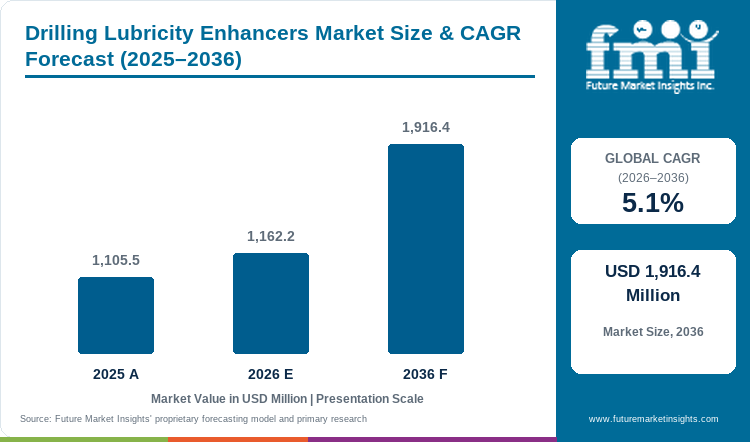
- USD 1162.2 Mn
- Forecast (2036)
- USD 1916.4 Mn
- CAGR (2026 to 2036)
- 5.1%
How big is Drilling Lubricity Enhancers Market in 2026?
USD 1,162.2 million in 2026 and USD 1,916.4 million by 2036, expanding at 5.1% CAGR.
Drilling friction-control additive sales are expected to reach USD 1,162.2 million in 2026, rising from USD 1,105.5 million in 2025. The market is projected to reach USD 1,916.4 million by 2036 at a 5.1% CAGR. Longer well sections put more of the drillstring against the wellbore. This contact raises torque in the active fluid system. In August 2026, the U.S. Energy Information Administration reported that the average new Permian lateral reached 10,867 feet in 2025. Wells above 15,000 feet made up 15% of new completions. Fluid engineers check whether a treatment cuts friction without changing the mud properties the well needs.
Country demand changes with the main type of drilling. Brazil shows the offshore route. ANP reported that maritime fields produced 98.1% of Brazil's oil in June 2026. Land laterals and geothermal wells face different heat and salt conditions. Lubricants gain use when dose and fluid stability stay predictable. Local support also helps field teams manage fluid changes during active drilling and keep the dose stable.
Key Takeaways
- Long horizontal and directional wells raise torque and drag because more drillstring contacts casing and formation.
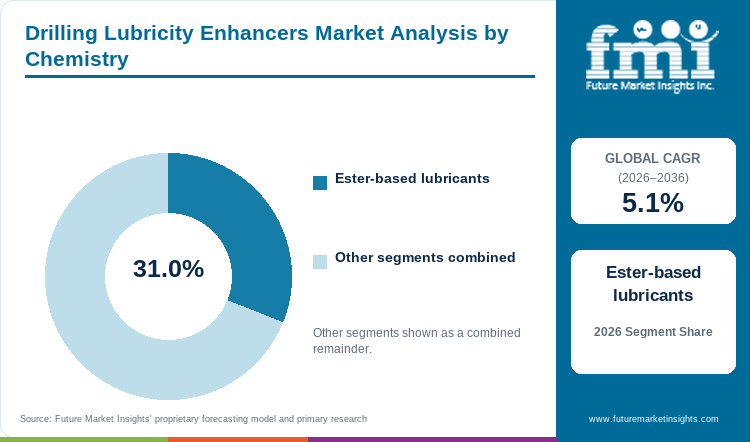
- Ester-based lubricants are forecast to represent 31.0% of chemistry in 2026 as formulators can tune friction performance around the active fluid.
- Water-based muds are expected to hold 48.0% of fluid type in 2026 due to the reason that field dosing can add friction control without replacing the base mud.
- Directional drilling is projected to hold 28.0% share in 2026, linked to torque and drag control as planned inclination increases contact length.
- Fluid fit restrains adoption because salt level and hardness can change lubricant behavior inside the active system.
- Key players include SLB, Halliburton, Baker Hughes, and Newpark Fluids Systems. Other suppliers include Chevron Phillips Chemical, Cargill Bioindustrial UK Ltd, Ergon, Inc., and Daqing Jingcheng Chemical Co., Ltd.
Analyst Perspective
“Lubricant selection starts with friction reduction inside the active fluid rather than a generic bench result. Wider use depends on stable dose behavior across salinity, temperature and changing solids loading.”
- Nikhil Kaitwade, Principal Consultant, Future Market Insights
How is the drilling lubricity enhancers market segmented?
The drilling lubricity enhancers market is segmented by chemistry, fluid type, application, end use, sales channel, and region.
Chemistry separates ester-based, fatty acid, glycol, graphite/solid and bio-based lubricants. Fluid type covers water-based, oil-based and synthetic-based muds plus high-performance brines. Application includes directional, extended-reach, shale, HPHT and deepwater drilling. End use separates onshore, offshore, unconventional and geothermal drilling. Sales channel covers drilling fluid companies, oilfield service companies and direct customer or distributor routes. Region completes the global structure.
How do ester-based lubricants balance friction control and fluid compatibility within chemistry?
Ester-based lubricants provide boundary lubrication, which creates a thin film at contact points. Formulators adjust the package for water-based systems and completion brines. Salt can change how the lubricant spreads through the fluid. Teams then tune the oil phase and surfactant package around the active fluid. The chemistry remains useful when it cuts friction without grease-out or a major change in flow behavior.
- Ester-based lubricants are forecast to hold 31.0% of chemistry in 2026. Formulators can tune their friction control for water-based and brine systems.
- In August 2026, Cargill Bioindustrial UK Ltd received Canadian patent CA3091947C. The patent covers a drilling-fluid lubricant mix for aqueous and brine phases.
Why do water-based muds create the largest fluid type opportunity?
Water-based muds need more friction control in long lateral wells. Long sections raise torque and drag. Operators can add lubricant to active drilling and completion fluids without replacing the full system. Fluid engineers still test hardness and salt levels. Lower friction does not help if the base mud becomes unstable during circulation.
- Water-based muds are expected to hold 48.0% of fluid type in 2026. Field dosing adds friction control without replacing the full system.
- An SLB Ecuador case study says its encapsulated lubricant reduced friction in water-based mud. The team drilled a long 12¼-inch section in one run.
How does directional drilling concentrate the core application need?
Directional drilling puts more of the drillstring against the wellbore as the angle increases. This raises the need for directional drilling services and friction-control chemistry that keeps the active fluid stable. Long tangent and lateral sections make poor weight transfer or slow tripping more costly over the planned well path and extended measured depth.
- Directional drilling is projected to hold 28.0% share in 2026. Greater planned inclination increases contact length and raises the need to control torque and drag.
- The U.S. Energy Information Administration reported on new Permian wells. In 2025, 15% of new completions had laterals above 15,000 feet.
What supports onshore drilling as the leading end use?
Onshore drilling creates repeat demand because land programs can reuse approved fluid recipes across wells. Teams adjust onshore drilling fluids as rock conditions and well paths change. The basic lubricant route can remain familiar. Field crews can also change treatment with less effort near active basins.
- Onshore drilling is set to hold 45.0% of the end use category in 2026. Repeat land programs support this position because they reuse approved fluid designs.
- EIA reported that the Permian has stayed near 6,000 new horizontal completions per year since 2022. Average lateral length has also increased.
Why do drilling fluid companies lead the sales channel category?
Drilling fluid companies work closest to the active mix. The lubricant must work with chemistry already moving through the well. These companies set treatment rates in oilfield chemicals programs. They adjust the dose as dilution removes active material. This role joins chemical supply with testing in the fluid.
- Drilling fluid companies are forecast to hold 39.0% of the sales channel category in 2026. They control additive approval in the active program. That role supports their share.
- A Baker Hughes case study reports that OMNI-LUBE V2 cut average drilling torque by 15%. It also cut lubricant cost by 44% in an offshore field trial.
What are the drivers, restraints and opportunities in the Drilling Lubricity Enhancers Market?
Longer well sections increase friction-control demand, fluid compatibility limits substitution and geothermal drilling opens a high-temperature application route.
- Driver: Long horizontal and directional well sections create more torque and drag.
- Restraint: A lubricant must work with the active mud or brine before field use.
- Opportunity: Geothermal drilling can use high-heat chemistry that works with water-based muds and brines.
Longer well geometry makes measurable friction reduction more valuable
Long horizontal and directional wells create more friction because more drillstring touches the wellbore. In August 2026, the U.S. Energy Information Administration reported that the average new Permian lateral reached 10,867 feet in 2025. Wells above 15,000 feet made up 15% of new completions. Longer contact can slow sliding and tripping. Teams compare treatment cost with rig time lost to those delays. Drilling tools also face more torque and drag in long sections. A lubricant is useful when it cuts friction without changing fluid properties or directional response. This balance helps the drillstring move during long drilling runs while the approved fluid system stays in place.
Fluid fit can disqualify an otherwise effective lubricant
Fluid fit can block a lubricant even when it cuts friction. A poor match may change flow behavior or reduce wellbore stability. In August 2026, Cargill Bioindustrial UK Ltd received Canadian patent CA3091947C for a mix made for aqueous and brine phases. The filing addresses a key approval issue. Teams must test salt level and base-fluid chemistry along with the coefficient of friction. Dilution and contamination can also change drilling mud chemicals during circulation. Technical teams keep the treatment rate inside the operating window. They approve a mix for a long well section after it stays stable under those changing conditions.
Geothermal drilling creates a high-temperature application route
Geothermal drilling adds another use for friction-control chemistry. Deep wells combine high heat with deviation and hard hole-cleaning work. In June 2026, Natural Resources Canada announced the country's first national deep-geothermal roadmap. Existing oil and gas field services can move drilling-fluid testing and technical support into geothermal projects. Suppliers can gain wider access when a mix keeps cutting friction at higher temperatures. It must also protect the stability of water-based muds and brines. These wells place a heavy load on the fluid system as conditions change with depth. That burden favors chemistry that keeps working through changes in heat and well conditions.
Which country CAGRs are profiled in the Drilling Lubricity Enhancers Market?
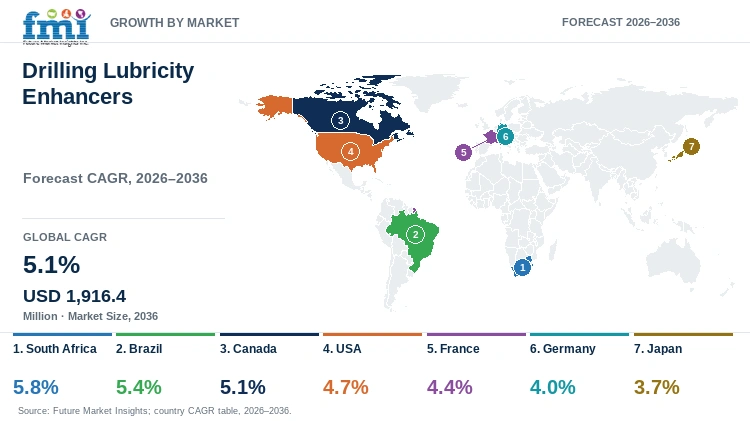
| Country | CAGR |
|---|---|
| South Africa | 5.8% |
| Brazil | 5.4% |
| Canada | 5.1% |
| USA | 4.7% |
| France | 4.4% |
| Germany | 4.0% |
| Japan | 3.7% |
How do country-level CAGRs compare in the Drilling Lubricity Enhancers Market?
Country outlooks differ because each drilling route creates a different friction problem. South Africa depends on exploration timing. Brazil depends more on offshore work. Canada combines land drilling with geothermal plans. The USA focuses on long shale laterals. France, Germany and Japan add geothermal approval routes.
- In South Africa, exploration approvals often determine when drilling chemicals can be procured for field operations.
- Brazil’s offshore drilling activity increases the cost and complexity of changing approved fluid formulations.
- Canada’s established land-drilling service network supports geothermal projects through existing technical expertise.
- In the USA, repeat horizontal drilling programs favor consistent lubricant formulations across extended laterals.
- France’s deep-geothermal developments require fluid chemistries capable of maintaining performance at elevated temperatures.
- Germany’s streamlined geothermal permitting process can accelerate the transition from project approval to drilling activity.
- Japan’s large-deviation geothermal wells make effective hole cleaning a key consideration during fluid qualification
The full report provides country-level CAGR analysis across seven regions. These are North America, Latin America, Europe, East Asia, South Asia, Oceania and the Middle East and Africa.
Country-wise Analysis
- Long shale wells keep friction control tied to repeat fluid design in the USA. US demand for drilling friction-control additives is forecast to rise at 4.7% CAGR over the forecast period. Longer laterals support that growth because more drillstring touches the wellbore. In August 2026, EIA reported that the average new Permian lateral reached 10,867 feet in 2025. It also said wells above 15,000 feet made up 15% of new completions. Repeat programs let fluid teams reuse approved recipes while adjusting the dose for salt and solids. The same service networks also support coiled tubing work, which has a separate friction-control need during well intervention.
- Deep geothermal drilling gives Germany a route for friction-control chemistry. Demand for drilling friction-control additives in Germany is expected to grow at 4.0% CAGR through 2036. Project growth and faster permits support this outlook. In December 2025, the Federal Ministry for Economic Affairs and Energy said the Bundestag had agreed the Geothermal Energy Acceleration Act. The law aims to make geothermal approvals simpler. Fluid fit at high heat and local approval matter as projects move into drilling. Service teams need mixes that stay stable as heat and solids change through the planned well section. Teams therefore check friction control and fluid stability before field use.
- Large-deviation geothermal wells give Japan a use case for friction-control additives. Demand in Japan is expected to grow at 3.7% CAGR through 2036. Large-deviation geothermal work supports this outlook. In February 2025, JOGMEC issued a procurement for a study on hole cleaning in domestic large-deviation geothermal drilling. More deviation puts more of the drillstring against the wellbore. High heat also raises the need for stable water-based chemistry. Project costs make careful approval important because lost rig time is costly. Fluid specialists can gain access by pairing friction reduction with reliable hole cleaning. They also need to prove fluid fit before drilling high-deviation sections during long geothermal cycles.
- Brazil is expected to post 5.4% CAGR over the forecast period. Offshore work supports this outlook because a fluid problem can use costly rig time. Offshore and pre-salt wells make fluid fit an important issue. In August 2026, ANP reported that maritime fields produced 98.1% of national oil during June. Pre-salt fields also made up 82% of national oil and gas production. Deepwater programs use controlled drilling and completion fluids through long well sections. Friction-control products need to work in brine and keep flow stable. Local approval support can lower switching risk across multiwell deepwater campaigns and repeat fluid changes during offshore work.
- Canada's drilling friction-control additive sales are forecast to grow at 5.1% CAGR by 2036. Mature land drilling and new geothermal work support this outlook. In June 2026, Natural Resources Canada announced the country's first national deep-geothermal roadmap. Geothermal projects can use existing fluid skills in hotter wells that need friction and hole-cleaning control. Contractors handling filter cake breakers already work in the same wellbore-fluid process. Lubricant approval stays separate. Local testing can cut the risk and cost of moving crews or supplies over long distances. Existing service channels give specialty fluid chemistry a practical route into geothermal field work.
- France's drilling friction-control additive demand is forecast to grow at 4.4% CAGR over the forecast period. High-heat underground work supports this outlook. Deep geothermal projects give France a use case for friction-control chemistry in long and deviated wells. BRGM reported in 2025 that 73 deep geothermal heating and cooling sites operated in France during 2023. New projects still need careful study of the ground before drilling starts. Water-based or brine-compatible mixes can serve these wells if they keep working at depth. Local contractor support matters because drilling cost and resource risk make teams sensitive to lost rig time. Extra field approval can also add time and cost.
- South Africa is expected to post 5.8% CAGR over the forecast period. Projects moving from approval into drilling support this outlook. Exploration timing decides when teams start buying drilling chemicals. In July 2025, the Department of Mineral and Petroleum Resources said phase 2 of the Karoo Shale Gas Project had started. The department also said appeals had delayed several petroleum exploration projects. Those delays can push back chemical delivery while geological work continues. Once drilling starts, the chosen lubricant must work with the active mud and planned well path. Local stock and technical support can lower the risk of moving supplies into remote drilling programs. This support reduces mobilization risk for remote work.
Who are the notable companies in the Drilling Lubricity Enhancers Market?
SLB, Halliburton, Baker Hughes, Newpark Fluids Systems, Chevron Phillips Chemical, Cargill Bioindustrial UK Ltd, Ergon, Inc., Daqing Jingcheng Chemical Co., Ltd.
Companies compete on how well a lubricant works in the active fluid. Integrated drilling-fluid groups pair chemistry with field support. Specialist formulators use focused friction-control systems and recorded mix designs. Each route supports a different part of fluid approval.
- Integrated fluid-system suppliers include SLB, Halliburton, Baker Hughes and Newpark Fluids Systems.
- Chevron Phillips Chemical and Daqing Jingcheng Chemical Co., Ltd. provide direct evidence of specialty drilling lubricants.
- Cargill Bioindustrial UK Ltd and Ergon, Inc. have patent records for drilling-fluid lubricant mixes.
Competitive Benchmarking: Drilling Lubricity Enhancers Market
| Company | Documented Lubricant Application Evidence | Fluid-System Qualification Evidence | Complex-Well / Brine Fit | Geographic Reach |
|---|---|---|---|---|
| SLB | High | High | High | Global oilfield markets |
| Halliburton | High | High | High | Global oilfield markets |
| Baker Hughes | High | High | High | Global oilfield markets |
| Newpark Fluids Systems | High | High | High | 23-country operating footprint |
| Chevron Phillips Chemical | Medium | High | High | Global specialty-chemicals network |
| Cargill Bioindustrial UK Ltd | Low | Medium | High | Canada patent route |
| Ergon, Inc. | Low | Medium | Medium | United States patent route |
| Daqing Jingcheng Chemical Co., Ltd. | Low | Medium | High | China patent route |
Scoring basis: High application evidence means several recorded lubricant uses. Medium means the exact-market evidence is narrower. Low means one recorded route. For approval evidence, High requires field testing or an integrated rollout. Medium requires mix evidence. For complex-well or brine fit, High requires direct high-temperature or saline evidence. Geographic reach lists recorded coverage only.
Key Developments in the Drilling Lubricity Enhancers Market
- In September 2026, Daqing Jingcheng Chemical Co., Ltd. published CN122726892A. The filing covers a high-temperature wear-resistant composite lubricant for drilling fluids.
- In August 2026, Cargill Bioindustrial UK Ltd received CA3091947C. The patent covers a drilling-fluid lubricant for aqueous and brine phases.
- In June 2026, Ergon, Inc. received U.S. Patent 12,668,733. The patent covers drilling-fluid compositions that use polymerized biorenewable oil.
Key Players in the Drilling Lubricity Enhancers Market
Integrated Drilling-Fluid Platforms
- SLB
- Halliburton
- Baker Hughes
- Newpark Fluids Systems
Specialty Lubricity Chemistry
- Chevron Phillips Chemical
- Daqing Jingcheng Chemical Co., Ltd.
Formulation Technology
- Cargill Bioindustrial UK Ltd
- Ergon, Inc.
Drilling Lubricity Enhancers Market - Report Scope
| Coverage field | Report scope |
|---|---|
| Market breakdown | By chemistry, fluid type, application, end use, sales channel and region. |
| Quantitative Units | USD million. |
| Market Definition | Revenue includes drilling lubricity enhancers sold for drilling-fluid and drill-in-fluid systems across the defined chemistries, fluid types, applications, end uses and sales channels. Downstream finished-product revenue and unrelated industrial lubricant revenue are excluded. |
| Regions Covered | North America, Latin America, Western Europe, Eastern Europe, East Asia, South Asia and Pacific, and Middle East and Africa. |
| Countries Covered | USA, Germany, Japan, Brazil, Canada, France, South Africa, and 20+ countries included in the full report. |
| Key Companies Profiled | SLB, Halliburton, Baker Hughes, Newpark Fluids Systems, Chevron Phillips Chemical, Cargill Bioindustrial UK Ltd, Ergon, Inc., Daqing Jingcheng Chemical Co., Ltd. |
| Forecast Period | 2026 to 2036. |
| Approach | Primary and secondary research with market triangulation. |
Drilling Lubricity Enhancers Market - Research Methodology
| Method | Approach |
|---|---|
| Primary Research | FMI analysts gathered input from manufacturers, service providers, technology developers, distributors, end users, procurement teams, and subject-matter experts. Interviews examined purchasing decisions, product or service evaluation, adoption barriers, approval requirements, pricing considerations, and expectations for technical or commercial support. Respondents were also asked what evidence is required before a trial, pilot, or initial order develops into regular purchasing. |
| Desk Research | Desk research covered government statistics, regulatory publications, trade data, industry associations, technical literature, standards, company filings, product information, and official corporate announcements. Sources were reviewed for relevance, publication date, geographic coverage, and consistency with the defined market scope. Claims relating to performance, applications, approvals, capacity, investment, and commercial activity were retained only when supported by credible public evidence. |
| Market Sizing and Forecasting | The market model combined the baseline value with historical performance, segment structure, pricing and volume indicators, adoption levels, company participation, and country-level demand conditions. Forecast assumptions considered economic activity, investment trends, regulatory developments, technology adoption, purchasing cycles, supply availability, and barriers to wider market use. Segment and regional estimates were reconciled before the final market total was calculated. |
| Data Validation | Estimates were checked against multiple independent indicators, including public data, company activity, trade patterns, industry developments, and findings from primary interviews. Validation also tested whether products, services, applications, and company revenues fell within the defined market boundaries. Adjacent categories, unsupported claims, overlapping revenues, and activities without direct market relevance were excluded to reduce double counting and maintain consistency across segments and countries. |
Drilling Lubricity Enhancers Market by Segments
Drilling Lubricity Enhancers Market segmented by Chemistry:
- Ester-based lubricants
- Fatty acid derivatives
- Glycol-based lubricants
- Graphite/solid lubricants
- Bio-based lubricants
Drilling Lubricity Enhancers Market segmented by Fluid Type:
- Water-based muds
- Oil-based muds
- Synthetic-based muds
- High-performance brines
Drilling Lubricity Enhancers Market segmented by Application:
- Directional drilling
- Extended-reach drilling
- Shale drilling
- HPHT wells
- Deepwater wells
Drilling Lubricity Enhancers Market segmented by End Use:
- Onshore drilling
- Offshore drilling
- Unconventional wells
- Geothermal drilling
Drilling Lubricity Enhancers Market segmented by Sales Channel:
- Drilling fluid companies
- Oilfield service companies
- Direct operator supply
- Chemical distributors
Drilling Lubricity Enhancers Market by Region:
- North America
- United States
- Canada
- Latin America
- Brazil
- Mexico
- Argentina
- Chile
- Western Europe
- Germany
- France
- United Kingdom
- Italy
- Spain
- Benelux
- Nordics
- Eastern Europe
- Poland
- Czech Republic
- Romania
- Hungary
- East Asia
- China
- Japan
- South Korea
- South Asia and Pacific
- India
- ASEAN
- Australia and New Zealand
- Middle East and Africa
- GCC Countries
- South Africa
- Türkiye
- Israel
Research Sources and Bibliography
- U.S. Energy Information Administration. (2026, August 19). Longer wells boost Permian crude oil and natural gas production.
- Agência Nacional do Petróleo, Gás Natural e Biocombustíveis. (2026, August 3). ANP divulga dados consolidados da produção de petróleo e gás em junho de 2026.
- Cargill Bioindustrial UK Ltd. (2026, August 18). Drilling fluid comprising a lubricant (CA3091947C).
- SLB. (n.d.). Encapsulated lubricant helps drill longest 12¼-in section in Ecuador in a single run. Retrieved September 20, 2026.
- Baker Hughes. (2025). OMNI-LUBE V2 reduced torque 15 percent in an offshore Gulf of Thailand field trial.
- Natural Resources Canada. (2026, June 11). Canada invests in its first national geothermal energy roadmap.
- Federal Ministry for Economic Affairs and Energy. (2025, December 16). Geothermal energy - expansion accelerated.
- Japan Organization for Metals and Energy Security. (2025, February 17). Study on hole-cleaning technology for large-deviation drilling in domestic geothermal development.
- BRGM. (2025). Renewable cooling: Geothermal energy key for meeting climate challenges.
- South African Government. (2025, July 2). Minister Gwede Mantashe: Mineral and Petroleum Resources Dept Budget Vote 2025/26.
- Halliburton. (n.d.). High-performance lubricant saves operator USD 480K in ERD well. Retrieved September 20, 2026.
- SLB. (n.d.). OMV achieves record horizontal appraisal well. Retrieved September 20, 2026.
- Newpark Fluids Systems. (2026, August 14). Fluids technology and global market positioning: Newpark CEO David Paterson talks with The Energy Year.
- Chevron Phillips Chemical. (2025, November 17). NanoSlide drilling fluid lubricant: A game-changer in lubrication.
- Daqing Jingcheng Chemical Co., Ltd. (2026, September 11). High-temperature wear-resistant long-life composite lubricant for drilling fluid and preparation method thereof (CN122726892A).
- Ergon, Inc. (2026, June 30). Drilling fluid compositions comprising a polymerized biorenewable oil (U.S. Patent 12,668,733).
- Puyang Haoran Chemical Co., Ltd. (2026, February 6). Lubricant for drilling fluid and preparation method thereof (CN121471887A).
- Lamberti S.p.A. (2026, January 15). Lubricant compositions (Mexican national phase MX2026000599A).
- Saudi Arabian Oil Company. (2026, July 9). Drilling fluids utilizing a salt-tolerant lubricant and methods of use therefor (US20260193511A1).
- SHELFOIL Petroleum Equipment & Services Co. Ltd. (2026, July 3). Lubricant for drilling fluid, and preparation method and application thereof (CN122326187A).
- Shaanxi Wande Petroleum Technology Co. Ltd. (2026, June 19). Drilling fluid anti-sloughing lubricant and preparation method thereof (CN122234770A).
- Sinopec Oilfield Service Corp. (2026, April 21). Environmentally friendly lubricants for drilling fluids and their preparation methods (CN119351064B).
- CNPC Xibu Drilling Engineering Co. Ltd. (2026, April 21). Hyperbranched high-temperature and salt-resistant lubricant, preparation method and application thereof (CN121494750B).
- China National Petroleum Corporation. (2026, March 27). Water-based drilling fluid polyphenol hydroxy fatty alkylamide lubricant and preparation method (CN119859512B).
This bibliography gives readers key sources but is not exhaustive. The full report contains the complete reference list and detailed citations.
This Report Answers
- What is the Drilling Lubricity Enhancers Market size in 2026 and what value is projected for 2036?
- Which well conditions turn friction control into a measurable drilling need?
- Why do ester-based lubricants lead the chemistry category?
- Why do water-based muds lead the fluid type category?
- How do application, end use and sales channel positions differ in 2026?
- How do drilling routes change demand conditions across the profiled countries?
- Which companies provide recorded drilling-lubricant or exact mix evidence?
- How does fluid fit limit switching between lubricant mixes?
- Which 2026 company developments are changing drilling-fluid friction control chemistry?
Frequently Asked Questions
What is the Drilling Lubricity Enhancers Market size in 2026?
The drilling lubricity enhancers market is valued at USD 1,162.2 million in 2026. It is projected to reach USD 1,916.4 million by 2036. Longer well sections keep friction control tied to the performance of the active fluid.
What is the forecast CAGR for the Drilling Lubricity Enhancers Market?
The drilling lubricity enhancers market is projected to grow at 5.1% CAGR from 2026 to 2036. Longer well sections need more friction control in drilling-fluid programs. This raises the value of treatment chemistry that stays stable in the active fluid.
Which chemistry and fluid type lead the Drilling Lubricity Enhancers Market?
Ester-based lubricants are forecast to hold 31.0% of chemistry in 2026. Water-based muds are expected to hold 48.0% of fluid type. Both positions reflect the need for friction control that can be tuned for aqueous drilling systems.
What operating problem do drilling friction-control additives address?
Long or deviated well sections create torque and drag as more drillstring touches the wellbore. Drilling lubricity enhancers reduce that friction. Lower friction supports directional response and helps crews move the drillstring through the planned path with less resistance.
What limits adoption of a new drilling lubricant?
Salt level and hardness can change how a new lubricant works in the drilling fluid. Temperature and contamination can also change treatment performance during field use. Teams test fluid fit before they adopt a new mix.
Preview the report firsthand - request a free sample
Get SampleGet the brochure for pricing and purchase details.
Get PDFTable of Content
- Key Takeaways
- Market Size and CAGR
- Top Growth Driver
- Fastest Growing Segment
- Leading Region
- Key Companies
- Emerging Opportunities
- Executive Summary
- Global Market Outlook
- Demand-side Trends
- Supply-side Trends
- Technology Roadmap Analysis
- Analysis and Recommendations
- Analyst Perspective (What is happening? Why now? What should investors know?)
- Key Questions Answered
- How large is the market?
- What is the CAGR?
- What are key trends?
- Which region dominates?
- Who are the leaders?
- Market Overview
- Market Coverage / Taxonomy
- Market Definition / Scope / Limitations
- Research Methodology
- Chapter Orientation
- Analytical Lens and Working Hypotheses
- Market Structure, Signals, and Trend Drivers
- Benchmarking and Cross-market Comparability
- Market Sizing, Forecasting, and Opportunity Mapping
- Research Design and Evidence Framework
- Desk Research Programme (Secondary Evidence)
- Expert Input and Fieldwork (Primary Evidence)
- Tooling, Models, and Reference Databases
- Data Engineering and Model Build
- Quality Assurance and Audit Trail
- Market Background
- Market Dynamics (Drivers, Restraints, Opportunity, Trends)
- Scenario Forecast (Optimistic, Likely, Conservative)
- Impact Analysis
- AI Impact
- Sustainability Impact
- Regulatory Impact
- Technology Impact
- Consumer / Buyer Analysis
- Purchase Drivers
- Adoption Barriers
- Buyer Journey
- Opportunity Map Analysis
- Product Life Cycle Analysis
- Supply Chain Analysis
- Investment Feasibility Matrix
- Value Chain Analysis
- PESTLE and Porter's Analysis
- Regulatory Landscape
- Regional Parent Market Outlook
- Production and Consumption Statistics
- Import and Export Statistics
- Global Market Analysis and Forecast, 2021 to 2036
- Historical Market Size Value (USD Million) Analysis, 2021 to 2025
- Current and Future Market Size Value (USD Million) Projections, 2026 to 2036
- Y-o-Y Growth Trend Analysis
- Absolute $ Opportunity Analysis
- Global Market Pricing Analysis, 2021 to 2036
- Global Market Analysis and Forecast, By Chemistry, 2021 to 2036
- Introduction / Key Findings
- Historical Market Size Value (USD Million) Analysis By Chemistry, 2021 to 2025
- Current and Future Market Size Value (USD Million) Analysis and Forecast By Chemistry, 2026 to 2036
- Ester-based lubricants
- Fatty acid derivatives
- Glycol-based lubricants
- Graphite/solid lubricants
- Bio-based lubricants
- Y-o-Y Growth Trend Analysis By Chemistry, 2021 to 2025
- Absolute $ Opportunity Analysis By Chemistry, 2026 to 2036
- Global Market Analysis and Forecast, By Fluid Type, 2021 to 2036
- Introduction / Key Findings
- Historical Market Size Value (USD Million) Analysis By Fluid Type, 2021 to 2025
- Current and Future Market Size Value (USD Million) Analysis and Forecast By Fluid Type, 2026 to 2036
- Water-based muds
- Oil-based muds
- Synthetic-based muds
- High-performance brines
- Y-o-Y Growth Trend Analysis By Fluid Type, 2021 to 2025
- Absolute $ Opportunity Analysis By Fluid Type, 2026 to 2036
- Global Market Analysis and Forecast, By Application, 2021 to 2036
- Introduction / Key Findings
- Historical Market Size Value (USD Million) Analysis By Application, 2021 to 2025
- Current and Future Market Size Value (USD Million) Analysis and Forecast By Application, 2026 to 2036
- Directional drilling
- Extended-reach drilling
- Shale drilling
- HPHT wells
- Deepwater wells
- Y-o-Y Growth Trend Analysis By Application, 2021 to 2025
- Absolute $ Opportunity Analysis By Application, 2026 to 2036
- Global Market Analysis and Forecast, By End Use, 2021 to 2036
- Introduction / Key Findings
- Historical Market Size Value (USD Million) Analysis By End Use, 2021 to 2025
- Current and Future Market Size Value (USD Million) Analysis and Forecast By End Use, 2026 to 2036
- Onshore drilling
- Offshore drilling
- Unconventional wells
- Geothermal drilling
- Y-o-Y Growth Trend Analysis By End Use, 2021 to 2025
- Absolute $ Opportunity Analysis By End Use, 2026 to 2036
- Global Market Analysis and Forecast, By Sales Channel, 2021 to 2036
- Introduction / Key Findings
- Historical Market Size Value (USD Million) Analysis By Sales Channel, 2021 to 2025
- Current and Future Market Size Value (USD Million) Analysis and Forecast By Sales Channel, 2026 to 2036
- Drilling fluid companies
- Oilfield service companies
- Direct operator supply
- Chemical distributors
- Y-o-Y Growth Trend Analysis By Sales Channel, 2021 to 2025
- Absolute $ Opportunity Analysis By Sales Channel, 2026 to 2036
- Global Market Analysis and Forecast, By Region, 2021 to 2036
- Introduction
- Historical Market Size Value (USD Million) Analysis By Region, 2021 to 2025
- Current Market Size Value (USD Million) Analysis and Forecast By Region, 2026 to 2036
- North America
- Latin America
- Western Europe
- Eastern Europe
- East Asia
- South Asia and Pacific
- Middle East and Africa
- Market Attractiveness Analysis By Region
- North America Market Analysis and Forecast, By Country, 2021 to 2036
- Historical Market Size Value (USD Million) Trend Analysis By Market Taxonomy, 2021 to 2025
- Market Size Value (USD Million) Forecast By Market Taxonomy, 2026 to 2036
- By Country
- United States
- Canada
- By Chemistry
- By Fluid Type
- By Application
- By End Use
- By Sales Channel
- By Country
- Market Attractiveness Analysis
- By Country
- By Chemistry
- By Fluid Type
- By Application
- By End Use
- By Sales Channel
- Key Takeaways
- Latin America Market Analysis and Forecast, By Country
- Historical Market Size Value (USD Million) Trend Analysis By Market Taxonomy, 2021 to 2025
- Market Size Value (USD Million) Forecast By Market Taxonomy, 2026 to 2036
- By Country
- Brazil
- Mexico
- Argentina
- Chile
- By Chemistry
- By Fluid Type
- By Application
- By End Use
- By Sales Channel
- By Country
- Market Attractiveness Analysis
- By Country
- By Chemistry
- By Fluid Type
- By Application
- By End Use
- By Sales Channel
- Key Takeaways
- Western Europe Market Analysis and Forecast, By Country
- Historical Market Size Value (USD Million) Trend Analysis By Market Taxonomy, 2021 to 2025
- Market Size Value (USD Million) Forecast By Market Taxonomy, 2026 to 2036
- By Country
- Germany
- France
- United Kingdom
- Italy
- Spain
- Benelux
- Nordics
- By Chemistry
- By Fluid Type
- By Application
- By End Use
- By Sales Channel
- By Country
- Market Attractiveness Analysis
- By Country
- By Chemistry
- By Fluid Type
- By Application
- By End Use
- By Sales Channel
- Key Takeaways
- Eastern Europe Market Analysis and Forecast, By Country
- Historical Market Size Value (USD Million) Trend Analysis By Market Taxonomy, 2021 to 2025
- Market Size Value (USD Million) Forecast By Market Taxonomy, 2026 to 2036
- By Country
- Poland
- Czech Republic
- Romania
- Hungary
- By Chemistry
- By Fluid Type
- By Application
- By End Use
- By Sales Channel
- By Country
- Market Attractiveness Analysis
- By Country
- By Chemistry
- By Fluid Type
- By Application
- By End Use
- By Sales Channel
- Key Takeaways
- East Asia Market Analysis and Forecast, By Country
- Historical Market Size Value (USD Million) Trend Analysis By Market Taxonomy, 2021 to 2025
- Market Size Value (USD Million) Forecast By Market Taxonomy, 2026 to 2036
- By Country
- China
- Japan
- South Korea
- By Chemistry
- By Fluid Type
- By Application
- By End Use
- By Sales Channel
- By Country
- Market Attractiveness Analysis
- By Country
- By Chemistry
- By Fluid Type
- By Application
- By End Use
- By Sales Channel
- Key Takeaways
- South Asia and Pacific Market Analysis and Forecast, By Country
- Historical Market Size Value (USD Million) Trend Analysis By Market Taxonomy, 2021 to 2025
- Market Size Value (USD Million) Forecast By Market Taxonomy, 2026 to 2036
- By Country
- India
- ASEAN
- Australia and New Zealand
- By Chemistry
- By Fluid Type
- By Application
- By End Use
- By Sales Channel
- By Country
- Market Attractiveness Analysis
- By Country
- By Chemistry
- By Fluid Type
- By Application
- By End Use
- By Sales Channel
- Key Takeaways
- Middle East and Africa Market Analysis and Forecast, By Country
- Historical Market Size Value (USD Million) Trend Analysis By Market Taxonomy, 2021 to 2025
- Market Size Value (USD Million) Forecast By Market Taxonomy, 2026 to 2036
- By Country
- GCC Countries
- South Africa
- Türkiye
- Israel
- By Chemistry
- By Fluid Type
- By Application
- By End Use
- By Sales Channel
- By Country
- Market Attractiveness Analysis
- By Country
- By Chemistry
- By Fluid Type
- By Application
- By End Use
- By Sales Channel
- Key Takeaways
- Key Countries Market Analysis
- United States
- Pricing Analysis
- Market Share Analysis, 2025
- By Chemistry
- By Fluid Type
- By Application
- By End Use
- By Sales Channel
- Canada
- Pricing Analysis
- Market Share Analysis, 2025
- By Chemistry
- By Fluid Type
- By Application
- By End Use
- By Sales Channel
- Mexico
- Pricing Analysis
- Market Share Analysis, 2025
- By Chemistry
- By Fluid Type
- By Application
- By End Use
- By Sales Channel
- Brazil
- Pricing Analysis
- Market Share Analysis, 2025
- By Chemistry
- By Fluid Type
- By Application
- By End Use
- By Sales Channel
- Chile
- Pricing Analysis
- Market Share Analysis, 2025
- By Chemistry
- By Fluid Type
- By Application
- By End Use
- By Sales Channel
- Germany
- Pricing Analysis
- Market Share Analysis, 2025
- By Chemistry
- By Fluid Type
- By Application
- By End Use
- By Sales Channel
- United Kingdom
- Pricing Analysis
- Market Share Analysis, 2025
- By Chemistry
- By Fluid Type
- By Application
- By End Use
- By Sales Channel
- Italy
- Pricing Analysis
- Market Share Analysis, 2025
- By Chemistry
- By Fluid Type
- By Application
- By End Use
- By Sales Channel
- Spain
- Pricing Analysis
- Market Share Analysis, 2025
- By Chemistry
- By Fluid Type
- By Application
- By End Use
- By Sales Channel
- France
- Pricing Analysis
- Market Share Analysis, 2025
- By Chemistry
- By Fluid Type
- By Application
- By End Use
- By Sales Channel
- India
- Pricing Analysis
- Market Share Analysis, 2025
- By Chemistry
- By Fluid Type
- By Application
- By End Use
- By Sales Channel
- ASEAN
- Pricing Analysis
- Market Share Analysis, 2025
- By Chemistry
- By Fluid Type
- By Application
- By End Use
- By Sales Channel
- Australia and New Zealand
- Pricing Analysis
- Market Share Analysis, 2025
- By Chemistry
- By Fluid Type
- By Application
- By End Use
- By Sales Channel
- China
- Pricing Analysis
- Market Share Analysis, 2025
- By Chemistry
- By Fluid Type
- By Application
- By End Use
- By Sales Channel
- Japan
- Pricing Analysis
- Market Share Analysis, 2025
- By Chemistry
- By Fluid Type
- By Application
- By End Use
- By Sales Channel
- South Korea
- Pricing Analysis
- Market Share Analysis, 2025
- By Chemistry
- By Fluid Type
- By Application
- By End Use
- By Sales Channel
- Poland
- Pricing Analysis
- Market Share Analysis, 2025
- By Chemistry
- By Fluid Type
- By Application
- By End Use
- By Sales Channel
- Hungary
- Pricing Analysis
- Market Share Analysis, 2025
- By Chemistry
- By Fluid Type
- By Application
- By End Use
- By Sales Channel
- Türkiye
- Pricing Analysis
- Market Share Analysis, 2025
- By Chemistry
- By Fluid Type
- By Application
- By End Use
- By Sales Channel
- South Africa
- Pricing Analysis
- Market Share Analysis, 2025
- By Chemistry
- By Fluid Type
- By Application
- By End Use
- By Sales Channel
- United States
- Market Structure Analysis
- Competition Dashboard
- Competition Benchmarking
- Market Share Analysis of Top Players
- By Regional
- By Chemistry
- By Fluid Type
- By Application
- By End Use
- By Sales Channel
- Emerging Startups
- Innovation Benchmarking
- Competition Analysis
- Competition Deep Dive
- SLB
- Overview
- Product Portfolio
- Profitability by Market Segments
- Sales Footprint
- Strategy Overview
- Marketing Strategy
- Product Strategy
- Channel Strategy
- Halliburton
- Baker Hughes
- Newpark Fluids Systems
- Chevron Phillips Chemical
- Cargill Bioindustrial UK Ltd
- Ergon, Inc.
- Daqing Jingcheng Chemical Co., Ltd.
- SLB
- Case Studies
- Success Stories
- Recent Developments
- Competition Deep Dive
- Assumptions & Acronyms Used


