

- Market Size (2026)
- USD 760.7 Mn
- Forecast (2036)
- USD 1227.3 Mn
- CAGR (2026 to 2036)
- 4.9%
How Big is the Cement Extender Additives Market in 2026?
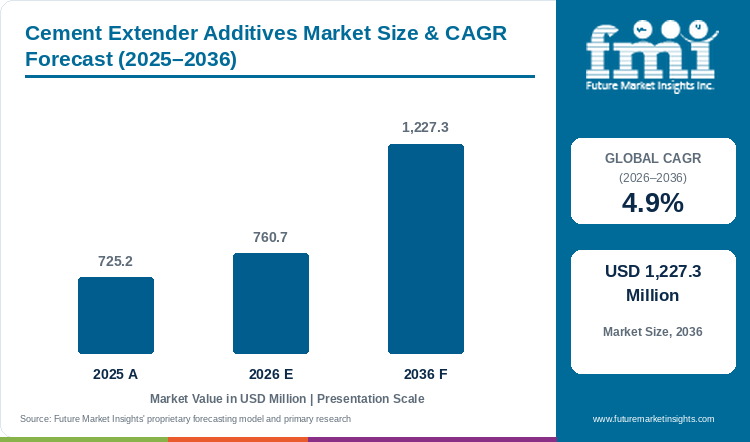
The cement extender additives market is valued at USD 760.7 Million in 2026, up from USD 725.2 Million in 2025, and is projected to reach USD 1,227.3 Million by 2036 at 4.9% CAGR.
At USD 760.7 Million in 2026, the cement extender additives market is projected to reach USD 1,227.3 Million by 2036 at 4.9% CAGR, according to FMI. On the market size chart, a 2025 base of USD 725.2 Million gives way to USD 466.6 Million of added value over the decade. Bentonite extenders take 29% of demand by extender type in 2026, ahead of pozzolanic and fly ash grades.
Oilfield buyers draw these minerals from supply chains built for much larger customers. Of the 4.1 million tons of bentonite produced in the USA in 2025, 48% went to pet waste absorbents and 22% to drilling mud [1]. Fly ash is tightening as coal plants close, with US coal combustion product output falling to 63.6 million tons in 2024 from 66.7 million tons in 2023, and concrete producers used 14.6 million tons of fly ash the same year [2]. Construction demand in the supplementary cementitious materials market, projected to reach USD 35.2 Billion by 2036, pulls on the same ash. Bentonite supply is broader, so clay grades are expected to keep the lead through 2036, and fly ash extenders will rely more on harvested and imported ash.
Key Takeaways
- Leading companies in the cement extender additives market include Halliburton, SLB, Baker Hughes, Imerys, Sibelco, Omya, CenoStar and Sika.
- Bentonite extenders will carry 29% of demand by extender type in 2026. One familiar clay gives high slurry yield at low cost.
- Cost reduction is the leading application at 28% of demand in 2026, as extended slurries place more barrels from each sack of cement.
- Canada will post the fastest growth at 5.6% CAGR through 2036, with KSA next at 5.3%, as repeat land wells and large gas programs keep cementing crews busy.
Analyst Perspective
“The weak point for cement extenders over the next decade is mineral supply, since oilfield buyers take only part of the bentonite and fly ash produced and coal plant closures keep shrinking ash output. Service companies securing clay and pozzolan volume near cementing bases will protect the 43% of demand held by the cementing channel in 2026.”
- Nikhil Kaitwade, Principal Consultant, Future Market Insights
How is the Cement Extender Additives Market Segmented?
Cement extender additives are divided by extender type, cement system, application, well type, sales channel and region.
Extender types in the study run from bentonite extenders and pozzolanic extenders to fly ash extenders, diatomaceous earth and lightweight mineral extenders. As per FMI, cement systems split into lightweight cement, low-density slurry, standard slurry extension and lost circulation cement. Applications cover cost reduction, density reduction, yield increase, weak formation cementing and thermal insulation. Onshore, offshore, shallow, deepwater and geothermal wells make up the well type split, and sales are tracked through cementing service companies, industrial mineral suppliers, direct E&P supply and regional distributors. Coverage extends to seven regions and more than 30 countries.
Why Do Bentonite Extenders Lead the Cement Extender Additives Market by Extender Type?
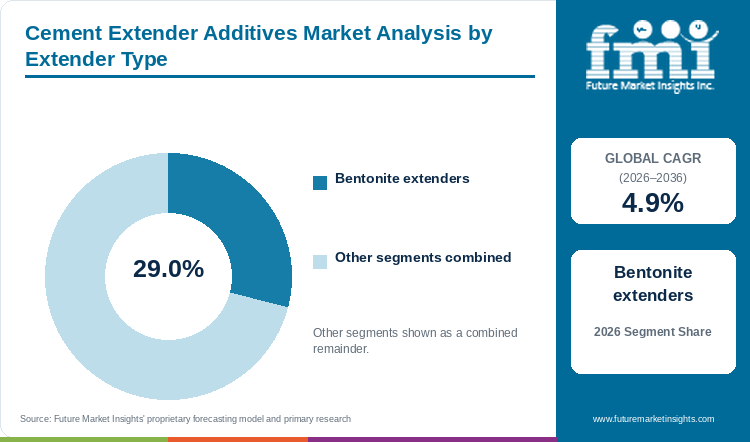
Bentonite extenders take 29% of market share by extender type in 2026.
Bentonite extenders lead the extender type category with 29% of demand in 2026, and deep clay supply keeps bentonite in front. Clay is mined at scale for many industries, so cementing bases can source consistent grades close to the well. Pozzolanic and fly ash extenders follow power plant output and ash quality, and diatomaceous earth and lightweight minerals serve narrower density and thermal targets.
- Shallow and onshore jobs with moderate strength targets are expected to keep the largest bentonite volumes through 2036.
- US bentonite carried an average unit value of USD 110 per metric ton in 2025, according to the U.S. Geological Survey [1].
Why Does Lightweight Cement Lead the Cement Extender Additives Market by Cement System?
By cement system, lightweight cement leads with 38% of market share in 2026.
With 38% of demand by cement system in 2026, lightweight cement is the first choice for loss-prone and depleted intervals. Low-density slurry, standard slurry extension and lost circulation cement serve narrower pressure windows, and engineered low-density designs add material and equipment cost per job.
- Weak rock in depleted fields is expected to keep lightweight systems on most new loss-prone wells.
- In September 2026, OMV issued a call to tender for cementing and pumping services covering oil, gas and geothermal wells [3].
Why Does Cost Reduction Lead the Cement Extender Additives Market by Application?
Cost reduction is projected to account for 28% of market share by application in 2026.
Cost reduction holds 28% of demand by application in 2026. A higher-yield slurry needs fewer sacks of base cement for the same placed volume, and rising well costs have turned that saving into a budget line for operators. Density reduction and weak formation cementing need more laboratory work, so approvals take longer, and thermal insulation stays with a small set of geothermal and steam wells.
- Operators comparing quotes per placed barrel are expected to favour extended designs on most land jobs.
- Finding and development costs reported by E&P firms in the Dallas Fed Energy Survey rose from 22.3 to 40 in the second quarter of 2026 [4].
Why Do Onshore Wells Lead the Cement Extender Additives Market by Well Type?
In 2026, onshore wells will hold 39% of market share by well type.
Onshore wells account for 39% of demand by well type in 2026, since land programs repeat the same casing design across many wells. Offshore, deepwater, shallow and geothermal wells buy smaller volumes, as fewer jobs, marine logistics and thermal approvals favour engineered systems over bulk minerals.
- One approved recipe moves from well to well with small changes on land, keeping bulk mineral orders steady.
- In June 2026, Kuwait Oil Company awarded National Petroleum Services a five-year cementing contract for unconventional drilling and workover wells, valued at about USD 38.8 million [5].
Why Do Cementing Service Companies Lead the Cement Extender Additives Market by Sales Channel?
Cementing service companies control 43% of market share by sales channel in 2026.
Cementing service companies control 43% of demand by sales channel in 2026, because the contractor pumping the job writes the slurry recipe. Industrial mineral suppliers sell mostly through service company blends, direct E&P supply is limited to operators standardizing materials across large programs, and regional distributors compete mainly on stock.
- Mineral suppliers are expected to gain direct E&P orders mainly through recipes already approved by service companies.
- Sika documented the Sikacrete-416 Light well-plugging material in October 2025, bringing a specialty material maker into well-integrity work [6].
What are the Drivers, Restraints, and Opportunities in the Cement Extender Additives Market?
Rising well costs are increasing the use of high-yield slurries, according to FMI. Strength and rheology testing slows supplier changes, and thermally stable extenders for geothermal and complex gas wells are set to open new demand through 2036.
- Driver: Higher oilfield service costs are making cement yield a budget item, so extended slurries are quoted on more land jobs.
- Restraint: Higher extender loading can weaken early strength and change rheology, and each design needs job-specific laboratory qualification.
- Opportunity: Geothermal and complex gas wells are creating demand for low-density extenders with documented high-temperature stability.
Oilfield service costs are rising faster than cement prices for land operators. The Dallas Fed input cost index for oilfield services firms jumped from 34.9 to 64.4 in the second quarter of 2026, with roughly two-thirds of firms reporting increases [4]. U.S. portland cement held an average mill value of USD 160 per metric ton in 2025, unchanged from 2024 [7]. Every sack saved through a higher-yield slurry cuts trucking, mixing and pumping cost, and sales of cement accelerator additives are projected to grow from USD 920.7 Million in 2026 to USD 1,514.1 Million by 2036 as extended designs need faster strength.
Slurry testing slows every change of extender, as extra water or light solids alter free fluid, sedimentation and thickening time. Each new material is tested with local cement, mix water and companion additives, so service companies often keep a familiar extender. Fly ash grades add batch risk, as supply from the fly ash market varies by power plant source. Clay buyers draw from the wider bentonite market, projected to grow from USD 1.7 Billion in 2026 to USD 3.1 Billion by 2036.
Which Country CAGRs are Profiled in the Cement Extender Additives Market?
| Country | CAGR, 2026 to 2036 |
|---|---|
| Canada | 5.6% |
| KSA | 5.3% |
| Brazil | 5.1% |
| UAE | 5% |
| Australia | 4.8% |
| USA | 4.5% |
| Japan | 3.2% |
How do Country-level CAGRs Compare in the Cement Extender Additives Market?
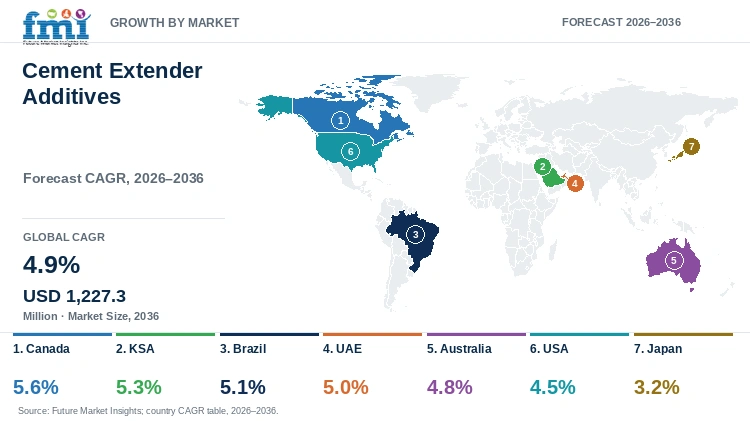
Canada and Japan bracket the profiled group on FMI's country CAGR chart, at 5.6% and 3.2% through 2036. Canada, KSA, Brazil and the UAE are projected to grow at 5% or above on repeat land programs, gas expansion and deepwater work. Australia and the USA are expected to follow at 4.8% and 4.5%, with US operators producing more oil from fewer rigs. Japan relies on geothermal projects with long lead times and posts the lowest rate. Weighting additives in the cement density enhancers market and products in the cement fluid loss additives market, projected at 5.4% CAGR through 2036, move through the same cementing contracts in each country.
- Alberta land programs reusing approved extender recipes put Canada at the top of the group with 5.6% CAGR through 2036.
- KSA is projected to grow at 5.3% CAGR by 2036. Gas expansion keeps adding rigs and directional drilling contracts.
- Deepwater pre-salt work will carry Brazil to 5.1% CAGR during the forecast period.
- Demand for cement extender additives in the UAE will rise at 5% CAGR through 2036 across onshore and offshore work.
- Onshore gas, offshore LNG supply and abandonment work support 4.8% CAGR in Australia by 2036.
- Growth of 4.5% CAGR in the USA during the forecast period will follow cost per well, as operators drill with fewer rigs.
- Japan is set to post the lowest rate at 3.2% CAGR through 2036, tied to geothermal projects with long lead times.
Regional estimates in the full report cover seven regions and more than 30 countries, each sized on well activity and cement volumes.
Country Outlook
- The Alberta Energy Regulator reported 2,430 new crude oil wells placed on production in 2025 and forecasts 2,885 new wells by 2035 [8]. Repeat land drilling lets service companies reuse approved extender recipes across long programs, and demand in Canada is projected to rise at 5.6% CAGR through 2036.
- Unconventional gas programs in KSA are adding rigs and directional drilling contracts at a steady pace. Large programs reward suppliers able to hold extender quality constant across repeated wells, and KSA is projected at 5.3% CAGR during the forecast period.
- Brazil is set to grow at 5.1% CAGR by 2036 on deepwater pre-salt projects. These wells cement through narrow pressure windows with long offshore logistics, and reformulation at sea is expensive, so operators keep extenders already approved in laboratory packages.
- ADNOC stated in May 2025 that the company advanced new unconventional onshore opportunities and continued Upper Zakum development [9]. Onshore unconventional acreage and offshore fields create several density targets within one national program, supporting 5% CAGR in the UAE through 2036.
- Dispersed basins shape extender buying in Australia, from onshore gas to offshore LNG supply and well abandonment. Exploration budgets move in cycles and buyers order in small batches, so growth is projected at 4.8% CAGR during the forecast period.
- U.S. crude oil production reached a record 13.6 million barrels per day in 2025 even as active rigs averaged 5% fewer than in 2024 [10]. Operators producing more with fewer rigs judge cementing inputs on cost per well, and demand in the USA is projected at 4.5% CAGR by 2036.
- Japanese cementing work follows geothermal projects with long permitting cycles and few wells each year. Geothermal casing needs thermal-cycling data before any extender is approved, which keeps Japan at 3.2% CAGR through 2036.
Who are the Notable Companies in the Cement Extender Additives Market?
Halliburton, SLB, Baker Hughes, Imerys, Sibelco and CenoStar are among the leading companies profiled by FMI across cementing services, industrial minerals and lightweight fillers.
Recipe control is held by three cementing contractors, Halliburton, SLB and Baker Hughes, and mineral supply is spread across many clay, ash and filler producers. National Petroleum Services received a five-year Kuwait Oil Company cementing contract for unconventional wells in June 2026, and OMV called for cementing and pumping services for oil, gas and geothermal wells in September 2026 [5] [3]. Contractors check particle consistency, moisture control, regional stock and laboratory support before naming a mineral supplier in a recipe. Approved suppliers keep recipes for long periods, as each new mineral needs testing with local cement and mix water. FMI expects secured clay and pozzolan supply near cementing bases to separate leading mineral suppliers through 2036.
- Integrated Cementing and Slurry Engineering: Baker Hughes, Halliburton and SLB combine cement system design, laboratory testing and field execution at the wellsite.
- Industrial Mineral and Lightweight Filler Supply: Imerys, Sibelco, Omya and CenoStar supply bentonite, diatomite, perlite, calcium carbonate or cenosphere materials with controlled particle properties.
- Specialty Formulation and Oilfield Support: Sika, BASF and TETRA Technologies offer formulated cementitious materials, oilfield chemicals and fluid products, and Sika issued a Sikacrete-416 Light data sheet in October 2025 [6].
Competitive Benchmarking
| Company | Lightweight Slurry Engineering | Extender Mineral Supply | Field Cementing Integration | Geographic Reach |
|---|---|---|---|---|
| Baker Hughes | High | Medium | High | Global oilfield service footprint |
| Halliburton | High | Medium | High | Global oilfield service footprint |
| SLB | High | Low | High | Global oilfield service footprint |
| Imerys | Medium | High | Low | Global industrial mineral operations |
| Sibelco | Low | High | Low | Multi-region mineral operations |
| Omya | Low | Medium | Low | Multi-region mineral and chemical supply |
| Sika | Medium | Low | Medium | Global specialty material presence |
| BASF | Medium | Low | Medium | Global chemical supply footprint |
| TETRA Technologies | Low | Medium | Medium | Major oil and gas basins |
| CenoStar | Medium | High | Low | International direct and distribution supply |
Scoring basis: Lightweight Slurry Engineering rates documented ability to formulate or supply systems that reduce cement density with retained job performance. Extender Mineral Supply rates documented access to mineral or lightweight solids used as extender inputs. Field Cementing Integration rates documented links between laboratory design and cementing execution or related wellsite services. High reflects broad documented capability, Medium a narrower proven range, and Low limited public documentation or an adjacent role.
Key Developments
- In October 2025, Sika published product data for Sikacrete-416 Light, a lightweight expansive cementitious material for secured well plugging with a fresh density of 1,600 to 1,650 kg/m3 [6].
- In June 2026, Kuwait Oil Company awarded National Petroleum Services a five-year contract worth about USD 38.8 million for cementing services on unconventional drilling and workover wells [5].
- In September 2026, OMV issued a call to tender for cementing and pumping services across oil, gas and geothermal wells, covering personnel, equipment, materials and technical support [3].
Key Players
Integrated Cementing and Slurry Engineering
- Baker Hughes
- Halliburton
- SLB
Industrial Mineral and Lightweight Filler Supply
- Imerys
- Sibelco
- Omya
- CenoStar
Specialty Formulation and Oilfield Support
- Sika
- BASF
- TETRA Technologies
Report Scope and Methodology
| Coverage field | Report scope |
|---|---|
| Market breakdown | 5 categories plus region: Extender Type (Bentonite extenders, Pozzolanic extenders, Fly ash extenders, Diatomaceous earth, Lightweight mineral extenders), Cement System (Lightweight cement, Low-density slurry, Standard slurry extension, Lost circulation cement), Application (Cost reduction, Density reduction, Yield increase, Weak formation cementing, Thermal insulation), Well Type (Onshore, Offshore, Shallow wells, Deepwater, Geothermal), Sales Channel (Cementing service companies, Industrial mineral suppliers, Direct E&P supply, Regional distributors), and Region |
| Quantitative units | USD Million |
| Market definition | Revenue from cement extender additives sold for oil, gas, geothermal and related well-cementing applications within the stated extender type, cement system, application, well type and sales channel segments. Downstream cementing service revenue and adjacent additives or substitutes are excluded unless the revenue is directly attributable to a cement extender. |
| Regions covered | North America, Latin America, Western Europe, Eastern Europe, East Asia, South Asia and Pacific, Middle East and Africa |
| Countries covered | More than 30 countries, including Canada, KSA, Brazil, the UAE, Australia, the USA and Japan |
| Key companies profiled | A few of the leading companies out of many players covered in the study: Baker Hughes, Halliburton, SLB, Imerys, Sibelco, Omya, Sika, BASF, TETRA Technologies and CenoStar |
| Forecast period | 2026 to 2036 |
| Approach | A hybrid bottom-up and top-down model built by FMI combines supplier revenue checks, material volume and price indicators, well construction activity, extender-use intensity and channel validation. |
Research Methodology
| Method | Approach |
|---|---|
| Primary research | Discussions with cementing service providers, industrial mineral suppliers, E&P technical and procurement staff, regional distributors and specialists test extender selection, qualification criteria, pricing, sourcing and channel roles. |
| Desk research | The analysis reviews government energy statistics, regulator publications, company filings and technical documentation, project disclosures, standards and trade records, retaining sources relevant to cement extenders. |
| Market sizing and forecasting | The sizing framework triangulates supplier revenue and volume indicators with material pricing, well construction activity, cement system mix, extender-use intensity and channel structure. Forecasts consider drilling activity, pressure-window challenges, mineral supply and qualification cycles. |
| Data validation | Estimates are cross-checked across independent source types and company evidence. Full-service cementing revenue, adjacent additives and substitute products outside the market definition are excluded to avoid double counting. |
Cement Extender Additives Market by Segments
Cement Extender Additives Market Segmented by Extender Type
- Bentonite extenders
- Pozzolanic extenders
- Fly ash extenders
- Diatomaceous earth
- Lightweight mineral extenders
Cement Extender Additives Market Segmented by Cement System
- Lightweight cement
- Low-density slurry
- Standard slurry extension
- Lost circulation cement
Cement Extender Additives Market Segmented by Application
- Cost reduction
- Density reduction
- Yield increase
- Weak formation cementing
- Thermal insulation
Cement Extender Additives Market Segmented by Well Type
- Onshore
- Offshore
- Shallow wells
- Deepwater
- Geothermal
Cement Extender Additives Market Segmented by Sales Channel
- Cementing service companies
- Industrial mineral suppliers
- Direct E&P supply
- Regional distributors
Cement Extender Additives Market Segmented by Region
- North America
- Latin America
- Western Europe
- Eastern Europe
- East Asia
- South Asia and Pacific
- Middle East and Africa
Research Sources and Bibliography
- [1] U.S. Geological Survey (2026, February). Clays, Mineral Commodity Summaries 2026.
- [2] Concrete Products (2026, January 29). Class F, C ash shipments approach 15 million tons in ACAA Survey.
- [3] OMV (2026, September 3). Call to Tender for Cementing and Pumping Services.
- [4] Federal Reserve Bank of Dallas (2026, June 24). Dallas Fed Energy Survey: Expansion in oil and gas activity accompanies growing cost pressures.
- [5] Saudi Gulf Projects (2026, June 9). National Petroleum Services Company Awarded $38.8 Drilling and Workover Services Contract in Kuwait.
- [6] Sika (2025, October). Sikacrete-416 Light Product Data Sheet.
- [7] U.S. Geological Survey (2026, February). Cement, Mineral Commodity Summaries 2026.
- [8] Alberta Energy Regulator (2026, September). Crude Oil.
- [9] ADNOC (2025, May 16). ADNOC Deepens Energy Partnerships with US Companies.
- [10] U.S. Energy Information Administration (2026, March 31). U.S. Crude Oil Production Rose to a Record in 2025.
This bibliography is provided for reader reference and is not exhaustive. The full report contains the complete reference list and detailed citations.
This Report Answers
- What will the Cement Extender Additives Market size be in 2026, and what value will the market reach by 2036?
- What effect will rising oilfield service costs have on the use of high-yield cement slurries?
- Why will bentonite extenders hold the leading position within the Extender Type category in 2026?
- In what ways will lightweight cement and cost-reduction designs shape extender selection?
- Why will onshore wells and cementing service companies anchor demand across the other categories?
- Which growth rates will Canada, KSA, Brazil, the UAE, Australia, the USA and Japan post till 2036?
- Which strength, rheology and thickening-time tests will slow supplier switching?
- What will cementing service companies and E&P teams need to verify before approving a new extender?
Frequently Asked Questions
How Big Is the Cement Extender Additives Market Expected to Be in 2026?
Cement extender additive sales will reach USD 760.7 Million in 2026, up from USD 725.2 Million in 2025, as FMI estimates show. Revenue will rise to USD 1,227.3 Million by 2036 as higher well costs push service companies toward high-yield slurries.
What Is the CAGR of the Cement Extender Additives Market from 2026 to 2036?
The market will grow at a 4.9% CAGR from 2026 to 2036. Growth will come from repeat land programs, deepwater pre-salt work and geothermal wells needing lighter, thermally stable cement.
Which Extender Type Holds the Largest Share of the Cement Extender Additives Market?
Bentonite extenders will lead with 29% of market share by extender type in 2026. Higher slurry yield and lower density from controlled water addition will support the position.
Which Cement System Leads the Cement Extender Additives Market?
Lightweight cement will account for 38% of market share by cement system in 2026. Lower hydrostatic load across weak and loss-prone intervals will support the lead.
Which Country Is Expected to Grow Fastest in the Cement Extender Additives Market?
Canada will grow fastest at a 5.6% CAGR till 2036, followed by KSA at 5.3% and Brazil at 5.1%. Japan will post the slowest rate of the seven profiled countries at 3.2%.
What Notable Restraint Affects the Cement Extender Additives Market?
Key challenges will come from slurry qualification, as higher extender loading will change water demand, rheology and early strength. Each new material will need testing with local cement and mix water, and supplier changes will stay slow.
Which Are the Key Companies in the Cement Extender Additives Market?
Baker Hughes, Halliburton, SLB, Imerys, Sibelco, Omya, Sika, BASF, TETRA Technologies and CenoStar rank among the leading companies covered by FMI. The report assigns each company to one of three supplier groups.
Preview the report firsthand - request a free sample
Get SampleGet the brochure for pricing and purchase details.
Get PDFTable of Content
- Key Takeaways
- Market Size and CAGR
- Top Growth Driver
- Fastest Growing Segment
- Leading Region
- Key Companies
- Emerging Opportunities
- Executive Summary
- Global Market Outlook
- Demand-side Trends
- Supply-side Trends
- Technology Roadmap Analysis
- Analysis and Recommendations
- Analyst Perspective (What is happening? Why now? What should investors know?)
- Key Questions Answered
- How large is the market?
- What is the CAGR?
- What are key trends?
- Which region dominates?
- Who are the leaders?
- Market Overview
- Market Coverage / Taxonomy
- Market Definition / Scope / Limitations
- Research Methodology
- Chapter Orientation
- Analytical Lens and Working Hypotheses
- Market Structure, Signals, and Trend Drivers
- Benchmarking and Cross-market Comparability
- Market Sizing, Forecasting, and Opportunity Mapping
- Research Design and Evidence Framework
- Desk Research Programme (Secondary Evidence)
- Expert Input and Fieldwork (Primary Evidence)
- Tooling, Models, and Reference Databases
- Data Engineering and Model Build
- Quality Assurance and Audit Trail
- Market Background
- Market Dynamics (Drivers, Restraints, Opportunity, Trends)
- Scenario Forecast (Optimistic, Likely, Conservative)
- Impact Analysis
- AI Impact
- Sustainability Impact
- Regulatory Impact
- Technology Impact
- Consumer / Buyer Analysis
- Purchase Drivers
- Adoption Barriers
- Buyer Journey
- Opportunity Map Analysis
- Product Life Cycle Analysis
- Supply Chain Analysis
- Investment Feasibility Matrix
- Value Chain Analysis
- PESTLE and Porter's Analysis
- Regulatory Landscape
- Regional Parent Market Outlook
- Production and Consumption Statistics
- Import and Export Statistics
- Global Market Analysis and Forecast, 2021 to 2036
- Historical Market Size Value (USD Million) Analysis, 2021 to 2025
- Current and Future Market Size Value (USD Million) Projections, 2026 to 2036
- Y-o-Y Growth Trend Analysis
- Absolute $ Opportunity Analysis
- Global Market Pricing Analysis, 2021 to 2036
- Global Market Analysis and Forecast, By Extender Type, 2021 to 2036
- Introduction / Key Findings
- Historical Market Size Value (USD Million) Analysis By Extender Type, 2021 to 2025
- Current and Future Market Size Value (USD Million) Analysis and Forecast By Extender Type, 2026 to 2036
- Bentonite extenders
- Pozzolanic extenders
- Fly ash extenders
- Diatomaceous earth
- Lightweight mineral extenders
- Y-o-Y Growth Trend Analysis By Extender Type, 2021 to 2025
- Absolute $ Opportunity Analysis By Extender Type, 2026 to 2036
- Global Market Analysis and Forecast, By Cement System, 2021 to 2036
- Introduction / Key Findings
- Historical Market Size Value (USD Million) Analysis By Cement System, 2021 to 2025
- Current and Future Market Size Value (USD Million) Analysis and Forecast By Cement System, 2026 to 2036
- Lightweight cement
- Low-density slurry
- Standard slurry extension
- Lost circulation cement
- Y-o-Y Growth Trend Analysis By Cement System, 2021 to 2025
- Absolute $ Opportunity Analysis By Cement System, 2026 to 2036
- Global Market Analysis and Forecast, By Application, 2021 to 2036
- Introduction / Key Findings
- Historical Market Size Value (USD Million) Analysis By Application, 2021 to 2025
- Current and Future Market Size Value (USD Million) Analysis and Forecast By Application, 2026 to 2036
- Cost reduction
- Density reduction
- Yield increase
- Weak formation cementing
- Thermal insulation
- Y-o-Y Growth Trend Analysis By Application, 2021 to 2025
- Absolute $ Opportunity Analysis By Application, 2026 to 2036
- Global Market Analysis and Forecast, By Well Type, 2021 to 2036
- Introduction / Key Findings
- Historical Market Size Value (USD Million) Analysis By Well Type, 2021 to 2025
- Current and Future Market Size Value (USD Million) Analysis and Forecast By Well Type, 2026 to 2036
- Onshore
- Offshore
- Shallow wells
- Deepwater
- Geothermal
- Y-o-Y Growth Trend Analysis By Well Type, 2021 to 2025
- Absolute $ Opportunity Analysis By Well Type, 2026 to 2036
- Global Market Analysis and Forecast, By Sales Channel, 2021 to 2036
- Introduction / Key Findings
- Historical Market Size Value (USD Million) Analysis By Sales Channel, 2021 to 2025
- Current and Future Market Size Value (USD Million) Analysis and Forecast By Sales Channel, 2026 to 2036
- Cementing service companies
- Industrial mineral suppliers
- Direct E&P supply
- Regional distributors
- Y-o-Y Growth Trend Analysis By Sales Channel, 2021 to 2025
- Absolute $ Opportunity Analysis By Sales Channel, 2026 to 2036
- Global Market Analysis and Forecast, By Region, 2021 to 2036
- Introduction
- Historical Market Size Value (USD Million) Analysis By Region, 2021 to 2025
- Current Market Size Value (USD Million) Analysis and Forecast By Region, 2026 to 2036
- North America
- Latin America
- Western Europe
- Eastern Europe
- East Asia
- South Asia and Pacific
- Middle East and Africa
- Market Attractiveness Analysis By Region
- North America Market Analysis and Forecast, By Country, 2021 to 2036
- Historical Market Size Value (USD Million) Trend Analysis By Market Taxonomy, 2021 to 2025
- Market Size Value (USD Million) Forecast By Market Taxonomy, 2026 to 2036
- By Country
- By Extender Type
- By Cement System
- By Application
- By Well Type
- By Sales Channel
- Market Attractiveness Analysis
- By Country
- By Extender Type
- By Cement System
- By Application
- By Well Type
- By Sales Channel
- Key Takeaways
- Latin America Market Analysis and Forecast, By Country
- Historical Market Size Value (USD Million) Trend Analysis By Market Taxonomy, 2021 to 2025
- Market Size Value (USD Million) Forecast By Market Taxonomy, 2026 to 2036
- By Country
- By Extender Type
- By Cement System
- By Application
- By Well Type
- By Sales Channel
- Market Attractiveness Analysis
- By Country
- By Extender Type
- By Cement System
- By Application
- By Well Type
- By Sales Channel
- Key Takeaways
- Western Europe Market Analysis and Forecast, By Country
- Historical Market Size Value (USD Million) Trend Analysis By Market Taxonomy, 2021 to 2025
- Market Size Value (USD Million) Forecast By Market Taxonomy, 2026 to 2036
- By Country
- By Extender Type
- By Cement System
- By Application
- By Well Type
- By Sales Channel
- Market Attractiveness Analysis
- By Country
- By Extender Type
- By Cement System
- By Application
- By Well Type
- By Sales Channel
- Key Takeaways
- Eastern Europe Market Analysis and Forecast, By Country
- Historical Market Size Value (USD Million) Trend Analysis By Market Taxonomy, 2021 to 2025
- Market Size Value (USD Million) Forecast By Market Taxonomy, 2026 to 2036
- By Country
- By Extender Type
- By Cement System
- By Application
- By Well Type
- By Sales Channel
- Market Attractiveness Analysis
- By Country
- By Extender Type
- By Cement System
- By Application
- By Well Type
- By Sales Channel
- Key Takeaways
- East Asia Market Analysis and Forecast, By Country
- Historical Market Size Value (USD Million) Trend Analysis By Market Taxonomy, 2021 to 2025
- Market Size Value (USD Million) Forecast By Market Taxonomy, 2026 to 2036
- By Country
- By Extender Type
- By Cement System
- By Application
- By Well Type
- By Sales Channel
- Market Attractiveness Analysis
- By Country
- By Extender Type
- By Cement System
- By Application
- By Well Type
- By Sales Channel
- Key Takeaways
- South Asia and Pacific Market Analysis and Forecast, By Country
- Historical Market Size Value (USD Million) Trend Analysis By Market Taxonomy, 2021 to 2025
- Market Size Value (USD Million) Forecast By Market Taxonomy, 2026 to 2036
- By Country
- By Extender Type
- By Cement System
- By Application
- By Well Type
- By Sales Channel
- Market Attractiveness Analysis
- By Country
- By Extender Type
- By Cement System
- By Application
- By Well Type
- By Sales Channel
- Key Takeaways
- Middle East and Africa Market Analysis and Forecast, By Country
- Historical Market Size Value (USD Million) Trend Analysis By Market Taxonomy, 2021 to 2025
- Market Size Value (USD Million) Forecast By Market Taxonomy, 2026 to 2036
- By Country
- By Extender Type
- By Cement System
- By Application
- By Well Type
- By Sales Channel
- Market Attractiveness Analysis
- By Country
- By Extender Type
- By Cement System
- By Application
- By Well Type
- By Sales Channel
- Key Takeaways
- Key Countries Market Analysis
- Canada
- Pricing Analysis
- Market Share Analysis, 2025
- By Extender Type
- By Cement System
- By Application
- By Well Type
- By Sales Channel
- KSA
- Pricing Analysis
- Market Share Analysis, 2025
- By Extender Type
- By Cement System
- By Application
- By Well Type
- By Sales Channel
- Brazil
- Pricing Analysis
- Market Share Analysis, 2025
- By Extender Type
- By Cement System
- By Application
- By Well Type
- By Sales Channel
- UAE
- Pricing Analysis
- Market Share Analysis, 2025
- By Extender Type
- By Cement System
- By Application
- By Well Type
- By Sales Channel
- Australia
- Pricing Analysis
- Market Share Analysis, 2025
- By Extender Type
- By Cement System
- By Application
- By Well Type
- By Sales Channel
- USA
- Pricing Analysis
- Market Share Analysis, 2025
- By Extender Type
- By Cement System
- By Application
- By Well Type
- By Sales Channel
- Japan
- Pricing Analysis
- Market Share Analysis, 2025
- By Extender Type
- By Cement System
- By Application
- By Well Type
- By Sales Channel
- Canada
- Market Structure Analysis
- Competition Dashboard
- Competition Benchmarking
- Market Share Analysis of Top Players
- By Regional
- By Extender Type
- By Cement System
- By Application
- By Well Type
- By Sales Channel
- Emerging Startups
- Innovation Benchmarking
- Competition Analysis
- Competition Deep Dive
- Baker Hughes
- Overview
- Product Portfolio
- Profitability by Market Segments
- Sales Footprint
- Strategy Overview
- Marketing Strategy
- Product Strategy
- Channel Strategy
- Halliburton
- SLB
- Imerys
- Sibelco
- Omya
- Sika
- BASF
- TETRA Technologies
- CenoStar
- Baker Hughes
- Case Studies
- Success Stories
- Recent Developments
- Competition Deep Dive
- Assumptions & Acronyms Used


