

- Market Size (2026)
- USD 17.9 Bn
- Forecast (2036)
- USD 35.2 Bn
- CAGR (2026 to 2036)
- 7.0%
How big is Supplementary Cementitious Materials Market in 2026?
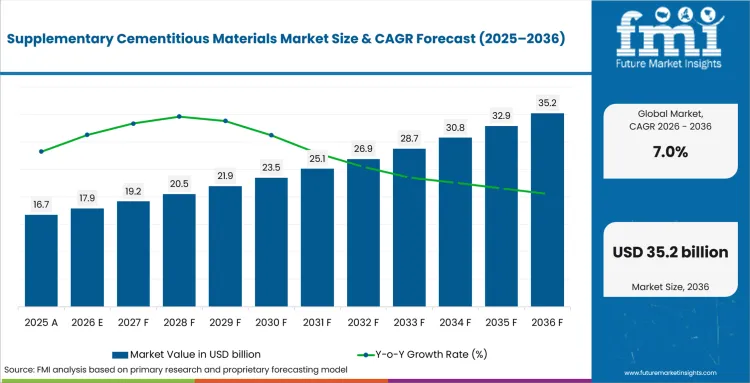
USD 17.9 billion in 2026 and USD 35.2 billion by 2036 at a 7.0% CAGR.
Demand for supplementary cementitious materials is projected to expand at 7.0% CAGR between 2026 and 2036, increasing valuation from USD 17.9 billion in 2026 to USD 35.2 billion by 2036. Cement manufacturers are lowering clinker content without changing the strength and durability expected from established products. Stable plant output requires qualified mineral sources and production controls that keep chemistry consistent across recurring batches. The International Energy Agency stated in October 2025 that wider SCM use is one measure needed to reduce cement emissions. The requirement supports investment in blended cement formulations that work with existing grinding and batching systems. Revenue covers qualified mineral additions that replace part of portland cement in commercial cement and concrete formulations.
North American producers face a separate test because environmental declarations and concrete performance follow different review rules. Project teams need consistent product boundaries before comparing recovered ash, calcined clay and other lower-clinker inputs. The American Cement Association reported in July 2025 that revised cement product category rules added clearer boundaries for SCMs and related concrete products. Clearer boundaries help engineers compare green cement options without treating every recovered mineral as technically interchangeable. Regional rail access and terminal storage remain decisive because a qualified material can lose its cost advantage across a long delivery route. Producers with nearby testing support can complete mix approval faster and manage source changes with less production disruption.
Key Takeaways of Supplementary Cementitious Materials Market
- Cement and concrete producers are increasing SCM use to lower clinker content without sacrificing strength, durability or routine plant output.
- By product type, fly ash is forecast to represent 34.0% in 2026 owing to established sampling routines and storage systems.
- Residential construction is set to lead the application category with 27.0% share in 2026 due to repeat housing programs and approved regional mix designs.
- The cement manufacturers segment is likely to capture 32.0% share in 2026 attributable to direct control of grinding, blending and product release.
- Feedstock variation and long transport routes slow qualification, while reduced access to conventional by-products increases interest in recovered ash and calcined clay.
- Holcim, Heidelberg Materials, Cemex, CRH, Eco Material Technologies, Boral, Ferroglobe and Votorantim Cimentos compete through integrated portfolios, processing assets and regional technical support.
Analyst Perspective
"Supplementary cementitious materials gain value when cement plants preserve strength, production stability and delivered cost across every approved source. Calcined clay broadens mineral availability, but each deposit needs testing and equipment suited to its chemistry. Harvested ash provides another commercial route, although excavation and beneficiation costs vary across individual storage sites. Companies with nearby laboratories, terminals and application teams can protect approved mix designs during supply changes without restarting qualification across an entire product line."
- Nikhil Kaitwade, Principal Analyst, Future Market Insights
How is the Supplementary Cementitious Materials Market segmented?
The Supplementary Cementitious Materials industry is segmented by product type, application, end user, distribution channel, technology, and region.
The segmentation separates material chemistry from the operating route that determines qualification and repeat purchasing. Product type covers fly ash, slag cement, silica fume, natural pozzolans, calcined clay, metakaolin and other approved mineral additions. Application distinguishes residential, commercial, infrastructure, industrial, marine and specialized concrete uses with different strength and curing schedules. End user separates cement manufacturers, ready-mix producers, precast plants, contractors, infrastructure developers and other industrial users. Distribution channel identifies direct contracts, material distributors, ready-mix networks, by-product aggregators and business procurement portals. Technology covers beneficiation, grinding, granulation, calcination, densification and newer processes that recover usable minerals from industrial residues. Regional analysis then tests every category against local specifications, source availability and delivery distance across ready-mix concrete systems.
How does fly ash shape demand in the product type category?
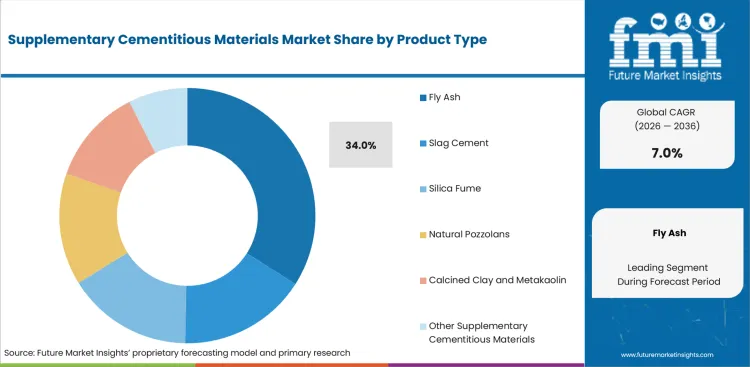
Fly ash enters cement and concrete plants through familiar silos, sampling plans and strength tests. Carbon content and fineness can change air demand, so each source needs approval before routine batching. The USA Environmental Protection Agency reported in April 2026 that about 15 million tons of coal combustion residuals entered concrete products and grout during 2024. The established reuse route supports broad familiarity, although mix designers must confirm concrete admixture compatibility whenever ash chemistry changes.
- By product type, fly ash is estimated to hold 34.0% in 2026 owing to established specifications and storage systems. Cement and concrete plants already understand common sampling and acceptance procedures for qualified ash sources. Its 2026 position depends on consistent carbon content and fineness across recurring deliveries to approved cement and concrete plants throughout regional production cycles.
- Ready-mix producers are purchasing fly ash from terminals that hold approved inventory near major batching networks. Local storage reduces production interruptions and lets laboratories resolve quality changes before material reaches several plants. Adoption becomes harder at sites that depend on distant rail routes or legacy deposits requiring excavation and beneficiation.
What keeps residential construction ahead within the application category?
Residential projects repeat foundations and slabs across many sites, so developers favor concrete mixes that passed local testing. Builders need evidence that unfamiliar binders preserve placement quality and early strength across short construction schedules. Field trials should follow the placement and curing conditions used across housing sites and seasonal construction schedules. The National Research Council Canada opened a July 2025 call requiring independent tests and field trials for harvested fly ash and calcined clay. The requirement makes construction chemical guidance useful for controlling workability and early strength during housing-scale validation.
- In 2026, residential construction is expected to lead the application category with 27.0% share because regional housing programs can repeat approved mix designs. A ready-mix plant can serve several developments through one approved formulation and one production routine. The segment loses ground if early-strength variation disrupts formwork cycles or planned site schedules across repeated housing projects.
- Residential contractors are expected to favor approved SCM mixes over project-specific formulations because familiar placement and finishing methods reduce site risk. Smaller developments rarely justify extended laboratory programs or dedicated mineral storage without sufficient annual concrete volume. Regional producers need standard mixes that perform consistently across seasonal temperatures and practical delivery distances.
Which buying mechanism supports cement manufacturers in the end user category?
Cement manufacturers control grinding and product release, which lets plant teams integrate SCM decisions with existing quality systems. CRH reported in March 2025 that concrete made with ECO3 calcined-clay cement contained about 20% less carbon dioxide per cubic meter than conventional Portland-limestone cement. Commercial teams still need plant trials that connect formulation changes with concrete performance under routine production. Cement teams can compare this route with geopolymer cement pathways without treating the binder systems as interchangeable.
- Based on the end user category, the cement manufacturers segment is projected to account for 32.0% in 2026 due to direct control of binder formulation and final product quality. Integrated plants can adjust grinding and blending systems before revised cement reaches customer silos across regional distribution networks. Their position depends on separate feed systems and dependable laboratory release procedures during recurring production campaigns.
- Integrated cement plants are purchasing qualified SCMs to reduce clinker content across established product lines. Customer trials connect plant settings with strength development and durability under actual production and placement conditions. Older facilities face limits from restricted storage and fixed mill layouts, so expansion requires capital planning that protects existing output during each formulation change.
What supports the position of direct sales within the distribution channel category?
Direct contracts connect source approval with delivery schedules and technical support across a defined plant network. Multi-plant cement groups value one accountable route for sample approval and recurring bulk deliveries across several facilities. A processing laboratory can reproduce difficult mineral conditions before bulk material reaches commercial cement plants. CRH reported in June 2026 that Eco Material Technologies opened a pilot processing center and expanded its 16,400-square-foot laboratory in Georgia. The expanded site gives large accounts a route for mix validation, pilot processing and SCM activator trials.
- The distribution channel category is forecast to be led by direct sales at 35.0% share in 2026 due to coordinated technical support and scheduled bulk delivery. Large accounts can resolve quality disputes through one contract and a technical team responsible for corrective action. The channel maintains its position through response speed and technical accountability rather than material price alone.
- Direct sales adoption is gaining momentum among cement groups that can support dedicated storage and scheduled transport across several plants. Smaller concrete producers often use distributors because direct terminal economics remain weak at limited annual volumes. Long contracts need replacement-source clauses that protect production during regional feedstock interruptions or quality failures.
Why does fly ash processing and beneficiation lead the technology category?
Fly ash processing removes excess carbon and separates unsuitable fractions before recovered material enters routine cement or concrete production. Each deposit needs detailed feedstock mapping because ash quality can change across separate storage zones and excavation depths. Natural Resources Canada described an active SCM project in July 2026 that will process incinerator ash, clay, concrete waste and mine tailings while establishing an integrated testing center. The project supports commercial processing routes that connect source characterization with full cement and concrete validation.
- By technology, the fly ash processing and beneficiation segment is forecast to represent 28.0% in 2026 driven by tighter quality requirements for recovered deposits. Classification and carbon removal can convert stored ash into a consistent production input for cement and concrete plants. The segment depends on reliable feedstock mapping and controlled excavation across every commercial deposit and storage site.
- Sales of fly ash processing and beneficiation are forecast to gain traction at legacy ash sites with accessible material and nearby cement demand. Controlled sampling and particle separation reduce quality variation between recovered loads during routine processing and production. Processors can assess processed mineral fines beside recycled concrete aggregates in lower-clinker systems, but each material requires separate grading and performance controls.
What are the drivers, restraints, and opportunities in the Supplementary Cementitious Materials Market?
Lower-clinker specifications support demand, variable regional feedstock slows qualification, and recovered ash plus calcined clay expand supply for processors with reliable testing.
- Driver: Lower-clinker specifications require qualified mineral additions that maintain strength and durability within established cement and concrete workflows.
- Restraint: Changing by-product supply and source chemistry extend qualification, while long delivery routes can remove the expected material cost advantage.
- Opportunity: Recovered ash and calcined clay can expand usable supply through source mapping, controlled processing and full-scale performance validation.
Lower-clinker specifications give cement producers a direct reason to qualify SCMs that preserve strength and durability across established products. Plant laboratories must connect each mineral source with a controlled formulation and dependable production settings. The Government Office for Science identified SCMs and lower clinker-to-binder ratios as core low-carbon cement solutions in August 2025. Investment follows the requirement for verified materials that fit existing mills, storage systems and customer specifications instead of broad environmental claims.
Fresh fly ash supply changes as coal units retire, delay closure or alter operating schedules across established source regions. The USA Energy Information Administration reported in April 2026 that 2.6 GW of coal capacity retired during 2025 and 6.4 GW was then planned for 2026. The changing schedule makes regional supply planning less predictable without establishing an immediate nationwide shortage. Cement plants need replacement sources, terminal inventory and qualification plans before a local ash stream changes.
Commercial processing can expand supply beyond traditional fly ash and slag if new mineral routes reach industrial scale. A viable project needs source testing and a clear path from pilot equipment to commercial output. The USA Department of Energy awarded nearly USD 8.7 million in January 2025 for initial work on a proposed cement and SCM plant. The award supports engineering design and environmental review, which define the next commercial investment decision. Processors must prove repeatable output and competitive delivered cost before similar projects attract wider capital.
Which country CAGRs are profiled in the Supplementary Cementitious Materials Market?
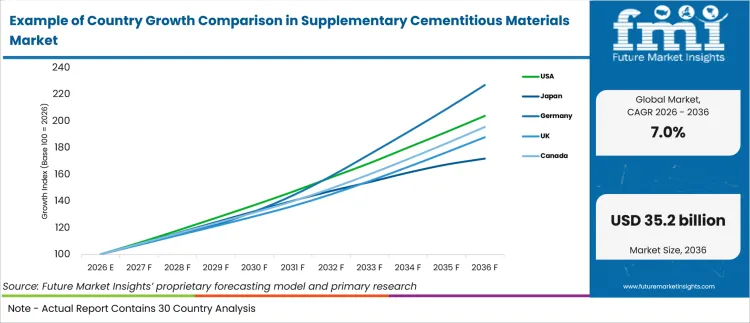
| Country | CAGR |
|---|---|
| Germany | 8.5% |
| Brazil | 8.2% |
| USA | 7.4% |
| Canada | 6.9% |
| UK | 6.5% |
| South Korea | 6.2% |
| Japan | 5.6% |
How do country-level CAGRs compare in the Supplementary Cementitious Materials Market?
The seven-country comparison spans 2.9 percentage points from Germany at 8.5% to Japan at 5.6%. Germany and Brazil form a narrow 0.3-point band, so feedstock quality and plant support matter more than the small rate difference. The USA and Canada form the next pair with a measured 0.5-point separation in their approved growth rates. The UK and South Korea remain similarly close at 0.3 point, while Japan sits 0.6 point below South Korea. These gaps should be read beside qualification cost, freight distance and material availability rather than treated as a complete entry ranking.
- Germany and Brazil occupy the first growth cluster despite relying on different material supply and processing routes. Germany favors controlled calcined-clay processing, while Brazil gains more from local mineral deposits near large cement plants.
- The USA and Canada depend on strong testing networks and regional storage to convert approved formulations into recurring supply. The USA has broader federal purchasing routes, while Canada places greater weight on cold-weather validation and dispersed service coverage.
- The UK and South Korea share a narrow growth interval but face different feedstock and approval constraints. UK formulations depend on changing by-product supply, while South Korean projects require documented recycling and material-handling routes.
- Japan remains separated from the preceding group by formal public works trials and strict early-strength requirements. Its entry case favors controlled applications that combine repeat production with detailed curing and strength records.
Comparable country rates can produce different margins because qualification effort and service distance change the cost of recurring supply. Cement producers should compare local chemistry evidence, storage needs and technical support before allocating regional investment. The full report provides country-level CAGR analysis across North America, Latin America, Europe, East Asia, South Asia, Oceania and the Middle East and Africa.
Country-wise Analysis
- German cement plants need rapid mineralogical control before calcined clay can enter routine blended cement production. The German supplementary cementitious materials sector is projected to record 8.5% CAGR during the assessment period, supported by lower-clinker formulation work and strong cement research capacity. VDZ completed an X-ray production-control project in February 2025 that addressed calcined clay chemistry and cement quality. The method gives plant laboratories a practical route for adjusting calcination and blending as clay composition changes. Germany benefits from established testing organizations and integrated cement production across several industrial regions with established quality systems. Variable clay deposits and separate calcination equipment remain material frictions that require local mineral data and responsive technical teams. These teams must resolve production changes without interrupting approved cement output across established regional product lines.
- Brazilian cement plants serve housing and infrastructure projects across broad regions that increase transport distance between mineral deposits and production sites. Local grinding and laboratory capacity can qualify calcined clay from deposits located near established cement production corridors. Brazil's supplementary cementitious materials outlook is anticipated to advance at 8.2% CAGR over the assessment period, shaped by access to local mineral sources and established cement production. The Federal University of Technology - Paraná published a June 2025 study that characterized seven clay samples from southeastern Paraná for SCM use. The study identified local clays that delivered suitable 28-day strength across the tested cement formulations. Commercial production requires plant-scale calcination and consistent deposit chemistry across recurring batches and operating seasons. Investment decisions should favor deposits that can serve several plants without adding costly storage or repeated formulation changes across construction aggregates networks.
- United States concrete projects increasingly require environmental declarations alongside strength and durability evidence for cement and ready-mix products. By 2036, supplementary cementitious materials demand in the USA is projected to grow at 7.4% CAGR, aided by federal purchasing rules and a large concrete production base. The General Services Administration published updated low-embodied-carbon requirements in April 2025 for concrete and cement used in funded projects. Those limits give project teams a defined route for comparing lower-clinker mixtures across strength classes. Regional terminals and specialized laboratories help producers qualify replacement sources for precast concrete specifications across several states and recurring public construction programs. Long freight routes and different state specifications remain material frictions for producers serving several project markets. Commercial entry works best through regions that combine federal project demand with dependable storage and mix-design support.
- Canadian project teams rely on independent testing and cold-weather performance evidence for unfamiliar mineral additions used in load-bearing concrete. Dispersed construction centers increase the value of regional laboratories and dependable transport planning across provincial markets. Source approval must connect mineral chemistry with freeze-thaw performance under exposed service conditions across provincial construction markets. In Canada, supplementary cementitious material demand is predicted to advance at 6.9% CAGR through 2036, reinforced by public testing programs and cold-weather validation needs. The National Research Council Canada published a June 2025 review of current and emerging low-carbon concrete materials. The review gives cement producers common performance measures for calcined clay and recovered ash during qualification. Distance between deposits and demand centers raises delivered cost, while freeze-thaw requirements extend validation for exposed applications. New sources need regional trial data before cement and concrete producers commit storage or long supply contracts.
- United Kingdom project purchasing increasingly compares embodied emissions with concrete performance and documented delivery evidence during material selection. The government completed a consultation with 109 valid responses in May 2026 and initially focused its policy framework on steel, cement and concrete. Adoption of supplementary cementitious materials in the UK is estimated to expand at 6.5% CAGR through 2036, underpinned by clearer product comparison and purchasing guidance. The framework gives public and private projects a common route for assessing lower-clinker products during material selection. Technical advisers and ready-mix laboratories remain direct adoption enablers because final specifications control material acceptance. Tighter fly ash and slag availability raises material risk for established formulations that depend on familiar by-product sources. Cement groups need alternative mineral plans that preserve early strength and supply continuity across national project networks.
- South Korean recycling routes operate under formal guidance for steel slag and coal ash generators across dense industrial regions. Supplementary cementitious material sales in South Korea are forecast to expand at 6.2% CAGR by 2036, influenced by formal coal ash recycling rules and short industrial service routes. National recycling guidance for steel slag and coal ash generators took effect in October 2025 under official environment and industry ministry notices. The active guidance gives cement producers a formal reference for documenting recovered material handling and recycling routes. Nearby industrial sources can reduce freight distance and support faster technical response across dense cement and concrete production networks. Variable by-product chemistry and environmental approvals remain material frictions for higher-value concrete uses that require narrow performance tolerances. Processors need source-specific testing and stable contracts before recovered material enters recurring cement production at commercial scale.
- Japanese public works agencies use controlled trials and formal performance review for lower-carbon concrete used in public infrastructure. The Ministry of Land, Infrastructure, Transport and Tourism reported in March 2025 that nationwide trials had expanded and most cases used ground granulated blast-furnace slag in precast products. The program gives cement and precast producers a practical route for building local performance records. Supplementary cementitious material demand in Japan is forecast to rise at 5.6% CAGR over the forecast period, reflecting gradual adoption through controlled public works trials. Reliable domestic technical support strengthens mix consistency across formal approval cycles and repeated production campaigns. Strict early-strength requirements and conservative specification changes remain material frictions for unfamiliar mineral additions in public projects. Commercial entry should focus on applications with repeat production and documented curing conditions instead of broad portfolio replacement.
Who are the notable companies in the Supplementary Cementitious Materials Market?
Holcim Ltd., Heidelberg Materials AG, CEMEX S.A.B. de C.V., CRH plc, Eco Material Technologies, Boral Limited, Ferroglobe PLC, and Votorantim Cimentos S.A. are notable companies shaping this market.
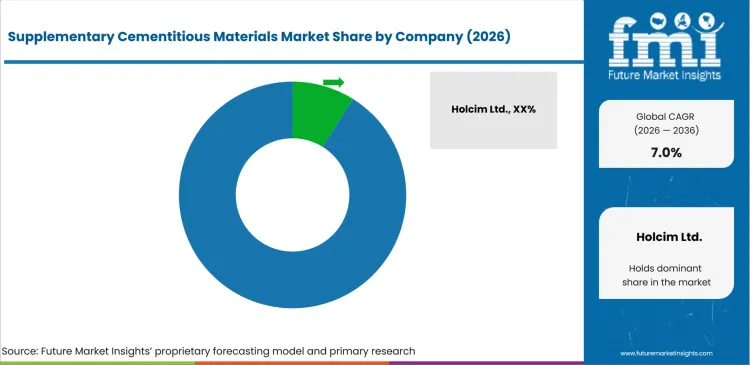
Competition is moderately concentrated within national and regional supply networks rather than one uniform global market. Integrated cement groups control product formulation, customer access and plant laboratories across several national markets. Specialist processors compete through feedstock rights, beneficiation assets and local terminals positioned near cement plants. Entry remains possible for calcined clay, natural pozzolan and recovered ash projects located near dependable deposits. New entrants must fund source testing and reliable logistics before challenging materials that already hold plant approval. Commercial success depends on stable chemistry, manageable freight and application support that carries a source from trials into routine production.
- Holcim and Heidelberg Materials combine international cement operations with calcined clay production and application laboratories. Their commercial advantage comes from testing mineral sources inside established product portfolios and regional application laboratories. Local clay suitability and plant configuration decide whether that scale produces a reliable lower-clinker cement for each region.
- Cemex combines cement and concrete portfolios with a global materials laboratory and distribution across several national construction markets. CRH operates Eco Material Technologies within its North American cementitious network, adding harvested ash processing and regional terminals. Both groups must complete local formulation and delivery tests before a mineral source can enter recurring product lines.
- Boral develops calcined clay for Australian concrete, while Ferroglobe supplies silica fume from metallurgical plants in several countries. Votorantim Cimentos combines local cement production with slag and fly ash use across its regional network. These companies compete through specific mineral access and application knowledge instead of identical global portfolios.
Competitive Benchmarking: Supplementary Cementitious Materials Market
| Company | SCM Portfolio Depth | Processing and Beneficiation | Technical and Distribution Support | Geographic Reach |
|---|---|---|---|---|
| Holcim Ltd. | High | High | High | Global |
| Heidelberg Materials AG | High | High | High | Global |
| CEMEX S.A.B. de C.V. | High | Medium | High | Global |
| CRH plc | High | High | High | Global |
| Eco Material Technologies | High | High | High | North America |
| Boral Limited | Medium | Medium | Medium | Australia |
| Ferroglobe PLC | Low | Medium | Medium | Multi-country |
| Votorantim Cimentos S.A. | Medium | Medium | Medium | Multi-country |
Key Developments in the Supplementary Cementitious Materials Market
- In July 2026, Holcim reported that calcined-clay cement had reached nine plants across Europe, Latin America and North Africa. The company stated that sales reached 0.5 million tonnes during the first half of 2025 and described further capacity expansion. The network demonstrates repeat commercial production across different clay sources, but each regional product needs local chemistry control and customer approval before broader portfolio use.
- In May 2025, Heidelberg Materials started production at a calcined-clay plant in Ghana with annual capacity above 400,000 tonnes. The company reported that initial batches had already reached customers in the regional cement network. The plant adds industrial supply for lower-clinker cement near suitable clay resources, although commercial performance depends on consistent calcination and customer results across local formulations.
- In September 2025, CRH completed its USD 2.1 billion acquisition of Eco Material Technologies. The transaction added fly ash processing, harvested ash projects and regional terminals across North America to CRH’s cementitious materials network. Completed ownership gives CRH direct control over a wider SCM supply route and technical service platform. Concrete producers must complete source-specific approval for every mix and project requirement before routine commercial use.
- In February 2026, Boral completed product development and field trials for an Australian calcined-clay concrete. The company moved the formulation beyond laboratory testing and generated placement evidence under local construction conditions. The program broadens Boral’s options for reducing clinker content in selected commercial concrete production, while wider sales depend on source consistency and project specification approval across additional Australian applications.
Supplementary Cementitious Materials Market - Report Scope
| Coverage field | Report scope |
| Market breakdown | Product Type, Application, End User, Distribution Channel, Technology, and Region. |
| Quantitative Units | Revenue in USD Billion and CAGR in %. |
| Market Definition | Fly ash, slag cement, silica fume, natural pozzolans, calcined clay, metakaolin, and other qualified materials sold to replace part of portland cement in cement or concrete production. |
| Regions Covered | North America, Latin America, Western Europe, Eastern Europe, East Asia, South Asia and Pacific, and Middle East and Africa. |
| Countries Covered | Germany, Brazil, USA, Canada, UK, South Korea, and Japan. |
| Key Companies Profiled | Holcim Ltd., Heidelberg Materials AG, CEMEX S.A.B. de C.V., CRH plc, Eco Material Technologies, Boral Limited, Ferroglobe PLC, and Votorantim Cimentos S.A. |
| Forecast Period | 2026 to 2036. |
| Approach | Hybrid bottom-up and top-down market sizing supported by primary interviews and official desk research. |
Supplementary Cementitious Materials Market - Research Methodology
| Method | Approach |
| Primary Research | FMI analysts gathered input from manufacturers, service providers, technology developers, distributors, end users, procurement teams, and subject-matter experts. Interviews examined purchasing decisions, product or service evaluation, adoption barriers, approval requirements, pricing considerations, and expectations for technical or commercial support. Respondents were also asked what evidence is required before a trial, pilot, or initial order develops into regular purchasing. |
| Desk Research | Desk research covered government statistics, regulatory publications, trade data, industry associations, technical literature, standards, company filings, product information, and official corporate announcements. Sources were reviewed for relevance, publication date, geographic coverage, and consistency with the defined market scope. Claims relating to performance, applications, approvals, capacity, investment, and commercial activity were retained only when supported by credible public evidence. |
| Market Sizing and Forecasting | The market model combined the baseline value with historical performance, segment structure, pricing and volume indicators, adoption levels, company participation, and country-level demand conditions. Forecast assumptions considered economic activity, investment trends, regulatory developments, technology adoption, purchasing cycles, supply availability, and barriers to wider market use. Segment and regional estimates were reconciled before the final market total was calculated. |
| Data Validation | Estimates were checked against multiple independent indicators, including public data, company activity, trade patterns, industry developments, and findings from primary interviews. Validation also tested whether products, services, applications, and company revenues fell within the defined market boundaries. Adjacent categories, unsupported claims, overlapping revenues, and activities without direct market relevance were excluded to reduce double counting and maintain consistency across segments and countries. |
Supplementary Cementitious Materials Market by Segments
Supplementary Cementitious Materials Market, by Product Type
- Fly Ash
- Class F Fly Ash
- Class C Fly Ash
- Slag Cement
- Ground Granulated Blast-Furnace Slag
- Granulated Blast-Furnace Slag
- Silica Fume
- Densified Silica Fume
- Undensified Silica Fume
- Natural Pozzolans
- Volcanic Ash
- Pumicite and Other Natural Pozzolans
- Calcined Clay and Metakaolin
- Calcined Clay
- Metakaolin
- Other Supplementary Cementitious Materials
- Rice Husk Ash
- Ground Limestone and Recycled Glass
Supplementary Cementitious Materials Market, by Application
- Residential Construction
- Single-Family Housing
- Multi-Family Housing
- Commercial Construction
- Office and Commercial Buildings
- Retail and Hospitality Buildings
- Infrastructure
- Roads and Bridges
- Transit and Utility Infrastructure
- Industrial Construction
- Manufacturing Facilities
- Warehouses and Logistics Facilities
- Marine and Coastal Construction
- Ports and Harbors
- Marine Structures
- Other Applications
- Precast Concrete Products
- Ready-Mix and Specialty Concrete
Supplementary Cementitious Materials Market, by End User
- Cement Manufacturers
- Integrated Cement Producers
- Grinding and Blending Operators
- Ready-Mix Concrete Producers
- Independent Ready-Mix Producers
- Ready-Mix Subsidiaries of Cement Companies
- Precast Concrete Manufacturers
- Prestressed Concrete Producers
- Architectural and Structural Precast Producers
- Construction Contractors
- General Contractors
- Specialty Concrete Contractors
- Infrastructure Developers
- Public Infrastructure Developers
- Private Infrastructure Developers
- Other Industrial Users
- Mining and Resource Projects
- Marine and Energy Projects
Supplementary Cementitious Materials Market, by Distribution Channel
- Direct Sales
- Direct Manufacturer-to-Cement Plant Sales
- Long-Term Supply Contracts
- Cement and Building Material Distributors
- Regional Building Material Distributors
- Specialized Cement Distributors
- Ready-Mix and Concrete Supply Networks
- Ready-Mix Supplier Networks
- Concrete Producer Partnerships
- Industrial Byproduct Aggregators
- Fly Ash Collection and Processing Networks
- Slag Recovery and Processing Networks
- Online and B2B Procurement Channels
- Industrial E-Commerce Platforms
- B2B Procurement Portals
Supplementary Cementitious Materials Market, by Technology
- Fly Ash Processing and Beneficiation
- Ash Classification
- Carbon Removal and Beneficiation
- Slag Grinding and Granulation
- Ground Granulated Blast-Furnace Slag Production
- Slag Granulation and Processing
- Calcined Clay Processing
- Clay Calcination
- Low-Carbon Calcined Clay Processing
- Silica Fume Processing
- Densification
- Micro-Silica Processing
- Natural Pozzolan Processing
- Pozzolan Grinding
- Thermal Activation
- Emerging SCM Technologies
- Recycled Glass Pozzolans
- Rice Husk Ash Processing
Supplementary Cementitious Materials Market by Region:
- North America
- United States
- Canada
- Latin America
- Brazil
- Mexico
- Argentina
- Chile
- Western Europe
- Germany
- France
- United Kingdom
- Italy
- Spain
- Benelux
- Nordics
- Eastern Europe
- Poland
- Czech Republic
- Romania
- Hungary
- East Asia
- China
- Japan
- South Korea
- South Asia and Pacific
- India
- ASEAN
- Australia and New Zealand
- Middle East and Africa
- GCC Countries
- South Africa
- Türkiye
- Israel
Research Sources and Bibliography
- International Energy Agency. (2025, October 30). Cement and concrete - Breakthrough Agenda Report 2025 - Analysis.
- American Cement Association. (2025, July 2). Quantifying Environmental Impact.
- USA Environmental Protection Agency. (2026, April 9). Coal Combustion Residuals Reuse.
- National Research Council Canada. (2025, July 17). Low Carbon Built Environment Challenge program - Call for proposals.
- CRH plc. (2025, March 10). Calcined Clay Helps Decarbonize Cement.
- CRH plc. (2026, June 15). Scaling Next-Generation Cementitious Materials.
- Natural Resources Canada. (2026, July 13). Upcycling Waste CO₂ into Sustainable Cement Alternatives.
- Government Office for Science. (2025, August 21). Net Zero Technology Outlook: report.
- USA Energy Information Administration. (2026, April 13). USA coal-fired generating capacity retired in 2025 was the least in 15 years.
- USA Department of Energy. (2025, January 8). Award Wednesday | January 8, 2025.
- VDZ. (2025, February). X-ray analysis for production control of cements with calcined clays.
- Moreira, M. (2025, June 17). Caracterização de argilas da região Sudeste do estado do Paraná para utilização como material cimentício suplementar [Master’s dissertation, Universidade Tecnológica Federal do Paraná]. Repositório Institucional da Universidade Tecnológica Federal do Paraná.
- USA General Services Administration. (2025, April 10). Inflation Reduction Act low-embodied carbon material requirements.
- Greenis, M., Fares, G., Heidari, D., & Zhang, J. (2025, June 19). Low-carbon concrete materials: current and emerging technologies. National Research Council Canada.
- Department for Energy Security and Net Zero. (2026, May 28). Growing the market for low carbon industrial products: policy framework.
- National Law Information Center. (2025, October 1). [Guidelines for recycling by steel slag and coal ash generators].
- Ministry of Land, Infrastructure, Transport and Tourism. (2025, March 14). [Use of low-carbon concrete is expanding nationwide].
- Holcim Ltd. (2026, July 22). Scaling calcined clay for sustainable building.
- Holcim Ltd. (2026, February 27). 2025 Annual Report: Strong Profitable Growth.
- Heidelberg Materials AG. (2025, May 16). World’s largest plant for calcined clay starts production.
- CRH plc. (2025, September 22). CRH completes $2.1 billion acquisition of Eco Material Technologies.
- Boral Limited. (2026, February 16). Boral completes product development of Australian-first low carbon calcined clay concrete.
- CEMEX S.A.B. de C.V. (2026, April 27). Cemex highlights sustainability and operational progress in its 2025 Integrated Report.
- Ferroglobe PLC. (2026, March 26). Annual report for the fiscal year ended December 31, 2025 (Form 20-F).
- Votorantim Cimentos S.A. (2026, March 18). Our 2025 Integrated Report.
This bibliography is provided for reader reference and is not exhaustive. The full report contains the complete reference list and detailed citations
This Report Answers
- How large is the supplementary cementitious materials market in 2026 and 2036?
- Which operating conditions support recurring SCM purchasing across cement and concrete production?
- Why does fly ash represent dominant share of product type in 2026?
- How do residential construction and cement manufacturers shape demand across different purchasing routes?
- Which supply constraints affect fresh fly ash and recovered mineral economics?
- How do country growth rates differ across Germany, Brazil, the USA, Canada, the UK, South Korea, and Japan?
- Which companies combine material processing with technical and distribution support?
- What evidence should project teams request before approving a new SCM source?
- How do beneficiation and calcined clay processing expand the usable supply base?
Frequently Asked Questions
How big is the Supplementary Cementitious Materials Market in 2026?
The supplementary cementitious materials market is valued at USD 17.9 billion in 2026 and is forecast to reach USD 35.2 billion by 2036. Growth is supported by cement manufacturers lowering clinker content while preserving strength and durability across established production systems and recurring batch qualification requirements.
What is the CAGR of the Supplementary Cementitious Materials Market from 2026 to 2036?
The supplementary cementitious materials market grows at a CAGR of 7.0% between 2026 and 2036, supported by lower-clinker cement specifications that require qualified mineral additions maintaining strength and durability across established grinding, blending, and batching systems used by cement and concrete producers.
Which product type leads the Supplementary Cementitious Materials Market?
Fly ash leads the supplementary cementitious materials market with a 34.0% product type share in 2026, supported by established sampling routines and storage systems that let cement and concrete plants qualify recurring deliveries through familiar acceptance procedures and consistent carbon content controls.
How much will the Supplementary Cementitious Materials Market add between 2026 and 2036?
The supplementary cementitious materials market is set to add USD 17.3 billion between 2026 and 2036, growing from USD 17.9 billion to USD 35.2 billion as lower-clinker specifications and recovered mineral processing expand qualified supply across cement manufacturers and ready-mix producers worldwide.
Who are the leading companies in the Supplementary Cementitious Materials Market?
Eight companies lead the supplementary cementitious materials market in 2026, including Holcim, Heidelberg Materials, Cemex, CRH, Eco Material Technologies, Boral, Ferroglobe, and Votorantim Cimentos, competing through integrated portfolios, processing assets, calcined clay production, and regional technical and distribution support.
Preview the report firsthand - request a free sample
Get SampleGet the brochure for pricing and purchase details.
Get PDFTable of Content
- Key Takeaways
- Market Size and CAGR
- Top Growth Driver
- Fastest Growing Segment
- Leading Region
- Key Companies
- Emerging Opportunities
- Executive Summary
- Global Market Outlook
- Demand-side Trends
- Supply-side Trends
- Technology Roadmap Analysis
- Analysis and Recommendations
- Analyst Perspective (What is happening? Why now? What should investors know?)
- Key Questions Answered
- How large is the market?
- What is the CAGR?
- What are key trends?
- Which region dominates?
- Who are the leaders?
- Market Overview
- Market Coverage / Taxonomy
- Market Definition / Scope / Limitations
- Research Methodology
- Chapter Orientation
- Analytical Lens and Working Hypotheses
- Market Structure, Signals, and Trend Drivers
- Benchmarking and Cross-market Comparability
- Market Sizing, Forecasting, and Opportunity Mapping
- Research Design and Evidence Framework
- Desk Research Programme (Secondary Evidence)
- Expert Input and Fieldwork (Primary Evidence)
- Tooling, Models, and Reference Databases
- Data Engineering and Model Build
- Quality Assurance and Audit Trail
- Market Background
- Market Dynamics (Drivers, Restraints, Opportunity, Trends)
- Scenario Forecast (Optimistic, Likely, Conservative)
- Impact Analysis
- AI Impact
- Sustainability Impact
- Regulatory Impact
- Technology Impact
- Consumer / Buyer Analysis
- Purchase Drivers
- Adoption Barriers
- Buyer Journey
- Opportunity Map Analysis
- Product Life Cycle Analysis
- Supply Chain Analysis
- Investment Feasibility Matrix
- Value Chain Analysis
- PESTLE and Porter's Analysis
- Regulatory Landscape
- Regional Parent Market Outlook
- Production and Consumption Statistics
- Import and Export Statistics
- Global Market Analysis and Forecast, 2021 to 2036
- Historical Market Size Value (USD billion) Analysis, 2021 to 2025
- Current and Future Market Size Value (USD billion) Projections, 2026 to 2036
- Y-o-Y Growth Trend Analysis
- Absolute $ Opportunity Analysis
- Global Market Pricing Analysis, 2021 to 2036
- Global Market Analysis and Forecast, By Product Type, 2021 to 2036
- Introduction / Key Findings
- Historical Market Size Value (USD billion) Analysis By Product Type, 2021 to 2025
- Current and Future Market Size Value (USD billion) Analysis and Forecast By Product Type, 2026 to 2036
- Fly Ash
- Class F Fly Ash
- Class C Fly Ash
- Slag Cement
- Ground Granulated Blast-Furnace Slag
- Granulated Blast-Furnace Slag
- Silica Fume
- Densified Silica Fume
- Undensified Silica Fume
- Natural Pozzolans
- Volcanic Ash
- Pumicite and Other Natural Pozzolans
- Calcined Clay and Metakaolin
- Calcined Clay
- Metakaolin
- Other Supplementary Cementitious Materials
- Rice Husk Ash
- Ground Limestone and Recycled Glass
- Fly Ash
- Y-o-Y Growth Trend Analysis By Product Type, 2021 to 2025
- Absolute $ Opportunity Analysis By Product Type, 2026 to 2036
- Global Market Analysis and Forecast, By Application, 2021 to 2036
- Introduction / Key Findings
- Historical Market Size Value (USD billion) Analysis By Application, 2021 to 2025
- Current and Future Market Size Value (USD billion) Analysis and Forecast By Application, 2026 to 2036
- Residential Construction
- Single-Family Housing
- Multi-Family Housing
- Commercial Construction
- Office and Commercial Buildings
- Retail and Hospitality Buildings
- Infrastructure
- Roads and Bridges
- Transit and Utility Infrastructure
- Industrial Construction
- Manufacturing Facilities
- Warehouses and Logistics Facilities
- Marine and Coastal Construction
- Ports and Harbors
- Marine Structures
- Other Applications
- Precast Concrete Products
- Ready-Mix and Specialty Concrete
- Residential Construction
- Y-o-Y Growth Trend Analysis By Application, 2021 to 2025
- Absolute $ Opportunity Analysis By Application, 2026 to 2036
- Global Market Analysis and Forecast, By End User, 2021 to 2036
- Introduction / Key Findings
- Historical Market Size Value (USD billion) Analysis By End User, 2021 to 2025
- Current and Future Market Size Value (USD billion) Analysis and Forecast By End User, 2026 to 2036
- Cement Manufacturers
- Integrated Cement Producers
- Grinding and Blending Operators
- Ready-Mix Concrete Producers
- Independent Ready-Mix Producers
- Ready-Mix Subsidiaries of Cement Companies
- Precast Concrete Manufacturers
- Prestressed Concrete Producers
- Architectural and Structural Precast Producers
- Construction Contractors
- General Contractors
- Specialty Concrete Contractors
- Infrastructure Developers
- Public Infrastructure Developers
- Private Infrastructure Developers
- Other Industrial Users
- Mining and Resource Projects
- Marine and Energy Projects
- Cement Manufacturers
- Y-o-Y Growth Trend Analysis By End User, 2021 to 2025
- Absolute $ Opportunity Analysis By End User, 2026 to 2036
- Global Market Analysis and Forecast, By Distribution Channel, 2021 to 2036
- Introduction / Key Findings
- Historical Market Size Value (USD billion) Analysis By Distribution Channel, 2021 to 2025
- Current and Future Market Size Value (USD billion) Analysis and Forecast By Distribution Channel, 2026 to 2036
- Direct Sales
- Direct Manufacturer-to-Cement Plant Sales
- Long-Term Supply Contracts
- Cement and Building Material Distributors
- Regional Building Material Distributors
- Specialized Cement Distributors
- Ready-Mix and Concrete Supply Networks
- Ready-Mix Supplier Networks
- Concrete Producer Partnerships
- Industrial Byproduct Aggregators
- Fly Ash Collection and Processing Networks
- Slag Recovery and Processing Networks
- Online and B2B Procurement Channels
- Industrial E-Commerce Platforms
- B2B Procurement Portals
- Direct Sales
- Y-o-Y Growth Trend Analysis By Distribution Channel, 2021 to 2025
- Absolute $ Opportunity Analysis By Distribution Channel, 2026 to 2036
- Global Market Analysis and Forecast, By Technology, 2021 to 2036
- Introduction / Key Findings
- Historical Market Size Value (USD billion) Analysis By Technology, 2021 to 2025
- Current and Future Market Size Value (USD billion) Analysis and Forecast By Technology, 2026 to 2036
- Fly Ash Processing and Beneficiation
- Ash Classification
- Carbon Removal and Beneficiation
- Slag Grinding and Granulation
- Ground Granulated Blast-Furnace Slag Production
- Slag Granulation and Processing
- Calcined Clay Processing
- Clay Calcination
- Low-Carbon Calcined Clay Processing
- Silica Fume Processing
- Densification
- Micro-Silica Processing
- Natural Pozzolan Processing
- Pozzolan Grinding
- Thermal Activation
- Emerging SCM Technologies
- Recycled Glass Pozzolans
- Rice Husk Ash Processing
- Fly Ash Processing and Beneficiation
- Y-o-Y Growth Trend Analysis By Technology, 2021 to 2025
- Absolute $ Opportunity Analysis By Technology, 2026 to 2036
- Global Market Analysis and Forecast, By Region, 2021 to 2036
- Introduction
- Historical Market Size Value (USD billion) Analysis By Region, 2021 to 2025
- Current Market Size Value (USD billion) Analysis and Forecast By Region, 2026 to 2036
- North America
- Latin America
- Western Europe
- Eastern Europe
- East Asia
- South Asia and Pacific
- Middle East & Africa
- Market Attractiveness Analysis By Region
- North America Market Analysis and Forecast, By Country, 2021 to 2036
- Historical Market Size Value (USD billion) Trend Analysis By Market Taxonomy, 2021 to 2025
- Market Size Value (USD billion) Forecast By Market Taxonomy, 2026 to 2036
- By Country
- USA
- Canada
- By Product Type
- By Application
- By End User
- By Distribution Channel
- By Technology
- By Country
- Market Attractiveness Analysis
- By Country
- By Product Type
- By Application
- By End User
- By Distribution Channel
- By Technology
- Key Takeaways
- Latin America Market Analysis and Forecast, By Country
- Historical Market Size Value (USD billion) Trend Analysis By Market Taxonomy, 2021 to 2025
- Market Size Value (USD billion) Forecast By Market Taxonomy, 2026 to 2036
- By Country
- Brazil
- Mexico
- Chile
- Rest of Latin America
- By Product Type
- By Application
- By End User
- By Distribution Channel
- By Technology
- By Country
- Market Attractiveness Analysis
- By Country
- By Product Type
- By Application
- By End User
- By Distribution Channel
- By Technology
- Key Takeaways
- Western Europe Market Analysis and Forecast, By Country
- Historical Market Size Value (USD billion) Trend Analysis By Market Taxonomy, 2021 to 2025
- Market Size Value (USD billion) Forecast By Market Taxonomy, 2026 to 2036
- By Country
- Germany
- UK
- Italy
- Spain
- France
- Nordic
- BENELUX
- Rest of Western Europe
- By Product Type
- By Application
- By End User
- By Distribution Channel
- By Technology
- By Country
- Market Attractiveness Analysis
- By Country
- By Product Type
- By Application
- By End User
- By Distribution Channel
- By Technology
- Key Takeaways
- Eastern Europe Market Analysis and Forecast, By Country
- Historical Market Size Value (USD billion) Trend Analysis By Market Taxonomy, 2021 to 2025
- Market Size Value (USD billion) Forecast By Market Taxonomy, 2026 to 2036
- By Country
- Russia
- Poland
- Hungary
- Balkan & Baltic
- Rest of Eastern Europe
- By Product Type
- By Application
- By End User
- By Distribution Channel
- By Technology
- By Country
- Market Attractiveness Analysis
- By Country
- By Product Type
- By Application
- By End User
- By Distribution Channel
- By Technology
- Key Takeaways
- East Asia Market Analysis and Forecast, By Country
- Historical Market Size Value (USD billion) Trend Analysis By Market Taxonomy, 2021 to 2025
- Market Size Value (USD billion) Forecast By Market Taxonomy, 2026 to 2036
- By Country
- China
- Japan
- South Korea
- By Product Type
- By Application
- By End User
- By Distribution Channel
- By Technology
- By Country
- Market Attractiveness Analysis
- By Country
- By Product Type
- By Application
- By End User
- By Distribution Channel
- By Technology
- Key Takeaways
- South Asia and Pacific Market Analysis and Forecast, By Country
- Historical Market Size Value (USD billion) Trend Analysis By Market Taxonomy, 2021 to 2025
- Market Size Value (USD billion) Forecast By Market Taxonomy, 2026 to 2036
- By Country
- India
- ASEAN
- Australia & New Zealand
- Rest of South Asia and Pacific
- By Product Type
- By Application
- By End User
- By Distribution Channel
- By Technology
- By Country
- Market Attractiveness Analysis
- By Country
- By Product Type
- By Application
- By End User
- By Distribution Channel
- By Technology
- Key Takeaways
- Middle East & Africa Market Analysis and Forecast, By Country
- Historical Market Size Value (USD billion) Trend Analysis By Market Taxonomy, 2021 to 2025
- Market Size Value (USD billion) Forecast By Market Taxonomy, 2026 to 2036
- By Country
- Kingdom of Saudi Arabia
- Other GCC Countries
- Türkiye
- South Africa
- Other African Union
- Rest of Middle East & Africa
- By Product Type
- By Application
- By End User
- By Distribution Channel
- By Technology
- By Country
- Market Attractiveness Analysis
- By Country
- By Product Type
- By Application
- By End User
- By Distribution Channel
- By Technology
- Key Takeaways
- Key Countries Market Analysis
- USA
- Pricing Analysis
- Market Share Analysis, 2025
- By Product Type
- By Application
- By End User
- By Distribution Channel
- By Technology
- Canada
- Pricing Analysis
- Market Share Analysis, 2025
- By Product Type
- By Application
- By End User
- By Distribution Channel
- By Technology
- Mexico
- Pricing Analysis
- Market Share Analysis, 2025
- By Product Type
- By Application
- By End User
- By Distribution Channel
- By Technology
- Brazil
- Pricing Analysis
- Market Share Analysis, 2025
- By Product Type
- By Application
- By End User
- By Distribution Channel
- By Technology
- Chile
- Pricing Analysis
- Market Share Analysis, 2025
- By Product Type
- By Application
- By End User
- By Distribution Channel
- By Technology
- Germany
- Pricing Analysis
- Market Share Analysis, 2025
- By Product Type
- By Application
- By End User
- By Distribution Channel
- By Technology
- UK
- Pricing Analysis
- Market Share Analysis, 2025
- By Product Type
- By Application
- By End User
- By Distribution Channel
- By Technology
- Italy
- Pricing Analysis
- Market Share Analysis, 2025
- By Product Type
- By Application
- By End User
- By Distribution Channel
- By Technology
- Spain
- Pricing Analysis
- Market Share Analysis, 2025
- By Product Type
- By Application
- By End User
- By Distribution Channel
- By Technology
- France
- Pricing Analysis
- Market Share Analysis, 2025
- By Product Type
- By Application
- By End User
- By Distribution Channel
- By Technology
- India
- Pricing Analysis
- Market Share Analysis, 2025
- By Product Type
- By Application
- By End User
- By Distribution Channel
- By Technology
- ASEAN
- Pricing Analysis
- Market Share Analysis, 2025
- By Product Type
- By Application
- By End User
- By Distribution Channel
- By Technology
- Australia & New Zealand
- Pricing Analysis
- Market Share Analysis, 2025
- By Product Type
- By Application
- By End User
- By Distribution Channel
- By Technology
- China
- Pricing Analysis
- Market Share Analysis, 2025
- By Product Type
- By Application
- By End User
- By Distribution Channel
- By Technology
- Japan
- Pricing Analysis
- Market Share Analysis, 2025
- By Product Type
- By Application
- By End User
- By Distribution Channel
- By Technology
- South Korea
- Pricing Analysis
- Market Share Analysis, 2025
- By Product Type
- By Application
- By End User
- By Distribution Channel
- By Technology
- Russia
- Pricing Analysis
- Market Share Analysis, 2025
- By Product Type
- By Application
- By End User
- By Distribution Channel
- By Technology
- Poland
- Pricing Analysis
- Market Share Analysis, 2025
- By Product Type
- By Application
- By End User
- By Distribution Channel
- By Technology
- Hungary
- Pricing Analysis
- Market Share Analysis, 2025
- By Product Type
- By Application
- By End User
- By Distribution Channel
- By Technology
- Kingdom of Saudi Arabia
- Pricing Analysis
- Market Share Analysis, 2025
- By Product Type
- By Application
- By End User
- By Distribution Channel
- By Technology
- Türkiye
- Pricing Analysis
- Market Share Analysis, 2025
- By Product Type
- By Application
- By End User
- By Distribution Channel
- By Technology
- South Africa
- Pricing Analysis
- Market Share Analysis, 2025
- By Product Type
- By Application
- By End User
- By Distribution Channel
- By Technology
- USA
- Market Structure Analysis
- Competition Dashboard
- Competition Benchmarking
- Market Share Analysis of Top Players
- By Regional
- By Product Type
- By Application
- By End User
- By Distribution Channel
- By Technology
- Emerging Startups
- Innovation Benchmarking
- Competition Analysis
- Competition Deep Dive
- Holcim Ltd.
- Overview
- Product Portfolio
- Profitability by Market Segments
- Sales Footprint
- Strategy Overview
- Marketing Strategy
- Product Strategy
- Channel Strategy
- Heidelberg Materials AG
- CEMEX S.A.B. de C.V.
- CRH plc
- Charah Solutions, Inc.
- Eco Material Technologies
- Sika AG
- Boral Limited
- Ferroglobe PLC
- Votorantim Cimentos
- Holcim Ltd.
- Case Studies
- Success Stories
- Recent Developments
- Competition Deep Dive
- Assumptions & Acronyms Used


