

- Market Size (2026)
- USD 308.5 Mn
- Forecast (2036)
- USD 757.6 Mn
- CAGR (2026 to 2036)
- 9.4%
How big is Fisetin Market in 2026?
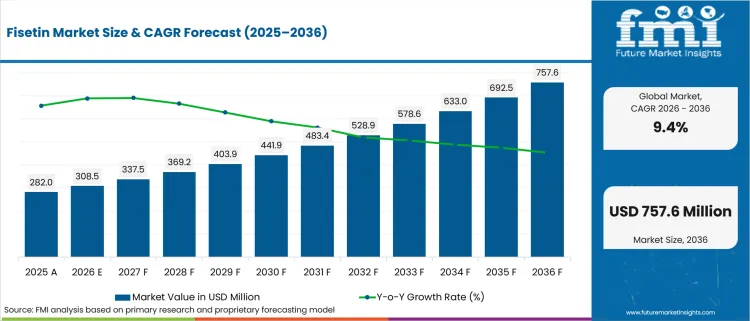
USD 308.5 million in 2026 and USD 757.6 million by 2036 at a 9.4% CAGR.
Demand for fisetin is projected to expand at 9.4% CAGR between 2026 and 2036. Market value is expected to increase from USD 308.5 million to USD 757.6 million across the period as repeat capsule and powder production creates the main commercial route. Brands need stable identity and composition across every batch of flavonoid ingredients used in recurring supplement programs. In June 2025, the FDA released educational materials that help dietary supplement companies prepare complete New Dietary Ingredient Notifications. Better-organized submissions support efficient review and reduce preventable delays during fisetin supplement planning for brands.
National routes differ even though supplements provide the common commercial volume base for fisetin across consumer wellness products. United States brands separate lawful structure or function claims from disease treatment language under federal supplement rules. Japanese companies use the Foods with Function Claims notification system. In contrast, China-based health foods follow registration or filing routes based on ingredient status. ClinicalTrials.gov posted a Denmark-based randomized fisetin study in September 2025 that tests daily supplementation in healthy older adults. The trial expands the human evidence pipeline but does not authorize consumer treatment claims for finished supplement products. These differences separate scientific interest from lawful market access and require local documentation that preserves ingredient consistency. Commercial planning therefore depends on regulatory classification as much as formulation economics across botanical supplement portfolios.
Key Takeaways of Fisetin Market
- Repeat capsule and powder programs create recurring fisetin orders and reward ingredients with stable identity records across production batches.
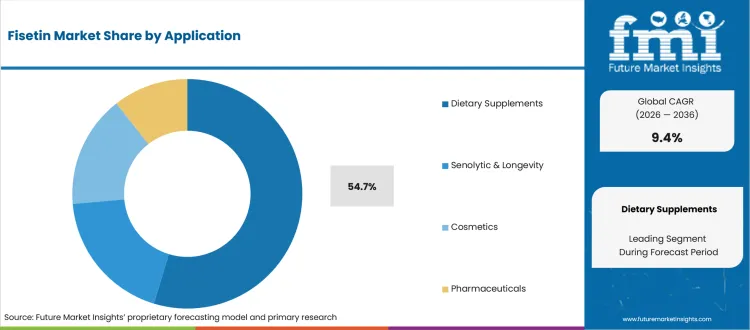
- Dietary supplements are estimated to hold 54.7% share by application in 2026, supported by repeat production across established supplement formats.
- The ≥98% grade is forecast to represent 64.1% of purity-grade demand in 2026, owing to practical quality control and broader sourcing flexibility.
- Fisetin demand is projected to rise from USD 308.5 million in 2026 to USD 757.6 million by 2036.
- Limited human evidence and different national claim rules restrict broader positioning and lengthen commercial review for several fisetin applications.
- The company landscape includes Stanford Chemicals; Cayman Chemical; Tocris Bioscience; ROKIT America; Life Extension; Codeage; Prenetics Global Limited; and Clinique La Prairie Holistic Health, which compete through ingredient supply; research products; finished formulations; and consumer access.
Analyst Perspective
"Fisetin growth depends on whether brands match each product claim with evidence that supports the intended use. Routine supplements need dependable identity records and stable batches; higher-purity material adds value for formulations requiring tighter controls. Companies that separate research interest from proven consumer benefits are better placed to build repeat demand and avoid costly label changes."
- Nandini Roy Choudhury, Principal Analyst, Future Market Insights
How is the Fisetin Market segmented?
The fisetin industry is segmented by Application, Purity Grade, and Region.
Application divides fisetin demand among dietary supplements, senolytic and longevity products, cosmetics, and pharmaceuticals across commercial uses. Purity grade separates material sold at ≥98%, ≥99%, and ≥99.5% specifications for different formulation and research needs. Regional analysis compares registration, notification, and claim pathways across commercial areas that treat botanical ingredients differently. These dimensions show why routine supplement production often uses practical purity grades, while laboratory and specialized formulations require tighter impurity controls. Application choice determines acceptable claims and dosage form; purity grade determines testing depth, sourcing options, and manufacturing cost. Regional rules determine whether the same ingredient can enter through a standard supplement route or needs further review. The segmentation framework helps companies match each proposed use with the right quality records and regulatory pathway across food botanical sourcing decisions.
What supports demand for dietary supplements within the application category?
Supplement products give fisetin a repeat commercial route through capsules and powders sold for general wellness use. ClinicalTrials.gov updated a United States phase II fisetin study in July 2025 that evaluates physical function among breast cancer survivors. The research shows continuing human study activity but does not establish a permitted supplement claim. Brands must align consumer education with the study population and the evidence available for their finished products.
- Dietary supplements are projected to hold 54.7% share by application in 2026, supported by established capsule and powder production. Recurring manufacturing concentrates ingredient orders around specifications that brands can reproduce across labels and contract sites. The segment therefore offers steadier purchasing throughout the year than research programs with long qualification schedules and irregular material needs.
- Consumer brands increasingly use fisetin in herbal supplement channels that support direct education and repeat online orders. Clear dosage disclosure and disciplined claims support adoption; weak substantiation creates regulatory exposure and damages trust in longevity products. Added delivery complexity must provide a clear benefit that consumers can understand across routine purchasing decisions.
How is the ≥98% purity grade evaluated within the purity grade category?
The ≥98% grade gives supplement manufacturers a practical starting specification for recurring commercial production without requiring research-grade purity. An FDA warning letter issued in June 2026 required product-specific limits for identity and purity as well as strength and composition. The action shows why botanical ingredient quality depends on more than a headline assay and requires complete analytical methods with lot certificates.
- Based on purity grade, the ≥98% grade is projected to account for 64.1% share in 2026 due to its fit across routine supplement production. The specification gives brands enough control for standardized formulations and preserves sourcing flexibility across qualified manufacturers. Higher grades remain useful for specialized work but add cost without improving every finished-product requirement.
- Contract manufacturers are expected to favor the ≥98% tier for formulations that need defined input specifications without research-grade costs. Purchase approval depends on validated methods and complete batch records; a stated percentage cannot replace identity confirmation or contaminant controls. Reliable documentation reduces reformulation risk during transfers between qualified production sites and supports consistent release decisions across repeat batches.
What are the drivers, restraints, and opportunities in the Fisetin Market?
Repeat supplement production supports demand; limited human evidence restricts claims; complete quality records create specialized commercial openings.
- Driver: Repeat supplement production creates recurring fisetin orders across standardized capsule and powder manufacturing programs.
- Restraint: Limited human evidence and different national claim rules restrict positioning beyond general wellness applications.
- Opportunity: Verified purity records and application support open specialized commercial routes for higher-specification fisetin formulations.
Recurring supplement production converts consumer interest into scheduled ingredient orders and repeat manufacturing runs for fisetin products. ROKIT America reported in a June 2026 SEC filing that 2025 fisetin sales reached USD 888,000 and increased 139% from 2024. The company result does not define the global market but shows measurable revenue from finished fisetin products. Brands planning nutraceutical applications need stable supply and batch economics that support regular production instead of isolated launches. Manufacturers that cannot maintain consistent lots face production delays and expensive label revisions across recurring programs.
Much fisetin research remains preclinical or exploratory across intended uses, which creates a material barrier for broader product claims. The FDA clarified in December 2025 that structure or function claims still need the DSHEA disclaimer and a clear link to each claim. Brands must translate technical findings into lawful consumer language without implying disease treatment or proven clinical outcomes. Early claim planning reduces late label changes and protects launch schedules throughout product development and market entry.
Complete ingredient records create a commercial opening for companies that connect higher-purity material with clear testing and formulation support. The FDA placed New Dietary Ingredient identity and safety information on its June 2025 Human Foods Program guidance agenda. Organized data packages help functional food formulations and specialized supplements advance through internal review with fewer avoidable questions. Consistent lots reduce reformulation risk across repeat production, but the commercial opening remains limited to lawful applications supported by available evidence.
Which country CAGRs are profiled in the Fisetin Market?
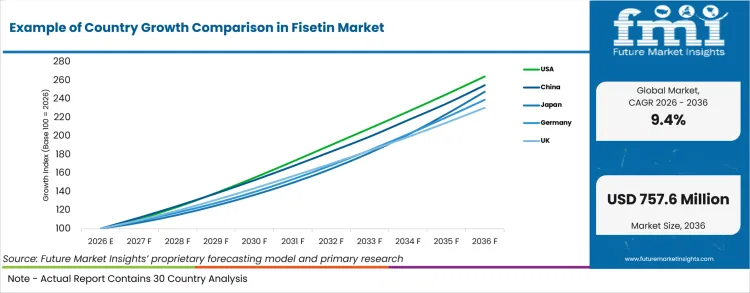
| Country | CAGR |
|---|---|
| United States | 10.2% |
| China | 9.8% |
| Japan | 9.5% |
| Germany | 9.1% |
| United Kingdom | 8.7% |
| South Korea | 8.4% |
How do country-level CAGRs compare in the Fisetin Market?
The country forecasts span 1.8 percentage points and form a gradual progression rather than separate adoption groups. Similar rates reflect shared interest in botanical supplements but do not mean that market entry is equally simple. The United States and United Kingdom emphasize ingredient status and claim boundaries; China and South Korea use defined registration or recognition routes. Japan relies on public notification records for functional claims, and Germany combines established supplement use with strict expectations for consumer communication. These differences influence launch timing and documentation cost more than the small spacing between forecast rates. Country planning should compare lawful claims and technical files separately from projected growth across each national market.
- United States growth reflects broad direct-to-consumer supplement access, but ingredient status and claim support determine acceptable launch routes.
- China combines active health-food registration with filing routes that place greater weight on ingredient eligibility and complete quality records.
- Japan uses a public notification system for functional claims, which supports transparent entry but exposes incomplete records to wider review.
- Germany provides established supplement retail access, yet national notification duties and consumer misconceptions require careful product positioning.
- United Kingdom demand develops through specialist wellness channels, but novel-food status can change the lawful route for unfamiliar uses.
- South Korea uses recognized functional-ingredient standards that define permitted functions and require products to match approved specifications.
Close forecast rates produce different entry conditions in practice under each authority's ingredient classifications and claim pathways. Commercial teams should compare documentation burdens and channel access separately from each country CAGR during launch planning. The full report provides country-level CAGR analysis across North America, Latin America, Europe, East Asia, South Asia, Oceania and the Middle East and Africa.
Country-wise Analysis
- United States supplement launches require brands to determine ingredient status and prepare safety support for qualifying new dietary ingredients. The FDA announced a March 2026 public meeting on the scope of dietary ingredient categories and newer production methods. The discussion gives companies a formal route to clarify how federal definitions apply to proposed ingredients. Fisetin demand in the United States is forecast to rise at 10.2% CAGR over the forecast period. Direct online sales support product access across the country, but unresolved ingredient status or weak claim support can delay labels and launch decisions. Ingredient manufacturers should provide identity methods and production records early so brands can assess notification duties without disrupting scheduled batches.
- China routes health foods through registration or filing based on ingredient status and finished-product classification. The State Administration for Market Regulation reported in June 2025 that 13,000 health-food registration certificates remained active at the end of March. The established system gives fisetin products a defined commercial route if the ingredient and intended use fit national requirements. China is estimated to post 9.8% CAGR over the forecast period, supported by a defined registration and filing system. Ingredients outside official catalogues can require broader safety and quality review that increases documentation and preparation work. Local technical files must connect fisetin specifications with the finished formula and proposed claim throughout registration. Distributors need accurate Chinese documentation and local support during every registration or filing stage in China.
- Japan's Foods with Function Claims system requires a complete notification record for companies marketing products under the framework. Adoption of fisetin products in Japan is estimated to expand at 9.5% CAGR through 2036. The Consumer Affairs Agency renewed its functional-food notification database in April 2025 to support submissions and public access. The searchable route gives brands a clear entry process and exposes inconsistent product information to public review. Safety records and manufacturing details must align with the intended label, so Japanese partners should test ingredient files and consumer language together. Careful preparation reduces the risk that product education extends beyond the evidence included in the notification.
- Germany combines broad supplement use with product notification duties and close review of health-related consumer messages. The Federal Institute for Risk Assessment reported in June 2025 that more than three-quarters of surveyed respondents had used supplements during the previous year. The German fisetin sector is projected to record 9.1% CAGR during the assessment period. Familiar retail channels support access to botanical wellness products, but consumer misunderstandings about supplement oversight create a clear positioning friction. Brands need German-language labels and evidence that separates general wellness support from unauthorized treatment claims across online and physical retail channels. Consistent product descriptions help retailers explain fisetin without implying a level of regulatory review that supplements do not receive.
- Great Britain requires companies to resolve novel-food status prior to placing an unfamiliar ingredient or materially new use on the market. The Food Standards Agency stated in October 2025 that novel foods need authorization prior to market placement. Its guidance permits limited research tasting under defined conditions and excludes promotional sampling for unauthorized novel foods. Fisetin sales in the United Kingdom are forecast to expand at 8.7% CAGR by 2036. Specialist supplement retailing provides an entry route for established uses, but uncertain consumption history can delay packaging and inventory decisions. Commercial teams should establish regulatory status and intended use prior to stock commitments or consumer communications.
- South Korea connects recognized functional ingredients with defined specifications and permitted health functions across its health-functional-food framework. The national route gives companies a structured basis for product planning and review of permitted consumer claims. In South Korea, fisetin demand is predicted to advance at 8.4% CAGR through 2036 across organized health-functional-food channels. The Ministry of Food and Drug Safety published an English translation of Regulation 2024-79 in January 2026 for functional-ingredient recognition and specifications. The translated rules improve access to formal requirements for international companies evaluating local ingredient recognition. Product claims must match recognized functions and approved specifications across formulation strength and consumer communication. Local partners should review ingredient status early to avoid revisions to dosage choices or promotional language.
Who are the notable companies in the Fisetin Market?
Stanford Chemicals, Cayman Chemical, Tocris Bioscience, ROKIT America, Life Extension, Codeage, Prenetics Global Limited, and Clinique La Prairie Holistic Health are notable companies shaping the fisetin market.
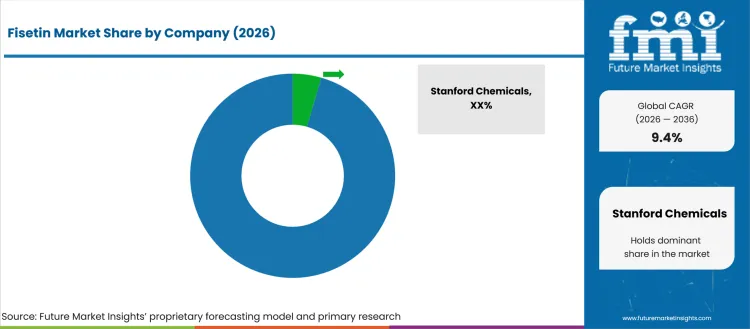
Key players in the fisetin industry typically follow three commercial models, like raw material and ingredient supply, finished nutraceutical product manufacturing, and contract/private-label production. One common approach is the bulk supply of fisetin ingredients at various purity levels by chemical and nutraceutical suppliers such as Stanford Chemicals. Cayman Chemical and Tocris Bioscience serve laboratory use with fisetin-specific technical data and certificate access. ROKIT America and Life Extension sell finished wellness products through different dose and delivery approaches. Codeage and Prenetics use multi-ingredient formulations through direct consumer channels; Clinique La Prairie places fisetin within a premium international retail model. Stanford Chemicals published a January 2026 application review that described fisetin use in food products. Company selection depends on intended use and documented quality across natural antioxidant systems and specialized fisetin formulations.
- Stanford Chemicals supports commercial formulation through bulk botanical material offered across multiple purity options and order sizes. Cayman Chemical and Tocris Bioscience focus on research purchasing through stated assays and batch documentation. The three companies address different order sizes and testing needs across supplement development and laboratory work.
- ROKIT America and Life Extension connect fisetin with finished consumer products through different dose formats and purchasing schedules. ROKIT reports fisetin sales through United States regulatory filings, and Life Extension offers stand-alone plus multi-ingredient formulas. Each model depends on repeat purchasing supported by clear composition and restrained claims across consumer wellness channels.
- Codeage and Prenetics use newer multi-ingredient fisetin formats sold through direct consumer channels and recurring subscription programs. Clinique La Prairie combines fisetin with its premium Holistic Health complex and physical retail access. Each model depends on a clear use case and transparent ingredient quantities that justify recurring purchases.
Competitive Benchmarking: Fisetin Market
| Company | Purity Verification | Formulation Support | Channel Access | Geographic Reach |
|---|---|---|---|---|
| Stanford Chemicals | High | Medium | Medium | Global |
| Cayman Chemical | Medium | Medium | Medium | Global |
| Tocris Bioscience | High | Medium | High | Global |
| ROKIT America | Medium | High | Medium | United States and South Korea |
| Life Extension | Medium | High | High | United States and international |
| Codeage | Medium | Medium | High | United States and selected international markets |
| Prenetics Global Limited | Medium | Medium | Medium | Direct sales across 31 countries |
| Clinique La Prairie Holistic Health | Medium | High | High | Europe, United States, and worldwide delivery |
Key Developments in the Fisetin Market
- In January 2026, Codeage introduced Liposomal Fisetin+ with 500 mg of fisetin per serving in its new formula. The formula combines fisetin with resveratrol and luteolin through a sunflower-derived liposomal format for botanical delivery. Codeage made the product available through its website and selected retail partners across consumer channels. The launch expands access to a defined polyphenol blend and increases competitive attention on delivery design as well as transparent ingredient quantities.
- In October 2025, Prenetics launched IM8 Daily Ultimate Longevity with 100 mg of fisetin in its senolytic complex. The powder also contains quercetin and resveratrol within a broader daily formula for recurring supplementation. Prenetics offered the product through its direct online channel and recurring subscription program for United States consumers. The launch broadens fisetin exposure through a multi-ingredient drink and shows how established consumer platforms can introduce the ingredient beyond stand-alone capsules.
- In May 2025, Life Extension reported preclinical research that examined fisetin in laboratory models of vascular calcification. The company described the findings as early research rather than an established benefit for human consumers. The update adds scientific context for product education but does not support disease treatment claims. Commercial brands can explain ongoing study activity through the research and must keep labels aligned with the available human evidence.
- In October 2025, Clinique La Prairie Holistic Health opened its supplement collection at Bergdorf Goodman in New York. The launch brought the company's complete Holistic Health range and new EPINOME formula into United States physical retail. An August 2025 company article identified fisetin among the senolytic ingredients used in its Holistic Health supplement approach. The expansion therefore gives fisetin-related formulations a visible retail route beyond direct international delivery channels.
Fisetin Market - Report Scope
| Coverage field | Report scope |
|---|---|
| Market breakdown | Application, purity grade, and region. |
| Quantitative Units | Revenue in USD Million, CAGR in %. |
| Market Definition | Commercial demand and supply for fisetin used in dietary supplements, longevity products, cosmetics, and pharmaceutical applications across defined purity grades. |
| Regions Covered | North America, Latin America, Western Europe, Eastern Europe, East Asia, South Asia and Pacific, and Middle East and Africa. |
| Countries Covered | United States, Canada, Brazil, Mexico, Argentina, Chile, Germany, France, United Kingdom, Italy, Spain, Benelux, Nordics, Poland, Czech Republic, Romania, Hungary, China, Japan, South Korea, India, ASEAN, Australia and New Zealand, GCC Countries, South Africa, Türkiye, and Israel. |
| Key Companies Profiled | Stanford Chemicals, Cayman Chemical, Tocris Bioscience, ROKIT America, Life Extension, Codeage, Prenetics Global Limited, and Clinique La Prairie Holistic Health. |
| Forecast Period | 2026 to 2036. |
| Approach | Hybrid bottom-up and top-down market sizing supported by primary interviews and official desk research. |
Fisetin Market - Research Methodology
| Method | Approach |
|---|---|
| Primary Research | FMI analysts gathered input from manufacturers, service providers, technology developers, distributors, end users, procurement teams, and subject-matter experts. Interviews examined purchasing decisions, product or service evaluation, adoption barriers, approval requirements, pricing considerations, and expectations for technical or commercial support. Respondents were also asked what evidence is required before a trial, pilot, or initial order develops into regular purchasing. |
| Desk Research | Desk research covered government statistics, regulatory publications, trade data, industry associations, technical literature, standards, company filings, product information, and official corporate announcements. Sources were reviewed for relevance, publication date, geographic coverage, and consistency with the defined market scope. Claims relating to performance, applications, approvals, capacity, investment, and commercial activity were retained only when supported by credible public evidence. |
| Market Sizing and Forecasting | The market model combined the baseline value with historical performance, segment structure, pricing and volume indicators, adoption levels, company participation, and country-level demand conditions. Forecast assumptions considered economic activity, investment trends, regulatory developments, technology adoption, purchasing cycles, supply availability, and barriers to wider market use. Segment and regional estimates were reconciled before the final market total was calculated. |
| Data Validation | Estimates were checked against multiple independent indicators, including public data, company activity, trade patterns, industry developments, and findings from primary interviews. Validation also tested whether products, services, applications, and company revenues fell within the defined market boundaries. Adjacent categories, unsupported claims, overlapping revenues, and activities without direct market relevance were excluded to reduce double counting and maintain consistency across segments and countries. |
Fisetin Market by Segments
Fisetin Market segmented by Application:
- Dietary Supplements
- Senolytic & Longevity
- Cosmetics
- Pharmaceuticals
Fisetin Market segmented by Purity Grade:
- ≥98%
- ≥99%
- ≥99.5%
Fisetin Market by Region:
- North America
- United States
- Canada
- Latin America
- Brazil
- Mexico
- Argentina
- Chile
- Western Europe
- Germany
- France
- United Kingdom
- Italy
- Spain
- Benelux
- Nordics
- Eastern Europe
- Poland
- Czech Republic
- Romania
- Hungary
- East Asia
- China
- Japan
- South Korea
- South Asia and Pacific
- India
- ASEAN
- Australia and New Zealand
- Middle East and Africa
- GCC Countries
- South Africa
- Türkiye
- Israel
Research Sources and Bibliography
- U.S. Food and Drug Administration. (2025, June 11). FDA Releases Educational Materials on the New Dietary Ingredient Notification Process for Dietary Supplements.
- ClinicalTrials.gov. (2025, September 26). Fisetin Supplementation for Healthy Aging (NCT07195318).
- ClinicalTrials.gov. (2025, July 2). Fisetin to Improve Physical Function in Stage I-III Breast Cancer Survivors (NCT05595499).
- U.S. Food and Drug Administration. (2026, June 4). Nutratech, LLC - 723021 - 06/04/2026.
- ROKIT America, Inc. (2026, June 3). Amendment No. 2 to Form S-1 Registration Statement.
- U.S. Food and Drug Administration. (2025, December 11). Letter to the Dietary Supplement Industry on the DSHEA Disclaimer.
- U.S. Food and Drug Administration. (2025, June 30). FDA Releases 2025 Human Foods Program Guidance Agenda.
- U.S. Food and Drug Administration. (2026, March 3). FDA Announces Public Meeting on Dietary Supplement Innovation and the Scope of Dietary Ingredients.
- State Administration for Market Regulation. (2025, June 24).
- Consumer Affairs Agency. (2025, April 1).
- Federal Institute for Risk Assessment. (2025, June 17). Zwischen Hype und Halbwissen: Häufige Irrtümer rund um Nahrungsergänzungsmittel.
- Food Standards Agency. (2025, October 24). Taste trials guidance.
- Ministry of Food and Drug Safety. (2026, January 29).
- Stanford Chemicals. (2026, January 19). What Are the Applications of Fisetin.
- Codeage. (2026, January 14). Discover a Polyphenol-Driven Formula: Liposomal Fisetin+.
- Prenetics Global Limited. (2025, October 8). Prenetics’ IM8 Launches Daily Ultimate Longevity, First Supplement to Target All 12 Hallmarks of Aging.
- Life Extension. (2025, May 7). Fisetin Helps Prevent Arterial Calcification in Preclinical Research.
- Clinique La Prairie Holistic Health. (2025, October 13). Clinique La Prairie Launches Holistic Health at Bergdorf Goodman in the U.S..
- Clinique La Prairie. (2025, August 27). The Cellular Shift Behind Aging.
This bibliography is provided for reader reference and is not exhaustive. The full report contains the complete reference list and detailed citations.
This Report Answers
- How large is the fisetin market in 2026 and 2036?
- Which operating conditions support recurring fisetin purchases within supplement manufacturing?
- Why do dietary supplements represent 54.7% of application demand in 2026?
- How does the ≥98% purity grade balance commercial quality and sourcing economics?
- Which regulatory conditions shape fisetin entry across the profiled countries?
- How do ingredient suppliers, research providers, and consumer brands compete differently?
- What limits broader claims and application development for fisetin products?
- Which company developments are expanding delivery formats and commercial channels?
- How should formulation teams compare purity verification, formulation support, and channel access?
Frequently Asked Questions
How big is the Fisetin Market in 2026?
The fisetin market is valued at USD 308.5 million in 2026 and is forecast to reach USD 757.6 million by 2036. Growth is supported by recurring capsule and powder production as supplement brands seek stable ingredient identity, composition records, and consistent fisetin batches across established consumer wellness programs and formulation channels.
What is the CAGR of the Fisetin Market from 2026 to 2036?
The fisetin market grows at a CAGR of 9.4% between 2026 and 2036, supported by repeat supplement production across standardized capsule and powder formats. Commercial demand also benefits from broader consumer wellness channels, although differing national ingredient classifications and claim requirements continue to shape product development, labeling, and market entry.
Which application leads the Fisetin Market?
Dietary supplements account for 54.7% of the fisetin market by application in 2026, supported by established capsule and powder production across consumer wellness programs. Recurring manufacturing creates steady ingredient requirements, while brands increasingly use defined dosage formats and composition records to support repeat purchases and consistent production across supplement channels.
How much will the Fisetin Market add between 2026 and 2036?
The fisetin market is set to add USD 449.1 million between 2026 and 2036, growing from USD 308.5 million to USD 757.6 million as capsule and powder programs expand across dietary supplements, longevity products, cosmetics, and pharmaceutical applications while manufacturers strengthen ingredient quality controls and documentation for recurring production.
Who are the notable companies in the Fisetin Market?
Eight companies are profiled in the fisetin market, including Stanford Chemicals, Cayman Chemical, Tocris Bioscience, ROKIT America, Life Extension, Codeage, Prenetics Global Limited, and Clinique La Prairie Holistic Health, competing through ingredient supply, research products, finished formulations, multi-ingredient supplements, direct consumer channels, and premium wellness programs.
Preview the report firsthand - request a free sample
Get SampleGet the brochure for pricing and purchase details.
Get PDFTable of Content
- Key Takeaways
- Market Size and CAGR
- Top Growth Driver
- Fastest Growing Segment
- Leading Region
- Key Companies
- Emerging Opportunities
- Executive Summary
- Global Market Outlook
- Demand-side Trends
- Supply-side Trends
- Technology Roadmap Analysis
- Analysis and Recommendations
- Analyst Perspective (What is happening? Why now? What should investors know?)
- Key Questions Answered
- How large is the market?
- What is the CAGR?
- What are key trends?
- Which region dominates?
- Who are the leaders?
- Market Overview
- Market Coverage / Taxonomy
- Market Definition / Scope / Limitations
- Research Methodology
- Chapter Orientation
- Analytical Lens and Working Hypotheses
- Market Structure, Signals, and Trend Drivers
- Benchmarking and Cross-market Comparability
- Market Sizing, Forecasting, and Opportunity Mapping
- Research Design and Evidence Framework
- Desk Research Programme (Secondary Evidence)
- Expert Input and Fieldwork (Primary Evidence)
- Tooling, Models, and Reference Databases
- Data Engineering and Model Build
- Quality Assurance and Audit Trail
- Market Background
- Market Dynamics (Drivers, Restraints, Opportunity, Trends)
- Scenario Forecast (Optimistic, Likely, Conservative)
- Impact Analysis
- AI Impact
- Sustainability Impact
- Regulatory Impact
- Technology Impact
- Consumer / Buyer Analysis
- Purchase Drivers
- Adoption Barriers
- Buyer Journey
- Opportunity Map Analysis
- Product Life Cycle Analysis
- Supply Chain Analysis
- Investment Feasibility Matrix
- Value Chain Analysis
- PESTLE and Porter's Analysis
- Regulatory Landscape
- Regional Parent Market Outlook
- Production and Consumption Statistics
- Import and Export Statistics
- Global Market Analysis and Forecast, 2021 to 2036
- Historical Market Size Value (USD Million) Analysis, 2021 to 2025
- Current and Future Market Size Value (USD Million) Projections, 2026 to 2036
- Y-o-Y Growth Trend Analysis
- Absolute $ Opportunity Analysis
- Global Market Pricing Analysis, 2021 to 2036
- Global Market Analysis and Forecast, By Application, 2021 to 2036
- Introduction / Key Findings
- Historical Market Size Value (USD Million) Analysis By Application, 2021 to 2025
- Current and Future Market Size Value (USD Million) Analysis and Forecast By Application, 2026 to 2036
- Dietary Supplements
- Senolytic & Longevity
- Cosmetics
- Pharmaceuticals
- Dietary Supplements
- Y-o-Y Growth Trend Analysis By Application, 2021 to 2025
- Absolute $ Opportunity Analysis By Application, 2026 to 2036
- Global Market Analysis and Forecast, By Purity Grade, 2021 to 2036
- Introduction / Key Findings
- Historical Market Size Value (USD Million) Analysis By Purity Grade, 2021 to 2025
- Current and Future Market Size Value (USD Million) Analysis and Forecast By Purity Grade, 2026 to 2036
- ≥98%
- ≥99%
- ≥99.5%
- ≥98%
- Y-o-Y Growth Trend Analysis By Purity Grade, 2021 to 2025
- Absolute $ Opportunity Analysis By Purity Grade, 2026 to 2036
- Global Market Analysis and Forecast, By Region, 2021 to 2036
- Introduction
- Historical Market Size Value (USD Million) Analysis By Region, 2021 to 2025
- Current Market Size Value (USD Million) Analysis and Forecast By Region, 2026 to 2036
- North America
- Latin America
- Western Europe
- Eastern Europe
- East Asia
- South Asia and Pacific
- Middle East & Africa
- Market Attractiveness Analysis By Region
- North America Market Analysis and Forecast, By Country, 2021 to 2036
- Historical Market Size Value (USD Million) Trend Analysis By Market Taxonomy, 2021 to 2025
- Market Size Value (USD Million) Forecast By Market Taxonomy, 2026 to 2036
- By Country
- USA
- Canada
- By Application
- By Purity Grade
- By Country
- Market Attractiveness Analysis
- By Country
- By Application
- By Purity Grade
- Key Takeaways
- Latin America Market Analysis and Forecast, By Country
- Historical Market Size Value (USD Million) Trend Analysis By Market Taxonomy, 2021 to 2025
- Market Size Value (USD Million) Forecast By Market Taxonomy, 2026 to 2036
- By Country
- Brazil
- Mexico
- Chile
- Rest of Latin America
- By Application
- By Purity Grade
- By Country
- Market Attractiveness Analysis
- By Country
- By Application
- By Purity Grade
- Key Takeaways
- Western Europe Market Analysis and Forecast, By Country
- Historical Market Size Value (USD Million) Trend Analysis By Market Taxonomy, 2021 to 2025
- Market Size Value (USD Million) Forecast By Market Taxonomy, 2026 to 2036
- By Country
- Germany
- UK
- Italy
- Spain
- France
- Nordic
- BENELUX
- Rest of Western Europe
- By Application
- By Purity Grade
- By Country
- Market Attractiveness Analysis
- By Country
- By Application
- By Purity Grade
- Key Takeaways
- Eastern Europe Market Analysis and Forecast, By Country
- Historical Market Size Value (USD Million) Trend Analysis By Market Taxonomy, 2021 to 2025
- Market Size Value (USD Million) Forecast By Market Taxonomy, 2026 to 2036
- By Country
- Russia
- Poland
- Hungary
- Balkan & Baltic
- Rest of Eastern Europe
- By Application
- By Purity Grade
- By Country
- Market Attractiveness Analysis
- By Country
- By Application
- By Purity Grade
- Key Takeaways
- East Asia Market Analysis and Forecast, By Country
- Historical Market Size Value (USD Million) Trend Analysis By Market Taxonomy, 2021 to 2025
- Market Size Value (USD Million) Forecast By Market Taxonomy, 2026 to 2036
- By Country
- China
- Japan
- South Korea
- By Application
- By Purity Grade
- By Country
- Market Attractiveness Analysis
- By Country
- By Application
- By Purity Grade
- Key Takeaways
- South Asia and Pacific Market Analysis and Forecast, By Country
- Historical Market Size Value (USD Million) Trend Analysis By Market Taxonomy, 2021 to 2025
- Market Size Value (USD Million) Forecast By Market Taxonomy, 2026 to 2036
- By Country
- India
- ASEAN
- Australia & New Zealand
- Rest of South Asia and Pacific
- By Application
- By Purity Grade
- By Country
- Market Attractiveness Analysis
- By Country
- By Application
- By Purity Grade
- Key Takeaways
- Middle East & Africa Market Analysis and Forecast, By Country
- Historical Market Size Value (USD Million) Trend Analysis By Market Taxonomy, 2021 to 2025
- Market Size Value (USD Million) Forecast By Market Taxonomy, 2026 to 2036
- By Country
- Kingdom of Saudi Arabia
- Other GCC Countries
- Türkiye
- South Africa
- Other African Union
- Rest of Middle East & Africa
- By Application
- By Purity Grade
- By Country
- Market Attractiveness Analysis
- By Country
- By Application
- By Purity Grade
- Key Takeaways
- Key Countries Market Analysis
- USA
- Pricing Analysis
- Market Share Analysis, 2025
- By Application
- By Purity Grade
- Canada
- Pricing Analysis
- Market Share Analysis, 2025
- By Application
- By Purity Grade
- Mexico
- Pricing Analysis
- Market Share Analysis, 2025
- By Application
- By Purity Grade
- Brazil
- Pricing Analysis
- Market Share Analysis, 2025
- By Application
- By Purity Grade
- Chile
- Pricing Analysis
- Market Share Analysis, 2025
- By Application
- By Purity Grade
- Germany
- Pricing Analysis
- Market Share Analysis, 2025
- By Application
- By Purity Grade
- UK
- Pricing Analysis
- Market Share Analysis, 2025
- By Application
- By Purity Grade
- Italy
- Pricing Analysis
- Market Share Analysis, 2025
- By Application
- By Purity Grade
- Spain
- Pricing Analysis
- Market Share Analysis, 2025
- By Application
- By Purity Grade
- France
- Pricing Analysis
- Market Share Analysis, 2025
- By Application
- By Purity Grade
- India
- Pricing Analysis
- Market Share Analysis, 2025
- By Application
- By Purity Grade
- ASEAN
- Pricing Analysis
- Market Share Analysis, 2025
- By Application
- By Purity Grade
- Australia & New Zealand
- Pricing Analysis
- Market Share Analysis, 2025
- By Application
- By Purity Grade
- China
- Pricing Analysis
- Market Share Analysis, 2025
- By Application
- By Purity Grade
- Japan
- Pricing Analysis
- Market Share Analysis, 2025
- By Application
- By Purity Grade
- South Korea
- Pricing Analysis
- Market Share Analysis, 2025
- By Application
- By Purity Grade
- Russia
- Pricing Analysis
- Market Share Analysis, 2025
- By Application
- By Purity Grade
- Poland
- Pricing Analysis
- Market Share Analysis, 2025
- By Application
- By Purity Grade
- Hungary
- Pricing Analysis
- Market Share Analysis, 2025
- By Application
- By Purity Grade
- Kingdom of Saudi Arabia
- Pricing Analysis
- Market Share Analysis, 2025
- By Application
- By Purity Grade
- Türkiye
- Pricing Analysis
- Market Share Analysis, 2025
- By Application
- By Purity Grade
- South Africa
- Pricing Analysis
- Market Share Analysis, 2025
- By Application
- By Purity Grade
- USA
- Market Structure Analysis
- Competition Dashboard
- Competition Benchmarking
- Market Share Analysis of Top Players
- By Regional
- By Application
- By Purity Grade
- Emerging Startups
- Innovation Benchmarking
- Competition Analysis
- Competition Deep Dive
- Stanford Chemicals
- Overview
- Product Portfolio
- Profitability by Market Segments
- Sales Footprint
- Strategy Overview
- Marketing Strategy
- Product Strategy
- Channel Strategy
- Cayman Chemical
- Tocris Bioscience
- AIDP
- Nutra Biotechnology
- Doctor's Best
- Nootropics Depot
- Double Wood
- Stanford Chemicals
- Case Studies
- Success Stories
- Recent Developments
- Competition Deep Dive
- Assumptions & Acronyms Used


