

- Market Size (2026)
- USD 690.6 Mn
- Forecast (2036)
- USD 1775.0 Mn
- CAGR (2026 to 2036)
- 9.9%
How big is the fluorine scrubbers market in 2026?
USD 690.6 million in 2026 and USD 1,775.0 million by 2036 at a 9.9% CAGR.
The fluorine scrubbers industry value is forecast to grow from USD 628.4 million in 2025 to USD 1,775.0 million by 2036 at 9.9% CAGR. Semiconductor fabs are forecast to represent 58.0% share in 2026 because etch and CVD chamber cleaning lines produce fluoride-rich exhaust. Wet scrubbers are expected to secure 46.0% share in 2026 due to proven HF absorption and neutralization duty.
Summary of the Fluorine Scrubbers Market
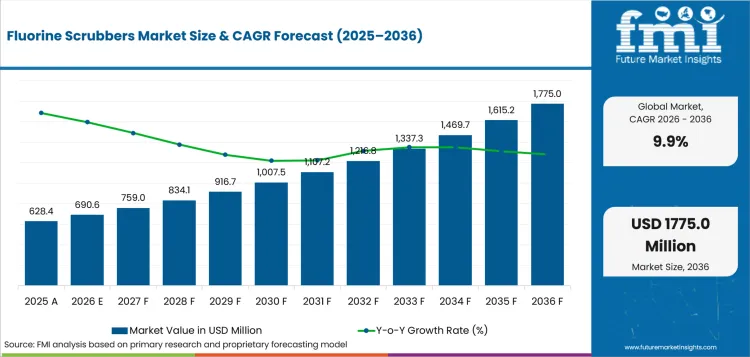
Fluorine Scrubbers Market Overview: Size and Forecast
- 2025 Market Size: USD 628.4 million
- 2026 Market Size: USD 690.6 million
- 2036 Market Size: USD 1,775.0 million
- Forecast CAGR: 9.9% from 2026 to 2036
- Leading Application: Semiconductor Fabs
- Semiconductor Fabs Share in 2026: 58.0%
- Leading Scrubber Type: Wet Scrubbers
- Wet Scrubbers Share in 2026: 46.0%
- Fastest-growing Country: China
- China CAGR: 11.8% by 2036
- Demand and Growth Drivers
- Semiconductor fabs are expected to represent 58.0% share in 2026 because etch and chamber-clean tools create high-value scrubber demand.
- HF is projected to account for 44.0% share in 2026 since hydrofluoric acid vapor remains the clearest acid-gas target.
- China is projected to record 11.8% CAGR through 2036 as domestic integrated-circuit production supports capacity additions.
- Medium systems are expected to represent 41.0% share in 2026 since they match clustered process tools and retrofit sub-fab footprints.
- Product and Segment View
- Wet scrubbers are projected to lead by scrubber type with 46.0% share as water-soluble fluoride removal fits many fab exhaust streams.
- Semiconductor fabs are expected to lead by application with 58.0% share because fluorinated gases are used across plasma etch and CVD cleaning.
- HF is estimated to lead by acid gas target with 44.0% share since buyers prioritize proven neutralization for corrosive acid exhaust.
- EPC / Turnkey is expected to lead by sales channel with 47.0% share as integrated design lowers commissioning risk for owners.
- Geography and Competitive Outlook
- China is projected to record the fastest country CAGR at 11.8% due to integrated-circuit output and local fab expansion.
- South Korea is expected to expand at 11.2% CAGR through 2036 as memory and logic clusters keep sub-fab spending active.
- Ebara and Edwards compete for large semiconductor accounts through abatement platforms and global service networks.
- CS Clean Solutions and DAS Environmental Expert compete through dry-bed and burn-wet systems for process-specific exhaust needs.
- Analyst Opinion
- Nikhil Kaitwade, Principal Consultant at Future Market Insights for industrial domain, says, “Fluorine scrubbers are moving from an end-of-pipe purchase into a production assurance purchase. Buyers are asking whether a unit can protect ducting, reduce tool stoppage, and stay serviceable inside crowded sub-fab space. Suppliers should document fluoride capture, by-product handling, and field service depth in the same proposal.”
Fluorine scrubber demand is moving from basic compliance hardware toward sub-fab risk control as semiconductor plants tie abatement performance to uptime and process stability. The USA EPA states that semiconductor manufacturing uses fluorinated gases for etching and chamber cleaning, including CF₄, C₂F₆, C₃F₈, NF₃, and SF₆. This matters because each gas stream creates different removal and by-product handling requirements near specific process tools. Buyers are therefore prioritizing scrubber vendors that can prove removal efficiency, service response, tool-level compatibility, and maintenance access before approving systems for new fabs or capacity expansions.
The fluorine scrubbers market is expected to expand through 2036 as semiconductor fabs and chemical plants tighten control of HF and fluorinated exhaust. Market value is linked to fab capacity additions, sub-fab retrofit work, and process-specific abatement requirements.
Which factors support expansion in the fluorine scrubbers market?
Finished scrubber systems, sub-fab service contracts, and EPC-led installation packages support market value across semiconductor and industrial sites.
- Market value is supported by wet, dry, and hybrid scrubber revenue before service and media replacement add incremental sales.
- Supplier pricing reflects gas load, materials of construction, control systems, and commissioning support before channel margins affect final quotes.
- Revenue improves as fabs convert facility exhaust plans into tool-level abatement and scrubber replacement programs.
- Buyer trust rises as vendors document fluoride capture performance and maintenance access under real process conditions.
Why is the fluorine scrubbers market growing?
Semiconductor capacity additions are creating demand for gas scrubber systems that can handle HF, F₂ mixtures, and multiple acid streams near process tools.
Growth outlook is tied to semiconductor manufacturing equipment investment because every new tool cluster increases the need for matched exhaust control.
The National Institute of Standards and Technology announced the July 2024 availability of a final environmental assessment for semiconductor fabrication facility modernization under the CHIPS Incentives Program. Environmental review matters because public funding, new tool installation, and permit documentation all raise scrutiny of exhaust abatement. Scrubber suppliers benefit when they support safety reviews, commissioning records, and equipment monitoring in a single package.
The revised Industrial Emissions Directive in Europe also supports demand for air pollution control systems because large installations must align emissions control with updated permitting requirements.
This policy setting favors suppliers that can connect equipment design with compliance files and operating proof. It also narrows the space for generic exhaust systems without fluorine-specific duty.
How is the fluorine scrubbers market segmented?
The fluorine scrubbers industry is segmented by scrubber type, application, acid gas target, capacity, sales channel, and region.
- Wet scrubbers are projected to account for 46.0% share in 2026 because HF-heavy exhaust streams favor absorption and neutralization.
- Semiconductor fabs are expected to lead by application with 58.0% share due to dense fluorinated gas use in etch and chamber cleaning.
- HF is anticipated to represent 44.0% share in 2026 since acid gas capture remains the clearest compliance need.
- Medium systems are expected to hold 41.0% share in 2026 with clustered process tools needing compact treatment capacity.
- EPC / Turnkey channels are projected to account for 47.0% share in 2026 as owners seek bundled design and commissioning support.
Why do wet scrubbers dominate the fluorine scrubbers market?
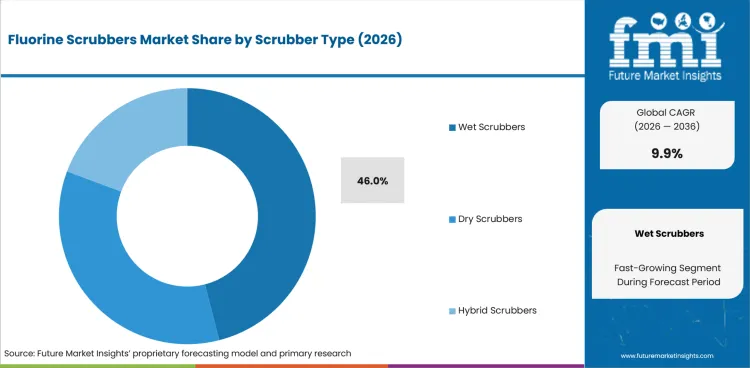
- Wet scrubbers are projected to account for 46.0% share in 2026 because HF absorption and fluoride neutralization match common exhaust streams.
- Dry scrubbers remain relevant where low-flow lines need passive capture without water handling or fuel utilities.
Which application leads the fluorine scrubbers market?
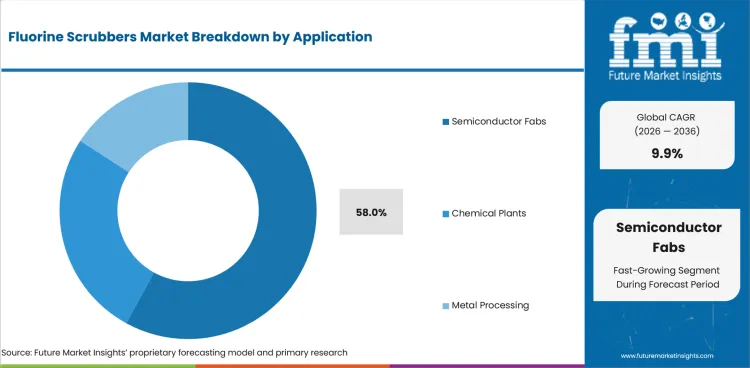
- Semiconductor fabs are expected to represent 58.0% share in 2026 as etch and CVD cleaning lines produce fluoride-rich exhaust.
- Chemical plants create steady replacement demand where HF handling and fluorochemical processing increase corrosion risk.
Which acid gas target leads the fluorine scrubbers market?
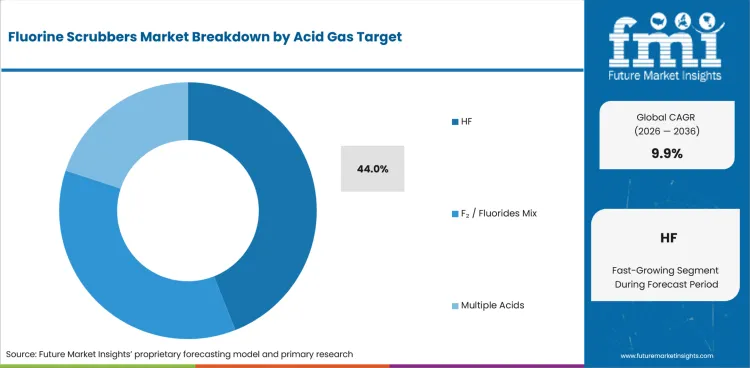
- HF is anticipated to hold 44.0% share in 2026 since hydrofluoric acid vapor creates corrosion and worker exposure risks.
- Demand is also linked to hydrofluoric acid use in industrial processing because even small vapor losses can affect ducts, pumps, and safety controls.
Which capacity segment leads the fluorine scrubbers market?
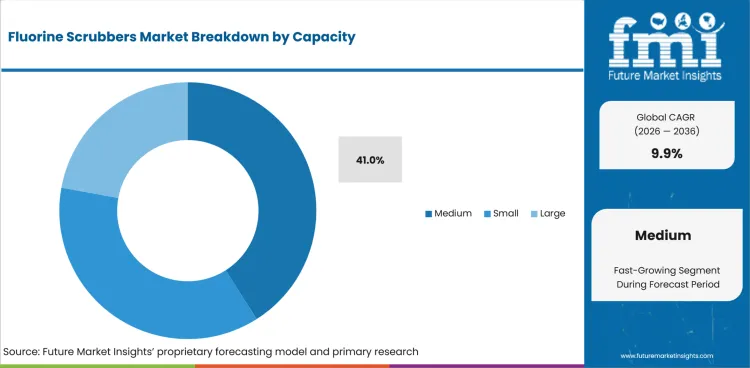
- Medium systems are expected to account for 41.0% share in 2026 as clustered tools need capacity without occupying scarce sub-fab space.
- Large packages gain importance when fabs consolidate exhaust from multiple tools or add hybrid burn-wet trains.
Which sales channel leads the fluorine scrubbers market?
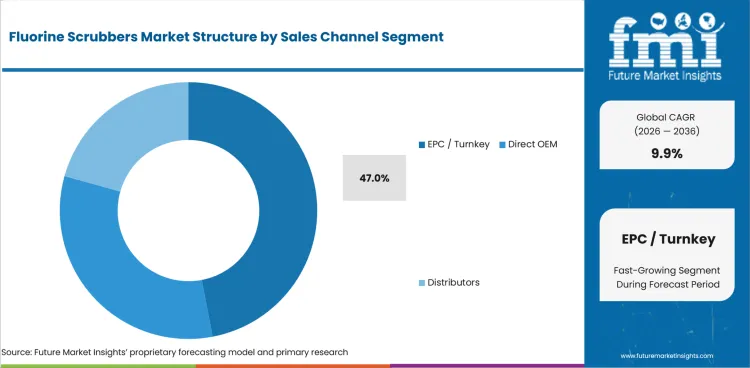
- EPC / Turnkey is projected to represent 47.0% share in 2026 as buyers bundle scrubber layout, ductwork, controls, and commissioning.
- Direct OEM sales remain common for replacement units where the facility team already knows load, footprint, and service needs.
What are the drivers, restraints, and opportunities in the fluorine scrubbers market?
Sub-fab risk control and HF compliance support growth. Utility load, wastewater treatment, and supplier qualification constrain faster adoption.
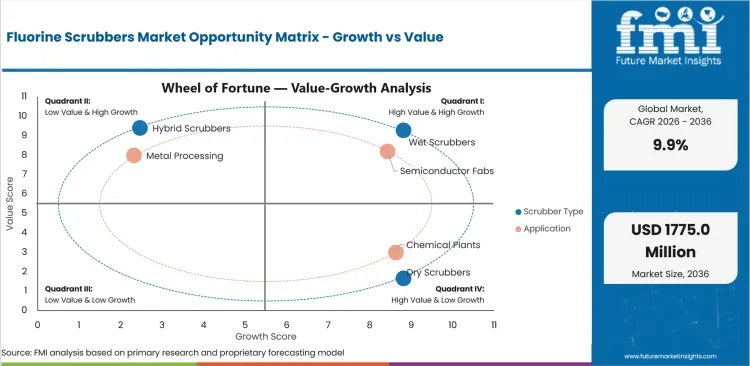
- Driver: Fluorinated gas use in etch and CVD processes drives scrubber demand as fabs need treatment near exhaust origin.
- Driver: HF corrosion risk supports replacement purchases since duct and pump damage can exceed the cost of upgraded treatment.
- Restraint: Wet scrubber blowdown can raise wastewater treatment costs for plants handling fluoride-rich process lines.
- Restraint: Supplier qualification can slow replacement decisions when fabs require tool-specific performance proof.
- Opportunity: Hybrid packages create value when one facility handles fluorides, PFCs, and mixed acid gases across several tools.
Fluorine Scrubbers Market Demand Outlook
Demand outlook is moving toward validated abatement trains that combine fluoride capture with service access. Buyers compare scrubbers against broader air pollution control equipment budgets when they plan tool additions and plant retrofits.
Ebara launched a new dry vacuum pump and plasma abatement system in December 2025. The company stated that the plasma system decomposes PFCs such as CF₄ and NF₃ using electricity. That launch supports the market shift toward process-specific packages that reduce fossil-fuel dependence and fit sub-fab installation limits.
Buyer Segmentation and Purchase Behavior Analysis
Semiconductor fabs form the main buyer group because exhaust treatment affects uptime, worker safety, and facility permits. Chemical plants and metal processors buy more selectively, yet they still replace equipment when HF duty causes corrosion or maintenance cost. Buyers usually shortlist vendors that can explain gas chemistry, materials compatibility, and maintenance access before price negotiation begins. Purchase behavior is also shaped by fluorochemicals production because specialty chemical plants need scrubbers that manage acidic gas mixtures without creating new wastewater liabilities.
Voice of Customer and Decision-driver Analysis
Facility teams prioritize removal performance, service access, and by-product handling. Semiconductor buyers also examine footprint because pumps, scrubbers, and exhaust ducts compete for space below the fab floor. EPC teams prefer vendors that can provide drawings, equipment data, commissioning evidence, and spare-part support before construction milestones are locked. Demand for fluorochemical intermediates gives chemical buyers a similar need for corrosion-resistant construction and acid-gas monitoring. Large fabs are also increasing interest in stack emissions real-time speciation and compliance test systems because verified emissions data helps connect process control with reporting obligations.
Which countries are growing fastest in the fluorine scrubbers market?
China 11.8% CAGR, South Korea 11.2% CAGR, India 10.8% CAGR, Japan 10.1% CAGR, United States 9.7% CAGR, Germany 9.4% CAGR, France 8.8% CAGR, and United Kingdom 7.6% CAGR through 2036.
.webp "Top Country Growth Comparison Fluorine Scrubbers Market Cagr (2026 2036)")
| Country | CAGR |
|---|---|
| China | 11.8% |
| South Korea | 11.2% |
| India | 10.8% |
| Japan | 10.1% |
| United States | 9.7% |
| Germany | 9.4% |
| France | 8.8% |
| United Kingdom | 7.6% |
Source: Future Market Insights, 2026.
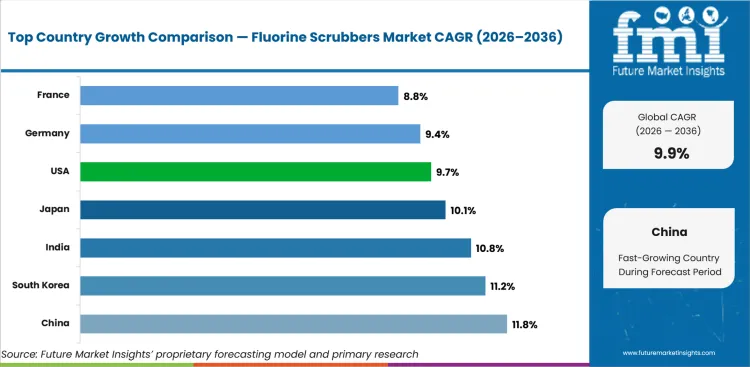
How do country-level CAGRs compare in the fluorine scrubbers market?
China leads country growth while the United Kingdom records the most cautious expansion outlook among profiled markets.
- China is forecast to record an 11.8% CAGR by 2036, driven by its expanding semiconductor fabrication capacity and continued investments in advanced chip manufacturing facilities.
- South Korea is forecast to record an 11.2% CAGR by 2036, supported by the presence of leading memory chip manufacturers and ongoing upgrades to semiconductor production lines.
- India is forecast to record a 10.8% CAGR by 2036, attributed to rising investments in domestic semiconductor manufacturing and government-backed electronics production initiatives.
- Japan is forecast to record a 10.1% CAGR by 2036, fueled by growth in semiconductor equipment manufacturing and the modernization of chip fabrication infrastructure.
- The United States is forecast to record a 9.7% CAGR by 2036, owing to increased semiconductor manufacturing investments and the expansion of domestic chip fabrication plants.
- Germany is forecast to record a 9.4% CAGR by 2036, supported by semiconductor capacity expansion and strong demand from the automotive electronics industry.
- France is forecast to record an 8.8% CAGR by 2036, driven by growing investments in microelectronics production and semiconductor research activities.
How fast is the fluorine scrubbers market growing in China?
An 11.8% CAGR through 2036 reflects China demand for fluorine scrubbers in semiconductor and industrial acid-gas control.
Country Market Snapshot Table
| Parameter | Value |
|---|---|
| Market Size in 2025 (Value) | USD 138.6 million |
| Market Size in 2026 (Value) | USD 155.0 million |
| Market Forecast in 2036 (Value) | USD 472.9 million |
| CAGR (2026 to 2036) | 11.8% |
| Years Considered | 2021 to 2036 |
| Base Year | 2025 |
| Forecast Period | 2026 to 2036 |
| Units Considered | Value (USD million) |
| Leading Sub-Region | Yangtze River Delta and Pearl River Delta fab clusters |
China Fluorine Scrubbers Market Outlook
- China fluorine scrubber demand is expected to lead profiled countries due to integrated-circuit output and domestic fab expansion. Buyers are expected to combine price discipline with stronger local service coverage.
- Demand should remain broad across semiconductor fabs and display manufacturing. Electronics-materials plants add a further demand base. Localized sourcing is expected to shape supplier selection where import access and service speed affect project timing.
Key Growth Drivers
- Electronics output supports scrubber demand. NBS reported 14.2% growth for computer, communication, and other electronic equipment output in January to February 2026.
- IC scale lifts scrubber demand. China’s State Council reported integrated circuit output reached 484.3 billion units in 2025.
- Local service reach helps suppliers win bids where tool downtime carries high opportunity cost.
- Display and electronics-materials plants add fluoride treatment demand outside leading-edge fabs.
Key Restraints
- Export controls can complicate foreign component access. BIS added controls on 24 types of semiconductor manufacturing equipment in December 2024.
- Price pressure can push buyers toward lower-cost scrubbers with higher lifecycle risk.
- Localization rules can limit foreign suppliers that lack China-based service coverage.
What makes China unique
China is unique because large integrated-circuit output and localized supply-chain targets create the broadest scrubber demand base among profiled countries.
Key Companies
- Suzhou Leeden Environmental Technology
- Shanghai Shengjian Environment Technology
- Beijing North Microelectronics
- CETC Environmental Engineering
- Jiangsu Jingyuan Environmental Protection
- Wuxi Hongqing Environmental Equipment
Sales & Marketing Channels
- Fab facility teams
- Domestic EPC contractors
- Environmental engineering firms
- Direct OEM sales
- Industrial distributors
- Service contractors
Country Segment Breakdown Table
| Segment | Sub-Segments |
|---|---|
| By Scrubber Type | Wet Scrubbers · Dry Scrubbers · Hybrid Scrubbers |
| By Application | Semiconductor Fabs · Chemical Plants · Metal Processing · Other Industrial |
| By Acid Gas Target | HF · F₂ / Fluorides Mix · Multiple Acids |
| By Capacity | Small · Medium · Large |
| By Sales Channel | EPC / Turnkey · Direct OEM · Distributors |
| Key Sub-Regions Covered, Manufacturing and automation corridors | Yangtze River Delta and Pearl River Delta fab clusters |
Frequently Asked Questions
How fast is the China fluorine scrubbers market expected to grow?
The China fluorine scrubbers market is projected to expand at 11.8% CAGR through 2036.
What supports fluorine scrubber demand in China?
Demand is supported by semiconductor activity, acid-gas control needs, and service-backed sub-fab equipment procurement in China.
What limits faster adoption in China?
Adoption is limited by qualification cycles, installation cost, and site-specific exhaust control requirements in China.
How fast is the fluorine scrubbers market growing in South Korea?
An 11.2% CAGR through 2036 reflects South Korea demand for fluorine scrubbers in semiconductor and industrial acid-gas control.
Country Market Snapshot Table
| Parameter | Value |
|---|---|
| Market Size in 2025 (Value) | USD 86.3 million |
| Market Size in 2026 (Value) | USD 96.0 million |
| Market Forecast in 2036 (Value) | USD 277.3 million |
| CAGR (2026 to 2036) | 11.2% |
| Years Considered | 2021 to 2036 |
| Base Year | 2025 |
| Forecast Period | 2026 to 2036 |
| Units Considered | Value (USD million) |
| Leading Sub-Region | Gyeonggi and Chungcheong semiconductor clusters |
South Korea Fluorine Scrubbers Market Outlook
- South Korea fluorine scrubber demand is supported by high-volume memory and logic manufacturing. Buyers are expected to prioritize approved suppliers that can deliver rapid service and stable performance under continuous fab operation.
- Domestic abatement suppliers should retain an advantage in service response and account access. Global suppliers are expected to compete where fabs require specific burn-wet, dry, or plasma abatement platforms.
Key Growth Drivers
- Export scale supports abatement demand. MOTIE reported semiconductor exports of USD 173.4 billion in 2025.
- Equipment intensity favors local scrubbers. SEMI projected Korea semiconductor equipment investment at USD 23.4 billion in 2025.
- Memory and logic clusters create repeat demand for point-of-use scrubbers under approved-vendor programs.
- Domestic suppliers such as GST and UNISEM improve response time for high-volume fab accounts.
Key Restraints
- Large buyers can pressure supplier margins. Invest Korea reported South Korea held 17.4% of the global semiconductor equipment market in 2024.
- Approved-vendor qualification can limit new entrant access.
- Service failures carry high downtime risk in memory clusters, so buyers may avoid unproven suppliers.
What makes South Korea unique
South Korea is unique because high fab intensity and domestic abatement suppliers create one of the most service-sensitive scrubber markets.
Key Companies
- Global Standard Technology Co. Ltd.
- UNISEM Co. Ltd.
- CSK Inc.
- KC Cottrell Co. Ltd.
- Wonik IPS
- Yuil Engineering
Sales & Marketing Channels
- Direct OEM sales
- Approved-vendor programs
- Fab facility teams
- EPC contractors
- Maintenance service providers
- Industrial gas suppliers
Country Segment Breakdown Table
| Segment | Sub-Segments |
|---|---|
| By Scrubber Type | Wet Scrubbers · Dry Scrubbers · Hybrid Scrubbers |
| By Application | Semiconductor Fabs · Chemical Plants · Metal Processing · Other Industrial |
| By Acid Gas Target | HF · F₂ / Fluorides Mix · Multiple Acids |
| By Capacity | Small · Medium · Large |
| By Sales Channel | EPC / Turnkey · Direct OEM · Distributors |
| Key Sub-Regions Covered, Manufacturing and automation corridors | Gyeonggi and Chungcheong semiconductor clusters |
Frequently Asked Questions
How fast is the South Korea fluorine scrubbers market expected to grow?
The South Korea fluorine scrubbers market is projected to expand at 11.2% CAGR through 2036.
What supports fluorine scrubber demand in South Korea?
Demand is supported by semiconductor activity, acid-gas control needs, and service-backed sub-fab equipment procurement in South Korea.
What limits faster adoption in South Korea?
Adoption is limited by qualification cycles, installation cost, and site-specific exhaust control requirements in South Korea.
How fast is the fluorine scrubbers market growing in India?
A 10.8% CAGR through 2036 reflects India demand for fluorine scrubbers in semiconductor and industrial acid-gas control.
Country Market Snapshot Table
| Parameter | Value |
|---|---|
| Market Size in 2025 (Value) | USD 25.3 million |
| Market Size in 2026 (Value) | USD 28.0 million |
| Market Forecast in 2036 (Value) | USD 78.1 million |
| CAGR (2026 to 2036) | 10.8% |
| Years Considered | 2021 to 2036 |
| Base Year | 2025 |
| Forecast Period | 2026 to 2036 |
| Units Considered | Value (USD million) |
| Leading Sub-Region | Gujarat and southern electronics corridors |
India Fluorine Scrubbers Market Outlook
- India fluorine scrubber demand is emerging from approved semiconductor projects and EPC-led facility buildouts. Buyers are expected to rely on turnkey suppliers because local installed experience in high-spec fluorine abatement remains limited.
- Early demand should concentrate in compound semiconductor, ATMP, and electronics materials facilities. Local service depth is expected to decide supplier retention after first installations are commissioned.
Key Growth Drivers
- Approved project scale creates first-generation demand. PIB reported 10 projects with investment of about INR 1.6 lakh crore in February 2026.
- Electronics exports support facility investment. PIB reported USD 22.2 billion in electronics exports in the first half of FY 2025-26.
- EPC-led projects favor turnkey scrubber packages with training, commissioning, and spares.
- Compound semiconductor and ATMP facilities create early HF and fluoride treatment specifications.
Key Restraints
- Domestic supply depth is still forming. PIB said approved semiconductor projects were spread across 6 states in December 2025.
- Local service and spare-part networks remain limited for specialized fluorine scrubbers.
- Early projects may prioritize core process tools before auxiliary abatement budgets are finalized.
What makes India unique
India is unique because new semiconductor projects create first-cycle demand for turnkey scrubber packages and local service training.
Key Companies
- Tata Electronics
- CG Power and Industrial Solutions
- Kaynes Semicon
- L&T Semiconductor Technologies
- Sahasra Semiconductors
- DAS Environmental Expert India
Sales & Marketing Channels
- EPC contractors
- Project owners
- Direct OEM sales
- Specialty gas suppliers
- Environmental consultants
- Maintenance service providers
Country Segment Breakdown Table
| Segment | Sub-Segments |
|---|---|
| By Scrubber Type | Wet Scrubbers · Dry Scrubbers · Hybrid Scrubbers |
| By Application | Semiconductor Fabs · Chemical Plants · Metal Processing · Other Industrial |
| By Acid Gas Target | HF · F₂ / Fluorides Mix · Multiple Acids |
| By Capacity | Small · Medium · Large |
| By Sales Channel | EPC / Turnkey · Direct OEM · Distributors |
| Key Sub-Regions Covered, Manufacturing and automation corridors | Gujarat and southern electronics corridors |
Frequently Asked Questions
How fast is the India fluorine scrubbers market expected to grow?
The India fluorine scrubbers market is projected to expand at 10.8% CAGR through 2036.
What supports fluorine scrubber demand in India?
Demand is supported by semiconductor activity, acid-gas control needs, and service-backed sub-fab equipment procurement in India.
What limits faster adoption in India?
Adoption is limited by qualification cycles, installation cost, and site-specific exhaust control requirements in India.
How fast is the fluorine scrubbers market growing in Japan?
A 10.1% CAGR through 2036 reflects Japan demand for fluorine scrubbers in semiconductor and industrial acid-gas control.
Country Market Snapshot Table
| Parameter | Value |
|---|---|
| Market Size in 2025 (Value) | USD 65.4 million |
| Market Size in 2026 (Value) | USD 72.0 million |
| Market Forecast in 2036 (Value) | USD 188.8 million |
| CAGR (2026 to 2036) | 10.1% |
| Years Considered | 2021 to 2036 |
| Base Year | 2025 |
| Forecast Period | 2026 to 2036 |
| Units Considered | Value (USD million) |
| Leading Sub-Region | Hokkaido and Kyushu semiconductor corridors |
Japan Fluorine Scrubbers Market Outlook
- Japan fluorine scrubber demand is shaped by advanced-node investment and domestic abatement supplier strength. Buyers are expected to favor systems that support low-emission operation and compact sub-fab footprints.
- Domestic suppliers should retain an advantage in engineering access and field support. Advanced fab projects are expected to raise demand for plasma and hybrid systems that manage fluorinated by-products.
Key Growth Drivers
- Advanced-node investment raises scrubber specification needs. JapanGov reported government support totaling JPY 330.0 billion for Rapidus in March 2024.
- Policy funding supports local fab planning. METI stated in November 2025 that JPY 100.0 billion from the FY2025 budget was allocated to Rapidus.
- Domestic suppliers such as Ebara and Kanken Techno shorten maintenance response for local fab customers.
- Fuel-free plasma abatement supports lower-emission sub-fab choices for PFC-heavy process streams.
Key Restraints
- Equipment-cycle caution can temper urgent replacement. The USA International Trade Administration cited SEAJ projecting 10.0% growth for Japan semiconductor equipment sales in 2025.
- Conservative qualification cycles can delay new supplier entry.
- Stable mature lines may extend older scrubber life when tool recipes remain unchanged.
What makes Japan unique
Japan is unique because domestic abatement suppliers and advanced-node investment align around compact low-emission sub-fab equipment.
Key Companies
-
Ebara Corporation
- Kanken Techno Co. Ltd.
- Kashima Engineering
- Mitsubishi Chemical Engineering
- Kurita Water Industries
- Towa Corporation
Sales & Marketing Channels
- Direct OEM sales
- Fab facility teams
- Engineering firms
- Maintenance contractors
- Specialty gas suppliers
- Industrial distributors
Country Segment Breakdown Table
| Segment | Sub-Segments |
|---|---|
| By Scrubber Type | Wet Scrubbers · Dry Scrubbers · Hybrid Scrubbers |
| By Application | Semiconductor Fabs · Chemical Plants · Metal Processing · Other Industrial |
| By Acid Gas Target | HF · F₂ / Fluorides Mix · Multiple Acids |
| By Capacity | Small · Medium · Large |
| By Sales Channel | EPC / Turnkey · Direct OEM · Distributors |
| Key Sub-Regions Covered, Manufacturing and automation corridors | Hokkaido and Kyushu semiconductor corridors |
Frequently Asked Questions
How fast is the Japan fluorine scrubbers market expected to grow?
The Japan fluorine scrubbers market is projected to expand at 10.1% CAGR through 2036.
What supports fluorine scrubber demand in Japan?
Demand is supported by semiconductor activity, acid-gas control needs, and service-backed sub-fab equipment procurement in Japan.
What limits faster adoption in Japan?
Adoption is limited by qualification cycles, installation cost, and site-specific exhaust control requirements in Japan.
How fast is the fluorine scrubbers market growing in the United States?
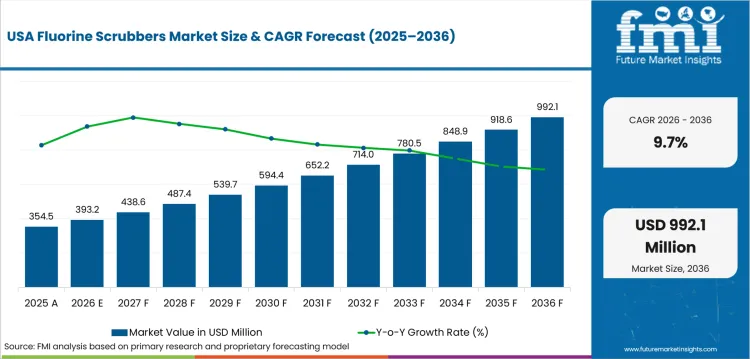
A 9.7% CAGR through 2036 reflects United States demand for fluorine scrubbers in semiconductor and industrial acid-gas control.
Country Market Snapshot Table
| Parameter | Value |
|---|---|
| Market Size in 2025 (Value) | USD 125.8 million |
| Market Size in 2026 (Value) | USD 138.0 million |
| Market Forecast in 2036 (Value) | USD 348.0 million |
| CAGR (2026 to 2036) | 9.7% |
| Years Considered | 2021 to 2036 |
| Base Year | 2025 |
| Forecast Period | 2026 to 2036 |
| Units Considered | Value (USD million) |
| Leading Sub-Region | Arizona and New York fab corridors |
United States Fluorine Scrubbers Market Outlook
- United States fluorine scrubber demand is shaped by CHIPS-linked fab expansion and local sub-fab equipment investment. Buyers are expected to favor suppliers that can support permitting records, service access, and tool-level abatement proof.
- Retrofit demand is expected to remain active because fabs must manage fluorinated gases used in etch and chamber cleaning. Domestic service depth should carry more weight as fabs reduce downtime risk in crowded sub-fab areas.
Key Growth Drivers
- CHIPS supply-chain funding improves local sub-fab equipment access. NIST finalized up to USD 18.0 million for Edwards Vacuum in January 2025.
- Unreacted process gas raises abatement urgency. EPA states that 10% to 80% of fluorinated GHGs can pass through tool chambers unreacted.
- Fluorinated process-gas use keeps point-of-use scrubbers tied to etch and CVD tool clusters.
- Pump and scrubber service planning supports lifecycle purchases for fabs that treat sub-fab uptime as output protection.
Key Restraints
- Export-control compliance can slow equipment delivery. BIS added controls on 24 types of semiconductor manufacturing equipment in December 2024.
- High installation labor and service cost can delay smaller retrofit packages.
- Tool-specific qualification can slow switching between incumbent abatement suppliers.
What makes United States unique
The United States is unique because CHIPS-linked fab funding connects equipment purchases with domestic supply-chain resilience and compliance documentation.
Key Companies
- Edwards Vacuum LLC
- Ebara Technologies Inc.
- Kanto Corporation
- Thermo Fisher Scientific
- Critical Process Systems Group
- Airgard Inc.
Sales & Marketing Channels
- EPC contractors
- Direct OEM sales
- Fab facility teams
- Sub-fab service providers
- Specialty gas distributors
- Environmental engineering consultants
Country Segment Breakdown Table
| Segment | Sub-Segments |
|---|---|
| By Scrubber Type | Wet Scrubbers · Dry Scrubbers · Hybrid Scrubbers |
| By Application | Semiconductor Fabs · Chemical Plants · Metal Processing · Other Industrial |
| By Acid Gas Target | HF · F₂ / Fluorides Mix · Multiple Acids |
| By Capacity | Small · Medium · Large |
| By Sales Channel | EPC / Turnkey · Direct OEM · Distributors |
| Key Sub-Regions Covered, Manufacturing and automation corridors | Arizona and New York fab corridors |
Frequently Asked Questions
How fast is the United States fluorine scrubbers market expected to grow?
The United States fluorine scrubbers market is projected to expand at 9.7% CAGR through 2036.
What supports fluorine scrubber demand in United States?
Demand is supported by semiconductor activity, acid-gas control needs, and service-backed sub-fab equipment procurement in United States.
What limits faster adoption in United States?
Adoption is limited by qualification cycles, installation cost, and site-specific exhaust control requirements in United States.
How fast is the fluorine scrubbers market growing in Germany?
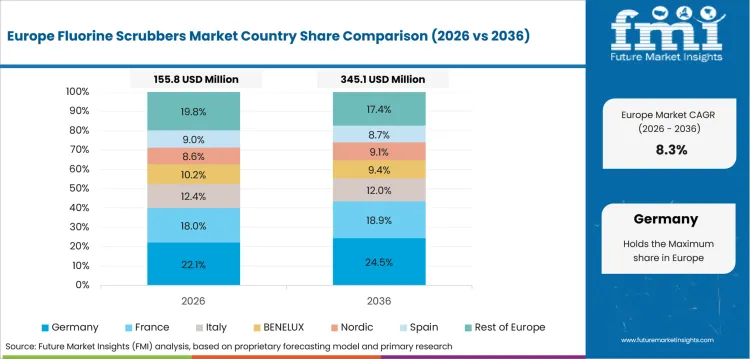
A 9.4% CAGR through 2036 reflects Germany demand for fluorine scrubbers in semiconductor and industrial acid-gas control.
Country Market Snapshot Table
| Parameter | Value |
|---|---|
| Market Size in 2025 (Value) | USD 47.5 million |
| Market Size in 2026 (Value) | USD 52.0 million |
| Market Forecast in 2036 (Value) | USD 127.6 million |
| CAGR (2026 to 2036) | 9.4% |
| Years Considered | 2021 to 2036 |
| Base Year | 2025 |
| Forecast Period | 2026 to 2036 |
| Units Considered | Value (USD million) |
| Leading Sub-Region | Saxony and Bavaria semiconductor corridors |
Germany Fluorine Scrubbers Market Outlook
- Germany fluorine scrubber demand is supported by microelectronics investment and a strong industrial environmental engineering base. Buyers are expected to value suppliers that can combine acid-gas control, CE documentation, and local service response.
- Demand should remain weighted toward wet and hybrid systems for fabs and specialty chemical sites. Dry-bed scrubbers should gain selective use where water and wastewater limits shape utility planning.
Key Growth Drivers
- German microelectronics funding supports scrubber planning. GTAI reported more than EUR 20.0 billion earmarked federally for Chips Act measures.
- Electronics orders reinforce sub-fab demand. Destatis reported a 21.5% monthly rise in computer and electronic product orders in April 2025.
- Local environmental engineering suppliers strengthen dry, wet, and hybrid scrubber evaluation for European fabs.
- Saxony semiconductor density keeps abatement vendors close to tool owners and facility engineers.
Key Restraints
- EU permitting pressure remains broad. The European Commission said the revised industrial emissions rules cover around 75,000 large installations.
- Energy cost scrutiny can slow approval for thermal and hybrid units that use fuel or high power.
- Strict industrial permitting can extend commissioning schedules for new acid-gas control installations.
What makes Germany unique
Germany is unique because semiconductor clusters and environmental engineering suppliers create a technically demanding scrubber market.
Key Companies
- DAS Environmental Expert GmbH
- CS Clean Solutions AG
- Centrotherm International AG
- M+W Group
- Linde Engineering
- Herding GmbH Filtertechnik
Sales & Marketing Channels
- EPC contractors
- Environmental engineering firms
- Direct OEM sales
- Semiconductor facility teams
- Chemical plant operators
- Maintenance contractors
Country Segment Breakdown Table
| Segment | Sub-Segments |
|---|---|
| By Scrubber Type | Wet Scrubbers · Dry Scrubbers · Hybrid Scrubbers |
| By Application | Semiconductor Fabs · Chemical Plants · Metal Processing · Other Industrial |
| By Acid Gas Target | HF · F₂ / Fluorides Mix · Multiple Acids |
| By Capacity | Small · Medium · Large |
| By Sales Channel | EPC / Turnkey · Direct OEM · Distributors |
| Key Sub-Regions Covered, Manufacturing and automation corridors | Saxony and Bavaria semiconductor corridors |
Frequently Asked Questions
How fast is the Germany fluorine scrubbers market expected to grow?
The Germany fluorine scrubbers market is projected to expand at 9.4% CAGR through 2036.
What supports fluorine scrubber demand in Germany?
Demand is supported by semiconductor activity, acid-gas control needs, and service-backed sub-fab equipment procurement in Germany.
What limits faster adoption in Germany?
Adoption is limited by qualification cycles, installation cost, and site-specific exhaust control requirements in Germany.
How fast is the fluorine scrubbers market growing in France?
An 8.8% CAGR through 2036 reflects France demand for fluorine scrubbers in semiconductor and industrial acid-gas control.
Country Market Snapshot Table
| Parameter | Value |
|---|---|
| Market Size in 2025 (Value) | USD 29.4 million |
| Market Size in 2026 (Value) | USD 32.0 million |
| Market Forecast in 2036 (Value) | USD 74.3 million |
| CAGR (2026 to 2036) | 8.8% |
| Years Considered | 2021 to 2036 |
| Base Year | 2025 |
| Forecast Period | 2026 to 2036 |
| Units Considered | Value (USD million) |
| Leading Sub-Region | Grenoble and Crolles semiconductor corridor |
France Fluorine Scrubbers Market Outlook
- France fluorine scrubber demand is tied to advanced wafer capacity and European semiconductor funding. Buyers are expected to prioritize acid-gas control systems that integrate with existing fab utilities.
- Demand should remain concentrated around Crolles and Grenoble-area semiconductor sites. Service coverage and wastewater planning are expected to shape wet scrubber selection.
Key Growth Drivers
- Advanced manufacturing finance supports scrubber demand. EIB announced a EUR 1.0 billion agreement with STMicroelectronics in December 2025.
- Manufacturing recovery helps facility spending. INSEE reported French manufacturing output rose 0.9% in September 2025.
- Crolles and Grenoble-area semiconductor clusters create concentrated demand for high-spec acid-gas treatment.
- European service coverage matters because French fabs often buy through facility teams and regional equipment suppliers.
Key Restraints
- EU permitting pressure remains broad. The European Commission said the revised industrial emissions rules cover around 75,000 large installations.
- Capital timing can shift when semiconductor demand weakens.
- Wastewater handling can lift engineering cost for wet scrubbers at space-constrained fab sites.
What makes France unique
France is unique because Crolles and Grenoble-area clusters concentrate scrubber demand around advanced wafer and power semiconductor facilities.
Key Companies
- DAS Environmental Expert France
- Air Liquide Engineering & Construction
- STMicroelectronics facility teams
- Soitec facility teams
- Exyte France
- SUEZ Industrial Solutions
Sales & Marketing Channels
- Fab facility teams
- EPC contractors
- Environmental engineering consultants
- Direct OEM sales
- Industrial service providers
- Specialty chemical suppliers
Country Segment Breakdown Table
| Segment | Sub-Segments |
|---|---|
| By Scrubber Type | Wet Scrubbers · Dry Scrubbers · Hybrid Scrubbers |
| By Application | Semiconductor Fabs · Chemical Plants · Metal Processing · Other Industrial |
| By Acid Gas Target | HF · F₂ / Fluorides Mix · Multiple Acids |
| By Capacity | Small · Medium · Large |
| By Sales Channel | EPC / Turnkey · Direct OEM · Distributors |
| Key Sub-Regions Covered, Manufacturing and automation corridors | Grenoble and Crolles semiconductor corridor |
Frequently Asked Questions
How fast is the France fluorine scrubbers market expected to grow?
The France fluorine scrubbers market is projected to expand at 8.8% CAGR through 2036.
What supports fluorine scrubber demand in France?
Demand is supported by semiconductor activity, acid-gas control needs, and service-backed sub-fab equipment procurement in France.
What limits faster adoption in France?
Adoption is limited by qualification cycles, installation cost, and site-specific exhaust control requirements in France.
How fast is the fluorine scrubbers market growing in the United Kingdom?
A 7.6% CAGR through 2036 reflects United Kingdom demand for fluorine scrubbers in semiconductor and industrial acid-gas control.
Country Market Snapshot Table
| Parameter | Value |
|---|---|
| Market Size in 2025 (Value) | USD 35.3 million |
| Market Size in 2026 (Value) | USD 38.0 million |
| Market Forecast in 2036 (Value) | USD 79.2 million |
| CAGR (2026 to 2036) | 7.6% |
| Years Considered | 2021 to 2036 |
| Base Year | 2025 |
| Forecast Period | 2026 to 2036 |
| Units Considered | Value (USD million) |
| Leading Sub-Region | Wales and compound semiconductor clusters |
United Kingdom Fluorine Scrubbers Market Outlook
- United Kingdom fluorine scrubber demand is concentrated in compound-semiconductor and specialist wafer facilities. The market is expected to favor smaller high-spec systems and service-backed retrofits instead of large greenfield packages.
- Facility teams are expected to connect scrubber purchases with permit variations and hydrofluoric-acid emission controls. Supplier access to local engineering support should remain central to purchase decisions.
Key Growth Drivers
- A wider semiconductor base supports specialist scrubber opportunities. A June 2026 UK government study identified 703 semiconductor companies and 295 dedicated firms.
- Newport capacity strengthens advanced wafer activity. The UK government highlighted GBP 250.0 million of semiconductor investment in Wales in March 2025.
- Compound semiconductor lines create HF and fluoride gas exposure in smaller but higher-spec exhaust trains.
- Local engineering capability helps suppliers sell service-backed abatement packages to specialist fabs.
Key Restraints
- Environmental review can slow site changes. A December 2025 Environment Agency filing used 2 H1 screening stages for hydrofluoric-acid emission assessment.
- The domestic fab base is narrower than Germany or France, so large scrubber packages appear less frequently.
- Specialist projects can defer abatement spending until permit variations or tool additions are finalized.
What makes United Kingdom unique
The United Kingdom is unique because compound-semiconductor clusters create high-spec scrubber demand despite a smaller domestic fab base.
Key Companies
- Plessey Semiconductors
- IQE plc
- Edwards Vacuum
- CS Clean Solutions UK
- DAS Environmental Expert UK
- Air Products UK
Sales & Marketing Channels
- Compound semiconductor fabs
- EPC contractors
- Environmental permit consultants
- Direct OEM sales
- Specialty gas suppliers
- Maintenance service firms
Country Segment Breakdown Table
| Segment | Sub-Segments |
|---|---|
| By Scrubber Type | Wet Scrubbers · Dry Scrubbers · Hybrid Scrubbers |
| By Application | Semiconductor Fabs · Chemical Plants · Metal Processing · Other Industrial |
| By Acid Gas Target | HF · F₂ / Fluorides Mix · Multiple Acids |
| By Capacity | Small · Medium · Large |
| By Sales Channel | EPC / Turnkey · Direct OEM · Distributors |
| Key Sub-Regions Covered, Manufacturing and automation corridors | Wales and compound semiconductor clusters |
Frequently Asked Questions
How fast is the United Kingdom fluorine scrubbers market expected to grow?
The United Kingdom fluorine scrubbers market is projected to expand at 7.6% CAGR through 2036.
What supports fluorine scrubber demand in United Kingdom?
Demand is supported by semiconductor activity, acid-gas control needs, and service-backed sub-fab equipment procurement in United Kingdom.
What limits faster adoption in United Kingdom?
Adoption is limited by qualification cycles, installation cost, and site-specific exhaust control requirements in United Kingdom.
Who are the leading companies in the fluorine scrubbers market?
Ebara, Edwards Vacuum, CS Clean Solutions, DAS Environmental Expert, Kanken Techno, GST, UNISEM, and local environmental equipment makers compete in the fluorine scrubbers market.
- Established abatement suppliers hold an advantage through semiconductor references and installed service teams.
- Dry-bed specialists gain demand where passive media lowers utility needs and simplifies smaller exhaust lines.
- Burn-wet and plasma abatement suppliers compete where mixed fluorinated gases need conversion before downstream capture.
- Regional suppliers can win local service contracts where fabs require faster spare-part access and site support.
Suppliers with semiconductor references and regional service teams are best positioned. They can support fab buyers during design review, installation, commissioning, and planned maintenance. Vendors relying only on low equipment price are expected to face harder qualification because fabs evaluate uptime risk and by-product handling.
Who are the leading players in the fluorine scrubbers market?
Competitive outlook is driven by systems that combine abatement with emissions proof.
Competition in the fluorine scrubbers market is increasingly shaped by suppliers’ ability to combine emissions abatement performance with monitoring, service support, and process-specific technology solutions. Ebara strengthened its semiconductor abatement portfolio in December 2025 with a plasma abatement system designed to decompose PFCs using electricity. Edwards expanded service capability in May 2024 with its Dublin Service Technology Centre. CS Clean Solutions and DAS Environmental Expert compete by process-specific designs across dry-bed and burn-wet abatement.
Dry-bed suppliers compete where buyers need lower utility use. Burn-wet suppliers compete where mixed fluorinated gases require conversion before scrubbing. Regional suppliers are expected to retain opportunities where local service and retrofit access matter more than global account coverage.
Who are the key players in the fluorine scrubbers market?
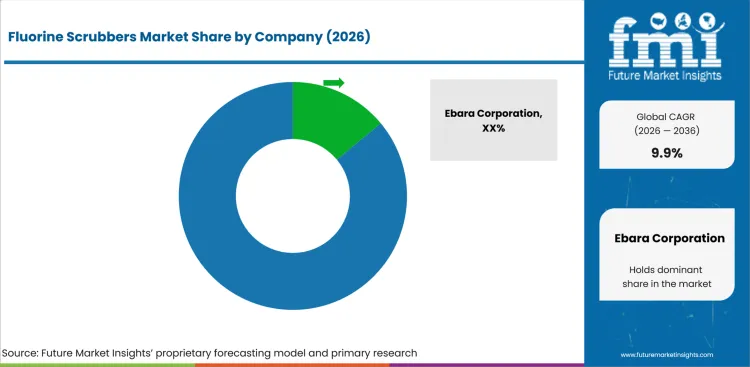
Ebara Corporation, Edwards Vacuum, CS Clean Solutions, DAS Environmental Expert, Kanken Techno, GST, UNISEM, Centrotherm International, Airgard, and Shanghai Shengjian Environment Technology are listed among the main suppliers.
Semiconductor Abatement Suppliers
- Ebara Corporation
- Edwards Vacuum
- Kanken Techno
- GST
- UNISEM
Specialty Exhaust Control Suppliers
- CS Clean Solutions
- DAS Environmental Expert
- Centrotherm International
Regional and Retrofit Suppliers
- Airgard
- Shanghai Shengjian Environment Technology
How do top fluorine scrubber companies compare?
Ebara and Edwards score strongest on semiconductor abatement depth while CS Clean Solutions and DAS Environmental Expert remain strong in process-specific exhaust control.
| Company | Relevance to Market Title | Scrubber Portfolio | Semiconductor Account Access | Service Reach | Geographic Footprint |
|---|---|---|---|---|---|
| Ebara Corporation | Very High | Very Strong | Very Strong | Very Strong | Global |
| Edwards Vacuum | Very High | Very Strong | Very Strong | Very Strong | Global |
| CS Clean Solutions | High | Strong | Strong | Moderate to Strong | Europe · United States · Asia |
| DAS Environmental Expert | High | Strong | Strong | Strong | Europe and selected global sites |
| Kanken Techno | High | Strong | Strong | Strong | Japan and Asia |
| GST | High | Strong | Very Strong | Strong | South Korea and Asia |
| UNISEM | High | Strong | Very Strong | Strong | South Korea and Asia |
| Centrotherm International | Moderate to High | Moderate | Moderate | Moderate | Europe and Asia |
| Airgard | Moderate | Moderate | Moderate | Moderate | United States |
Source: Future Market Insights competitive analysis, 2026.
Key Developments in Fluorine Scrubbers Market
- In December 2025, Ebara launched the Model EV-H dry vacuum pump and Model ELF plasma abatement system for semiconductor production lines.
- In January 2025, NIST finalized up to USD 18.0 million in CHIPS incentives for Edwards Vacuum to support USA dry vacuum pump production.
- In May 2024, Edwards Vacuum opened a flagship Service Technology Centre in Dublin to support dry pump and abatement service needs.
Fluorine Scrubbers Market - Scope & Definition
| Attribute | Detail |
|---|---|
| Market Definition | Gas treatment systems that capture, neutralize, or decompose fluorine-bearing exhaust from industrial processes, including HF, F₂ mixtures, fluorides, and mixed acid streams. |
| Functions Covered | Acid gas capture, fluoride neutralization, PFC decomposition support, by-product handling, duct protection, and sub-fab exhaust control. |
| Applications Covered | Semiconductor fabs, chemical plants, metal processing sites, and other industrial users with fluorine or fluoride exhaust duty. |
| End-Use Industries | Semiconductor manufacturing, fluorochemicals, specialty chemicals, electronics materials, metal processing, and industrial environmental control. |
| Grades Covered | Small, medium, and large capacity systems across wet scrubbers, dry scrubbers, and hybrid scrubbers. |
| Inclusions | New scrubber systems, replacement units, integrated packages, commissioning revenue, dry media systems, wet systems, hybrid systems, and turnkey fluoride exhaust control packages. |
| Exclusions | General VOC oxidizers, dust collectors, broad air filters, unrelated wastewater treatment units, and gas handling equipment without fluorine or fluoride exhaust treatment duty. |
Fluorine Scrubbers Market - Research Methodology
| Method | Description |
|---|---|
| Primary Research | FMI analyst interviews with semiconductor facility teams, chemical plant operators, EPC engineers, environmental consultants, and service channel managers across key markets. |
| Desk Research | Review of regulator documents, official semiconductor investment evidence, company product literature, environmental permitting records, and public industrial statistics related to fluorinated exhaust treatment. |
| Market Sizing & Forecasting | Bottom-up equipment-boundary approach using scrubber system revenue, process tool density, replacement cycles, channel model, capacity class, and country-level fab activity. |
| Data Validation | Cross-verification using regulatory documents, semiconductor capacity signals, company portfolio checks, distributor input, and public evidence on fluorinated process-gas use. |
Fluorine Scrubbers Market - Report Scope
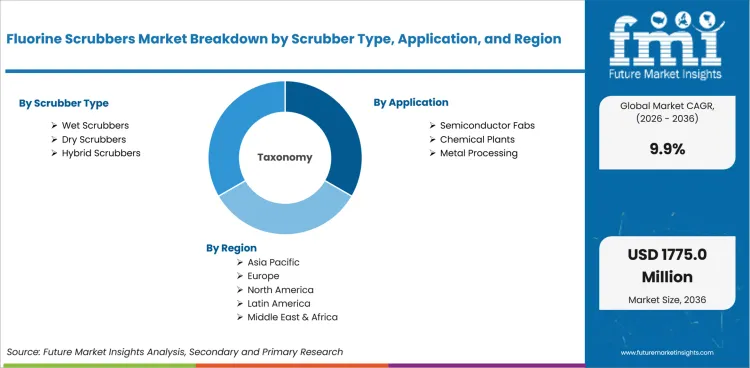
| Parameter | Details |
|---|---|
| Forecast period | 2026 to 2036 |
| Historical period | 2021 to 2025 |
| Quantitative unit | Revenue in USD million |
| By scrubber type | Wet scrubbers, dry scrubbers, hybrid scrubbers |
| By application | Semiconductor fabs, chemical plants, metal processing, other industrial |
| By acid gas target | HF, F₂ / fluorides mix, multiple acids |
| By capacity | Small, medium, large |
| By sales channel | EPC / turnkey, direct OEM, distributors |
| Regions covered | North America, Latin America, Europe, East Asia, South Asia and Pacific, Middle East and Africa |
| Countries covered | China, South Korea, India, Japan, United States, Germany, France, United Kingdom |
| Key companies profiled | Ebara, Edwards Vacuum, CS Clean Solutions, DAS Environmental Expert, Kanken Techno, GST, UNISEM, and regional suppliers |
| Approach | Bottom-up equipment-boundary approach using scrubber system revenue, process exhaust duty, service intensity, and country-level fab activity |
Fluorine Scrubbers Market Breakdown by Scrubber Type, Application, Acid Gas Target, Capacity, Sales Channel, and Region
Fluorine Scrubbers Market Segmented by Scrubber Type
- Wet Scrubbers
- Dry Scrubbers
- Hybrid Scrubbers
Fluorine Scrubbers Market Segmented by Application
- Semiconductor Fabs
- Chemical Plants
- Metal Processing
- Other Industrial
Fluorine Scrubbers Market Segmented by Acid Gas Target
- HF
- F₂ / Fluorides Mix
- Multiple Acids
Fluorine Scrubbers Market Segmented by Capacity
- Small
- Medium
- Large
Fluorine Scrubbers Market Segmented by Sales Channel
- EPC / Turnkey
- Direct OEM
- Distributors
Fluorine Scrubbers Market by Region
- North America
- Latin America
- Europe
- East Asia
- South Asia and Pacific
- Middle East and Africa
Research Sources and Bibliography
- Bureau of Industry and Security. (2024, December 2). Commerce strengthens export controls to restrict China’s capability to produce advanced semiconductors for military applications.
- EBARA Corporation. (2024, December 9). Combustion exhaust gas abatement system Model LPCMN.
- EBARA Corporation. (2025, December 17). EBARA launches new dry vacuum pump and plasma abatement system.
- Edwards Vacuum. (2024, May 7). Edwards officially opens new flagship Service Technology Centre in Dublin.
- Environment Agency. (2025, December). Plessey Semiconductors permit variation supporting document.
- European Commission. (2024, August 2). Revised industrial emissions directive comes into effect.
- European Investment Bank. (2025, December 11). EIB and STMicroelectronics announce EUR 1 billion agreement to boost Europe’s competitiveness and strategic autonomy.
- Federal Statistical Office of Germany. (2025, June 5). New orders in manufacturing in April 2025.
- French National Institute of Statistics and Economic Studies. (2025, November 5). In September 2025, manufacturing output bounced back.
- Future Market Insights. (2026). Fluorine scrubbers market internal forecast dataset.
- Germany Trade & Invest. (2026). Semiconductor industry in Germany.
- Government of the United Kingdom. (2025, March 27). Hundreds of millions of pounds to turbocharge manufacturing sector in Wales.
- Government of the United Kingdom. (2026, June 8). UK semiconductor sectoral analysis.
- Invest Korea. (2025, October 2). South Korea’s semiconductor industry and investment status.
- JapanGov. (2024, March 1). Japan’s pursuit of a game-changing technology and ecosystem for semiconductors.
- Ministry of Economy, Trade and Industry. (2025, November 21). Press conference by Minister Akazawa.
- Ministry of Trade, Industry and Energy of the Republic of Korea. (2026, January 2). Korea’s annual exports reach new highs in 2025.
- National Bureau of Statistics of China. (2026, January 20). Industrial production operation in December 2025.
- National Institute of Standards and Technology. (2024, June 28). Final programmatic environmental assessment for modernization and expansion of semiconductor fabrication facilities under the CHIPS Incentives Program.
- National Institute of Standards and Technology. (2025, January 17). USA Department of Commerce announces CHIPS incentives awards for Corning, Edwards Vacuum, and Infinera.
- Press Information Bureau, Government of India. (2026, February 3). Electronics Components Manufacturing Scheme.
- Press Information Bureau, Government of India. (2026, February 4). Semicon India Programme advances with approval of 10 semiconductor projects.
- Press Information Bureau, Government of India. (2026, February 7). India Semiconductor Mission 2.0.
- SEMI. (2025, March 24). SEMICON Korea 2025 bringing together the global semiconductor ecosystem to drive innovation.
- The State Council of the People’s Republic of China. (2026, January 30). China’s electronic information manufacturing sector posts rapid growth in 2025.
- USA Environmental Protection Agency. (2026, February 26). Semiconductor industry.
- USA International Trade Administration. (2025, November 20). Japan semiconductors country commercial guide.
- UK Research and Innovation. (2024, September 27). GBP 11.5 million to improve semiconductor manufacturing and supply chains.
This bibliography is provided for reader reference and is not exhaustive. The full report contains the complete reference list and detailed citations.
Frequently Asked Questions
What is the growth prospect for fluorine scrubbers?
Demand for fluorine scrubbers is expected to rise as semiconductor fabs and chemical plants tighten control of HF and fluorinated exhaust streams.
Which companies are expected to shape the fluorine scrubbers market?
Ebara, Edwards Vacuum, CS Clean Solutions, DAS Environmental Expert, Kanken Techno, GST, and UNISEM are expected to shape competition through process-specific abatement and service access.
Why are semiconductor fabs investing in fluorine scrubbers?
Semiconductor fabs are investing in fluorine scrubbers to manage etch and chamber-clean exhaust before fluoride by-products damage ducting or affect uptime.
Why are EPC and turnkey channels important in the fluorine scrubbers market?
EPC and turnkey channels support design, permitting, ductwork, controls, and commissioning in one procurement route.
Which scrubber formats are gaining attention in fluorine scrubbers?
Wet scrubbers lead HF control while dry and hybrid systems gain attention where utilities or mixed gases shape system choice.
How do regulations influence fluorine scrubber purchases?
Regulations influence purchases through air permits, wastewater handling rules, worker safety reviews, and documentation requirements.
Why is service access important for fluorine scrubbers?
Service access is important because sub-fab space constraints and tool uptime targets affect how buyers evaluate lifecycle risk.
What role do dry scrubbers play in fluorine scrubber adoption?
Dry scrubbers support low-flow or utility-constrained lines where passive media can reduce water and fuel requirements.
How do hybrid scrubbers support mixed-gas exhaust control?
Hybrid scrubbers support mixed-gas exhaust control by combining conversion and downstream capture within one abatement train.
Preview the report firsthand - request a free sample
Get SampleGet the brochure for pricing and purchase details.
Get PDFTable of Content
- Executive Summary
- Global Market Outlook
- Demand-side Trends
- Supply-side Trends
- Technology Roadmap Analysis
- Analysis and Recommendations
- Market Overview
- Market Coverage / Taxonomy
- Market Definition / Scope / Limitations
- Research Methodology
- Research Design
- Primary Research
- Desk Research
- Market Sizing and Forecasting
- Data Validation
- Global Market Analysis 2021 to 2025 and Forecast, 2026 to 2036
- Historical Market Size Value (USD Million) Analysis, 2021 to 2025
- Current and Future Market Size Value (USD Million) Projections, 2026 to 2036
- Y-o-Y Growth Trend Analysis
- Absolute $ Opportunity Analysis
- Global Market Pricing Analysis 2021 to 2025 and Forecast 2026 to 2036
- Global Market Analysis 2021 to 2025 and Forecast 2026 to 2036, By Scrubber Type
- Introduction / Key Findings
- Historical Market Size Value (USD Million) Analysis By Scrubber Type, 2021 to 2025
- Current and Future Market Size Value (USD Million) Analysis By Scrubber Type, 2026 to 2036
- Global Market Analysis 2021 to 2025 and Forecast 2026 to 2036, By Application
- Introduction / Key Findings
- Historical Market Size Value (USD Million) Analysis By Application, 2021 to 2025
- Current and Future Market Size Value (USD Million) Analysis By Application, 2026 to 2036
- Global Market Analysis 2021 to 2025 and Forecast 2026 to 2036, By Acid Gas Target
- Introduction / Key Findings
- Historical Market Size Value (USD Million) Analysis By Acid Gas Target, 2021 to 2025
- Current and Future Market Size Value (USD Million) Analysis By Acid Gas Target, 2026 to 2036
- Global Market Analysis 2021 to 2025 and Forecast 2026 to 2036, By Capacity
- Introduction / Key Findings
- Historical Market Size Value (USD Million) Analysis By Capacity, 2021 to 2025
- Current and Future Market Size Value (USD Million) Analysis By Capacity, 2026 to 2036
- Global Market Analysis 2021 to 2025 and Forecast 2026 to 2036, By Region
- Introduction / Key Findings
- Historical Market Size Value (USD Million) Analysis By Region, 2021 to 2025
- Current and Future Market Size Value (USD Million) Analysis By Region, 2026 to 2036
- North America Market Analysis 2021 to 2025 and Forecast 2026 to 2036
- Pricing Analysis
- Market Share Analysis, 2025
- By Country
- By Scrubber Type
- By Application
- By Acid Gas Target
- By Capacity
- Country-level Analysis
- United States
- Canada
- Latin America Market Analysis 2021 to 2025 and Forecast 2026 to 2036
- Pricing Analysis
- Market Share Analysis, 2025
- By Country
- By Scrubber Type
- By Application
- By Acid Gas Target
- By Capacity
- Country-level Analysis
- Brazil
- Mexico
- Rest of Latin America
- Western Europe Market Analysis 2021 to 2025 and Forecast 2026 to 2036
- Pricing Analysis
- Market Share Analysis, 2025
- By Country
- By Scrubber Type
- By Application
- By Acid Gas Target
- By Capacity
- Country-level Analysis
- Germany
- France
- United Kingdom
- Italy
- Spain
- BENELUX
- Nordics
- Rest of Western Europe
- Eastern Europe Market Analysis 2021 to 2025 and Forecast 2026 to 2036
- Pricing Analysis
- Market Share Analysis, 2025
- By Country
- By Scrubber Type
- By Application
- By Acid Gas Target
- By Capacity
- Country-level Analysis
- Russia
- Poland
- Rest of Eastern Europe
- East Asia Market Analysis 2021 to 2025 and Forecast 2026 to 2036
- Pricing Analysis
- Market Share Analysis, 2025
- By Country
- By Scrubber Type
- By Application
- By Acid Gas Target
- By Capacity
- Country-level Analysis
- China
- Japan
- South Korea
- South Asia and Pacific Market Analysis 2021 to 2025 and Forecast 2026 to 2036
- Pricing Analysis
- Market Share Analysis, 2025
- By Country
- By Scrubber Type
- By Application
- By Acid Gas Target
- By Capacity
- Country-level Analysis
- India
- ASEAN
- Australia & New Zealand
- Rest of South Asia and Pacific
- Middle East & Africa Market Analysis 2021 to 2025 and Forecast 2026 to 2036
- Pricing Analysis
- Market Share Analysis, 2025
- By Country
- By Scrubber Type
- By Application
- By Acid Gas Target
- By Capacity
- Country-level Analysis
- GCC Countries
- South Africa
- Turkey
- Rest of Middle East & Africa
- Market Structure Analysis
- Competition Dashboard
- Competition Benchmarking
- Market Share Analysis of Top Players
- By Region
- By Scrubber Type
- By Application
- By Acid Gas Target
- By Capacity
- Emerging Startups
- Innovation Benchmarking
- Competition Analysis
- Competition Deep Dive
- Company Profiles
- Case Studies
- Success Stories
- Recent Developments
- Assumptions & Acronyms Used
- List of Tables: Fluorine Scrubbers Market
- List of Figures: Fluorine Scrubbers Market


