

- Industry Size (2026)
- USD 472.0 Mn
- Forecast (2036)
- USD 610.5 Mn
- CAGR (2026 to 2036)
- 2.6%
Foam-Free Snack Inserts Market Forecast and Outlook 2026 to 2036
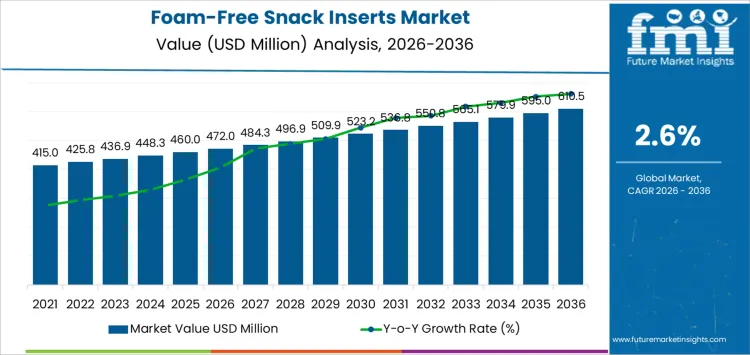
The foam-free snack inserts market is valued at USD 472.0 million in 2026 and is expected to reach USD 610.5 million by 2036, expanding at a CAGR of 2.6%. The first five-year block from 2026 to 2031 sees the market rise to approximately USD 536.7 million. This phase is characterized by steady demand from snack trays, confectionery, and bakery packaging, where molded fiber and pulp-based inserts replace conventional foam formats. Growth remains gradual, supported by routine packaging turnover and stable adoption across existing snack categories rather than expansion into new applications.
From 2031 to 2036, the market advances from about USD 536.7 million to USD 610.5 million, forming the second growth block with moderate absolute additions. Snack trays continue to anchor volumes, while ready meals and secondary applications contribute incremental demand. Thermoforming and wet molding technologies dominate production as manufacturers optimize output efficiency. This later block reflects a maturing demand profile, where growth is driven by incremental packaging volume increases and consistent replacement cycles, rather than rapid shifts in material choice or processing technology.
Quick Stats of the Foam-Free Snack Inserts Market
- Foam-Free Snack Inserts Market Value (2026): USD 472.0 million
- Foam-Free Snack Inserts Market Forecast Value (2036): USD 610.5 million
- Foam-Free Snack Inserts Market Forecast CAGR (2026-2036): 2.6%
- Leading Application: Snack Trays (40%)
- Key Growth Regions: China, India, USA, Brazil, Germany, Japan
- Top Players: Huhtamaki, YUTO Packaging, Mondi, UFlex, Klabin, Toppan
What is the Growth Forecast for the Foam-Free Snack Inserts Market through 2036?
From 2026 to 2031, the foam-free snack inserts market expands from USD 472.0 million to about USD 523.1 million, reflecting controlled growth shaped by gradual material substitution rather than step-change demand. Adoption in this phase is driven by snack manufacturers and packaging converters seeking rigid or paper-based inserts that maintain product separation and stability without relying on foam. Early growth is concentrated in premium snacks, export packaging, and portion-controlled assortments where presentation and product integrity are critical. YeAR-on-year gains remain moderate, indicating steady qualification cycles, tooling adjustments, and cautious scale-up across established packaging lines.
Between 2031 and 2036, the market grows from approximately USD 523.1 million to USD 610.5 million, showing a slightly stronger but still measured expansion profile. This phase reflects broader normalization of foam-free inserts across high-volume snack categories, including biscuits, confectionery assortments, and gift packs. Growth is supported by higher insert usage per pack, wider acceptance across private-label programs, and repeat procurement as designs stabilize. Earlier expansion was driven by selective replacement, while later growth reflects embedded adoption within standardized snack packaging formats and long-term supplier agreements across global food manufacturing networks.
Foam Free Snack Inserts Market Key Takeaways
| Metric | Value |
|---|---|
| Market Value (2026) | USD 472.0 million |
| Forecast Value (2036) | USD 610.5 million |
| Forecast CAGR (2026-2036) | 2.6% |
How Are Product Protection and Material Reduction Goals Shaping the Foam-Free Snack Inserts Market from 2026 to 2036?
Foam-free snack inserts gained adoption as snack producers and brand owners reassessed internal packaging materials used for product separation and cushioning. Biscuits, chocolates, baked snacks, and confectionery relied on inserts to prevent breakage and maintain presentation during transport. Historical demand reflected shift away from traditional foam pads toward paperboard, molded fiber, and corrugated inserts that offered structure without excess bulk. Packaging teams prioritised inserts that fit automated packing lines, maintained product spacing, and supported consistent portion presentation. Procurement focused on dimensional accuracy, stacking strength, and compatibility with existing outer packaging formats.
From 2026 to 2036 demand is expected to increase as packaging optimisation and waste reduction become central to snack packaging design. Brands adopt fiber-based inserts that balance rigidity with lower material weight. Growth aligns with expansion of premium snack assortments and e-commerce shipping, where internal protection affects damage rates. Manufacturers develop inserts that integrate directly into box geometry to reduce assembly steps. Buyers assess protection efficiency, recyclability, and cost per unit. Demand depends on packaging redesign cycles, logistics stress profiles, and alignment with retailer packaging guidelines.
What Is the Demand for the Foam-Free Snack Inserts Market by Application and Product Type for 2026 to 2036?
From 2026 to 2036, the foam-free snack inserts market expands as food brands replace plastic cushioning with fiber-based alternatives that protect products while aligning with packaging material transitions. Snack trays account for 40% of application demand because portioned snacks require separation, stability, and impact resistance during transport and display. Molded fiber inserts lead product type adoption with a 45% share due to their structural rigidity, dimensional consistency, and compatibility with automated tray-loading systems. Demand reflects growing preference for paper-based protective formats that maintain snack presentation and reduce breakage without relying on polymer foams.
Why do snack trays account for 40% of demand in the foam-free snack inserts market by application from 2026 to 2036?
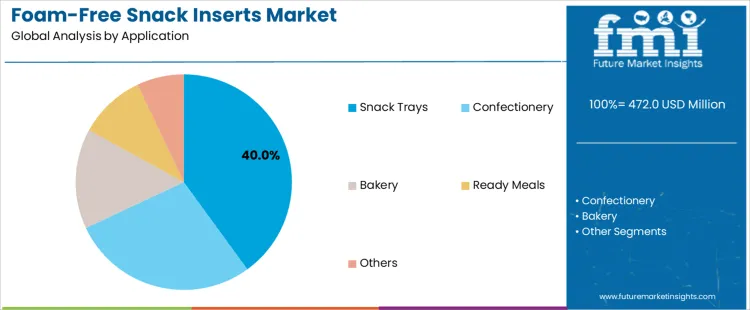
Snack trays account for 40% of demand because they are widely used for portion control, visual presentation, and multi-compartment packaging in ready-to-eat snack formats. Consumption intensity remains high in chips, biscuits, confectionery assortments, and mixed snack packs where inserts prevent movement and product damage. Usage stays steady as trays require inserts that hold shape under stacking and vibration during distribution. Procurement decisions emphasize inserts that fit precisely within tray cavities and maintain spacing between fragile items. Buyers favor materials that absorb shock without shedding fibers or affecting food safety. Price sensitivity remains moderate since inserts reduce product loss and customer complaints. Specification control focuses on dimensional accuracy, compression strength, and compatibility with sealing and lidding operations. Demand continues from 2026 to 2036 as snack producers expand tray-based formats for retail, gifting, and portioned consumption. Repeat utilization remains predictable due to high-volume snack production cycles and standardized tray dimensions across product lines.
Why do molded fiber inserts represent 45% of demand in the foam-free snack inserts market by product type from 2026 to 2036?
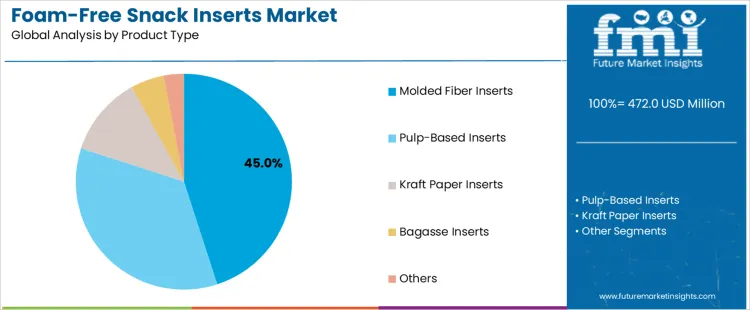
Molded fiber inserts represent 45% of demand because they offer rigid protection while supporting complex shapes required for snack compartmentalization. Consumption is strong in applications where inserts must cradle products securely and resist deformation under load. Usage remains steady as molded fiber maintains structural integrity during temperature variation and handling stress. Procurement favors inserts produced with consistent wall thickness and smooth contact surfaces suitable for direct food proximity. Buyers prioritize materials that perform reliably on high-speed forming and tray-loading lines. Price sensitivity stays moderate since molded fiber inserts reduce breakage and rework costs. Specification control emphasizes fiber blend consistency, moisture resistance, and stackability during storage. Demand persists from 2026 to 2036 as manufacturers standardize molded fiber solutions to replace foam inserts while maintaining product protection and packaging efficiency.
How Are Foam Free Snack Inserts Being Incorporated Into Modern Snack Packaging Systems?
Adoption appears in packaging lines where internal organization matters more than shock absorption. Snack manufacturers place inserts to hold crackers, bars, or coated items in fixed positions during sealing and transport. Multipack assortments use inserts to prevent surface contact between different flavors. Subscription snack boxes apply them to maintain layout consistency across shipments. Export focused producers rely on inserts to control movement inside rigid cartons during long haul distribution. These uses reflect packaging control strategies centered on alignment, cleanliness, and visual order rather than traditional cushioning functions.
What Packaging Design Needs Encourage Use of Foam Free Snack Inserts?
Use aligns with efforts to simplify material structures and improve line compatibility. Brands moving toward paper based or mono material packaging avoid foam to maintain material consistency. Automated packing operations favor inserts that stack flat and feed predictably. Snack producers handling fragile coatings select inserts to reduce scuffing without adding bulk. Retail focused brands use inserts to support premium presentation on opening. These needs arise from packaging design priorities, production efficiency targets, and brand presentation requirements within structured filling environments.
Which Practical Considerations Limit Broader Reliance on Foam Free Snack Inserts?
Performance depends on carton rigidity and distribution conditions. High vibration transport routes reduce effectiveness without added cushioning. Insert placement can slow packing speed in high volume lines. Custom shapes increase tooling and changeover costs for varied product sizes. Storage space is required for flat blanks at scale. Flexible pouch formats offer limited compatibility. These considerations lead to selective use where presentation control and material strategy justify added handling and design complexity.
What is the Demand for Foam Free Snack Inserts by Country?
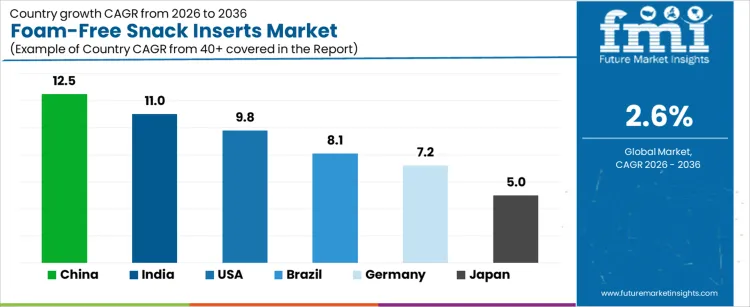
| Country | CAGR (%) |
|---|---|
| USA | 9.8% |
| China | 12.5% |
| Germany | 7.2% |
| India | 11.0% |
| Brazil | 8.1% |
| Japan | 5.0% |
The demand for foam free snack inserts differs across countries due to snack consumption patterns, packaging formats, and regulatory preferences. China leads with a 12.5% CAGR, supported by high volume packaged snack production and growing use of non-foam protective inserts. India follows at 11.0%, driven by expanding snack manufacturing and demand for cost efficient packaging solutions. The USA grows at 9.8%, reflecting adoption among branded snack producers focused on product protection and shelf presentation. Brazil records 8.1%, supported by rising packaged food consumption. Germany posts 7.2%, shaped by established food packaging standards, while Japan grows at 5.0%, reflecting mature snack markets and stable packaging requirements.
How Is Sustainable Packaging Transition Supporting Adoption in the United States?
In the United States, revenue from the Foam Free Snack Inserts Market is expanding at a CAGR of 9.8% through 2035, driven by snack manufacturers shifting away from plastic cushioning materials toward paper based and molded fiber inserts. Food brands are adopting foam free inserts to stabilize products during transport while meeting retailer packaging guidelines. Demand is concentrated in premium snacks, subscription food boxes, and direct to consumer shipments. Domestic packaging converters supply standardized insert formats compatible with automated packing lines. Retail compliance requirements and brand commitments to material reduction are sustaining steady procurement across large snack producers nationwide.
- Retail packaging standards support foam free adoption.
- Direct to consumer snack shipments drive demand.
- Domestic converters ensure scalable supply.
- Automated packing compatibility sustains usage.
How Is E Commerce Snack Distribution Accelerating Growth in China?
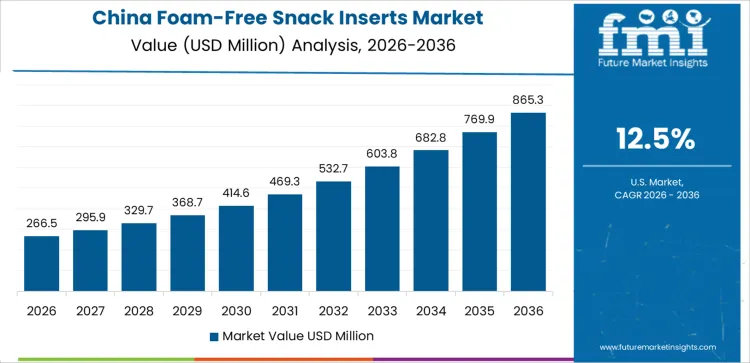
In China, revenue from the Foam Free Snack Inserts Market is growing at a CAGR of 12.5% through 2035, supported by rapid expansion of e commerce snack distribution and packaged food logistics. Snack producers are replacing foam inserts with paper based solutions to reduce waste and improve recyclability. Demand is strong across online snack brands and large scale fulfillment centers. Domestic manufacturers are expanding capacity to supply cost efficient insert designs. High shipment volumes and structured logistics networks are sustaining rapid adoption across major snack production hubs nationwide.
- E commerce snack growth drives insert demand.
- Waste reduction priorities support material shifts.
- Domestic capacity expansion improves availability.
- Fulfillment centers sustain volume usage.
How Does Packaging Standardization Shape Demand in Germany?
Germany continues to record steady growth in the Foam Free Snack Inserts Market at a CAGR of 7.2% through 2035, supported by standardized packaging practices and strict material compliance expectations. Snack manufacturers use foam free inserts to ensure product stability while meeting recycling requirements. Demand is centered on premium snacks and export oriented food packaging. Technical expertise in paper processing supports consistent insert performance. Stable production volumes and long term supplier relationships are sustaining predictable procurement across domestic snack manufacturing facilities.
- Packaging compliance supports foam free usage.
- Export snack packaging drives demand.
- Technical expertise ensures performance consistency.
- Long term contracts sustain procurement stability.
How Is Organized Snack Manufacturing Driving Growth in India?
India is witnessing expansion in the Foam Free Snack Inserts Market at a CAGR of 11% through 2035, driven by growth in organized snack manufacturing and branded packaged food consumption. Producers are adopting foam free inserts to improve transport protection and align with evolving packaging norms. Demand is rising across biscuits, confectionery, and ready to eat snack segments. Domestic converters supply cost focused insert solutions suited to high volume production. Expanding distribution networks and retail penetration are sustaining steady procurement across urban snack production centers nationwide.
- Branded snack growth supports insert adoption.
- Transport protection needs drive usage.
- Domestic converters improve cost access.
- Retail expansion sustains demand growth.
How Are Premium Snack Brands Supporting Adoption in Brazil?
Brazil is seeing growth in the Foam Free Snack Inserts Market at a CAGR of 8.1% through 2035, supported by rising demand for premium and gift oriented snack packaging. Manufacturers use foam free inserts to improve presentation and reduce packaging waste. Demand is concentrated in chocolates, confectionery, and specialty snacks. Imports supply some specialty materials, while local producers expand basic insert production. Growth in packaged snack availability is sustaining recurring demand across food packaging operations nationwide.
- Premium snack packaging drives insert usage.
- Waste reduction supports material substitution.
- Imports supply specialty requirements.
- Packaged snack growth sustains procurement.
How Does Mature Snack Consumption Influence Stability in Japan?
Japan is maintaining measured growth in the Foam Free Snack Inserts Market at a CAGR of 5% through 2035, supported by mature snack consumption and consistent packaging quality expectations. Snack producers apply foam free inserts selectively to protect delicate products during distribution. Demand remains focused on confectionery, seasonal gift snacks, and specialty food packaging. Domestic suppliers emphasize precision and dimensional consistency. Stable consumption patterns and replacement driven usage are sustaining predictable procurement across established snack manufacturing operations nationwide.
- Mature snack markets support steady demand.
- Quality focused packaging drives selective adoption.
- Domestic suppliers ensure consistent specifications.
- Replacement cycles sustain procurement continuity.
What Is Driving the Demand for Foam Free Snack Inserts and Which Packaging Groups Influence Adoption?
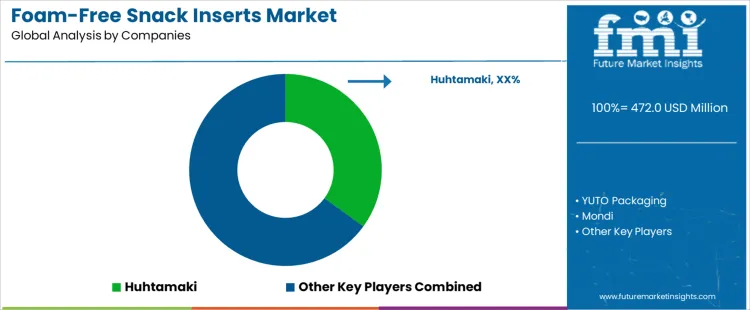
Foam free snack inserts are gaining use as food brands move away from polystyrene and expanded foam materials inside multipack snack boxes and gift assortments. Confectionery, bakery, and premium snack producers use molded fiber, paperboard, and structured film inserts to separate items, control movement, and preserve appearance during transport. Huhtamaki supports adoption through molded fiber inserts designed for chocolates and baked snacks. YUTO Packaging contributes rigid and folding board inserts used in premium gifting and seasonal assortments. Mondi participates through paper based structures integrated into snack cartons. UFlex supports laminated and coated inserts for moisture sensitive snacks. Klabin supplies fiber substrates used in insert conversion.
Insert selection is driven by structural stability, food contact compliance, and ease of integration into automated packing lines. Toppan contributes through printed insert formats that combine separation with branding elements. Snack manufacturers favor inserts that hold shape without adding bulk or weight. Retailers value packaging that reduces breakage and maintains presentation on shelf. Usage spans festive gift boxes, multipack snacks, and subscription food kits. Demand visibility tracks regulatory pressure on foam materials, brand commitments to fiber based packaging, and continued growth of premium snack formats that require internal protection without plastic foam components.
Key Players in the Foam Free Snack Inserts Market
- Huhtamaki
- YUTO Packaging
- Mondi
- UFlex
- Klabin
- Toppan
Scope of the Report
| Items | Values |
|---|---|
| Quantitative Units (2026) | USD million |
| Application | Snack Trays; Confectionery; Bakery; Ready Meals; Other Snack and Food Applications |
| Product Type | Molded Fiber Inserts; Pulp-Based Inserts; Kraft Paper Inserts; Bagasse Inserts; Other Insert Types |
| Technology | Thermoforming; Wet Molding; Die-Cutting; Press Molding; Other Manufacturing Technologies |
| Regions Covered | Asia Pacific; Europe; North America; Latin America; Middle East and Africa |
| Countries Covered | China; Japan; South Korea; India; Australia and New Zealand; ASEAN; Germany; United Kingdom; France; Italy; Spain; Nordic; BENELUX; United States; Canada; Mexico; Brazil; Chile; Kingdom of Saudi Arabia; Turkey; South Africa; plus additional countries across Asia Pacific, Europe, Latin America, and Middle East and Africa |
| Key Companies Profiled | Huhtamaki; YUTO Packaging; Mondi; UFlex; Klabin; Toppan |
| Additional Attributes | Dollar by sales across applications and product types; replacement of foam inserts with molded fiber and pulp-based formats in snack trays, confectionery, and bakery packaging; use of thermoforming and wet molding for dimensional accuracy and high-volume production; integration of foam free inserts into automated snack packing and tray-loading systems; role of inserts in product separation, stability, and presentation during transport and display; influence of packaging redesign cycles and standardized tray dimensions on repeat procurement; alignment of insert selection with food contact compliance, stacking strength, and material reduction objectives |
Foam Free Snack Inserts Market Segmentation
By Application
- Snack Trays
- Confectionery
- Bakery
- Ready Meals
- Others
By Product Type
- Molded Fiber Inserts
- Pulp-Based Inserts
- Kraft Paper Inserts
- Bagasse Inserts
- Others
By Technology
- Thermoforming
- Wet Molding
- Die-Cutting
- Press Molding
- Others
Region
- Asia Pacific
- China
- Japan
- South Korea
- India
- Australia & New Zealand
- ASEAN
- Rest of Asia Pacific
- Europe
- Germany
- United Kingdom
- France
- Italy
- Spain
- Nordic
- BENELUX
- Rest of Europe
- North America
- United States
- Canada
- Mexico
- Latin America
- Brazil
- Chile
- Rest of Latin America
- Middle East & Africa
- Kingdom of Saudi Arabia
- Other GCC Countries
- Turkey
- South Africa
- Other African Union
- Rest of Middle East & Africa
Frequently Asked Questions
How big is the foam-free snack inserts market in 2026?
The global foam-free snack inserts market is estimated to be valued at USD 472.0 million in 2026.
What will be the size of foam-free snack inserts market in 2036?
The market size for the foam-free snack inserts market is projected to reach USD 610.5 million by 2036.
How much will be the foam-free snack inserts market growth between 2026 and 2036?
The foam-free snack inserts market is expected to grow at a 2.6% CAGR between 2026 and 2036.
What are the key product types in the foam-free snack inserts market?
The key product types in foam-free snack inserts market are snack trays, confectionery, bakery, ready meals and others.
Which product type segment to contribute significant share in the foam-free snack inserts market in 2026?
In terms of product type, molded fiber inserts segment to command 45.0% share in the foam-free snack inserts market in 2026.
Preview the report firsthand - request a free sample
Get SampleGet the brochure for pricing and purchase details.
Get PDFTable of Content
- Executive Summary
- Global Market Outlook
- Demand-side Trends
- Supply-side Trends
- Technology Roadmap Analysis
- Analysis and Recommendations
- Market Overview
- Market Coverage / Taxonomy
- Market Definition / Scope / Limitations
- Market Background
- Market Dynamics
- Drivers
- Restraints
- Opportunity
- Trends
- Scenario Forecast
- Demand in Optimistic Scenario
- Demand in Likely Scenario
- Demand in Conservative Scenario
- Opportunity Map Analysis
- Product Life Cycle Analysis
- Supply Chain Analysis
- Investment Feasibility Matrix
- Value Chain Analysis
- PESTLE and Porter’s Analysis
- Regulatory Landscape
- Regional Parent Market Outlook
- Production and Consumption Statistics
- Import and Export Statistics
- Market Dynamics
- Global Market Analysis 2021 to 2025 and Forecast, 2026 to 2036
- Historical Market Size Value (USD Million) Analysis, 2021 to 2025
- Current and Future Market Size Value (USD Million) Projections, 2026 to 2036
- Y-o-Y Growth Trend Analysis
- Absolute $ Opportunity Analysis
- Global Market Pricing Analysis 2021 to 2025 and Forecast 2026 to 2036
- Global Market Analysis 2021 to 2025 and Forecast 2026 to 2036, By Application
- Introduction / Key Findings
- Historical Market Size Value (USD Million) Analysis By Application , 2021 to 2025
- Current and Future Market Size Value (USD Million) Analysis and Forecast By Application , 2026 to 2036
- Snack Trays
- Confectionery
- Bakery
- Ready Meals
- Others
- Y-o-Y Growth Trend Analysis By Application , 2021 to 2025
- Absolute $ Opportunity Analysis By Application , 2026 to 2036
- Global Market Analysis 2021 to 2025 and Forecast 2026 to 2036, By Product Type
- Introduction / Key Findings
- Historical Market Size Value (USD Million) Analysis By Product Type, 2021 to 2025
- Current and Future Market Size Value (USD Million) Analysis and Forecast By Product Type, 2026 to 2036
- Molded Fiber Inserts
- Pulp-Based Inserts
- Kraft Paper Inserts
- Bagasse Inserts
- Others
- Y-o-Y Growth Trend Analysis By Product Type, 2021 to 2025
- Absolute $ Opportunity Analysis By Product Type, 2026 to 2036
- Global Market Analysis 2021 to 2025 and Forecast 2026 to 2036, By Technology
- Introduction / Key Findings
- Historical Market Size Value (USD Million) Analysis By Technology, 2021 to 2025
- Current and Future Market Size Value (USD Million) Analysis and Forecast By Technology, 2026 to 2036
- Thermoforming
- Wet Molding
- Die-Cutting
- Press Molding
- Others
- Y-o-Y Growth Trend Analysis By Technology, 2021 to 2025
- Absolute $ Opportunity Analysis By Technology, 2026 to 2036
- Global Market Analysis 2021 to 2025 and Forecast 2026 to 2036, By Region
- Introduction
- Historical Market Size Value (USD Million) Analysis By Region, 2021 to 2025
- Current Market Size Value (USD Million) Analysis and Forecast By Region, 2026 to 2036
- North America
- Latin America
- Western Europe
- Eastern Europe
- East Asia
- South Asia and Pacific
- Middle East & Africa
- Market Attractiveness Analysis By Region
- North America Market Analysis 2021 to 2025 and Forecast 2026 to 2036, By Country
- Historical Market Size Value (USD Million) Trend Analysis By Market Taxonomy, 2021 to 2025
- Market Size Value (USD Million) Forecast By Market Taxonomy, 2026 to 2036
- By Country
- USA
- Canada
- Mexico
- By Application
- By Product Type
- By Technology
- By Country
- Market Attractiveness Analysis
- By Country
- By Application
- By Product Type
- By Technology
- Key Takeaways
- Latin America Market Analysis 2021 to 2025 and Forecast 2026 to 2036, By Country
- Historical Market Size Value (USD Million) Trend Analysis By Market Taxonomy, 2021 to 2025
- Market Size Value (USD Million) Forecast By Market Taxonomy, 2026 to 2036
- By Country
- Brazil
- Chile
- Rest of Latin America
- By Application
- By Product Type
- By Technology
- By Country
- Market Attractiveness Analysis
- By Country
- By Application
- By Product Type
- By Technology
- Key Takeaways
- Western Europe Market Analysis 2021 to 2025 and Forecast 2026 to 2036, By Country
- Historical Market Size Value (USD Million) Trend Analysis By Market Taxonomy, 2021 to 2025
- Market Size Value (USD Million) Forecast By Market Taxonomy, 2026 to 2036
- By Country
- Germany
- UK
- Italy
- Spain
- France
- Nordic
- BENELUX
- Rest of Western Europe
- By Application
- By Product Type
- By Technology
- By Country
- Market Attractiveness Analysis
- By Country
- By Application
- By Product Type
- By Technology
- Key Takeaways
- Eastern Europe Market Analysis 2021 to 2025 and Forecast 2026 to 2036, By Country
- Historical Market Size Value (USD Million) Trend Analysis By Market Taxonomy, 2021 to 2025
- Market Size Value (USD Million) Forecast By Market Taxonomy, 2026 to 2036
- By Country
- Russia
- Poland
- Hungary
- Balkan & Baltic
- Rest of Eastern Europe
- By Application
- By Product Type
- By Technology
- By Country
- Market Attractiveness Analysis
- By Country
- By Application
- By Product Type
- By Technology
- Key Takeaways
- East Asia Market Analysis 2021 to 2025 and Forecast 2026 to 2036, By Country
- Historical Market Size Value (USD Million) Trend Analysis By Market Taxonomy, 2021 to 2025
- Market Size Value (USD Million) Forecast By Market Taxonomy, 2026 to 2036
- By Country
- China
- Japan
- South Korea
- By Application
- By Product Type
- By Technology
- By Country
- Market Attractiveness Analysis
- By Country
- By Application
- By Product Type
- By Technology
- Key Takeaways
- South Asia and Pacific Market Analysis 2021 to 2025 and Forecast 2026 to 2036, By Country
- Historical Market Size Value (USD Million) Trend Analysis By Market Taxonomy, 2021 to 2025
- Market Size Value (USD Million) Forecast By Market Taxonomy, 2026 to 2036
- By Country
- India
- ASEAN
- Australia & New Zealand
- Rest of South Asia and Pacific
- By Application
- By Product Type
- By Technology
- By Country
- Market Attractiveness Analysis
- By Country
- By Application
- By Product Type
- By Technology
- Key Takeaways
- Middle East & Africa Market Analysis 2021 to 2025 and Forecast 2026 to 2036, By Country
- Historical Market Size Value (USD Million) Trend Analysis By Market Taxonomy, 2021 to 2025
- Market Size Value (USD Million) Forecast By Market Taxonomy, 2026 to 2036
- By Country
- Kingdom of Saudi Arabia
- Other GCC Countries
- Turkiye
- South Africa
- Other African Union
- Rest of Middle East & Africa
- By Application
- By Product Type
- By Technology
- By Country
- Market Attractiveness Analysis
- By Country
- By Application
- By Product Type
- By Technology
- Key Takeaways
- Key Countries Market Analysis
- USA
- Pricing Analysis
- Market Share Analysis, 2025
- By Application
- By Product Type
- By Technology
- Canada
- Pricing Analysis
- Market Share Analysis, 2025
- By Application
- By Product Type
- By Technology
- Mexico
- Pricing Analysis
- Market Share Analysis, 2025
- By Application
- By Product Type
- By Technology
- Brazil
- Pricing Analysis
- Market Share Analysis, 2025
- By Application
- By Product Type
- By Technology
- Chile
- Pricing Analysis
- Market Share Analysis, 2025
- By Application
- By Product Type
- By Technology
- Germany
- Pricing Analysis
- Market Share Analysis, 2025
- By Application
- By Product Type
- By Technology
- UK
- Pricing Analysis
- Market Share Analysis, 2025
- By Application
- By Product Type
- By Technology
- Italy
- Pricing Analysis
- Market Share Analysis, 2025
- By Application
- By Product Type
- By Technology
- Spain
- Pricing Analysis
- Market Share Analysis, 2025
- By Application
- By Product Type
- By Technology
- France
- Pricing Analysis
- Market Share Analysis, 2025
- By Application
- By Product Type
- By Technology
- India
- Pricing Analysis
- Market Share Analysis, 2025
- By Application
- By Product Type
- By Technology
- ASEAN
- Pricing Analysis
- Market Share Analysis, 2025
- By Application
- By Product Type
- By Technology
- Australia & New Zealand
- Pricing Analysis
- Market Share Analysis, 2025
- By Application
- By Product Type
- By Technology
- China
- Pricing Analysis
- Market Share Analysis, 2025
- By Application
- By Product Type
- By Technology
- Japan
- Pricing Analysis
- Market Share Analysis, 2025
- By Application
- By Product Type
- By Technology
- South Korea
- Pricing Analysis
- Market Share Analysis, 2025
- By Application
- By Product Type
- By Technology
- Russia
- Pricing Analysis
- Market Share Analysis, 2025
- By Application
- By Product Type
- By Technology
- Poland
- Pricing Analysis
- Market Share Analysis, 2025
- By Application
- By Product Type
- By Technology
- Hungary
- Pricing Analysis
- Market Share Analysis, 2025
- By Application
- By Product Type
- By Technology
- Kingdom of Saudi Arabia
- Pricing Analysis
- Market Share Analysis, 2025
- By Application
- By Product Type
- By Technology
- Turkiye
- Pricing Analysis
- Market Share Analysis, 2025
- By Application
- By Product Type
- By Technology
- South Africa
- Pricing Analysis
- Market Share Analysis, 2025
- By Application
- By Product Type
- By Technology
- USA
- Market Structure Analysis
- Competition Dashboard
- Competition Benchmarking
- Market Share Analysis of Top Players
- By Regional
- By Application
- By Product Type
- By Technology
- Competition Analysis
- Competition Deep Dive
- Huhtamaki
- Overview
- Product Portfolio
- Profitability by Market Segments (Product/Age /Sales Channel/Region)
- Sales Footprint
- Strategy Overview
- Marketing Strategy
- Product Strategy
- Channel Strategy
- YUTO Packaging
- Mondi
- UFlex
- Klabin
- Toppan
- Huhtamaki
- Competition Deep Dive
- Assumptions & Acronyms Used
- Research Methodology


