

- Market Size (2026)
- USD 793.0 Mn
- Forecast (2036)
- USD 1319.3 Mn
- CAGR (2026 to 2036)
- 5.2%
How big is Follow Focus Systems Market in 2026?
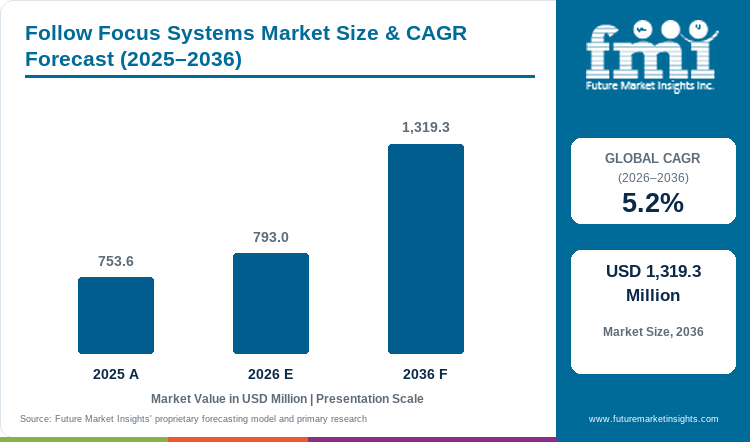
USD 793.0 Million in 2026 and USD 1,319.3 Million by 2036, expanding at 5.2% CAGR.
Demand for follow focus systems is projected to expand at 5.2% CAGR from 2026 to 2036. Valuation grows from USD 753.6 Million in 2025 to USD 793.0 Million in 2026 and reaches USD 1,319.3 Million by 2036. Camera crews are moving lens control away from the operator as camera technology supports more remote shooting. In June 2025, ARRI launched NIA-1 for camera and lens control over Ethernet and IP networks. Remote mounts let focus pullers work away from the camera body.
Canada is projected at 5.4% CAGR through 2036, compared with 4.0% for Japan. Different project flow and replacement cycles explain the gap. In April 2026, Telefilm Canada selected 11 English-market feature films in its first big-budget round. Seven were majority coproductions. Funded projects keep rental fleets and cine lenses in use. Japanese crews replace gear more slowly to match proven camera and lens packages.
Key Takeaways
- Remote camera use and repeatable lens control are increasing demand for dedicated follow focus systems.
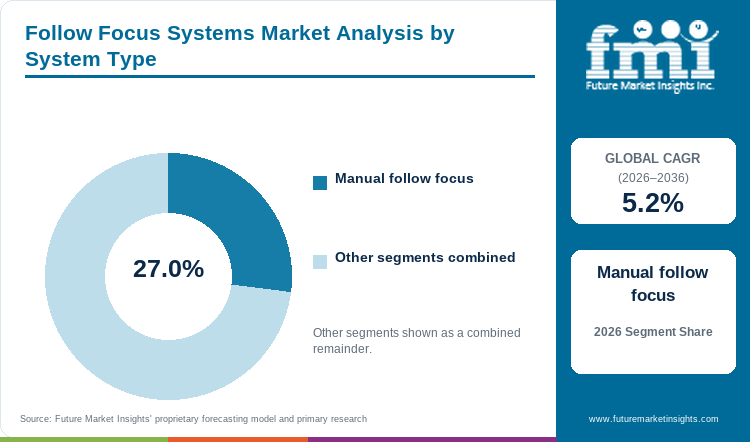
- By system type, manual follow focus is estimated to hold 27.0% share in 2026, supported by simple setup and direct mechanical control.
- In 2026, cinema cameras are expected to lead camera type with 39.0% share, supported by separate focus pulling on professional sets.
- By end use, film production is forecast to represent 31.0% share in 2026, driven by repeated takes and shallow-focus work.
- Wireless systems need extra setup because motors, radio links, camera control, power and lens calibration must work together.
- Key players include ARRI, Tilta, Chrosziel GmbH, Teradek, Preston Cinema Systems, DJI, SmallRig, Vocas Systems B.V., Movcam Tech. Co., Ltd. and PDMOVIE.
Analyst Perspective
“Camera teams keep lens-control gear longer when motors, hand units and camera links survive rig changes. Suppliers can win wider fleet use by making calibration and compatibility easier.”
- Sudip saha, Principal Consultant, Future Market Insights
How is the follow focus systems market segmented?
The follow focus systems market is segmented by System Type, Camera Type, End Use, Control and Sales Channel.
System type covers manual, wireless, motorized, single-channel and multi-axis FIZ systems. Camera type covers cinema, broadcast, mirrorless - cine, studio and specialty rigs. End use covers film, commercial, live broadcast, indie filmmaking and rental houses. Control covers wireless hand units, gear-driven, app - controller and integrated motor formats. Sales channels cover professional dealers, rental houses, direct sales and e-commerce - catalog routes.
What keeps manual follow focus relevant within the system type category?
Manual systems handle the main focusing job without radio pairing, firmware, or motor power. Camera teams can move one unit between rod-mounted builds and older camera accessories. Motorized options allow remote control but need more setup. In January 2026, ARRI updated cforce mini RF software. The update shows that electronic lens control needs matching firmware and mechanical parts.
- Based on system type, manual follow focus is projected to account for 27.0% in 2026, supported by simple setup and broad geared-lens compatibility.
- Mechanical control also reduces battery, radio and firmware needs on compact owner-operator or rental packages.
How do cinema cameras shape demand within the camera type category?
Cinema-camera packages often separate camera operation from focus pulling. They also use lenses with long focus throws. Crews rebuild one package for handheld, studio, vehicle, or remote work. In July 2025, Teradek published CTRL.5 camera-control guidance for ARRI bodies. The guidance explains what is needed before one handset can control camera lenses and camera functions.
- By camera type, cinema cameras are estimated to hold 39.0% in 2026, attributable to regular external focus, iris and zoom control.
- Broadcast and mirrorless rigs also use follow focus hardware. Internal autofocus and servo lenses can reduce the need for a separate system.
Why does film production hold the largest end-use share?
Film crews repeat focus marks and often work with a shallow depth of field. Dedicated control is more useful on moving gimbal systems or vehicle rigs. Mexico recorded 235 domestic feature films in production stages during 2025. The figure appeared in its April 2026 national cinema yearbook. This production base gives rental houses and camera teams a steady pool of projects that need flexible equipment.
- In 2026, film production is expected to lead end use with 31.0% share, driven by repeatable focus marks and complex camera movement.
- Commercial and live work use the same tools. Shorter schedules or servo-lens workflows can reduce dedicated follow focus use.
What supports wireless hand unit leadership within the control category?
Wireless hand units keep a physical focus wheel while moving the operator away from the camera. The interface works with remote heads and robotic broadcast cameras. Chrosziel's July 2025 CMC-BRO manual documents wireless focus, iris and zoom control through its Magnum hand unit. A dedicated handset can stay as the main control surface while the camera moves.
- Wireless hand units are likely to capture 33.0% share in 2026, linked to remote operator placement and direct control of repeatable focus pulls.
- Apps remain useful for setup. Professional hand units keep direct controls available during fast changes on set.
What drives professional dealers within the sales channel category?
Follow focus purchases often need motors, cables, gears, power and camera-control parts for one rig. Professional dealers can check those parts and help with replacements. In April 2026, ARRI released cforce MAX through its worldwide service network. This sales route helps buyers manage higher-value systems as camera modules and rig parts change.
- By sales channel, professional dealers are forecast to represent 36.0% in 2026, supported by setup advice and service access for multi-part systems.
- Direct and e-commerce routes work well for standard kits, replacement parts and buyers who already know the setup they need.
What are the drivers, restraints and opportunities in the Follow Focus Systems Market?
Mobile camera work raises remote-control needs, integration work slows some upgrades and assisted focus gives manual lenses a new operating route.
- Driver: More professional productions use moving or remote camera positions that move focus control away from the lens barrel.
- Restraint: Compatibility, licensing and calibration can slow setup before a wireless system works across a mixed camera fleet.
- Opportunity: Hybrid focus help can keep manual cinema lenses useful for smaller crews and fast-moving camera builds.
Funded film and high-end series work keeps professional camera packages in use. In January 2026, Germany's FFA reported support for 140 feature-film and high-end series projects during 2025. The eligible funding rate was 30%. These programs do not buy follow focus systems. Still, more active productions give rental houses and camera teams more packages to equip.
Wireless control adds setup work before a camera is ready, especially in mixed fleets. Teradek's August 2025 CTRL.5 guidance lists separate camera-control licenses for ARRI, RED and Sony. It also covers lens calibration and motor setup. Buyers may delay an upgrade until one system works with enough existing CMOS cameras and lenses. That wider fit can reduce retraining and cable changes.
Assisted focus can keep manual cinema lenses useful for smaller crews without removing direct control. In August 2025, Tilta announced a Nucleus-M II autofocus adapter. It sends phase-detection data from compatible image sensors to external motors. The system must switch quickly between focus help and manual control. Focus pullers still need direct control when tracking fails.
Which country CAGRs are profiled in the Follow Focus Systems Market?
| Country | CAGR |
|---|---|
| France | 6.1% |
| Mexico | 5.8% |
| Canada | 5.4% |
| Italy | 5.1% |
| USA | 4.8% |
| Germany | 4.4% |
| Japan | 4.0% |
How do country-level CAGRs compare in the Follow Focus Systems Market?
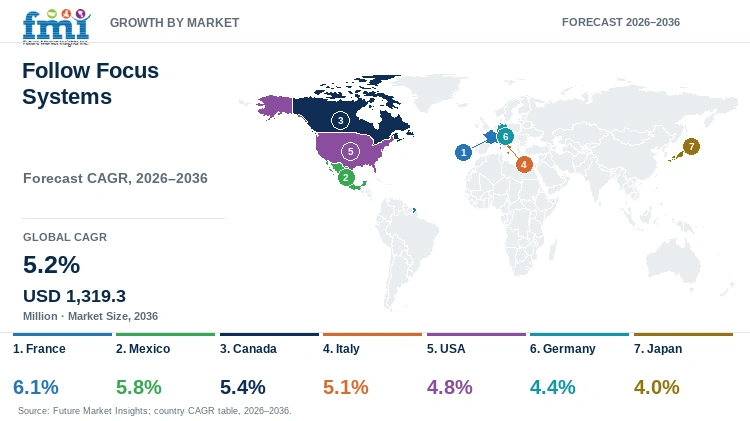
France and Mexico have the significant growth rates at 6.1% and 5.8% CAGR. Canada and Italy follow at 5.4% and 5.1%. The USA, Germany and Japan range from 4.8% to 4.0%. The 2.1-point spread compares forecast speed, not current revenue.
- France has domestic films and coproductions that keep premium rental packages in use.
- Mexico has studio and independent work, so suppliers must cover a wide range of prices.
- Canada relies on service production, which keeps rental support important for equipment access.
- Italy mixes film and audiovisual projects that use equipment for different lengths of time.
- US replacement timing differs between large rental fleets and owner-operated rigs.
- Germany's funded high-end productions place strong weight on reliable equipment and service.
- Japan's mature workflows make compatibility a key part of replacement decisions.
Similar CAGRs can still create different buying conditions because production mix and service capacity vary by country. The full report gives country-level CAGR analysis for North America, Latin America, Western Europe, Eastern Europe, East Asia, South Asia and Pacific and the Middle East and Africa.
Country-wise Analysis
- French camera teams work in a large domestic production base with regular coproduction activity. By 2036, France is projected to grow at 6.1% CAGR, supported by steady approved film activity. In March 2026, the CNC reported 290 approved films for 2025. The total included 228 French-initiative films and 62 minority coproductions. Rental houses can keep premium camera lenses and focus-control gear in use across these projects. Project size still varies, so suppliers need service and setups that work for both small and large productions.
- Mexican equipment demand comes from projects at several stages and a growing support pipeline. By 2036, Mexico is projected to grow at 5.8% CAGR, supported by broad national film activity. In May 2026, IMCINE selected 183 FOCINE projects. The total included 90 production projects. This program adds more camera packages that need reliable camera accessories. Budgets still vary widely and specialist service is weaker outside major hubs. Modular systems with clear upgrade paths can serve these different needs.
- Canadian productions rely on rental fleets and service companies that move camera packages between projects. Canada is estimated to post 5.4% CAGR over the forecast period, supported by project funding and rental activity. In April 2026, Telefilm Canada selected 12 French-language feature films for production funding. The group included two coproductions. These projects create repeat demand for camera support, but equipment use can still vary. Dealers and rental houses need systems that can be set up again quickly as lenses, bodies and crews change.
- Italian camera crews work on films and audiovisual projects with different schedules and equipment needs. By 2036, Italy is projected to grow at 5.1% CAGR, supported by steady national film output. In September 2026, the Directorate General for Cinema and Audiovisual released national data. It counted 403 feature films classified during 2025. The total included 364 eligible Italian films. Suppliers can serve this base with systems that move between cinema and television packages. Project budgets keep service access and modular buying important during replacement.
- US camera teams range from large rental operations to independent owner-operators. This mix creates a broad replacement cycle. By 2036, the USA is projected to grow at 4.8% CAGR, supported by a large professional camera workforce. In May 2026, the Bureau of Labor Statistics reported 21,550 television, video and film camera operators nationally for May 2025. These crews use many camera and lens combinations. Suppliers therefore need broad compatibility. Upgrade paths that keep existing motors, cables and controllers can lower fleet-change costs.
- German professional production relies on rental networks and public film support for major projects. Germany is estimated to post 4.4% CAGR over the forecast period, constrained by careful replacement in a mature equipment base. In August 2026, the FFA reported 103 DFFF and GMPF projects already funded during 2026. Another 111 applications were in process. This project flow keeps robotic broadcast cameras and cinema packages in use. Suppliers still need local service and support for established camera systems before new lens-control gear can replace working equipment.
- Japanese production teams use established camera packages and value simple setup and predictable integration. By 2036, Japan is projected to grow at 4.0% CAGR, linked to careful replacement in an established production base. In January 2026, the Motion Picture Producers Association of Japan released national film data. It reported 1,305 film releases during 2025. Of these, 694 were Japanese films. Production is active, but working control systems do not need fast replacement. Suppliers need clear compatibility and local support to turn trials into repeat purchases.
Who are the notable companies in the Follow Focus Systems Market?
ARRI, Tilta, Chrosziel GmbH, Teradek, Preston Cinema Systems, DJI, SmallRig, Vocas Systems B.V., Movcam Tech. Co., Ltd. and PDMOVIE
The supplier base includes large cinema-system brands, specialist FIZ developers and lower-cost accessory brands. New suppliers must show that their radio links, motors, camera links and service are reliable. A focus-control failure can stop a shot. ARRI, Teradek and Preston Cinema Systems focus on professional electronic control. Tilta, DJI, SmallRig and PDMOVIE bring wireless control to compact rigs. Chrosziel GmbH, Vocas Systems B.V. and Movcam Tech. Co., Ltd. keep mechanical or modular options for established distance measurement sensors and camera packages.
- ARRI, Teradek and Preston Cinema Systems focus on lens data and camera links. They also offer professional multi-axis control.
- Tilta, DJI, SmallRig and PDMOVIE serve wireless or assisted-focus work for owner-operators and smaller production teams.
- Chrosziel GmbH, Vocas Systems B.V. and Movcam Tech. Co., Ltd. cover specialist broadcast, mechanical and modular lens-control needs.
Competitive Benchmarking: Follow Focus Systems Market
| Company | Wireless Multi-Axis Control | Lens Data or Focus Assist | Camera/Rig Integration | Geographic Reach |
|---|---|---|---|---|
| ARRI | High | High | High | Global |
| Tilta | High | High | High | Global direct and dealer channels |
| Chrosziel GmbH | High | Medium | High | Europe, Americas and Middle East |
| Teradek | High | High | High | Global professional production |
| Preston Cinema Systems | High | High | High | North America and international production |
| DJI | High | High | High | Global |
| SmallRig | Medium | Low | High | Global e-commerce and dealers |
| Vocas Systems B.V. | Low | Low | Medium | Europe and international dealers |
| Movcam Tech. Co., Ltd. | High | Medium | High | Asia and international dealers |
| PDMOVIE | Medium | High | High | Global direct and e-commerce channels |
Scoring basis: High wireless control needs current proof of several linked motors or full multi-axis control. Medium means single-axis wireless control or a smaller multi-axis setup. Low means the system is mainly mechanical. High lens-data or focus-help evidence needs mapped lens data, distance help, or focus data from the camera. Medium means a smaller amount of electronic feedback. Low means basic mechanical control. High integration needs several documented camera or rig links. Medium means fewer links. Low means little public proof of integration.
Key Developments in the Follow Focus Systems Market
- In August 2026, DJI released DJI Assistant 2 for the Ronin series, version 2.1.16. Focus Pro was listed among the supported products.
- In February 2026, PDMOVIE launched SMART FUSION. It passes Sony phase-detection focus data to the LIVE AIR 4 SMART lens motor.
- In June 2025, Preston Cinema Systems released HU4 and MDR5 firmware. The update added RED camera control and Wireless Microforce 2 support.
Key Players in the Follow Focus Systems Market
Integrated professional lens-control systems
- ARRI
- Teradek
- Preston Cinema Systems
- Chrosziel GmbH
Wireless and assisted-focus platforms
- Tilta
- DJI
- PDMOVIE
- SmallRig
Mechanical and modular follow focus specialists
- Vocas Systems B.V.
- Movcam Tech. Co., Ltd.
Follow Focus Systems Market - Report Scope
| Coverage field | Report scope |
|---|---|
| Market breakdown | By system type, camera type, end use, control, sales channel and region. |
| Quantitative Units | USD Million. |
| Market Definition | Commercial follow focus systems used to control lens focus and related FIZ functions are included. Cameras, lenses, gimbals, monitors and production-service revenue are excluded. |
| Regions Covered | North America, Latin America, Western Europe, Eastern Europe, East Asia, South Asia and Pacific and Middle East and Africa. |
| Countries Covered | France, Mexico, Canada, Italy, USA, Germany, Japan and 20+ countries included in the full report. |
| Key Companies Profiled | ARRI, Tilta, Chrosziel GmbH, Teradek, Preston Cinema Systems, DJI, SmallRig, Vocas Systems B.V., Movcam Tech. Co., Ltd. and PDMOVIE. |
| Forecast Period | 2026 to 2036. |
| Approach | Primary and secondary research with market triangulation. |
Follow Focus Systems Market - Research Methodology
| Method | Approach |
|---|---|
| Primary Research | FMI analysts gathered input from manufacturers, service providers, technology developers, distributors, end users, procurement teams and subject-matter experts. Interviews examined purchasing decisions, product or service evaluation, adoption barriers, approval requirements, pricing considerations and expectations for technical or commercial support. Respondents were also asked what evidence is required before a trial, pilot, or initial order develops into regular purchasing. |
| Desk Research | Desk research covered government statistics, regulatory publications, trade data, industry associations, technical literature, standards, company filings, product information and official corporate announcements. Sources were reviewed for relevance, publication date, geographic coverage and consistency with the defined market scope. Claims relating to performance, applications, approvals, capacity, investment and commercial activity were retained only when supported by credible public evidence. |
| Market Sizing and Forecasting | The market model combined the baseline value with historical performance, segment structure, pricing and volume indicators, adoption levels, company participation and country-level demand conditions. Forecast assumptions considered economic activity, investment trends, regulatory developments, technology adoption, purchasing cycles, supply availability and barriers to wider market use. Segment and regional estimates were reconciled before the final market total was calculated. |
| Data Validation | Estimates were checked against multiple independent indicators, including public data, company activity, trade patterns, industry developments and findings from primary interviews. Validation also tested whether products, services, applications and company revenues fell within the defined market boundaries. Adjacent categories, unsupported claims, overlapping revenues and activities without direct market relevance were excluded to reduce double counting and maintain consistency across segments and countries. |
Follow Focus Systems Market by Segments
Follow Focus Systems Market segmented by System Type:
- Manual follow focus
- Wireless follow focus
- Motorized lens control
- Single-channel systems
- Multi-axis FIZ systems
Follow Focus Systems Market segmented by Camera Type:
- Cinema cameras
- Broadcast cameras
- Mirrorless - cine rigs
- Studio cameras
- Specialty rigs
Follow Focus Systems Market segmented by End Use:
- Film production
- Commercial production
- Live broadcast
- Indie filmmaking
- Rental houses
Follow Focus Systems Market segmented by Control:
- Wireless hand unit
- Gear-driven
- App - controller based
- Integrated lens motor
Follow Focus Systems Market segmented by Sales Channel:
- Professional dealers
- Rental houses
- Direct manufacturer sales
- E-commerce - catalog
Follow Focus Systems Market by Region:
- North America
- United States
- Canada
- Latin America
- Brazil
- Mexico
- Chile
- Rest of Latin America
- Western Europe
- Germany
- United Kingdom
- Italy
- Spain
- France
- Nordics
- Benelux
- Rest of Western Europe
- Eastern Europe
- Russia
- Poland
- Hungary
- Balkan and Baltic States
- Rest of Eastern Europe
- East Asia
- China
- Japan
- South Korea
- South Asia and Pacific
- India
- ASEAN
- Australia and New Zealand
- Rest of South Asia and Pacific
- Middle East and Africa
- Kingdom of Saudi Arabia
- Other GCC Countries
- Türkiye
- South Africa
- Other African Union Countries
- Rest of Middle East and Africa
Research Sources and Bibliography
- ARRI. (2025, June 5). New ARRI Network Interface Adapter NIA-1 expands camera and lens control via Ethernet.
- Telefilm Canada. (2026, April 15). Telefilm Canada invests in 11 big-budget features in the English market.
- ARRI. (2026, January 22). Overview of current Electronic Control System software update packages.
- Teradek. (2025, July 17). ARRI camera control setup for CTRL.5.
- Secretariat of Culture, Government of Mexico. (2026, April 14). The Secretariat of Culture presents the 16th edition of the Statistical Yearbook of Mexican Cinema.
- Chrosziel GmbH. (2025, July). CMC-BRO operating manual.
- ARRI. (2026, April 29). Compact new cforce MAX lens motor brings speed and responsiveness to the Hi-5 ecosystem.
- Film Funding Agency Germany. (2026, January 15). DFFF and GMPF 2025 annual funding balance: 140 national and international feature films and high-end series supported.
- Teradek. (2025, August 6). Purchasing camera control licenses for CTRL.5.
- Tilta. (2025, August 30). A new era of lens control with Nucleus Auto Focus Adapter.
- Centre national du cinéma et de l’image animée. (2026, March 18). 2025 Film Production Observatory: Film production records a slight decline.
- Secretariat of Culture, Government of Mexico. (2026, May 4). IMCINE publishes the 2026 FOCINE results.
- Telefilm Canada. (2026, April 14). Telefilm Canada announces 12 French-language feature films selected for production funding.
- Directorate General for Cinema and Audiovisual, Italian Ministry of Culture. (2026, September 3). Italian cinema and audiovisual industry 2025 in numbers.
- U.S. Bureau of Labor Statistics. (2026, May 15). Occupational employment and wages - May 2025.
- Film Funding Agency Germany. (2026, August 11). DFFF and GMPF application numbers reach an all-time high.
- Motion Picture Producers Association of Japan. (2026, January). 2025 national film overview.
- DJI. (2026, August 3). DJI Assistant 2 for Ronin Series, version 2.1.16.
- PDMOVIE. (2026, February 14). 2026 new product launch - SMART FUSION.
- Preston Cinema Systems. (2025, June 17). HU4, MDR5 RED camera control.
- ARRI. (2026, July 2). Hi-5 and Hi-5 SX software update package 3.5.2.
- Tilta. (2026, July 15). Nucleus-M II firmware update package.
- CABSAT. (2025, May). Chrosziel GmbH exhibitor profile and CMC-BRO demonstration.
- Teradek. (2025, July 9). CTRL.5 quick start guide.
- Preston Cinema Systems. (2025, June 8). Wireless Microforce 2 availability update.
- DJI. (2025, September 11). DJI Assistant 2 for Ronin Series, version 2.1.15.
- SmallRig Support Team. (2026, February 28). How to connect Wireless Control Handle 4329 with Follow Focus Motor 4297.
- PDMOVIE. (2026, May 19). SMART FUSION officially begins.
This bibliography is provided for reader reference and is not exhaustive. The full report contains the complete reference list and detailed citations
This Report Answers
- How large is the follow focus systems market in 2026 and what value is projected for 2036?
- Which camera-workflow changes are increasing demand for remote lens control?
- Why does manual follow focus retain the largest system type share?
- Why do cinema cameras account for the largest camera type share?
- How does film production sustain the largest end-use share?
- What slows adoption of wireless and multi-axis follow focus systems?
- How do profiled country CAGRs differ from 2026 to 2036?
- Which suppliers compete in professional, assisted-focus and mechanical lens-control systems?
- Which compatibility and service factors affect a follow focus purchase?
Frequently Asked Questions
How big is the follow focus systems market in 2026?
The follow focus systems market is valued at USD 793.0 Million in 2026. It is projected to reach USD 1,319.3 Million by 2036. More remote camera use is increasing the need for repeatable cine-lens control.
What is the CAGR of the follow focus systems market from 2026 to 2036?
The follow focus systems market is projected to grow at 5.2% CAGR from 2026 to 2036. Wireless lens control and steady professional production support replacement and upgrade demand.
Which system type leads the follow focus systems market?
Manual follow focus is expected to hold 27.0% of system type in 2026. Its simple mechanical setup needs no radio pairing, motor power, or firmware coordination.
Which camera type leads the follow focus systems market?
Cinema cameras are expected to hold 39.0% of camera type in 2026. Professional sets often use separate focus pullers. External hand units stay useful as camera packages move between rig types.
Which companies are active in the follow focus systems market?
Active companies include ARRI, Tilta, Chrosziel GmbH, Teradek, Preston Cinema Systems, DJI, SmallRig, Vocas Systems B.V., Movcam Tech. Co., Ltd. and PDMOVIE. They compete through motor control, lens data, camera integration, manual accuracy, service and price.
What is driving growth in the follow focus systems market?
Growth comes from camera work that moves focus control away from the lens barrel. This is common on gimbals, remote heads and complex cinema-camera builds. Higher production activity also gives dealers and rental houses more equipment to set up, service and replace.
Who are the key players in the follow focus systems market?
The profiled companies are ARRI, Tilta, Chrosziel GmbH, Teradek, Preston Cinema Systems, DJI, SmallRig, Vocas Systems B.V., Movcam Tech. Co., Ltd. and PDMOVIE. They compete through professional FIZ control, motor performance, focus help, mechanical accuracy, compatibility, service and sales reach.
What notable restraint affects the follow focus systems market?
Integration work is a major restraint for wireless systems. A setup may need separate motors, receivers, power links, lens mapping and calibration. Mixed camera and lens fleets can delay a purchase when one system does not cover enough existing gear.
Why should executives track the follow focus systems market?
The category connects cinema-camera spending, lens reuse, rental-fleet costs and wireless production work. Tracking it helps suppliers see whether users are moving toward premium multi-axis systems, focus help, lower-cost wireless kits, or durable mechanical options.
What business problem does the follow focus systems market address?
Follow focus systems let camera teams change focus accurately without touching the lens barrel during a shot. They also support repeatable focus marks and remote operation when the camera is moving, stabilized, enclosed, or far from the focus puller.
What should camera departments evaluate in the follow focus systems market?
Camera departments should check lens compatibility, motor torque, control delay, calibration, radio behavior and power needs. They should also test camera-control support, service access, upgrade options and movement between their most-used rigs and camera bodies.
What limits return on investment in the follow focus systems market?
Return on investment falls when a system needs frequent adapters, repeated calibration, proprietary replacement parts, or distant service. Premium multi-axis hardware can also cost too much when crews mainly need single-axis focus control or rarely use advanced features.
What supports long-term commercial confidence in the follow focus systems market?
Long-term confidence comes from continued professional production and a clear path toward wireless control, lens data and focus help. Manual systems also remain useful. The category can therefore serve premium cinema work and buyers with tighter equipment budgets.
Preview the report firsthand - request a free sample
Get SampleGet the brochure for pricing and purchase details.
Get PDFTable of Content
- Key Takeaways
- Market Size and CAGR
- Top Growth Driver
- Fastest Growing Segment
- Leading Region
- Key Companies
- Emerging Opportunities
- Executive Summary
- Global Market Outlook
- Demand-side Trends
- Supply-side Trends
- Technology Roadmap Analysis
- Analysis and Recommendations
- Analyst Perspective (What is happening? Why now? What should investors know?)
- Key Questions Answered
- How large is the market?
- What is the CAGR?
- What are key trends?
- Which region dominates?
- Who are the leaders?
- Market Overview
- Market Coverage / Taxonomy
- Market Definition / Scope / Limitations
- Research Methodology
- Chapter Orientation
- Analytical Lens and Working Hypotheses
- Market Structure, Signals, and Trend Drivers
- Benchmarking and Cross-market Comparability
- Market Sizing, Forecasting, and Opportunity Mapping
- Research Design and Evidence Framework
- Desk Research Programme (Secondary Evidence)
- Expert Input and Fieldwork (Primary Evidence)
- Tooling, Models, and Reference Databases
- Data Engineering and Model Build
- Quality Assurance and Audit Trail
- Market Background
- Market Dynamics (Drivers, Restraints, Opportunity, Trends)
- Scenario Forecast (Optimistic, Likely, Conservative)
- Impact Analysis
- AI Impact
- Sustainability Impact
- Regulatory Impact
- Technology Impact
- Consumer / Buyer Analysis
- Purchase Drivers
- Adoption Barriers
- Buyer Journey
- Opportunity Map Analysis
- Product Life Cycle Analysis
- Supply Chain Analysis
- Investment Feasibility Matrix
- Value Chain Analysis
- PESTLE and Porter's Analysis
- Regulatory Landscape
- Regional Parent Market Outlook
- Production and Consumption Statistics
- Import and Export Statistics
- Global Market Analysis and Forecast, 2021 to 2036
- Historical Market Size Value (USD Million) Analysis, 2021 to 2025
- Current and Future Market Size Value (USD Million) Projections, 2026 to 2036
- Y-o-Y Growth Trend Analysis
- Absolute $ Opportunity Analysis
- Global Market Pricing Analysis, 2021 to 2036
- Global Market Analysis and Forecast, By System Type, 2021 to 2036
- Introduction / Key Findings
- Historical Market Size Value (USD Million) Analysis By System Type, 2021 to 2025
- Current and Future Market Size Value (USD Million) Analysis and Forecast By System Type, 2026 to 2036
- Manual follow focus
- Wireless follow focus
- Motorized lens control
- Single-channel systems
- Multi-axis FIZ systems
- Y-o-Y Growth Trend Analysis By System Type, 2021 to 2025
- Absolute $ Opportunity Analysis By System Type, 2026 to 2036
- Global Market Analysis and Forecast, By Camera Type, 2021 to 2036
- Introduction / Key Findings
- Historical Market Size Value (USD Million) Analysis By Camera Type, 2021 to 2025
- Current and Future Market Size Value (USD Million) Analysis and Forecast By Camera Type, 2026 to 2036
- Cinema cameras
- Broadcast cameras
- Mirrorless - cine rigs
- Studio cameras
- Specialty rigs
- Y-o-Y Growth Trend Analysis By Camera Type, 2021 to 2025
- Absolute $ Opportunity Analysis By Camera Type, 2026 to 2036
- Global Market Analysis and Forecast, By End Use, 2021 to 2036
- Introduction / Key Findings
- Historical Market Size Value (USD Million) Analysis By End Use, 2021 to 2025
- Current and Future Market Size Value (USD Million) Analysis and Forecast By End Use, 2026 to 2036
- Film production
- Commercial production
- Live broadcast
- Indie filmmaking
- Rental houses
- Y-o-Y Growth Trend Analysis By End Use, 2021 to 2025
- Absolute $ Opportunity Analysis By End Use, 2026 to 2036
- Global Market Analysis and Forecast, By Control, 2021 to 2036
- Introduction / Key Findings
- Historical Market Size Value (USD Million) Analysis By Control, 2021 to 2025
- Current and Future Market Size Value (USD Million) Analysis and Forecast By Control, 2026 to 2036
- Wireless hand unit
- Gear-driven
- App - controller based
- Integrated lens motor
- Y-o-Y Growth Trend Analysis By Control, 2021 to 2025
- Absolute $ Opportunity Analysis By Control, 2026 to 2036
- Global Market Analysis and Forecast, By Sales Channel, 2021 to 2036
- Introduction / Key Findings
- Historical Market Size Value (USD Million) Analysis By Sales Channel, 2021 to 2025
- Current and Future Market Size Value (USD Million) Analysis and Forecast By Sales Channel, 2026 to 2036
- Professional dealers
- Rental houses
- Direct manufacturer sales
- E-commerce - catalog
- Y-o-Y Growth Trend Analysis By Sales Channel, 2021 to 2025
- Absolute $ Opportunity Analysis By Sales Channel, 2026 to 2036
- Global Market Analysis and Forecast, By Region, 2021 to 2036
- Introduction
- Historical Market Size Value (USD Million) Analysis By Region, 2021 to 2025
- Current Market Size Value (USD Million) Analysis and Forecast By Region, 2026 to 2036
- North America
- Latin America
- Western Europe
- Eastern Europe
- East Asia
- South Asia and Pacific
- Middle East and Africa
- Market Attractiveness Analysis By Region
- North America Market Analysis and Forecast, By Country, 2021 to 2036
- Historical Market Size Value (USD Million) Trend Analysis By Market Taxonomy, 2021 to 2025
- Market Size Value (USD Million) Forecast By Market Taxonomy, 2026 to 2036
- By Country
- United States
- Canada
- By System Type
- By Camera Type
- By End Use
- By Control
- By Sales Channel
- By Country
- Market Attractiveness Analysis
- By Country
- By System Type
- By Camera Type
- By End Use
- By Control
- By Sales Channel
- Key Takeaways
- Latin America Market Analysis and Forecast, By Country
- Historical Market Size Value (USD Million) Trend Analysis By Market Taxonomy, 2021 to 2025
- Market Size Value (USD Million) Forecast By Market Taxonomy, 2026 to 2036
- By Country
- Brazil
- Mexico
- Chile
- Rest of Latin America
- By System Type
- By Camera Type
- By End Use
- By Control
- By Sales Channel
- By Country
- Market Attractiveness Analysis
- By Country
- By System Type
- By Camera Type
- By End Use
- By Control
- By Sales Channel
- Key Takeaways
- Western Europe Market Analysis and Forecast, By Country
- Historical Market Size Value (USD Million) Trend Analysis By Market Taxonomy, 2021 to 2025
- Market Size Value (USD Million) Forecast By Market Taxonomy, 2026 to 2036
- By Country
- Germany
- United Kingdom
- Italy
- Spain
- France
- Nordics
- Benelux
- Rest of Western Europe
- By System Type
- By Camera Type
- By End Use
- By Control
- By Sales Channel
- By Country
- Market Attractiveness Analysis
- By Country
- By System Type
- By Camera Type
- By End Use
- By Control
- By Sales Channel
- Key Takeaways
- Eastern Europe Market Analysis and Forecast, By Country
- Historical Market Size Value (USD Million) Trend Analysis By Market Taxonomy, 2021 to 2025
- Market Size Value (USD Million) Forecast By Market Taxonomy, 2026 to 2036
- By Country
- Russia
- Poland
- Hungary
- Balkan and Baltic States
- Rest of Eastern Europe
- By System Type
- By Camera Type
- By End Use
- By Control
- By Sales Channel
- By Country
- Market Attractiveness Analysis
- By Country
- By System Type
- By Camera Type
- By End Use
- By Control
- By Sales Channel
- Key Takeaways
- East Asia Market Analysis and Forecast, By Country
- Historical Market Size Value (USD Million) Trend Analysis By Market Taxonomy, 2021 to 2025
- Market Size Value (USD Million) Forecast By Market Taxonomy, 2026 to 2036
- By Country
- China
- Japan
- South Korea
- By System Type
- By Camera Type
- By End Use
- By Control
- By Sales Channel
- By Country
- Market Attractiveness Analysis
- By Country
- By System Type
- By Camera Type
- By End Use
- By Control
- By Sales Channel
- Key Takeaways
- South Asia and Pacific Market Analysis and Forecast, By Country
- Historical Market Size Value (USD Million) Trend Analysis By Market Taxonomy, 2021 to 2025
- Market Size Value (USD Million) Forecast By Market Taxonomy, 2026 to 2036
- By Country
- India
- ASEAN
- Australia and New Zealand
- Rest of South Asia and Pacific
- By System Type
- By Camera Type
- By End Use
- By Control
- By Sales Channel
- By Country
- Market Attractiveness Analysis
- By Country
- By System Type
- By Camera Type
- By End Use
- By Control
- By Sales Channel
- Key Takeaways
- Middle East and Africa Market Analysis and Forecast, By Country
- Historical Market Size Value (USD Million) Trend Analysis By Market Taxonomy, 2021 to 2025
- Market Size Value (USD Million) Forecast By Market Taxonomy, 2026 to 2036
- By Country
- Kingdom of Saudi Arabia
- Other GCC Countries
- Türkiye
- South Africa
- Other African Union Countries
- Rest of Middle East and Africa
- By System Type
- By Camera Type
- By End Use
- By Control
- By Sales Channel
- By Country
- Market Attractiveness Analysis
- By Country
- By System Type
- By Camera Type
- By End Use
- By Control
- By Sales Channel
- Key Takeaways
- Key Countries Market Analysis
- United States
- Pricing Analysis
- Market Share Analysis, 2025
- By System Type
- By Camera Type
- By End Use
- By Control
- By Sales Channel
- Canada
- Pricing Analysis
- Market Share Analysis, 2025
- By System Type
- By Camera Type
- By End Use
- By Control
- By Sales Channel
- Mexico
- Pricing Analysis
- Market Share Analysis, 2025
- By System Type
- By Camera Type
- By End Use
- By Control
- By Sales Channel
- Brazil
- Pricing Analysis
- Market Share Analysis, 2025
- By System Type
- By Camera Type
- By End Use
- By Control
- By Sales Channel
- Chile
- Pricing Analysis
- Market Share Analysis, 2025
- By System Type
- By Camera Type
- By End Use
- By Control
- By Sales Channel
- Germany
- Pricing Analysis
- Market Share Analysis, 2025
- By System Type
- By Camera Type
- By End Use
- By Control
- By Sales Channel
- United Kingdom
- Pricing Analysis
- Market Share Analysis, 2025
- By System Type
- By Camera Type
- By End Use
- By Control
- By Sales Channel
- Italy
- Pricing Analysis
- Market Share Analysis, 2025
- By System Type
- By Camera Type
- By End Use
- By Control
- By Sales Channel
- Spain
- Pricing Analysis
- Market Share Analysis, 2025
- By System Type
- By Camera Type
- By End Use
- By Control
- By Sales Channel
- France
- Pricing Analysis
- Market Share Analysis, 2025
- By System Type
- By Camera Type
- By End Use
- By Control
- By Sales Channel
- India
- Pricing Analysis
- Market Share Analysis, 2025
- By System Type
- By Camera Type
- By End Use
- By Control
- By Sales Channel
- ASEAN
- Pricing Analysis
- Market Share Analysis, 2025
- By System Type
- By Camera Type
- By End Use
- By Control
- By Sales Channel
- Australia and New Zealand
- Pricing Analysis
- Market Share Analysis, 2025
- By System Type
- By Camera Type
- By End Use
- By Control
- By Sales Channel
- China
- Pricing Analysis
- Market Share Analysis, 2025
- By System Type
- By Camera Type
- By End Use
- By Control
- By Sales Channel
- Japan
- Pricing Analysis
- Market Share Analysis, 2025
- By System Type
- By Camera Type
- By End Use
- By Control
- By Sales Channel
- South Korea
- Pricing Analysis
- Market Share Analysis, 2025
- By System Type
- By Camera Type
- By End Use
- By Control
- By Sales Channel
- Russia
- Pricing Analysis
- Market Share Analysis, 2025
- By System Type
- By Camera Type
- By End Use
- By Control
- By Sales Channel
- Poland
- Pricing Analysis
- Market Share Analysis, 2025
- By System Type
- By Camera Type
- By End Use
- By Control
- By Sales Channel
- Hungary
- Pricing Analysis
- Market Share Analysis, 2025
- By System Type
- By Camera Type
- By End Use
- By Control
- By Sales Channel
- Kingdom of Saudi Arabia
- Pricing Analysis
- Market Share Analysis, 2025
- By System Type
- By Camera Type
- By End Use
- By Control
- By Sales Channel
- Türkiye
- Pricing Analysis
- Market Share Analysis, 2025
- By System Type
- By Camera Type
- By End Use
- By Control
- By Sales Channel
- South Africa
- Pricing Analysis
- Market Share Analysis, 2025
- By System Type
- By Camera Type
- By End Use
- By Control
- By Sales Channel
- United States
- Market Structure Analysis
- Competition Dashboard
- Competition Benchmarking
- Market Share Analysis of Top Players
- By Regional
- By System Type
- By Camera Type
- By End Use
- By Control
- By Sales Channel
- Emerging Startups
- Innovation Benchmarking
- Competition Analysis
- Competition Deep Dive
- ARRI
- Overview
- Product Portfolio
- Profitability by Market Segments
- Sales Footprint
- Strategy Overview
- Marketing Strategy
- Product Strategy
- Channel Strategy
- Tilta
- Chrosziel GmbH
- Teradek
- Preston Cinema Systems
- DJI
- SmallRig
- Vocas Systems B.V.
- Movcam Tech. Co., Ltd.
- PDMOVIE
- ARRI
- Case Studies
- Success Stories
- Recent Developments
- Competition Deep Dive
- Assumptions & Acronyms Used


