

- Market Size (2026)
- USD 780 Mn
- Forecast (2036)
- USD 2466.2 Mn
- CAGR (2026 to 2036)
- 12.2%
How big is Foot Ulcer Sensors Market size?
USD 780 million in 2026 and USD 2466.2 million by 2036 at a 12.2% CAGR.
Sales of foot ulcer sensors are estimated to rise at 12.2% CAGR through 2036, increasing valuation from USD 780 million in 2026 to USD 2466.2 million by 2036. Preventive clinical programs depend on specialized sensor systems to track subtle skin temperature and foot pressure changes between scheduled doctor visits. The Centers for Disease Control and Prevention published statistics in May 2024 confirming about half of all individuals with diabetes experience nerve damage. Routine daily surveillance for minor injuries becomes essential since patients frequently lose sensation and cannot feel early foot damage. Capturing such physical signals early accelerates medical reviews of unnoticed skin stress and loading changes to improve foot care for diabetic patients significantly.
Regional healthcare systems enforce distinct operational priorities on deploying continuous foot-monitoring technologies. Care programs in the United States and Canada emphasize remote clinical reviews with strict reimbursement compatibility. Medical providers in Germany and Japan demand documented clinical validation and require specialist-led implementation protocols. Clinical researchers in Germany evaluated 261 adult patients using sensor-equipped smart insoles during March 2024. Their medical investigation uncovered peripheral neuropathy in 59% of the participants, highlighting an extensive clinical demand for objective foot measurements across complex diabetes care. Translating raw sensor data into clinically actionable outputs requires established diagnostic thresholds and clearly documented clinical response steps.
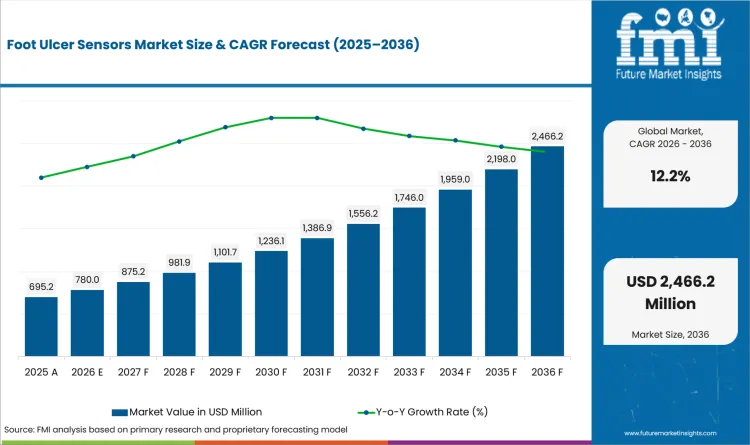
Key Takeaways for the Foot Ulcer Sensors Market
- Demand for foot ulcer sensors is supported by preventive surveillance between visits, with care teams favoring devices connecting patient signals to defined escalation pathways.
- Diabetic foot ulcer prevention is set to garner 42.0% share of application in 2026, driven by recurring ulcer risk and emphasis on early intervention.
- Direct sales is estimated to lead distribution channel with 39.0% share in 2026, led by clinical onboarding and service coordination for connected monitoring programs.
- Daily-use fatigue and uncertain response thresholds represent primary barriers limiting dependable data collection and sustained clinical participation.
- Competition focuses on Podimetrics, Orpyx Medical Technologies Inc., Siren, Sensoria Health Inc., Tekscan, Inc., XSENSOR Technology Corporation, novel GmbH, and WoundVision, LLC, with providers differentiated by sensing depth and care support.
Analyst Perspective
“Clinical adoption relies on sensor programs connecting daily patient measurements with defined escalation duties across preventive diabetes services. Care teams assess patient adherence and response timing during product review, connecting measurement reliability with consistent performance across routine monitoring pathways. Significant scale in adoption follows devices combining dependable measurements with documented preventive action and clearly assigned clinical support across continuing diabetes management programs.”
- Anurag Sharma, Principal Analyst for Healthcare at Future Market Insights
How is Foot Ulcer Sensors Market segmented?
The foot ulcer sensors industry is segmented by product type, application, end user, distribution channel, technology, and region.
The foot ulcer sensors sector is segmented by product type, application, end user, distribution channel, technology, and region. Product type coverage includes temperature monitoring sensors and pressure monitoring sensors serving distinct physiological indicators. Multi-parameter sensors and wearable foot ulcer sensors extend measurement across daily activity. Wireless monitoring sensors complete product coverage for remote transmission. Application coverage spans diabetic foot ulcer prevention and foot ulcer monitoring. Remote patient monitoring and rehabilitation monitoring support care outside scheduled appointments. Clinical research completes application assessment. End-user coverage includes hospitals, specialty clinics, home healthcare providers, ambulatory surgical centers, and research institutes. Distribution coverage includes direct sales, medical device distributors, online medical supply platforms, retail medical equipment stores, and Healthcare Procurement Organizations. Technology coverage includes IoT-based monitoring, wireless sensor technology, MEMS sensor technology, AI-based predictive analytics, and flexible printed sensors. Regional coverage includes North America, Europe, East Asia, South Asia and Pacific, Latin America, Middle East and Africa.
Why do temperature monitoring sensors lead product type selection?
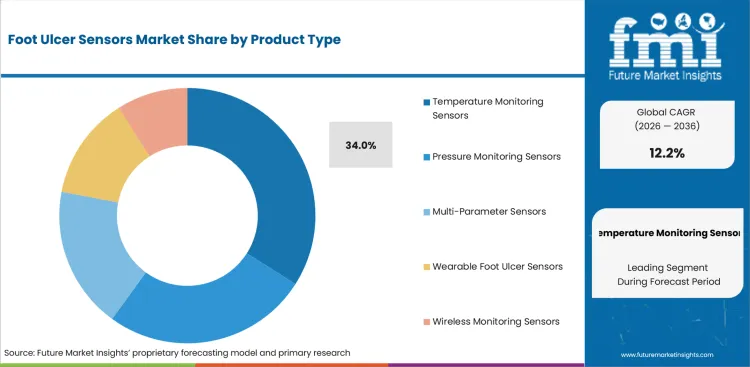
Temperature monitoring sensors identify localized inflammation patterns associated with tissue stress prior to open ulcer presentation. Daily measurements offer a simple comparison between corresponding foot locations and support remote review for high-risk patients. In March 2026, Department of Veterans Affairs reported an evidence review covering 12 studies, including 11 temperature-monitoring studies and 1 pressure-monitoring study. Evidence remained limited across newer connected devices, prompting buyers to examine adherence and study design during approval. Temperature tools therefore lead through established clinical familiarity despite uneven outcome certainty.
- Temperature monitoring sensors are likely to capture 34.0% share of product type in 2026, driven by non-invasive daily use and established interest in inflammation-based warning signals. Clinical teams assess repeatability across both feet and response protocols for persistent differences.
- Pressure monitoring sensors and multi-parameter sensors support offloading review across gait and footwear decisions. Wearable and wireless formats support out-of-clinic observation through manageable charging and calibration routines.
How does diabetic foot ulcer prevention shape application demand?
In May 2024, Centers for Disease Control and Prevention reported about 12% of people with diabetes develop diabetic foot ulcers during their lifetime, with clinical literature from the American Diabetes Association citing a broader range of 19% to 34% as the current consensus estimate. Sustained risk supports remote patient monitoring devices offering repeated foot checks between specialist appointments. Clinical value rests on patient adherence and timely care-team review beyond simple signal collection. Diabetic foot ulcer prevention leads application demand through surveillance directed at patients with neuropathy or prior ulcer history. Preventive programs seek early warning signals and assign intervention steps for abnormal temperature or loading patterns before skin breakdown occurs.
- In 2026, diabetic foot ulcer prevention is anticipated to account for 42.0% share due to recurring surveillance needs among patients carrying neuropathy or previous ulcer risk. Preventive deployment receives preference as care teams seek action prior to infection or tissue loss.
- Foot ulcer monitoring and remote patient monitoring address active lesions or established high-risk pathways through repeated measurements. Rehabilitation monitoring and clinical research serve narrower workflows requiring structured outcome records and specialist interpretation.
What supports hospitals across end-user demand?
Hospitals lead end-user demand through multidisciplinary teams managing diabetes complications and complex wounds. Sensor data enters clinical decisions involving vascular care and wound services. In November 2025, NHS England reported only 20.2% of referred patients received first expert assessment within 3 days during 2024-25. Delayed specialist access strengthens interest in chronic wound care tools supporting earlier triage and structured follow-up. Hospitals retain an advantage through access to escalation services and documentation systems.
- Based on end user, hospitals are estimated to hold 36.0% share in 2026 owing to multidisciplinary decision pathways and access to complex diabetes services. Adoption reviews examine device alerts together with clinical ownership and specialist response capacity.
- Specialty clinics and home healthcare providers extend surveillance through focused foot care and community support. Ambulatory surgical centers and research & academic institutes use sensors for procedural follow-up or evidence generation under narrower operating requirements.
Why does direct sales lead distribution channel demand?
Podimetrics announced a partnership with Alivi Health in March 2025 to add its foot-health solution to specialty benefits for health plans and payers. Direct supplier involvement links wearable medical devices with implementation support and ongoing service accountability. Distributor-led routes remain useful for equipment-focused pressure systems and research tools. Direct sales leads distribution channel selection depending on device onboarding and recurring clinical-service coordination. Connected foot sensors often require patient enrollment and escalation support beyond physical product delivery.
- By distribution channel, direct sales are projected to represent 39.0% share in 2026 since being guided by implementation support and clinical-service coordination. Suppliers protect recurring use through training and patient onboarding instead of device delivery by itself.
- Medical device distributors and online medical supply platforms extend reach across equipment buyers and smaller practices. Specialist monitoring programs preserve direct supplier involvement across standardized retail and group purchasing routes.
What supports IoT-based monitoring within technology demand?
IoT-based monitoring connects foot measurements with remote review and clinical escalation. Cellular or wireless transmission reduces manual reporting and supports repeated surveillance across home settings. In November 2025, Orpyx Medical Technologies Inc. reported a National Institutes of Health-funded trial would enroll 400 participants using sensory insoles measuring temperature and activity. Research scale supports assessment of connected biosensors under routine care conditions. Platform selection therefore includes transmission reliability and clinician workload together with sensor accuracy.
- IoT-based monitoring is estimated to secure 25.0% share in 2026, guided by remote data transfer and clinician access between appointments. Buyer review covers connectivity resilience and alert routing across patient-care teams.
- Wireless sensor technology and MEMS sensor technology support compact devices and mobile measurements across insoles or socks. Clinical adoption of predictive and flexible tools advances through documented validation and dependable patient comfort.
What are drivers, restraints, and opportunities in Foot Ulcer Sensors Market?
Preventive monitoring strengthens adoption across high-risk diabetes care by supporting intervention between scheduled visits. Inconsistent daily participation restricts dependable trend analysis and delays timely clinical response.
- Driver: Recurrent ulcer risk sustains regular foot monitoring among patients with neuropathy or prior wound history. Scheduled readings help care teams identify emerging changes prior to tissue damage requiring intensive treatment.
- Restraint: Daily monitoring routines may weaken as device use adds effort to established home-care schedules. Unclear alert thresholds reduce confidence among clinicians responsible for reviewing incoming measurements.
- Opportunity: Combined temperature and imaging measurements provide a fuller view of developing foot complications. Integrated assessment supports precise escalation decisions and improves coordination across preventive care programs.
Diabetes-related limb complications create sustained need for preventive surveillance. In May 2024, Centers for Disease Control and Prevention reported diabetes complications account for 80% of lower-limb amputations. Sensor programs support earlier identification of temperature or loading changes linked with sensor patches and other wearable formats. Commercial adoption requires a defined pathway from abnormal signal to patient contact and preventive action.
Monitoring performance weakens through incomplete daily use and missed scans. A feasibility study published in October 2025 recorded 80% ± 19% adherence across active participants using an at-home thermal and visual scanner. Variable participation affects trend continuity and may obscure emerging risk periods. Suppliers need simple routines and responsive support instead of complex patient interaction.
Combined sensing creates expansion potential across prevention and active wound management. A systematic review published in July 2026 selected 23 studies from 1,088 records and found wearable systems primarily measured plantar pressure and temperature. Evidence heterogeneity and short follow-up periods preserved uncertainty around long-term outcomes. Opportunity favors validated combinations connecting multiple signals with practical clinical decisions.
How are country CAGRs aligned in Foot Ulcer Sensors Market?
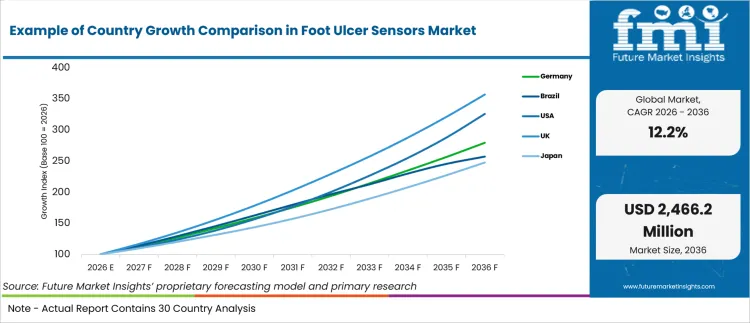
| Country or Market | CAGR |
|---|---|
| Australia | 14.7% |
| Canada | 14.3% |
| UK | 13.6% |
| USA | 12.5% |
| Germany | 10.8% |
| Brazil | 9.9% |
| Japan | 9.5% |
Source: Future Market Insights analysis, 2026.
How do country-level CAGRs compare in Foot Ulcer Sensors Market?
Country comparison shows a gradual step-down across profiled markets. Australia occupies the upper forecast position, followed closely by Canada. The United Kingdom forms the next rate band led by organized specialist pathways. The United States maintains a central position supported by established remote monitoring programs. Germany follows through validation-led adoption. Brazil and Japan complete the disclosed comparison under distinct care-delivery conditions. A 5.2 percentage-point spread separates Australia from Japan, reflecting differences in care delivery infrastructure and reimbursement frameworks rather than market maturity alone.
- Australia is anticipated to lead disclosed expansion led by community care needs and high diabetes-related limb burden.
- Canada is projected to follow closely as provincial service variation supports remote surveillance interest.
- The United Kingdom is expected to maintain an upper-middle position depending on specialist foot-care audit structures.
- The United States is estimated to record established expansion due to veteran care and payer-supported monitoring programs.
- Germany is likely to progress based on evidence-led clinical review and telemedical validation.
- Brazil and Japan are forecast to complete comparison through guideline development and specialist assessment needs.
Markets carrying similar CAGRs are expected to present different entry conditions based on clinical ownership and patient support. Full report coverage includes North America, Europe, East Asia, South Asia and Pacific, Latin America, Middle East and Africa.
Country-wise Analysis
- Sales in Australia are projected to expand at 14.7% CAGR from 2026 to 2036, led by remote monitoring needs across dispersed care settings and older high-risk populations. Australian Institute of Health and Welfare reported in May 2026 around 7,000 hospitalizations for lower-limb amputations among people with type 2 diabetes during 2023 to 2024, reinforcing pressure for earlier foot-risk identification. Home-capable sensors reduce reliance on frequent specialist travel and support structured escalation across regional services.
- Canadian Institute for Health Information reported in September 2024 a 3-fold difference between jurisdictions at opposite ends of age-standardized lower-limb complication rates. Demand in Canada is anticipated to rise at 14.3% CAGR during the study period, backed by provincial care variation and interest in standardized prevention pathways. Connected monitoring may support consistent surveillance across regions carrying uneven access to specialist foot and wound services.
- Formal audit measures and specialist referral pathways shape adoption across United Kingdom diabetes foot services. In May 2024, NHS England reported approximately 49.0% of patients were alive and ulcer free at 12 weeks following expert assessment, based on the National Diabetes Foot Care Audit 2018 to 2023. Foot ulcer sensor adoption in the United Kingdom is expected to increase at 13.6% CAGR between 2026 and 2036, helped by early warning signals with digital wound measurement devices across specialist services.
- Sector in the United States set to expand at 12.5% CAGR by 2036, driven by established veteran programs and payer engagement. During its May 2026 review, Department of Veterans Affairs reported 15% of enrolled veterans were at high risk for lower-extremity amputation. A sizable defined-risk population supports home temperature mats and pressure-sensing insoles connected with accountable clinical follow-up.
- In February 2024, University Hospital Magdeburg reported its telemedical insole study followed participants for 24 months. Clinical evidence supporting temperature measurement encourages structured evaluation of MEMS sensor formats and connected foot-monitoring services. Industry in Germany is forecast to scale at 10.8% CAGR over the assessment period, reflecting adoption led by validation.
- Brazilian Society of Angiology and Vascular Surgery guidelines published in May 2024 organized diabetic-foot recommendations into 6 chapters covering prevention and clinical management. The market in Brazil is estimated to register 9.9% CAGR from 2026 to 2036, aided by expanding clinical guidance and need for affordable prevention tools. Structured recommendations help clinicians place sensor findings within established assessment and follow-up pathways.
- Specialist foot-care practices and aging diabetes populations shape adoption across Japan. The market in Japan is predicted to grow at 9.5% CAGR during the forecast period, guided by footwear assessment and offloading needs. A study in Japan published in May 2024 interviewed 10 high-risk patients and identified difficulty selecting ready-made footwear, supporting sensors within specialist clinical programs.
Who are notable companies in Foot Ulcer Sensors Market?
Podimetrics, Orpyx Medical Technologies Inc., Siren, Sensoria Health Inc., Tekscan, Inc., XSENSOR Technology Corporation, novel GmbH, and WoundVision, LLC are prominent companies contributing to this market.
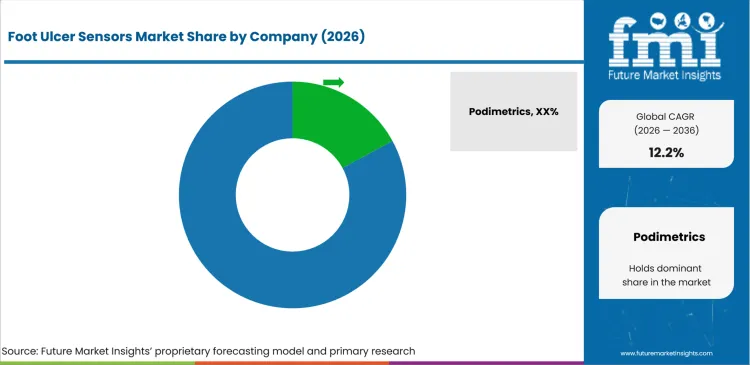
Competition centers on measurement accuracy and clinical response support across prevention or treatment workflows. Remote monitoring specialists combine home devices with patient outreach and clinician alerts. Pressure-mapping providers emphasize detailed plantar-load analysis for offloading and footwear assessment. Connected rehabilitation suppliers track adherence inside protective boots or smart garments. Imaging providers support wound measurement and thermal documentation. Buyer review covers device comfort and integration effort.
- Orpyx Medical Technologies Inc. and Siren compete depending on home monitoring programs focused on temperature or multimodal foot signals. Care teams assess patient adherence and escalation support across recurring preventive use.
- Sensoria Health Inc. and XSENSOR Technology Corporation compete based on pressure sensing and connected offloading assessment. Clinical users examine plantar-load detail and intervention feedback across active wound or gait workflows.
- novel GmbH and WoundVision, LLC contribute led by pedography and multimodal wound documentation. Hospitals and research teams compare measurement precision and workflow compatibility across specialist assessment settings.
Competitive Benchmarking: Foot Ulcer Sensors Market
| Company | Prevention Workflow | Foot-Sensor Depth | Clinical Evidence | Service Reach |
|---|---|---|---|---|
| Podimetrics | High | High | High | United States programs |
| Orpyx Medical Technologies Inc. | High | High | High | North American programs |
| Siren | High | Medium | High | United States programs |
| Sensoria Health Inc. | Medium | High | Medium | United States and European programs |
| Tekscan, Inc. | Medium | High | High | Global equipment reach |
| XSENSOR Technology Corporation | Medium | High | Medium | International equipment reach |
| novel GmbH | Medium | High | High | Global research reach |
| WoundVision, LLC | Medium | Medium | Medium | United States clinical reach |
Source: Future Market Insights competitive analysis, 2026.
Key Developments in Foot Ulcer Sensors Market
- In January 2025, Siren announced completion of a USD 9.5 million funding round led by an USD 8 million strategic investment from Mölnlycke Health Care. Funding supported development and adoption of temperature-sensing textile solutions for diabetic foot ulcer prevention and management.
- Orpyx Medical Technologies Inc. launched its next-generation sensory insole program in August 2025. New insoles track plantar pressure, foot temperature, step count, and wear time to support early clinical intervention across diabetes care programs.
- Podimetrics launched SmartMat+ in October 2025 with home measurements covering foot temperature, weight, and stability. Expanded capability extended diabetic foot surveillance into fall-risk and heart-failure indicators for complex diabetes populations.
Key Players in Foot Ulcer Sensors Market
Remote Foot Monitoring Programs
- Podimetrics
- Orpyx Medical Technologies Inc.
- Siren
Connected Offloading and Pressure Assessment
- Sensoria Health Inc.
- Tekscan, Inc.
- XSENSOR Technology Corporation
Pedography and Wound Imaging
- novel GmbH
- WoundVision, LLC
Foot Ulcer Sensors Market Report Scope
| Coverage field | Report scope |
|---|---|
| Market breakdown | Foot ulcer sensors market breakdown includes product type, application, end user, distribution channel, technology, and region. |
| Market Definition | Foot ulcer sensors measure physiological or biomechanical changes associated with ulcer risk or wound deterioration. Temperature, pressure, moisture, perfusion, imaging, and connected monitoring technologies fall within defined coverage. General diabetes devices lacking foot-specific measurement are excluded. |
| Regions Covered | North America, Europe, East Asia, South Asia and Pacific, Latin America, Middle East and Africa. |
| Countries Covered | Australia, Canada, UK, USA, Germany, Brazil, Japan, and more than 25 additional countries complete full report coverage. |
| Key Companies Profiled | Podimetrics, Orpyx Medical Technologies Inc., Siren, Sensoria Health Inc., Tekscan, Inc., XSENSOR Technology Corporation, novel GmbH, and WoundVision, LLC. |
| Forecast Period | 2026 to 2036 |
| Approach | Hybrid bottom-up and top-down methodology uses segment shares and country CAGRs. Company activity and buyer adoption support final market reconciliation. |
Source: Future Market Insights analysis, 2026.
Foot Ulcer Sensors Market - Research Methodology
| Method | Approach |
|---|---|
| Primary Research | FMI analysts gathered input from manufacturers, service providers, technology developers, distributors, end users, procurement teams, and subject-matter experts. Interviews examined purchasing decisions, product or service evaluation, adoption barriers, approval requirements, pricing considerations, and expectations for technical or commercial support. Respondents were also asked what evidence is required before a trial, pilot, or initial order develops into regular purchasing. |
| Desk Research | Desk research covered government statistics, regulatory publications, trade data, industry associations, technical literature, standards, company filings, product information, and official corporate announcements. Sources were reviewed for relevance, publication date, geographic coverage, and consistency with the defined market scope. Claims relating to performance, applications, approvals, capacity, investment, and commercial activity were retained only when supported by credible public evidence. |
| Market Sizing and Forecasting | The market model combined the baseline value with historical performance, segment structure, pricing and volume indicators, adoption levels, company participation, and country-level demand conditions. Forecast assumptions considered economic activity, investment trends, regulatory developments, technology adoption, purchasing cycles, supply availability, and barriers to wider market use. Segment and regional estimates were reconciled before the final market total was calculated. |
| Data Validation | Estimates were checked against multiple independent indicators, including public data, company activity, trade patterns, industry developments, and findings from primary interviews. Validation also tested whether products, services, applications, and company revenues fell within the defined market boundaries. Adjacent categories, unsupported claims, overlapping revenues, and activities without direct market relevance were excluded to reduce double counting and maintain consistency across segments and countries. |
Source: Future Market Insights analysis, 2026.
Foot Ulcer Sensors Market by Segments
Foot Ulcer Sensors Market segmented by Product Type:
- Temperature Monitoring Sensors
- Pressure Monitoring Sensors
- Multi-Parameter Sensors
- Wearable Foot Ulcer Sensors
- Wireless Monitoring Sensors
Foot Ulcer Sensors Market segmented by Application:
- Diabetic Foot Ulcer Prevention
- Foot Ulcer Monitoring
- Remote Patient Monitoring
- Rehabilitation Monitoring
- Clinical Research
Foot Ulcer Sensors Market segmented by End User:
- Hospitals
- Specialty Clinics
- Home Healthcare Providers
- Ambulatory Surgical Centers
- Research & Academic Institutes
Foot Ulcer Sensors Market segmented by Distribution Channel:
- Direct Sales
- Medical Device Distributors
- Online Medical Supply Platforms
- Retail Medical Equipment Stores
- Healthcare Procurement Organizations
Foot Ulcer Sensors Market segmented by Technology:
- IoT-Based Monitoring
- Wireless Sensor Technology
- MEMS Sensor Technology
- AI-Based Predictive Analytics
- Flexible Printed Sensors
Foot Ulcer Sensors Market segmented by Region:
- North America
- United States
- Canada
- Latin America
- Brazil
- Mexico
- Argentina
- Chile
- Western Europe
- Germany
- France
- United Kingdom
- Italy
- Spain
- Benelux
- Nordics
- Eastern Europe
- Poland
- Czech Republic
- Romania
- Hungary
- East Asia
- China
- Japan
- South Korea
- South Asia and Pacific
- India
- ASEAN
- Australia and New Zealand
- Middle East and Africa
- GCC Countries
- South Africa
- Türkiye
- Israel
Research Sources and Bibliography
- Abbott, C. A., Franklyn, K. J., Stuart, D. E., Kirwan, E., Flynn, S., Scott, R., McIntosh, C., & Boulton, A. J. M. (2025, October). Assessing the possibility of recurrent diabetic foot ulcer prevention via remote patient monitoring: A feasibility study. Diabetes/Metabolism Research and Reviews, 41(7), e70096.
- Australian Institute of Health and Welfare. (2026, May 27). Diabetes: Australian facts.
- Canadian Institute for Health Information. (2024, September 26). Provincial and territorial rates of lower limb complications associated with diabetes.
- Centers for Disease Control and Prevention. (2024, May 15). Preventing diabetes-related amputations.
- Centers for Disease Control and Prevention. (2024, May 15). Promoting foot health.
- Centers for Disease Control and Prevention. (2024, May 15). Your feet and diabetes.
- Duarte, E. G., Lopes, C. F., Gaio, D. R. F., Mariúba, J. V. O., Cerqueira, L. O., Manhanelli, M. A. B., Navarro, T. P., Castro, A. A., Araujo, W. J. B., Pedrosa, H., Galli, J., de Luccia, N., de Paula, C., Reis, F., Bohatch, M. S., de Oliveira, T. F., da Silva, A. F. V., de Oliveira, J. C. P., & Joviliano, E. E. (2024, May 17). Brazilian Society of Angiology and Vascular Surgery 2023 guidelines on the diabetic foot. Jornal Vascular Brasileiro, 23, e20230087.
- Ehtemam, H., Salehinejad, S., Robbins, D., Sanaei, A., Shirvani, H., & Sadeghi-Esfahlani, S. (2026, July 13). Wearable technologies for diabetic foot ulcer monitoring and risk prediction: Systematic review. JMIR Diabetes, 11, e84463.
- Ming, A., Lorek, E., Wall, J., Schubert, T., Ebert, N., Galatzky, I., Baum, A.-K., Glanz, W., Stober, S., & Mertens, P. R. (2024, March 1). Unveiling peripheral neuropathy and cognitive dysfunction in diabetes: An observational and proof-of-concept study with video games and sensor-equipped insoles. Frontiers in Endocrinology, 15, 1310152.
- NHS England. (2024, May 9). Key findings and recommendations: National Diabetes Foot Care Audit 2018 to 2023.
- NHS England. (2025, November 13). National Diabetes Foot Care Audit 2020 to 2025.
- Orpyx Medical Technologies Inc. (2025, August 7). Orpyx launches sensory insole program to combat >$80B annual cost of diabetic foot complications.
- Orpyx Medical Technologies Inc. (2025, November 13). Orpyx Medical Technologies supplies digital health platform for NIH-funded and Johns Hopkins Medicine-led clinical trial on diabetic foot ulcer prevention.
- Podimetrics. (2025, March 20). Podimetrics and Alivi Health announce new partnership to support diabetic foot health.
- Podimetrics. (2025, October 20). Podimetrics launches SmartMat+ to save limbs, reduce falls, and monitor signs of heart failure in complex diabetes.
- Siren. (2025, January 8). Siren raises $9.5M, led by an $8M investment from Mölnlycke Health Care to drive diabetic foot ulcer prevention and management.
- Uehara, F., Takahashi, Y., Kusama, E., Yamaguchi, D., Tange, M., Kawai, Y., & Komatsu, M. (2024, May 31). What are patients at high risk of developing diabetic foot lesions aware of when selecting footwear? Journal of Japanese Society for Foot Care and Podiatric Medicine, 5(2), 92-98.
- University Hospital Magdeburg. (2024, February 6). Innovative insole protects against foot ulcers with diabetes.
- USA Department of Veterans Affairs. (2026, March). Remote patient pedal monitoring for foot ulcer prevention: A systematic review.
- USA Department of Veterans Affairs. (2026, May 1). Field manual for foot health: The battle to fight diabetic foot problems.
This bibliography lists every external source retained in this article. The full report coverage contains detailed source reconciliation and supporting citations.
This Report Answers
- How do segments influence demand across product type and application with end-user coverage?
- What criteria guide care teams evaluating foot ulcer sensors prior to clinical use?
- Why do country CAGRs differ across profiled markets?
- What companies compete through temperature sensing and plantar-pressure monitoring capabilities?
- How are forecasts validated through bottom-up and top-down analysis using independent indicators?
- What evidence supports home monitoring prior to multi-site clinical deployment?
- Why do patient adherence and response protocols influence device selection?
- How does weak alert ownership limit return across integration and monitoring work?
- How do clinical evidence records influence approval across diabetes and wound-care teams?
- What company capabilities improve long-term confidence and recurring sensor use?
Frequently Asked Questions
How big is the Foot Ulcer Sensors Market in 2026?
The foot ulcer sensors market is valued at USD 780.0 million in 2026 and is forecast to reach USD 2466.2 million by 2036. Growth is supported by preventive clinical programs depending on specialized sensor systems to track subtle skin temperature and foot pressure changes between scheduled visits across high-risk diabetic patient populations worldwide.
What is the CAGR of the Foot Ulcer Sensors Market from 2026 to 2036?
The foot ulcer sensors market grows at a CAGR of 12.2% between 2026 and 2036, supported by care teams adopting connected foot monitoring devices once those systems demonstrate dependable daily measurements, defined escalation pathways, and reliable patient adherence across preventive diabetes foot surveillance programs.
Which application leads the Foot Ulcer Sensors Market?
Diabetic foot ulcer prevention accounts for 42.0% of the foot ulcer sensors market by application in 2026, driven by recurring surveillance needs among patients carrying neuropathy or previous ulcer risk where preventive deployment seeks early warning signals prior to skin breakdown and assigns intervention steps for abnormal temperature or loading patterns.
How much will the Foot Ulcer Sensors Market add between 2026 and 2036?
The foot ulcer sensors market is set to add USD 1686.2 million between 2026 and 2036, growing from USD 780.0 million to USD 2466.2 million as temperature monitoring sensors, pressure sensing insoles, and IoT-connected multi-parameter platforms enter funded diabetes care pathways across a widening base of preventive and remote patient monitoring programs worldwide.
Who are the leading companies in the Foot Ulcer Sensors Market?
Five companies lead the foot ulcer sensors market, including Podimetrics, Orpyx Medical Technologies, Siren, Sensoria Health, and Tekscan, competing through home temperature monitoring mats, sensory pressure insoles, connected patient outreach programs, plantar-load assessment platforms, and clinical escalation support across diabetic foot prevention and remote monitoring programs worldwide.
Preview the report firsthand - request a free sample
Get SampleGet the brochure for pricing and purchase details.
Get PDFTable of Content
- Key Takeaways
- Market Size and CAGR
- Top Growth Driver
- Fastest Growing Segment
- Leading Region
- Key Companies
- Emerging Opportunities
- Executive Summary
- Global Market Outlook
- Demand-side Trends
- Supply-side Trends
- Technology Roadmap Analysis
- Analysis and Recommendations
- Analyst Perspective (What is happening? Why now? What should investors know?)
- Key Questions Answered
- How large is the market?
- What is the CAGR?
- What are key trends?
- Which region dominates?
- Who are the leaders?
- Market Overview
- Market Coverage / Taxonomy
- Market Definition / Scope / Limitations
- Research Methodology
- Chapter Orientation
- Analytical Lens and Working Hypotheses
- Market Structure, Signals, and Trend Drivers
- Benchmarking and Cross-market Comparability
- Market Sizing, Forecasting, and Opportunity Mapping
- Research Design and Evidence Framework
- Desk Research Programme (Secondary Evidence)
- Expert Input and Fieldwork (Primary Evidence)
- Tooling, Models, and Reference Databases
- Data Engineering and Model Build
- Quality Assurance and Audit Trail
- Market Background
- Market Dynamics (Drivers, Restraints, Opportunity, Trends)
- Scenario Forecast (Optimistic, Likely, Conservative)
- Impact Analysis
- AI Impact
- Sustainability Impact
- Regulatory Impact
- Technology Impact
- Consumer / Buyer Analysis
- Purchase Drivers
- Adoption Barriers
- Buyer Journey
- Opportunity Map Analysis
- Product Life Cycle Analysis
- Supply Chain Analysis
- Investment Feasibility Matrix
- Value Chain Analysis
- PESTLE and Porter's Analysis
- Regulatory Landscape
- Regional Parent Market Outlook
- Production and Consumption Statistics
- Import and Export Statistics
- Global Market Analysis and Forecast, 2021 to 2036
- Historical Market Size Value (USD Million) Analysis, 2021 to 2025
- Current and Future Market Size Value (USD Million) Projections, 2026 to 2036
- Y-o-Y Growth Trend Analysis
- Absolute $ Opportunity Analysis
- Global Market Pricing Analysis, 2021 to 2036
- Global Market Analysis and Forecast, By Product Type, 2021 to 2036
- Introduction / Key Findings
- Historical Market Size Value (USD Million) Analysis By Product Type, 2021 to 2025
- Current and Future Market Size Value (USD Million) Analysis and Forecast By Product Type, 2026 to 2036
- Temperature Monitoring Sensors
- In-Shoe Temperature Sensors
- Smart Foot Mat Sensors
- Pressure Monitoring Sensors
- Plantar Pressure Sensors
- Dynamic Gait Pressure Sensors
- Multi-Parameter Sensors
- Temperature & Pressure Sensors
- Humidity & Pressure Sensors
- Wearable Foot Ulcer Sensors
- Smart Insoles
- Smart Socks
- Wireless Monitoring Sensors
- Bluetooth-Enabled Sensors
- Cloud-Connected Sensors
- Temperature Monitoring Sensors
- Y-o-Y Growth Trend Analysis By Product Type, 2021 to 2025
- Absolute $ Opportunity Analysis By Product Type, 2026 to 2036
- Global Market Analysis and Forecast, By Application, 2021 to 2036
- Introduction / Key Findings
- Historical Market Size Value (USD Million) Analysis By Application, 2021 to 2025
- Current and Future Market Size Value (USD Million) Analysis and Forecast By Application, 2026 to 2036
- Diabetic Foot Ulcer Prevention
- Early Temperature Detection
- Risk Assessment Monitoring
- Foot Ulcer Monitoring
- Chronic Wound Monitoring
- Post-Treatment Monitoring
- Remote Patient Monitoring
- Home Healthcare Monitoring
- Telemedicine Integration
- Rehabilitation Monitoring
- Gait Recovery Assessment
- Post-Surgical Monitoring
- Clinical Research
- Diabetic Foot Studies
- Wound Healing Research
- Diabetic Foot Ulcer Prevention
- Y-o-Y Growth Trend Analysis By Application, 2021 to 2025
- Absolute $ Opportunity Analysis By Application, 2026 to 2036
- Global Market Analysis and Forecast, By End User, 2021 to 2036
- Introduction / Key Findings
- Historical Market Size Value (USD Million) Analysis By End User, 2021 to 2025
- Current and Future Market Size Value (USD Million) Analysis and Forecast By End User, 2026 to 2036
- Hospitals
- Multispecialty Hospitals
- Diabetic Care Centers
- Specialty Clinics
- Podiatry Clinics
- Wound Care Clinics
- Home Healthcare Providers
- Home Nursing Services
- Remote Care Providers
- Ambulatory Surgical Centers
- Outpatient Surgical Centers
- Day Care Facilities
- Research & Academic Institutes
- Medical Universities
- Clinical Research Centers
- Hospitals
- Y-o-Y Growth Trend Analysis By End User, 2021 to 2025
- Absolute $ Opportunity Analysis By End User, 2026 to 2036
- Global Market Analysis and Forecast, By Distribution Channel, 2021 to 2036
- Introduction / Key Findings
- Historical Market Size Value (USD Million) Analysis By Distribution Channel, 2021 to 2025
- Current and Future Market Size Value (USD Million) Analysis and Forecast By Distribution Channel, 2026 to 2036
- Direct Sales
- Hospital Procurement
- Enterprise Contracts
- Medical Device Distributors
- National Distributors
- Regional Distributors
- Online Medical Supply Platforms
- B2B Medical Portals
- Manufacturer Websites
- Retail Medical Equipment Stores
- Specialty Medical Stores
- Diabetic Care Retailers
- Healthcare Procurement Organizations
- Group Purchasing Organizations
- Public Healthcare Procurement
- Direct Sales
- Y-o-Y Growth Trend Analysis By Distribution Channel, 2021 to 2025
- Absolute $ Opportunity Analysis By Distribution Channel, 2026 to 2036
- Global Market Analysis and Forecast, By Technology, 2021 to 2036
- Introduction / Key Findings
- Historical Market Size Value (USD Million) Analysis By Technology, 2021 to 2025
- Current and Future Market Size Value (USD Million) Analysis and Forecast By Technology, 2026 to 2036
- IoT-Based Monitoring
- Cloud-Based Monitoring
- Connected Medical Devices
- Wireless Sensor Technology
- Bluetooth Low Energy (BLE)
- Wi-Fi Enabled Sensors
- MEMS Sensor Technology
- Micro Pressure Sensors
- Micro Temperature Sensors
- AI-Based Predictive Analytics
- Risk Prediction Algorithms
- Wound Progression Analytics
- Flexible Printed Sensors
- Thin-Film Sensors
- Wearable Flexible Electronics
- IoT-Based Monitoring
- Y-o-Y Growth Trend Analysis By Technology, 2021 to 2025
- Absolute $ Opportunity Analysis By Technology, 2026 to 2036
- Global Market Analysis and Forecast, By Region, 2021 to 2036
- Introduction
- Historical Market Size Value (USD Million) Analysis By Region, 2021 to 2025
- Current Market Size Value (USD Million) Analysis and Forecast By Region, 2026 to 2036
- North America
- Latin America
- Western Europe
- Eastern Europe
- East Asia
- South Asia and Pacific
- Middle East & Africa
- Market Attractiveness Analysis By Region
- North America Market Analysis and Forecast, By Country, 2021 to 2036
- Historical Market Size Value (USD Million) Trend Analysis By Market Taxonomy, 2021 to 2025
- Market Size Value (USD Million) Forecast By Market Taxonomy, 2026 to 2036
- By Country
- USA
- Canada
- By Product Type
- By Application
- By End User
- By Distribution Channel
- By Technology
- By Country
- Market Attractiveness Analysis
- By Country
- By Product Type
- By Application
- By End User
- By Distribution Channel
- By Technology
- Key Takeaways
- Latin America Market Analysis and Forecast, By Country
- Historical Market Size Value (USD Million) Trend Analysis By Market Taxonomy, 2021 to 2025
- Market Size Value (USD Million) Forecast By Market Taxonomy, 2026 to 2036
- By Country
- Brazil
- Mexico
- Chile
- Rest of Latin America
- By Product Type
- By Application
- By End User
- By Distribution Channel
- By Technology
- By Country
- Market Attractiveness Analysis
- By Country
- By Product Type
- By Application
- By End User
- By Distribution Channel
- By Technology
- Key Takeaways
- Western Europe Market Analysis and Forecast, By Country
- Historical Market Size Value (USD Million) Trend Analysis By Market Taxonomy, 2021 to 2025
- Market Size Value (USD Million) Forecast By Market Taxonomy, 2026 to 2036
- By Country
- Germany
- UK
- Italy
- Spain
- France
- Nordic
- BENELUX
- Rest of Western Europe
- By Product Type
- By Application
- By End User
- By Distribution Channel
- By Technology
- By Country
- Market Attractiveness Analysis
- By Country
- By Product Type
- By Application
- By End User
- By Distribution Channel
- By Technology
- Key Takeaways
- Eastern Europe Market Analysis and Forecast, By Country
- Historical Market Size Value (USD Million) Trend Analysis By Market Taxonomy, 2021 to 2025
- Market Size Value (USD Million) Forecast By Market Taxonomy, 2026 to 2036
- By Country
- Russia
- Poland
- Hungary
- Balkan & Baltic
- Rest of Eastern Europe
- By Product Type
- By Application
- By End User
- By Distribution Channel
- By Technology
- By Country
- Market Attractiveness Analysis
- By Country
- By Product Type
- By Application
- By End User
- By Distribution Channel
- By Technology
- Key Takeaways
- East Asia Market Analysis and Forecast, By Country
- Historical Market Size Value (USD Million) Trend Analysis By Market Taxonomy, 2021 to 2025
- Market Size Value (USD Million) Forecast By Market Taxonomy, 2026 to 2036
- By Country
- China
- Japan
- South Korea
- By Product Type
- By Application
- By End User
- By Distribution Channel
- By Technology
- By Country
- Market Attractiveness Analysis
- By Country
- By Product Type
- By Application
- By End User
- By Distribution Channel
- By Technology
- Key Takeaways
- South Asia and Pacific Market Analysis and Forecast, By Country
- Historical Market Size Value (USD Million) Trend Analysis By Market Taxonomy, 2021 to 2025
- Market Size Value (USD Million) Forecast By Market Taxonomy, 2026 to 2036
- By Country
- India
- ASEAN
- Australia & New Zealand
- Rest of South Asia and Pacific
- By Product Type
- By Application
- By End User
- By Distribution Channel
- By Technology
- By Country
- Market Attractiveness Analysis
- By Country
- By Product Type
- By Application
- By End User
- By Distribution Channel
- By Technology
- Key Takeaways
- Middle East & Africa Market Analysis and Forecast, By Country
- Historical Market Size Value (USD Million) Trend Analysis By Market Taxonomy, 2021 to 2025
- Market Size Value (USD Million) Forecast By Market Taxonomy, 2026 to 2036
- By Country
- Kingdom of Saudi Arabia
- Other GCC Countries
- Türkiye
- South Africa
- Other African Union
- Rest of Middle East & Africa
- By Product Type
- By Application
- By End User
- By Distribution Channel
- By Technology
- By Country
- Market Attractiveness Analysis
- By Country
- By Product Type
- By Application
- By End User
- By Distribution Channel
- By Technology
- Key Takeaways
- Key Countries Market Analysis
- USA
- Pricing Analysis
- Market Share Analysis, 2025
- By Product Type
- By Application
- By End User
- By Distribution Channel
- By Technology
- Canada
- Pricing Analysis
- Market Share Analysis, 2025
- By Product Type
- By Application
- By End User
- By Distribution Channel
- By Technology
- Mexico
- Pricing Analysis
- Market Share Analysis, 2025
- By Product Type
- By Application
- By End User
- By Distribution Channel
- By Technology
- Brazil
- Pricing Analysis
- Market Share Analysis, 2025
- By Product Type
- By Application
- By End User
- By Distribution Channel
- By Technology
- Chile
- Pricing Analysis
- Market Share Analysis, 2025
- By Product Type
- By Application
- By End User
- By Distribution Channel
- By Technology
- Germany
- Pricing Analysis
- Market Share Analysis, 2025
- By Product Type
- By Application
- By End User
- By Distribution Channel
- By Technology
- UK
- Pricing Analysis
- Market Share Analysis, 2025
- By Product Type
- By Application
- By End User
- By Distribution Channel
- By Technology
- Italy
- Pricing Analysis
- Market Share Analysis, 2025
- By Product Type
- By Application
- By End User
- By Distribution Channel
- By Technology
- Spain
- Pricing Analysis
- Market Share Analysis, 2025
- By Product Type
- By Application
- By End User
- By Distribution Channel
- By Technology
- France
- Pricing Analysis
- Market Share Analysis, 2025
- By Product Type
- By Application
- By End User
- By Distribution Channel
- By Technology
- India
- Pricing Analysis
- Market Share Analysis, 2025
- By Product Type
- By Application
- By End User
- By Distribution Channel
- By Technology
- ASEAN
- Pricing Analysis
- Market Share Analysis, 2025
- By Product Type
- By Application
- By End User
- By Distribution Channel
- By Technology
- Australia & New Zealand
- Pricing Analysis
- Market Share Analysis, 2025
- By Product Type
- By Application
- By End User
- By Distribution Channel
- By Technology
- China
- Pricing Analysis
- Market Share Analysis, 2025
- By Product Type
- By Application
- By End User
- By Distribution Channel
- By Technology
- Japan
- Pricing Analysis
- Market Share Analysis, 2025
- By Product Type
- By Application
- By End User
- By Distribution Channel
- By Technology
- South Korea
- Pricing Analysis
- Market Share Analysis, 2025
- By Product Type
- By Application
- By End User
- By Distribution Channel
- By Technology
- Russia
- Pricing Analysis
- Market Share Analysis, 2025
- By Product Type
- By Application
- By End User
- By Distribution Channel
- By Technology
- Poland
- Pricing Analysis
- Market Share Analysis, 2025
- By Product Type
- By Application
- By End User
- By Distribution Channel
- By Technology
- Hungary
- Pricing Analysis
- Market Share Analysis, 2025
- By Product Type
- By Application
- By End User
- By Distribution Channel
- By Technology
- Kingdom of Saudi Arabia
- Pricing Analysis
- Market Share Analysis, 2025
- By Product Type
- By Application
- By End User
- By Distribution Channel
- By Technology
- Türkiye
- Pricing Analysis
- Market Share Analysis, 2025
- By Product Type
- By Application
- By End User
- By Distribution Channel
- By Technology
- South Africa
- Pricing Analysis
- Market Share Analysis, 2025
- By Product Type
- By Application
- By End User
- By Distribution Channel
- By Technology
- USA
- Market Structure Analysis
- Competition Dashboard
- Competition Benchmarking
- Market Share Analysis of Top Players
- By Regional
- By Product Type
- By Application
- By End User
- By Distribution Channel
- By Technology
- Emerging Startups
- Innovation Benchmarking
- Competition Analysis
- Competition Deep Dive
- Podimetrics
- Overview
- Product Portfolio
- Profitability by Market Segments
- Sales Footprint
- Strategy Overview
- Marketing Strategy
- Product Strategy
- Channel Strategy
- Orpyx Medical Technologies
- Sensoria Health
- Tekscan
- XSENSOR Technology Corporation
- Bittium Corporation
- Medtronic plc
- Smith+Nephew
- WoundVision
- Biosensics
- Podimetrics
- Case Studies
- Success Stories
- Recent Developments
- Competition Deep Dive
- Assumptions & Acronyms Used


