

- Market Size (2026)
- USD 362.0 Mn
- Forecast (2036)
- USD 930.4 Mn
- CAGR (2026 to 2036)
- 9.9%
How Big is the Frangipane & Almond Creams Market in 2026?
The frangipane & almond creams market is estimated at USD 362.0 million in 2026.
The global frangipane & almond creams market was valued at USD 329.4 million in 2025 and is estimated to reach USD 362.0 million in 2026. The market is projected to reach USD 930.4 million by 2036, expanding at a compound annual growth rate (CAGR) of 9.9% between 2026 and 2036. Standard grade accounted for the largest share of the market, contributing 42.0% of total revenue in 2026. Demand is supported by bakeries that buy prepared almond creams to obtain consistent filling performance across repeated pastry production. Almond supply remains an important cost factor. According to the Almond Board of California, the United States Department of Agriculture (USDA) forecast the 2026 California almond crop at 2.7 billion pounds in May 2026, down 1.0% from the previous year[5]. Trade in almonds nevertheless remained firm. California almond shipments reached 2,629.6 million pounds in the 2025/26 crop year, while exports increased by 3.0% to 2,034.3 million pounds[6]. Suppliers are also investing in nut-based fillings. For instance, Puratos acquired Pennsylvania-based Vör Foods in January 2026, adding US production of almond, pistachio, hazelnut and cashew pastes and fillings[4].
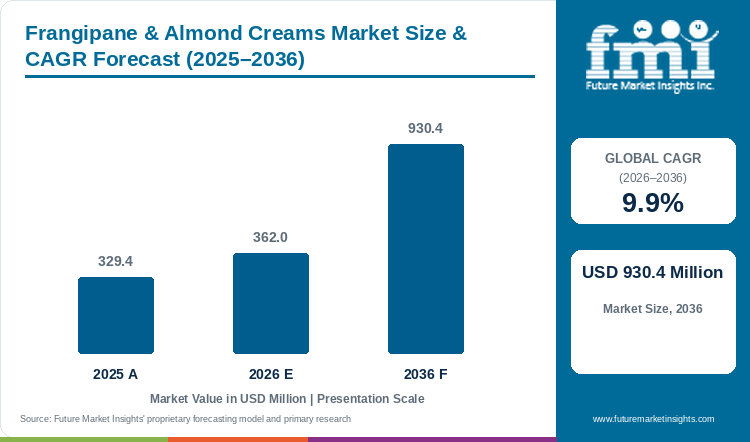
Table 1: Frangipane & Almond Creams Market Size and Forecast (USD million), 2025 to 2036
| Market size and forecast | Value |
|---|---|
| 2025 market size | USD 329.4 million |
| Estimated market size in 2026 | USD 362.0 million |
| Projected market size by 2036 | USD 930.4 million |
| CAGR (2026-2036) | 9.9% |
| Added revenue, 2026 to 2036 | USD 568.4 million |
Key Market Trends & Insights
- By product type: The Standard grade segment accounted for the largest share of the frangipane & almond creams market in 2026, representing 42.0% of total market revenue.
- By form: Powder / dry preparations held the leading market position with a share of 40.0% in 2026, as bakeries can prepare cream in quantities matched to each production run.
- By application: Bread & rolls remained the largest application segment, accounting for 35.0% of the market in 2026.
Regional Highlights
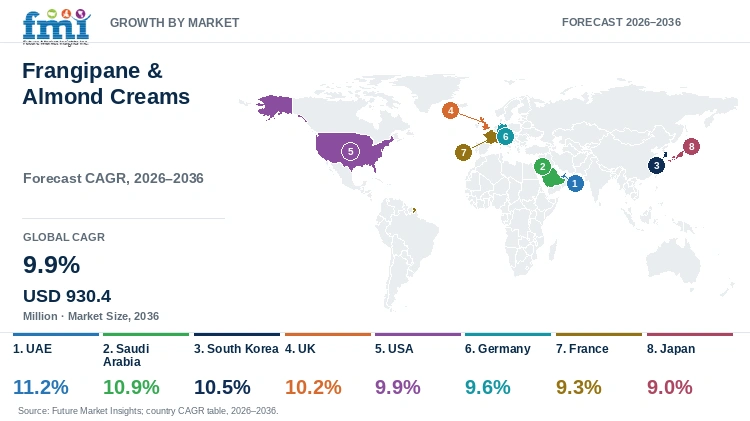
- Fastest-growing country: The UAE is expected to record the highest growth rate among the eight profiled countries, with a projected CAGR of 11.2% between 2026 and 2036.
- Growth across other countries: Saudi Arabia is projected to expand at a CAGR of 10.9%, followed by South Korea at 10.5% and the UK at 10.2%. Japan is expected to register comparatively slower growth, with a CAGR of 9.0% during the forecast period.
The availability of almonds remains an important factor influencing the cost of prepared creams. The 2026 California forecast of 2.7 billion pounds was based on a yield of 1,940 pounds per acre, unchanged from the previous season, while bearing acreage declined by 15,227 acres to approximately 1.39 million acres[5]. Data collection is also changing. In December 2025, the Almond Board of California voted to stop funding the USDA objective measurement report, so the May subjective forecast will be the only USDA estimate for the 2026 crop[5]. Fewer official crop estimates may make almond ingredient purchasing more dependent on industry forecasts and shipment reports. Such changes can affect contract timing for almond cream manufacturers, as roasting, grinding and formulation costs are added to the price of the nut.
Export demand provides a further indication of almond consumption. According to the Almond Board's July 2026 position report, as summarised by FreshPlaza, Europe received 681.2 million pounds of California almonds in the 2025/26 season, an increase of 5.0%, and was the main driver of export growth[6]. In contrast, shipments to India declined by 11.0% to 378.5 million pounds. Ending carryover was estimated at 494.2 million pounds, 4.0% lower than in the previous year[6]. Lower carryover can reduce the buffer available to processors if the 2026 harvest falls short of the forecast. European bakeries, which use almond creams widely in pastry, are therefore exposed to changes in California supply.
The supplier landscape is also consolidating. In March 2026, Puratos agreed to acquire Dawn Foods, subject to regulatory approvals, with financial details not disclosed[7]. Both companies supply bakery fillings and almond-based preparations, and Dawn Foods' distribution network is expected to strengthen Puratos' position in North America[7]. Product specifications continue to determine how creams are used inside the bakery. IRCA lists CUKICREAM MANDORLA for pre-bake applications in shortcrust and puff pastry[3]. Allergen information also remains part of supplier qualification, as European Union food-information rules require allergen presentation for relevant prepacked and non-prepacked foods[2]. A change in almond source or formulation can therefore affect product records as well as flavour.
Table 2: Supporting Industry Indicators for the Frangipane & Almond Creams Market, 2025 to 2026
| Indicator | Data point | Why it matters | Source |
|---|---|---|---|
| Crop forecast | USDA forecast the 2026 California almond crop at 2.7 billion pounds, down 1.0% from the previous year. | Crop size sets the upstream supply conditions for almond-based preparations. | [5] |
| Yield and acreage | Yield was forecast at 1,940 pounds per acre, while bearing acreage declined by 15,227 acres to approximately 1.39 million acres. | Flat yields and lower acreage limit growth in almond supply. | [5] |
| Crop reporting | The Almond Board stopped funding the USDA objective measurement report in December 2025. | Fewer official estimates increase reliance on industry forecasts for purchasing decisions. | [5] |
| Total shipments | California almond shipments reached 2,629.6 million pounds in 2025/26, 0.6% below the previous season. | Shipments indicate the volume of almonds available to processors worldwide. | [6] |
| Export shipments | Exports increased by 3.0% to 2,034.3 million pounds, representing 77.0% of total shipments. | Export demand reflects the strength of almond use outside the United States. | [6] |
| European demand | Shipments to Europe rose by 5.0% to 681.2 million pounds in 2025/26. | Europe is a major consumer of almond creams in pastry. | [6] |
| Carryover | Ending carryover was estimated at 494.2 million pounds, down 4.0%. | Lower carryover reduces the supply buffer before the next harvest. | [6] |
| Earlier crop estimate | USDA projected the 2025 California almond crop at 3.0 billion pounds in July 2025. | The figure provides a reference for the previous season's supply expectations. | [1] |
| Acquisition | Puratos acquired Vör Foods in January 2026, adding US production of nut pastes and fillings. | The deal expands domestic supply options for professional bakery customers. | [4] |
| Consolidation | Puratos agreed to acquire Dawn Foods in March 2026, subject to regulatory approvals. | The transaction would combine two of the profiled suppliers of bakery fillings. | [7] |
| Allergen information | EU food-information legislation requires allergen presentation for relevant prepacked and non-prepacked foods. | Nut identity must remain clear through ingredient handling and product descriptions. | [2] |
| Pre-bake application | IRCA lists CUKICREAM MANDORLA for shortcrust and puff pastry before baking. | A defined preparation route supports trials with the intended dough. | [3] |
Demand Intensity Analysis
A comparison of FMI's market estimate with California almond shipments provides a measure of value added by processing. California almond shipments of 2,629.6 million pounds in 2025/26 are equivalent to approximately 1.19 million tonnes[6]. FMI estimated the frangipane & almond creams market at USD 329.4 million in 2025, which corresponds to approximately USD 276.0 for every tonne of California almonds shipped. The figure is modest because almond creams account for only a small share of total almond use, which also includes snacking, confectionery and almond milk.
Europe provides a more relevant comparison, as almond creams are widely used in European pastry. Shipments to Europe of 681.2 million pounds are equivalent to approximately 309,000 tonnes, or 33.5% of California's export shipments in 2025/26[6]. Growth in European demand of 5.0% compares with a 1.0% decline in the 2026 crop forecast[5], which suggests that processors may face tighter supply in the coming season.
A similar comparison can be made between market growth and almond supply. FMI expects the market to grow at a CAGR of 9.9% between 2026 and 2036, while California's bearing acreage declined by approximately 1.1% in 2026 and yields remained unchanged[5]. Since almond supply is not expanding, most of the projected growth will need to come from higher conversion of almonds into prepared creams, a shift towards premium formulations and changes in prices and product mix.
Segment values show where this growth is concentrated. Standard grade represented USD 152.0 million in 2026, while Direct to industrial bakeries contributed USD 195.5 million within the separate Sales Channel breakdown. These figures describe different purchasing dimensions and are not additive. The market is projected to reach 2.6 times its 2026 value by 2036.
Table 3: Demand Intensity Metrics for the Frangipane & Almond Creams Market, 2025/26 Trade Data Against 2025 and 2026 Market Values
| Demand intensity metric | Value | Basis |
|---|---|---|
| FMI market value, 2025 | USD 329.4 million | FMI estimate of prepared almond cream revenue. |
| California almond shipments, 2025/26 | 1.19 million tonnes | 2,629.6 million pounds converted at 0.4536 kg per pound. |
| FMI value per tonne of almonds shipped | USD 276.0 | The calculation divides USD 329.4 million by 1.19 million tonnes. |
| Shipments to Europe, 2025/26 | 309,000 tonnes | 681.2 million pounds converted to tonnes. |
| Europe share of California exports | 33.5% | 681.2 million pounds divided by 2,034.3 million pounds. |
| Growth in shipments to Europe | 5.0% | Almond Board July 2026 position report. |
| Change in 2026 crop forecast | -1.0% | USDA May 2026 forecast against the previous year. |
| Change in bearing acreage, 2026 | -1.1% | 15,227 acres divided by the previous year's bearing acreage. |
| FMI value CAGR, 2026 to 2036 | 9.9% | FMI market forecast. |
| Standard grade revenue, 2026 | USD 152.0 million | 42.0% of the USD 362.0 million market. |
| Direct industrial channel revenue, 2026 | USD 195.5 million | 54.0% of the USD 362.0 million market. |
| Market expansion multiple | 2.6 times | Projected 2036 market value relative to 2026. |
Analyst Perspective
"Almond supply is flat, so growth in this market depends on bakeries replacing in-house almond mixtures with prepared creams that bake the same way on every run."
- Nandini Roy Choudhury, Principal Analyst at Future Market Insights
How is the frangipane & almond creams market segmented?
The frangipane & almond creams market is segmented by product type, form, application, claim and sales channel. Product Type covers Standard grade, Premium / specialty grade, Organic certified and Clean label grade. Form includes Powder / dry, Liquid, Paste / semi-solid and Granules / pieces. Application comprises Bread & rolls, Cakes & muffins, Biscuits & cookies, Viennoiserie & pastry and Other bakery & snacks. Claim includes Conventional, Clean label, Organic and Non-GMO / identity preserved. Sales Channel covers Direct to industrial bakeries, Ingredient distributors, Foodservice & artisan supply and Online B2B.
Why does Standard grade anchor Product Type demand?
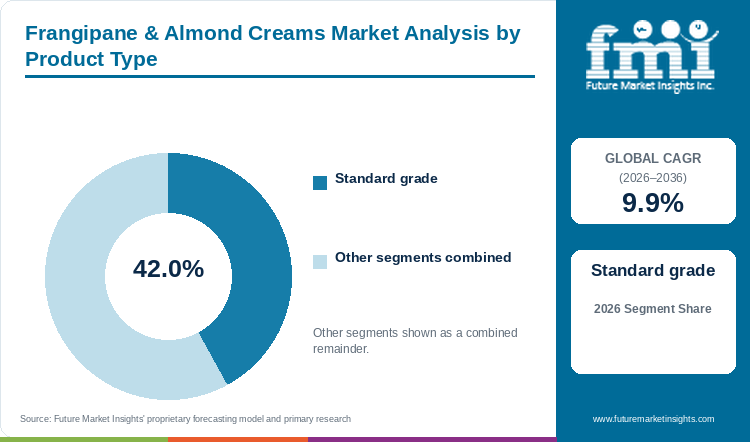
Standard grade accounts for 42.0% of Product Type revenue in 2026.
Regular bakery lines need an almond cream that behaves predictably without repeated changes to filling weight or mixing conditions. Standard grade meets this requirement through an agreed almond content and particle profile, and the segment generated approximately USD 152.0 million in 2026. With almond prices exposed to changes in California supply[5], a standard specification also allows the bakery to compare incoming lots and cost its recipe with less uncertainty. Premium / specialty grade serves products where stronger nut intensity is part of the appeal. Organic certified and Clean label grade introduce further sourcing or ingredient conditions, which only add value if the cream still performs through normal preparation and baking.
- Standard grade accounts for 42.0% of Product Type revenue in 2026.
- A consistent almond profile allows the bakery to use the same cream in seasonal and regular pastry lines.
What makes Powder / dry the preferred Form for routine processing?
Powder / dry contributes 40.0% of Form revenue in 2026.
Bakeries using dry preparations control the timing of water addition and the quantity of cream produced, which simplifies storage and reduces waste. Powder / dry formats generated approximately USD 144.8 million in 2026. The trade-off is that mixing work remains at the site. Water temperature and mixing time must produce a cream with a usable depositing window, and if the consistency changes while the batch waits, the convenience of a dry ingredient is quickly lost. Liquid products avoid reconstitution, while Paste / semi-solid formats can be deposited directly. Granules / pieces suit applications where texture is required.
- Powder / dry contributes 40.0% of Form revenue in 2026.
- The prepared cream needs to remain workable for the full depositing period.
Why do Bread & rolls account for the largest Application share?
Bread & rolls hold 35.0% of Application revenue in 2026.
Sweet bread and rolls account for the largest share of almond cream use, with Bread & rolls generating approximately USD 126.7 million in 2026. Almond fillings in these products must retain their flavour through baking while remaining compatible with the surrounding crumb. Oil migration or a change in filling consistency can alter the product even when the dough recipe stays the same. A cream that works across several roll shapes allows the bakery to vary its assortment while keeping a common ingredient specification. Cakes & muffins have different moisture and portion requirements, while pastry uses other preparation methods. For instance, IRCA's almond cream is designed for pre-bake use in shortcrust and puff pastry[3].
- Bread & rolls hold 35.0% of Application revenue in 2026.
- The filling should be checked after baking for oil release and its effect on the surrounding crumb.
How does Conventional maintain its lead among Claims?
Conventional represents 55.0% of Claim revenue in 2026.
Manufacturers of conventional recipes have considerable freedom to balance almond character, texture and cost, which explains why Conventional products held 55.0% of the Claim segment in 2026. The cream still needs an accurate ingredient declaration and reliable handling of nut allergens, as required under EU food-information rules[2]. Other claims narrow the choices in different ways. Clean label purchasing may favour a shorter ingredient list, Organic requires a certified supply chain and Non-GMO / identity preserved depends on sourcing records. If a nut source changes, those records may need review before the next batch is used.
- Conventional represents 55.0% of Claim revenue in 2026.
- A sourcing change may affect the recipe declaration even when flavour remains similar.
Why does direct supply lead Sales Channel revenue?
Direct to industrial bakeries holds 54.0% of Sales Channel revenue in 2026.
Before agreeing a recurring order, an industrial bakery will usually test an almond cream on its own line. Direct contact with the manufacturer makes it easier to agree depositing behaviour, working temperatures and the specification both sides will use, and direct supply generated approximately USD 195.5 million in 2026. It also provides a clear route for investigating problems with later deliveries. Smaller accounts may prefer a distributor because pack sizes and delivery frequency suit their output. Consolidation may change these routes. Dawn Foods' distribution network, for instance, is expected to strengthen Puratos' reach in North America once the acquisition is completed[7].
- Direct to industrial bakeries holds 54.0% of Sales Channel revenue in 2026.
- Line trials establish the working specification that later deliveries must reproduce.
What are the drivers, restraints and opportunities in the frangipane & almond creams market?
Central production favours repeatable almond preparations, but tight almond supply and allergen controls restrain supplier changes, while freeze-tolerant recipes can widen the addressable account base.
Central production favours repeatable almond preparations
Bakery production is becoming more centralised, and small variations in an almond cream become more costly when one site supplies many products or outlets. Filling weights can drift, ingredient use can rise and the finished pastry can become less consistent. Prepared creams reduce this risk by keeping the formulation within the range the bakery's depositor and oven can handle. Dough and filling must also work together, so trials with the intended bakery mix are more informative than testing the cream on its own. Supplier investment supports this shift. For instance, Puratos' acquisition of Vör Foods added a nut paste and filling plant located 35 minutes from Puratos USA[4].
Tight almond supply and allergen controls restrain supplier changes
Almond supply offers little room for expansion. The 2026 California crop is forecast to fall by 1.0%, bearing acreage has declined and ending carryover for 2025/26 was 4.0% lower than a year earlier[5][6]. Tighter supply can raise ingredient costs at a time when bakeries are under pressure to hold prices. Changing supplier is also difficult. The recipe may pass through areas that handle products without nuts, so production staff need clear ingredient identification and cleaning procedures. EU food-information rules make allergen presentation a legal requirement, including for food sold without prepacking[2]. A lower ingredient price loses its appeal if a new cream adds segregation work or requires changes to the production schedule.
Freeze-tolerant recipes can widen the addressable account base
Bakeries supplying frozen or partly prepared pastries need an almond cream that survives the full route to the finished product. Freezing is only one stage, as moisture or oil released during thawing and baking can still affect the dough. A formulation with a clear operating range can serve more of these accounts, particularly where its consistency can be adjusted for different products. Comparisons with other confectionery fillings include portion control and the time an opened pack remains usable. Nut variety is another opportunity. Vör Foods' range of pistachio, hazelnut, almond, cashew and blended nut fillings[4] shows how suppliers can extend an accepted almond cream into related products for the same customer.
Which country CAGRs are profiled in the frangipane & almond creams market?
Table 4: Country growth outlook for the frangipane & almond creams market
| Country | CAGR |
|---|---|
| UAE | 11.2% |
| Saudi Arabia | 10.9% |
| South Korea | 10.5% |
| UK | 10.2% |
| USA | 9.9% |
| Germany | 9.6% |
| France | 9.3% |
| Japan | 9.0% |
UAE
- Foodservice pastry kitchens and central bakeries in the UAE have different requirements for almond preparations. Kitchens need flexibility across several desserts, while central bakeries need a cream that deposits consistently through longer runs. The UAE is the fastest-growing market among the profiled countries, with a forecast CAGR of 11.2% from 2026 to 2036. Pack size and delivery frequency have to fit both patterns of use. A distributor can make imported creams available in smaller quantities, reducing the stock a kitchen has to carry, and a preparation that works across several recipes allows the customer to simplify purchasing.
Saudi Arabia
- Portioning accuracy becomes more important when a pastry is repeated across several outlets. A Saudi bakery using a central kitchen needs the almond cream to retain its character after baking and remain easy for staff to handle. Saudi Arabia is forecast to grow at a CAGR of 10.9% between 2026 and 2036. Preparation time and waste belong in the cost comparison alongside the price per kilogram. The same formulation may need to be supplied in different pack sizes to industrial and foodservice accounts, and clear storage instructions help those customers use it consistently.
South Korea
- With a projected CAGR of 10.5% from 2026 to 2036, South Korea ranks third among the profiled countries. Smaller pastry portions in the country place particular importance on the balance between almond filling and dough. Chilling, freezing and final baking may each change how the cream behaves, so trials need to follow the intended sequence. Initial sales of a new item may be modest. A distributor offering trial quantities and suitable packs allows the bakery to establish demand before committing to a larger imported order.
UK
- UK pastry specialists may choose a prepared cream to reduce mixing work, whereas central bakeries are more concerned with sustained depositing performance. The UK frangipane & almond creams market is forecast to grow at a CAGR of 10.2% from 2026 to 2036. Supply conditions in Europe are relevant to UK buyers, as European shipments of California almonds rose by 5.0% to 681.2 million pounds in 2025/26[6]. Ingredient identity and almond content must remain clear as the recipe moves into retail descriptions. Using one accepted cream across complementary pastries can simplify stockholding, provided the manufacturer gives enough notice of recipe changes.
USA
- The United States is both the largest almond producer and a growing market for prepared almond creams. USDA forecast the 2026 California crop at 2.7 billion pounds, with exports accounting for 77.0% of 2025/26 shipments[5][6]. The USA market is forecast to grow at a CAGR of 9.9% from 2026 to 2036. Domestic processing capacity is expanding. Puratos added US nut paste and filling production through its January 2026 acquisition of Vör Foods[4], and its planned acquisition of Dawn Foods would add a large North American distribution network[7]. Local supply is particularly relevant when an accepted pastry is introduced at several sites.
Germany
- German bakeries often choose between dry and ready-to-use almond cream based on the labour they can absorb. A plant with spare mixing capacity may prepare its own batches from a dry product, while another may value the time saved by a finished cream. Germany is projected to grow at a CAGR of 9.6% from 2026 to 2036. Both formats must deliver a stable filling weight and an acceptable baked texture. Comparing usable yield with preparation time gives a clearer cost picture. Allergen labelling under EU food-information rules[2] also requires consistent ingredient records across successive deliveries.
France
- In French pastry, almond cream has to sit comfortably beside butter, dough and fruit. A recognisable nut profile can be lost if the preparation overwhelms these ingredients. France is forecast to grow at a CAGR of 9.3% between 2026 and 2036. Seasonal demand, such as the galette des rois period in January, concentrates production into short windows, while artisan bakeries prefer smaller packs. Larger producers need assured availability across the full run. Evaluating the pastry after cooling and normal storage provides a better basis for selecting a cream than flavour at the moment it leaves the oven.
Japan
- Japan is expected to register the slowest growth among the profiled countries, with a CAGR of 9.0% from 2026 to 2036. Order quantities and import lead times influence the suitability of almond creams for Japanese bakery customers, as shipment sizes have to match the scale of the finished product. Consolidating smaller orders through a distributor can help a specialist account move from a pilot run to regular use. The specification should preserve the sweetness and texture accepted during that pilot, so that later deliveries can reproduce the pastry without adjustments to the dough or filling portion.
Who are the notable companies in the frangipane & almond creams market?
Puratos; IRCA Group; Zeelandia; Bakels; Dawn Foods
Puratos, IRCA Group, Zeelandia, Bakels and Dawn Foods supply almond and nut-based preparations to professional bakeries. The competitive landscape changed significantly in 2026. Puratos acquired Vör Foods in January, adding a US producer of pistachio, hazelnut, almond, cashew and blended nut pastes founded in 2016[4]. In March, Puratos agreed to acquire Dawn Foods, subject to regulatory approvals[7]. IRCA offers a named almond cream, CUKICREAM MANDORLA, for pre-bake use[3]. Zeelandia and Bakels serve professional customers with almond pastes and frangipane preparations, giving bakeries a choice between a prepared cream and a paste used within an in-house recipe.
For bakery buyers, the most useful comparison is how each preparation behaves in their own pastry. Almond profile, oil release and filling weight all affect the choice. A wide catalogue of bakery ingredients becomes valuable when related products can be bought together without compromising the cream specification.
Competitive Benchmarking: Frangipane & Almond Creams Market
Table 5: Company capabilities in the frangipane & almond creams market
| Company | Relevant offering | Purchasing consideration |
|---|---|---|
| Puratos | Nut pastes and nut-based bakery fillings | Match almond content and preparation needs |
| IRCA Group | CUKICREAM MANDORLA almond cream | Confirm the intended pre-bake application |
| Zeelandia | Almond pastes and frangipane preparations | Set flavor and mixing requirements |
| Bakels | Almond and other nut-based bakery products | Select the appropriate recipe and use conditions |
| Dawn Foods | Almond and confectionery pastes through Royal Steensma | Coordinate paste selection with the finished filling |
Key Developments in the Frangipane & Almond Creams Market
- In July 2025, USDA projected the 2025 California almond crop at 3.0 billion pounds[1].
- In December 2025, the Almond Board of California voted to stop funding the USDA objective measurement report for almonds[5].
- In January 2026, Puratos acquired Pennsylvania-based Vör Foods, adding US production of almond, pistachio, hazelnut, cashew and blended nut pastes and fillings[4].
- In March 2026, Puratos agreed to acquire Dawn Foods, subject to regulatory approvals[7].
- In May 2026, USDA forecast the 2026 California almond crop at 2.7 billion pounds, down 1.0% from the previous year[5].
- In August 2026, the Almond Board's July position report closed the 2025/26 season with shipments of 2,629.6 million pounds and exports of 2,034.3 million pounds[6].
Key Players in the Frangipane & Almond Creams Market
- Puratos
- IRCA Group
- Zeelandia
- Bakels
- Dawn Foods
Frangipane & Almond Creams Market - Report Scope
Table 6: Report scope for the frangipane & almond creams market
| Coverage field | Report scope |
|---|---|
| Market breakdown | Product Type; Form; Application; Claim; Sales Channel. |
| Quantitative Units | USD Million |
| Market Definition | Revenue earned from prepared frangipane and almond-cream formulations sold as bakery ingredients within the stated segmentation. Excludes downstream finished pastry and bread sales, raw nuts, standalone ingredient pastes not sold as prepared cream, substitute-nut fillings and unrelated fruit or chocolate fillings. Bundled bakery ingredients are included only to the extent attributable to the qualifying preparation. |
| Regions Covered | North America; Latin America; Western Europe; Eastern Europe; East Asia; South Asia and Pacific; Middle East and Africa. |
| Countries Covered | UAE; Saudi Arabia; South Korea; UK; USA; Germany; France; Japan |
| Key Companies Profiled | Puratos; IRCA Group; Zeelandia; Bakels; Dawn Foods |
| Forecast Period | 2026 to 2036 |
| Approach | Market assessment supported by official technical and regulatory publications, company product information and country operating conditions. |
Frangipane & Almond Creams Market - Research Methodology
Table 7: Research approach for the frangipane & almond creams market
| Method | Approach |
|---|---|
| Market definition | The assessment separates qualifying ingredient revenue from finished bakery products and unrelated formulation inputs. |
| Secondary evidence | Government publications, regulatory material, technical literature and first-party product documentation establish the operating context. |
| Commercial assessment | Product performance, supply continuity and customer qualification requirements are considered within each segment and country profile. |
| Comparability | Market values, segment shares and country forecasts use the stated revenue boundary, units and forecast period. |
Frangipane & Almond Creams Market by Segments
Product Type
- Standard grade
- Premium / specialty grade
- Organic certified
- Clean label grade
Form
- Powder / dry
- Liquid
- Paste / semi-solid
- Granules / pieces
Application
- Bread & rolls
- Cakes & muffins
- Biscuits & cookies
- Viennoiserie & pastry
- Other bakery & snacks
Claim
- Conventional
- Clean label
- Organic
- Non-GMO / identity preserved
Sales Channel
- Direct to industrial bakeries
- Ingredient distributors
- Foodservice & artisan supply
- Online B2B
Frangipane & Almond Creams Market by Region
- North America
- United States
- Canada
- Latin America
- Brazil
- Mexico
- Argentina
- Chile
- Western Europe
- Germany
- France
- United Kingdom
- Italy
- Spain
- Benelux
- Nordics
- Eastern Europe
- Poland
- Czech Republic
- Romania
- Hungary
- East Asia
- China
- Japan
- South Korea
- South Asia and Pacific
- India
- ASEAN
- Australia and New Zealand
- Middle East and Africa
- GCC Countries
- South Africa
- Türkiye
- Israel
Research Sources and Bibliography
- [1] Almond Board of California. (2025, July 10). USDA projects larger 2025 almond crop; Up 7 percent from May subjective forecast.
- [2] European Commission. (n.d.). Food information to consumers: Legislation.
- [3] IRCA Group. (n.d.). CUKICREAM MANDORLA.
- [4] Puratos. (2026, January 21). Puratos acquires Vör Foods, accelerating U.S. nut-based innovation.
- [5] Almond Board of California. (2026, May 12). USDA forecasts slightly smaller almond crop.
- [6] FreshPlaza. (2026, August 13). California almond shipments rise 3.3% as 2025/26 season closes.
- [7] Food Ingredients First. (2026, March 12). Puratos strikes deal to acquire Dawn Foods in bakery industry shakeup.
Future Market Insights. (2026). Frangipane & Almond Creams Market: Global Industry Analysis and Opportunity Assessment 2036.
This Report Answers
- How large is the frangipane & almond creams market in 2026, and what is the projection for 2036?
- Which production and purchasing pressures support demand for prepared almond fillings?
- Why does Standard grade lead the Product Type classification?
- What makes Powder / dry the largest Form segment?
- How do CAGRs differ across the eight profiled countries?
- Which profiled companies document almond-paste, ready-to-use cream or adjacent bakery-filling capabilities?
Frequently Asked Questions
How big is the frangipane & almond creams market in 2026, and what is forecast for 2036?
The market is valued at USD 362.0 million in 2026 and is projected to reach USD 930.4 million by 2036. These figures cover prepared almond cream revenue and exclude finished bakery sales.
What is the projected CAGR for the frangipane & almond creams market from 2026 to 2036?
The market is projected to grow at a CAGR of 9.9% from 2026 to 2036, supported by bakeries replacing in-house almond mixtures with prepared creams.
Which Product Type segment leads the frangipane & almond creams market?
Standard grade leads with a 42.0% share in 2026, as routine bakery production favours a consistent almond profile at a predictable cost.
Which Form segment leads the frangipane & almond creams market?
Powder / dry leads with a 40.0% share in 2026, as bakeries can prepare cream in quantities matched to each production run.
Which profiled countries have the highest frangipane & almond creams growth rates?
The UAE leads at 11.2%, followed by Saudi Arabia at 10.9% and South Korea at 10.5% from 2026 to 2036. These are growth rates rather than rankings by market size.
Which companies are profiled in the frangipane & almond creams market?
The report profiles Puratos, IRCA Group, Zeelandia, Bakels and Dawn Foods.
Preview the report firsthand - request a free sample
Get SampleGet the brochure for pricing and purchase details.
Get PDFTable of Content
- Key Takeaways
- Market Size and CAGR
- Top Growth Driver
- Fastest Growing Segment
- Leading Region
- Key Companies
- Emerging Opportunities
- Executive Summary
- Global Market Outlook
- Demand-side Trends
- Supply-side Trends
- Technology Roadmap Analysis
- Analysis and Recommendations
- Analyst Perspective (What is happening? Why now? What should investors know?)
- Key Questions Answered
- How large is the market?
- What is the CAGR?
- What are key trends?
- Which region dominates?
- Who are the leaders?
- Market Overview
- Market Coverage / Taxonomy
- Market Definition / Scope / Limitations
- Research Methodology
- Chapter Orientation
- Analytical Lens and Working Hypotheses
- Market Structure, Signals, and Trend Drivers
- Benchmarking and Cross-market Comparability
- Market Sizing, Forecasting, and Opportunity Mapping
- Research Design and Evidence Framework
- Desk Research Programme (Secondary Evidence)
- Expert Input and Fieldwork (Primary Evidence)
- Tooling, Models, and Reference Databases
- Data Engineering and Model Build
- Quality Assurance and Audit Trail
- Market Background
- Market Dynamics (Drivers, Restraints, Opportunity, Trends)
- Scenario Forecast (Optimistic, Likely, Conservative)
- Impact Analysis
- AI Impact
- Sustainability Impact
- Regulatory Impact
- Technology Impact
- Consumer / Buyer Analysis
- Purchase Drivers
- Adoption Barriers
- Buyer Journey
- Opportunity Map Analysis
- Product Life Cycle Analysis
- Supply Chain Analysis
- Investment Feasibility Matrix
- Value Chain Analysis
- PESTLE and Porter's Analysis
- Regulatory Landscape
- Regional Parent Market Outlook
- Production and Consumption Statistics
- Import and Export Statistics
- Global Market Analysis and Forecast, 2021 to 2036
- Historical Market Size Value (USD Million) Analysis, 2021 to 2025
- Current and Future Market Size Value (USD Million) Projections, 2026 to 2036
- Y-o-Y Growth Trend Analysis
- Absolute $ Opportunity Analysis
- Global Market Pricing Analysis, 2021 to 2036
- Global Market Analysis and Forecast, By Product Type, 2021 to 2036
- Introduction / Key Findings
- Historical Market Size Value (USD Million) Analysis By Product Type, 2021 to 2025
- Current and Future Market Size Value (USD Million) Analysis and Forecast By Product Type, 2026 to 2036
- Standard grade
- Premium / specialty grade
- Organic certified
- Clean label grade
- Y-o-Y Growth Trend Analysis By Product Type, 2021 to 2025
- Absolute $ Opportunity Analysis By Product Type, 2026 to 2036
- Global Market Analysis and Forecast, By Form, 2021 to 2036
- Introduction / Key Findings
- Historical Market Size Value (USD Million) Analysis By Form, 2021 to 2025
- Current and Future Market Size Value (USD Million) Analysis and Forecast By Form, 2026 to 2036
- Powder / dry
- Liquid
- Paste / semi-solid
- Granules / pieces
- Y-o-Y Growth Trend Analysis By Form, 2021 to 2025
- Absolute $ Opportunity Analysis By Form, 2026 to 2036
- Global Market Analysis and Forecast, By Application, 2021 to 2036
- Introduction / Key Findings
- Historical Market Size Value (USD Million) Analysis By Application, 2021 to 2025
- Current and Future Market Size Value (USD Million) Analysis and Forecast By Application, 2026 to 2036
- Bread & rolls
- Cakes & muffins
- Biscuits & cookies
- Viennoiserie & pastry
- Other bakery & snacks
- Y-o-Y Growth Trend Analysis By Application, 2021 to 2025
- Absolute $ Opportunity Analysis By Application, 2026 to 2036
- Global Market Analysis and Forecast, By Claim, 2021 to 2036
- Introduction / Key Findings
- Historical Market Size Value (USD Million) Analysis By Claim, 2021 to 2025
- Current and Future Market Size Value (USD Million) Analysis and Forecast By Claim, 2026 to 2036
- Conventional
- Clean label
- Organic
- Non-GMO / identity preserved
- Y-o-Y Growth Trend Analysis By Claim, 2021 to 2025
- Absolute $ Opportunity Analysis By Claim, 2026 to 2036
- Global Market Analysis and Forecast, By Sales Channel, 2021 to 2036
- Introduction / Key Findings
- Historical Market Size Value (USD Million) Analysis By Sales Channel, 2021 to 2025
- Current and Future Market Size Value (USD Million) Analysis and Forecast By Sales Channel, 2026 to 2036
- Direct to industrial bakeries
- Ingredient distributors
- Foodservice & artisan supply
- Online B2B
- Y-o-Y Growth Trend Analysis By Sales Channel, 2021 to 2025
- Absolute $ Opportunity Analysis By Sales Channel, 2026 to 2036
- Global Market Analysis and Forecast, By Region, 2021 to 2036
- Introduction
- Historical Market Size Value (USD Million) Analysis By Region, 2021 to 2025
- Current Market Size Value (USD Million) Analysis and Forecast By Region, 2026 to 2036
- North America
- Latin America
- Western Europe
- Eastern Europe
- East Asia
- South Asia and Pacific
- Middle East and Africa
- Market Attractiveness Analysis By Region
- North America Market Analysis and Forecast, By Country, 2021 to 2036
- Historical Market Size Value (USD Million) Trend Analysis By Market Taxonomy, 2021 to 2025
- Market Size Value (USD Million) Forecast By Market Taxonomy, 2026 to 2036
- By Country
- United States
- Canada
- By Product Type
- By Form
- By Application
- By Claim
- By Sales Channel
- By Country
- Market Attractiveness Analysis
- By Country
- By Product Type
- By Form
- By Application
- By Claim
- By Sales Channel
- Key Takeaways
- Latin America Market Analysis and Forecast, By Country
- Historical Market Size Value (USD Million) Trend Analysis By Market Taxonomy, 2021 to 2025
- Market Size Value (USD Million) Forecast By Market Taxonomy, 2026 to 2036
- By Country
- Brazil
- Mexico
- Argentina
- Chile
- By Product Type
- By Form
- By Application
- By Claim
- By Sales Channel
- By Country
- Market Attractiveness Analysis
- By Country
- By Product Type
- By Form
- By Application
- By Claim
- By Sales Channel
- Key Takeaways
- Western Europe Market Analysis and Forecast, By Country
- Historical Market Size Value (USD Million) Trend Analysis By Market Taxonomy, 2021 to 2025
- Market Size Value (USD Million) Forecast By Market Taxonomy, 2026 to 2036
- By Country
- Germany
- France
- United Kingdom
- Italy
- Spain
- Benelux
- Nordics
- By Product Type
- By Form
- By Application
- By Claim
- By Sales Channel
- By Country
- Market Attractiveness Analysis
- By Country
- By Product Type
- By Form
- By Application
- By Claim
- By Sales Channel
- Key Takeaways
- Eastern Europe Market Analysis and Forecast, By Country
- Historical Market Size Value (USD Million) Trend Analysis By Market Taxonomy, 2021 to 2025
- Market Size Value (USD Million) Forecast By Market Taxonomy, 2026 to 2036
- By Country
- Poland
- Czech Republic
- Romania
- Hungary
- By Product Type
- By Form
- By Application
- By Claim
- By Sales Channel
- By Country
- Market Attractiveness Analysis
- By Country
- By Product Type
- By Form
- By Application
- By Claim
- By Sales Channel
- Key Takeaways
- East Asia Market Analysis and Forecast, By Country
- Historical Market Size Value (USD Million) Trend Analysis By Market Taxonomy, 2021 to 2025
- Market Size Value (USD Million) Forecast By Market Taxonomy, 2026 to 2036
- By Country
- China
- Japan
- South Korea
- By Product Type
- By Form
- By Application
- By Claim
- By Sales Channel
- By Country
- Market Attractiveness Analysis
- By Country
- By Product Type
- By Form
- By Application
- By Claim
- By Sales Channel
- Key Takeaways
- South Asia and Pacific Market Analysis and Forecast, By Country
- Historical Market Size Value (USD Million) Trend Analysis By Market Taxonomy, 2021 to 2025
- Market Size Value (USD Million) Forecast By Market Taxonomy, 2026 to 2036
- By Country
- India
- ASEAN
- Australia and New Zealand
- By Product Type
- By Form
- By Application
- By Claim
- By Sales Channel
- By Country
- Market Attractiveness Analysis
- By Country
- By Product Type
- By Form
- By Application
- By Claim
- By Sales Channel
- Key Takeaways
- Middle East and Africa Market Analysis and Forecast, By Country
- Historical Market Size Value (USD Million) Trend Analysis By Market Taxonomy, 2021 to 2025
- Market Size Value (USD Million) Forecast By Market Taxonomy, 2026 to 2036
- By Country
- GCC Countries
- South Africa
- Türkiye
- Israel
- By Product Type
- By Form
- By Application
- By Claim
- By Sales Channel
- By Country
- Market Attractiveness Analysis
- By Country
- By Product Type
- By Form
- By Application
- By Claim
- By Sales Channel
- Key Takeaways
- Key Countries Market Analysis
- United States
- Pricing Analysis
- Market Share Analysis, 2025
- By Product Type
- By Form
- By Application
- By Claim
- By Sales Channel
- Canada
- Pricing Analysis
- Market Share Analysis, 2025
- By Product Type
- By Form
- By Application
- By Claim
- By Sales Channel
- Mexico
- Pricing Analysis
- Market Share Analysis, 2025
- By Product Type
- By Form
- By Application
- By Claim
- By Sales Channel
- Brazil
- Pricing Analysis
- Market Share Analysis, 2025
- By Product Type
- By Form
- By Application
- By Claim
- By Sales Channel
- Chile
- Pricing Analysis
- Market Share Analysis, 2025
- By Product Type
- By Form
- By Application
- By Claim
- By Sales Channel
- Germany
- Pricing Analysis
- Market Share Analysis, 2025
- By Product Type
- By Form
- By Application
- By Claim
- By Sales Channel
- United Kingdom
- Pricing Analysis
- Market Share Analysis, 2025
- By Product Type
- By Form
- By Application
- By Claim
- By Sales Channel
- Italy
- Pricing Analysis
- Market Share Analysis, 2025
- By Product Type
- By Form
- By Application
- By Claim
- By Sales Channel
- Spain
- Pricing Analysis
- Market Share Analysis, 2025
- By Product Type
- By Form
- By Application
- By Claim
- By Sales Channel
- France
- Pricing Analysis
- Market Share Analysis, 2025
- By Product Type
- By Form
- By Application
- By Claim
- By Sales Channel
- India
- Pricing Analysis
- Market Share Analysis, 2025
- By Product Type
- By Form
- By Application
- By Claim
- By Sales Channel
- ASEAN
- Pricing Analysis
- Market Share Analysis, 2025
- By Product Type
- By Form
- By Application
- By Claim
- By Sales Channel
- Australia and New Zealand
- Pricing Analysis
- Market Share Analysis, 2025
- By Product Type
- By Form
- By Application
- By Claim
- By Sales Channel
- China
- Pricing Analysis
- Market Share Analysis, 2025
- By Product Type
- By Form
- By Application
- By Claim
- By Sales Channel
- Japan
- Pricing Analysis
- Market Share Analysis, 2025
- By Product Type
- By Form
- By Application
- By Claim
- By Sales Channel
- South Korea
- Pricing Analysis
- Market Share Analysis, 2025
- By Product Type
- By Form
- By Application
- By Claim
- By Sales Channel
- Poland
- Pricing Analysis
- Market Share Analysis, 2025
- By Product Type
- By Form
- By Application
- By Claim
- By Sales Channel
- Hungary
- Pricing Analysis
- Market Share Analysis, 2025
- By Product Type
- By Form
- By Application
- By Claim
- By Sales Channel
- Türkiye
- Pricing Analysis
- Market Share Analysis, 2025
- By Product Type
- By Form
- By Application
- By Claim
- By Sales Channel
- South Africa
- Pricing Analysis
- Market Share Analysis, 2025
- By Product Type
- By Form
- By Application
- By Claim
- By Sales Channel
- UAE
- Pricing Analysis
- Market Share Analysis, 2025
- By Product Type
- By Form
- By Application
- By Claim
- By Sales Channel
- Saudi Arabia
- Pricing Analysis
- Market Share Analysis, 2025
- By Product Type
- By Form
- By Application
- By Claim
- By Sales Channel
- United States
- Market Structure Analysis
- Competition Dashboard
- Competition Benchmarking
- Market Share Analysis of Top Players
- By Regional
- By Product Type
- By Form
- By Application
- By Claim
- By Sales Channel
- Emerging Startups
- Innovation Benchmarking
- Competition Analysis
- Competition Deep Dive
- Puratos
- Overview
- Product Portfolio
- Profitability by Market Segments
- Sales Footprint
- Strategy Overview
- Marketing Strategy
- Product Strategy
- Channel Strategy
- IRCA Group
- Zeelandia
- Bakels
- Dawn Foods
- Puratos
- Case Studies
- Success Stories
- Recent Developments
- Competition Deep Dive
- Assumptions & Acronyms Used


