

- Market Size (2026)
- USD 259.4 Bn
- Forecast (2036)
- USD 348.6 Bn
- CAGR (2026 to 2036)
- 3.0%
Freshwater Fish Market Size, Market Forecast and Outlook By FMI
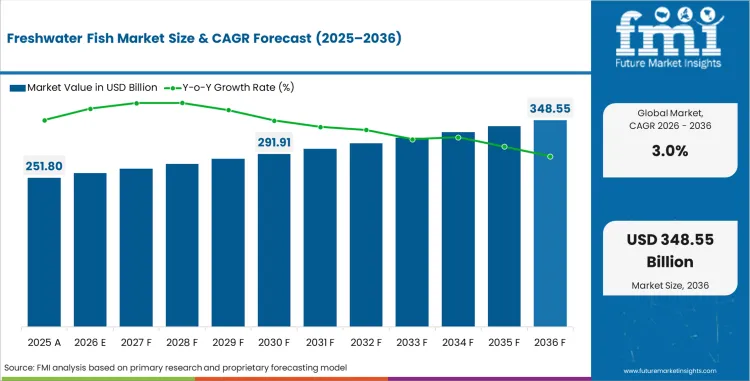
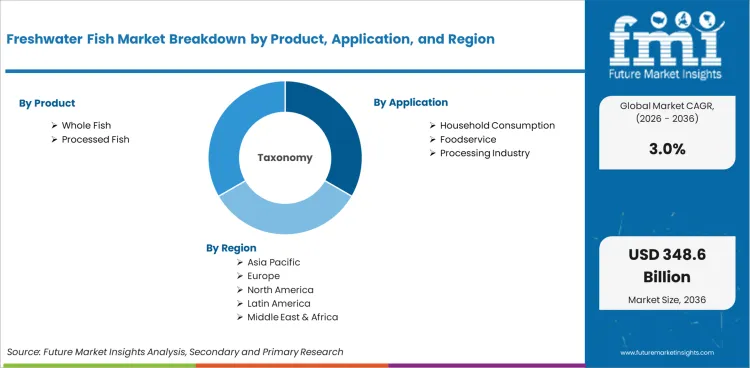
The freshwater fish market was valued at USD 251.8 billion in 2025. The market is set to reach USD 259.4 billion by 2026-end and grow at a CAGR of 3.0% between 2026-2036 to reach USD 348.6 billion by 2036. Whole Fish will dominate with a 50.0% share, while Household Consumption will lead with a 60.0% share.
Summary of the Freshwater Fish Market
- Demand and Growth Drivers
- Aquaculture production expansion is the primary supply-side growth driver, with freshwater fish farming investment increasing in Asia, Africa, and Latin America to meet rising protein demand from growing populations.
- Health-conscious consumer preference for lean protein sources is shifting dietary patterns toward fish consumption, supported by nutritional guidance recommending increased fish intake for cardiovascular and cognitive health benefits.
- Cold chain infrastructure development in emerging markets is reducing post-harvest losses and extending fresh fish distribution reach from production regions to urban consumption centers.
- Product and Segment View
- Whole Fish is expected to remain the leading product segment with 50% share driven by established demand and procurement patterns.
- Household Consumption is expected to account for 60% of the application segment, reflecting consumer tastes and usage behavior.
- Retail Consumers is projected to lead the end use segment with 65% share during the forecast period.
- Geography and Competitive Outlook
- China is expected to remain a major market at 4.05% CAGR, driven by strong demand fundamentals and growing adoption.
- Increasing expenditure and growing infrastructure are likely to drive India to register 3.75% CAGR growth.
- Companies with the wide product portfolio and multi-channel distribution are expected to gain traction during the forecast period.
- Analyst Opinion
- The freshwater fish market is evolving into a more defined commercial category with clear segment leaders and established distribution patterns.
- Adoption is increasing due to rising awareness, expanding distribution, and growing influence of health and wellness trends on purchasing behavior.
- Premiumization is also supporting demand, with buyers trading up to higher quality products with validated health or functional benefits.
- Companies that can improve cost competitiveness along with consistent quality are expected to consolidate its position over the forecast period.
Key Takeaways, Market Size, and Forecast
- The freshwater fish market was valued at USD 251.8 billion in 2025.
- By 2036, the Freshwater Fish Market is expected to be worth USD 348.6 billion.
- From 2026 to 2036, the market is projected to expand at a CAGR of 3.0%.
- The market is projected to create an incremental opportunity of USD 89.2 billion between 2026 and 2036.
- The whole fish is expected to capture 50% of the product segment in 2026, owing to demand for whole unprocessed fish through traditional wet markets, supermarkets, and direct farm-to-consumer channels.
- China (4.05%) and India (3.75%) are some of the fastest growing markets in the world.
Freshwater Fish Market Definition
Freshwater fish market is of commercially traded fish species grown or harvested in freshwater environments such as lakes, rivers, ponds and aquaculture systems. Product categories are whole fish, fillets and portions, processed fish products and value-added fish products from aquaculture and wild capture operations.
Freshwater Fish Market Inclusions
The market scope is inclusive of all commercially traded freshwater fish products by product (whole fish, fillets and portions, processed fish products, value added products), application (household consumption, foodservice, industrial processing), end use (retail consumers, foodservice operators, food manufacturers), distribution channel (offline retail, online retail), source (aquaculture, wild capture), processing (fresh processing, frozen processing, dried and smoked) and pricing tier (mid range, economy, premium). The revenue range is from 2026 to 2036.
Freshwater Fish Market Exclusions
It excludes marine and salt-water species of fish, fish for ornamental use in fresh water, and fish meal and fish oil used solely as ingredients of animal feed.
Freshwater Fish Market Research Methodology
- Primary Research: FMI analysts conducted discussions with aquaculture operators, fish processing companies, wholesale market operators and retail seafood buyers in key markets.
- Desk Research: Data from fisheries associations, aquaculture production databases and trade statistics were combined.
- Market sizing and forecasting: Bottom-up aggregation across species categories and processing formats, with regional production curves adjusted for aquaculture yield and wild catch quotas.
- Data validation: Cross-checked quarterly with FAO fisheries production data and trade flow statistics.
Why is the Freshwater Fish Market Growing?
- Growth on the supply side is mainly driven by the increase in aquaculture production. Investment in freshwater fish farming is increasing in Asia.
- There is a shift in dietary patterns towards fish consumption due to the preference of health-conscious consumers for lean protein sources, with nutritional advice recommending increased fish intake for cardiovascular and cognitive health benefits.
- Infrastructure development of the cold chain in emerging markets is minimizing the post-harvest losses and increasing the reach of fresh fish distribution from the production regions to the urban consumption centers.
The freshwater fish market is increasing with increasing aquaculture production to meet the protein demand across the world. Whole fish is the leading product in 50.0% of the product segment, indicating the dominance of traditional retail formats in major consumption markets. The source segment is aquaculture, which represents 65.0% of the source segment, with tilapia, carp, catfish and pangasius being the major commercial species grown in pond-based and cage-based farming systems.
60.0% of the demand for applications is accounted for by household consumption, with retail consumers buying from wet markets, supermarkets and fish shops. Offline retail is the dominant channel with 70.0% distribution and traditional wet markets remain the main purchase destination across Asia and Africa. Fresh processing leads at 55.0% as consumers prefer fresh product over frozen in major consumption markets.
Market Segmentation Analysis
- Whole Fish accounts for 50% of the product segment, reflecting the existence of established demand.
- Retail Consumers is the largest end use segment with 65% share.
The segments studied in the freshwater fish market are product, application, end use, distribution channel, source, processing, pricing tier.
Insights into the Whole Fish Product Segment
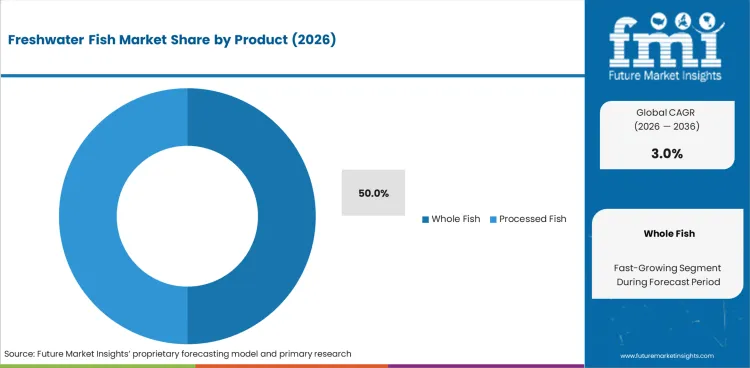
The whole fish segment is expected to account for 50.0% of the product segment in 2026. Traditional retail formats in Asia and Africa tend to sell whole fish through wet markets and fish shops. In China and Southeast Asia, live fish sales at market are still the preferred format. Processing infrastructure limitations in developing markets also drive the dominance of whole fish format over fillets and portions.
Insights into the Aquaculture Source Segment
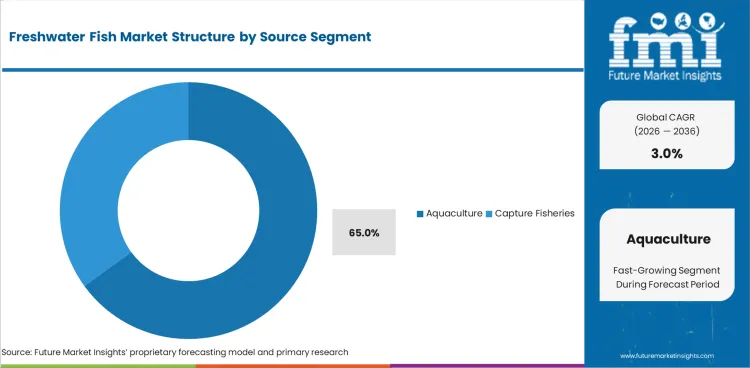
Source segment Aquaculture holds 65.0% share. Most of the volume of commercial freshwater fish is produced in pond-based farming systems in China, India, Bangladesh and Southeast Asia. Main farmed species are tilapia, carp, catfish and pangasius. The other 35.0% is wild capture from lakes and rivers, with capture volumes limited by environmental regulations and dwindling wild fish stocks.
Freshwater Fish Market Drivers, Restraints, and Opportunities
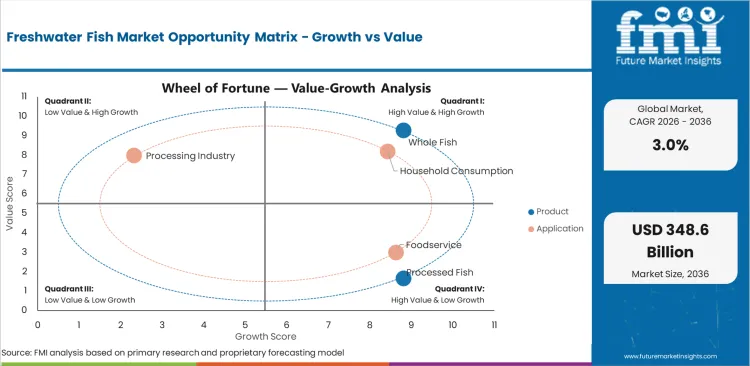
- Aquaculture Production Expansion and is creating structured demand across key segments.
- Post-Harvest Loss and Cold is limiting adoption velocity in price-sensitive segments.
The freshwater fish market is shaped by demand-side catalysts and supply-side constraints that vary by region and price tier.
Aquaculture Production Expansion and Intensification
Investment in aquaculture is driving demand by increasing both the volume of production and the yield per hectare. Government subsidies, technical assistance and land allocation for fish farming are underpinning increased production capacity in Asia, Sub-Saharan Africa and Latin America.
Protein Demand Growth and Dietary Shift
The growth is driven by increasing global protein demand due to population growth and a shift in the diets towards lean animal protein sources. In middle-income markets, health guidance recommending fish consumption for cardiovascular benefits supports consumer purchasing decisions.
Post-Harvest Loss and Cold Chain Gaps
Post-harvest losses in developing markets are 20 to 30% due to limited cold chain infrastructure, restricting the use of formal distribution channels. Temperature control gaps from the farm gate to the retail outlet reduce marketable product volume and quality.
Cold Chain Infrastructure Development
Investment in cold chain logistics that connect aquaculture production zones to urban consumption centers is conducive to growth. Refrigerated transport, cold storage facilities and an organized retail infrastructure ensure efficient distribution and less post-harvest losses.
Analysis of Freshwater Fish Market By Key Countries
.webp "Top Country Growth Comparison Freshwater Fish Market Cagr (2026 2036)")
| Country | CAGR |
|---|---|
| China | 4.05% |
| India | 3.75% |
| Germany | 3.45% |
| Brazil | 3.15% |
| USA | 2.85% |
| UK | 2.55% |
| Japan | 2.25% |
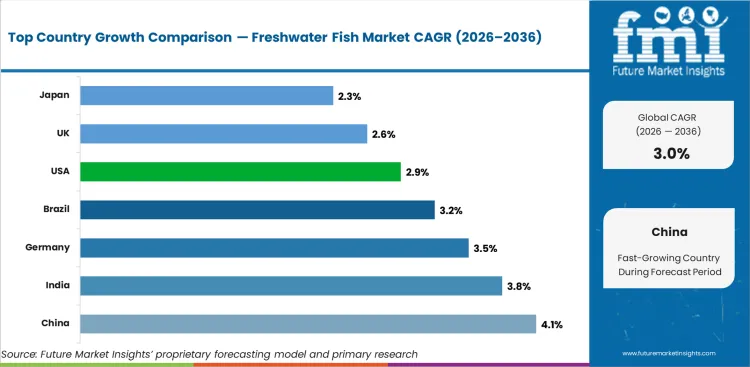
- China is leading with a CAGR of 4.05% and the largest demand base with increasing adoption.
- India (3.75%) is seeing strong demand aided by rising spends and distribution expansion.
- Germany (3.45%) and Brazil (3.15%) are contributing to growth, developing an expanding market.
The global freshwater fish market is projected to expand at 3% per year from 2026 to 2036. The study covers more than 30 countries.
Sales Analysis of Freshwater Fish Market in China
China leads at 4.05% through 2036. China produces and consumes more freshwater fish than any other country, with an integrated aquaculture system spanning carp, tilapia, and catfish production. Government aquaculture modernization programs are improving yield and quality standards.
- Largest global freshwater fish producer and consumer with integrated pond-based aquaculture systems.
- Government aquaculture modernization programs improve production yield and food safety standards.
- Traditional wet market and live fish retail remain the dominant distribution formats.
Demand Outlook for Freshwater Fish Market in India
India is expanding at 3.75% through 2036. India ranks second globally in freshwater fish production, with carp species dominating aquaculture output. Blue Revolution scheme and state-level fisheries development programs support production expansion.
- Second-largest global freshwater fish producer with carp-dominated aquaculture systems.
- Blue Revolution scheme and state fisheries programs support aquaculture production expansion.
- Organized retail growth is improving cold chain access and reducing post-harvest losses.
Future Outlook for Freshwater Fish Market in the United States
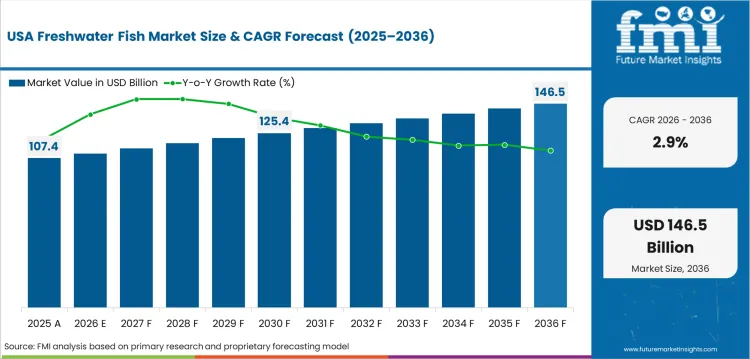
The USA is growing at 3.2% through 2036. Consumer demand for sustainable and domestically farmed fish supports catfish and tilapia aquaculture. Retail distribution is shifting toward pre-portioned and value-added formats in supermarkets and online grocery platforms.
- Domestic catfish and tilapia aquaculture serves consumer demand for sustainably farmed protein.
- Retail distribution favors pre-portioned and value-added formats over whole fish in supermarkets.
- Online grocery platforms are growing as distribution channels for fresh and frozen fish products.
In-depth Analysis of Freshwater Fish Market in Germany
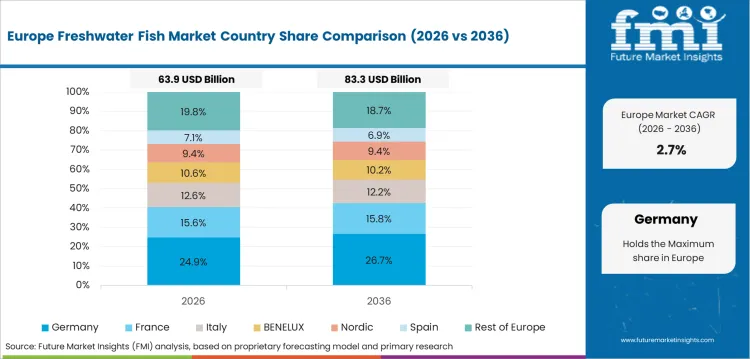
Germany is expanding at 2.8% through 2036. Trout and carp are the primary domestic freshwater species. EU aquaculture sustainability standards and consumer preference for certified sustainable fish shape the market.
- Trout and carp are the primary domestically produced freshwater fish species.
- EU aquaculture sustainability standards shape production and procurement requirements.
- Consumer preference for certified sustainable fish supports premium product positioning.
In-depth Analysis of Freshwater Fish Market in Japan
Japan is growing at 2.5% through 2036. Japanese freshwater fish consumption focuses on eel, trout, and sweetfish species. High quality standards and traditional culinary applications sustain consistent demand at premium price points.
- Eel, trout, and sweetfish species dominate Japanese freshwater fish consumption.
- High quality standards and traditional culinary applications support premium pricing.
- Declining domestic wild capture is increasing reliance on aquaculture and imports.
Competitive Landscape and Strategic Positioning
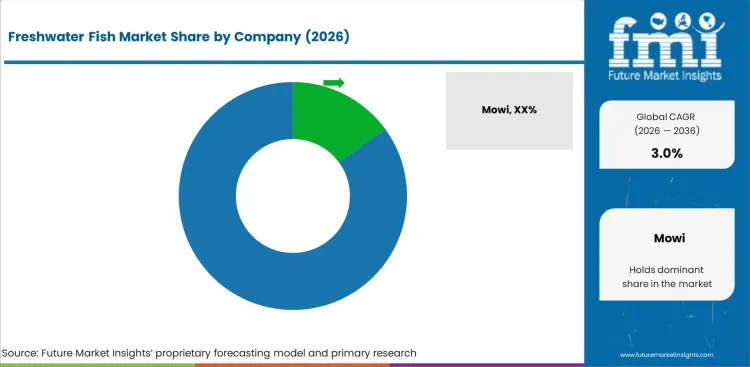
- Mowi is a global leader in integrated aquaculture, processing infrastructure and distribution, with a presence in fresh, frozen and value added fish product categories.
- Thai Union Group PCL competes on the scale of processing, multi-species capabilities and established export relationships serving retail and foodservice customers in global markets.
- Through their aquaculture production expertise and sustainable farming certifications, Cermag Group AS and Grieg Seafoods ASA meet the requirements of retailers and consumers.
The competitive landscape is characterized by global leaders with wide portfolios and regional specialists with niche capabilities.
Key Companies in the Freshwater Fish Market
Key global companies leading the freshwater fish market include:
- Leading the way are Mowi (Norway), Thai Union Group PCL (Thailand) and Cermag Group AS (Norway), with integrated aquaculture, processing and global distribution infrastructure serving retail and foodservice channels.
- Huon Aqua (Australia), Stolt Sea Farm (Norway) and Stehr Group (Australia) serve regional markets via species specialisation, aquaculture production know-how and sustainable farming certifications.
- Leigh Fisheries (NZ), True World Foods (USA), Grieg Seafoods ASA (Norway) and Priory Fishery Ltd. (UK) compete by way of regional distribution, species expertise and direct-to-retail supply relationships.
Competitive Benchmarking: Freshwater Fish Market
| Company | Production Scale | Species Range | Sustainability Cert | Market Reach |
|---|---|---|---|---|
| Mowi | Very High | High | Very Strong | Global |
| Thai Union Group | Very High | Very High | Strong | Global |
| Cermag Group | High | Medium | Very Strong | Europe, Asia |
| Huon Aqua | Medium | Medium | Strong | Australia |
| Stolt Sea Farm | Medium | Medium | Strong | Europe |
| Stehr Group | Medium | Low | Moderate | Australia |
| True World Foods | Medium | High | Moderate | N. America |
| Grieg Seafoods | High | Medium | Very Strong | Europe |
| Leigh Fisheries | Low | Medium | Moderate | Oceania |
| Priory Fishery | Low | Low | Moderate | UK |
Source: Future Market Insights competitive analysis, 2026.
Key Developments in Freshwater Fish Market
- In 2025, Mowi ASA expanded its sustainable aquaculture and freshwater farming capabilities to support growing demand for premium fish products across European retail markets.
- In 2025, Thai Union Group strengthened its value-added seafood portfolio with expanded branded fish product offerings targeting retail and foodservice channels in North America and Europe.
Key Players in the Freshwater Fish Market
Major Global Players
- Mowi
- Thai Union Group PCL
- Cermag Group AS
- Huon Aqua
- Stolt Sea Farm
Emerging Players/Startups
- Stehr Group
- Leigh Fisheries
- True World Foods
- Grieg Seafoods ASA
- Priory Fishery Ltd.
Report Scope and Coverage
| Parameter | Details |
|---|---|
| Quantitative Units | USD 259.4 billion to USD 348.6 billion, at a CAGR of 3% |
| Market Definition | The freshwater fish market encompasses commercially traded fish species cultivated or captured in freshwater environments including lakes, rivers, ponds, and aquaculture systems. Product categories include whole fish, fillets and portions, processed fish products, and value-added fish products sourced from aquaculture and wild capture operations. |
| Regions Covered | North America, Latin America, Europe, East Asia, South Asia and Pacific, Middle East and Africa |
| Countries Covered | China, India, Germany, Brazil, USA, UK, Japan, 30 plus countries |
| Key Companies Profiled | Mowi, Thai Union Group PCL, Cermag Group AS, Huon Aqua, Stolt Sea Farm, Stehr Group, Leigh Fisheries, True World Foods |
| Forecast Period | 2026 to 2036 |
| Approach | Hybrid bottom-up and top-down methodology starting with verified transaction data, projecting adoption velocity across segments and regions. |
Market Segmentation Analysis
Freshwater Fish Market Segmented by Product:
- Whole Fish
- Fresh Whole Fish
- Chilled Fish
- Live Fish
- Frozen Whole Fish
- Individually Frozen
- Block Frozen
- Fresh Whole Fish
- Processed Fish
- Fillets
- Skinless Fillets
- Boneless Fillets
- Steaks And Portions
- Cut Portions
- Value Added Cuts
- Ready To Cook
- Marinated Fish
- Seasoned Fish
- Fillets
Freshwater Fish Market Segmented by Application:
- Household Consumption
- Daily Cooking
- Fresh Meal Preparation
- Traditional Dishes
- Convenience Cooking
- Ready To Cook Use
- Quick Meal Preparation
- Daily Cooking
- Foodservice
- Restaurants
- Casual Dining
- Fine Dining
- Hotels And Catering
- Buffet Services
- Event Catering
- Restaurants
- Processing Industry
- Fish Processing Units
- Canning
- Freezing
- Export Processing
- Value Added Products
- Packaging And Distribution
- Fish Processing Units
Freshwater Fish Market Segmented by End Use:
- Retail Consumers
- Urban Consumers
- Health Conscious Buyers
- Convenience Seekers
- Rural Consumers
- Traditional Consumption
- Local Market Buyers
- Urban Consumers
- Foodservice Industry
- Restaurants And Hotels
- Chain Restaurants
- Independent Outlets
- Catering Services
- Event Catering
- Institutional Catering
- Restaurants And Hotels
Freshwater Fish Market Segmented by Distribution Channel:
- Offline Retail
- Wet Markets
- Local Fish Markets
- Traditional Vendors
- Supermarkets And Hypermarkets
- Modern Retail Stores
- Frozen Sections
- Specialty Seafood Stores
- Premium Fish Stores
- Organic Fish Stores
- Wet Markets
- Online Retail
- E Commerce Platforms
- Marketplace Sales
- Brand Owned Platforms
- Direct To Consumer
- Subscription Deliveries
- Home Delivery Services
- E Commerce Platforms
Freshwater Fish Market Segmented by Source:
- Aquaculture
- Pond Farming
- Small Scale Farms
- Commercial Farms
- Cage Farming
- River Cage Systems
- Lake Cage Systems
- Pond Farming
- Capture Fisheries
- River Fishing
- Small Scale Fishing
- Commercial Fishing
- Lake Fishing
- Traditional Methods
- Mechanized Fishing
- River Fishing
Freshwater Fish Market Segmented by Processing:
- Fresh Processing
- Chilling
- Ice Storage
- Cold Chain Distribution
- Cleaning And Gutting
- Manual Processing
- Automated Processing
- Chilling
- Frozen Processing
- Individual Quick Freezing
- Rapid Freezing
- Quality Retention
- Block Freezing
- Bulk Freezing
- Storage Efficiency
- Individual Quick Freezing
Freshwater Fish Market Segmented by Pricing Tier:
- Mid Range
- Standard Fresh Fish
- Daily Consumption Fish
- Standard Fresh Fish
- Economy
- Low Cost Fish Varieties
- Mass Market Supply
- Low Cost Fish Varieties
- Premium
- High Value Species
- Organic Certified Fish
- Export Quality Fish
- High Value Species
Freshwater Fish Market by Region:
- North America
- USA
- Canada
- Mexico
- Latin America
- Brazil
- Chile
- Rest of Latin America
- Western Europe
- Germany
- UK
- Italy
- Spain
- France
- Nordic
- BENELUX
- Rest of Western Europe
- Eastern Europe
- Russia
- Poland
- Hungary
- Balkan & Baltic
- Rest of Eastern Europe
- East Asia
- China
- Japan
- South Korea
- South Asia and Pacific
- India
- ASEAN
- Australia & New Zealand
- Rest of South Asia and Pacific
- Middle East & Africa
- Kingdom of Saudi Arabia
- Other GCC Countries
- Turkiye
- South Africa
- Other African Union
- Rest of Middle East & Africa
Research Sources and Bibliography
- 1. Food and Agriculture Organization. (2025). FAO State of World Fisheries and Aquaculture. FAO.
- 2. World Bank. (2024). Fish to 2030: Prospects for Fisheries and Aquaculture. World Bank.
- 3. European Commission. (2024). EU Common Fisheries Policy: Aquaculture Strategy. EC.
- 4. National Oceanic and Atmospheric Administration. (2025). NOAA Fisheries Annual Report. NOAA.
- 5. International Council for the Exploration of the Sea. (2024). ICES Freshwater Fisheries Advisory Report. ICES.
This bibliography is provided for reader reference.
This Report Answers
- Estimating the market size and revenue generation from 2026 to 2036.
- Segmenting by product, application, end use, distribution channel, source, processing, and pricing tier.
- Providing regional insights across more than 30 markets.
- Analyzing aquaculture production and supply chain dynamics.
- Assessing the competitive landscape across production and processing segments.
- Identifying investment opportunities in cold chain and value-added products.
- Tracking sustainability certification and production technology trends.
- Delivering data in PDF and Excel formats.
Frequently Asked Questions
How big is the freshwater fish market in 2026?
The global freshwater fish market is estimated to be valued at USD 259.4 billion in 2026.
What will be the size of freshwater fish market in 2036?
The market size for the freshwater fish market is projected to reach USD 348.6 billion by 2036.
How much will be the freshwater fish market growth between 2026 and 2036?
The freshwater fish market is expected to grow at a 3.0% CAGR between 2026 and 2036.
What are the key product types in the freshwater fish market?
The key product types in freshwater fish market are whole fish and processed fish.
Which application segment is expected to contribute significant share in the freshwater fish market in 2026?
In terms of application, household consumption segment is expected to command 60.0% share in the freshwater fish market in 2026.
Preview the report firsthand - request a free sample
Get SampleGet the brochure for pricing and purchase details.
Get PDFTable of Content
- Executive Summary
- Global Market Outlook
- Demand-side Trends
- Supply-side Trends
- Technology Roadmap Analysis
- Analysis and Recommendations
- Market Overview
- Market Coverage / Taxonomy
- Market Definition / Scope / Limitations
- Research Methodology
- Chapter Orientation
- Analytical Lens and Working Hypotheses
- Market Structure, Signals, and Trend Drivers
- Benchmarking and Cross-market Comparability
- Market Sizing, Forecasting, and Opportunity Mapping
- Research Design and Evidence Framework
- Desk Research Programme (Secondary Evidence)
- Company Annual and Sustainability Reports
- Peer-reviewed Journals and Academic Literature
- Corporate Websites, Product Literature, and Technical Notes
- Earnings Decks and Investor Briefings
- Statutory Filings and Regulatory Disclosures
- Technical White Papers and Standards Notes
- Trade Journals, Industry Magazines, and Analyst Briefs
- Conference Proceedings, Webinars, and Seminar Materials
- Government Statistics Portals and Public Data Releases
- Press Releases and Reputable Media Coverage
- Specialist Newsletters and Curated Briefings
- Sector Databases and Reference Repositories
- FMI Internal Proprietary Databases and Historical Market Datasets
- Subscription Datasets and Paid Sources
- Social Channels, Communities, and Digital Listening Inputs
- Additional Desk Sources
- Expert Input and Fieldwork (Primary Evidence)
- Primary Modes
- Qualitative Interviews and Expert Elicitation
- Quantitative Surveys and Structured Data Capture
- Blended Approach
- Why Primary Evidence is Used
- Field Techniques
- Interviews
- Surveys
- Focus Groups
- Observational and In-context Research
- Social and Community Interactions
- Stakeholder Universe Engaged
- C-suite Leaders
- Board Members
- Presidents and Vice Presidents
- R&D and Innovation Heads
- Technical Specialists
- Domain Subject-matter Experts
- Scientists
- Physicians and Other Healthcare Professionals
- Governance, Ethics, and Data Stewardship
- Research Ethics
- Data Integrity and Handling
- Primary Modes
- Tooling, Models, and Reference Databases
- Desk Research Programme (Secondary Evidence)
- Data Engineering and Model Build
- Data Acquisition and Ingestion
- Cleaning, Normalisation, and Verification
- Synthesis, Triangulation, and Analysis
- Quality Assurance and Audit Trail
- Market Background
- Market Dynamics
- Drivers
- Restraints
- Opportunity
- Trends
- Scenario Forecast
- Demand in Optimistic Scenario
- Demand in Likely Scenario
- Demand in Conservative Scenario
- Opportunity Map Analysis
- Product Life Cycle Analysis
- Supply Chain Analysis
- Investment Feasibility Matrix
- Value Chain Analysis
- PESTLE and Porter’s Analysis
- Regulatory Landscape
- Regional Parent Market Outlook
- Production and Consumption Statistics
- Import and Export Statistics
- Market Dynamics
- Global Market Analysis 2021 to 2025 and Forecast, 2026 to 2036
- Historical Market Size Value (USD Million) Analysis, 2021 to 2025
- Current and Future Market Size Value (USD Million) Projections, 2026 to 2036
- Y-o-Y Growth Trend Analysis
- Absolute $ Opportunity Analysis
- Global Market Pricing Analysis 2021 to 2025 and Forecast 2026 to 2036
- Global Market Analysis 2021 to 2025 and Forecast 2026 to 2036, By Product
- Introduction / Key Findings
- Historical Market Size Value (USD Million) Analysis By Product , 2021 to 2025
- Current and Future Market Size Value (USD Million) Analysis and Forecast By Product , 2026 to 2036
- Whole Fish
- Fresh Whole Fish
- Chilled Fish
- Live Fish
- Frozen Whole Fish
- Individually Frozen
- Block Frozen
- Processed Fish
- Fillets
- Skinless Fillets
- Boneless Fillets
- Steaks And Portions
- Cut Portions
- Whole Fish
- Y-o-Y Growth Trend Analysis By Product , 2021 to 2025
- Absolute $ Opportunity Analysis By Product , 2026 to 2036
- Global Market Analysis 2021 to 2025 and Forecast 2026 to 2036, By Application
- Introduction / Key Findings
- Historical Market Size Value (USD Million) Analysis By Application, 2021 to 2025
- Current and Future Market Size Value (USD Million) Analysis and Forecast By Application, 2026 to 2036
- Household Consumption
- Daily Cooking
- Fresh Meal Preparation
- Traditional Dishes
- Convenience Cooking
- Ready To Cook Use
- Quick Meal Preparation
- Foodservice
- Restaurants
- Casual Dining
- Fine Dining
- Hotels And Catering
- Buffet Services
- Processing Industry
- Fish Processing Value (USD Million)s
- Canning
- Freezing
- Export Processing
- Value Added Products
- Household Consumption
- Y-o-Y Growth Trend Analysis By Application, 2021 to 2025
- Absolute $ Opportunity Analysis By Application, 2026 to 2036
- Global Market Analysis 2021 to 2025 and Forecast 2026 to 2036, By End Use
- Introduction / Key Findings
- Historical Market Size Value (USD Million) Analysis By End Use, 2021 to 2025
- Current and Future Market Size Value (USD Million) Analysis and Forecast By End Use, 2026 to 2036
- Retail Consumers
- Urban Consumers
- Health Conscious Buyers
- Convenience Seekers
- Rural Consumers
- Traditional Consumption
- Local Market Buyers
- Foodservice Industry
- Restaurants And Hotels
- Chain Restaurants
- Independent Outlets
- Catering Services
- Event Catering
- Retail Consumers
- Y-o-Y Growth Trend Analysis By End Use, 2021 to 2025
- Absolute $ Opportunity Analysis By End Use, 2026 to 2036
- Global Market Analysis 2021 to 2025 and Forecast 2026 to 2036, By Distribution Channel
- Introduction / Key Findings
- Historical Market Size Value (USD Million) Analysis By Distribution Channel, 2021 to 2025
- Current and Future Market Size Value (USD Million) Analysis and Forecast By Distribution Channel, 2026 to 2036
- Offline Retail
- Wet Markets
- Local Fish Markets
- Traditional Vendors
- Supermarkets And Hypermarkets
- Modern Retail Stores
- Frozen Sections
- Specialty Seafood Stores
- Premium Fish Stores
- Organic Fish Stores
- Online Retail
- E Commerce Platforms
- Marketplace Sales
- Brand Owned Platforms
- Direct To Consumer
- Subscription Deliveries
- Offline Retail
- Y-o-Y Growth Trend Analysis By Distribution Channel, 2021 to 2025
- Absolute $ Opportunity Analysis By Distribution Channel, 2026 to 2036
- Global Market Analysis 2021 to 2025 and Forecast 2026 to 2036, By Source
- Introduction / Key Findings
- Historical Market Size Value (USD Million) Analysis By Source, 2021 to 2025
- Current and Future Market Size Value (USD Million) Analysis and Forecast By Source, 2026 to 2036
- Aquaculture
- Pond Farming
- Small Scale Farms
- Commercial Farms
- Cage Farming
- River Cage Systems
- Lake Cage Systems
- Capture Fisheries
- River Fishing
- Small Scale Fishing
- Commercial Fishing
- Lake Fishing
- Traditional Methods
- Aquaculture
- Y-o-Y Growth Trend Analysis By Source, 2021 to 2025
- Absolute $ Opportunity Analysis By Source, 2026 to 2036
- Global Market Analysis 2021 to 2025 and Forecast 2026 to 2036, By Processing
- Introduction / Key Findings
- Historical Market Size Value (USD Million) Analysis By Processing, 2021 to 2025
- Current and Future Market Size Value (USD Million) Analysis and Forecast By Processing, 2026 to 2036
- Fresh Processing
- Chilling
- Ice Storage
- Cold Chain Distribution
- Cleaning And Gutting
- Manual Processing
- Automated Processing
- Frozen Processing
- Individual Quick Freezing
- Rapid Freezing
- Quality Retention
- Block Freezing
- Bulk Freezing
- Fresh Processing
- Y-o-Y Growth Trend Analysis By Processing, 2021 to 2025
- Absolute $ Opportunity Analysis By Processing, 2026 to 2036
- Global Market Analysis 2021 to 2025 and Forecast 2026 to 2036, By Pricing Tier
- Introduction / Key Findings
- Historical Market Size Value (USD Million) Analysis By Pricing Tier, 2021 to 2025
- Current and Future Market Size Value (USD Million) Analysis and Forecast By Pricing Tier, 2026 to 2036
- Mid Range
- Standard Fresh Fish
- Daily Consumption Fish
- Economy
- Low Cost Fish Varieties
- Mass Market Supply
- Premium
- High Value Species
- Organic Certified Fish
- Export Quality Fish
- Mid Range
- Y-o-Y Growth Trend Analysis By Pricing Tier, 2021 to 2025
- Absolute $ Opportunity Analysis By Pricing Tier, 2026 to 2036
- Global Market Analysis 2021 to 2025 and Forecast 2026 to 2036, By Region
- Introduction
- Historical Market Size Value (USD Million) Analysis By Region, 2021 to 2025
- Current Market Size Value (USD Million) Analysis and Forecast By Region, 2026 to 2036
- North America
- Latin America
- Western Europe
- Eastern Europe
- East Asia
- South Asia and Pacific
- Middle East & Africa
- Market Attractiveness Analysis By Region
- North America Market Analysis 2021 to 2025 and Forecast 2026 to 2036, By Country
- Historical Market Size Value (USD Million) Trend Analysis By Market Taxonomy, 2021 to 2025
- Market Size Value (USD Million) Forecast By Market Taxonomy, 2026 to 2036
- By Country
- USA
- Canada
- Mexico
- By Product
- By Application
- By End Use
- By Distribution Channel
- By Source
- By Processing
- By Pricing Tier
- By Country
- Market Attractiveness Analysis
- By Country
- By Product
- By Application
- By End Use
- By Distribution Channel
- By Source
- By Processing
- By Pricing Tier
- Key Takeaways
- Latin America Market Analysis 2021 to 2025 and Forecast 2026 to 2036, By Country
- Historical Market Size Value (USD Million) Trend Analysis By Market Taxonomy, 2021 to 2025
- Market Size Value (USD Million) Forecast By Market Taxonomy, 2026 to 2036
- By Country
- Brazil
- Chile
- Rest of Latin America
- By Product
- By Application
- By End Use
- By Distribution Channel
- By Source
- By Processing
- By Pricing Tier
- By Country
- Market Attractiveness Analysis
- By Country
- By Product
- By Application
- By End Use
- By Distribution Channel
- By Source
- By Processing
- By Pricing Tier
- Key Takeaways
- Western Europe Market Analysis 2021 to 2025 and Forecast 2026 to 2036, By Country
- Historical Market Size Value (USD Million) Trend Analysis By Market Taxonomy, 2021 to 2025
- Market Size Value (USD Million) Forecast By Market Taxonomy, 2026 to 2036
- By Country
- Germany
- UK
- Italy
- Spain
- France
- Nordic
- BENELUX
- Rest of Western Europe
- By Product
- By Application
- By End Use
- By Distribution Channel
- By Source
- By Processing
- By Pricing Tier
- By Country
- Market Attractiveness Analysis
- By Country
- By Product
- By Application
- By End Use
- By Distribution Channel
- By Source
- By Processing
- By Pricing Tier
- Key Takeaways
- Eastern Europe Market Analysis 2021 to 2025 and Forecast 2026 to 2036, By Country
- Historical Market Size Value (USD Million) Trend Analysis By Market Taxonomy, 2021 to 2025
- Market Size Value (USD Million) Forecast By Market Taxonomy, 2026 to 2036
- By Country
- Russia
- Poland
- Hungary
- Balkan & Baltic
- Rest of Eastern Europe
- By Product
- By Application
- By End Use
- By Distribution Channel
- By Source
- By Processing
- By Pricing Tier
- By Country
- Market Attractiveness Analysis
- By Country
- By Product
- By Application
- By End Use
- By Distribution Channel
- By Source
- By Processing
- By Pricing Tier
- Key Takeaways
- East Asia Market Analysis 2021 to 2025 and Forecast 2026 to 2036, By Country
- Historical Market Size Value (USD Million) Trend Analysis By Market Taxonomy, 2021 to 2025
- Market Size Value (USD Million) Forecast By Market Taxonomy, 2026 to 2036
- By Country
- China
- Japan
- South Korea
- By Product
- By Application
- By End Use
- By Distribution Channel
- By Source
- By Processing
- By Pricing Tier
- By Country
- Market Attractiveness Analysis
- By Country
- By Product
- By Application
- By End Use
- By Distribution Channel
- By Source
- By Processing
- By Pricing Tier
- Key Takeaways
- South Asia and Pacific Market Analysis 2021 to 2025 and Forecast 2026 to 2036, By Country
- Historical Market Size Value (USD Million) Trend Analysis By Market Taxonomy, 2021 to 2025
- Market Size Value (USD Million) Forecast By Market Taxonomy, 2026 to 2036
- By Country
- India
- ASEAN
- Australia & New Zealand
- Rest of South Asia and Pacific
- By Product
- By Application
- By End Use
- By Distribution Channel
- By Source
- By Processing
- By Pricing Tier
- By Country
- Market Attractiveness Analysis
- By Country
- By Product
- By Application
- By End Use
- By Distribution Channel
- By Source
- By Processing
- By Pricing Tier
- Key Takeaways
- Middle East & Africa Market Analysis 2021 to 2025 and Forecast 2026 to 2036, By Country
- Historical Market Size Value (USD Million) Trend Analysis By Market Taxonomy, 2021 to 2025
- Market Size Value (USD Million) Forecast By Market Taxonomy, 2026 to 2036
- By Country
- Kingdom of Saudi Arabia
- Other GCC Countries
- Turkiye
- South Africa
- Other African Union
- Rest of Middle East & Africa
- By Product
- By Application
- By End Use
- By Distribution Channel
- By Source
- By Processing
- By Pricing Tier
- By Country
- Market Attractiveness Analysis
- By Country
- By Product
- By Application
- By End Use
- By Distribution Channel
- By Source
- By Processing
- By Pricing Tier
- Key Takeaways
- Key Countries Market Analysis
- USA
- Pricing Analysis
- Market Share Analysis, 2025
- By Product
- By Application
- By End Use
- By Distribution Channel
- By Source
- By Processing
- By Pricing Tier
- Canada
- Pricing Analysis
- Market Share Analysis, 2025
- By Product
- By Application
- By End Use
- By Distribution Channel
- By Source
- By Processing
- By Pricing Tier
- Mexico
- Pricing Analysis
- Market Share Analysis, 2025
- By Product
- By Application
- By End Use
- By Distribution Channel
- By Source
- By Processing
- By Pricing Tier
- Brazil
- Pricing Analysis
- Market Share Analysis, 2025
- By Product
- By Application
- By End Use
- By Distribution Channel
- By Source
- By Processing
- By Pricing Tier
- Chile
- Pricing Analysis
- Market Share Analysis, 2025
- By Product
- By Application
- By End Use
- By Distribution Channel
- By Source
- By Processing
- By Pricing Tier
- Germany
- Pricing Analysis
- Market Share Analysis, 2025
- By Product
- By Application
- By End Use
- By Distribution Channel
- By Source
- By Processing
- By Pricing Tier
- UK
- Pricing Analysis
- Market Share Analysis, 2025
- By Product
- By Application
- By End Use
- By Distribution Channel
- By Source
- By Processing
- By Pricing Tier
- Italy
- Pricing Analysis
- Market Share Analysis, 2025
- By Product
- By Application
- By End Use
- By Distribution Channel
- By Source
- By Processing
- By Pricing Tier
- Spain
- Pricing Analysis
- Market Share Analysis, 2025
- By Product
- By Application
- By End Use
- By Distribution Channel
- By Source
- By Processing
- By Pricing Tier
- France
- Pricing Analysis
- Market Share Analysis, 2025
- By Product
- By Application
- By End Use
- By Distribution Channel
- By Source
- By Processing
- By Pricing Tier
- India
- Pricing Analysis
- Market Share Analysis, 2025
- By Product
- By Application
- By End Use
- By Distribution Channel
- By Source
- By Processing
- By Pricing Tier
- ASEAN
- Pricing Analysis
- Market Share Analysis, 2025
- By Product
- By Application
- By End Use
- By Distribution Channel
- By Source
- By Processing
- By Pricing Tier
- Australia & New Zealand
- Pricing Analysis
- Market Share Analysis, 2025
- By Product
- By Application
- By End Use
- By Distribution Channel
- By Source
- By Processing
- By Pricing Tier
- China
- Pricing Analysis
- Market Share Analysis, 2025
- By Product
- By Application
- By End Use
- By Distribution Channel
- By Source
- By Processing
- By Pricing Tier
- Japan
- Pricing Analysis
- Market Share Analysis, 2025
- By Product
- By Application
- By End Use
- By Distribution Channel
- By Source
- By Processing
- By Pricing Tier
- South Korea
- Pricing Analysis
- Market Share Analysis, 2025
- By Product
- By Application
- By End Use
- By Distribution Channel
- By Source
- By Processing
- By Pricing Tier
- Russia
- Pricing Analysis
- Market Share Analysis, 2025
- By Product
- By Application
- By End Use
- By Distribution Channel
- By Source
- By Processing
- By Pricing Tier
- Poland
- Pricing Analysis
- Market Share Analysis, 2025
- By Product
- By Application
- By End Use
- By Distribution Channel
- By Source
- By Processing
- By Pricing Tier
- Hungary
- Pricing Analysis
- Market Share Analysis, 2025
- By Product
- By Application
- By End Use
- By Distribution Channel
- By Source
- By Processing
- By Pricing Tier
- Kingdom of Saudi Arabia
- Pricing Analysis
- Market Share Analysis, 2025
- By Product
- By Application
- By End Use
- By Distribution Channel
- By Source
- By Processing
- By Pricing Tier
- Turkiye
- Pricing Analysis
- Market Share Analysis, 2025
- By Product
- By Application
- By End Use
- By Distribution Channel
- By Source
- By Processing
- By Pricing Tier
- South Africa
- Pricing Analysis
- Market Share Analysis, 2025
- By Product
- By Application
- By End Use
- By Distribution Channel
- By Source
- By Processing
- By Pricing Tier
- USA
- Market Structure Analysis
- Competition Dashboard
- Competition Benchmarking
- Market Share Analysis of Top Players
- By Regional
- By Product
- By Application
- By End Use
- By Distribution Channel
- By Source
- By Processing
- By Pricing Tier
- Competition Analysis
- Competition Deep Dive
- Mowi
- Overview
- Product Portfolio
- Profitability by Market Segments (Product/Age /Sales Channel/Region)
- Sales Footprint
- Strategy Overview
- Marketing Strategy
- Product Strategy
- Channel Strategy
- Thai Union Group PCL
- Cermag Group AS
- Huon Aqua
- Stolt Sea Farm
- Stehr Group
- Leigh Fisheries
- True World Foods
- Grieg Seafoods ASA
- Priory Fishery Ltd.
- Mowi
- Competition Deep Dive
- Assumptions & Acronyms Used


