

- Market Size (2026)
- USD 313.0 Mn
- Forecast (2036)
- USD 509.8 Mn
- CAGR (2026 to 2036)
- 5.0%
How big is Furniture Flat-Pack Protection Market in 2026?
USD 313.0 million in 2026 and USD 509.8 million by 2036 at a 5.0% CAGR.
Furniture flat-pack protection is projected to expand from USD 313.0 million in 2026 to USD 509.8 million by 2036 at a 5.0% CAGR because repeated parcel and LTL handling keeps protection tied to shipment exposure. Sealed Air launched its AUTOBAG 850HB hybrid system in September 2025 for paper and poly mailers. The launch links protective packaging purchases with material selection and pack-line execution for fulfillment accounts.
Channel density changes how often flat packs encounter conveyors and manual transfers on the route to the final customer. USA Census Bureau data published in August 2026 show second-quarter e-commerce sales rose 12.2% year over year and represented 17.1% of retail sales. More individual shipments increase the cost of inconsistent protection and strengthen interest in retail e-commerce packaging systems that control damage without unnecessary cube.
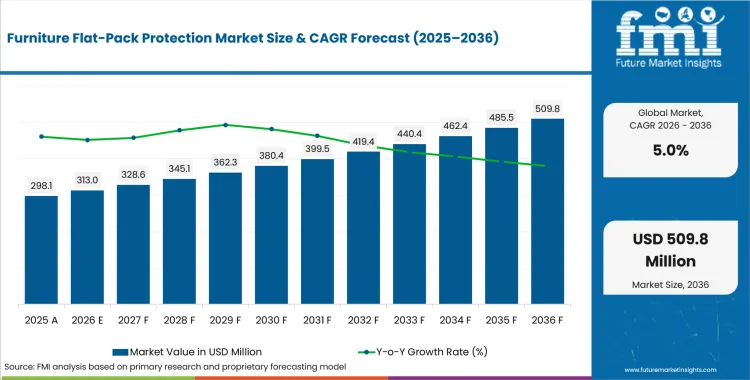
Key Takeaways
- Parcelized fulfillment increases demand for protection that survives repeated handling while preserving pack speed and shipping density.
- Based on format type, standard formats are projected to account for 44.0% in 2026 due to repeatable geometries that shorten specification and replenishment cycles.
- By material, paper-based systems are estimated to hold 31.0% in 2026 owing to fiber structures covering cushioning and edge-protection requirements.
- In 2026, standard duty is expected to lead performance class with 42.0% share because routine distribution lanes rarely justify heavier construction.
- Format changes face requalification costs because new materials or dimensions can alter compression and cushioning performance during distribution.
- Some of the key players in this market include Storopack, Sealed Air, Pregis, Ranpak, Smurfit Westrock, Signode, Cold Chain Technologies, and ThermoSafe.
Analyst Perspective
"Furniture flat-pack protection earns its margin when packaging engineers match edge, surface and compression controls to the actual parcel or LTL lane. Commercial proposals should quantify damage exposure and packing labor ahead of any request for material requalification or station automation."
- Nandini Roy Choudhury, Principal Consultant, Future Market Insights
How is the furniture flat-pack protection market segmented?
The market is segmented by format type, material, performance class, end use, sales channel and region.
Format type covers standard, recyclable-optimized, premium and custom-engineered formats, while material includes paper, foam, air and film plus thermal insulated systems. Performance class includes standard duty, heavy duty and temperature-assured protection, while end use covers e-commerce and parcel, electronics and industrial, pharma and healthcare plus food and grocery. Sales channels comprise direct accounts, packaging distributors and online B2B purchasing, with region completing the market taxonomy.
What supports e-commerce and parcel demand within end use?
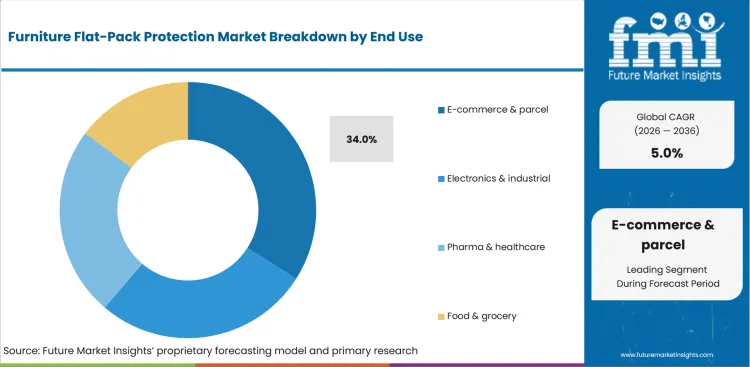
Direct shipment exposes furniture kits and comparable flat packs to more handling events than controlled pallet movement during consumer fulfillment. Visible corner damage can trigger a return even if the furniture is still usable after final delivery.
- The e-commerce and parcel segment is likely to capture 34.0% share in 2026 attributable to individual fulfillment requiring repeated cushioning and bracing for consumer shipments.
- Japan's 2024 e-commerce ratio for household goods and furniture reached 32.58% according to METI's August 2025 survey. The channel penetration keeps package dimensions and transit durability inside the fulfillment decision for e-commerce packaging sent as individual direct consumer orders.
What makes standard formats central to the format type category?
Repeatable furniture kits favor protection that packaging engineers can specify once without redesigning every carton for recurring production runs. Standard pads and inserts also let distributors stock common dimensions for replenishment programs with predictable product geometries.
- Standard formats are set to lead the format type category with 44.0% share in 2026 due to repeatable configurations that reduce quoting and pack-line setup changes.
- In May 2025 Signode documented an office-furniture program in which engineers assessed the application before producing prototypes and manufacturing the final design locally. The documented sequence explains how standard specifications can scale after initial qualification while flexible protective packaging covers simpler protection tasks.
Why do paper-based systems lead the material category?
Paper structures cover cushioning and surface protection while allowing one material family to serve several furniture pack geometries. Corrugated pads also provide blocking or edge reinforcement for applications whose compression strength controls the protection decision.
- By material, paper-based systems are forecast to represent 31.0% in 2026 driven by fiber formats covering several furniture protection jobs inside one sourcing family.
- Germany's ZSVR published the 2025 minimum standard in August and set a 2030 goal of at least 70% recyclability for packaging. The requirement raises the value of material documentation during account approval of paper cushion systems as replacement formats in commercial distribution.
How does standard duty shape the performance class category?
Routine parcel and regional distribution require verified shock and compression protection without the material load associated with heavy-duty construction for repeat shipments. Packaging engineers therefore size standard-duty protection to the intended lane instead of the most severe conceivable event.
- Standard duty is projected to hold 42.0% share in 2026 owing to routine distribution lanes requiring controlled protection without heavy-duty material loads.
- Ranpak introduced three automated packaging systems in January 2025 that integrated paper protection with packing-line equipment for fulfillment operations. One PadPak configuration can serve up to ten pack stations which links standard-duty throughput requirements with packaging automation economics.
What are the drivers, restraints and opportunities in the Furniture Flat-Pack Protection Market?
Parcel fulfillment raises damage-control requirements, requalification work slows material changes, and measured paper or automated systems offer the clearest route to lower total packing cost.
- Driver: High-volume fulfillment increases the commercial cost of inconsistent protection during repeated parcel handling and packing shifts.
- Restraint: Recyclability changes can increase approval work when new materials alter a pack specification or documented recovery rating.
- Opportunity: Packaging systems can capture more account value by measuring material use beside pack-station performance during commercial trials.
Parcel Fulfillment Raises Damage-Control Requirements
High-volume fulfillment exposes every individually shipped flat pack to another handling decision at the pack station. Ranpak said in August 2025 that Walmart was deploying AutoFill in five Next Generation Fulfillment Centers. The deployment links PCR protective packaging programs with automated void reduction at the packing point. Large furniture shippers gain from the same model if corner protection stays consistent without slowing peak throughput.
Requalification and Fee Exposure Slow Material Switching
Material reduction can fail commercially if a revised pack requires new testing for account approval. PackUK's June 2025 policy set red-rated packaging factors at 1.2 for 2026-2027 and 1.6 for 2027-2028. Those fee multipliers increase the cost of poor recyclability ratings during review of molded fiber protection alternatives. Furniture shippers therefore need transit evidence that justifies conversion work for lighter protection at the packing line.
Measured Pack Systems Offer a Revenue Route
Pack-station providers can earn more account revenue by measuring material use and packing speed beside protection performance during trials. Storopack updated AUTO.PROTECT in September 2025 with vision-based void detection and automated paper or air padding placement. The equipment gives packaging engineers a repeatable basis for right-sizing irregular products. Furniture programs adopt the system once lower manual adjustment offsets integration costs during production shifts.
Which country CAGRs are profiled in the Furniture Flat-Pack Protection Market?
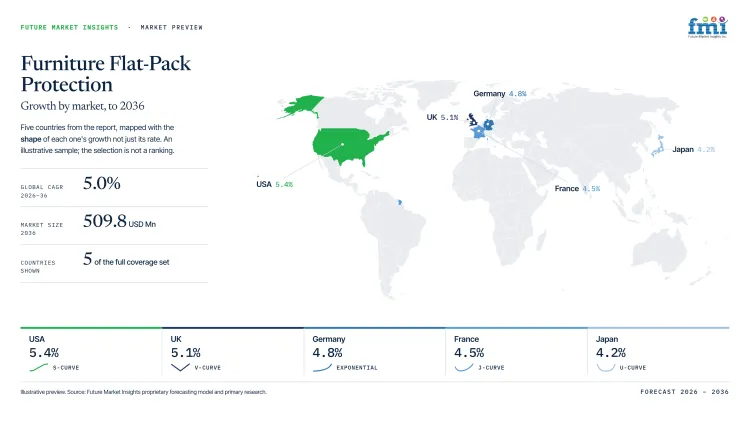
| Country | CAGR |
|---|---|
| Saudi Arabia | 6.3% |
| UAE | 6.0% |
| South Korea | 5.7% |
| USA | 5.4% |
| UK | 5.1% |
How do country-level CAGRs compare in the Furniture Flat-Pack Protection Market?
The country CAGRs span 1.2 percentage points between Saudi Arabia at 6.3% and the UK at 5.1%. Saudi Arabia and UAE form the upper group while South Korea and USA sit in the middle. The UK follows closely, so service economics distinguish these markets more than forecast spacing alone.
- Saudi Arabia needs local stock as imports lengthen replenishment for furniture programs.
- Redistribution mixes furniture dimensions and destinations, so UAE distributors need broad material coverage.
- Online peaks punish packing delays, making insertion essential in South Korean fulfillment centers.
- Different parcel and LTL risks require USA programs to qualify protection by lane.
- Producer responsibility changes costs, so UK accounts compare material fees with damage risk.
Comparable CAGRs produce different entry costs as service and qualification requirements vary.
The full report provides country-level CAGR analysis across North America, Latin America, Europe, East Asia, South Asia, Oceania and the Middle East and Africa.
Country-wise Analysis
- Saudi furniture distributors commonly rely on imported cushioning and structural protection, making stock near Riyadh and Jeddah a practical requirement for national programs with tight replenishment schedules during account rollouts that cannot tolerate unplanned packaging substitutions. Saudi Arabia is projected to grow at 6.3% CAGR through 2036 because digital ordering shortens coordination between large furniture accounts and regional packaging distributors serving dispersed retail networks with fewer manual follow-ups. GASTAT's August 2025 release recorded internet access at 97.7% of establishments in 2023, while imported equipment and specialty materials require local inventory plus service coverage for proprietary protection formats to scale reliably.
- Regional redistribution through UAE logistics hubs mixes imported furniture lines with different carton dimensions, so packaging distributors need broad material coverage without carrying too many narrowly specified protective formats for each destination market. In September 2025, TDRA documented more than 15,000 UAE PASS services through over 350 entities, giving large accounts a common digital administrative layer for transport documents and commercial approvals. Furniture flat-pack protection demand in UAE is forecast to expand at 6.0% CAGR through 2036 as faster commercial coordination supports regional sourcing while concentrated account volumes require flexible material families until dedicated local inventory becomes economical.
- Tight floor space inside South Korean fulfillment centers makes quick insertion and predictable package dimensions operating requirements during evening and weekend peaks for furniture orders moving through dense parcel networks. Furniture flat-pack protection demand in South Korea is forecast to rise at 5.7% CAGR through 2036 given online retail intensity and the frequency of individually handled consumer shipments requiring repeatable cushioning performance. June online shopping increased 10.7% year over year according to the Ministry of Data and Statistics' August 2026 release, while labor-sensitive packing stations can reject material-saving formats that require frequent manual adjustment or slow insertion during high-volume shifts.
- Bulky flat packs in the United States routinely move through parcel and less-than-truckload networks, requiring packaging teams to qualify one national specification against different handling assumptions ahead of release by major distribution centers. USA Census Bureau data published in May 2026 show first-quarter e-commerce represented 16.9% of total retail sales, which keeps individual shipment protection commercially relevant for direct consumer orders and replacement furniture components. Furniture flat-pack protection demand in USA is projected to record 5.4% CAGR through 2036 with the rate tied to parcel scale, while mixed carrier routes make test-backed regional service more valuable than one cushioning design applied without lane-specific validation.
- Producer-responsibility fees have moved recyclability into routine packaging decisions, so furniture protection changes must reduce material exposure without shifting cost into damage claims or slower packing at regional fulfillment sites. Furniture flat-pack protection demand in the UK is forecast to advance at 5.1% CAGR through 2036 supported by established fiber recovery and a practical route for paper-based protection in routine shipments. In July 2025, Defra published a provisional 86.4% recycling rate for paper and cardboard under its second 2024 packaging methodology, while protection providers need damage evidence since recyclability cannot compensate for higher returns from under-protected furniture shipments.
Who are the notable companies in the Furniture Flat-Pack Protection Market?
Storopack, Sealed Air, Pregis, Ranpak, Smurfit Westrock, Signode, Cold Chain Technologies and ThermoSafe are the notable companies serving this market.
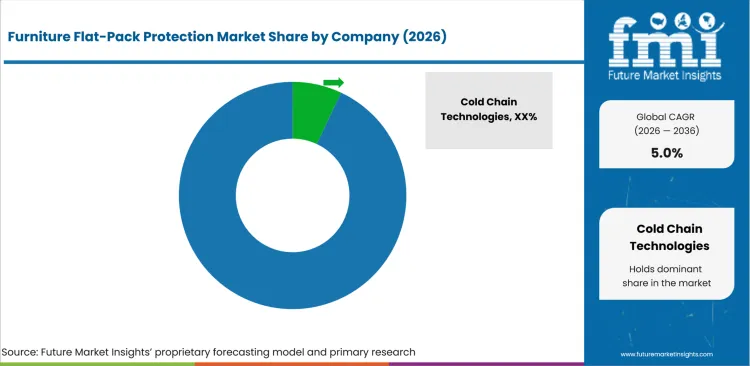
Furniture flat-pack protection draws broad protective-system groups, corrugated engineering specialists and temperature-assurance providers with different qualification requirements. Storopack and Sealed Air pair protective materials with equipment or pack-station support for repeated fulfillment programs. Smurfit Westrock and Signode focus on corrugated structures for large or damage-sensitive furniture, while Cold Chain Technologies and ThermoSafe address the narrower temperature-controlled packaging scope. Entry depends on proving a specific protection route through design support and test evidence instead of relying on company scale.
- Broad pack-station systems: Storopack and Sealed Air pair protective media with equipment integration, while Pregis and Ranpak extend automated packing support for repeated fulfillment programs.
- Structural protection specialists: Smurfit Westrock and Signode apply corrugated structures to furniture programs whose geometry and compression strength determine the protective design for large shipments.
- Temperature-assured specialists: Cold Chain Technologies and ThermoSafe compete in the narrower passive thermal packaging scope through qualified parcel or pallet formats with documented temperature duration.
Competitive Benchmarking: Furniture Flat-Pack Protection Market
| Company | Protection Route Breadth | Engineering & Deployment Support | Qualification / Validation Depth | Geographic Reach |
|---|---|---|---|---|
| Storopack | High | High | Medium | Global |
| Sealed Air | High | High | Medium | Global |
| Pregis | High | High | High | North America and Europe |
| Ranpak | Medium | High | Medium | North America and Europe |
| Smurfit Westrock | High | High | Medium | Global |
| Signode | High | High | Medium | Global |
| Cold Chain Technologies | Medium | High | High | Americas, Europe, Asia-Pacific and Middle East hubs |
| ThermoSafe | Medium | High | High | Americas, Europe and Asia |
Scoring basis: High protection-route breadth requires at least three verified material or format families while Medium requires two and Low identifies one. High engineering support requires documented design plus deployment or integration service while Medium identifies one structured route and Low indicates limited implementation support. High qualification depth requires formal testing with multiple documented procedures while Medium identifies application testing and Low identifies one documented suitability check.
Key Developments in the Furniture Flat-Pack Protection Market
- In August 2026, Pregis acquired MP Global Packaging's cold-chain and thermal packaging business with two USA manufacturing facilities producing paper-based thermal protection.
- In May 2025, Cold Chain Technologies launched the TRUEtemp Naturals universal parcel shipper with ISTA 7E qualification for 2°C to 8°C shipments lasting up to 48 hours.
- In February 2025, Storopack introduced AIRfiber paper air pillows with a water-soluble inner coating that permits recycling through paper streams.
Key Players in the Furniture Flat-Pack Protection Market
Broad Protective Packaging and Pack-Station Systems
- Storopack
- Sealed Air
- Pregis
- Ranpak
Structural and Furniture-Focused Protection
- Smurfit Westrock
- Signode
Temperature-Assured Protection Specialists
- Cold Chain Technologies
- ThermoSafe
Furniture Flat-Pack Protection Market - Report Scope
| Coverage field | Report scope |
|---|---|
| Market breakdown | By format type, material, performance class, end use, sales channel and region. |
| Quantitative Units | USD million. |
| Market Definition | Revenue from protective materials, structural inserts, cushioning systems, engineered assemblies and temperature-assured protection within the defined furniture flat-pack protection scope. |
| Regions Covered | North America, Latin America, Europe, East Asia, South Asia and Pacific and Middle East and Africa. |
| Countries Covered | Saudi Arabia, UAE, South Korea, USA, UK, and 20+ countries included in the full report. |
| Key Companies Profiled | Storopack, Sealed Air, Pregis, Ranpak, Smurfit Westrock, Signode, Cold Chain Technologies, ThermoSafe. |
| Forecast Period | 2026 to 2036. |
| Approach | Primary and secondary research with market triangulation. |
Furniture Flat-Pack Protection Market - Research Methodology
| Method | Approach |
|---|---|
| Primary Research | FMI analysts gathered input from manufacturers, service providers, technology developers, distributors, end users, procurement teams, and subject-matter experts. Interviews examined purchasing decisions, product or service evaluation, adoption barriers, approval requirements, pricing considerations, and expectations for technical or commercial support. Respondents were also asked what evidence is required before a trial, pilot, or initial order develops into regular purchasing. |
| Desk Research | Desk research covered government statistics, regulatory publications, trade data, industry associations, technical literature, standards, company filings, product information, and official corporate announcements. Sources were reviewed for relevance, publication date, geographic coverage, and consistency with the defined market scope. Claims relating to performance, applications, approvals, capacity, investment, and commercial activity were retained only when supported by credible public evidence. |
| Market Sizing and Forecasting | The market model combined the baseline value with historical performance, segment structure, pricing and volume indicators, adoption levels, company participation, and country-level demand conditions. Forecast assumptions considered economic activity, investment trends, regulatory developments, technology adoption, purchasing cycles, supply availability, and barriers to wider market use. Segment and regional estimates were reconciled before the final market total was calculated. |
| Data Validation | Estimates were checked against multiple independent indicators, including public data, company activity, trade patterns, industry developments, and findings from primary interviews. Validation also tested whether products, services, applications, and company revenues fell within the defined market boundaries. Adjacent categories, unsupported claims, overlapping revenues, and activities without direct market relevance were excluded to reduce double counting and maintain consistency across segments and countries. |
Furniture Flat-Pack Protection Market by Segments
Furniture Flat-Pack Protection Market segmented by Format Type:
- Standard formats
- Recyclable-optimized formats
- Premium & branded formats
- Custom-engineered formats
Furniture Flat-Pack Protection Market segmented by Material:
- Paper-based systems
- Foam systems
- Air & film systems
- Thermal insulated systems
Furniture Flat-Pack Protection Market segmented by Performance Class:
- Standard duty
- Heavy duty
- Temperature-assured
Furniture Flat-Pack Protection Market segmented by End Use:
- E-commerce & parcel
- Electronics & industrial
- Pharma & healthcare
- Food & grocery
Furniture Flat-Pack Protection Market segmented by Sales Channel:
- Direct accounts
- Packaging distributors
- Online B2B
Furniture Flat-Pack Protection Market by Region:
- North America
- United States
- Canada
- Latin America
- Brazil
- Mexico
- Chile
- Rest of Latin America
- Western Europe
- Germany
- United Kingdom
- Italy
- Spain
- France
- Nordics
- Benelux
- Rest of Western Europe
- Eastern Europe
- Russia
- Poland
- Hungary
- Balkan and Baltic States
- Rest of Eastern Europe
- East Asia
- China
- Japan
- South Korea
- South Asia and Pacific
- India
- ASEAN
- Australia and New Zealand
- Rest of South Asia and Pacific
- Middle East and Africa
- Kingdom of Saudi Arabia
- Other GCC Countries
- Türkiye
- South Africa
- Other African Union Countries
- Rest of Middle East and Africa
Research Sources and Bibliography
- Sealed Air. (2025, September 16). Sealed Air Launches AUTOBAG Brand 850HB Hybrid Bagging Machine for Paper and Poly Mailers.
- USA Census Bureau. (2026, August 18). Quarterly Retail E-Commerce Sales, Second Quarter 2026.
- Signode. (2025, May 19). Optimal Outcomes - Custom Protective Packaging.
- Zentrale Stelle Verpackungsregister. (2025, August 29). 2025 minimum standard published - initial touchstone for companies preparing for the EU Packaging and Packaging Waste Regulation (PPWR).
- Ranpak Holdings Corp. (2025, January 22). Ranpak announces three new automated packaging solutions to drive improved productivity.
- Ministry of Economy, Trade and Industry of Japan. (2025, August 26). 令和6年度電子商取引に関する市場調査の結果を取りまとめました。
- Ranpak Holdings Corp. (2025, August 26). Ranpak and Walmart Join Forces to Roll Out Automated Technology and Sustainable Packaging Collaboration.
- PackUK. (2025, June 28). PackUK extended producer responsibility (EPR) for packaging: producer disposal fees modulation statement.
- Storopack. (2025, September 25). Enhanced standard with AUTO.PROTECT.
- General Authority for Statistics, Saudi Arabia. (2025, August 4). Percentage of establishments with internet access in the Kingdom reaches 97.7% in 2023.
- Telecommunications and Digital Government Regulatory Authority. (2025, September 13). National forum bringing together federal, local, and private sector entities to showcase the UAE's digital achievements and launch a new initiative.
- Ministry of Data and Statistics, Republic of Korea. (2026, August 3). Online Shopping in June 2026.
- USA Census Bureau. (2026, May 18). Quarterly Retail E-Commerce Sales, First Quarter 2026.
- Department for Environment, Food & Rural Affairs. (2025, July 23). UK statistics on waste.
- Pregis. (2026, June 23). Pregis Opens Customer Experience Centers in Atlanta and Los Angeles, Creating More Access to Customers Nationwide.
- Smurfit Westrock. (2026, January 22). Smurfit Westrock demonstrates industry-leading performance by winning 15 WorldStar awards.
- Pregis. (2026, August 6). Pregis Acquires MP Global Packaging Cold Chain and Thermal Packaging Business.
- Cold Chain Technologies. (2025, May 1). Cold Chain Technologies Expands its Curbside Recyclable Parcel Shipper Portfolio.
- Storopack. (2025, February 27). AIRfiber - Air Pillows Made of Paper.
- Smurfit Westrock. (2025, January 13). Victory Packaging becomes Smurfit Westrock Packaging Solutions.
- Sealed Air. (2026, April 9). Sealed Air Announces Completion of Acquisition by CD&R.
- Storopack. (2026, June 30). PAPERwrap - Paper Wrapping for Optimal Protection.
- Ranpak Holdings Corp. (2025, February 26). Ranpak Debuts Customizable, On-Demand, Printing Capabilities for Automated Packaging Lines.
- Ranpak Holdings Corp. (2026, January 13). Ranpak and Medline Partner to Advance Automation and Sustainable Packaging Across High-Volume Distribution Operations.
- Pregis. (2026, March 24). Pregis Launches Sharp Lynx 18 Automated Bagger.
- Signode. (2026, May 7). Signode Launches BXT Go at Interpack 2026.
- Cold Chain Technologies. (2025, April). Cold Chain Technologies Looks to "Go Further" with Launch of Universal CCT Tower Elite.
- ThermoSafe. (2026, February 5). ThermoSafe Expands Orion Reusable Platform with Launch of Orion Express.
- ThermoSafe. (2025, November 3). Arsenal Capital Partners Completes Acquisition of ThermoSafe.
This bibliography is provided for reader reference and is not exhaustive. The full report contains the complete reference list and detailed citations.
This Report Answers
- How large is the furniture flat-pack protection market in 2026 and what is its projected value by 2036?
- Which shipment conditions increase demand for furniture flat-pack protection during parcel and LTL distribution?
- Why do standard formats hold the largest share within the format type category in 2026?
- Why do paper-based systems lead the material category and where do qualification requirements affect switching?
- How does standard duty balance damage control with material use in routine distribution lanes?
- Why does e-commerce and parcel account for the largest share within the end-use category?
- How do the five profiled country growth rates differ between Saudi Arabia and the UK?
- Which companies provide broad protective systems or structural furniture protection and temperature-assured formats?
- What should packaging teams compare during approval of a new flat-pack protection specification?
Frequently Asked Questions
How big is the furniture flat-pack protection market in 2026?
The furniture flat-pack protection market is valued at USD 313.0 million in 2026 and is projected to reach USD 509.8 million by 2036. Growth follows rising parcel handling and demand for protection that limits damage without unnecessary shipping cube.
What is the CAGR of the furniture flat-pack protection market from 2026 to 2036?
The furniture flat-pack protection market is projected to grow at a CAGR of 5.0% between 2026 and 2036. Expansion follows e-commerce fulfillment and repeated replacement demand for qualified cushioning plus structural protection in direct shipment programs.
Which format type leads the furniture flat-pack protection market?
The standard formats segment is expected to hold 44.0% of the furniture flat-pack protection market in 2026, driven by repeatable product geometries. Common specifications shorten approval cycles and simplify replenishment for furniture programs using stable carton dimensions.
Which material leads the furniture flat-pack protection market?
The paper-based systems segment is expected to hold 31.0% of the furniture flat-pack protection market in 2026, supported by fiber formats serving cushioning and edge protection. Common material families also reduce specification complexity for repeated furniture protection programs.
How much value will the furniture flat-pack protection market add between 2026 and 2036?
The furniture flat-pack protection market is expected to add USD 196.8 million in value between 2026 and 2036. The increase follows repeated protective-material purchasing plus broader use of engineered pack systems in parcel fulfillment operations.
Which countries are projected to record the highest growth in the furniture flat-pack protection market?
Saudi Arabia is projected to grow at 6.3% CAGR, followed by UAE at 6.0% and South Korea at 5.7% through 2036. Digital ordering and regional distribution raise local-format demand in these faster-growth countries.
Which companies are active in the furniture flat-pack protection market?
Key companies operating in the furniture flat-pack protection market include Storopack, Sealed Air, Pregis, Ranpak, Smurfit Westrock, Signode, Cold Chain Technologies, and ThermoSafe. Their positions cover protective materials and structural packaging plus narrower temperature-assured formats requiring documented thermal qualification.
Preview the report firsthand - request a free sample
Get SampleGet the brochure for pricing and purchase details.
Get PDFTable of Content
- Key Takeaways
- Market Size and CAGR
- Top Growth Driver
- Fastest Growing Segment
- Leading Region
- Key Companies
- Emerging Opportunities
- Executive Summary
- Global Market Outlook
- Demand-side Trends
- Supply-side Trends
- Technology Roadmap Analysis
- Analysis and Recommendations
- Analyst Perspective (What is happening? Why now? What should investors know?)
- Key Questions Answered
- How large is the market?
- What is the CAGR?
- What are key trends?
- Which region dominates?
- Who are the leaders?
- Market Overview
- Market Coverage / Taxonomy
- Market Definition / Scope / Limitations
- Research Methodology
- Chapter Orientation
- Analytical Lens and Working Hypotheses
- Market Structure, Signals, and Trend Drivers
- Benchmarking and Cross-market Comparability
- Market Sizing, Forecasting, and Opportunity Mapping
- Research Design and Evidence Framework
- Desk Research Programme (Secondary Evidence)
- Expert Input and Fieldwork (Primary Evidence)
- Tooling, Models, and Reference Databases
- Data Engineering and Model Build
- Quality Assurance and Audit Trail
- Market Background
- Market Dynamics (Drivers, Restraints, Opportunity, Trends)
- Scenario Forecast (Optimistic, Likely, Conservative)
- Impact Analysis
- AI Impact
- Sustainability Impact
- Regulatory Impact
- Technology Impact
- Consumer / Buyer Analysis
- Purchase Drivers
- Adoption Barriers
- Buyer Journey
- Opportunity Map Analysis
- Product Life Cycle Analysis
- Supply Chain Analysis
- Investment Feasibility Matrix
- Value Chain Analysis
- PESTLE and Porter's Analysis
- Regulatory Landscape
- Regional Parent Market Outlook
- Production and Consumption Statistics
- Import and Export Statistics
- Global Market Analysis and Forecast, 2021 to 2036
- Historical Market Size Value (USD Million) Analysis, 2021 to 2025
- Current and Future Market Size Value (USD Million) Projections, 2026 to 2036
- Y-o-Y Growth Trend Analysis
- Absolute $ Opportunity Analysis
- Global Market Pricing Analysis, 2021 to 2036
- Global Market Analysis and Forecast, By Format Type, 2021 to 2036
- Introduction / Key Findings
- Historical Market Size Value (USD Million) Analysis By Format Type, 2021 to 2025
- Current and Future Market Size Value (USD Million) Analysis and Forecast By Format Type, 2026 to 2036
- Standard formats
- Recyclable-optimized formats
- Premium & branded formats
- Custom-engineered formats
- Standard formats
- Y-o-Y Growth Trend Analysis By Format Type, 2021 to 2025
- Absolute $ Opportunity Analysis By Format Type, 2026 to 2036
- Global Market Analysis and Forecast, By Material, 2021 to 2036
- Introduction / Key Findings
- Historical Market Size Value (USD Million) Analysis By Material, 2021 to 2025
- Current and Future Market Size Value (USD Million) Analysis and Forecast By Material, 2026 to 2036
- Paper-based systems
- Foam systems
- Air & film systems
- Thermal insulated systems
- Paper-based systems
- Y-o-Y Growth Trend Analysis By Material, 2021 to 2025
- Absolute $ Opportunity Analysis By Material, 2026 to 2036
- Global Market Analysis and Forecast, By Performance Class, 2021 to 2036
- Introduction / Key Findings
- Historical Market Size Value (USD Million) Analysis By Performance Class, 2021 to 2025
- Current and Future Market Size Value (USD Million) Analysis and Forecast By Performance Class, 2026 to 2036
- Standard duty
- Heavy duty
- Temperature-assured
- Standard duty
- Y-o-Y Growth Trend Analysis By Performance Class, 2021 to 2025
- Absolute $ Opportunity Analysis By Performance Class, 2026 to 2036
- Global Market Analysis and Forecast, By End Use, 2021 to 2036
- Introduction / Key Findings
- Historical Market Size Value (USD Million) Analysis By End Use, 2021 to 2025
- Current and Future Market Size Value (USD Million) Analysis and Forecast By End Use, 2026 to 2036
- E-commerce & parcel
- Electronics & industrial
- Pharma & healthcare
- Food & grocery
- E-commerce & parcel
- Y-o-Y Growth Trend Analysis By End Use, 2021 to 2025
- Absolute $ Opportunity Analysis By End Use, 2026 to 2036
- Global Market Analysis and Forecast, By Sales Channel, 2021 to 2036
- Introduction / Key Findings
- Historical Market Size Value (USD Million) Analysis By Sales Channel, 2021 to 2025
- Current and Future Market Size Value (USD Million) Analysis and Forecast By Sales Channel, 2026 to 2036
- Direct accounts
- Packaging distributors
- Online B2B
- Direct accounts
- Y-o-Y Growth Trend Analysis By Sales Channel, 2021 to 2025
- Absolute $ Opportunity Analysis By Sales Channel, 2026 to 2036
- Global Market Analysis and Forecast, By Region, 2021 to 2036
- Introduction
- Historical Market Size Value (USD Million) Analysis By Region, 2021 to 2025
- Current Market Size Value (USD Million) Analysis and Forecast By Region, 2026 to 2036
- North America
- Latin America
- Western Europe
- Eastern Europe
- East Asia
- South Asia and Pacific
- Middle East & Africa
- Market Attractiveness Analysis By Region
- North America Market Analysis and Forecast, By Country, 2021 to 2036
- Historical Market Size Value (USD Million) Trend Analysis By Market Taxonomy, 2021 to 2025
- Market Size Value (USD Million) Forecast By Market Taxonomy, 2026 to 2036
- By Country
- USA
- Canada
- By Format Type
- By Material
- By Performance Class
- By End Use
- By Sales Channel
- By Country
- Market Attractiveness Analysis
- By Country
- By Format Type
- By Material
- By Performance Class
- By End Use
- By Sales Channel
- Key Takeaways
- Latin America Market Analysis and Forecast, By Country
- Historical Market Size Value (USD Million) Trend Analysis By Market Taxonomy, 2021 to 2025
- Market Size Value (USD Million) Forecast By Market Taxonomy, 2026 to 2036
- By Country
- Brazil
- Mexico
- Chile
- Rest of Latin America
- By Format Type
- By Material
- By Performance Class
- By End Use
- By Sales Channel
- By Country
- Market Attractiveness Analysis
- By Country
- By Format Type
- By Material
- By Performance Class
- By End Use
- By Sales Channel
- Key Takeaways
- Western Europe Market Analysis and Forecast, By Country
- Historical Market Size Value (USD Million) Trend Analysis By Market Taxonomy, 2021 to 2025
- Market Size Value (USD Million) Forecast By Market Taxonomy, 2026 to 2036
- By Country
- Germany
- UK
- Italy
- Spain
- France
- Nordic
- BENELUX
- Rest of Western Europe
- By Format Type
- By Material
- By Performance Class
- By End Use
- By Sales Channel
- By Country
- Market Attractiveness Analysis
- By Country
- By Format Type
- By Material
- By Performance Class
- By End Use
- By Sales Channel
- Key Takeaways
- Eastern Europe Market Analysis and Forecast, By Country
- Historical Market Size Value (USD Million) Trend Analysis By Market Taxonomy, 2021 to 2025
- Market Size Value (USD Million) Forecast By Market Taxonomy, 2026 to 2036
- By Country
- Russia
- Poland
- Hungary
- Balkan & Baltic
- Rest of Eastern Europe
- By Format Type
- By Material
- By Performance Class
- By End Use
- By Sales Channel
- By Country
- Market Attractiveness Analysis
- By Country
- By Format Type
- By Material
- By Performance Class
- By End Use
- By Sales Channel
- Key Takeaways
- East Asia Market Analysis and Forecast, By Country
- Historical Market Size Value (USD Million) Trend Analysis By Market Taxonomy, 2021 to 2025
- Market Size Value (USD Million) Forecast By Market Taxonomy, 2026 to 2036
- By Country
- China
- Japan
- South Korea
- By Format Type
- By Material
- By Performance Class
- By End Use
- By Sales Channel
- By Country
- Market Attractiveness Analysis
- By Country
- By Format Type
- By Material
- By Performance Class
- By End Use
- By Sales Channel
- Key Takeaways
- South Asia and Pacific Market Analysis and Forecast, By Country
- Historical Market Size Value (USD Million) Trend Analysis By Market Taxonomy, 2021 to 2025
- Market Size Value (USD Million) Forecast By Market Taxonomy, 2026 to 2036
- By Country
- India
- ASEAN
- Australia & New Zealand
- Rest of South Asia and Pacific
- By Format Type
- By Material
- By Performance Class
- By End Use
- By Sales Channel
- By Country
- Market Attractiveness Analysis
- By Country
- By Format Type
- By Material
- By Performance Class
- By End Use
- By Sales Channel
- Key Takeaways
- Middle East & Africa Market Analysis and Forecast, By Country
- Historical Market Size Value (USD Million) Trend Analysis By Market Taxonomy, 2021 to 2025
- Market Size Value (USD Million) Forecast By Market Taxonomy, 2026 to 2036
- By Country
- Kingdom of Saudi Arabia
- Other GCC Countries
- Türkiye
- South Africa
- Other African Union
- Rest of Middle East & Africa
- By Format Type
- By Material
- By Performance Class
- By End Use
- By Sales Channel
- By Country
- Market Attractiveness Analysis
- By Country
- By Format Type
- By Material
- By Performance Class
- By End Use
- By Sales Channel
- Key Takeaways
- Key Countries Market Analysis
- USA
- Pricing Analysis
- Market Share Analysis, 2025
- By Format Type
- By Material
- By Performance Class
- By End Use
- By Sales Channel
- Canada
- Pricing Analysis
- Market Share Analysis, 2025
- By Format Type
- By Material
- By Performance Class
- By End Use
- By Sales Channel
- Mexico
- Pricing Analysis
- Market Share Analysis, 2025
- By Format Type
- By Material
- By Performance Class
- By End Use
- By Sales Channel
- Brazil
- Pricing Analysis
- Market Share Analysis, 2025
- By Format Type
- By Material
- By Performance Class
- By End Use
- By Sales Channel
- Chile
- Pricing Analysis
- Market Share Analysis, 2025
- By Format Type
- By Material
- By Performance Class
- By End Use
- By Sales Channel
- Germany
- Pricing Analysis
- Market Share Analysis, 2025
- By Format Type
- By Material
- By Performance Class
- By End Use
- By Sales Channel
- UK
- Pricing Analysis
- Market Share Analysis, 2025
- By Format Type
- By Material
- By Performance Class
- By End Use
- By Sales Channel
- Italy
- Pricing Analysis
- Market Share Analysis, 2025
- By Format Type
- By Material
- By Performance Class
- By End Use
- By Sales Channel
- Spain
- Pricing Analysis
- Market Share Analysis, 2025
- By Format Type
- By Material
- By Performance Class
- By End Use
- By Sales Channel
- France
- Pricing Analysis
- Market Share Analysis, 2025
- By Format Type
- By Material
- By Performance Class
- By End Use
- By Sales Channel
- India
- Pricing Analysis
- Market Share Analysis, 2025
- By Format Type
- By Material
- By Performance Class
- By End Use
- By Sales Channel
- ASEAN
- Pricing Analysis
- Market Share Analysis, 2025
- By Format Type
- By Material
- By Performance Class
- By End Use
- By Sales Channel
- Australia & New Zealand
- Pricing Analysis
- Market Share Analysis, 2025
- By Format Type
- By Material
- By Performance Class
- By End Use
- By Sales Channel
- China
- Pricing Analysis
- Market Share Analysis, 2025
- By Format Type
- By Material
- By Performance Class
- By End Use
- By Sales Channel
- Japan
- Pricing Analysis
- Market Share Analysis, 2025
- By Format Type
- By Material
- By Performance Class
- By End Use
- By Sales Channel
- South Korea
- Pricing Analysis
- Market Share Analysis, 2025
- By Format Type
- By Material
- By Performance Class
- By End Use
- By Sales Channel
- Russia
- Pricing Analysis
- Market Share Analysis, 2025
- By Format Type
- By Material
- By Performance Class
- By End Use
- By Sales Channel
- Poland
- Pricing Analysis
- Market Share Analysis, 2025
- By Format Type
- By Material
- By Performance Class
- By End Use
- By Sales Channel
- Hungary
- Pricing Analysis
- Market Share Analysis, 2025
- By Format Type
- By Material
- By Performance Class
- By End Use
- By Sales Channel
- Kingdom of Saudi Arabia
- Pricing Analysis
- Market Share Analysis, 2025
- By Format Type
- By Material
- By Performance Class
- By End Use
- By Sales Channel
- Türkiye
- Pricing Analysis
- Market Share Analysis, 2025
- By Format Type
- By Material
- By Performance Class
- By End Use
- By Sales Channel
- South Africa
- Pricing Analysis
- Market Share Analysis, 2025
- By Format Type
- By Material
- By Performance Class
- By End Use
- By Sales Channel
- USA
- Market Structure Analysis
- Competition Dashboard
- Competition Benchmarking
- Market Share Analysis of Top Players
- By Regional
- By Format Type
- By Material
- By Performance Class
- By End Use
- By Sales Channel
- Emerging Startups
- Innovation Benchmarking
- Competition Analysis
- Competition Deep Dive
- Cold Chain Technologies
- Overview
- Product Portfolio
- Profitability by Market Segments
- Sales Footprint
- Strategy Overview
- Marketing Strategy
- Product Strategy
- Channel Strategy
- Storopack
- Sealed Air
- Smurfit Westrock
- Sonoco ThermoSafe
- Signode
- Peli BioThermal
- va-Q-tec
- Pregis
- Ranpak
- Cold Chain Technologies
- Case Studies
- Success Stories
- Recent Developments
- Competition Deep Dive
- Assumptions & Acronyms Used


