

- Industry Size (2026)
- USD 2480 Mn
- Forecast (2036)
- USD 8360 Mn
- CAGR (2026 to 2036)
- 12.9%
Flat-Pack Packaging Market Forecast and Outlook By FMI
The flat-pack packaging market is forecasted to total USD 2,480 million in 2026 and is expected to increase further to USD 8,360 million by 2036. As per FMI’s projections, demand is slated to progress at a CAGR of 12.9% from 2026 to 2036. This growth reflects a structural shift in transport packaging from conventional rigid formats toward space-optimized, precision-folded architectures that are increasingly specified as default logistics solutions across furniture kit manufacturers, home improvement product distributors, e-commerce fulfillment operators, and modular furniture fabricators.
Carrier pricing methodology transformation is the immediate economic accelerator. FedEx and UPS introduced density-based dimensional weight pricing effective January 2026, penalizing low-density shipments occupying disproportionate truck space. The document highlights that dimensional weight can exceed actual product weight by two to four times for poorly optimized packaging with excessive void space. In response, businesses are adopting flat-pack systems that minimize cubic volume through engineered designs that eliminate unnecessary airspace while maintaining structural integrity. This pricing regime is also catalyzing investment in box-on-demand automation, with the document citing Smurfit Westrock reporting a 40% surge in Pak On Demand deployments following the carrier changes, positioning packaging efficiency as a core competitive advantage.
Summary of Flat-Pack Packaging Market
- The flat-pack packaging market comprises collapsible, foldable, and ready-to-assemble transport packaging formats engineered to minimize shipping cube, reduce dimensional weight freight charges, enable efficient home delivery and customer self-assembly, and optimize storage density across furniture kit distribution, home improvement product supply chains, e-commerce fulfillment networks, and modular furniture transport.
- The defined scope is structured under FMI taxonomy with segmentation across product segment, pack structure, material, and region, focusing exclusively on dedicated flat-pack formats designed for efficient flat storage and rapid erection. The scope excludes rigid one-piece containers, non-collapsible wooden crating, flexible plastic packaging, and downstream assembly or installation services.
- The flat-pack packaging market is projected to grow at a 12.9% CAGR from 2026 to 2036, expanding from USD 2,480 million in 2026 to USD 8,360 million by 2036, based on FMI proprietary forecasting integrating carrier pricing enforcement, EU PPWR void-space mandates, e-commerce fulfillment automation investment, ready-to-assemble furniture consumption growth, and circular economy material innovation across North American, European, and Asia-Pacific distribution networks.
- Competition is concentrated among global packaging corporations with vertical integration across containerboard manufacturing and high-speed die-cut converting capacity, coupled with automated packaging system integration and sustainability portfolios. The document highlights a competitive set including DS Smith, Smurfit Kappa/WestRock (Smurfit Westrock), Sonoco, Nine Dragons, Greatview, and Billerud, with differentiation anchored in circular positioning, box-on-demand automation capability, heavy-duty industrial flat-pack engineering, and specialized coated board development.
- Country-wise, China is projected as the fastest-growing market at 14.2% CAGR (driven by automotive component export needs and Xingfa Aluminum’s automated industrial flat-pack production lines), with Germany at 12.0% CAGR (PPWR enforcement and Mondi showcases) and the United States at 11.4% CAGR (FedEx/UPS January 2026 pricing change and Pak On Demand deployment growth).
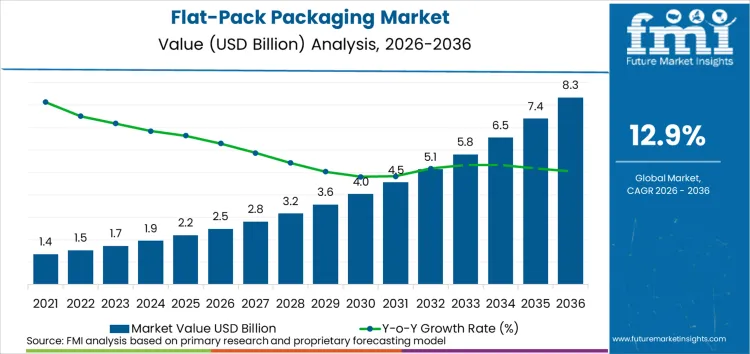
Regulatory void-space mandates reinforce the same directional shift. The document states that the EU Packaging and Packaging Waste Regulation (PPWR) enforces a maximum 50% empty space ratio effective August 2026, accelerating adoption of slim-fill corrugated designs and adjustable flat-pack configurations that allow brands to handle multiple SKU sizes while staying compliant. Corporate actions cited include Mondi Group showcasing advanced flat-pack solutions at WorldStar Düsseldorf 2026, and market behavior in Germany shifting toward multi-depth constructions and fast-assembly mechanisms as standard requirements under the compliance environment described.
Industry adoption is also being propelled by the furniture industry’s structural shift toward direct-to-consumer distribution and labor constraints in fulfillment operations. The document references Blum’s Beyond Components expansion unveiled at interzum Cologne, including PLICOBOX systems and kit variants representing complete drawer sets with smart packaging solutions, designed to address cost pressure, complexity, and skilled labor shortages. On the fulfillment side, self-erecting flat-pack designs deploying in under two seconds-pioneered in Japan amid the Logistics 2024 to 2026 Crisis-are increasingly framed as an operational necessity for maintaining throughput under labor scarcity.
Flat-Pack Packaging Market Key Takeaways
| Metric | Value |
|---|---|
| Expected Value (2026E) | USD 2,480 million |
| Projected Value (2036F) | USD 8,360 million |
| CAGR (2026 to 2036) | 12.9% |
Source: Future Market Insights (FMI) analysis
Why is the Flat-Pack Packaging Market Growing?
Carrier pricing methodology transformation, regulatory void-space enforcement, furniture industry structural shift toward direct-to-consumer distribution, e-commerce fulfillment automation proliferation, and sustainability-driven material innovation, propels expansion of flat-pack packaging demand. Institutional procurement specifications from major retailers, furniture manufacturers, and third-party logistics providers are forcing immediate adoption of cube-optimized, precision-folded flat-pack systems across inbound supplier packaging and outbound consumer shipment channels.
A central driver is density-based freight pricing, with FedEx and UPS implementing the new pricing logic in January 2026. The document emphasizes that this shift penalizes low-density shipments occupying disproportionate truck space and that dimensional weight frequently exceeds actual product weight by factors of two to four times for void-heavy packaging. This change elevates flat-pack designs from “efficiency projects” to direct freight-cost control mechanisms, accelerating adoption of engineered formats that eliminate unnecessary airspace. The stated 40% surge in Smurfit Westrock’s Pak On Demand deployments illustrates how quickly shippers are moving toward precision-sizing systems that remove void fill entirely.
Regulatory enforcement provides a second non-discretionary growth engine. The EU PPWR’s 50% maximum empty-space ratio effective August 2026 is explicitly identified as accelerating slim-fill corrugated designs and adjustable configurations that can cover multiple SKU sizes while remaining compliant. This is shaping Germany’s expansion pathway in particular, reinforced by the document’s references to Mondi showcases and the rise of multi-depth construction and fast assembly as standard requirements. Together, these dynamics establish flat-pack packaging as compliance-aligned infrastructure while simultaneously improving freight economics, creating a compounding growth effect rather than a single-cause adoption cycle.
How is the Flat-Pack Packaging Market Segmented?
The flat-pack packaging market is segmented by product segment, pack structure, and material, reflecting how cube-optimization needs differ across furniture kits, industrial components, and home improvement shipments, and how downstream handling constraints shape packaging architecture selection. Unlike conventional packaging categories, segmentation here is primarily dictated by three operational determinants: (i) dimensional-weight sensitivity under density-based carrier pricing, (ii) erection/assembly time at fulfillment centers under labor scarcity, and (iii) void-space compliance under the document-cited PPWR empty-space ratio requirements. As a result, segments that directly reduce cubic volume and accelerate pack-out throughput command disproportionate value share.
Structurally, the market is also shifting from commodity corrugated procurement to engineering-led flat-pack system specification, where buyers evaluate packaging against measurable KPIs such as trailer fill rates, carton-to-product volume ratio, and assembly cycle time (seconds). This is why the segment landscape is not simply “who uses flat-pack,” but “which use cases require precision folding logic, multi-depth configurations, and automation compatibility.” The document positions this evolution as being reinforced by carrier pricing changes (FedEx/UPS January 2026) and adoption of box-on-demand and fast-assembly architectures, which raises the performance threshold across all segment categories.
Why do Furniture Kits remain the dominant product segment?
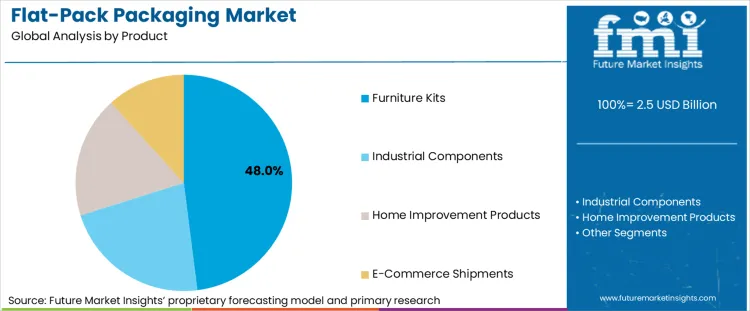
Furniture kits account for 48% of market demand, making them the leading product segment. The document’s logic is clear: furniture components are typically high in volume relative to weight, meaning they incur disproportionate dimensional-weight charges when shipped in void-heavy packaging. Flat-pack formats directly correct this by enabling slim, dense shipments that remove airspace while keeping components protected and organized for downstream assembly. In practice, packaging design becomes a freight-control lever rather than an afterthought, and this is why furniture kits sit at the center of flat-pack adoption.
The segment’s dominance is reinforced by structural channel shifts. Direct-to-consumer furniture distribution demands packaging that is not only cube-efficient, but also consumer-manageable-easy to handle, open, and recycle. The document also links furniture kit demand to supplier ecosystem moves (e.g., component suppliers showcasing packaged kit solutions at major industry events), positioning flat-pack systems as a response to complexity and labor constraints in distribution and installation pathways. Taken together, these drivers sustain furniture kits as the anchor segment for volume and value share through the forecast window.
How are Foldable Corrugated Boxes sustaining pack-structure leadership?
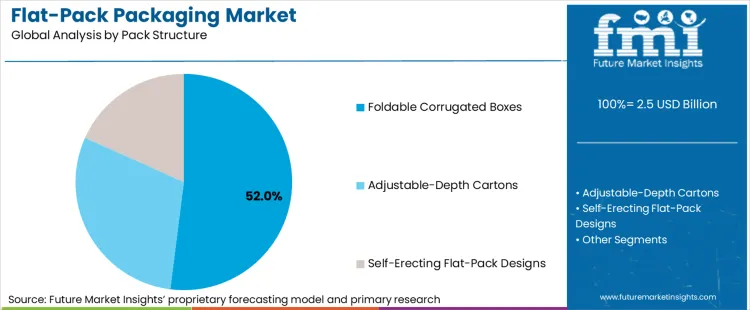
Foldable corrugated boxes hold a 52% share because they provide the most balanced solution across the market’s dominant constraints: cube optimization, protection performance, and automation compatibility. In the context described in your file, foldable corrugated architectures are favored because they preserve predictable geometry (which supports pallet patterns and trailer fill optimization) while also enabling efficient flat storage and rapid erection in fulfillment settings. This predictability matters more as operations migrate to standardized, high-throughput pack-out lines.
Their leadership is also reinforced by compliance direction. The document highlights policy pressure around empty space and packaging efficiency, which pushes buyers toward designs that can adapt to SKU variation without adding void fill. Foldable corrugated systems-especially multi-depth or adjustable configurations-support this by offering fit-to-size capability while remaining within mainstream recycling streams. As a result, this pack structure becomes the default “lowest risk” design choice that satisfies freight economics, operational throughput, and compliance expectations simultaneously.
Why does Corrugated Board remain the dominant material platform?
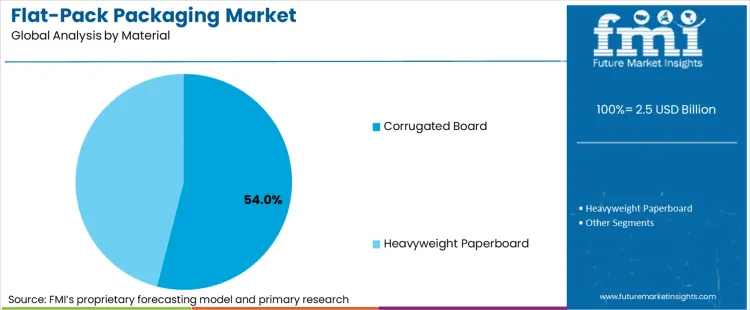
Corrugated board holds a 54% material share, reflecting its structural integrity, printability, and recycling alignment-attributes that directly map to the market’s operating logic in the document. Corrugated board enables high compression performance even in reduced-volume designs, allowing shippers to minimize outer dimensions without compromising stacking strength. It also supports high-quality converting and scoring, which is essential for flat-pack geometries that require consistent folds and reliable erection behavior under speed.
Beyond mechanical performance, corrugated’s dominance is sustained by ecosystem scale and regulatory defensibility. The file links market momentum to PPWR void-space rules and the broader shift toward engineered designs that reduce material and air shipped per unit. Corrugated board formats-particularly those designed for multi-depth and fast assembly-allow companies to meet these constraints while maintaining a clear recyclability narrative. This makes corrugated board the platform material that aligns best with both efficiency and compliance needs across regions highlighted in the document.
What Drivers, Restraints, Opportunities, and Trends Prevail in the Flat-Pack Packaging Market?
Density-based pricing enforcement is making cube efficiency a direct cost-control mechanism. Companies such as FedEx and UPS are introducing density-based dimensional-weight pricing effective January 2026, with dimensional weight frequently exceeding actual weight by two to four times for void-heavy packs. This immediately shifts packaging selection toward flat-pack designs that minimize cube and standardize dimensions, because the freight savings are structural and repeatable, not one-time.
PPWR void-space constraints are institutionalizing fit-to-size and adjustable flat-pack designs. The document frames the PPWR empty-space ratio requirement with a maximum 50% empty space effective August 2026, as a strong accelerant for slim-fill corrugated formats and adjustable configurations. This regulatory driver increases adoption even among companies that previously tolerated inefficiency, because compliance becomes a procurement gate rather than an optimization project.
Design and converting complexity can slow adoption for mid-tier brands. Flat-pack solutions that truly deliver cube reduction require precision scoring, folding logic, and often multi-depth constructions. The document’s positioning implies that these are not “drop-in” changes for all users; they can require converter capability upgrades and redesign cycles, which slows conversion among firms without strong packaging engineering resources.
Fulfilment-line disruption risk creates friction during transition. Moving from conventional boxes to fast-assembly or adjustable flat-pack formats changes pack-out routines. In high-throughput operations, even small disruptions to pack station ergonomics, scanning flow, or erection time can create resistance until solutions are proven at scale-especially where labor is constrained and training bandwidth is limited.
Box-on-demand and right-sizing deployments can compound benefits beyond material savings. The document references a surge in Pak On Demand deployments, highlighting that right-sized flat-pack systems reduce not only corrugated usage but also void fill, labor steps, and dimensional-weight penalties. Suppliers that bundle engineered flat-pack formats with right-sizing automation and analytics can capture higher-value, longer-duration contracts.
Fast-erection flat-pack designs can become a throughput safeguard under labor scarcity. Japan’s logistics labor pressure referenced in the document positions sub-2-second assembly concepts as an operational necessity. This creates opportunity for suppliers offering designs that reduce touch time per carton, enabling fulfillment centers to scale volume without proportional labor increases.
Multi-depth and adjustable flat-pack architectures are becoming standard to manage SKU proliferation. To comply with empty-space limits and reduce dimensional penalties across variable product sizes, companies are adopting multi-depth constructions and adjustable configurations rather than maintaining many single-SKU cartons. This trend aligns with the document’s emphasis on compliance and efficiency converging into common packaging specifications.
Major showcases such as packaging and furniture component exhibitions where advanced flat-pack solutions are positioned as the response to cost, complexity, and labor constraints present significant opportunities. This indicates a trend toward faster diffusion of best-practice designs as global suppliers use events to standardize expectations and drive procurement conversion cycles.
Analysis of Flat-Pack Packaging Market by Key Countries
Country-Wise CAGR Snapshot (2026 to 2036)
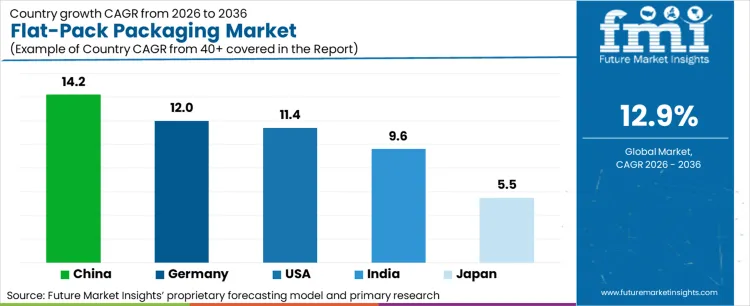
| Country | CAGR (2026 to 2036) |
|---|---|
| China | 14.20% |
| Germany | 12.00% |
| United States | 11.40% |
| India | 9.60% |
| Japan | 5.50% |
Source: Future Market Insights (FMI) analysis, based on proprietary forecasting model and primary research.
How is automotive export growth driving China’s flat-pack market expansion?
China exhibits the highest market acceleration with a 14.2% CAGR from 2026 to 2036, anchored in export-oriented manufacturing-especially automotive component exports that require standardized, heavy-duty flat-pack systems capable of protecting assemblies across long ocean transit while maximizing container utilization. The document frames this as a packaging problem created by global shipping economics: knock-down vehicle parts must be protected with repeatable specifications, yet the packaging must collapse efficiently to control outbound cube and return logistics. This export logic is reinforced by the scale and standardization achievable in China’s manufacturing clusters, which enables rapid adoption of engineered flat-pack designs at industrial volumes.
A concrete operational mechanism is highlighted through industrial line deployment. The document states that Xingfa Aluminum launched automated industrial flat-pack production lines in Guangdong Province, featuring high-compression corrugated bins replacing traditional steel racks. The value logic is explicitly framed in logistics terms: the conversion reduces tare weight by 60-70%, improves volumetric efficiency for containerized ocean freight, and enables collapse-flat return logistics, compounding cube benefits through the full shipment cycle rather than only on the outbound leg. This dual advantage-export cube efficiency plus return/storage efficiency-supports China’s role as the fastest-growing country market.
What regulatory framework is shaping Germany’s flat-pack packaging market growth?
Germany’s market expands at a 12.0% CAGR through 2036, shaped primarily by strict enforcement of the EU Packaging and Packaging Waste Regulation (PPWR) requirements cited in the document. The policy mechanism described is operationally direct: effective August 2026, packaging must not exceed a 50% empty space ratio, accelerating adoption of slim-fill corrugated designs and adjustable flat-pack configurations that allow brands to manage multiple SKU sizes while staying compliant. This is not positioned as a sustainability preference; it is described as a compliance constraint that directly influences packaging procurement and design selection.
The country narrative also shows how compliance pressure translates into converter and brand behavior. The document notes Mondi Group showcased advanced flat-pack solutions at WorldStar Düsseldorf 2026, including designs for food-box formats and specialized transport applications (e.g., solar panel transport). Germany’s engineering ecosystem is framed as enabling more complex packaging architectures-multi-depth construction and fast assembly mechanisms are becoming standard requirements as companies design around both regulatory constraints and throughput realities. Additionally, Germany’s position as Europe’s largest furniture market and a premium automotive hub is stated to reinforce both consumer and industrial demand, creating “favorable adoption economics” where compliance and efficiency reinforce each other rather than compete.
How is density-based carrier pricing driving United States market growth at 11.4% CAGR?
USA is projected to grow at an 11.4% CAGR, and the document identifies carrier pricing reform as the central demand trigger. In January 2026, FedEx and UPS introduced density-based pricing, immediately increasing shipping costs for bulky packaging and creating a direct economic incentive to shift toward flat-pack formats with lower dimensional-weight penalties. In this environment, flat-pack adoption is framed as a freight-cost control strategy-companies are not merely optimizing packaging; they are responding to a pricing regime that penalizes low-density shipments by design.
The document then ties this pricing catalyst to automation deployment behavior. It states that Smurfit Westrock reported a 40% surge in Pak On Demand automation deployments, with the core operational advantage being elimination of void fill through boxes produced precisely to product dimensions. The narrative further anchors the shift to executive-level positioning by referencing a New York Stock Exchange presentation on February 11, 2026, where packaging efficiency is framed as a competitive advantage under the new freight regime. Beyond pricing, the USA market’s structural support is described as its mature e-commerce ecosystem and the scale of direct-to-consumer distribution-channels where returns, residential delivery constraints, and handling efficiency make flat-pack systems economically compelling at volume.
What e-commerce catalyst is accelerating India’s flat-pack packaging adoption?
India’s market grows at a 9.6% CAGR over 2026 to 2036, and the document attributes this trajectory to the expansion of the Open Network for Digital Commerce (ONDC) and the rapid scaling of quick commerce. The mechanism described is both structural and operational: ONDC is framed as democratizing access to e-commerce and fueling double-digit sector growth, which increases demand for space-efficient packaging suited to dense urban micro-hub operations where throughput and handling speed matter as much as protection.
The packaging response is described as a move away from bulky boxes toward high-strength B-flute micro-corrugated flat-packs with thinner profiles-a practical design shift aligning with last-mile constraints. The document also notes ITC Limited expanding into value-added paperboards designed for e-commerce-ready flat-pack formats, positioning integrated fiber operations as supportive of competitive pricing and scale. Under quick commerce models promising delivery within minutes, the narrative emphasizes that packaging must minimize handling time while protecting products, and flat-pack designs enable faster picking and improved delivery efficiency in dense cities-supporting India’s sustained growth even from a more cost-sensitive baseline.
What labor market conditions accelerate automation adoption in Japan’s 5.5% flat-pack market growth?
Japan’s market expands at a 5.5% CAGR, and the document frames this as a labor-economics-led market rather than a volume-driven one. Severe labor shortages associated with the 2024 to 2026 Logistics Crisis, including driver shortages and tighter working-hour constraints, are described as making labor efficiency critical across fulfillment operations. Consequently, demand is shifting toward flat-pack designs requiring minimal assembly effort-particularly self-erecting boxes deploying in under two seconds, which materially improve productivity at pack-out stations and reduce dependency on manual labor.
The document further anchors Japan’s pathway to a specific product innovation event: Oji Holdings launched recycled aseptic carton corrugated boxes on January 30, 2026, positioned as balancing sustainability goals with performance needs while being compatible with automation-directly aligned to labor scarcity. Japan’s advanced manufacturing base and cultural emphasis on precision are described as reinforcing demand for flat-pack solutions delivering consistent protection and handling efficiency. While demographic headwinds limit macro growth, the document argues they create a targeted tailwind for labor-saving packaging innovations, sustaining Japan’s measured but resilient expansion rate.
What Is the Competition Outlook for the Flat-Pack Packaging Market?
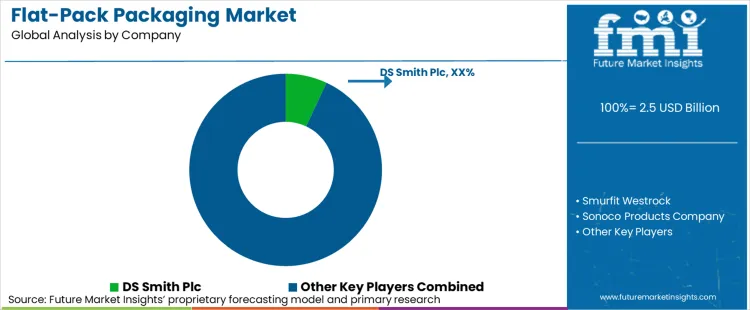
Competition in the flat-pack packaging market is increasingly defined by engineering capability, automation compatibility, and compliance-readiness, rather than by corrugated conversion capacity alone. As flat-pack formats move from optional efficiency tools to mandated solutions under density-based carrier pricing and regulatory void-space constraints, buyers are prioritizing suppliers that can quantify and guarantee cube-reduction outcomes across outbound shipping, return logistics, and empty storage.
A key competitive differentiator is the ability to integrate flat-pack design with right-sizing and box-on-demand automation. Suppliers that offer engineered folding geometries compatible with automated erection and on-demand cutting systems are gaining preference among large e-commerce and furniture distributors. This capability allows customers to eliminate void fill entirely while maintaining predictable carton geometry-an essential requirement under FedEx and UPS density-based pricing regimes introduced in January 2026. As a result, competition is shifting away from standardized SKU-based cartons toward platform-based flat-pack systems that adapt dynamically to product dimensions.
Another axis of competition is regulatory and sustainability alignment. The EU Packaging and Packaging Waste Regulation (PPWR) cited in the document enforces maximum empty-space thresholds and recyclability documentation, pushing buyers toward suppliers with auditable compliance frameworks. Flat-pack packaging suppliers able to demonstrate fiber efficiency, recyclability, and fit-to-size compliance are increasingly shortlisted in procurement processes, particularly in Europe. Over the forecast period, this dynamic is expected to consolidate market share among global packaging groups with integrated design, automation, and sustainability capabilities, while limiting the role of smaller converters focused solely on price competition.
Key Players Profiled in the Flat-Pack Packaging Market
- DS Smith Plc
- Smurfit Westrock
- Sonoco Products Company
- Nine Dragons Paper Holdings Limited
- Greatview Aseptic Packaging Company Limited
- Billerud AB
Market Definition
The flat-pack packaging market comprises collapsible, foldable, and ready-to-assemble transport packaging formats engineered to minimize shipping cube, reduce dimensional-weight freight charges, and enable efficient storage and handling across furniture kits, home improvement products, industrial components, and e-commerce fulfillment operations.
Within FMI’s defined scope, flat-pack packaging includes foldable corrugated boxes, adjustable-depth cartons, self-erecting flat-pack designs, and precision-scored paperboard systems intended for flat storage prior to use and rapid erection at pack-out. The scope excludes rigid one-piece containers, non-collapsible wooden crating, flexible plastic packaging, and downstream installation or assembly services.
Scope of the Report
| Attribute | Details |
|---|---|
| Base Year | 2026 |
| Forecast Period | 2026 to 2036 |
| Market Size (2026E) | USD 2,480 million |
| Market Size (2036F) | USD 8,360 million |
| CAGR (2026 to 2036) | 12.9% |
| Product Segments | Furniture Kits; Industrial Components; Home Improvement Products; E-Commerce Shipments |
| Pack Structures | Foldable Corrugated Boxes; Adjustable-Depth Cartons; Self-Erecting Flat-Pack Designs |
| Materials | Corrugated Board; Heavyweight Paperboard |
| Regions Covered | North America; Europe; East Asia; South Asia; Japan; Rest of the World |
| Key Countries | China; Germany; United States; India; Japan |
Flat-Pack Packaging Market Key Segments
By Product Segment:
- Furniture Kits
- Industrial Components
- Home Improvement Products
- E-Commerce Shipments
By Pack Structure:
- Foldable Corrugated Boxes
- Adjustable-Depth Cartons
- Self-Erecting Flat-Pack Designs
By Material:
- Corrugated Board
- Heavyweight Paperboard
By Region:
- North America
- Europe
- East Asia
- South Asia
- Japan
- Rest of the World
Bibliography
- FedEx Corporation. (2026). Dimensional weight pricing methodology update for ground and express shipments. FedEx Official Carrier Bulletin.
- United Parcel Service, Inc. (2026). Density-based pricing changes and packaging efficiency requirements. UPS Rate and Service Guide.
- European Commission. (2024). Packaging and Packaging Waste Regulation (PPWR): Empty space limits and packaging efficiency requirements. Official Journal of the European Union.
- Smurfit Westrock. (2026). Pak On Demand automation deployment and right-sizing performance update. Investor presentation, February 11, 2026.
- Mondi Group. (2026). Advanced flat-pack and slim-fill corrugated solutions showcased at WorldStar Düsseldorf 2026. Corporate exhibition release.
- Blum Group. (2026). Beyond Components initiative: PLICOBOX systems and ready-to-assemble furniture kit packaging. interzum Cologne product announcement.
- Oji Holdings Corporation. (2026). Recycled aseptic-carton-based corrugated packaging for automation-ready flat-pack applications. Corporate press release, January 30, 2026.
- ITC Limited. (2026). Expansion of value-added paperboards for e-commerce and flat-pack packaging applications. Company sustainability and packaging materials disclosure.
Frequently Asked Questions
What is the long-term growth outlook for the flat-pack packaging market?
FMI projects the market to grow at a 12.9% CAGR from 2026 to 2036, driven by carrier pricing reforms, regulatory void-space limits, and expanding e-commerce and furniture kit distribution.
How large is the market expected to be by 2036?
The flat-pack packaging market is expected to reach USD 8,360 million by 2036, up from USD 2,480 million in 2026.
Which product segment dominates demand?
Furniture kits dominate demand due to their high volume-to-weight ratio and sensitivity to dimensional-weight pricing.
Which countries are growing the fastest?
China leads growth at 14.2% CAGR, followed by Germany (12.0%) and the United States (11.4%), driven by export logistics, regulatory enforcement, and carrier pricing changes.
Why is flat-pack packaging becoming mandatory rather than optional?
Density-based freight pricing and regulatory empty-space limits penalize inefficient packaging, making flat-pack systems essential for cost control and compliance rather than discretionary efficiency upgrades.
Preview the report firsthand - request a free sample
Get SampleGet the brochure for pricing and purchase details.
Get PDFTable of Content
- Executive Summary
- Global Market Outlook
- Demand-side Trends
- Supply-side Trends
- Technology Roadmap Analysis
- Analysis and Recommendations
- Market Overview
- Market Coverage / Taxonomy
- Market Definition / Scope / Limitations
- Research Methodology
- Chapter Orientation
- Analytical Lens and Working Hypotheses
- Market Structure, Signals, and Trend Drivers
- Benchmarking and Cross-market Comparability
- Market Sizing, Forecasting, and Opportunity Mapping
- Research Design and Evidence Framework
- Desk Research Programme (Secondary Evidence)
- Company Annual and Sustainability Reports
- Peer-reviewed Journals and Academic Literature
- Corporate Websites, Product Literature, and Technical Notes
- Earnings Decks and Investor Briefings
- Statutory Filings and Regulatory Disclosures
- Technical White Papers and Standards Notes
- Trade Journals, Industry Magazines, and Analyst Briefs
- Conference Proceedings, Webinars, and Seminar Materials
- Government Statistics Portals and Public Data Releases
- Press Releases and Reputable Media Coverage
- Specialist Newsletters and Curated Briefings
- Sector Databases and Reference Repositories
- FMI Internal Proprietary Databases and Historical Market Datasets
- Subscription Datasets and Paid Sources
- Social Channels, Communities, and Digital Listening Inputs
- Additional Desk Sources
- Expert Input and Fieldwork (Primary Evidence)
- Primary Modes
- Qualitative Interviews and Expert Elicitation
- Quantitative Surveys and Structured Data Capture
- Blended Approach
- Why Primary Evidence is Used
- Field Techniques
- Interviews
- Surveys
- Focus Groups
- Observational and In-context Research
- Social and Community Interactions
- Stakeholder Universe Engaged
- C-suite Leaders
- Board Members
- Presidents and Vice Presidents
- R&D and Innovation Heads
- Technical Specialists
- Domain Subject-matter Experts
- Scientists
- Physicians and Other Healthcare Professionals
- Governance, Ethics, and Data Stewardship
- Research Ethics
- Data Integrity and Handling
- Primary Modes
- Tooling, Models, and Reference Databases
- Desk Research Programme (Secondary Evidence)
- Data Engineering and Model Build
- Data Acquisition and Ingestion
- Cleaning, Normalisation, and Verification
- Synthesis, Triangulation, and Analysis
- Quality Assurance and Audit Trail
- Market Background
- Market Dynamics
- Drivers
- Restraints
- Opportunity
- Trends
- Scenario Forecast
- Demand in Optimistic Scenario
- Demand in Likely Scenario
- Demand in Conservative Scenario
- Opportunity Map Analysis
- Product Life Cycle Analysis
- Supply Chain Analysis
- Investment Feasibility Matrix
- Value Chain Analysis
- PESTLE and Porter’s Analysis
- Regulatory Landscape
- Regional Parent Market Outlook
- Production and Consumption Statistics
- Import and Export Statistics
- Market Dynamics
- Global Market Analysis 2021 to 2025 and Forecast, 2026 to 2036
- Historical Market Size Value (USD Million) Analysis, 2021 to 2025
- Current and Future Market Size Value (USD Million) Projections, 2026 to 2036
- Y-o-Y Growth Trend Analysis
- Absolute $ Opportunity Analysis
- Global Market Pricing Analysis 2021 to 2025 and Forecast 2026 to 2036
- Global Market Analysis 2021 to 2025 and Forecast 2026 to 2036, By Product
- Introduction / Key Findings
- Historical Market Size Value (USD Million) Analysis By Product , 2021 to 2025
- Current and Future Market Size Value (USD Million) Analysis and Forecast By Product , 2026 to 2036
- Furniture Kits
- Industrial Components
- Home Improvement Products
- E-Commerce Shipments
- Furniture Kits
- Y-o-Y Growth Trend Analysis By Product , 2021 to 2025
- Absolute $ Opportunity Analysis By Product , 2026 to 2036
- Global Market Analysis 2021 to 2025 and Forecast 2026 to 2036, By Pack Structure
- Introduction / Key Findings
- Historical Market Size Value (USD Million) Analysis By Pack Structure, 2021 to 2025
- Current and Future Market Size Value (USD Million) Analysis and Forecast By Pack Structure, 2026 to 2036
- Foldable Corrugated Boxes
- Adjustable-Depth Cartons
- Self-Erecting Flat-Pack Designs
- Foldable Corrugated Boxes
- Y-o-Y Growth Trend Analysis By Pack Structure, 2021 to 2025
- Absolute $ Opportunity Analysis By Pack Structure, 2026 to 2036
- Global Market Analysis 2021 to 2025 and Forecast 2026 to 2036, By Material
- Introduction / Key Findings
- Historical Market Size Value (USD Million) Analysis By Material, 2021 to 2025
- Current and Future Market Size Value (USD Million) Analysis and Forecast By Material, 2026 to 2036
- Corrugated Board
- Heavyweight Paperboard
- Corrugated Board
- Y-o-Y Growth Trend Analysis By Material, 2021 to 2025
- Absolute $ Opportunity Analysis By Material, 2026 to 2036
- Global Market Analysis 2021 to 2025 and Forecast 2026 to 2036, By Region
- Introduction
- Historical Market Size Value (USD Million) Analysis By Region, 2021 to 2025
- Current Market Size Value (USD Million) Analysis and Forecast By Region, 2026 to 2036
- North America
- Latin America
- Western Europe
- Eastern Europe
- East Asia
- South Asia and Pacific
- Middle East & Africa
- Market Attractiveness Analysis By Region
- North America Market Analysis 2021 to 2025 and Forecast 2026 to 2036, By Country
- Historical Market Size Value (USD Million) Trend Analysis By Market Taxonomy, 2021 to 2025
- Market Size Value (USD Million) Forecast By Market Taxonomy, 2026 to 2036
- By Country
- USA
- Canada
- Mexico
- By Product
- By Pack Structure
- By Material
- By Country
- Market Attractiveness Analysis
- By Country
- By Product
- By Pack Structure
- By Material
- Key Takeaways
- Latin America Market Analysis 2021 to 2025 and Forecast 2026 to 2036, By Country
- Historical Market Size Value (USD Million) Trend Analysis By Market Taxonomy, 2021 to 2025
- Market Size Value (USD Million) Forecast By Market Taxonomy, 2026 to 2036
- By Country
- Brazil
- Chile
- Rest of Latin America
- By Product
- By Pack Structure
- By Material
- By Country
- Market Attractiveness Analysis
- By Country
- By Product
- By Pack Structure
- By Material
- Key Takeaways
- Western Europe Market Analysis 2021 to 2025 and Forecast 2026 to 2036, By Country
- Historical Market Size Value (USD Million) Trend Analysis By Market Taxonomy, 2021 to 2025
- Market Size Value (USD Million) Forecast By Market Taxonomy, 2026 to 2036
- By Country
- Germany
- UK
- Italy
- Spain
- France
- Nordic
- BENELUX
- Rest of Western Europe
- By Product
- By Pack Structure
- By Material
- By Country
- Market Attractiveness Analysis
- By Country
- By Product
- By Pack Structure
- By Material
- Key Takeaways
- Eastern Europe Market Analysis 2021 to 2025 and Forecast 2026 to 2036, By Country
- Historical Market Size Value (USD Million) Trend Analysis By Market Taxonomy, 2021 to 2025
- Market Size Value (USD Million) Forecast By Market Taxonomy, 2026 to 2036
- By Country
- Russia
- Poland
- Hungary
- Balkan & Baltic
- Rest of Eastern Europe
- By Product
- By Pack Structure
- By Material
- By Country
- Market Attractiveness Analysis
- By Country
- By Product
- By Pack Structure
- By Material
- Key Takeaways
- East Asia Market Analysis 2021 to 2025 and Forecast 2026 to 2036, By Country
- Historical Market Size Value (USD Million) Trend Analysis By Market Taxonomy, 2021 to 2025
- Market Size Value (USD Million) Forecast By Market Taxonomy, 2026 to 2036
- By Country
- China
- Japan
- South Korea
- By Product
- By Pack Structure
- By Material
- By Country
- Market Attractiveness Analysis
- By Country
- By Product
- By Pack Structure
- By Material
- Key Takeaways
- South Asia and Pacific Market Analysis 2021 to 2025 and Forecast 2026 to 2036, By Country
- Historical Market Size Value (USD Million) Trend Analysis By Market Taxonomy, 2021 to 2025
- Market Size Value (USD Million) Forecast By Market Taxonomy, 2026 to 2036
- By Country
- India
- ASEAN
- Australia & New Zealand
- Rest of South Asia and Pacific
- By Product
- By Pack Structure
- By Material
- By Country
- Market Attractiveness Analysis
- By Country
- By Product
- By Pack Structure
- By Material
- Key Takeaways
- Middle East & Africa Market Analysis 2021 to 2025 and Forecast 2026 to 2036, By Country
- Historical Market Size Value (USD Million) Trend Analysis By Market Taxonomy, 2021 to 2025
- Market Size Value (USD Million) Forecast By Market Taxonomy, 2026 to 2036
- By Country
- Kingdom of Saudi Arabia
- Other GCC Countries
- Turkiye
- South Africa
- Other African Union
- Rest of Middle East & Africa
- By Product
- By Pack Structure
- By Material
- By Country
- Market Attractiveness Analysis
- By Country
- By Product
- By Pack Structure
- By Material
- Key Takeaways
- Key Countries Market Analysis
- USA
- Pricing Analysis
- Market Share Analysis, 2025
- By Product
- By Pack Structure
- By Material
- Canada
- Pricing Analysis
- Market Share Analysis, 2025
- By Product
- By Pack Structure
- By Material
- Mexico
- Pricing Analysis
- Market Share Analysis, 2025
- By Product
- By Pack Structure
- By Material
- Brazil
- Pricing Analysis
- Market Share Analysis, 2025
- By Product
- By Pack Structure
- By Material
- Chile
- Pricing Analysis
- Market Share Analysis, 2025
- By Product
- By Pack Structure
- By Material
- Germany
- Pricing Analysis
- Market Share Analysis, 2025
- By Product
- By Pack Structure
- By Material
- UK
- Pricing Analysis
- Market Share Analysis, 2025
- By Product
- By Pack Structure
- By Material
- Italy
- Pricing Analysis
- Market Share Analysis, 2025
- By Product
- By Pack Structure
- By Material
- Spain
- Pricing Analysis
- Market Share Analysis, 2025
- By Product
- By Pack Structure
- By Material
- France
- Pricing Analysis
- Market Share Analysis, 2025
- By Product
- By Pack Structure
- By Material
- India
- Pricing Analysis
- Market Share Analysis, 2025
- By Product
- By Pack Structure
- By Material
- ASEAN
- Pricing Analysis
- Market Share Analysis, 2025
- By Product
- By Pack Structure
- By Material
- Australia & New Zealand
- Pricing Analysis
- Market Share Analysis, 2025
- By Product
- By Pack Structure
- By Material
- China
- Pricing Analysis
- Market Share Analysis, 2025
- By Product
- By Pack Structure
- By Material
- Japan
- Pricing Analysis
- Market Share Analysis, 2025
- By Product
- By Pack Structure
- By Material
- South Korea
- Pricing Analysis
- Market Share Analysis, 2025
- By Product
- By Pack Structure
- By Material
- Russia
- Pricing Analysis
- Market Share Analysis, 2025
- By Product
- By Pack Structure
- By Material
- Poland
- Pricing Analysis
- Market Share Analysis, 2025
- By Product
- By Pack Structure
- By Material
- Hungary
- Pricing Analysis
- Market Share Analysis, 2025
- By Product
- By Pack Structure
- By Material
- Kingdom of Saudi Arabia
- Pricing Analysis
- Market Share Analysis, 2025
- By Product
- By Pack Structure
- By Material
- Turkiye
- Pricing Analysis
- Market Share Analysis, 2025
- By Product
- By Pack Structure
- By Material
- South Africa
- Pricing Analysis
- Market Share Analysis, 2025
- By Product
- By Pack Structure
- By Material
- USA
- Market Structure Analysis
- Competition Dashboard
- Competition Benchmarking
- Market Share Analysis of Top Players
- By Regional
- By Product
- By Pack Structure
- By Material
- Competition Analysis
- Competition Deep Dive
- DS Smith Plc
- Overview
- Product Portfolio
- Profitability by Market Segments (Product/Age /Sales Channel/Region)
- Sales Footprint
- Strategy Overview
- Marketing Strategy
- Product Strategy
- Channel Strategy
- Smurfit Westrock
- Sonoco Products Company
- Nine Dragons Paper Holdings Limited
- Greatview Aseptic Packaging Company Limited
- DS Smith Plc
- Competition Deep Dive
- Assumptions & Acronyms Used


