

- Market Size (2026)
- USD 2.3 Bn
- Forecast (2036)
- USD 5.9 Bn
- CAGR (2026 to 2036)
- 9.8%
How big is the Genotoxicity Testing Market in 2026?
USD 2.3 billion in 2026 and USD 5.9 billion by 2036 at a 9.8% CAGR.
Sales in the genotoxicity testing market are projected to grow at a 9.8% CAGR through 2036, increasing valuation from USD 2.3 billion in 2026 to USD 5.9 billion by 2036. Growth is being supported by regulatory expectations for comprehensive genetic toxicology assessment during drug development and submission activities. FDA guidance issued in November 2024 established a consistent follow-up framework for Ames-positive drug candidates, reinforcing the importance of confirmatory testing and scientifically robust genotoxicity evaluation. This increases demand for preclinical CRO services capable of providing screening capacity and defensible interpretation of study findings.
The United Kingdom is forecast to expand at a 9.6% CAGR compared with 9.3% for the United States. MHRA receives approximately 950 to 1,000 clinical trial applications annually through a centralized review structure, concentrating nonclinical documentation requirements and creating a streamlined pathway for regulatory testing support. This environment can support more consistent demand for genotoxicity assessment services, whereas the United States follows separate pharmaceutical and medical device regulatory pathways that often require different evidence packages and testing strategies from contract laboratories.
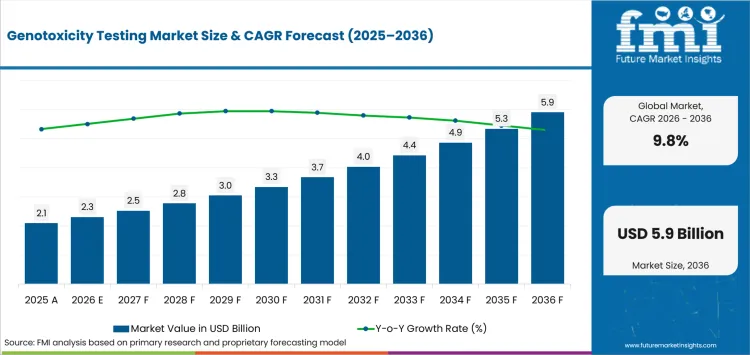
Key Takeaways of Genotoxicity Testing Market
- Regulatory submissions sustain demand for laboratories that connect mutation screening with defensible interpretation.
- In vitro genotoxicity testing is projected at 46.0% by service in 2026 due to lower material requirements.
- Pharmaceuticals are estimated at 43.0% of application demand in 2026 owing to recurring drug and impurity assessments.
- In vitro testing is forecast at 54.0% of test type demand in 2026 supported by accepted assay batteries.
- Equivocal findings extend schedules as sponsors commission targeted confirmation to reach a defensible conclusion.
- Charles River Laboratories International, Inc., Eurofins Scientific SE, WuXi AppTec Co., Ltd., Labcorp, Inotiv, Inc., Thermo Fisher Scientific Inc., NAMSA and Toxys.
Analyst Perspective
"Positive or equivocal results shift the work from hazard detection to evidence-based interpretation. Laboratories that link metabolic activation, exposure and mode-of-action evidence can prevent weak signals from triggering redundant studies or avoidable submission delays."
- Nikhil Kaitwade, Principal Consultant, Future Market Insights
How is the Genotoxicity Testing Market segmented?
The genotoxicity testing industry is segmented by service, application, test type, end user, technology and region.
The genotoxicity testing market is segmented by service, application, test type, end user, technology and region. Service categories cover in vitro and in vivo testing plus analytical, regulatory and consulting services. Applications include pharmaceuticals, medical devices, chemicals and agrochemicals, and cosmetics and personal care regulated programs. Test types distinguish in vitro, in vivo and mechanistic testing across accepted endpoints and follow-up questions. End users include pharmaceutical and biotechnology companies, contract research organizations and research institutes, while technologies cover molecular assays, cell-based assays and genomic analysis.
Why does in vitro genotoxicity testing lead the service category?
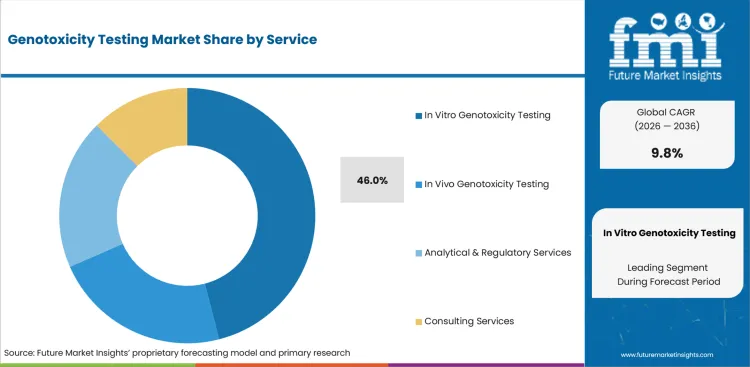
Outsourced testing services use in vitro batteries to identify mutation and chromosome damage with limited test material. Early findings direct exposure confirmation or mechanistic work and preserve material for later study decisions. A defined sequence prevents follow-up packages that fail to address the unresolved signal.
- In vitro genotoxicity testing is projected to hold 46.0% share in 2026 owing to accepted screening workflows and lower compound requirements.
- Cytotoxicity assays help laboratories separate test-system stress from genetic damage during confirmatory planning. Sponsors purchase interpretation with the assay so an unexplained positive result does not delay candidate selection or filing.
Why do pharmaceuticals lead the application category?
A positive mutation signal can stop a pharmaceutical candidate or alter its development plan. Early drug discovery services therefore place genotoxicity testing near candidate-selection and impurity-control milestones. Programs also reassess process impurities and degradants as manufacturing routes change during development.
- By application, pharmaceuticals are estimated to hold 43.0% in 2026 owing to recurring requirements for active substances and mutagenic impurities.
- Toxicologists use early screens during flexible study planning across dose and exposure decisions for candidate programs. Preclinical medical device testing follows an extraction-based route tied to patient contact. Pharmaceutical demand remains linked to systemic exposure assessment and mutagenic impurity control across development programs.
What supports in vitro testing within the test type category?
Bacterial and mammalian systems identify mutation or chromosome damage under controlled exposure conditions. Sponsors compare endpoint patterns and reserve animal work for unresolved exposure questions. Mechanistic assays clarify ambiguous findings but do not replace accepted regulatory endpoints.
- The in vitro testing segment is likely to capture 54.0% share in 2026 attributable to established batteries used ahead of justified in vivo follow-up.
- Bacterial assays screen point mutations, and mammalian systems add chromosome-level evidence during early safety assessment. Laboratories combine both endpoints to direct later work toward the remaining biological question instead of repeating broad testing without a defined purpose.
How do pharmaceutical and biotechnology companies influence end-user demand?
Sponsors define the nonclinical strategy and remain accountable for submitted evidence even as clinical research organizations execute specialized studies. Internal toxicologists connect outsourced results with exposure, regulatory timing and manufacturing changes across global development portfolios. Consistent sponsor oversight keeps follow-up logic aligned across laboratories and submission stages.
- By end user, pharmaceutical and biotechnology companies are forecast to represent 45.0% in 2026 driven by repeated testing across development programs.
- Specialist laboratories provide added capacity across discovery, GLP execution and submission-stage work. Sponsors retain the study rationale so a positive signal triggers targeted confirmation instead of duplicated assays or conflicting conclusions.
What are the drivers, restraints and opportunities in the Genotoxicity Testing Market?
Accepted methods sustain demand, ambiguous findings add follow-up work and mechanistic assays improve study selection.
- Driver: ICH, OECD and ISO methods define accepted endpoints across pharmaceutical, device and chemical programs.
- Restraint: Positive or borderline findings require exposure confirmation or another endpoint to resolve genetic risk.
- Opportunity: Reporter assays and genomic tools direct confirmatory work toward the biological mechanism causing a signal.
Regulated development requires mutation and chromosome-damage evidence within each application-specific safety plan, and harmonized endpoints support comparable GLP studies across chemical testing services and pharmaceutical programs.
Cytotoxicity and weak metabolic activation sometimes produce findings that do not explain human risk. Sponsors then commission exposure confirmation or another endpoint, increasing material use and delaying the next decision.
Mechanistic assays narrow the next study by separating direct genetic damage from broader cellular stress. FDA’s March 2026 draft guidance requires fit-for-purpose validation for new approach methods used in regulatory submissions, including organ-on-chip drug testing approaches.
Which country CAGRs are profiled in the Genotoxicity Testing Market?
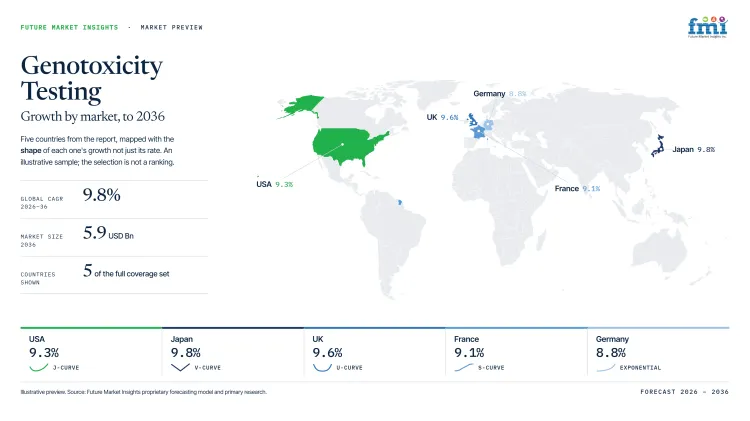
| Country | CAGR |
|---|---|
| Japan | 9.8% |
| United Kingdom | 9.6% |
| United States | 9.3% |
| France | 9.1% |
| Germany | 8.8% |
How do country-level CAGRs compare in the Genotoxicity Testing Market?
The displayed country CAGRs span 1.0 percentage point and describe forecast pace without measuring current market size. National oversight and application coverage determine how required studies convert into laboratory orders.
- Japan rewards laboratories that align harmonized pharmaceutical batteries with product-specific study justification.
- The United Kingdom concentrates review and places greater weight on auditable GLP documentation.
- The United States distributes demand across pharmaceutical and medical device pathways with separate evidence expectations.
- France combines European rules with detailed national review for chemicals and consumer applications.
- Germany pairs strong GLP expertise with demanding reassessment work for industrial and pharmaceutical substances.
Comparable CAGRs can produce different market entry conditions. The full report provides country-level CAGR analysis across North America, Latin America, Europe, East Asia, South Asia and Pacific, and the Middle East and Africa.
Country-wise Analysis
- Japan’s pharmaceutical laboratories work within harmonized ICH expectations across conventional medicines and newer radiopharmaceutical programs, yet national submissions require translated protocols plus written justification for deviations and clear links between nonclinical findings and final decisions. In August 2025 the Ministry of Health, Labour and Welfare removed routine genotoxicity studies for expected radiation damage from its radiopharmaceutical guidance and retained safety reasoning for nonradioactive components and related impurities. Genotoxicity testing sales in Japan are forecast to expand at 9.8% CAGR by 2036, supported by specialist laboratories despite separate evidence packages and added consultation for uncommon exposure routes during complex dossier review.
- United Kingdom sponsors use centralized trial authorization and an established contract laboratory base for multi-site pharmaceutical programs, which concentrates submission work around auditable GLP records and coordinated responses from laboratories serving several development partners. The United Kingdom’s genotoxicity testing outlook is anticipated to advance at 9.6% CAGR over the assessment period, reinforced by consistent nonclinical review and mature outsourcing capacity for complex product portfolios and changing specifications. MHRA guidance updated in April 2026 requires an OECD GLP compliance statement for applicable safety studies, yet incomplete audit trails can delay authorization and postpone laboratory orders for sponsors until later development stages.
- United States sponsors follow separate pharmaceutical and medical device submission pathways, producing distinct exposure questions and biological evaluation records across a broad contract laboratory network that serves domestic and global development programs. FDA updated its nitrosamine recommendations in June 2025 and identified enhanced Ames testing plus a second mammalian mutation assay for impurities lacking sufficient compound-specific data, increasing follow-up work and coordination across submissions. In the United States, genotoxicity testing demand is predicted to advance at 9.3% CAGR through 2036, supported by diverse sponsor activity despite fragmented review routes and longer scheduling for multi-laboratory evidence packages with specialized review teams.
- France combines national toxicology review with European product rules for chemical and cosmetic ingredients, requiring laboratories to defend assay quality plus biological relevance across varied exposure routes and representative materials used in regulated product categories. In February 2025 ANSES reported that potential genotoxic effects could not be ruled out for most titanium dioxide forms used in cosmetics, prompting manufacturers to assess additional data needs across distinct particle characteristics. Adoption of genotoxicity testing in France is estimated to expand at 9.1% CAGR through 2036, influenced by standardized methods despite material-representation requirements and mechanistic interpretation during market authorization for complex cosmetic formulations.
- Germany combines dense GLP expertise with chemical risk-assessment experience for industrial substances and pharmaceutical products, supporting mutation and chromosome-damage investigations that must reconcile conflicting historical evidence across regulated supply chains and cross-border submissions. In February 2026 the German Federal Institute for Risk Assessment reassessed 2-chloroethanol using updated mutagenicity evidence, demonstrating how national authorities revise documentation requirements as scientific expectations change across complex chemical risk assessments. By 2036, Germany is projected to grow at 8.8% CAGR, aided by technical depth despite concentrated specialist capacity and longer scheduling for imported products requiring aligned European and national records across multiple national submission authorities.
Who are the notable companies in the Genotoxicity Testing Market?
Charles River Laboratories International, Inc., Eurofins Scientific SE, WuXi AppTec Co., Ltd., Labcorp, Inotiv, Inc., Thermo Fisher Scientific Inc., NAMSA and Toxys are the notable companies serving this market.
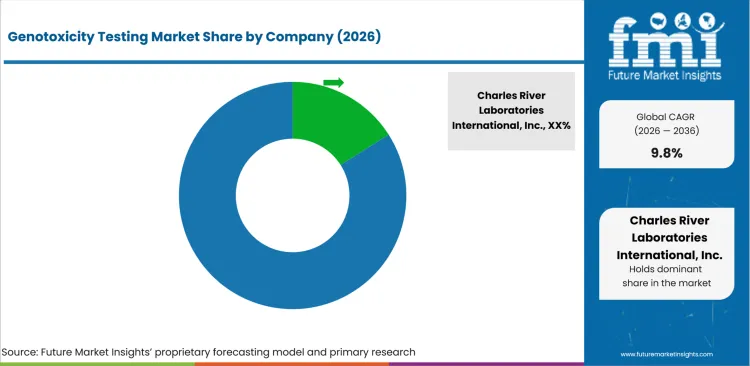
Competition remains fragmented across global CROs, testing networks, device specialists and mechanistic assay developers serving distinct regulatory applications. Entry requires verified GLP scope, validated methods and interpretation that resolves equivocal findings within the relevant product pathway.
- Charles River, Eurofins, WuXi AppTec and Labcorp provide broad regulated assay coverage across development programs.
- Inotiv provides GLP in vitro and in vivo genetic toxicology testing built on its acquired BioReliance and Integrated Laboratory Systems capabilities, serving pharmaceutical sponsors across development programs. NAMSA concentrates on medical device biological evaluation within broader testing and certification networks serving international clients.
- Thermo Fisher supplies laboratory workflow platforms and Toxys provides mechanistic reporter assays used to investigate unresolved genotoxic signals.
Competitive Benchmarking: Genotoxicity Testing Market
| Company | Regulatory Assay Breadth | Mechanistic Capability | Medical Device Relevance | Geographic Reach |
|---|---|---|---|---|
| Charles River Laboratories International, Inc. | High | High | Medium | Global |
| Eurofins Scientific SE | High | High | High | Global |
| WuXi AppTec Co., Ltd. | High | High | Medium | Asia with worldwide clients |
| Labcorp | High | High | Low | Global |
| Inotiv, Inc. | Medium | Medium | High | Global |
| Thermo Fisher Scientific Inc. | Low | High | Low | Global |
| NAMSA | Medium | Medium | High | North America and Europe |
| Toxys | Low | High | Low | Europe and North America |
Key Developments in the Genotoxicity Testing Market
- In March 2026, Toxys signed a memorandum with the Korean Institute of Toxicology to evaluate ToxTracker adoption. The agreement gives KIT a defined route to assess the assay within research and regulatory activities.
- In January 2026, NAMSA completed its acquisition of selected Labcorp medical device testing assets. The transaction transferred biological safety and preclinical services into its United States network.
- In August 2025, Toxys launched ToxTracker EMP for N-nitrosamine genotoxicity with enhanced metabolism. The contracted service addresses impurities requiring stronger bioactivation than standard mammalian conditions provide.
Key Players in the Genotoxicity Testing Market
Integrated Genetic Toxicology CROs
- Charles River Laboratories International, Inc.
- Eurofins Scientific SE
- WuXi AppTec Co., Ltd.
- Labcorp
Testing and Medical Device Specialists
- Inotiv, Inc.
- NAMSA
Mechanistic Assay and Workflow Platforms
- Thermo Fisher Scientific Inc.
- Toxys
Genotoxicity Testing Market - Report Scope
| Coverage field | Report scope |
|---|---|
| Market breakdown | By service, application, test type, end user, technology and region. |
| Quantitative Units | USD billion. |
| Market Definition | Genotoxicity testing, interpretation and assay workflows used across regulated product development. |
| Regions Covered | North America, Latin America, Europe, East Asia, South Asia and Pacific, and Middle East and Africa. |
| Countries Covered | Japan, United Kingdom, United States, France, Germany, and 20+ countries included in the full report. |
| Key Companies Profiled | Charles River Laboratories International, Inc., Eurofins Scientific SE, WuXi AppTec Co., Ltd., Labcorp, Inotiv, Inc., Thermo Fisher Scientific Inc., NAMSA and Toxys. |
| Forecast Period | 2026 to 2036. |
| Approach | Primary and secondary research with market triangulation. |
Genotoxicity Testing Market - Research Methodology
| Method | Approach |
|---|---|
| Primary Research | FMI analysts gathered input from manufacturers, service providers, technology developers, distributors, end users, procurement teams, and subject-matter experts. Interviews examined purchasing decisions, product or service evaluation, adoption barriers, approval requirements, pricing considerations, and expectations for technical or commercial support. Respondents were also asked what evidence is required before a trial, pilot, or initial order develops into regular purchasing. |
| Desk Research | Desk research covered government statistics, regulatory publications, trade data, industry associations, technical literature, standards, company filings, product information, and official corporate announcements. Sources were reviewed for relevance, publication date, geographic coverage, and consistency with the defined market scope. Claims relating to performance, applications, approvals, capacity, investment, and commercial activity were retained only when supported by credible public evidence. |
| Market Sizing and Forecasting | The market model combined the baseline value with historical performance, segment structure, pricing and volume indicators, adoption levels, company participation, and country-level demand conditions. Forecast assumptions considered economic activity, investment trends, regulatory developments, technology adoption, purchasing cycles, supply availability, and barriers to wider market use. Segment and regional estimates were reconciled before the final market total was calculated. |
| Data Validation | Estimates were checked against multiple independent indicators, including public data, company activity, trade patterns, industry developments, and findings from primary interviews. Validation also tested whether products, services, applications, and company revenues fell within the defined market boundaries. Adjacent categories, unsupported claims, overlapping revenues, and activities without direct market relevance were excluded to reduce double counting and maintain consistency across segments and countries. |
Genotoxicity Testing Market by Segments
Genotoxicity Testing Market segmented by Service:
- In Vitro Genotoxicity Testing
- Ames Test
- Micronucleus Assay
- Chromosomal Aberration Test
- In Vivo Genotoxicity Testing
- Rodent Micronucleus Test
- Comet Assay
- Transgenic Rodent Mutation Assay
- Analytical & Regulatory Services
- Study Design
- Regulatory Documentation
- Data Interpretation
- Consulting Services
- Preclinical Safety Consulting
- Risk Assessment
- Compliance Support
Genotoxicity Testing Market segmented by Application:
- Pharmaceuticals
- Small Molecule Drugs
- Biologics
- Cell & Gene Therapies
- Medical Devices
- Implantable Devices
- Drug-device Combination Products
- Diagnostic Devices
- Chemicals & Agrochemicals
- Industrial Chemicals
- Pesticides
- Specialty Chemicals
- Cosmetics & Personal Care
- Cosmetic Ingredients
- Personal Care Products
- Fragrance Ingredients
Genotoxicity Testing Market segmented by Test Type:
- In Vitro Testing
- Bacterial Reverse Mutation Test
- In Vitro Micronucleus Test
- Mammalian Cell Gene Mutation Test
- In Vivo Testing
- Rodent Bone Marrow Micronucleus Test
- Comet Assay
- DNA Damage Assessment
- Mechanistic Genotoxicity Testing
- DNA Adduct Analysis
- Oxidative DNA Damage Studies
- Genome Stability Assessment
Genotoxicity Testing Market segmented by End User:
- Pharmaceutical & Biotechnology Companies
- Pharmaceutical Companies
- Biotechnology Companies
- Generic Drug Manufacturers
- Contract Research Organizations
- Preclinical CROs
- Safety Assessment Laboratories
- Analytical Service Providers
- Academic & Research Institutes
- Universities
- Government Research Centers
- Toxicology Institutes
Genotoxicity Testing Market segmented by Technology:
- Molecular Assays
- Flow Cytometry
- Fluorescence-based Assays
- Gene Mutation Assays
- Cell-based Assays
- Mammalian Cell Culture
- Bacterial Cell Systems
- Stem Cell-based Models
- Genomic Analysis
- Next-generation Sequencing
- DNA Damage Biomarker Analysis
- Bioinformatics Analysis
Genotoxicity Testing Market segmented by Region:
- North America
- Europe
- East Asia
- South Asia
- Latin America
Research Sources and Bibliography
- USA Food and Drug Administration. (2024, November 5). Recommended Followup Testing for an Ames-Positive Drug (Active Ingredient) or Metabolite To Support First-in-Human Clinical Trials With Healthy Subjects.
- Medicines and Healthcare products Regulatory Agency. (2026, April 28). Common issues identified during clinical trial applications.
- USA Food and Drug Administration. (2026, March). General Considerations for the Use of New Approach Methodologies in Drug Development.
- Ministry of Health, Labour and Welfare. (2025, August 1).
- Medicines and Healthcare products Regulatory Agency. (2026, April 28). Common issues: Non-clinical.
- USA Food and Drug Administration. (2025, June 23). CDER Nitrosamine Impurity Acceptable Intake Limits.
- French Agency for Food, Environmental and Occupational Health & Safety. (2025, February 14). Cosmetics: how can we better protect consumer health?
- German Federal Institute for Risk Assessment. (2026, February 27). 2-chloroethanol: Re-assessment of its mutagenic potential and derivation of provisional acute and chronic oral reference values.
- Toxys. (2026, March 25). Toxys and the Korean Institute of Toxicology Sign Memorandum of Understanding to Advance Collaboration in Genetic Toxicology.
- NAMSA. (2026, January 8). NAMSA Announces Strategic Acquisition of Select Assets of the Early Development Medical Device Testing Business of Labcorp.
- Toxys. (2025, August 25). ToxTracker EMP launches as a service for evaluating the genotoxic potential of N-nitrosamines.
This bibliography is provided for reader reference and is not exhaustive. The full report contains the complete reference list and detailed citations.
This Report Answers
- What are the 2026 and 2036 values?
- Which rules sustain genetic toxicology studies?
- Which segments hold major 2026 shares?
- Why does in vitro testing lead?
- How does sponsor oversight shape outsourcing?
- Which findings extend study schedules?
- How do country growth routes differ?
- Which companies provide testing and interpretation?
- Which developments changed capacity and access?
Frequently Asked Questions
How big is the Genotoxicity Testing Market in 2026?
USD 2.3 billion is the estimated 2026 value of the genotoxicity testing market across regulated service and assay categories. The genotoxicity testing market is projected to reach USD 5.9 billion by 2036 as sponsors require defensible mutation and chromosome-damage evidence.
What is the CAGR of the Genotoxicity Testing Market from 2026 to 2036?
The genotoxicity testing market is projected to expand at 9.8% CAGR from 2026 to 2036 across regulated pharmaceutical and device applications. The genotoxicity testing market forecast depends on accepted batteries and interpretation that converts uncertain findings into justified follow-up decisions.
Which test type is projected to account for 54.0% of the Genotoxicity Testing Market?
In vitro testing is forecast to account for 54.0% of genotoxicity testing market demand by test type in 2026. The genotoxicity testing market uses bacterial and mammalian assays for screening and reserves animal work for exposure confirmation or unresolved mechanisms.
How much value is the Genotoxicity Testing Market expected to add between 2026 and 2036?
USD 3.6 billion is expected to be added to the genotoxicity testing market between 2026 and 2036. The genotoxicity testing market increase reflects recurring regulated studies plus interpretation and confirmation work that changes material requirements and laboratory selection across development programs.
Which companies are active in the Genotoxicity Testing Market?
Key companies are profiled in the genotoxicity testing market across laboratory testing, medical device evaluation and assay-platform roles. The genotoxicity testing market includes Charles River, Eurofins, WuXi AppTec, Labcorp, Intertek, Thermo Fisher, NAMSA and Toxys across laboratory execution, medical device work and mechanistic workflows.
Preview the report firsthand - request a free sample
Get SampleGet the brochure for pricing and purchase details.
Get PDFTable of Content
- Key Takeaways
- Market Size and CAGR
- Top Growth Driver
- Fastest Growing Segment
- Leading Region
- Key Companies
- Emerging Opportunities
- Executive Summary
- Global Market Outlook
- Demand-side Trends
- Supply-side Trends
- Technology Roadmap Analysis
- Analysis and Recommendations
- Analyst Perspective (What is happening? Why now? What should investors know?)
- Key Questions Answered
- How large is the market?
- What is the CAGR?
- What are key trends?
- Which region dominates?
- Who are the leaders?
- Market Overview
- Market Coverage / Taxonomy
- Market Definition / Scope / Limitations
- Research Methodology
- Chapter Orientation
- Analytical Lens and Working Hypotheses
- Market Structure, Signals, and Trend Drivers
- Benchmarking and Cross-market Comparability
- Market Sizing, Forecasting, and Opportunity Mapping
- Research Design and Evidence Framework
- Desk Research Programme (Secondary Evidence)
- Expert Input and Fieldwork (Primary Evidence)
- Tooling, Models, and Reference Databases
- Data Engineering and Model Build
- Quality Assurance and Audit Trail
- Market Background
- Market Dynamics (Drivers, Restraints, Opportunity, Trends)
- Scenario Forecast (Optimistic, Likely, Conservative)
- Impact Analysis
- AI Impact
- Sustainability Impact
- Regulatory Impact
- Technology Impact
- Consumer / Buyer Analysis
- Purchase Drivers
- Adoption Barriers
- Buyer Journey
- Opportunity Map Analysis
- Product Life Cycle Analysis
- Supply Chain Analysis
- Investment Feasibility Matrix
- Value Chain Analysis
- PESTLE and Porter's Analysis
- Regulatory Landscape
- Regional Parent Market Outlook
- Production and Consumption Statistics
- Import and Export Statistics
- Global Market Analysis and Forecast, 2021 to 2036
- Historical Market Size Value (USD Billion) Analysis, 2021 to 2025
- Current and Future Market Size Value (USD Billion) Projections, 2026 to 2036
- Y-o-Y Growth Trend Analysis
- Absolute $ Opportunity Analysis
- Global Market Pricing Analysis, 2021 to 2036
- Global Market Analysis and Forecast, By Service, 2021 to 2036
- Introduction / Key Findings
- Historical Market Size Value (USD Billion) Analysis By Service, 2021 to 2025
- Current and Future Market Size Value (USD Billion) Analysis and Forecast By Service, 2026 to 2036
- In Vitro Genotoxicity Testing
- Ames Test
- Micronucleus Assay
- Chromosomal Aberration Test
- In Vivo Genotoxicity Testing
- Rodent Micronucleus Test
- Comet Assay
- Transgenic Rodent Mutation Assay
- Analytical & Regulatory Services
- Study Design
- Regulatory Documentation
- Data Interpretation
- Consulting Services
- Preclinical Safety Consulting
- Risk Assessment
- Compliance Support
- In Vitro Genotoxicity Testing
- Y-o-Y Growth Trend Analysis By Service, 2021 to 2025
- Absolute $ Opportunity Analysis By Service, 2026 to 2036
- Global Market Analysis and Forecast, By Application, 2021 to 2036
- Introduction / Key Findings
- Historical Market Size Value (USD Billion) Analysis By Application, 2021 to 2025
- Current and Future Market Size Value (USD Billion) Analysis and Forecast By Application, 2026 to 2036
- Pharmaceuticals
- Small Molecule Drugs
- Biologics
- Cell & Gene Therapies
- Medical Devices
- Implantable Devices
- Drug-device Combination Products
- Diagnostic Devices
- Chemicals & Agrochemicals
- Industrial Chemicals
- Pesticides
- Specialty Chemicals
- Cosmetics & Personal Care
- Cosmetic Ingredients
- Personal Care Products
- Fragrance Ingredients
- Pharmaceuticals
- Y-o-Y Growth Trend Analysis By Application, 2021 to 2025
- Absolute $ Opportunity Analysis By Application, 2026 to 2036
- Global Market Analysis and Forecast, By Test Type, 2021 to 2036
- Introduction / Key Findings
- Historical Market Size Value (USD Billion) Analysis By Test Type, 2021 to 2025
- Current and Future Market Size Value (USD Billion) Analysis and Forecast By Test Type, 2026 to 2036
- In Vitro Testing
- Bacterial Reverse Mutation Test
- In Vitro Micronucleus Test
- Mammalian Cell Gene Mutation Test
- In Vivo Testing
- Rodent Bone Marrow Micronucleus Test
- Comet Assay
- DNA Damage Assessment
- Mechanistic Genotoxicity Testing
- DNA Adduct Analysis
- Oxidative DNA Damage Studies
- Genome Stability Assessment
- In Vitro Testing
- Y-o-Y Growth Trend Analysis By Test Type, 2021 to 2025
- Absolute $ Opportunity Analysis By Test Type, 2026 to 2036
- Global Market Analysis and Forecast, By End User, 2021 to 2036
- Introduction / Key Findings
- Historical Market Size Value (USD Billion) Analysis By End User, 2021 to 2025
- Current and Future Market Size Value (USD Billion) Analysis and Forecast By End User, 2026 to 2036
- Pharmaceutical & Biotechnology Companies
- Pharmaceutical Companies
- Biotechnology Companies
- Generic Drug Manufacturers
- Contract Research Organizations
- Preclinical CROs
- Safety Assessment Laboratories
- Analytical Service Providers
- Academic & Research Institutes
- Universities
- Government Research Centers
- Toxicology Institutes
- Pharmaceutical & Biotechnology Companies
- Y-o-Y Growth Trend Analysis By End User, 2021 to 2025
- Absolute $ Opportunity Analysis By End User, 2026 to 2036
- Global Market Analysis and Forecast, By Technology, 2021 to 2036
- Introduction / Key Findings
- Historical Market Size Value (USD Billion) Analysis By Technology, 2021 to 2025
- Current and Future Market Size Value (USD Billion) Analysis and Forecast By Technology, 2026 to 2036
- Molecular Assays
- Flow Cytometry
- Fluorescence-based Assays
- Gene Mutation Assays
- Cell-based Assays
- Mammalian Cell Culture
- Bacterial Cell Systems
- Stem Cell-based Models
- Genomic Analysis
- Next-generation Sequencing
- DNA Damage Biomarker Analysis
- Bioinformatics Analysis
- Molecular Assays
- Y-o-Y Growth Trend Analysis By Technology, 2021 to 2025
- Absolute $ Opportunity Analysis By Technology, 2026 to 2036
- Global Market Analysis and Forecast, By Region, 2021 to 2036
- Introduction
- Historical Market Size Value (USD Billion) Analysis By Region, 2021 to 2025
- Current Market Size Value (USD Billion) Analysis and Forecast By Region, 2026 to 2036
- North America
- Latin America
- Western Europe
- Eastern Europe
- East Asia
- South Asia and Pacific
- Middle East & Africa
- Market Attractiveness Analysis By Region
- North America Market Analysis and Forecast, By Country, 2021 to 2036
- Historical Market Size Value (USD Billion) Trend Analysis By Market Taxonomy, 2021 to 2025
- Market Size Value (USD Billion) Forecast By Market Taxonomy, 2026 to 2036
- By Country
- USA
- Canada
- By Service
- By Application
- By Test Type
- By End User
- By Technology
- By Country
- Market Attractiveness Analysis
- By Country
- By Service
- By Application
- By Test Type
- By End User
- By Technology
- Key Takeaways
- Latin America Market Analysis and Forecast, By Country
- Historical Market Size Value (USD Billion) Trend Analysis By Market Taxonomy, 2021 to 2025
- Market Size Value (USD Billion) Forecast By Market Taxonomy, 2026 to 2036
- By Country
- Brazil
- Mexico
- Chile
- Rest of Latin America
- By Service
- By Application
- By Test Type
- By End User
- By Technology
- By Country
- Market Attractiveness Analysis
- By Country
- By Service
- By Application
- By Test Type
- By End User
- By Technology
- Key Takeaways
- Western Europe Market Analysis and Forecast, By Country
- Historical Market Size Value (USD Billion) Trend Analysis By Market Taxonomy, 2021 to 2025
- Market Size Value (USD Billion) Forecast By Market Taxonomy, 2026 to 2036
- By Country
- Germany
- UK
- Italy
- Spain
- France
- Nordic
- BENELUX
- Rest of Western Europe
- By Service
- By Application
- By Test Type
- By End User
- By Technology
- By Country
- Market Attractiveness Analysis
- By Country
- By Service
- By Application
- By Test Type
- By End User
- By Technology
- Key Takeaways
- Eastern Europe Market Analysis and Forecast, By Country
- Historical Market Size Value (USD Billion) Trend Analysis By Market Taxonomy, 2021 to 2025
- Market Size Value (USD Billion) Forecast By Market Taxonomy, 2026 to 2036
- By Country
- Russia
- Poland
- Hungary
- Balkan & Baltic
- Rest of Eastern Europe
- By Service
- By Application
- By Test Type
- By End User
- By Technology
- By Country
- Market Attractiveness Analysis
- By Country
- By Service
- By Application
- By Test Type
- By End User
- By Technology
- Key Takeaways
- East Asia Market Analysis and Forecast, By Country
- Historical Market Size Value (USD Billion) Trend Analysis By Market Taxonomy, 2021 to 2025
- Market Size Value (USD Billion) Forecast By Market Taxonomy, 2026 to 2036
- By Country
- China
- Japan
- South Korea
- By Service
- By Application
- By Test Type
- By End User
- By Technology
- By Country
- Market Attractiveness Analysis
- By Country
- By Service
- By Application
- By Test Type
- By End User
- By Technology
- Key Takeaways
- South Asia and Pacific Market Analysis and Forecast, By Country
- Historical Market Size Value (USD Billion) Trend Analysis By Market Taxonomy, 2021 to 2025
- Market Size Value (USD Billion) Forecast By Market Taxonomy, 2026 to 2036
- By Country
- India
- ASEAN
- Australia & New Zealand
- Rest of South Asia and Pacific
- By Service
- By Application
- By Test Type
- By End User
- By Technology
- By Country
- Market Attractiveness Analysis
- By Country
- By Service
- By Application
- By Test Type
- By End User
- By Technology
- Key Takeaways
- Middle East & Africa Market Analysis and Forecast, By Country
- Historical Market Size Value (USD Billion) Trend Analysis By Market Taxonomy, 2021 to 2025
- Market Size Value (USD Billion) Forecast By Market Taxonomy, 2026 to 2036
- By Country
- Kingdom of Saudi Arabia
- Other GCC Countries
- Türkiye
- South Africa
- Other African Union
- Rest of Middle East & Africa
- By Service
- By Application
- By Test Type
- By End User
- By Technology
- By Country
- Market Attractiveness Analysis
- By Country
- By Service
- By Application
- By Test Type
- By End User
- By Technology
- Key Takeaways
- Key Countries Market Analysis
- USA
- Pricing Analysis
- Market Share Analysis, 2025
- By Service
- By Application
- By Test Type
- By End User
- By Technology
- Canada
- Pricing Analysis
- Market Share Analysis, 2025
- By Service
- By Application
- By Test Type
- By End User
- By Technology
- Mexico
- Pricing Analysis
- Market Share Analysis, 2025
- By Service
- By Application
- By Test Type
- By End User
- By Technology
- Brazil
- Pricing Analysis
- Market Share Analysis, 2025
- By Service
- By Application
- By Test Type
- By End User
- By Technology
- Chile
- Pricing Analysis
- Market Share Analysis, 2025
- By Service
- By Application
- By Test Type
- By End User
- By Technology
- Germany
- Pricing Analysis
- Market Share Analysis, 2025
- By Service
- By Application
- By Test Type
- By End User
- By Technology
- UK
- Pricing Analysis
- Market Share Analysis, 2025
- By Service
- By Application
- By Test Type
- By End User
- By Technology
- Italy
- Pricing Analysis
- Market Share Analysis, 2025
- By Service
- By Application
- By Test Type
- By End User
- By Technology
- Spain
- Pricing Analysis
- Market Share Analysis, 2025
- By Service
- By Application
- By Test Type
- By End User
- By Technology
- France
- Pricing Analysis
- Market Share Analysis, 2025
- By Service
- By Application
- By Test Type
- By End User
- By Technology
- India
- Pricing Analysis
- Market Share Analysis, 2025
- By Service
- By Application
- By Test Type
- By End User
- By Technology
- ASEAN
- Pricing Analysis
- Market Share Analysis, 2025
- By Service
- By Application
- By Test Type
- By End User
- By Technology
- Australia & New Zealand
- Pricing Analysis
- Market Share Analysis, 2025
- By Service
- By Application
- By Test Type
- By End User
- By Technology
- China
- Pricing Analysis
- Market Share Analysis, 2025
- By Service
- By Application
- By Test Type
- By End User
- By Technology
- Japan
- Pricing Analysis
- Market Share Analysis, 2025
- By Service
- By Application
- By Test Type
- By End User
- By Technology
- South Korea
- Pricing Analysis
- Market Share Analysis, 2025
- By Service
- By Application
- By Test Type
- By End User
- By Technology
- Russia
- Pricing Analysis
- Market Share Analysis, 2025
- By Service
- By Application
- By Test Type
- By End User
- By Technology
- Poland
- Pricing Analysis
- Market Share Analysis, 2025
- By Service
- By Application
- By Test Type
- By End User
- By Technology
- Hungary
- Pricing Analysis
- Market Share Analysis, 2025
- By Service
- By Application
- By Test Type
- By End User
- By Technology
- Kingdom of Saudi Arabia
- Pricing Analysis
- Market Share Analysis, 2025
- By Service
- By Application
- By Test Type
- By End User
- By Technology
- Türkiye
- Pricing Analysis
- Market Share Analysis, 2025
- By Service
- By Application
- By Test Type
- By End User
- By Technology
- South Africa
- Pricing Analysis
- Market Share Analysis, 2025
- By Service
- By Application
- By Test Type
- By End User
- By Technology
- USA
- Market Structure Analysis
- Competition Dashboard
- Competition Benchmarking
- Market Share Analysis of Top Players
- By Regional
- By Service
- By Application
- By Test Type
- By End User
- By Technology
- Emerging Startups
- Innovation Benchmarking
- Competition Analysis
- Competition Deep Dive
- Charles River Laboratories International, Inc.
- Overview
- Product Portfolio
- Profitability by Market Segments
- Sales Footprint
- Strategy Overview
- Marketing Strategy
- Product Strategy
- Channel Strategy
- Eurofins Scientific SE
- WuXi AppTec Co., Ltd.
- Labcorp Drug Development
- SGS SA
- Inotiv, Inc.
- Thermo Fisher Scientific Inc.
- BioReliance Corporation
- NAMSA
- Toxikon Corporation
- Charles River Laboratories International, Inc.
- Case Studies
- Success Stories
- Recent Developments
- Competition Deep Dive
- Assumptions & Acronyms Used


