

- Market Size (2026)
- USD 176.0 Mn
- Forecast (2036)
- USD 352.7 Mn
- CAGR (2026 to 2036)
- 7.2%
How big is Gochugaru Market in 2026?
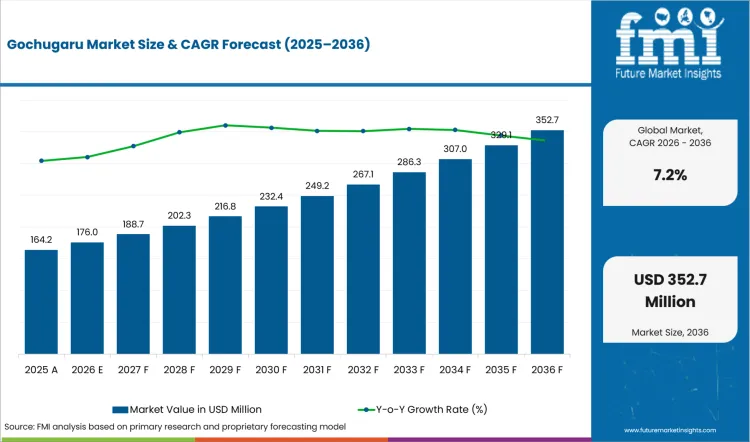
USD 176.0 million in 2026 and USD 352.7 million by 2036 at a 7.2% CAGR.
Gochugaru demand is projected to expand at a 7.2% CAGR between 2026 and 2036, pushing valuation from USD 176.0 million in 2026 and USD 352.7 million by 2036 as Korean cuisine gains wider adoption across retail and foodservice channels. MAFRA reported in January 2026 that Korean sauce exports reached USD 411.9 million during 2025, supported by growing international demand for Korean spicy flavors. The expansion of gochujang, marinades and other Korean condiments increases ingredient demand across the supply chain. Gochugaru benefits from this trend because it remains a key source of color, heat and flavor in many Korean sauce formulations.
Country conversion depends on import controls and channel maturity more than flavor awareness across international gochugaru routes. Japan’s health ministry reported 206,227 imported-food inspections during FY2024 in its August 2025 monitoring results. The inspection workload makes complete specifications and importer records operating requirements for dried spice formats crossing national borders. South Korean suppliers face a different threshold because domestic pepper availability shortens sourcing routes, although crop variability can restrict origin-specific supply.
Key Takeaways of Gochugaru Market
- Recurring use in kimchi and Korean sauces expands demand for gochugaru that meets defined origin, grind and food-safety requirements.
- Based on product type, coarse gochugaru flakes are projected to account for 31.0% in 2026 due to their visible texture in kimchi seasoning.
- The Korean-grown peppers segment is likely to capture 43.0% share in 2026 attributable to provenance-based Korean recipe specifications.
- Mild gochugaru is set to lead the heat level category with 24.0% share in 2026 due to wider tolerance across household and foodservice recipes.
- Microbiological controls and importer documentation can lengthen qualification because red-pepper lots must remain consistent across origin, grind and heat specifications.
- CJ CheilJedang Corp., Sempio Foods Company, Daesang Corporation, Nongshim Taekyung Co., Ltd., Samjin Globalnet Co., Ltd., McCormick & Company, Incorporated, Frontier Co-op and Spiceology form the profiled company register.
Analyst Perspective
"Gochugaru suppliers earn repeat business by controlling color and particle size across crop seasons without weakening the heat profile expected in Korean recipes. Commercial advantage comes from pairing those specifications with importer-ready safety records, pack formats suited to kimchi production and foodservice use."
- Nandini Roy Choudhury, Principal Consultant, Future Market Insights
How is the Gochugaru Market segmented?
The gochugaru market is segmented by product type, pepper source, heat level, application, sales channel and region.
Product type covers coarse flakes, fine powder, kimchi-grade, organic and specialty gochugaru. Pepper source includes Korean-grown, Chinese-grown, blended and other Asian origins. Heat level separates mild, medium and hot products. Application covers kimchi and fermented foods, sauces and marinades, seasoning blends, foodservice cooking and household use. Sales channels include Asian grocery retail, e-commerce, ingredient or bulk supply and foodservice distributors.
What supports kimchi and fermented foods within the application category?
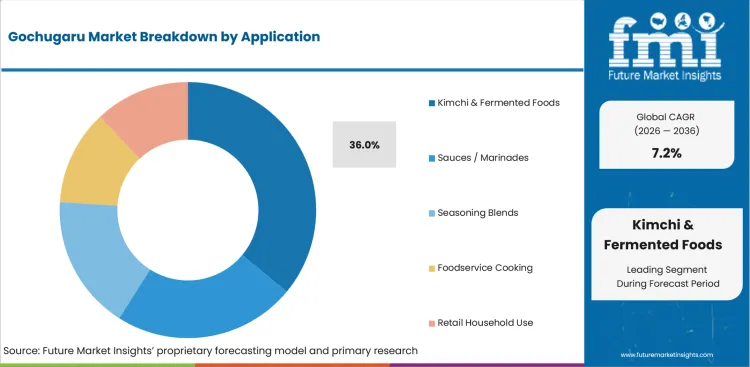
Kimchi uses gochugaru inside seasoning before fermentation, so processors manage grind and color as production inputs across food flavor systems. MAFRA reported in July 2026 that first-half kimchi exports reached USD 86.0 million after increasing 3.2% year over year. Recurring export production therefore makes pepper consistency a commercial requirement across repeated kimchi batches and seasonal sourcing cycles.
- In 2026, kimchi and fermented foods are expected to lead application demand with 36.0% share due to gochugaru’s recipe-defining color and texture.
- Fermented-food processors specify lot consistency because changes in grind or heat can alter seasoning coverage across recurring commercial batches and force recipe adjustments during production.
What makes coarse gochugaru flakes central to the product type category?
Coarse flakes retain visible pepper particles in kimchi seasoning and other preparations that need color without fine-powder dispersion. Sempio stated in December 2025 that its kimchi seasoning requires users to add gochugaru as a separately specified recipe input. That separation lets commercial kitchens adjust chile intensity without changing the rest of the seasoning base.
- By product type, coarse gochugaru flakes are estimated to hold 31.0% in 2026 owing to particle structure that remains visible across fermented-vegetable seasoning.
- Commercial kimchi makers specify particle size and color separately from heat, helping preserve batch appearance across recurring production and reducing recipe adjustment between pepper lots.
How does Korean-grown pepper influence selection within the pepper source category?
Korean-grown pepper gives food manufacturers a direct provenance statement for recipes presented as Korean-style products. Seasonal availability remains important because origin claims depend on domestic planting and harvested supply, so sourcing decisions include crop planning alongside sensory performance.
- Korean-grown peppers are likely to capture 43.0% share in 2026 attributable to origin requirements that connect finished recipes with Korean culinary positioning.
- Korean-origin programs need seasonal buffers before committing larger volumes to seasoning specifications. Korea’s statistics agency reported 25,759 hectares of chili pepper cultivation after a 2.5% annual decline in 2025. Reduced planting can tighten domestic supply during crop planning.
What drives Asian grocery retail within the sales channel category?
Asian grocery stores concentrate shoppers who already distinguish gochugaru from generic red pepper flakes and paprika. Shelf adjacency to kimchi inputs and Korean pantry products lowers the education burden during first purchase.
- The sales channel category is forecast to be led by Asian grocery retail at 34.0% share in 2026 due to product recognition and related pantry purchasing.
- Retail rollout expands ethnic food channels for Korean pantry discovery even when sales data are not broken out by specific ingredient. CJ Foods installed bibigo display zones at about 200 Don Quijote stores in Japan during July 2025 and planned expansion beyond 600 locations.
What are the drivers, restraints and opportunities in the Gochugaru Market?
Overseas Korean foodservice expands repeat ingredient use, microbiological qualification raises conversion costs and clearer specifications can widen mainstream retail access.
- Driver: Overseas Korean restaurants add recurring preparation occasions for recipes that require defined Korean red-pepper inputs across commercial kitchens.
- Restraint: Microbiological failures in imported pepper categories raise testing and documentation requirements before new listings secure recurring approval.
- Opportunity: Clear origin, heat and grind specifications can convert mainstream Korean-flavor interest into repeat purchases of pure gochugaru.
Global Korean Foodservice Expands Repeat Ingredient Use
Overseas Korean restaurants generate recurring ingredient demand because standardized menus need stable flavor inputs across locations. MAFRA reported in February 2026 that Korean foodservice companies operated 4,644 overseas outlets across 56 countries at December 2025. A larger restaurant service network increases professional kitchens that can specify gochugaru for kimchi and Korean-style dishes.
Food-Safety Failures Raise Qualification Cost
Imported red-pepper spices face supplier-verification requirements that can delay new listings until hazard analysis and source records are complete. FDA reported in October 2025 that Turkana Food Inc. lacked a documented hazard analysis for imported crushed hot red pepper spice. The finding places supplier verification ahead of recurring orders because incomplete records can expose imported pepper shipments to enforcement and interrupt replenishment.
Mainstream Retail Rewards Clear Ingredient Specifications
Mainstream retailers can convert Korean spicy-flavor familiarity into gochugaru sales if packs explain origin, heat and grind clearly. MAFRA reported in July 2025 that first-half Korean sauce exports rose 18.4% to USD 228.4 million across gochujang and other sauces. Those downstream sales remain outside gochugaru revenue, but they expand chili sauce channels where pure pepper can gain trial with clear use instructions.
Which country CAGRs are profiled in the Gochugaru Market?
| Country | CAGR |
|---|---|
| South Korea | 6.9% |
| Australia | 6.8% |
| USA | 6.5% |
| Japan | 6.4% |
| United Kingdom | 6.3% |
How do country-level CAGRs compare in the Gochugaru Market?
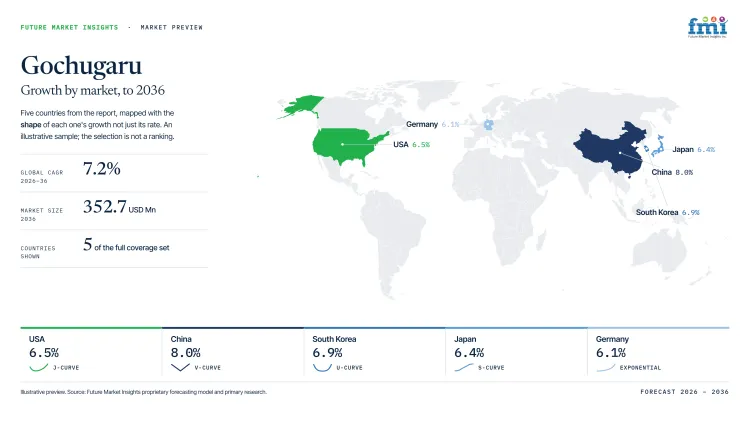
The country comparison spans 0.6 percentage points and reveals three distinct growth groups across the gochugaru market. South Korea and Australia form the upper tier with a 0.1-point gap, while the USA and Japan create a closely aligned middle group separated by 0.1 percentage points. The UK remains at the lower end with a 0.1-point gap from Japan.
- South Korea leads the comparison at a 6.9% CAGR through 2036, supported by recurring kimchi demand, domestic pepper use and established consumption of gochugaru across food applications.
- Australia follows at a 6.8% CAGR, remaining 0.1 percentage points below South Korea. Wider Korean-food retail access and foodservice demand support gochugaru consumption despite longer imported-spice supply routes.
- The USA records a 6.5% CAGR, creating a 0.3-percentage-point gap from Australia. Expanding Korean cuisine adoption across foodservice and retail channels supports demand, while import documentation shapes supplier qualification.
- Japan grows at a 6.4% CAGR, 0.1 percentage points below the USA. Established import channels, interest in Korean foods and formal spice-monitoring requirements support steady gochugaru demand.
- The UK records a 6.3% CAGR, 0.1 percentage points below Japan and the lowest among the profiled countries. Growing Korean-food discovery beyond specialty stores supports demand, while compliant documentation remains important for distributors.
The full report provides country-level CAGR analysis across North America, Latin America, Europe, East Asia, South Asia, Oceania and the Middle East and Africa.
Country-wise Analysis
- South Korean gochugaru suppliers operate near a domestic pepper base that serves established kimchi production and household cooking across national food channels, giving processors shorter sourcing routes for origin-specific grades during recurring seasonal purchasing nationwide. The South Korean gochugaru market is projected to record 6.9% CAGR during the assessment period, and official statistics reported national pepper output fell 9.7% to 61 thousand tons in 2025. Domestic sourcing strengthens provenance claims and simplifies processor replenishment, but lower annual output requires inventory buffers plus alternative contracted farms before larger national kimchi or foodservice programs can depend on steady Korean-grown pepper volumes across seasons.
- Australian retailers already give Korean pantry products broad shelf access across major cities and established specialty-food distribution networks, and CJ reported in January 2025 that bibigo products reached more than 80% of leading Australian supermarkets. Australia’s gochugaru outlook is anticipated to advance at 6.8% CAGR over the assessment period, supported by mainstream Korean-food availability across supermarkets and specialty channels. Longer import distances and food-safety testing remain the main conversion frictions for dried pepper products, so importers need stable inventory plus microbiological records before national herbs and spices distributors can expand recurring gochugaru orders across retail and foodservice accounts during planned promotional cycles.
- United States distributors place gochugaru across Asian groceries, e-commerce and restaurant supply networks that already serve Korean cooking applications in major metropolitan markets across national retail and foodservice accounts. Demand for gochugaru in the USA is forecast to rise at 6.5% CAGR over the forecast period, supported by wider access across household and professional food channels. USA Customs and Border Protection ruled in January 2026 that pure red chili pepper powder processed in South Korea qualified as a South Korean product, making processing histories and origin records commercially relevant before importers approve origin-sensitive Korean pepper specifications for recurring retail or manufacturing orders.
- Japanese retailers operate within formal food-import controls, and the health ministry reported 1.28 million import notifications from April through September 2025 as importers managed large volumes of food entries across national border inspection systems. Adoption of gochugaru in Japan is estimated to expand at 6.4% CAGR through 2036, aided by established Korean-food retail and restaurant demand across major urban markets. Dense distribution lowers discovery friction for dedicated pepper formats, but formal notification and inspection procedures reward complete importer records plus consistent grind, color and heat specifications across repeat shipments during seasonal demand changes and product reviews with retail category managers.
- United Kingdom importers serve Korean restaurants and specialty retailers alongside grocery channels that broaden exposure to Korean pantry ingredients through distributors managing packaged spice documentation and routine replenishment. Gochugaru sales in the United Kingdom are forecast to expand at 6.3% CAGR by 2036, aided by established trade links and wider Korean-food discovery across major urban markets. The December 2025 UK-Republic of Korea trade conclusion retained sanitary requirements for Korean agri-food imports, so distributors still need compliant records and dependable landed inventory before larger retail accounts commit to recurring listings during planned Korean-food category expansion cycles across national supermarket and foodservice programs.
Who are the notable companies in the Gochugaru Market?
CJ CheilJedang Corp., Sempio Foods Company, Daesang Corporation, Nongshim Taekyung Co., Ltd., Samjin Globalnet Co., Ltd., McCormick & Company, Incorporated, Frontier Co-op and Spiceology are the notable companies serving this market.
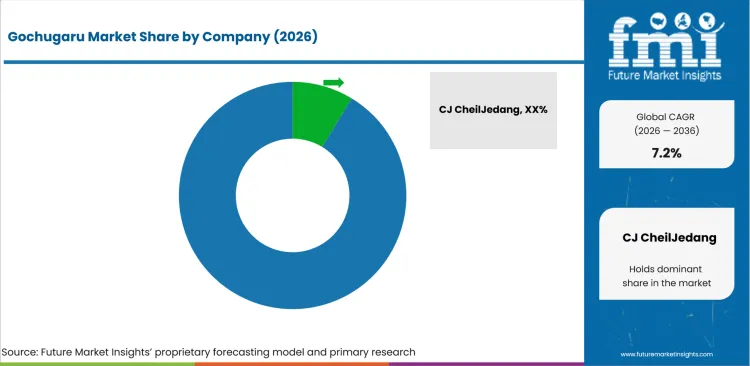
Gochugaru competition remains fragmented between Korean ingredient specialists and broad spice channels because no route covers origin control, milling consistency and every end-use channel. Entry requires documented pepper quality plus repeatable grind, and companies distinguish offers by separating gochugaru from paprika color ingredients and generic chile flakes.
- Sempio Foods Company, Nongshim Taekyung Co., Ltd. and Samjin Globalnet Co., Ltd. connect Korean applications with processing and export distribution.
- CJ CheilJedang Corp. and Daesang Corporation provide downstream kimchi and sauce knowledge relevant to red-pepper specifications.
- McCormick & Company, Incorporated, Frontier Co-op and Spiceology extend Korean chile familiarity across retail and professional culinary channels.
Competitive Benchmarking: Gochugaru Market
| Company | Application Evidence | Quality-Control Evidence | Channel Coverage | Geographic Reach |
|---|---|---|---|---|
| CJ CheilJedang Corp. | Medium | High | High | Global K-food operations |
| Sempio Foods Company | High | High | High | South Korea and 76+ export countries |
| Daesang Corporation | Low | High | High | Asia, North America and Europe |
| Nongshim Taekyung Co., Ltd. | Low | High | Medium | South Korea and global B2B exports |
| Samjin Globalnet Co., Ltd. | Medium | Medium | High | 65+ countries |
| McCormick & Company, Incorporated | Medium | High | High | 150 countries and territories |
| Frontier Co-op | Medium | High | High | United States wholesale network |
| Spiceology | Medium | Low | High | United States retail and foodservice |
Key Developments in the Gochugaru Market
- In October 2025, Sempio Foods Company presented its Kimchi@Home kit at Anuga 2025 with gochugaru as a separately packaged ingredient component for overseas kimchi preparation.
- In August 2025, CJ CheilJedang Corp. began distributing kimchi cooking sauce in 12 countries for Asian restaurants, widening downstream Korean-food exposure outside gochugaru revenue.
- In July 2026, Sempio Foods Company launched a recurring bimonthly "Cook Korean Live" online cooking program in the United States in partnership with Asian supermarket chain H Mart, with sessions covering Korean dishes such as bibimbap, tteokbokki, and bulgogi for overseas consumers.
Key Players in the Gochugaru Market
Korean Food and Fermentation Platforms
- CJ CheilJedang Corp.
- Sempio Foods Company
- Daesang Corporation
Ingredient and Korean-Food Supply Specialists
- Nongshim Taekyung Co., Ltd.
- Samjin Globalnet Co., Ltd.
Mainstream Spice and Professional Culinary Channels
- McCormick & Company, Incorporated
- Frontier Co-op
- Spiceology
Gochugaru Market - Report Scope
| Coverage field | Report scope |
|---|---|
| Market breakdown | By product type, pepper source, heat level, application, sales channel and region. |
| Quantitative Units | Revenue in USD million and CAGR in % |
| Market Definition | Commercial revenue from gochugaru sold as Korean red-pepper flakes or powder within the stated segmentation universe excludes finished kimchi, gochujang, prepared sauces and unrelated chili products. |
| Regions Covered | North America, Latin America, Europe, East Asia, South Asia and Pacific, and Middle East and Africa. |
| Countries Covered | South Korea, Australia, USA, Japan, United Kingdom, and 20+ countries included in the full report. |
| Key Companies Profiled | CJ CheilJedang Corp., Sempio Foods Company, Daesang Corporation, Nongshim Taekyung Co., Ltd., Samjin Globalnet Co., Ltd., McCormick & Company, Incorporated, Frontier Co-op, Spiceology. |
| Forecast Period | 2026 to 2036. |
| Approach | Primary and secondary research with market triangulation. |
Gochugaru Market - Research Methodology
| Method | Approach |
|---|---|
| Primary Research | FMI analysts gathered input from manufacturers, service providers, technology developers, distributors, end users, procurement teams, and subject-matter experts. Interviews examined purchasing decisions, product or service evaluation, adoption barriers, approval requirements, pricing considerations, and expectations for technical or commercial support. Respondents were also asked what evidence is required before a trial, pilot, or initial order develops into regular purchasing. |
| Desk Research | Desk research covered government statistics, regulatory publications, trade data, industry associations, technical literature, standards, company filings, product information, and official corporate announcements. Sources were reviewed for relevance, publication date, geographic coverage, and consistency with the defined market scope. Claims relating to performance, applications, approvals, capacity, investment, and commercial activity were retained only when supported by credible public evidence. |
| Market Sizing and Forecasting | The market model combined the baseline value with historical performance, segment structure, pricing and volume indicators, adoption levels, company participation, and country-level demand conditions. Forecast assumptions considered economic activity, investment trends, regulatory developments, technology adoption, purchasing cycles, supply availability, and barriers to wider market use. Segment and regional estimates were reconciled before the final market total was calculated. |
| Data Validation | Estimates were checked against multiple independent indicators, including public data, company activity, trade patterns, industry developments, and findings from primary interviews. Validation also tested whether products, services, applications, and company revenues fell within the defined market boundaries. Adjacent categories, unsupported claims, overlapping revenues, and activities without direct market relevance were excluded to reduce double counting and maintain consistency across segments and countries. |
Gochugaru Market by Segments
Gochugaru Market segmented by Product Type:
- Coarse Gochugaru Flakes
- Fine Gochugaru Powder
- Kimchi-grade Gochugaru
- Organic Gochugaru
- Smoked / Specialty Gochugaru
Gochugaru Market segmented by Pepper Source:
- Korean-grown Peppers
- Chinese-grown Peppers
- Blended Origin Peppers
- Other Asian Origins
Gochugaru Market segmented by Heat Level:
- Mild
- Medium
- Hot
Gochugaru Market segmented by Application:
- Kimchi & Fermented Foods
- Sauces / Marinades
- Seasoning Blends
- Foodservice Cooking
- Retail Household Use
Gochugaru Market segmented by Sales Channel:
- Asian Grocery Retail
- E-commerce
- Ingredient / Bulk Supply
- Foodservice Distributors
Gochugaru Market by Region:
- North America
- United States
- Canada
- Latin America
- Brazil
- Mexico
- Chile
- Rest of Latin America
- Western Europe
- Germany
- United Kingdom
- Italy
- Spain
- France
- Nordics
- Benelux
- Rest of Western Europe
- Eastern Europe
- Russia
- Poland
- Hungary
- Balkan and Baltic States
- Rest of Eastern Europe
- East Asia
- China
- Japan
- South Korea
- South Asia and Pacific
- India
- ASEAN
- Australia and New Zealand
- Rest of South Asia and Pacific
- Middle East and Africa
- Kingdom of Saudi Arabia
- Other GCC Countries
- Türkiye
- South Africa
- Other African Union Countries
- Rest of Middle East and Africa
Research Sources and Bibliography
- Ministry of Agriculture, Food and Rural Affairs, Republic of Korea. (2026, January 12).
- Ministry of Health, Labour and Welfare, Japan. (2025, August 28).
- Sempio Foods Company. (2025, December 5).
- Ministry of Data and Statistics, Republic of Korea. (2025, August 28). 2025
- Ministry of Agriculture, Food and Rural Affairs, Republic of Korea. (2026, July 5). 2026
- CJ CheilJedang Corp. (2025, August 1). CJ Foods’ bibigo Debuts in Japan’s Don Quijote.
- Ministry of Agriculture, Food and Rural Affairs, Republic of Korea. (2026, February 6). Key Findings from the 2025 Survey on the Overseas Expansion of Korean Food Service Companies.
- USA Food and Drug Administration. (2025, October 9). Turkana Food Inc. MARCS-CMS 711329 - October 09, 2025.
- Ministry of Agriculture, Food and Rural Affairs, Republic of Korea. (2025, July 3).
- Ministry of Data and Statistics, Republic of Korea. (2025, November 21). 2025
- CJ CheilJedang Corp. (2025, September 24). Why Is CJ CheilJedang Making bibigo Mandu in Australia?
- USA Customs and Border Protection. (2026, January 9). N356879: The tariff classification, country of origin and marking of Red Chili Pepper Powder.
- Ministry of Health, Labour and Welfare, Japan. (2025, December 22).
- Department for Business and Trade. (2025, December 15). UK-Republic of Korea Free Trade Agreement: conclusion summary.
- CJ CheilJedang Corp. (Retrieved August 10, 2026). Food Safety and Quality | CJ Cheiljedang.
- Sempio Foods Company. (2026, January 30).
- Sempio Foods Company. (Retrieved August 10, 2026). About Sempio | Sempio.
- Daesang Corporation. (Retrieved August 10, 2026). Center for Food Safety | Food Business | Major Business | Daesang Corporation.
- Daesang Corporation. (Retrieved August 10, 2026). Global Network|Network|About Company|Daesang Corporation.
- Nongshim Taekyung Co., Ltd. (Retrieved August 10, 2026). Business Area.
- Nongshim Taekyung Co., Ltd. (Retrieved August 10, 2026). Nongshim Taekyung.
- Samjin Globalnet Co., Ltd. (Retrieved August 10, 2026). Samjin Globalnet | Leading Korean Food Exporter Worldwide.
- McCormick & Company, Incorporated. (Retrieved August 10, 2026). Company | McCormick & Company.
- McCormick & Company, Incorporated. (Retrieved August 10, 2026). Food Safety | McCormick & Company.
- McCormick & Company, Incorporated. (2026, April 14). About Gochugaru Uses, Pairings and Recipes.
- Frontier Co-op. (Retrieved August 10, 2026). Bulk for Culinary Professionals | Wholesale.
- Frontier Co-op. (Retrieved August 10, 2026). Quality | Frontier Co-op.
- Frontier Co-op. (Retrieved August 10, 2026). How to Make Your Own Amazingly Delicious Chili Oil.
- Spiceology. (Retrieved August 10, 2026). Distributors.
- Spiceology. (Retrieved August 10, 2026). Shop Fresh Spices and Seasonings | Recipe Ideas | Spiceology.
- Sempio Foods Company. (2025, October 10).
- CJ CheilJedang Corp. (2025, September 4). CJ Foods Launches All-Purpose Kimchi Cooking Sauce for Global Market.
- Sempio Foods Company. (2025, June 25).
This bibliography is provided for reader reference and is not exhaustive. The full report contains the complete reference list and detailed citations
This Report Answers
- How large is the gochugaru market in 2026 and what value is forecast by 2036?
- Why do coarse gochugaru flakes account for 31.0% of product type demand in 2026?
- How does Korean-grown pepper provenance affect sourcing and qualification decisions?
- Why do kimchi and fermented foods account for 36.0% of application demand in 2026?
- How do growth rates differ across the five profiled gochugaru countries?
- Which companies participate across Korean food platforms, ingredient processing and broader spice channels?
- Which food-safety and consistency conditions can delay repeat orders for imported gochugaru?
- What should retailers, food manufacturers and foodservice operators evaluate before approving a gochugaru supplier?
Frequently Asked Questions
How big is the gochugaru market in 2026?
The gochugaru market is estimated at USD 176.0 million in 2026 and is projected to reach USD 352.7 million by 2036. Growth is driven by increasing consumption of Korean cuisine and rising demand across retail, foodservice, and food manufacturing applications.
What is the CAGR of the gochugaru market from 2026 to 2036?
The gochugaru market is projected to grow at a CAGR of 7.2% between 2026 and 2036. Expansion is supported by broader adoption of Korean food products and growing demand for authentic spice ingredients.
Which product type is projected to account for 31.0% of the gochugaru market?
Coarse gochugaru flakes are projected to account for 31.0% of the market in 2026. Their leading share is supported by widespread use in kimchi, seasonings, and other applications that require a visible pepper texture.
How much will the gochugaru market add between 2026 and 2036?
The gochugaru market is expected to add USD 176.7 million in value between 2026 and 2036. Growth reflects increasing repeat purchases and expanding use of Korean pepper products across global food channels.
Which companies are active in the gochugaru market?
Key companies operating in the market include CJ CheilJedang Corp., Sempio Foods Company, Daesang Corporation, Nongshim Taekyung Co., Ltd., Samjin Globalnet Co., Ltd., McCormick & Company, Incorporated, Frontier Co-op, and Spiceology. These companies compete through Korean food expertise, spice manufacturing capabilities, and extensive distribution networks.
Preview the report firsthand - request a free sample
Get SampleGet the brochure for pricing and purchase details.
Get PDFTable of Content
- Key Takeaways
- Market Size and CAGR
- Top Growth Driver
- Fastest Growing Segment
- Leading Region
- Key Companies
- Emerging Opportunities
- Executive Summary
- Global Market Outlook
- Demand-side Trends
- Supply-side Trends
- Technology Roadmap Analysis
- Analysis and Recommendations
- Analyst Perspective (What is happening? Why now? What should investors know?)
- Key Questions Answered
- How large is the market?
- What is the CAGR?
- What are key trends?
- Which region dominates?
- Who are the leaders?
- Market Overview
- Market Coverage / Taxonomy
- Market Definition / Scope / Limitations
- Research Methodology
- Chapter Orientation
- Analytical Lens and Working Hypotheses
- Market Structure, Signals, and Trend Drivers
- Benchmarking and Cross-market Comparability
- Market Sizing, Forecasting, and Opportunity Mapping
- Research Design and Evidence Framework
- Desk Research Programme (Secondary Evidence)
- Expert Input and Fieldwork (Primary Evidence)
- Tooling, Models, and Reference Databases
- Data Engineering and Model Build
- Quality Assurance and Audit Trail
- Market Background
- Market Dynamics (Drivers, Restraints, Opportunity, Trends)
- Scenario Forecast (Optimistic, Likely, Conservative)
- Impact Analysis
- AI Impact
- Sustainability Impact
- Regulatory Impact
- Technology Impact
- Consumer / Buyer Analysis
- Purchase Drivers
- Adoption Barriers
- Buyer Journey
- Opportunity Map Analysis
- Product Life Cycle Analysis
- Supply Chain Analysis
- Investment Feasibility Matrix
- Value Chain Analysis
- PESTLE and Porter's Analysis
- Regulatory Landscape
- Regional Parent Market Outlook
- Production and Consumption Statistics
- Import and Export Statistics
- Global Market Analysis and Forecast, 2021 to 2036
- Historical Market Size Value (USD Million) & Volume (Unit) Analysis, 2021 to 2025
- Current and Future Market Size Value (USD Million) & Volume (Unit) Projections, 2026 to 2036
- Y-o-Y Growth Trend Analysis
- Absolute $ Opportunity Analysis
- Global Market Pricing Analysis, 2021 to 2036
- Global Market Analysis and Forecast, By Product Type, 2021 to 2036
- Introduction / Key Findings
- Historical Market Size Value (USD Million) & Volume (Unit) Analysis By Product Type, 2021 to 2025
- Current and Future Market Size Value (USD Million) & Volume (Unit) Analysis and Forecast By Product Type, 2026 to 2036
- Coarse Gochugaru Flakes
- Fine Gochugaru Powder
- Kimchi-grade Gochugaru
- Organic Gochugaru
- Smoked / Specialty Gochugaru
- Coarse Gochugaru Flakes
- Y-o-Y Growth Trend Analysis By Product Type, 2021 to 2025
- Absolute $ Opportunity Analysis By Product Type, 2026 to 2036
- Global Market Analysis and Forecast, By Pepper Source, 2021 to 2036
- Introduction / Key Findings
- Historical Market Size Value (USD Million) & Volume (Unit) Analysis By Pepper Source, 2021 to 2025
- Current and Future Market Size Value (USD Million) & Volume (Unit) Analysis and Forecast By Pepper Source, 2026 to 2036
- Korean-grown Peppers
- Chinese-grown Peppers
- Blended Origin Peppers
- Other Asian Origins
- Korean-grown Peppers
- Y-o-Y Growth Trend Analysis By Pepper Source, 2021 to 2025
- Absolute $ Opportunity Analysis By Pepper Source, 2026 to 2036
- Global Market Analysis and Forecast, By Heat Level, 2021 to 2036
- Introduction / Key Findings
- Historical Market Size Value (USD Million) & Volume (Unit) Analysis By Heat Level, 2021 to 2025
- Current and Future Market Size Value (USD Million) & Volume (Unit) Analysis and Forecast By Heat Level, 2026 to 2036
- Mild
- Medium
- Hot
- Mild
- Y-o-Y Growth Trend Analysis By Heat Level, 2021 to 2025
- Absolute $ Opportunity Analysis By Heat Level, 2026 to 2036
- Global Market Analysis and Forecast, By Application, 2021 to 2036
- Introduction / Key Findings
- Historical Market Size Value (USD Million) & Volume (Unit) Analysis By Application, 2021 to 2025
- Current and Future Market Size Value (USD Million) & Volume (Unit) Analysis and Forecast By Application, 2026 to 2036
- Kimchi & Fermented Foods
- Sauces / Marinades
- Seasoning Blends
- Foodservice Cooking
- Retail Household Use
- Kimchi & Fermented Foods
- Y-o-Y Growth Trend Analysis By Application, 2021 to 2025
- Absolute $ Opportunity Analysis By Application, 2026 to 2036
- Global Market Analysis and Forecast, By Sales Channel, 2021 to 2036
- Introduction / Key Findings
- Historical Market Size Value (USD Million) & Volume (Unit) Analysis By Sales Channel, 2021 to 2025
- Current and Future Market Size Value (USD Million) & Volume (Unit) Analysis and Forecast By Sales Channel, 2026 to 2036
- Asian Grocery Retail
- E-commerce
- Ingredient / Bulk Supply
- Foodservice Distributors
- Asian Grocery Retail
- Y-o-Y Growth Trend Analysis By Sales Channel, 2021 to 2025
- Absolute $ Opportunity Analysis By Sales Channel, 2026 to 2036
- Global Market Analysis and Forecast, By Region, 2021 to 2036
- Introduction
- Historical Market Size Value (USD Million) & Volume (Unit) Analysis By Region, 2021 to 2025
- Current Market Size Value (USD Million) & Volume (Unit) Analysis and Forecast By Region, 2026 to 2036
- North America
- Latin America
- Western Europe
- Eastern Europe
- East Asia
- South Asia and Pacific
- Middle East & Africa
- Market Attractiveness Analysis By Region
- North America Market Analysis and Forecast, By Country, 2021 to 2036
- Historical Market Size Value (USD Million) & Volume (Unit) Trend Analysis By Market Taxonomy, 2021 to 2025
- Market Size Value (USD Million) & Volume (Unit) Forecast By Market Taxonomy, 2026 to 2036
- By Country
- USA
- Canada
- By Product Type
- By Pepper Source
- By Heat Level
- By Application
- By Sales Channel
- By Country
- Market Attractiveness Analysis
- By Country
- By Product Type
- By Pepper Source
- By Heat Level
- By Application
- By Sales Channel
- Key Takeaways
- Latin America Market Analysis and Forecast, By Country
- Historical Market Size Value (USD Million) & Volume (Unit) Trend Analysis By Market Taxonomy, 2021 to 2025
- Market Size Value (USD Million) & Volume (Unit) Forecast By Market Taxonomy, 2026 to 2036
- By Country
- Brazil
- Mexico
- Chile
- Rest of Latin America
- By Product Type
- By Pepper Source
- By Heat Level
- By Application
- By Sales Channel
- By Country
- Market Attractiveness Analysis
- By Country
- By Product Type
- By Pepper Source
- By Heat Level
- By Application
- By Sales Channel
- Key Takeaways
- Western Europe Market Analysis and Forecast, By Country
- Historical Market Size Value (USD Million) & Volume (Unit) Trend Analysis By Market Taxonomy, 2021 to 2025
- Market Size Value (USD Million) & Volume (Unit) Forecast By Market Taxonomy, 2026 to 2036
- By Country
- Germany
- UK
- Italy
- Spain
- France
- Nordic
- BENELUX
- Rest of Western Europe
- By Product Type
- By Pepper Source
- By Heat Level
- By Application
- By Sales Channel
- By Country
- Market Attractiveness Analysis
- By Country
- By Product Type
- By Pepper Source
- By Heat Level
- By Application
- By Sales Channel
- Key Takeaways
- Eastern Europe Market Analysis and Forecast, By Country
- Historical Market Size Value (USD Million) & Volume (Unit) Trend Analysis By Market Taxonomy, 2021 to 2025
- Market Size Value (USD Million) & Volume (Unit) Forecast By Market Taxonomy, 2026 to 2036
- By Country
- Russia
- Poland
- Hungary
- Balkan & Baltic
- Rest of Eastern Europe
- By Product Type
- By Pepper Source
- By Heat Level
- By Application
- By Sales Channel
- By Country
- Market Attractiveness Analysis
- By Country
- By Product Type
- By Pepper Source
- By Heat Level
- By Application
- By Sales Channel
- Key Takeaways
- East Asia Market Analysis and Forecast, By Country
- Historical Market Size Value (USD Million) & Volume (Unit) Trend Analysis By Market Taxonomy, 2021 to 2025
- Market Size Value (USD Million) & Volume (Unit) Forecast By Market Taxonomy, 2026 to 2036
- By Country
- China
- Japan
- South Korea
- By Product Type
- By Pepper Source
- By Heat Level
- By Application
- By Sales Channel
- By Country
- Market Attractiveness Analysis
- By Country
- By Product Type
- By Pepper Source
- By Heat Level
- By Application
- By Sales Channel
- Key Takeaways
- South Asia and Pacific Market Analysis and Forecast, By Country
- Historical Market Size Value (USD Million) & Volume (Unit) Trend Analysis By Market Taxonomy, 2021 to 2025
- Market Size Value (USD Million) & Volume (Unit) Forecast By Market Taxonomy, 2026 to 2036
- By Country
- India
- ASEAN
- Australia & New Zealand
- Rest of South Asia and Pacific
- By Product Type
- By Pepper Source
- By Heat Level
- By Application
- By Sales Channel
- By Country
- Market Attractiveness Analysis
- By Country
- By Product Type
- By Pepper Source
- By Heat Level
- By Application
- By Sales Channel
- Key Takeaways
- Middle East & Africa Market Analysis and Forecast, By Country
- Historical Market Size Value (USD Million) & Volume (Unit) Trend Analysis By Market Taxonomy, 2021 to 2025
- Market Size Value (USD Million) & Volume (Unit) Forecast By Market Taxonomy, 2026 to 2036
- By Country
- Kingdom of Saudi Arabia
- Other GCC Countries
- Türkiye
- South Africa
- Other African Union
- Rest of Middle East & Africa
- By Product Type
- By Pepper Source
- By Heat Level
- By Application
- By Sales Channel
- By Country
- Market Attractiveness Analysis
- By Country
- By Product Type
- By Pepper Source
- By Heat Level
- By Application
- By Sales Channel
- Key Takeaways
- Key Countries Market Analysis
- USA
- Pricing Analysis
- Market Share Analysis, 2025
- By Product Type
- By Pepper Source
- By Heat Level
- By Application
- By Sales Channel
- Canada
- Pricing Analysis
- Market Share Analysis, 2025
- By Product Type
- By Pepper Source
- By Heat Level
- By Application
- By Sales Channel
- Mexico
- Pricing Analysis
- Market Share Analysis, 2025
- By Product Type
- By Pepper Source
- By Heat Level
- By Application
- By Sales Channel
- Brazil
- Pricing Analysis
- Market Share Analysis, 2025
- By Product Type
- By Pepper Source
- By Heat Level
- By Application
- By Sales Channel
- Chile
- Pricing Analysis
- Market Share Analysis, 2025
- By Product Type
- By Pepper Source
- By Heat Level
- By Application
- By Sales Channel
- Germany
- Pricing Analysis
- Market Share Analysis, 2025
- By Product Type
- By Pepper Source
- By Heat Level
- By Application
- By Sales Channel
- UK
- Pricing Analysis
- Market Share Analysis, 2025
- By Product Type
- By Pepper Source
- By Heat Level
- By Application
- By Sales Channel
- Italy
- Pricing Analysis
- Market Share Analysis, 2025
- By Product Type
- By Pepper Source
- By Heat Level
- By Application
- By Sales Channel
- Spain
- Pricing Analysis
- Market Share Analysis, 2025
- By Product Type
- By Pepper Source
- By Heat Level
- By Application
- By Sales Channel
- France
- Pricing Analysis
- Market Share Analysis, 2025
- By Product Type
- By Pepper Source
- By Heat Level
- By Application
- By Sales Channel
- India
- Pricing Analysis
- Market Share Analysis, 2025
- By Product Type
- By Pepper Source
- By Heat Level
- By Application
- By Sales Channel
- ASEAN
- Pricing Analysis
- Market Share Analysis, 2025
- By Product Type
- By Pepper Source
- By Heat Level
- By Application
- By Sales Channel
- Australia & New Zealand
- Pricing Analysis
- Market Share Analysis, 2025
- By Product Type
- By Pepper Source
- By Heat Level
- By Application
- By Sales Channel
- China
- Pricing Analysis
- Market Share Analysis, 2025
- By Product Type
- By Pepper Source
- By Heat Level
- By Application
- By Sales Channel
- Japan
- Pricing Analysis
- Market Share Analysis, 2025
- By Product Type
- By Pepper Source
- By Heat Level
- By Application
- By Sales Channel
- South Korea
- Pricing Analysis
- Market Share Analysis, 2025
- By Product Type
- By Pepper Source
- By Heat Level
- By Application
- By Sales Channel
- Russia
- Pricing Analysis
- Market Share Analysis, 2025
- By Product Type
- By Pepper Source
- By Heat Level
- By Application
- By Sales Channel
- Poland
- Pricing Analysis
- Market Share Analysis, 2025
- By Product Type
- By Pepper Source
- By Heat Level
- By Application
- By Sales Channel
- Hungary
- Pricing Analysis
- Market Share Analysis, 2025
- By Product Type
- By Pepper Source
- By Heat Level
- By Application
- By Sales Channel
- Kingdom of Saudi Arabia
- Pricing Analysis
- Market Share Analysis, 2025
- By Product Type
- By Pepper Source
- By Heat Level
- By Application
- By Sales Channel
- Türkiye
- Pricing Analysis
- Market Share Analysis, 2025
- By Product Type
- By Pepper Source
- By Heat Level
- By Application
- By Sales Channel
- South Africa
- Pricing Analysis
- Market Share Analysis, 2025
- By Product Type
- By Pepper Source
- By Heat Level
- By Application
- By Sales Channel
- USA
- Market Structure Analysis
- Competition Dashboard
- Competition Benchmarking
- Market Share Analysis of Top Players
- By Regional
- By Product Type
- By Pepper Source
- By Heat Level
- By Application
- By Sales Channel
- Emerging Startups
- Innovation Benchmarking
- Competition Analysis
- Competition Deep Dive
- CJ CheilJedang
- Overview
- Product Portfolio
- Profitability by Market Segments
- Sales Footprint
- Strategy Overview
- Marketing Strategy
- Product Strategy
- Channel Strategy
- Sempio
- Daesang
- Chung Jung One
- Taekyung
- Wang Korea
- Nongshim
- McCormick
- Frontier Co-op
- Spiceology
- CJ CheilJedang
- Case Studies
- Success Stories
- Recent Developments
- Competition Deep Dive
- Assumptions & Acronyms Used


