

- Market Size (2026)
- USD 320.7 Mn
- Forecast (2036)
- USD 878.4 Mn
- CAGR (2026 to 2036)
- 10.6%
How big is Gut Friendly Cookies Market in 2026?
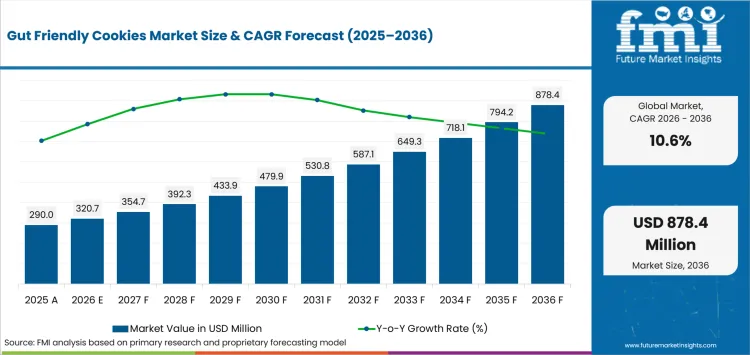
USD 320.7 million in 2026 and USD 878.4 million by 2036 at a 10.6% CAGR.
Demand for gut friendly cookies is projected to expand at a 10.6% CAGR between 2026 and 2036, increasing valuation from USD 320.7 million in 2026 to USD 878.4 million by 2036. Growth depends on converting digestive-wellness intent into a familiar snack that can earn repeat purchase on taste as well as tolerance.
Fiber and digestive claims require more formulation and labeling discipline than a general better-for-you message. The USA Food and Drug Administration defines which intrinsic and added nondigestible carbohydrates can be declared as dietary fiber, while Monash University treats low-FODMAP eating as a staged approach for people with medically diagnosed IBS. Serving size, ingredient choice and claim wording therefore shape product design and repeat purchase.
Key Takeaways of Gut Friendly Cookies Market
- Demand expands when digestive positioning fits a routine cookie occasion without weakening sensory appeal.
- Prebiotic Fiber gives formulators a measurable route to digestive-oriented nutrition inside a baked format.
- Soft-Baked formats help alternative flours and functional ingredients retain a familiar eating experience.
- Low-FODMAP positioning gives a defined tolerance signal, although ingredient composition and serving size still require care.
- Single-Serve packaging supports controlled trial, while Supermarkets & Hypermarkets make replenishment part of a regular grocery trip.
- Uplift Food, Simple Mills, Emmy's Organics and Partake Foods compete through gut-health, gluten-free, plant-based or allergy-friendly cookie propositions.
Analyst Perspective
"Gut friendly cookies have to do two jobs at once. The formulation must give shoppers a clear digestive or dietary reason to choose it, while the product still has to behave like a cookie on taste, texture and repeat use. Brands should test tolerance language and portion guidance before expanding distribution."
- Nandini Roy Choudhury, Principal Consultant, Future Market Insights
How is the Gut Friendly Cookies Market segmented?
The gut friendly cookies market is segmented by Functional Ingredient, Product Type, Claim, Packaging, Sales Channel and Region.
Functional Ingredient separates the nutritional or digestive architecture carried by the cookie. Product Type captures texture and construction, while Claim reflects the label signal a shopper may use to screen for dietary fit. Packaging governs portioning and trial. Sales Channel shows where discovery converts into repeat purchase across mainstream, direct and health-focused retail routes.
What supports Soft-Baked within Product Type?
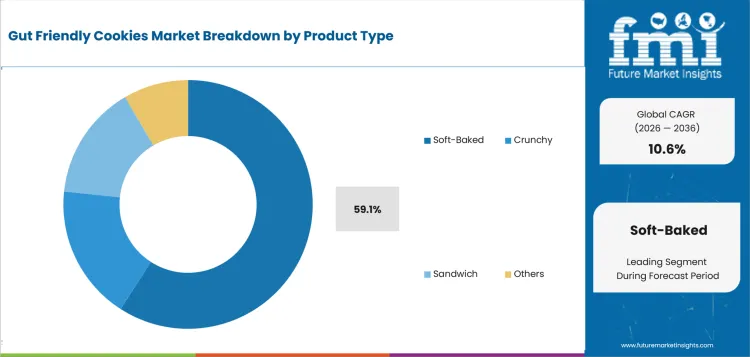
Soft-Baked is estimated to represent 59.1% of Product Type demand in 2026, as the format helps functional ingredients and alternative flours retain a familiar cookie texture.
Soft-baked products can preserve an indulgent texture while accommodating alternative flours or functional ingredients. That balance matters because consumers still compare the product with conventional cookies and the wider healthy snacks category. Partake Foods currently sells soft-baked chocolate chip and lemon cookies alongside crunchy formats, showing how dietary-compatible positioning can extend across texture preferences.
- Crunchy cookies create a different sensory route and can suit shelf-stable formats where crispness is part of the purchase expectation.
- Sandwich cookies and Others broaden construction options, including filled formats that can carry a functional concept without changing the basic cookie occasion.
What supports Prebiotic Fiber within Functional Ingredient?
Prebiotic fiber is projected to account for 42.7% of Functional Ingredient demand in 2026, supported by its measurable role in digestive-oriented nutrition and compatibility with familiar baked formats.
Prebiotic fiber gives formulators a direct way to connect a familiar baked snack with digestive-oriented nutrition. The category also sits within the wider prebiotic ingredients market, where ingredient identity and usable dose matter alongside sensory performance. In cookies, measurable fiber can make the functional proposition easier to understand at the point of purchase without forcing the consumer into a supplement format.
- Sprouted Grains can emphasize whole-food architecture, while Probiotic Cultures require attention to viability and processing conditions across shelf life.
- Low-FODMAP Blends and Others serve more specific formulation needs, with ingredient choice and portion size determining whether the final cookie fits the intended dietary proposition.
What makes Low-FODMAP commercially relevant within Claim?
Low-FODMAP is forecast to account for 24.3% of Claim demand in 2026, reflecting its relevance to consumers seeking defined digestive-tolerance positioning within packaged cookies.
Low-FODMAP is tied to a structured dietary approach used for IBS management, so it gives a more specific tolerance signal than broad wellness language. It should not be treated as interchangeable with gluten-free food, vegan positioning or lower-sugar reformulation. Monash University describes the diet as a three-step process in which individual response is tested over time.
- Gluten-Free and Vegan claims address separate dietary requirements and can overlap with digestive-wellness purchasing without proving low-FODMAP suitability.
- Low-Sugar and Others can widen the dietary proposition, but the commercial case still depends on clear formulation boundaries and accurate consumer communication.
What supports Single-Serve within Packaging?
Single-Serve is projected to account for 60.0% of Packaging demand in 2026, supported by portion control and lower trial commitment for consumers evaluating tolerance and dietary fit.
Single-serve packaging creates a repeatable consumption unit for shoppers who want to test tolerance or control portions before committing to a larger pack. It also supports travel, lunchbox and workplace occasions. Current Partake snack packs show how portioned cookie formats can extend dietary-compatible products into on-the-go use without changing the core cookie proposition.
- Multipacks can convert successful trial into planned repeat use while keeping portions separated within one household purchase.
- Boxes and Others support family or pantry use, although serving guidance becomes more important when consumers control the portion themselves.
What supports Supermarkets & Hypermarkets within Sales Channel?
Supermarkets & Hypermarkets are expected to account for 42.1% of Sales Channel demand in 2026, as mainstream grocery placement supports direct comparison with conventional cookies and repeat replenishment.
Supermarkets and hypermarkets place gut-positioned cookies beside conventional alternatives, which reduces the search effort required for repeat purchase. The channel also makes price, taste and claim clarity visible in one comparison set. A product that wins trial online still needs dependable replenishment if the brand wants digestive positioning to become part of a routine grocery decision.
- Online / DTC gives brands more room for education and ingredient explanation, but customer-acquisition cost can weigh on repeat economics.
- Convenience Stores, Specialty & Health Stores and Others serve different missions, from impulse purchase to more guided discovery around dietary compatibility.
What are the drivers, restraints and opportunities in the Gut Friendly Cookies Market?
Digestive-wellness snacking supports demand, while individual tolerance and claim discipline constrain formulation. Clear functional positioning with practical portions can widen mainstream access.
- Driver: Consumers can pursue digestive-oriented nutrition without leaving a familiar cookie occasion when fiber or dietary compatibility is easy to understand.
- Restraint: Individual tolerance varies, and a functional claim can create expectations that the formulation or serving size does not support for every shopper.
- Opportunity: Brands can combine clear functional positioning with portioned packs and broader retail access once sensory performance supports repeat purchase.
Fiber is a practical bridge between digestive intent and packaged food because it can be quantified under defined labeling rules. The wider functional ingredients market also shows why bakery applications matter for nutrition-led reformulation. Cookie brands still have to show that added function does not compromise texture or flavor after the first trial.
Tolerance is a harder constraint than awareness. Monash University notes that response to a low-FODMAP diet varies and uses staged reintroduction to identify individual triggers. Added fibers can also behave differently across consumers and formulations. Brands therefore need restrained language that helps shoppers distinguish a digestive-tolerance proposition from unrelated gluten-free or lifestyle claims.
Mainstream access becomes more valuable once the product has a clear use case. Single-serve packs can lower trial commitment and connect serving guidance with actual intake. Retail expansion should follow repeat-purchase performance, because wider distribution creates little value if a premium formulation loses on taste or consumers are unsure how the claim applies to them.
Which country CAGRs are profiled in the Gut Friendly Cookies Market?
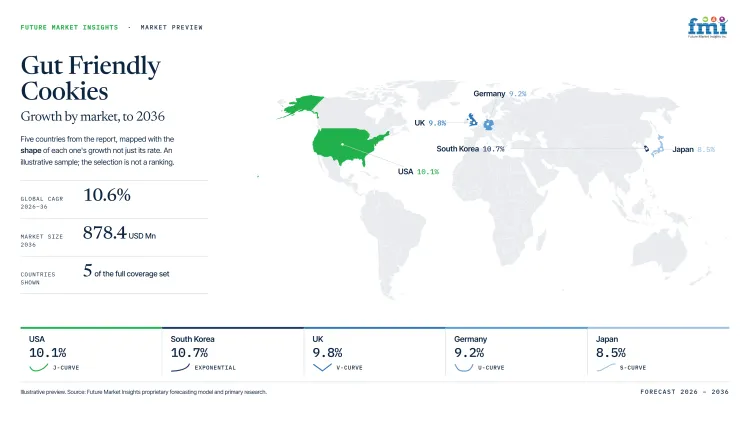
| Country | CAGR |
|---|---|
| USA | 10.1% |
| UK | 9.8% |
| Germany | 9.2% |
| Japan | 8.5% |
| South Korea | 10.7% |
How do country-level CAGRs compare in the Gut Friendly Cookies Market?
The five country CAGRs span 2.2 percentage points from 8.5% to 10.7%. The spacing indicates expected expansion pace rather than present market size, and local claim rules can change the amount of formulation or labeling work required before a product reaches shelves.
- USA is forecast at 10.1% CAGR. FDA dietary-fiber definitions make ingredient qualification and label wording part of formulation planning for fiber-positioned cookies.
- UK is forecast at 9.8% CAGR. National nutrition surveillance reported adult fiber intake below the 30 g per day recommendation, keeping fiber adequacy visible in public nutrition discussion.
- Germany is forecast at 9.2% CAGR. EU nutrition-claim thresholds and DGE guidance give fiber a defined nutrition context, while cookies still compete as discretionary snacks.
- Japan is forecast at 8.5% CAGR. The Consumer Affairs Agency maintains formal food-labeling systems for nutrition and health claims, increasing the value of precise local labeling preparation.
- South Korea is forecast at 10.7% CAGR. MFDS labeling rules require packaged foods to communicate product and nutrition information within a defined regulatory system.
Small CAGR differences should not determine launch order by themselves. Suppliers still need to compare claim permissions, ingredient fit and retail economics before selecting local pack architecture or channel strategy.
Country-wise Analysis
- USA: Demand for Gut Friendly Cookies in USA is forecast to rise at 10.1% CAGR from 2026 to 2036. The FDA states that declared dietary fiber includes intrinsic plant fiber plus certain isolated or synthetic nondigestible carbohydrates with recognized physiological effects. That creates a clear labeling checkpoint for prebiotic-fiber formulations. Commercial execution still depends on familiar taste and enough retail availability to turn an initial functional trial into a routine cookie purchase.
- UK: Demand for Gut Friendly Cookies in UK is forecast to expand at 9.8% CAGR from 2026 to 2036. The National Diet and Nutrition Survey 2019 to 2023 reported that mean fiber intake was below recommendations in all age groups, with a 30 g per day population recommendation for adults. Brands can use that nutrition context to explain fiber, but digestive claims need to remain distinct from general healthy-eating messages and from clinical dietary advice.
- Germany: Demand for Gut Friendly Cookies in Germany is forecast to rise at 9.2% CAGR from 2026 to 2036. EU rules set quantitative conditions for source-of-fibre and high-fibre nutrition claims, while DGE material describes fiber effects that include bowel transit and prebiotic action. The local task is to present a cookie as a transparent food product, not to let health language obscure its indulgent role.
- Japan: Adoption of Gut Friendly Cookies in Japan is forecast to expand at 8.5% CAGR from 2026 to 2036. The Consumer Affairs Agency maintains food-labeling systems that cover nutrition and health claims. Suppliers entering with stronger functional positioning need locally appropriate substantiation and exact pack language, both of which can influence launch readiness before retail expansion.
- South Korea: Sales of Gut Friendly Cookies in South Korea are forecast to rise at 10.7% CAGR from 2026 to 2036. MFDS states that packaged-food labeling rules cover product identity, ingredients and nutrition information, among other required elements. Functional or dietary-positioned cookies therefore need disciplined Korean-language communication, with benefit wording that stays inside the applicable food-labeling framework.
Who are the notable companies in the Gut Friendly Cookies Market?
Uplift Food, Simple Mills, Emmy's Organics and Partake Foods are notable companies serving gut-health or dietary-compatible cookie demand.
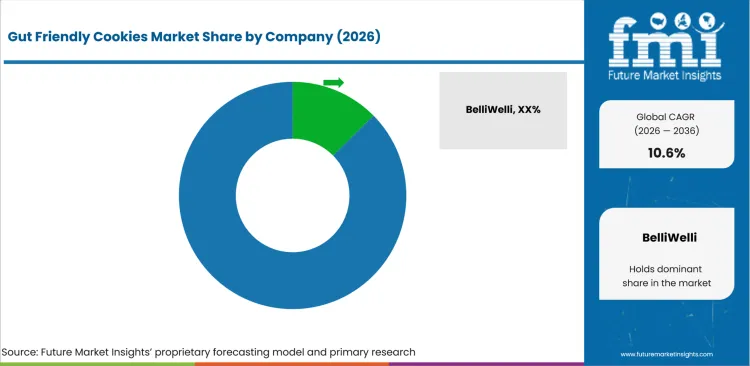
Competition spans direct gut-health formulations and broader dietary-compatible cookie portfolios. Uplift Food markets Gut Happy Cookies with prebiotic and probiotic positioning. Simple Mills sells gluten-free crunchy and sandwich cookies, Emmy's Organics offers organic gluten-free cookie formats, and Partake Foods focuses on top-nine-allergen-free cookies. Partake's positioning also overlaps with the wider allergen-free food category as mainstream retailers give specialist dietary formats more shelf exposure.
- Uplift Food markets Gut Happy Cookies as prebiotic and probiotic sandwich biscuits with plant-based, high-fiber positioning.
- Simple Mills sells crunchy almond-flour cookies and nut-butter sandwich cookies with gluten-free and vegan positioning, while Partake Foods offers soft-baked, crunchy and snack-pack cookie formats that are free from the top nine allergens.
- Emmy's Organics sells soft and chewy coconut cookies, grab-and-go packs and Oatmeal No-Bakes with organic, gluten-free and plant-based positioning.
Competitive Benchmarking: Gut Friendly Cookies Market
| Company | Product focus | Cookie formats | Product positioning | Commercial presence |
|---|---|---|---|---|
| Uplift Food | Gut-health | Sandwich biscuits | Prebiotic/probiotic; plant-based; high fiber | USA direct-to-consumer |
| Simple Mills | Better-for-you | Crunchy; sandwich | Gluten-free; vegan; nut and seed flour | USA retail and online |
| Emmy's Organics | Organic and plant-based | Coconut cookies; no-bakes; grab-and-go | Organic; gluten-free; vegan | USA retail and direct-to-consumer |
| Partake Foods | Allergy-friendly | Soft-baked; crunchy; snack packs | Top-nine-allergen-free; gluten-free; vegan | USA retail and direct-to-consumer |
The benchmarking table compares product focus, format and commercial presence rather than ranking company scale. Uplift Food centers its proposition on prebiotic and probiotic cookies. Simple Mills competes through gluten-free crunchy and sandwich formats. Emmy's Organics emphasizes organic and plant-based cookies, while Partake Foods combines allergy-friendly positioning with multiple cookie textures and pack sizes.
Key Developments in the Gut Friendly Cookies Market
- In February 2025, Flowers Foods completed its acquisition of Simple Mills. The transaction added Simple Mills crackers, cookies, snack bars and baking mixes to Flowers Foods and was positioned around wider distribution and continued product innovation.
- In 2025, Partake Foods refreshed its packaging and received B Corp recertification, reinforcing its allergy-friendly positioning as the brand continued to expand through USA retail channels.
- In 2026, Emmy's Organics introduced Oatmeal No-Bakes and began rolling the new chocolate chip and peanut butter variants into Sprouts Farmers Market locations.
Key Players in the Gut Friendly Cookies Market
Gut-Health Cookie Brand
- Uplift Food
Dietary-Compatible Cookie Portfolios
- Simple Mills
- Emmy's Organics
- Partake Foods
Gut Friendly Cookies Market - Report Scope
| Coverage field | Report scope |
|---|---|
| Market breakdown | By Functional Ingredient, Product Type, Claim, Packaging, Sales Channel and Region. |
| Quantitative Units | USD Million. |
| Market Definition | Packaged cookies positioned for digestive wellness or dietary compatibility through defined functional ingredients, claims, formats and packaging within the stated segmentation universe. |
| Regions Covered | North America, Latin America, Western Europe, Eastern Europe, East Asia, South Asia and Pacific, and Middle East and Africa. |
| Countries Covered | USA, UK, Germany, Japan, South Korea, and additional countries included in the full report. |
| Key Companies Profiled | Uplift Food, Simple Mills, Emmy's Organics, Partake Foods. |
| Forecast Period | 2026 to 2036. |
| Approach | Primary and secondary research with market triangulation. |
Gut Friendly Cookies Market - Research Methodology
| Method | Approach |
|---|---|
| Primary Research | FMI analysts gather input from manufacturers, ingredient suppliers, distributors, retail buyers, category managers and dietetics specialists. Interviews examine product boundaries, purchasing criteria, pricing logic, claim interpretation and channel conditions. |
| Desk Research | Desk research covers regulator and health-agency guidance, national nutrition publications, corporate filings, product documentation and dated company announcements. Sources are matched to the market definition and the jurisdiction in which a claim is made. |
| Market Sizing and Forecasting | Market sizing reconciles company and channel indicators with product availability and segment structure. Forecast assumptions consider distribution intensity, claim adoption, product format, country conditions and purchasing frictions across the assessment period. |
| Data Validation | Market totals are reconciled across segments and countries to limit overlap between channels, substitute snack categories and products outside the stated market definition. |
Gut Friendly Cookies Market by Segments
Gut Friendly Cookies Market segmented by Functional Ingredient:
- Prebiotic Fiber
- Sprouted Grains
- Probiotic Cultures
- Low-FODMAP Blends
- Others
Gut Friendly Cookies Market segmented by Product Type:
- Soft-Baked
- Crunchy
- Sandwich
- Others
Gut Friendly Cookies Market segmented by Claim:
- Low-FODMAP
- Gluten-Free
- Vegan
- Low-Sugar
- Others
Gut Friendly Cookies Market segmented by Packaging:
- Single-Serve
- Multipacks
- Boxes
- Others
Gut Friendly Cookies Market segmented by Sales Channel:
- Supermarkets & Hypermarkets
- Online / DTC
- Convenience Stores
- Specialty & Health Stores
- Others
Gut Friendly Cookies Market by Region:
- North America
- United States
- Canada
- Latin America
- Brazil
- Mexico
- Argentina
- Chile
- Western Europe
- Germany
- France
- United Kingdom
- Italy
- Spain
- Benelux
- Nordics
- Eastern Europe
- Poland
- Czech Republic
- Romania
- Hungary
- East Asia
- China
- Japan
- South Korea
- South Asia and Pacific
- India
- ASEAN
- Australia and New Zealand
- Middle East and Africa
- GCC Countries
- South Africa
- Türkiye
- Israel
Research Sources and Bibliography
- USA Food and Drug Administration. Questions and Answers on Dietary Fiber.
- National Institute of Diabetes and Digestive and Kidney Diseases. Eating, Diet, & Nutrition for Irritable Bowel Syndrome.
- Monash University. Starting the Low FODMAP Diet.
- UK Office for Health Improvement and Disparities. National Diet and Nutrition Survey 2019 to 2023: report.
- European Commission. Nutrition claims.
- German Nutrition Society. Ballaststoffe.
- Consumer Affairs Agency, Japan. Food Labelling.
- Ministry of Food and Drug Safety, Republic of Korea. Food Labeling System.
- Uplift Food. Gut Happy Cookies product information.
- Simple Mills. Crunchy Almond Flour Cookies and Nut Butter Stuffed Sandwich Cookies product information.
- Flowers Foods. Flowers Foods, Inc. Completes Acquisition of Simple Mills. February 21, 2025.
- Emmy's Organics. Oatmeal No-Bakes and Coconut Cookies product information, 2026.
- Partake Foods. Cookies collection and Ten Years of Partake company update, 2026.
This bibliography is provided for reader reference and is not exhaustive. The full report contains the complete reference list and detailed citations.
This Report Answers
- How large is the Gut Friendly Cookies Market in 2026 and 2036?
- Which formulation conditions support digestive positioning inside a familiar cookie format?
- How does Prebiotic Fiber shape the Functional Ingredient category?
- Why does Soft-Baked matter for texture and formulation flexibility?
- How does Low-FODMAP differ from gluten-free or lifestyle claims?
- How do country growth rates affect labeling preparation and route-to-market choices?
- Which companies compete across gut-health and dietary-compatible cookie formats?
- What tolerance and claim-substantiation issues can delay repeat adoption?
Frequently Asked Questions
How big is the gut friendly cookies market in 2026?
USD 320.7 million represents the gut friendly cookies market value in 2026. Demand is forecast to reach USD 878.4 million by 2036 as digestive or dietary positioning moves into familiar cookie formats and wider retail routes.
What is the CAGR of the gut friendly cookies market from 2026 to 2036?
A 10.6% CAGR is projected for the gut friendly cookies market between 2026 and 2036. The outlook assumes that functional positioning can translate into repeat purchase without losing on taste, tolerance or claim clarity.
Why are prebiotic ingredients relevant to gut friendly cookies?
Prebiotic ingredients give formulators a measurable digestive-oriented component that can be incorporated into a baked snack. Commercial use still depends on applicable dietary-fiber rules, usable serving levels and sensory performance in the finished cookie.
How much value is expected to be added between 2026 and 2036?
USD 557.7 million is expected to be added to the gut friendly cookies market between 2026 and 2036. The increase reflects broader availability across functional ingredients, dietary claims and portion formats within the defined cookie market.
Which companies are active in the gut friendly cookies market?
Companies active in the gut friendly cookies market include Uplift Food, Simple Mills, Emmy's Organics and Partake Foods. Their portfolios span prebiotic and probiotic cookies, gluten-free formats, plant-based products and allergy-friendly cookies across direct-to-consumer and retail channels.
Preview the report firsthand - request a free sample
Get SampleGet the brochure for pricing and purchase details.
Get PDFTable of Content
- Key Takeaways
- Market Size and CAGR
- Top Growth Driver
- Fastest Growing Segment
- Leading Region
- Key Companies
- Emerging Opportunities
- Executive Summary
- Global Market Outlook
- Demand-side Trends
- Supply-side Trends
- Technology Roadmap Analysis
- Analysis and Recommendations
- Analyst Perspective (What is happening? Why now? What should investors know?)
- Key Questions Answered
- How large is the market?
- What is the CAGR?
- What are key trends?
- Which region dominates?
- Who are the leaders?
- Market Overview
- Market Coverage / Taxonomy
- Market Definition / Scope / Limitations
- Research Methodology
- Chapter Orientation
- Analytical Lens and Working Hypotheses
- Market Structure, Signals, and Trend Drivers
- Benchmarking and Cross-market Comparability
- Market Sizing, Forecasting, and Opportunity Mapping
- Research Design and Evidence Framework
- Desk Research Programme (Secondary Evidence)
- Expert Input and Fieldwork (Primary Evidence)
- Tooling, Models, and Reference Databases
- Data Engineering and Model Build
- Quality Assurance and Audit Trail
- Market Background
- Market Dynamics (Drivers, Restraints, Opportunity, Trends)
- Scenario Forecast (Optimistic, Likely, Conservative)
- Impact Analysis
- AI Impact
- Sustainability Impact
- Regulatory Impact
- Technology Impact
- Consumer / Buyer Analysis
- Purchase Drivers
- Adoption Barriers
- Buyer Journey
- Opportunity Map Analysis
- Product Life Cycle Analysis
- Supply Chain Analysis
- Investment Feasibility Matrix
- Value Chain Analysis
- PESTLE and Porter's Analysis
- Regulatory Landscape
- Regional Parent Market Outlook
- Production and Consumption Statistics
- Import and Export Statistics
- Global Market Analysis and Forecast, 2021 to 2036
- Historical Market Size Value (USD Million) Analysis, 2021 to 2025
- Current and Future Market Size Value (USD Million) Projections, 2026 to 2036
- Y-o-Y Growth Trend Analysis
- Absolute $ Opportunity Analysis
- Global Market Pricing Analysis, 2021 to 2036
- Global Market Analysis and Forecast, By Functional Ingredient, 2021 to 2036
- Introduction / Key Findings
- Historical Market Size Value (USD Million) Analysis By Functional Ingredient, 2021 to 2025
- Current and Future Market Size Value (USD Million) Analysis and Forecast By Functional Ingredient, 2026 to 2036
- Prebiotic Fiber
- Sprouted Grains
- Probiotic Cultures
- Low-FODMAP Blends
- Others
- Prebiotic Fiber
- Y-o-Y Growth Trend Analysis By Functional Ingredient, 2021 to 2025
- Absolute $ Opportunity Analysis By Functional Ingredient, 2026 to 2036
- Global Market Analysis and Forecast, By Product Type, 2021 to 2036
- Introduction / Key Findings
- Historical Market Size Value (USD Million) Analysis By Product Type, 2021 to 2025
- Current and Future Market Size Value (USD Million) Analysis and Forecast By Product Type, 2026 to 2036
- Soft-Baked
- Crunchy
- Sandwich
- Others
- Soft-Baked
- Y-o-Y Growth Trend Analysis By Product Type, 2021 to 2025
- Absolute $ Opportunity Analysis By Product Type, 2026 to 2036
- Global Market Analysis and Forecast, By Claim, 2021 to 2036
- Introduction / Key Findings
- Historical Market Size Value (USD Million) Analysis By Claim, 2021 to 2025
- Current and Future Market Size Value (USD Million) Analysis and Forecast By Claim, 2026 to 2036
- Low-FODMAP
- Gluten-Free
- Vegan
- Low-Sugar
- Others
- Low-FODMAP
- Y-o-Y Growth Trend Analysis By Claim, 2021 to 2025
- Absolute $ Opportunity Analysis By Claim, 2026 to 2036
- Global Market Analysis and Forecast, By Packaging, 2021 to 2036
- Introduction / Key Findings
- Historical Market Size Value (USD Million) Analysis By Packaging, 2021 to 2025
- Current and Future Market Size Value (USD Million) Analysis and Forecast By Packaging, 2026 to 2036
- Single-Serve
- Multipacks
- Boxes
- Others
- Single-Serve
- Y-o-Y Growth Trend Analysis By Packaging, 2021 to 2025
- Absolute $ Opportunity Analysis By Packaging, 2026 to 2036
- Global Market Analysis and Forecast, By Sales Channel, 2021 to 2036
- Introduction / Key Findings
- Historical Market Size Value (USD Million) Analysis By Sales Channel, 2021 to 2025
- Current and Future Market Size Value (USD Million) Analysis and Forecast By Sales Channel, 2026 to 2036
- Supermarkets & Hypermarkets
- Online / DTC
- Convenience Stores
- Specialty & Health Stores
- Others
- Supermarkets & Hypermarkets
- Y-o-Y Growth Trend Analysis By Sales Channel, 2021 to 2025
- Absolute $ Opportunity Analysis By Sales Channel, 2026 to 2036
- Global Market Analysis and Forecast, By Region, 2021 to 2036
- Introduction
- Historical Market Size Value (USD Million) Analysis By Region, 2021 to 2025
- Current Market Size Value (USD Million) Analysis and Forecast By Region, 2026 to 2036
- North America
- Latin America
- Western Europe
- Eastern Europe
- East Asia
- South Asia and Pacific
- Middle East & Africa
- Market Attractiveness Analysis By Region
- North America Market Analysis and Forecast, By Country, 2021 to 2036
- Historical Market Size Value (USD Million) Trend Analysis By Market Taxonomy, 2021 to 2025
- Market Size Value (USD Million) Forecast By Market Taxonomy, 2026 to 2036
- By Country
- USA
- Canada
- By Functional Ingredient
- By Product Type
- By Claim
- By Packaging
- By Sales Channel
- By Country
- Market Attractiveness Analysis
- By Country
- By Functional Ingredient
- By Product Type
- By Claim
- By Packaging
- By Sales Channel
- Key Takeaways
- Latin America Market Analysis and Forecast, By Country
- Historical Market Size Value (USD Million) Trend Analysis By Market Taxonomy, 2021 to 2025
- Market Size Value (USD Million) Forecast By Market Taxonomy, 2026 to 2036
- By Country
- Brazil
- Mexico
- Chile
- Rest of Latin America
- By Functional Ingredient
- By Product Type
- By Claim
- By Packaging
- By Sales Channel
- By Country
- Market Attractiveness Analysis
- By Country
- By Functional Ingredient
- By Product Type
- By Claim
- By Packaging
- By Sales Channel
- Key Takeaways
- Western Europe Market Analysis and Forecast, By Country
- Historical Market Size Value (USD Million) Trend Analysis By Market Taxonomy, 2021 to 2025
- Market Size Value (USD Million) Forecast By Market Taxonomy, 2026 to 2036
- By Country
- Germany
- UK
- Italy
- Spain
- France
- Nordic
- BENELUX
- Rest of Western Europe
- By Functional Ingredient
- By Product Type
- By Claim
- By Packaging
- By Sales Channel
- By Country
- Market Attractiveness Analysis
- By Country
- By Functional Ingredient
- By Product Type
- By Claim
- By Packaging
- By Sales Channel
- Key Takeaways
- Eastern Europe Market Analysis and Forecast, By Country
- Historical Market Size Value (USD Million) Trend Analysis By Market Taxonomy, 2021 to 2025
- Market Size Value (USD Million) Forecast By Market Taxonomy, 2026 to 2036
- By Country
- Russia
- Poland
- Hungary
- Balkan & Baltic
- Rest of Eastern Europe
- By Functional Ingredient
- By Product Type
- By Claim
- By Packaging
- By Sales Channel
- By Country
- Market Attractiveness Analysis
- By Country
- By Functional Ingredient
- By Product Type
- By Claim
- By Packaging
- By Sales Channel
- Key Takeaways
- East Asia Market Analysis and Forecast, By Country
- Historical Market Size Value (USD Million) Trend Analysis By Market Taxonomy, 2021 to 2025
- Market Size Value (USD Million) Forecast By Market Taxonomy, 2026 to 2036
- By Country
- China
- Japan
- South Korea
- By Functional Ingredient
- By Product Type
- By Claim
- By Packaging
- By Sales Channel
- By Country
- Market Attractiveness Analysis
- By Country
- By Functional Ingredient
- By Product Type
- By Claim
- By Packaging
- By Sales Channel
- Key Takeaways
- South Asia and Pacific Market Analysis and Forecast, By Country
- Historical Market Size Value (USD Million) Trend Analysis By Market Taxonomy, 2021 to 2025
- Market Size Value (USD Million) Forecast By Market Taxonomy, 2026 to 2036
- By Country
- India
- ASEAN
- Australia & New Zealand
- Rest of South Asia and Pacific
- By Functional Ingredient
- By Product Type
- By Claim
- By Packaging
- By Sales Channel
- By Country
- Market Attractiveness Analysis
- By Country
- By Functional Ingredient
- By Product Type
- By Claim
- By Packaging
- By Sales Channel
- Key Takeaways
- Middle East & Africa Market Analysis and Forecast, By Country
- Historical Market Size Value (USD Million) Trend Analysis By Market Taxonomy, 2021 to 2025
- Market Size Value (USD Million) Forecast By Market Taxonomy, 2026 to 2036
- By Country
- Kingdom of Saudi Arabia
- Other GCC Countries
- Türkiye
- South Africa
- Other African Union
- Rest of Middle East & Africa
- By Functional Ingredient
- By Product Type
- By Claim
- By Packaging
- By Sales Channel
- By Country
- Market Attractiveness Analysis
- By Country
- By Functional Ingredient
- By Product Type
- By Claim
- By Packaging
- By Sales Channel
- Key Takeaways
- Key Countries Market Analysis
- USA
- Pricing Analysis
- Market Share Analysis, 2025
- By Functional Ingredient
- By Product Type
- By Claim
- By Packaging
- By Sales Channel
- Canada
- Pricing Analysis
- Market Share Analysis, 2025
- By Functional Ingredient
- By Product Type
- By Claim
- By Packaging
- By Sales Channel
- Mexico
- Pricing Analysis
- Market Share Analysis, 2025
- By Functional Ingredient
- By Product Type
- By Claim
- By Packaging
- By Sales Channel
- Brazil
- Pricing Analysis
- Market Share Analysis, 2025
- By Functional Ingredient
- By Product Type
- By Claim
- By Packaging
- By Sales Channel
- Chile
- Pricing Analysis
- Market Share Analysis, 2025
- By Functional Ingredient
- By Product Type
- By Claim
- By Packaging
- By Sales Channel
- Germany
- Pricing Analysis
- Market Share Analysis, 2025
- By Functional Ingredient
- By Product Type
- By Claim
- By Packaging
- By Sales Channel
- UK
- Pricing Analysis
- Market Share Analysis, 2025
- By Functional Ingredient
- By Product Type
- By Claim
- By Packaging
- By Sales Channel
- Italy
- Pricing Analysis
- Market Share Analysis, 2025
- By Functional Ingredient
- By Product Type
- By Claim
- By Packaging
- By Sales Channel
- Spain
- Pricing Analysis
- Market Share Analysis, 2025
- By Functional Ingredient
- By Product Type
- By Claim
- By Packaging
- By Sales Channel
- France
- Pricing Analysis
- Market Share Analysis, 2025
- By Functional Ingredient
- By Product Type
- By Claim
- By Packaging
- By Sales Channel
- India
- Pricing Analysis
- Market Share Analysis, 2025
- By Functional Ingredient
- By Product Type
- By Claim
- By Packaging
- By Sales Channel
- ASEAN
- Pricing Analysis
- Market Share Analysis, 2025
- By Functional Ingredient
- By Product Type
- By Claim
- By Packaging
- By Sales Channel
- Australia & New Zealand
- Pricing Analysis
- Market Share Analysis, 2025
- By Functional Ingredient
- By Product Type
- By Claim
- By Packaging
- By Sales Channel
- China
- Pricing Analysis
- Market Share Analysis, 2025
- By Functional Ingredient
- By Product Type
- By Claim
- By Packaging
- By Sales Channel
- Japan
- Pricing Analysis
- Market Share Analysis, 2025
- By Functional Ingredient
- By Product Type
- By Claim
- By Packaging
- By Sales Channel
- South Korea
- Pricing Analysis
- Market Share Analysis, 2025
- By Functional Ingredient
- By Product Type
- By Claim
- By Packaging
- By Sales Channel
- Russia
- Pricing Analysis
- Market Share Analysis, 2025
- By Functional Ingredient
- By Product Type
- By Claim
- By Packaging
- By Sales Channel
- Poland
- Pricing Analysis
- Market Share Analysis, 2025
- By Functional Ingredient
- By Product Type
- By Claim
- By Packaging
- By Sales Channel
- Hungary
- Pricing Analysis
- Market Share Analysis, 2025
- By Functional Ingredient
- By Product Type
- By Claim
- By Packaging
- By Sales Channel
- Kingdom of Saudi Arabia
- Pricing Analysis
- Market Share Analysis, 2025
- By Functional Ingredient
- By Product Type
- By Claim
- By Packaging
- By Sales Channel
- Türkiye
- Pricing Analysis
- Market Share Analysis, 2025
- By Functional Ingredient
- By Product Type
- By Claim
- By Packaging
- By Sales Channel
- South Africa
- Pricing Analysis
- Market Share Analysis, 2025
- By Functional Ingredient
- By Product Type
- By Claim
- By Packaging
- By Sales Channel
- USA
- Market Structure Analysis
- Competition Dashboard
- Competition Benchmarking
- Market Share Analysis of Top Players
- By Regional
- By Functional Ingredient
- By Product Type
- By Claim
- By Packaging
- By Sales Channel
- Emerging Startups
- Innovation Benchmarking
- Competition Analysis
- Competition Deep Dive
- BelliWelli
- Overview
- Product Portfolio
- Profitability by Market Segments
- Sales Footprint
- Strategy Overview
- Marketing Strategy
- Product Strategy
- Channel Strategy
- Uplift Food
- Purely Elizabeth
- Simple Mills
- Emmy's Organics
- Siren Snacks
- Bobo's
- Partake Foods
- BelliWelli
- Case Studies
- Success Stories
- Recent Developments
- Competition Deep Dive
- Assumptions & Acronyms Used


