

- Market Size (2026)
- USD 333.5 Mn
- Forecast (2036)
- USD 503.2 Mn
- CAGR (2026 to 2036)
- 4.2%
How big is Hair Botox Treatments Market in 2026?
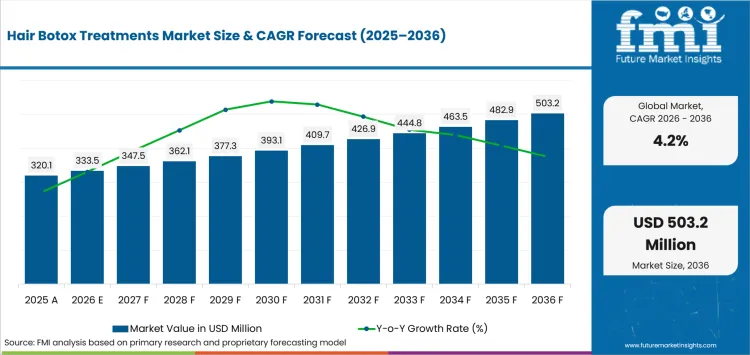
USD 333.5 million in 2026 and USD 503.2 million by 2036 at a 4.2% CAGR.
Demand for hair botox treatments are projected to rise from USD 333.5 million in 2026 to USD 503.2 million by 2036 at a 4.2% CAGR. Growth is driven by salon reconstruction and repeat professional hair care routines that target damage without requiring permanent straightening. L’Oréal reported in February 2026 that its Professional Products division grew 7.5% like-for-like during 2025 as premium haircare and omnichannel sales advanced. That channel momentum gives repair-led treatments more opportunities to move from stylist recommendation into scheduled home maintenance.
Regulatory scrutiny changes the cost of explaining those benefits across countries. European Commission Safety Gate data published in April 2025 recorded 4,137 dangerous-product alerts for 2024 and cosmetics represented 36% of them. The figure raises documentation expectations for brands selling intensive hair care across several jurisdictions. Brazil rewards clearly separated reconstruction claims while Gulf import hubs place more weight on traceable product files. Commercial conversion therefore depends on pairing visible repair performance with precise intended-use language.
Key Takeaways of Hair Botox Treatments Market
- Demand is supported by repeat repair routines that exist between professional salon services and regular home conditioning programs.
- Core - classic lines are expected to hold 36.0% of product type demand in 2026 because their broad repair positioning fits several damage patterns.
- Conventional formulations are projected to represent 53.0% of nature demand in 2026 because formulators retain wide latitude across conditioning systems and sensory design.
- Cream & balm products are estimated at 28.0% share in 2026 owing to controlled application and sustained contact during intensive treatment steps.
- Regulatory scrutiny around formaldehyde-related smoothing chemistry raises documentation costs and penalizes products whose repair claims drift toward chemical straightening.
- Some of the key players in this market include Wella Company, Henkel AG & Co. KGaA, L’Oréal Groupe, Unilever PLC, Procter & Gamble, Kao Corporation, Amorepacific Corporation, and The Estée Lauder Companies Inc.
Analyst Perspective
"Hair botox treatments earn commercial value when brands make repair performance easy to verify without blurring the boundary with chemical straightening. Buyers should compare treatment repeatability and claim discipline alongside formula cost because retailer acceptance and stylist confidence determine whether initial trial becomes routine replenishment."
- Rahul Pandita, Principal Consultant, Future Market Insights
How is the Hair Botox Treatments Market segmented?
The hair botox treatments market is segmented by product type, nature, format, price positioning, sales channel and region.
Product type includes Core - classic lines, targeted treatment lines, sensitive & gentle lines, premium & clinical lines and kits & sets. Nature covers conventional, vegan & cruelty-free, natural & organic, dermocosmetic / clinical and fragrance-free & sensitive. Format covers cream & balm, liquid & serum, stick & solid, spray & mist, sheet & patch and powder. Price positioning spans mass, masstige, premium and professional. Sales channels cover e-commerce & DTC, specialty beauty retail, pharmacies & drugstores, supermarkets & hypermarkets and salons & spas.
Why do Core - classic lines lead demand within the product type category?
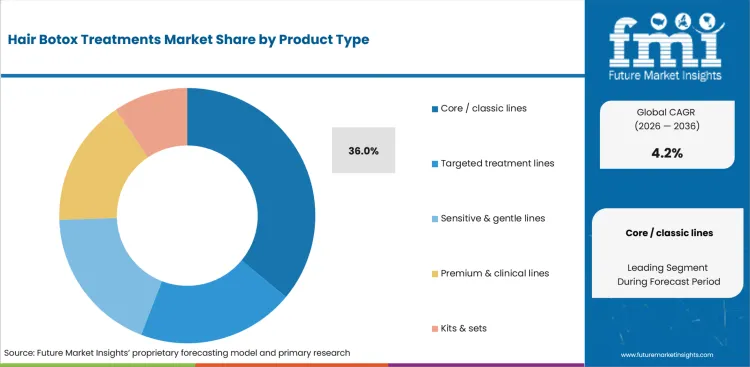
Core - classic lines give salons and home users one broad reconstruction step for softness and manageability across several damage patterns. That breadth also overlaps with established hair bond repair routines without forcing a narrow diagnosis before purchase.
- By product type, core - classic lines are expected to hold 36.0% in 2026 because one treatment can address recurring dryness and visible frizz across mixed consumer needs.
- Unilever introduced Dove Damage Therapy with Bio-Protein Care in May 2025 and reported that its three-step system made damaged hair ten times stronger after use. The launch gives broad reconstruction claims a current mass-market proof point while specialist lines remain more condition-specific.
Why do Cream & balm products lead demand within the format category?
Cream & balm formats fit section-by-section application because their viscosity helps keep intensive formulations on the hair during a defined contact period. The format also mirrors familiar overnight hair treatments and rinse-off masks used between salon appointments.
- Cream & balm products are estimated to hold 28.0% of format demand in 2026 because controlled coating supports deliberate treatment routines without requiring specialist dispensing equipment.
- Amorepacific reported in March 2026 that Tripeptide-132 treatment increased hair tensile strength by up to 44% in its testing after screening about 8,000 compounds. The work illustrates how intensive treatment formats increasingly carry measurable repair technology rather than relying on richness cues alone.
Why does Mass lead demand within the price positioning category?
Mass pricing makes periodic reconstruction easier to repeat between salon visits because the treatment fits an existing household hair-care budget. It also lets brands place intensive conditioning treatments beside routine shampoo and conditioner rather than reserving them for professional-only purchase.
- Mass products are projected to account for 34.0% of price positioning demand in 2026 because lower basket values support frequent replenishment across wide retail audiences.
- L’Oréal reported in July 2025 that Consumer Products haircare delivered double-digit growth during the first half as launches including Garnier Fructis Keratin Sleek gained traction. Scaled innovation therefore gives accessible treatment lines room to compete on specific smoothing benefits without adopting professional service pricing.
Why does E-commerce & DTC lead demand within the sales channel category?
Hair botox treatments often need more explanation than routine conditioners because shoppers compare application steps and intended repair outcomes before purchase. Digital shelves give brands more space than physical aisles to separate treatment use from adjacent hair texturizer products.
- E-commerce & DTC are expected to hold 34.0% of sales channel demand in 2026 because instruction-rich product pages reduce discovery friction and simplify replenishment.
- The Estée Lauder Companies launched Aveda in the USA Amazon Premium Beauty store in May 2025 with a Hair Care Guide created alongside salon professionals. The model lets professional recommendation remain visible during online purchase and gives intensive treatment brands a practical route from education to repeat ordering.
What are the drivers, restraints and opportunities in the Hair Botox Treatments Market?
Repeat at-home reconstruction supports demand, while smoothing-related safety scrutiny raises compliance costs and verified repair positioning creates room for higher-value treatment programs.
- Driver: Consumers increasingly maintain salon-inspired repair routines at home and replenish intensive treatments between professional appointments.
- Restraint: Formaldehyde-related scrutiny increases formula review and claim-control costs for treatments marketed near the smoothing category.
- Opportunity: Brands can convert demand into repeat revenue by separating repair outcomes from straightening claims and simplifying multi-channel education.
Repeat Repair Routines Extend Beyond the Salon
Home treatment demand is likely to rise as damage repair becomes a scheduled maintenance step. P&G reported in March 2026 that a Pantene damage-repair launch increased in-store sales by more than 10% across Australia and Southeast Asia. That response supports recurring hair gloss products and reconstruction routines that deliver visible improvements between professional visits. Brands gain repeat orders when treatment timing and expected results are easy to understand.
Safety Scrutiny Raises Qualification Costs
One of the main restraint appears when repair positioning approaches heat-activated smoothing or straightening claims. On August 6, 2026 the USA Office of Information and Regulatory Affairs received FDA’s proposed rule covering formaldehyde and formaldehyde-releasing chemicals in heated smoothing products. That review raises the commercial penalty for vague formula positioning across frizz-control shampoo and intensive treatment portfolios. Brands need tighter ingredient records and retailer-facing claim controls before scaling distribution.
Clear Repair Claims Support Premium Conversion
The opportunity lies in treatments that make damage repair specific enough for consumers and stylists to evaluate without implying permanent straightening. L’Oréal signed an agreement in June 2025 to acquire Color Wow and described the brand as a premium professional haircare business with proven efficacy. The transaction shows why verified results remain commercially valuable when a brand can carry professional credibility into home maintenance. That logic also supports restructuring hair care sold as repeat digital replenishment rather than an occasional salon rescue.
Which country CAGRs are profiled in the Hair Botox Treatments Market?
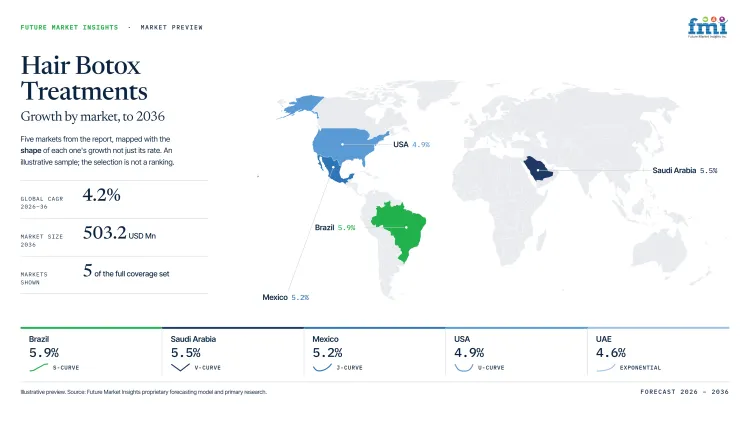
| Country | CAGR |
|---|---|
| Brazil | 5.9% |
| Saudi Arabia | 5.5% |
| Mexico | 5.2% |
| USA | 4.9% |
| UAE | 4.5% |
How do country-level CAGRs compare in the Hair Botox Treatments Market?
The five profiled forecasts span 1.4 percentage points from Brazil at 5.9% to the UAE at 4.5%. Brazil and Saudi Arabia form the faster professional-treatment group while Mexico follows with fragmented salon coverage. The USA and UAE occupy a lower band where claim controls or import requirements add friction to treatment expansion.
- Brazil pairs established reconstruction demand with tighter Anvisa scrutiny of straightening chemistry.
- Saudi Arabia combines premium salon demand with pressure to justify treatment pricing.
- Mexico rewards distributor coverage across a fragmented base of small beauty-service establishments.
- The USA offers broad professional reach while claim-control costs constrain smoothing-adjacent products.
- The UAE depends on import documentation and local registration across crowded assortments.
Different service structures and compliance costs change how trial converts into replenishment. The full report provides country-level CAGR analysis across North America, Latin America, Europe, East Asia, South Asia, Oceania and the Middle East and Africa.
Country-wise Analysis
- Brazil remains the fastest profiled market because salon users already understand intensive smoothing, while Anvisa scrutiny forces brands to prove that reconstruction benefits do not cross into prohibited straightening chemistry. Anvisa stated in July 2025 that formaldehyde is permitted in cosmetics only as a preservative up to 0.2%, giving registered suppliers a clearer compliance advantage over poorly controlled salon formulas. With demand forecast to expand at a 5.9% CAGR through 2036, successful entrants will need distributor depth and claim language that keeps conditioning and fiber repair visibly separate from illegal smoothing promises.
- In Saudi Arabia, the opportunity is about convincing clients that premium finish, import quality and repeat treatment value justify prices above routine grooming. Hair botox treatment demand is projected to grow at a 5.5% CAGR over the assessment period, supported by salon culture and imported professional brands. GASTAT reported in March 2026 that its monitored men’s hairdresser service averaged SAR 16.2 and declined 0.7% year over year, so suppliers should anchor higher tickets in stylist proof and dependable product documentation.
- Mexico presents a distributor-led growth case, as independent salons and small personal-care operators create broad trial potential but require repeated education across dispersed service points. Data México reported in May 2026 that personal care services included 310,869 DENUE 2026 economic units, underscoring the scale of neighborhood beauty businesses. Sales of hair botox treatments are forecast to expand at a 5.2% CAGR through 2036, making localized training materials and simple retail instructions more valuable than a narrow focus on prestige counters.
- The USA offers one of the broadest professional-to-home pathways because licensed stylists, national beauty retailers and digital replenishment can reinforce the same repair routine. Sales of hair botox treatments are forecast to rise at a 4.9% CAGR through 2036, although brands must absorb the cost of distinguishing reconstruction from chemical straightening. The Bureau of Labor Statistics reported in August 2025 that hairdressers, hairstylists, and cosmetologists held 575,200 jobs in 2024, giving suppliers a large education base where concise protocols can turn salon recommendations into repeat home-care purchases.
- In the UAE, market access depends first on clean import documentation and local conformity processes before brands can compete for attention in premium salon and retail assortments. The Ministry of Industry and Advanced Technology reported in April 2025 that a national survey found 93% product compliance with UAE standards, which favors suppliers able to maintain organized technical files and registration support. Demand is forecast to rise at a 4.5% CAGR through 2036, and conversion will hinge on using compliant market entry as the foundation for differentiated treatment education and repeat replenishment.
Who are the notable companies in the Hair Botox Treatments Market?
Wella Company, Henkel AG & Co. KGaA, L’Oréal Groupe, Unilever PLC, Procter & Gamble, Kao Corporation, Amorepacific Corporation, and The Estée Lauder Companies Inc. are the notable companies profiled in this market.
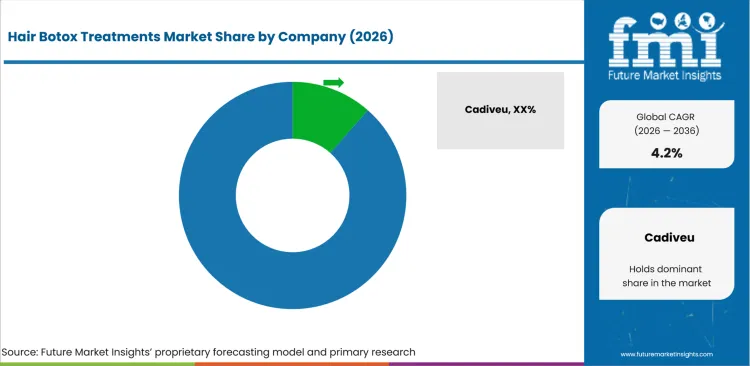
Competition spans professional service platforms and scaled consumer hair-care owners rather than one uniform product set. Wella Company and Henkel AG & Co. KGaA carry strong salon credentials while L’Oréal Groupe links prestige treatment brands with global professional distribution. Unilever PLC and Procter & Gamble bring large consumer channels. Kao Corporation and Amorepacific Corporation contribute Asian repair technology. The Estée Lauder Companies Inc. links Aveda salon authority with premium digital retail. Entry barriers sit in repair evidence and channel education more than company size alone, particularly across anti-frizz hair care.
- Professional treatment platforms: Wella Company, Henkel AG & Co. KGaA and L’Oréal Groupe pair salon relationships with intensive repair or smoothing technologies.
- Scaled consumer hair-care owners: Unilever PLC and Procter & Gamble translate repair technology into mass retail and digital replenishment across large audiences.
- Premium and Asian treatment groups: Kao Corporation, Amorepacific Corporation and The Estée Lauder Companies Inc. compete through repair research and premium routines.
Competitive Benchmarking: Hair Botox Treatments Market
| Company | Treatment Format Breadth | Repair / Smoothing Technology Evidence | Professional-to-Home Channel Integration | Geographic Reach |
|---|---|---|---|---|
| Wella Company | High | High | High | Global professional salons and retail |
| Henkel AG & Co. KGaA | High | High | High | Global with strong Europe and North America presence |
| L’Oréal Groupe | High | High | High | Global across professional and consumer channels |
| Unilever PLC | High | High | High | Global consumer reach with professional hair programs |
| Procter & Gamble | High | High | Medium | Global consumer retail and e-commerce |
| Kao Corporation | High | High | High | Asia-led with Europe and Americas hair businesses |
| Amorepacific Corporation | Medium | High | High | South Korea with expanding global digital channels |
| The Estée Lauder Companies Inc. | Medium | High | High | Global prestige retail and Aveda salon network |
Scoring basis: High treatment-format breadth requires at least three documented intensive hair-care formats while Medium requires two and Low identifies one. High repair / smoothing technology evidence requires a named proprietary or research-backed system while Medium requires a claim-backed treatment architecture and Low identifies basic conditioning evidence. High professional-to-home integration requires salon or stylist involvement plus retail and e-commerce access while Medium requires two documented channel types and Low identifies one route. Geographic Reach remains descriptive rather than scored.
Key Developments in the Hair Botox Treatments Market
- In July 2026, Henkel AG & Co. KGaA completed its acquisition of OLAPLEX after receiving required regulatory approvals. OLAPLEX generated about EUR 370 million in fiscal 2025 sales and brings Henkel a globally balanced premium repair business with professional and specialty-retail relevance.
- In July 2026, Amorepacific Corporation reported that Mise-en-Scène expanded its treatment portfolio with the Salon 10 Peptide Repair line. The launch places peptide-based repair into a scaled Asian hair-care brand as the group broadens online and offline distribution outside Korea.
- In May 2026, Unilever PLC launched TRESemmé Professional in the UK and Ireland as a premium science-led hair-care range. The relaunch covers damaged-hair strengthening and frizz control while preserving an at-home price proposition backed by stylist involvement.
Key Players in the Hair Botox Treatments Market
Professional Treatment and Salon Platforms
- Wella Company
- Henkel AG & Co. KGaA
- L’Oréal Groupe
Scaled Consumer Hair-Care Owners
- Unilever PLC
- Procter & Gamble
- Kao Corporation
Premium Repair and Treatment Groups
- Amorepacific Corporation
- The Estée Lauder Companies Inc.
Hair Botox Treatments Market - Report Scope
| Coverage field | Report scope |
|---|---|
| Market breakdown | By product type, nature, format, price positioning, sales channel and region. |
| Quantitative Units | USD million. |
| Market Definition | Revenue from topical consumer and professional formulations sold or marketed as hair botox treatments within the defined segmentation universe. Salon service fees, injectable botulinum toxin, styling tools, generic masks not positioned as hair botox treatments, and adjacent chemical straightening products are excluded. |
| Regions Covered | North America, Latin America, Western Europe, Eastern Europe, East Asia, South Asia and Pacific, and Middle East and Africa. |
| Countries Covered | Brazil, Saudi Arabia, Mexico, USA, UAE, and 20+ countries included in the full report. |
| Key Companies Profiled | Wella Company, Henkel AG & Co. KGaA, L’Oréal Groupe, Unilever PLC, Procter & Gamble, Kao Corporation, Amorepacific Corporation, The Estée Lauder Companies Inc. |
| Forecast Period | 2026 to 2036. |
| Approach | Primary and secondary research with market triangulation. |
Hair Botox Treatments Market - Research Methodology
| Method | Approach |
|---|---|
| Primary Research | FMI analysts gathered input from manufacturers, service providers, technology developers, distributors, end users, procurement teams, and subject-matter experts. Interviews examined purchasing decisions, product or service evaluation, adoption barriers, approval requirements, pricing considerations, and expectations for technical or commercial support. Respondents were also asked what evidence is required before a trial, pilot, or initial order develops into regular purchasing. |
| Desk Research | Desk research covered government statistics, regulatory publications, trade data, industry associations, technical literature, standards, company filings, product information, and official corporate announcements. Sources were reviewed for relevance, publication date, geographic coverage, and consistency with the defined market scope. Claims relating to performance, applications, approvals, capacity, investment, and commercial activity were retained only when supported by credible public evidence. |
| Market Sizing and Forecasting | The market model combined the baseline value with historical performance, segment structure, pricing and volume indicators, adoption levels, company participation, and country-level demand conditions. Forecast assumptions considered economic activity, investment trends, regulatory developments, technology adoption, purchasing cycles, supply availability, and barriers to wider market use. Segment and regional estimates were reconciled before the final market total was calculated. |
| Data Validation | Estimates were checked against multiple independent indicators, including public data, company activity, trade patterns, industry developments, and findings from primary interviews. Validation also tested whether products, services, applications, and company revenues fell within the defined market boundaries. Adjacent categories, unsupported claims, overlapping revenues, and activities without direct market relevance were excluded to reduce double counting and maintain consistency across segments and countries. |
Hair Botox Treatments Market by Segments
Hair Botox Treatments Market segmented by Product Type:
- Core - classic lines
- Targeted treatment lines
- Sensitive & gentle lines
- Premium & clinical lines
- Kits & sets
Hair Botox Treatments Market segmented by Nature:
- Conventional
- Vegan & cruelty-free
- Natural & organic
- Dermocosmetic / clinical
- Fragrance-free & sensitive
Hair Botox Treatments Market segmented by Format:
- Cream & balm
- Liquid & serum
- Stick & solid
- Spray & mist
- Sheet & patch
- Powder
Hair Botox Treatments Market segmented by Price Positioning:
- Mass
- Masstige
- Premium
- Professional
Hair Botox Treatments Market segmented by Sales Channel:
- E-commerce & DTC
- Specialty beauty retail
- Pharmacies & drugstores
- Supermarkets & hypermarkets
- Salons & spas
Hair Botox Treatments Market by Region:
- North America
- United States
- Canada
- Latin America
- Brazil
- Mexico
- Chile
- Rest of Latin America
- Western Europe
- Germany
- United Kingdom
- Italy
- Spain
- France
- Nordics
- Benelux
- Rest of Western Europe
- Eastern Europe
- Russia
- Poland
- Hungary
- Balkan and Baltic States
- Rest of Eastern Europe
- East Asia
- China
- Japan
- South Korea
- South Asia and Pacific
- India
- ASEAN
- Australia and New Zealand
- Rest of South Asia and Pacific
- Middle East and Africa
- Kingdom of Saudi Arabia
- Other GCC Countries
- Türkiye
- South Africa
- Other African Union Countries
- Rest of Middle East and Africa
Research Sources and Bibliography
- L’Oréal. (2026, February 12). 2025 Annual Results.
- European Commission, Representation in Ireland. (2025, April 16). List of dangerous products notified in Commission’s Safety Gate 2024 sets the path for increased consumer protection.
- Unilever. (2025, May 16). Dove’s premium range revolutionises hair damage repair.
- Amorepacific Corporation. (2026, March 30). Amorepacific Develops Novel Peptide to Reinforce Hair Keratin Through AI and Molecular Modeling.
- L’Oréal. (2025, July 29). 2025 Half-Year Results.
- The Estée Lauder Companies Inc. (2025, May 28). AVEDA Launches in the USA Amazon Premium Beauty Store.
- Procter & Gamble. (2026, March 31). P&G: Celebrating Consumer-First Excellence.
- Office of Information and Regulatory Affairs. (2026, August 6). Pending EO 12866 Regulatory Review: Use of Formaldehyde and Formaldehyde-Releasing Chemicals as an Ingredient in Hair Smoothing Products or Hair Straightening Products.
- L’Oréal. (2025, June 30). L’Oréal signs agreement to acquire Color Wow.
- Agência Nacional de Vigilância Sanitária. (2025, July 7). Informe de Segurança GGMON nº 03/2025 (Cosmetovigilância).
- General Authority for Statistics. (2026, March). Average Prices of Goods and Services, March 2026.
- Secretaría de Economía. (2026, May). Personal Care Services: Wages, production, investment and economic units.
- USA Bureau of Labor Statistics. (2025, August 28). Barbers, Hairstylists, and Cosmetologists: Occupational Outlook Handbook.
- Ministry of Industry and Advanced Technology. (2025, April 9). MoIAT transforms conformity labels elevating Made in the UAE products globally.
- Henkel AG & Co. KGaA. (2026, July 7). Henkel successfully closes acquisition of premium hair care brand OLAPLEX.
- Amorepacific Corporation. (2026, July 31). Amorepacific Group Announces Q2 2026 Business Performance.
- Unilever. (2026, July 9). TRESemmé’s transformation: introducing the brand’s new science-led, salon-quality haircare.
- Wella Professionals. (2025, October 1). Introducing SmoothFiller: A New Era of Keratin Treatments.
- Henkel AG & Co. KGaA. (2026, March 9). Henkel to acquire fast-growing consumer hair care and styling brand Not Your Mother’s in the USA
- L’Oréal. (2025, April 17). First quarter 2025 sales.
- Unilever. (2026, January 27). Sunsilk’s transformation shaped by Gen Z beauty trends.
- Procter & Gamble. (2026, February 25). Unraveling the Hair Loss Challenge: Introducing Pantene Abundant & Strong.
- Kao Corporation. (2026, July 13). Kao Aims to Make Liese Asia’s No. 1 Fashion Hair Color Brand and Accelerate Hair Care Business Growth.
- Amorepacific Corporation. (2026, April 29). Amorepacific Group Announces Q1 2026 Business Performance.
- The Estée Lauder Companies Inc. (2025, June 26). Aveda Launches In The Amazon.ca Premium Beauty Store.
- Wella Professionals. (2026, January 6). This NEW Breakthrough Gives You up to 10 Weeks of Color Vibrancy.
This bibliography is provided for reader reference and is not exhaustive. The full report contains the complete reference list and detailed citations
This Report Answers
- What is the hair botox treatments market worth in 2026 and what value is forecast for 2036?
- What CAGR is projected for the hair botox treatments market from 2026 to 2036?
- Which product type holds the largest share of the hair botox treatments market in 2026?
- Why do cream & balm formats fit intensive repair routines in this market?
- How do mass and premium price tiers differ commercially for hair botox treatments?
- Which sales channels best support treatment education and repeat replenishment?
- Which profiled countries show the fastest growth through 2036?
- Which companies shape professional treatment and at-home competition in this market?
Frequently Asked Questions
How big is the Hair Botox Treatments Market in 2026?
The hair botox treatments market is expected to be valued at USD 333.5 million in 2026. Repeat demand for intensive repair and smoothing care is anticipated to support expansion toward USD 503.2 million by 2036.
What is the CAGR of the Hair Botox Treatments Market from 2026 to 2036?
The hair botox treatments market is projected to grow at a 4.2% CAGR between 2026 and 2036. Growth is supported by salon-inspired home maintenance and wider digital access to intensive reconstruction products.
Which product type leads the Hair Botox Treatments Market?
The Core - classic lines segment is expected to hold 36.0% of the hair botox treatments market in 2026, supported by broad repair and smoothing use. Its wider application lowers the need for condition-specific purchasing decisions.
Which segment is projected to grow at the fastest pace in the Hair Botox Treatments Market?
A separate fastest-growing segment CAGR is not available for the 2026-2036 forecast. Current-share estimates alone cannot establish that rate without introducing an unsupported assumption into the hair botox treatments market analysis.
Which companies are key players in the Hair Botox Treatments Market?
Key players in the hair botox treatments market include Wella Company, Henkel AG & Co. KGaA, L’Oréal Groupe and Unilever PLC. Procter & Gamble, Kao Corporation, Amorepacific Corporation and The Estée Lauder Companies Inc. also shape repair and distribution competition.
Preview the report firsthand - request a free sample
Get SampleGet the brochure for pricing and purchase details.
Get PDFTable of Content
- Key Takeaways
- Market Size and CAGR
- Top Growth Driver
- Fastest Growing Segment
- Leading Region
- Key Companies
- Emerging Opportunities
- Executive Summary
- Global Market Outlook
- Demand-side Trends
- Supply-side Trends
- Technology Roadmap Analysis
- Analysis and Recommendations
- Analyst Perspective (What is happening? Why now? What should investors know?)
- Key Questions Answered
- How large is the market?
- What is the CAGR?
- What are key trends?
- Which region dominates?
- Who are the leaders?
- Market Overview
- Market Coverage / Taxonomy
- Market Definition / Scope / Limitations
- Research Methodology
- Chapter Orientation
- Analytical Lens and Working Hypotheses
- Market Structure, Signals, and Trend Drivers
- Benchmarking and Cross-market Comparability
- Market Sizing, Forecasting, and Opportunity Mapping
- Research Design and Evidence Framework
- Desk Research Programme (Secondary Evidence)
- Expert Input and Fieldwork (Primary Evidence)
- Tooling, Models, and Reference Databases
- Data Engineering and Model Build
- Quality Assurance and Audit Trail
- Market Background
- Market Dynamics (Drivers, Restraints, Opportunity, Trends)
- Scenario Forecast (Optimistic, Likely, Conservative)
- Impact Analysis
- AI Impact
- Sustainability Impact
- Regulatory Impact
- Technology Impact
- Consumer / Buyer Analysis
- Purchase Drivers
- Adoption Barriers
- Buyer Journey
- Opportunity Map Analysis
- Product Life Cycle Analysis
- Supply Chain Analysis
- Investment Feasibility Matrix
- Value Chain Analysis
- PESTLE and Porter's Analysis
- Regulatory Landscape
- Regional Parent Market Outlook
- Production and Consumption Statistics
- Import and Export Statistics
- Global Market Analysis and Forecast, 2021 to 2036
- Historical Market Size Value (USD Million) Analysis, 2021 to 2025
- Current and Future Market Size Value (USD Million) Projections, 2026 to 2036
- Y-o-Y Growth Trend Analysis
- Absolute $ Opportunity Analysis
- Global Market Pricing Analysis, 2021 to 2036
- Global Market Analysis and Forecast, By Product Type, 2021 to 2036
- Introduction / Key Findings
- Historical Market Size Value (USD Million) Analysis By Product Type, 2021 to 2025
- Current and Future Market Size Value (USD Million) Analysis and Forecast By Product Type, 2026 to 2036
- Core / classic lines
- Targeted treatment lines
- Sensitive & gentle lines
- Premium & clinical lines
- Kits & sets
- Core / classic lines
- Y-o-Y Growth Trend Analysis By Product Type, 2021 to 2025
- Absolute $ Opportunity Analysis By Product Type, 2026 to 2036
- Global Market Analysis and Forecast, By Nature, 2021 to 2036
- Introduction / Key Findings
- Historical Market Size Value (USD Million) Analysis By Nature, 2021 to 2025
- Current and Future Market Size Value (USD Million) Analysis and Forecast By Nature, 2026 to 2036
- Conventional
- Vegan & cruelty-free
- Natural & organic
- Dermocosmetic / clinical
- Fragrance-free & sensitive
- Conventional
- Y-o-Y Growth Trend Analysis By Nature, 2021 to 2025
- Absolute $ Opportunity Analysis By Nature, 2026 to 2036
- Global Market Analysis and Forecast, By Format, 2021 to 2036
- Introduction / Key Findings
- Historical Market Size Value (USD Million) Analysis By Format, 2021 to 2025
- Current and Future Market Size Value (USD Million) Analysis and Forecast By Format, 2026 to 2036
- Cream & balm
- Liquid & serum
- Stick & solid
- Spray & mist
- Sheet & patch
- Powder
- Cream & balm
- Y-o-Y Growth Trend Analysis By Format, 2021 to 2025
- Absolute $ Opportunity Analysis By Format, 2026 to 2036
- Global Market Analysis and Forecast, By Price Positioning, 2021 to 2036
- Introduction / Key Findings
- Historical Market Size Value (USD Million) Analysis By Price Positioning, 2021 to 2025
- Current and Future Market Size Value (USD Million) Analysis and Forecast By Price Positioning, 2026 to 2036
- Mass
- Masstige
- Premium
- Professional
- Mass
- Y-o-Y Growth Trend Analysis By Price Positioning, 2021 to 2025
- Absolute $ Opportunity Analysis By Price Positioning, 2026 to 2036
- Global Market Analysis and Forecast, By Sales Channel, 2021 to 2036
- Introduction / Key Findings
- Historical Market Size Value (USD Million) Analysis By Sales Channel, 2021 to 2025
- Current and Future Market Size Value (USD Million) Analysis and Forecast By Sales Channel, 2026 to 2036
- E-commerce & DTC
- Specialty beauty retail
- Pharmacies & drugstores
- Supermarkets & hypermarkets
- Salons & spas
- E-commerce & DTC
- Y-o-Y Growth Trend Analysis By Sales Channel, 2021 to 2025
- Absolute $ Opportunity Analysis By Sales Channel, 2026 to 2036
- Global Market Analysis and Forecast, By Region, 2021 to 2036
- Introduction
- Historical Market Size Value (USD Million) Analysis By Region, 2021 to 2025
- Current Market Size Value (USD Million) Analysis and Forecast By Region, 2026 to 2036
- North America
- Latin America
- Western Europe
- Eastern Europe
- East Asia
- South Asia and Pacific
- Middle East & Africa
- Market Attractiveness Analysis By Region
- North America Market Analysis and Forecast, By Country, 2021 to 2036
- Historical Market Size Value (USD Million) Trend Analysis By Market Taxonomy, 2021 to 2025
- Market Size Value (USD Million) Forecast By Market Taxonomy, 2026 to 2036
- By Country
- USA
- Canada
- By Product Type
- By Nature
- By Format
- By Price Positioning
- By Sales Channel
- By Country
- Market Attractiveness Analysis
- By Country
- By Product Type
- By Nature
- By Format
- By Price Positioning
- By Sales Channel
- Key Takeaways
- Latin America Market Analysis and Forecast, By Country
- Historical Market Size Value (USD Million) Trend Analysis By Market Taxonomy, 2021 to 2025
- Market Size Value (USD Million) Forecast By Market Taxonomy, 2026 to 2036
- By Country
- Brazil
- Mexico
- Chile
- Rest of Latin America
- By Product Type
- By Nature
- By Format
- By Price Positioning
- By Sales Channel
- By Country
- Market Attractiveness Analysis
- By Country
- By Product Type
- By Nature
- By Format
- By Price Positioning
- By Sales Channel
- Key Takeaways
- Western Europe Market Analysis and Forecast, By Country
- Historical Market Size Value (USD Million) Trend Analysis By Market Taxonomy, 2021 to 2025
- Market Size Value (USD Million) Forecast By Market Taxonomy, 2026 to 2036
- By Country
- Germany
- UK
- Italy
- Spain
- France
- Nordic
- BENELUX
- Rest of Western Europe
- By Product Type
- By Nature
- By Format
- By Price Positioning
- By Sales Channel
- By Country
- Market Attractiveness Analysis
- By Country
- By Product Type
- By Nature
- By Format
- By Price Positioning
- By Sales Channel
- Key Takeaways
- Eastern Europe Market Analysis and Forecast, By Country
- Historical Market Size Value (USD Million) Trend Analysis By Market Taxonomy, 2021 to 2025
- Market Size Value (USD Million) Forecast By Market Taxonomy, 2026 to 2036
- By Country
- Russia
- Poland
- Hungary
- Balkan & Baltic
- Rest of Eastern Europe
- By Product Type
- By Nature
- By Format
- By Price Positioning
- By Sales Channel
- By Country
- Market Attractiveness Analysis
- By Country
- By Product Type
- By Nature
- By Format
- By Price Positioning
- By Sales Channel
- Key Takeaways
- East Asia Market Analysis and Forecast, By Country
- Historical Market Size Value (USD Million) Trend Analysis By Market Taxonomy, 2021 to 2025
- Market Size Value (USD Million) Forecast By Market Taxonomy, 2026 to 2036
- By Country
- China
- Japan
- South Korea
- By Product Type
- By Nature
- By Format
- By Price Positioning
- By Sales Channel
- By Country
- Market Attractiveness Analysis
- By Country
- By Product Type
- By Nature
- By Format
- By Price Positioning
- By Sales Channel
- Key Takeaways
- South Asia and Pacific Market Analysis and Forecast, By Country
- Historical Market Size Value (USD Million) Trend Analysis By Market Taxonomy, 2021 to 2025
- Market Size Value (USD Million) Forecast By Market Taxonomy, 2026 to 2036
- By Country
- India
- ASEAN
- Australia & New Zealand
- Rest of South Asia and Pacific
- By Product Type
- By Nature
- By Format
- By Price Positioning
- By Sales Channel
- By Country
- Market Attractiveness Analysis
- By Country
- By Product Type
- By Nature
- By Format
- By Price Positioning
- By Sales Channel
- Key Takeaways
- Middle East & Africa Market Analysis and Forecast, By Country
- Historical Market Size Value (USD Million) Trend Analysis By Market Taxonomy, 2021 to 2025
- Market Size Value (USD Million) Forecast By Market Taxonomy, 2026 to 2036
- By Country
- Kingdom of Saudi Arabia
- Other GCC Countries
- Türkiye
- South Africa
- Other African Union
- Rest of Middle East & Africa
- By Product Type
- By Nature
- By Format
- By Price Positioning
- By Sales Channel
- By Country
- Market Attractiveness Analysis
- By Country
- By Product Type
- By Nature
- By Format
- By Price Positioning
- By Sales Channel
- Key Takeaways
- Key Countries Market Analysis
- USA
- Pricing Analysis
- Market Share Analysis, 2025
- By Product Type
- By Nature
- By Format
- By Price Positioning
- By Sales Channel
- Canada
- Pricing Analysis
- Market Share Analysis, 2025
- By Product Type
- By Nature
- By Format
- By Price Positioning
- By Sales Channel
- Mexico
- Pricing Analysis
- Market Share Analysis, 2025
- By Product Type
- By Nature
- By Format
- By Price Positioning
- By Sales Channel
- Brazil
- Pricing Analysis
- Market Share Analysis, 2025
- By Product Type
- By Nature
- By Format
- By Price Positioning
- By Sales Channel
- Chile
- Pricing Analysis
- Market Share Analysis, 2025
- By Product Type
- By Nature
- By Format
- By Price Positioning
- By Sales Channel
- Germany
- Pricing Analysis
- Market Share Analysis, 2025
- By Product Type
- By Nature
- By Format
- By Price Positioning
- By Sales Channel
- UK
- Pricing Analysis
- Market Share Analysis, 2025
- By Product Type
- By Nature
- By Format
- By Price Positioning
- By Sales Channel
- Italy
- Pricing Analysis
- Market Share Analysis, 2025
- By Product Type
- By Nature
- By Format
- By Price Positioning
- By Sales Channel
- Spain
- Pricing Analysis
- Market Share Analysis, 2025
- By Product Type
- By Nature
- By Format
- By Price Positioning
- By Sales Channel
- France
- Pricing Analysis
- Market Share Analysis, 2025
- By Product Type
- By Nature
- By Format
- By Price Positioning
- By Sales Channel
- India
- Pricing Analysis
- Market Share Analysis, 2025
- By Product Type
- By Nature
- By Format
- By Price Positioning
- By Sales Channel
- ASEAN
- Pricing Analysis
- Market Share Analysis, 2025
- By Product Type
- By Nature
- By Format
- By Price Positioning
- By Sales Channel
- Australia & New Zealand
- Pricing Analysis
- Market Share Analysis, 2025
- By Product Type
- By Nature
- By Format
- By Price Positioning
- By Sales Channel
- China
- Pricing Analysis
- Market Share Analysis, 2025
- By Product Type
- By Nature
- By Format
- By Price Positioning
- By Sales Channel
- Japan
- Pricing Analysis
- Market Share Analysis, 2025
- By Product Type
- By Nature
- By Format
- By Price Positioning
- By Sales Channel
- South Korea
- Pricing Analysis
- Market Share Analysis, 2025
- By Product Type
- By Nature
- By Format
- By Price Positioning
- By Sales Channel
- Russia
- Pricing Analysis
- Market Share Analysis, 2025
- By Product Type
- By Nature
- By Format
- By Price Positioning
- By Sales Channel
- Poland
- Pricing Analysis
- Market Share Analysis, 2025
- By Product Type
- By Nature
- By Format
- By Price Positioning
- By Sales Channel
- Hungary
- Pricing Analysis
- Market Share Analysis, 2025
- By Product Type
- By Nature
- By Format
- By Price Positioning
- By Sales Channel
- Kingdom of Saudi Arabia
- Pricing Analysis
- Market Share Analysis, 2025
- By Product Type
- By Nature
- By Format
- By Price Positioning
- By Sales Channel
- Türkiye
- Pricing Analysis
- Market Share Analysis, 2025
- By Product Type
- By Nature
- By Format
- By Price Positioning
- By Sales Channel
- South Africa
- Pricing Analysis
- Market Share Analysis, 2025
- By Product Type
- By Nature
- By Format
- By Price Positioning
- By Sales Channel
- USA
- Market Structure Analysis
- Competition Dashboard
- Competition Benchmarking
- Market Share Analysis of Top Players
- By Regional
- By Product Type
- By Nature
- By Format
- By Price Positioning
- By Sales Channel
- Emerging Startups
- Innovation Benchmarking
- Competition Analysis
- Competition Deep Dive
- Cadiveu
- Overview
- Product Portfolio
- Profitability by Market Segments
- Sales Footprint
- Strategy Overview
- Marketing Strategy
- Product Strategy
- Channel Strategy
- Brasil Cacau
- GK Hair
- Wella Company
- Amorepacific
- Olaplex
- Church & Dwight
- Procter & Gamble
- Unilever
- Kao Corporation
- Cadiveu
- Case Studies
- Success Stories
- Recent Developments
- Competition Deep Dive
- Assumptions & Acronyms Used


