
- Market Size (2026)
- USD 1.2 Bn
- Forecast (2036)
- USD 2.2 Bn
- CAGR (2026 to 2036)
- 6.0%
How Big Is the Halloumi Cheese Market in 2026?
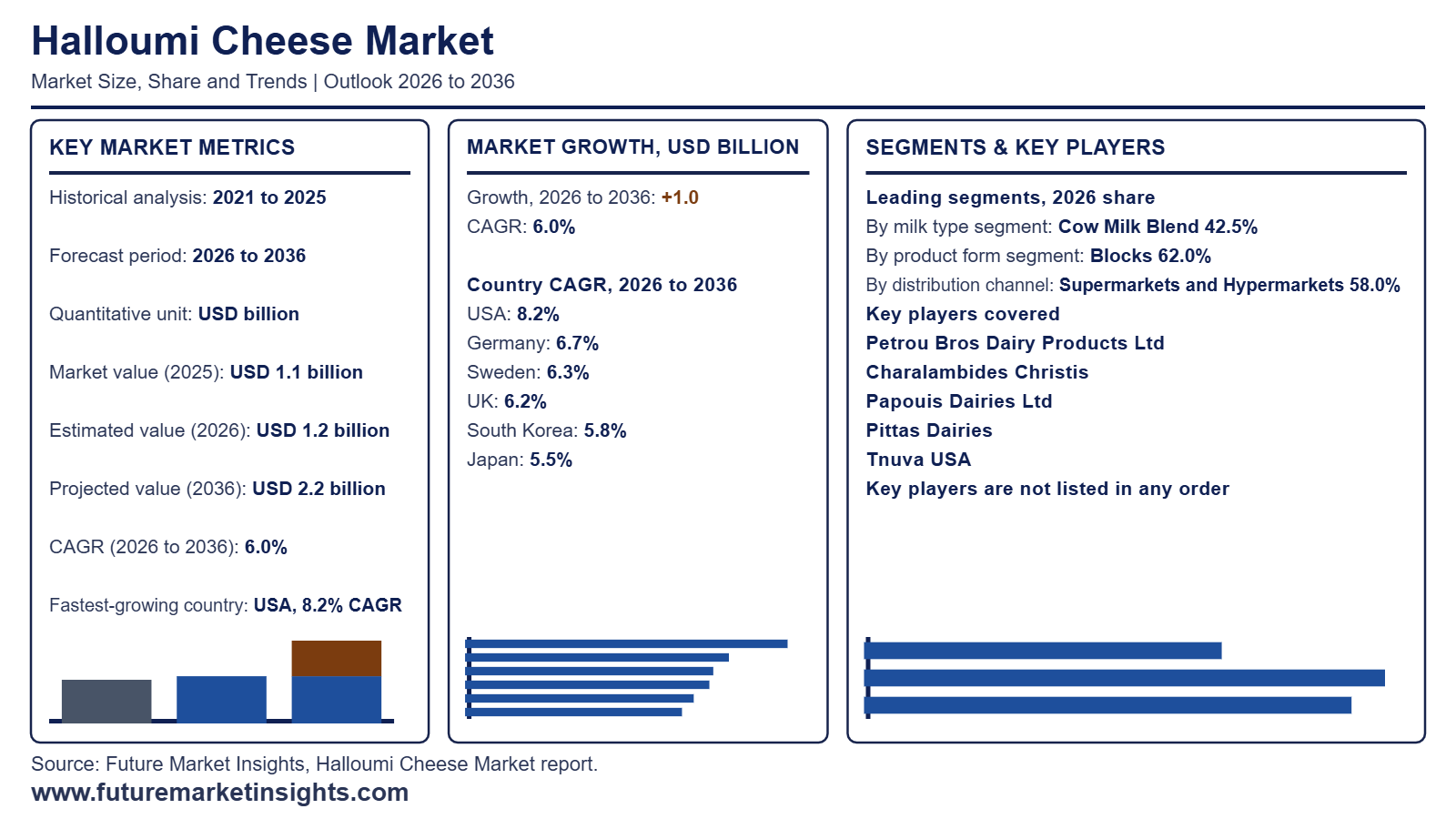
The halloumi cheese market demonstrated steady progress from USD 1.1 billion in 2025 to USD 1.2 billion in 2026, building toward a targeted valuation of USD 2.2 billion by 2036 at a 6.0% CAGR. FMI estimates that repeat grilling occasions across retail and hospitality kitchens generate an incremental opportunity of USD 1.0 billion over the ten-year period.
| Market Metric | Valuation / Share / Forecast Benchmark |
|---|---|
| 2025 Market Size (Historical) | USD 1.1 billion |
| 2026 Market Size (Estimated) | USD 1.2 billion |
| 2036 Market Size (Projected) | USD 2.2 billion |
| Compound Annual Growth Rate (2026 to 2036) | 6.0% CAGR |
| Incremental Dollar Opportunity (2026 to 2036) | USD 1.0 billion |
| Dominant Milk Type Segment (2026 Share) | Cow Milk Blend (42.5% share in 2026) | Other Segment Combined (57.5%) |
| Leading Product Form Segment (2026 Share) | Blocks (62.0% share in 2026) | Other Segment Combined (38.0%) |
| Leading Distribution Channel (2026 Share) | Supermarkets and Hypermarkets (58.0% share in 2026) | Other Segment Combined (42.0%) |
| Leading Origin Segment (2026 Share) | Cyprus Protected Origin (44.7% share in 2026) | Other Segment Combined (55.3%) |
| Fastest-Growing Country Markets (2026 to 2036) | USA (8.2% CAGR), Germany (6.7% CAGR), Sweden (6.3% CAGR) |
| Leading Tier-1 Companies | Petrou Bros Dairy Products Ltd, Charalambides Christis, Papouis Dairies Ltd, Pittas Dairies, Tnuva USA |
Source: Future Market Insights analysis of the halloumi cheese market, 2026.
Executive Market Overview
Demand for halloumi cheese is accelerating across European and North American supermarkets as consumers increasingly seek high-protein, non-melting grilling cheeses as meat alternatives in casual dining. Figures released by the Cyprus Statistical Service (November 2026) show halloumi led all domestically produced Cypriot exports from January to August 2026 at EUR 258.3 million, confirming that overseas retail buyers are locking in multi-year container shipments. In comparison, the United Kingdom and Germany lead baseline consumption through established supermarket private labels, whereas consumer demand across the United States and South Korea advances at a higher forecast CAGR owing to expanding foodservice menu adoption across dairy products and specialty cheese.
Dairy processors defend operating profit margins by shifting production toward pre-sliced grilling fries and frozen burger patties rather than competing on commodity brine blocks. While retail buyer appetite remains strong, strict European Union Protected Designation of Origin (PDO) quotas (mandating minimum sheep and goat milk ratios) and limited raw milk availability act as practical restraints on sudden volume jumps. FMI projects cheese alternative formulations to advance at a 10.9% CAGR and specialty grilling varieties at a 6.0% CAGR through 2036, supported by convenience-store foodservice contracts. Market sizing tracks commercial revenues from PDO and non-PDO halloumi and halloumi-style grilling cheese, while excluding, imitation curd blocks, and processed cheese spreads.
Analyst Perspective
"Halloumi cheese suppliers will capture stronger margin expansion by pairing verified Cyprus Protected Designation of Origin (PDO) milk traceability with pre-portioned grilling slices tailored to commercial kitchens. The main commercial risk is seasonal sheep and goat milk shortfalls that force abrupt recipe adjustments and delay export certification."
- Nandini Roy Choudhury, Principal Consultant, Future Market Insights.
Major Market Trends and Insights
- Protected-Origin Milk Decrees Reshape Production Planning: Ministerial decrees tracked by StockWatch (October 2026) set a 15.0% minimum sheep and goat milk ratio from May through December 2026, meaning Cypriot dairies must lock in farm-gate milk contracts well ahead of peak export shipping. At present, 80.0% to 85.0% of national halloumi output moves into foreign retail channels, so processors are adjusting production runs to protect PDO eligibility without stalling orders. Industry output records show that it is likely that blended recipes will carry near-term export growth while low-fat cheese nutrition lines stay niche, though raw-milk cost pressure remains a restraint.
- Export Biosecurity Protocols Tighten Cross-Border Documentation: Border health-certificate checks are actively reshaping which European exporters win repeat British supermarket contracts right now. Confirmation from the UK Department for Environment, Food and Rural Affairs (February 2026) proves that commercial Cypriot halloumi imports stay open only when accompanied by mandatory pasteurization and veterinary paperwork. Port clearance trends indicate that analysts project higher adoption of automated batch-traceability systems among tier-one dairies, while uncertified traders face shipment delays. That compliance discipline is expected to influence buyer trust and steady sales growth over competing dairy alternatives through 2036.
- Air-Fryer Recipes and Pre-Sliced Formats Broaden Meal Occasions: Consumer preferences suggest that shoppers want fast weeknight cooking options rather than limiting halloumi to summer barbecues, which is expected to lift year-round retail sales. Charalambides Christis (October 2025) proved that point by launching air-fryer halloumi recipe campaigns, while Petrou Bros Dairy Products Ltd (January 2026) showcased pre-portioned PDO grilling formats at Salon du Fromage 2026. Foodservice and retail adoption indicates that convenience slices will expand faster than bulk tubs, however, it does not mean traditional blocks will lose household share to plant-based cheese substitutes.
What Are the Main Drivers, Restraints, and Opportunities?
Heat-stable grilling performance and established European export channels drive recurring orders, whereas seasonal sheep and goat milk deficits and border health-certificate checks restrain fulfillment, leaving pre-portioned foodservice slices as the clearest expansion opportunity.
Driver: Heat-Stable Grilling Performance and Sustained Export Channel Demand
Thermal stability on commercial flat-tops and home grills is driving sales of halloumi cheese at present across grocery and hospitality accounts. Monthly trade releases from the Cyprus Statistical Service (November 2025) recorded EUR 262.9 million in Cypriot halloumi exports through September 2025, followed by EUR 258.3 million through August 2026 per the Cyprus Statistical Service (November 2026), proving that overseas buyers reorder consistently. To put that in plain business terms, supermarkets treat halloumi as a repeat weekly protein rather than a one-off specialty item, so the likelihood of steady volume expansion through 2036 is rising.
Restraint: Sheep and Goat Milk Deficits and Export Health-Certificate Friction
Even though buyer appetite is strong, limited domestic sheep and goat milk supply acts as a direct restraint on certified PDO industry growth. the Cyprus Ministry of Agriculture, Rural Development and Environment (March 2025) set seasonal minimums at 20.0% from late March through July and 15.0% from August through December, while Cyprus Mail (October 2026) noted cow's milk quotas remain frozen at 234,000 tonnes annually with EUR 4.0 million in farmer subsidies. Combined with ongoing inspection oversight by the European Commission (April 2026), these supply caps delay new distributor onboarding.
Opportunity: Pre-Portioned Burger Slices and Non-PDO Grilling Formats
Quick-service restaurant menus show that pre-portioned grilling slices represent a major expansion opportunity for dairies seeking higher margins per kilogram. Papouis Dairies Ltd (February 2026) proves that point by supplying halloumi fries and catering blocks from its 10,000-tonne annual facility to major UK grocers and quick-service chains across more than 30 countries, while Petrou Bros Dairy Products Ltd (2025) lists dedicated PDO burger slices in its catalogue. Because commercial kitchens want zero prep waste, buyer preferences point toward rising adoption of portion-controlled packs through 2036.
How Is the Halloumi Cheese Market Segmented?
Halloumi Cheese Market is segmented by Milk Type, Product Form, Distribution Channel, Origin, and Region. Forecast period from 2026 to 2036.
| Segmentation Axis | Sub-Segments Covered | 2026 Leading Segment & Share | Other Segment Combined & Total |
|---|---|---|---|
| Milk Type | Cow Milk Blend, Sheep and Goat Milk Blend, Cow Milk Only, Plant-Based Halloumi-Style | Cow Milk Blend (42.5% share in 2026) | Other Segment Combined (57.5%) | Total (100.0%) |
| Product Form | Blocks, Sliced and Grilling Packs, Flavoured and Herb Varieties, Shredded and Cubed, Light and Reduced-Fat | Blocks (62.0% share in 2026) | Other Segment Combined (38.0%) | Total (100.0%) |
| Distribution Channel | Supermarkets and Hypermarkets, Foodservice, Specialty and Ethnic Stores, Online Retail, Convenience Stores | Supermarkets and Hypermarkets (58.0% share in 2026) | Other Segment Combined (42.0%) | Total (100.0%) |
| Origin | Cyprus Protected Origin, Mediterranean and Middle East, United Kingdom Production | Cyprus Protected Origin (44.7% share in 2026) | Other Segment Combined (55.3%) | Total (100.0%) |
| Region | North America, Latin America, Western Europe, Eastern Europe, East Asia, South Asia and Pacific, Middle East and Africa | Western Europe (led by UK at 6.2% CAGR) | Global Coverage Across 7 Core Countries (100.0%) |
Source: Future Market Insights analysis of the halloumi cheese market, 2026.
Why Does Cow Milk Blend Lead the Milk Type Segment in 2026?
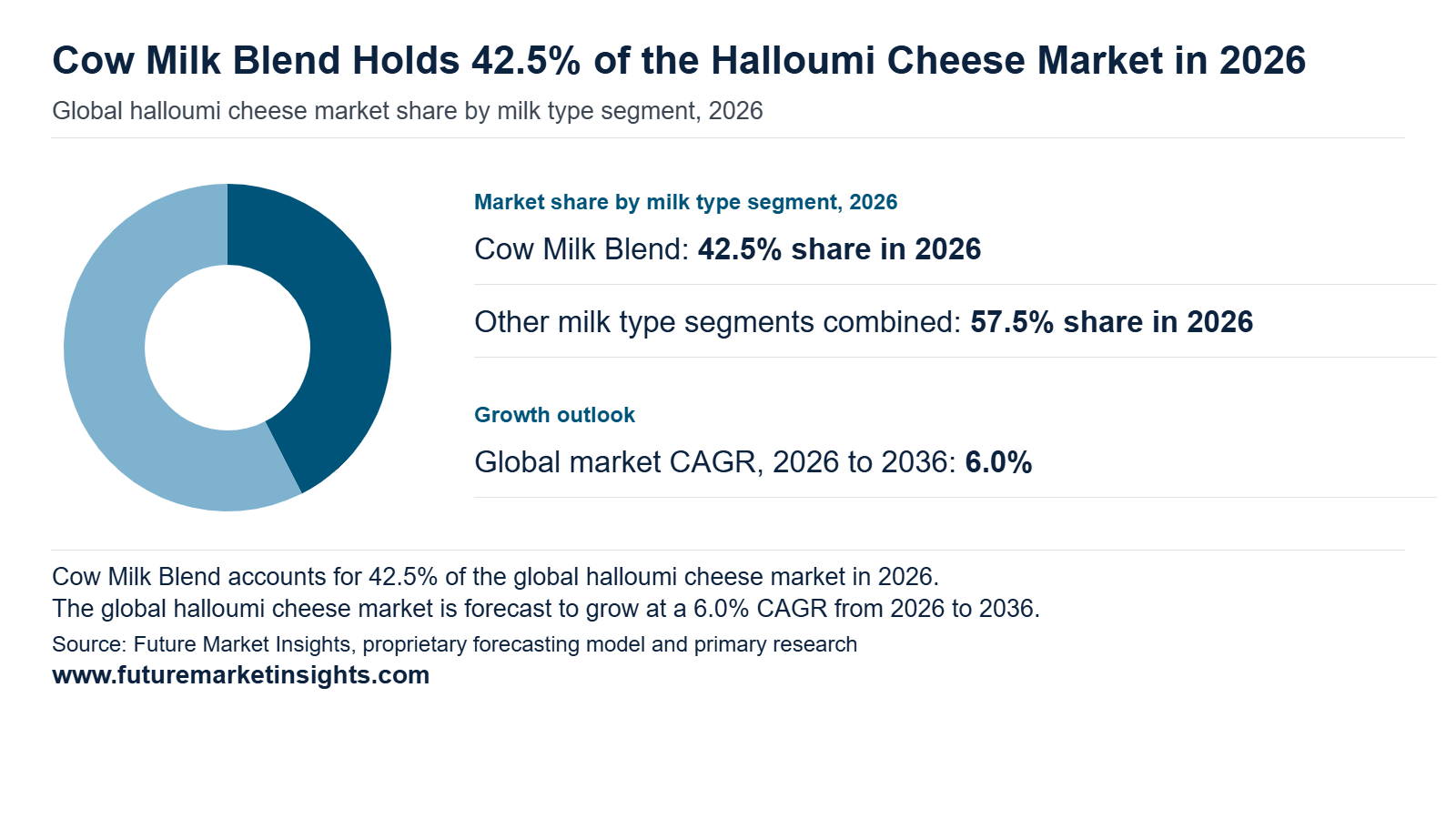
Due to lower raw-milk procurement costs and steady year-round herd availability, cow milk blend captures 42.5% of milk type revenue in 2026. From what dairy intake schedules show, it can be projected that blended recipes will anchor mainstream supermarket volume while pure sheep-and-goat lines remain premium, however, that does not mean processors can ignore legal PDO ratios. To put it simply, StockWatch (October 2026) noted that Cyprus enforces a 15.0% minimum sheep and goat milk floor through December 2026, meaning suppliers balance cost control with compliance. Even as buyers test vegan cheese and cyprosin-coagulated cheeses, reliable grilling performance keeps cow milk blend ahead through 2036.
What Keeps Blocks Dominant Within Product Form?
Retail and catering buyers favor blocks at 62.0% of product form revenue in 2026 because one brine-packed brick serves home slicing and deli counter portioning. Petrou Bros Dairy Products Ltd (2025) proves that point by featuring 900-gram catering slabs and standard retail blocks as core volume items in its ALAMBRA catalogue, while pre-sliced burger packs address narrower fast-food menus. In plain business terms, carrying fewer cut SKUs lowers chilled warehouse waste and protects grocer margins. Because of this operational efficiency, the likelihood of blocks retaining their segment lead through 2036 remains high.
How Do Supermarkets and Hypermarkets Anchor Distribution Channel Sales?
Supermarkets and hypermarkets capture 58.0% of distribution channel revenue in 2026, and supplier contracts disclosed by Papouis Dairies Ltd (February 2026) with Sainsbury's, Aldi and Morrisons prove how central large grocery chains are to volume expansion. From what chilled-bay shelf resets indicate, analysts project continued private-label and branded growth in mainstream grocers, while specialty ethnic shops serve smaller niche demand. Stated simply, shoppers already buy grilling cheese during weekly grocery runs beside cheddar and cheese color-standardized dairy lines, which is expected to sustain supermarket channel dominance through 2036.
Why Does Cyprus Protected Origin Hold the Largest Origin Share?
Legal name protection under European Union law explains why Cyprus Protected Origin commands 44.7% of origin revenue in 2026. Specifically, the European Commission (April 2026) continues overseeing island-wide PDO inspection standards through its Informal Working Group, meaning European supermarkets require certified Cypriot origin before using the Halloumi name. Meanwhile, Tnuva USA (2026) proves that non-Cypriot suppliers can still build sales in North America using clearly distinguished Halloumi Type Cheese labels. Buyer preferences for authentic geographical-indication assurance will keep Cyprus Protected Origin ahead through 2036.
Halloumi Cheese Market by Region and Country (2026 to 2036)
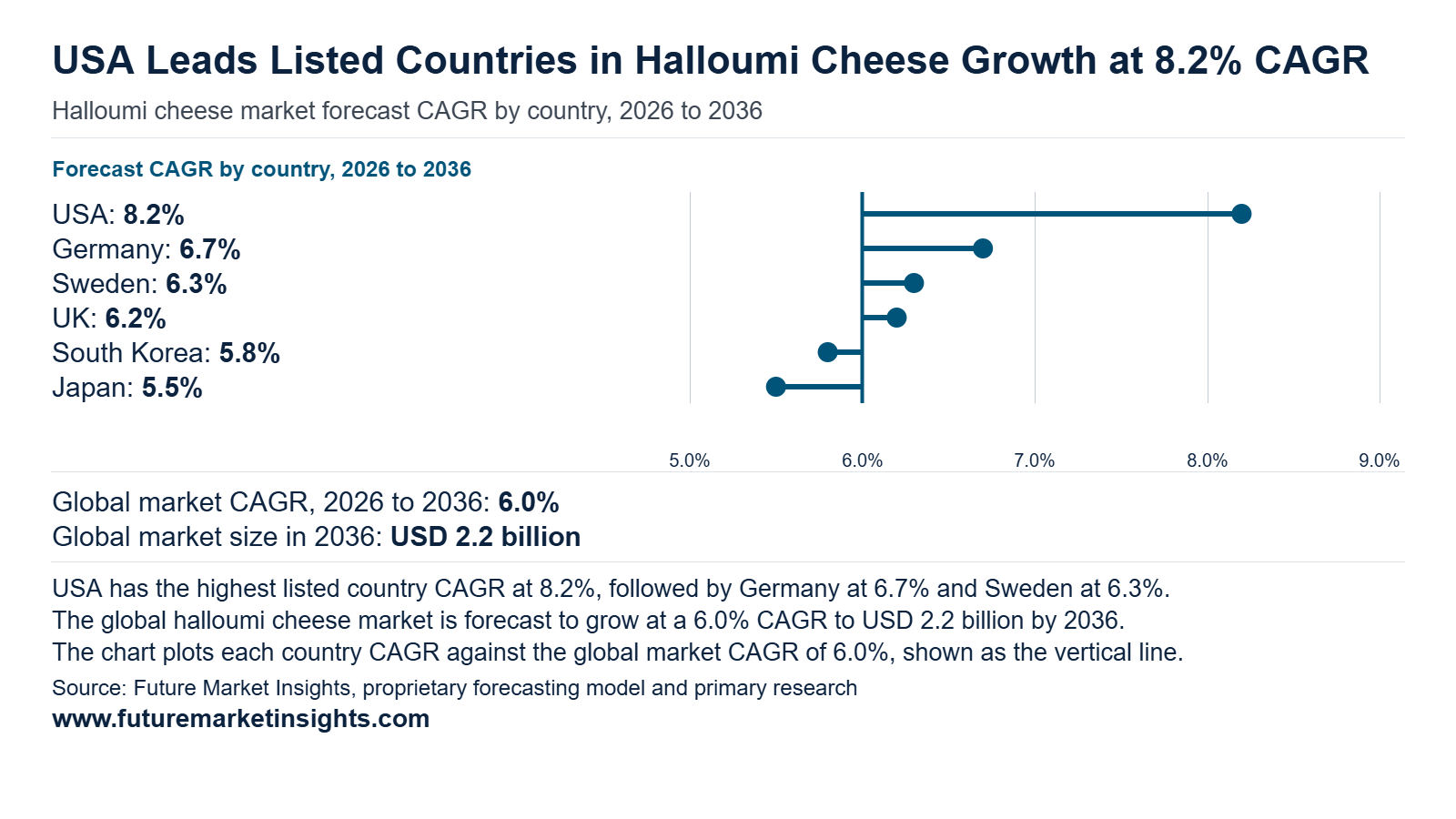
Western Europe accounts for the largest share of global halloumi cheese sales on account of mature supermarket distribution in the UK and Sweden, while North America leads percentage expansion from a smaller import base. FMI observes that the USA paces national growth at an 8.2% CAGR through 2036, followed by Germany at 6.7%, Sweden at 6.3%, and the UK at 6.2%. South Korea grows at 5.8%, Japan at 5.5%, and Cyprus at 3.7%, reflecting a 4.5 percentage-point spread between emerging import markets and mature domestic production.
| Country | 2026 Revenue | 2036 Revenue | 10-Year Addition | 2026 to 2036 CAGR | Global Share (2026 -> 2036) |
|---|---|---|---|---|---|
| UK | USD 384.0 million | USD 700.8 million | +USD 316.8 million | 6.2% | 32.0% -> 31.9% |
| Germany | USD 168.0 million | USD 321.3 million | +USD 153.3 million | 6.7% | 14.0% -> 14.6% |
| Sweden | USD 144.0 million | USD 265.3 million | +USD 121.3 million | 6.3% | 12.0% -> 12.1% |
| Cyprus | USD 132.0 million | USD 189.8 million | +USD 57.8 million | 3.7% | 11.0% -> 8.6% |
| USA | USD 120.0 million | USD 263.9 million | +USD 143.9 million | 8.2% | 10.0% -> 12.0% |
| Japan | USD 30.0 million | USD 51.2 million | +USD 21.2 million | 5.5% | 2.5% -> 2.3% |
| South Korea | USD 18.0 million | USD 31.6 million | +USD 13.6 million | 5.8% | 1.5% -> 1.4% |
Source: Future Market Insights analysis of the halloumi cheese market, 2026.
UK
UK halloumi cheese demand is projected to advance at a 6.2% CAGR through 2036, spurred by steady retail demand and growing consumer preference for certified products. In FMI's assessment, high existing household penetration means British growth relies on private-label fries, air-fryer packs, and quick-service menu items rather than first-time awareness. Retail tracking by the Agriculture and Horticulture Development Board (October 2026) shows Great Britain specialty and continental cheese volumes rising 4.6%, while the UK Department for Environment, Food and Rural Affairs (February 2026) keeps commercial Cypriot halloumi imports open under health-certificate rules. Consistent grocer replenishment will sustain UK sales leadership through 2036.
Germany
Germany halloumi cheese demand is projected to advance at a 6.7% CAGR through 2036, anchored by expanding end-user adoption and recurring replenishment demand. From what German retail buying rules show, analysts project steady supermarket expansion as European Union PDO enforcement blocks generic grilling cheeses from using the protected name. Trade figures reported by Cyprus Business News (March 2025) placed German imports at 3,256 tonnes worth EUR 24.8 million in 2024, while European Commission (April 2026) oversight secures label compliance. Increased summer grilling demand and organic PDO assortments will drive German sales growth through 2036.
Sweden
Sweden halloumi cheese demand is projected to advance at a 6.3% CAGR through 2036, supported by expanding procurement agreements across specialized commercial distribution channels. Sweden already operates a mature import lane, with Cyprus Business News (March 2025) documenting 3,247 tonnes worth EUR 25.3 million shipped to Swedish buyers in 2024. FMI believes Swedish consumers' strong preference for meat-free grilling meals pushes grocers to stock flavored and light PDO varieties rather than relying solely on plain blocks. Promotional stability and cold-chain consistency will support Swedish market expansion through 2036.
Cyprus
Cyprus halloumi cheese demand is projected to advance at a 3.7% CAGR through 2036, driven by continuous technical modernization and shifting institutional buyer preferences. FMI notes that Cyprus grows slower than importing countries because local consumption is already saturated and output prioritizes foreign shipments. Official industrial data from the Cyprus Statistical Service (September 2026) show local halloumi unit sales reached 46.1 thousand tonnes worth EUR 364.1 million, while Cyprus Mail (October 2026) reports EUR 4.0 million in annual farmer subsidies to expand sheep and goat milk intake. Tourism dining and higher-value aged PDO lines will guide Cypriot growth through 2036.
USA
USA halloumi cheese demand is projected to advance at a 8.2% CAGR through 2036, reflecting sustained industrial usage and growing awareness of operational advantages. Due to a smaller initial base, new grocery listings and restaurant appetizer trials produce faster percentage gains than in mature European markets. Industry updates from StockWatch (October 2026) confirm Cypriot exporters are targeting American retail expansion beyond the 1,037 tonnes recorded by Cyprus Business News (March 2025), while Tnuva USA (2026) scales Halloumi Type Cheese. Broader national distribution will propel American sales through 2036.
Japan
Japan halloumi cheese demand is projected to advance at a 5.5% CAGR through 2036, sustained by long-term corporate supply contracts and resilient customer adoption. FMI finds that Japanese specialty importers test chilled shelf life and compact pack sizes carefully before scaling beyond urban gourmet grocers, keeping growth measured. Export outreach highlighted by Petrou Bros Dairy Products Ltd (January 2026) at Salon du Fromage 2026 confirms active supplier engagement with Japanese foodservice and retail buyers. Clear pan-frying guidance and smaller household portions will support steady Japanese adoption through 2036.
South Korea
South Korea halloumi cheese demand is projected to advance at a 5.8% CAGR through 2036, strengthened by expanding regional network capabilities and favorable regulatory guidelines. Specifically, World Bank WITS (2025) recorded 14 tonnes of cheese and curd imports from Cyprus in 2024, meaning South Korea starts from a modest trade lane where cafe brunch menus and e-commerce grocers drive trial. Export disclosures from Charalambides Christis (October 2025) confirm ongoing shipments to Korean accounts requiring Korean-language labeling. Selective foodservice menu adoption will sustain South Korean growth through 2036.
Competitive Environment and Notable Companies
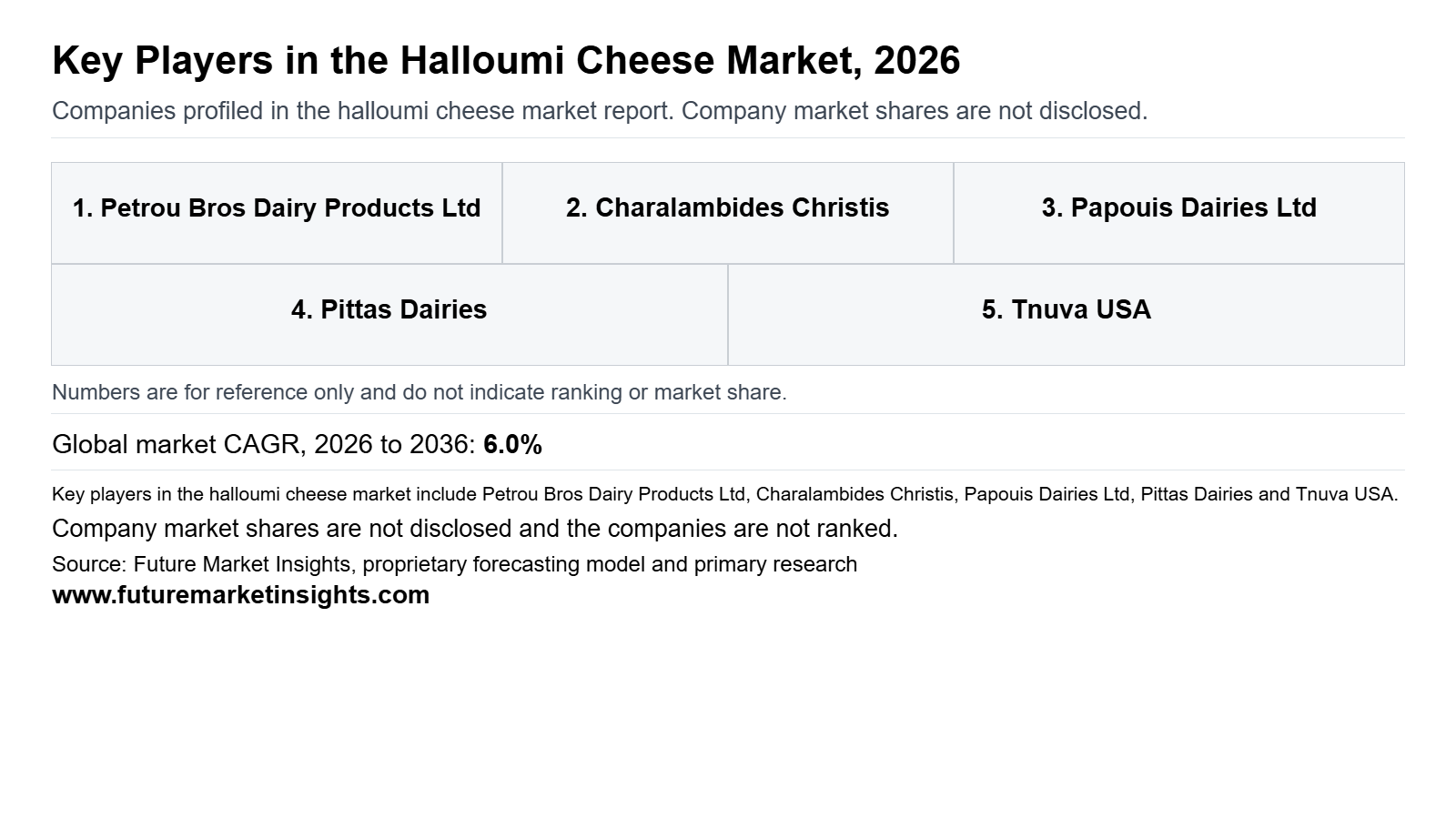
Competition in the halloumi cheese market centers on verified Cyprus Protected Designation of Origin (PDO) certification, raw-milk intake security, and format breadth across retail blocks and foodservice slices. Major Cypriot exporters including Petrou Bros Dairy Products Ltd, Charalambides Christis, Pittas Dairies, and Papouis Dairies Ltd supply branded and private-label PDO assortments to European and North American grocers, while Tnuva USA competes in the United States with a clearly distinguished Halloumi Type Cheese. Buyers increasingly favor suppliers that back origin claims with accredited food-safety audits and consistent brine-pack shelf life.
How Are Companies Positioned in the Halloumi Cheese Market?
At present, Petrou Bros Dairy Products Ltd and Charalambides Christis anchor multi-format Cypriot PDO exports, while Papouis Dairies Ltd (February 2026) operates a 10,000-tonne annual halloumi facility serving major UK supermarket private labels and quick-service chains. Pittas Dairies (2026) maintains heritage retail and catering blocks, whereas Tnuva USA (2026) competes in North America with non-PDO grilling cheese. From what supplier portfolios show, PDO compliance separates authentic island exporters from regional grilling-cheese producers.
What Matters Most When Buyers Select a Halloumi Supplier?
Procurement teams prioritize Bureau Veritas PDO certification, grill-yield consistency, and uninterrupted cold-chain documentation over lowest spot price. Veterinary import rules enforced by the UK Department for Environment, Food and Rural Affairs (February 2026) require complete pasteurization and health-certificate records on every Cypriot shipment, proving that regulatory readiness governs repeat orders. Foodservice buyers also audit slice uniformity and moisture retention before approving multi-unit contracts.
Which Capabilities Distinguish Product Portfolios?
Format engineering and consumer education separate tier-one exporters from generic dairy blenders. Petrou Bros Dairy Products Ltd (2025) supplies 900-gram catering slabs and traditional PDO blocks under its ALAMBRA brand, while Charalambides Christis (October 2025) pairs organic and light PDO packs with air-fryer cooking campaigns. Papouis Dairies Ltd (February 2026) manufactures dedicated halloumi fries and catering blocks for global hospitality chains.
How Does Geographic Reach Shape Supplier Competition?
Export reach determines how effectively dairies balance seasonal European barbecue demand with year-round international orders. Papouis Dairies Ltd (February 2026) ships to more than 30 countries including top UK supermarkets, while Charalambides Christis and Petrou Bros Dairy Products Ltd (January 2026) maintain active channels into Germany, Sweden, the USA, Japan, and South Korea. Tnuva USA (2026) uses established American kosher-dairy distribution to grow halloumi-type sales without relying on Cypriot milk quotas.
| Verified Company Evidence (2025 to 2026) | Commercial Effect | Buyer Action |
|---|---|---|
| January 2026: Petrou Bros Dairy Products Ltd showcased its PDO halloumi assortment to international buyers at Salon du Fromage 2026 (Petrou Bros Dairy Products Ltd, January 2026). | Strengthens direct European and Japanese distributor relationships for authentic Cypriot PDO blocks and slices. | Verify 2026 export pack availability and minimum order quantities for PDO burger slices. |
| February 2026: Papouis Dairies Ltd highlighted its 10,000-tonne annual halloumi capacity and UK supermarket and Ho.Re.Ca supply at Gulfood 2026 (Papouis Dairies Ltd, February 2026). | Confirms large-scale private-label and foodservice fries/sticks capability across 30+ export countries. | Evaluate Papouis private-label specifications for retail chilled aisles and QSR poultry menus. |
| October 2025: Charalambides Christis launched dedicated air-fryer halloumi recipe campaigns with its export PDO range (Charalambides Christis, October 2025). | Extends household halloumi cooking beyond summer grilling into year-round weeknight air-fryer meals. | Pair retail block promotions with air-fryer cooking callouts to lift off-season velocity. |
Source: Verified corporate disclosures and Future Market Insights analysis, 2026.
| Company | Core Positioning | Verified Activity & Source Attribution |
|---|---|---|
| Petrou Bros Dairy Products Ltd | Cyprus PDO dairy exporter; ALAMBRA brand blocks, slices, and slabs | Exhibited PDO halloumi range at Salon du Fromage 2026; 2025 catalogue lists 900 g slabs and burger slices (Petrou Bros Dairy Products Ltd, January 2026). |
| Charalambides Christis | Largest Cyprus dairy; traditional, light, and organic PDO halloumi | Published air-fryer halloumi consumer campaigns in October 2025; exports across EU, UK, USA, and Korea (Charalambides Christis, October 2025). |
| Papouis Dairies Ltd | Cyprus private-label and foodservice PDO halloumi manufacturer | Operates 10,000-tonne annual halloumi capacity serving Sainsbury's, Aldi, Costco, Morrisons, and KFC across 30+ countries (Papouis Dairies Ltd, February 2026). |
| Pittas Dairies | Heritage Cyprus halloumi specialist serving retail and catering | Supplies authentic Cypriot PDO blocks and foodservice packs to European and Middle Eastern trade partners (Pittas Dairies, 2026). |
| Tnuva USA | United States kosher and specialty halloumi-type grilling cheese supplier | Markets separately labeled Halloumi Type Cheese across American retail and foodservice channels (Tnuva USA, 2026). |
Source: Verified corporate disclosures and Future Market Insights analysis, 2026.
Halloumi Cheese Market Report Scope and Research Methodology
FMI analysts size the global halloumi cheese market through primary interviews with Cypriot dairy exporters, European retail category buyers, foodservice distributors, and specialty cheese importers, combined with desk research across customs export logs, veterinary import notices, ministerial milk decrees, and corporate filings. Baseline 2025 and 2026 valuations reconcile packaged retail blocks, pre-sliced grilling formats and clearly labeled halloumi-type variants across all seven tracked countries. Segment shares across Milk Type, Product Form, Distribution Channel, and Origin are validated against active SKU portfolios and export trade volumes, while excluding restaurant meal receipts and unrelated cheese categories to prevent double counting.
| Coverage Field | Report Scope |
|---|---|
| Market Definition | Revenue from packaged, foodservice, and retail halloumi cheese and explicitly labeled halloumi-style grilling variants. |
| Milk Type Segments | Cow Milk Blend, Sheep and Goat Milk Blend, Cow Milk Only, and Plant-Based Halloumi-Style. |
| Product Form Segments | Blocks, Sliced and Grilling Packs, Flavoured and Herb Varieties, Shredded and Cubed, and Light and Reduced-Fat. |
| Distribution Channels | Supermarkets and Hypermarkets, Foodservice, Specialty and Ethnic Stores, Online Retail, and Convenience Stores. |
| Origin Segments | Cyprus Protected Origin, Mediterranean and Middle East, and United Kingdom Production. |
| Exclusions | Finished restaurant meal receipts, downstream prepared dishes, and unrelated brined or mozzarella cheeses. |
| Quantitative Units | USD Billion for global market sizing; USD Million for country-level breakdowns. |
| Historical & Base Years | 2025 (Historical) and 2026 (Estimated Base Year). |
| Forecast Period | 2026 to 2036 (10-Year Projection Window). |
| Regions Covered | North America, Latin America, Western Europe, Eastern Europe, East Asia, South Asia and Pacific, and Middle East and Africa. |
| Countries Profiled | UK, Germany, Sweden, Cyprus, USA, Japan, and South Korea. |
| Companies Covered | Petrou Bros Dairy Products Ltd, Charalambides Christis, Papouis Dairies Ltd, Pittas Dairies, and Tnuva USA. |
| Research Approach | Primary buyer and dairy interviews combined with secondary trade, regulatory, and corporate disclosure triangulation. |
Source: Future Market Insights analysis of the halloumi cheese market, 2026.
Research Sources and Bibliography
- Agriculture and Horticulture Development Board. (2026, October 22). Q3 2026 Dairy Market Review: Retail Cow Cheese and Specialty Volume Trends.
- Charalambides Christis. (2025, October 29). Healthy, Tasty, and Ready in Minutes: Air Fryer Halloumi Recipes.
- Cyprus Business News. (2025, March 26). The countries that imported EUR 324 million worth of Halloumi from Cyprus in 2024.
- Cyprus Mail. (2026, October 13). Halloumi exports exceed EUR 350m per year.
- Cyprus Ministry of Agriculture, Rural Development and Environment. (2025, March 20). Press conference on support measures for sheep and goat farmers to enhance the Halloumi PDO. https://www.gov.cy/en/event/agriculture-minister-press-conference-on-support-measures-for-sheep-and-goat-farmers-to-enhance-the-halloumi-pdo/
- Cyprus Statistical Service. (2025, November 10). Foreign Trade Statistics: Provisional data for September 2025 and final data for August 2025. https://library.cystat.gov.cy/NEW/Foreign_Trade_Monthly-0825_0925-EN-101125.pdf
- Cyprus Statistical Service. (2026, September 24). Sales of Industrial Commodities of Local Production by Type: 2024. https://www.gov.cy/en/economy-and-finance/sales-of-industrial-commodities-of-local-production-by-type-2024/
- Cyprus Statistical Service. (2026, November 10). Foreign trade statistics: Provisional data for September 2026 and final data for August 2026. https://www.gov.cy/en/economy-and-finance/foreign-trade-statistics-provisional-data-for-september-2026-and-final-data-for-august-2026/
- European Commission. (2026, April 15). Green Line Regulation: Informal Working Group on Halloumi/Hellim. https://commission.europa.eu/about/departments-and-executive-agencies/regional-and-urban-policy/green-line-regulation_en
- Papouis Dairies Ltd. (2026, February). Exhibitor Profile: Halloumi Cheese PDO Capacity and Global Retail Supply, Gulfood 2026. https://www.gulfood.com/exhibitors/papouis-dairies-ltd
- Petrou Bros Dairy Products Ltd. (2025). ALAMBRA Dairy Products: 2025 Product Catalogue. https://petroubros.com.cy/ALAMBRA-PRODUCTS-CATALOGUE.pdf
- Petrou Bros Dairy Products Ltd. (2026, January 8). Petrou Cheese Factory: The Authenticity and Expertise of Halloumi PDO at Salon du Fromage 2026. https://www.salon-fromage.com/en/news-and-trends/news/Fromagerie-Petrou
- Pittas Dairies. (2026). Authentic Cypriot Halloumi Cheese: Retail and Foodservice Portfolio. https://pittas.com/halloumi
- StockWatch. (2026, October 8). Cyprus cheesemakers see further halloumi export potential in United States market. https://www.stockwatch.com.cy/en/news/cyprus-cheesemakers-see-further-halloumi-export-potential-in-us-market
- Tnuva USA. (2026). Halloumi Type Cheese: Product Specification. https://tnuvausa.com/product/halloumi-type-cheese/
- UK Department for Environment, Food and Rural Affairs. (2026, February 25). Foot and Mouth disease detected in Cyprus: Commercial dairy import controls. https://www.gov.uk/government/news/foot-and-mouth-disease-detected-in-cyprus
- World Bank WITS. (2025). Korea, Rep. Cheese and curd imports from Cyprus, 2024 trade data. https://wits.worldbank.org/trade/comtrade/en/country/KOR/year/2024/tradeflow/Imports/partner/ALL/product/0406
Table of Content
- Key Takeaways
- Market Size and CAGR
- Top Growth Driver
- Fastest Growing Segment
- Leading Region
- Key Companies
- Emerging Opportunities
- Executive Summary
- Global Market Outlook
- Demand-side Trends
- Supply-side Trends
- Technology Roadmap Analysis
- Analysis and Recommendations
- Analyst Perspective (What is happening? Why now? What should investors know?)
- Key Questions Answered
- How large is the market?
- What is the CAGR?
- What are key trends?
- Which region dominates?
- Who are the leaders?
Read More...
- Market Overview
- Market Coverage / Taxonomy
- Market Definition / Scope / Limitations
- Research Methodology
- Chapter Orientation
- Analytical Lens and Working Hypotheses
- Market Structure, Signals, and Trend Drivers
- Benchmarking and Cross-market Comparability
- Market Sizing, Forecasting, and Opportunity Mapping
- Research Design and Evidence Framework
- Desk Research Programme (Secondary Evidence)
- Expert Input and Fieldwork (Primary Evidence)
- Tooling, Models, and Reference Databases
- Data Engineering and Model Build
- Quality Assurance and Audit Trail
- Market Background
- Market Dynamics (Drivers, Restraints, Opportunity, Trends)
- Scenario Forecast (Optimistic, Likely, Conservative)
- Impact Analysis
- AI Impact
- Sustainability Impact
- Regulatory Impact
- Technology Impact
- Consumer / Buyer Analysis
- Purchase Drivers
- Adoption Barriers
- Buyer Journey
- Opportunity Map Analysis
- Product Life Cycle Analysis
- Supply Chain Analysis
- Investment Feasibility Matrix
- Value Chain Analysis
- PESTLE and Porter's Analysis
- Regulatory Landscape
- Regional Parent Market Outlook
- Production and Consumption Statistics
- Import and Export Statistics
- Global Market Analysis and Forecast, 2021 to 2036
- Historical Market Size Value (USD Billion) Analysis, 2021 to 2025
- Current and Future Market Size Value (USD Billion) Projections, 2026 to 2036
- Y-o-Y Growth Trend Analysis
- Absolute $ Opportunity Analysis
- Global Market Pricing Analysis, 2021 to 2036
- Global Market Analysis and Forecast, By Milk Type, 2021 to 2036
- Introduction / Key Findings
- Historical Market Size Value (USD Billion) Analysis By Milk Type, 2021 to 2025
- Current and Future Market Size Value (USD Billion) Analysis and Forecast By Milk Type, 2026 to 2036
- Cow Milk Blend
- Sheep and Goat Milk Blend
- Cow Milk Only
- Plant-Based Halloumi-Style
- Y-o-Y Growth Trend Analysis By Milk Type, 2021 to 2025
- Absolute $ Opportunity Analysis By Milk Type, 2026 to 2036
- Global Market Analysis and Forecast, By Product Form, 2021 to 2036
- Introduction / Key Findings
- Historical Market Size Value (USD Billion) Analysis By Product Form, 2021 to 2025
- Current and Future Market Size Value (USD Billion) Analysis and Forecast By Product Form, 2026 to 2036
- Blocks
- Sliced and Grilling Packs
- Flavoured and Herb Varieties
- Shredded and Cubed
- Light and Reduced-Fat
- Y-o-Y Growth Trend Analysis By Product Form, 2021 to 2025
- Absolute $ Opportunity Analysis By Product Form, 2026 to 2036
- Global Market Analysis and Forecast, By Distribution Channel, 2021 to 2036
- Introduction / Key Findings
- Historical Market Size Value (USD Billion) Analysis By Distribution Channel, 2021 to 2025
- Current and Future Market Size Value (USD Billion) Analysis and Forecast By Distribution Channel, 2026 to 2036
- Supermarkets and Hypermarkets
- Foodservice
- Specialty and Ethnic Stores
- Online Retail
- Convenience Stores
- Y-o-Y Growth Trend Analysis By Distribution Channel, 2021 to 2025
- Absolute $ Opportunity Analysis By Distribution Channel, 2026 to 2036
- Global Market Analysis and Forecast, By Origin, 2021 to 2036
- Introduction / Key Findings
- Historical Market Size Value (USD Billion) Analysis By Origin, 2021 to 2025
- Current and Future Market Size Value (USD Billion) Analysis and Forecast By Origin, 2026 to 2036
- Cyprus Protected Origin
- Mediterranean and Middle East
- United Kingdom Production
- Y-o-Y Growth Trend Analysis By Origin, 2021 to 2025
- Absolute $ Opportunity Analysis By Origin, 2026 to 2036
- Global Market Analysis and Forecast, By Region, 2021 to 2036
- Introduction
- Historical Market Size Value (USD Billion) Analysis By Region, 2021 to 2025
- Current Market Size Value (USD Billion) Analysis and Forecast By Region, 2026 to 2036
- North America
- Western Europe
- East Asia
- South Asia and Pacific
- Market Attractiveness Analysis By Region
- North America Market Analysis and Forecast, By Country, 2021 to 2036
- Historical Market Size Value (USD Billion) Trend Analysis By Market Taxonomy, 2021 to 2025
- Market Size Value (USD Billion) Forecast By Market Taxonomy, 2026 to 2036
- By Country
- United States
- Canada
- By Milk Type
- By Product Form
- By Distribution Channel
- By Origin
- By Country
- Market Attractiveness Analysis
- By Country
- By Milk Type
- By Product Form
- By Distribution Channel
- By Origin
- Key Takeaways
- Western Europe Market Analysis and Forecast, By Country
- Historical Market Size Value (USD Billion) Trend Analysis By Market Taxonomy, 2021 to 2025
- Market Size Value (USD Billion) Forecast By Market Taxonomy, 2026 to 2036
- By Country
- United Kingdom
- Germany
- France
- By Milk Type
- By Product Form
- By Distribution Channel
- By Origin
- By Country
- Market Attractiveness Analysis
- By Country
- By Milk Type
- By Product Form
- By Distribution Channel
- By Origin
- Key Takeaways
- East Asia Market Analysis and Forecast, By Country
- Historical Market Size Value (USD Billion) Trend Analysis By Market Taxonomy, 2021 to 2025
- Market Size Value (USD Billion) Forecast By Market Taxonomy, 2026 to 2036
- By Country
- China
- Japan
- South Korea
- By Milk Type
- By Product Form
- By Distribution Channel
- By Origin
- By Country
- Market Attractiveness Analysis
- By Country
- By Milk Type
- By Product Form
- By Distribution Channel
- By Origin
- Key Takeaways
- South Asia and Pacific Market Analysis and Forecast, By Country
- Historical Market Size Value (USD Billion) Trend Analysis By Market Taxonomy, 2021 to 2025
- Market Size Value (USD Billion) Forecast By Market Taxonomy, 2026 to 2036
- By Country
- India
- Australia
- Rest of world aggregate
- By Milk Type
- By Product Form
- By Distribution Channel
- By Origin
- By Country
- Market Attractiveness Analysis
- By Country
- By Milk Type
- By Product Form
- By Distribution Channel
- By Origin
- Key Takeaways
- Key Countries Market Analysis
- United States
- Pricing Analysis
- Market Share Analysis, 2025
- By Milk Type
- By Product Form
- By Distribution Channel
- By Origin
- Canada
- Pricing Analysis
- Market Share Analysis, 2025
- By Milk Type
- By Product Form
- By Distribution Channel
- By Origin
- Germany
- Pricing Analysis
- Market Share Analysis, 2025
- By Milk Type
- By Product Form
- By Distribution Channel
- By Origin
- United Kingdom
- Pricing Analysis
- Market Share Analysis, 2025
- By Milk Type
- By Product Form
- By Distribution Channel
- By Origin
- France
- Pricing Analysis
- Market Share Analysis, 2025
- By Milk Type
- By Product Form
- By Distribution Channel
- By Origin
- India
- Pricing Analysis
- Market Share Analysis, 2025
- By Milk Type
- By Product Form
- By Distribution Channel
- By Origin
- China
- Pricing Analysis
- Market Share Analysis, 2025
- By Milk Type
- By Product Form
- By Distribution Channel
- By Origin
- Japan
- Pricing Analysis
- Market Share Analysis, 2025
- By Milk Type
- By Product Form
- By Distribution Channel
- By Origin
- South Korea
- Pricing Analysis
- Market Share Analysis, 2025
- By Milk Type
- By Product Form
- By Distribution Channel
- By Origin
- Australia
- Pricing Analysis
- Market Share Analysis, 2025
- By Milk Type
- By Product Form
- By Distribution Channel
- By Origin
- United States
- Market Structure Analysis
- Competition Dashboard
- Competition Benchmarking
- Market Share Analysis of Top Players
- By Regional
- By Milk Type
- By Product Form
- By Distribution Channel
- By Origin
- Emerging Startups
- Innovation Benchmarking
- Competition Analysis
- Competition Deep Dive
- Petrou Bros Dairy Products Ltd
- Overview
- Product Portfolio
- Profitability by Market Segments
- Sales Footprint
- Strategy Overview
- Marketing Strategy
- Product Strategy
- Channel Strategy
- Charalambides Christis
- Papouis Dairies Ltd
- Pittas Dairies
- Tnuva USA
- Petrou Bros Dairy Products Ltd
- Case Studies
- Success Stories
- Recent Developments
- Competition Deep Dive
- Assumptions & Acronyms Used
List of Tables
- Table 1: Global Market Value (USD Billion) Forecast by Region, 2021 to 2036
- Table 2: Global Market Value (USD Billion) Forecast by Milk Type, 2021 to 2036
- Table 3: Global Market Value (USD Billion) Forecast by Product Form, 2021 to 2036
- Table 4: Global Market Value (USD Billion) Forecast by Distribution Channel, 2021 to 2036
- Table 5: Global Market Value (USD Billion) Forecast by Origin, 2021 to 2036
- Table 6: North America Market Value (USD Billion) Forecast by Country, 2021 to 2036
- Table 7: North America Market Value (USD Billion) Forecast by Milk Type, 2021 to 2036
- Table 8: North America Market Value (USD Billion) Forecast by Product Form, 2021 to 2036
- Table 9: North America Market Value (USD Billion) Forecast by Distribution Channel, 2021 to 2036
- Table 10: North America Market Value (USD Billion) Forecast by Origin, 2021 to 2036
- Table 11: Western Europe Market Value (USD Billion) Forecast by Country, 2021 to 2036
- Table 12: Western Europe Market Value (USD Billion) Forecast by Milk Type, 2021 to 2036
- Table 13: Western Europe Market Value (USD Billion) Forecast by Product Form, 2021 to 2036
- Table 14: Western Europe Market Value (USD Billion) Forecast by Distribution Channel, 2021 to 2036
- Table 15: Western Europe Market Value (USD Billion) Forecast by Origin, 2021 to 2036
- Table 16: East Asia Market Value (USD Billion) Forecast by Country, 2021 to 2036
- Table 17: East Asia Market Value (USD Billion) Forecast by Milk Type, 2021 to 2036
- Table 18: East Asia Market Value (USD Billion) Forecast by Product Form, 2021 to 2036
- Table 19: East Asia Market Value (USD Billion) Forecast by Distribution Channel, 2021 to 2036
- Table 20: East Asia Market Value (USD Billion) Forecast by Origin, 2021 to 2036
- Table 21: South Asia and Pacific Market Value (USD Billion) Forecast by Country, 2021 to 2036
- Table 22: South Asia and Pacific Market Value (USD Billion) Forecast by Milk Type, 2021 to 2036
- Table 23: South Asia and Pacific Market Value (USD Billion) Forecast by Product Form, 2021 to 2036
- Table 24: South Asia and Pacific Market Value (USD Billion) Forecast by Distribution Channel, 2021 to 2036
- Table 25: South Asia and Pacific Market Value (USD Billion) Forecast by Origin, 2021 to 2036
List of Figures
- Figure 1: Global Market Pricing Analysis
- Figure 2: Global Market Value (USD Billion) Forecast 2021-2036
- Figure 3: Global Market Value Share and BPS Analysis by Milk Type, 2026 and 2036
- Figure 4: Global Market Y-o-Y Growth Comparison by Milk Type, 2026-2036
- Figure 5: Global Market Attractiveness Analysis by Milk Type
- Figure 6: Global Market Value Share and BPS Analysis by Product Form, 2026 and 2036
- Figure 7: Global Market Y-o-Y Growth Comparison by Product Form, 2026-2036
- Figure 8: Global Market Attractiveness Analysis by Product Form
- Figure 9: Global Market Value Share and BPS Analysis by Distribution Channel, 2026 and 2036
- Figure 10: Global Market Y-o-Y Growth Comparison by Distribution Channel, 2026-2036
- Figure 11: Global Market Attractiveness Analysis by Distribution Channel
- Figure 12: Global Market Value Share and BPS Analysis by Origin, 2026 and 2036
- Figure 13: Global Market Y-o-Y Growth Comparison by Origin, 2026-2036
- Figure 14: Global Market Attractiveness Analysis by Origin
- Figure 15: Global Market Value (USD Billion) Share and BPS Analysis by Region, 2026 and 2036
- Figure 16: Global Market Y-o-Y Growth Comparison by Region, 2026-2036
- Figure 17: Global Market Attractiveness Analysis by Region
- Figure 18: North America Market Incremental Dollar Opportunity, 2026-2036
- Figure 19: Western Europe Market Incremental Dollar Opportunity, 2026-2036
- Figure 20: East Asia Market Incremental Dollar Opportunity, 2026-2036
- Figure 21: South Asia and Pacific Market Incremental Dollar Opportunity, 2026-2036
- Figure 22: North America Market Value Share and BPS Analysis by Country, 2026 and 2036
- Figure 23: North America Market Value Share and BPS Analysis by Milk Type, 2026 and 2036
- Figure 24: North America Market Y-o-Y Growth Comparison by Milk Type, 2026-2036
- Figure 25: North America Market Attractiveness Analysis by Milk Type
- Figure 26: North America Market Value Share and BPS Analysis by Product Form, 2026 and 2036
- Figure 27: North America Market Y-o-Y Growth Comparison by Product Form, 2026-2036
- Figure 28: North America Market Attractiveness Analysis by Product Form
- Figure 29: North America Market Value Share and BPS Analysis by Distribution Channel, 2026 and 2036
- Figure 30: North America Market Y-o-Y Growth Comparison by Distribution Channel, 2026-2036
- Figure 31: North America Market Attractiveness Analysis by Distribution Channel
- Figure 32: North America Market Value Share and BPS Analysis by Origin, 2026 and 2036
- Figure 33: North America Market Y-o-Y Growth Comparison by Origin, 2026-2036
- Figure 34: North America Market Attractiveness Analysis by Origin
- Figure 35: Western Europe Market Value Share and BPS Analysis by Country, 2026 and 2036
- Figure 36: Western Europe Market Value Share and BPS Analysis by Milk Type, 2026 and 2036
- Figure 37: Western Europe Market Y-o-Y Growth Comparison by Milk Type, 2026-2036
- Figure 38: Western Europe Market Attractiveness Analysis by Milk Type
- Figure 39: Western Europe Market Value Share and BPS Analysis by Product Form, 2026 and 2036
- Figure 40: Western Europe Market Y-o-Y Growth Comparison by Product Form, 2026-2036
- Figure 41: Western Europe Market Attractiveness Analysis by Product Form
- Figure 42: Western Europe Market Value Share and BPS Analysis by Distribution Channel, 2026 and 2036
- Figure 43: Western Europe Market Y-o-Y Growth Comparison by Distribution Channel, 2026-2036
- Figure 44: Western Europe Market Attractiveness Analysis by Distribution Channel
- Figure 45: Western Europe Market Value Share and BPS Analysis by Origin, 2026 and 2036
- Figure 46: Western Europe Market Y-o-Y Growth Comparison by Origin, 2026-2036
- Figure 47: Western Europe Market Attractiveness Analysis by Origin
- Figure 48: East Asia Market Value Share and BPS Analysis by Country, 2026 and 2036
- Figure 49: East Asia Market Value Share and BPS Analysis by Milk Type, 2026 and 2036
- Figure 50: East Asia Market Y-o-Y Growth Comparison by Milk Type, 2026-2036
- Figure 51: East Asia Market Attractiveness Analysis by Milk Type
- Figure 52: East Asia Market Value Share and BPS Analysis by Product Form, 2026 and 2036
- Figure 53: East Asia Market Y-o-Y Growth Comparison by Product Form, 2026-2036
- Figure 54: East Asia Market Attractiveness Analysis by Product Form
- Figure 55: East Asia Market Value Share and BPS Analysis by Distribution Channel, 2026 and 2036
- Figure 56: East Asia Market Y-o-Y Growth Comparison by Distribution Channel, 2026-2036
- Figure 57: East Asia Market Attractiveness Analysis by Distribution Channel
- Figure 58: East Asia Market Value Share and BPS Analysis by Origin, 2026 and 2036
- Figure 59: East Asia Market Y-o-Y Growth Comparison by Origin, 2026-2036
- Figure 60: East Asia Market Attractiveness Analysis by Origin
- Figure 61: South Asia and Pacific Market Value Share and BPS Analysis by Country, 2026 and 2036
- Figure 62: South Asia and Pacific Market Value Share and BPS Analysis by Milk Type, 2026 and 2036
- Figure 63: South Asia and Pacific Market Y-o-Y Growth Comparison by Milk Type, 2026-2036
- Figure 64: South Asia and Pacific Market Attractiveness Analysis by Milk Type
- Figure 65: South Asia and Pacific Market Value Share and BPS Analysis by Product Form, 2026 and 2036
- Figure 66: South Asia and Pacific Market Y-o-Y Growth Comparison by Product Form, 2026-2036
- Figure 67: South Asia and Pacific Market Attractiveness Analysis by Product Form
- Figure 68: South Asia and Pacific Market Value Share and BPS Analysis by Distribution Channel, 2026 and 2036
- Figure 69: South Asia and Pacific Market Y-o-Y Growth Comparison by Distribution Channel, 2026-2036
- Figure 70: South Asia and Pacific Market Attractiveness Analysis by Distribution Channel
- Figure 71: South Asia and Pacific Market Value Share and BPS Analysis by Origin, 2026 and 2036
- Figure 72: South Asia and Pacific Market Y-o-Y Growth Comparison by Origin, 2026-2036
- Figure 73: South Asia and Pacific Market Attractiveness Analysis by Origin
- Figure 74: Global Market - Tier Structure Analysis
- Figure 75: Global Market - Company Share Analysis
Frequently Asked Questions
What is the projected size and CAGR of the halloumi cheese market through 2036?
Global halloumi cheese sales are projected to reach USD 2.2 billion by 2036, expanding at a 6.0% CAGR from 2026 to 2036 and generating USD 1.0 billion in incremental value.
Which Milk Type segment leads the halloumi cheese market in 2026?
Cow Milk Blend leads the Milk Type axis with a 42.5% revenue share in 2026, balancing scalable dairy procurement with the firm grilling texture sought by commercial buyers.
Which Product Form segment captures the largest share of halloumi cheese sales?
Blocks hold 62.0% of Product Form revenue in 2026 because standard brine-packed blocks serve both household slicing and bulk restaurant portioning from a single SKU.
How much share does Supermarkets and Hypermarkets hold in Distribution Channel?
Supermarkets and Hypermarkets account for 58.0% of Distribution Channel revenue in 2026 as mainstream grocery chains consolidate chilled retail halloumi purchasing.
Why does Cyprus Protected Origin lead the Origin segment?
Cyprus Protected Origin captures 44.7% of Origin revenue in 2026 because European Union geographical-indication law restricts the registered Halloumi/Hellim name to certified Cypriot producers.
Which countries are projected to grow fastest in the halloumi cheese market?
The USA leads national growth at an 8.2% CAGR from 2026 to 2036, followed by Germany at 6.7% and Sweden at 6.3% as specialty retail distribution expands.
Which companies are profiled as key players in the halloumi cheese market?
Key profiled companies include Petrou Bros Dairy Products Ltd, Charalambides Christis, Papouis Dairies Ltd, Pittas Dairies, and Tnuva USA.
Preview the report firsthand - request a free sample
Get SampleGet the brochure for pricing and purchase details.
Get PDF
