

- Market Size (2026)
- USD 223.0 Mn
- Forecast (2036)
- USD 430.5 Mn
- CAGR (2026 to 2036)
- 6.8%
How big is Harissa Sauce Market in 2026?
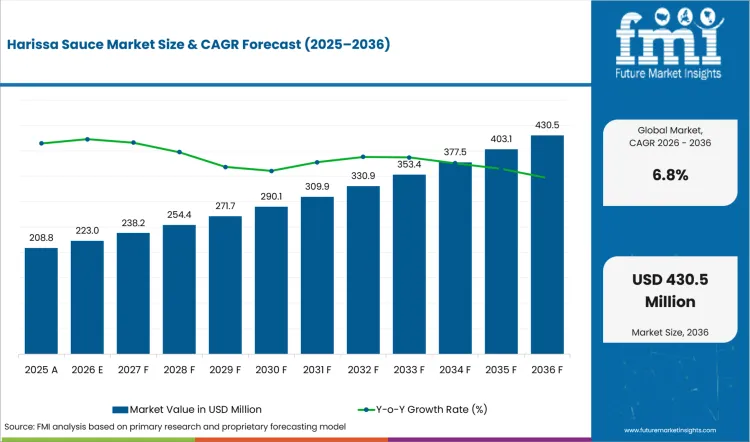
USD 223.0 million in 2026 and USD 430.5 million by 2036 at a 6.8% CAGR.
Demand for harissa sauce is projected to expand at 6.8% CAGR between 2026 and 2036, increasing valuation from USD 223.0 million in 2026 to USD 430.5 million by 2036. Harissa sector is expected to benefit from its versatility across sauces and condiments, marinades and prepared-food applications in both retail and foodservice channels. A single concentrated paste can be adapted to multiple recipes, making it suitable for home kitchens as well as commercial menu development. CEPEX reported in April 2025 that around fifteen Tunisian exporters showcased products including harissa at SIAM Meknès, providing producers with direct access to Moroccan trade buyers. The event highlighted ongoing efforts to expand distribution channels and increase the visibility of Tunisian-origin products in regional markets.
Growth prospects vary according to production scale and brand recognition. Tunisia is expected to outpace the United Kingdom because established domestic production provides exporters with a stronger origin story and supply base during distributor negotiations. CEPEX scheduled Tunisian-Moroccan business meetings in March 2026 that included harissa among the featured products, linking available production capacity with potential commercial partnerships. Existing familiarity with Tunisian harissa can shorten the sales cycle in ethnic and specialty-food channels. In the United Kingdom, commercial success depends more heavily on shelf-ready packaging and retailer-specific product requirements.
Key Takeaways of Harissa Sauce Market
- Demand rises as households and foodservice operators reuse the same pepper paste across seasonings and marinades plus finishing applications.
- Based on product type, traditional harissa paste is projected to account for 34.0% in 2026 due to concentrated texture supporting several preparation methods.
- By packaging, glass jars are estimated to hold 31.0% in 2026 owing to resealable presentation that suits repeated household use.
- Labeling obligations and poorly matched heat can slow repeat purchasing by adding launch work or disappointing first-time users during follow-up use.
- SCAPCB INTERNATIONAL (Le Phare du Cap Bon), Soom Foods, Terrapin Ridge Farms, Major International, ABIDA, ManarThon, Pinch Dab Dash and New York Shuk are some notable companies in the industry.
Analyst Perspective
"Harissa manufacturers protect repeat purchasing by keeping the pepper profile recognizable as heat and pack formats change across channels. Stronger offers then match that profile to practical serving sizes and prove dependable replenishment for the intended retail or foodservice route."
- Nandini Roy Choudhury, Principal Consultant, Future Market Insights
How is the Harissa Sauce Market segmented?
The harissa sauce market is segmented by product type, packaging, heat level, distribution channel, end use and region.
The harissa sauce market is segmented by product type, packaging, heat level, distribution channel, end use and region. Product types include traditional paste, sauce, dry spice mix, organic and mild or fusion harissa. Packaging covers glass jars, squeeze bottles, tubes, pouches or sachets and tubs. Heat levels are mild, medium, hot and extra hot. Channels include supermarkets or hypermarkets, specialty and ethnic stores, e-commerce, foodservice or HoReCa and private label. End uses cover household consumers, restaurants or foodservice, sauce and meal-kit brands and ready-meal manufacturers.
What role do supermarkets and hypermarkets play within the distribution channel category?
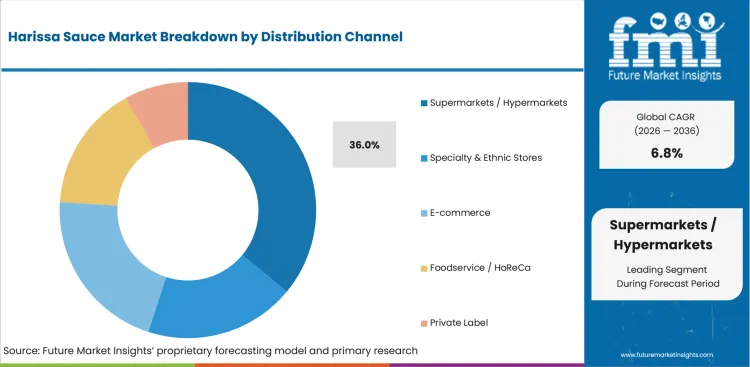
Supermarkets reduce discovery effort as shoppers compare harissa with chili sauce and world-food products during routine grocery trips in large grocery environments. Routine traffic also lets unfamiliar brands build repeat visibility without depending entirely on specialist-store visits.
- Supermarkets and hypermarkets are set to lead the distribution channel with 36.0% share in 2026 due to regular grocery traffic and physical shelf visibility.
- Exporters need reliable replenishment and shelf-ready packs once a listing joins broader sauces and dressings assortments. CEPEX's May 2026 APAS program included Harissa AOC among priority products at an event offering access to more than 73,000 professionals and 850 exhibitors.
What makes traditional harissa paste central to the product type category?
Traditional harissa paste concentrates peppers and spices into a format that works for direct seasoning or recipe preparation across household and professional kitchens. CEPEX scheduled harissa for April 2026 meetings with representatives of a European grocery group, giving Tunisian producers a direct retail discussion route for shelf-ready imported condiments.
- Based on product type, traditional harissa paste is projected to account for 34.0% in 2026 due to concentrated texture supporting several preparation methods.
- Restaurants and households dilute paste into culinary sauces or apply it during cooking so one product can serve several meals without separate recipe-specific seasonings.
How do glass jars influence selection within the packaging category?
Glass jars support repeated pantry use as rigid resealable containers let households spoon concentrated paste across several meals and inspect product texture at purchase. Visible color also helps shoppers compare consistency across brands that share similar pepper-led ingredient cues on the shelf.
- By packaging, glass jars are estimated to hold 31.0% in 2026 owing to resealable presentation that suits repeated household use.
- Retailers gain a stable format for dips and spreads comparisons, although jar weight raises transport exposure. GOV.UK updated packaging guidance in July 2026 and requires food businesses to keep glass containers clean and undamaged.
How do household consumers shape demand within the end use category?
Household cooks compare harissa with familiar hot sauce choices but concentrated paste can season vegetables and proteins across several meals without special preparation. Terrapin Ridge Farms introduced its 9-ounce Harissa Aioli Squeeze in February 2025, placing North African pepper flavor inside a familiar household condiment format.
- The end use category is forecast to be led by household consumers at 46.0% share in 2026 due to frequent low-volume use across several meal types.
- Home adoption improves as recipe guidance turns one pack into several predictable uses and reduces the chance that first trial remains a single-meal purchase.
What are the drivers, restraints and opportunities in the Harissa Sauce Market?
Broader culinary use raises repeat demand while labeling work slows cross-border launches and controlled adaptation adds new serving occasions.
- Driver: Harissa earns repeat orders as one pepper base serves several menu applications without separate seasonings for every preparation.
- Restraint: Cross-border launches slow as packaged sauces need destination-specific labels and importer records for retailers to accept routine replenishment.
- Opportunity: Recipe adaptation can add prepared-food occasions when a recognizable harissa profile fits formats consumers already understand.
Prepared-Food Use Broadens Repeat Occasions
Demand for harissa rises as one pepper base performs across several menu tasks without adding separate seasonings for each dish. Tyson Foods introduced Harissa Chicken Cups at selected USA retailers in June 2026, placing the flavor inside a ready-to-eat protein format. The crossover gives sauce makers a route from protein condiments into prepared foods that preserves a recognizable harissa profile.
Label Compliance Adds Cross-Border Launch Work
Cross-border launches slow as packaged sauce labels and importer records must match destination rules during artwork finalization. FDA updated its General Food Labeling Requirements Compliance Program in June 2025, covering domestic and imported foods under current enforcement procedures. Late information changes cost smaller brands more as short runs spread compliance work across fewer saleable units.
Controlled Adaptation Extends Serving Occasions
Recipe adaptation widens addressable use as convenient foods retain enough harissa character for consumers to recognize the underlying pepper profile. Whole Foods Market listed Creamy Harissa and Cheese Phyllo Bites among its October 2025 products for a 2026 frozen-food trend, placing harissa inside a ready-to-heat format. Sauce formulators can target prepared meals and pasta sauces as one concentrated base reduces kitchen preparation without turning the flavor into a generic hot sauce.
Which country CAGRs are profiled in the Harissa Sauce Market?
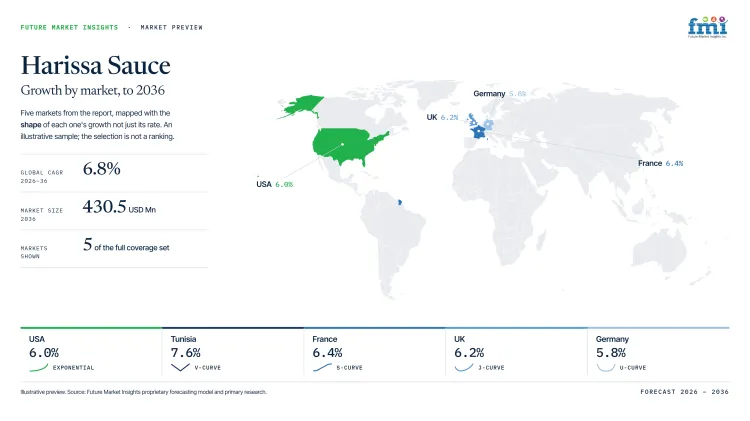
| Country | CAGR |
| Tunisia | 7.6% |
| Morocco | 7.1% |
| UAE | 7.0% |
| France | 6.4% |
| United Kingdom | 6.2% |
How do country-level CAGRs compare in the Harissa Sauce Market?
The country comparison spans 1.4 percentage points and reveals three distinct growth groups across the harissa sauce market. Tunisia and Morocco form the upper tier with a 0.5-point gap, while the UAE sits between the leading and European markets. France and the United Kingdom form the lower tier, separated by 0.2 percentage points.
- Tunisia leads the comparison at a 7.6% CAGR through 2036, supported by established production, export programs and strong familiarity with harissa across food applications.
- Morocco follows at a 7.1% CAGR, remaining 0.5 percentage points below Tunisia. Defined sauce requirements and established production capabilities support packaged-product expansion and export opportunities.
- The UAE records a 7.0% CAGR, 0.1 percentage points below Morocco. Strong imported-food turnover, expanding commercial channels and dependable local distribution support harissa sauce demand.
- France grows at a 6.4% CAGR, creating a 0.6-percentage-point gap from the UAE. Mature condiment assortments make shelf differentiation, product positioning and established harissa familiarity important to continued growth.
- The United Kingdom records a 6.2% CAGR, 0.2 percentage points below France and the lowest among the profiled countries. Retail listings, usage guidance and packs suited to repeat purchasing support market expansion.
Similar CAGRs can therefore produce materially different entry costs and replenishment conditions for harissa suppliers. The full report provides country-level CAGR analysis across North America, Latin America, Europe, East Asia, South Asia, Oceania and the Middle East and Africa.
Country-wise Analysis
- Tunisian producers work from an established pepper-processing base that gives traditional paste a recognizable origin during export discussions with specialty importers and mainstream grocers seeking dependable North African supply for recurring retail programs. Harissa sauce demand in Tunisia is forecast to rise at 7.6% CAGR over the forecast period, supported by CEPEX’s June 2026 Poland program that placed harissa in meetings with importers and large retailers. Export promotion gives manufacturers direct commercial access to foreign accounts, but recurring orders still depend on stable pepper sourcing and destination-ready labels that prevent recipe or pack changes from disrupting replenishment across several markets.
- Moroccan packaged sauces enter formal retail under a defined national category that gives manufacturers a clear legal reference for product naming and composition across supermarket and foodservice channels serving domestic consumers and import programs. Morocco’s harissa sauce outlook is anticipated to advance at 7.1% CAGR over the assessment period, reinforced by ONSSA’s April 2025 publication of Order 356-25 defining designations and characteristics for sauces sold nationally. The defined category reduces uncertainty during launch planning, but manufacturers must preserve familiar pepper intensity while aligning formulas and labels with the legal classification that retailers use for routine national assortment decisions.
- UAE grocery and foodservice channels rely on imported packaged foods serving residents and international restaurant concepts across high-throughput retail centers with frequent product turnover and broad cuisine exposure across Dubai’s diverse dining mix. Adoption of harissa sauce in the UAE is estimated to expand at 7.0% CAGR through 2036, supported by Dubai Municipality registering 77,700 new food products during the first half of 2025. Rapid registration activity gives imported harissa several cuisine entry points, but overseas brands need accurate product records and capable local distribution to secure dependable shelf replenishment and repeat professional-kitchen orders across routine ordering cycles.
- French supermarkets place harissa inside mature world-food and condiment assortments shaped by long exposure to North African cuisines, reducing product education while increasing the need for clear shelf differentiation across crowded national grocery aisles. France is estimated to post 6.4% CAGR over the forecast period, shaped by mature national retail conditions as DGCCRF reported nearly 58,000 establishment and website checks during 2025 in June 2026. Familiar flavor lowers trial friction for retailers, but imported brands need precise consumer information and a distinct recipe or use case for mature shelves to convert exposure into dependable repeat purchasing at wider scale.
- Large grocers and specialist food stores give United Kingdom shoppers repeated harissa exposure, and recipe-led discovery can convert the imported condiment into routine pantry use across everyday household cooking and premium culinary ranges. Harissa sauce sales in the United Kingdom are forecast to expand at 6.2% CAGR by 2036 as ONS recorded a 6% rise in restaurant and hotel spending for the year ending March 2025. Channel access widens flavor exposure across foodservice, but listings remain sensitive to pack size and usage clarity owing to retailers’ need for shelf-ready formats that households can finish without waste or confusing preparation locally.
Who are the notable companies in the Harissa Sauce Market?
SCAPCB INTERNATIONAL (Le Phare du Cap Bon), Soom Foods, Terrapin Ridge Farms, Major International, ABIDA, ManarThon, Pinch Dab Dash and New York Shuk are the notable companies serving this market.
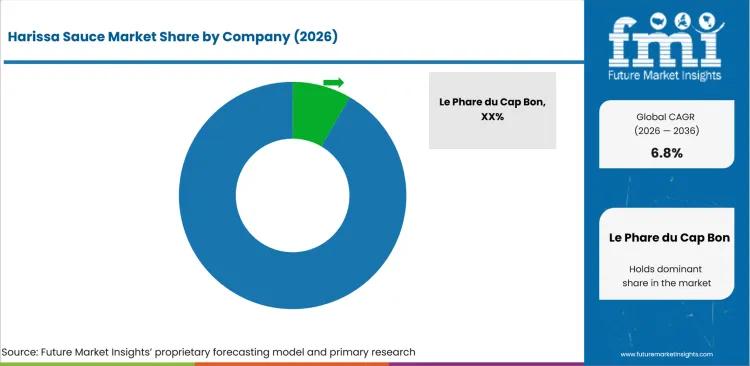
The field remains fragmented as Tunisian processors compete with specialty pantry brands and foodservice condiment makers. Retailers compare recipe credibility with pack usability beside broader herbs and spices assortments once harissa moves beyond specialist shelves. Wider distribution raises compliance and replenishment demands that smaller brands must meet to expand routine listings.
- SCAPCB INTERNATIONAL (Le Phare du Cap Bon), ABIDA and ManarThon operate Tunisian processing bases serving export-oriented packaged food channels.
- New York Shuk and Pinch Dab Dash focus on pantry use across retail and direct channels serving regular household cooking.
- Soom Foods, Terrapin Ridge Farms and Major International use squeeze or foodservice formats for adjacent harissa condiment occasions.
Competitive Benchmarking: Harissa Sauce Market
| Company | Harissa Product Depth | Adjacent Portfolio Breadth | Commercial Channel Breadth | Geographic Reach |
|---|---|---|---|---|
| SCAPCB INTERNATIONAL (Le Phare du Cap Bon) | High | Medium | Low | Tunisia; export markets |
| Soom Foods | Low | High | High | United States |
| Terrapin Ridge Farms | Low | High | Medium | United States |
| Major International | Low | High | Medium | United Kingdom |
| ABIDA | High | High | Low | Tunisia; export markets |
| ManarThon | Medium | High | Medium | Tunisia; 30+ export markets |
| Pinch Dab Dash | Low | High | Medium | United States |
| New York Shuk | High | High | Medium | United States |
Key Developments in the Harissa Sauce Market
- In June 2026, Soom Foods launched a 12-ounce tahini squeeze line with harissa among two flavored options for everyday finishing and condiment use.
- In April 2026, Major International launched harissa within its four-product Global Paste range for professional kitchens in resealable 1-kilogram tubs.
- In March 2026, Pinch Dab Dash reported harissa among recent additions to its 21-blend line as specialty retail distribution expanded across New England.
Key Players in the Harissa Sauce Market
Traditional Harissa Processing Platforms
- SCAPCB INTERNATIONAL (Le Phare du Cap Bon)
- ABIDA
- ManarThon
Pantry and Retail Harissa Brands
- New York Shuk
- Pinch Dab Dash
Adapted Condiment and Foodservice Formats
- Soom Foods
- Terrapin Ridge Farms
- Major International
Harissa Sauce Market - Report Scope
| Coverage field | Report scope |
|---|---|
| Market breakdown | By product type, packaging, heat level, distribution channel, end use and region. |
| Quantitative Units | Revenue in USD million and CAGR in %. |
| Market Definition | Commercial harissa pastes, sauces, seasoning formats and packaged variants sold for household, foodservice and prepared-food applications. |
| Regions Covered | North America, Latin America, Europe, East Asia, South Asia and Pacific, and Middle East and Africa. |
| Countries Covered | Tunisia, Morocco, UAE, France, United Kingdom, and 20+ countries included in the full report. |
| Key Companies Profiled | SCAPCB INTERNATIONAL (Le Phare du Cap Bon), Soom Foods, Terrapin Ridge Farms, Major International, ABIDA, ManarThon, Pinch Dab Dash, New York Shuk. |
| Forecast Period | 2026 to 2036. |
| Approach | Primary and secondary research with market triangulation. |
Harissa Sauce Market - Research Methodology
| Method | Approach |
|---|---|
| Primary Research | FMI analysts gathered input from manufacturers, service providers, technology developers, distributors, end users, procurement teams, and subject-matter experts. Interviews examined purchasing decisions, product or service evaluation, adoption barriers, approval requirements, pricing considerations, and expectations for technical or commercial support. Respondents were also asked what evidence is required before a trial, pilot, or initial order develops into regular purchasing. |
| Desk Research | Desk research covered government statistics, regulatory publications, trade data, industry associations, technical literature, standards, company filings, product information, and official corporate announcements. Sources were reviewed for relevance, publication date, geographic coverage, and consistency with the defined market scope. Claims relating to performance, applications, approvals, capacity, investment, and commercial activity were retained only when supported by credible public evidence. |
| Market Sizing and Forecasting | The market model combined the baseline value with historical performance, segment structure, pricing and volume indicators, adoption levels, company participation, and country-level demand conditions. Forecast assumptions considered economic activity, investment trends, regulatory developments, technology adoption, purchasing cycles, supply availability, and barriers to wider market use. Segment and regional estimates were reconciled before the final market total was calculated. |
| Data Validation | Estimates were checked against multiple independent indicators, including public data, company activity, trade patterns, industry developments, and findings from primary interviews. Validation also tested whether products, services, applications, and company revenues fell within the defined market boundaries. Adjacent categories, unsupported claims, overlapping revenues, and activities without direct market relevance were excluded to reduce double counting and maintain consistency across segments and countries. |
Harissa Sauce Market by Segments
Harissa Sauce Market segmented by Product Type:
- Traditional Harissa Paste
- Harissa Sauce
- Dry Harissa Spice Mix
- Organic Harissa
- Mild / Fusion Harissa
Harissa Sauce Market segmented by Packaging:
- Glass Jars
- Squeeze Bottles
- Tubes
- Pouches / Sachets
- Foodservice Tubs
Harissa Sauce Market segmented by Heat Level:
- Mild
- Medium
- Hot
- Extra Hot
Harissa Sauce Market segmented by Distribution Channel:
- Supermarkets / Hypermarkets
- Specialty & Ethnic Stores
- E-commerce
- Foodservice / HoReCa
- Private Label
Harissa Sauce Market segmented by End Use:
- Household Consumers
- Restaurants / Foodservice
- Sauce & Meal Kit Brands
- Ready Meal Manufacturers
Harissa Sauce Market by Region
- North America
- United States
- Canada
- Latin America
- Brazil
- Mexico
- Chile
- Rest of Latin America
- Western Europe
- Germany
- United Kingdom
- Italy
- Spain
- France
- Nordics
- Benelux
- Rest of Western Europe
- Eastern Europe
- Russia
- Poland
- Hungary
- Balkan and Baltic States
- Rest of Eastern Europe
- East Asia
- China
- Japan
- South Korea
- South Asia and Pacific
- India
- ASEAN
- Australia and New Zealand
- Rest of South Asia and Pacific
- Middle East and Africa
- Kingdom of Saudi Arabia
- Other GCC Countries
- Türkiye
- South Africa
- Other African Union Countries
- Rest of Middle East and Africa
Research Sources and Bibliography
- Centre de Promotion des Exportations. (2025, April 23). La Tunisie à l'honneur au SIAM Meknès 2025 : une vitrine rayonnante du savoir-faire agroalimentaire tunisien.
- Centre de Promotion des Exportations. (2026, March 25). Rencontres professionnelles Tuniso-Marocaines.
- Centre de Promotion des Exportations. (2026, April 14). Rencontres professionnelles B to B.
- Food Standards Agency. (2026, July 21). Packaging and labelling.
- Specialty Food Association. (2025, February 7). Terrapin Ridge Farms Introduces 8 New Global Flavors for 2025.
- Centre de Promotion des Exportations. (2026, May 18). APAS SHOW 2026 : La Tunisie renforce sa présence au Brésil pour une 7ème Édition !
- Tyson Foods. (2026, June 22). Tyson® Debuts New Garlic & Herb, BBQ and Harissa Chicken Cups.
- USA Food and Drug Administration. (2025, June 24). FDA Updates General Food Labeling Requirements Compliance Program.
- Whole Foods Market. (2025, October 8). Whole Foods Market Forecasts the Top Food and Beverage Trends for 2026.
- Centre de Promotion des Exportations. (2026, June 23). Rencontres Professionnelles Tuniso-Polonaises.
- Office National de Sécurité Sanitaire des Produits Alimentaires. (2025, April 8). Réglementation sectorielle : Produits alimentaires.
- Dubai Municipality. (2025, July 30). Over 34,000 food inspections conducted in first half of 2025.
- Direction générale de la concurrence, de la consommation et de la répression des fraudes. (2026, June 10). Protéger les consommateurs et défendre la compétitivité des entreprises françaises : la DGCCRF publie son rapport d’activité 2025.
- Office for National Statistics. (2026, June 11). Family spending in the UK: April 2024 to March 2025.
- Centre de Promotion des Exportations. (n.d.). SCAPCB INTERNATIONAL.
- Specialty Food Association. (2026, June 27). Soom Foods Expands Tahini Category with New Flavored Squeeze Bottles.
- Waddell, E. (2026, April 21). Major unlocks ‘a world of flavour’ with new Global Paste range.
- Gulfood. (2025, December 26). ABIDA Press Release / Communiqué de Presse GULFOOD 2026.
- Gulfood. (2025, December 19). MANARTHON.
- Specialty Food Association. (2026, March 18). Massachusetts Woman-Owned Spice Brand Pinch Dab Dash Gains Traction in Specialty Food Market.
- New York Shuk. (n.d.). Middle Eastern Pantry & Recipes.
- Easton Chilli. (2026, March 27). Introducing Pomona - our charity collaboration with Coexist Community Kitchen.
- Specialty Food Association. (2026, June 24). ROGERS COLLECTION UNVEILS NEW DISCOVERIES AT THE 2026 FANCY FOOD SHOW.
- Centre de Promotion des Exportations. (n.d.). société de conditionnement méditerranéen.
- Centre de Promotion des Exportations. (n.d.). STE JMAL ASSAKER.
- Centre de Promotion des Exportations. (n.d.). MRG International Trading & Soourcing.
- Paulig PRO. (n.d.). Keys to Eastern Mediterranean Taste.
- Centre de Promotion des Exportations. (n.d.). SOU AND ME HANDMADE.
- Jouda. (n.d.). Commitment.
- Institut National de la Normalisation et de la Propriété Industrielle. (n.d.). Le système de la certification des produits.
This bibliography is provided for reader reference and is not exhaustive. The full report contains the complete reference list and detailed citations
This Report Answers
- How large is the harissa sauce market in 2026 and what value is projected for 2036?
- Which repeat-use occasions convert harissa trial into recurring household and foodservice purchasing?
- Why does traditional harissa paste hold the leading product type position in 2026?
- How do glass jars influence shelf presentation and repeated household use?
- Why do household consumers account for the leading end use share in 2026?
- How do supermarkets and hypermarkets reduce discovery barriers for repeat harissa purchases?
- Which labeling and importer requirements can slow cross-border harissa launches across major markets?
- How do commercial entry conditions differ across Tunisia, Morocco, UAE, France and the United Kingdom?
- Which company capabilities matter beyond unit price during retail and foodservice evaluation?
- What recent company actions are changing how harissa reaches retail and professional kitchens?
Frequently Asked Questions
How big is the harissa sauce market in 2026?
The harissa sauce market is estimated at USD 223.0 million in 2026 and is projected to reach USD 430.5 million by 2036. Growth is driven by increasing consumer demand for ethnic flavors and expanding use of harissa across household and foodservice applications.
What is the CAGR of the harissa sauce market from 2026 to 2036?
The harissa sauce market is projected to grow at a CAGR of 6.8% between 2026 and 2036. Expansion is supported by broader adoption in everyday cooking, menu innovation, and growing popularity of spicy condiment products.
Which product type is projected to account for 34.0% of the harissa sauce market?
Traditional harissa paste is projected to account for 34.0% of the market in 2026. Its leading share is supported by its authentic flavor profile and versatility across a wide range of culinary applications.
How much will the harissa sauce market add between 2026 and 2036?
The harissa sauce market is expected to add USD 207.5 million in value between 2026 and 2036. Growth reflects increasing repeat purchases across retail and foodservice channels as consumer familiarity with the product rises.
Which companies are active in the harissa sauce market?
Key companies operating in the market include SCAPCB INTERNATIONAL (Le Phare du Cap Bon), Soom Foods, Terrapin Ridge Farms, Major International, ABIDA, ManarThon, Pinch Dab Dash, and New York Shuk. These companies compete through product variety, brand positioning, and distribution across retail and foodservice channels.
Preview the report firsthand - request a free sample
Get SampleGet the brochure for pricing and purchase details.
Get PDFTable of Content
- Key Takeaways
- Market Size and CAGR
- Top Growth Driver
- Fastest Growing Segment
- Leading Region
- Key Companies
- Emerging Opportunities
- Executive Summary
- Global Market Outlook
- Demand-side Trends
- Supply-side Trends
- Technology Roadmap Analysis
- Analysis and Recommendations
- Analyst Perspective (What is happening? Why now? What should investors know?)
- Key Questions Answered
- How large is the market?
- What is the CAGR?
- What are key trends?
- Which region dominates?
- Who are the leaders?
- Market Overview
- Market Coverage / Taxonomy
- Market Definition / Scope / Limitations
- Research Methodology
- Chapter Orientation
- Analytical Lens and Working Hypotheses
- Market Structure, Signals, and Trend Drivers
- Benchmarking and Cross-market Comparability
- Market Sizing, Forecasting, and Opportunity Mapping
- Research Design and Evidence Framework
- Desk Research Programme (Secondary Evidence)
- Expert Input and Fieldwork (Primary Evidence)
- Tooling, Models, and Reference Databases
- Data Engineering and Model Build
- Quality Assurance and Audit Trail
- Market Background
- Market Dynamics (Drivers, Restraints, Opportunity, Trends)
- Scenario Forecast (Optimistic, Likely, Conservative)
- Impact Analysis
- AI Impact
- Sustainability Impact
- Regulatory Impact
- Technology Impact
- Consumer / Buyer Analysis
- Purchase Drivers
- Adoption Barriers
- Buyer Journey
- Opportunity Map Analysis
- Product Life Cycle Analysis
- Supply Chain Analysis
- Investment Feasibility Matrix
- Value Chain Analysis
- PESTLE and Porter's Analysis
- Regulatory Landscape
- Regional Parent Market Outlook
- Production and Consumption Statistics
- Import and Export Statistics
- Global Market Analysis and Forecast, 2021 to 2036
- Historical Market Size Value (USD Million) & Volume (Unit) Analysis, 2021 to 2025
- Current and Future Market Size Value (USD Million) & Volume (Unit) Projections, 2026 to 2036
- Y-o-Y Growth Trend Analysis
- Absolute $ Opportunity Analysis
- Global Market Pricing Analysis, 2021 to 2036
- Global Market Analysis and Forecast, By Product Type, 2021 to 2036
- Introduction / Key Findings
- Historical Market Size Value (USD Million) & Volume (Unit) Analysis By Product Type, 2021 to 2025
- Current and Future Market Size Value (USD Million) & Volume (Unit) Analysis and Forecast By Product Type, 2026 to 2036
- Traditional Harissa Paste
- Harissa Sauce
- Dry Harissa Spice Mix
- Organic Harissa
- Mild / Fusion Harissa
- Traditional Harissa Paste
- Y-o-Y Growth Trend Analysis By Product Type, 2021 to 2025
- Absolute $ Opportunity Analysis By Product Type, 2026 to 2036
- Global Market Analysis and Forecast, By Packaging, 2021 to 2036
- Introduction / Key Findings
- Historical Market Size Value (USD Million) & Volume (Unit) Analysis By Packaging, 2021 to 2025
- Current and Future Market Size Value (USD Million) & Volume (Unit) Analysis and Forecast By Packaging, 2026 to 2036
- Glass Jars
- Squeeze Bottles
- Tubes
- Pouches / Sachets
- Foodservice Tubs
- Glass Jars
- Y-o-Y Growth Trend Analysis By Packaging, 2021 to 2025
- Absolute $ Opportunity Analysis By Packaging, 2026 to 2036
- Global Market Analysis and Forecast, By Heat Level, 2021 to 2036
- Introduction / Key Findings
- Historical Market Size Value (USD Million) & Volume (Unit) Analysis By Heat Level, 2021 to 2025
- Current and Future Market Size Value (USD Million) & Volume (Unit) Analysis and Forecast By Heat Level, 2026 to 2036
- Mild
- Medium
- Hot
- Extra Hot
- Mild
- Y-o-Y Growth Trend Analysis By Heat Level, 2021 to 2025
- Absolute $ Opportunity Analysis By Heat Level, 2026 to 2036
- Global Market Analysis and Forecast, By Distribution Channel, 2021 to 2036
- Introduction / Key Findings
- Historical Market Size Value (USD Million) & Volume (Unit) Analysis By Distribution Channel, 2021 to 2025
- Current and Future Market Size Value (USD Million) & Volume (Unit) Analysis and Forecast By Distribution Channel, 2026 to 2036
- Supermarkets / Hypermarkets
- Specialty & Ethnic Stores
- E-commerce
- Foodservice / HoReCa
- Private Label
- Supermarkets / Hypermarkets
- Y-o-Y Growth Trend Analysis By Distribution Channel, 2021 to 2025
- Absolute $ Opportunity Analysis By Distribution Channel, 2026 to 2036
- Global Market Analysis and Forecast, By End Use, 2021 to 2036
- Introduction / Key Findings
- Historical Market Size Value (USD Million) & Volume (Unit) Analysis By End Use, 2021 to 2025
- Current and Future Market Size Value (USD Million) & Volume (Unit) Analysis and Forecast By End Use, 2026 to 2036
- Household Consumers
- Restaurants / Foodservice
- Sauce & Meal Kit Brands
- Ready Meal Manufacturers
- Household Consumers
- Y-o-Y Growth Trend Analysis By End Use, 2021 to 2025
- Absolute $ Opportunity Analysis By End Use, 2026 to 2036
- Global Market Analysis and Forecast, By Region, 2021 to 2036
- Introduction
- Historical Market Size Value (USD Million) & Volume (Unit) Analysis By Region, 2021 to 2025
- Current Market Size Value (USD Million) & Volume (Unit) Analysis and Forecast By Region, 2026 to 2036
- North America
- Latin America
- Western Europe
- Eastern Europe
- East Asia
- South Asia and Pacific
- Middle East & Africa
- Market Attractiveness Analysis By Region
- North America Market Analysis and Forecast, By Country, 2021 to 2036
- Historical Market Size Value (USD Million) & Volume (Unit) Trend Analysis By Market Taxonomy, 2021 to 2025
- Market Size Value (USD Million) & Volume (Unit) Forecast By Market Taxonomy, 2026 to 2036
- By Country
- USA
- Canada
- By Product Type
- By Packaging
- By Heat Level
- By Distribution Channel
- By End Use
- By Country
- Market Attractiveness Analysis
- By Country
- By Product Type
- By Packaging
- By Heat Level
- By Distribution Channel
- By End Use
- Key Takeaways
- Latin America Market Analysis and Forecast, By Country
- Historical Market Size Value (USD Million) & Volume (Unit) Trend Analysis By Market Taxonomy, 2021 to 2025
- Market Size Value (USD Million) & Volume (Unit) Forecast By Market Taxonomy, 2026 to 2036
- By Country
- Brazil
- Mexico
- Chile
- Rest of Latin America
- By Product Type
- By Packaging
- By Heat Level
- By Distribution Channel
- By End Use
- By Country
- Market Attractiveness Analysis
- By Country
- By Product Type
- By Packaging
- By Heat Level
- By Distribution Channel
- By End Use
- Key Takeaways
- Western Europe Market Analysis and Forecast, By Country
- Historical Market Size Value (USD Million) & Volume (Unit) Trend Analysis By Market Taxonomy, 2021 to 2025
- Market Size Value (USD Million) & Volume (Unit) Forecast By Market Taxonomy, 2026 to 2036
- By Country
- Germany
- UK
- Italy
- Spain
- France
- Nordic
- BENELUX
- Rest of Western Europe
- By Product Type
- By Packaging
- By Heat Level
- By Distribution Channel
- By End Use
- By Country
- Market Attractiveness Analysis
- By Country
- By Product Type
- By Packaging
- By Heat Level
- By Distribution Channel
- By End Use
- Key Takeaways
- Eastern Europe Market Analysis and Forecast, By Country
- Historical Market Size Value (USD Million) & Volume (Unit) Trend Analysis By Market Taxonomy, 2021 to 2025
- Market Size Value (USD Million) & Volume (Unit) Forecast By Market Taxonomy, 2026 to 2036
- By Country
- Russia
- Poland
- Hungary
- Balkan & Baltic
- Rest of Eastern Europe
- By Product Type
- By Packaging
- By Heat Level
- By Distribution Channel
- By End Use
- By Country
- Market Attractiveness Analysis
- By Country
- By Product Type
- By Packaging
- By Heat Level
- By Distribution Channel
- By End Use
- Key Takeaways
- East Asia Market Analysis and Forecast, By Country
- Historical Market Size Value (USD Million) & Volume (Unit) Trend Analysis By Market Taxonomy, 2021 to 2025
- Market Size Value (USD Million) & Volume (Unit) Forecast By Market Taxonomy, 2026 to 2036
- By Country
- China
- Japan
- South Korea
- By Product Type
- By Packaging
- By Heat Level
- By Distribution Channel
- By End Use
- By Country
- Market Attractiveness Analysis
- By Country
- By Product Type
- By Packaging
- By Heat Level
- By Distribution Channel
- By End Use
- Key Takeaways
- South Asia and Pacific Market Analysis and Forecast, By Country
- Historical Market Size Value (USD Million) & Volume (Unit) Trend Analysis By Market Taxonomy, 2021 to 2025
- Market Size Value (USD Million) & Volume (Unit) Forecast By Market Taxonomy, 2026 to 2036
- By Country
- India
- ASEAN
- Australia & New Zealand
- Rest of South Asia and Pacific
- By Product Type
- By Packaging
- By Heat Level
- By Distribution Channel
- By End Use
- By Country
- Market Attractiveness Analysis
- By Country
- By Product Type
- By Packaging
- By Heat Level
- By Distribution Channel
- By End Use
- Key Takeaways
- Middle East & Africa Market Analysis and Forecast, By Country
- Historical Market Size Value (USD Million) & Volume (Unit) Trend Analysis By Market Taxonomy, 2021 to 2025
- Market Size Value (USD Million) & Volume (Unit) Forecast By Market Taxonomy, 2026 to 2036
- By Country
- Kingdom of Saudi Arabia
- Other GCC Countries
- Türkiye
- South Africa
- Other African Union
- Rest of Middle East & Africa
- By Product Type
- By Packaging
- By Heat Level
- By Distribution Channel
- By End Use
- By Country
- Market Attractiveness Analysis
- By Country
- By Product Type
- By Packaging
- By Heat Level
- By Distribution Channel
- By End Use
- Key Takeaways
- Key Countries Market Analysis
- USA
- Pricing Analysis
- Market Share Analysis, 2025
- By Product Type
- By Packaging
- By Heat Level
- By Distribution Channel
- By End Use
- Canada
- Pricing Analysis
- Market Share Analysis, 2025
- By Product Type
- By Packaging
- By Heat Level
- By Distribution Channel
- By End Use
- Mexico
- Pricing Analysis
- Market Share Analysis, 2025
- By Product Type
- By Packaging
- By Heat Level
- By Distribution Channel
- By End Use
- Brazil
- Pricing Analysis
- Market Share Analysis, 2025
- By Product Type
- By Packaging
- By Heat Level
- By Distribution Channel
- By End Use
- Chile
- Pricing Analysis
- Market Share Analysis, 2025
- By Product Type
- By Packaging
- By Heat Level
- By Distribution Channel
- By End Use
- Germany
- Pricing Analysis
- Market Share Analysis, 2025
- By Product Type
- By Packaging
- By Heat Level
- By Distribution Channel
- By End Use
- UK
- Pricing Analysis
- Market Share Analysis, 2025
- By Product Type
- By Packaging
- By Heat Level
- By Distribution Channel
- By End Use
- Italy
- Pricing Analysis
- Market Share Analysis, 2025
- By Product Type
- By Packaging
- By Heat Level
- By Distribution Channel
- By End Use
- Spain
- Pricing Analysis
- Market Share Analysis, 2025
- By Product Type
- By Packaging
- By Heat Level
- By Distribution Channel
- By End Use
- France
- Pricing Analysis
- Market Share Analysis, 2025
- By Product Type
- By Packaging
- By Heat Level
- By Distribution Channel
- By End Use
- India
- Pricing Analysis
- Market Share Analysis, 2025
- By Product Type
- By Packaging
- By Heat Level
- By Distribution Channel
- By End Use
- ASEAN
- Pricing Analysis
- Market Share Analysis, 2025
- By Product Type
- By Packaging
- By Heat Level
- By Distribution Channel
- By End Use
- Australia & New Zealand
- Pricing Analysis
- Market Share Analysis, 2025
- By Product Type
- By Packaging
- By Heat Level
- By Distribution Channel
- By End Use
- China
- Pricing Analysis
- Market Share Analysis, 2025
- By Product Type
- By Packaging
- By Heat Level
- By Distribution Channel
- By End Use
- Japan
- Pricing Analysis
- Market Share Analysis, 2025
- By Product Type
- By Packaging
- By Heat Level
- By Distribution Channel
- By End Use
- South Korea
- Pricing Analysis
- Market Share Analysis, 2025
- By Product Type
- By Packaging
- By Heat Level
- By Distribution Channel
- By End Use
- Russia
- Pricing Analysis
- Market Share Analysis, 2025
- By Product Type
- By Packaging
- By Heat Level
- By Distribution Channel
- By End Use
- Poland
- Pricing Analysis
- Market Share Analysis, 2025
- By Product Type
- By Packaging
- By Heat Level
- By Distribution Channel
- By End Use
- Hungary
- Pricing Analysis
- Market Share Analysis, 2025
- By Product Type
- By Packaging
- By Heat Level
- By Distribution Channel
- By End Use
- Kingdom of Saudi Arabia
- Pricing Analysis
- Market Share Analysis, 2025
- By Product Type
- By Packaging
- By Heat Level
- By Distribution Channel
- By End Use
- Türkiye
- Pricing Analysis
- Market Share Analysis, 2025
- By Product Type
- By Packaging
- By Heat Level
- By Distribution Channel
- By End Use
- South Africa
- Pricing Analysis
- Market Share Analysis, 2025
- By Product Type
- By Packaging
- By Heat Level
- By Distribution Channel
- By End Use
- USA
- Market Structure Analysis
- Competition Dashboard
- Competition Benchmarking
- Market Share Analysis of Top Players
- By Regional
- By Product Type
- By Packaging
- By Heat Level
- By Distribution Channel
- By End Use
- Emerging Startups
- Innovation Benchmarking
- Competition Analysis
- Competition Deep Dive
- Le Phare du Cap Bon
- Overview
- Product Portfolio
- Profitability by Market Segments
- Sales Footprint
- Strategy Overview
- Marketing Strategy
- Product Strategy
- Channel Strategy
- DEA Harissa
- Belazu
- Mina
- Entube
- NY Shuk
- Dea
- Villa Jerada
- Al'Fez
- Trader Joe's
- Le Phare du Cap Bon
- Case Studies
- Success Stories
- Recent Developments
- Competition Deep Dive
- Assumptions & Acronyms Used


