

- Market Size (2026)
- USD 1.6 Bn
- Forecast (2036)
- USD 2.5 Bn
- CAGR (2026 to 2036)
- 4.6%
Heavy-Duty Truck Brake Lining Materials Market Size, Forecast and Outlook By FMI
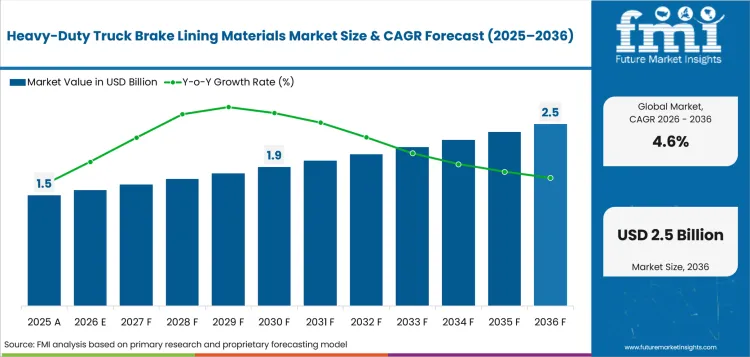
The heavy-duty truck brake lining materials market surpassed a valuation of USD 1.5 billion in 2025. The market is expected to cross USD 1.6 billion by 2026 and expand at a CAGR of 4.6% between 2026 and 2036 to reach USD 2.5 billion by 2036. Aftermarket sales are expected to dominate with 66.0% channel share, while drum linings are expected to lead brake type with 57.0% share.
Key Takeaways, Market Size and Forecast
- The heavy-duty truck brake lining materials market was valued at USD 1.5 billion in 2025.
- By 2036, the heavy-duty truck brake lining materials market is expected to be worth USD 2.5 billion.
- From 2026 to 2036, the market is projected to expand at a CAGR of 4.6%.
- The market is projected to create an incremental opportunity of USD 0.9 billion between 2026 and 2036.
- In 2026, aftermarket sales are expected to account for 66.0% of sales channel demand.
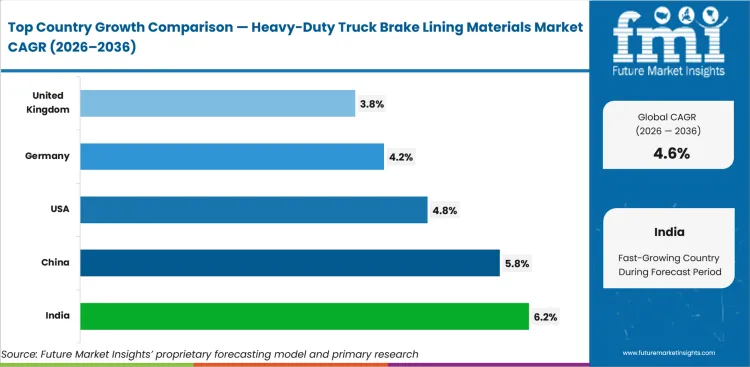
- India and China are expected to be faster-growing country markets, with CAGRs of 6.2% and 5.8% respectively.
Brake lining suppliers are facing stricter material and testing requirements. Bendix stated in November 2024 that most of its drum brake friction was already N-Level copper compliant, and ES600 would be discontinued at the end of 2024. This means distributors must keep product catalogs updated so older non-compliant friction parts do not enter replacement channels.
TMD Friction invested €1.5 million in a Euro 7 brake emissions test bench in November 2024. This helps the company test brake pads faster for new emissions rules and product approvals. Severe-duty fleets need linings to handle heat and heavy axle loads. Haldex states that its GZ 2035 semi-metallic lining is equivalent to FMVSS 121 performance levels for a 23,000 lb axle load and a 1000°F temperature range. These claims help suppliers position premium linings for demanding truck applications.
Summary of the Heavy-Duty Truck Brake Lining Materials Market
- Demand and Growth Drivers
- Fleet maintenance schedules create repeat demand for brake lining materials as heavy trucks consume friction surfaces during loaded service.
- Roadside brake inspections increase replacement discipline as worn linings can remove trucks from freight service.
- Copper-free and asbestos-free rules increase the need for better formulation control in replacement pads and drum linings.
- Product and Segment View
- Aftermarket sales are expected to lead sales channel demand with 66.0% share in 2026, reflecting frequent service replacement.
- Drum linings are expected to lead brake type demand with 57.0% share in 2026, reflecting broad use across tractors and trailers.
- Semi-metallic materials are expected to hold 42.0% material type share in 2026, reflecting heat resistance across severe-duty braking.
- Geography and Competitive Outlook
- India is expected to record a CAGR of 6.2% through 2036, as freight activity and local truck sales expand service demand.
- China is projected to expand at 5.8% CAGR through 2036, as heavy vehicle production and service networks deepen.
- Companies combining friction chemistry, catalog coverage, and compliance proof are strengthening position during the forecast period.
- Analyst Opinion
- Nikhil Kaitwade, Principal Consultant for Automotive domain at FMI, says, “Heavy-duty truck brake lining material demand is shifting toward uptime planning and compliance control. Fleets need correct fitment with stable fade behavior. Aftermarket channels gain from long-haul wear cycles. Copper-free formulations raise cost while OE validation reduces workshop service errors.”
- Heavy-Duty Truck Brake Lining Materials Market Value Analysis
- The heavy-duty truck brake lining materials market is moving from routine part replacement into planned service control.
- Adoption is driven by friction wear across heavy trucks and compliance needs for modern lining compounds.
- The market benefits from deeper use of demand for automotive brake friction products across mixed fleet service bases.
- Demand depends on brake parts that meet safety checks and material rules.
- Price pressure is leading in severe-duty linings as heat stability and copper-free chemistry raise test costs.
Heavy-Duty Truck Brake Lining Materials Market Definition
The heavy-duty truck brake lining materials market includes friction compounds used on brake shoes, drum linings, disc pads, and brake blocks for heavy commercial vehicles. These materials convert vehicle motion into stopping force through friction inside drum and disc brake assemblies. Scope includes semi-metallic, non-asbestos organic, ceramic, sintered, and aramid friction materials. Complete brake systems, brake fluids, drums, rotors, calipers, and electronic braking controls are outside scope.
Heavy-Duty Truck Brake Lining Materials Market Inclusions
Market scope covers all commercially traded heavy-duty truck brake lining materials categorized by material type, including semi-metallic, non-asbestos organic, ceramic, sintered, and aramid friction materials; brake type, including drum linings, disc pads, brake blocks, and combination linings; vehicle class, including Class 8 trucks, Class 7 trucks, heavy buses, and vocational trucks; sales channel, including aftermarket, OEM supply, distributor sales, and fleet contracts; and end use, including linehaul freight, construction haulage, municipal fleets, and mining trucks.
Revenue scope covers 2026 to 2036, with adjacent compliance exposure reflected through demand for copper-free brake pad materials across low-copper and no-copper friction systems. Key stakeholders include brake lining material manufacturers, friction compound formulators, fleet operators, truck OEMs, axle and brake system suppliers, aftermarket distributors, service workshops, raw material suppliers, testing laboratories, regulatory bodies, and remanufacturing service providers involved in brake caliper and component remanufacturing services industry analysis.
Heavy-Duty Truck Brake Lining Materials Market Exclusions
Scope does not include complete brake assemblies, rotors, drums, calipers, brake fluids, electronic braking systems, or passenger vehicle brake friction products.
Heavy-Duty Truck Brake Lining Materials Market Research Methodology
- Primary Research: FMI analysts talked to fleet service managers, brake part distributors, friction material suppliers, and commercial vehicle workshops in important markets.
- Desk Research: Combined data from safety inspection records, brake material rules, official vehicle sales data, and company product portfolios.
- Market sizing and forecasting: Added replacement demand across brake type, vehicle class, sales channel, and duty cycle from the bottom up.
- Data validation: Cross-checked every three months against fleet mileage, inspection outcomes, regulatory changes, and supplier catalog coverage.
Why is the Heavy-Duty Truck Brake Lining Materials Market Growing?
- Heavy truck brake linings wear under axle load and heat, creating recurring replacement demand across linehaul and vocational fleets.
- Brake inspection programs increase focus on lining thickness and missing friction material during roadside checks.
- Asbestos-free and copper-free rules push manufacturers toward better compound traceability and friction validation.
- Service shops need accurate catalog cross-references as wrong lining selection can increase downtime and repeat work.
Fleet operating intensity is the main reason brake lining materials move through service channels. FMCSA’s July 2025 pocket guide recorded 331.3 billion large truck miles traveled in 2022. This mileage base increases repeated friction wear across tractors and buses. Heavy brake use turns lining quality into an uptime decision for fleet workshops. Suppliers with correct fitment data can reduce service delays across automotive brake pad industry analysis and commercial vehicle maintenance cycles.
Regulatory pressure is moving material selection away from older friction compounds. EPA’s March 2024 chrysotile asbestos rule bans aftermarket automotive brakes and linings after a six-month transition period. Federal Register analysis estimated about 1,800 asbestos-containing automotive brake or lining sets may enter the United States each year. This small share means substitution is practical for most buyers. Friction material makers can use compliant materials to protect access across regulated replacement channels.
Market Segmentation Analysis
- Semi-metallic materials are projected to hold 42.0% of material type demand in 2026 as severe-duty fleets prioritize fade control under loaded braking.
- Drum linings are expected to represent 57.0% of the brake type segment in 2026, reflecting continued use across trailer service and tractor applications.
- Higher mileage exposure places Class 8 trucks at 46.0% of vehicle class share in 2026 across long-haul and heavy payload operations.
- Aftermarket sales are forecast to capture 66.0% of channel revenue in 2026 as worn linings move through service replacement channels.
- Linehaul freight is forecast to account for 44.0% of end-use value in 2026 as scheduled maintenance enhances repeat lining replacement.
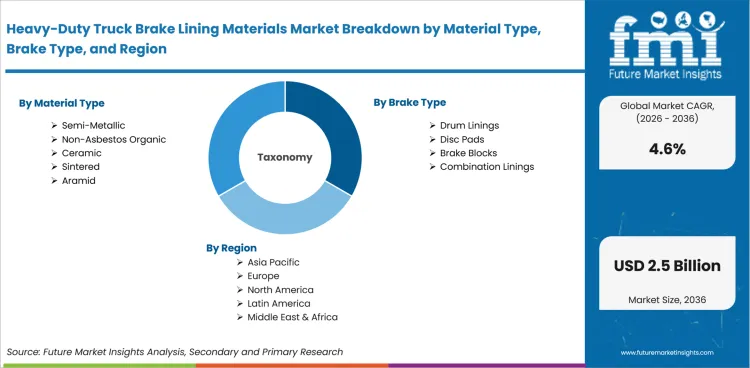
The market for heavy-duty truck brake lining materials is divided into groups based on material type, brake type, vehicle class, sales channel, end use, and region. There are semi-metallic, non-asbestos organic, ceramic, sintered, and aramid under material type. By brake type, the market includes drum linings, disc pads, brake blocks, and combination linings. By vehicle class, the market covers Class 8 trucks, Class 7 trucks, heavy buses, and vocational trucks. Based on sales channel, it includes aftermarket, OEM supply, distributor sales, and fleet contracts.
By end use, the market includes linehaul freight, construction haulage, municipal fleets, and mining trucks. Replacement demand is linked with brake system service depth, so automotive brake booster and master cylinder industry analysis helps frame adjacent braking component demand. brake assist technologies influence service planning, making automotive vacuum brake booster market outlook relevant for broader wheel-end maintenance assessment.
Insights into Heavy-Duty Truck Brake Lining Materials Market by Material Type
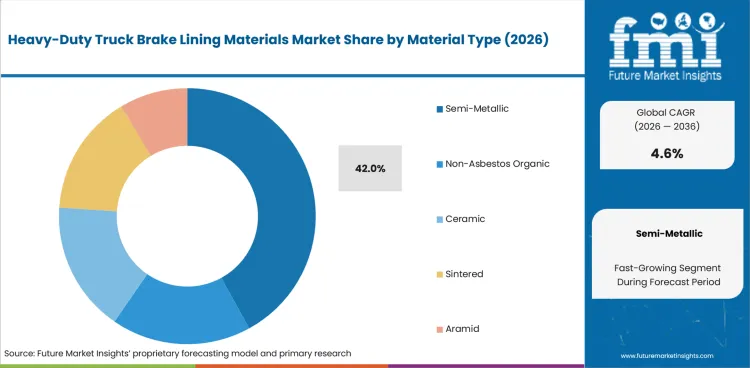
- In 2026, semi-metallic materials are expected to contribute 42.0% of the material type segment. Their position is driven by heat resistance and fade control across severe-duty truck braking.
- Non-asbestos organic and ceramic options address selected fleet needs. Their value improves in applications requiring quieter braking or lighter service conditions.
Insights into Heavy-Duty Truck Brake Lining Materials Market by Brake Type
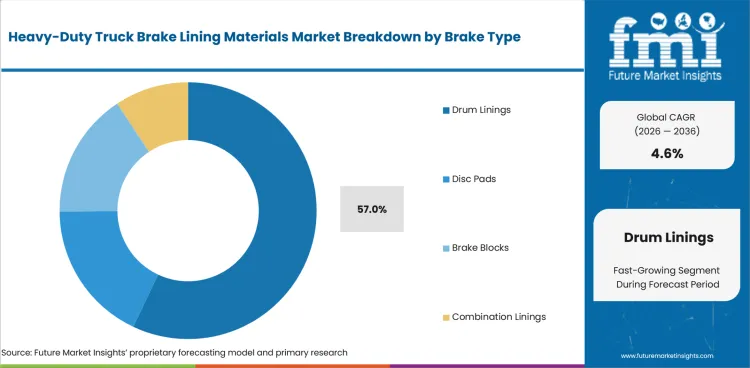
- Drum linings are projected to account for 57.0% of the brake type segment in 2026. Trailer service and vocational truck use keep drum formats important across replacement channels.
- Disc pads serve fleets using air disc brake systems. Their value improves as operators prioritize shorter stopping response and updated braking platforms.
Insights into Heavy-Duty Truck Brake Lining Materials Market by Vehicle Class
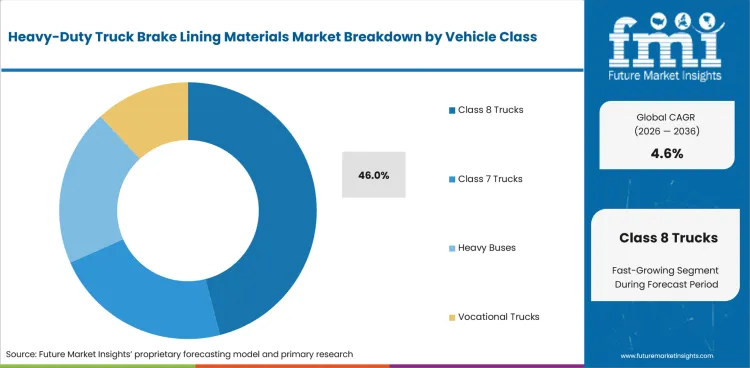
- Class 8 trucks are forecast to account for 46.0% share in 2026. Long-haul freight and heavy payload movement increase regular brake lining replacement across wheel-end service programs.
- Class 7 trucks and heavy buses support additional demand across regional freight and passenger transport. Replacement needs vary by duty cycle and service frequency.
Insights into Heavy-Duty Truck Brake Lining Materials Market by Sales Channel
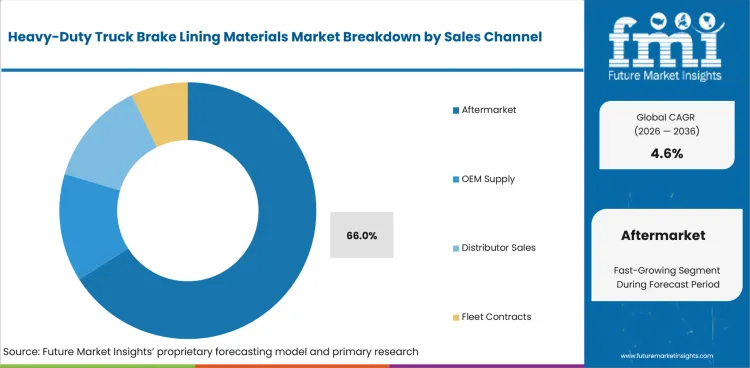
- Aftermarket sales are poised to represent 66.0% share in 2026. Fleet operators replace brake lining materials through service channels after original parts wear down.
- OEM supply supports new truck production and approved replacement programs. Distributor sales stay important for workshops needing fast access to brake linings by axle specification.
Insights into Heavy-Duty Truck Brake Lining Materials Market by End Use
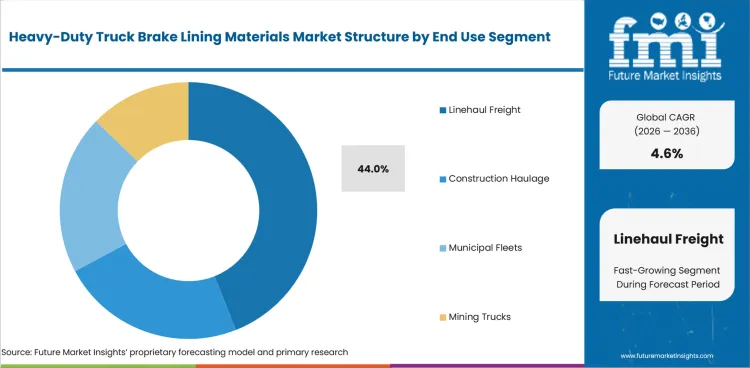
- Linehaul freight is projected to hold 44.0% share in 2026. High mileage and scheduled maintenance increase repeat replacement demand for brake lining materials.
- Construction haulage and municipal fleets add severe-duty demand. Their braking conditions create higher heat exposure and a higher need for reliable lining performance.
Heavy-Duty Truck Brake Lining Materials Market Drivers, Restraints and Opportunities
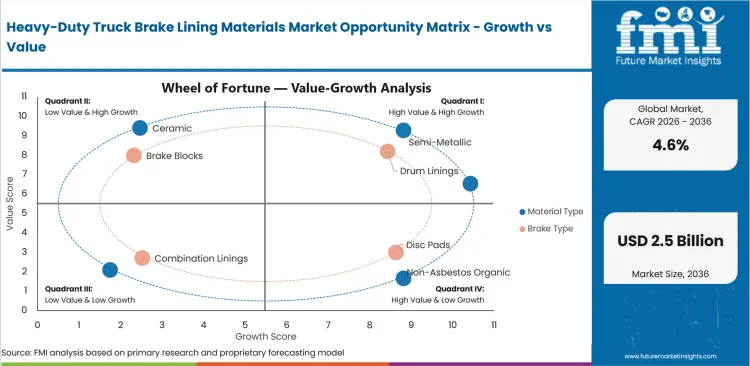
- Driver: Fleet replacement cycles keep brake lining material demand active as heavy trucks need dependable stopping performance under load.
- Restraint: Metal cost pressure can raise quote volatility for semi-metallic and severe-duty brake lining formulations.
- Opportunity: Heat-stable and lower-risk friction systems enhance supplier differentiation for fleets seeking longer lining life and safer replacement programs.
Heavy-duty truck brake lining material demand is supported by safety needs and service replacement discipline. Fleet operators cannot delay brake lining replacement once wear begins to affect stopping performance. Semi-metallic and severe-duty products are most exposed to input cost changes as metallic fibers and heat-management additives form part of the compound structure. Buyers now compare lining life with delivered cost before approving long-term replacement contracts. Suppliers with stronger raw material coverage and proven compound stability can protect share during cost pressure cycles.
Metal Input Firmness and Aftermarket Quote Analysis
Metal exposure creates a direct pricing issue for brake lining buyers. The World Bank reported in December 2025 that its metals and minerals price index surged 6% in October after a 4% rise in 2025Q3. This is important for semi-metallic linings because metallic fibers and heat-management additives influence compound cost. Higher input firmness does not affect every product equally, but it makes severe-duty quotes harder to hold. Suppliers with longer metal coverage can protect contract pricing, while spot-exposed compounders may reprice short-cycle replacement orders.
Antimony Cost Pressure and Formulation Risk Analysis
Friction modifiers are becoming a sharper cost pressure point in heavy-duty brake lining materials. The USA Geological Survey reported in February 2026 that average antimony metal price reached USD 25 per lb in 2025, over double the 2024 level. Prices rose further to USD 27.50 per lb by June 2025 and eased to USD 20.30 per lb in November. USA net import reliance was estimated at 91% of apparent consumption in 2025. Severe-duty lining suppliers remain exposed to this volatility because antimony-based compounds help manage heat and wear consistency.
Analysis of Heavy-Duty Truck Brake Lining Materials Market By Key Countries
.webp "Top Country Growth Comparison Heavy Duty Truck Brake Lining Materials Market Cagr (2026 2036)")
| Country | CAGR |
|---|---|
| India | 6.2% |
| China | 5.8% |
| USA | 4.8% |
| Germany | 4.2% |
| United Kingdom | 3.8% |
Source: Future Market Insights, 2026.
Sales Analysis of Heavy-Duty Truck Brake Lining Materials Market in India
Faster-growing country market · 2026–2036
India Market Outlook
India is the faster-growing country market with demand forecast at USD 104.0 million in 2026 and USD 189.8 million by 2036. The 6.2% CAGR reflects expanding freight movement and a large commercial vehicle service base.
Key Demand Drivers
- SIAM reported 10,79,871 commercial vehicle sales during FY 2025-26, strengthening the replacement base for truck brake lining materials.
- National freight corridors increase brake wear exposure as loaded trucks operate across long-distance haulage cycles.
- Domestic friction material production improves workshop access across transport hubs and regional service markets.
- Construction haulage raises need for heat-stable linings across mining zones and infrastructure project areas.
Key Restraints
- PIB reported IS 11852:2019 braking requirements apply to heavy commercial vehicles from October 2027, raising compliance work for suppliers.
- Price-sensitive fleet repair behavior limits faster migration toward premium brake lining materials in small workshops.
- Low-grade replacement parts weaken branded channel trust in districts with limited product verification.
What Makes India Unique
India combines a large commercial vehicle sales base with domestic friction material production, creating strong aftermarket depth.
Key Companies
- Rane Brake Lining
- Brakes India
- Sundaram Brake Linings
Sales & Marketing Channels
- Authorized distributors
- Independent truck workshops
- Fleet service contracts
- OEM service centers
- Regional spare parts dealers
Market Taxonomy & Sub-Regions Covered
| Segment | Sub-Segments |
|---|---|
| By Material Type | Semi-Metallic · Non-Asbestos Organic · Ceramic · Sintered · Aramid |
| By Brake Type | Drum Linings · Disc Pads · Brake Blocks · Combination Linings |
| By Vehicle Class | Class 8 Trucks · Class 7 Trucks · Heavy Buses · Vocational Trucks |
| By Sales Channel | Aftermarket · OEM Supply · Distributor Sales · Fleet Contracts |
| By End Use | Linehaul Freight · Construction Haulage · Municipal Fleets · Mining Trucks |
Frequently Asked Questions
How fast is India’s heavy-duty truck brake lining materials market growing?
India is projected at a 6.2% CAGR during 2026 to 2036, ranking first among covered countries.
Who leads the India heavy-duty truck brake lining materials market?
Rane Brake Lining, Brakes India, and Sundaram Brake Linings compete over local production and service coverage.
What is driving demand in India?
Demand is led by commercial vehicle sales and frequent replacement across truck workshops.
Sales Analysis of Heavy-Duty Truck Brake Lining Materials Market in China
Large-scale country market · 2026–2036
China Market Outlook
China represents a large-scale country market with demand projected at USD 246.0 million in 2026 and USD 432.3 million by 2036. A 5.8% CAGR shows steady demand from truck production and replacement needs across China’s freight networks.
Key Demand Drivers
- OICA reported China produced 4,260,835 commercial vehicles in 2025, expanding the service pool for brake lining replacement.
- Port logistics and factory distribution enhance repeated service demand across loaded truck operations.
- Local friction material producers widen access through low-cost catalogs and provincial parts distributors.
- Trailer service demand sustains drum lining consumption across industrial freight and regional haulage.
Key Restraints
- ICCT reported battery electric trucks reached 22% sales share in H1 2025, reducing friction wear in selected duty cycles.
- Dense local supplier competition compresses pricing across standard drum linings and replacement brake pads.
- Premium imported products face slower uptake as fleets compare them with lower-cost domestic alternatives.
What Makes China Unique
China combines high commercial vehicle output with deep local component supply, making price and availability decisive.
Key Companies
- Local friction material producers
- National truck parts distributors
- Global aftermarket brands
- OEM service networks
Sales & Marketing Channels
- Provincial distributors
- OEM service centers
- Independent truck workshops
- Online parts platforms
- Fleet service suppliers
Market Taxonomy & Sub-Regions Covered
| Segment | Sub-Segments |
|---|---|
| By Material Type | Semi-Metallic · Non-Asbestos Organic · Ceramic · Sintered · Aramid |
| By Brake Type | Drum Linings · Disc Pads · Brake Blocks · Combination Linings |
| By Vehicle Class | Class 8 Trucks · Class 7 Trucks · Heavy Buses · Vocational Trucks |
| By Sales Channel | Aftermarket · OEM Supply · Distributor Sales · Fleet Contracts |
| By End Use | Linehaul Freight · Construction Haulage · Municipal Fleets · Mining Trucks |
Frequently Asked Questions
How fast is China’s heavy-duty truck brake lining materials market growing?
China is projected at a 5.8% CAGR during 2026 to 2036, ranking second among covered countries.
Who leads the China heavy-duty truck brake lining materials market?
Domestic friction material producers lead standard replacement demand, with global brands competing in premium fleet applications.
What is driving demand in China?
Demand is led by commercial vehicle production and broad local distribution networks.
Sales Analysis of Heavy-Duty Truck Brake Lining Materials Market in the USA
Leading mature service market · 2026–2036
USA Market Outlook
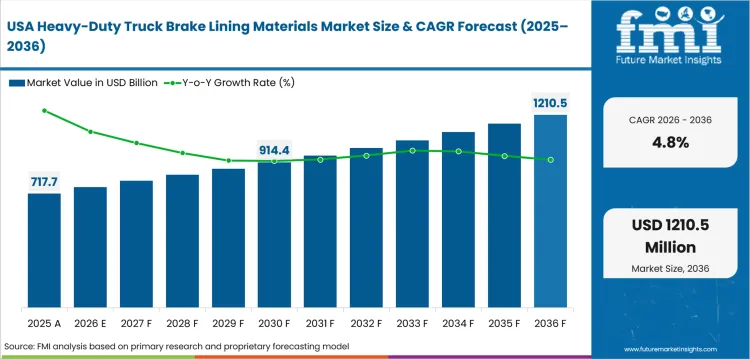
The USA holds the leading mature service value base with demand expected to reach USD 368.0 million in 2026 and USD 588.1 million by 2036. The 4.8% CAGR indicates high freight mileage and disciplined brake maintenance across fleets.
Key Demand Drivers
- FMCSA recorded 331.3 billion large truck miles in its 2024 pocket guide, reinforcing repeated brake lining wear.
- Roadside inspection activity increases workshop attention to lining thickness and friction surface condition.
- Copper-free product rules lift demand for verified brake materials across fleet service channels.
- National distributors help fleets secure consistent lining access across multi-state service networks.
Key Restraints
- CVSA reported a 15.1% brake-related out-of-service rate in 2025, raising pressure on low-quality replacement materials.
- Copper-free formulation work increases validation costs for smaller friction material suppliers.
- Fleet consolidation restricts supplier entry for brands lacking national catalog and service coverage.
What Makes the USA Unique
High truck mileage and inspection discipline make brake lining quality a direct fleet operating concern.
Key Companies
- Bendix Commercial Vehicle Systems
- Fras-le
- Meritor Aftermarket
- Haldex
Sales & Marketing Channels
- National parts distributors
- Dealer service centers
- Independent heavy truck shops
- Fleet maintenance programs
- Online parts catalogs
Market Taxonomy & Sub-Regions Covered
| Segment | Sub-Segments |
|---|---|
| By Material Type | Semi-Metallic · Non-Asbestos Organic · Ceramic · Sintered · Aramid |
| By Brake Type | Drum Linings · Disc Pads · Brake Blocks · Combination Linings |
| By Vehicle Class | Class 8 Trucks · Class 7 Trucks · Heavy Buses · Vocational Trucks |
| By Sales Channel | Aftermarket · OEM Supply · Distributor Sales · Fleet Contracts |
| By End Use | Linehaul Freight · Construction Haulage · Municipal Fleets · Mining Trucks |
Frequently Asked Questions
How fast is the USA heavy-duty truck brake lining materials market growing?
The USA is projected at a 4.8% CAGR during 2026 to 2036, with the leading value base.
Who leads the USA heavy-duty truck brake lining materials market?
Bendix, Fras-le, Meritor Aftermarket, and Haldex compete on service coverage and product validation.
What is driving demand in the USA?
Demand is led by heavy truck mileage and copper-free friction material requirements.
Sales Analysis of Heavy-Duty Truck Brake Lining Materials Market in Germany
Euro 7 compliance market · 2026–2036
Germany Market Outlook
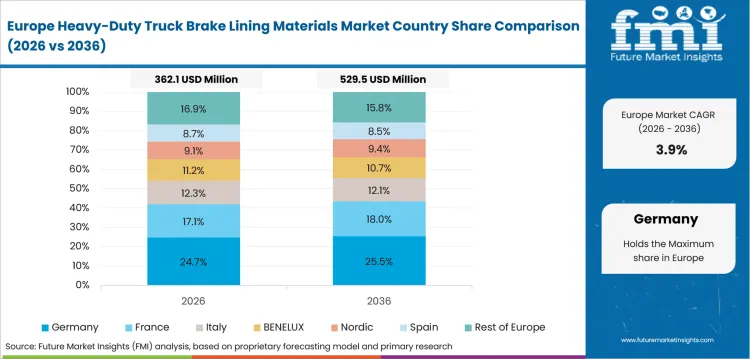
Germany has an established value base with demand projected to cross USD 86.0 million in 2026 and USD 129.8 million by 2036. The 4.2% CAGR is projected due to replacement activity across freight fleets and Euro 7 brake particle rules.
Key Demand Drivers
- ACEA reported EU truck registrations increased 10.7% in Q1 2026, aiding service demand across Germany’s truck base.
- Motorway freight keeps brake lining replacement active across long-distance truck and trailer operations.
- Euro 7 brake particle rules strengthen demand for tested friction materials with emissions documentation.
- Premium fleet workshops prefer linings with stable wear behavior under loaded motorway service.
Key Restraints
- ACEA reported Germany’s van registrations declined 9.0% in Q1 2026, signaling pressure across some commercial vehicle channels.
- Brake particle testing raises development costs for suppliers without emissions measurement capacity.
- Mature distributor networks limit quick entry for smaller brake lining material brands.
What Makes Germany Unique
Germany combines motorway freight density with Euro 7 testing pressure, making validation capacity a key supplier filter.
Key Companies
- TMD Friction
- SAF-Holland SE / Haldex
Sales & Marketing Channels
- Specialist parts distributors
- OEM service networks
- Technical sales teams
- Fleet maintenance partners
- Heavy truck repair workshops
Market Taxonomy & Sub-Regions Covered
| Segment | Sub-Segments |
|---|---|
| By Material Type | Semi-Metallic · Non-Asbestos Organic · Ceramic · Sintered · Aramid |
| By Brake Type | Drum Linings · Disc Pads · Brake Blocks · Combination Linings |
| By Vehicle Class | Class 8 Trucks · Class 7 Trucks · Heavy Buses · Vocational Trucks |
| By Sales Channel | Aftermarket · OEM Supply · Distributor Sales · Fleet Contracts |
| By End Use | Linehaul Freight · Construction Haulage · Municipal Fleets · Mining Trucks |
Frequently Asked Questions
How fast is Germany’s heavy-duty truck brake lining materials market growing?
Germany is projected at a 4.2% CAGR during 2026 to 2036, reflecting mature fleet service demand.
Who leads the Germany heavy-duty truck brake lining materials market?
TMD Friction and Haldex participate through commercial vehicle service channels.
What is driving demand in Germany?
Demand is led by freight service activity and Euro 7 brake particle testing requirements.
Sales Analysis of Heavy-Duty Truck Brake Lining Materials Market in the United Kingdom
Service-intensive country market · 2026–2036
UK Market Outlook
The United Kingdom is a service-intensive country market with demand forecast at USD 52.0 million in 2026 and USD 75.5 million by 2036. The 3.8% CAGR reveals measured fleet renewal and steady replacement demand across HGV workshops.
Key Demand Drivers
- DfT reported lorries travelled 16.6 billion vehicle miles in the year ending June 2025, backing replacement demand.
- Retail distribution fleets raise repeated brake lining use across depot-based service operations.
- Municipal refuse fleets increase stop-heavy duty cycles with high friction material wear exposure.
- Distributor-led aftermarket channels help workshops source replacement linings across HGV service clusters.
Key Restraints
- SMMT reported new HGV registrations fell 10.0% to 40,504 units in 2025, limiting OEM demand.
- Slower fleet renewal increases price scrutiny across replacement brake lining purchases.
- Smaller repair shops often prioritize availability and price over premium friction material specification.
What Makes the United Kingdom Unique
The United Kingdom combines high service dependence with slower HGV renewal, placing aftermarket replacement at the center of demand.
Key Companies
- TMD Friction
- SAF-Holland SE / Haldex
Sales & Marketing Channels
- Heavy truck parts distributors
- Independent repair workshops
- Fleet service sites
- OE service networks
- Municipal maintenance channels
Market Taxonomy & Sub-Regions Covered
| Segment | Sub-Segments |
|---|---|
| By Material Type | Semi-Metallic · Non-Asbestos Organic · Ceramic · Sintered · Aramid |
| By Brake Type | Drum Linings · Disc Pads · Brake Blocks · Combination Linings |
| By Vehicle Class | Class 8 Trucks · Class 7 Trucks · Heavy Buses · Vocational Trucks |
| By Sales Channel | Aftermarket · OEM Supply · Distributor Sales · Fleet Contracts |
| By End Use | Linehaul Freight · Construction Haulage · Municipal Fleets · Mining Trucks |
Frequently Asked Questions
How fast is the United Kingdom heavy-duty truck brake lining materials market growing?
The United Kingdom is projected at a 3.8% CAGR during 2026 to 2036, reflecting a mature service base.
Who leads the United Kingdom heavy-duty truck brake lining materials market?
TMD Friction and Haldex serve demand through distributor and service channels.
What is driving demand in the United Kingdom?
Demand is led by lorry mileage and recurring aftermarket brake lining replacement.
Competitive Landscape and Strategic Positioning
Heavy-Duty Truck Brake Lining Materials Market Analysis By Company
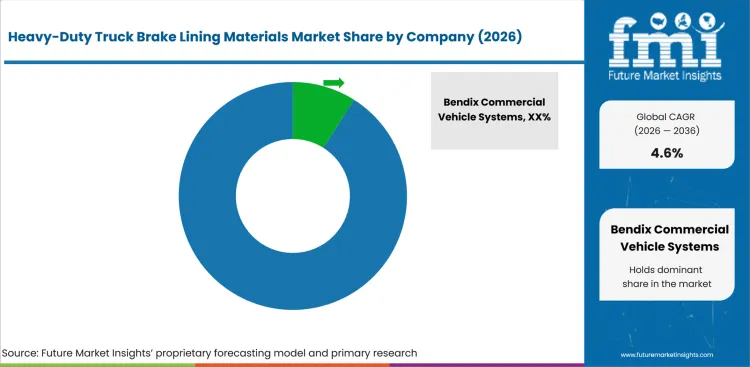
- Bendix Commercial Vehicle Systems is a leading provider through commercial vehicle brake system coverage and compliant friction offerings.
- TMD Friction and Haldex focus on broad aftermarket catalogs and friction material depth.
- Fras-le focuses on replacement coverage across truck and trailer service networks.
Bendix holds a strong North American position through air disc brake and drum brake friction products. TMD Friction offers commercial vehicle brake pads and drum brake linings through Don and Cobreq. Haldex serves heavy-duty braking channels with severe-duty lining options and wheel-end service relevance. Fras-le competes on aftermarket coverage and distributor reach.
Barriers include formulation testing cost and compliance proof across changing material rules. Strategic priorities include copper-free product updates and faster emissions test validation. Buyers favor suppliers offering catalog accuracy and service-ready replacement options. Broad brake system knowledge helps manufacturers align lining products with automotive brake system & components revenue across connected service categories.
Key Companies in the Heavy-Duty Truck Brake Lining Materials Market
Key global companies leading the heavy-duty truck brake lining materials market include:
- Bendix Commercial Vehicle Systems, TMD Friction, and Haldex have strong friction material coverage for commercial vehicle braking.
- Fras-le and Meritor Aftermarket serve fleets through replacement parts and distributor channels.
Competitive Benchmarking: Heavy-Duty Truck Brake Lining Materials Market
| Company | Friction Chemistry Depth | Heavy-Duty Catalog Coverage | Compliance Readiness | Geographic Footprint |
|---|---|---|---|---|
| Bendix Commercial Vehicle Systems | High | High | High | North America, with headquarters in Avon, Ohio and manufacturing in the USA and Mexico. |
| TMD Friction | High | High | High | Global presence, with 23 locations across 12 countries and headquarters in Leverkusen, Germany. |
| Haldex | High | Medium | High | North America, Europe and Asia, serving truck, bus and trailer manufacturers plus aftermarket channels. |
| Fras-le | Medium | High | Medium | Brazil, USA, China, Argentina, Uruguay and India, with strategic distribution centers worldwide. |
| Meritor Aftermarket | Medium | High | Medium | Global commercial vehicle aftermarket reach under Cummins Drivetrain and Braking Systems, with North America and worldwide Class 5-8 coverage. |
Source: Future Market Insights, 2026.
Key Developments in Heavy-Duty Truck Brake Lining Materials Market
- In January 2026, Cummins announced the Meritor MFLEX4™ air disc brake pad as a patent-pending aftermarket solution for heavy-duty applications. The pad is designed to fit Bendix ADB22X, Hendrickson MAXX22T, WABCO MAXXUS, and WABCO PAN22 calipers, giving coverage across a large share of the Class 8 truck and trailer market.
- In April 2026, TMD Friction stated that it manufactures disc brake pads and drum brake linings for commercial vehicles, including trucks, trailers, buses, and coaches. The company noted that its drum brake linings are entirely copper-free, while the transition remains ongoing for commercial-vehicle brake pads.
Key Players in the Heavy-Duty Truck Brake Lining Materials Market
Major Global Players:
- Bendix Commercial Vehicle Systems
- TMD Friction
- Haldex
- Fras-le
- Meritor Aftermarket
Report Scope and Coverage
Heavy-Duty Truck Brake Lining Materials Market Breakdown By Material Type, Brake Type, Vehicle Class, Sales Channel, End Use, and Region
| Parameter | Details |
|---|---|
| Quantitative Units | USD 1.6 billion to USD 2.5 billion, at a CAGR of 4.6% |
| Market Definition | The heavy-duty truck brake lining materials market encompasses friction compounds used to create stopping force in drum and disc brake assemblies. |
| Regions Covered | North America, Latin America, Europe, East Asia, South Asia and Pacific, Middle East and Africa |
| Countries Covered | USA, UK, Germany, China, India, Japan, South Korea, and 30 plus countries |
| Key Companies Profiled | Bendix Commercial Vehicle Systems, TMD Friction, Haldex, Fras-le, Meritor Aftermarket |
| Forecast Period | 2026 to 2036 |
| Approach | Hybrid bottom-up and top-down methodology starting with service replacement demand and verified regulatory use patterns. |
Heavy-Duty Truck Brake Lining Materials Market by Segments
Heavy-Duty Truck Brake Lining Materials Market Segmented by Material Type:
- Semi-Metallic
- Non-Asbestos Organic
- Ceramic
- Sintered
- Aramid
Heavy-Duty Truck Brake Lining Materials Market Segmented by Brake Type:
- Drum Linings
- Disc Pads
- Brake Blocks
- Combination Linings
Heavy-Duty Truck Brake Lining Materials Market Segmented by Vehicle Class:
- Class 8 Trucks
- Class 7 Trucks
- Heavy Buses
- Vocational Trucks
Heavy-Duty Truck Brake Lining Materials Market Segmented by Sales Channel:
- Aftermarket
- OEM Supply
- Distributor Sales
- Fleet Contracts
Heavy-Duty Truck Brake Lining Materials Market Segmented by End Use:
- Linehaul Freight
- Construction Haulage
- Municipal Fleets
- Mining Trucks
Heavy-Duty Truck Brake Lining Materials Market by Region:
- North America
- USA
- Canada
- Mexico
- Latin America
- Brazil
- Chile
- Rest of Latin America
- Europe
- Germany
- UK
- Italy
- Spain
- France
- Rest of Europe
- East Asia
- China
- Japan
- South Korea
- South Asia and Pacific
- India
- ASEAN
- Australia & New Zealand
- Rest of South Asia and Pacific
- Middle East and Africa
- Saudi Arabia
- Other GCC Countries
- South Africa
- Rest of Middle East and Africa
Research Sources and Bibliography
- USA Environmental Protection Agency. (2024, March). Risk management for asbestos part 1 chrysotile asbestos.
- Federal Register. (2024, March 28). Asbestos part 1 chrysotile asbestos regulation of certain conditions of use under TSCA.
- Commercial Vehicle Safety Alliance. (2025, October 27). CVSA releases 2025 Brake Safety Week results.
- Federal Motor Carrier Safety Administration. (2025, July). 2024 pocket guide to large truck and bus statistics.
- Society of Indian Automobile Manufacturers. (2026, April 14). Auto industry performance of Q4 and FY 2025-26.
- International Organization of Motor Vehicle Manufacturers. (n.d.). Production statistics 2025.
- European Automobile Manufacturers’ Association. (2026, April 29). New commercial vehicle registrations in Q1 2026.
- Society of Motor Manufacturers and Traders. (2026, February 17). HGV demand dips in 2025 as nascent ZEV uptake grows.
- Bendix Commercial Vehicle Systems. (2024, November 14). Bendix provides reminders and product updates as EPA’s Copper-Free Brake Initiative reaches its finish line.
- TMD Friction. (2024, November 12). TMD Friction invests EUR 1.5 million in emissions testing.
- TMD Friction. (2024, October 28). Don offers serious stopping power for commercial vehicles.
- TMD Friction. (2025, February 10). Textar achieves 39 first-to-markets in 2024.
This Report Answers
- What is the current and future size of the heavy-duty truck brake lining materials market?
- How fast is the heavy-duty truck brake lining materials market expected to expand between 2026 and 2036?
- Which sales channel is expected to lead the market by 2026?
- Which brake type segment is expected to account for the leading demand by 2026?
- What factors are driving demand for heavy-duty truck brake lining materials globally?
- How are copper-free and asbestos-free rules influencing brake lining material adoption?
- Why are aftermarket channels the main demand base for brake lining materials?
- How are severe-duty trucks creating demand for heat-stable friction compounds?
- Which countries are projected to record faster expansion through 2036?
- What is driving market expansion in India and China?
- Who are the key companies active in the heavy-duty truck brake lining materials market?
- How does FMI estimate and validate the market forecast?
Frequently Asked Questions
What is the global market demand for heavy-duty truck brake lining materials in 2026?
In 2026, the global market for heavy-duty truck brake lining materials is expected to be worth USD 1.6 billion.
How big will the market for Heavy-Duty Truck Brake Lining Materials be in 2036?
By 2036, the market for heavy-duty truck brake lining materials is expected to be worth USD 2.5 billion.
How much is demand for Heavy-Duty Truck Brake Lining Materials expected to expand between 2026 and 2036?
Between 2026 and 2036, demand for heavy-duty truck brake lining materials is expected to expand at a CAGR of 4.6%.
Which sales channel segment is likely to be the leading seller globally by 2026?
Aftermarket sales are expected to contribute 66.0% of the sales channel segment in 2026.
What is causing demand to rise in India?
The India heavy-duty truck brake lining materials market is projected to record 6.2% CAGR through 2036, aided by commercial vehicle sales and freight use.
What is causing demand to rise in China?
The China heavy-duty truck brake lining materials market is projected to expand at 5.8% CAGR through 2036, aided by truck output and service replacement.
What does this report mean by Heavy-Duty Truck Brake Lining Materials Market definition?
The heavy-duty truck brake lining materials market includes friction compounds used on drum linings, brake pads, brake blocks, and brake shoes.
How does FMI make the Heavy-Duty Truck Brake Lining Materials forecast and check it?
Forecasting models use a hybrid bottom-up and top-down approach, starting with service replacement demand and checking it against regulatory use patterns.
Preview the report firsthand - request a free sample
Get SampleGet the brochure for pricing and purchase details.
Get PDFTable of Content
- Key Takeaways
- Market Size and CAGR
- Top Growth Driver
- Fastest Growing Segment
- Leading Region
- Key Companies
- Emerging Opportunities
- Executive Summary
- Global Market Outlook
- Demand-side Trends
- Supply-side Trends
- Technology Roadmap Analysis
- Analysis and Recommendations
- Analyst Perspective (What is happening? Why now? What should investors know?)
- Key Questions Answered
- How large is the market?
- What is the CAGR?
- What are key trends?
- Which region dominates?
- Who are the leaders?
- Market Overview
- Market Coverage / Taxonomy
- Market Definition / Scope / Limitations
- Research Methodology
- Chapter Orientation
- Analytical Lens and Working Hypotheses
- Market Structure, Signals, and Trend Drivers
- Benchmarking and Cross-market Comparability
- Market Sizing, Forecasting, and Opportunity Mapping
- Research Design and Evidence Framework
- Desk Research Programme (Secondary Evidence)
- Expert Input and Fieldwork (Primary Evidence)
- Tooling, Models, and Reference Databases
- Data Engineering and Model Build
- Quality Assurance and Audit Trail
- Market Background
- Market Dynamics (Drivers, Restraints, Opportunity, Trends)
- Scenario Forecast (Optimistic, Likely, Conservative)
- Impact Analysis
- AI Impact
- Sustainability Impact
- Regulatory Impact
- Technology Impact
- Consumer / Buyer Analysis
- Purchase Drivers
- Adoption Barriers
- Buyer Journey
- Opportunity Map Analysis
- Product Life Cycle Analysis
- Supply Chain Analysis
- Investment Feasibility Matrix
- Value Chain Analysis
- PESTLE and Porter's Analysis
- Regulatory Landscape
- Regional Parent Market Outlook
- Production and Consumption Statistics
- Import and Export Statistics
- Global Market Analysis and Forecast, 2021 to 2036
- Historical Market Size Value (USD Billion) & Volume (Unit) Analysis, 2021 to 2025
- Current and Future Market Size Value (USD Billion) & Volume (Unit) Projections, 2026 to 2036
- Y-o-Y Growth Trend Analysis
- Absolute $ Opportunity Analysis
- Global Market Pricing Analysis, 2021 to 2036
- Global Market Analysis and Forecast, By Material Type, 2021 to 2036
- Introduction / Key Findings
- Historical Market Size Value (USD Billion) & Volume (Unit) Analysis By Material Type, 2021 to 2025
- Current and Future Market Size Value (USD Billion) & Volume (Unit) Analysis and Forecast By Material Type, 2026 to 2036
- Semi-Metallic
- Non-Asbestos Organic
- Ceramic
- Sintered
- Aramid
- Semi-Metallic
- Y-o-Y Growth Trend Analysis By Material Type, 2021 to 2025
- Absolute $ Opportunity Analysis By Material Type, 2026 to 2036
- Global Market Analysis and Forecast, By Brake Type, 2021 to 2036
- Introduction / Key Findings
- Historical Market Size Value (USD Billion) & Volume (Unit) Analysis By Brake Type, 2021 to 2025
- Current and Future Market Size Value (USD Billion) & Volume (Unit) Analysis and Forecast By Brake Type, 2026 to 2036
- Drum Linings
- Disc Pads
- Brake Blocks
- Combination Linings
- Drum Linings
- Y-o-Y Growth Trend Analysis By Brake Type, 2021 to 2025
- Absolute $ Opportunity Analysis By Brake Type, 2026 to 2036
- Global Market Analysis and Forecast, By Vehicle Class, 2021 to 2036
- Introduction / Key Findings
- Historical Market Size Value (USD Billion) & Volume (Unit) Analysis By Vehicle Class, 2021 to 2025
- Current and Future Market Size Value (USD Billion) & Volume (Unit) Analysis and Forecast By Vehicle Class, 2026 to 2036
- Class 8 Trucks
- Class 7 Trucks
- Heavy Buses
- Vocational Trucks
- Class 8 Trucks
- Y-o-Y Growth Trend Analysis By Vehicle Class, 2021 to 2025
- Absolute $ Opportunity Analysis By Vehicle Class, 2026 to 2036
- Global Market Analysis and Forecast, By Sales Channel, 2021 to 2036
- Introduction / Key Findings
- Historical Market Size Value (USD Billion) & Volume (Unit) Analysis By Sales Channel, 2021 to 2025
- Current and Future Market Size Value (USD Billion) & Volume (Unit) Analysis and Forecast By Sales Channel, 2026 to 2036
- Aftermarket
- OEM Supply
- Distributor Sales
- Fleet Contracts
- Aftermarket
- Y-o-Y Growth Trend Analysis By Sales Channel, 2021 to 2025
- Absolute $ Opportunity Analysis By Sales Channel, 2026 to 2036
- Global Market Analysis and Forecast, By End Use, 2021 to 2036
- Introduction / Key Findings
- Historical Market Size Value (USD Billion) & Volume (Unit) Analysis By End Use, 2021 to 2025
- Current and Future Market Size Value (USD Billion) & Volume (Unit) Analysis and Forecast By End Use, 2026 to 2036
- Linehaul Freight
- Construction Haulage
- Municipal Fleets
- Mining Trucks
- Linehaul Freight
- Y-o-Y Growth Trend Analysis By End Use, 2021 to 2025
- Absolute $ Opportunity Analysis By End Use, 2026 to 2036
- Global Market Analysis and Forecast, By Region, 2021 to 2036
- Introduction
- Historical Market Size Value (USD Billion) & Volume (Unit) Analysis By Region, 2021 to 2025
- Current Market Size Value (USD Billion) & Volume (Unit) Analysis and Forecast By Region, 2026 to 2036
- North America
- Latin America
- Western Europe
- Eastern Europe
- East Asia
- South Asia and Pacific
- Middle East & Africa
- Market Attractiveness Analysis By Region
- North America Market Analysis and Forecast, By Country, 2021 to 2036
- Historical Market Size Value (USD Billion) & Volume (Unit) Trend Analysis By Market Taxonomy, 2021 to 2025
- Market Size Value (USD Billion) & Volume (Unit) Forecast By Market Taxonomy, 2026 to 2036
- By Country
- USA
- Canada
- Mexico
- By Material Type
- By Brake Type
- By Vehicle Class
- By Sales Channel
- By End Use
- By Country
- Market Attractiveness Analysis
- By Country
- By Material Type
- By Brake Type
- By Vehicle Class
- By Sales Channel
- By End Use
- Key Takeaways
- Latin America Market Analysis and Forecast, By Country
- Historical Market Size Value (USD Billion) & Volume (Unit) Trend Analysis By Market Taxonomy, 2021 to 2025
- Market Size Value (USD Billion) & Volume (Unit) Forecast By Market Taxonomy, 2026 to 2036
- By Country
- Brazil
- Chile
- Rest of Latin America
- By Material Type
- By Brake Type
- By Vehicle Class
- By Sales Channel
- By End Use
- By Country
- Market Attractiveness Analysis
- By Country
- By Material Type
- By Brake Type
- By Vehicle Class
- By Sales Channel
- By End Use
- Key Takeaways
- Western Europe Market Analysis and Forecast, By Country
- Historical Market Size Value (USD Billion) & Volume (Unit) Trend Analysis By Market Taxonomy, 2021 to 2025
- Market Size Value (USD Billion) & Volume (Unit) Forecast By Market Taxonomy, 2026 to 2036
- By Country
- Germany
- UK
- Italy
- Spain
- France
- Nordic
- BENELUX
- Rest of Western Europe
- By Material Type
- By Brake Type
- By Vehicle Class
- By Sales Channel
- By End Use
- By Country
- Market Attractiveness Analysis
- By Country
- By Material Type
- By Brake Type
- By Vehicle Class
- By Sales Channel
- By End Use
- Key Takeaways
- Eastern Europe Market Analysis and Forecast, By Country
- Historical Market Size Value (USD Billion) & Volume (Unit) Trend Analysis By Market Taxonomy, 2021 to 2025
- Market Size Value (USD Billion) & Volume (Unit) Forecast By Market Taxonomy, 2026 to 2036
- By Country
- Russia
- Poland
- Hungary
- Balkan & Baltic
- Rest of Eastern Europe
- By Material Type
- By Brake Type
- By Vehicle Class
- By Sales Channel
- By End Use
- By Country
- Market Attractiveness Analysis
- By Country
- By Material Type
- By Brake Type
- By Vehicle Class
- By Sales Channel
- By End Use
- Key Takeaways
- East Asia Market Analysis and Forecast, By Country
- Historical Market Size Value (USD Billion) & Volume (Unit) Trend Analysis By Market Taxonomy, 2021 to 2025
- Market Size Value (USD Billion) & Volume (Unit) Forecast By Market Taxonomy, 2026 to 2036
- By Country
- China
- Japan
- South Korea
- By Material Type
- By Brake Type
- By Vehicle Class
- By Sales Channel
- By End Use
- By Country
- Market Attractiveness Analysis
- By Country
- By Material Type
- By Brake Type
- By Vehicle Class
- By Sales Channel
- By End Use
- Key Takeaways
- South Asia and Pacific Market Analysis and Forecast, By Country
- Historical Market Size Value (USD Billion) & Volume (Unit) Trend Analysis By Market Taxonomy, 2021 to 2025
- Market Size Value (USD Billion) & Volume (Unit) Forecast By Market Taxonomy, 2026 to 2036
- By Country
- India
- ASEAN
- Australia & New Zealand
- Rest of South Asia and Pacific
- By Material Type
- By Brake Type
- By Vehicle Class
- By Sales Channel
- By End Use
- By Country
- Market Attractiveness Analysis
- By Country
- By Material Type
- By Brake Type
- By Vehicle Class
- By Sales Channel
- By End Use
- Key Takeaways
- Middle East & Africa Market Analysis and Forecast, By Country
- Historical Market Size Value (USD Billion) & Volume (Unit) Trend Analysis By Market Taxonomy, 2021 to 2025
- Market Size Value (USD Billion) & Volume (Unit) Forecast By Market Taxonomy, 2026 to 2036
- By Country
- Kingdom of Saudi Arabia
- Other GCC Countries
- Türkiye
- South Africa
- Other African Union
- Rest of Middle East & Africa
- By Material Type
- By Brake Type
- By Vehicle Class
- By Sales Channel
- By End Use
- By Country
- Market Attractiveness Analysis
- By Country
- By Material Type
- By Brake Type
- By Vehicle Class
- By Sales Channel
- By End Use
- Key Takeaways
- Key Countries Market Analysis
- USA
- Pricing Analysis
- Market Share Analysis, 2025
- By Material Type
- By Brake Type
- By Vehicle Class
- By Sales Channel
- By End Use
- Canada
- Pricing Analysis
- Market Share Analysis, 2025
- By Material Type
- By Brake Type
- By Vehicle Class
- By Sales Channel
- By End Use
- Mexico
- Pricing Analysis
- Market Share Analysis, 2025
- By Material Type
- By Brake Type
- By Vehicle Class
- By Sales Channel
- By End Use
- Brazil
- Pricing Analysis
- Market Share Analysis, 2025
- By Material Type
- By Brake Type
- By Vehicle Class
- By Sales Channel
- By End Use
- Chile
- Pricing Analysis
- Market Share Analysis, 2025
- By Material Type
- By Brake Type
- By Vehicle Class
- By Sales Channel
- By End Use
- Germany
- Pricing Analysis
- Market Share Analysis, 2025
- By Material Type
- By Brake Type
- By Vehicle Class
- By Sales Channel
- By End Use
- UK
- Pricing Analysis
- Market Share Analysis, 2025
- By Material Type
- By Brake Type
- By Vehicle Class
- By Sales Channel
- By End Use
- Italy
- Pricing Analysis
- Market Share Analysis, 2025
- By Material Type
- By Brake Type
- By Vehicle Class
- By Sales Channel
- By End Use
- Spain
- Pricing Analysis
- Market Share Analysis, 2025
- By Material Type
- By Brake Type
- By Vehicle Class
- By Sales Channel
- By End Use
- France
- Pricing Analysis
- Market Share Analysis, 2025
- By Material Type
- By Brake Type
- By Vehicle Class
- By Sales Channel
- By End Use
- India
- Pricing Analysis
- Market Share Analysis, 2025
- By Material Type
- By Brake Type
- By Vehicle Class
- By Sales Channel
- By End Use
- ASEAN
- Pricing Analysis
- Market Share Analysis, 2025
- By Material Type
- By Brake Type
- By Vehicle Class
- By Sales Channel
- By End Use
- Australia & New Zealand
- Pricing Analysis
- Market Share Analysis, 2025
- By Material Type
- By Brake Type
- By Vehicle Class
- By Sales Channel
- By End Use
- China
- Pricing Analysis
- Market Share Analysis, 2025
- By Material Type
- By Brake Type
- By Vehicle Class
- By Sales Channel
- By End Use
- Japan
- Pricing Analysis
- Market Share Analysis, 2025
- By Material Type
- By Brake Type
- By Vehicle Class
- By Sales Channel
- By End Use
- South Korea
- Pricing Analysis
- Market Share Analysis, 2025
- By Material Type
- By Brake Type
- By Vehicle Class
- By Sales Channel
- By End Use
- Russia
- Pricing Analysis
- Market Share Analysis, 2025
- By Material Type
- By Brake Type
- By Vehicle Class
- By Sales Channel
- By End Use
- Poland
- Pricing Analysis
- Market Share Analysis, 2025
- By Material Type
- By Brake Type
- By Vehicle Class
- By Sales Channel
- By End Use
- Hungary
- Pricing Analysis
- Market Share Analysis, 2025
- By Material Type
- By Brake Type
- By Vehicle Class
- By Sales Channel
- By End Use
- Kingdom of Saudi Arabia
- Pricing Analysis
- Market Share Analysis, 2025
- By Material Type
- By Brake Type
- By Vehicle Class
- By Sales Channel
- By End Use
- Türkiye
- Pricing Analysis
- Market Share Analysis, 2025
- By Material Type
- By Brake Type
- By Vehicle Class
- By Sales Channel
- By End Use
- South Africa
- Pricing Analysis
- Market Share Analysis, 2025
- By Material Type
- By Brake Type
- By Vehicle Class
- By Sales Channel
- By End Use
- USA
- Market Structure Analysis
- Competition Dashboard
- Competition Benchmarking
- Market Share Analysis of Top Players
- By Regional
- By Material Type
- By Brake Type
- By Vehicle Class
- By Sales Channel
- By End Use
- Emerging Startups
- Innovation Benchmarking
- Competition Analysis
- Competition Deep Dive
- Bendix Commercial Vehicle Systems
- Overview
- Product Portfolio
- Profitability by Market Segments (Product/Region/Sales Channel)
- Sales Footprint
- Strategy Overview
- Marketing Strategy
- Product Strategy
- Channel Strategy
- TMD Friction
- Haldex
- Fras-le
- Meritor Aftermarket
- Bendix Commercial Vehicle Systems
- Case Studies
- Success Stories
- Recent Developments
- Competition Deep Dive
- Assumptions & Acronyms Used


