

- Market Size (2026)
- USD 20.7 Bn
- Forecast (2036)
- USD 40.7 Bn
- CAGR (2026 to 2036)
- 7.0%
How big is Herbs and Spices Extract Market in 2026?
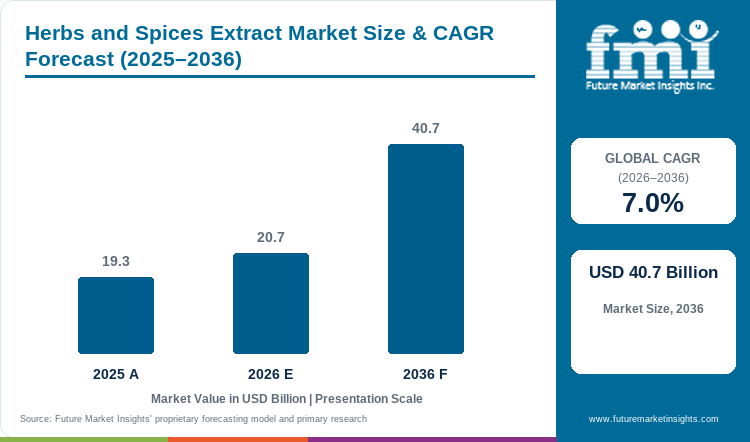
USD 20.7 billion in 2026 and USD 40.7 billion by 2036 at a 7.0% CAGR.
Sales in the herbs and spices extract market are projected to grow at 7.0% CAGR through 2036, climbing from USD 19.3 billion in 2025 to USD 20.7 billion in 2026 before driving valuation to USD 40.7 billion by 2036. Commercial buyers are using concentrated botanicals to hold flavor intensity within recurring recipes and reduce whole-spice variation. USDA Economic Research Service data updated in April 2026 describe rising spice and imported gourmet product use within the American food basket. That purchasing pattern supports demand for natural food flavors that deliver repeatable intensity across commercial recipes.
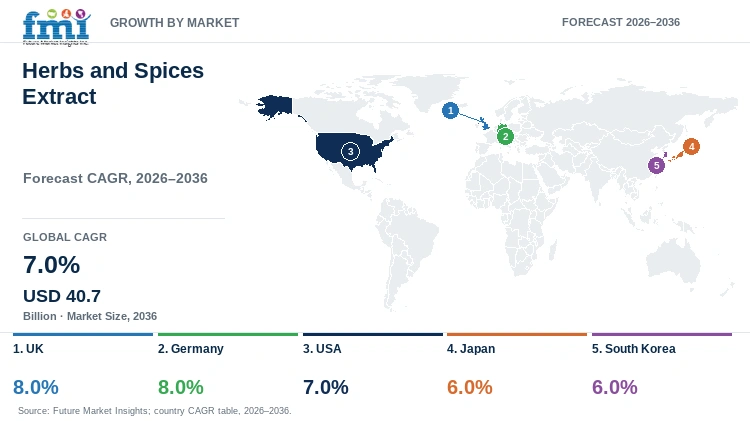
The UK and Germany are each forecast to expand at 8.0% CAGR through 2036, compared with 6.0% for Japan and South Korea. Defra reported in April 2026 that real-term UK imports in the coffee tea cocoa and spices group increased 18% between 2024 and 2025. Greater import activity supports a broader raw-material base for extract suppliers and seasoning products manufacturers.
Key Takeaways
- Standardized botanical flavor supports repeat purchasing because manufacturers need consistent intensity across recurring commercial recipes.
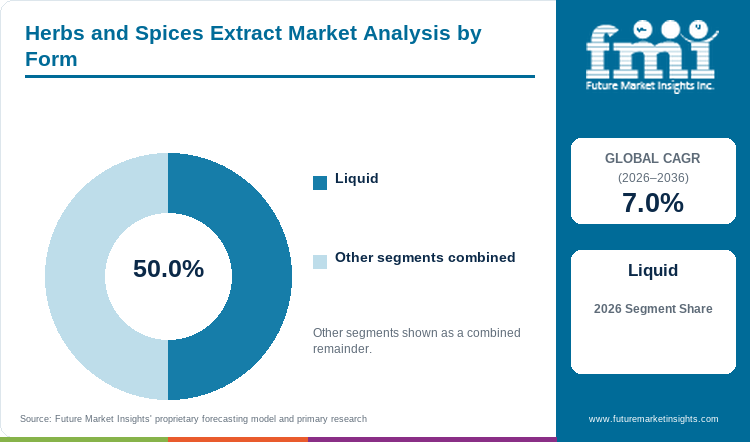
- Liquid is estimated to hold 50.0% of the form category in 2026, enabled by precise metering across high-throughput formulation lines.
- Spice extracts are forecast to represent 59.0% of the product type category in 2026, attributable to demand for standardized spice intensity across repeat seasoning formulas.
- The supplied market model separates delivery form from botanical product type without assigning a third dominant-share dimension.
- Raw-material variation and food-safety documentation can extend qualification timelines and delay routine purchasing for a new extract.
- Some of the key players in this market include McCormick & Company, Kalsec, Synthite Industries, Givaudan, Sensient Technologies, Kerry Group, dsm-firmenich, Plant Lipids, MANE, and Döhler.
Analyst Perspective
"Extract suppliers earn repeat business as sensory consistency clears the buyer's safety and residue checks without slowing production. The commercial advantage shifts toward suppliers that control botanical variability and support application work near the customer's formulation team."
- Nandini Roy Choudhury, Principal Consultant, Future Market Insights
How is the herbs and spices extract market segmented?
Form: Liquid, Powder, Leaf extracts. Product Type: Spice Extracts, Herb Extracts. Region.
The herbs and spices extract market is segmented by form, product type and region. Form covers liquid, powder and leaf extracts. Product type includes spice extracts and herb extracts. The region dimension follows the standard FMI geography hierarchy used later in the report.
How does liquid format support high-throughput flavor dosing requirements?
Liquid extracts support production lines that meter concentrated flavor directly into sauces or beverage bases without a separate hydration step. The same production environment also supports food flavors that require controlled dispersion and repeatable dosing at high throughput. Givaudan broke ground on a new liquids production facility in Reading Ohio during October 2025. The facility provides current evidence that large taste suppliers are expanding liquid manufacturing capacity for regional customer support.
- In 2026 liquid is expected to lead the form category with 50.0% share, reinforced by direct dosing across repeat industrial recipes.
- Formulators still test solubility and heat behavior because liquid delivery does not guarantee compatibility with every finished-food process.
Why do spice extracts suit repeat seasoning formulas better than raw spice lots?
Spice extracts concentrate volatile and non-volatile flavor components into controlled ingredient systems that reduce lot-to-lot sensory variation. Manufacturers use spice oils and oleoresins under the same purchasing logic because standardized potency replaces bulky ground material in repeat seasoning systems. MANE Kancor reported in September 2025 that its Sichuan Pepper Oleoresin received recognition in the Fi India product showcase.
- Spice extracts are likely to capture 59.0% of product type demand in 2026, influenced by the need to reduce raw-spice variability across commercial recipes.
- Food manufacturers still compare carrier system and release behavior because equal spice identity does not ensure equal performance in every recipe.
What are the drivers, restraints and opportunities in the Herbs and Spices Extract Market?
Standardized flavor demand supports extraction, food-safety controls slow qualification and application-ready processing gives suppliers a higher-value route.
- Driver: Raw-spice variability increases the value of concentrated ingredients because manufacturers need stable flavor intensity across repeat production targets.
- Restraint: Food-safety and import controls can delay supplier approval if spice origin or contamination risk requires additional documentation.
- Opportunity: Application-ready extraction and taste support can shorten reformulation work during raw-material or regulatory changes.
Raw botanical supply changes by origin and crop condition, so manufacturers use standardized ingredients to limit flavor swings across production lots. MANE Kancor's January 2025 spice overview reported firm black-pepper pricing in several origins because stocks and arrivals remained tight. Formulators use botanical ingredients as a controlled potency route for recipes that cannot absorb large sensory changes between production lots.
Food-safety controls restrain adoption because a new origin or supplier can require additional qualification documentation. The FDA announced in October 2025 that spices from defined Indonesian regions would require import certification because of potential cesium-137 contamination. The same controls leave food additives and concentrated flavor systems exposed to shipment-level compliance checks despite acceptable sensory performance.
Formulation support carries more commercial value as manufacturers protect taste during cost changes or ingredient substitutions. Kerry launched Smart Taste in September 2025 as a taste-solutions range intended to address supply and regulatory pressures without sacrificing sensory performance. Reformulation with botanical CO2 extracts requires careful route and carrier selection because both factors influence potency during processing.
Which country CAGRs are profiled in the Herbs and Spices Extract Market?
| Country | CAGR |
|---|---|
| UK | 8.0% |
| Germany | 8.0% |
| USA | 7.0% |
| Japan | 6.0% |
| South Korea | 6.0% |
How do country-level CAGRs compare in the Herbs and Spices Extract Market?
The UK and Germany are each forecast to expand at 8.0% CAGR through 2036. The USA is projected to advance at 7.0% CAGR and occupies the midpoint of the supplied country set. Japan and South Korea are each estimated at 6.0% CAGR through 2036. The two-percentage-point range describes forecast speed and does not indicate the size of each current revenue base.
- UK import procedures make local safety files and origin documentation important during supplier qualification of new botanical sources.
- Germany's documented irradiation controls keep process records relevant for herbs and spices moving through quality-sensitive supply chains.
- USA import alerts keep contamination and adulteration controls visible during supplier approval for spices and concentrated flavor inputs.
- Japan's national imported-food monitoring system places inspection planning alongside the commercial need for reliable botanical supply.
- South Korea's current Food Additives Code keeps ingredient classification and permitted-use requirements within routine formulation decisions.
Comparable CAGRs therefore translate into different order conditions because regulation and supply structure vary by country. The full report provides country-level CAGR analysis across North America, Latin America, Western Europe, Eastern Europe, East Asia, South Asia and Pacific, and the Middle East and Africa.
Country-wise Analysis
- Great Britain applies the same hygiene and safety procedures to imported herbs and spices that domestic foods must meet. Herbs and spices extract demand in the UK is projected to expand at 8.0% CAGR through 2036, supported by imported botanical supply and a broad formulation base. Food Standards Agency guidance updated in August 2026 states that flavorings accepted in an origin country may not be approved for Great Britain. That requirement keeps national compliance files as important as sensory performance for botanical extracts entering new recipes. Suppliers are localizing documentation to reduce delays between sample approval and recurring commercial orders.
- German processors operate within a food-control system that documents treatment conditions for herbs and spices used in sensitive applications. Germany's herbs and spices extract sector is forecast to grow at 8.0% CAGR through 2036, attributable to a processing base accustomed to documented treatment controls. BVL reported that one German irradiation facility treated 49.44 tonnes of herbs and spices for third-country markets during 2024. Another facility treated pressed sage under the same national reporting system. These records indicate a supply base accustomed to documented treatment steps. Extract suppliers are maintaining recipe-specific residue and identity files to secure repeat industrial orders.
- United States buyers operate within a broad imported-spice system that can interrupt established sourcing through contamination and adulteration controls. Herbs and spices extract demand in the USA is anticipated to advance at 7.0% CAGR through 2036, driven by clean-label ingredients and natural flavor reformulation. FDA Import Alert 99-47 was published in September 2026 and identifies filler material or unapproved colors in spices as examples of economically motivated adulteration. That enforcement setting increases the value of identity testing and traceable extraction inputs.
- Japan relies heavily on imported food and subjects those flows to national monitoring under the Food Sanitation Act. Adoption of herbs and spices extract in Japan is estimated to expand at 6.0% CAGR through 2036, shaped by regulated access to diverse botanical inputs. MHLW planned approximately 100,000 monitoring inspections for fiscal 2025 within its national imported-food program. The system requires import notification and can escalate inspection following documented violations. Herb and spice extract suppliers are maintaining stable identity and safety records for routine local formulation. Application support gains commercial value once import controls are cleared.
- South Korean food formulators operate within a national additives code that defines classifications and permitted-use conditions. The South Korean herbs and spices extract sector is projected to record 6.0% CAGR through 2036, reinforced by domestic and export-oriented food formulation. MFDS issued Food Additives Code Notification 2025-76 on November 26 2025 and registered the consolidated text the next day. The current code keeps regulatory classification close to routine formula review. Extract suppliers are matching local taste expectations without weakening the compliance record carried by each ingredient. Clear technical files remain a practical requirement for repeat purchasing.
Who are the notable companies in the Herbs and Spices Extract Market?
McCormick & Company, Kalsec, Synthite Industries, Givaudan, Sensient Technologies, Kerry Group, dsm-firmenich, Plant Lipids, MANE, and Döhler are notable companies serving this market.
Competition spans specialist spice extractors and integrated taste platforms that combine concentrated botanicals with formulation support. Direct extract capability is strongest among companies operating extraction assets or documented oleoresin portfolios. Integrated suppliers are connecting extract capability with natural flavors development and regional application laboratories. Buyers compare botanical identity and food-safety records during qualification of each new source.
- Direct spice and botanical extraction specialists include Kalsec, Synthite Industries, Plant Lipids, MANE and Döhler.
- Integrated taste platforms with documented extract capability include Givaudan, Sensient Technologies, Kerry Group and dsm-firmenich.
- McCormick & Company participates through seasonings and flavor solutions that overlap the immediate commercial purchase path for standardized botanicals.
Competitive Benchmarking: Herbs and Spices Extract Market
| Company | Extract Portfolio Breadth | Application Support | Regional Processing & Service | Geographic Reach |
|---|---|---|---|---|
| McCormick & Company | Medium | High | High | Global flavor and seasoning operations |
| Kalsec | High | High | High | North America, Europe and Asia |
| Synthite Industries | High | High | High | India manufacturing with global customer reach |
| Givaudan | High | High | High | Global Taste & Wellbeing network |
| Sensient Technologies | High | High | High | Global Flavors & Extracts operations |
| Kerry Group | Medium | High | High | Global taste and application network |
| dsm-firmenich | Medium | High | High | Global taste manufacturing and application network |
| Plant Lipids | High | High | High | Manufacturing in India, Sri Lanka and Germany |
| MANE | High | High | High | Global network with MANE Kancor extraction assets |
| Döhler | Medium | High | High | Global natural ingredient and application network |
Scoring basis: High extract breadth requires a documented multi-botanical extract or oleoresin range. Medium reflects narrower direct coverage or immediate-family taste capability. High application support requires documented laboratories or co-development capability. High regional processing and service requires operations in multiple commercial regions.
Key Developments in the Herbs and Spices Extract Market
- In August 2025, dsm-firmenich inaugurated an expanded seasoning plant in Kerala and broke ground on a new Taste facility in Gujarat for regional liquid and powder flavor supply.
- In April 2025, MANE inaugurated a new Woodlawn facility in Ohio that increased North American liquid-flavor production capacity fivefold for food and beverage customers.
- In February 2025, Plant Lipids inaugurated a Gundlupet processing facility focused on turmeric raw material and direct farmer sourcing for tighter traceability.
Key Players in the Herbs and Spices Extract Market
Spice and Botanical Extraction Specialists
- Kalsec
- Synthite Industries
- Plant Lipids
- MANE
- Döhler
Integrated Taste and Extract Platforms
- Givaudan
- Sensient Technologies
- Kerry Group
- dsm-firmenich
Seasoning and Flavor Solutions
- McCormick & Company
Herbs and Spices Extract Market - Report Scope
| Coverage field | Report scope |
|---|---|
| Market breakdown | By form, product type and region. |
| Quantitative Units | USD billion. |
| Market Definition | Commercial herbs and spices extracts used as concentrated flavor or botanical ingredients in food and beverage formulations. |
| Regions Covered | North America, Latin America, Western Europe, Eastern Europe, East Asia, South Asia and Pacific, and Middle East and Africa. |
| Countries Covered | UK, Germany, USA, Japan, South Korea, and 20+ countries included in the full report. |
| Key Companies Profiled | McCormick & Company, Kalsec, Synthite Industries, Givaudan, Sensient Technologies, Kerry Group, dsm-firmenich, Plant Lipids, MANE, and Döhler. |
| Forecast Period | 2026 to 2036. |
| Approach | Primary and secondary research with market triangulation. |
Herbs and Spices Extract Market - Research Methodology
| Method | Approach |
|---|---|
| Primary Research | FMI analysts gathered input from manufacturers, service providers, technology developers, distributors, end users, procurement teams, and subject-matter experts. Interviews examined purchasing decisions, product or service evaluation, adoption barriers, approval requirements, pricing considerations, and expectations for technical or commercial support. Respondents were also asked which evidence is required for a trial, pilot, or initial order to develop into regular purchasing. |
| Desk Research | Desk research covered government statistics, regulatory publications, trade data, industry associations, technical literature, standards, company filings, product information, and official corporate announcements. Sources were reviewed for relevance, publication date, geographic coverage, and consistency with the defined market scope. Claims relating to performance, applications, approvals, capacity, investment, and commercial activity were retained with support from credible public evidence. |
| Market Sizing and Forecasting | The market model combined the baseline value with historical performance, segment structure, pricing and volume indicators, adoption levels, company participation, and country-level demand conditions. Forecast assumptions considered economic activity, investment trends, regulatory developments, technology adoption, purchasing cycles, supply availability, and barriers to wider market use. Segment and regional estimates were reconciled prior to calculating the final market total. |
| Data Validation | Estimates were checked against multiple independent indicators, including public data, company activity, trade patterns, industry developments, and findings from primary interviews. Validation also tested whether products, services, applications, and company revenues fell within the defined market boundaries. Adjacent categories, unsupported claims, overlapping revenues, and activities without direct market relevance were excluded to reduce double counting and maintain consistency across segments and countries. |
Herbs and Spices Extract Market by Segments
Herbs and Spices Extract Market segmented by Form:
- Liquid
- Powder
- Leaf extracts
Herbs and Spices Extract Market segmented by Product Type:
- Spice Extracts
- Herb Extracts
Herbs and Spices Extract Market by Region:
- North America
- United States
- Canada
- Latin America
- Brazil
- Mexico
- Chile
- Rest of Latin America
- Western Europe
- Germany
- United Kingdom
- Italy
- Spain
- France
- Nordics
- Benelux
- Rest of Western Europe
- Eastern Europe
- Russia
- Poland
- Hungary
- Balkan and Baltic States
- Rest of Eastern Europe
- East Asia
- China
- Japan
- South Korea
- South Asia and Pacific
- India
- ASEAN
- Australia and New Zealand
- Rest of South Asia and Pacific
- Middle East and Africa
- Kingdom of Saudi Arabia
- Other GCC Countries
- Türkiye
- South Africa
- Other African Union Countries
- Rest of Middle East and Africa
Research Sources and Bibliography
- U.S. Department of Agriculture, Economic Research Service. (2026, April 8). U.S. Food Imports.
- Department for Environment, Food & Rural Affairs. (2026, April 30). UK trade in Food, Feed and Drink, 2025 provisional.
- Givaudan. (2025, October 8). Givaudan Taste & Wellbeing breaks ground on new production facility near Cincinnati, Ohio.
- MANE Kancor. (2025, September 10). Mane Kancor wins two awards at Fi India 2025.
- MANE Kancor. (2025, January). Spices Market Overview: January 2025.
- U.S. Food and Drug Administration. (2025, October 3). FDA Announces First Use of Import Certification Authority for Certain Shrimp and Spices Potentially Contaminated with Cesium-137.
- Kerry Group. (2025, September 30). Kerry Launches Smart Taste™ to Help Customers Navigate Market Complexities Without Compromising on Taste.
- Food Standards Agency. (2026, August 28). Importing herbs and spices.
- Federal Office of Consumer Protection and Food Safety (BVL). (2025). Jahresbericht Lebensmittelbestrahlung 2024.
- U.S. Food and Drug Administration. (2026, September 14). Import Alert 99-47: Detention Without Physical Examination of Human Food Products That Appear to be Adulterated for Economic Gain.
- Ministry of Health, Labour and Welfare, Japan. (2025). Imported Foods Monitoring and Guidance Plan for FY 2025.
- Ministry of Food and Drug Safety, Republic of Korea. (2025, November 27). Food Additives Code, Notification No. 2025-76.
- dsm-firmenich. (2025, August 26). dsm-firmenich unveils major plant investments, emphasizing commitment to shaping the future of flavor in India.
- MANE. (2025, April 17). MANE new state-of-the-art manufacturing facility in Woodlawn, Ohio.
- Plant Lipids. (2025, February 10). Plant Lipids Expands with New Processing Facility in Gundlupet.
- Synthite Industries. (Retrieved September 16, 2026). Natural Food and Beverage Ingredient Solutions.
- Plant Lipids. (Retrieved September 16, 2026). Products.
- MANE. (Retrieved September 16, 2026). Our specialities.
- Döhler. (Retrieved September 16, 2026). Wine & Spirit Flavour Solutions.
- Kalsec. (Retrieved September 16, 2026). Certified Organic Food Ingredients.
- Sensient Technologies Corporation. (2026, February 13). 2025 Annual Report.
- McCormick & Company, Incorporated. (2026, January 22). Annual Report on Form 10-K for the fiscal year ended November 30, 2025.
- Givaudan. (2025, May 14). Givaudan launches next-generation innovation for stress management with Zensera™.
- Kalsec. (2026, July 27). Kalsec Celebrates Opening of New Spice Processing Center.
- Döhler. (2026, June 29). Döhler Significantly Expands Flavor Production and Innovation Capabilities in Cartersville, GA.
- MANE. (2025, November 25). Future powder flavours plant in Telangana.
- dsm-firmenich. (2025, December 5). dsm-firmenich names ‘Frosted Star Anise’ as Flavor of the Year 2026, capturing a global desire for warmth and freshness.
- Kerry Group. (2026, March 19). Kerry publishes 2025 Annual Report: A year defined by impact, innovation and purpose.
This bibliography is provided for reader reference and is not exhaustive. The full report contains the complete reference list and detailed citations
This Report Answers
- How large is the herbs and spices extract market in 2026?
- What explains the seven percent forecast CAGR through 2036?
- Why does liquid format hold half of form demand?
- Why do spice extracts represent most product-type demand?
- Which country conditions separate the five supplied growth rates?
- What safety controls slow supplier qualification for concentrated botanicals?
- Which extraction capabilities improve repeatability during commercial recipe development?
- How do the notable companies differ by extraction and application support?
- Which recent company actions are changing regional taste production capacity?
Frequently Asked Questions
How big is the herbs and spices extract market in 2026?
The herbs and spices extract market is valued at USD 20.7 billion in 2026 and is projected to reach USD 40.7 billion by 2036. Manufacturers are using concentrated botanicals to reduce flavor variation across repeat recipes.
What is the CAGR of the herbs and spices extract market?
The herbs and spices extract market is projected to expand at 7.0% CAGR between 2026 and 2036. Demand is supported by the need for standardized botanical flavor alongside documented food-safety and residue controls.
Which form leads the herbs and spices extract market?
The liquid segment is projected to hold 50.0% of the form category in 2026, aided by direct metering across high-throughput formulation lines. Buyers still test solubility and heat behavior during routine qualification.
Which product type leads the herbs and spices extract market?
The spice extracts segment is set to lead product type with 59.0% share in 2026, linked to procurement demand for controlled potency across repeat seasoning formulas. Carrier choice and release behavior still determine recipe compatibility.
Which countries record the strongest supplied growth rates?
The UK and Germany are each projected to expand at 8.0% CAGR through 2036 within the supplied country set. Their growth conditions differ because import controls and documented processing affect supplier approval through different national routes.
Which companies are active in the herbs and spices extract market?
Key companies include McCormick & Company, Kalsec, Synthite Industries, Givaudan, Sensient Technologies, Kerry Group, dsm-firmenich, Plant Lipids, MANE, and Döhler. Their competitive positions differ by extraction depth and application support.
Preview the report firsthand - request a free sample
Get SampleGet the brochure for pricing and purchase details.
Get PDFTable of Content
- Key Takeaways
- Market Size and CAGR
- Top Growth Driver
- Fastest Growing Segment
- Leading Region
- Key Companies
- Emerging Opportunities
- Executive Summary
- Global Market Outlook
- Demand-side Trends
- Supply-side Trends
- Technology Roadmap Analysis
- Analysis and Recommendations
- Analyst Perspective (What is happening? Why now? What should investors know?)
- Key Questions Answered
- How large is the market?
- What is the CAGR?
- What are key trends?
- Which region dominates?
- Who are the leaders?
- Market Overview
- Market Coverage / Taxonomy
- Market Definition / Scope / Limitations
- Research Methodology
- Chapter Orientation
- Analytical Lens and Working Hypotheses
- Market Structure, Signals, and Trend Drivers
- Benchmarking and Cross-market Comparability
- Market Sizing, Forecasting, and Opportunity Mapping
- Research Design and Evidence Framework
- Desk Research Programme (Secondary Evidence)
- Expert Input and Fieldwork (Primary Evidence)
- Tooling, Models, and Reference Databases
- Data Engineering and Model Build
- Quality Assurance and Audit Trail
- Market Background
- Market Dynamics (Drivers, Restraints, Opportunity, Trends)
- Scenario Forecast (Optimistic, Likely, Conservative)
- Impact Analysis
- AI Impact
- Sustainability Impact
- Regulatory Impact
- Technology Impact
- Consumer / Buyer Analysis
- Purchase Drivers
- Adoption Barriers
- Buyer Journey
- Opportunity Map Analysis
- Product Life Cycle Analysis
- Supply Chain Analysis
- Investment Feasibility Matrix
- Value Chain Analysis
- PESTLE and Porter's Analysis
- Regulatory Landscape
- Regional Parent Market Outlook
- Production and Consumption Statistics
- Import and Export Statistics
- Global Market Analysis and Forecast, 2021 to 2036
- Historical Market Size Value (USD Billion) Analysis, 2021 to 2025
- Current and Future Market Size Value (USD Billion) Projections, 2026 to 2036
- Y-o-Y Growth Trend Analysis
- Absolute $ Opportunity Analysis
- Global Market Pricing Analysis, 2021 to 2036
- Global Market Analysis and Forecast, By Form, 2021 to 2036
- Introduction / Key Findings
- Historical Market Size Value (USD Billion) Analysis By Form, 2021 to 2025
- Current and Future Market Size Value (USD Billion) Analysis and Forecast By Form, 2026 to 2036
- Liquid
- Powder
- Leaf extracts
- Y-o-Y Growth Trend Analysis By Form, 2021 to 2025
- Absolute $ Opportunity Analysis By Form, 2026 to 2036
- Global Market Analysis and Forecast, By Product Type, 2021 to 2036
- Introduction / Key Findings
- Historical Market Size Value (USD Billion) Analysis By Product Type, 2021 to 2025
- Current and Future Market Size Value (USD Billion) Analysis and Forecast By Product Type, 2026 to 2036
- Spice Extracts
- Herb Extracts
- Y-o-Y Growth Trend Analysis By Product Type, 2021 to 2025
- Absolute $ Opportunity Analysis By Product Type, 2026 to 2036
- Global Market Analysis and Forecast, By Region, 2021 to 2036
- Introduction
- Historical Market Size Value (USD Billion) Analysis By Region, 2021 to 2025
- Current Market Size Value (USD Billion) Analysis and Forecast By Region, 2026 to 2036
- North America
- Latin America
- Western Europe
- Eastern Europe
- East Asia
- South Asia and Pacific
- Middle East and Africa
- Market Attractiveness Analysis By Region
- North America Market Analysis and Forecast, By Country, 2021 to 2036
- Historical Market Size Value (USD Billion) Trend Analysis By Market Taxonomy, 2021 to 2025
- Market Size Value (USD Billion) Forecast By Market Taxonomy, 2026 to 2036
- By Country
- United States
- Canada
- By Form
- By Product Type
- By Country
- Market Attractiveness Analysis
- By Country
- By Form
- By Product Type
- Key Takeaways
- Latin America Market Analysis and Forecast, By Country
- Historical Market Size Value (USD Billion) Trend Analysis By Market Taxonomy, 2021 to 2025
- Market Size Value (USD Billion) Forecast By Market Taxonomy, 2026 to 2036
- By Country
- Brazil
- Mexico
- Chile
- Rest of Latin America
- By Form
- By Product Type
- By Country
- Market Attractiveness Analysis
- By Country
- By Form
- By Product Type
- Key Takeaways
- Western Europe Market Analysis and Forecast, By Country
- Historical Market Size Value (USD Billion) Trend Analysis By Market Taxonomy, 2021 to 2025
- Market Size Value (USD Billion) Forecast By Market Taxonomy, 2026 to 2036
- By Country
- Germany
- United Kingdom
- Italy
- Spain
- France
- Nordics
- Benelux
- Rest of Western Europe
- By Form
- By Product Type
- By Country
- Market Attractiveness Analysis
- By Country
- By Form
- By Product Type
- Key Takeaways
- Eastern Europe Market Analysis and Forecast, By Country
- Historical Market Size Value (USD Billion) Trend Analysis By Market Taxonomy, 2021 to 2025
- Market Size Value (USD Billion) Forecast By Market Taxonomy, 2026 to 2036
- By Country
- Russia
- Poland
- Hungary
- Balkan and Baltic States
- Rest of Eastern Europe
- By Form
- By Product Type
- By Country
- Market Attractiveness Analysis
- By Country
- By Form
- By Product Type
- Key Takeaways
- East Asia Market Analysis and Forecast, By Country
- Historical Market Size Value (USD Billion) Trend Analysis By Market Taxonomy, 2021 to 2025
- Market Size Value (USD Billion) Forecast By Market Taxonomy, 2026 to 2036
- By Country
- China
- Japan
- South Korea
- By Form
- By Product Type
- By Country
- Market Attractiveness Analysis
- By Country
- By Form
- By Product Type
- Key Takeaways
- South Asia and Pacific Market Analysis and Forecast, By Country
- Historical Market Size Value (USD Billion) Trend Analysis By Market Taxonomy, 2021 to 2025
- Market Size Value (USD Billion) Forecast By Market Taxonomy, 2026 to 2036
- By Country
- India
- ASEAN
- Australia and New Zealand
- Rest of South Asia and Pacific
- By Form
- By Product Type
- By Country
- Market Attractiveness Analysis
- By Country
- By Form
- By Product Type
- Key Takeaways
- Middle East and Africa Market Analysis and Forecast, By Country
- Historical Market Size Value (USD Billion) Trend Analysis By Market Taxonomy, 2021 to 2025
- Market Size Value (USD Billion) Forecast By Market Taxonomy, 2026 to 2036
- By Country
- Kingdom of Saudi Arabia
- Other GCC Countries
- Türkiye
- South Africa
- Other African Union Countries
- Rest of Middle East and Africa
- By Form
- By Product Type
- By Country
- Market Attractiveness Analysis
- By Country
- By Form
- By Product Type
- Key Takeaways
- Key Countries Market Analysis
- United States
- Pricing Analysis
- Market Share Analysis, 2025
- By Form
- By Product Type
- Canada
- Pricing Analysis
- Market Share Analysis, 2025
- By Form
- By Product Type
- Mexico
- Pricing Analysis
- Market Share Analysis, 2025
- By Form
- By Product Type
- Brazil
- Pricing Analysis
- Market Share Analysis, 2025
- By Form
- By Product Type
- Chile
- Pricing Analysis
- Market Share Analysis, 2025
- By Form
- By Product Type
- Germany
- Pricing Analysis
- Market Share Analysis, 2025
- By Form
- By Product Type
- United Kingdom
- Pricing Analysis
- Market Share Analysis, 2025
- By Form
- By Product Type
- Italy
- Pricing Analysis
- Market Share Analysis, 2025
- By Form
- By Product Type
- Spain
- Pricing Analysis
- Market Share Analysis, 2025
- By Form
- By Product Type
- France
- Pricing Analysis
- Market Share Analysis, 2025
- By Form
- By Product Type
- India
- Pricing Analysis
- Market Share Analysis, 2025
- By Form
- By Product Type
- ASEAN
- Pricing Analysis
- Market Share Analysis, 2025
- By Form
- By Product Type
- Australia and New Zealand
- Pricing Analysis
- Market Share Analysis, 2025
- By Form
- By Product Type
- China
- Pricing Analysis
- Market Share Analysis, 2025
- By Form
- By Product Type
- Japan
- Pricing Analysis
- Market Share Analysis, 2025
- By Form
- By Product Type
- South Korea
- Pricing Analysis
- Market Share Analysis, 2025
- By Form
- By Product Type
- Russia
- Pricing Analysis
- Market Share Analysis, 2025
- By Form
- By Product Type
- Poland
- Pricing Analysis
- Market Share Analysis, 2025
- By Form
- By Product Type
- Hungary
- Pricing Analysis
- Market Share Analysis, 2025
- By Form
- By Product Type
- Kingdom of Saudi Arabia
- Pricing Analysis
- Market Share Analysis, 2025
- By Form
- By Product Type
- Türkiye
- Pricing Analysis
- Market Share Analysis, 2025
- By Form
- By Product Type
- South Africa
- Pricing Analysis
- Market Share Analysis, 2025
- By Form
- By Product Type
- United States
- Market Structure Analysis
- Competition Dashboard
- Competition Benchmarking
- Market Share Analysis of Top Players
- By Regional
- By Form
- By Product Type
- Emerging Startups
- Innovation Benchmarking
- Competition Analysis
- Competition Deep Dive
- McCormick & Company
- Overview
- Product Portfolio
- Profitability by Market Segments
- Sales Footprint
- Strategy Overview
- Marketing Strategy
- Product Strategy
- Channel Strategy
- Kalsec
- Synthite Industries
- Givaudan
- Sensient Technologies
- Kerry Group
- dsm-firmenich
- Plant Lipids
- MANE
- Döhler
- McCormick & Company
- Case Studies
- Success Stories
- Recent Developments
- Competition Deep Dive
- Assumptions & Acronyms Used


