

- Industry Size (2026)
- USD 3.20 Bn
- Forecast (2036)
- USD 4.43 Bn
- CAGR (2026 to 2036)
- 3.30%
Hermetic Jars Market Size, Market Forecast and Outlook By FMI
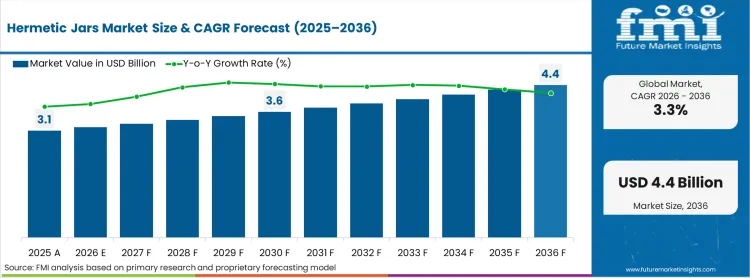
In 2025, the hermetic jars market was valued at USD 3.10 billion. Based on Future Market Insights' analysis, demand is estimated to grow to USD 3.20 billion in 2026 and USD 4.43 billion by 2036. FMI projects a CAGR of 3.30% during the forecast period.
Summary of Hermetic Jars Market
- Hermetic Jars Market Definition
- Hermetic jars are airtight glass and specialty container systems with sealed closure mechanisms (threaded lids, wire bail closures, vacuum-sealed caps) used for food preservation (canning, pickling, fermenting), cosmetic packaging, craft storage, and home decor applications in commercial and household settings.
- Demand Drivers in the Market
- Home canning and food preservation activity growth, accelerated by consumer food self-sufficiency trends, sustains mason jar procurement through retail and online channels, with Ball and Kerr brand jars maintaining dominant household market positions in North America.
- Artisanal food brand packaging preferences for glass hermetic jars over plastic containers drive commercial procurement, with hexagonal and paragon jar shapes providing shelf differentiation for premium jam, honey, and specialty condiment product lines.
- Cosmetic and personal care brands adopting glass hermetic jars for moisturizer, lip balm, and candle packaging leverage the premium material perception and recyclability credentials that glass provides over plastic alternatives in sustainability-conscious consumer segments.
- Key Segments Analyzed in the FMI Report
- Mason Jar product: 34.8% share in 2026, reflecting its structural position as the primary category across established procurement channels.
- 4 oz to 8 oz capacity: 36.1% share in 2026, reflecting its structural position as the primary category across established procurement channels.
- India: 5.30% compound growth through 2036, indicating concentrated demand acceleration.
- Analyst Opinion at FMI
- Ismail Sutaria, Principal Consultant for Packaging observe that, The hermetic jars market is a glass packaging niche where multi-functional consumer use and artisanal food brand adoption create steady demand independent of broader packaging industry substitution trends. FMI analysts observe that mason jars command 34.8% product share because their dual-purpose utility spanning food preservation and lifestyle applications generates repeat purchase rates that single-function jar types cannot match. The 4 oz to 8 oz capacity at 36.1% share represents the sweet spot for single-serve preserves, specialty food samples, and cosmetic packaging formats. India leads at 5.3% CAGR because growing urban household food preservation adoption and artisanal food brand proliferation are expanding glass jar consumption from a low base.
- Strategic Implications / Executive Takeaways
- Glass container manufacturers should develop lightweight hermetic jar designs that maintain airtight seal performance while reducing per-unit glass weight, addressing shipping cost and sustainability concerns for e-commerce food brand distribution.
- Artisanal food brands should standardize on hexagonal or paragon jar formats to create visual shelf differentiation from commodity mason jar packaging, justifying premium product positioning in specialty retail channels.
- Cosmetic brands should evaluate hermetic glass jar formats with refillable closure systems to align with EU PPWR reuse requirements while maintaining the premium material perception that glass packaging provides.
Hermetic Jars Market Key Takeaways
| Metric | Details |
|---|---|
| Industry Size (2026) | USD 3.20 Billion |
| Industry Value (2036) | USD 4.43 Billion |
| CAGR (2026 to 2036) | 3.30% |
Source: Future Market Insights, 2026
The market is set to add approximately USD 1.23 billion in absolute terms between 2026 and 2036. Home canning and food preservation revival driven by consumer interest in artisanal food preparation and food waste reduction is sustaining demand growth. Mason jars in particular benefit from multi-functional consumer use spanning food preservation, beverage service, cosmetic packaging, and craft/decor applications. The 4 oz to 8 oz capacity range leads because it serves the broadest intersection of jam, preserve, and specialty food packaging applications.
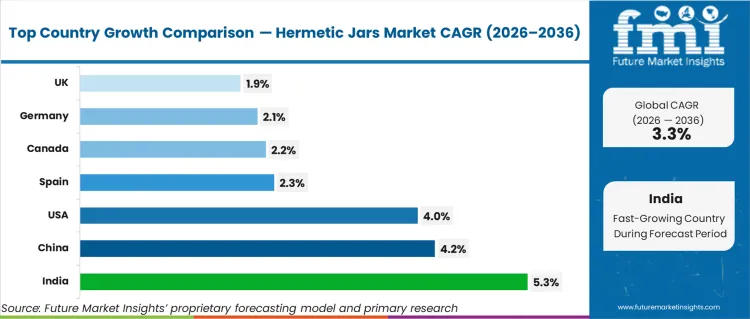
As per FMI, country-level growth rates through 2036 are projected as follows: India at 5.30%, China at 4.20%, USA at 4.00%, Spain at 2.30%, Canada at 2.20%, Germany at 2.10%, UK at 1.90%. India records the fastest expansion driven by concentrated institutional investment and infrastructure development.
Hermetic Jars Market Definition
The hermetic jars market encompasses airtight glass container systems engineered for food preservation, specialty food packaging, cosmetic containment, and multi-functional household use. Product formats span mason jars with two-piece threaded lid closures, hexagonal jars for premium food branding, paragon jars for specialty shapes, and straight-sided jars for cosmetic and candle applications. Based on FMI's analysis, the market benefits from multi-functional consumer demand that extends jar utility beyond single-use food packaging into beverage service, craft, and home decor applications, creating repeat purchase cycles that sustain steady growth.
Hermetic Jars Market Inclusions
Market scope covers mason jars, hexagonal jars, paragon jars, and straight-sided jars in capacity ranges from less than 4 oz to above 12 oz, supplied for commercial food packaging, household food preservation, cosmetic containers, and specialty storage applications.
Hermetic Jars Market Exclusions
Non-hermetic open-mouth glass jars without airtight sealing mechanisms, plastic food storage containers, metal canning tins, and industrial glass vessels for laboratory or chemical processing use are excluded.
Hermetic Jars Market Research Methodology
- Primary Research: Analysts conducted structured interviews with procurement managers, product engineers, and distribution channel operators to map purchase decision triggers and specification requirements across key verticals.
- Desk Research: Data collection aggregated regulatory filings, industry standards documentation, patent registries, trade body publications, and company annual reports across all target geographies.
- Market-Sizing and Forecasting: Baseline values derive from a bottom-up aggregation of product shipment volumes and average selling prices, validated against publicly disclosed revenue figures from leading suppliers.
- Data Validation and Update Cycle: Projections are cross-referenced against quarterly earnings data, import-export trade statistics, and industry association production reports to maintain forecast integrity.
Key Industry Highlights
Aesthetic Appeal of the Hermetic Jar Push the Market Growth
Consumer preferences for visually appealing packaging make hermetic jars popular. This is because hermetic jars possess aesthetic qualities and perceived value. Glass jars are glossy and elegant, giving the product an excellent presentation and making it more attractive to consumers. Besides, one can see the contents inside, thus enhancing visual inspection, which increases consumer confidence in the quality of the product.
Also, these jars are associated with high-quality products, as their design reflects luxury and careful packaging. Visual attractiveness, quality perception, and eco-friendliness make hermetic jars a preferable choice for brands to target customers.
Health and Wellness Propel Boosts the Market Growth
Now, people are more conscious about their health and their diet, so consumers prefer safe food storage options. They look for packaging options that keep food fresh. Also, cleaning these jars is quite easy so it is an odorless stain-free, hygienic option. As increasing awareness of the environment, people are opting for glass jars that can be used multiple times rather than using plastic bottles, which are degrading the earth. Hermetic jars are not only hardy but also eco-friendly.
Such jars attract health-conscious people who have conscious buying decisions about sustainable living. The increasing trend of health and wellness and the demand for a safe and ecological storage solution are driving the increasing demand for hermetic jars in every household.
Alternative Packaging and Fragility May Restrict Hermetic Jar Adoption
Hermetic jars weigh heavily on consumers who like light packaging, as they can be inconvenient to carry around. Therefore, alternate packaging like plastic becoming more popular. Which reduces fragility and is also lighter-weight. Hermetic jars are heavier and more fragile; therefore, they have higher shipping costs and tend to break in shipping, particularly in e-commerce, where the potential damage in shipping is a concern.
In order to minimize costs and ensure safety in shipping products, these competing materials may restrict the market share of glass packaging, particularly for mass-market and online retail sectors.
2021 to 2025 Global Hermetic Jar Sales Outlook Compared to Demand Forecast from 2026 to 2036
The hermetic jars market was witnessing steady growth between 2021 and 2025 due to the continuously increasing consumer demand for sustainable packaging. Sustainability attributes such as recyclable content and premium look, especially within the food and cosmetics markets, helped the sale of hermetic jars better. A spurring environmental concern and the imperative need to reduce plastic waste also enhanced the adoption of glass.
In the assessment period, global demand for hermetic jar is expected to grow strongly. The drivers for this are mainly sustainability regulations, the innovation of lightweight glass, consumer preference for premium, organic, and eco-conscious products, and the efficiency in manufacturing and recycling of glass.
Market Concentration
Tier 1 companies comprise market leaders with significant market share in global market. These market leaders are characterized by high production capacity and a wide product portfolio. These market leaders are distinguished by their extensive expertise in manufacturing across multiple packaging formats and a broad geographical reach, underpinned by a robust consumer base. They provide a wide range of series including recycling and manufacturing utilizing the latest technology and meeting the regulatory standards providing the highest quality. Prominent companies within tier 1 include Tzanet, Einkochwelt, Browin, Qosmedix, Bed Bath & Beyond Inc.
Tier 2 companies include mid-size players having presence in specific regions and highly influencing the local market. These are characterized by a strong presence overseas and strong market knowledge. These market players have good technology and ensure regulatory compliance but may not have advanced technology and wide global reach. Prominent companies in tier 2 include Modern Houseware Imports Inc., Container and Packaging Supply Inc., Pres-On Corporation, Bormioli Rocco S.p.A. and others., Meiyun (Wuhan) Craft Technology Co.Ltd.
Tier 3 includes the majority of small-scale companies operating at the local presence and serving niche markets. These companies are notably oriented towards fulfilling local market demands and are consequently classified within the tier 3 share segment. They are small-scale players and have limited geographical reach. Tier 3, within this context, is recognized as an unorganized market, denoting a sector characterized by a lack of extensive structure and formalization when compared to organized competitors.
Country-wise Insights
The section below covers the forecast for the hermetic jar market in terms of countries. Information on key countries in several parts of the globe, including North America, Latin America, East Asia, South Asia and Pacific, Western Europe, Eastern Europe, and MEA, is provided. The USA is anticipated to remain at the forefront of North America, with a CAGR of 4.0% through 2036. In Europe, Spain is projected to witness a CAGR of 2.3% by 2036.
.webp "Top Country Growth Comparison Hermetic Jars Market Cagr (2026 2036)")
| Countries | Value CAGR (2026 to 2036) |
|---|---|
| USA | 4.0% |
| Germany | 2.1% |
| China | 4.2% |
| UK | 1.9% |
| Spain | 2.3% |
| India | 5.3% |
| Canada | 2.2% |
Small Business in India Accelerate the Growth Hermetic Jars
In India, many small businesses manufacture homemade pickles, jams, and sauces that need hermetic jars to preserve them. These jars are airtight. It ensures the product does not go bad soon, so small businesses prefer these jars. Also, small businesses embrace eco-friendly measures. These recyclable and reusable jars suit the sustainability targets of these businesses and thus appeal to eco-conscious consumers. The consumer trend in India has become more favorable toward small, local businesses.
This trend helps sales increase as buyers are more willing to purchase from quality-oriented brands that care about sustainability. Small businesses usually seek niche packaging for differentiation. Further, Hermetic jars come in diverse sizes, colors, and designs, which gives such businesses ease in achieving any specific brand image.
Sustainability Propel Boost the Market Growth in the USA
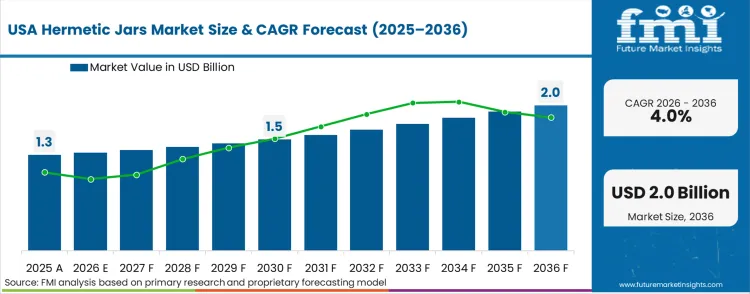
Most consumers are turning towards eco-friendly products, so the hermetic jars market in the USA is increasing. These jars, which are recyclable and minimize plastic waste, will be more acceptable to consumers. As shoppers become aware of environmental issues, they look for brands with sustainable packaging, and hermetic jars precisely meet this need.
These jars are gaining popularity because of their freshness and safety as long as one maintains them correctly. Home canning and DIY projects are currently popular among people, so this calls for efficient storage. Thus, the need arises for hermetic jars, especially for their exquisite beauty in not only storing goods but also decorations.
Category-wise Insights
The section contains information about the leading segments in the industry. In terms of capacity, 4 oz to 8 oz capacity is estimated to account for a share of 36.1% by 2036. By product formats, mason jars are projected to dominate by holding a share of 34.8% by the end of 2036.
Classic, Pretty Design of Mason Jars Attracts the Consumers
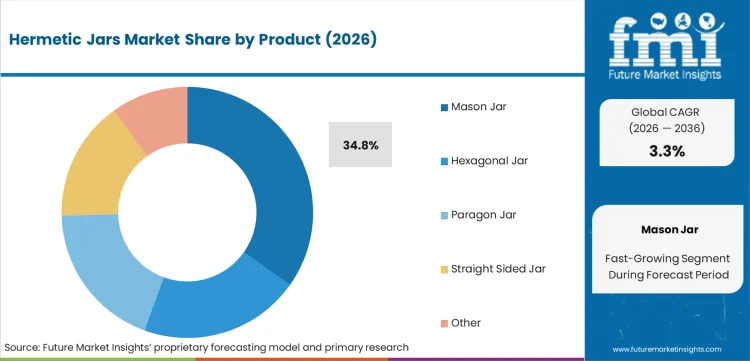
| Product | Market Share (2036) |
|---|---|
| Mason Jars | 34.8% |
The airtight sealing feature of Mason jars makes food and beverages stay longer fresh. Hence, they are highly used in jams and pickles. This is because it allows consumers to store their food fresh without the addition of preservatives. Another reason mason jars remain popular is the classic, pretty design that consumers who like their kitchen to seem rustic or antique would love to have.
Mason jars are versatile because they may be used in many ways instead of just storage for foodstuffs; some may use them for crafting purposes, organizing the home, and even as decor. In general, good sealing, aesthetic appeal, flexibility, and aspects of sustainability make Mason jars a hit in the hermetic jars market, increasing demand.
4 oz to 8 oz Capacity of Hermetic Jars Is Perfect for Versatile Uses
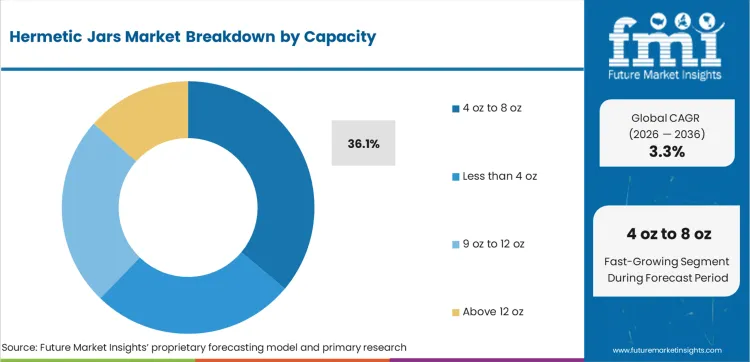
| Capacity | Market Share (2036) |
|---|---|
| 4 oz to 8 oz | 36.1% |
The 4 Oz to 8 Oz capacity jars take up a major share of the hermetic jars market because these are ideal for any size requirement of various applications. It is also excellent for storage to serve foods in jars individually, especially with jams, sauces, or spices, to provide an effective service for house cooks and business entrepreneurs. Their small size makes them convenient to carry and store in the kitchen cabinets and fridge, taking less space.
Furthermore, they are preferred for canning and preserving since they make it possible to produce smaller batches of homemade goods. It is quite attractive to people who wish to try out new recipes without making a huge commitment.
Competitive Landscape
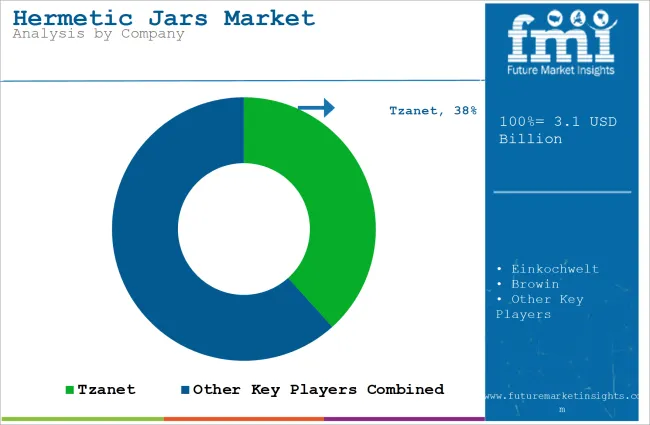
Key players in the hermetic jars industry are developing and launching new products. They are integrating with different firms and extending their geographical presence. A few of them are also collaborating and partnering with local brands and start-up companies for new product development.
Key Developments in the Hermetic Jars Market
- In May 2023, Ardagh Glass Packaging collaborated with Newell Brands, the maker of Ball® home canning jars, to design and manufacture the Ball® Honeybee Keepsake Mason Jars.
- In October 2024, Ardagh Glass Packaging-Europe presented its newest range of healthcare products, the ‘Cream Jars.’ These beautifully designed glass jars are the ideal solution for filling and storing various products, including medicines, creams, balms, supplements, and vitamins.
Scope of the Report
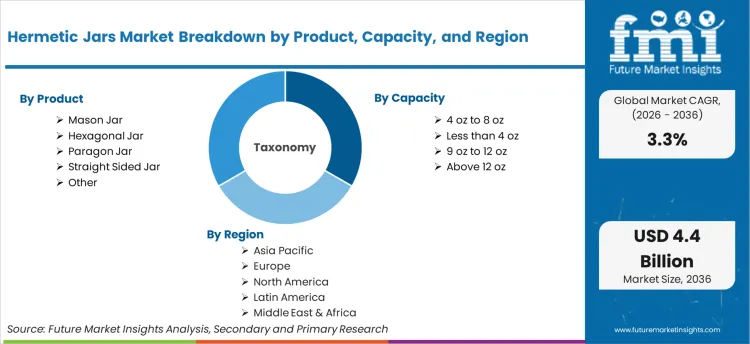
| Metric | Value |
|---|---|
| Quantitative Units | USD 3.20 Bn to USD 4.43 Bn, at a CAGR of 3.30% |
| Market Definition | Hermetic jars are airtight glass and specialty container systems with sealed closure mechanisms (threaded lids, wire bail closures, vacuum-sealed caps) used for food preservation (canning, pickling, fermenting), cosmetic packaging, craft storage, and home decor applications in commercial and household settings. |
| Product Segmentation | Mason Jar, Hexagonal Jar, Paragon Jar, Straight Sided Jar, Other |
| Capacity Segmentation | 4 oz to 8 oz, Less than 4 oz, 9 oz to 12 oz, Above 12 oz |
| Regions Covered | North America, Latin America, Europe, East Asia, South Asia, Oceania, Middle East & Africa |
| Countries Covered | India, China, USA, Spain, Canada, Germany, UK, and 40 plus countries |
| Key Companies Profiled | Tzanet, Einkochwelt, BROWIN, Qosmedix, Bed Bath & Beyond Inc., Modern Houseware Imports Inc., Container and Packaging Supply Inc., Pres-On Corporation, Bormioli Rocco S.p.A., Meiyun (Wuhan) Craft Technology Co. Ltd., Ardagh Glass Packaging, Newell Brands |
| Forecast Period | 2026 to 2036 |
| Approach | Hybrid bottom-up and top-down modeling validated against primary research inputs and publicly available industry data. |
Hermetic Jars Market Segmentation
By Product:
In terms of product, the market of hermetic jars is divided into mason jar, hexagonal jar, paragon jar, straight sided jar and others (facet jar, tempered round jar, etc.)
By Capacity:
In terms of capacity, the market of hermetic jars is segmented into less than 4 oz, 4 oz to 8 oz, 9 oz to 12 oz, above 12 oz
By End Use:
Some of end users in the market of hermetic jars include commercial and household.
By Region:
Key countries of North America, Latin America, East Asia, South Asia and Pacific, Western Europe, Eastern Europe, Middle East and Africa are covered.
Bibliography
- [1] Ardagh Glass Packaging. (2024). Annual Report 2024: Glass Container Division. Ardagh.
- [2] European Commission. (2024). Packaging and Packaging Waste Regulation (PPWR): Reuse and Refill Targets for Glass Packaging. European Commission.
- [3] Glass Packaging Institute. (2024). GPI Annual Report: US Glass Container Production Statistics. GPI.
- [4] Bormioli Rocco S.p.A. (2024). Product Catalog: Food Preservation and Specialty Glass Containers. Bormioli Rocco.
- [5] Food and Agriculture Organization. (2024). Home Food Preservation: Safety Guidelines and Practices. FAO.
This bibliography is provided for reader reference. The full FMI report contains the complete reference list with primary research documentation.
Frequently Asked Questions
How large is the demand for Hermetic Jars in the global market in 2026?
Demand for Hermetic Jars in the global market is estimated to be valued at USD 3.20 billion in 2026.
What will be the market size of Hermetic Jars by 2036?
Market size for Hermetic Jars is projected to reach USD 4.43 billion by 2036.
What is the expected demand growth between 2026 and 2036?
Demand is expected to grow at a CAGR of 3.30% between 2026 and 2036.
Which Product is poised to lead by 2026?
Mason Jar accounts for 34.8% in 2026.
How significant is 4 oz to 8 oz in driving adoption?
4 oz to 8 oz represents 36.1% of segment share in 2026.
What country records the fastest growth?
India is projected to grow at a CAGR of 5.30% during 2026 to 2036.
What is the projected growth for China?
China is projected to expand at a CAGR of 4.20% during 2026 to 2036.
What is included in the scope of this report?
Market scope covers mason jars, hexagonal jars, paragon jars, and straight-sided jars in capacity ranges from less than 4 oz to above 12 oz, supplied for commercial food packaging, household food preservation, cosmetic containers, and specialty storage applications.
Preview the report firsthand - request a free sample
Get SampleGet the brochure for pricing and purchase details.
Get PDFTable of Content
- Executive Summary
- Global Market Outlook
- Demand-side Trends
- Supply-side Trends
- Technology Roadmap Analysis
- Analysis and Recommendations
- Market Overview
- Market Coverage / Taxonomy
- Market Definition / Scope / Limitations
- Research Methodology
- Chapter Orientation
- Analytical Lens and Working Hypotheses
- Market Structure, Signals, and Trend Drivers
- Benchmarking and Cross-market Comparability
- Market Sizing, Forecasting, and Opportunity Mapping
- Research Design and Evidence Framework
- Desk Research Programme (Secondary Evidence)
- Company Annual and Sustainability Reports
- Peer-reviewed Journals and Academic Literature
- Corporate Websites, Product Literature, and Technical Notes
- Earnings Decks and Investor Briefings
- Statutory Filings and Regulatory Disclosures
- Technical White Papers and Standards Notes
- Trade Journals, Industry Magazines, and Analyst Briefs
- Conference Proceedings, Webinars, and Seminar Materials
- Government Statistics Portals and Public Data Releases
- Press Releases and Reputable Media Coverage
- Sector Databases and Reference Repositories
- FMI Internal Proprietary Databases and Historical Market Datasets
- Subscription Datasets and Paid Sources
- Social Channels, Communities, and Digital Listening Inputs
- Additional Desk Sources
- Expert Input and Fieldwork (Primary Evidence)
- Primary Modes
- Qualitative Interviews and Expert Elicitation
- Quantitative Surveys and Structured Data Capture
- Blended Approach
- Why Primary Evidence is Used
- Field Techniques
- Interviews
- Surveys
- Focus Groups
- Observational and In-context Research
- Social and Community Interactions
- Stakeholder Universe Engaged
- C-suite Leaders
- Board Members
- Presidents and Vice Presidents
- R&D and Innovation Heads
- Technical Specialists
- Domain Subject-matter Experts
- Scientists
- Physicians and Other Healthcare Professionals
- Governance, Ethics, and Data Stewardship
- Research Ethics
- Data Integrity and Handling
- Primary Modes
- Tooling, Models, and Reference Databases
- Desk Research Programme (Secondary Evidence)
- Data Engineering and Model Build
- Data Acquisition and Ingestion
- Cleaning, Normalisation, and Verification
- Synthesis, Triangulation, and Analysis
- Quality Assurance and Audit Trail
- Market Background
- Market Dynamics
- Drivers
- Restraints
- Opportunity
- Trends
- Scenario Forecast
- Demand in Optimistic Scenario
- Demand in Likely Scenario
- Demand in Conservative Scenario
- Opportunity Map Analysis
- Product Life Cycle Analysis
- Supply Chain Analysis
- Investment Feasibility Matrix
- Value Chain Analysis
- PESTLE and Porter’s Analysis
- Regulatory Landscape
- Regional Parent Market Outlook
- Production and Consumption Statistics
- Import and Export Statistics
- Market Dynamics
- Global Market Analysis 2021 to 2025 and Forecast, 2026 to 2036
- Historical Market Size Value (USD Million) Analysis, 2021 to 2025
- Current and Future Market Size Value (USD Million) Projections, 2026 to 2036
- Y-o-Y Growth Trend Analysis
- Absolute $ Opportunity Analysis
- Global Market Pricing Analysis 2021 to 2025 and Forecast 2026 to 2036
- Global Market Analysis 2021 to 2025 and Forecast 2026 to 2036, By Product
- Introduction / Key Findings
- Historical Market Size Value (USD Million) Analysis By Product , 2021 to 2025
- Current and Future Market Size Value (USD Million) Analysis and Forecast By Product , 2026 to 2036
- Mason Jar
- Hexagonal Jar
- Paragon Jar
- Straight Sided Jar
- Other
- Mason Jar
- Y-o-Y Growth Trend Analysis By Product , 2021 to 2025
- Absolute $ Opportunity Analysis By Product , 2026 to 2036
- Global Market Analysis 2021 to 2025 and Forecast 2026 to 2036, By Capacity
- Introduction / Key Findings
- Historical Market Size Value (USD Million) Analysis By Capacity, 2021 to 2025
- Current and Future Market Size Value (USD Million) Analysis and Forecast By Capacity, 2026 to 2036
- 4 oz to 8 oz
- Less than 4 oz
- 9 oz to 12 oz
- Above 12 oz
- 4 oz to 8 oz
- Y-o-Y Growth Trend Analysis By Capacity, 2021 to 2025
- Absolute $ Opportunity Analysis By Capacity, 2026 to 2036
- Global Market Analysis 2021 to 2025 and Forecast 2026 to 2036, By End Use
- Introduction / Key Findings
- Historical Market Size Value (USD Million) Analysis By End Use, 2021 to 2025
- Current and Future Market Size Value (USD Million) Analysis and Forecast By End Use, 2026 to 2036
- Commercial
- Household
- Commercial
- Y-o-Y Growth Trend Analysis By End Use, 2021 to 2025
- Absolute $ Opportunity Analysis By End Use, 2026 to 2036
- Global Market Analysis 2021 to 2025 and Forecast 2026 to 2036, By Region
- Introduction
- Historical Market Size Value (USD Million) Analysis By Region, 2021 to 2025
- Current Market Size Value (USD Million) Analysis and Forecast By Region, 2026 to 2036
- North America
- Latin America
- Western Europe
- Eastern Europe
- East Asia
- South Asia and Pacific
- Middle East & Africa
- Market Attractiveness Analysis By Region
- North America Market Analysis 2021 to 2025 and Forecast 2026 to 2036, By Country
- Historical Market Size Value (USD Million) Trend Analysis By Market Taxonomy, 2021 to 2025
- Market Size Value (USD Million) Forecast By Market Taxonomy, 2026 to 2036
- By Country
- USA
- Canada
- Mexico
- By Product
- By Capacity
- By End Use
- By Country
- Market Attractiveness Analysis
- By Country
- By Product
- By Capacity
- By End Use
- Key Takeaways
- Latin America Market Analysis 2021 to 2025 and Forecast 2026 to 2036, By Country
- Historical Market Size Value (USD Million) Trend Analysis By Market Taxonomy, 2021 to 2025
- Market Size Value (USD Million) Forecast By Market Taxonomy, 2026 to 2036
- By Country
- Brazil
- Chile
- Rest of Latin America
- By Product
- By Capacity
- By End Use
- By Country
- Market Attractiveness Analysis
- By Country
- By Product
- By Capacity
- By End Use
- Key Takeaways
- Western Europe Market Analysis 2021 to 2025 and Forecast 2026 to 2036, By Country
- Historical Market Size Value (USD Million) Trend Analysis By Market Taxonomy, 2021 to 2025
- Market Size Value (USD Million) Forecast By Market Taxonomy, 2026 to 2036
- By Country
- Germany
- UK
- Italy
- Spain
- France
- Nordic
- BENELUX
- Rest of Western Europe
- By Product
- By Capacity
- By End Use
- By Country
- Market Attractiveness Analysis
- By Country
- By Product
- By Capacity
- By End Use
- Key Takeaways
- Eastern Europe Market Analysis 2021 to 2025 and Forecast 2026 to 2036, By Country
- Historical Market Size Value (USD Million) Trend Analysis By Market Taxonomy, 2021 to 2025
- Market Size Value (USD Million) Forecast By Market Taxonomy, 2026 to 2036
- By Country
- Russia
- Poland
- Hungary
- Balkan & Baltic
- Rest of Eastern Europe
- By Product
- By Capacity
- By End Use
- By Country
- Market Attractiveness Analysis
- By Country
- By Product
- By Capacity
- By End Use
- Key Takeaways
- East Asia Market Analysis 2021 to 2025 and Forecast 2026 to 2036, By Country
- Historical Market Size Value (USD Million) Trend Analysis By Market Taxonomy, 2021 to 2025
- Market Size Value (USD Million) Forecast By Market Taxonomy, 2026 to 2036
- By Country
- China
- Japan
- South Korea
- By Product
- By Capacity
- By End Use
- By Country
- Market Attractiveness Analysis
- By Country
- By Product
- By Capacity
- By End Use
- Key Takeaways
- South Asia and Pacific Market Analysis 2021 to 2025 and Forecast 2026 to 2036, By Country
- Historical Market Size Value (USD Million) Trend Analysis By Market Taxonomy, 2021 to 2025
- Market Size Value (USD Million) Forecast By Market Taxonomy, 2026 to 2036
- By Country
- India
- ASEAN
- Australia & New Zealand
- Rest of South Asia and Pacific
- By Product
- By Capacity
- By End Use
- By Country
- Market Attractiveness Analysis
- By Country
- By Product
- By Capacity
- By End Use
- Key Takeaways
- Middle East & Africa Market Analysis 2021 to 2025 and Forecast 2026 to 2036, By Country
- Historical Market Size Value (USD Million) Trend Analysis By Market Taxonomy, 2021 to 2025
- Market Size Value (USD Million) Forecast By Market Taxonomy, 2026 to 2036
- By Country
- Kingdom of Saudi Arabia
- Other GCC Countries
- Turkiye
- South Africa
- Other African Union
- Rest of Middle East & Africa
- By Product
- By Capacity
- By End Use
- By Country
- Market Attractiveness Analysis
- By Country
- By Product
- By Capacity
- By End Use
- Key Takeaways
- Key Countries Market Analysis
- USA
- Pricing Analysis
- Market Share Analysis, 2025
- By Product
- By Capacity
- By End Use
- Canada
- Pricing Analysis
- Market Share Analysis, 2025
- By Product
- By Capacity
- By End Use
- Mexico
- Pricing Analysis
- Market Share Analysis, 2025
- By Product
- By Capacity
- By End Use
- Brazil
- Pricing Analysis
- Market Share Analysis, 2025
- By Product
- By Capacity
- By End Use
- Chile
- Pricing Analysis
- Market Share Analysis, 2025
- By Product
- By Capacity
- By End Use
- Germany
- Pricing Analysis
- Market Share Analysis, 2025
- By Product
- By Capacity
- By End Use
- UK
- Pricing Analysis
- Market Share Analysis, 2025
- By Product
- By Capacity
- By End Use
- Italy
- Pricing Analysis
- Market Share Analysis, 2025
- By Product
- By Capacity
- By End Use
- Spain
- Pricing Analysis
- Market Share Analysis, 2025
- By Product
- By Capacity
- By End Use
- France
- Pricing Analysis
- Market Share Analysis, 2025
- By Product
- By Capacity
- By End Use
- India
- Pricing Analysis
- Market Share Analysis, 2025
- By Product
- By Capacity
- By End Use
- ASEAN
- Pricing Analysis
- Market Share Analysis, 2025
- By Product
- By Capacity
- By End Use
- Australia & New Zealand
- Pricing Analysis
- Market Share Analysis, 2025
- By Product
- By Capacity
- By End Use
- China
- Pricing Analysis
- Market Share Analysis, 2025
- By Product
- By Capacity
- By End Use
- Japan
- Pricing Analysis
- Market Share Analysis, 2025
- By Product
- By Capacity
- By End Use
- South Korea
- Pricing Analysis
- Market Share Analysis, 2025
- By Product
- By Capacity
- By End Use
- Russia
- Pricing Analysis
- Market Share Analysis, 2025
- By Product
- By Capacity
- By End Use
- Poland
- Pricing Analysis
- Market Share Analysis, 2025
- By Product
- By Capacity
- By End Use
- Hungary
- Pricing Analysis
- Market Share Analysis, 2025
- By Product
- By Capacity
- By End Use
- Kingdom of Saudi Arabia
- Pricing Analysis
- Market Share Analysis, 2025
- By Product
- By Capacity
- By End Use
- Turkiye
- Pricing Analysis
- Market Share Analysis, 2025
- By Product
- By Capacity
- By End Use
- South Africa
- Pricing Analysis
- Market Share Analysis, 2025
- By Product
- By Capacity
- By End Use
- USA
- Market Structure Analysis
- Competition Dashboard
- Competition Benchmarking
- Market Share Analysis of Top Players
- By Regional
- By Product
- By Capacity
- By End Use
- Competition Analysis
- Competition Deep Dive
- Tzanet
- Overview
- Product Portfolio
- Profitability by Market Segments (Product/Age /Sales Channel/Region)
- Sales Footprint
- Strategy Overview
- Marketing Strategy
- Product Strategy
- Channel Strategy
- Einkochwelt
- BROWIN
- Qosmedix
- Bed Bath & Beyond Inc.
- Modern Houseware Imports Inc.
- Container and Packaging Supply Inc.
- Pres-On Corporation
- Bormioli Rocco S.p.A. and others.
- Meiyun (Wuhan) Craft Technology Co.Ltd.
- Zibo Great Sailing Light Industrial Products Co.Ltd.
- Zeyuan Glass Product Co.Ltd
- Shaoxing Dalica Cosmetic Packaging Co.Ltd.
- Ardagh Glass Packaging
- Newell Brands
- Tzanet
- Competition Deep Dive
- Assumptions & Acronyms Used


