

- Industry Size (2026)
- USD 940 Mn
- Forecast (2036)
- USD 2980 Mn
- CAGR (2026 to 2036)
- 12.2%
Holy Books and Scriptures Packaging Market Forecast and Outlook 2026 to 2036
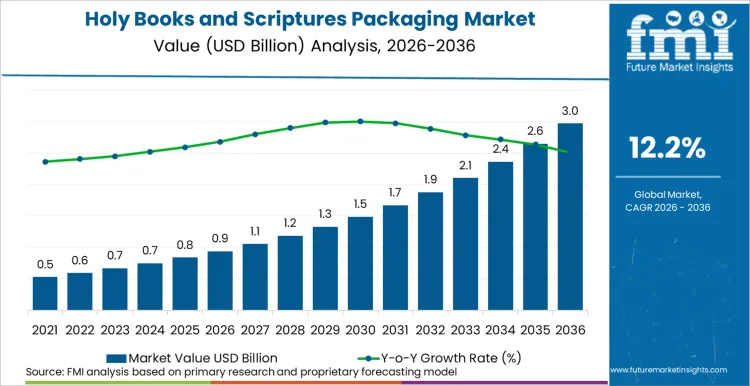
Holy books and scriptures packaging market revenue is projected to total USD 940 million in 2026, increasing to USD 2,980 million by 2036, at a CAGR of 12.2%. FMI analysis indicates the market is undergoing a fundamental shift from generic book covers to specialized systems addressing distinct needs: durable institutional distribution, premium retail presentation, and secure direct-to-consumer shipping. The 2026–2027 period will be defined by large-scale religious education initiatives and scriptural redistribution programs by global faith institutions, coupled with rising consumer demand for collectible and gift editions, driving parallel growth in both high-volume and high-value segments.
Growth is anchored in the non-discretionary and resilient demand within faith-driven economies. The procurement of holy books is often tied to life rituals, educational sacraments, and devotional practice rather than general consumer spending cycles.
TCPL Packaging has continued strengthening its capabilities in cost-optimized, high-volume corrugated and folding carton packaging during 2024–2025, with an emphasis on durability, moisture tolerance, and efficient handling across complex distribution networks. These solutions are suited to large-scale institutional distribution of printed materials and publications across South Asia, where multi-handling, variable storage conditions, and long transport distances place a premium on robust and economical packaging formats.
WestRock Company has continued expanding its premium paperboard and rigid packaging capabilities during 2024–2025, including FSC-certified materials, decorative finishes such as foiling and embossing, and high-fidelity print reproduction. These solutions are widely applied to presentation-grade publishing and gift products in North America, where durability, visual impact, and unboxing experience influence purchasing decisions for special-edition books and keepsake publications.
In Europe, sustainability-driven material innovation remains central. DS Smith has leveraged its circular design expertise to develop high–recycled-content paperboard mailers and cartons optimized for single-item e-commerce shipments. These solutions support damage-free delivery of books and printed materials while aligning with EU packaging sustainability targets, making them suitable for publishers and distributors serving direct-to-consumer channels.
Japanese suppliers continue to emphasize precision, material quality, and refined aesthetics for niche publishing applications. Rengo Co., Ltd. is recognized for producing high-quality paperboard packaging, specialty boxes, and decorative wraps that prioritize craftsmanship and minimalist design. Such formats are commonly used for limited-edition publications and cultural products, where packaging quality contributes to perceived value and collectability.
Summary of Holy Books and Scriptures Packaging Market
- The holy books and scriptures packaging market comprises primary and secondary packaging solutions specifically designed for sacred texts, including Bibles, Qur'ans, Gitas, prayer books, and religious study materials. It encompasses formats that provide physical protection, retail presentation, and ceremonial gifting, such as rigid slipcases, folding cartons, protective mailers, and custom boxes.
- The defined scope follows FMI taxonomy, covering packaging where design and material are tailored to the symbolic value, handling frequency, and distribution channels of religious texts. It excludes general-purpose book covers and non-specialized shipping materials.
- The market is projected to grow at a CAGR of 12.2% from 2026 to 2036, expanding from USD 940 million in 2026 to USD 2,980 million by 2036, based on FMI proprietary modeling incorporating religious demographic trends, institutional procurement cycles, retail sales data for religious books, and primary interviews with religious publishers and packaging converters.
- The sector is transitioning from a unified commodity market to a bifurcated landscape: high-volume, durable packaging for institutional distribution and mass-market prints, and low-volume, high-value packaging for premium gift, collector, and specialty editions.
- Competition is concentrated between regional paperboard packaging giants serving institutional volume and specialty converters focusing on premium design, with differentiation driven by cost efficiency for volume, design authenticity for gifting, and supply chain reliability for global faith networks.
- India records the fastest growth at 15.2% CAGR through 2036, driven by the scale of its religious publishing and institutional distribution, while South Asia is the largest regional market, anchored by India's dominant share and the continuous demand from its vast, observant population.
Holy Books and Scriptures Packaging Market Key Takeaways
| Metrics | Values |
|---|---|
| Expected Value (2026E) | USD 940 million |
| Projected Value (2036F) | USD 2,980 million |
| CAGR (2026–2036) | 12.2% |
Source: Future Market Insights (FMI) analysis, based on proprietary forecasting model and primary research
Why is the Holy Books and Scriptures Packaging Market Growing?
The formalization and global expansion of religious organizations' outreach and educational programs is a primary driver. As these institutions grow, they systematically procure and distribute study materials, scripture portions, and complete holy books on a massive scale. This institutional demand creates a steady, high-volume baseline for durable, functional packaging designed for bulk handling and global logistics.
The convergence of personal spirituality with wellness and mindfulness trends is expanding the consumer market. Holy books are increasingly positioned and purchased as tools for mental well-being and spiritual self-care. This shift attracts new demographics who value aesthetic presentation and quality materials, driving demand for premium packaging in retail and online channels beyond traditional faith-based stores.
The resilience of religious gift-giving traditions for milestones (baptisms, confirmations, weddings, etc.) sustains a premium segment. A holy book is a quintessential gift, and its packaging is integral to the act of presentation, expected to reflect the significance of the occasion and the sanctity of the contents. This cultural practice ensures continuous demand for decorated boxes, slipcases, and gift sets that transcend economic cycles.
How is the Holy Books and Scriptures Packaging Market Segmented?
The primary purchasing channel, the packaging format that best serves the use case, and the dominant substrate material, segments the market. The Religious Institutions end-use segment commands the largest share (46%), representing the volume-driven core of the market for bulk distribution. Slipcases & rigid book boxes lead in format share (38%), favored for their superior protection, shelf presence for retail, and perceived value for gift editions.
How is the Dominance of Premium Paperboard Sustained in Value-Added Packaging?
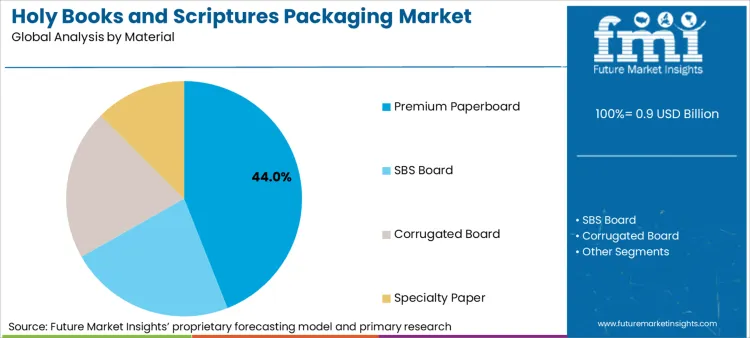
Premium paperboard accounts for a leading 44% material share due to its unmatched suitability for the market's core requirements: superior printability for religious art and gold foil, structural rigidity for protecting heavy texts, and a perceived quality that aligns with the sacred content. It is the definitive material for creating the "heirloom" feel in gift and collector editions. Furthermore, its potential for sustainable sourcing (e.g., FSC certification) aligns with the values-based procurement policies of many religious organizations and the preferences of ethically conscious consumers.
Which Operational Scale and Distribution Logics are Concentrating Value in the Religious Institutions Segment?
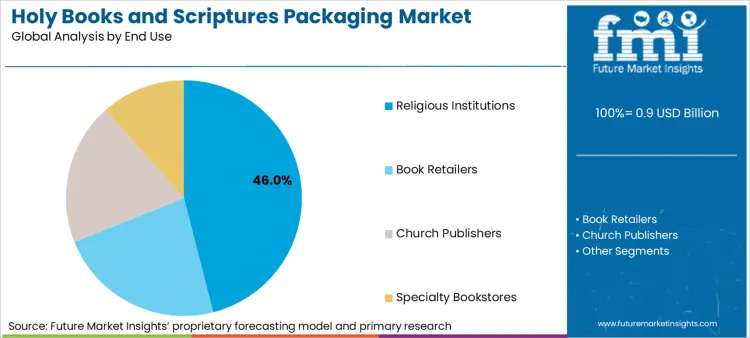
The religious institutions segment holds a 46% share because it operates on a scale that defines market volume. Churches, temples, international ministries, and educational arms purchase scriptures in batches of thousands or millions for missions, Sunday schools, and community programs.
Their procurement prioritizes cost-effectiveness, extreme durability for shipping and storage, and functional design for easy handling by volunteers. Success in this segment requires mastering high-volume production, robust supply chains, and an understanding of the complex logistics within global faith networks.
What Role do Population Demographics and Ritual Embeddedness Play in South Asia's Market Leadership?
South Asia holds a dominant 32% regional share, propelled overwhelmingly by India's market dynamics. This leadership is rooted in the profound ritual embeddedness of scripture in daily and ceremonial life for a population of over 1.4 billion. The constant demand for scriptures for personal worship, temple distribution, and festival gifting creates a massive, consistent market.
India's status as a global hub for cost-competitive printing and packaging manufacturing allows it to serve both its immense domestic demand and supply packaging for religious texts exported worldwide, solidifying its central position in the global value chain.
What Drivers, Restraints, Opportunities, and Trends Prevail in the Market?
Market expansion is supported by the growing integration of ESG (Environmental, Social, and Governance) principles into the values of both religious institutions and consumers. There is rising demand for packaging made from recycled content, sustainably sourced paperboard, and biodegradable materials. Suppliers that can provide certified sustainable options without compromising on protection or aesthetic quality are gaining a significant competitive and ethical advantage.
While demand is robust, a key restraint is the intense cost sensitivity, particularly in high-volume institutional and price-conscious retail segments. The packaging is often viewed as a necessary cost rather than a value-add, leading to fierce margin pressure for suppliers. This can stifle innovation and delay the adoption of more sustainable but initially expensive material alternatives.
Technical innovation is defined by smart packaging integration for educational and engagement purposes. Pioneering publishers are embedding QR codes or NFC tags into packaging that link to supplementary digital content: audio readings, scholarly commentaries, or study guides. This bridges the physical sacred text with digital devotional tools, adding value for the user and creating new data touchpoints for publishers.
The rise of digital printing enabling ultra-short runs and hyper-personalization represents a disruptive opportunity. This allows for the cost-effective production of customized packaging for specific church anniversaries, denominational conferences, or personalized gift inscriptions, opening a high-margin niche within the broader market and serving the desire for unique, meaningful presentation.
Analysis of Holy Books and Scriptures Packaging Market by Key Countries
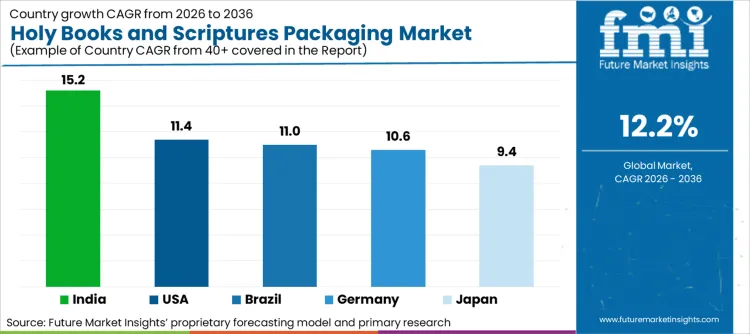
| Country | CAGR (2026–2036) |
|---|---|
| India | 15.2% |
| USA | 11.4% |
| Germany | 10.6% |
| Japan | 9.4% |
| Brazil | 11.0% |
Source: FMI analysis based on primary research and proprietary forecasting model
How is India's Unmatched Scale of Religious Practice and Publishing Driving Growth?
The sheer volume of its religiously engaged population and its corresponding publishing output fuels India’s leading 15.2% CAGR. Daily ritual use, massive temple-based distribution of scriptures, and a growing literate population seeking affordable personal copies drive demand.
The packaging requirement is primarily for durable, cost-optimized folding cartons and corrugated shippers that can withstand India's logistics environment. Growth is less about premiumization and more about scaling efficient, low-cost solutions to serve hundreds of millions of units, making it a volume-led market.
Which Retail Premiumization and Direct-to-Consumer Trends Define the US Market?
USA, growing at an 11.4% CAGR, is characterized by a mature retail landscape and the strength of DTC sales by churches and ministries. In retail, competition demands premium slipcases and gift boxes that enhance perceived value.
For DTC, the focus is on e-commerce rugged protective mailers that ensure pristine condition upon delivery to a member's home. The US market effectively bifurcates: investing in high-margin presentation for retail and in optimized, damage-free logistics for institutional DTC, driving value in both segments.
What Role does Sustainable Regulation and Church Publishing Play in Germany?
Germany’s 10.6% CAGR is shaped by the stringent EU sustainability regulations affecting packaging and the robust ecosystem of church-owned publishers. Packaging suppliers must innovate with high-recycled-content materials and designs that meet end-of-life targets without compromising the protection of often high-quality, heavy texts.
Germany's centralized church publishing houses demand packaging that is both dignified and efficient for their nationwide distribution to congregations, favoring solutions that are environmentally compliant, standardized, and easy to handle.
How are Japan's Artisanal Sensibilities and Niche Collectibles Influencing Packaging?
Japan’s market, growing at a 9.4% CAGR, is defined by artisanal quality and niche collectibility rather than mass volume. Packaging for limited-edition scriptures, prayer books, and spiritual texts emphasizes exquisite craftsmanship-using specialty papers, precise drawer-box construction, and subtle, respectful design. The package is an integral part of the object's value as a sacred artifact or a refined gift. Suppliers compete on precision, material quality, and the ability to produce small batches of exceptionally high-grade packaging.
Which Pentecostal Growth and Community-Based Distribution Shape Brazil's Market?
Brazil’s market expansion at an 11.0% CAGR is closely tied to the dynamic growth of Pentecostal and Evangelical communities. These fast-growing groups are highly active in scripture distribution and often utilize community-based sales models. Packaging must be eye-catching to attract new adherents in competitive religious marketplaces, durable for distribution in varied climates, and cost-effective to support the volume goals of outreach campaigns. This creates demand for vibrantly designed yet robust folding cartons that serve both evangelical and commercial purposes.
What is the Competition Outlook for Holy Books and Scriptures Packaging?
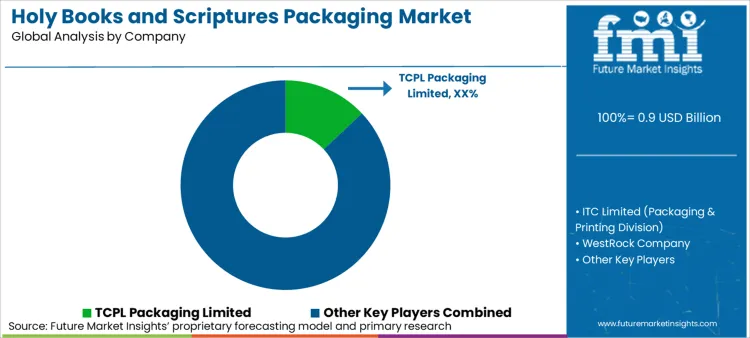
Competitive intensity is increasing as large, integrated paperboard companies apply their scale to the stable institutional segment, while smaller specialists compete on design expertise and customization for the premium gift segment. The key differentiator is becoming "cultural competency"—the ability to design packaging that is aesthetically and symbolically appropriate for diverse faith traditions without causing offense, requiring in-depth knowledge of religious iconography and sensibilities.
The observable strategic direction is vertical integration into the religious products value chain. Leading packaging suppliers are not just selling boxes but offering value-added services like kitting (assembling books with bookmarks, study guides), warehousing, and fulfillment for religious publishers and institutions. This transforms them from component suppliers to essential logistics partners, locking in long-term contracts.
Strategic leadership is pivoting towards circular economy models aligned with faith-based values of stewardship. Forward-thinking suppliers are developing take-back programs for used gift boxes or offering packaging-as-a-service for recurring church distribution events. This approach reduces waste, creates recurring revenue streams, and resonates deeply with the environmental ethics of many religious organizations and consumers.
Key Players Profiled
- TCPL Packaging Limited
- ITC Limited (Packaging & Printing Division)
- WestRock Company
- Graphic Packaging International, LLC
- DS Smith Plc
- Smurfit Kappa Group plc
- Rengo Co., Ltd.
- Toppan Printing Co., Ltd.
- Klabin S.A.
- Mayr-Melnhof Karton AG
Market Definition
The holy books and scriptures packaging market comprises the design, manufacture, and sale of packaging solutions specifically for bound sacred texts and religious literature. This includes primary packaging that houses and presents the book (e.g., slipcases, rigid boxes, folding cartons) and secondary packaging for distribution and protection (e.g., corrugated shippers, protective mailers). The core function is to preserve the physical integrity of the text, convey reverence through design, and facilitate its distribution through retail or institutional channels.
The market scope covers packaging where design elements (materials, structure, graphics) are specifically adapted for religious books. It excludes generic book jackets, unbranded shrink wrap, and non-specialized shipping boxes used for a wide variety of products.
Scope of Report
| Items | Values |
|---|---|
| Quantitative Units | USD 940 million |
| End Use | Religious Institutions, Book Retailers, Church Publishers, Specialty Bookstores, Others |
| Packaging Format | Slipcases & Rigid Book Boxes, Folding Cartons, Protective Mailers, Drawer Boxes, Others |
| Material | Premium Paperboard, SBS Board, Corrugated Board, Specialty Paper, Others |
| Regions Covered | South Asia, North America, Europe, Japan, Latin America, Middle East & Africa |
| Countries | India, USA, Germany, Japan, Brazil and 40+ countries |
| Key Companies | TCPL Packaging, ITC Packaging, WestRock, Graphic Packaging, DS Smith, Smurfit Kappa, Rengo, Toppan, Klabin, Mayr-Melnhof |
Source: Future Market Insights (FMI) analysis, based on proprietary forecasting model and primary research
Holy Books and Scriptures Packaging Market Key Segments
By End Use
- Religious Institutions
- Book Retailers
- Church Publishers
- Specialty Bookstores
- Others
By Packaging Format
- Slipcases & Rigid Book Boxes
- Folding Cartons
- Protective Mailers
- Drawer Boxes
- Others
By Material
- Premium Paperboard
- SBS Board
- Corrugated Board
- Specialty Paper
- Others
By Region
- South Asia
- North America
- Europe
- Japan
- Latin America
- Middle East & Africa
Bibliography
- International Publishers Association (IPA). (2025). Global Religious Publishing and Distribution Trends. IPA.
- Confederation of European Paper Industries (CEPI). (2025). Paper-Based Packaging for Books, Cultural Publications, and Heritage Products. CEPI.
- Indian Institute of Packaging (IIP). (2025). Packaging Requirements for Printed Materials and Religious Publications in India. IIP.
- Japan Packaging Institute (JPI). (2025). High-Value Book and Cultural Product Packaging Design in Japan. JPI.
- UN World Tourism Organization (UNWTO). (2026). Pilgrimage Economies, Religious Distribution, and Associated Goods Logistics. UNWTO.
-
Frequently Asked Questions
- What is the expected value of the holy books and scriptures packaging market in 2026?
- The market is expected to reach USD 940 million in 2026, driven by steady institutional procurement, resilient gift-giving traditions, and the expansion of global religious distribution networks.
- What is the projected value by 2036 and CAGR from 2026 to 2036?
- By 2036, the market is projected to reach USD 2,980 million, expanding at a CAGR of 12.2% between 2026 and 2036.
- What is the primary driver for the religious institutions segment?
- The primary driver is the operational scale of global religious organizations, which purchase and distribute scriptures in massive volumes for education, outreach, and community support, creating a consistent, high-demand channel for durable, functional packaging.
- Which packaging format is most associated with premium and gift editions?
- Slipcases & rigid book boxes hold a leading 38% share in this segment because they provide superior physical protection, create a substantial and dignified shelf presence, and fundamentally enhance the perceived value and heirloom quality of a holy book, making them the preferred choice for gift and premium editions.
- Why does South Asia hold the largest regional market share?
- South Asia commands a 32% share primarily due to India's unmatched combination of a vast, religiously observant population, deeply embedded scriptural practices in daily and ceremonial life, and its role as a global hub for cost-effective religious publishing and packaging manufacturing. This creates the world's largest volume market for holy book packaging.
Frequently Asked Questions
How big is the holy books and scriptures packaging market in 2026?
The global holy books and scriptures packaging market is estimated to be valued at USD 0.9 billion in 2026.
What will be the size of holy books and scriptures packaging market in 2036?
The market size for the holy books and scriptures packaging market is projected to reach USD 3.0 billion by 2036.
How much will be the holy books and scriptures packaging market growth between 2026 and 2036?
The holy books and scriptures packaging market is expected to grow at a 12.2% CAGR between 2026 and 2036.
What are the key product types in the holy books and scriptures packaging market?
The key product types in holy books and scriptures packaging market are premium paperboard, sbs board, corrugated board and specialty paper.
Which end use segment to contribute significant share in the holy books and scriptures packaging market in 2026?
In terms of end use, religious institutions segment to command 46.0% share in the holy books and scriptures packaging market in 2026.
Preview the report firsthand - request a free sample
Get SampleGet the brochure for pricing and purchase details.
Get PDFTable of Content
- Executive Summary
- Global Market Outlook
- Demand-side Trends
- Supply-side Trends
- Technology Roadmap Analysis
- Analysis and Recommendations
- Market Overview
- Market Coverage / Taxonomy
- Market Definition / Scope / Limitations
- Research Methodology
- Chapter Orientation
- Analytical Lens and Working Hypotheses
- Market Structure, Signals, and Trend Drivers
- Benchmarking and Cross-market Comparability
- Market Sizing, Forecasting, and Opportunity Mapping
- Research Design and Evidence Framework
- Desk Research Programme (Secondary Evidence)
- Company Annual and Sustainability Reports
- Peer-reviewed Journals and Academic Literature
- Corporate Websites, Product Literature, and Technical Notes
- Earnings Decks and Investor Briefings
- Statutory Filings and Regulatory Disclosures
- Technical White Papers and Standards Notes
- Trade Journals, Industry Magazines, and Analyst Briefs
- Conference Proceedings, Webinars, and Seminar Materials
- Government Statistics Portals and Public Data Releases
- Press Releases and Reputable Media Coverage
- Specialist Newsletters and Curated Briefings
- Sector Databases and Reference Repositories
- FMI Internal Proprietary Databases and Historical Market Datasets
- Subscription Datasets and Paid Sources
- Social Channels, Communities, and Digital Listening Inputs
- Additional Desk Sources
- Expert Input and Fieldwork (Primary Evidence)
- Primary Modes
- Qualitative Interviews and Expert Elicitation
- Quantitative Surveys and Structured Data Capture
- Blended Approach
- Why Primary Evidence is Used
- Field Techniques
- Interviews
- Surveys
- Focus Groups
- Observational and In-context Research
- Social and Community Interactions
- Stakeholder Universe Engaged
- C-suite Leaders
- Board Members
- Presidents and Vice Presidents
- R&D and Innovation Heads
- Technical Specialists
- Domain Subject-matter Experts
- Scientists
- Physicians and Other Healthcare Professionals
- Governance, Ethics, and Data Stewardship
- Research Ethics
- Data Integrity and Handling
- Primary Modes
- Tooling, Models, and Reference Databases
- Desk Research Programme (Secondary Evidence)
- Data Engineering and Model Build
- Data Acquisition and Ingestion
- Cleaning, Normalisation, and Verification
- Synthesis, Triangulation, and Analysis
- Quality Assurance and Audit Trail
- Market Background
- Market Dynamics
- Drivers
- Restraints
- Opportunity
- Trends
- Scenario Forecast
- Demand in Optimistic Scenario
- Demand in Likely Scenario
- Demand in Conservative Scenario
- Opportunity Map Analysis
- Product Life Cycle Analysis
- Supply Chain Analysis
- Investment Feasibility Matrix
- Value Chain Analysis
- PESTLE and Porter’s Analysis
- Regulatory Landscape
- Regional Parent Market Outlook
- Production and Consumption Statistics
- Import and Export Statistics
- Market Dynamics
- Global Market Analysis 2021 to 2025 and Forecast, 2026 to 2036
- Historical Market Size Value (USD Million) Analysis, 2021 to 2025
- Current and Future Market Size Value (USD Million) Projections, 2026 to 2036
- Y-o-Y Growth Trend Analysis
- Absolute $ Opportunity Analysis
- Global Market Pricing Analysis 2021 to 2025 and Forecast 2026 to 2036
- Global Market Analysis 2021 to 2025 and Forecast 2026 to 2036, By Material
- Introduction / Key Findings
- Historical Market Size Value (USD Million) Analysis By Material , 2021 to 2025
- Current and Future Market Size Value (USD Million) Analysis and Forecast By Material , 2026 to 2036
- Premium Paperboard
- SBS Board
- Corrugated Board
- Specialty Paper
- Premium Paperboard
- Y-o-Y Growth Trend Analysis By Material , 2021 to 2025
- Absolute $ Opportunity Analysis By Material , 2026 to 2036
- Global Market Analysis 2021 to 2025 and Forecast 2026 to 2036, By End Use
- Introduction / Key Findings
- Historical Market Size Value (USD Million) Analysis By End Use, 2021 to 2025
- Current and Future Market Size Value (USD Million) Analysis and Forecast By End Use, 2026 to 2036
- Religious Institutions
- Book Retailers
- Church Publishers
- Specialty Bookstores
- Religious Institutions
- Y-o-Y Growth Trend Analysis By End Use, 2021 to 2025
- Absolute $ Opportunity Analysis By End Use, 2026 to 2036
- Global Market Analysis 2021 to 2025 and Forecast 2026 to 2036, By Region
- Introduction
- Historical Market Size Value (USD Million) Analysis By Region, 2021 to 2025
- Current Market Size Value (USD Million) Analysis and Forecast By Region, 2026 to 2036
- North America
- Latin America
- Western Europe
- Eastern Europe
- East Asia
- South Asia and Pacific
- Middle East & Africa
- Market Attractiveness Analysis By Region
- North America Market Analysis 2021 to 2025 and Forecast 2026 to 2036, By Country
- Historical Market Size Value (USD Million) Trend Analysis By Market Taxonomy, 2021 to 2025
- Market Size Value (USD Million) Forecast By Market Taxonomy, 2026 to 2036
- By Country
- USA
- Canada
- Mexico
- By Material
- By End Use
- By Country
- Market Attractiveness Analysis
- By Country
- By Material
- By End Use
- Key Takeaways
- Latin America Market Analysis 2021 to 2025 and Forecast 2026 to 2036, By Country
- Historical Market Size Value (USD Million) Trend Analysis By Market Taxonomy, 2021 to 2025
- Market Size Value (USD Million) Forecast By Market Taxonomy, 2026 to 2036
- By Country
- Brazil
- Chile
- Rest of Latin America
- By Material
- By End Use
- By Country
- Market Attractiveness Analysis
- By Country
- By Material
- By End Use
- Key Takeaways
- Western Europe Market Analysis 2021 to 2025 and Forecast 2026 to 2036, By Country
- Historical Market Size Value (USD Million) Trend Analysis By Market Taxonomy, 2021 to 2025
- Market Size Value (USD Million) Forecast By Market Taxonomy, 2026 to 2036
- By Country
- Germany
- UK
- Italy
- Spain
- France
- Nordic
- BENELUX
- Rest of Western Europe
- By Material
- By End Use
- By Country
- Market Attractiveness Analysis
- By Country
- By Material
- By End Use
- Key Takeaways
- Eastern Europe Market Analysis 2021 to 2025 and Forecast 2026 to 2036, By Country
- Historical Market Size Value (USD Million) Trend Analysis By Market Taxonomy, 2021 to 2025
- Market Size Value (USD Million) Forecast By Market Taxonomy, 2026 to 2036
- By Country
- Russia
- Poland
- Hungary
- Balkan & Baltic
- Rest of Eastern Europe
- By Material
- By End Use
- By Country
- Market Attractiveness Analysis
- By Country
- By Material
- By End Use
- Key Takeaways
- East Asia Market Analysis 2021 to 2025 and Forecast 2026 to 2036, By Country
- Historical Market Size Value (USD Million) Trend Analysis By Market Taxonomy, 2021 to 2025
- Market Size Value (USD Million) Forecast By Market Taxonomy, 2026 to 2036
- By Country
- China
- Japan
- South Korea
- By Material
- By End Use
- By Country
- Market Attractiveness Analysis
- By Country
- By Material
- By End Use
- Key Takeaways
- South Asia and Pacific Market Analysis 2021 to 2025 and Forecast 2026 to 2036, By Country
- Historical Market Size Value (USD Million) Trend Analysis By Market Taxonomy, 2021 to 2025
- Market Size Value (USD Million) Forecast By Market Taxonomy, 2026 to 2036
- By Country
- India
- ASEAN
- Australia & New Zealand
- Rest of South Asia and Pacific
- By Material
- By End Use
- By Country
- Market Attractiveness Analysis
- By Country
- By Material
- By End Use
- Key Takeaways
- Middle East & Africa Market Analysis 2021 to 2025 and Forecast 2026 to 2036, By Country
- Historical Market Size Value (USD Million) Trend Analysis By Market Taxonomy, 2021 to 2025
- Market Size Value (USD Million) Forecast By Market Taxonomy, 2026 to 2036
- By Country
- Kingdom of Saudi Arabia
- Other GCC Countries
- Turkiye
- South Africa
- Other African Union
- Rest of Middle East & Africa
- By Material
- By End Use
- By Country
- Market Attractiveness Analysis
- By Country
- By Material
- By End Use
- Key Takeaways
- Key Countries Market Analysis
- USA
- Pricing Analysis
- Market Share Analysis, 2025
- By Material
- By End Use
- Canada
- Pricing Analysis
- Market Share Analysis, 2025
- By Material
- By End Use
- Mexico
- Pricing Analysis
- Market Share Analysis, 2025
- By Material
- By End Use
- Brazil
- Pricing Analysis
- Market Share Analysis, 2025
- By Material
- By End Use
- Chile
- Pricing Analysis
- Market Share Analysis, 2025
- By Material
- By End Use
- Germany
- Pricing Analysis
- Market Share Analysis, 2025
- By Material
- By End Use
- UK
- Pricing Analysis
- Market Share Analysis, 2025
- By Material
- By End Use
- Italy
- Pricing Analysis
- Market Share Analysis, 2025
- By Material
- By End Use
- Spain
- Pricing Analysis
- Market Share Analysis, 2025
- By Material
- By End Use
- France
- Pricing Analysis
- Market Share Analysis, 2025
- By Material
- By End Use
- India
- Pricing Analysis
- Market Share Analysis, 2025
- By Material
- By End Use
- ASEAN
- Pricing Analysis
- Market Share Analysis, 2025
- By Material
- By End Use
- Australia & New Zealand
- Pricing Analysis
- Market Share Analysis, 2025
- By Material
- By End Use
- China
- Pricing Analysis
- Market Share Analysis, 2025
- By Material
- By End Use
- Japan
- Pricing Analysis
- Market Share Analysis, 2025
- By Material
- By End Use
- South Korea
- Pricing Analysis
- Market Share Analysis, 2025
- By Material
- By End Use
- Russia
- Pricing Analysis
- Market Share Analysis, 2025
- By Material
- By End Use
- Poland
- Pricing Analysis
- Market Share Analysis, 2025
- By Material
- By End Use
- Hungary
- Pricing Analysis
- Market Share Analysis, 2025
- By Material
- By End Use
- Kingdom of Saudi Arabia
- Pricing Analysis
- Market Share Analysis, 2025
- By Material
- By End Use
- Turkiye
- Pricing Analysis
- Market Share Analysis, 2025
- By Material
- By End Use
- South Africa
- Pricing Analysis
- Market Share Analysis, 2025
- By Material
- By End Use
- USA
- Market Structure Analysis
- Competition Dashboard
- Competition Benchmarking
- Market Share Analysis of Top Players
- By Regional
- By Material
- By End Use
- Competition Analysis
- Competition Deep Dive
- TCPL Packaging Limited
- Overview
- Product Portfolio
- Profitability by Market Segments (Product/Age /Sales Channel/Region)
- Sales Footprint
- Strategy Overview
- Marketing Strategy
- Product Strategy
- Channel Strategy
- ITC Limited (Packaging & Printing Division)
- WestRock Company
- Graphic Packaging International, LLC
- DS Smith Plc
- Smurfit Kappa Group plc
- Rengo Co., Ltd.
- Toppan Printing Co., Ltd.
- TCPL Packaging Limited
- Competition Deep Dive
- Assumptions & Acronyms Used


