

- Industry Size (2026)
- USD 210.0 Mn
- Forecast (2036)
- USD 688.0 Mn
- CAGR (2026 to 2036)
- 12.6%
Horticulture Quantum Sensors Market Forecast and Outlook 2026 to 2036
The horticulture quantum sensors market is likely to be valued at USD 210.0 million in 2026 and is forecasted to reach USD 688.0 million by 2036 at a CAGR of 12.6%. Value behavior reflects dependence on measurement accuracy as a production control input rather than optional monitoring equipment. Sensor deployment is tied to light optimization economics, where photon efficiency, energy cost, and crop uniformity intersect. Capital allocation favors calibrated PPFD measurement to manage LED investment intensity and electricity exposure. Adoption persists where yield variance, light non-uniformity, and energy inefficiency impose direct operating penalties on growers. Replacement cycles align with calibration drift, system upgrades, and expansion of controlled cultivation area rather than routine wear.
Demand scaling remains constrained by calibration cost, integration complexity, and environmental exposure. Optical stability under humidity, dust, and chemical aerosols affects usable lifespan and recalibration frequency. Installation density increases expenditure in multi-layer vertical farms, limiting indiscriminate sensor proliferation. Data utility depends on compatibility with climate computers and lighting controllers, creating dependency on interoperable control architecture. Lower-cost sensors face resistance where spectral mismatch or cosine error distorts decision inputs. Procurement prioritizes reliability and traceability over unit price, anchoring value growth to expansion of precision-controlled cultivation capacity rather than sensor commoditization.
Quick Stats for Horticulture Quantum Sensors Market
- Horticulture Quantum Sensors Market Value (2026): USD 210.0 million
- Horticulture Quantum Sensors Market Forecast Value (2036): USD 688.0 million
- Horticulture Quantum Sensors Market Forecast CAGR 2026 to 2036: 12.6%
- Leading Sensor Product Type by Demand Share: Quantum PAR or PPFD Sensors
- Fastest-Growing Countries: India, China, UAE, Saudi Arabia, Singapore
- Top Players in Global Demand: Apogee Instruments, LI-COR Biosciences, METER Group, Skye Instruments, Delta-T Devices, Spectrum Technologies, Aranet (SAF Tehnika), Onset (HOBO), Priva, Ridder (Hortimax)
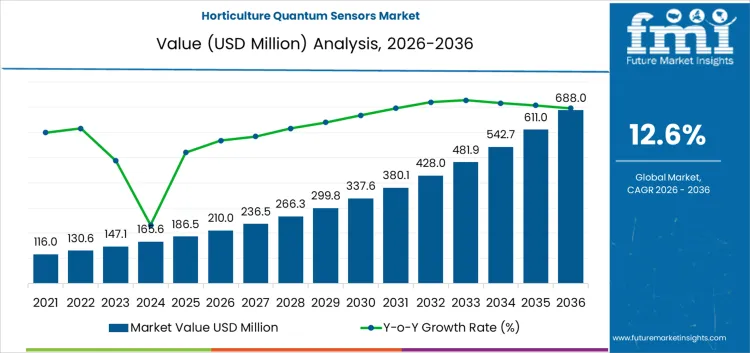
Horticulture Quantum Sensors Market Key Takeaways
| Metric | Value |
|---|---|
| Market Value (2026) | USD 210.0 million |
| Market Forecast Value (2036) | USD 688.0 million |
| Forecast CAGR 2026 to 2036 | 12.6% |
Why is the Demand for Horticulture Quantum Sensors Growing?
Demand for horticulture quantum sensors is increasing as controlled environment agriculture and greenhouse operators require precise measurement of photosynthetically active radiation (PAR) to optimize plant growth and energy efficiency. Quantum sensors quantify light intensity in the wavelengths that plants use for photosynthesis, and growers specify these instruments to inform decisions about supplemental lighting, crop density, and photoperiod scheduling. Agronomists and horticultural engineers assess sensor accuracy, spectral response uniformity, and calibration stability because reliable PAR data directly influences decisions that affect biomass accumulation, flowering initiation, and crop quality. Procurement teams evaluate sensor robustness, environmental sealing, and integration capability with climate control and lighting management systems because indoor farms and greenhouses demand continuous performance under temperature and humidity fluctuations. As precision horticulture adopts data driven cultivation practices, growers increasingly rely on quantum sensors to reduce input waste and support repeatable production outcomes across crop cycles.
Growth in vertical farming, high value specialty crops, and investment in LED lighting technologies reinforces uptake of quantum sensors that support dynamic adjustment of light spectra and intensity for different growth stages. Facilities with automated control systems integrate quantum sensors with lighting controllers and environmental monitors to maintain target photosynthetic conditions and energy efficient operation. Research institutions and commercial breeders also deploy quantum sensors as part of experimental setups to correlate light profiles with plant physiology responses. These market specific cultivation requirements and technology integration priorities are contributing to sustained demand for horticulture quantum sensors.
How Are the Segments Classified in the Horticulture Quantum Sensors Market?
Demand for horticulture quantum sensors is shaped by precise light measurement requirements, crop productivity optimization, and controlled environment agriculture practices. Growers and researchers rely on accurate photosynthetically active radiation measurement to manage lighting strategies and plant response. Adoption aligns with expansion of greenhouses, vertical farming, and data-driven cultivation methods. Sensor selection prioritizes measurement accuracy, stability over time, and integration with control systems. Segment classification reflects differentiation by sensor product design, cultivation end use, and installation approach influencing monitoring resolution, operational workflow, and deployment density.
Which Sensor Product Type Represents the Largest Share of Demand?
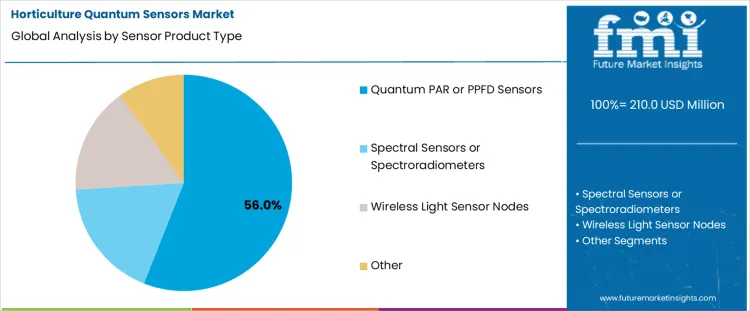
Quantum PAR or PPFD sensors hold 56.0%, representing the largest share among sensor product types due to direct relevance to plant photosynthesis. These sensors measure light within the photosynthetically active spectrum, enabling growers to quantify usable light intensity. Reliable PPFD data supports lighting adjustment, energy optimization, and yield consistency. Simplicity of interpretation supports routine operational use. Spectral sensors provide wavelength-specific analysis for advanced research applications. Wireless light sensor nodes support distributed monitoring with added system complexity. Sensor product segmentation reflects preference for core measurement tools delivering actionable data for everyday cultivation decisions.
Key Points
- PPFD sensors directly quantify photosynthetically active light.
- Data supports lighting optimization and yield consistency.
- Other sensors address advanced spectral or distributed monitoring needs.
Which End Use Accounts for the Highest Share of Demand?
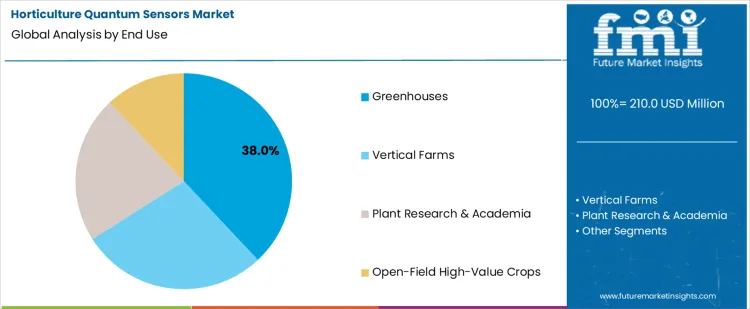
Greenhouses hold 38.0%, representing the largest share among end-use settings due to widespread adoption of supplemental lighting. Controlled structures require continuous monitoring to balance natural and artificial light exposure. Quantum sensors support uniform crop development across large growing areas. Integration with climate and lighting systems enhances operational control. Vertical farms apply sensors for fully artificial lighting environments with higher precision needs. Research institutions use sensors for experimental accuracy. Open-field applications focus on high-value crops with selective deployment. End-use segmentation reflects concentration where controlled light management directly influences productivity.
Key Points
- Greenhouses rely on balanced natural and artificial lighting.
- Continuous monitoring supports uniform crop growth.
- Other end uses apply sensors for precision or research needs.
Which Installation Mode Drives the Largest Share of Demand?
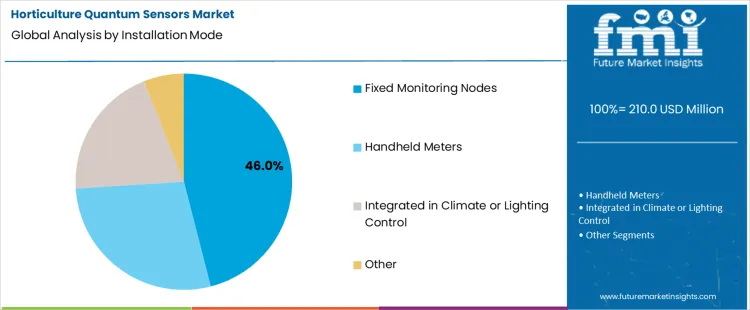
Fixed monitoring nodes hold 46.0%, representing the largest share among installation modes due to continuous data collection capability. Permanently installed sensors provide consistent light measurements over time and across growth cycles. Fixed placement supports trend analysis and automated control feedback. Installation stability reduces calibration drift caused by handling. Handheld meters support spot checks and calibration verification. Integration within climate or lighting control systems enables closed-loop automation with lower deployment density. Installation mode segmentation reflects preference for stable, always-on monitoring supporting data-driven cultivation management.
Key Points
- Fixed nodes enable continuous and comparable light data.
- Stable placement improves measurement consistency.
- Other modes support spot measurement or integrated automation.
What are the Key Dynamics in the Horticulture Quantum Sensors Market?
Demand for horticulture quantum sensors reflects measurement requirements for photosynthetically active radiation in controlled and open-field cultivation. Adoption concentrates in greenhouses, vertical farms, research stations, and high-value crop operations. Global scope aligns with precision agriculture practices and light optimization needs. Usage centers on sensors measuring photon flux density to support lighting control, crop monitoring, and yield consistency across artificial and natural light environments.
How do light optimization and crop productivity requirements shape adoption?
Plant growth depends on accurate quantification of usable light within the 400 to 700 nanometer range. Demand increases as growers rely on supplemental LED lighting and need precise feedback to avoid underexposure or photoinhibition. Quantum sensors provide real-time PAR data enabling adjustment of light intensity, photoperiod, and fixture placement. Vertical farms depend on dense sensor deployment to manage stacked growing layers with uneven light distribution. Greenhouses use sensors to balance sunlight and artificial lighting for energy efficiency. Research institutions rely on calibrated sensors to compare cultivars and lighting recipes. Integration with climate control systems supports automated decision-making. Adoption reflects operational need for measurable light input tied directly to plant physiology.
How do calibration accuracy, environmental exposure, and cost constraints influence market scalability?
Sensor accuracy depends on cosine response, spectral correction, and long-term calibration stability. Demand sensitivity rises where drift affects crop decisions and yield outcomes. Exposure to humidity, dust, and chemical aerosols affects sensor lifespan in production environments. Calibration and verification add operating cost for commercial growers. Lower-cost sensors show variability across light spectra, limiting acceptance in precision applications. Installation density increases capital expenditure in large facilities. Data integration requires compatible control platforms. Supply chain dependence on optical components and calibration services constrains scalable deployment across cost-sensitive horticulture operations.
How Is Demand for Horticulture Quantum Sensors Evolving Globally?
Demand for horticulture quantum sensors is expanding globally due to precision light measurement requirements in controlled environment agriculture. Growers require accurate PPFD and PAR data to optimize photosynthesis, crop uniformity, and energy efficiency under artificial lighting. Adoption aligns with greenhouses, vertical farms, and research facilities integrating LED systems and climate control. Data-driven cultivation increases reliance on calibrated sensing for yield consistency. Growth rates in India at 14.6%, China at 13.8%, UAE at 12.0%, Saudi Arabia at 11.6%, and Singapore at 10.9% indicate strong expansion driven by protected cultivation scale-up, lighting optimization, and productivity-focused horticulture systems.
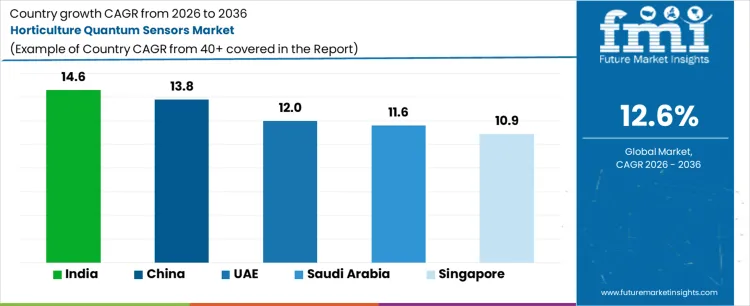
| Country | CAGR (%) |
|---|---|
| India | 14.6% |
| China | 13.8% |
| UAE | 12.0% |
| Saudi Arabia | 11.6% |
| Singapore | 10.9% |
What Is Driving Rapid Growth of Horticulture Quantum Sensor Demand in India?
Horticulture quantum sensor demand in India is growing at a CAGR of 14.6%, supported by rapid expansion of protected cultivation and vertical farming. Commercial growers deploy sensors to optimize LED lighting intensity for leafy greens and herbs. Variable solar radiation across regions increases need for real-time light measurement. Agri-tech startups integrate sensors with climate control platforms to improve yield predictability. Research institutions expand controlled trials requiring calibrated light data. Demand growth reflects precision horticulture adoption and energy efficiency priorities rather than experimental or academic-only usage.
- Expansion of vertical farms and protected cultivation
- LED lighting optimization for high-value crops
- Regional variability in natural light conditions
- Integration with agri-tech climate platforms
Why Is China Sustaining Elevated Demand for Horticulture Quantum Sensors?
China is expanding at a CAGR of 13.8%, driven by large-scale greenhouse deployment and lighting standardization. Intensive vegetable and seedling production requires accurate PPFD control under LED arrays. Government-backed modernization programs emphasize data-driven agriculture. Domestic manufacturers supply sensors compatible with integrated control systems. Research stations and commercial farms adopt networked sensing for yield optimization. Demand growth reflects scale-driven protected agriculture and lighting efficiency management rather than small-scale urban farming initiatives.
- Large greenhouse clusters requiring light standardization
- LED-driven vegetable and seedling production
- Policy-supported modernization of horticulture systems
- Availability of domestically produced sensor solutions
How Is the UAE Shaping Demand for Horticulture Quantum Sensors?
Horticulture quantum sensor demand in United Arab Emirates is growing at a CAGR of 12.0%, influenced by climate-controlled farming and water-energy efficiency goals. Extreme sunlight variability and indoor cultivation necessitate precise light measurement. Vertical farms and high-tech greenhouses deploy sensors to balance artificial and natural light inputs. Energy optimization under high cooling loads increases reliance on accurate PPFD data. Demand growth reflects climate adaptation strategies and technology-intensive food production rather than expansion of traditional open-field horticulture.
- Climate-controlled farming under extreme conditions
- Balancing artificial and natural light inputs
- Energy efficiency optimization in indoor farms
- High-tech greenhouse and vertical farm deployment
What Factors Are Supporting Horticulture Quantum Sensor Demand in Saudi Arabia?
Saudi Arabia is expanding at a CAGR of 11.6%, supported by food security initiatives and protected agriculture investment. Greenhouse projects rely on sensors to manage light exposure for water-efficient crop production. High solar intensity requires monitoring to prevent plant stress. Integration with automated climate systems supports consistent crop cycles. Public and private investment sustains procurement across regions. Demand growth reflects controlled agriculture expansion and resource efficiency mandates rather than seasonal horticulture practices.
- Food security-driven protected agriculture projects
- Monitoring of high solar intensity conditions
- Integration with automated greenhouse controls
- Water and energy efficiency requirements
Why Is Singapore Showing Consistent Growth in Horticulture Quantum Sensor Demand?
Horticulture quantum sensor demand in Singapore is growing at a CAGR of 10.9%, driven by urban farming density and technology-led cultivation. Limited land availability accelerates vertical farming adoption. Operators require precise PPFD measurement to maximize yield per square meter. Regulatory focus on local food production supports controlled environment systems. Continuous optimization of lighting recipes sustains replacement and upgrade demand. Growth reflects urban agriculture intensity and data-driven operations rather than expansion of greenhouse acreage.
- High-density urban vertical farming systems
- Yield maximization per unit growing area
- Regulatory support for local food production
- Continuous lighting optimization and upgrades
What is the competitive landscape of demand for the horticulture quantum sensors market globally?
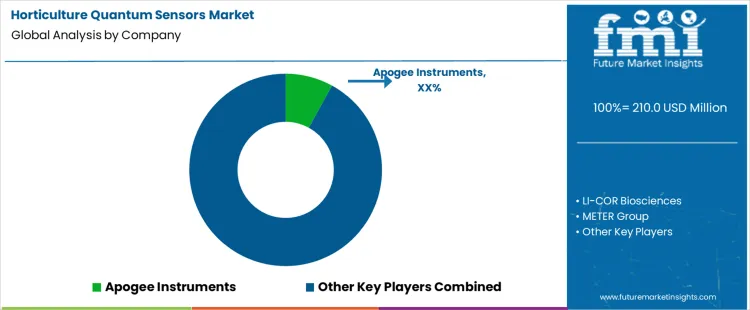
Demand for horticulture quantum sensors is driven by the expansion of controlled-environment agriculture, greenhouse automation, and precision lighting management to optimize photosynthetically active radiation (PAR) for crop yield and quality. Buyers evaluate sensor accuracy, spectral response, calibration stability, measurement range, integration compatibility with climate control systems, and data logging capabilities. Procurement teams prioritize suppliers with validated accuracy, global support networks, compliance with horticultural standards, and ability to integrate sensors with environmental controllers, lighting systems, and data analytics platforms. Trend in the global market reflects increased adoption of LED lighting, data-driven cultivation strategies, and demand for reliable light measurement to support energy efficiency and crop performance optimization.
Apogee Instruments holds leading positioning through high-precision quantum sensors and PAR measurement solutions widely adopted across greenhouse, vertical farm, and research settings with strong technical support. LI-COR Biosciences supports demand with calibrated quantum and PAR sensors integrated into environmental monitoring networks used by growers and researchers. METER Group contributes robust horticulture sensors and data logging equipment with emphasis on long-term stability and integration flexibility.
Skye Instruments participates with spectral and quantum sensor technologies tailored for crop light analysis and lighting optimization. Delta-T Devices supplies environmental sensors including PAR measurement solutions suited for controlled-environment agriculture and research applications. Competitive differentiation depends on measurement accuracy, spectral fidelity, calibration traceability, integration ease with climate systems, and ability to support growers’ precision cultivation needs.
Key Players in the Horticulture Quantum Sensors Market
- Apogee Instruments
- LI-COR Biosciences
- METER Group
- Skye Instruments
- Delta-T Devices
- Spectrum Technologies
- Aranet (SAF Tehnika)
- Onset (HOBO)
- Priva
- Ridder (Hortimax)
Scope of the Report
| Items | Values |
|---|---|
| Quantitative Units | USD million |
| Sensor Product Type | Quantum PAR or PPFD Sensors; Spectral Sensors or Spectroradiometers; Wireless Light Sensor Nodes; Other |
| End Use | Greenhouses; Vertical Farms; Plant Research & Academia; Open-Field High-Value Crops |
| Installation Mode | Fixed Monitoring Nodes; Handheld Meters; Integrated in Climate or Lighting Control; Other |
| Sales Channel | Direct Manufacturer Sales; Distributors or Resellers; OEM Integration; E-commerce |
| Regions Covered | Asia Pacific, Europe, North America, Latin America, Middle East & Africa |
| Countries Covered | India, China, UAE, Saudi Arabia, Singapore, and 40+ countries |
| Key Companies Profiled | Apogee Instruments; LI-COR Biosciences; METER Group; Skye Instruments; Delta-T Devices; Spectrum Technologies; Aranet (SAF Tehnika); Onset; Priva; Ridder |
| Additional Attributes | Dollar sales by sensor product type, end use, installation mode, and sales channel; measurement accuracy and cosine response performance for PAR and PPFD sensing; spectral resolution and calibration stability for spectroradiometers used in LED tuning; wireless node reliability, battery life, and network latency in greenhouse and vertical farm deployments; interoperability with climate computers and lighting controllers; ruggedization and ingress protection for open-field applications; procurement patterns balancing direct OEM integration with distributor-led sales for research and retrofit use cases. |
Horticulture Quantum Sensors Market by Segment
Sensor Product Type:
- Quantum PAR or PPFD Sensors
- Spectral Sensors or Spectroradiometers
- Wireless Light Sensor Nodes
- Other
End Use:
- Greenhouses
- Vertical Farms
- Plant Research & Academia
- Open-Field High-Value Crops
Installation Mode:
- Fixed Monitoring Nodes
- Handheld Meters
- Integrated in Climate or Lighting Control
- Other
Sales Channel:
- Direct Manufacturer Sales
- Distributors or Resellers
- OEM Integration
- E-commerce
Region:
- Asia Pacific
- China
- Japan
- South Korea
- India
- Australia & New Zealand
- ASEAN
- Rest of Asia Pacific
- Europe
- Germany
- United Kingdom
- France
- Italy
- Spain
- Nordic
- BENELUX
- Rest of Europe
- North America
- United States
- Canada
- Mexico
- Latin America
- Brazil
- Chile
- Rest of Latin America
- Middle East & Africa
- Kingdom of Saudi Arabia
- Other GCC Countries
- Turkey
- South Africa
- Other African Union
- Rest of Middle East & Africa
Bibliography
- Food and Agriculture Organization of the United Nations. (2023). Good practices for greenhouse crop production under controlled environments. FAO.
- Food and Agriculture Organization of the United Nations. (2024). Precision horticulture and protected agriculture systems for sustainable food production. FAO.
- International Society for Horticultural Science. (2023). Light management and photosynthetically active radiation in protected horticulture. ISHS.
- Organisation for Economic Co-operation and Development. (2023). Digital technologies and precision tools in modern agriculture. OECD Publishing.
- United Nations Environment Programme. (2023). Energy-efficient food production in controlled environment agriculture. UNEP.
- United States Department of Agriculture. (2024). Controlled environment agriculture and artificial lighting management. USDA National Agricultural Library.
- World Bank. (2023). Technology-enabled horticulture for climate-resilient food systems. World Bank Publications.
Frequently Asked Questions
How big is the horticulture quantum sensors market in 2026?
The global horticulture quantum sensors market is estimated to be valued at USD 210.0 million in 2026.
What will be the size of horticulture quantum sensors market in 2036?
The market size for the horticulture quantum sensors market is projected to reach USD 688.0 million by 2036.
How much will be the horticulture quantum sensors market growth between 2026 and 2036?
The horticulture quantum sensors market is expected to grow at a 12.6% CAGR between 2026 and 2036.
What are the key product types in the horticulture quantum sensors market?
The key product types in horticulture quantum sensors market are quantum par or ppfd sensors, spectral sensors or spectroradiometers, wireless light sensor nodes and other.
Which end use segment to contribute significant share in the horticulture quantum sensors market in 2026?
In terms of end use, greenhouses segment to command 38.0% share in the horticulture quantum sensors market in 2026.
Preview the report firsthand - request a free sample
Get SampleGet the brochure for pricing and purchase details.
Get PDFTable of Content
- Executive Summary
- Global Market Outlook
- Demand-side Trends
- Supply-side Trends
- Technology Roadmap Analysis
- Analysis and Recommendations
- Market Overview
- Market Coverage / Taxonomy
- Market Definition / Scope / Limitations
- Market Background
- Market Dynamics
- Drivers
- Restraints
- Opportunity
- Trends
- Scenario Forecast
- Demand in Optimistic Scenario
- Demand in Likely Scenario
- Demand in Conservative Scenario
- Opportunity Map Analysis
- Product Life Cycle Analysis
- Supply Chain Analysis
- Investment Feasibility Matrix
- Value Chain Analysis
- PESTLE and Porter’s Analysis
- Regulatory Landscape
- Regional Parent Market Outlook
- Production and Consumption Statistics
- Import and Export Statistics
- Market Dynamics
- Global Market Analysis 2021 to 2025 and Forecast, 2026 to 2036
- Historical Market Size Value (USD Million) Analysis, 2021 to 2025
- Current and Future Market Size Value (USD Million) Projections, 2026 to 2036
- Y-o-Y Growth Trend Analysis
- Absolute $ Opportunity Analysis
- Global Market Pricing Analysis 2021 to 2025 and Forecast 2026 to 2036
- Global Market Analysis 2021 to 2025 and Forecast 2026 to 2036, By Sensor Product Type
- Introduction / Key Findings
- Historical Market Size Value (USD Million) Analysis By Sensor Product Type, 2021 to 2025
- Current and Future Market Size Value (USD Million) Analysis and Forecast By Sensor Product Type, 2026 to 2036
- Quantum PAR or PPFD Sensors
- Spectral Sensors or Spectroradiometers
- Wireless Light Sensor Nodes
- Other
- Quantum PAR or PPFD Sensors
- Y-o-Y Growth Trend Analysis By Sensor Product Type, 2021 to 2025
- Absolute $ Opportunity Analysis By Sensor Product Type, 2026 to 2036
- Global Market Analysis 2021 to 2025 and Forecast 2026 to 2036, By End Use
- Introduction / Key Findings
- Historical Market Size Value (USD Million) Analysis By End Use, 2021 to 2025
- Current and Future Market Size Value (USD Million) Analysis and Forecast By End Use, 2026 to 2036
- Greenhouses
- Vertical Farms
- Plant Research & Academia
- Open-Field High-Value Crops
- Greenhouses
- Y-o-Y Growth Trend Analysis By End Use, 2021 to 2025
- Absolute $ Opportunity Analysis By End Use, 2026 to 2036
- Global Market Analysis 2021 to 2025 and Forecast 2026 to 2036, By Installation Mode
- Introduction / Key Findings
- Historical Market Size Value (USD Million) Analysis By Installation Mode, 2021 to 2025
- Current and Future Market Size Value (USD Million) Analysis and Forecast By Installation Mode, 2026 to 2036
- Fixed Monitoring Nodes
- Handheld Meters
- Integrated in Climate or Lighting Control
- Other
- Fixed Monitoring Nodes
- Y-o-Y Growth Trend Analysis By Installation Mode, 2021 to 2025
- Absolute $ Opportunity Analysis By Installation Mode, 2026 to 2036
- Global Market Analysis 2021 to 2025 and Forecast 2026 to 2036, By Sales Channel
- Introduction / Key Findings
- Historical Market Size Value (USD Million) Analysis By Sales Channel, 2021 to 2025
- Current and Future Market Size Value (USD Million) Analysis and Forecast By Sales Channel, 2026 to 2036
- Direct Manufacturer Sales
- Distributors or Resellers
- OEM Integration
- E-commerce
- Direct Manufacturer Sales
- Y-o-Y Growth Trend Analysis By Sales Channel, 2021 to 2025
- Absolute $ Opportunity Analysis By Sales Channel, 2026 to 2036
- Global Market Analysis 2021 to 2025 and Forecast 2026 to 2036, By Region
- Introduction
- Historical Market Size Value (USD Million) Analysis By Region, 2021 to 2025
- Current Market Size Value (USD Million) Analysis and Forecast By Region, 2026 to 2036
- North America
- Latin America
- Western Europe
- Eastern Europe
- East Asia
- South Asia and Pacific
- Middle East & Africa
- Market Attractiveness Analysis By Region
- North America Market Analysis 2021 to 2025 and Forecast 2026 to 2036, By Country
- Historical Market Size Value (USD Million) Trend Analysis By Market Taxonomy, 2021 to 2025
- Market Size Value (USD Million) Forecast By Market Taxonomy, 2026 to 2036
- By Country
- USA
- Canada
- Mexico
- By Sensor Product Type
- By End Use
- By Installation Mode
- By Sales Channel
- By Country
- Market Attractiveness Analysis
- By Country
- By Sensor Product Type
- By End Use
- By Installation Mode
- By Sales Channel
- Key Takeaways
- Latin America Market Analysis 2021 to 2025 and Forecast 2026 to 2036, By Country
- Historical Market Size Value (USD Million) Trend Analysis By Market Taxonomy, 2021 to 2025
- Market Size Value (USD Million) Forecast By Market Taxonomy, 2026 to 2036
- By Country
- Brazil
- Chile
- Rest of Latin America
- By Sensor Product Type
- By End Use
- By Installation Mode
- By Sales Channel
- By Country
- Market Attractiveness Analysis
- By Country
- By Sensor Product Type
- By End Use
- By Installation Mode
- By Sales Channel
- Key Takeaways
- Western Europe Market Analysis 2021 to 2025 and Forecast 2026 to 2036, By Country
- Historical Market Size Value (USD Million) Trend Analysis By Market Taxonomy, 2021 to 2025
- Market Size Value (USD Million) Forecast By Market Taxonomy, 2026 to 2036
- By Country
- Germany
- UK
- Italy
- Spain
- France
- Nordic
- BENELUX
- Rest of Western Europe
- By Sensor Product Type
- By End Use
- By Installation Mode
- By Sales Channel
- By Country
- Market Attractiveness Analysis
- By Country
- By Sensor Product Type
- By End Use
- By Installation Mode
- By Sales Channel
- Key Takeaways
- Eastern Europe Market Analysis 2021 to 2025 and Forecast 2026 to 2036, By Country
- Historical Market Size Value (USD Million) Trend Analysis By Market Taxonomy, 2021 to 2025
- Market Size Value (USD Million) Forecast By Market Taxonomy, 2026 to 2036
- By Country
- Russia
- Poland
- Hungary
- Balkan & Baltic
- Rest of Eastern Europe
- By Sensor Product Type
- By End Use
- By Installation Mode
- By Sales Channel
- By Country
- Market Attractiveness Analysis
- By Country
- By Sensor Product Type
- By End Use
- By Installation Mode
- By Sales Channel
- Key Takeaways
- East Asia Market Analysis 2021 to 2025 and Forecast 2026 to 2036, By Country
- Historical Market Size Value (USD Million) Trend Analysis By Market Taxonomy, 2021 to 2025
- Market Size Value (USD Million) Forecast By Market Taxonomy, 2026 to 2036
- By Country
- China
- Japan
- South Korea
- By Sensor Product Type
- By End Use
- By Installation Mode
- By Sales Channel
- By Country
- Market Attractiveness Analysis
- By Country
- By Sensor Product Type
- By End Use
- By Installation Mode
- By Sales Channel
- Key Takeaways
- South Asia and Pacific Market Analysis 2021 to 2025 and Forecast 2026 to 2036, By Country
- Historical Market Size Value (USD Million) Trend Analysis By Market Taxonomy, 2021 to 2025
- Market Size Value (USD Million) Forecast By Market Taxonomy, 2026 to 2036
- By Country
- India
- ASEAN
- Australia & New Zealand
- Rest of South Asia and Pacific
- By Sensor Product Type
- By End Use
- By Installation Mode
- By Sales Channel
- By Country
- Market Attractiveness Analysis
- By Country
- By Sensor Product Type
- By End Use
- By Installation Mode
- By Sales Channel
- Key Takeaways
- Middle East & Africa Market Analysis 2021 to 2025 and Forecast 2026 to 2036, By Country
- Historical Market Size Value (USD Million) Trend Analysis By Market Taxonomy, 2021 to 2025
- Market Size Value (USD Million) Forecast By Market Taxonomy, 2026 to 2036
- By Country
- Kingdom of Saudi Arabia
- Other GCC Countries
- Turkiye
- South Africa
- Other African Union
- Rest of Middle East & Africa
- By Sensor Product Type
- By End Use
- By Installation Mode
- By Sales Channel
- By Country
- Market Attractiveness Analysis
- By Country
- By Sensor Product Type
- By End Use
- By Installation Mode
- By Sales Channel
- Key Takeaways
- Key Countries Market Analysis
- USA
- Pricing Analysis
- Market Share Analysis, 2025
- By Sensor Product Type
- By End Use
- By Installation Mode
- By Sales Channel
- Canada
- Pricing Analysis
- Market Share Analysis, 2025
- By Sensor Product Type
- By End Use
- By Installation Mode
- By Sales Channel
- Mexico
- Pricing Analysis
- Market Share Analysis, 2025
- By Sensor Product Type
- By End Use
- By Installation Mode
- By Sales Channel
- Brazil
- Pricing Analysis
- Market Share Analysis, 2025
- By Sensor Product Type
- By End Use
- By Installation Mode
- By Sales Channel
- Chile
- Pricing Analysis
- Market Share Analysis, 2025
- By Sensor Product Type
- By End Use
- By Installation Mode
- By Sales Channel
- Germany
- Pricing Analysis
- Market Share Analysis, 2025
- By Sensor Product Type
- By End Use
- By Installation Mode
- By Sales Channel
- UK
- Pricing Analysis
- Market Share Analysis, 2025
- By Sensor Product Type
- By End Use
- By Installation Mode
- By Sales Channel
- Italy
- Pricing Analysis
- Market Share Analysis, 2025
- By Sensor Product Type
- By End Use
- By Installation Mode
- By Sales Channel
- Spain
- Pricing Analysis
- Market Share Analysis, 2025
- By Sensor Product Type
- By End Use
- By Installation Mode
- By Sales Channel
- France
- Pricing Analysis
- Market Share Analysis, 2025
- By Sensor Product Type
- By End Use
- By Installation Mode
- By Sales Channel
- India
- Pricing Analysis
- Market Share Analysis, 2025
- By Sensor Product Type
- By End Use
- By Installation Mode
- By Sales Channel
- ASEAN
- Pricing Analysis
- Market Share Analysis, 2025
- By Sensor Product Type
- By End Use
- By Installation Mode
- By Sales Channel
- Australia & New Zealand
- Pricing Analysis
- Market Share Analysis, 2025
- By Sensor Product Type
- By End Use
- By Installation Mode
- By Sales Channel
- China
- Pricing Analysis
- Market Share Analysis, 2025
- By Sensor Product Type
- By End Use
- By Installation Mode
- By Sales Channel
- Japan
- Pricing Analysis
- Market Share Analysis, 2025
- By Sensor Product Type
- By End Use
- By Installation Mode
- By Sales Channel
- South Korea
- Pricing Analysis
- Market Share Analysis, 2025
- By Sensor Product Type
- By End Use
- By Installation Mode
- By Sales Channel
- Russia
- Pricing Analysis
- Market Share Analysis, 2025
- By Sensor Product Type
- By End Use
- By Installation Mode
- By Sales Channel
- Poland
- Pricing Analysis
- Market Share Analysis, 2025
- By Sensor Product Type
- By End Use
- By Installation Mode
- By Sales Channel
- Hungary
- Pricing Analysis
- Market Share Analysis, 2025
- By Sensor Product Type
- By End Use
- By Installation Mode
- By Sales Channel
- Kingdom of Saudi Arabia
- Pricing Analysis
- Market Share Analysis, 2025
- By Sensor Product Type
- By End Use
- By Installation Mode
- By Sales Channel
- Turkiye
- Pricing Analysis
- Market Share Analysis, 2025
- By Sensor Product Type
- By End Use
- By Installation Mode
- By Sales Channel
- South Africa
- Pricing Analysis
- Market Share Analysis, 2025
- By Sensor Product Type
- By End Use
- By Installation Mode
- By Sales Channel
- USA
- Market Structure Analysis
- Competition Dashboard
- Competition Benchmarking
- Market Share Analysis of Top Players
- By Regional
- By Sensor Product Type
- By End Use
- By Installation Mode
- By Sales Channel
- Competition Analysis
- Competition Deep Dive
- Apogee Instruments
- Overview
- Product Portfolio
- Profitability by Market Segments (Product/Age /Sales Channel/Region)
- Sales Footprint
- Strategy Overview
- Marketing Strategy
- Product Strategy
- Channel Strategy
- LI-COR Biosciences
- METER Group
- Skye Instruments
- Delta-T Devices
- Spectrum Technologies
- Aranet (SAF Tehnika)
- Onset (HOBO)
- Priva
- Ridder (Hortimax)
- Apogee Instruments
- Competition Deep Dive
- Assumptions & Acronyms Used
- Research Methodology


