

- Market Size (2026)
- USD 980.7 Mn
- Forecast (2036)
- USD 1823.7 Mn
- CAGR (2026 to 2036)
- 6.4%
How big is Hull Inspection Tools Market in 2026?
USD 980.7 million in 2026 and USD 1823.7 million by 2036 at a 6.4% CAGR.
Sales of hull inspection tools are projected to rise at 6.4% CAGR through 2036 from USD 980.7 million in 2026 to USD 1823.7 million. Recurring survey obligations make verified plate measurements a continuing operating requirement rather than an optional maintenance exercise. The International Maritime Organization reported in January 2026 that revised ESP Code rules strengthened administration audits of firms measuring hull thickness. Shipowners therefore need traceable calibration and repeatable readings from non-destructive testing equipment during classification surveys. Portable ultrasonic NDT equipment supports that requirement without removing representative steel samples from operating vessels.
Remote access broadens inspection coverage and qualified surveyors retain final acceptance authority over every recorded defect. Evidence formats must connect remote images with exact hull locations and measured conditions throughout each survey workflow. In June 2025 the International Maritime Organization approved draft ESP Code amendments covering drones, remotely operated vehicles, crawlers, and ultrasonic measurements during close-up surveys. Ship repair services can examine difficult areas earlier and reduce uncertainty around steel renewal planning. Connected marine electronics improve record transfer across ports although weak communications can require physical confirmation.
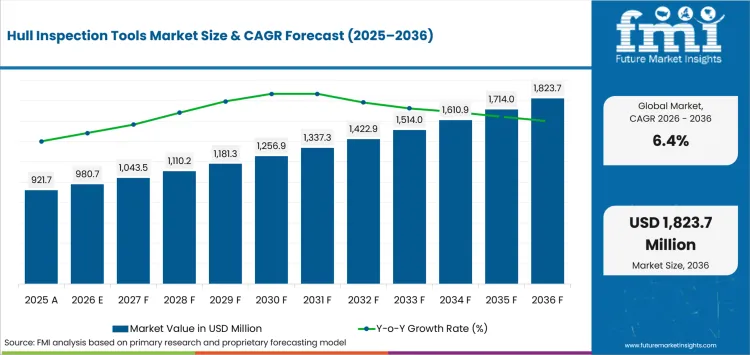
Key Takeaways of Hull Inspection Tools Market
- Mandatory hull surveys sustain recurring equipment use as commercial fleets document structural condition ahead of certificate renewal.
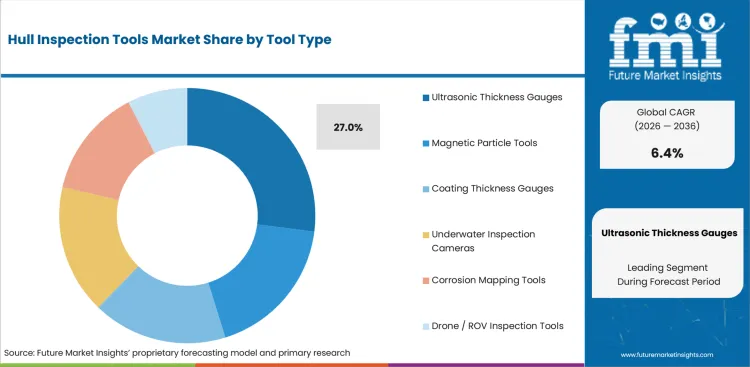
- By tool type ultrasonic thickness gauges are projected to account for 27.0% share in 2026 due to repeatable wall-loss measurements.
- Manual NDT is estimated to hold 42.0% share in 2026 owing to adaptable work across irregular hull structures.
- Commercial ships are forecast to represent 43.0% share in 2026 driven by recurring classification and insurance reviews.
- Capital costs and trained operators limit robotic inspection across fleets without repeat deployment volume or nearby technical support.
- Evident, Waygate Technologies, Cygnus Instruments, Elcometer, Deep Trekker, VideoRay, Flyability, and Gecko Robotics compete through measurement and remote-access capabilities.
Analyst Perspective
“Hull inspection purchasing rewards defensible condition records that engineers can compare across successive survey cycles. Handheld gauges confirm critical findings and remote systems reach hazardous structures and preserve location-linked evidence.”
- Nikhil Kaitwade, Principal Analyst, Future Market Insights
How is the Hull Inspection Tools Market segmented?
By tool type, inspection method, vessel type, application, sales channel, and region
The hull inspection tools market is organized by tool type, inspection method, vessel type, application, sales channel, and region. Tool categories cover thickness gauges, surface testing devices, cameras, mapping systems, and remote platforms across manual or robotic workflows. Vessel categories reflect separate survey obligations across commercial, naval, offshore, workboat, and private yacht operations. Applications define the inspection objective and sales channels determine access to testing and measurement equipment plus calibration services.
Why do ultrasonic thickness gauges remain central within tool type?
Remaining plate thickness provides the numerical basis for corrosion assessment and steel renewal decisions across hull surveys. Portable mapping connects each reading with a position on large steel surfaces and supports repeat comparison. In June 2026 Waygate Technologies introduced the Krautkrämer PAXYS with encoded corrosion mapping and connected reporting that supports condition monitoring systems with preserved location data.
- By tool type, ultrasonic thickness gauges are projected to account for 27.0% in 2026 due to direct wall-loss measurement across accessible hull surfaces. Their numerical output supports comparisons between survey periods and gives repair planners a defensible basis for defining steel renewal zones.
- Marine inspection teams favor thickness gauges for confirmation work because one-sided access produces immediate readings without cutting a steel sample. Coating condition and surface preparation remain practical variables that determine probe choice and measurement repeatability across different vessel structures.
How does manual NDT retain its position within inspection methods?
Manual NDT lets certified technicians change probes and inspection angles as hull geometry or surface condition changes during attendance. Approved service routes and documented technician competency preserve survey control across varied marine operating conditions. The International Maritime Organization’s current survey framework assigns verification duties to administrations or recognized organizations. Manual tools resolve unexpected indications during the same attendance without requiring another external specialist visit.
- Manual NDT is set to lead the inspection method category with 42.0% share in 2026 due to adaptable work across welds, frames, tanks, and accessible shell plating. Technicians can verify an uncertain indication immediately without arranging another specialist visit or remote platform deployment.
- Classification surveyors and marine service firms continue purchasing portable manual tools because field conditions vary across one vessel. Robotic systems complement that work by screening hazardous areas and technicians retain direct control over confirmation measurements and final inspection records.
What supports commercial ship demand within vessel type?
Commercial ships operate through recurring statutory and classification survey cycles that connect hull condition with certificate validity and trading availability. Germany’s official flag guidance states that authorized classification societies inspect ships and issue safety documentation within defined delegated areas. Portable tools and maritime satellite communication therefore support records that must travel with internationally operating fleets.
- The vessel type category is forecast to be led by commercial ships at 43.0% share in 2026 due to scheduled surveys and repair planning. High operating intensity increases exposure to corrosion and contact damage across commercial routes and shortens the interval between condition checks.
- Fleet technical managers favor portable equipment that can travel between ports and produce records accepted by classification surveyors. Tool choice changes with vessel size and coating condition and local calibration access determines turnaround and replacement availability during brief attendance windows.
How is hull thickness measurement positioned within applications?
Hull thickness measurement converts corrosion into engineering data that supports plate renewal limits and remaining-life calculations. Evident’s 39DL PLUS records minimum-thickness scans with linked waveform data across several consecutive survey cycles. The connected workflow supports corrosion protection coatings assessments and gives repair planners a consistent evidence trail.
- The hull thickness measurement segment is likely to capture 29.0% share in 2026 attributable to its direct role in structural assessment and repair scoping. Numerical readings provide clearer engineering inputs than visual condition alone during classification review and shipyard planning.
- Shipyards use thickness grids to identify steel renewal zones and estimate work before opening additional structures. Operators compare readings across survey cycles although inconsistent locations or calibration records can weaken historical trends and increase contingency allowances.
Why do NDT distributors remain important within sales channels?
NDT distributors combine instrument access with calibration coordination and replacement probes for inspection teams using several methods. Local support becomes decisive during short vessel attendance windows when delayed parts can postpone survey completion. Deep Trekker opened a Tampa service center in July 2025 for diagnostics, repairs, training, and parts distribution. The investment illustrates why marine electronics testers and remote platforms require support beyond the initial purchase.
- By sales channel, NDT distributors are estimated to hold 36.0% in 2026 owing to multi-brand access and recurring calibration requirements. The channel consolidates gauges, probes, couplant, field accessories, and documented service within one purchasing relationship.
- Regional inspection firms prefer distributors that provide loan units and traceable calibration during short vessel attendance windows. Direct OEM purchasing remains attractive for specialized robotic platforms whereas rental routes support occasional surveys without permanent capital commitments.
What are the drivers, restraints, and opportunities in the Hull Inspection Tools Market?
Driver: Periodic surveys sustain calibrated tool demand. Restraint: Underwater conditions limit robotic reliability. Opportunity: Live trials can establish approved deployment routes.
- Driver: Periodic survey and certification requirements sustain recurring purchases of calibrated tools that document hull condition across operating fleets.
- Restraint: Robotic platforms face unstable currents, poor visibility, complex geometry, and operator shortages that can interrupt underwater inspection work.
- Opportunity: Live port trials can establish reliable performance evidence and service procedures for robotic systems under commercial operating conditions.
- Periodic survey obligations provide a dependable demand base because ship certificates require verified condition evidence. Maritime and Port Authority of Singapore guidance confirms that flag-state inspections verify hull condition against certificates carried by registered ships. Instrument manufacturers compete through measurement repeatability, calibration traceability, and reporting compatibility and service networks restore equipment within scheduled attendance windows.
Robotic adoption slows under currents or visibility conditions that prevent stable navigation and sensor contact. Singapore’s November 2025 hull robotics call identified strong currents, tight berth spaces, limited visibility, and complex structures as operating gaps. Smaller service firms therefore face higher validation and training costs because unstable contact cannot support confirmation measurements during certificate reviews.
Live port trials provide a credible route for developers that prove safe navigation and repeatable records under commercial conditions. In April 2026 Singapore selected six partners for robotic hull inspection and cleaning trials across active port waters. The program joins technology developers with shipowners and classification societies that must convert results into approved procedures, maintenance support, and predictable service pricing.
Which country CAGRs are profiled in the Hull Inspection Tools Market?
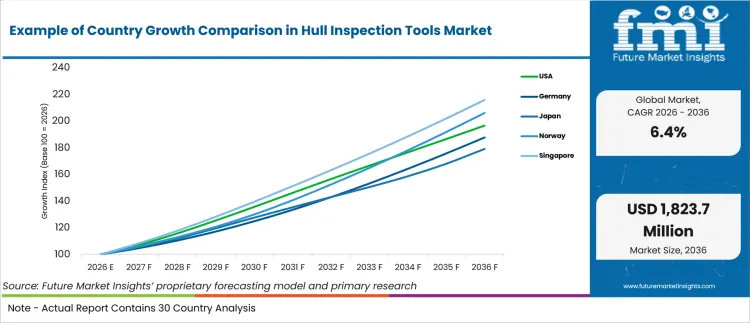
| Country | CAGR |
|---|---|
| United States | 7.0% |
| Germany | 6.5% |
| Japan | 6.0% |
| Norway | 7.5% |
| Singapore | 8.0% |
How do country-level CAGRs compare in the Hull Inspection Tools Market?
The country forecasts remain closely grouped across the hull inspection tools market, with only 2.0 percentage points separating Singapore and Japan. Singapore and Norway form an upper group, reflecting strong investment in maritime infrastructure, vessel maintenance and port operations. The United States follows within a narrow range and benefits from extensive commercial and defense fleet inspection requirements. Germany and Japan create a lower pair with limited separation, indicating steady demand supported by established shipbuilding and marine engineering activities. The pattern suggests that growth is being shaped by fleet maintenance needs, underwater inspection requirements and adoption of digital inspection technologies rather than differences in shipping activity alone.
- Singapore benefits from its position as a major maritime hub where regular vessel inspection and maintenance are critical to fleet operations.
- Norway supports strong demand through advanced offshore, shipping and maritime service industries that rely on frequent hull assessment.
- The United States reflects consistent adoption of inspection tools across commercial shipping, naval fleets and port infrastructure.
- Germany maintains demand through its shipbuilding expertise and focus on vessel safety and maintenance standards.
- Japan continues to support market growth through a large maritime sector and ongoing investment in vessel lifecycle management.
Comparable CAGRs may still reflect different market conditions because inspection practices, fleet composition, regulatory requirements and adoption of remotely operated and digital inspection technologies vary across countries. The full report provides country-level CAGR analysis across North America, Latin America, Europe, East Asia, South Asia, Oceania and the Middle East and Africa.
Country-wise Analysis
- United States naval and commercial fleets require hull tools that fit established maintenance records and approved inspection procedures. Hull inspection tool demand in the United States is forecast to rise at 7.0% CAGR over the forecast period supported by large fleet sustainment programs. The Government Accountability Office reported in January 2025 that the Navy operated 149 non-nuclear combat ships and faced persistent maintenance workforce shortages. The installed base supports recurring inspection work although qualified labor and shipyard capacity remain material frictions for timely deployment.
- Germany requires recognized organizations to perform delegated ship-safety surveys within defined authorization areas for merchant vessels. Germany’s hull inspection tools outlook is anticipated to advance at 6.5% CAGR over the assessment period underpinned by recurring survey work. German Flag guidance connects periodical surveys with safety-certificate renewal but divided responsibilities can lengthen coordination for unfamiliar remote methods.
- Japan places strong weight on class-approved service firms and documented procedures for hull thickness work. Adoption of hull inspection tools in Japan is estimated to expand at 6.0% CAGR through 2036 shaped by conservative qualification and dependable local support. ClassNK’s July 2026 application directory lists approval routes for firms conducting thickness measurements and remote inspection surveys. The defined route supports consistent purchasing although separate vessel procedures can slow deployment for newer robotic systems.
- Norway uses risk-based supervision but retains physical attendance for inspections carrying greater structural and certificate consequences. Norway is estimated to post 7.5% CAGR over the forecast period enabled by offshore fleets and established remote-supervision practice. The Norwegian Maritime Authority shifted annual passenger-certificate supervision to video from April 2025 but retained physical attendance for docking and renewal surveys. Remote capability supports adoption although harsh waters and physical checks limit complete substitution of field teams.
- Singapore combines dense port activity with recurring hull inspection requirements across locally licensed commercial craft. Hull inspection tool sales in Singapore are forecast to expand at 8.0% CAGR by 2036 aided by concentrated service demand and port-based testing routes. MPA guidance requires annual hull and equipment inspections ahead of licence renewal but tight berth space and active cargo operations constrain underwater deployments.
Who are the notable companies in the Hull Inspection Tools Market?
Evident, Waygate Technologies, Cygnus Instruments, Elcometer, Deep Trekker, VideoRay, Flyability, and Gecko Robotics are notable companies shaping this market.
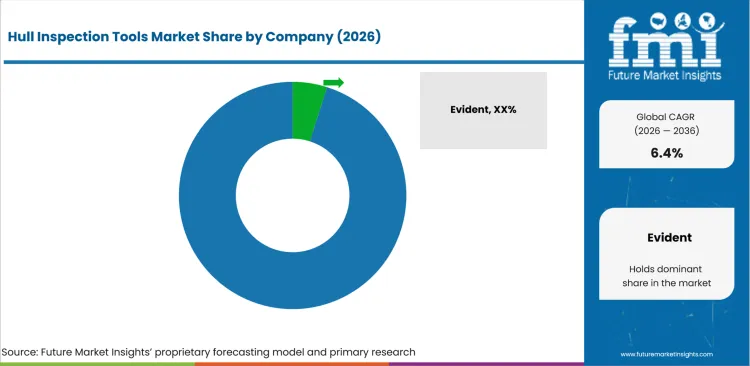
The competitive field divides between handheld NDT specialists and remote-access platform developers that often contribute separate capabilities within one survey. Entry remains possible through one strong capability although competition depends on class acceptance, measurement traceability, service reach, and reporting compatibility.
- Evident, Waygate Technologies, Cygnus Instruments, and Elcometer compete through portable ultrasonic measurement, calibration support, and connected reporting workflows.
- Deep Trekker and VideoRay provide underwater ROV platforms that combine visual access with sensor integration for submerged hull structures.
- Flyability and Gecko Robotics address confined or remote structures through robotic access, ultrasonic measurement, and digital condition mapping.
Competitive Benchmarking: Hull Inspection Tools Market
| Company | Thickness Measurement | Remote Access Integration | Digital Mapping and Reporting | Geographic Reach |
|---|---|---|---|---|
| Evident | High | Low | High | Global |
| Waygate Technologies | High | Medium | High | Global |
| Cygnus Instruments | High | Medium | High | Global |
| Elcometer | High | Low | High | Global |
| Deep Trekker | Medium | High | High | Global |
| VideoRay | Medium | High | Medium | Global |
| Flyability | High | High | High | Global |
| Gecko Robotics | High | High | High | North America |
Key Developments in the Hull Inspection Tools Market
- In August 2025, Cygnus Instruments announced an underwater ultrasonic gauge with topside display and data logging for classification review.
- In March 2026, Deep Trekker launched the SPECTRA inspection ROV with stereo vision and three-dimensional mapping for low-visibility documentation.
- In April 2025, Flyability received ClassNK Innovation Endorsement certification for the Elios 3 ultrasonic drone used inside confined ship structures.
- In March 2026, Gecko Robotics secured a five-year United States Navy contract for robotic assessments across 18 Pacific Fleet ships.
Hull Inspection Tools Market - Report Scope
| Coverage field | Report scope |
|---|---|
| Market breakdown | Tool type, inspection method, vessel type, application, sales channel, region. |
| Market Definition | Equipment and support used to measure vessel hull thickness, corrosion, coatings, welds, and underwater structural condition. |
| Regions Covered | North America, Latin America, Western Europe, Eastern Europe, East Asia, South Asia and Pacific, Middle East and Africa. |
| Countries Covered | United States, Germany, Japan, Norway, Singapore |
| Key Companies Profiled | Evident, Waygate Technologies, Cygnus Instruments, Elcometer, Deep Trekker, VideoRay, Flyability, Gecko Robotics |
| Forecast Period | 2026–2036. |
| Approach | Primary and secondary research with market triangulation. |
Hull Inspection Tools Market - Research Methodology
| Method | Approach |
|---|---|
| Primary Research | FMI analysts gathered input from manufacturers, service providers, technology developers, distributors, end users, procurement teams, and subject-matter experts. Interviews examined purchasing decisions, product or service evaluation, adoption barriers, approval requirements, pricing considerations, and expectations for technical or commercial support. Respondents were also asked what evidence is required before a trial, pilot, or initial order develops into regular purchasing. |
| Desk Research | Desk research covered government statistics, regulatory publications, trade data, industry associations, technical literature, standards, company filings, product information, and official corporate announcements. Sources were reviewed for relevance, publication date, geographic coverage, and consistency with the defined market scope. Claims relating to performance, applications, approvals, capacity, investment, and commercial activity were retained only when supported by credible public evidence. |
| Market Sizing and Forecasting | The market model combined the baseline value with historical performance, segment structure, pricing and volume indicators, adoption levels, company participation, and country-level demand conditions. Forecast assumptions considered economic activity, investment trends, regulatory developments, technology adoption, purchasing cycles, supply availability, and barriers to wider market use. Segment and regional estimates were reconciled before the final market total was calculated. |
| Data Validation | Estimates were checked against multiple independent indicators, including public data, company activity, trade patterns, industry developments, and findings from primary interviews. Validation also tested whether products, services, applications, and company revenues fell within the defined market boundaries. Adjacent categories, unsupported claims, overlapping revenues, and activities without direct market relevance were excluded to reduce double counting and maintain consistency across segments and countries. |
Hull Inspection Tools Market by Segments
Hull Inspection Tools Market segmented by Tool Type:
- Ultrasonic Thickness Gauges
- Magnetic Particle Tools
- Coating Thickness Gauges
- Underwater Inspection Cameras
- Corrosion Mapping Tools
- Drone / ROV Inspection Tools
Hull Inspection Tools Market segmented by Inspection Method:
- Manual NDT
- Underwater Visual Inspection
- Robotic / Remote Inspection
- Digital Reporting-linked Inspection
Hull Inspection Tools Market segmented by Vessel Type:
- Commercial Ships
- Naval Vessels
- Offshore Vessels
- Fishing / Workboats
- Yachts
Hull Inspection Tools Market segmented by Application:
- Hull Thickness Measurement
- Corrosion / Pitting Detection
- Coating Condition Assessment
- Weld / Plate Inspection
- Dry Dock Survey
Hull Inspection Tools Market segmented by Sales Channel:
- NDT Distributors
- Direct OEM
- Marine Service Providers
- Rental / Calibration
Hull Inspection Tools Market by Region:
- North America
- United States
- Canada
- Latin America
- Brazil
- Chile
- Mexico
- Rest of Latin America
- Western Europe
- Germany
- United Kingdom
- Italy
- Spain
- France
- Nordics
- Benelux
- Rest of Western Europe
- Eastern Europe
- Russia
- Poland
- Hungary
- Balkan and Baltic States
- Rest of Eastern Europe
- East Asia
- China
- Japan
- South Korea
- South Asia and Pacific
- India
- ASEAN
- Australia and New Zealand
- Rest of South Asia and Pacific
- Middle East and Africa
- Kingdom of Saudi Arabia
- Other GCC Countries
- Türkiye
- South Africa
- Other African Union Countries
- Rest of Middle East and Africa
Research Sources and Bibliography
- International Maritime Organization. (2026, January 9).
- International Maritime Organization. (2025, June 27).
- Waygate Technologies. (2026, June 15).
- International Maritime Organization. (2026).
- German Flag. (2026).
- Evident Scientific. (2026).
- Deep Trekker. (2025, July 5).
- German Flag. (2026).
- Maritime and Port Authority of Singapore. (2025, November 6).
- Maritime and Port Authority of Singapore. (2026, April 22).
- U.S. Government Accountability Office. (2025, January 31).
- ClassNK. (2026, July 31)
- Norwegian Maritime Authority. (2025, April 22).
- Maritime and Port Authority of Singapore. (2026).
- Cygnus Instruments. (2025, August 21).
- Deep Trekker. (2026, March 11).
- Flyability. (2025, April 8).
- Gecko Robotics. (2026, March 17).
- Evident Scientific. (2026)
- Maritime and Port Authority of Singapore. (2026, July 29).
- Elcometer. (2026).
- Cygnus Instruments. (2026).
This Report Answers
- What is the global Hull Inspection Tools market size in 2026, and what value is forecast for 2036?
- Which regulatory requirements and survey standards sustain recurring demand for hull inspection equipment?
- Why do ultrasonic thickness gauges hold the largest share of tool-type demand?
- How do manual inspection methods compare with robotic and remotely operated inspection solutions?
- Which vessel types and inspection applications require portable hull inspection tools?
- How do market growth trends and adoption patterns differ across the countries profiled in the report?
- Which companies combine measurement accuracy, digital reporting, and remote inspection capabilities?
- Which technical, operational, and cost-related challenges limit the adoption of robotic hull inspection systems?
- How should purchasers evaluate suppliers based on calibration services, inspection software, and reporting support?
Frequently Asked Questions
How big is the Hull Inspection Tools Market in 2026?
The hull inspection tools market is valued at USD 980.7 million in 2026 and is forecast to reach USD 1823.7 million by 2036. Growth is supported by recurring classification survey obligations that require traceable calibration and repeatable hull thickness readings from portable ultrasonic testing equipment across operating fleets.
What is the CAGR of the Hull Inspection Tools Market from 2026 to 2036?
The hull inspection tools market grows at a CAGR of 6.4% between 2026 and 2036, supported by periodic survey and certification requirements that sustain recurring purchases of calibrated tools documenting hull condition across commercial, naval, and offshore fleet inspection programs.
Which inspection method leads the Hull Inspection Tools Market?
Manual NDT accounts for 42.0% of the hull inspection tools market by inspection method in 2026, driven by adaptable work across welds, frames, tanks, and accessible shell plating that lets certified technicians resolve indications during the same attendance without arranging remote platform deployment.
How much will the Hull Inspection Tools Market add between 2026 and 2036?
The hull inspection tools market is set to add USD 843.0 million between 2026 and 2036, growing from USD 980.7 million to USD 1,823.7 million as recurring classification surveys and expanding remote-inspection technologies sustain demand for calibrated hull condition equipment worldwide.
Who are the leading companies in the Hull Inspection Tools Market?
Eight companies lead the hull inspection tools market, including Evident, Waygate Technologies, Cygnus Instruments, Elcometer, Deep Trekker, VideoRay, Flyability, and Gecko Robotics, competing through thickness measurement, remote access integration, and digital mapping and reporting across global service networks.
Preview the report firsthand - request a free sample
Get SampleGet the brochure for pricing and purchase details.
Get PDFTable of Content
- Key Takeaways
- Market Size and CAGR
- Top Growth Driver
- Fastest Growing Segment
- Leading Region
- Key Companies
- Emerging Opportunities
- Executive Summary
- Global Market Outlook
- Demand-side Trends
- Supply-side Trends
- Technology Roadmap Analysis
- Analysis and Recommendations
- Analyst Perspective (What is happening? Why now? What should investors know?)
- Key Questions Answered
- How large is the market?
- What is the CAGR?
- What are key trends?
- Which region dominates?
- Who are the leaders?
- Market Overview
- Market Coverage / Taxonomy
- Market Definition / Scope / Limitations
- Research Methodology
- Chapter Orientation
- Analytical Lens and Working Hypotheses
- Market Structure, Signals, and Trend Drivers
- Benchmarking and Cross-market Comparability
- Market Sizing, Forecasting, and Opportunity Mapping
- Research Design and Evidence Framework
- Desk Research Programme (Secondary Evidence)
- Expert Input and Fieldwork (Primary Evidence)
- Tooling, Models, and Reference Databases
- Data Engineering and Model Build
- Quality Assurance and Audit Trail
- Market Background
- Market Dynamics (Drivers, Restraints, Opportunity, Trends)
- Scenario Forecast (Optimistic, Likely, Conservative)
- Impact Analysis
- AI Impact
- Sustainability Impact
- Regulatory Impact
- Technology Impact
- Consumer / Buyer Analysis
- Purchase Drivers
- Adoption Barriers
- Buyer Journey
- Opportunity Map Analysis
- Product Life Cycle Analysis
- Supply Chain Analysis
- Investment Feasibility Matrix
- Value Chain Analysis
- PESTLE and Porter's Analysis
- Regulatory Landscape
- Regional Parent Market Outlook
- Production and Consumption Statistics
- Import and Export Statistics
- Global Market Analysis and Forecast, 2021 to 2036
- Historical Market Size Value (USD Million) Analysis, 2021 to 2025
- Current and Future Market Size Value (USD Million) Projections, 2026 to 2036
- Y-o-Y Growth Trend Analysis
- Absolute $ Opportunity Analysis
- Global Market Pricing Analysis, 2021 to 2036
- Global Market Analysis and Forecast, By Tool Type, 2021 to 2036
- Introduction / Key Findings
- Historical Market Size Value (USD Million) Analysis By Tool Type, 2021 to 2025
- Current and Future Market Size Value (USD Million) Analysis and Forecast By Tool Type, 2026 to 2036
- Ultrasonic Thickness Gauges
- Magnetic Particle Tools
- Coating Thickness Gauges
- Underwater Inspection Cameras
- Corrosion Mapping Tools
- Drone / ROV Inspection Tools
- Ultrasonic Thickness Gauges
- Y-o-Y Growth Trend Analysis By Tool Type, 2021 to 2025
- Absolute $ Opportunity Analysis By Tool Type, 2026 to 2036
- Global Market Analysis and Forecast, By Inspection Method, 2021 to 2036
- Introduction / Key Findings
- Historical Market Size Value (USD Million) Analysis By Inspection Method, 2021 to 2025
- Current and Future Market Size Value (USD Million) Analysis and Forecast By Inspection Method, 2026 to 2036
- Manual NDT
- Underwater Visual Inspection
- Robotic / Remote Inspection
- Digital Reporting-linked Inspection
- Manual NDT
- Y-o-Y Growth Trend Analysis By Inspection Method, 2021 to 2025
- Absolute $ Opportunity Analysis By Inspection Method, 2026 to 2036
- Global Market Analysis and Forecast, By Vessel Type, 2021 to 2036
- Introduction / Key Findings
- Historical Market Size Value (USD Million) Analysis By Vessel Type, 2021 to 2025
- Current and Future Market Size Value (USD Million) Analysis and Forecast By Vessel Type, 2026 to 2036
- Commercial Ships
- Naval Vessels
- Offshore Vessels
- Fishing / Workboats
- Yachts
- Commercial Ships
- Y-o-Y Growth Trend Analysis By Vessel Type, 2021 to 2025
- Absolute $ Opportunity Analysis By Vessel Type, 2026 to 2036
- Global Market Analysis and Forecast, By Application, 2021 to 2036
- Introduction / Key Findings
- Historical Market Size Value (USD Million) Analysis By Application, 2021 to 2025
- Current and Future Market Size Value (USD Million) Analysis and Forecast By Application, 2026 to 2036
- Hull Thickness Measurement
- Corrosion / Pitting Detection
- Coating Condition Assessment
- Weld / Plate Inspection
- Dry Dock Survey
- Hull Thickness Measurement
- Y-o-Y Growth Trend Analysis By Application, 2021 to 2025
- Absolute $ Opportunity Analysis By Application, 2026 to 2036
- Global Market Analysis and Forecast, By Sales Channel, 2021 to 2036
- Introduction / Key Findings
- Historical Market Size Value (USD Million) Analysis By Sales Channel, 2021 to 2025
- Current and Future Market Size Value (USD Million) Analysis and Forecast By Sales Channel, 2026 to 2036
- NDT Distributors
- Direct OEM
- Marine Service Providers
- Rental / Calibration
- NDT Distributors
- Y-o-Y Growth Trend Analysis By Sales Channel, 2021 to 2025
- Absolute $ Opportunity Analysis By Sales Channel, 2026 to 2036
- Global Market Analysis and Forecast, By Region, 2021 to 2036
- Introduction
- Historical Market Size Value (USD Million) Analysis By Region, 2021 to 2025
- Current Market Size Value (USD Million) Analysis and Forecast By Region, 2026 to 2036
- North America
- Latin America
- Western Europe
- Eastern Europe
- East Asia
- South Asia and Pacific
- Middle East & Africa
- Market Attractiveness Analysis By Region
- North America Market Analysis and Forecast, By Country, 2021 to 2036
- Historical Market Size Value (USD Million) Trend Analysis By Market Taxonomy, 2021 to 2025
- Market Size Value (USD Million) Forecast By Market Taxonomy, 2026 to 2036
- By Country
- USA
- Canada
- By Tool Type
- By Inspection Method
- By Vessel Type
- By Application
- By Sales Channel
- By Country
- Market Attractiveness Analysis
- By Country
- By Tool Type
- By Inspection Method
- By Vessel Type
- By Application
- By Sales Channel
- Key Takeaways
- Latin America Market Analysis and Forecast, By Country
- Historical Market Size Value (USD Million) Trend Analysis By Market Taxonomy, 2021 to 2025
- Market Size Value (USD Million) Forecast By Market Taxonomy, 2026 to 2036
- By Country
- Brazil
- Mexico
- Chile
- Rest of Latin America
- By Tool Type
- By Inspection Method
- By Vessel Type
- By Application
- By Sales Channel
- By Country
- Market Attractiveness Analysis
- By Country
- By Tool Type
- By Inspection Method
- By Vessel Type
- By Application
- By Sales Channel
- Key Takeaways
- Western Europe Market Analysis and Forecast, By Country
- Historical Market Size Value (USD Million) Trend Analysis By Market Taxonomy, 2021 to 2025
- Market Size Value (USD Million) Forecast By Market Taxonomy, 2026 to 2036
- By Country
- Germany
- UK
- Italy
- Spain
- France
- Nordic
- BENELUX
- Rest of Western Europe
- By Tool Type
- By Inspection Method
- By Vessel Type
- By Application
- By Sales Channel
- By Country
- Market Attractiveness Analysis
- By Country
- By Tool Type
- By Inspection Method
- By Vessel Type
- By Application
- By Sales Channel
- Key Takeaways
- Eastern Europe Market Analysis and Forecast, By Country
- Historical Market Size Value (USD Million) Trend Analysis By Market Taxonomy, 2021 to 2025
- Market Size Value (USD Million) Forecast By Market Taxonomy, 2026 to 2036
- By Country
- Russia
- Poland
- Hungary
- Balkan & Baltic
- Rest of Eastern Europe
- By Tool Type
- By Inspection Method
- By Vessel Type
- By Application
- By Sales Channel
- By Country
- Market Attractiveness Analysis
- By Country
- By Tool Type
- By Inspection Method
- By Vessel Type
- By Application
- By Sales Channel
- Key Takeaways
- East Asia Market Analysis and Forecast, By Country
- Historical Market Size Value (USD Million) Trend Analysis By Market Taxonomy, 2021 to 2025
- Market Size Value (USD Million) Forecast By Market Taxonomy, 2026 to 2036
- By Country
- China
- Japan
- South Korea
- By Tool Type
- By Inspection Method
- By Vessel Type
- By Application
- By Sales Channel
- By Country
- Market Attractiveness Analysis
- By Country
- By Tool Type
- By Inspection Method
- By Vessel Type
- By Application
- By Sales Channel
- Key Takeaways
- South Asia and Pacific Market Analysis and Forecast, By Country
- Historical Market Size Value (USD Million) Trend Analysis By Market Taxonomy, 2021 to 2025
- Market Size Value (USD Million) Forecast By Market Taxonomy, 2026 to 2036
- By Country
- India
- ASEAN
- Australia & New Zealand
- Rest of South Asia and Pacific
- By Tool Type
- By Inspection Method
- By Vessel Type
- By Application
- By Sales Channel
- By Country
- Market Attractiveness Analysis
- By Country
- By Tool Type
- By Inspection Method
- By Vessel Type
- By Application
- By Sales Channel
- Key Takeaways
- Middle East & Africa Market Analysis and Forecast, By Country
- Historical Market Size Value (USD Million) Trend Analysis By Market Taxonomy, 2021 to 2025
- Market Size Value (USD Million) Forecast By Market Taxonomy, 2026 to 2036
- By Country
- Kingdom of Saudi Arabia
- Other GCC Countries
- Türkiye
- South Africa
- Other African Union
- Rest of Middle East & Africa
- By Tool Type
- By Inspection Method
- By Vessel Type
- By Application
- By Sales Channel
- By Country
- Market Attractiveness Analysis
- By Country
- By Tool Type
- By Inspection Method
- By Vessel Type
- By Application
- By Sales Channel
- Key Takeaways
- Key Countries Market Analysis
- USA
- Pricing Analysis
- Market Share Analysis, 2025
- By Tool Type
- By Inspection Method
- By Vessel Type
- By Application
- By Sales Channel
- Canada
- Pricing Analysis
- Market Share Analysis, 2025
- By Tool Type
- By Inspection Method
- By Vessel Type
- By Application
- By Sales Channel
- Mexico
- Pricing Analysis
- Market Share Analysis, 2025
- By Tool Type
- By Inspection Method
- By Vessel Type
- By Application
- By Sales Channel
- Brazil
- Pricing Analysis
- Market Share Analysis, 2025
- By Tool Type
- By Inspection Method
- By Vessel Type
- By Application
- By Sales Channel
- Chile
- Pricing Analysis
- Market Share Analysis, 2025
- By Tool Type
- By Inspection Method
- By Vessel Type
- By Application
- By Sales Channel
- Germany
- Pricing Analysis
- Market Share Analysis, 2025
- By Tool Type
- By Inspection Method
- By Vessel Type
- By Application
- By Sales Channel
- UK
- Pricing Analysis
- Market Share Analysis, 2025
- By Tool Type
- By Inspection Method
- By Vessel Type
- By Application
- By Sales Channel
- Italy
- Pricing Analysis
- Market Share Analysis, 2025
- By Tool Type
- By Inspection Method
- By Vessel Type
- By Application
- By Sales Channel
- Spain
- Pricing Analysis
- Market Share Analysis, 2025
- By Tool Type
- By Inspection Method
- By Vessel Type
- By Application
- By Sales Channel
- France
- Pricing Analysis
- Market Share Analysis, 2025
- By Tool Type
- By Inspection Method
- By Vessel Type
- By Application
- By Sales Channel
- India
- Pricing Analysis
- Market Share Analysis, 2025
- By Tool Type
- By Inspection Method
- By Vessel Type
- By Application
- By Sales Channel
- ASEAN
- Pricing Analysis
- Market Share Analysis, 2025
- By Tool Type
- By Inspection Method
- By Vessel Type
- By Application
- By Sales Channel
- Australia & New Zealand
- Pricing Analysis
- Market Share Analysis, 2025
- By Tool Type
- By Inspection Method
- By Vessel Type
- By Application
- By Sales Channel
- China
- Pricing Analysis
- Market Share Analysis, 2025
- By Tool Type
- By Inspection Method
- By Vessel Type
- By Application
- By Sales Channel
- Japan
- Pricing Analysis
- Market Share Analysis, 2025
- By Tool Type
- By Inspection Method
- By Vessel Type
- By Application
- By Sales Channel
- South Korea
- Pricing Analysis
- Market Share Analysis, 2025
- By Tool Type
- By Inspection Method
- By Vessel Type
- By Application
- By Sales Channel
- Russia
- Pricing Analysis
- Market Share Analysis, 2025
- By Tool Type
- By Inspection Method
- By Vessel Type
- By Application
- By Sales Channel
- Poland
- Pricing Analysis
- Market Share Analysis, 2025
- By Tool Type
- By Inspection Method
- By Vessel Type
- By Application
- By Sales Channel
- Hungary
- Pricing Analysis
- Market Share Analysis, 2025
- By Tool Type
- By Inspection Method
- By Vessel Type
- By Application
- By Sales Channel
- Kingdom of Saudi Arabia
- Pricing Analysis
- Market Share Analysis, 2025
- By Tool Type
- By Inspection Method
- By Vessel Type
- By Application
- By Sales Channel
- Türkiye
- Pricing Analysis
- Market Share Analysis, 2025
- By Tool Type
- By Inspection Method
- By Vessel Type
- By Application
- By Sales Channel
- South Africa
- Pricing Analysis
- Market Share Analysis, 2025
- By Tool Type
- By Inspection Method
- By Vessel Type
- By Application
- By Sales Channel
- USA
- Market Structure Analysis
- Competition Dashboard
- Competition Benchmarking
- Market Share Analysis of Top Players
- By Regional
- By Tool Type
- By Inspection Method
- By Vessel Type
- By Application
- By Sales Channel
- Emerging Startups
- Innovation Benchmarking
- Competition Analysis
- Competition Deep Dive
- Evident
- Overview
- Product Portfolio
- Profitability by Market Segments
- Sales Footprint
- Strategy Overview
- Marketing Strategy
- Product Strategy
- Channel Strategy
- Waygate Technologies
- Cygnus Instruments
- Elcometer
- PCE Instruments
- Fischer Technology
- Teledyne FLIR
- Deep Trekker
- Blueprint Subsea
- SubC Imaging
- Evident
- Case Studies
- Success Stories
- Recent Developments
- Competition Deep Dive
- Assumptions & Acronyms Used


