

- Market Size (2026)
- USD 1.2 Bn
- Forecast (2036)
- USD 3.0 Bn
- CAGR (2026 to 2036)
- 9.7%
How big is the Hydrochloric Acid Electrolysis Market in 2026?
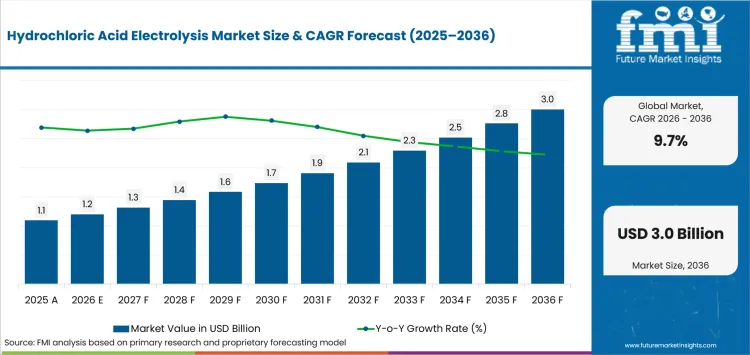
USD 1.2 billion in 2026 and USD 3.0 billion by 2036 at a 9.7% CAGR.
Demand for hydrochloric acid electrolysis is projected to expand at a 9.7% CAGR between 2026 and 2036. Market value rises from USD 1.2 billion in 2026 to USD 3.0 billion by 2036. Adoption is concentrated in chemical production sites seeking to recover chlorine and hydrogen from hydrochloric acid streams while reducing waste-handling requirements. Euro Chlor reported in February 2026 that European chlorine production reached 7.79 million tonnes in 2025 and operated at 67.6% capacity utilization. Large installed chlorine production assets create opportunities for electrolysis systems where hydrogen chloride is generated as a by-product and recovered materials can be returned to existing production processes.
Electricity exposure changes project screening even when chemical sites have similar acid and chlorine balances. Eurostat reported in May 2026 that Germany recorded one of the EU’s highest non-household electricity prices during late 2025. France recorded a 14.1% year-over-year decline during the same period and reduced the power disadvantage for some site-level evaluations. Developers compare local power contracts with avoided chlorine purchases before selecting the cell configuration and gas-treatment scope.
Key Takeaways of Hydrochloric Acid Electrolysis Market
- Demand is supported by chemical sites that convert hydrogen chloride by-products into reusable chlorine for continuous internal production.
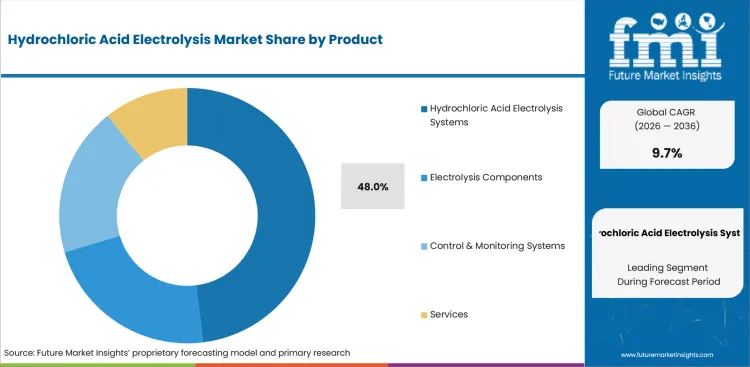
- Complete hydrochloric acid electrolysis systems are projected to hold 48.0% of product demand in 2026 because one process package coordinates cells, circulation equipment and gas treatment.
- Chlorine recovery is estimated to account for 39.0% by application as internal reuse reduces acid treatment and external chlorine logistics.
- Membrane electrolysis is forecast to represent 46.0% of technology demand because controlled product separation supports chlorine quality and stable industrial operation.
- Electricity exposure, feed purification and component replacement remain the principal qualification constraints for new commercial installations.
- thyssenkrupp nucera AG & Co. KGaA, Industrie De Nora S.p.A., Covestro AG, Asahi Kasei Corporation, AGC Inc., CAC Engineering GmbH, Bilfinger SE and Technip Energies N.V. combine HCl process, component and plant-integration roles within the profiled field.
Analyst Perspective
“Hydrochloric acid electrolysis should be evaluated as a chemical-loop project rather than an isolated equipment purchase. The strongest business case combines a stable HCl feed, a dependable chlorine outlet, contracted electricity and a service plan that protects membrane and electrode life.”
- Nikhil Kaitwade, Principal Consultant, Future Market Insights
How is the Hydrochloric Acid Electrolysis Market segmented?
The Hydrochloric Acid Electrolysis Market is segmented by product, application, technology, end user, capacity and region.
Market taxonomy covers product, application, technology, end user, capacity and region across the ten-year assessment period. Product categories include complete systems, components, control platforms and services, while applications cover chlorine recovery, hydrogen production, metal processing and chemical recycling. Technology routes comprise membrane, bipolar and hybrid electrolysis across chemical producers, metal processors and waste-treatment companies operating small-scale, medium-scale or large-scale systems.
Why do hydrochloric acid electrolysis systems lead the product category?
Complete systems combine the cell stack with acid circulation, feed conditioning, gas separation and operating controls. Chemical producers prefer one accountable package because failure in any balance-of-plant element can interrupt chlorine recovery or force hydrogen chloride treatment.
- Based on product, hydrochloric acid electrolysis systems are projected to account for 48.0% in 2026 due to coordinated process-performance responsibility.
- Commercial qualification treats the stack and balance of plant as one corrosion-managed operating unit during project approval. Site engineers assess gas purity, emergency isolation and replacement access before approving an industrial electrolyzer for continuous HCl service.
Why does chlorine recovery lead the application category?
Chlorinated chemical processes can generate hydrogen chloride while consuming chlorine elsewhere within the same production complex. Electrolysis becomes commercially relevant when recovered output meets a stable internal specification and reduces reliance on external chlorine supply or acid neutralization.
- By application, chlorine recovery is estimated to hold 39.0% in 2026 owing to direct reuse within chlorinated chemical production.
- Project approval depends on maintaining chlorine quality across changing feed impurities and operating loads at each site. Engineers compare recovered output with brine electrolysis routes that consume industrial sodium chloride before specifying purification, drying and storage equipment.
Why does membrane electrolysis lead the technology category?
Membrane cells separate reaction products and control ion transport under corrosive operating conditions inside the industrial cell. Qualification depends on acid resistance, current efficiency and predictable conductivity from fluorinated membranes or related ion exchange resins.
- In 2026, membrane electrolysis is expected to lead technology with 46.0% share because product separation simplifies downstream chlorine treatment.
- Asahi Kasei reported in May 2025 that its chlor-alkali process operated at more than 160 plants across over 30 countries. That adjacent installed base provides membrane separation technology experience for durability testing and operational support without proving the modeled HCl share.
Why do large-scale systems lead the capacity category?
Large plants distribute rectifiers, gas treatment and safety infrastructure across higher acid throughput within integrated chemical complexes. Their economics are strongest at chemical complexes with predictable hydrogen chloride generation, continuous chlorine demand and established industrial gases handling capability.
- Large-scale systems are set to lead the capacity category with 52.0% share in 2026 due to fixed engineering costs being spread across higher throughput.
- Operations teams align membrane replacement with planned production campaigns and specialist maintenance availability at each operating site. Integrated workplace safety systems must detect chlorine releases and isolate equipment without exposing adjacent units or extending the outage.
What are the drivers, restraints and opportunities in the Hydrochloric Acid Electrolysis Market?
On-site chlorine recovery improves material economics, while electricity exposure and corrosive service limit returns. Standardized retrofit engineering and lifecycle support can reduce qualification risk.
- Driver: Chemical producers reduce acid treatment and external chlorine transport by returning recovered chlorine to the generating site.
- Restraint: Electricity exposure, feed impurities and corrosive service raise operating cost while shortening membrane and electrode life.
- Opportunity: Standardized retrofit engineering and lifecycle support can convert medium-volume HCl streams into qualified recovery projects.
Closed Chlorine Loops Improve Material Economics
On-site recovery becomes commercially attractive when a plant generates hydrogen chloride and consumes chlorine at comparable operating rates. The closed loop reduces neutralization volumes and limits reliance on externally delivered chlorine during steady production. Engineers also compare the hydrogen co-product with a hydrogen electrolyzer route before choosing diaphragm or oxygen-depolarized cathode technology.
Power and Corrosion Determine Operating Returns
Electricity consumption and corrosive service determine whether technical performance produces an acceptable return at commercial scale. Feed impurities can raise cell voltage or shorten membrane and electrode life during repeated shutdown cycles. Gas treatment and corrosion-resistant materials add further capital, while an oxygen-depolarized cathode route also needs dependable oxygen supply.
Lifecycle Packages Reduce Retrofit Uncertainty
Retrofit packages can widen adoption at plants with usable HCl streams and limited engineering resources. Standardized modules reduce custom design work for feeds inside proven operating windows at existing chemical sites. Remote diagnostics and planned electrolyzer service contracts clarify replacement intervals and outage responsibilities before capital approval.
Which country CAGRs are profiled in the Hydrochloric Acid Electrolysis Market?
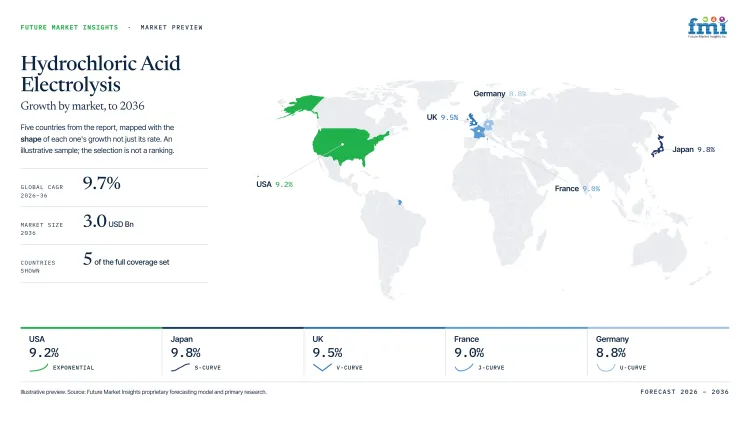
| Country | CAGR |
|---|---|
| Japan | 9.8% |
| United Kingdom | 9.5% |
| United States | 9.2% |
| France | 9.0% |
| Germany | 8.8% |
How do country-level CAGRs compare in the Hydrochloric Acid Electrolysis Market?
The profiled country forecasts span one percentage point between Germany at 8.8% and Japan at 9.8% during the assessment period.
The narrow range reflects established chemical bases in every market, although electricity economics and service access produce different project thresholds.
- Japan occupies the upper end because domestic membrane and electrode expertise supports detailed qualification and planned component replacement.
- The United Kingdom benefits from clustered chemical sites that concentrate brownfield engineering and chlorine-handling experience.
- United States projects compare large internal chlorine outlets with state electricity prices and local permitting requirements.
- French screening benefits from improved electricity conditions but remains dependent on a documented site-level investment case.
- German process expertise supports complex integration while high power costs place greater pressure on utilization assumptions.
Comparable CAGRs can therefore represent different project economics, qualification routes and service requirements across operating sites. The full report separates forecast pace from current revenue, installed capacity and immediate equipment purchasing conditions.
Country-wise Analysis
- Japan could remain among the stronger growth markets for hydrochloric acid electrolysis, with adoption advancing at a 9.8% CAGR through 2036. An established domestic supply base provides access to membranes, electrodes, and specialized engineering services required for large-scale electrolysis projects. Japan's Ministry of Economy, Trade and Industry reported that the industrial production index reached 101.8 in December 2025. The scale of industrial activity supports interest in process-efficiency technologies and by-product recovery systems. Investment decisions nevertheless depend on competitive electricity pricing and a reliable internal use case for recovered chlorine.
- The United Kingdom is on track to record 9.5% CAGR growth during the forecast period. Existing chemical clusters offer favorable conditions for retrofitting hydrochloric acid electrolysis systems into sites that already handle chlorine and related intermediates. Shared engineering resources and mature safety frameworks can simplify project execution. Manufacturing electricity prices fell 7.9% in the fourth quarter of 2025 compared with the same period in 2024, according to the Department for Energy Security and Net Zero. Lower energy costs improve operating economics, although limited outage windows and capital review procedures can lengthen project approval timelines.
- The United States is positioned to expand at a 9.2% CAGR over the assessment period. Major chemical corridors combine substantial hydrogen chloride generation with established utility infrastructure and internal chlorine demand. These operating conditions allow producers to evaluate recovery projects against the cost of sourcing chlorine through external channels. The Energy Information Administration reported average industrial electricity prices of 8.62 cents per kilowatt-hour during 2025. Regional differences in power costs and permitting requirements continue to make project economics highly site specific.
- France is likely to register CAGR of 9.0% through 2036. Mature chemical manufacturing regions provide a foundation for integrating hydrochloric acid electrolysis into existing chlorinated production assets. Experienced maintenance contractors and established process-engineering capabilities can support system deployment and ongoing operation. INSEE reported that manufacturing output in January 2026 rebounded by 0.6%, with cumulative output for early 2026 remaining above the equivalent prior-year period. Project sponsors still require a clear site-level economic justification before committing capital to recovery installations.
- Germany's market is set to progress at an 8.8% CAGR during the forecast period. Chemical producers benefit from extensive process-integration expertise and direct access to electrolysis specialists across major industrial regions. Continuous-production facilities can capture greater value from chlorine recovery where hydrochloric acid streams are consistently available. Destatis reported a 2.1% increase in chemical-industry production during April 2026. High electricity costs remain a hurdle for projects that lack dependable chlorine displacement opportunities and stable acid-generation volumes.
Who are the notable companies in the Hydrochloric Acid Electrolysis Market?
thyssenkrupp nucera AG & Co. KGaA, Industrie De Nora S.p.A., Covestro AG, Asahi Kasei Corporation, AGC Inc., CAC Engineering GmbH, Bilfinger SE and Technip Energies N.V. are the notable companies profiled in this market assessment.
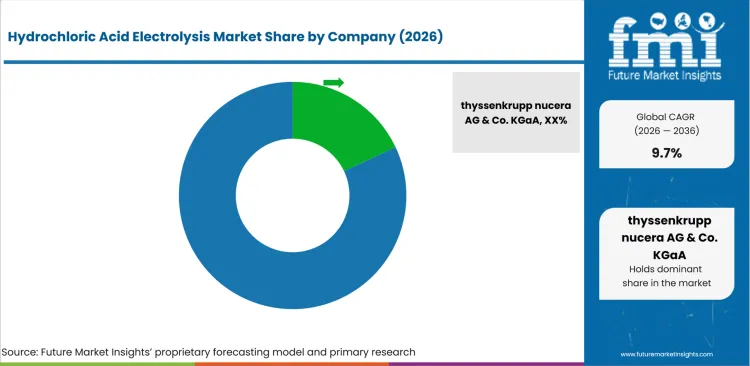
The competitive field is concentrated around a limited group of HCl process owners, electrochemical component specialists and industrial engineering contractors. Entry depends on corrosion records, operating references and clear responsibility for plant integration rather than corporate scale alone.
- thyssenkrupp nucera documents complete diaphragm and oxygen-depolarized cathode routes, while Covestro provides direct operating experience with HCl-ODC cells. Industrie De Nora adds gas-diffusion electrode capacity for chlorine-related electrochemical service at industrial chemical plants.
- Asahi Kasei and AGC provide membranes, cells or electrode materials across established industrial electrolysis platforms. Their experience in sodium hydroxide production supports component qualification without establishing direct HCl process ownership.
- CAC Engineering combines membrane-plant design with brownfield commissioning, while Bilfinger and Technip Energies add construction, piping and project-execution capability. Their roles become valuable where interface management determines schedule and operating readiness at complex chemical sites.
Competitive Benchmarking: Hydrochloric Acid Electrolysis Market
| Company | HCl Process Relevance | Electrolysis Component Depth | Plant Integration Support | Geographic Reach |
|---|---|---|---|---|
| thyssenkrupp nucera AG & Co. KGaA | High | High | High | Global |
| Industrie De Nora S.p.A. | Medium | High | Medium | Americas, Europe, Asia and Middle East |
| Covestro AG | High | Medium | Medium | Europe, North America and Asia |
| Asahi Kasei Corporation | Low | High | High | Global |
| AGC Inc. | Low | High | Medium | Asia, Europe and Americas |
| CAC Engineering GmbH | Low | Medium | High | Europe and international projects |
| Bilfinger SE | Low | Low | High | Europe and international projects |
| Technip Energies N.V. | Low | Medium | High | Global |
Key Developments in the Hydrochloric Acid Electrolysis Market
- In March 2026, thyssenkrupp nucera presented hydrochloric acid electrolysis routes using oxygen-depolarized cathode and diaphragm technology for chlorine recovery. The portfolio lets chemical producers compare lower electricity consumption with hydrogen co-product requirements under one HCl-specific engineering platform.
- In September 2025, Asahi Kasei and CAC Engineering started commercial operation of nine chlor-alkali electrolyzers at Bondalti Chemicals in Portugal. One unit also entered demonstration trials alongside production, providing an industrial reference for power consumption optimization and resource efficiency during live plant operation.
- In February 2025, Covestro reported that an optimized oxygen-depolarized cathode cell reduced electricity consumption during HCl processing. Covestro planned to apply the improved design across its HCl electrolysis cells, linking cell efficiency with lower operating exposure at chlorinated chemical sites.
Key Players in the Hydrochloric Acid Electrolysis Market
HCl Process and Electrode Specialists
- thyssenkrupp nucera AG & Co. KGaA
- Industrie De Nora S.p.A.
- Covestro AG
Membrane and Electrolyzer Technology Providers
- Asahi Kasei Corporation
- AGC Inc.
Plant Engineering and Integration Companies
- CAC Engineering GmbH
- Bilfinger SE
- Technip Energies N.V.
Hydrochloric Acid Electrolysis Market - Report Scope
| Coverage field | Report scope |
|---|---|
| Market breakdown | By product, application, technology, end user, capacity and region. |
| Quantitative Units | Revenue in USD billion and CAGR in %. |
| Market Definition | Systems, components, control and monitoring platforms, and services used to electrolyze hydrochloric acid or hydrogen chloride for chlorine and/or hydrogen recovery across commercial industrial applications. |
| Regions Covered | North America, Latin America, Western Europe, Eastern Europe, East Asia, South Asia and Pacific, and Middle East and Africa. |
| Countries Covered | United States, Germany, United Kingdom, France and Japan, with 20+ countries covered in the full report. |
| Key Companies Profiled | thyssenkrupp nucera, Industrie De Nora, Covestro, Asahi Kasei, AGC, CAC Engineering, Bilfinger and Technip Energies. |
| Forecast Period | 2026-2036. |
| Approach | Primary and secondary research with market triangulation. |
Hydrochloric Acid Electrolysis Market - Research Methodology
| Method | Approach |
|---|---|
| Primary Research | FMI analysts gathered input from manufacturers, service providers, technology developers, distributors, end users, procurement teams, and subject-matter experts. Interviews examined purchasing decisions, product or service evaluation, adoption barriers, approval requirements, pricing considerations, and expectations for technical or commercial support. Respondents were also asked what evidence is required before a trial, pilot, or initial order develops into regular purchasing. |
| Desk Research | Desk research covered government statistics, regulatory publications, trade data, industry associations, technical literature, standards, company filings, product information, and official corporate announcements. Sources were reviewed for relevance, publication date, geographic coverage, and consistency with the defined market scope. Claims relating to performance, applications, approvals, capacity, investment, and commercial activity were retained only when supported by credible public evidence. |
| Market Sizing and Forecasting | The market model combined the baseline value with historical performance, segment structure, pricing and volume indicators, adoption levels, company participation, and country-level demand conditions. Forecast assumptions considered economic activity, investment trends, regulatory developments, technology adoption, purchasing cycles, supply availability, and barriers to wider market use. Segment and regional estimates were reconciled before the final market total was calculated. |
| Data Validation | Estimates were checked against multiple independent indicators, including public data, company activity, trade patterns, industry developments, and findings from primary interviews. Validation also tested whether products, services, applications, and company revenues fell within the defined market boundaries. Adjacent categories, unsupported claims, overlapping revenues, and activities without direct market relevance were excluded to reduce double counting and maintain consistency across segments and countries. |
Hydrochloric Acid Electrolysis Market by Segments
Hydrochloric Acid Electrolysis Market segmented by Product:
- Hydrochloric Acid Electrolysis Systems
- Bipolar Electrolysis Systems
- Membrane Electrolysis Systems
- Modular Electrolysis Units
- Electrolysis Components
- Anodes
- Cathodes
- Ion Exchange Membranes
- Control & Monitoring Systems
- Process Control Software
- Remote Monitoring Systems
- Safety Monitoring Systems
- Services
- Engineering & Installation Services
- Maintenance Services
- Process Optimization Services
Hydrochloric Acid Electrolysis Market segmented by Application:
- Chlorine Recovery
- Chemical Manufacturing
- PVC Production
- Chlor-Alkali Integration
- Hydrogen Production
- Industrial Hydrogen Recovery
- Clean Hydrogen Generation
- Process Gas Recovery
- Metal Processing
- Pickling Acid Regeneration
- Surface Treatment
- Metal Finishing
- Chemical Recycling
- Waste Acid Recycling
- Circular Chemical Processing
- Industrial Waste Treatment
Hydrochloric Acid Electrolysis Market segmented by Technology:
- Membrane Electrolysis
- Perfluorinated Membrane Systems
- Zero-gap Membrane Cells
- High-efficiency Membrane Electrolysis
- Bipolar Electrolysis
- Bipolar Cell Technology
- High-current Density Systems
- Industrial-scale Electrolysis
- Hybrid Electrolysis
- Integrated Acid Recovery Systems
- Energy-efficient Electrolysis
- Advanced Process Integration
Hydrochloric Acid Electrolysis Market segmented by End User:
- Chemical Industry
- Chlor-Alkali Manufacturers
- Specialty Chemical Producers
- Basic Chemical Manufacturers
- Metal Processing Industry
- Steel Processing
- Galvanizing Facilities
- Metal Surface Treatment Plants
- Waste Treatment Companies
- Industrial Waste Processors
- Hazardous Waste Treatment Facilities
- Chemical Recycling Companies
Hydrochloric Acid Electrolysis Market segmented by Capacity:
- Large-scale Systems
- Above 1000 Tons per Year
- Continuous Industrial Systems
- Centralized Processing Plants
- Medium-scale Systems
- 100-1000 Tons per Year
- Regional Industrial Facilities
- Modular Installations
- Small-scale Systems
- Below 100 Tons per Year
- Pilot Plants
- Laboratory-scale Systems
Hydrochloric Acid Electrolysis Market by Region:
- North America
- United States
- Canada
- Mexico
- Latin America
- Brazil
- Chile
- Rest of Latin America
- Western Europe
- Germany
- United Kingdom
- Italy
- Spain
- France
- Nordics
- Benelux
- Rest of Western Europe
- Eastern Europe
- Russia
- Poland
- Hungary
- Balkan and Baltic States
- Rest of Eastern Europe
- East Asia
- China
- Japan
- South Korea
- South Asia and Pacific
- India
- ASEAN
- Australia and New Zealand
- Rest of South Asia and Pacific
- Middle East and Africa
- Kingdom of Saudi Arabia
- Other GCC Countries
- Türkiye
- South Africa
- Other African Union Countries
- Rest of Middle East and Africa
Research Sources and Bibliography
- Euro Chlor. (2026, February 20). December 2025 chlorine production.
- Eurostat. (2026, May 8). Non-household electricity prices in 2nd half of 2025: -3.5%.
- Asahi Kasei Corporation. (2025, May 27). Receipt of the Imperial Invention Prize for technology using nickel to extend electrode service life.
- Ministry of Economy, Trade and Industry. (2026, February 16). Indices of Industrial Production: Revised report for December 2025.
- Department for Energy Security and Net Zero. (2026, June 30). Quarterly Energy Prices: June 2026.
- USA Energy Information Administration. (2026, February 24). Electric Power Monthly: Average price of electricity to ultimate customers.
- INSEE. (2026, May 6). In January 2026, manufacturing output rebounded (+0.6%).
- Federal Statistical Office of Germany. (2026, June 9). Production in April 2026: +0.4% on the previous month.
- thyssenkrupp nucera AG & Co. KGaA. (2026, March 30). Hydrchloric Acid Electrolysis.
- Asahi Kasei Corporation. (2025, September 2). Bondalti Chemicals starts operation of chlor-alkali plant in Portugal with Asahi Kasei’s electrolyzer system.
- Covestro AG. (2025, February 26). Innovation - Covestro Annual Financial Report on February 26th 2025.
- Industrie De Nora S.p.A. (2025, April 17). Industrie De Nora strengthens its presence in North America.
- AGC Inc. (2026, May 19). AGC’s FORBLUE™ i-SERIES Fluorinated Electrolyte Polymer Dispersion Adopted as Electrode Material for PEM Water Electrolysis Demonstration System.
- Bilfinger SE. (2026, February 5). Bilfinger Contracted for Assembly and Installation of BP’s Green Hydrogen Plant in Lingen, Germany.
- Technip Energies N.V. (2025, July 31). Technip Energies H1 2025 Financial Results.
This Report Answers
- How large is the Hydrochloric Acid Electrolysis Market in 2026 and 2036?
- Which site conditions make internal chlorine recovery commercially viable?
- Why do complete systems hold the leading product share?
- How does chlorine recovery reduce external handling and treatment requirements?
- Which operating conditions determine membrane and electrode qualification?
- How do power costs and service access change country-level project screening?
- Which companies provide HCl process technology, electrochemical components and plant integration?
- Which lifecycle costs and utilization risks constrain investment approval?
Frequently Asked Questions
How big is the Hydrochloric Acid Electrolysis Market in 2026?
The Hydrochloric Acid Electrolysis Market is estimated at USD 1.2 billion in 2026. The Hydrochloric Acid Electrolysis Market serves chemical sites that recover chlorine or hydrogen from controlled hydrogen chloride streams while managing electricity use, gas treatment and corrosive operating conditions.
What is the CAGR of the Hydrochloric Acid Electrolysis Market from 2026 to 2036?
The Hydrochloric Acid Electrolysis Market is projected to expand at a 9.7% CAGR from 2026 to 2036. The Hydrochloric Acid Electrolysis Market is forecast to reach USD 3.0 billion by 2036 as qualified recovery systems enter wider use across integrated chemical production sites.
Which product segment leads the Hydrochloric Acid Electrolysis Market?
Hydrochloric acid electrolysis systems are estimated to hold 48.0% of the Hydrochloric Acid Electrolysis Market product category in 2026. The Hydrochloric Acid Electrolysis Market favors complete packages because cell stacks, acid circulation, gas treatment and controls require coordinated validation before continuous commercial operation.
How much value is the Hydrochloric Acid Electrolysis Market expected to add between 2026 and 2036?
The Hydrochloric Acid Electrolysis Market is expected to add USD 1.8 billion between 2026 and 2036. The Hydrochloric Acid Electrolysis Market gains this value across systems, components, monitoring platforms and lifecycle services that support qualified installations and recurring replacement requirements.
Which companies are active in the Hydrochloric Acid Electrolysis Market?
The Hydrochloric Acid Electrolysis Market includes thyssenkrupp nucera, Industrie De Nora, Covestro, Asahi Kasei, AGC, CAC Engineering, Bilfinger and Technip Energies. The Hydrochloric Acid Electrolysis Market combines process owners, component specialists and engineering contractors that compete on corrosion records, operating references and integration responsibility.
Preview the report firsthand - request a free sample
Get SampleGet the brochure for pricing and purchase details.
Get PDFTable of Content
- Key Takeaways
- Market Size and CAGR
- Top Growth Driver
- Fastest Growing Segment
- Leading Region
- Key Companies
- Emerging Opportunities
- Executive Summary
- Global Market Outlook
- Demand-side Trends
- Supply-side Trends
- Technology Roadmap Analysis
- Analysis and Recommendations
- Analyst Perspective (What is happening? Why now? What should investors know?)
- Key Questions Answered
- How large is the market?
- What is the CAGR?
- What are key trends?
- Which region dominates?
- Who are the leaders?
- Market Overview
- Market Coverage / Taxonomy
- Market Definition / Scope / Limitations
- Research Methodology
- Chapter Orientation
- Analytical Lens and Working Hypotheses
- Market Structure, Signals, and Trend Drivers
- Benchmarking and Cross-market Comparability
- Market Sizing, Forecasting, and Opportunity Mapping
- Research Design and Evidence Framework
- Desk Research Programme (Secondary Evidence)
- Expert Input and Fieldwork (Primary Evidence)
- Tooling, Models, and Reference Databases
- Data Engineering and Model Build
- Quality Assurance and Audit Trail
- Market Background
- Market Dynamics (Drivers, Restraints, Opportunity, Trends)
- Scenario Forecast (Optimistic, Likely, Conservative)
- Impact Analysis
- AI Impact
- Sustainability Impact
- Regulatory Impact
- Technology Impact
- Consumer / Buyer Analysis
- Purchase Drivers
- Adoption Barriers
- Buyer Journey
- Opportunity Map Analysis
- Product Life Cycle Analysis
- Supply Chain Analysis
- Investment Feasibility Matrix
- Value Chain Analysis
- PESTLE and Porter's Analysis
- Regulatory Landscape
- Regional Parent Market Outlook
- Production and Consumption Statistics
- Import and Export Statistics
- Global Market Analysis and Forecast, 2021 to 2036
- Historical Market Size Value (USD Billion) Analysis, 2021 to 2025
- Current and Future Market Size Value (USD Billion) Projections, 2026 to 2036
- Y-o-Y Growth Trend Analysis
- Absolute $ Opportunity Analysis
- Global Market Pricing Analysis, 2021 to 2036
- Global Market Analysis and Forecast, By Product, 2021 to 2036
- Introduction / Key Findings
- Historical Market Size Value (USD Billion) Analysis By Product, 2021 to 2025
- Current and Future Market Size Value (USD Billion) Analysis and Forecast By Product, 2026 to 2036
- Hydrochloric Acid Electrolysis Systems
- Bipolar Electrolysis Systems
- Membrane Electrolysis Systems
- Modular Electrolysis Units
- Electrolysis Components
- Anodes
- Cathodes
- Ion Exchange Membranes
- Control & Monitoring Systems
- Process Control Software
- Remote Monitoring Systems
- Safety Monitoring Systems
- Services
- Engineering & Installation Services
- Maintenance Services
- Process Optimization Services
- Hydrochloric Acid Electrolysis Systems
- Y-o-Y Growth Trend Analysis By Product, 2021 to 2025
- Absolute $ Opportunity Analysis By Product, 2026 to 2036
- Global Market Analysis and Forecast, By Application, 2021 to 2036
- Introduction / Key Findings
- Historical Market Size Value (USD Billion) Analysis By Application, 2021 to 2025
- Current and Future Market Size Value (USD Billion) Analysis and Forecast By Application, 2026 to 2036
- Chlorine Recovery
- Chemical Manufacturing
- PVC Production
- Chlor-Alkali Integration
- Hydrogen Production
- Industrial Hydrogen Recovery
- Clean Hydrogen Generation
- Process Gas Recovery
- Metal Processing
- Pickling Acid Regeneration
- Surface Treatment
- Metal Finishing
- Chemical Recycling
- Waste Acid Recycling
- Circular Chemical Processing
- Industrial Waste Treatment
- Chlorine Recovery
- Y-o-Y Growth Trend Analysis By Application, 2021 to 2025
- Absolute $ Opportunity Analysis By Application, 2026 to 2036
- Global Market Analysis and Forecast, By Technology, 2021 to 2036
- Introduction / Key Findings
- Historical Market Size Value (USD Billion) Analysis By Technology, 2021 to 2025
- Current and Future Market Size Value (USD Billion) Analysis and Forecast By Technology, 2026 to 2036
- Membrane Electrolysis
- Perfluorinated Membrane Systems
- Zero-gap Membrane Cells
- High-efficiency Membrane Electrolysis
- Bipolar Electrolysis
- Bipolar Cell Technology
- High-current Density Systems
- Industrial-scale Electrolysis
- Hybrid Electrolysis
- Integrated Acid Recovery Systems
- Energy-efficient Electrolysis
- Advanced Process Integration
- Membrane Electrolysis
- Y-o-Y Growth Trend Analysis By Technology, 2021 to 2025
- Absolute $ Opportunity Analysis By Technology, 2026 to 2036
- Global Market Analysis and Forecast, By End User, 2021 to 2036
- Introduction / Key Findings
- Historical Market Size Value (USD Billion) Analysis By End User, 2021 to 2025
- Current and Future Market Size Value (USD Billion) Analysis and Forecast By End User, 2026 to 2036
- Chemical Industry
- Chlor-Alkali Manufacturers
- Specialty Chemical Producers
- Basic Chemical Manufacturers
- Metal Processing Industry
- Steel Processing
- Galvanizing Facilities
- Metal Surface Treatment Plants
- Waste Treatment Companies
- Industrial Waste Processors
- Hazardous Waste Treatment Facilities
- Chemical Recycling Companies
- Chemical Industry
- Y-o-Y Growth Trend Analysis By End User, 2021 to 2025
- Absolute $ Opportunity Analysis By End User, 2026 to 2036
- Global Market Analysis and Forecast, By Capacity, 2021 to 2036
- Introduction / Key Findings
- Historical Market Size Value (USD Billion) Analysis By Capacity, 2021 to 2025
- Current and Future Market Size Value (USD Billion) Analysis and Forecast By Capacity, 2026 to 2036
- Large-scale Systems
- Above 1000 Tons per Year
- Continuous Industrial Systems
- Centralized Processing Plants
- Medium-scale Systems
- 100-1000 Tons per Year
- Regional Industrial Facilities
- Modular Installations
- Small-scale Systems
- Below 100 Tons per Year
- Pilot Plants
- Laboratory-scale Systems
- Large-scale Systems
- Y-o-Y Growth Trend Analysis By Capacity, 2021 to 2025
- Absolute $ Opportunity Analysis By Capacity, 2026 to 2036
- Global Market Analysis and Forecast, By Region, 2021 to 2036
- Introduction
- Historical Market Size Value (USD Billion) Analysis By Region, 2021 to 2025
- Current Market Size Value (USD Billion) Analysis and Forecast By Region, 2026 to 2036
- North America
- Latin America
- Western Europe
- Eastern Europe
- East Asia
- South Asia and Pacific
- Middle East & Africa
- Market Attractiveness Analysis By Region
- North America Market Analysis and Forecast, By Country, 2021 to 2036
- Historical Market Size Value (USD Billion) Trend Analysis By Market Taxonomy, 2021 to 2025
- Market Size Value (USD Billion) Forecast By Market Taxonomy, 2026 to 2036
- By Country
- USA
- Canada
- By Product
- By Application
- By Technology
- By End User
- By Capacity
- By Country
- Market Attractiveness Analysis
- By Country
- By Product
- By Application
- By Technology
- By End User
- By Capacity
- Key Takeaways
- Latin America Market Analysis and Forecast, By Country
- Historical Market Size Value (USD Billion) Trend Analysis By Market Taxonomy, 2021 to 2025
- Market Size Value (USD Billion) Forecast By Market Taxonomy, 2026 to 2036
- By Country
- Brazil
- Mexico
- Chile
- Rest of Latin America
- By Product
- By Application
- By Technology
- By End User
- By Capacity
- By Country
- Market Attractiveness Analysis
- By Country
- By Product
- By Application
- By Technology
- By End User
- By Capacity
- Key Takeaways
- Western Europe Market Analysis and Forecast, By Country
- Historical Market Size Value (USD Billion) Trend Analysis By Market Taxonomy, 2021 to 2025
- Market Size Value (USD Billion) Forecast By Market Taxonomy, 2026 to 2036
- By Country
- Germany
- UK
- Italy
- Spain
- France
- Nordic
- BENELUX
- Rest of Western Europe
- By Product
- By Application
- By Technology
- By End User
- By Capacity
- By Country
- Market Attractiveness Analysis
- By Country
- By Product
- By Application
- By Technology
- By End User
- By Capacity
- Key Takeaways
- Eastern Europe Market Analysis and Forecast, By Country
- Historical Market Size Value (USD Billion) Trend Analysis By Market Taxonomy, 2021 to 2025
- Market Size Value (USD Billion) Forecast By Market Taxonomy, 2026 to 2036
- By Country
- Russia
- Poland
- Hungary
- Balkan & Baltic
- Rest of Eastern Europe
- By Product
- By Application
- By Technology
- By End User
- By Capacity
- By Country
- Market Attractiveness Analysis
- By Country
- By Product
- By Application
- By Technology
- By End User
- By Capacity
- Key Takeaways
- East Asia Market Analysis and Forecast, By Country
- Historical Market Size Value (USD Billion) Trend Analysis By Market Taxonomy, 2021 to 2025
- Market Size Value (USD Billion) Forecast By Market Taxonomy, 2026 to 2036
- By Country
- China
- Japan
- South Korea
- By Product
- By Application
- By Technology
- By End User
- By Capacity
- By Country
- Market Attractiveness Analysis
- By Country
- By Product
- By Application
- By Technology
- By End User
- By Capacity
- Key Takeaways
- South Asia and Pacific Market Analysis and Forecast, By Country
- Historical Market Size Value (USD Billion) Trend Analysis By Market Taxonomy, 2021 to 2025
- Market Size Value (USD Billion) Forecast By Market Taxonomy, 2026 to 2036
- By Country
- India
- ASEAN
- Australia & New Zealand
- Rest of South Asia and Pacific
- By Product
- By Application
- By Technology
- By End User
- By Capacity
- By Country
- Market Attractiveness Analysis
- By Country
- By Product
- By Application
- By Technology
- By End User
- By Capacity
- Key Takeaways
- Middle East & Africa Market Analysis and Forecast, By Country
- Historical Market Size Value (USD Billion) Trend Analysis By Market Taxonomy, 2021 to 2025
- Market Size Value (USD Billion) Forecast By Market Taxonomy, 2026 to 2036
- By Country
- Kingdom of Saudi Arabia
- Other GCC Countries
- Türkiye
- South Africa
- Other African Union
- Rest of Middle East & Africa
- By Product
- By Application
- By Technology
- By End User
- By Capacity
- By Country
- Market Attractiveness Analysis
- By Country
- By Product
- By Application
- By Technology
- By End User
- By Capacity
- Key Takeaways
- Key Countries Market Analysis
- USA
- Pricing Analysis
- Market Share Analysis, 2025
- By Product
- By Application
- By Technology
- By End User
- By Capacity
- Canada
- Pricing Analysis
- Market Share Analysis, 2025
- By Product
- By Application
- By Technology
- By End User
- By Capacity
- Mexico
- Pricing Analysis
- Market Share Analysis, 2025
- By Product
- By Application
- By Technology
- By End User
- By Capacity
- Brazil
- Pricing Analysis
- Market Share Analysis, 2025
- By Product
- By Application
- By Technology
- By End User
- By Capacity
- Chile
- Pricing Analysis
- Market Share Analysis, 2025
- By Product
- By Application
- By Technology
- By End User
- By Capacity
- Germany
- Pricing Analysis
- Market Share Analysis, 2025
- By Product
- By Application
- By Technology
- By End User
- By Capacity
- UK
- Pricing Analysis
- Market Share Analysis, 2025
- By Product
- By Application
- By Technology
- By End User
- By Capacity
- Italy
- Pricing Analysis
- Market Share Analysis, 2025
- By Product
- By Application
- By Technology
- By End User
- By Capacity
- Spain
- Pricing Analysis
- Market Share Analysis, 2025
- By Product
- By Application
- By Technology
- By End User
- By Capacity
- France
- Pricing Analysis
- Market Share Analysis, 2025
- By Product
- By Application
- By Technology
- By End User
- By Capacity
- India
- Pricing Analysis
- Market Share Analysis, 2025
- By Product
- By Application
- By Technology
- By End User
- By Capacity
- ASEAN
- Pricing Analysis
- Market Share Analysis, 2025
- By Product
- By Application
- By Technology
- By End User
- By Capacity
- Australia & New Zealand
- Pricing Analysis
- Market Share Analysis, 2025
- By Product
- By Application
- By Technology
- By End User
- By Capacity
- China
- Pricing Analysis
- Market Share Analysis, 2025
- By Product
- By Application
- By Technology
- By End User
- By Capacity
- Japan
- Pricing Analysis
- Market Share Analysis, 2025
- By Product
- By Application
- By Technology
- By End User
- By Capacity
- South Korea
- Pricing Analysis
- Market Share Analysis, 2025
- By Product
- By Application
- By Technology
- By End User
- By Capacity
- Russia
- Pricing Analysis
- Market Share Analysis, 2025
- By Product
- By Application
- By Technology
- By End User
- By Capacity
- Poland
- Pricing Analysis
- Market Share Analysis, 2025
- By Product
- By Application
- By Technology
- By End User
- By Capacity
- Hungary
- Pricing Analysis
- Market Share Analysis, 2025
- By Product
- By Application
- By Technology
- By End User
- By Capacity
- Kingdom of Saudi Arabia
- Pricing Analysis
- Market Share Analysis, 2025
- By Product
- By Application
- By Technology
- By End User
- By Capacity
- Türkiye
- Pricing Analysis
- Market Share Analysis, 2025
- By Product
- By Application
- By Technology
- By End User
- By Capacity
- South Africa
- Pricing Analysis
- Market Share Analysis, 2025
- By Product
- By Application
- By Technology
- By End User
- By Capacity
- USA
- Market Structure Analysis
- Competition Dashboard
- Competition Benchmarking
- Market Share Analysis of Top Players
- By Regional
- By Product
- By Application
- By Technology
- By End User
- By Capacity
- Emerging Startups
- Innovation Benchmarking
- Competition Analysis
- Competition Deep Dive
- thyssenkrupp nucera AG & Co. KGaA
- Overview
- Product Portfolio
- Profitability by Market Segments
- Sales Footprint
- Strategy Overview
- Marketing Strategy
- Product Strategy
- Channel Strategy
- Asahi Kasei Corporation
- De Nora S.p.A.
- Nouryon
- Technip Energies N.V.
- Sunfire GmbH
- Tosoh Corporation
- NEOM Green Hydrogen Company
- Chlorine Engineers Corp., Ltd.
- Bilfinger SE
- thyssenkrupp nucera AG & Co. KGaA
- Case Studies
- Success Stories
- Recent Developments
- Competition Deep Dive
- Assumptions & Acronyms Used


